A Mathematical Approach to the
Spread of Rumors on Social Media:
Using Graph Algorithm Theory
• Sanjida Alam (232-15-898)
• Sadia Islam Shanta ( 232-15-082 )
• Afia Anzum (232-15-385)
• Lamia Tabassum (232-15-929)
• Suraiya Anam Mouri (232-15-877)
Presente
d by
group 3
Table of content
Introduction
Objectives
Theoretical Background
Graph-Based Rumor Models
Applications of Graph Theory
Strategies to Counter Rumor Spread
Challenges and Limitations
Conclusion
Introduction
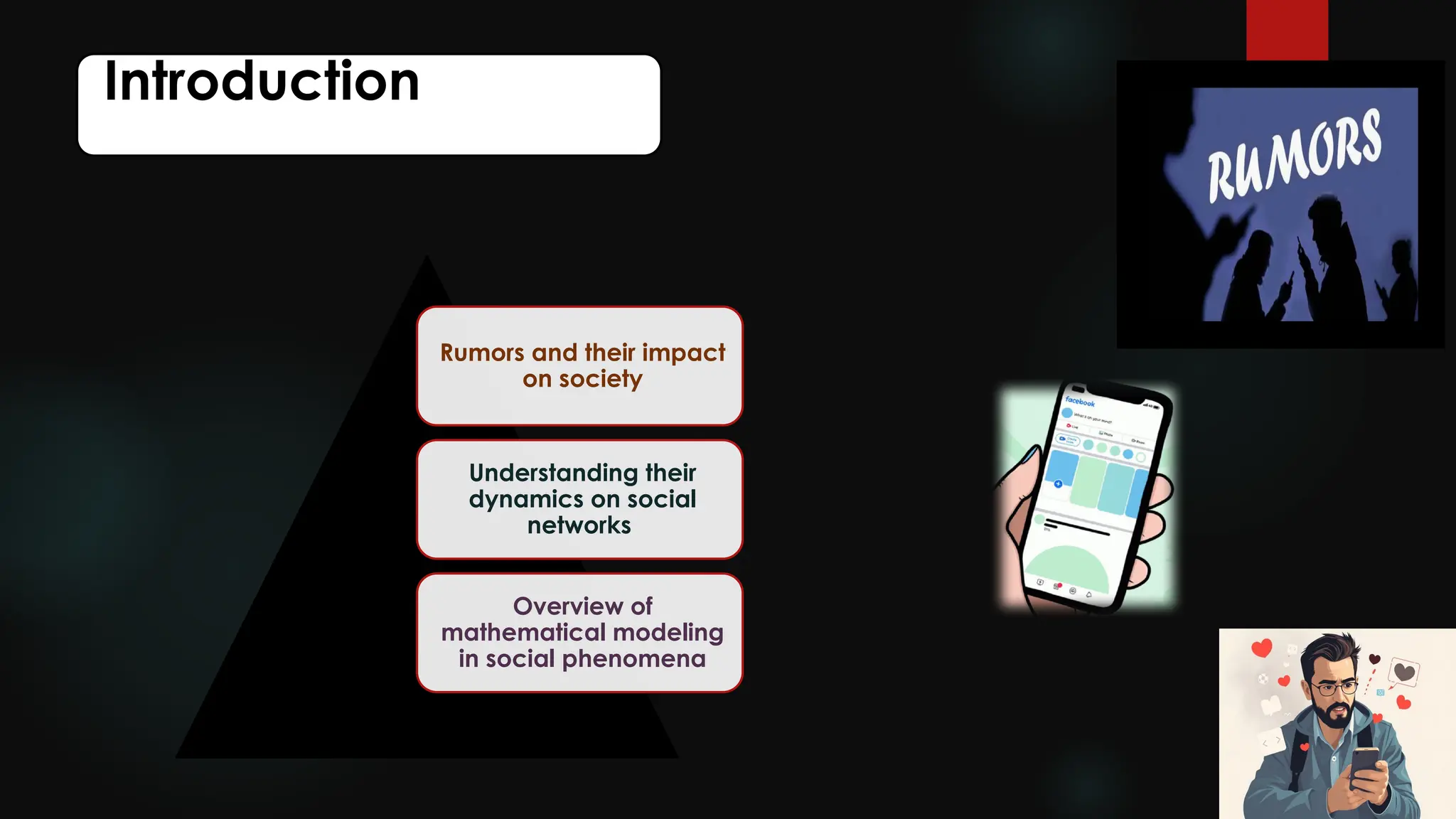
Rumors and their impact
on society
Understanding their
dynamics on social
networks
Overview of
mathematical modeling
in social phenomena
Objectives
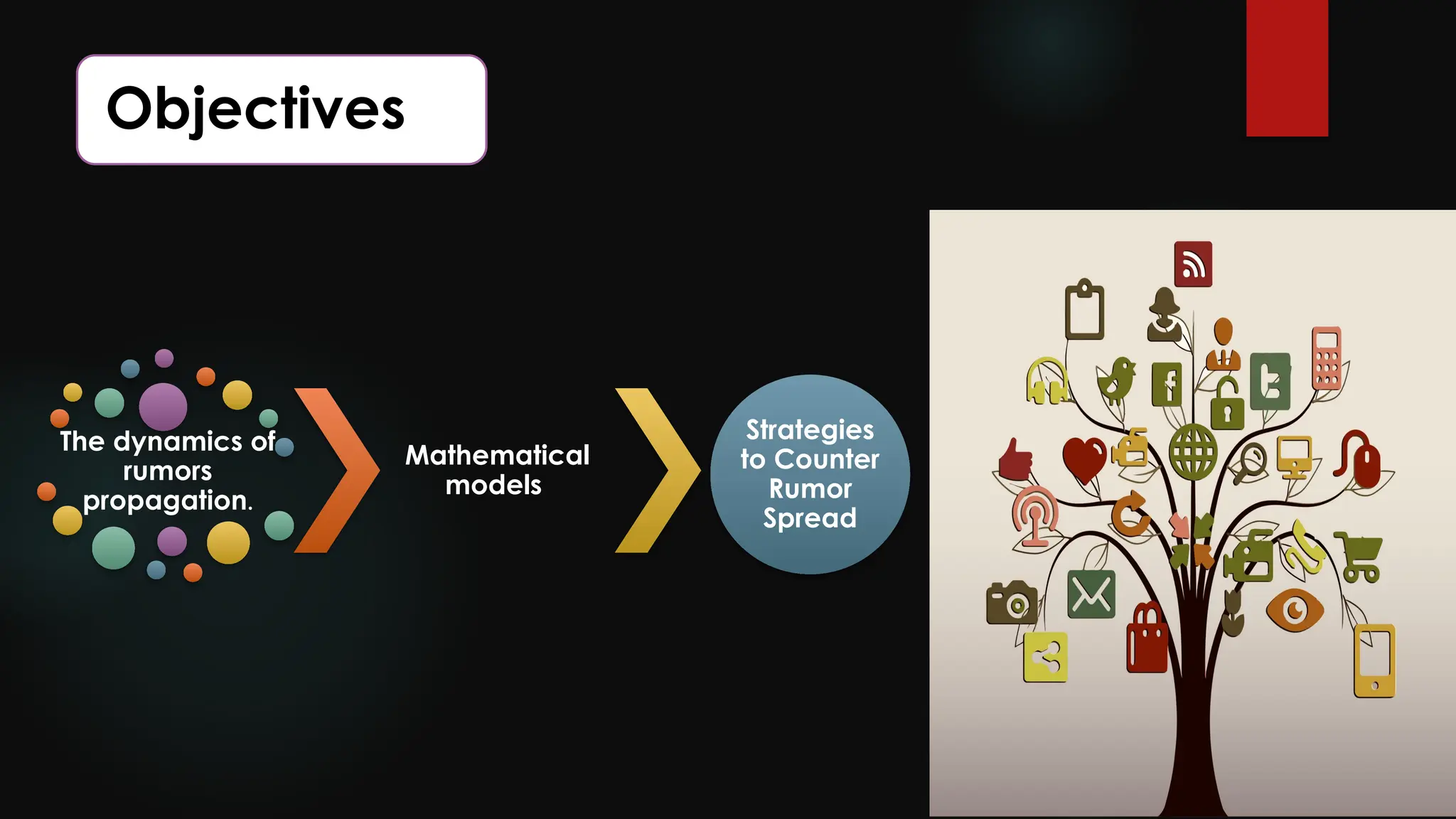
The dynamics of
rumors
propagation.
Mathematical
models
Strategies
to Counter
Rumor
Spread
Theoretical Background
Network Topology Scale-Free
Networks: Social
media graphs often
follow this structure,
where a few nodes
(influencers) have a
high degree, while
most have a low
degree.
Small-World
Networks: Social
networks exhibit
short average path
lengths and high
clustering, aiding
rapid rumor spread.
Centrality
Measures
Degree Centrality:
Identifies nodes with
the most direct
connections
Betweenness
Centrality: Measures
a node's importance
in connecting
different parts of the
network.
Closeness
Centrality:
Indicates how
quickly a node
can spread
information.
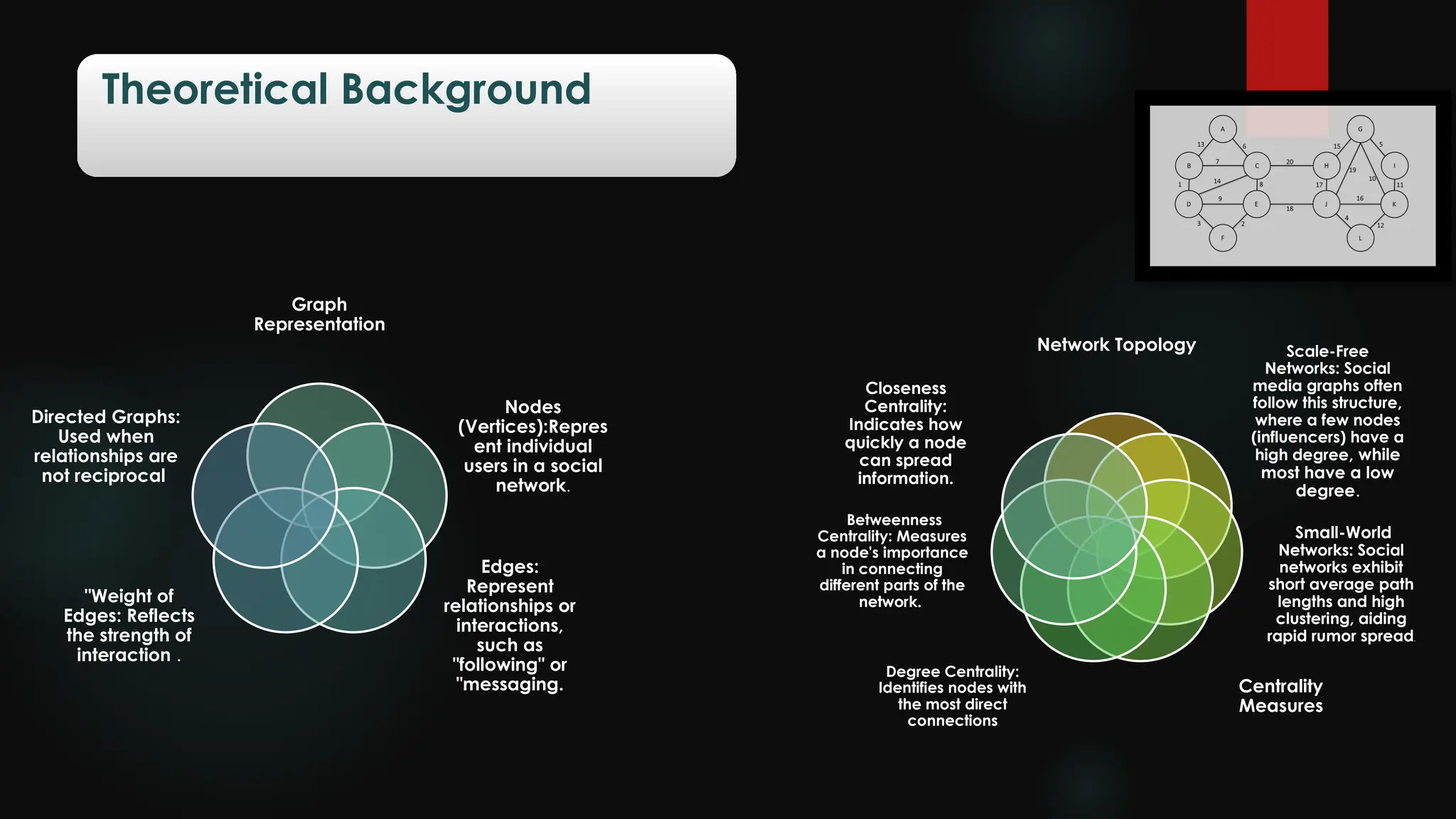
Graph
Representation
Nodes
(Vertices):Repres
ent individual
users in a social
network.
Edges:
Represent
relationships or
interactions,
such as
"following" or
"messaging.
"Weight of
Edges: Reflects
the strength of
interaction .
Directed Graphs:
Used when
relationships are
not reciprocal
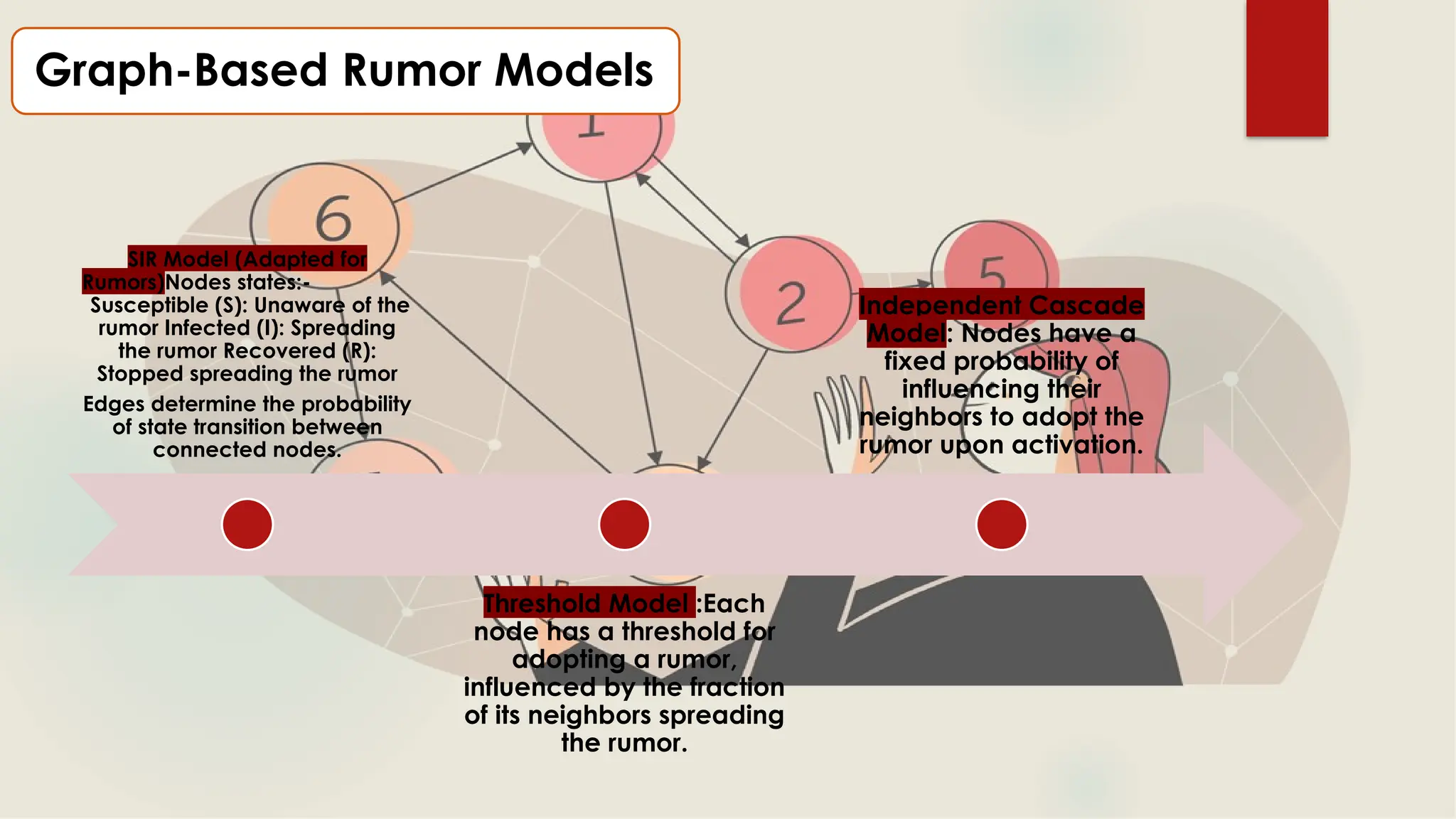
Graph-Based Rumor Models
SIR Model (Adapted for
Rumors)Nodes states:-
Susceptible (S): Unaware of the
rumor Infected (I): Spreading
the rumor Recovered (R):
Stopped spreading the rumor
Edges determine the probability
of state transition between
connected nodes.
Threshold Model :Each
node has a threshold for
adopting a rumor,
influenced by the fraction
of its neighbors spreading
the rumor.
Independent Cascade
Model: Nodes have a
fixed probability of
influencing their
neighbors to adopt the
rumor upon activation.
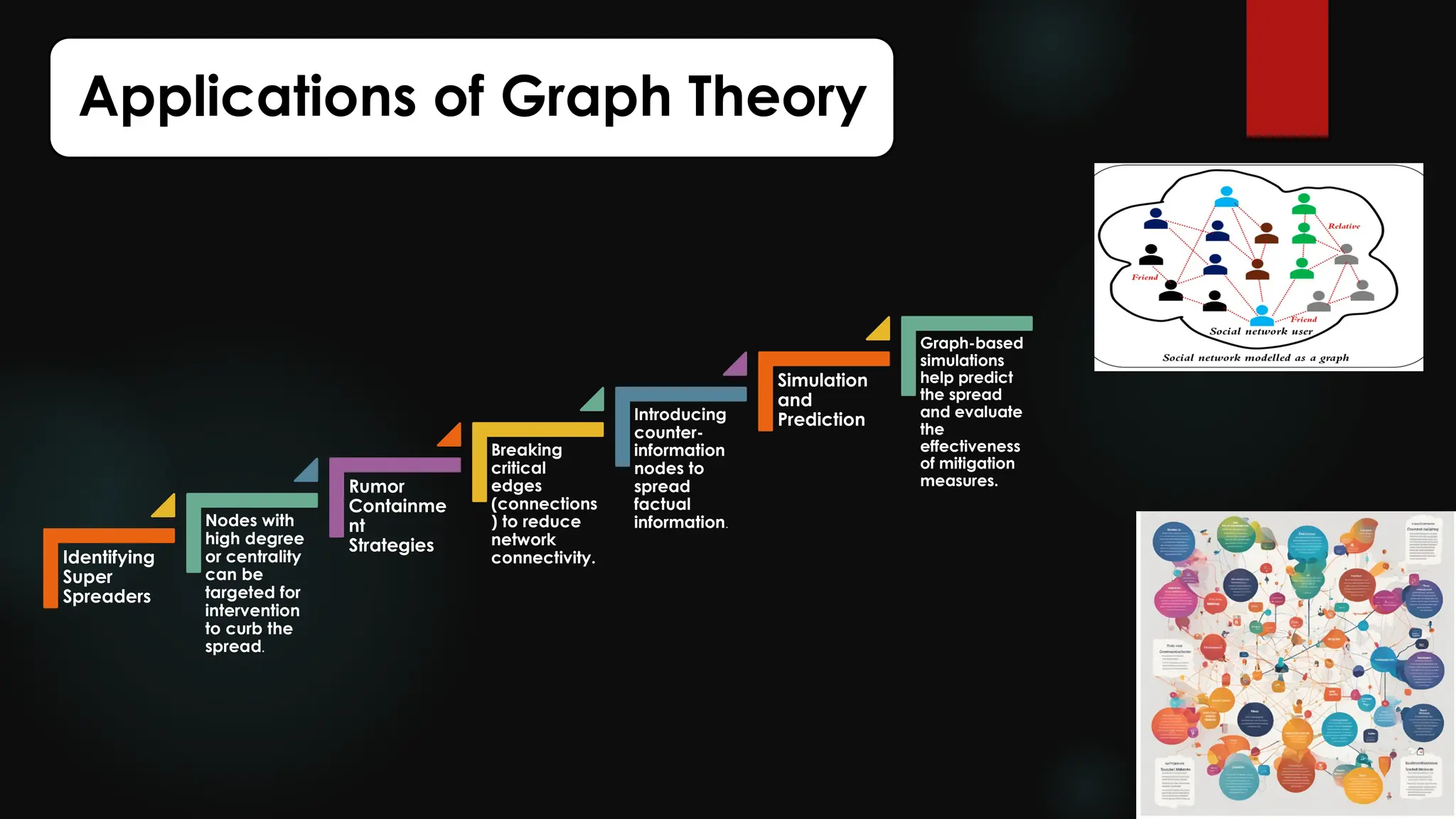
Applications of Graph Theory
Identifying
Super
Spreaders
Nodes with
high degree
or centrality
can be
targeted for
intervention
to curb the
spread.
Rumor
Containme
nt
Strategies
Breaking
critical
edges
(connections
) to reduce
network
connectivity.
Introducing
counter-
information
nodes to
spread
factual
information.
Simulation
and
Prediction
Graph-based
simulations
help predict
the spread
and evaluate
the
effectiveness
of mitigation
measures.
Strategies to Counter Rumor Spread
Identify Influential
Nodes
Containment of
Rumor Spread
Monitoring and Early
Detection
Optimized Counter-
Rumor Spread
Visualization and
Analysis
Challenges
and
Limitations
• Data-Related Challenges
• Algorithmic Limitations
• Evaluation and Feedback
• Behavioral and
Psychological Challenges
Using only graph algorithms to counter the
spread of rumors comes with several challenges
and limitations.
Conclusion
In this presentation, we studied how rumors
spread on social media using mathematical
models.We used equations to describe how information
flows between people and how it can influence others.The
results showed that rumors can spread quickly, but the
spread depends on factors like the number of people
involved, how strongly they believe the rumor, and how
they share information.
Thank you​
!

A mathematical approach to the spread of rumors o social media using graph algorithm theory

  • 1.
    A Mathematical Approachto the Spread of Rumors on Social Media: Using Graph Algorithm Theory • Sanjida Alam (232-15-898) • Sadia Islam Shanta ( 232-15-082 ) • Afia Anzum (232-15-385) • Lamia Tabassum (232-15-929) • Suraiya Anam Mouri (232-15-877) Presente d by group 3
  • 2.
    Table of content Introduction Objectives TheoreticalBackground Graph-Based Rumor Models Applications of Graph Theory Strategies to Counter Rumor Spread Challenges and Limitations Conclusion
  • 3.
    Introduction Rumors and theirimpact on society Understanding their dynamics on social networks Overview of mathematical modeling in social phenomena
  • 4.
  • 5.
    Theoretical Background Network TopologyScale-Free Networks: Social media graphs often follow this structure, where a few nodes (influencers) have a high degree, while most have a low degree. Small-World Networks: Social networks exhibit short average path lengths and high clustering, aiding rapid rumor spread. Centrality Measures Degree Centrality: Identifies nodes with the most direct connections Betweenness Centrality: Measures a node's importance in connecting different parts of the network. Closeness Centrality: Indicates how quickly a node can spread information. Graph Representation Nodes (Vertices):Repres ent individual users in a social network. Edges: Represent relationships or interactions, such as "following" or "messaging. "Weight of Edges: Reflects the strength of interaction . Directed Graphs: Used when relationships are not reciprocal
  • 6.
    Graph-Based Rumor Models SIRModel (Adapted for Rumors)Nodes states:- Susceptible (S): Unaware of the rumor Infected (I): Spreading the rumor Recovered (R): Stopped spreading the rumor Edges determine the probability of state transition between connected nodes. Threshold Model :Each node has a threshold for adopting a rumor, influenced by the fraction of its neighbors spreading the rumor. Independent Cascade Model: Nodes have a fixed probability of influencing their neighbors to adopt the rumor upon activation.
  • 7.
    Applications of GraphTheory Identifying Super Spreaders Nodes with high degree or centrality can be targeted for intervention to curb the spread. Rumor Containme nt Strategies Breaking critical edges (connections ) to reduce network connectivity. Introducing counter- information nodes to spread factual information. Simulation and Prediction Graph-based simulations help predict the spread and evaluate the effectiveness of mitigation measures.
  • 8.
    Strategies to CounterRumor Spread Identify Influential Nodes Containment of Rumor Spread Monitoring and Early Detection Optimized Counter- Rumor Spread Visualization and Analysis
  • 9.
    Challenges and Limitations • Data-Related Challenges •Algorithmic Limitations • Evaluation and Feedback • Behavioral and Psychological Challenges Using only graph algorithms to counter the spread of rumors comes with several challenges and limitations.
  • 10.
    Conclusion In this presentation,we studied how rumors spread on social media using mathematical models.We used equations to describe how information flows between people and how it can influence others.The results showed that rumors can spread quickly, but the spread depends on factors like the number of people involved, how strongly they believe the rumor, and how they share information.
  • 11.