




Camera2 API: Overview
Shift (Suhyun Park)
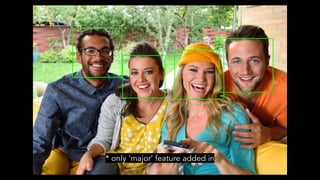
Android Camera API existed
since version 1.0 (API 1)
* only ‘major’ feature added in
Camera2 API (android.hardware.camera2)
- Introduced in Lollipop 5.0 (API 21) / Nov. 12, 2014: almost 4 years ago
- New devices can use both Camera2 API (android.hardware.camera2) and
deprecated Camera API (android.hardware.camera)
- To reduce confusion, we’ll call the deprecated one as ‘Camera1’
What Camera2 can do while Camera1 can’t
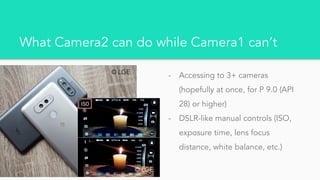
- Accessing to 3+ cameras
(hopefully at once, for P 9.0 (API
28) or higher)
- DSLR-like manual controls (ISO,
exposure time, lens focus
distance, white balance, etc.)
© LGE
© LGE
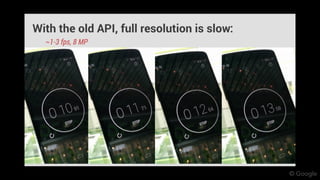
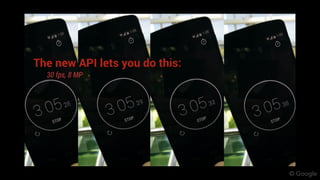
What Camera2 can do while Camera1 can’t
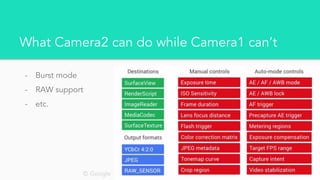
- Burst mode
- RAW support
- etc.
© Google
Example use of Camera2
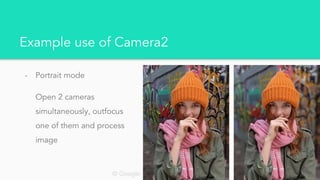
- Portrait mode
Open 2 cameras
simultaneously, outfocus
one of them and process
image
© Google
… but do they?
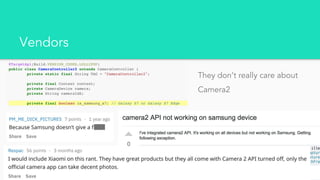
Vendors
They don’t really care about
Camera2
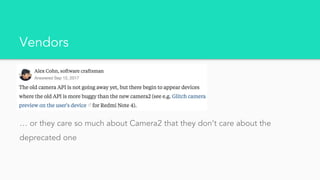
Vendors
… or they care so much about Camera2 that they don’t care about the
deprecated one
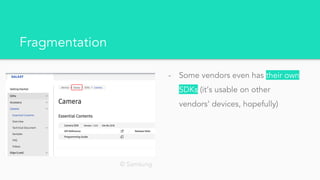
Fragmentation
- Some vendors even has their own
SDKs (it’s usable on other
vendors’ devices, hopefully)
© Samsung
So is it worth using?
- Camera1 is deprecated
- Camera2 has some serious professional features for a camera app, and it’s
generally way faster compared to Camera1 when implemented right
- API 21+ (>87%, as of July 2018) can benefit from it
- But we have to make 2 logics (for devices not fully supporting and/or
acting strange on Camera2)
Dealing with it
: Technical Aspect
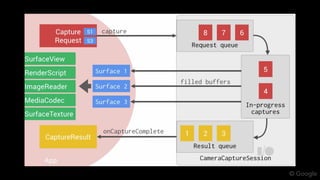
© Google
© Google
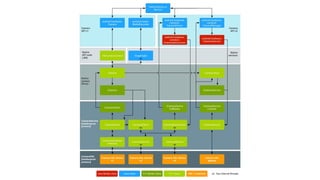
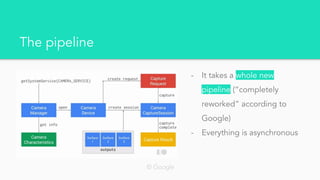
The pipeline
- It takes a whole new
pipeline (“completely
reworked” according to
Google)
- Everything is asynchronous
© Google
The pipeline
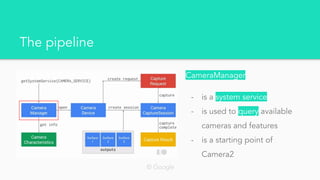
CameraManager
- is a system service
- is used to query available
cameras and features
- is a starting point of
Camera2
© Google
The pipeline
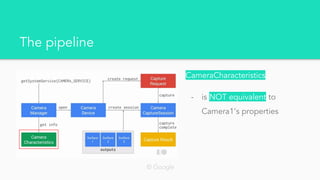
CameraCharacteristics
- is a map of the camera’s
characteristics
- Used like this:
characteristics[CameraChar
acteristics.LENS_FACING]
© Google
The pipeline
CameraCharacteristics
- is NOT equivalent to
Camera1’s properties
© Google
The pipeline
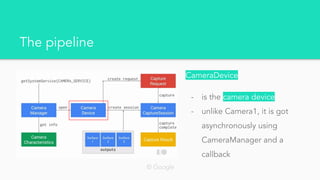
CameraDevice
- is the camera device
- unlike Camera1, it is got
asynchronously using
CameraManager and a
callback
© Google
The pipeline
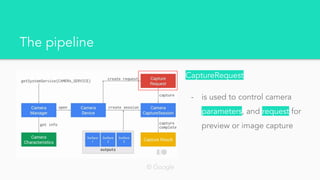
CaptureRequest
- is used to control camera
parameters, and request for
preview or image capture
© Google
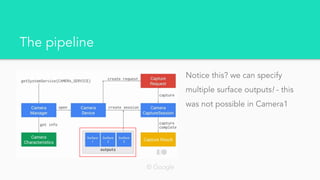
The pipeline
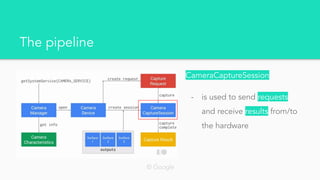
CameraCaptureSession
- is used to send requests
and receive results from/to
the hardware
© Google
© Google
The pipeline
Notice this? we can specify
multiple surface outputs! - this
was not possible in Camera1
© Google
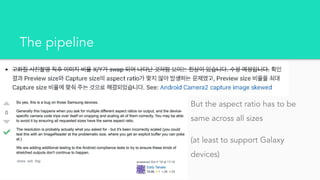
The pipeline
But the aspect ratio has to be
same across all sizes
(at least to support Galaxy
devices)
The pipeline
Example CaptureRequest for camera previewing
// Preview request is built with builder pattern
previewRequestBuilder = cameraDevice?.createCaptureRequest(CameraDevice.TEMPLATE_PREVIEW) ?: return
// We can set multiple targets, i.e. show multiple previews
previewRequestBuilder.addTarget(Surface(imageTexture))
// Setting camera preferences
previewRequestBuilder[CaptureRequest.CONTROL_AF_MODE] = CaptureRequest.CONTROL_AF_MODE_CONTINUOUS_PICTURE
previewRequestBuilder[CaptureRequest.FLASH_MODE] = CaptureRequest.FLASH_MODE_OFF
previewRequest = previewRequestBuilder.build()
// Sending a PreviewRequest to current camera session
// The session will handle given PreviewRequest appropriately
captureSession?.setRepeatingRequest(previewRequest, captureCallback, backgroundHandler)
The pipeline
Notice the backgroundHandler?
the API manages all the background stuff for us
// Preview request is built with builder pattern
previewRequestBuilder = cameraDevice?.createCaptureRequest(CameraDevice.TEMPLATE_PREVIEW) ?: return
// We can set multiple targets, i.e. show multiple previews
previewRequestBuilder.addTarget(Surface(imageTexture))
// Setting camera preferences
previewRequestBuilder[CaptureRequest.CONTROL_AF_MODE] = CaptureRequest.CONTROL_AF_MODE_CONTINUOUS_PICTURE
previewRequestBuilder[CaptureRequest.FLASH_MODE] = CaptureRequest.FLASH_MODE_OFF
previewRequest = previewRequestBuilder.build()
// Sending a PreviewRequest to current camera session
// The session will handle given PreviewRequest appropriately
captureSession?.setRepeatingRequest(previewRequest, captureCallback, backgroundHandler)
Find the Difference
: Differences Between Camera1 and 2
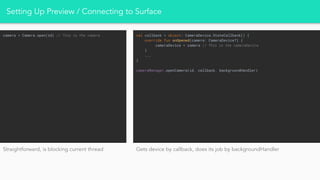
Setting Up Preview / Connecting to Surface
camera = Camera.open(id) // This is the camera val callback = object: CameraDevice.StateCallback() {
override fun onOpened(camera: CameraDevice?) {
cameraDevice = camera // This is the cameraDevice
}
...
}
cameraManager.openCamera(id, callback, backgroundHandler)
Straightforward, is blocking current thread Gets device by callback, does its job by backgroundHandler
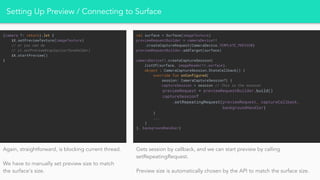
Setting Up Preview / Connecting to Surface
(camera ?: return).let {
it.setPreviewTexture(imageTexture)
// or you can do
// it.setPreviewDisplay(surfaceHolder)
it.startPreview()
}
val surface = Surface(imageTexture)
previewRequestBuilder = cameraDevice!!
.createCaptureRequest(CameraDevice.TEMPLATE_PREVIEW)
previewRequestBuilder.addTarget(surface)
cameraDevice!!.createCaptureSession(
listOf(surface, imageReader!!.surface),
object : CameraCaptureSession.StateCallback() {
override fun onConfigured(
session: CameraCaptureSession?) {
captureSession = session // This is the session
previewRequest = previewRequestBuilder.build()
captureSession?
.setRepeatingRequest(previewRequest, captureCallback,
backgroundHandler)
}
...
}
}, backgroundHandler)
Again, straightforward, is blocking current thread.
We have to manually set preview size to match
the surface’s size.
Gets session by callback, and we can start preview by calling
setRepeatingRequest.
Preview size is automatically chosen by the API to match the surface size.
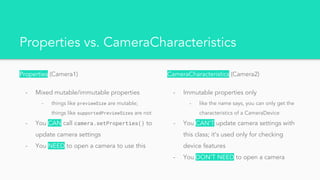
Properties vs. CameraCharacteristics
Properties (Camera1)
- Mixed mutable/immutable properties
- things like previewSize are mutable;
things like supportedPreviewSizes are not
- You CAN call camera.setProperties() to
update camera settings
- You NEED to open a camera to use this
CameraCharacteristics (Camera2)
- Immutable properties only
- like the name says, you can only get the
characteristics of a CameraDevice
- You CAN’T update camera settings with
this class; it’s used only for checking
device features
- You DON’T NEED to open a camera
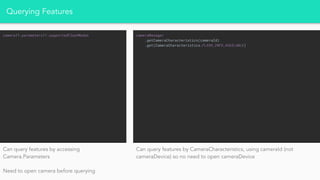
Querying Features
camera!!.parameters!!.supportedFlashModes cameraManager
.getCameraCharacteristics(cameraId)
.get(CameraCharacteristics.FLASH_INFO_AVAILABLE)
Can query features by accessing
Camera.Parameters
Need to open camera before querying
Can query features by CameraCharacteristics, using cameraId (not
cameraDevice) so no need to open cameraDevice
Setting Parameters
camera!!.parameters = camera!!.parameters.apply {
flashMode = Camera.Parameters.FLASH_MODE_ON
zoom = 125 // Sets zoom to x1.25, if supported
}
previewRequestBuilder[CaptureRequest.LENS_FOCUS_DISTANCE] = 9.50f
previewRequestBuilder[CaptureRequest.SENSOR_EXPOSURE_TIME] = 1000000000L / 30
previewRequest = previewRequestBuilder.build()
captureSession?.stopRepeating()
captureSession?.setRepeatingRequest(previewRequest, captureCallback,
backgroundHandler)
Sets parameters directly
When given unsupported values, it’ll throw an
error
Sets parameters by builder pattern
When given unsupported values, it’ll try its best to fit into supported values,
by rounding or clamping, etc
Setting Parameters
camera!!.parameters = camera!!.parameters.apply {
flashMode = Camera.Parameters.FLASH_MODE_ON
zoom = 125 // Sets zoom to x1.25, if supported
}
private fun <T> setPreviewOptions(
vararg options: Pair<CaptureRequest.Key<in T>, T>,
postProcess: () -> Unit = {}) {
for (option in options) {
previewRequestBuilder[option.first] = option.second
}
postProcess()
previewRequest = previewRequestBuilder.build()
captureSession?.stopRepeating()
captureSession?.setRepeatingRequest(
previewRequest, captureCallback, backgroundHandler)
}
...
setPreivewOptions(
CaptureRequest.LENS_FOCUS_DISTANCE to 9.50f,
CaptureRequest.SENSOR_EXPOSURE_TIME to 1000000000L / 30
)
Sets parameters directly
When given unsupported values, it’ll throw an
error
We can make an extension function to simplify this
Setting Parameters
camera!!.parameters = camera!!.parameters.apply {
flashMode = Camera.Parameters.FLASH_MODE_ON
zoom = 125 // Sets zoom to x1.25, if supported
}
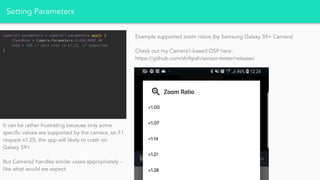
It can be rather frustrating because only some
specific values are supported by the camera, so if I
request x1.25, the app will likely to crash on
Galaxy S9+
But Camera2 handles similar cases appropriately -
like what would we expect
Example supported zoom ratios (by Samsung Galaxy S9+ Camera)
Check out my Camera1-based OSP here :
https://github.com/shiftpsh/sensor-tester/releases
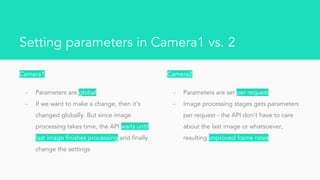
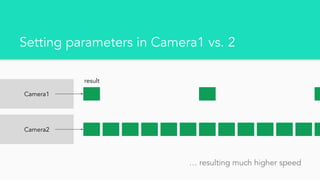
Setting parameters in Camera1 vs. 2
Camera1
- Parameters are global
- If we want to make a change, then it’s
changed globally. But since image
processing takes time, the API waits until
last image finishes processing and finally
change the settings
Camera2
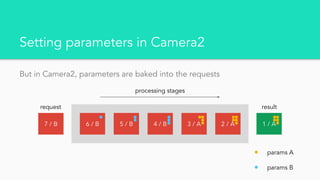
- Parameters are set per request
- Image processing stages gets parameters
per request - the API don’t have to care
about the last image or whatsoever,
resulting improved frame rates
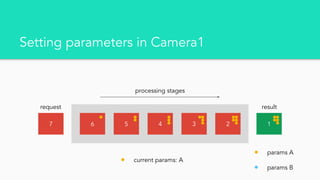
Setting parameters in Camera1
1234567
processing stages
request
params A
params B
current params: A
result
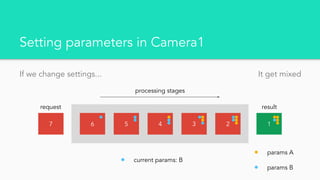
Setting parameters in Camera1
1234567
processing stages
request
params A
params B
If we change settings... It get mixed
current params: B
result
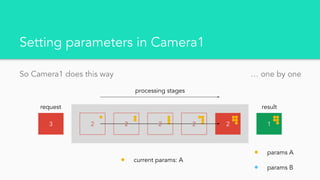
Setting parameters in Camera1
1222223
processing stages
request
params A
params B
current params: A
So Camera1 does this way … one by one
result
Setting parameters in Camera2
1 / A2 / A3 / A4 / B5 / B6 / B7 / B
processing stages
request
params A
params B
But in Camera2, parameters are baked into the requests
result
Setting parameters in Camera1 vs. 2
Camera1
Camera2
result
… resulting much higher speed
© Google
© Google
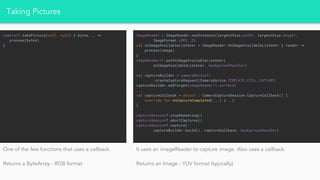
Taking Pictures
camera!!.takePicture(null, null) { bytes, _ ->
process(bytes)
}
imageReader = ImageReader.newInstance(largestSize.width, largestSize.height,
ImageFormat.JPEG, 2)
val onImageAvailableListener = ImageReader.OnImageAvailableListener { reader ->
process(image)
}
imageReader!!.setOnImageAvailableListener(
onImageAvailableListener, backgroundHandler)
val captureBuilder = cameraDevice!!
.createCaptureRequest(CameraDevice.TEMPLATE_STILL_CAPTURE)
captureBuilder.addTarget(imageReader!!.surface)
...
val captureCallback = object : CameraCaptureSession.CaptureCallback() {
override fun onCaptureCompleted(...) {...}
}
captureSession?.stopRepeating()
captureSession?.abortCaptures()
captureSession?.capture(
captureBuilder.build(), captureCallback, backgroundHandler)
One of the few functions that uses a callback.
Returns a ByteArray - RGB format
It uses an imageReader to capture image. Also uses a callback.
Returns an Image - YUV format (typically)
Implementing it in existing apps
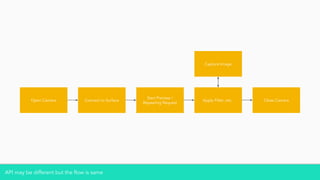
API may be different but the flow is same
Open Camera Connect to Surface
Start Preview /
Repeating Request
Apply Filter, etc..
Capture Image
Close Camera
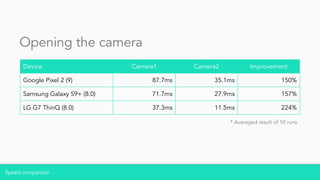
Speed comparison
Device Camera1 Camera2 Improvement
Google Pixel 2 (9) 87.7ms 35.1ms 150%
Samsung Galaxy S9+ (8.0) 71.7ms 27.9ms 157%
LG G7 ThinQ (8.0) 37.3ms 11.5ms 224%
Opening the camera
* Averaged result of 10 runs
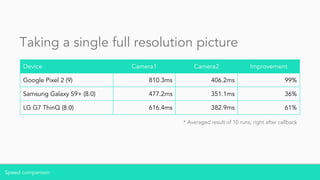
Speed comparison
Device Camera1 Camera2 Improvement
Google Pixel 2 (9) 810.3ms 406.2ms 99%
Samsung Galaxy S9+ (8.0) 477.2ms 351.1ms 36%
LG G7 ThinQ (8.0) 616.4ms 382.9ms 61%
Taking a single full resolution picture
* Averaged result of 10 runs, right after callback
Migration Strategy
- Not all devices work well with Camera2, even if its API level ≥ 21
- It’s up to vendors - if they wrote good enough HAL(hardware abstraction
layer) for Camera2 then it’ll work well, otherwise not
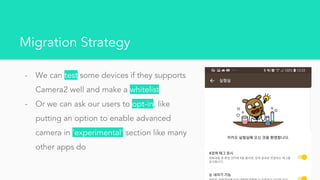
Migration Strategy
- We can test some devices if they supports
Camera2 well and make a whitelist
- Or we can ask our users to opt-in, like
putting an option to enable advanced
camera in ‘experimental’ section like many
other apps do
Q&A

Camera2 API: Overview

  • 1.
  • 2.
    Android Camera APIexisted since version 1.0 (API 1)
  • 4.
    * only ‘major’feature added in
  • 5.
    Camera2 API (android.hardware.camera2) -Introduced in Lollipop 5.0 (API 21) / Nov. 12, 2014: almost 4 years ago - New devices can use both Camera2 API (android.hardware.camera2) and deprecated Camera API (android.hardware.camera) - To reduce confusion, we’ll call the deprecated one as ‘Camera1’
  • 6.
    What Camera2 cando while Camera1 can’t - Accessing to 3+ cameras (hopefully at once, for P 9.0 (API 28) or higher) - DSLR-like manual controls (ISO, exposure time, lens focus distance, white balance, etc.) © LGE © LGE
  • 8.
    What Camera2 cando while Camera1 can’t - Burst mode - RAW support - etc. © Google
  • 9.
    Example use ofCamera2 - Portrait mode Open 2 cameras simultaneously, outfocus one of them and process image © Google
  • 10.
  • 11.
    Vendors They don’t reallycare about Camera2
  • 12.
    Vendors … or theycare so much about Camera2 that they don’t care about the deprecated one
  • 13.
    Fragmentation - Some vendorseven has their own SDKs (it’s usable on other vendors’ devices, hopefully) © Samsung
  • 15.
    So is itworth using? - Camera1 is deprecated - Camera2 has some serious professional features for a camera app, and it’s generally way faster compared to Camera1 when implemented right - API 21+ (>87%, as of July 2018) can benefit from it - But we have to make 2 logics (for devices not fully supporting and/or acting strange on Camera2)
  • 16.
    Dealing with it :Technical Aspect
  • 17.
  • 18.
  • 19.
    The pipeline - Ittakes a whole new pipeline (“completely reworked” according to Google) - Everything is asynchronous © Google
  • 20.
    The pipeline CameraManager - isa system service - is used to query available cameras and features - is a starting point of Camera2 © Google
  • 21.
    The pipeline CameraCharacteristics - isa map of the camera’s characteristics - Used like this: characteristics[CameraChar acteristics.LENS_FACING] © Google
  • 22.
    The pipeline CameraCharacteristics - isNOT equivalent to Camera1’s properties © Google
  • 23.
    The pipeline CameraDevice - isthe camera device - unlike Camera1, it is got asynchronously using CameraManager and a callback © Google
  • 24.
    The pipeline CaptureRequest - isused to control camera parameters, and request for preview or image capture © Google
  • 25.
    The pipeline CameraCaptureSession - isused to send requests and receive results from/to the hardware © Google
  • 26.
  • 27.
    The pipeline Notice this?we can specify multiple surface outputs! - this was not possible in Camera1 © Google
  • 28.
    The pipeline But theaspect ratio has to be same across all sizes (at least to support Galaxy devices)
  • 29.
    The pipeline Example CaptureRequestfor camera previewing // Preview request is built with builder pattern previewRequestBuilder = cameraDevice?.createCaptureRequest(CameraDevice.TEMPLATE_PREVIEW) ?: return // We can set multiple targets, i.e. show multiple previews previewRequestBuilder.addTarget(Surface(imageTexture)) // Setting camera preferences previewRequestBuilder[CaptureRequest.CONTROL_AF_MODE] = CaptureRequest.CONTROL_AF_MODE_CONTINUOUS_PICTURE previewRequestBuilder[CaptureRequest.FLASH_MODE] = CaptureRequest.FLASH_MODE_OFF previewRequest = previewRequestBuilder.build() // Sending a PreviewRequest to current camera session // The session will handle given PreviewRequest appropriately captureSession?.setRepeatingRequest(previewRequest, captureCallback, backgroundHandler)
  • 30.
    The pipeline Notice thebackgroundHandler? the API manages all the background stuff for us // Preview request is built with builder pattern previewRequestBuilder = cameraDevice?.createCaptureRequest(CameraDevice.TEMPLATE_PREVIEW) ?: return // We can set multiple targets, i.e. show multiple previews previewRequestBuilder.addTarget(Surface(imageTexture)) // Setting camera preferences previewRequestBuilder[CaptureRequest.CONTROL_AF_MODE] = CaptureRequest.CONTROL_AF_MODE_CONTINUOUS_PICTURE previewRequestBuilder[CaptureRequest.FLASH_MODE] = CaptureRequest.FLASH_MODE_OFF previewRequest = previewRequestBuilder.build() // Sending a PreviewRequest to current camera session // The session will handle given PreviewRequest appropriately captureSession?.setRepeatingRequest(previewRequest, captureCallback, backgroundHandler)
  • 31.
    Find the Difference :Differences Between Camera1 and 2
  • 32.
    Setting Up Preview/ Connecting to Surface camera = Camera.open(id) // This is the camera val callback = object: CameraDevice.StateCallback() { override fun onOpened(camera: CameraDevice?) { cameraDevice = camera // This is the cameraDevice } ... } cameraManager.openCamera(id, callback, backgroundHandler) Straightforward, is blocking current thread Gets device by callback, does its job by backgroundHandler
  • 33.
    Setting Up Preview/ Connecting to Surface (camera ?: return).let { it.setPreviewTexture(imageTexture) // or you can do // it.setPreviewDisplay(surfaceHolder) it.startPreview() } val surface = Surface(imageTexture) previewRequestBuilder = cameraDevice!! .createCaptureRequest(CameraDevice.TEMPLATE_PREVIEW) previewRequestBuilder.addTarget(surface) cameraDevice!!.createCaptureSession( listOf(surface, imageReader!!.surface), object : CameraCaptureSession.StateCallback() { override fun onConfigured( session: CameraCaptureSession?) { captureSession = session // This is the session previewRequest = previewRequestBuilder.build() captureSession? .setRepeatingRequest(previewRequest, captureCallback, backgroundHandler) } ... } }, backgroundHandler) Again, straightforward, is blocking current thread. We have to manually set preview size to match the surface’s size. Gets session by callback, and we can start preview by calling setRepeatingRequest. Preview size is automatically chosen by the API to match the surface size.
  • 34.
    Properties vs. CameraCharacteristics Properties(Camera1) - Mixed mutable/immutable properties - things like previewSize are mutable; things like supportedPreviewSizes are not - You CAN call camera.setProperties() to update camera settings - You NEED to open a camera to use this CameraCharacteristics (Camera2) - Immutable properties only - like the name says, you can only get the characteristics of a CameraDevice - You CAN’T update camera settings with this class; it’s used only for checking device features - You DON’T NEED to open a camera
  • 35.
    Querying Features camera!!.parameters!!.supportedFlashModes cameraManager .getCameraCharacteristics(cameraId) .get(CameraCharacteristics.FLASH_INFO_AVAILABLE) Canquery features by accessing Camera.Parameters Need to open camera before querying Can query features by CameraCharacteristics, using cameraId (not cameraDevice) so no need to open cameraDevice
  • 36.
    Setting Parameters camera!!.parameters =camera!!.parameters.apply { flashMode = Camera.Parameters.FLASH_MODE_ON zoom = 125 // Sets zoom to x1.25, if supported } previewRequestBuilder[CaptureRequest.LENS_FOCUS_DISTANCE] = 9.50f previewRequestBuilder[CaptureRequest.SENSOR_EXPOSURE_TIME] = 1000000000L / 30 previewRequest = previewRequestBuilder.build() captureSession?.stopRepeating() captureSession?.setRepeatingRequest(previewRequest, captureCallback, backgroundHandler) Sets parameters directly When given unsupported values, it’ll throw an error Sets parameters by builder pattern When given unsupported values, it’ll try its best to fit into supported values, by rounding or clamping, etc
  • 37.
    Setting Parameters camera!!.parameters =camera!!.parameters.apply { flashMode = Camera.Parameters.FLASH_MODE_ON zoom = 125 // Sets zoom to x1.25, if supported } private fun <T> setPreviewOptions( vararg options: Pair<CaptureRequest.Key<in T>, T>, postProcess: () -> Unit = {}) { for (option in options) { previewRequestBuilder[option.first] = option.second } postProcess() previewRequest = previewRequestBuilder.build() captureSession?.stopRepeating() captureSession?.setRepeatingRequest( previewRequest, captureCallback, backgroundHandler) } ... setPreivewOptions( CaptureRequest.LENS_FOCUS_DISTANCE to 9.50f, CaptureRequest.SENSOR_EXPOSURE_TIME to 1000000000L / 30 ) Sets parameters directly When given unsupported values, it’ll throw an error We can make an extension function to simplify this
  • 38.
    Setting Parameters camera!!.parameters =camera!!.parameters.apply { flashMode = Camera.Parameters.FLASH_MODE_ON zoom = 125 // Sets zoom to x1.25, if supported } It can be rather frustrating because only some specific values are supported by the camera, so if I request x1.25, the app will likely to crash on Galaxy S9+ But Camera2 handles similar cases appropriately - like what would we expect Example supported zoom ratios (by Samsung Galaxy S9+ Camera) Check out my Camera1-based OSP here : https://github.com/shiftpsh/sensor-tester/releases
  • 39.
    Setting parameters inCamera1 vs. 2 Camera1 - Parameters are global - If we want to make a change, then it’s changed globally. But since image processing takes time, the API waits until last image finishes processing and finally change the settings Camera2 - Parameters are set per request - Image processing stages gets parameters per request - the API don’t have to care about the last image or whatsoever, resulting improved frame rates
  • 40.
    Setting parameters inCamera1 1234567 processing stages request params A params B current params: A result
  • 41.
    Setting parameters inCamera1 1234567 processing stages request params A params B If we change settings... It get mixed current params: B result
  • 42.
    Setting parameters inCamera1 1222223 processing stages request params A params B current params: A So Camera1 does this way … one by one result
  • 43.
    Setting parameters inCamera2 1 / A2 / A3 / A4 / B5 / B6 / B7 / B processing stages request params A params B But in Camera2, parameters are baked into the requests result
  • 44.
    Setting parameters inCamera1 vs. 2 Camera1 Camera2 result … resulting much higher speed
  • 45.
  • 46.
  • 47.
    Taking Pictures camera!!.takePicture(null, null){ bytes, _ -> process(bytes) } imageReader = ImageReader.newInstance(largestSize.width, largestSize.height, ImageFormat.JPEG, 2) val onImageAvailableListener = ImageReader.OnImageAvailableListener { reader -> process(image) } imageReader!!.setOnImageAvailableListener( onImageAvailableListener, backgroundHandler) val captureBuilder = cameraDevice!! .createCaptureRequest(CameraDevice.TEMPLATE_STILL_CAPTURE) captureBuilder.addTarget(imageReader!!.surface) ... val captureCallback = object : CameraCaptureSession.CaptureCallback() { override fun onCaptureCompleted(...) {...} } captureSession?.stopRepeating() captureSession?.abortCaptures() captureSession?.capture( captureBuilder.build(), captureCallback, backgroundHandler) One of the few functions that uses a callback. Returns a ByteArray - RGB format It uses an imageReader to capture image. Also uses a callback. Returns an Image - YUV format (typically)
  • 48.
    Implementing it inexisting apps
  • 49.
    API may bedifferent but the flow is same Open Camera Connect to Surface Start Preview / Repeating Request Apply Filter, etc.. Capture Image Close Camera
  • 50.
    Speed comparison Device Camera1Camera2 Improvement Google Pixel 2 (9) 87.7ms 35.1ms 150% Samsung Galaxy S9+ (8.0) 71.7ms 27.9ms 157% LG G7 ThinQ (8.0) 37.3ms 11.5ms 224% Opening the camera * Averaged result of 10 runs
  • 51.
    Speed comparison Device Camera1Camera2 Improvement Google Pixel 2 (9) 810.3ms 406.2ms 99% Samsung Galaxy S9+ (8.0) 477.2ms 351.1ms 36% LG G7 ThinQ (8.0) 616.4ms 382.9ms 61% Taking a single full resolution picture * Averaged result of 10 runs, right after callback
  • 52.
    Migration Strategy - Notall devices work well with Camera2, even if its API level ≥ 21 - It’s up to vendors - if they wrote good enough HAL(hardware abstraction layer) for Camera2 then it’ll work well, otherwise not
  • 53.
    Migration Strategy - Wecan test some devices if they supports Camera2 well and make a whitelist - Or we can ask our users to opt-in, like putting an option to enable advanced camera in ‘experimental’ section like many other apps do
  • 54.