Nuclear Physics
Efendi Y., S.Si
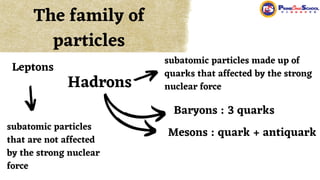
The family of
particles
Hadrons
Leptons
subatomic particles
that are not affected
by the strong nuclear
force
subatomic particles made up of
quarks that affected by the strong
nuclear force
Baryons : 3 quarks
Mesons : quark + antiquark
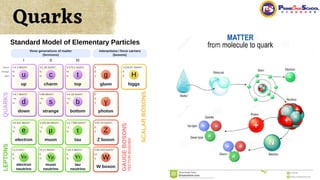
Quarks
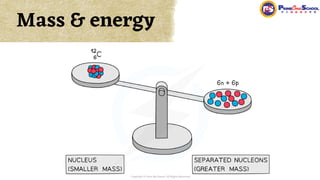
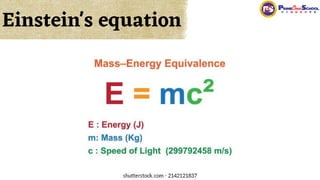
Mass & energy
Einstein's equation
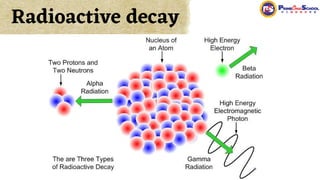
Radioactive decay
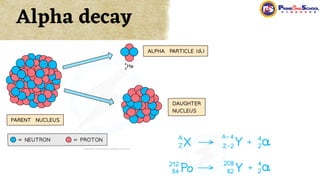
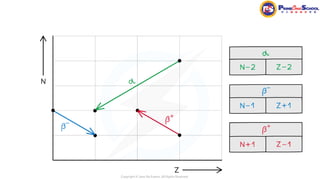
Alpha decay
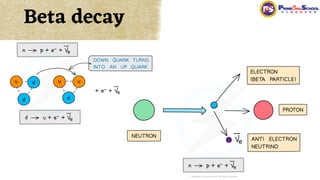
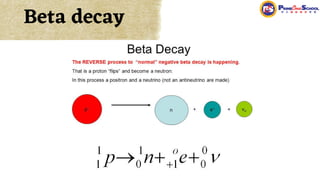
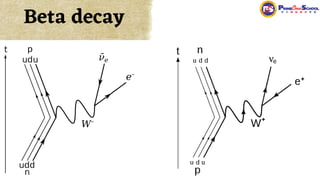
Beta decay
Beta decay
Beta decay
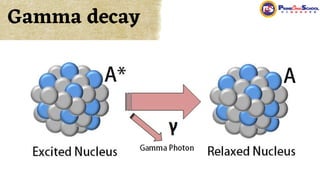
Gamma decay
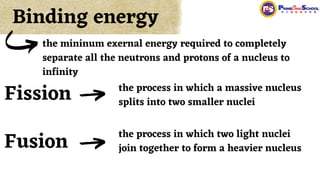
the process in which a massive nucleus
splits into two smaller nuclei
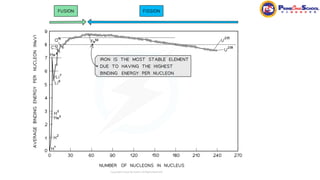
Binding energy
the mininum exernal energy required to completely
separate all the neutrons and protons of a nucleus to
infinity
Fission
Fusion
the process in which two light nuclei
join together to form a heavier nucleus
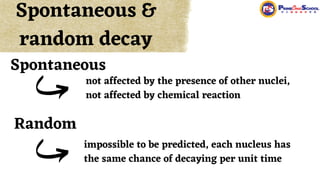
not affected by the presence of other nuclei,
not affected by chemical reaction
Spontaneous &
random decay
Spontaneous
Random
impossible to be predicted, each nucleus has
the same chance of decaying per unit time
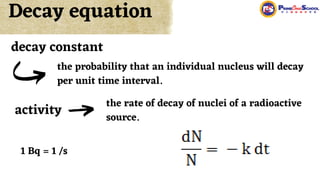
Decay equation
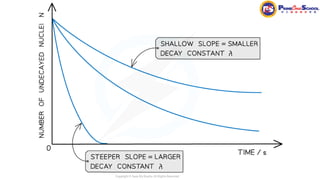
decay constant
the probability that an individual nucleus will decay
per unit time interval.
activity
the rate of decay of nuclei of a radioactive
source.
1 Bq = 1 /s
Good Luck for MID
SA2

A Level Physics (A2 Level) Nuclear Physics