JESUS SAID IAM THE WAY THE TRUTH THE LIFE
NUCLEI
PREPARED BY
T.RAMESH
PGT –PHYSICS
JAWAHAR NAVODAYA
VIDYALAYA
ONGOLE – PRAKASAM -1
ANDHRA PRADESH
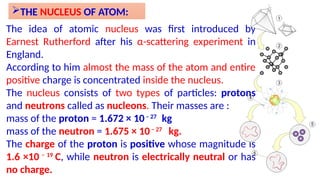
THE NUCLEUS OF ATOM:
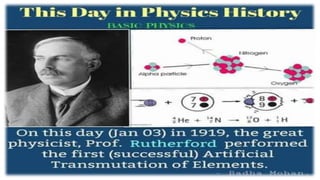
The idea of atomic nucleus was first introduced by
Earnest Rutherford after his α-scattering experiment in
England.
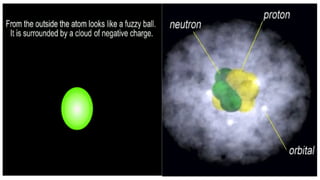
According to him almost the mass of the atom and entire
positive charge is concentrated inside the nucleus.
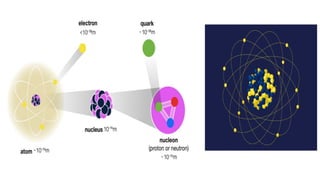
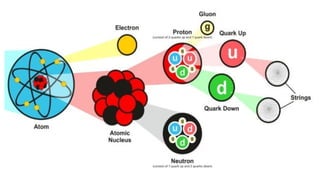
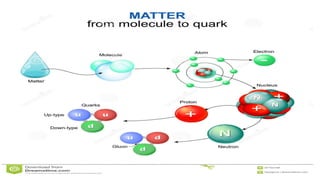
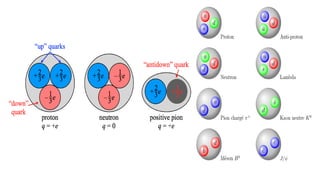
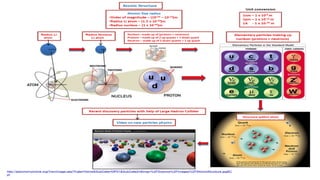
The nucleus consists of two types of particles: protons
and neutrons called as nucleons. Their masses are :
mass of the proton = 1.672 × 10– 27
kg
mass of the neutron = 1.675 × 10– 27
kg.
The charge of the proton is positive whose magnitude is
1.6 ×10 – 19
C, while neutron is electrically neutral or has
no charge.
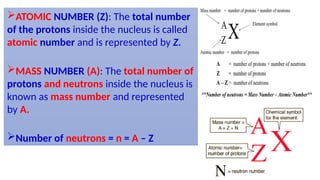
ATOMIC NUMBER (Z): The total number
of the protons inside the nucleus is called
atomic number and is represented by Z.
MASS NUMBER (A): The total number of
protons and neutrons inside the nucleus is
known as mass number and represented
by A.
Number of neutrons = n = A – Z
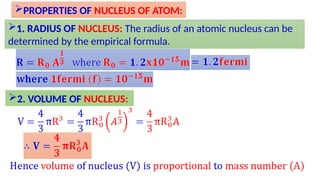
PROPERTIES OF NUCLEUS OF ATOM:
1. RADIUS OF NUCLEUS: The radius of an atomic nucleus can be
determined by the empirical formula.
2. VOLUME OF NUCLEUS:
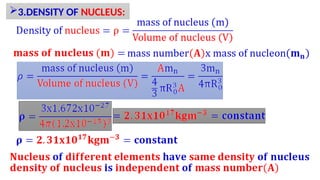
3.DENSITY OF NUCLEUS:
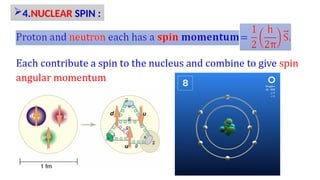
4.NUCLEAR SPIN :
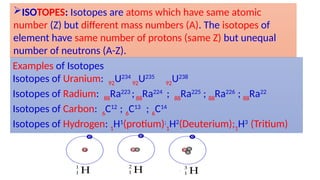
ISOTOPES: Isotopes are atoms which have same atomic
number (Z) but different mass numbers (A). The isotopes of
element have same number of protons (same Z) but unequal
number of neutrons (A-Z).
Examples of Isotopes
Isotopes of Uranium: 92
U234
92
U235
92
U238
Isotopes of Radium: 88
Ra223
;88
Ra224
; 88
Ra225
; 88
Ra226
; 88
Ra22
Isotopes of Carbon: 6
C12
; 6
C13
; 6
C14
Isotopes of Hydrogen: 1
H1
(protium);
1
H2
(Deuterium);1
H3
(Tritium)
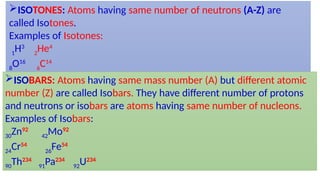
ISOTONES: Atoms having same number of neutrons (A-Z) are
called Isotones.
Examples of Isotones:
1
H3
2
He4
8
O16
6
C14
ISOBARS: Atoms having same mass number (A) but different atomic
number (Z) are called Isobars. They have different number of protons
and neutrons or isobars are atoms having same number of nucleons.
Examples of Isobars:
30
Zn92
42
Mo92
24
Cr54
26
Fe54
90
Th234
91
Pa234
92
U234
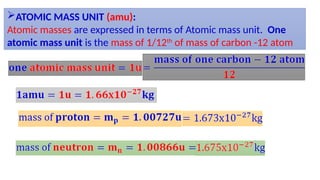
ATOMIC MASS UNIT (amu):
Atomic masses are expressed in terms of Atomic mass unit. One
atomic mass unit is the mass of 1/12th
of mass of carbon -12 atom
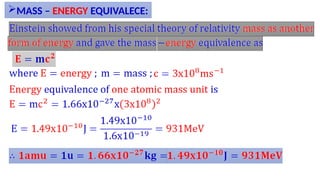
MASS – ENERGY EQUIVALECE:
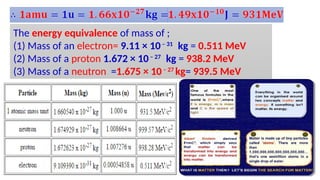
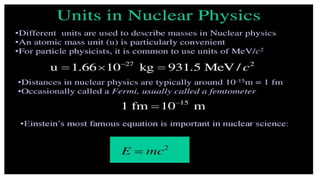
The energy equivalence of mass of ;
(1) Mass of an electron= 9.11 × 10– 31
kg = 0.511 MeV
(2) Mass of a proton 1.672 × 10– 27
kg = 938.2 MeV
(3) Mass of a neutron =1.675 × 10– 27
kg= 939.5 MeV
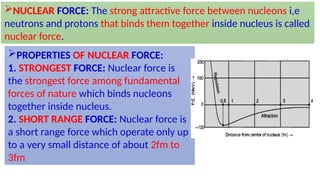
NUCLEAR FORCE: The strong attractive force between nucleons i,e
neutrons and protons that binds them together inside nucleus is called
nuclear force.
PROPERTIES OF NUCLEAR FORCE:
1. STRONGEST FORCE: Nuclear force is
the strongest force among fundamental
forces of nature which binds nucleons
together inside nucleus.
2. SHORT RANGE FORCE: Nuclear force is
a short range force which operate only up
to a very small distance of about 2fm to
3fm
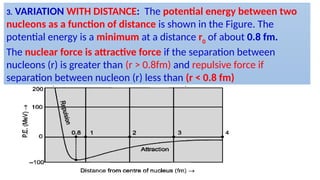
3. VARIATION WITH DISTANCE: The potential energy between two
nucleons as a function of distance is shown in the Figure. The
potential energy is a minimum at a distance r0
of about 0.8 fm.
The nuclear force is attractive force if the separation between
nucleons (r) is greater than (r > 0.8fm) and repulsive force if
separation between nucleon (r) less than (r < 0.8 fm)
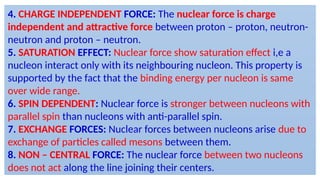
4. CHARGE INDEPENDENT FORCE: The nuclear force is charge
independent and attractive force between proton – proton, neutron-
neutron and proton – neutron.
5. SATURATION EFFECT: Nuclear force show saturation effect i,e a
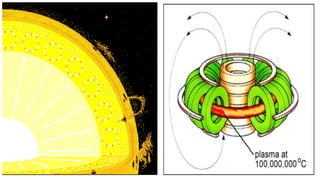
nucleon interact only with its neighbouring nucleon. This property is
supported by the fact that the binding energy per nucleon is same
over wide range.
6. SPIN DEPENDENT: Nuclear force is stronger between nucleons with
parallel spin than nucleons with anti-parallel spin.
7. EXCHANGE FORCES: Nuclear forces between nucleons arise due to
exchange of particles called mesons between them.
8. NON – CENTRAL FORCE: The nuclear force between two nucleons
does not act along the line joining their centers.
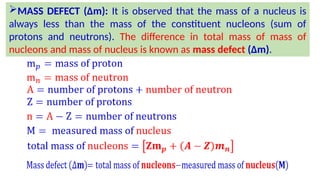
MASS DEFECT (∆m): It is observed that the mass of a nucleus is
always less than the mass of the constituent nucleons (sum of
protons and neutrons). The difference in total mass of mass of
nucleons and mass of nucleus is known as mass defect (∆m).
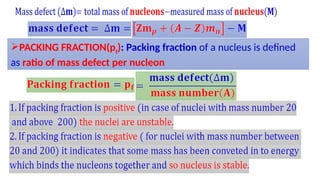
PACKING FRACTION(pf
): Packing fraction of a nucleus is defined
as ratio of mass defect per nucleon
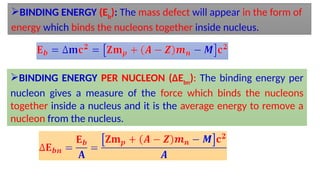
BINDING ENERGY (Eb
): The mass defect will appear in the form of
energy which binds the nucleons together inside nucleus.
BINDING ENERGY PER NUCLEON (∆Ebn
): The binding energy per
nucleon gives a measure of the force which binds the nucleons
together inside a nucleus and it is the average energy to remove a
nucleon from the nucleus.
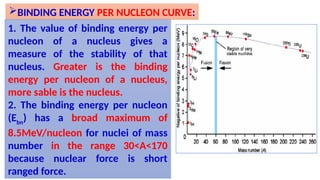
BINDING ENERGY PER NUCLEON CURVE:
1. The value of binding energy per
nucleon of a nucleus gives a
measure of the stability of that
nucleus. Greater is the binding
energy per nucleon of a nucleus,
more sable is the nucleus.
2. The binding energy per nucleon
(Ebn
) has a broad maximum of
8.5MeV/nucleon for nuclei of mass
number in the range 30<A<170
because nuclear force is short
ranged force.
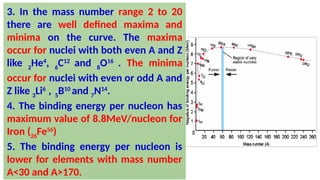
3. In the mass number range 2 to 20
there are well defined maxima and
minima on the curve. The maxima
occur for nuclei with both even A and Z
like 2
He4
, 6
C12
and 8
O16
. The minima
occur for nuclei with even or odd A and
Z like 3
Li6
, 5
B10
and 7
N14
.
4. The binding energy per nucleon has
maximum value of 8.8MeV/nucleon for
Iron (26
Fe56
)
5. The binding energy per nucleon is
lower for elements with mass number
A<30 and A>170.
6. SATURATION PROPERTY OF NUCLEAR FORCE: If a nucleon can
have a maximum of p neighbours within the range of nuclear force,
its binding energy would be proportional to p. Let the binding
energy of the nucleus be pk, where k is a constant having the
dimensions of energy. If we increase A by adding nucleons they will
not change the binding energy of a nucleon inside. Since most of
the nucleons in a large nucleus reside inside it and not on the
surface, the change in binding energy per nucleon would be small.
The binding energy per nucleon is a constant and is approximately
equal to pk. The property that a given nucleon influences only
nucleons close to it is also referred to as saturation property of the
nuclear force.
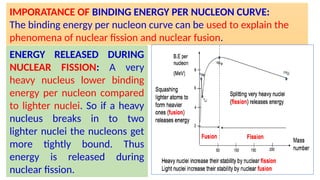
IMPORATANCE OF BINDING ENERGY PER NUCLEON CURVE:
The binding energy per nucleon curve can be used to explain the
phenomena of nuclear fission and nuclear fusion.
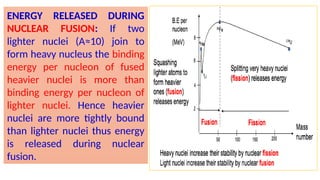
ENERGY RELEASED DURING
NUCLEAR FISSION: A very
heavy nucleus lower binding
energy per nucleon compared
to lighter nuclei. So if a heavy
nucleus breaks in to two
lighter nuclei the nucleons get
more tightly bound. Thus
energy is released during
nuclear fission.
ENERGY RELEASED DURING
NUCLEAR FUSION: If two
lighter nuclei (A≈10) join to
form heavy nucleus the binding
energy per nucleon of fused
heavier nuclei is more than
binding energy per nucleon of
lighter nuclei. Hence heavier
nuclei are more tightly bound
than lighter nuclei thus energy
is released during nuclear
fusion.
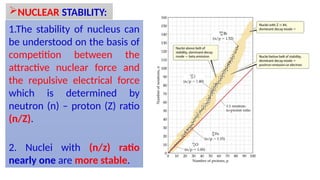
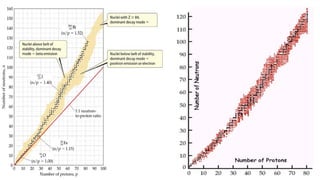
NUCLEAR STABILITY:
1.The stability of nucleus can
be understood on the basis of
competition between the
attractive nuclear force and
the repulsive electrical force
which is determined by
neutron (n) – proton (Z) ratio
(n/Z).
2. Nuclei with (n/z) ratio
nearly one are more stable.
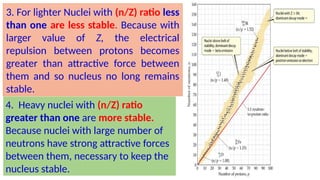
3. For lighter Nuclei with (n/Z) ratio less
than one are less stable. Because with
larger value of Z, the electrical
repulsion between protons becomes
greater than attractive force between
them and so nucleus no long remains
stable.
4. Heavy nuclei with (n/Z) ratio
greater than one are more stable.
Because nuclei with large number of
neutrons have strong attractive forces
between them, necessary to keep the
nucleus stable.
RADIOACTIVITY:
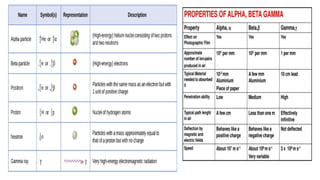
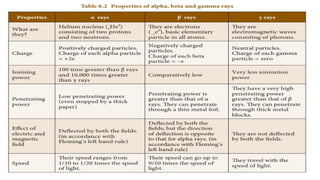
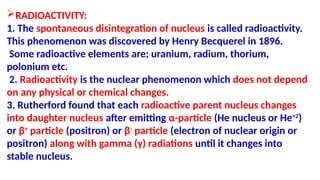
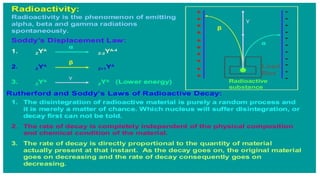
1. The spontaneous disintegration of nucleus is called radioactivity.
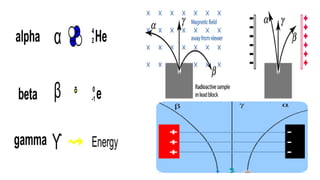
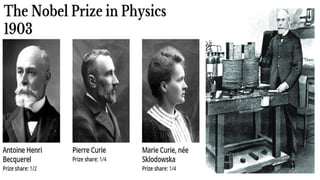
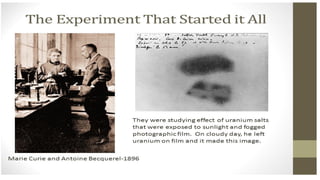
This phenomenon was discovered by Henry Becquerel in 1896.
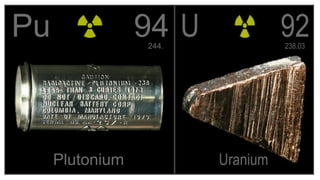
Some radioactive elements are; uranium, radium, thorium,
polonium etc.
2. Radioactivity is the nuclear phenomenon which does not depend
on any physical or chemical changes.
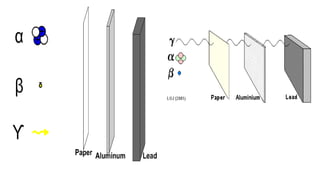
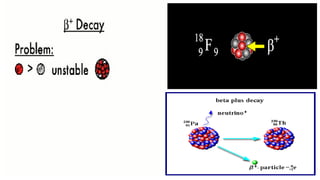
3. Rutherford found that each radioactive parent nucleus changes
into daughter nucleus after emitting α-particle (He nucleus or He+2
)
or β+
particle (positron) or β-
particle (electron of nuclear origin or
positron) along with gamma (γ) radiations until it changes into
stable nucleus.
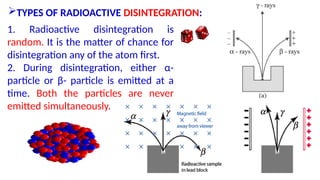
TYPES OF RADIOACTIVE DISINTEGRATION:
1. Radioactive disintegration is
random. It is the matter of chance for
disintegration any of the atom first.
2. During disintegration, either α-
particle or β- particle is emitted at a
time. Both the particles are never
emitted simultaneously.
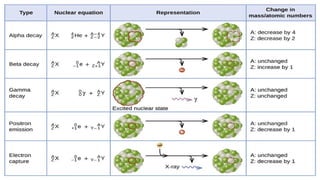
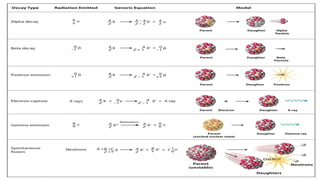
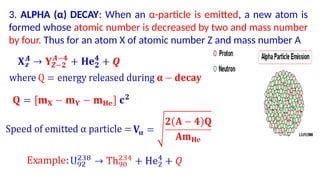
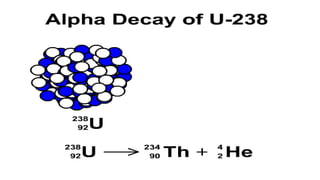
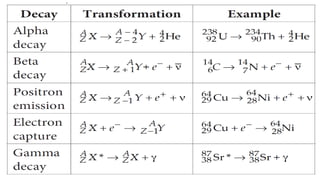
3. ALPHA (α) DECAY: When an α-particle is emitted, a new atom is
formed whose atomic number is decreased by two and mass number
by four. Thus for an atom X of atomic number Z and mass number A
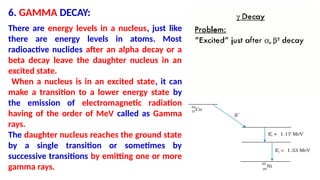
6. GAMMA DECAY:
There are energy levels in a nucleus, just like
there are energy levels in atoms. Most
radioactive nuclides after an alpha decay or a
beta decay leave the daughter nucleus in an
excited state.
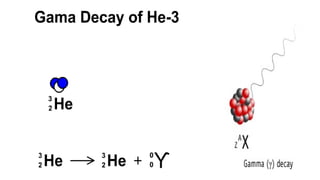
When a nucleus is in an excited state, it can
make a transition to a lower energy state by
the emission of electromagnetic radiation
having of the order of MeV called as Gamma
rays.
The daughter nucleus reaches the ground state
by a single transition or sometimes by
successive transitions by emitting one or more
gamma rays.
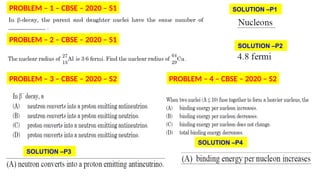
PROBLEM – 1 – CBSE – 2020 – S1 SOLUTION –P1
PROBLEM – 2 – CBSE – 2020 – S1
PROBLEM – 3 – CBSE – 2020 – S2
SOLUTION –P2
SOLUTION –P3
PROBLEM – 4 – CBSE – 2020 – S2
SOLUTION –P4
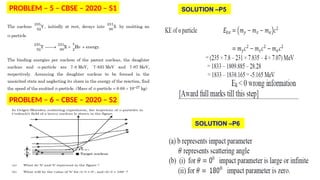
PROBLEM – 5 – CBSE – 2020 – S1 SOLUTION –P5
PROBLEM – 6 – CBSE – 2020 – S2
SOLUTION –P6
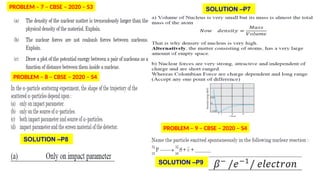
PROBLEM – 7 – CBSE – 2020 – S3 SOLUTION –P7
PROBLEM – 8 – CBSE – 2020 – S4
PROBLEM – 9 – CBSE – 2020 – S4
SOLUTION –P8
SOLUTION –P9
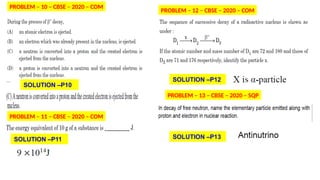
PROBLEM – 10 – CBSE – 2020 – COM
SOLUTION –P10
PROBLEM – 11 – CBSE – 2020 – COM
PROBLEM – 12 – CBSE – 2020 – COM
SOLUTION –P11
PROBLEM – 13 – CBSE – 2020 – SQP
SOLUTION –P13
SOLUTION –P12
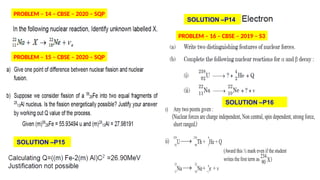
PROBLEM – 14 – CBSE – 2020 – SQP
PROBLEM – 15 – CBSE – 2020 – SQP
SOLUTION –P14
SOLUTION –P15
PROBLEM – 16 – CBSE – 2019 – S3
SOLUTION –P16
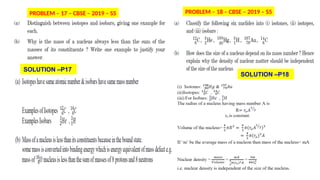
PROBLEM – 17 – CBSE – 2019 – S5 PROBLEM – 18 – CBSE – 2019 – S5
SOLUTION –P17
SOLUTION –P18
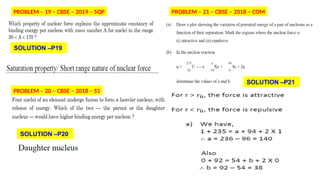
PROBLEM – 19 – CBSE – 2019 – SQP
PROBLEM – 20 – CBSE – 2018 – S1
PROBLEM – 21 – CBSE – 2018 – COM
SOLUTION –P20
SOLUTION –P19
SOLUTION –P21
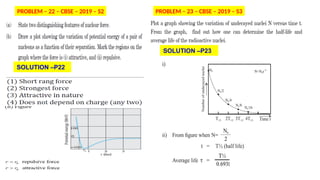
PROBLEM – 22 – CBSE – 2019 – S2 PROBLEM – 23 – CBSE – 2019 – S3
SOLUTION –P22
SOLUTION –P23
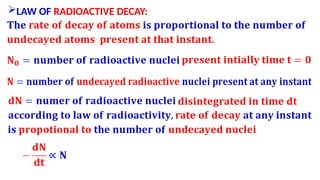
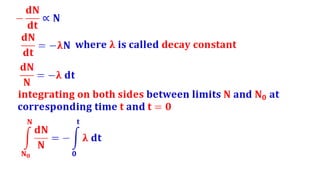
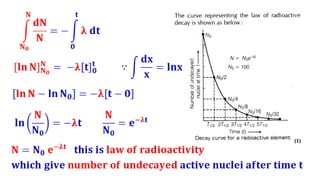
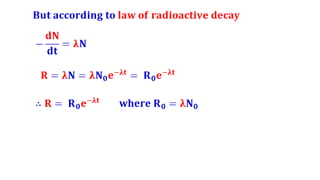
LAW OF RADIOACTIVE DECAY:
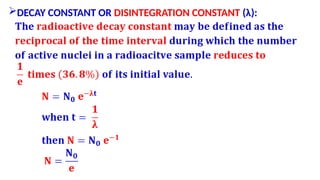
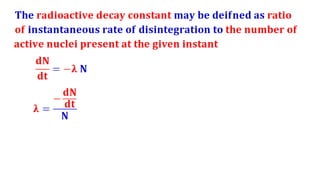
DECAY CONSTANT OR DISINTEGRATION CONSTANT (λ):
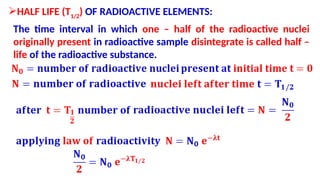
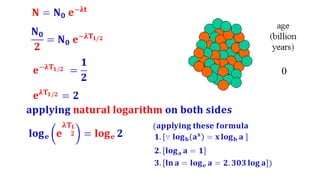
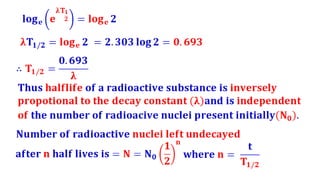
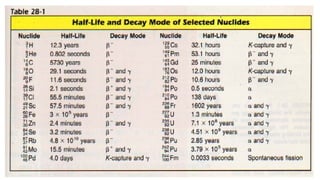
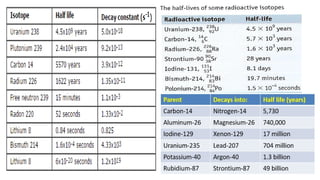
HALF LIFE (T1/2
) OF RADIOACTIVE ELEMENTS:
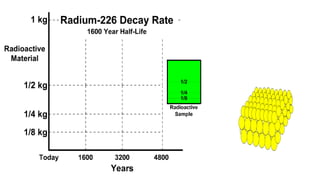
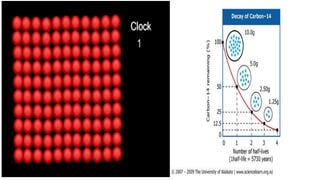
The time interval in which one – half of the radioactive nuclei
originally present in radioactive sample disintegrate is called half –
life of the radioactive substance.
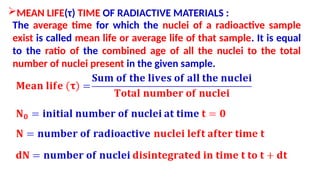
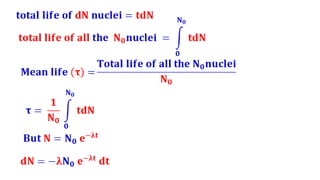
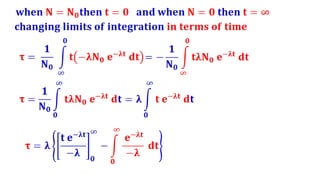
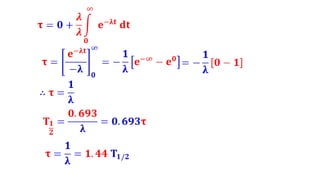
MEAN LIFE(τ) TIME OF RADIACTIVE MATERIALS :
The average time for which the nuclei of a radioactive sample
exist is called mean life or average life of that sample. It is equal
to the ratio of the combined age of all the nuclei to the total
number of nuclei present in the given sample.
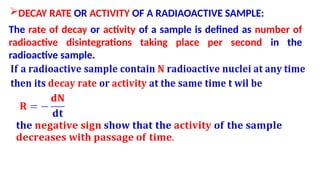
DECAY RATE OR ACTIVITY OF A RADIAOACTIVE SAMPLE:
The rate of decay or activity of a sample is defined as number of
radioactive disintegrations taking place per second in the
radioactive sample.
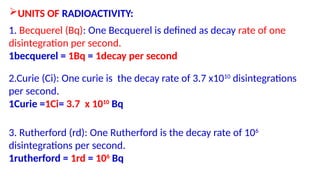
UNITS OF RADIOACTIVITY:
1. Becquerel (Bq): One Becquerel is defined as decay rate of one
disintegration per second.
1becquerel = 1Bq = 1decay per second
2.Curie (Ci): One curie is the decay rate of 3.7 x10¹⁰
disintegrations
per second.
1Curie =1Ci= 3.7 x 10¹⁰
Bq
3. Rutherford (rd): One Rutherford is the decay rate of 106
disintegrations per second.
1rutherford = 1rd = 106
Bq
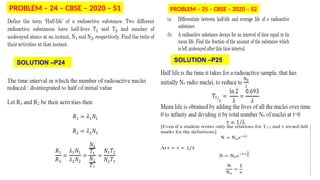
PROBLEM – 24 – CBSE – 2020 – S1
SOLUTION –P24
PROBLEM – 25 – CBSE – 2020 – S2
SOLUTION –P25
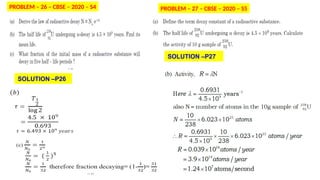
PROBLEM – 26 – CBSE – 2020 – S4
SOLUTION –P26
PROBLEM – 27 – CBSE – 2020 – S5
SOLUTION –P27
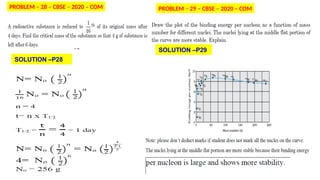
PROBLEM – 28 – CBSE – 2020 – COM PROBLEM – 29 – CBSE – 2020 – COM
SOLUTION –P28
SOLUTION –P29
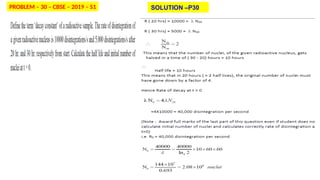
PROBLEM – 30 – CBSE – 2019 – S1 SOLUTION –P30
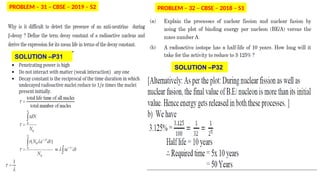
PROBLEM – 31 – CBSE – 2019 – S2
SOLUTION –P31
PROBLEM – 32 – CBSE – 2018 – S1
SOLUTION –P32
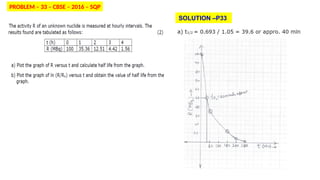
PROBLEM – 33 – CBSE – 2016 – SQP
SOLUTION –P33
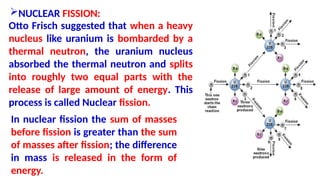
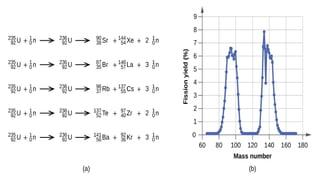
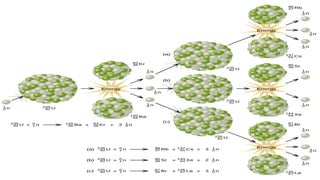
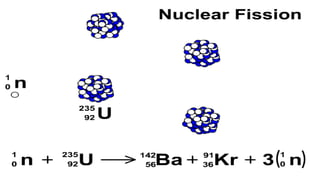
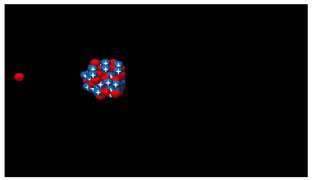
NUCLEAR FISSION:
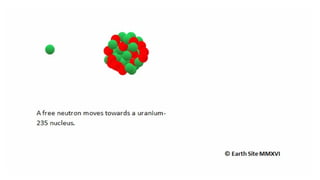
Otto Frisch suggested that when a heavy
nucleus like uranium is bombarded by a
thermal neutron, the uranium nucleus
absorbed the thermal neutron and splits
into roughly two equal parts with the
release of large amount of energy. This
process is called Nuclear fission.
In nuclear fission the sum of masses
before fission is greater than the sum
of masses after fission; the difference
in mass is released in the form of
energy.
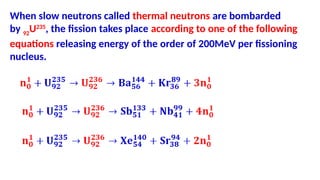
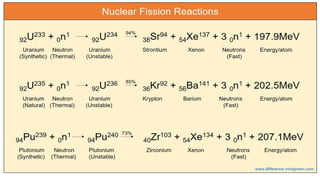
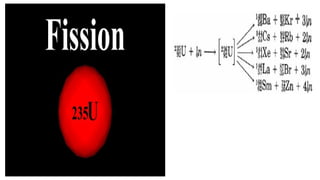
When slow neutrons called thermal neutrons are bombarded
by 92
U235
, the fission takes place according to one of the following
equations releasing energy of the order of 200MeV per fissioning
nucleus.
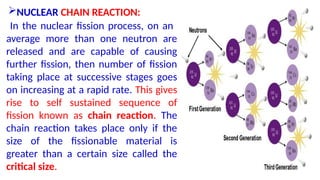
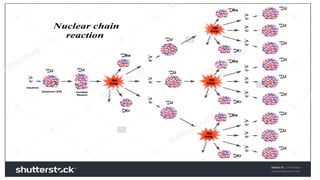
NUCLEAR CHAIN REACTION:
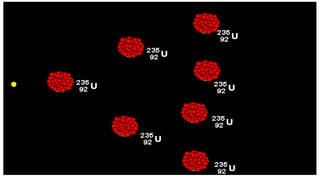
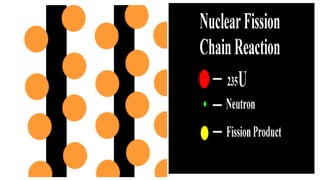
In the nuclear fission process, on an
average more than one neutron are
released and are capable of causing
further fission, then number of fission
taking place at successive stages goes
on increasing at a rapid rate. This gives
rise to self sustained sequence of
fission known as chain reaction. The
chain reaction takes place only if the
size of the fissionable material is
greater than a certain size called the
critical size.
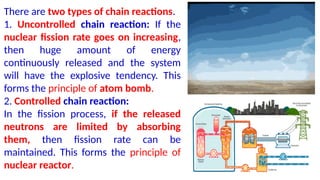
There are two types of chain reactions.
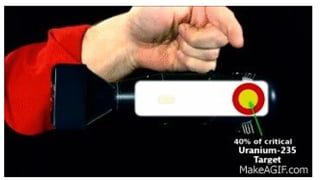
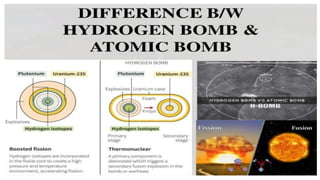
1. Uncontrolled chain reaction: If the
nuclear fission rate goes on increasing,
then huge amount of energy
continuously released and the system
will have the explosive tendency. This
forms the principle of atom bomb.
2. Controlled chain reaction:
In the fission process, if the released
neutrons are limited by absorbing
them, then fission rate can be
maintained. This forms the principle of
nuclear reactor.
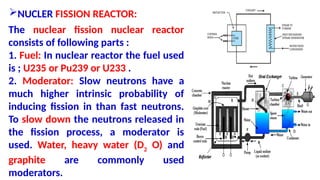
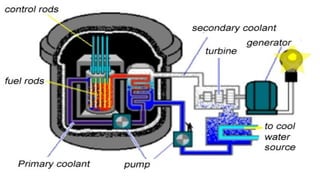
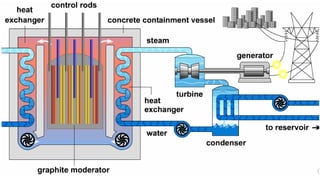
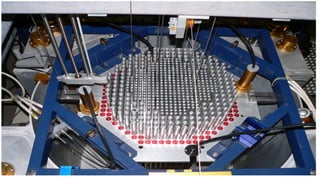
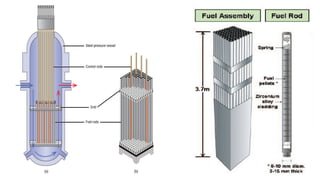
NUCLER FISSION REACTOR:
The nuclear fission nuclear reactor
consists of following parts :
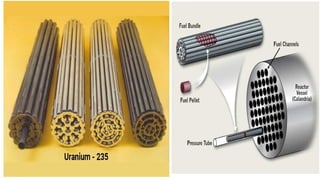
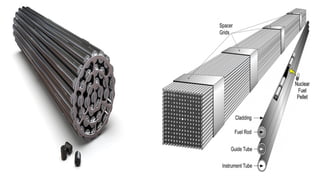
1. Fuel: In nuclear reactor the fuel used
is ; U235 or Pu239 or U233 .
2. Moderator: Slow neutrons have a
much higher intrinsic probability of
inducing fission in than fast neutrons.
To slow down the neutrons released in
the fission process, a moderator is
used. Water, heavy water (D2
O) and
graphite are commonly used
moderators.
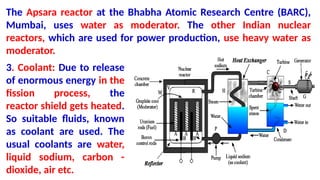
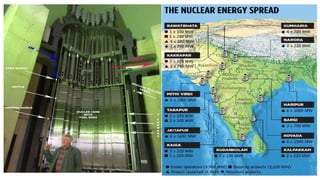
The Apsara reactor at the Bhabha Atomic Research Centre (BARC),
Mumbai, uses water as moderator. The other Indian nuclear
reactors, which are used for power production, use heavy water as
moderator.
3. Coolant: Due to release
of enormous energy in the
fission process, the
reactor shield gets heated.
So suitable fluids, known
as coolant are used. The
usual coolants are water,
liquid sodium, carbon -
dioxide, air etc.
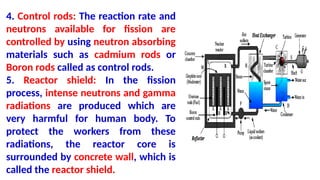
4. Control rods: The reaction rate and
neutrons available for fission are
controlled by using neutron absorbing
materials such as cadmium rods or
Boron rods called as control rods.
5. Reactor shield: In the fission
process, intense neutrons and gamma
radiations are produced which are
very harmful for human body. To
protect the workers from these
radiations, the reactor core is
surrounded by concrete wall, which is
called the reactor shield.
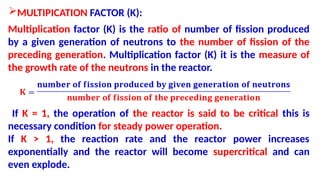
MULTIPICATION FACTOR (K):
Multiplication factor (K) is the ratio of number of fission produced
by a given generation of neutrons to the number of fission of the
preceding generation. Multiplication factor (K) it is the measure of
the growth rate of the neutrons in the reactor.
If K = 1, the operation of the reactor is said to be critical this is
necessary condition for steady power operation.
If K > 1, the reaction rate and the reactor power increases
exponentially and the reactor will become supercritical and can
even explode.
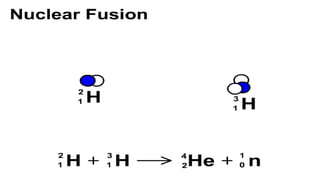
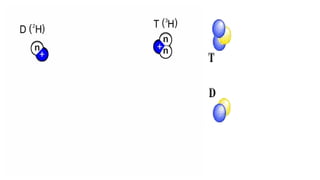
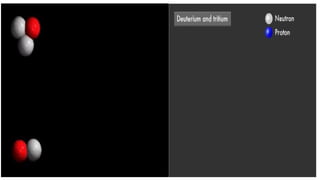
NUCLEAR FUSION:
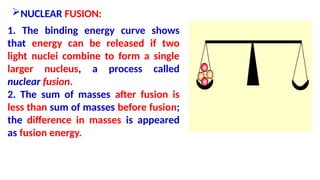
1. The binding energy curve shows
that energy can be released if two
light nuclei combine to form a single
larger nucleus, a process called
nuclear fusion.
2. The sum of masses after fusion is
less than sum of masses before fusion;
the difference in masses is appeared
as fusion energy.
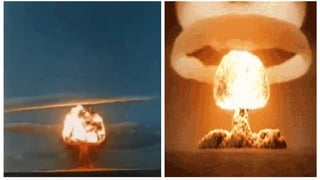
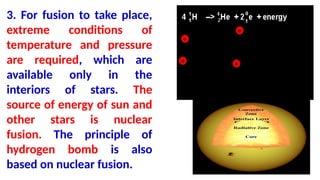
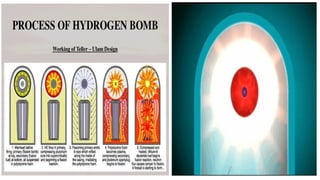
3. For fusion to take place,
extreme conditions of
temperature and pressure
are required, which are
available only in the
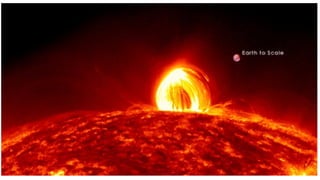
interiors of stars. The
source of energy of sun and
other stars is nuclear
fusion. The principle of
hydrogen bomb is also
based on nuclear fusion.
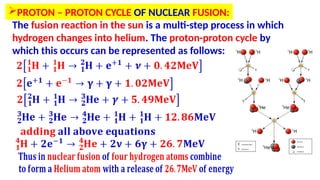
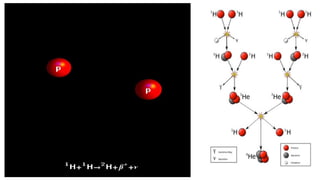
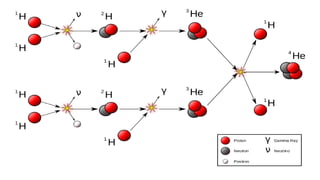
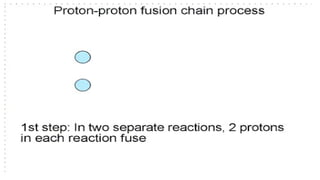
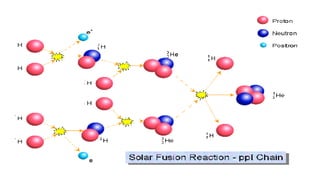
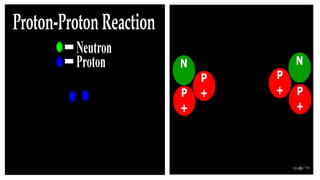
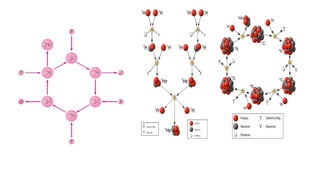
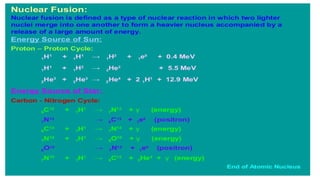
PROTON – PROTON CYCLE OF NUCLEAR FUSION:
The fusion reaction in the sun is a multi-step process in which
hydrogen changes into helium. The proton-proton cycle by
which this occurs can be represented as follows:
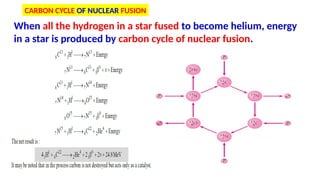
When all the hydrogen in a star fused to become helium, energy
in a star is produced by carbon cycle of nuclear fusion.
CARBON CYCLE OF NUCLEAR FUSION
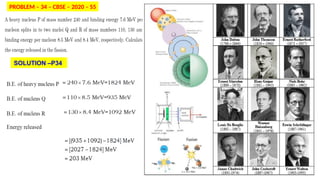
PROBLEM – 34 – CBSE – 2020 – S5
SOLUTION –P34
THANK
YOU

class 12 physics imp NUCLEUS-C12.pptx

  • 1.
    JESUS SAID IAMTHE WAY THE TRUTH THE LIFE NUCLEI PREPARED BY T.RAMESH PGT –PHYSICS JAWAHAR NAVODAYA VIDYALAYA ONGOLE – PRAKASAM -1 ANDHRA PRADESH
  • 3.
    THE NUCLEUS OFATOM: The idea of atomic nucleus was first introduced by Earnest Rutherford after his α-scattering experiment in England. According to him almost the mass of the atom and entire positive charge is concentrated inside the nucleus. The nucleus consists of two types of particles: protons and neutrons called as nucleons. Their masses are : mass of the proton = 1.672 × 10– 27 kg mass of the neutron = 1.675 × 10– 27 kg. The charge of the proton is positive whose magnitude is 1.6 ×10 – 19 C, while neutron is electrically neutral or has no charge.
  • 12.
    ATOMIC NUMBER (Z):The total number of the protons inside the nucleus is called atomic number and is represented by Z. MASS NUMBER (A): The total number of protons and neutrons inside the nucleus is known as mass number and represented by A. Number of neutrons = n = A – Z
  • 13.
    PROPERTIES OF NUCLEUSOF ATOM: 1. RADIUS OF NUCLEUS: The radius of an atomic nucleus can be determined by the empirical formula. 2. VOLUME OF NUCLEUS:
  • 14.
  • 15.
  • 16.
    ISOTOPES: Isotopes areatoms which have same atomic number (Z) but different mass numbers (A). The isotopes of element have same number of protons (same Z) but unequal number of neutrons (A-Z). Examples of Isotopes Isotopes of Uranium: 92 U234 92 U235 92 U238 Isotopes of Radium: 88 Ra223 ;88 Ra224 ; 88 Ra225 ; 88 Ra226 ; 88 Ra22 Isotopes of Carbon: 6 C12 ; 6 C13 ; 6 C14 Isotopes of Hydrogen: 1 H1 (protium); 1 H2 (Deuterium);1 H3 (Tritium)
  • 17.
    ISOTONES: Atoms havingsame number of neutrons (A-Z) are called Isotones. Examples of Isotones: 1 H3 2 He4 8 O16 6 C14 ISOBARS: Atoms having same mass number (A) but different atomic number (Z) are called Isobars. They have different number of protons and neutrons or isobars are atoms having same number of nucleons. Examples of Isobars: 30 Zn92 42 Mo92 24 Cr54 26 Fe54 90 Th234 91 Pa234 92 U234
  • 18.
    ATOMIC MASS UNIT(amu): Atomic masses are expressed in terms of Atomic mass unit. One atomic mass unit is the mass of 1/12th of mass of carbon -12 atom
  • 19.
    MASS – ENERGYEQUIVALECE:
  • 20.
    The energy equivalenceof mass of ; (1) Mass of an electron= 9.11 × 10– 31 kg = 0.511 MeV (2) Mass of a proton 1.672 × 10– 27 kg = 938.2 MeV (3) Mass of a neutron =1.675 × 10– 27 kg= 939.5 MeV
  • 23.
    NUCLEAR FORCE: Thestrong attractive force between nucleons i,e neutrons and protons that binds them together inside nucleus is called nuclear force. PROPERTIES OF NUCLEAR FORCE: 1. STRONGEST FORCE: Nuclear force is the strongest force among fundamental forces of nature which binds nucleons together inside nucleus. 2. SHORT RANGE FORCE: Nuclear force is a short range force which operate only up to a very small distance of about 2fm to 3fm
  • 24.
    3. VARIATION WITHDISTANCE: The potential energy between two nucleons as a function of distance is shown in the Figure. The potential energy is a minimum at a distance r0 of about 0.8 fm. The nuclear force is attractive force if the separation between nucleons (r) is greater than (r > 0.8fm) and repulsive force if separation between nucleon (r) less than (r < 0.8 fm)
  • 25.
    4. CHARGE INDEPENDENTFORCE: The nuclear force is charge independent and attractive force between proton – proton, neutron- neutron and proton – neutron. 5. SATURATION EFFECT: Nuclear force show saturation effect i,e a nucleon interact only with its neighbouring nucleon. This property is supported by the fact that the binding energy per nucleon is same over wide range. 6. SPIN DEPENDENT: Nuclear force is stronger between nucleons with parallel spin than nucleons with anti-parallel spin. 7. EXCHANGE FORCES: Nuclear forces between nucleons arise due to exchange of particles called mesons between them. 8. NON – CENTRAL FORCE: The nuclear force between two nucleons does not act along the line joining their centers.
  • 26.
    MASS DEFECT (∆m):It is observed that the mass of a nucleus is always less than the mass of the constituent nucleons (sum of protons and neutrons). The difference in total mass of mass of nucleons and mass of nucleus is known as mass defect (∆m).
  • 27.
    PACKING FRACTION(pf ): Packingfraction of a nucleus is defined as ratio of mass defect per nucleon
  • 28.
    BINDING ENERGY (Eb ):The mass defect will appear in the form of energy which binds the nucleons together inside nucleus. BINDING ENERGY PER NUCLEON (∆Ebn ): The binding energy per nucleon gives a measure of the force which binds the nucleons together inside a nucleus and it is the average energy to remove a nucleon from the nucleus.
  • 29.
    BINDING ENERGY PERNUCLEON CURVE: 1. The value of binding energy per nucleon of a nucleus gives a measure of the stability of that nucleus. Greater is the binding energy per nucleon of a nucleus, more sable is the nucleus. 2. The binding energy per nucleon (Ebn ) has a broad maximum of 8.5MeV/nucleon for nuclei of mass number in the range 30<A<170 because nuclear force is short ranged force.
  • 30.
    3. In themass number range 2 to 20 there are well defined maxima and minima on the curve. The maxima occur for nuclei with both even A and Z like 2 He4 , 6 C12 and 8 O16 . The minima occur for nuclei with even or odd A and Z like 3 Li6 , 5 B10 and 7 N14 . 4. The binding energy per nucleon has maximum value of 8.8MeV/nucleon for Iron (26 Fe56 ) 5. The binding energy per nucleon is lower for elements with mass number A<30 and A>170.
  • 31.
    6. SATURATION PROPERTYOF NUCLEAR FORCE: If a nucleon can have a maximum of p neighbours within the range of nuclear force, its binding energy would be proportional to p. Let the binding energy of the nucleus be pk, where k is a constant having the dimensions of energy. If we increase A by adding nucleons they will not change the binding energy of a nucleon inside. Since most of the nucleons in a large nucleus reside inside it and not on the surface, the change in binding energy per nucleon would be small. The binding energy per nucleon is a constant and is approximately equal to pk. The property that a given nucleon influences only nucleons close to it is also referred to as saturation property of the nuclear force.
  • 32.
    IMPORATANCE OF BINDINGENERGY PER NUCLEON CURVE: The binding energy per nucleon curve can be used to explain the phenomena of nuclear fission and nuclear fusion. ENERGY RELEASED DURING NUCLEAR FISSION: A very heavy nucleus lower binding energy per nucleon compared to lighter nuclei. So if a heavy nucleus breaks in to two lighter nuclei the nucleons get more tightly bound. Thus energy is released during nuclear fission.
  • 33.
    ENERGY RELEASED DURING NUCLEARFUSION: If two lighter nuclei (A≈10) join to form heavy nucleus the binding energy per nucleon of fused heavier nuclei is more than binding energy per nucleon of lighter nuclei. Hence heavier nuclei are more tightly bound than lighter nuclei thus energy is released during nuclear fusion.
  • 34.
    NUCLEAR STABILITY: 1.The stabilityof nucleus can be understood on the basis of competition between the attractive nuclear force and the repulsive electrical force which is determined by neutron (n) – proton (Z) ratio (n/Z). 2. Nuclei with (n/z) ratio nearly one are more stable.
  • 35.
    3. For lighterNuclei with (n/Z) ratio less than one are less stable. Because with larger value of Z, the electrical repulsion between protons becomes greater than attractive force between them and so nucleus no long remains stable. 4. Heavy nuclei with (n/Z) ratio greater than one are more stable. Because nuclei with large number of neutrons have strong attractive forces between them, necessary to keep the nucleus stable.
  • 37.
    RADIOACTIVITY: 1. The spontaneousdisintegration of nucleus is called radioactivity. This phenomenon was discovered by Henry Becquerel in 1896. Some radioactive elements are; uranium, radium, thorium, polonium etc. 2. Radioactivity is the nuclear phenomenon which does not depend on any physical or chemical changes. 3. Rutherford found that each radioactive parent nucleus changes into daughter nucleus after emitting α-particle (He nucleus or He+2 ) or β+ particle (positron) or β- particle (electron of nuclear origin or positron) along with gamma (γ) radiations until it changes into stable nucleus.
  • 47.
    TYPES OF RADIOACTIVEDISINTEGRATION: 1. Radioactive disintegration is random. It is the matter of chance for disintegration any of the atom first. 2. During disintegration, either α- particle or β- particle is emitted at a time. Both the particles are never emitted simultaneously.
  • 48.
    3. ALPHA (α)DECAY: When an α-particle is emitted, a new atom is formed whose atomic number is decreased by two and mass number by four. Thus for an atom X of atomic number Z and mass number A
  • 57.
    6. GAMMA DECAY: Thereare energy levels in a nucleus, just like there are energy levels in atoms. Most radioactive nuclides after an alpha decay or a beta decay leave the daughter nucleus in an excited state. When a nucleus is in an excited state, it can make a transition to a lower energy state by the emission of electromagnetic radiation having of the order of MeV called as Gamma rays. The daughter nucleus reaches the ground state by a single transition or sometimes by successive transitions by emitting one or more gamma rays.
  • 62.
    PROBLEM – 1– CBSE – 2020 – S1 SOLUTION –P1 PROBLEM – 2 – CBSE – 2020 – S1 PROBLEM – 3 – CBSE – 2020 – S2 SOLUTION –P2 SOLUTION –P3 PROBLEM – 4 – CBSE – 2020 – S2 SOLUTION –P4
  • 63.
    PROBLEM – 5– CBSE – 2020 – S1 SOLUTION –P5 PROBLEM – 6 – CBSE – 2020 – S2 SOLUTION –P6
  • 64.
    PROBLEM – 7– CBSE – 2020 – S3 SOLUTION –P7 PROBLEM – 8 – CBSE – 2020 – S4 PROBLEM – 9 – CBSE – 2020 – S4 SOLUTION –P8 SOLUTION –P9
  • 65.
    PROBLEM – 10– CBSE – 2020 – COM SOLUTION –P10 PROBLEM – 11 – CBSE – 2020 – COM PROBLEM – 12 – CBSE – 2020 – COM SOLUTION –P11 PROBLEM – 13 – CBSE – 2020 – SQP SOLUTION –P13 SOLUTION –P12
  • 66.
    PROBLEM – 14– CBSE – 2020 – SQP PROBLEM – 15 – CBSE – 2020 – SQP SOLUTION –P14 SOLUTION –P15 PROBLEM – 16 – CBSE – 2019 – S3 SOLUTION –P16
  • 67.
    PROBLEM – 17– CBSE – 2019 – S5 PROBLEM – 18 – CBSE – 2019 – S5 SOLUTION –P17 SOLUTION –P18
  • 68.
    PROBLEM – 19– CBSE – 2019 – SQP PROBLEM – 20 – CBSE – 2018 – S1 PROBLEM – 21 – CBSE – 2018 – COM SOLUTION –P20 SOLUTION –P19 SOLUTION –P21
  • 69.
    PROBLEM – 22– CBSE – 2019 – S2 PROBLEM – 23 – CBSE – 2019 – S3 SOLUTION –P22 SOLUTION –P23
  • 70.
  • 73.
    DECAY CONSTANT ORDISINTEGRATION CONSTANT (λ):
  • 75.
    HALF LIFE (T1/2 )OF RADIOACTIVE ELEMENTS: The time interval in which one – half of the radioactive nuclei originally present in radioactive sample disintegrate is called half – life of the radioactive substance.
  • 85.
    MEAN LIFE(τ) TIMEOF RADIACTIVE MATERIALS : The average time for which the nuclei of a radioactive sample exist is called mean life or average life of that sample. It is equal to the ratio of the combined age of all the nuclei to the total number of nuclei present in the given sample.
  • 89.
    DECAY RATE ORACTIVITY OF A RADIAOACTIVE SAMPLE: The rate of decay or activity of a sample is defined as number of radioactive disintegrations taking place per second in the radioactive sample.
  • 91.
    UNITS OF RADIOACTIVITY: 1.Becquerel (Bq): One Becquerel is defined as decay rate of one disintegration per second. 1becquerel = 1Bq = 1decay per second 2.Curie (Ci): One curie is the decay rate of 3.7 x10¹⁰ disintegrations per second. 1Curie =1Ci= 3.7 x 10¹⁰ Bq 3. Rutherford (rd): One Rutherford is the decay rate of 106 disintegrations per second. 1rutherford = 1rd = 106 Bq
  • 97.
    PROBLEM – 24– CBSE – 2020 – S1 SOLUTION –P24 PROBLEM – 25 – CBSE – 2020 – S2 SOLUTION –P25
  • 98.
    PROBLEM – 26– CBSE – 2020 – S4 SOLUTION –P26 PROBLEM – 27 – CBSE – 2020 – S5 SOLUTION –P27
  • 99.
    PROBLEM – 28– CBSE – 2020 – COM PROBLEM – 29 – CBSE – 2020 – COM SOLUTION –P28 SOLUTION –P29
  • 100.
    PROBLEM – 30– CBSE – 2019 – S1 SOLUTION –P30
  • 101.
    PROBLEM – 31– CBSE – 2019 – S2 SOLUTION –P31 PROBLEM – 32 – CBSE – 2018 – S1 SOLUTION –P32
  • 102.
    PROBLEM – 33– CBSE – 2016 – SQP SOLUTION –P33
  • 103.
    NUCLEAR FISSION: Otto Frischsuggested that when a heavy nucleus like uranium is bombarded by a thermal neutron, the uranium nucleus absorbed the thermal neutron and splits into roughly two equal parts with the release of large amount of energy. This process is called Nuclear fission. In nuclear fission the sum of masses before fission is greater than the sum of masses after fission; the difference in mass is released in the form of energy.
  • 104.
    When slow neutronscalled thermal neutrons are bombarded by 92 U235 , the fission takes place according to one of the following equations releasing energy of the order of 200MeV per fissioning nucleus.
  • 107.
    NUCLEAR CHAIN REACTION: Inthe nuclear fission process, on an average more than one neutron are released and are capable of causing further fission, then number of fission taking place at successive stages goes on increasing at a rapid rate. This gives rise to self sustained sequence of fission known as chain reaction. The chain reaction takes place only if the size of the fissionable material is greater than a certain size called the critical size.
  • 118.
    There are twotypes of chain reactions. 1. Uncontrolled chain reaction: If the nuclear fission rate goes on increasing, then huge amount of energy continuously released and the system will have the explosive tendency. This forms the principle of atom bomb. 2. Controlled chain reaction: In the fission process, if the released neutrons are limited by absorbing them, then fission rate can be maintained. This forms the principle of nuclear reactor.
  • 119.
    NUCLER FISSION REACTOR: Thenuclear fission nuclear reactor consists of following parts : 1. Fuel: In nuclear reactor the fuel used is ; U235 or Pu239 or U233 . 2. Moderator: Slow neutrons have a much higher intrinsic probability of inducing fission in than fast neutrons. To slow down the neutrons released in the fission process, a moderator is used. Water, heavy water (D2 O) and graphite are commonly used moderators.
  • 120.
    The Apsara reactorat the Bhabha Atomic Research Centre (BARC), Mumbai, uses water as moderator. The other Indian nuclear reactors, which are used for power production, use heavy water as moderator. 3. Coolant: Due to release of enormous energy in the fission process, the reactor shield gets heated. So suitable fluids, known as coolant are used. The usual coolants are water, liquid sodium, carbon - dioxide, air etc.
  • 121.
    4. Control rods:The reaction rate and neutrons available for fission are controlled by using neutron absorbing materials such as cadmium rods or Boron rods called as control rods. 5. Reactor shield: In the fission process, intense neutrons and gamma radiations are produced which are very harmful for human body. To protect the workers from these radiations, the reactor core is surrounded by concrete wall, which is called the reactor shield.
  • 122.
    MULTIPICATION FACTOR (K): Multiplicationfactor (K) is the ratio of number of fission produced by a given generation of neutrons to the number of fission of the preceding generation. Multiplication factor (K) it is the measure of the growth rate of the neutrons in the reactor. If K = 1, the operation of the reactor is said to be critical this is necessary condition for steady power operation. If K > 1, the reaction rate and the reactor power increases exponentially and the reactor will become supercritical and can even explode.
  • 137.
    NUCLEAR FUSION: 1. Thebinding energy curve shows that energy can be released if two light nuclei combine to form a single larger nucleus, a process called nuclear fusion. 2. The sum of masses after fusion is less than sum of masses before fusion; the difference in masses is appeared as fusion energy.
  • 138.
    3. For fusionto take place, extreme conditions of temperature and pressure are required, which are available only in the interiors of stars. The source of energy of sun and other stars is nuclear fusion. The principle of hydrogen bomb is also based on nuclear fusion.
  • 139.
    PROTON – PROTONCYCLE OF NUCLEAR FUSION: The fusion reaction in the sun is a multi-step process in which hydrogen changes into helium. The proton-proton cycle by which this occurs can be represented as follows:
  • 141.
    When all thehydrogen in a star fused to become helium, energy in a star is produced by carbon cycle of nuclear fusion. CARBON CYCLE OF NUCLEAR FUSION
  • 154.
    PROBLEM – 34– CBSE – 2020 – S5 SOLUTION –P34
  • 166.