PRESENTS

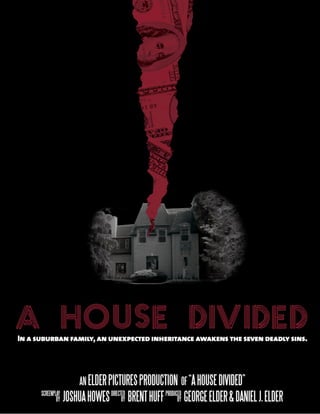
A HOUSE DIVIDED

A Motion Picture
Prospectus
©

2 0 1 0 -2 0 1 1

S T A T E & C A B R IL L O P R O D U C T IO N S , IN C . | A L L R IG H T S
R ES ER V ED
LEGAL NOTICE
This prospectus has been submitted on a confidential basis solely for the benefit of selected,
highly qualified investors and is not for use by any other persons. Neither may it be
reproduced, stored or copied in any form. By accepting delivery of this business plan
proposal, the recipient acknowledges and agrees that: (i) in the event that the recipient does
not wish to pursue this matter, the recipient will return the copy to the contact and address
listed as soon as practical; (ii) the recipient will not copy, fax, reproduce, or distribute this
Confidential Business Plan Proposal in whole or in part, without permission; and (iii) all of
the information contained herein will be treated as proprietary and confidential material.
This agreement is executed by the recipient prior to, or contemporaneously with, his or her
receipt of the Business Plan Proposal.
THIS BUSINESS PLAN PROPOSAL DOES NOT CONSTITUTE AN OFFER OR
SOLICITATION TO ANYONE.
PROSPECTIVE FINANCING PARTIES SHOULD NOT CONSTRUE THE
CONTENTS OF THIS BUSINESS PLAN PROPOSAL AS LEGAL, INVESTMENT OR
TAX ADVICE. EACH FINANCING PARTY SHOULD CONSULT ITS OWN
COUNSEL, ACCOUNTANTS, AND OTHER ADVISORS AS TO THE LEGAL, TAX,
ECONOMIC AND RELATED ASPECTS OF PROVIDING FINANCING TO THE
COMPANY AND AS TO THE SUITABILITY OF SUCH INVESTMENT.
THIS BUSINESS PLAN PROPOSAL INCLUDES CERTAIN STATEMENTS,
ESTIMATES AND PROJECTIONS PROVIDED BY THE COMPANY WITH
RESPECT TO THE ANTICIPATED FUTURE PERFORMANCE OF THE
COMPANY. SUCH STATEMENTS, ESTIMATES AND PROJECTIONS REFLECT
VARIOUS ASSUMPTIONS MADE BY THE MANAGEMENT OF THE COMPANY
CONCERNING ANTICIPATED RESULTS, WHICH ASSUMPTIONS MAY BE
INCOMPLETE OR INACCURATE AND MAY BE AFFECTED BY THE
OCCURRENCE OF UNANTICIPATED EVENTS AND CIRCUMSTANCES. BE
INCOMPLETE OR INACCURATE AND MAY BE AFFECTED BY THE
OCCURRENCE OF UNANTICIPATED EVENTS AND CIRCUMSTANCES.
CONSEQUENTLY, ACTUAL RESULTS ACHIEVED MAY VARY MATERIALLY
AND ADVERSLY FROM THOSE PROJECTED.
TABLE OF CONTENTS
EXECUTIVE SUMMARY	

...........................................................................................................................................6
MISSION and BUSINESS MODEL	

.............................................................................................................................................6
LOGLINE	

.......................................................................................................................................................................................6
PRODUCTION TEAM	

..................................................................................................................................................................7
MARKET DEFINITION	

...............................................................................................................................................................7
INVESTMENT PROPOSAL	

.........................................................................................................................................................7
EXIT / PAYBACK STRATEGY	

.....................................................................................................................................................8

A HOUSE DIVIDED, LLC 	

...........................................................................................................................................9
A. MISSION	

..................................................................................................................................................................................9
B. LEGAL BUSINESS DESCRIPTION	

.....................................................................................................................................9
C. STRATEGY	

..............................................................................................................................................................................9

i. Operating	

............................................................................................................................................9
ii. A HOUSE DIVIDED, LLC Philosophy:	

........................................................................................10
iii. Production	

.......................................................................................................................................10
D. A HOUSE DIVIDED, LLC Production Strategy	

................................................................................................................10
E. DEAL STRUCTURE	

.............................................................................................................................................................11

DEAL DESCRIPTION	

........................................................................................................................11
F. MANAGEMENT	

....................................................................................................................................................................12

i. Production & Management Team	

....................................................................................................12
F. ALLIANCES and RELATIONSHIPS	

..................................................................................................................................13

i. Studios, Distributors, Agencies, and Law Firms	

............................................................................13
a. Studios/Distributors 	

................................................................................................................13
b. Agencies 	

....................................................................................................................................13
c. Law Firms	

.................................................................................................................................13
G. INTELLECTUAL PROPERTY STRATEGY	

.....................................................................................................................14
H. FACILITIES	

...........................................................................................................................................................................14
I. RISKS	

.......................................................................................................................................................................................14

i. A HOUSE DIVIDED, LLC Specific Risks	

......................................................................................14
a. FOREIGN DISTRIBUTERS PROJECTION ACCURACY	

...............................................14
ii. Industry-Specific Risks	

....................................................................................................................14
a. A Competitive Marketplace	

....................................................................................................14
b. Impact Of Technological Change And Film Piracy	

..............................................................15
c. Expansion of new media and emerging media platforms	

....................................................15
A HOUSE DIVIDED MOTION PICTURE	

..............................................................................................................16
A. “A HOUSE DIVIDED” OVERVIEW	

..................................................................................................................................16
B. WRITER	

.................................................................................................................................................................................16

JOSHUA HOWES	

................................................................................................................................16
C. DIRECTOR	

............................................................................................................................................................................17

Brent Huff	

.............................................................................................................................................17
CASTING DIRECTOR	

..............................................................................................................................................................18
E. TALENT	

..................................................................................................................................................................................19
F. GRITTY FAMILY DRAMA/THRILLER	

............................................................................................................................19

MARKETING AND COMPETITIVE ANALYSIS	

...................................................................................................20
A. MARKET DESCRIPTION	

...................................................................................................................................................20
B. TARGET MARKET	

..............................................................................................................................................................21
C. COMPETITIVE PROFILES	

................................................................................................................................................21
D. COMPETITIVE ADVANTAGES	

.........................................................................................................................................22

i. Production Partnerships	

..................................................................................................................22
ii. Cutting-Edge Digital Technologies 	

................................................................................................24
iii. New Media Marketing and Distribution	

......................................................................................25
a. Communication	

........................................................................................................................26
b. Collaboration	

............................................................................................................................27
A HOUSE DIVIDED | LONG FORM PROSPECTUS | NOT AN OFFERING !

!

!

Pg. 4 | December 16, 2013
c. Multimedia	

................................................................................................................................27
d. Reviews and opinions	

..............................................................................................................27
e. Entertainment	

...........................................................................................................................27
f. Brand Monitoring	

....................................................................................................................27
iv. Branded Entertainment	

..................................................................................................................28
SALES AND DISTRIBUTION PLAN	

.......................................................................................................................29
DISTRIBUTION CHANNELS	

..................................................................................................................................................29
PROJECT DISTRIBUTION STRATEGY	

...............................................................................................................................30

i. Distribution Approach	

......................................................................................................................31
a. Split Distribution Rights in Foreign Territories	

....................................................................31
b. Choose Effective Distribution Partners in each territory worldwide	

.................................32
c. Circumscribe Rights 	

................................................................................................................32
d. Craft Win-Win Deals	

...............................................................................................................32
e. Retain Direct Sales Rights 	

.......................................................................................................32
f. Maximize Direct Revenues	

......................................................................................................33
g. Grow And Nurture Audiences	

................................................................................................33
ii. INVESTMENT and EXIT/PAYBACK STRATEGY	

...................................................................33
a. International Pre-Sales and Distribution	

...............................................................................34
ii. North American Theatrical Pre-Sales and Distribution	

...............................................................35
INVESTMENTS AND FINANCIALS	

........................................................................................................................36
A. STATE OF INDUSTRY	

.........................................................................................................................................................36
B. FINANCIAL SUMMARY	

.....................................................................................................................................................36
C. USE OF FUNDS	

.....................................................................................................................................................................37

i. Operation Overhead	

.........................................................................................................................37
ii. Production (Pre to Post)	

..................................................................................................................37
iii. Marketing and P&A	

.......................................................................................................................37
D. PROFIT and LOSS PROJECTIONS	

..................................................................................................................................37
E. CASH FLOW PROJECTIONS	

............................................................................................................................................37
F. RELEASE WINDOWS and REVENUE STREAMS	

..........................................................................................................38

i. Domestic -Foreign Distribution Revenue	

........................................................................................38
ii. Revenue Stream Timeline	

...............................................................................................................38
Tax Credits and Rebates	

.............................................................................................................38
b. Product Integration	

.................................................................................................................38
c. Theatrical Box Office Receipts	

................................................................................................38
d. DVD Sales	

.................................................................................................................................38
e. Pay Cable	

..................................................................................................................................39
f. Syndicated/Network Television	

................................................................................................39
g. New Media & Emerging Media Platforms	

............................................................................39
h. Other Ancillary Revenue, in addition to a film’s main revenue streams, including:	

.........39
G. INVESTMENT INSURANCE	

..............................................................................................................................................39

i. CONTINGENCY	

..............................................................................................................................39
J. CONCLUSION	

........................................................................................................................................................................39

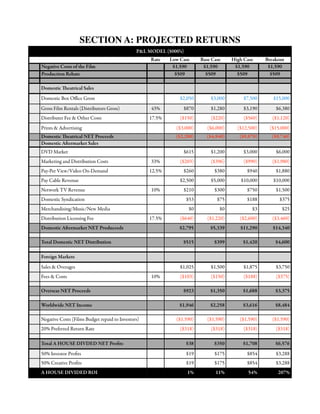
SECTION A: PROJECTED RETURNS	

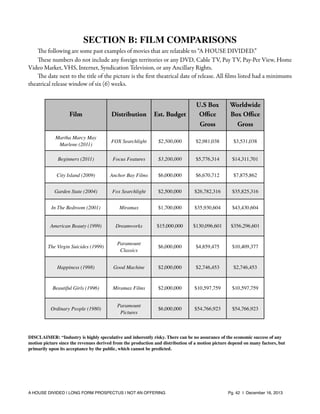
......................................................SECTION B: FILM COMPARISONS	

....................41
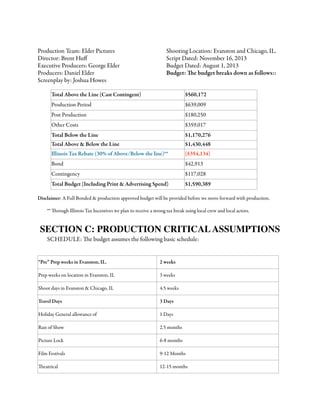
SECTION C: PRODUCTION CRITICAL ASSUMPTIONS	

..................................................................................43
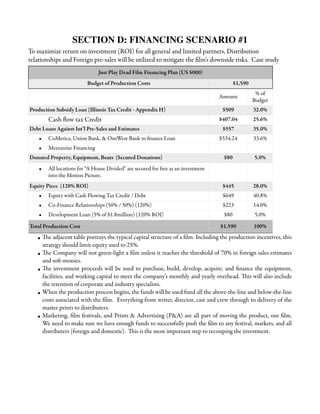
SECTION D: FINANCING SCENARIO #1	

.............................................................................................................44
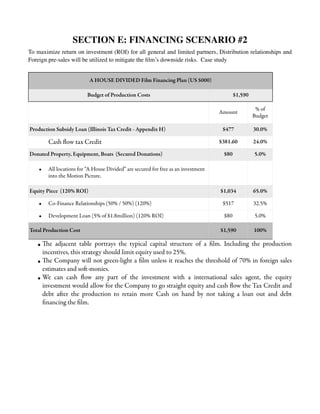
SECTION E: FINANCING SCENARIO #2 	

.............................................................................................................45
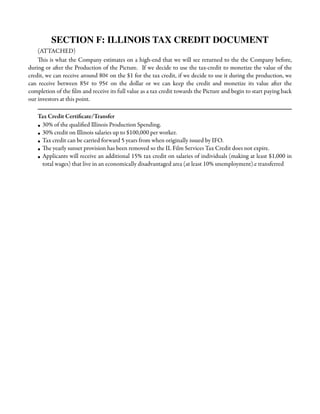
SECTION F: ILLINOIS TAX CREDIT DOCUMENT	

............................................................................................46

A HOUSE DIVIDED | LONG FORM PROSPECTUS | NOT AN OFFERING !

!

!

Pg. 5 | December 16, 2013
EXECUTIVE SUMMARY
THE COMPANY:
A HOUSE DIVIDED LLC., will be formed under its parent company, ELDER PICTURES, LLC.. for the
purposes of financing and producing the motion picture currently entitled A HOUSE DIVIDED (the “Motion
Picture”).
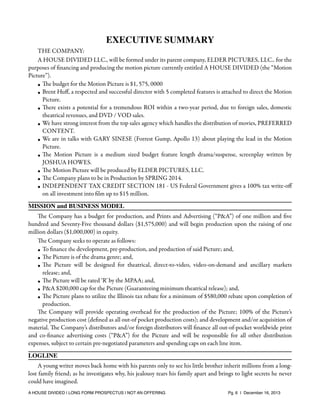
• The budget for the Motion Picture is $1, 575, 0000
• Brent Huff, a respected and successful director with 5 completed features is attached to direct the Motion
Picture.
• There exists a potential for a tremendous ROI within a two-year period, due to foreign sales, domestic
theatrical revenues, and DVD / VOD sales.
• We have strong interest from the top sales agency which handles the distribution of movies, PREFERRED
CONTENT.
• We are in talks with GARY SINESE (Forrest Gump, Apollo 13) about playing the lead in the Motion
Picture.
• The Motion Picture is a medium sized budget feature length drama/suspense, screenplay written by
JOSHUA HOWES.
• The Motion Picture will be produced by ELDER PICTURES, LLC.
• The Company plans to be in Production by SPRING 2014.
• INDEPENDENT TAX CREDIT SECTION 181 - US Federal Government gives a 100% tax write-off
on all investment into film up to $15 million.
MISSION and BUSINESS MODEL
The Company has a budget for production, and Prints and Advertising (“P&A”) of one million and five
hundred and Seventy-Five thousand dollars ($1,575,000) and will begin production upon the raising of one
million dollars ($1,000,000) in equity.
The Company seeks to operate as follows:
• To finance the development, pre-production, and production of said Picture; and,
• The Picture is of the drama genre; and,
• The Picture will be designed for theatrical, direct-to-video, video-on-demand and ancillary markets
release; and,
• The Picture will be rated ‘R’ by the MPAA; and,
• P&A $200,000 cap for the Picture (Guaranteeing minimum theatrical release); and,
• The Picture plans to utilize the Illinois tax rebate for a minimum of $580,000 rebate upon completion of
production.
The Company will provide operating overhead for the production of the Picture; 100% of the Picture’s
negative production cost (defined as all out-of pocket production costs); and development and/or acquisition of
material. The Company’s distributors and/or foreign distributors will finance all out-of-pocket worldwide print
and co-finance advertising costs (“P&A”) for the Picture and will be responsible for all other distribution
expenses, subject to certain pre-negotiated parameters and spending caps on each line item.
LOGLINE
A young writer moves back home with his parents only to see his little brother inherit millions from a longlost family friend; as he investigates why, his jealousy tears his family apart and brings to light secrets he never
could have imagined.
A HOUSE DIVIDED | LONG FORM PROSPECTUS | NOT AN OFFERING !

!

!

Pg. 6 | December 16, 2013
PRODUCTION TEAM
George Elder, Daniel Elder, and Brent Huff have more than 65+ years of combined entertainment industry
experience in all facets of the motion picture process, including development, financing, production,
distribution, marketing and management of intellectual property. The production team has released 5 feature
films to date with box office and DVD/TV receipts totaling $48 million, we also have releases through
Lionsgate, Peace Arch Entertainment, and IMAX. (Full Bios below)
MARKET DEFINITION
The market is defined as the financing, development, production and distribution of feature drama motion
pictures, used by countries around the world to entertain their citizens, with an emphasis on ages 18-45. The
Company intends to capitalize on the exciting developments of the dynamic entertainment marketplace.
The drama/thriller genre is a stable and strong market that provides for strong appeal with the adult
audience and award potential greater than any other motion picture genre. Drama has always maintained a loyal
audience and will continue to do so. Since low-budget drama movie are strong award winning candidates, the
investments have strong upside potential vs. risk. The rise of successful award winning low-budget drama
properties such as “Martha, Marcy, May, Marlene,” “Blue Valentine,” “The Artist,” “Take Shelter,” and “Little
Miss Sunshine” have generated tremendous film festival and award buzz which spawned purchases and strong
box office returns for a strong ROI for the original financiers.
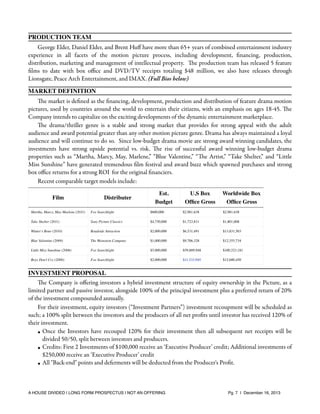
Recent comparable target models include:
Film

Distributer

Est.
Budget

U.S Box
Office Gross

Worldwide Box
Office Gross

Martha, Marcy, May Marlene (2011)

Fox Searchlight

$600,000

$2,981,638

$2,981,638

Take Shelter (2011)

Sony Picture Classics

$4,750,000

$1,723,811

$1,801,008

Winter’s Bone (2010)

Roadside Attraction

$2,000,000

$6,531,491

$13,831,503

Blue Valentine (2009)

The Weinstein Company

$1,000,000

$9,706,328

$12,355,734

Little Miss Sunshine (2006)

Fox Searchlight

$5,000,000

$59,889,948

$100,523,181

Boys Don’t Cry (2000)

Fox Searchlight

$2,000,000

$11,533,945

$12,680,450

INVESTMENT PROPOSAL
The Company is offering investors a hybrid investment structure of equity ownership in the Picture, as a
limited partner and passive investor, alongside 100% of the principal investment plus a preferred return of 20%
of the investment compounded annually.
For their investment, equity investors (“Investment Partners”) investment recoupment will be scheduled as
such; a 100% split between the investors and the producers of all net profits until investor has received 120% of
their investment.
• Once the Investors have recouped 120% for their investment then all subsequent net receipts will be
divided 50/50, split between investors and producers.
• Credits: First 2 Investments of $100,000 receive an ‘Executive Producer’ credit; Additional investments of
$250,000 receive an ‘Executive Producer’ credit
• All "Back-end" points and deferments will be deducted from the Producer's Profit.

A HOUSE DIVIDED | LONG FORM PROSPECTUS | NOT AN OFFERING !

!

!

Pg. 7 | December 16, 2013
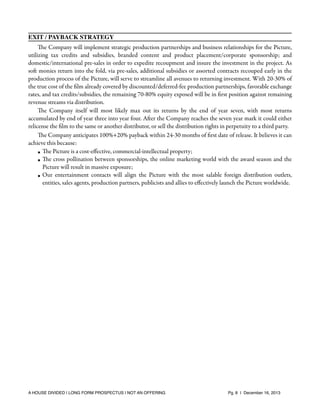
EXIT / PAYBACK STRATEGY
The Company will implement strategic production partnerships and business relationships for the Picture,
utilizing tax credits and subsidies, branded content and product placement/corporate sponsorship; and
domestic/international pre-sales in order to expedite recoupment and insure the investment in the project. As
soft monies return into the fold, via pre-sales, additional subsidies or assorted contracts recouped early in the
production process of the Picture, will serve to streamline all avenues to returning investment. With 20-30% of
the true cost of the film already covered by discounted/deferred-fee production partnerships, favorable exchange
rates, and tax credits/subsidies, the remaining 70-80% equity exposed will be in first position against remaining
revenue streams via distribution.
The Company itself will most likely max out its returns by the end of year seven, with most returns
accumulated by end of year three into year four. After the Company reaches the seven year mark it could either
relicense the film to the same or another distributor, or sell the distribution rights in perpetuity to a third party.
The Company anticipates 100%+20% payback within 24-30 months of first date of release. It believes it can
achieve this because:
• The Picture is a cost-effective, commercial-intellectual property;
• The cross pollination between sponsorships, the online marketing world with the award season and the
Picture will result in massive exposure;
• Our entertainment contacts will align the Picture with the most salable foreign distribution outlets,
entities, sales agents, production partners, publicists and allies to effectively launch the Picture worldwide.

A HOUSE DIVIDED | LONG FORM PROSPECTUS | NOT AN OFFERING !

!

!

Pg. 8 | December 16, 2013
A HOUSE DIVIDED, LLC
A. MISSION
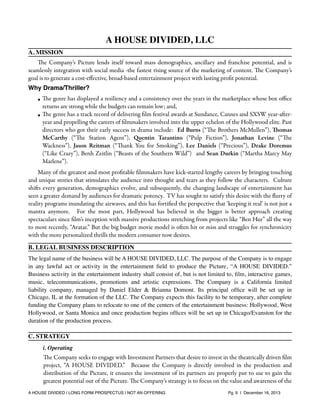
The Company’s Picture lends itself toward mass demographics, ancillary and franchise potential, and is
seamlessly integration with social media -the fastest rising source of the marketing of content. The Company’s
goal is to generate a cost-effective, broad-based entertainment project with lasting profit potential.
Why Drama/Thriller?
• The genre has displayed a resiliency and a consistency over the years in the marketplace whose box office
returns are strong while the budgets can remain low; and,
• The genre has a track record of delivering film festival awards at Sundance, Cannes and SXSW year-afteryear and propelling the careers of filmmakers involved into the upper echelon of the Hollywood elite. Past
directors who got their early success in drama include: Ed Burns (“The Brothers McMullen”), Thomas
McCarthy (“The Station Agent”), Quentin Tarantino (“Pulp Fiction”), Jonathan Levine (“The
Wackness”), Jason Reitman (“Thank You for Smoking”), Lee Daniels (“Precious”), Drake Doremus
(“Like Crazy”), Benh Zeitlin (“Beasts of the Southern Wild”) and Sean Durkin (“Martha Marcy May
Marlene”).
Many of the greatest and most profitable filmmakers have kick-started lengthy careers by bringing touching
and unique stories that stimulates the audience into thought and tears as they follow the characters. Culture
shifts every generation, demographics evolve, and subsequently, the changing landscape of entertainment has
seen a greater demand by audiences for dramatic potency. TV has sought to satisfy this desire with the flurry of
reality programs inundating the airwaves, and this has fortified the perspective that ‘keeping it real’ is not just a
mantra anymore. For the most part, Hollywood has believed in the bigger is better approach creating
spectaculars since film’s inception with massive productions stretching from projects like “Ben Hur” all the way
to most recently, “Avatar.” But the big budget movie model is often hit or miss and struggles for synchronicity
with the more personalized thrills the modern consumer now desires.
B. LEGAL BUSINESS DESCRIPTION
The legal name of the business will be A HOUSE DIVIDED, LLC. The purpose of the Company is to engage
in any lawful act or activity in the entertainment field to produce the Picture, “A HOUSE DIVIDED.”
Business activity in the entertainment industry shall consist of, but is not limited to, film, interactive games,
music, telecommunications, promotions and artistic expressions. The Company is a California limited
liability company, managed by Daniel Elder & Brianna Domont. Its principal office will be set up in
Chicago, IL at the formation of the LLC. The Company expects this facility to be temporary, after complete
funding the Company plans to relocate to one of the centers of the entertainment business: Hollywood, West
Hollywood, or Santa Monica and once production begins offices will be set up in Chicago/Evanston for the
duration of the production process.

C. STRATEGY
i. Operating

The Company seeks to engage with Investment Partners that desire to invest in the theatrically driven film
project, “A HOUSE DIVIDED.” Because the Company is directly involved in the production and
distribution of the Picture, it ensures the investment of its partners are properly put to use to gain the
greatest potential out of the Picture. The Company’s strategy is to focus on the value and awareness of the
A HOUSE DIVIDED | LONG FORM PROSPECTUS | NOT AN OFFERING !

!

!

Pg. 9 | December 16, 2013
Picture, contending with the bigger budget studio films, with a fraction of the budget, and expand among
the social networks, film festivals, and the massive populace looking for strong character driven stories.
ii. A HOUSE DIVIDED, LLC Philosophy:

• Produce and distribute a Strong and cinematic, feature drama film; and,
• Reduce the inherent risks in making the Picture through a lower break-even point (substantially
lower than studio films); and,
• Align with top distribution outlets, entities, sponsors, sales agents, production partners, publicists
and allies to effectively launch the Picture; and,
iii. Production

Our mandate is to produce a Picture that is developed for a specific demographic, for the appropriate and
efficient budget, and to capitalize on high-caliber, original and engaging content. The Company will own/
control the underling screenplay. Production partners in tax incentive/subsidy laden; exchange-rate
friendly environments will be utilized on the production depending on which partnership is most
appropriate for the Picture.
Investment in feature length films involves a substantial degree of risk and is a suitable investment only for
those with sufficient financial means, knowledge and experience. The Company requires that its Investment
Partners are ‘accredited’. Investment Partners will be considered as ‘accredited’ if they have a net worth of $1
million (joint with spouse including furnishings and automobiles); individual income in the prior two years and
estimated current income in excess of $200,000 or joint with-spouse of $300,000; corporations or tax exempt
organizations with at least $5 million in assets; or certain institutional investors (see SEC's Regulation D).
For the Picture, Investment Partners are participating in a production of said Picture, as well as equal
ownership in the Company. Generally, the Company will require that the distributor cover the prints and
advertising cost, though this is not always the case. Sometimes, it is more advantageous to retain as much
ownership as possible and merely hire the distributor for their services at a low distribution rate. The first
objective is to always: (a) repay the Investment Partner, and (b) maximize the film's profits thereafter. The
current international marketplace of soft money, regional tax incentives, exchange rates and strategic production
partnerships and planning, as well as new distribution models, offers the opportunity to produce and market
commercially viable films for under $5 million while maximizing the potential for the Company’s partners to
enjoy higher returns.
D. A HOUSE DIVIDED, LLC Production Strategy
• Focus on one of the stronger genres of the film business, a strong, adult drama/ thriller film; and,
• Partner with a strong foreign sales company and an independent film finance agent (CAA, WME, UTA,
ICM, etc.) to push the film through the proper channels towards distribution; and,
• Will operate in a cost-efficient manner, keeping with our precedent set, demonstrating; considerable
ability in keeping costs to a minimum through all stages of the filmmaking process; and,
• Intends to use new digital technologies to further reduce costs; and,
• This creative approach will employ the utilization of real or ‘practical’ locations and original talent that
will deliver a real-life quality and creative energy to the Picture; and,
• Leverage favorable market conditions to secure attractive distribution arrangements, operating in a
manner that seeks to distribute through major distributors in the U.S. and Canada, major distributors in
foreign territories, and U.S. ancillary rights direct to major licensees.
A HOUSE DIVIDED | LONG FORM PROSPECTUS | NOT AN OFFERING !

!

!

Pg. 10 | December 16, 2013
E. DEAL STRUCTURE
i. DEAL DESCRIPTION

By way of an “Explanation” (NOT AN OFFER) to help layout the overview of the Motion Picture.
Target Production Launch Production will begin in the Spring of 2014
Location Chicago & Evanston, IL.
Timing The Picture will be completed by the third quarter of 2014
Production Budget Budget will be held at $1,500,000
Investment

Minimum investment: $10,000
Maximum investment: $1,500,000 (Full Budget)

Print and Advertising Minimum $150,000 - $200,000
P&A Budgets (This is the amount the Production Company will put up in lieu of a
distribution agreement.)
The Company will have approval rights on all creative and business
decisions including but not limited to:
• Budget
• Chain of Title (copyright)
Approval Rights
• Lead Actors
• Director
• Final Cut
• Distribution
The Picture will be a Drama shot in English.
The Picture will be rated ‘R’ by the MPAA.
Target Genre
The Picture will target a limited/moderate theatrical, direct-to-video,
or video-on-demand release by a distributor.
50% of P&A cost Distributor will pay for guild residuals which will
be deducted ‘off-the-top’ prior to recoupment by either the Company
or the Distributor The Company has an experienced and seasoned
Distributor Obligations management team. The Company will enable the Picture and
Investment Partners to benefit from the company’s experience and
success in developing, producing, and selling the Picture, while
facilitating company creative independence.
Distributor must honor the Company’s commitments to potential
The Fund Exclusions strategic partners
(advertisers, post-production service providers, and territory partners)
Legal Structure Limited Liability Company (LLC)
Minimum Return Repayment of the principal invested, plus 20%
A HOUSE DIVIDED | LONG FORM PROSPECTUS | NOT AN OFFERING !

!

!

Pg. 11 | December 16, 2013
F. MANAGEMENT
The Company has an experienced and seasoned management team. The Company will enable the Picture
and Investment Partners to benefit from the company’s experience and success in developing, producing, and
selling the Picture, while facilitating company creative independence.
i. Production & Management Team
George Elder (Producer)

George served as President and Executive Producer of Luminair Film Productions, Inc. George has over
30 years of production experience as Producer/Director in corporate video work, television production,
documentary and feature films. His recent credits include the award-winning, “Encounter in the Third
Dimension,” which has grossed $40 million to date, award winning, internationally distributed feature
film “Boxboarders!,” and the Telly Classic award-winning production of a feature-length documentary
film on the music of Edith Piaf distributed by Lionsgate and Producer on a feature length film “You May
Not Kiss the Bride.” George currently serves as Executive Producer of “Mexico: One Plate at a Time with
Rick Bayless,” which has been nominated for two Emmy Awards in 2014. 
Daniel Elder (Producer)

Born and raised in Chicago, Il, Daniel, a Co-Founder and Award winning Producer at Elder Pictures, has
associate produced more than 700 hours of television, docs, commercials, music videos, and an
internationally distributed feature film. Daniel recently finished a short, “Your Own is Your Own,” that
was an official selection at the 2014 Cannes Film Festival, the Indian International Film Festival, and
others.
Mark Mathis (Producer / Line Producer) (In Talks)

Coming off an Academy Award winning performance for the production of Precious in 2009, Mark G.
Mathis produced the Sundance hit Brick which was released by Focus Features. He was also nominated
for the 2006 John Cassavetes Award (one of the Independent Spirit Awards) for Best Producer. Mark’s
other producing credits include Conversations With Other Women starring Helena Bonham Carter and
Aaron Eckhart, the Slamdance Grand Jury Winner Good Housekeeping, and the upcoming releases
Push,Tennessee, Ball Don’t Lie, and Still Waters. Mark also worked as the 1st Assistant Director on the
indie hit Waitress and John August’s directorial debut The Nines. During the course of his career, Mark
has worked on over 30 feature films and more than 100 television commercials for clients such as
McDonald’s, Direct TV, Disney, and ABC television.
Rob Levine (Consulting Producer) (Interested)

Rob Levine has been a production executive in the film and television industry for the past tenyears. A
graduate of Columbia University and NYU Film School, Rob has worked for a variety of production
companies including Wolf Films (Producer of Law & Order), New Line Cinema, and NBC/Universal
where he ran Emmy Award winning actor Peter Falk’s production company. While working for Peter, Rob
was responsible for developing the last three Columbo movies for ABC. Rob has also produced and
directed a variety of music videos and independent film projects and has written more than twenty
screenplays and teleplays.
Jordan Foley (Consulting Producer)

A HOUSE DIVIDED | LONG FORM PROSPECTUS | NOT AN OFFERING !

!

!

Pg. 12 | December 16, 2013
Foley produced The Open Road, which was written and directed by Michael Meredith, starring Jeff
Bridges, Justin Timberlake, Mary Steenburgen, Kate Mara and Harry Dean Stanton, which was released
theatrically in August 2009 by Anchor Bay Entertainment. He Co-Produced Puncture, directed by Adam
Kassen and Mark Kassen, starring Chris Evans, which premiered at the 2011 TriBeCa Film Festival and
was released theatrically by Millenium Films in September 2011. Jordan will be producing a feature with
Chris Evans this summer titled “Mantivities,” with Waterstone Productions.
F. ALLIANCES and RELATIONSHIPS
The Company, through its principles, has relationships with top studio executives, production companies,
distributors, sales agents, agents, managers and key talent. Additionally, the Company will retain a top industry
accountant to assist in managing the Company’s cash outflow, inflow and monetary protection and investment
as the Company conducts operations. And from a public relations perspective, one of the leading PR Firms will
be quickly brought into the Company fold to assist in building, defining and positioning the Picture throughout
the public marketplace.
i. Studios, Distributors, Agencies, and Law Firms

The Company will lend the presence and capacity to the partnership to evaluate, innovate, and connect
with exclusive talent that is essential to operating at the highest standards demanded of top professionals
in the entertainment industry’s most respected companies. These companies are high profile industry
entities that willingly assist in assuring the success of the Company. A partial list of these relationships
follows:
a. Studios/Distributors
• Paramount/Paramount Insurge
• Twentieth Century Fox/Fox Searchlight
• Warner Brothers
• Universal/Focus Features
• Sony/Sony Pictures Classics
• Film District

•
•
•
•
•
•

Open Road
Dreamworks
Lionsgate/Summit
The Weinstein Co.
MGM
Nu Image/Millennium

b. Agencies
•
•
•
•
•
•

William Morris Endeavor (WME)
Creative Artists Agency (CAA)
International Creative Management (ICM)
United Talent Agency (UTA)
Paradigm
The Gersh Agency

c. Law Firms
•
•
•
•
•

Ori Adrabi & Ron Levine
Greenberg Glusker Fields Claman & Machtinger, LLP
Gibson. Dunn & Crutcher, LLP
Greenberg Traurig, LLP
Loeb & Loeb, LLP

A HOUSE DIVIDED | LONG FORM PROSPECTUS | NOT AN OFFERING !

!

!

Pg. 13 | December 16, 2013
G. INTELLECTUAL PROPERTY STRATEGY
The Company plans to protect and exploit its intellectual properties and artists’ work. The Company will
rely on a combination of copyright, patent, trademark and trade secret laws, along with contractual provisions to
protect its intellectual property rights. In the entertainment industry, the Writers Guild of America serves as the
recognized industry standard for the registration of artistic creations. Copyright registration is necessary to sell a
creative work or file a lawsuit for copyright infringement.
H. FACILITIES
The Company’s headquarters are located in Southern California, the heart of the entertainment community.
The Company’s current production capacity, including internal and external production, is mainly development
oriented, thus requiring less office workspace. Additional facilities will be needed, preferably 25 days or less after
financing. Selection of the future site will take into account the following:
• Geographical Location (West Hollywood, Santa Monica, or Hollywood)
• Tax Consequences (Local, State, Federal Tax Benefits)
• Building Layout and Size (All-Inclusive Corporate, Studio Suites)
• Cost to Maintain Facility
I. RISKS

Investment in Limited Liability interest discussed herein is highly speculative and involves a high
degree of risk.
The Company’s slate performance cannot be guaranteed. This Picture may not perform as projected.
Presented below are certain factors that potential investors should consider with respect to the investment.
Participation in the investment involves various risks relating to, among other things, the nature of the financing
vehicles and to the film industry itself. Participation in the investment is suitable only for persons or entities
with the financial capability of making and holding long-term investments and of sustaining the loss of a portion
or all of their investment. Before investing in the Company, investors should consider the following risk factors:
i. A HOUSE DIVIDED, LLC Specific Risks

a. FOREIGN DISTRIBUTERS PROJECTION ACCURACY
Inability to get Film Foreign Distributors to Accurately Account/or Receipts Owed. The Company
intends to request certain audit rights from the distributor of the Picture. These rights are intended to
protect the Company’s ability to claim its share of all revenues earned through the distribution of its
films. However, distributors can account for revenues in a manner that makes it difficult to
conclusively audit their efforts and determine the Company’s true share of the receipts are due.
ii. Industry-Specific Risks

a. A Competitive Marketplace
Motion picture production and distribution is highly speculative, inherently risky and unpredictable.
Each motion picture is an individual work and there can be no assurance of the economic success of
any motion picture since the revenues derived depends primarily upon its acceptance by the public,
which cannot be predicted. The commercial success of a motion picture also depends upon the
quality and acceptance of competing films released in the marketplace at or near the same time, the
availability of all forms of entertainment and leisure activities, general economic conditions, and other
tangible and intangible factors.
A HOUSE DIVIDED | LONG FORM PROSPECTUS | NOT AN OFFERING !

!

!

Pg. 14 | December 16, 2013
The entertainment industry in general, and the motion picture industry in particular, is continuing to
undergo significant changes, primarily due to technological developments. It is impossible to predict
the overall effect of these changes on the potential revenue from and profitability of motion pictures.
New entertainment products and services are continually being introduced to the marketplace. Video
games, music, film, television, and sports programming all compete for the attention of consumers.
Although the overall share of leisure time dedicated to viewing films has remained constant over the
past few years, there is no guarantee that this will continue.
b. Impact Of Technological Change And Film Piracy
The film industry is currently experiencing a great degree of technological change including the
development and use of digital film and online file sharing technologies. While some technologies,
such as the DVD, have increased industry revenues, the effect of recent developments on the industry
is still unknown as DVD sales have dropped noticeably in recent years. Film piracy remains a major
area of concern in the film industry, and these new technologies could contribute to the problem.
Piracy is currently concentrated in areas outside of North America including Asia, South America, the
former Soviet Union, and other Eastern European countries.
A number of organizations are attempting to take control of the problem. Trade embargoes and
restrictions have been used to encourage particular countries to institute and enforce strict copyright
laws.
c. Expansion of new media and emerging media platforms
The home entertainment marketplace has become saturated with a diversity of content from
YouTube, Hulu, to Blip, Vimeo and all other platforms available from Android and iOS marketplaces.
This has diversified our audiences time from going to the movie theater as regular as they use to.
Although the diversification has saturated the marketplace, there is a lot of potential with Video-OnDemand (VOD) and also creating partnerships with these platforms for new ways to target our
specific audience. The opportunities are available to tap into an larger marketplace and a more
sophisticated audience.

A HOUSE DIVIDED | LONG FORM PROSPECTUS | NOT AN OFFERING !

!

!

Pg. 15 | December 16, 2013
A HOUSE DIVIDED MOTION PICTURE
A. “A HOUSE DIVIDED” OVERVIEW

Logline:
In a suburban family, an unexpected inheritance awakens the seven deadly sins.
A story about a young writer who moves back with his parents only to see his little brother inherit millions
from a long-lost family friend, his jealousy prompts him to uncover shocking secrets that lead to surprising acts
of love and violence.

Synopsis:
In a single week, young writer Max Lyons loses everything—he gets evicted from his apartment, attacks his
boss with a croquet mallet, and ends up moving back home with his parents in a leafy suburb of Chicago. There
he struggles to get along with his withdrawn artistic mother, Helene, and his boozy, blustery father, Greg, while
romancing his old crush Emma. All is fine UNTIL Max’s happy-go-lucky little brother, Ben, suddenly inherits
$30 million upon the death of a long-lost family friend.
Soon the sudden inheritance fills the family with jealousy, greed and distrust, awakening the seven deadly
sins. Prompted by jealousy, Max, with the help of the mysterious and beautiful family housekeeper, Nadia,
investigates why he was left out of the money. Driven by greed, Greg manipulates Ben to save his failing real
estate business, while proud Helene tries to hold the family together. Under the allure of money, Emma falls
unexpectedly in love with Ben, not Max, driving both brothers to anger. Alliances seem to shift daily as the
family’s sins grow.
It all culminates on the last weekend of the summer at the family’s new lake house, where Max uncovers
shocking secrets about his parent’s past that explain the inheritance - and prompts acts of violence that will
either tear the family apart forever, or lead to the reconciliation and rebirth.
B. WRITER
JOSHUA HOWES

Joshua, an author, filmmaker, and journalist, earned an MFA in Fiction & Screenwriting from
Columbia University, where he has also taught fiction as a Teaching Fellow. His feature screenplay “A
House Divided” won a national Golden Brad in Screenwriting, and his screenplay for the short film
“Jackson Parish” (dir. Edward McDonald, 2009) won festival awards nationwide, including Best
Screenplay at the NYU First Run Film Festival. Joshua wrote and directed the short film “Rock Paper
Scissors” (35 min, 2003), which headlined the Stanford Film Festival.
His fiction has been published in the prestigious national literary journal Ploughshares, among
others, and won the Bocock-Guerard Prize for Fiction at Stanford University. More than a hundred of his
articles and reviews have appeared in the Chicago Tribune, Baltimore Sun, and Newsday, among others.
Including “A House Divided,” he currently has three feature films in development; the others are “The
Last Cowboy” (Robyn Day Productions) and “Two Terrorists Meet” (Western Independent Media/
Producers Anthony Rocco and Yuri Psinakis).

A HOUSE DIVIDED | LONG FORM PROSPECTUS | NOT AN OFFERING !

!

!

Pg. 16 | December 16, 2013
C. DIRECTOR
Brent Huff

Brent Huff has directed eight feature films in the last decade, following a distinguished career as an
actor and writer. His latest film, the hard-hitting documentary “Chasing Beauty,” which reveals the dark
side of the modeling industry, was distributed by MTV and peaked at #1 on iTunes, ahead of
contemporaneous films such as “Lincoln,” “Life of Pi,” “Zero Dark Thirty,” and “Argo.” His previous
feature films were the courtroom drama “Last Will” (2012), starring Academy Award winner Tatum
O’Neal, Academy Award nominee Tom Berenger, and James Brolin; and the noir thriller “Cat
City” (2009), a fragmented tale of corruption and murder starring Rebecca Pidgeon and Brian Dennehy,
which earned accolades at the Palm Springs, Rhode Island, Stony Brook, Methodfest, St. Louis, and
Prince Edward Island International Film Festivals and was distributed by Showtime.
Huff works in both short and feature formats. His recent short films include “Hero” (2012), an
uplifting drama which won Best Film awards at the Brooklyn, Pan Pacific, Cottonwood, Family and
Enfogue festivals; and “Helpless” (2011), a disturbing portrayal of an accident told from multiple
perspectives, which won Best Overall Film at the San Diego Indie Fest and the Jury Award at the
Riverside International Film Festival.
Additional highlights from Huff’s feature film directing career include “Serbian Scars” (2009), a
political thriller starring Michael Madsen, shot on location in Serbia; “Treasure Raiders” (2006), starring
David Carradine, one of the most expensive productions ever mounted in Russia, praised for its stunning
cinematography and action choreography; and “100 Mile Rule” (2003), a dark comedy starring Maria
Bello, Jake Weber, and Michael McKean, a festival favorite at Fort Lauderdale, Santa Barbara, Palm
Springs, Taos Talking Pictures, Nashville, Newport Beach, the USA Film Festival in Dallas, and the
closing night film at the Cinequest Film Festival. “Welcome to Paradise” (2007), starring Brian Dennehy
and Crystal Bernard, a gripping drama about a small-town female evangelist, had its theatrical release in
2007 and has enjoyed great success in the DVD market.
Huff’s most recent project was the documentary, “Behind the Orange Curtain” (2013), an expose of
the prescription drug abuse epidemic, which has so far won Best Film at the Metropolitan Film Festival,
sold out four screenings at the Newport Beach Film Festival, and was recently picked up for distribution
by Filmbuff.
His next project is to direct the family drama “A House Divided,” a tale of an unexpected inheritance
that splits two brothers and awakens the seven deadly sins within a family.
While many directors begin their careers in commercial and music videos, Huff comes from an
acting and storytelling background. Since age 15, he starred in more than 50 films. Thus, in addition to
his knack for visual flair, crisp pacing, beautiful images, and expressive musical choices, Huff
specializes in drawing spectacular performances from actors—the heart of the director’s craft.

A HOUSE DIVIDED | LONG FORM PROSPECTUS | NOT AN OFFERING !

!

!

Pg. 17 | December 16, 2013
D. CASTING DIRECTOR
The Management Team is in negotiations with Johanna Ray who has casted some of the most
prolific film and TV projects over the last 25 years. She continually works with some of the great
directors such as Quentin Tarantino, David Lynch and Brian de Palma. Here are a few of her credits for
some notable movies she helped cast:
• Snowpiercer
• Mulholland Dr.
• Twin Peaks: Fire
Walk with Me
• Apollo 18
• Cherry Falls
• The Bad Lieutenant:
Port of Call - New
Orleans
• Inglourious Basterds
• The Black Dahlia
• Kill Bill: Vol. 2
• Kill Bill: Vol. 1

• Starship Troopers
• Habitat
• Lost Highway
• The
Lady

Portrait

of

a

• Buffy the Vampire
Slayer
• The Blob
• Red Sonja
• Conan the Destroyer
• Firestarter

• From Dusk Till Dawn
• Showgirls

A HOUSE DIVIDED | LONG FORM PROSPECTUS | NOT AN OFFERING !

!

!

Pg. 18 | December 16, 2013
E. TALENT
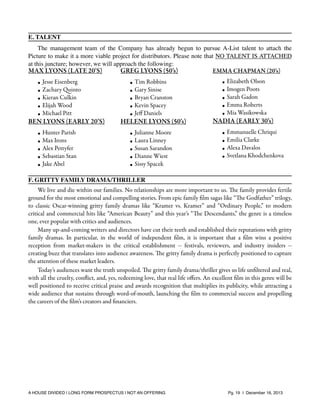
The management team of the Company has already begun to pursue A-List talent to attach the
Picture to make it a more viable project for distributors. Please note that NO TALENT IS ATTACHED
at this juncture; however, we will approach the following:
MAX LYONS (LATE 20’S)
GREG LYONS (50’s)
EMMA CHAPMAN (20’s)
•
•
•
•
•

Jesse Eisenberg
Zachary Quinto
Kieran Culkin
Elijah Wood
Michael Pitt

BEN LYONS (EARLY 20’S)
•
•
•
•
•

Hunter Parish
Max Irons
Alex Pettyfer
Sebastian Stan
Jake Abel

•
•
•
•
•

Tim Robbins
Gary Sinise
Bryan Cranston
Kevin Spacey
Jeff Daniels

•
•
•
•
•

NADIA (EARLY 30’s)

HELENE LYONS (50’s)
•
•
•
•
•

Elizabeth Olson
Imogen Poots
Sarah Gadon
Emma Roberts
Mia Wasikowska

Julianne Moore
Laura Linney
Susan Sarandon
Dianne Wiest
Sissy Spacek

•
•
•
•

Emmanuelle Chriqui
Emilia Clarke
Alexa Davalos
Svetlana Khodchenkova

F. GRITTY FAMILY DRAMA/THRILLER
We live and die within our families. No relationships are more important to us. The family provides fertile
ground for the most emotional and compelling stories. From epic family film sagas like “The Godfather” trilogy,
to classic Oscar-winning gritty family dramas like “Kramer vs. Kramer” and “Ordinary People,” to modern
critical and commercial hits like “American Beauty” and this year’s “The Descendants,” the genre is a timeless
one, ever popular with critics and audiences.
Many up-and-coming writers and directors have cut their teeth and established their reputations with gritty
family dramas. In particular, in the world of independent film, it is important that a film wins a positive
reception from market-makers in the critical establishment -- festivals, reviewers, and industry insiders -creating buzz that translates into audience awareness. The gritty family drama is perfectly positioned to capture
the attention of these market leaders.
Today’s audiences want the truth unspoiled. The gritty family drama/thriller gives us life unfiltered and real,
with all the cruelty, conflict, and, yes, redeeming love, that real life offers. An excellent film in this genre will be
well positioned to receive critical praise and awards recognition that multiplies its publicity, while attracting a
wide audience that sustains through word-of-mouth, launching the film to commercial success and propelling
the careers of the film’s creators and financiers.

A HOUSE DIVIDED | LONG FORM PROSPECTUS | NOT AN OFFERING !

!

!

Pg. 19 | December 16, 2013
MARKETING AND COMPETITIVE ANALYSIS
A. MARKET DESCRIPTION
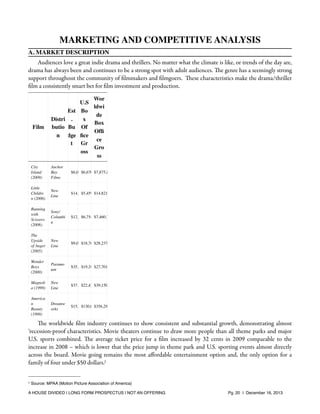
Audiences love a great indie drama and thrillers. No matter what the climate is like, or trends of the day are,
drama has always been and continues to be a strong spot with adult audiences. The genre has a seemingly strong
support throughout the community of filmmakers and filmgoers. These characteristics make the drama/thriller
film a consistently smart bet for film investment and production.

Film

U.S
Est Bo
Distri .
x
butio Bu Of
n dge fice
t Gr
oss

Wor
ldwi
de
Box
Offi
ce
Gro
ss

City
Island
(2009)

Anchor
Bay
Films

$6,000,000 $7,875,862
$6,670,712

Little
Childre
n (2006)

New
Line

$14,000,000 $14,821,658
$5,459,824

Running
with
Scissors
(2006)

Sony/
Columbi
a

$12,000,000 $7,460,797
$6,754,898

The
Upside
of Anger
(2005)

New
Line

$9,000,000 $28,237,190
$18,761,993

Wonder
Boys
(2000)

Paramo
unt

$35,000,000 $27,701,860
$19,389,454

Magnoli
a (1999)

New
Line

$37,000,000 $39,150,975
$22,450,975

America
n
Beauty
(1999)

Dreamw
orks

$15,000,000 $356,296,601
$130,096,601

The worldwide film industry continues to show consistent and substantial growth, demonstrating almost
‘recession-proof characteristics. Movie theaters continue to draw more people than all theme parks and major
U.S. sports combined. The average ticket price for a film increased by 32 cents in 2009 comparable to the
increase in 2008 – which is lower that the price jump in theme park and U.S. sporting events almost directly
across the board. Movie going remains the most affordable entertainment option and, the only option for a
family of four under $50 dollars.1
1

Source: MPAA (Motion Picture Association of America)

A HOUSE DIVIDED | LONG FORM PROSPECTUS | NOT AN OFFERING !

!

!

Pg. 20 | December 16, 2013
In 2009 and 2010, the leading Hollywood studios made more films and generated more revenue than ever
before, and for the first time in history the domestic box office grosses will surpass $10 billion. Neither the everincreasing piracy rates nor the global recession could prevent Hollywood having its best year ever in 2010. With
an estimated $10.8 billion in consumer spending at the US and Canadian box office, the movie industry will
break the 2008 record by nearly a billion dollars.2 Worldwide box office for all films reached $29.9 billion in
2009, up 7.6% over 2008’s total. International box office ($19.3 billion) made up 64% of the worldwide total,
while U.S. and Canada ($10.6 billion) made up 36%, a proportion consistent with the last several years. U.S./
Canada box office reached $10.6 billion in 2009, up 10.1% over 2008, and up 20.3% over five years ago.3
International box office increased 6.3% in 2009, with the largest growth (12.3%) in Asia Pacific. 81% of the
Asia Pacific increase occurred in Japan and China. Europe, Middle East & Africa (EMEA) remains more than
half (51%) of the international box office total.4
U.S./Canada movie admissions or tickets sold reached a five year high at 1.4 billion in 2009. Admissions
rose 5.5% from 2008, the first increase in two years. The national average of tickets sold per person (admissions
per capita) increased to 4.3 in 2009, the first increase since 2002.The 3D market was a key growth driver –11%
of 2009 box office, or $1.1 billion, came from 3D showings.5
B. TARGET MARKET
The Picture is geared toward the most active demographics in ticket sales within the entertainment industry:
young adults, the primary market; and mature adult and young couples as a secondary market. Spending trends
among young and adult filmgoers, television viewers, music listeners, and alternative target markets such as
online networks and video game players remains predictably strong.
The Company’s target market segments are:
• PRIMARY: 18-24 Years
• SECONDARY: 25-65 Years
C. COMPETITIVE PROFILES
The Company uses the team approach with aggressive pursuit, negotiation and production. Having been
involved with independent and studio feature film projects, the Company’s team relied on research, acumen and
discretion in selecting the Picture which has broad adult appeal while continuously tapping into the cultural
awareness both here in the United States and abroad. Our team of creative professionals and producers allows
the Company to form a differential advantage over the majority of entertainment companies.
The competition uses different, similar and sometimes the same means of distribution as A HOUSE
DIVIDED, LLC. Most companies in the entertainment business are run by executives who aren’t connected on
a first-hand basis with today’s youth and young adult target audiences and their ever-changing styles. The
Company feels that some of our competitors, on occasion are detached from the talent beds of America because
of their lack of desire to search for economically efficient, high concept and commercial projects geared toward
young adult markets. Their lack of aggressiveness will be overpowered by our own team who are ready to make
their mark on the entertainment community. Executives who aren't connected run most companies in the
entertainment business. By networking and using a team effort, the Company can beat the competition to the
hottest distribution deals, and, broadening out an audience in a new and cutting edge way.
2

Source: Slashdot.com, Hollywood sets $10 Billion Box Office Record

3

Source: MPAA (Motion Picture Association of America)

4

Source: MPAA

5

Source: MPAA

A HOUSE DIVIDED | LONG FORM PROSPECTUS | NOT AN OFFERING !

!

!

Pg. 21 | December 16, 2013
The competition remains focused on projects and traditional forms of marketing and advertising. Seizing
the new opportunities presented by the Internet and social media, the Company’s active social networking
community will build enormous and loyal fan bases around the globe. Through exclusive partnerships with
industry powerhouses and strategic production partnerships, the Company will fast become industry leaders
through an exclusive access community platform bridging the gap between entertainment and social content.
D. COMPETITIVE ADVANTAGES
i. Production Partnerships

The Company’s production strategy will capitalize off the Company’s production partnerships with
national/international production and post-production entities, state and national incentive/subsidy
programs, favorable exchange rates and various production cost benefits. Key to the Picture’s success is the
arrangements that the Company brings from international and domestic relationships. The Picture will
compromise a financial structure inclusive of a mix of the following country or state specific elements:
• Production Services
• Production Relationships
• Post-Production Relationship
• Government Film Agency -Subsidies/Incentives/Tax Credits
• Provincial Film Commission -Subsidies/Incentives/Tax Credits
• Bank -Country Specific Transaction Purposes
• Production Insurance -Country Specific Transaction Purposes
• Accounting Firm -Country Specific Transaction Purposes
• Legal Firm -Country Specific Transaction Purposes
The Company will select locations based on its cost effective working relationship with location intrinsic
production companies and production houses, knowledge of the area, general cost savings, and tax
considerations.
• Alternative locations offer significant cost advantages. Production costs can be substantially
reduced by taking advantage of lower labor costs, the utilization of government subsidies, tax
incentives, and financing deals.
• The Company has expertise in alternative location shooting. The Picture will benefit from our
knowledge of alternative locations and established relations with local partners in locations across
the USA.
The Company will work with dedicated production and post-production partners in Illinois on
advantageous terms. To maximize financial control, the Company will rely on trusted Line Producers
indigenous to each country or state. All films completed by the Company will have a credible Line
Producer, enabling us to identify script elements that may cause future budget overruns.

ILLINOIS TAX INCENTIVES
In December of 2008 the Illinois General Assembly passed the Illinois Film Production Tax Credit Act,
which offers producers a credit of 30% of all qualified expenditures, including post-production, and has no
sunset. The goal of the Tax Credit Act is to attract local vendors, union leaders and filmmakers to the Illinois
film industry in order to promote growth and job opportunities. In addition, the tax credit aims to stimulate
diversity in production hiring.
Tax Credit Benefits
• 30% of the qualified Illinois Production Spending.
A HOUSE DIVIDED | LONG FORM PROSPECTUS | NOT AN OFFERING !

!

!

Pg. 22 | December 16, 2013
30% credit on Illinois salaries up to $100,000 per worker.
Tax credit can be carried forward 5 years from when originally issued by IFO.
The yearly sunset provision has been removed so the IL Film Services Tax Credit does not expire.
Applicants will receive an additional 15% tax credit on salaries of individuals (making at least $1,000 in
total wages) that live in an economically disadvantaged area (at least 10% unemployment).
Rules/Requirements
• The tax credit must directly contribute to Illinois Production Spending.
• Illinois Production Spending includes tangible, personal property and services purchased from Illinois
vendors and compensation paid to Illinois resident employees.
• Illinois vendors qualify as businesses that have Illinois addresses.
• An Illinois resident qualifies as someone who has a valid Illinois state ID or drivers license, issued prior to
commencement of production.
• Compensation maximum is $100,000 for each Illinois resident employee.
• Must spend at least $50,000 in Illinois Production Spending for a project 29 minutes or under.
• Must spend at least $100,000 in Illinois Production Spending for a project 30 minutes or over.
• Receipts and financial materials must be processed by a certified public accountant.
•
•
•
•

OTHER USA STATE INCENTIVES
Production activities are increasing in many key states. The following are the top production states outside
of California and New York based on several factors. The Company will capitalize off these opportunities
if they meet the project’s necessities and fit within in the schematic of the project’s budget and financial
formula. The most attractive filmmaking production states for Company are:
• Arizona is one of the few states that can double for Los Angeles and also offers production
incentives. The state issues a transferable tax credit of 30% if in-state expenditures are more than
$1 million, or 20% with in-state spend of $250,000 to $1 million. The minimum spend
requirement is $250,000. Five percent of the statewide cap is now reserved for commercials and
music videos.
• Louisiana recently increased their transferable income tax credit to 30% of expenditures incurred
within the state, e.g., purchases made from a Louisiana vendor. Above-the-line resident and nonresident labor qualify for this incentive, which has no salary caps. An additional 5% employment
credit is offered on the first million dollars of each Louisiana resident’s payroll. Also, the state
now provides for an 85 cent buy-back of all certified tax credits for projects which receive their
initial certification on or after July 1, 2009, and has increased the digital interactive media credit
to 25%. The minimum in-state spend is $300,000 and there is no per production or statewide
cap. All fringes qualify.
• Michigan’s incentive are one of the most generous in the U.S.: a 40% rebate for all materials and
services purchased or rented from Michigan vendors; 40% for Michigan crew and all above-theline salaries; and 30% for any out-of-state below-the-line crew. There is a $2 million cap per hire,
but no per-year or per-project cap. Loan-out companies will qualify for the rebate, provided that
Michigan tax of 4.35% is withheld. The rebate will not be processed until all loan-out state
withholding taxes have been paid.
• Missouri’s State Tax Credits are issued to a qualified film production company for up to 35% of
the amount expended in Missouri (or up to 30% for qualifying out-of-state cast and crew when
Missouri income taxes are withheld) for production or production-related activities to facilitate
film production in Missouri. To become eligible, a film production company must have an
A HOUSE DIVIDED | LONG FORM PROSPECTUS | NOT AN OFFERING !

!

!

Pg. 23 | December 16, 2013
expected instate expenditure budget of at least $100,000 for films more than 30 minutes in
length. This tax credit can be carried forward five years and is sellable or transferable. The entire
film production tax credit program is capped at $4.5 million. The incentive continues to offer an
income tax credit equal to 25% of the total in-state spend if at least 50% of the movie is shot instate or more than half the production budget is spent in-state, without salary or annual
production caps. Recent proposed legislation planning to cap salaries at $2M was repealed.
Filmmakers may choose to receive the credit as a rebate, equal to 90% of the face value
(guaranteed and rebated by the state), or the credit may be transferred or sold at the current
market rate.
• North Carolina provides a refundable income tax credit equal to 25% of all the goods, services,
and labor purchased and used in-state. There is a hire cap of $1M per person and any excess is
excluded from the production’s qualifying expenses. The maximum credit per feature film is $7.5
million and the minimum spend is $250,000. There is no cap on other types of eligible
production expenses. The gross amount of the film credit is subject to the 6.9% corporate income
tax (for those who are filing as a corporation), which reduces the net rebate check. Compensation
and wages paid to both resident and non-resident employees qualify if the services are performed
in North Carolina and withholding payments are remitted to the Department of Revenue.
• Oklahoma’s Film Enhancement Rebate Program provides a rebate of 35% (plus a 2% bonus for
local music) of documented expenditures made in Oklahoma directly attributable to the
production of a film, television production or commercial. Crew includes salaries paid to loan
out companies, provided they have registered to do business in the state, but cannot compromise
more than 25% of the total rebated amount.
• Pennsylvania’s film incentive provides a 25% transferable tax credit, with a maximum of $75
million available per fiscal year. The most recent budget allocated $42 million for the current
fiscal year, and $60 million for fiscal year 2010-2011. To qualify, 60% of the total production
spend, including post, must be for “qualified Pennsylvania expenses.” The incentive is then
calculated on the qualified (i.e., Pennsylvania) expenses. Cast and crew need not be Pennsylvania
residents, provided their wages are subject to state taxes. Also, goods and services necessary for
the production of the film qualify, but they must be purchased from Pennsylvania vendors or
through a Pennsylvania service company. There is an aggregate talent cap of $15 million per
picture.
While tradable State Tax Credit Incentive Programs have existed for years, the recent addition of tradable
Film Tax Credit Programs to the marketplace has fueled a frenzied competition among states to attract
filmmakers. Nearly every state in the US is offering a version of incentives, either in the form of a direct
rebate or as a tradable tax credit. The recoupment timeline would consist of the payment from the State
Tax Rebate Program and the revenue streams listed within a twelve to eighteen (12-18) month time
period from the start of production. This process usually takes 45-90 days, and can be monetized and
expedited at a discount at any point upon signing of the contract with the deciding body of the state or
governmental organization.
ii. Cutting-Edge Digital Technologies

The Company intends to use new digital technologies to further reduce costs. Digital technologies have
proven to substantially reduce production costs and the Company intends to be at the forefront of this
technological revolution. The Company has forged alliances with leaders in nonlinear high-definition
postproduction, specializing in post-supervision, offline editorial, online, color correction, and graphic
A HOUSE DIVIDED | LONG FORM PROSPECTUS | NOT AN OFFERING !

!

!

Pg. 24 | December 16, 2013
design for film and TV. Being highly versed in HD and digital technology positions us to stay on the
cutting edge of technological advancements. Moreover, this gives us the stage to achieve greater
production value at a post-production cost that could be expedited by up to 20%, thus saving productions
an enormous amount of money while not losing quality.
Worldwide cinema screens have remained constant over the past five years at just under 150,000 screens.
During that period, however, the growth in digital screens has accelerated. More than 16,000 screens or
11% of the total have been upgraded to digital. International screens – particularly in Europe –
constituted the majority of global digital screen growth in 2009. As a result, for the first time ever there
6

are now more digital screens internationally than in North America.

Digital cinematography accounts for a larger fraction of feature movie shooting every year and appears
destined to eventually eclipse film-based acquisition much as digital photo cameras have largely replaced
film based photo cameras in the still photography world. While most major motion pictures are still shot
on film, digital cinematography has gained widespread acceptance over the last few years. In 2009, the
Academy Award for Best Cinematography was awarded for a movie mostly shot digitally: “Slumdog
Millionaire.”
Many vendors have brought products to market including traditional film camera vendors like Arri and
Panavision, as well as new vendors like RED and Silicon Imaging, and companies which have traditionally
focused on consumer and broadcast video equipment like Sony and Panasonic. The Company plans to
utilize the newest, most advanced and most exciting forms of digital technology to not only reduce cost
but capture and create images in pioneering and proactive new forms.
iii. New Media Marketing and Distribution

In addition to marketing the film via traditional routes, the expansion of film festival and viral marketing
techniques, enables the Company to start on aggressive grassroots campaigns via social media portals.
Penetration of the social media outlets coupled with the Picture’s own purpose-built website, quickly and
effectively creates massive awareness and sparks a groundswell of interest.
It wasn’t long ago that content owners were reluctant to offer online entertainment due to piracy fears and
uncertainty over their “old model” advertising and syndication revenues. But growing consumer time
spent with online media, along with memories of the crisis the music industry faced for not embracing
change, have led to an explosion of online entertainment and news. At the same time, the emergence of
free blog publishing services and the cultural trend of social networking have led many web users to
create, post and read user-generated content. For companies like A HOUSE DIVIDED, LLC, our
content can be easily mapped and searched for online, along with their insider knowledge of film industry
news, the online entertainment and news phenomenon is presenting attractive new business
opportunities.
Accompanying the explosion in online media have been the dollars flowing into the space in advertising,
acquisitions and consumer spending on web video entertainment. Internet video is growing as users are
subscribing to their favorite entertainment sites and buying downloads a la carte. Due to the loyalty of
drama fans, the Company expects that downloads of digital content and web series will be a significant

6

Source: MPAA (Motion Picture Association of America)

A HOUSE DIVIDED | LONG FORM PROSPECTUS | NOT AN OFFERING !

!

!

Pg. 25 | December 16, 2013
business. Including advertising revenues, IDC (International Data Corporation) estimates a 50% CAGR
in the Internet video market over the next five years. 7
Production company websites, and more specifically, drama sites are scattered throughout the web, but
without focus. The Company’s goal is to create a branded site that is the first stop for all entertainment
fans, and in A HOUSE DIVIDED’s case – all drama fans and poker fans. TV and film-related content
may be found on a studio, production company, or movie download site, while industry news and fan info
may be featured on other competing sites. As of yet, however, there are few sites providing reliable overall
entrainment media network communities directly driven to the Company market and future fan base.
The Company views this as a significant opportunity.
Though websites can be built in a matter of days, it’s important to remember it takes months for a new site
to blossom into an effective marketing tool. For this reason, the Company will create our sites as early in
the development and preproduction process as possible. As a rule of thumb, websites take six months to
mature. And somewhere in the six-month range, traffic patterns develop consistency and visitor averages
are roughly the same from day to day.
And while television and radio remain the cornerstones of picture marketing spends, gobbling up 60% to
70% of a promo campaign's budget, audiences are dipping into everything from, Twitter to text messages
to Facebook to TV and the Internet -often simultaneously. The studios are spreading their marketing
dollars wider, across multiple venues, with multiple trailers, multiple approaches and specific demos in
their sights. There are no longer general-interest campaigns. Other marketing traditions such as static
movie billboards have also become an endangered species or have been shifted to supplement online
campaigns, as Sony did with “District 9.” Studios still devote 8% to 12% of their total marketing
campaigns on outdoor, but that number used to be much closer to 20%. It's a reflection of the increasingly
cluttered media environment that building awareness of a movie now demands more than just delivering a
message passively to prospective audiences. It's now about engaging them more directly.
Social media has modernized how to reach consumers in a new way; through the internet. In recent years
social mediums have drastically grown. This has tremendously increased the number of consumers that
producers are able to reach. Social mediums have not only grown in popularity with the increase in
consumer participants, but social mediums have also expanded globally. Twitter, for example has
expanded its global reach to Japan, Indonesia, and Mexico to name a few. This means that brands are now
able to advertise in multiple languages and therefore empower brand and consumer reach and ultimately
improve their brand awareness. Social media has become the new ‘tool’ for effective business marketing
and sales.
Social media can take many different forms, including Internet forums, weblogs, social blogs,
microblogging, wikis, podcasts, pictures, video, rating and social bookmarking. Technologies include:
blogs, picture-sharing, vlogs, wall-postings, email, instant messaging, music-sharing, crowdsourcing, and
voice over IP, to name a few. Many of these social media services can be integrated via social network
aggregation platforms like Mybloglog and Plaxo.
Examples of social media software applications include: 8
a. Communication

7

Source: IDC

8

Source: Wikipedia

A HOUSE DIVIDED | LONG FORM PROSPECTUS | NOT AN OFFERING !

!

!

Pg. 26 | December 16, 2013
• Blogs: Blogger, LiveJournal, Open Diary, TypePad, WordPress, Vox, ExpressionEngine, Xanga
• Micro-blogging / Presence applications: FMyLife, Jaiku, Plurk, Twitter, Tumblr, Posterous,
Yammer, Qaiku
• Social networking: Facebook, Twitter, Geni.com, Hi5, LinkedIn, MySpace, Ning, Orkut,
Skyrock, Qzone, Vkontakte, RenRen, Kaixin, ASmallWorld, studivz, Xing, RunAlong.se, Bebo,
BigTent, Elgg, Hyves, Flirtomatic
• Social network aggregation: NutshellMail, FriendFeed
• Events: Upcoming, Eventful, Meetup.com
b. Collaboration
• Wikis: Wikipedia, PBworks, Wetpaint
• Social bookmarking: (or social tagging): Delicious, StumbleUpon, Google Reader, CiteULike
• Social news: Digg, Mixx, Reddit, NowPublic
c. Multimedia
•
•
•
•

Photography and art sharing: deviantArt, Flickr, Photobucket, Picasa, SmugMug, Zooomr
Video sharing: YouTube, Viddler, Vimeo, sevenload, Zideo
Livecasting: Ustream.tv, Justin.tv, Stickam, Skype, OpenCU
Music and audio sharing: MySpace Music, The Hype Machine, Last.fm, ccMixter,
ShareTheMusic

• Presentation sharing: slideshare, scribd
d. Reviews and opinions

• Product reviews: epinions.com, MouthShut.com
• Business reviews: Customer Lobby, yelp.com
• Community Q&A: Yahoo! Answers, WikiAnswers, Askville, Google Answers
e. Entertainment
• Media and entertainment platforms: Cisco Eos
• Virtual worlds: Second Life, The Sims Online, Forterra
• Game sharing: Miniclip, Kongregate
f. Brand Monitoring
• Social Media Monitoring: Sysomos Heartbeat
• Social Media Analytics: Sysomos MAP
The Company sees clearly this transition period within the entertainment industry as a phenomenal
opportunity. Through the use of a vast array of social media applications and networks, the Company will
aggressively harness the new pathways for marketing and distribution previously unavailable to production
companies and independent films.
The Company’s specialized new media marketing methodology will:
• Engage branded integration, product placement, sponsorships and lifestyle marketing;
• Leverage Company project and company’s brand assets, thus maximizing exposure, building brand
awareness, increasing sales, and meeting brand goals; and
• Drive ultra-targeted primary and secondary traffic growth exponentially via the Company’s own in-house
marketing and cross-pollination with other high-profile industry/non-industry partnerships, high quality
links, promotions and online campaigns.
A HOUSE DIVIDED | LONG FORM PROSPECTUS | NOT AN OFFERING !

!

!

Pg. 27 | December 16, 2013
iv. Branded Entertainment

The Company will partner with the top Entertainment Branding and Marketing agencies for public
relations, marketing and promotions specializing in strategic business consultation and creative, attentiongrabbing consumer campaigns for entertainment. These partners will:
• Marry brands with entertainment properties and/or like-minded brands to create synergistic and
meaningful strategic alliances;
• Specialize in partnership marketing branded integration, product placement, promotions,
sponsorships and lifestyle marketing;
• Represent entertainment properties and brands alike; the Company will work closely with our
clients to ensure that objectives and budgets are met;
• Create innovative entertainment promotions that leverage each partner’s brand assets, maximize
brand exposure, build brand awareness, increase product sales and meet brand goals.
The approach will focus on entertainment alliances fostering deeper relationships between brands and
consumers by endowing products with intrigue and glamour, setting them apart from competitors; brandto-brand partnerships engage consumer loyalty to broaden product reach; and brand integrations and
placements enable brands to connect with consumers/viewers in a space that their customer is already
engaged.
The process will work closely with brand management; will analyze brand traits, strategies and objectives
to identify key partnerships; and will craft fully integrated marketing and promotional partnerships that
can be executed locally, regionally, domestically and/or globally.
Services Company will seek from its Branded Entertainment partners will be:
• Partnerships and sponsorships
• Product placement
• Theatrical
• Promotions and sweepstakes
Home Entertainment
•
• Licensed merchandise
• Television
• Lifestyle marketing
• Music
• Screening programs
• Video Games
• Complete program design
Web Series
•
• Ideation
• Dedicated online presence
• Program Management & Execution
• New Media/Social Media
• Trade & Sales Incentives
• Brand-To-Brand
• Cross-Promotions
Branded integrations
•
• Premiums
The branded entertainment partnerships will create consumer-relevant entertainment alliances and brand
partnerships that:
•
•
•
•
•
•

Drive off-shelf performance;
Leverage media buys;
Increase product exposure;
Maximize promotional value;
Create a complete 360-degree consumer experience; and
Meet with brand budgets.

A HOUSE DIVIDED | LONG FORM PROSPECTUS | NOT AN OFFERING !

!

!

Pg. 28 | December 16, 2013
SALES AND DISTRIBUTION PLAN
A. DISTRIBUTION CHANNELS
NOTE: Both Preferred Content or Cassian Elwes ARE NOT ATTACHED, but we have had multiple
conversations with both parties and they have both expressed strong interest in the Motion Picture for coming
on as SALES AGENTS to rep the film for distribution and film festivals.

Cassian Elwes
Elwes began his producing career with 1983's "Oxford Blues" starring Rob Lowe and Ally Sheedy and
quickly went on to make another 29 films, including "Men at Work", with Emilio Estevez and Charlie Sheen,
and "The Chase" with Sheen.
In 1995, Elwes joined William Morris. His first effort was the long stalled project "The English Patient"
which won best picture that year. He quickly followed up with such indie hits as "Slingblade" and "The Apostle,"
both of which were nominated for multiple Oscars. "Monster's Ball" was their follow up, which won the Oscar
for Halle Berry.
The Hollywood Reporter has said that Elwes was "involved in a virtual who's who of every great
independent film of the last ten years" with films such as "Thank You For Smoking", "Half Nelson", and "Frozen
River" '(the last two of which garnered Oscar nominations for Ryan Gosling and Melissa Leo respectively).
"What people lose sight of," Elwes said to Screen International, "is that these films cost a tenth of the films
that they competed against at the Academy Awards. The privilege was the recognition."
Elwes is an expert in the field of arranging financing and distribution for independent films having done so
for 283 films during his tenure at William Morris Independent.
Since leaving William Morris Independent two years ago, Elwes has been involved in arranging financing
and distribution for 23 films including "Lawless," directed by John Hillcoat ("The Road"), starring Shia LaBeouf
and Tom Hardy, and the thriller "The Paperboy," directed by Lee Daniels ("Precious"), starring Matthew
McConaughey and Zac Efron. Elwes produced the period drama The Butler, which was directed by Lee Daniels
and featured an ensemble cast, including Forest Whitaker, Oprah Winfrey, John Cusack, Jane Fonda, Terrence
Howard, Vanessa Redgrave, Alan Rickman, Liev Schreiber, and Robin Williams, among others.
Additionally, he is producing "Dallas Buyers Club" starring Matthew McConaughey and Jennifer Garner,
"Saints" starring Rooney Mara, Casey Affleck and Ben Foster, and "Hateship, Loveship" starring Kristen Wiig,
Guy Pearce, Hailee Steinfeld and Nick Nolte.
On October 29, 2013, Elwes launched the Cassian Elwes Independent Screenwriter Fellowship, in
conjunction with The Black List, to award one writer an all-expenses-paid trip to the 2014 Sundance Film
Festival and mentorship from Elwes. Elwes and The Black List plan to award the fellowship annually

PREFERRED CONTENT / KEVIN IWASHINA
Kevin Iwashina is a Managing Partner of Preferred Content, a film sales, project finance and media advisory
company.
Founded in January 2010, Preferred Content (PC) is one of the premiere brokers of North American
distribution rights for both fictional and non-fictional filmed entertainment content. Additionally, PC is a
leading supplier of independent movies with a specialization in low budget genre and documentary features.
In addition to his responsibilities at PC, Iwashina is the Co-CEO of Preferred Film & TV (a film, television and
digital production company launched in partnership with Content Media Corporation), Managing Partner of
Preferred Ventures (a digital media investment fund), Co-President of City Room Creative (a video editing and
production services company) and Managing Partner of Killer Digital (an original content company partnered
A HOUSE DIVIDED | LONG FORM PROSPECTUS | NOT AN OFFERING !

!

!

Pg. 29 | December 16, 2013
with Christine Vachon's Killer Films that specializes in content for distribution on digital platforms).
Prior to founding PC and his suite of affiliated companies, Iwashina spent 10 years at the Creative Artists
Agency (CAA), where he was a talent agent, specializing in film packaging, financing and distribution.
Iwashina holds a B.A. in English Literature with a minor in French Language and Culture from U.C.L.A. He is
active in the non-profit and political sectors and currently serves as the Vice Chairman of the Board of Directors
of the Coalition of Asian Pacifics in Entertainment (CAPE) and is a Member of the Board of Directors of the
International Documentary Association (IDA). He began his career in the mailroom at the United Talent
Agency (UTA).
B. PROJECT DISTRIBUTION STRATEGY
Television sales for a film can return revenue over many years if the audiences receive it as a classic. Drama/
Thriller pictures ranging from “Disturbia,” to “American Beauty,” to “The Breakfast Club,” among hundreds of
others, are all household names that continue to play on television. This is an important factor since distributors
and networks are constantly looking for new material. Secondary markets including DVD sales/rentals coupled
with ancillary market revenue streams such as merchandising, video games, publishing of graphic novels and
comic books, and music will all lend themselves favorably toward producing substantial revenue when licensed
or sold as soundtracks, apparel, toys or other goods based on the film’s story and characters. With cheap rental
services like Redbox eating into profits, the studios are turning to video-on-demand; an area that the Company
will strategically focus on and use as both a primary and supplementary form of distribution and exposure.
Over the last ten years, entertainment and character licensing has grown tremendously. Merchandise
licensing affords the Company opportunities to enhance brand image and increase revenue streams from the
Picture. Licensors receive a royalty payment that is usually a percentage of the net wholesale price of the
product. This royalty stream adds another low-risk cash flow that, because the licensor incurs no manufacturing
or marketing costs, translates directly into profits. Not only one of the most popular types of licensing, it is also
one of the most profitable. The International Licensing Industry Merchandisers’ Association (LIMA), the
leading trade organization that also tracks licensing data, estimates overall North American retail sales of
licensed merchandise to be about $110 billion, with royalties of about $6 billion. Of retail sales, historically
about 45% have come from character and entertainment licensing. Last year, LIMA’s statistical survey put
North American entertainment property royalty revenues at $2.6 billion.9
There is a critical shift underway in the marketplace today, as media services are becoming increasingly
digitized and interactive, and advances in compression technology are reducing the bandwidth requirements.
The network access bandwidths widely available as consumer services are increasing. The convergence of these
trends coupled with advanced telecommunications capabilities and media-rich content is fundamentally
changing the nature of on-demand service delivery. Because the technology makes content almost instantly
accessible, customers have come to expect anywhere, anytime delivery of very high-quality video and other rich
media types to both wired and mobile devices. Video-on-demand (VOD), for example, is expected to grow to a
very respectable $35 billion industry worldwide by 2014.
Television VOD systems either stream content through a set-top box, allowing viewing in real time, or
download it to a device such as a computer, digital video recorder (also called a personal video recorder) or
portable media player for viewing at any time. The majority of cable-and telco-based television providers offer
both VOD streaming, including pay per-view and free content, whereby a user buys or selects a movie or
television program and it begins to play on the television set almost instantaneously, or downloading to a DVR
rented from the provider, or downloaded onto a PC, for viewing in the future. Internet television, using the
9

Source: LIMA

A HOUSE DIVIDED | LONG FORM PROSPECTUS | NOT AN OFFERING !

!

!

Pg. 30 | December 16, 2013
Internet, is an increasingly popular form of video on demand. VOD is expected to grow exponentially, creating a
host of opportunities. Ongoing changes within each of the media, technology and telecom sectors guarantee
that video-ondemand will become a major force in media delivery over the next few years.
Highlighted examples of the rapid growth of VOD include: global annual revenue from rental transactions
of full-length movies and TV shows on Pay-TV and online platforms generating $2.2bn in 2008, forecasted to
grow to $3.7BN by 201410 ; VOD will generate $330 million a year (in the UK) in ‘direct revenue’ by 201311 ;
the sum of all forms of video (TV, video on demand, Internet, and P2P) will account for over 91% of global
consumer traffic by 2013, with Internet video alone will account for over 60% of all consumer Internet traffic in
201312 ; Digital media revenue will jump about 270% between 2009 and 2013 to $3.28 billion13 . The total home
entertainment market in the US (all platforms – DVD/BD, TV-based VOD, online video and mobile video) is
projected to generate over $25 billion in revenues in 2009. Paid-for VOD revenues are expected to witness
steady growth moving forward, as the closure of VOD windows increases the appeal of premium on-demand
content. Global revenue for digital formats will grow to $2 billion in 2013, from about $500 million this year.
US revenue in the first half of the year was about $140 million.14
Video on Demand services and their accompanying digital video set-top boxes continue to improve. The
Roku digital video player has been solely a way to stream Netflix' Instant Watch movies to your TV at a cost of
$99 for over 12,000 titles. And now Roku is teaming up with Amazon to provide access to their 40,000 titles
available on Amazon Video on Demand. Roku owners will soon be able to buy or rent titles to instantly stream
from the Amazon Video on Demand service, some films being released the same day they come out on DVD.
LG has essentially put the VOD box directly in the television with the new ‘broadband HDTVs’ (in both LCD
and Plasma) will be able to instantly stream the Netflix selection of on demand films. Again, this is a new and
exciting area of distribution that the Company plans to fully incorporate into our business model and
distribution strategy.
i. Distribution Approach

Every film needs a customized distribution strategy. The Company will be creating a strategy for the
Picture well before the film enters production, thus increasing awareness and striving for the highest
possible revenue streams available. Some of these strategies include:
a. Split Distribution Rights in Foreign Territories
While in the old world of distribution all domestic rights were usually given to one company; hybrid
distribution enables rights to be split more finely and effectively. This enables filmmakers to retain
direct sales rights including the right to sell DVDs from their websites and at screenings while
holding the rights to sell downloads and rentals from their sites. Most often filmmakers also retain
theatrical and semi-theatrical. VOD, television, and retail DVD deals are usually made with separate
distribution partners. Deals are often made with educational partners but some filmmakers are
retaining these rights. Digital rights for avenues like iTunes are more complicated—they are
sometimes given to the retail DVD distributor or the VOD distributor and sometimes licensed
separately.
10

Source: Adam Media Research, a division of Screen Digest

11

Source: Paid Content, UK quoting Claire Enders speaking at the Westminister eForum on September 15th

12

Source: CISCO. Forecast and Methodology 2008-2013

13

Source: Futuresource Consulting research

14

Source: Screen Digest, analyst Arash Amel cited in an article of videobusiness.com

A HOUSE DIVIDED | LONG FORM PROSPECTUS | NOT AN OFFERING !

!

!

Pg. 31 | December 16, 2013
Rights can be usefully divided into eight domestic and international categories:
• Theatrical
• Retail DVD
• Semi-Theatrical & Non-theatrical
• Direct DVD
• Video-On-Demand
• Educational
• Television
• Digital Rental & Download
While splitting up rights is complicated and time consuming, it allows each right to be exploited well,
avoids cross-collateralization (where expenses from one area of distribution eat away at revenues from
others), and allows a filmmaker to retain overall distribution control.
b. Choose Effective Distribution Partners in each territory worldwide
In the old world where all domestic distribution rights were usually lumped together, certain rights
were often poorly utilized or completely overlooked. In the new world, it is important to determine
how best to exploit every right without neglecting any of them.
Filmmakers can handle some rights most successfully on their own. In other areas, the goal is to find
the distribution partner, or sales agent, with the skills and experience to be most effective. Ideally this
partner has an impressive track record with similar films or particular niche audiences. Before signing
any deal with a distribution partner, it is essential to speak with other filmmakers currently or recently
in business with the company.
c. Circumscribe Rights
Grant each distribution partner only the specific rights they can handle well. For example, if a
company is strong in retail DVD and digital, give them these rights, but do not also give them VOD
if they have no experience with VOD. Carefully limit the rights (scope, term, exclusivity) granted to
each partner. Make sure the rights given to different distributors complement each other without
conflicting. Make as many deals as possible at the same time so the rights given in one area do not
subsequently prevent you from making deals in other areas.
d. Craft Win-Win Deals
Design deals that will work well for both your distribution partner and you. Divide revenues fairly
and define responsibilities clearly. Build in guarantees (e.g. minimum number of cities and marketing
spend, performance guarantee), approvals (e.g. deals, marketing, editing), and safeguards (e.g. escape
clauses, expense cap, bankruptcy protection, limits on assignment, dispute resolution).
e. Retain Direct Sales Rights
Retain the domestic and international rights to sell DVDs (from your website and at screenings) and
downloads and streams (from your website). Also retain the rights to screen the film theatrically and
semi-theatrically. Direct sales are the lynchpin of a hybrid distribution strategy. They have four
significant advantages over third-party sales:
• Higher profit margins – A DVD sold directly from a filmmaker’s website can easily yield profit
margins 7-8 times as high as DVDs sold in retail.
• Faster payment – Filmmakers usually receive payments faster from PayPal or a fulfillment
company than they would from a distributor.
• Revenues aren’t split with middlemen – Filmmakers receive all of the revenues, after
manufacturing and fulfillment costs.
A HOUSE DIVIDED | LONG FORM PROSPECTUS | NOT AN OFFERING !

!

!

Pg. 32 | December 16, 2013
• Customer information – Filmmakers receive data on all customers who make purchases from their
websites, but do not get any information on consumers who buy through third-party retailers.
This data enables filmmakers to stay in touch with purchasers and offer them other products.

f. Maximize Direct Revenues
In addition to selling DVDs directly from their websites, filmmakers can also sell other products they
produce (e.g. soundtrack albums, companion books, posters, hats, and t-shirts). Filmmakers can also
purchase related products from third parties (e.g. books, DVDs, CDs) that will be of particular
interest to their audiences. As online retailers, they can buy these products at wholesale and resell
them from their sites at retail.
g. Grow And Nurture Audiences
Independents can expand their films’ audiences by building mailing lists, communicating effectively
and developing ongoing relationships with subscribers. They should provide them with valuable and
engaging content, while keeping sales pitches to a minimum. They should also create a content-rich,
dynamic, and interactive website that encourages participation. Their ultimate goal is to develop a
core personal audience that can support future projects through contributions and purchases.
ii. INVESTMENT and EXIT/PAYBACK STRATEGY

There are several elements the Company can entertain in order to offset the investment exposure with
regards to the Picture. The Company will implement, if feasible for the project, tax credits and subsidies,
branded content and product placement/corporate sponsorship, and most importantly, pre-sales in order
to expedite recoupment and insure the investment in the project. As soft monies return into the fold, via
pre-sales, additional subsidies, or assorted contracts, recouped early in the production process of each
film, these will serve as quick avenues to returning investment. Naturally, any investor financing would be
in a first position of recoupment and secured by a lien on the ownership (all rights) of the film title and all
revenue (Theatrical Box Office receipts, Rentals, Pay Cable/TV, Network TV, DVD Sales, and any/all
Residuals) into perpetuity until the original investment plus interest has been fully recouped. At such
time of full recoupment the lien on the title will be released back to the Company.
The Company will focus on international sales companies who support products that funnel directly into
the commercial marketplace and who specialize in drama and low-budget motion pictures. The
Company’s goal will be to secure an international sales agent early in the production process. This will
allow the agent to use key festivals such as Sundance, Berlin, Cannes, and the Toronto Film Festival to
introduce the film to the world marketplace. Sales will continue on through the American Film Market
(AFM). The Company will engage a sales rep who specializes in the US marketplace to help us maximize
our sales opportunities. Our plan for distributing projects produced by the Company will utilize markets
and festivals as a platform for sales, but the Company will not proceed forward without having sales
agents and potential distributors earmarked having reviewed and expressed genuine interest in the
Picture.
Internationally, the Company will utilize the festival circuit as platforms for international screenings and
sales. Again, broad-based genre films are very popular in both North America as well as in Europe and
internationally as a whole. Movies now often earn more of their box office overseas than they do in the
U.S., and a film's performance in Italy or Russia is as important as its New York City numbers. Just look at
A HOUSE DIVIDED | LONG FORM PROSPECTUS | NOT AN OFFERING !

!

!

Pg. 33 | December 16, 2013
the $687 million haul of Fox's "Ice Age: Dawn of the Dinosaurs" around the world (77% of its gross)
compared with $197 million domestically. In 2009, Sony passed the $2 billion mark overseas for the first
time ever with pictures like “2014” and the Michael Jackson documentary “This Is It” appealing to
international audiences. It was the fourth studio to ever do so, with Warner Bros., Paramount and Fox also
reaching that milestone this decade.15
Utilizing a risk-mitigating model centered on a portfolio of projects focused on a high-profile genre and
demographic, cost-reducing methods of production, and key sales alliances, the Company will see a rapid
acceleration of recoupment and fast entry into a library of exponentially growing revenues.
This has opened up a whole new area for both private and institutional investors to enter and negotiate
better deals with a more favorable recoupment position and participation. The recent slowdowns of real
estate and the stock market in delivering solid returns has helped shift Wall Street’s focus to Hollywood as
the worldwide film industry continues to show consistent and substantial growth, demonstrating
‘recession-proof ’ characteristics.
Additionally, as the Company will utilize 10% of the overall equity raise for operational and discretionary
expenses, each Investment Partner will be given a pro rata share of equity in A HOUSE DIVIDED, LLC.
Definition of Receipts: For purposes of this, production shall mean that all monies actually received by
the distributor and the production, including all subsidiaries, parent and affiliated companies involved in
the production and/or exploitation of the picture, from all sources of exploitation of the picture after
deduction of taxes, duties, tariffs and similar costs required be paid in connection with the exploitation of
the picture.
a. International Pre-Sales and Distribution
If sensible, A Foreign Sales Agency Agreement should be executed prior to production. In addition,
production should review the potential candidates and identify a priority listing based upon their
current portfolio, ability to sell our product, output deals, and most importantly the ability to make
collections once the territory is sold.
Again there should be minimal selling of the property to the foreign marketplace until after the North
American distributor is confirmed to increase the potential foreign revenue with a domestic theatrical
release – the ultimate distribution goal. After which, the international sales can continue throughout
the year based on what the buyers appetite & needs are with respect to levels of guarantees/valuations.
The following is a partial list of Foreign Sales Agents Company looks to forge relations with:
• Lionsgate/Summit Entertainment
• Canal Plus
• Hyde Park Films
• Gold Circle Films
• IM Global
• ContentFilm International
Q.E.D. International
•
• Cinetic Company
• Voltage Pictures
• Lakeshore Entertainment
• Icon Entertainment
• Submarine Entertainment
• E1 Entertainment
• Nu Image/Millenium
Film Nation
•
• BOLD Entertainment
• K5 International
• Odd Lot Entertainment
• Wild Bunch
15

Source: Variety, ‘Decade Changed Film Biz’ - 2009

A HOUSE DIVIDED | LONG FORM PROSPECTUS | NOT AN OFFERING !

!

!

Pg. 34 | December 16, 2013
ii. North American Theatrical Pre-Sales and Distribution

Securing North American Distribution is the obvious engine that drives all other valuations, negotiation
leverage, and product placement efforts. For all major business decisions, there will be a management
committee, led by members of the Company that will oversee any major financial or distribution-oriented
deal.
The following is a partial list of domestic distributors to forge relations with:
• Focus Features
• Patriot Pictures
th
• Union Patriot Capital
• 20 Century Fox
• Relativity Media
• The Weinstein Company
• Fox Searchlight
• Lions Gate
• Focus Features
• Sony Pictures
• Original Films
• Warner Bros. Studio
• Escape Artists
• NBC/Universal
• Fortress Investment Group
• Fox Studio
• Skydance Pictures
• Dreamworks Studio
• Participant Media
• Dreamworks Animation
• Scott Free Productions
• Disney
• New Line Cinema
• Legendary Pictures

A HOUSE DIVIDED | LONG FORM PROSPECTUS | NOT AN OFFERING !

!

!

Pg. 35 | December 16, 2013
INVESTMENTS AND FINANCIALS
Investing in a Motion Picture has a multitude of elements that can make it not only rewarding, but also very
exciting. There is no other business that brings the glitz and the glamour to an individual experience than that of
a feature length picture. From giant sets, movie stars and down to the intricacies that go into the physical
production, to the premiers, red carpets, and film festivals, it is something that few ever get to see first hand.
(See the Conclusion for a list of benefits as an Investor)
Still, with all the thrills that it brings, there is also a notable amount of risk. However, through the
established managers of the Company, their extensive knowledge, background in the entertainment industry,
and the contacts that they all bring, those risks can be minimized. It is still best to look at the whole picture and
understand the pros and cons of investing in the Picture.
A. STATE OF INDUSTRY
Over the last ten years, Wall Street has favored asset-based transactions. It’s now evolved toward packaging
other types of assets, which has led to backing content and intellectual property, i.e. entertainment, and
specifically motion pictures. And with the recent slowdowns of real estate and the stock market in delivering
solid returns on investment this has helped shift Wall Street’s focus to Hollywood.
That's opened up a whole area for investors, both private and institutional, to come in and negotiate better
deals and have a more favorable recoupment position and participation in these films. With studios focused on
the major releases, and fewer products in the distribution chain to offset flops, they have no choice really but to
partner with independent sources to not only provide product for the other distribution markets, but also to
mitigate risk on the larger, big event pictures. This is one of the most important reasons why studios began
working with hedge funds. Other reasons for this movement are:
• The number of studios that are now publicly traded is at it a peak.
• The parent companies want them to leverage more capital without diluting their shares, or control, or risk
weakening the balance sheet.
• The studios are looking to defray costs by an average of 40% -50%, and by using less of their own money
they increase the likelihood of jumping the return on the invested (on-the-books) capital to its
shareholders.
This means investors will:
• Receive greater participation;
• Lower risk; and
• Increased investor profit.
These new opportunities have created the foundation for the Company and our potential investors to
become involved at a more participatory level.
B. FINANCIAL SUMMARY
The Company has adopted strict financial protocols to ensure prudent use of funds and to maximize
Investment Partner returns. The Company’s total cash flows are used first to repay the production equity, and
then flow through the profit waterfall at a 90/10 split. Investment Partners receive 90% of all returns until 120%
of the initial investment has been recovered. The other 10% will go to the Company to support they’re efforts to
recoup all revenue generated by the picture. Of the remaining net profits, Investment Partners receive 50% and
the Company receives 50%. In addition, the Picture that the Company intends to produce will earn ancillary
revenue (i.e. video-on-demand, syndicated and cable TV, merchandising) at similar levels of feature films
costing up to ten times more. When the film becomes successful in the marketplace, all proceeds from the film
A HOUSE DIVIDED | LONG FORM PROSPECTUS | NOT AN OFFERING !

!

!

Pg. 36 | December 16, 2013
paid to the LLC, after deduction of the fees and expenses owed to distributors and sales agents from worldwide
gross receipts for all media will be paid out as follows:
• Each investor shall recoup, on a pari passu basis with all other investors, one hundred and twenty percent
(120%) of said investor’s contributed funds. By way of example, if an individual’s investment is $50,000,
he/she would recoup $60,000 prior to payments to any other party, except for other equity investors;
• After the Picture’s budget (or 120% of the final Picture budget) has been allocated to the equity investors
any outstanding residuals and/or deferred payments will be distributed.; and
• Following these distributions, further proceeds will be split, with 50% going to the investors and 50%
going to the Company and any other profit participants, in perpetuity.
C. USE OF FUNDS
The utilization of funds will be for: operating overhead need to launch company; and the negative cost of
each motion picture developed, financed, produced and/or acquired.
i. Operation Overhead

The investment proceeds will be used to purchase, build, develop, acquire, and finance the equipment,
facilities, and working capital to meet the company’s monthly and yearly overhead. This will also include
the retention of corporate and industry specialists.
ii. Production (Pre to Post)

When the production process begins, the funds will be used fund all the above-the-line and below-theline costs associated with the film. Everything from writer, director, cast and crew through to delivery of
the master prints to distributers.
iii. Marketing and P&A

Marketing, film festivals, and Prints & Advertising (P&A) are all part of moving the product, our film.
We need to make sure we have enough funds to successfully push the film to any festival, markets, and all
distributers (foreign and domestic). This is the most important step to recouping the investment.
D. PROFIT and LOSS PROJECTIONS
The Company measures performance by breaking down the revenues and costs of the Picture’s negative cost,
budget levels and performance. All of the revenue streams and releasing cost line items were taken from industry
standard budgets and historical information provided by independent and studio statistics. Over the years, these
numbers have been amassed via industry data from multiple sources. It is important to note that film analysis are
categorized by genres too and that drives the profitability and the percentages linked to the Domestic Box
Office (DBO). For instance, the film genres of drama, horror, romance thrillers, sci-fi and drama are all different
financial models and percentages of revenue and cost.
E. CASH FLOW PROJECTIONS
Most of a film’s life cycle in terms of revenue streams is realized within the film’s first 3 years. Cash flow
timing is predicated on the timing of receipts (revenue) and disbursements (costs). Upon all of the terms of the
financing, these models will be more defined by each film in the release slate. Given all of the financial analysis
provided in this business plan, the Company will be successful in the film market, as management will closely
monitor the trends and adapt to the marketplace. Performance will be tracked and comprehensive
entertainment industry data will be provided to management on a consistent basis to assist with the decisionmaking process.
A HOUSE DIVIDED | LONG FORM PROSPECTUS | NOT AN OFFERING !

!

!

Pg. 37 | December 16, 2013
F. RELEASE WINDOWS and REVENUE STREAMS
i. Domestic -Foreign Distribution Revenue

Motion picture revenue is derived from the worldwide licensing of a motion picture for: (a) theatrical
exhibition; (b) non-theatrical exhibition (airplanes, hotels, military bases, and other facilities); (c) pay
television systems for delivery by the means of cable, over-the-air and satellite systems; (d) commercial
television networks; (e) local commercial television stations and (f ) the reproduction on DVD for home
use. Revenue is also derived from licensing ‘ancillary rights’ to a motion picture from published music,
soundtrack albums, merchandising, and product placement. Distribution rights can be taken by one
company for all distribution regions and corridors by multiple distributors (e.g. domestic and foreign) for
specific regions.
ii. Revenue Stream Timeline

A film’s ‘first cycle’ generally begins with a U.S. theatrical release. The film’s performance at the box office
will then drive its release into other domestic and international corridors. Distributors carefully calibrate
the film’s release through these corridors to achieve maximum revenue realization.
• Tax Credits and Rebates
• Product Integration
• Foreign Distribution Fees
• Theatrical Box Office Receipts
• DVD Rentals
• Pay Cable/TV
Recoupment of Equity Investment will take approximately 14 – 24 months (from the first date of release)
depending on the financial variables. The breakdown of the main sources of revenue is outlined as follows:
a. Tax Credits and Rebates

✴

• Tax Credits can be sold on an open market. (Depending on State)
• 2nd payment upon the review of product in the production dailies.
*Estimated State Tax Rebate: 4 – 6 months (From the end of post production if not immediately provided to
the production for pre-production financing)
b. Product Integration
• 1st payment upon the receipt of the domestic distribution agreement.
• 2nd payment upon the review of product in the production dailies.
• 3rd payment upon the delivery of the film.
c. Theatrical Box Office Receipts

✴

• Distributor will be entitled to a pre-negotiated distribution fee.
• Distributor will also be allowed to recoup P&A costs, which will be under our supervision and
approval of the production company.
Estimated Release Timeline: 3 – 4 months from delivery of the film.
d. DVD Sales
• Distributor will recoup their “capped” marketing expenses.
• Production Company/Investment Partners will receive 80-85% and domestic distributor will
receive 15-20% of all additional revenues generated from DVD sales into perpetuity.

A HOUSE DIVIDED | LONG FORM PROSPECTUS | NOT AN OFFERING !

!

!

Pg. 38 | December 16, 2013
✴

✴

✴

Estimated Release Window: 3 months after the theatrical release of the film.
e. Pay Cable

• Cable rights will be sold to one of the major cable channels such as HBO, Showtime, Cinemax,
etc.
• Production Company/Investment Partners will receive 80% and distributor will receive 20% of
all additional revenues generated from Pay Cable into perpetuity
Estimated Timeline: Approximately 6 months from the DVD release.
f. Syndicated/Network Television
• Revenue TBD.
Estimated Timeline: Approximately 12 months from the Pay Cable release.
g. New Media & Emerging Media Platforms
• Their are many streaming platforms available now and streaming rights can go as in individual
streaming deal or through a packaged deal.
• Streaming deals can be exclusive or sold to multiple-platforms based on a films value.
• Services include Netflix, Hulu, Epix, Vudu and there are others available as tier two.
h. Other Ancillary Revenue, in addition to a film’s main revenue streams, including:
• Non-Theatrical: a film’s exhibition rights can be sold to airplanes, military bases, hotels and other
institutions; and,
• Music: the music in a film can produce substantial revenue when it is licensed or sold for use in a
soundtrack or for other recording and performance purposes; and,
• Merchandising rights: a film merchandising rights can be licensed to produce articles such as
apparel, and other goods based on the film’s story and characters; and,
• New Media: a film’s internet rights can be licensed to websites, social media forums, blogs,
microblogs, forums and live castings.

G. INVESTMENT INSURANCE
The film’s script, director, producers and overall production team are the crucial factors that form the
foundation to assure investors that a film will be made the best it can be, and each production carries with it a
full package of Motion Picture Insurance (Production, General Liability, Errors & Omissions, Worker’s
Compensation and Guild/Union Accident). To further ensure the investor that the film will be completed on
budget and delivered on time, the producers include multiple insurance measures to mitigate risk for the
Investment Partners through tax incentives as well as providing varying insurance elements to complement the
Company’s smart, protective and conservative production and distribution plans.
i. CONTINGENCY

A contingency percentage is built into the Picture’s budget. The Company requires the budget to contain
a contingency of 10% -calculated on below the line totals. Contingency serves as a cushion should there
be cost overruns on the film. The standard contingency for motion pictures is 10%.
J. CONCLUSION
The Company’s management team and advisors have proven track records of producing. Their collective
strategy is to become a leading supplier of profit-driven entertainment products and talent. The Picture’s
strategy is to become -along with its team members and partners – is to exceed in every level and become
successful within the indie drama circuit and eventually be referred to as a classic film viewed by its audience.
A HOUSE DIVIDED | LONG FORM PROSPECTUS | NOT AN OFFERING !

!

!

Pg. 39 | December 16, 2013
The Company believes it will exceed beyond expectations due to the management’s consistent ability to produce
quality, cutting edge, commercial projects. The potential upside for profit is unlimited.
The exponentially growing audience in the world of successful indie dramas demonstrates that there is a
strong demographic for “A HOUSE DIVIDED.” The Picture has the appeal that previously successful drama
films had to excel in the market place time and time again. The Company knows that success through a high
profile film festival would drive tremendous amount of traffic to the promotion of the film. That coupled with a
family friendly MPAA rating of ‘R’ will open the Picture to a wide demographic ranging from late teens to those
in their 40’s and 50’s.

Management and Advisory Team Resources and Assets:
• Highly experienced and successful team with a focused business strategy that leverages several key creative
partnerships, and a fiscally conservative approach governed by strict protocols and financial covenants
• Strong business and creative relationships with agencies, law firms, public relations companies, and
producers in all facets of the motion picture process including production, distribution, marketing and
management
• Direct access to distribution arms and ancillary distribution elements through most studios and boutique
distribution companies

Expanding the potency of the Investment by:
• Forming relationships with companies that assist in using in-kind services for locations, equipment, art
direction and postproduction; and,
• Using tax incentives which can garner up to 35% of the budget back in soft money, dependent on the state
in which production is focused; and,
• Shooting digitally, allowing a more affordable solution to shooting, post production and distribution due
to the cutting edge and climate of technology today; and,
• Creatively using resources that the management teams has acquired through the years of experience.
“A HOUSE DIVIDED” hits on a key genre of filmmaking and combines some of the most powerful
filmmaking, strong audience appeal during award season which can turn it into a viable motion picture. The
strong indie drama script will allow for A-List talent to get involved in the project, some of whom the Company
has been in contact with, and allows it to the potential of being a big success by capturing a strong audience and
word-of-mouth success.
The Picture also brings with it to investors a piece of the Hollywood glamour. Investors will have the ability
to:
• Visit set during production
• Meet the actors and crew of the Picture
• Indulge in the wrap party once filming is finished
• Partake in the multitude of premiers, film festivals and red carpet events associated with the Picture
• Dependent on the investment, receive credit that will be played at the end of the Picture
• Have a tangible end product that will live forever in the history of film
The Company is very excited about this project and the opportunity it presents, and we hope you do as well.
We appreciate your time and consideration for “A HOUSE DIVIDED,” and please know that we have nothing
but the highest expectations of what is to come.

DANIEL ELDER & GEORGE ELDER
MANAGEMENT TEAM of A HOUSE DIVIDED, LLC

A HOUSE DIVIDED | LONG FORM PROSPECTUS | NOT AN OFFERING !

!

!

Pg. 40 | December 16, 2013
SECTION A: PROJECTED RETURNS
P&L MODEL ($000's)
Rate
Negative Costs of the Film
Production Rebate

Low Case
$1,590
$509

Base Case
$1,590
$509

High Case
$1,590
$509

Breakout
$1,590
$509

Domestic Theatrical Sales
Domestic Box Office Gross

$2,050

$3,000

$7,500

$15,000

$870

$1,280

$3,190

$6,380

($150)

($220)

($560)

($1,120)

Prints & Advertising

($3,000)

($6,000)

($12,500)

($15,000)

Domestic Theatrical NET Proceeds
Domestic Aftermarket Sales

($2,280)

($4,940)

($9,870)

($9,740)

$615

$1,200

$3,000

$6,000

($203)

($396)

($990)

($1,980)

$260

$380

$940

$1,880

$2,500

$5,000

$10,000

$10,000

$210

$300

$750

$1,500

$53

$75

$188

$375

$0

$0

$3

$25

($640)

($1,220)

($2,600)

($3,460)

$2,795

$5,339

$11,290

$14,340

$515

$399

$1,420

$4,600

$1,025

$1,500

$1,875

$3,750

($103)

($150)

($188)

($375)

Overseas NET Proceeds

$923

$1,350

$1,688

$3,375

Worldwide NET Income

$1,946

$2,258

$3,616

$8,484

($1,590)

($1,590)

($1,590)

($1,590)

($318)

($318)

($318)

($318)

Total A HOUSE DIVDED NET Profits

$38

$350

$1,708

$6,576

50% Investor Profits

$19

$175

$854

$3,288

50% Creative Profits

$19

$175

$854

$3,288

A HOUSE DIVIDED ROI

1%

11%

54%

207%

Gross Film Rentals (Distributors Gross)
Distributer Fee & Other Costs

43%
17.5%

DVD Market
Marketing and Distribution Costs

33%

Pay-Per View/Video On-Demand

12.5%

Pay Cable Revenue
Network TV Revenue

10%

Domestic Syndication
Merchandising/Music/New Media
Distribution Licensing Fee

17.5%

Domestic Aftermarket NET Produceeds
Total Domestic NET Distribution
Foreign Markets
Sales & Overages
Fees & Costs

Negative Costs (Films Budget repaid to Investors)
20% Preferred Return Rate

10%
SECTION B: FILM COMPARISONS
The following are some past examples of movies that are relatable to “A HOUSE DIVIDED.”
These numbers do not include any foreign territories or any DVD, Cable TV, Pay TV, Pay-Per View, Home
Video Market, VHS, Internet, Syndication Television, or any Ancillary Rights.
The date next to the title of the picture is the first theatrical date of release. All films listed had a minimums
theatrical release window of six (6) weeks.

Film

Distribution

Est. Budget

U.S Box
Office
Gross

Worldwide
Box Office
Gross

Martha Marcy May
Marlene (2011)

FOX Searchlight

$2,500,000

$2,981,038

$3,531,038

Beginners (2011)

Focus Features

$3,200,000

$5,776,314

$14,311,701

City Island (2009)

Anchor Bay Films

$6,000,000

$6,670,712

$7,875,862

Garden State (2004)

Fox Searchlight

$2,500,000

$26,782,316

$35,825,316

In The Bedroom (2001)

Miramax

$1,700,000

$35,930,604

$43,430,604

American Beauty (1999)

Dreamworks

$15,000,000

$130,096,601

$356,296,601

The Virgin Suicides (1999)

Paramount
Classics

$6,000,000

$4,859,475

$10,409,377

Happiness (1998)

Good Machine

$2,000,000

$2,746,453

$2,746,453

Beautiful Girls (1996)

Miramax Films

$2,000,000

$10,597,759

$10,597,759

Ordinary People (1980)

Paramount
Pictures

$6,000,000

$54,766,923

$54,766,923

DISCLAIMER: “Industry is highly speculative and inherently risky. There can be no assurance of the economic success of any
motion picture since the revenues derived from the production and distribution of a motion picture depend on many factors, but
primarily upon its acceptance by the public, which cannot be predicted.

A HOUSE DIVIDED | LONG FORM PROSPECTUS | NOT AN OFFERING !

!

!

Pg. 42 | December 16, 2013
Production Team: Elder Pictures
Director: Brent Huff
Executive Producers: George Elder
Producers: Daniel Elder
Screenplay by: Joshua Howes

Shooting Location: Evanston and Chicago, IL.
Script Dated: November 16, 2013
Budget Dated: August 1, 2013
Budget: The budget breaks down as follows::

Total Above the Line (Cast Contingent)

$560,172

Production Period

$639,009

Post Production

$180,250

Other Costs

$359,017

Total Below the Line

$1,170,276

Total Above & Below the Line

$1,430,448

Illinois Tax Rebate (30% of Above/Below the line)**

($354,134)

Bond

$42,913

Contingency

$117,028

Total Budget (Including Print & Advertising Spend)

$1,590,389

Disclaimer: A Full Bonded & production approved budget will be provided before we move forward with production.
** Through Illinois Tax Incentives we plan to receive a strong tax break using local crew and local actors.

SECTION C: PRODUCTION CRITICAL ASSUMPTIONS
SCHEDULE: The budget assumes the following basic schedule:

“Pre” Prep weeks in Evanston, IL.

2 weeks

Prep weeks on location in Evanston, IL

3 weeks

Shoot days in Evanston & Chicago, IL

4.5 weeks

Travel Days

3 Days

Holiday General allowance of

1 Days

Run of Show

2.5 months

Picture Lock

6-8 months

Film Festivals

9-12 Months

Theatrical

12-15 months
SECTION D: FINANCING SCENARIO #1
To maximize return on investment (ROI) for all general and limited partners, Distribution
relationships and Foreign pre-sales will be utilized to mitigate the film’s downside risks. Case study
Just Play Dead Film Financing Plan (US $000)
Budget of Production Costs

$1,590
Amount

Production Subsidy Loan (Illinois Tax Credit - Appendix H)

Cash flow tax Credit
Debt Loans Against Int’l Pre-Sales and Estimates
•

CoMerica, Union Bank, & OneWest Bank to finance Loan

•

% of
Budget

$509

32.0%

$407.04

25.6%

$557

35.0%

$534.24

33.6%

$80

5.0%

$445

28.0%

Mezzanine Financing

Donated Property, Equipment, Boats (Secured Donations)
•

All locations for “A House Divided” are secured for free as an investment
into the Motion Picture.

Equity Piece (120% ROI)
•

Equity with Cash Flowing Tax Credit / Debt

$649

40.8%

•

Co-Finance Relationships (50% / 50%) (120%)

$223

14.0%

•

Development Loan (5% of $1.8million) (120% ROI)

$80

5.0%

$1,590

100%

Total Production Cost

• The adjacent table portrays the typical capital structure of a film. Including the production incentives, this
strategy should limit equity used to 25%.
• The Company will not green-light a film unless it reaches the threshold of 70% in foreign sales estimates
and soft-monies.
• The investment proceeds will be used to purchase, build, develop, acquire, and finance the equipment,
facilities, and working capital to meet the company’s monthly and yearly overhead. This will also include
the retention of corporate and industry specialists.
• When the production process begins, the funds will be used fund all the above-the-line and below-the-line
costs associated with the film. Everything from writer, director, cast and crew through to delivery of the
master prints to distributers.
• Marketing, film festivals, and Prints & Advertising (P&A) are all part of moving the product, our film.
We need to make sure we have enough funds to successfully push the film to any festival, markets, and all
distributers (foreign and domestic). This is the most important step to recouping the investment.
SECTION E: FINANCING SCENARIO #2
To maximize return on investment (ROI) for all general and limited partners, Distribution relationships and
Foreign pre-sales will be utilized to mitigate the film’s downside risks. Case study
A HOUSE DIVIDED Film Financing Plan (US $000)
Budget of Production Costs

$1,590
Amount

Production Subsidy Loan (Illinois Tax Credit - Appendix H)

Cash flow tax Credit
Donated Property, Equipment, Boats (Secured Donations)
•

% of
Budget

$477

30.0%

$381.60

24.0%

$80

5.0%

$1,034

65.0%

All locations for “A House Divided” are secured for free as an investment
into the Motion Picture.

Equity Piece (120% ROI)
•

Co-Finance Relationships (50% / 50%) (120%)

$517

32.5%

•

Development Loan (5% of $1.8million) (120% ROI)

$80

5.0%

$1,590

100%

Total Production Cost

• The adjacent table portrays the typical capital structure of a film. Including the production
incentives, this strategy should limit equity used to 25%.
• The Company will not green-light a film unless it reaches the threshold of 70% in foreign sales
estimates and soft-monies.
• We can cash flow any part of the investment with a international sales agent, the equity
investment would allow for the Company to go straight equity and cash flow the Tax Credit and
debt after the production to retain more Cash on hand by not taking a loan out and debt
financing the film.
SECTION F: ILLINOIS TAX CREDIT DOCUMENT
(ATTACHED)
This is what the Company estimates on a high-end that we will see returned to the the Company before,
during or after the Production of the Picture. If we decide to use the tax-credit to monetize the value of the
credit, we can receive around 80¢ on the $1 for the tax credit, if we decide to use it during the production, we
can receive between 85¢ to 95¢ on the dollar or we can keep the credit and monetize its value after the
completion of the film and receive its full value as a tax credit towards the Picture and begin to start paying back
our investors at this point.
Tax Credit Certificate/Transfer
• 30% of the qualified Illinois Production Spending.
• 30% credit on Illinois salaries up to $100,000 per worker.
• Tax credit can be carried forward 5 years from when originally issued by IFO.
• The yearly sunset provision has been removed so the IL Film Services Tax Credit does not expire.
• Applicants will receive an additional 15% tax credit on salaries of individuals (making at least $1,000 in
total wages) that live in an economically disadvantaged area (at least 10% unemployment).e transferred
March 23, 2012

Daniel Elder
Elder Pictures, LLC

Dear Mr. Elder,
The Illinois Film Office a division within the Illinois Department of Commerce and Economic
Opportunity has reviewed your budget for the film project entitled A House Divided.
Based on the budgetary information provided, A House Divided can anticipate an Illinois Film
Tax Credit in the approximate amount of Five Hundred Eighty Eight Thousand Dollars
($588,000).
Please note that this letter does not guarantee the issuance of a final Tax Credit Certificate.
Issuance of the Final Tax Credit Certificate is contingent upon meeting all of the rules and
regulations of the Film Services Tax Credit and the approval of the Director of the Department
of Commerce and Economic Opportunity.

Sincerely,

Cesar Lopez
Manager, Illinois Film Production Tax Credit
Illinois Film Office

A house divided prospectus

  • 1.
    PRESENTS A HOUSE DIVIDED AMotion Picture Prospectus
  • 2.
    © 2 0 10 -2 0 1 1 S T A T E & C A B R IL L O P R O D U C T IO N S , IN C . | A L L R IG H T S R ES ER V ED
  • 3.
    LEGAL NOTICE This prospectushas been submitted on a confidential basis solely for the benefit of selected, highly qualified investors and is not for use by any other persons. Neither may it be reproduced, stored or copied in any form. By accepting delivery of this business plan proposal, the recipient acknowledges and agrees that: (i) in the event that the recipient does not wish to pursue this matter, the recipient will return the copy to the contact and address listed as soon as practical; (ii) the recipient will not copy, fax, reproduce, or distribute this Confidential Business Plan Proposal in whole or in part, without permission; and (iii) all of the information contained herein will be treated as proprietary and confidential material. This agreement is executed by the recipient prior to, or contemporaneously with, his or her receipt of the Business Plan Proposal. THIS BUSINESS PLAN PROPOSAL DOES NOT CONSTITUTE AN OFFER OR SOLICITATION TO ANYONE. PROSPECTIVE FINANCING PARTIES SHOULD NOT CONSTRUE THE CONTENTS OF THIS BUSINESS PLAN PROPOSAL AS LEGAL, INVESTMENT OR TAX ADVICE. EACH FINANCING PARTY SHOULD CONSULT ITS OWN COUNSEL, ACCOUNTANTS, AND OTHER ADVISORS AS TO THE LEGAL, TAX, ECONOMIC AND RELATED ASPECTS OF PROVIDING FINANCING TO THE COMPANY AND AS TO THE SUITABILITY OF SUCH INVESTMENT. THIS BUSINESS PLAN PROPOSAL INCLUDES CERTAIN STATEMENTS, ESTIMATES AND PROJECTIONS PROVIDED BY THE COMPANY WITH RESPECT TO THE ANTICIPATED FUTURE PERFORMANCE OF THE COMPANY. SUCH STATEMENTS, ESTIMATES AND PROJECTIONS REFLECT VARIOUS ASSUMPTIONS MADE BY THE MANAGEMENT OF THE COMPANY CONCERNING ANTICIPATED RESULTS, WHICH ASSUMPTIONS MAY BE INCOMPLETE OR INACCURATE AND MAY BE AFFECTED BY THE OCCURRENCE OF UNANTICIPATED EVENTS AND CIRCUMSTANCES. BE INCOMPLETE OR INACCURATE AND MAY BE AFFECTED BY THE OCCURRENCE OF UNANTICIPATED EVENTS AND CIRCUMSTANCES. CONSEQUENTLY, ACTUAL RESULTS ACHIEVED MAY VARY MATERIALLY AND ADVERSLY FROM THOSE PROJECTED.
  • 4.
    TABLE OF CONTENTS EXECUTIVESUMMARY ...........................................................................................................................................6 MISSION and BUSINESS MODEL .............................................................................................................................................6 LOGLINE .......................................................................................................................................................................................6 PRODUCTION TEAM ..................................................................................................................................................................7 MARKET DEFINITION ...............................................................................................................................................................7 INVESTMENT PROPOSAL .........................................................................................................................................................7 EXIT / PAYBACK STRATEGY .....................................................................................................................................................8 A HOUSE DIVIDED, LLC ...........................................................................................................................................9 A. MISSION ..................................................................................................................................................................................9 B. LEGAL BUSINESS DESCRIPTION .....................................................................................................................................9 C. STRATEGY ..............................................................................................................................................................................9 i. Operating ............................................................................................................................................9 ii. A HOUSE DIVIDED, LLC Philosophy: ........................................................................................10 iii. Production .......................................................................................................................................10 D. A HOUSE DIVIDED, LLC Production Strategy ................................................................................................................10 E. DEAL STRUCTURE .............................................................................................................................................................11 DEAL DESCRIPTION ........................................................................................................................11 F. MANAGEMENT ....................................................................................................................................................................12 i. Production & Management Team ....................................................................................................12 F. ALLIANCES and RELATIONSHIPS ..................................................................................................................................13 i. Studios, Distributors, Agencies, and Law Firms ............................................................................13 a. Studios/Distributors ................................................................................................................13 b. Agencies ....................................................................................................................................13 c. Law Firms .................................................................................................................................13 G. INTELLECTUAL PROPERTY STRATEGY .....................................................................................................................14 H. FACILITIES ...........................................................................................................................................................................14 I. RISKS .......................................................................................................................................................................................14 i. A HOUSE DIVIDED, LLC Specific Risks ......................................................................................14 a. FOREIGN DISTRIBUTERS PROJECTION ACCURACY ...............................................14 ii. Industry-Specific Risks ....................................................................................................................14 a. A Competitive Marketplace ....................................................................................................14 b. Impact Of Technological Change And Film Piracy ..............................................................15 c. Expansion of new media and emerging media platforms ....................................................15 A HOUSE DIVIDED MOTION PICTURE ..............................................................................................................16 A. “A HOUSE DIVIDED” OVERVIEW ..................................................................................................................................16 B. WRITER .................................................................................................................................................................................16 JOSHUA HOWES ................................................................................................................................16 C. DIRECTOR ............................................................................................................................................................................17 Brent Huff .............................................................................................................................................17 CASTING DIRECTOR ..............................................................................................................................................................18 E. TALENT ..................................................................................................................................................................................19 F. GRITTY FAMILY DRAMA/THRILLER ............................................................................................................................19 MARKETING AND COMPETITIVE ANALYSIS ...................................................................................................20 A. MARKET DESCRIPTION ...................................................................................................................................................20 B. TARGET MARKET ..............................................................................................................................................................21 C. COMPETITIVE PROFILES ................................................................................................................................................21 D. COMPETITIVE ADVANTAGES .........................................................................................................................................22 i. Production Partnerships ..................................................................................................................22 ii. Cutting-Edge Digital Technologies ................................................................................................24 iii. New Media Marketing and Distribution ......................................................................................25 a. Communication ........................................................................................................................26 b. Collaboration ............................................................................................................................27 A HOUSE DIVIDED | LONG FORM PROSPECTUS | NOT AN OFFERING ! ! ! Pg. 4 | December 16, 2013
  • 5.
    c. Multimedia ................................................................................................................................27 d. Reviewsand opinions ..............................................................................................................27 e. Entertainment ...........................................................................................................................27 f. Brand Monitoring ....................................................................................................................27 iv. Branded Entertainment ..................................................................................................................28 SALES AND DISTRIBUTION PLAN .......................................................................................................................29 DISTRIBUTION CHANNELS ..................................................................................................................................................29 PROJECT DISTRIBUTION STRATEGY ...............................................................................................................................30 i. Distribution Approach ......................................................................................................................31 a. Split Distribution Rights in Foreign Territories ....................................................................31 b. Choose Effective Distribution Partners in each territory worldwide .................................32 c. Circumscribe Rights ................................................................................................................32 d. Craft Win-Win Deals ...............................................................................................................32 e. Retain Direct Sales Rights .......................................................................................................32 f. Maximize Direct Revenues ......................................................................................................33 g. Grow And Nurture Audiences ................................................................................................33 ii. INVESTMENT and EXIT/PAYBACK STRATEGY ...................................................................33 a. International Pre-Sales and Distribution ...............................................................................34 ii. North American Theatrical Pre-Sales and Distribution ...............................................................35 INVESTMENTS AND FINANCIALS ........................................................................................................................36 A. STATE OF INDUSTRY .........................................................................................................................................................36 B. FINANCIAL SUMMARY .....................................................................................................................................................36 C. USE OF FUNDS .....................................................................................................................................................................37 i. Operation Overhead .........................................................................................................................37 ii. Production (Pre to Post) ..................................................................................................................37 iii. Marketing and P&A .......................................................................................................................37 D. PROFIT and LOSS PROJECTIONS ..................................................................................................................................37 E. CASH FLOW PROJECTIONS ............................................................................................................................................37 F. RELEASE WINDOWS and REVENUE STREAMS ..........................................................................................................38 i. Domestic -Foreign Distribution Revenue ........................................................................................38 ii. Revenue Stream Timeline ...............................................................................................................38 Tax Credits and Rebates .............................................................................................................38 b. Product Integration .................................................................................................................38 c. Theatrical Box Office Receipts ................................................................................................38 d. DVD Sales .................................................................................................................................38 e. Pay Cable ..................................................................................................................................39 f. Syndicated/Network Television ................................................................................................39 g. New Media & Emerging Media Platforms ............................................................................39 h. Other Ancillary Revenue, in addition to a film’s main revenue streams, including: .........39 G. INVESTMENT INSURANCE ..............................................................................................................................................39 i. CONTINGENCY ..............................................................................................................................39 J. CONCLUSION ........................................................................................................................................................................39 SECTION A: PROJECTED RETURNS ......................................................SECTION B: FILM COMPARISONS ....................41 SECTION C: PRODUCTION CRITICAL ASSUMPTIONS ..................................................................................43 SECTION D: FINANCING SCENARIO #1 .............................................................................................................44 SECTION E: FINANCING SCENARIO #2 .............................................................................................................45 SECTION F: ILLINOIS TAX CREDIT DOCUMENT ............................................................................................46 A HOUSE DIVIDED | LONG FORM PROSPECTUS | NOT AN OFFERING ! ! ! Pg. 5 | December 16, 2013
  • 6.
    EXECUTIVE SUMMARY THE COMPANY: AHOUSE DIVIDED LLC., will be formed under its parent company, ELDER PICTURES, LLC.. for the purposes of financing and producing the motion picture currently entitled A HOUSE DIVIDED (the “Motion Picture”). • The budget for the Motion Picture is $1, 575, 0000 • Brent Huff, a respected and successful director with 5 completed features is attached to direct the Motion Picture. • There exists a potential for a tremendous ROI within a two-year period, due to foreign sales, domestic theatrical revenues, and DVD / VOD sales. • We have strong interest from the top sales agency which handles the distribution of movies, PREFERRED CONTENT. • We are in talks with GARY SINESE (Forrest Gump, Apollo 13) about playing the lead in the Motion Picture. • The Motion Picture is a medium sized budget feature length drama/suspense, screenplay written by JOSHUA HOWES. • The Motion Picture will be produced by ELDER PICTURES, LLC. • The Company plans to be in Production by SPRING 2014. • INDEPENDENT TAX CREDIT SECTION 181 - US Federal Government gives a 100% tax write-off on all investment into film up to $15 million. MISSION and BUSINESS MODEL The Company has a budget for production, and Prints and Advertising (“P&A”) of one million and five hundred and Seventy-Five thousand dollars ($1,575,000) and will begin production upon the raising of one million dollars ($1,000,000) in equity. The Company seeks to operate as follows: • To finance the development, pre-production, and production of said Picture; and, • The Picture is of the drama genre; and, • The Picture will be designed for theatrical, direct-to-video, video-on-demand and ancillary markets release; and, • The Picture will be rated ‘R’ by the MPAA; and, • P&A $200,000 cap for the Picture (Guaranteeing minimum theatrical release); and, • The Picture plans to utilize the Illinois tax rebate for a minimum of $580,000 rebate upon completion of production. The Company will provide operating overhead for the production of the Picture; 100% of the Picture’s negative production cost (defined as all out-of pocket production costs); and development and/or acquisition of material. The Company’s distributors and/or foreign distributors will finance all out-of-pocket worldwide print and co-finance advertising costs (“P&A”) for the Picture and will be responsible for all other distribution expenses, subject to certain pre-negotiated parameters and spending caps on each line item. LOGLINE A young writer moves back home with his parents only to see his little brother inherit millions from a longlost family friend; as he investigates why, his jealousy tears his family apart and brings to light secrets he never could have imagined. A HOUSE DIVIDED | LONG FORM PROSPECTUS | NOT AN OFFERING ! ! ! Pg. 6 | December 16, 2013
  • 7.
    PRODUCTION TEAM George Elder,Daniel Elder, and Brent Huff have more than 65+ years of combined entertainment industry experience in all facets of the motion picture process, including development, financing, production, distribution, marketing and management of intellectual property. The production team has released 5 feature films to date with box office and DVD/TV receipts totaling $48 million, we also have releases through Lionsgate, Peace Arch Entertainment, and IMAX. (Full Bios below) MARKET DEFINITION The market is defined as the financing, development, production and distribution of feature drama motion pictures, used by countries around the world to entertain their citizens, with an emphasis on ages 18-45. The Company intends to capitalize on the exciting developments of the dynamic entertainment marketplace. The drama/thriller genre is a stable and strong market that provides for strong appeal with the adult audience and award potential greater than any other motion picture genre. Drama has always maintained a loyal audience and will continue to do so. Since low-budget drama movie are strong award winning candidates, the investments have strong upside potential vs. risk. The rise of successful award winning low-budget drama properties such as “Martha, Marcy, May, Marlene,” “Blue Valentine,” “The Artist,” “Take Shelter,” and “Little Miss Sunshine” have generated tremendous film festival and award buzz which spawned purchases and strong box office returns for a strong ROI for the original financiers. Recent comparable target models include: Film Distributer Est. Budget U.S Box Office Gross Worldwide Box Office Gross Martha, Marcy, May Marlene (2011) Fox Searchlight $600,000 $2,981,638 $2,981,638 Take Shelter (2011) Sony Picture Classics $4,750,000 $1,723,811 $1,801,008 Winter’s Bone (2010) Roadside Attraction $2,000,000 $6,531,491 $13,831,503 Blue Valentine (2009) The Weinstein Company $1,000,000 $9,706,328 $12,355,734 Little Miss Sunshine (2006) Fox Searchlight $5,000,000 $59,889,948 $100,523,181 Boys Don’t Cry (2000) Fox Searchlight $2,000,000 $11,533,945 $12,680,450 INVESTMENT PROPOSAL The Company is offering investors a hybrid investment structure of equity ownership in the Picture, as a limited partner and passive investor, alongside 100% of the principal investment plus a preferred return of 20% of the investment compounded annually. For their investment, equity investors (“Investment Partners”) investment recoupment will be scheduled as such; a 100% split between the investors and the producers of all net profits until investor has received 120% of their investment. • Once the Investors have recouped 120% for their investment then all subsequent net receipts will be divided 50/50, split between investors and producers. • Credits: First 2 Investments of $100,000 receive an ‘Executive Producer’ credit; Additional investments of $250,000 receive an ‘Executive Producer’ credit • All "Back-end" points and deferments will be deducted from the Producer's Profit. A HOUSE DIVIDED | LONG FORM PROSPECTUS | NOT AN OFFERING ! ! ! Pg. 7 | December 16, 2013
  • 8.
    EXIT / PAYBACKSTRATEGY The Company will implement strategic production partnerships and business relationships for the Picture, utilizing tax credits and subsidies, branded content and product placement/corporate sponsorship; and domestic/international pre-sales in order to expedite recoupment and insure the investment in the project. As soft monies return into the fold, via pre-sales, additional subsidies or assorted contracts recouped early in the production process of the Picture, will serve to streamline all avenues to returning investment. With 20-30% of the true cost of the film already covered by discounted/deferred-fee production partnerships, favorable exchange rates, and tax credits/subsidies, the remaining 70-80% equity exposed will be in first position against remaining revenue streams via distribution. The Company itself will most likely max out its returns by the end of year seven, with most returns accumulated by end of year three into year four. After the Company reaches the seven year mark it could either relicense the film to the same or another distributor, or sell the distribution rights in perpetuity to a third party. The Company anticipates 100%+20% payback within 24-30 months of first date of release. It believes it can achieve this because: • The Picture is a cost-effective, commercial-intellectual property; • The cross pollination between sponsorships, the online marketing world with the award season and the Picture will result in massive exposure; • Our entertainment contacts will align the Picture with the most salable foreign distribution outlets, entities, sales agents, production partners, publicists and allies to effectively launch the Picture worldwide. A HOUSE DIVIDED | LONG FORM PROSPECTUS | NOT AN OFFERING ! ! ! Pg. 8 | December 16, 2013
  • 9.
    A HOUSE DIVIDED,LLC A. MISSION The Company’s Picture lends itself toward mass demographics, ancillary and franchise potential, and is seamlessly integration with social media -the fastest rising source of the marketing of content. The Company’s goal is to generate a cost-effective, broad-based entertainment project with lasting profit potential. Why Drama/Thriller? • The genre has displayed a resiliency and a consistency over the years in the marketplace whose box office returns are strong while the budgets can remain low; and, • The genre has a track record of delivering film festival awards at Sundance, Cannes and SXSW year-afteryear and propelling the careers of filmmakers involved into the upper echelon of the Hollywood elite. Past directors who got their early success in drama include: Ed Burns (“The Brothers McMullen”), Thomas McCarthy (“The Station Agent”), Quentin Tarantino (“Pulp Fiction”), Jonathan Levine (“The Wackness”), Jason Reitman (“Thank You for Smoking”), Lee Daniels (“Precious”), Drake Doremus (“Like Crazy”), Benh Zeitlin (“Beasts of the Southern Wild”) and Sean Durkin (“Martha Marcy May Marlene”). Many of the greatest and most profitable filmmakers have kick-started lengthy careers by bringing touching and unique stories that stimulates the audience into thought and tears as they follow the characters. Culture shifts every generation, demographics evolve, and subsequently, the changing landscape of entertainment has seen a greater demand by audiences for dramatic potency. TV has sought to satisfy this desire with the flurry of reality programs inundating the airwaves, and this has fortified the perspective that ‘keeping it real’ is not just a mantra anymore. For the most part, Hollywood has believed in the bigger is better approach creating spectaculars since film’s inception with massive productions stretching from projects like “Ben Hur” all the way to most recently, “Avatar.” But the big budget movie model is often hit or miss and struggles for synchronicity with the more personalized thrills the modern consumer now desires. B. LEGAL BUSINESS DESCRIPTION The legal name of the business will be A HOUSE DIVIDED, LLC. The purpose of the Company is to engage in any lawful act or activity in the entertainment field to produce the Picture, “A HOUSE DIVIDED.” Business activity in the entertainment industry shall consist of, but is not limited to, film, interactive games, music, telecommunications, promotions and artistic expressions. The Company is a California limited liability company, managed by Daniel Elder & Brianna Domont. Its principal office will be set up in Chicago, IL at the formation of the LLC. The Company expects this facility to be temporary, after complete funding the Company plans to relocate to one of the centers of the entertainment business: Hollywood, West Hollywood, or Santa Monica and once production begins offices will be set up in Chicago/Evanston for the duration of the production process. C. STRATEGY i. Operating The Company seeks to engage with Investment Partners that desire to invest in the theatrically driven film project, “A HOUSE DIVIDED.” Because the Company is directly involved in the production and distribution of the Picture, it ensures the investment of its partners are properly put to use to gain the greatest potential out of the Picture. The Company’s strategy is to focus on the value and awareness of the A HOUSE DIVIDED | LONG FORM PROSPECTUS | NOT AN OFFERING ! ! ! Pg. 9 | December 16, 2013
  • 10.
    Picture, contending withthe bigger budget studio films, with a fraction of the budget, and expand among the social networks, film festivals, and the massive populace looking for strong character driven stories. ii. A HOUSE DIVIDED, LLC Philosophy: • Produce and distribute a Strong and cinematic, feature drama film; and, • Reduce the inherent risks in making the Picture through a lower break-even point (substantially lower than studio films); and, • Align with top distribution outlets, entities, sponsors, sales agents, production partners, publicists and allies to effectively launch the Picture; and, iii. Production Our mandate is to produce a Picture that is developed for a specific demographic, for the appropriate and efficient budget, and to capitalize on high-caliber, original and engaging content. The Company will own/ control the underling screenplay. Production partners in tax incentive/subsidy laden; exchange-rate friendly environments will be utilized on the production depending on which partnership is most appropriate for the Picture. Investment in feature length films involves a substantial degree of risk and is a suitable investment only for those with sufficient financial means, knowledge and experience. The Company requires that its Investment Partners are ‘accredited’. Investment Partners will be considered as ‘accredited’ if they have a net worth of $1 million (joint with spouse including furnishings and automobiles); individual income in the prior two years and estimated current income in excess of $200,000 or joint with-spouse of $300,000; corporations or tax exempt organizations with at least $5 million in assets; or certain institutional investors (see SEC's Regulation D). For the Picture, Investment Partners are participating in a production of said Picture, as well as equal ownership in the Company. Generally, the Company will require that the distributor cover the prints and advertising cost, though this is not always the case. Sometimes, it is more advantageous to retain as much ownership as possible and merely hire the distributor for their services at a low distribution rate. The first objective is to always: (a) repay the Investment Partner, and (b) maximize the film's profits thereafter. The current international marketplace of soft money, regional tax incentives, exchange rates and strategic production partnerships and planning, as well as new distribution models, offers the opportunity to produce and market commercially viable films for under $5 million while maximizing the potential for the Company’s partners to enjoy higher returns. D. A HOUSE DIVIDED, LLC Production Strategy • Focus on one of the stronger genres of the film business, a strong, adult drama/ thriller film; and, • Partner with a strong foreign sales company and an independent film finance agent (CAA, WME, UTA, ICM, etc.) to push the film through the proper channels towards distribution; and, • Will operate in a cost-efficient manner, keeping with our precedent set, demonstrating; considerable ability in keeping costs to a minimum through all stages of the filmmaking process; and, • Intends to use new digital technologies to further reduce costs; and, • This creative approach will employ the utilization of real or ‘practical’ locations and original talent that will deliver a real-life quality and creative energy to the Picture; and, • Leverage favorable market conditions to secure attractive distribution arrangements, operating in a manner that seeks to distribute through major distributors in the U.S. and Canada, major distributors in foreign territories, and U.S. ancillary rights direct to major licensees. A HOUSE DIVIDED | LONG FORM PROSPECTUS | NOT AN OFFERING ! ! ! Pg. 10 | December 16, 2013
  • 11.
    E. DEAL STRUCTURE i.DEAL DESCRIPTION By way of an “Explanation” (NOT AN OFFER) to help layout the overview of the Motion Picture. Target Production Launch Production will begin in the Spring of 2014 Location Chicago & Evanston, IL. Timing The Picture will be completed by the third quarter of 2014 Production Budget Budget will be held at $1,500,000 Investment Minimum investment: $10,000 Maximum investment: $1,500,000 (Full Budget) Print and Advertising Minimum $150,000 - $200,000 P&A Budgets (This is the amount the Production Company will put up in lieu of a distribution agreement.) The Company will have approval rights on all creative and business decisions including but not limited to: • Budget • Chain of Title (copyright) Approval Rights • Lead Actors • Director • Final Cut • Distribution The Picture will be a Drama shot in English. The Picture will be rated ‘R’ by the MPAA. Target Genre The Picture will target a limited/moderate theatrical, direct-to-video, or video-on-demand release by a distributor. 50% of P&A cost Distributor will pay for guild residuals which will be deducted ‘off-the-top’ prior to recoupment by either the Company or the Distributor The Company has an experienced and seasoned Distributor Obligations management team. The Company will enable the Picture and Investment Partners to benefit from the company’s experience and success in developing, producing, and selling the Picture, while facilitating company creative independence. Distributor must honor the Company’s commitments to potential The Fund Exclusions strategic partners (advertisers, post-production service providers, and territory partners) Legal Structure Limited Liability Company (LLC) Minimum Return Repayment of the principal invested, plus 20% A HOUSE DIVIDED | LONG FORM PROSPECTUS | NOT AN OFFERING ! ! ! Pg. 11 | December 16, 2013
  • 12.
    F. MANAGEMENT The Companyhas an experienced and seasoned management team. The Company will enable the Picture and Investment Partners to benefit from the company’s experience and success in developing, producing, and selling the Picture, while facilitating company creative independence. i. Production & Management Team George Elder (Producer) George served as President and Executive Producer of Luminair Film Productions, Inc. George has over 30 years of production experience as Producer/Director in corporate video work, television production, documentary and feature films. His recent credits include the award-winning, “Encounter in the Third Dimension,” which has grossed $40 million to date, award winning, internationally distributed feature film “Boxboarders!,” and the Telly Classic award-winning production of a feature-length documentary film on the music of Edith Piaf distributed by Lionsgate and Producer on a feature length film “You May Not Kiss the Bride.” George currently serves as Executive Producer of “Mexico: One Plate at a Time with Rick Bayless,” which has been nominated for two Emmy Awards in 2014.  Daniel Elder (Producer) Born and raised in Chicago, Il, Daniel, a Co-Founder and Award winning Producer at Elder Pictures, has associate produced more than 700 hours of television, docs, commercials, music videos, and an internationally distributed feature film. Daniel recently finished a short, “Your Own is Your Own,” that was an official selection at the 2014 Cannes Film Festival, the Indian International Film Festival, and others. Mark Mathis (Producer / Line Producer) (In Talks) Coming off an Academy Award winning performance for the production of Precious in 2009, Mark G. Mathis produced the Sundance hit Brick which was released by Focus Features. He was also nominated for the 2006 John Cassavetes Award (one of the Independent Spirit Awards) for Best Producer. Mark’s other producing credits include Conversations With Other Women starring Helena Bonham Carter and Aaron Eckhart, the Slamdance Grand Jury Winner Good Housekeeping, and the upcoming releases Push,Tennessee, Ball Don’t Lie, and Still Waters. Mark also worked as the 1st Assistant Director on the indie hit Waitress and John August’s directorial debut The Nines. During the course of his career, Mark has worked on over 30 feature films and more than 100 television commercials for clients such as McDonald’s, Direct TV, Disney, and ABC television. Rob Levine (Consulting Producer) (Interested) Rob Levine has been a production executive in the film and television industry for the past tenyears. A graduate of Columbia University and NYU Film School, Rob has worked for a variety of production companies including Wolf Films (Producer of Law & Order), New Line Cinema, and NBC/Universal where he ran Emmy Award winning actor Peter Falk’s production company. While working for Peter, Rob was responsible for developing the last three Columbo movies for ABC. Rob has also produced and directed a variety of music videos and independent film projects and has written more than twenty screenplays and teleplays. Jordan Foley (Consulting Producer) A HOUSE DIVIDED | LONG FORM PROSPECTUS | NOT AN OFFERING ! ! ! Pg. 12 | December 16, 2013
  • 13.
    Foley produced TheOpen Road, which was written and directed by Michael Meredith, starring Jeff Bridges, Justin Timberlake, Mary Steenburgen, Kate Mara and Harry Dean Stanton, which was released theatrically in August 2009 by Anchor Bay Entertainment. He Co-Produced Puncture, directed by Adam Kassen and Mark Kassen, starring Chris Evans, which premiered at the 2011 TriBeCa Film Festival and was released theatrically by Millenium Films in September 2011. Jordan will be producing a feature with Chris Evans this summer titled “Mantivities,” with Waterstone Productions. F. ALLIANCES and RELATIONSHIPS The Company, through its principles, has relationships with top studio executives, production companies, distributors, sales agents, agents, managers and key talent. Additionally, the Company will retain a top industry accountant to assist in managing the Company’s cash outflow, inflow and monetary protection and investment as the Company conducts operations. And from a public relations perspective, one of the leading PR Firms will be quickly brought into the Company fold to assist in building, defining and positioning the Picture throughout the public marketplace. i. Studios, Distributors, Agencies, and Law Firms The Company will lend the presence and capacity to the partnership to evaluate, innovate, and connect with exclusive talent that is essential to operating at the highest standards demanded of top professionals in the entertainment industry’s most respected companies. These companies are high profile industry entities that willingly assist in assuring the success of the Company. A partial list of these relationships follows: a. Studios/Distributors • Paramount/Paramount Insurge • Twentieth Century Fox/Fox Searchlight • Warner Brothers • Universal/Focus Features • Sony/Sony Pictures Classics • Film District • • • • • • Open Road Dreamworks Lionsgate/Summit The Weinstein Co. MGM Nu Image/Millennium b. Agencies • • • • • • William Morris Endeavor (WME) Creative Artists Agency (CAA) International Creative Management (ICM) United Talent Agency (UTA) Paradigm The Gersh Agency c. Law Firms • • • • • Ori Adrabi & Ron Levine Greenberg Glusker Fields Claman & Machtinger, LLP Gibson. Dunn & Crutcher, LLP Greenberg Traurig, LLP Loeb & Loeb, LLP A HOUSE DIVIDED | LONG FORM PROSPECTUS | NOT AN OFFERING ! ! ! Pg. 13 | December 16, 2013
  • 14.
    G. INTELLECTUAL PROPERTYSTRATEGY The Company plans to protect and exploit its intellectual properties and artists’ work. The Company will rely on a combination of copyright, patent, trademark and trade secret laws, along with contractual provisions to protect its intellectual property rights. In the entertainment industry, the Writers Guild of America serves as the recognized industry standard for the registration of artistic creations. Copyright registration is necessary to sell a creative work or file a lawsuit for copyright infringement. H. FACILITIES The Company’s headquarters are located in Southern California, the heart of the entertainment community. The Company’s current production capacity, including internal and external production, is mainly development oriented, thus requiring less office workspace. Additional facilities will be needed, preferably 25 days or less after financing. Selection of the future site will take into account the following: • Geographical Location (West Hollywood, Santa Monica, or Hollywood) • Tax Consequences (Local, State, Federal Tax Benefits) • Building Layout and Size (All-Inclusive Corporate, Studio Suites) • Cost to Maintain Facility I. RISKS Investment in Limited Liability interest discussed herein is highly speculative and involves a high degree of risk. The Company’s slate performance cannot be guaranteed. This Picture may not perform as projected. Presented below are certain factors that potential investors should consider with respect to the investment. Participation in the investment involves various risks relating to, among other things, the nature of the financing vehicles and to the film industry itself. Participation in the investment is suitable only for persons or entities with the financial capability of making and holding long-term investments and of sustaining the loss of a portion or all of their investment. Before investing in the Company, investors should consider the following risk factors: i. A HOUSE DIVIDED, LLC Specific Risks a. FOREIGN DISTRIBUTERS PROJECTION ACCURACY Inability to get Film Foreign Distributors to Accurately Account/or Receipts Owed. The Company intends to request certain audit rights from the distributor of the Picture. These rights are intended to protect the Company’s ability to claim its share of all revenues earned through the distribution of its films. However, distributors can account for revenues in a manner that makes it difficult to conclusively audit their efforts and determine the Company’s true share of the receipts are due. ii. Industry-Specific Risks a. A Competitive Marketplace Motion picture production and distribution is highly speculative, inherently risky and unpredictable. Each motion picture is an individual work and there can be no assurance of the economic success of any motion picture since the revenues derived depends primarily upon its acceptance by the public, which cannot be predicted. The commercial success of a motion picture also depends upon the quality and acceptance of competing films released in the marketplace at or near the same time, the availability of all forms of entertainment and leisure activities, general economic conditions, and other tangible and intangible factors. A HOUSE DIVIDED | LONG FORM PROSPECTUS | NOT AN OFFERING ! ! ! Pg. 14 | December 16, 2013
  • 15.
    The entertainment industryin general, and the motion picture industry in particular, is continuing to undergo significant changes, primarily due to technological developments. It is impossible to predict the overall effect of these changes on the potential revenue from and profitability of motion pictures. New entertainment products and services are continually being introduced to the marketplace. Video games, music, film, television, and sports programming all compete for the attention of consumers. Although the overall share of leisure time dedicated to viewing films has remained constant over the past few years, there is no guarantee that this will continue. b. Impact Of Technological Change And Film Piracy The film industry is currently experiencing a great degree of technological change including the development and use of digital film and online file sharing technologies. While some technologies, such as the DVD, have increased industry revenues, the effect of recent developments on the industry is still unknown as DVD sales have dropped noticeably in recent years. Film piracy remains a major area of concern in the film industry, and these new technologies could contribute to the problem. Piracy is currently concentrated in areas outside of North America including Asia, South America, the former Soviet Union, and other Eastern European countries. A number of organizations are attempting to take control of the problem. Trade embargoes and restrictions have been used to encourage particular countries to institute and enforce strict copyright laws. c. Expansion of new media and emerging media platforms The home entertainment marketplace has become saturated with a diversity of content from YouTube, Hulu, to Blip, Vimeo and all other platforms available from Android and iOS marketplaces. This has diversified our audiences time from going to the movie theater as regular as they use to. Although the diversification has saturated the marketplace, there is a lot of potential with Video-OnDemand (VOD) and also creating partnerships with these platforms for new ways to target our specific audience. The opportunities are available to tap into an larger marketplace and a more sophisticated audience. A HOUSE DIVIDED | LONG FORM PROSPECTUS | NOT AN OFFERING ! ! ! Pg. 15 | December 16, 2013
  • 16.
    A HOUSE DIVIDEDMOTION PICTURE A. “A HOUSE DIVIDED” OVERVIEW Logline: In a suburban family, an unexpected inheritance awakens the seven deadly sins. A story about a young writer who moves back with his parents only to see his little brother inherit millions from a long-lost family friend, his jealousy prompts him to uncover shocking secrets that lead to surprising acts of love and violence. Synopsis: In a single week, young writer Max Lyons loses everything—he gets evicted from his apartment, attacks his boss with a croquet mallet, and ends up moving back home with his parents in a leafy suburb of Chicago. There he struggles to get along with his withdrawn artistic mother, Helene, and his boozy, blustery father, Greg, while romancing his old crush Emma. All is fine UNTIL Max’s happy-go-lucky little brother, Ben, suddenly inherits $30 million upon the death of a long-lost family friend. Soon the sudden inheritance fills the family with jealousy, greed and distrust, awakening the seven deadly sins. Prompted by jealousy, Max, with the help of the mysterious and beautiful family housekeeper, Nadia, investigates why he was left out of the money. Driven by greed, Greg manipulates Ben to save his failing real estate business, while proud Helene tries to hold the family together. Under the allure of money, Emma falls unexpectedly in love with Ben, not Max, driving both brothers to anger. Alliances seem to shift daily as the family’s sins grow. It all culminates on the last weekend of the summer at the family’s new lake house, where Max uncovers shocking secrets about his parent’s past that explain the inheritance - and prompts acts of violence that will either tear the family apart forever, or lead to the reconciliation and rebirth. B. WRITER JOSHUA HOWES Joshua, an author, filmmaker, and journalist, earned an MFA in Fiction & Screenwriting from Columbia University, where he has also taught fiction as a Teaching Fellow. His feature screenplay “A House Divided” won a national Golden Brad in Screenwriting, and his screenplay for the short film “Jackson Parish” (dir. Edward McDonald, 2009) won festival awards nationwide, including Best Screenplay at the NYU First Run Film Festival. Joshua wrote and directed the short film “Rock Paper Scissors” (35 min, 2003), which headlined the Stanford Film Festival. His fiction has been published in the prestigious national literary journal Ploughshares, among others, and won the Bocock-Guerard Prize for Fiction at Stanford University. More than a hundred of his articles and reviews have appeared in the Chicago Tribune, Baltimore Sun, and Newsday, among others. Including “A House Divided,” he currently has three feature films in development; the others are “The Last Cowboy” (Robyn Day Productions) and “Two Terrorists Meet” (Western Independent Media/ Producers Anthony Rocco and Yuri Psinakis). A HOUSE DIVIDED | LONG FORM PROSPECTUS | NOT AN OFFERING ! ! ! Pg. 16 | December 16, 2013
  • 17.
    C. DIRECTOR Brent Huff BrentHuff has directed eight feature films in the last decade, following a distinguished career as an actor and writer. His latest film, the hard-hitting documentary “Chasing Beauty,” which reveals the dark side of the modeling industry, was distributed by MTV and peaked at #1 on iTunes, ahead of contemporaneous films such as “Lincoln,” “Life of Pi,” “Zero Dark Thirty,” and “Argo.” His previous feature films were the courtroom drama “Last Will” (2012), starring Academy Award winner Tatum O’Neal, Academy Award nominee Tom Berenger, and James Brolin; and the noir thriller “Cat City” (2009), a fragmented tale of corruption and murder starring Rebecca Pidgeon and Brian Dennehy, which earned accolades at the Palm Springs, Rhode Island, Stony Brook, Methodfest, St. Louis, and Prince Edward Island International Film Festivals and was distributed by Showtime. Huff works in both short and feature formats. His recent short films include “Hero” (2012), an uplifting drama which won Best Film awards at the Brooklyn, Pan Pacific, Cottonwood, Family and Enfogue festivals; and “Helpless” (2011), a disturbing portrayal of an accident told from multiple perspectives, which won Best Overall Film at the San Diego Indie Fest and the Jury Award at the Riverside International Film Festival. Additional highlights from Huff’s feature film directing career include “Serbian Scars” (2009), a political thriller starring Michael Madsen, shot on location in Serbia; “Treasure Raiders” (2006), starring David Carradine, one of the most expensive productions ever mounted in Russia, praised for its stunning cinematography and action choreography; and “100 Mile Rule” (2003), a dark comedy starring Maria Bello, Jake Weber, and Michael McKean, a festival favorite at Fort Lauderdale, Santa Barbara, Palm Springs, Taos Talking Pictures, Nashville, Newport Beach, the USA Film Festival in Dallas, and the closing night film at the Cinequest Film Festival. “Welcome to Paradise” (2007), starring Brian Dennehy and Crystal Bernard, a gripping drama about a small-town female evangelist, had its theatrical release in 2007 and has enjoyed great success in the DVD market. Huff’s most recent project was the documentary, “Behind the Orange Curtain” (2013), an expose of the prescription drug abuse epidemic, which has so far won Best Film at the Metropolitan Film Festival, sold out four screenings at the Newport Beach Film Festival, and was recently picked up for distribution by Filmbuff. His next project is to direct the family drama “A House Divided,” a tale of an unexpected inheritance that splits two brothers and awakens the seven deadly sins within a family. While many directors begin their careers in commercial and music videos, Huff comes from an acting and storytelling background. Since age 15, he starred in more than 50 films. Thus, in addition to his knack for visual flair, crisp pacing, beautiful images, and expressive musical choices, Huff specializes in drawing spectacular performances from actors—the heart of the director’s craft. A HOUSE DIVIDED | LONG FORM PROSPECTUS | NOT AN OFFERING ! ! ! Pg. 17 | December 16, 2013
  • 18.
    D. CASTING DIRECTOR TheManagement Team is in negotiations with Johanna Ray who has casted some of the most prolific film and TV projects over the last 25 years. She continually works with some of the great directors such as Quentin Tarantino, David Lynch and Brian de Palma. Here are a few of her credits for some notable movies she helped cast: • Snowpiercer • Mulholland Dr. • Twin Peaks: Fire Walk with Me • Apollo 18 • Cherry Falls • The Bad Lieutenant: Port of Call - New Orleans • Inglourious Basterds • The Black Dahlia • Kill Bill: Vol. 2 • Kill Bill: Vol. 1 • Starship Troopers • Habitat • Lost Highway • The Lady Portrait of a • Buffy the Vampire Slayer • The Blob • Red Sonja • Conan the Destroyer • Firestarter • From Dusk Till Dawn • Showgirls A HOUSE DIVIDED | LONG FORM PROSPECTUS | NOT AN OFFERING ! ! ! Pg. 18 | December 16, 2013
  • 19.
    E. TALENT The managementteam of the Company has already begun to pursue A-List talent to attach the Picture to make it a more viable project for distributors. Please note that NO TALENT IS ATTACHED at this juncture; however, we will approach the following: MAX LYONS (LATE 20’S) GREG LYONS (50’s) EMMA CHAPMAN (20’s) • • • • • Jesse Eisenberg Zachary Quinto Kieran Culkin Elijah Wood Michael Pitt BEN LYONS (EARLY 20’S) • • • • • Hunter Parish Max Irons Alex Pettyfer Sebastian Stan Jake Abel • • • • • Tim Robbins Gary Sinise Bryan Cranston Kevin Spacey Jeff Daniels • • • • • NADIA (EARLY 30’s) HELENE LYONS (50’s) • • • • • Elizabeth Olson Imogen Poots Sarah Gadon Emma Roberts Mia Wasikowska Julianne Moore Laura Linney Susan Sarandon Dianne Wiest Sissy Spacek • • • • Emmanuelle Chriqui Emilia Clarke Alexa Davalos Svetlana Khodchenkova F. GRITTY FAMILY DRAMA/THRILLER We live and die within our families. No relationships are more important to us. The family provides fertile ground for the most emotional and compelling stories. From epic family film sagas like “The Godfather” trilogy, to classic Oscar-winning gritty family dramas like “Kramer vs. Kramer” and “Ordinary People,” to modern critical and commercial hits like “American Beauty” and this year’s “The Descendants,” the genre is a timeless one, ever popular with critics and audiences. Many up-and-coming writers and directors have cut their teeth and established their reputations with gritty family dramas. In particular, in the world of independent film, it is important that a film wins a positive reception from market-makers in the critical establishment -- festivals, reviewers, and industry insiders -creating buzz that translates into audience awareness. The gritty family drama is perfectly positioned to capture the attention of these market leaders. Today’s audiences want the truth unspoiled. The gritty family drama/thriller gives us life unfiltered and real, with all the cruelty, conflict, and, yes, redeeming love, that real life offers. An excellent film in this genre will be well positioned to receive critical praise and awards recognition that multiplies its publicity, while attracting a wide audience that sustains through word-of-mouth, launching the film to commercial success and propelling the careers of the film’s creators and financiers. A HOUSE DIVIDED | LONG FORM PROSPECTUS | NOT AN OFFERING ! ! ! Pg. 19 | December 16, 2013
  • 20.
    MARKETING AND COMPETITIVEANALYSIS A. MARKET DESCRIPTION Audiences love a great indie drama and thrillers. No matter what the climate is like, or trends of the day are, drama has always been and continues to be a strong spot with adult audiences. The genre has a seemingly strong support throughout the community of filmmakers and filmgoers. These characteristics make the drama/thriller film a consistently smart bet for film investment and production. Film U.S Est Bo Distri . x butio Bu Of n dge fice t Gr oss Wor ldwi de Box Offi ce Gro ss City Island (2009) Anchor Bay Films $6,000,000 $7,875,862 $6,670,712 Little Childre n (2006) New Line $14,000,000 $14,821,658 $5,459,824 Running with Scissors (2006) Sony/ Columbi a $12,000,000 $7,460,797 $6,754,898 The Upside of Anger (2005) New Line $9,000,000 $28,237,190 $18,761,993 Wonder Boys (2000) Paramo unt $35,000,000 $27,701,860 $19,389,454 Magnoli a (1999) New Line $37,000,000 $39,150,975 $22,450,975 America n Beauty (1999) Dreamw orks $15,000,000 $356,296,601 $130,096,601 The worldwide film industry continues to show consistent and substantial growth, demonstrating almost ‘recession-proof characteristics. Movie theaters continue to draw more people than all theme parks and major U.S. sports combined. The average ticket price for a film increased by 32 cents in 2009 comparable to the increase in 2008 – which is lower that the price jump in theme park and U.S. sporting events almost directly across the board. Movie going remains the most affordable entertainment option and, the only option for a family of four under $50 dollars.1 1 Source: MPAA (Motion Picture Association of America) A HOUSE DIVIDED | LONG FORM PROSPECTUS | NOT AN OFFERING ! ! ! Pg. 20 | December 16, 2013
  • 21.
    In 2009 and2010, the leading Hollywood studios made more films and generated more revenue than ever before, and for the first time in history the domestic box office grosses will surpass $10 billion. Neither the everincreasing piracy rates nor the global recession could prevent Hollywood having its best year ever in 2010. With an estimated $10.8 billion in consumer spending at the US and Canadian box office, the movie industry will break the 2008 record by nearly a billion dollars.2 Worldwide box office for all films reached $29.9 billion in 2009, up 7.6% over 2008’s total. International box office ($19.3 billion) made up 64% of the worldwide total, while U.S. and Canada ($10.6 billion) made up 36%, a proportion consistent with the last several years. U.S./ Canada box office reached $10.6 billion in 2009, up 10.1% over 2008, and up 20.3% over five years ago.3 International box office increased 6.3% in 2009, with the largest growth (12.3%) in Asia Pacific. 81% of the Asia Pacific increase occurred in Japan and China. Europe, Middle East & Africa (EMEA) remains more than half (51%) of the international box office total.4 U.S./Canada movie admissions or tickets sold reached a five year high at 1.4 billion in 2009. Admissions rose 5.5% from 2008, the first increase in two years. The national average of tickets sold per person (admissions per capita) increased to 4.3 in 2009, the first increase since 2002.The 3D market was a key growth driver –11% of 2009 box office, or $1.1 billion, came from 3D showings.5 B. TARGET MARKET The Picture is geared toward the most active demographics in ticket sales within the entertainment industry: young adults, the primary market; and mature adult and young couples as a secondary market. Spending trends among young and adult filmgoers, television viewers, music listeners, and alternative target markets such as online networks and video game players remains predictably strong. The Company’s target market segments are: • PRIMARY: 18-24 Years • SECONDARY: 25-65 Years C. COMPETITIVE PROFILES The Company uses the team approach with aggressive pursuit, negotiation and production. Having been involved with independent and studio feature film projects, the Company’s team relied on research, acumen and discretion in selecting the Picture which has broad adult appeal while continuously tapping into the cultural awareness both here in the United States and abroad. Our team of creative professionals and producers allows the Company to form a differential advantage over the majority of entertainment companies. The competition uses different, similar and sometimes the same means of distribution as A HOUSE DIVIDED, LLC. Most companies in the entertainment business are run by executives who aren’t connected on a first-hand basis with today’s youth and young adult target audiences and their ever-changing styles. The Company feels that some of our competitors, on occasion are detached from the talent beds of America because of their lack of desire to search for economically efficient, high concept and commercial projects geared toward young adult markets. Their lack of aggressiveness will be overpowered by our own team who are ready to make their mark on the entertainment community. Executives who aren't connected run most companies in the entertainment business. By networking and using a team effort, the Company can beat the competition to the hottest distribution deals, and, broadening out an audience in a new and cutting edge way. 2 Source: Slashdot.com, Hollywood sets $10 Billion Box Office Record 3 Source: MPAA (Motion Picture Association of America) 4 Source: MPAA 5 Source: MPAA A HOUSE DIVIDED | LONG FORM PROSPECTUS | NOT AN OFFERING ! ! ! Pg. 21 | December 16, 2013
  • 22.
    The competition remainsfocused on projects and traditional forms of marketing and advertising. Seizing the new opportunities presented by the Internet and social media, the Company’s active social networking community will build enormous and loyal fan bases around the globe. Through exclusive partnerships with industry powerhouses and strategic production partnerships, the Company will fast become industry leaders through an exclusive access community platform bridging the gap between entertainment and social content. D. COMPETITIVE ADVANTAGES i. Production Partnerships The Company’s production strategy will capitalize off the Company’s production partnerships with national/international production and post-production entities, state and national incentive/subsidy programs, favorable exchange rates and various production cost benefits. Key to the Picture’s success is the arrangements that the Company brings from international and domestic relationships. The Picture will compromise a financial structure inclusive of a mix of the following country or state specific elements: • Production Services • Production Relationships • Post-Production Relationship • Government Film Agency -Subsidies/Incentives/Tax Credits • Provincial Film Commission -Subsidies/Incentives/Tax Credits • Bank -Country Specific Transaction Purposes • Production Insurance -Country Specific Transaction Purposes • Accounting Firm -Country Specific Transaction Purposes • Legal Firm -Country Specific Transaction Purposes The Company will select locations based on its cost effective working relationship with location intrinsic production companies and production houses, knowledge of the area, general cost savings, and tax considerations. • Alternative locations offer significant cost advantages. Production costs can be substantially reduced by taking advantage of lower labor costs, the utilization of government subsidies, tax incentives, and financing deals. • The Company has expertise in alternative location shooting. The Picture will benefit from our knowledge of alternative locations and established relations with local partners in locations across the USA. The Company will work with dedicated production and post-production partners in Illinois on advantageous terms. To maximize financial control, the Company will rely on trusted Line Producers indigenous to each country or state. All films completed by the Company will have a credible Line Producer, enabling us to identify script elements that may cause future budget overruns. ILLINOIS TAX INCENTIVES In December of 2008 the Illinois General Assembly passed the Illinois Film Production Tax Credit Act, which offers producers a credit of 30% of all qualified expenditures, including post-production, and has no sunset. The goal of the Tax Credit Act is to attract local vendors, union leaders and filmmakers to the Illinois film industry in order to promote growth and job opportunities. In addition, the tax credit aims to stimulate diversity in production hiring. Tax Credit Benefits • 30% of the qualified Illinois Production Spending. A HOUSE DIVIDED | LONG FORM PROSPECTUS | NOT AN OFFERING ! ! ! Pg. 22 | December 16, 2013
  • 23.
    30% credit onIllinois salaries up to $100,000 per worker. Tax credit can be carried forward 5 years from when originally issued by IFO. The yearly sunset provision has been removed so the IL Film Services Tax Credit does not expire. Applicants will receive an additional 15% tax credit on salaries of individuals (making at least $1,000 in total wages) that live in an economically disadvantaged area (at least 10% unemployment). Rules/Requirements • The tax credit must directly contribute to Illinois Production Spending. • Illinois Production Spending includes tangible, personal property and services purchased from Illinois vendors and compensation paid to Illinois resident employees. • Illinois vendors qualify as businesses that have Illinois addresses. • An Illinois resident qualifies as someone who has a valid Illinois state ID or drivers license, issued prior to commencement of production. • Compensation maximum is $100,000 for each Illinois resident employee. • Must spend at least $50,000 in Illinois Production Spending for a project 29 minutes or under. • Must spend at least $100,000 in Illinois Production Spending for a project 30 minutes or over. • Receipts and financial materials must be processed by a certified public accountant. • • • • OTHER USA STATE INCENTIVES Production activities are increasing in many key states. The following are the top production states outside of California and New York based on several factors. The Company will capitalize off these opportunities if they meet the project’s necessities and fit within in the schematic of the project’s budget and financial formula. The most attractive filmmaking production states for Company are: • Arizona is one of the few states that can double for Los Angeles and also offers production incentives. The state issues a transferable tax credit of 30% if in-state expenditures are more than $1 million, or 20% with in-state spend of $250,000 to $1 million. The minimum spend requirement is $250,000. Five percent of the statewide cap is now reserved for commercials and music videos. • Louisiana recently increased their transferable income tax credit to 30% of expenditures incurred within the state, e.g., purchases made from a Louisiana vendor. Above-the-line resident and nonresident labor qualify for this incentive, which has no salary caps. An additional 5% employment credit is offered on the first million dollars of each Louisiana resident’s payroll. Also, the state now provides for an 85 cent buy-back of all certified tax credits for projects which receive their initial certification on or after July 1, 2009, and has increased the digital interactive media credit to 25%. The minimum in-state spend is $300,000 and there is no per production or statewide cap. All fringes qualify. • Michigan’s incentive are one of the most generous in the U.S.: a 40% rebate for all materials and services purchased or rented from Michigan vendors; 40% for Michigan crew and all above-theline salaries; and 30% for any out-of-state below-the-line crew. There is a $2 million cap per hire, but no per-year or per-project cap. Loan-out companies will qualify for the rebate, provided that Michigan tax of 4.35% is withheld. The rebate will not be processed until all loan-out state withholding taxes have been paid. • Missouri’s State Tax Credits are issued to a qualified film production company for up to 35% of the amount expended in Missouri (or up to 30% for qualifying out-of-state cast and crew when Missouri income taxes are withheld) for production or production-related activities to facilitate film production in Missouri. To become eligible, a film production company must have an A HOUSE DIVIDED | LONG FORM PROSPECTUS | NOT AN OFFERING ! ! ! Pg. 23 | December 16, 2013
  • 24.
    expected instate expenditurebudget of at least $100,000 for films more than 30 minutes in length. This tax credit can be carried forward five years and is sellable or transferable. The entire film production tax credit program is capped at $4.5 million. The incentive continues to offer an income tax credit equal to 25% of the total in-state spend if at least 50% of the movie is shot instate or more than half the production budget is spent in-state, without salary or annual production caps. Recent proposed legislation planning to cap salaries at $2M was repealed. Filmmakers may choose to receive the credit as a rebate, equal to 90% of the face value (guaranteed and rebated by the state), or the credit may be transferred or sold at the current market rate. • North Carolina provides a refundable income tax credit equal to 25% of all the goods, services, and labor purchased and used in-state. There is a hire cap of $1M per person and any excess is excluded from the production’s qualifying expenses. The maximum credit per feature film is $7.5 million and the minimum spend is $250,000. There is no cap on other types of eligible production expenses. The gross amount of the film credit is subject to the 6.9% corporate income tax (for those who are filing as a corporation), which reduces the net rebate check. Compensation and wages paid to both resident and non-resident employees qualify if the services are performed in North Carolina and withholding payments are remitted to the Department of Revenue. • Oklahoma’s Film Enhancement Rebate Program provides a rebate of 35% (plus a 2% bonus for local music) of documented expenditures made in Oklahoma directly attributable to the production of a film, television production or commercial. Crew includes salaries paid to loan out companies, provided they have registered to do business in the state, but cannot compromise more than 25% of the total rebated amount. • Pennsylvania’s film incentive provides a 25% transferable tax credit, with a maximum of $75 million available per fiscal year. The most recent budget allocated $42 million for the current fiscal year, and $60 million for fiscal year 2010-2011. To qualify, 60% of the total production spend, including post, must be for “qualified Pennsylvania expenses.” The incentive is then calculated on the qualified (i.e., Pennsylvania) expenses. Cast and crew need not be Pennsylvania residents, provided their wages are subject to state taxes. Also, goods and services necessary for the production of the film qualify, but they must be purchased from Pennsylvania vendors or through a Pennsylvania service company. There is an aggregate talent cap of $15 million per picture. While tradable State Tax Credit Incentive Programs have existed for years, the recent addition of tradable Film Tax Credit Programs to the marketplace has fueled a frenzied competition among states to attract filmmakers. Nearly every state in the US is offering a version of incentives, either in the form of a direct rebate or as a tradable tax credit. The recoupment timeline would consist of the payment from the State Tax Rebate Program and the revenue streams listed within a twelve to eighteen (12-18) month time period from the start of production. This process usually takes 45-90 days, and can be monetized and expedited at a discount at any point upon signing of the contract with the deciding body of the state or governmental organization. ii. Cutting-Edge Digital Technologies The Company intends to use new digital technologies to further reduce costs. Digital technologies have proven to substantially reduce production costs and the Company intends to be at the forefront of this technological revolution. The Company has forged alliances with leaders in nonlinear high-definition postproduction, specializing in post-supervision, offline editorial, online, color correction, and graphic A HOUSE DIVIDED | LONG FORM PROSPECTUS | NOT AN OFFERING ! ! ! Pg. 24 | December 16, 2013
  • 25.
    design for filmand TV. Being highly versed in HD and digital technology positions us to stay on the cutting edge of technological advancements. Moreover, this gives us the stage to achieve greater production value at a post-production cost that could be expedited by up to 20%, thus saving productions an enormous amount of money while not losing quality. Worldwide cinema screens have remained constant over the past five years at just under 150,000 screens. During that period, however, the growth in digital screens has accelerated. More than 16,000 screens or 11% of the total have been upgraded to digital. International screens – particularly in Europe – constituted the majority of global digital screen growth in 2009. As a result, for the first time ever there 6 are now more digital screens internationally than in North America. Digital cinematography accounts for a larger fraction of feature movie shooting every year and appears destined to eventually eclipse film-based acquisition much as digital photo cameras have largely replaced film based photo cameras in the still photography world. While most major motion pictures are still shot on film, digital cinematography has gained widespread acceptance over the last few years. In 2009, the Academy Award for Best Cinematography was awarded for a movie mostly shot digitally: “Slumdog Millionaire.” Many vendors have brought products to market including traditional film camera vendors like Arri and Panavision, as well as new vendors like RED and Silicon Imaging, and companies which have traditionally focused on consumer and broadcast video equipment like Sony and Panasonic. The Company plans to utilize the newest, most advanced and most exciting forms of digital technology to not only reduce cost but capture and create images in pioneering and proactive new forms. iii. New Media Marketing and Distribution In addition to marketing the film via traditional routes, the expansion of film festival and viral marketing techniques, enables the Company to start on aggressive grassroots campaigns via social media portals. Penetration of the social media outlets coupled with the Picture’s own purpose-built website, quickly and effectively creates massive awareness and sparks a groundswell of interest. It wasn’t long ago that content owners were reluctant to offer online entertainment due to piracy fears and uncertainty over their “old model” advertising and syndication revenues. But growing consumer time spent with online media, along with memories of the crisis the music industry faced for not embracing change, have led to an explosion of online entertainment and news. At the same time, the emergence of free blog publishing services and the cultural trend of social networking have led many web users to create, post and read user-generated content. For companies like A HOUSE DIVIDED, LLC, our content can be easily mapped and searched for online, along with their insider knowledge of film industry news, the online entertainment and news phenomenon is presenting attractive new business opportunities. Accompanying the explosion in online media have been the dollars flowing into the space in advertising, acquisitions and consumer spending on web video entertainment. Internet video is growing as users are subscribing to their favorite entertainment sites and buying downloads a la carte. Due to the loyalty of drama fans, the Company expects that downloads of digital content and web series will be a significant 6 Source: MPAA (Motion Picture Association of America) A HOUSE DIVIDED | LONG FORM PROSPECTUS | NOT AN OFFERING ! ! ! Pg. 25 | December 16, 2013
  • 26.
    business. Including advertisingrevenues, IDC (International Data Corporation) estimates a 50% CAGR in the Internet video market over the next five years. 7 Production company websites, and more specifically, drama sites are scattered throughout the web, but without focus. The Company’s goal is to create a branded site that is the first stop for all entertainment fans, and in A HOUSE DIVIDED’s case – all drama fans and poker fans. TV and film-related content may be found on a studio, production company, or movie download site, while industry news and fan info may be featured on other competing sites. As of yet, however, there are few sites providing reliable overall entrainment media network communities directly driven to the Company market and future fan base. The Company views this as a significant opportunity. Though websites can be built in a matter of days, it’s important to remember it takes months for a new site to blossom into an effective marketing tool. For this reason, the Company will create our sites as early in the development and preproduction process as possible. As a rule of thumb, websites take six months to mature. And somewhere in the six-month range, traffic patterns develop consistency and visitor averages are roughly the same from day to day. And while television and radio remain the cornerstones of picture marketing spends, gobbling up 60% to 70% of a promo campaign's budget, audiences are dipping into everything from, Twitter to text messages to Facebook to TV and the Internet -often simultaneously. The studios are spreading their marketing dollars wider, across multiple venues, with multiple trailers, multiple approaches and specific demos in their sights. There are no longer general-interest campaigns. Other marketing traditions such as static movie billboards have also become an endangered species or have been shifted to supplement online campaigns, as Sony did with “District 9.” Studios still devote 8% to 12% of their total marketing campaigns on outdoor, but that number used to be much closer to 20%. It's a reflection of the increasingly cluttered media environment that building awareness of a movie now demands more than just delivering a message passively to prospective audiences. It's now about engaging them more directly. Social media has modernized how to reach consumers in a new way; through the internet. In recent years social mediums have drastically grown. This has tremendously increased the number of consumers that producers are able to reach. Social mediums have not only grown in popularity with the increase in consumer participants, but social mediums have also expanded globally. Twitter, for example has expanded its global reach to Japan, Indonesia, and Mexico to name a few. This means that brands are now able to advertise in multiple languages and therefore empower brand and consumer reach and ultimately improve their brand awareness. Social media has become the new ‘tool’ for effective business marketing and sales. Social media can take many different forms, including Internet forums, weblogs, social blogs, microblogging, wikis, podcasts, pictures, video, rating and social bookmarking. Technologies include: blogs, picture-sharing, vlogs, wall-postings, email, instant messaging, music-sharing, crowdsourcing, and voice over IP, to name a few. Many of these social media services can be integrated via social network aggregation platforms like Mybloglog and Plaxo. Examples of social media software applications include: 8 a. Communication 7 Source: IDC 8 Source: Wikipedia A HOUSE DIVIDED | LONG FORM PROSPECTUS | NOT AN OFFERING ! ! ! Pg. 26 | December 16, 2013
  • 27.
    • Blogs: Blogger,LiveJournal, Open Diary, TypePad, WordPress, Vox, ExpressionEngine, Xanga • Micro-blogging / Presence applications: FMyLife, Jaiku, Plurk, Twitter, Tumblr, Posterous, Yammer, Qaiku • Social networking: Facebook, Twitter, Geni.com, Hi5, LinkedIn, MySpace, Ning, Orkut, Skyrock, Qzone, Vkontakte, RenRen, Kaixin, ASmallWorld, studivz, Xing, RunAlong.se, Bebo, BigTent, Elgg, Hyves, Flirtomatic • Social network aggregation: NutshellMail, FriendFeed • Events: Upcoming, Eventful, Meetup.com b. Collaboration • Wikis: Wikipedia, PBworks, Wetpaint • Social bookmarking: (or social tagging): Delicious, StumbleUpon, Google Reader, CiteULike • Social news: Digg, Mixx, Reddit, NowPublic c. Multimedia • • • • Photography and art sharing: deviantArt, Flickr, Photobucket, Picasa, SmugMug, Zooomr Video sharing: YouTube, Viddler, Vimeo, sevenload, Zideo Livecasting: Ustream.tv, Justin.tv, Stickam, Skype, OpenCU Music and audio sharing: MySpace Music, The Hype Machine, Last.fm, ccMixter, ShareTheMusic • Presentation sharing: slideshare, scribd d. Reviews and opinions • Product reviews: epinions.com, MouthShut.com • Business reviews: Customer Lobby, yelp.com • Community Q&A: Yahoo! Answers, WikiAnswers, Askville, Google Answers e. Entertainment • Media and entertainment platforms: Cisco Eos • Virtual worlds: Second Life, The Sims Online, Forterra • Game sharing: Miniclip, Kongregate f. Brand Monitoring • Social Media Monitoring: Sysomos Heartbeat • Social Media Analytics: Sysomos MAP The Company sees clearly this transition period within the entertainment industry as a phenomenal opportunity. Through the use of a vast array of social media applications and networks, the Company will aggressively harness the new pathways for marketing and distribution previously unavailable to production companies and independent films. The Company’s specialized new media marketing methodology will: • Engage branded integration, product placement, sponsorships and lifestyle marketing; • Leverage Company project and company’s brand assets, thus maximizing exposure, building brand awareness, increasing sales, and meeting brand goals; and • Drive ultra-targeted primary and secondary traffic growth exponentially via the Company’s own in-house marketing and cross-pollination with other high-profile industry/non-industry partnerships, high quality links, promotions and online campaigns. A HOUSE DIVIDED | LONG FORM PROSPECTUS | NOT AN OFFERING ! ! ! Pg. 27 | December 16, 2013
  • 28.
    iv. Branded Entertainment TheCompany will partner with the top Entertainment Branding and Marketing agencies for public relations, marketing and promotions specializing in strategic business consultation and creative, attentiongrabbing consumer campaigns for entertainment. These partners will: • Marry brands with entertainment properties and/or like-minded brands to create synergistic and meaningful strategic alliances; • Specialize in partnership marketing branded integration, product placement, promotions, sponsorships and lifestyle marketing; • Represent entertainment properties and brands alike; the Company will work closely with our clients to ensure that objectives and budgets are met; • Create innovative entertainment promotions that leverage each partner’s brand assets, maximize brand exposure, build brand awareness, increase product sales and meet brand goals. The approach will focus on entertainment alliances fostering deeper relationships between brands and consumers by endowing products with intrigue and glamour, setting them apart from competitors; brandto-brand partnerships engage consumer loyalty to broaden product reach; and brand integrations and placements enable brands to connect with consumers/viewers in a space that their customer is already engaged. The process will work closely with brand management; will analyze brand traits, strategies and objectives to identify key partnerships; and will craft fully integrated marketing and promotional partnerships that can be executed locally, regionally, domestically and/or globally. Services Company will seek from its Branded Entertainment partners will be: • Partnerships and sponsorships • Product placement • Theatrical • Promotions and sweepstakes Home Entertainment • • Licensed merchandise • Television • Lifestyle marketing • Music • Screening programs • Video Games • Complete program design Web Series • • Ideation • Dedicated online presence • Program Management & Execution • New Media/Social Media • Trade & Sales Incentives • Brand-To-Brand • Cross-Promotions Branded integrations • • Premiums The branded entertainment partnerships will create consumer-relevant entertainment alliances and brand partnerships that: • • • • • • Drive off-shelf performance; Leverage media buys; Increase product exposure; Maximize promotional value; Create a complete 360-degree consumer experience; and Meet with brand budgets. A HOUSE DIVIDED | LONG FORM PROSPECTUS | NOT AN OFFERING ! ! ! Pg. 28 | December 16, 2013
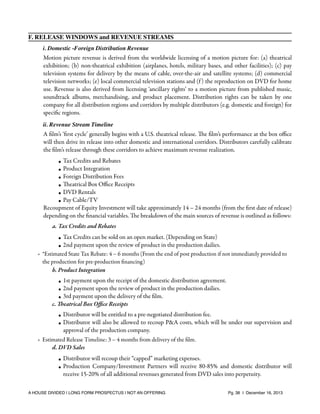
  • 29.
    SALES AND DISTRIBUTIONPLAN A. DISTRIBUTION CHANNELS NOTE: Both Preferred Content or Cassian Elwes ARE NOT ATTACHED, but we have had multiple conversations with both parties and they have both expressed strong interest in the Motion Picture for coming on as SALES AGENTS to rep the film for distribution and film festivals. Cassian Elwes Elwes began his producing career with 1983's "Oxford Blues" starring Rob Lowe and Ally Sheedy and quickly went on to make another 29 films, including "Men at Work", with Emilio Estevez and Charlie Sheen, and "The Chase" with Sheen. In 1995, Elwes joined William Morris. His first effort was the long stalled project "The English Patient" which won best picture that year. He quickly followed up with such indie hits as "Slingblade" and "The Apostle," both of which were nominated for multiple Oscars. "Monster's Ball" was their follow up, which won the Oscar for Halle Berry. The Hollywood Reporter has said that Elwes was "involved in a virtual who's who of every great independent film of the last ten years" with films such as "Thank You For Smoking", "Half Nelson", and "Frozen River" '(the last two of which garnered Oscar nominations for Ryan Gosling and Melissa Leo respectively). "What people lose sight of," Elwes said to Screen International, "is that these films cost a tenth of the films that they competed against at the Academy Awards. The privilege was the recognition." Elwes is an expert in the field of arranging financing and distribution for independent films having done so for 283 films during his tenure at William Morris Independent. Since leaving William Morris Independent two years ago, Elwes has been involved in arranging financing and distribution for 23 films including "Lawless," directed by John Hillcoat ("The Road"), starring Shia LaBeouf and Tom Hardy, and the thriller "The Paperboy," directed by Lee Daniels ("Precious"), starring Matthew McConaughey and Zac Efron. Elwes produced the period drama The Butler, which was directed by Lee Daniels and featured an ensemble cast, including Forest Whitaker, Oprah Winfrey, John Cusack, Jane Fonda, Terrence Howard, Vanessa Redgrave, Alan Rickman, Liev Schreiber, and Robin Williams, among others. Additionally, he is producing "Dallas Buyers Club" starring Matthew McConaughey and Jennifer Garner, "Saints" starring Rooney Mara, Casey Affleck and Ben Foster, and "Hateship, Loveship" starring Kristen Wiig, Guy Pearce, Hailee Steinfeld and Nick Nolte. On October 29, 2013, Elwes launched the Cassian Elwes Independent Screenwriter Fellowship, in conjunction with The Black List, to award one writer an all-expenses-paid trip to the 2014 Sundance Film Festival and mentorship from Elwes. Elwes and The Black List plan to award the fellowship annually PREFERRED CONTENT / KEVIN IWASHINA Kevin Iwashina is a Managing Partner of Preferred Content, a film sales, project finance and media advisory company. Founded in January 2010, Preferred Content (PC) is one of the premiere brokers of North American distribution rights for both fictional and non-fictional filmed entertainment content. Additionally, PC is a leading supplier of independent movies with a specialization in low budget genre and documentary features. In addition to his responsibilities at PC, Iwashina is the Co-CEO of Preferred Film & TV (a film, television and digital production company launched in partnership with Content Media Corporation), Managing Partner of Preferred Ventures (a digital media investment fund), Co-President of City Room Creative (a video editing and production services company) and Managing Partner of Killer Digital (an original content company partnered A HOUSE DIVIDED | LONG FORM PROSPECTUS | NOT AN OFFERING ! ! ! Pg. 29 | December 16, 2013
  • 30.
    with Christine Vachon'sKiller Films that specializes in content for distribution on digital platforms). Prior to founding PC and his suite of affiliated companies, Iwashina spent 10 years at the Creative Artists Agency (CAA), where he was a talent agent, specializing in film packaging, financing and distribution. Iwashina holds a B.A. in English Literature with a minor in French Language and Culture from U.C.L.A. He is active in the non-profit and political sectors and currently serves as the Vice Chairman of the Board of Directors of the Coalition of Asian Pacifics in Entertainment (CAPE) and is a Member of the Board of Directors of the International Documentary Association (IDA). He began his career in the mailroom at the United Talent Agency (UTA). B. PROJECT DISTRIBUTION STRATEGY Television sales for a film can return revenue over many years if the audiences receive it as a classic. Drama/ Thriller pictures ranging from “Disturbia,” to “American Beauty,” to “The Breakfast Club,” among hundreds of others, are all household names that continue to play on television. This is an important factor since distributors and networks are constantly looking for new material. Secondary markets including DVD sales/rentals coupled with ancillary market revenue streams such as merchandising, video games, publishing of graphic novels and comic books, and music will all lend themselves favorably toward producing substantial revenue when licensed or sold as soundtracks, apparel, toys or other goods based on the film’s story and characters. With cheap rental services like Redbox eating into profits, the studios are turning to video-on-demand; an area that the Company will strategically focus on and use as both a primary and supplementary form of distribution and exposure. Over the last ten years, entertainment and character licensing has grown tremendously. Merchandise licensing affords the Company opportunities to enhance brand image and increase revenue streams from the Picture. Licensors receive a royalty payment that is usually a percentage of the net wholesale price of the product. This royalty stream adds another low-risk cash flow that, because the licensor incurs no manufacturing or marketing costs, translates directly into profits. Not only one of the most popular types of licensing, it is also one of the most profitable. The International Licensing Industry Merchandisers’ Association (LIMA), the leading trade organization that also tracks licensing data, estimates overall North American retail sales of licensed merchandise to be about $110 billion, with royalties of about $6 billion. Of retail sales, historically about 45% have come from character and entertainment licensing. Last year, LIMA’s statistical survey put North American entertainment property royalty revenues at $2.6 billion.9 There is a critical shift underway in the marketplace today, as media services are becoming increasingly digitized and interactive, and advances in compression technology are reducing the bandwidth requirements. The network access bandwidths widely available as consumer services are increasing. The convergence of these trends coupled with advanced telecommunications capabilities and media-rich content is fundamentally changing the nature of on-demand service delivery. Because the technology makes content almost instantly accessible, customers have come to expect anywhere, anytime delivery of very high-quality video and other rich media types to both wired and mobile devices. Video-on-demand (VOD), for example, is expected to grow to a very respectable $35 billion industry worldwide by 2014. Television VOD systems either stream content through a set-top box, allowing viewing in real time, or download it to a device such as a computer, digital video recorder (also called a personal video recorder) or portable media player for viewing at any time. The majority of cable-and telco-based television providers offer both VOD streaming, including pay per-view and free content, whereby a user buys or selects a movie or television program and it begins to play on the television set almost instantaneously, or downloading to a DVR rented from the provider, or downloaded onto a PC, for viewing in the future. Internet television, using the 9 Source: LIMA A HOUSE DIVIDED | LONG FORM PROSPECTUS | NOT AN OFFERING ! ! ! Pg. 30 | December 16, 2013
  • 31.
    Internet, is anincreasingly popular form of video on demand. VOD is expected to grow exponentially, creating a host of opportunities. Ongoing changes within each of the media, technology and telecom sectors guarantee that video-ondemand will become a major force in media delivery over the next few years. Highlighted examples of the rapid growth of VOD include: global annual revenue from rental transactions of full-length movies and TV shows on Pay-TV and online platforms generating $2.2bn in 2008, forecasted to grow to $3.7BN by 201410 ; VOD will generate $330 million a year (in the UK) in ‘direct revenue’ by 201311 ; the sum of all forms of video (TV, video on demand, Internet, and P2P) will account for over 91% of global consumer traffic by 2013, with Internet video alone will account for over 60% of all consumer Internet traffic in 201312 ; Digital media revenue will jump about 270% between 2009 and 2013 to $3.28 billion13 . The total home entertainment market in the US (all platforms – DVD/BD, TV-based VOD, online video and mobile video) is projected to generate over $25 billion in revenues in 2009. Paid-for VOD revenues are expected to witness steady growth moving forward, as the closure of VOD windows increases the appeal of premium on-demand content. Global revenue for digital formats will grow to $2 billion in 2013, from about $500 million this year. US revenue in the first half of the year was about $140 million.14 Video on Demand services and their accompanying digital video set-top boxes continue to improve. The Roku digital video player has been solely a way to stream Netflix' Instant Watch movies to your TV at a cost of $99 for over 12,000 titles. And now Roku is teaming up with Amazon to provide access to their 40,000 titles available on Amazon Video on Demand. Roku owners will soon be able to buy or rent titles to instantly stream from the Amazon Video on Demand service, some films being released the same day they come out on DVD. LG has essentially put the VOD box directly in the television with the new ‘broadband HDTVs’ (in both LCD and Plasma) will be able to instantly stream the Netflix selection of on demand films. Again, this is a new and exciting area of distribution that the Company plans to fully incorporate into our business model and distribution strategy. i. Distribution Approach Every film needs a customized distribution strategy. The Company will be creating a strategy for the Picture well before the film enters production, thus increasing awareness and striving for the highest possible revenue streams available. Some of these strategies include: a. Split Distribution Rights in Foreign Territories While in the old world of distribution all domestic rights were usually given to one company; hybrid distribution enables rights to be split more finely and effectively. This enables filmmakers to retain direct sales rights including the right to sell DVDs from their websites and at screenings while holding the rights to sell downloads and rentals from their sites. Most often filmmakers also retain theatrical and semi-theatrical. VOD, television, and retail DVD deals are usually made with separate distribution partners. Deals are often made with educational partners but some filmmakers are retaining these rights. Digital rights for avenues like iTunes are more complicated—they are sometimes given to the retail DVD distributor or the VOD distributor and sometimes licensed separately. 10 Source: Adam Media Research, a division of Screen Digest 11 Source: Paid Content, UK quoting Claire Enders speaking at the Westminister eForum on September 15th 12 Source: CISCO. Forecast and Methodology 2008-2013 13 Source: Futuresource Consulting research 14 Source: Screen Digest, analyst Arash Amel cited in an article of videobusiness.com A HOUSE DIVIDED | LONG FORM PROSPECTUS | NOT AN OFFERING ! ! ! Pg. 31 | December 16, 2013
  • 32.
    Rights can beusefully divided into eight domestic and international categories: • Theatrical • Retail DVD • Semi-Theatrical & Non-theatrical • Direct DVD • Video-On-Demand • Educational • Television • Digital Rental & Download While splitting up rights is complicated and time consuming, it allows each right to be exploited well, avoids cross-collateralization (where expenses from one area of distribution eat away at revenues from others), and allows a filmmaker to retain overall distribution control. b. Choose Effective Distribution Partners in each territory worldwide In the old world where all domestic distribution rights were usually lumped together, certain rights were often poorly utilized or completely overlooked. In the new world, it is important to determine how best to exploit every right without neglecting any of them. Filmmakers can handle some rights most successfully on their own. In other areas, the goal is to find the distribution partner, or sales agent, with the skills and experience to be most effective. Ideally this partner has an impressive track record with similar films or particular niche audiences. Before signing any deal with a distribution partner, it is essential to speak with other filmmakers currently or recently in business with the company. c. Circumscribe Rights Grant each distribution partner only the specific rights they can handle well. For example, if a company is strong in retail DVD and digital, give them these rights, but do not also give them VOD if they have no experience with VOD. Carefully limit the rights (scope, term, exclusivity) granted to each partner. Make sure the rights given to different distributors complement each other without conflicting. Make as many deals as possible at the same time so the rights given in one area do not subsequently prevent you from making deals in other areas. d. Craft Win-Win Deals Design deals that will work well for both your distribution partner and you. Divide revenues fairly and define responsibilities clearly. Build in guarantees (e.g. minimum number of cities and marketing spend, performance guarantee), approvals (e.g. deals, marketing, editing), and safeguards (e.g. escape clauses, expense cap, bankruptcy protection, limits on assignment, dispute resolution). e. Retain Direct Sales Rights Retain the domestic and international rights to sell DVDs (from your website and at screenings) and downloads and streams (from your website). Also retain the rights to screen the film theatrically and semi-theatrically. Direct sales are the lynchpin of a hybrid distribution strategy. They have four significant advantages over third-party sales: • Higher profit margins – A DVD sold directly from a filmmaker’s website can easily yield profit margins 7-8 times as high as DVDs sold in retail. • Faster payment – Filmmakers usually receive payments faster from PayPal or a fulfillment company than they would from a distributor. • Revenues aren’t split with middlemen – Filmmakers receive all of the revenues, after manufacturing and fulfillment costs. A HOUSE DIVIDED | LONG FORM PROSPECTUS | NOT AN OFFERING ! ! ! Pg. 32 | December 16, 2013
  • 33.
    • Customer information– Filmmakers receive data on all customers who make purchases from their websites, but do not get any information on consumers who buy through third-party retailers. This data enables filmmakers to stay in touch with purchasers and offer them other products. f. Maximize Direct Revenues In addition to selling DVDs directly from their websites, filmmakers can also sell other products they produce (e.g. soundtrack albums, companion books, posters, hats, and t-shirts). Filmmakers can also purchase related products from third parties (e.g. books, DVDs, CDs) that will be of particular interest to their audiences. As online retailers, they can buy these products at wholesale and resell them from their sites at retail. g. Grow And Nurture Audiences Independents can expand their films’ audiences by building mailing lists, communicating effectively and developing ongoing relationships with subscribers. They should provide them with valuable and engaging content, while keeping sales pitches to a minimum. They should also create a content-rich, dynamic, and interactive website that encourages participation. Their ultimate goal is to develop a core personal audience that can support future projects through contributions and purchases. ii. INVESTMENT and EXIT/PAYBACK STRATEGY There are several elements the Company can entertain in order to offset the investment exposure with regards to the Picture. The Company will implement, if feasible for the project, tax credits and subsidies, branded content and product placement/corporate sponsorship, and most importantly, pre-sales in order to expedite recoupment and insure the investment in the project. As soft monies return into the fold, via pre-sales, additional subsidies, or assorted contracts, recouped early in the production process of each film, these will serve as quick avenues to returning investment. Naturally, any investor financing would be in a first position of recoupment and secured by a lien on the ownership (all rights) of the film title and all revenue (Theatrical Box Office receipts, Rentals, Pay Cable/TV, Network TV, DVD Sales, and any/all Residuals) into perpetuity until the original investment plus interest has been fully recouped. At such time of full recoupment the lien on the title will be released back to the Company. The Company will focus on international sales companies who support products that funnel directly into the commercial marketplace and who specialize in drama and low-budget motion pictures. The Company’s goal will be to secure an international sales agent early in the production process. This will allow the agent to use key festivals such as Sundance, Berlin, Cannes, and the Toronto Film Festival to introduce the film to the world marketplace. Sales will continue on through the American Film Market (AFM). The Company will engage a sales rep who specializes in the US marketplace to help us maximize our sales opportunities. Our plan for distributing projects produced by the Company will utilize markets and festivals as a platform for sales, but the Company will not proceed forward without having sales agents and potential distributors earmarked having reviewed and expressed genuine interest in the Picture. Internationally, the Company will utilize the festival circuit as platforms for international screenings and sales. Again, broad-based genre films are very popular in both North America as well as in Europe and internationally as a whole. Movies now often earn more of their box office overseas than they do in the U.S., and a film's performance in Italy or Russia is as important as its New York City numbers. Just look at A HOUSE DIVIDED | LONG FORM PROSPECTUS | NOT AN OFFERING ! ! ! Pg. 33 | December 16, 2013
  • 34.
    the $687 millionhaul of Fox's "Ice Age: Dawn of the Dinosaurs" around the world (77% of its gross) compared with $197 million domestically. In 2009, Sony passed the $2 billion mark overseas for the first time ever with pictures like “2014” and the Michael Jackson documentary “This Is It” appealing to international audiences. It was the fourth studio to ever do so, with Warner Bros., Paramount and Fox also reaching that milestone this decade.15 Utilizing a risk-mitigating model centered on a portfolio of projects focused on a high-profile genre and demographic, cost-reducing methods of production, and key sales alliances, the Company will see a rapid acceleration of recoupment and fast entry into a library of exponentially growing revenues. This has opened up a whole new area for both private and institutional investors to enter and negotiate better deals with a more favorable recoupment position and participation. The recent slowdowns of real estate and the stock market in delivering solid returns has helped shift Wall Street’s focus to Hollywood as the worldwide film industry continues to show consistent and substantial growth, demonstrating ‘recession-proof ’ characteristics. Additionally, as the Company will utilize 10% of the overall equity raise for operational and discretionary expenses, each Investment Partner will be given a pro rata share of equity in A HOUSE DIVIDED, LLC. Definition of Receipts: For purposes of this, production shall mean that all monies actually received by the distributor and the production, including all subsidiaries, parent and affiliated companies involved in the production and/or exploitation of the picture, from all sources of exploitation of the picture after deduction of taxes, duties, tariffs and similar costs required be paid in connection with the exploitation of the picture. a. International Pre-Sales and Distribution If sensible, A Foreign Sales Agency Agreement should be executed prior to production. In addition, production should review the potential candidates and identify a priority listing based upon their current portfolio, ability to sell our product, output deals, and most importantly the ability to make collections once the territory is sold. Again there should be minimal selling of the property to the foreign marketplace until after the North American distributor is confirmed to increase the potential foreign revenue with a domestic theatrical release – the ultimate distribution goal. After which, the international sales can continue throughout the year based on what the buyers appetite & needs are with respect to levels of guarantees/valuations. The following is a partial list of Foreign Sales Agents Company looks to forge relations with: • Lionsgate/Summit Entertainment • Canal Plus • Hyde Park Films • Gold Circle Films • IM Global • ContentFilm International Q.E.D. International • • Cinetic Company • Voltage Pictures • Lakeshore Entertainment • Icon Entertainment • Submarine Entertainment • E1 Entertainment • Nu Image/Millenium Film Nation • • BOLD Entertainment • K5 International • Odd Lot Entertainment • Wild Bunch 15 Source: Variety, ‘Decade Changed Film Biz’ - 2009 A HOUSE DIVIDED | LONG FORM PROSPECTUS | NOT AN OFFERING ! ! ! Pg. 34 | December 16, 2013
  • 35.
    ii. North AmericanTheatrical Pre-Sales and Distribution Securing North American Distribution is the obvious engine that drives all other valuations, negotiation leverage, and product placement efforts. For all major business decisions, there will be a management committee, led by members of the Company that will oversee any major financial or distribution-oriented deal. The following is a partial list of domestic distributors to forge relations with: • Focus Features • Patriot Pictures th • Union Patriot Capital • 20 Century Fox • Relativity Media • The Weinstein Company • Fox Searchlight • Lions Gate • Focus Features • Sony Pictures • Original Films • Warner Bros. Studio • Escape Artists • NBC/Universal • Fortress Investment Group • Fox Studio • Skydance Pictures • Dreamworks Studio • Participant Media • Dreamworks Animation • Scott Free Productions • Disney • New Line Cinema • Legendary Pictures A HOUSE DIVIDED | LONG FORM PROSPECTUS | NOT AN OFFERING ! ! ! Pg. 35 | December 16, 2013
  • 36.
    INVESTMENTS AND FINANCIALS Investingin a Motion Picture has a multitude of elements that can make it not only rewarding, but also very exciting. There is no other business that brings the glitz and the glamour to an individual experience than that of a feature length picture. From giant sets, movie stars and down to the intricacies that go into the physical production, to the premiers, red carpets, and film festivals, it is something that few ever get to see first hand. (See the Conclusion for a list of benefits as an Investor) Still, with all the thrills that it brings, there is also a notable amount of risk. However, through the established managers of the Company, their extensive knowledge, background in the entertainment industry, and the contacts that they all bring, those risks can be minimized. It is still best to look at the whole picture and understand the pros and cons of investing in the Picture. A. STATE OF INDUSTRY Over the last ten years, Wall Street has favored asset-based transactions. It’s now evolved toward packaging other types of assets, which has led to backing content and intellectual property, i.e. entertainment, and specifically motion pictures. And with the recent slowdowns of real estate and the stock market in delivering solid returns on investment this has helped shift Wall Street’s focus to Hollywood. That's opened up a whole area for investors, both private and institutional, to come in and negotiate better deals and have a more favorable recoupment position and participation in these films. With studios focused on the major releases, and fewer products in the distribution chain to offset flops, they have no choice really but to partner with independent sources to not only provide product for the other distribution markets, but also to mitigate risk on the larger, big event pictures. This is one of the most important reasons why studios began working with hedge funds. Other reasons for this movement are: • The number of studios that are now publicly traded is at it a peak. • The parent companies want them to leverage more capital without diluting their shares, or control, or risk weakening the balance sheet. • The studios are looking to defray costs by an average of 40% -50%, and by using less of their own money they increase the likelihood of jumping the return on the invested (on-the-books) capital to its shareholders. This means investors will: • Receive greater participation; • Lower risk; and • Increased investor profit. These new opportunities have created the foundation for the Company and our potential investors to become involved at a more participatory level. B. FINANCIAL SUMMARY The Company has adopted strict financial protocols to ensure prudent use of funds and to maximize Investment Partner returns. The Company’s total cash flows are used first to repay the production equity, and then flow through the profit waterfall at a 90/10 split. Investment Partners receive 90% of all returns until 120% of the initial investment has been recovered. The other 10% will go to the Company to support they’re efforts to recoup all revenue generated by the picture. Of the remaining net profits, Investment Partners receive 50% and the Company receives 50%. In addition, the Picture that the Company intends to produce will earn ancillary revenue (i.e. video-on-demand, syndicated and cable TV, merchandising) at similar levels of feature films costing up to ten times more. When the film becomes successful in the marketplace, all proceeds from the film A HOUSE DIVIDED | LONG FORM PROSPECTUS | NOT AN OFFERING ! ! ! Pg. 36 | December 16, 2013
  • 37.
    paid to theLLC, after deduction of the fees and expenses owed to distributors and sales agents from worldwide gross receipts for all media will be paid out as follows: • Each investor shall recoup, on a pari passu basis with all other investors, one hundred and twenty percent (120%) of said investor’s contributed funds. By way of example, if an individual’s investment is $50,000, he/she would recoup $60,000 prior to payments to any other party, except for other equity investors; • After the Picture’s budget (or 120% of the final Picture budget) has been allocated to the equity investors any outstanding residuals and/or deferred payments will be distributed.; and • Following these distributions, further proceeds will be split, with 50% going to the investors and 50% going to the Company and any other profit participants, in perpetuity. C. USE OF FUNDS The utilization of funds will be for: operating overhead need to launch company; and the negative cost of each motion picture developed, financed, produced and/or acquired. i. Operation Overhead The investment proceeds will be used to purchase, build, develop, acquire, and finance the equipment, facilities, and working capital to meet the company’s monthly and yearly overhead. This will also include the retention of corporate and industry specialists. ii. Production (Pre to Post) When the production process begins, the funds will be used fund all the above-the-line and below-theline costs associated with the film. Everything from writer, director, cast and crew through to delivery of the master prints to distributers. iii. Marketing and P&A Marketing, film festivals, and Prints & Advertising (P&A) are all part of moving the product, our film. We need to make sure we have enough funds to successfully push the film to any festival, markets, and all distributers (foreign and domestic). This is the most important step to recouping the investment. D. PROFIT and LOSS PROJECTIONS The Company measures performance by breaking down the revenues and costs of the Picture’s negative cost, budget levels and performance. All of the revenue streams and releasing cost line items were taken from industry standard budgets and historical information provided by independent and studio statistics. Over the years, these numbers have been amassed via industry data from multiple sources. It is important to note that film analysis are categorized by genres too and that drives the profitability and the percentages linked to the Domestic Box Office (DBO). For instance, the film genres of drama, horror, romance thrillers, sci-fi and drama are all different financial models and percentages of revenue and cost. E. CASH FLOW PROJECTIONS Most of a film’s life cycle in terms of revenue streams is realized within the film’s first 3 years. Cash flow timing is predicated on the timing of receipts (revenue) and disbursements (costs). Upon all of the terms of the financing, these models will be more defined by each film in the release slate. Given all of the financial analysis provided in this business plan, the Company will be successful in the film market, as management will closely monitor the trends and adapt to the marketplace. Performance will be tracked and comprehensive entertainment industry data will be provided to management on a consistent basis to assist with the decisionmaking process. A HOUSE DIVIDED | LONG FORM PROSPECTUS | NOT AN OFFERING ! ! ! Pg. 37 | December 16, 2013
  • 38.
    F. RELEASE WINDOWSand REVENUE STREAMS i. Domestic -Foreign Distribution Revenue Motion picture revenue is derived from the worldwide licensing of a motion picture for: (a) theatrical exhibition; (b) non-theatrical exhibition (airplanes, hotels, military bases, and other facilities); (c) pay television systems for delivery by the means of cable, over-the-air and satellite systems; (d) commercial television networks; (e) local commercial television stations and (f ) the reproduction on DVD for home use. Revenue is also derived from licensing ‘ancillary rights’ to a motion picture from published music, soundtrack albums, merchandising, and product placement. Distribution rights can be taken by one company for all distribution regions and corridors by multiple distributors (e.g. domestic and foreign) for specific regions. ii. Revenue Stream Timeline A film’s ‘first cycle’ generally begins with a U.S. theatrical release. The film’s performance at the box office will then drive its release into other domestic and international corridors. Distributors carefully calibrate the film’s release through these corridors to achieve maximum revenue realization. • Tax Credits and Rebates • Product Integration • Foreign Distribution Fees • Theatrical Box Office Receipts • DVD Rentals • Pay Cable/TV Recoupment of Equity Investment will take approximately 14 – 24 months (from the first date of release) depending on the financial variables. The breakdown of the main sources of revenue is outlined as follows: a. Tax Credits and Rebates ✴ • Tax Credits can be sold on an open market. (Depending on State) • 2nd payment upon the review of product in the production dailies. *Estimated State Tax Rebate: 4 – 6 months (From the end of post production if not immediately provided to the production for pre-production financing) b. Product Integration • 1st payment upon the receipt of the domestic distribution agreement. • 2nd payment upon the review of product in the production dailies. • 3rd payment upon the delivery of the film. c. Theatrical Box Office Receipts ✴ • Distributor will be entitled to a pre-negotiated distribution fee. • Distributor will also be allowed to recoup P&A costs, which will be under our supervision and approval of the production company. Estimated Release Timeline: 3 – 4 months from delivery of the film. d. DVD Sales • Distributor will recoup their “capped” marketing expenses. • Production Company/Investment Partners will receive 80-85% and domestic distributor will receive 15-20% of all additional revenues generated from DVD sales into perpetuity. A HOUSE DIVIDED | LONG FORM PROSPECTUS | NOT AN OFFERING ! ! ! Pg. 38 | December 16, 2013
  • 39.
    ✴ ✴ ✴ Estimated Release Window:3 months after the theatrical release of the film. e. Pay Cable • Cable rights will be sold to one of the major cable channels such as HBO, Showtime, Cinemax, etc. • Production Company/Investment Partners will receive 80% and distributor will receive 20% of all additional revenues generated from Pay Cable into perpetuity Estimated Timeline: Approximately 6 months from the DVD release. f. Syndicated/Network Television • Revenue TBD. Estimated Timeline: Approximately 12 months from the Pay Cable release. g. New Media & Emerging Media Platforms • Their are many streaming platforms available now and streaming rights can go as in individual streaming deal or through a packaged deal. • Streaming deals can be exclusive or sold to multiple-platforms based on a films value. • Services include Netflix, Hulu, Epix, Vudu and there are others available as tier two. h. Other Ancillary Revenue, in addition to a film’s main revenue streams, including: • Non-Theatrical: a film’s exhibition rights can be sold to airplanes, military bases, hotels and other institutions; and, • Music: the music in a film can produce substantial revenue when it is licensed or sold for use in a soundtrack or for other recording and performance purposes; and, • Merchandising rights: a film merchandising rights can be licensed to produce articles such as apparel, and other goods based on the film’s story and characters; and, • New Media: a film’s internet rights can be licensed to websites, social media forums, blogs, microblogs, forums and live castings. G. INVESTMENT INSURANCE The film’s script, director, producers and overall production team are the crucial factors that form the foundation to assure investors that a film will be made the best it can be, and each production carries with it a full package of Motion Picture Insurance (Production, General Liability, Errors & Omissions, Worker’s Compensation and Guild/Union Accident). To further ensure the investor that the film will be completed on budget and delivered on time, the producers include multiple insurance measures to mitigate risk for the Investment Partners through tax incentives as well as providing varying insurance elements to complement the Company’s smart, protective and conservative production and distribution plans. i. CONTINGENCY A contingency percentage is built into the Picture’s budget. The Company requires the budget to contain a contingency of 10% -calculated on below the line totals. Contingency serves as a cushion should there be cost overruns on the film. The standard contingency for motion pictures is 10%. J. CONCLUSION The Company’s management team and advisors have proven track records of producing. Their collective strategy is to become a leading supplier of profit-driven entertainment products and talent. The Picture’s strategy is to become -along with its team members and partners – is to exceed in every level and become successful within the indie drama circuit and eventually be referred to as a classic film viewed by its audience. A HOUSE DIVIDED | LONG FORM PROSPECTUS | NOT AN OFFERING ! ! ! Pg. 39 | December 16, 2013
  • 40.
    The Company believesit will exceed beyond expectations due to the management’s consistent ability to produce quality, cutting edge, commercial projects. The potential upside for profit is unlimited. The exponentially growing audience in the world of successful indie dramas demonstrates that there is a strong demographic for “A HOUSE DIVIDED.” The Picture has the appeal that previously successful drama films had to excel in the market place time and time again. The Company knows that success through a high profile film festival would drive tremendous amount of traffic to the promotion of the film. That coupled with a family friendly MPAA rating of ‘R’ will open the Picture to a wide demographic ranging from late teens to those in their 40’s and 50’s. Management and Advisory Team Resources and Assets: • Highly experienced and successful team with a focused business strategy that leverages several key creative partnerships, and a fiscally conservative approach governed by strict protocols and financial covenants • Strong business and creative relationships with agencies, law firms, public relations companies, and producers in all facets of the motion picture process including production, distribution, marketing and management • Direct access to distribution arms and ancillary distribution elements through most studios and boutique distribution companies Expanding the potency of the Investment by: • Forming relationships with companies that assist in using in-kind services for locations, equipment, art direction and postproduction; and, • Using tax incentives which can garner up to 35% of the budget back in soft money, dependent on the state in which production is focused; and, • Shooting digitally, allowing a more affordable solution to shooting, post production and distribution due to the cutting edge and climate of technology today; and, • Creatively using resources that the management teams has acquired through the years of experience. “A HOUSE DIVIDED” hits on a key genre of filmmaking and combines some of the most powerful filmmaking, strong audience appeal during award season which can turn it into a viable motion picture. The strong indie drama script will allow for A-List talent to get involved in the project, some of whom the Company has been in contact with, and allows it to the potential of being a big success by capturing a strong audience and word-of-mouth success. The Picture also brings with it to investors a piece of the Hollywood glamour. Investors will have the ability to: • Visit set during production • Meet the actors and crew of the Picture • Indulge in the wrap party once filming is finished • Partake in the multitude of premiers, film festivals and red carpet events associated with the Picture • Dependent on the investment, receive credit that will be played at the end of the Picture • Have a tangible end product that will live forever in the history of film The Company is very excited about this project and the opportunity it presents, and we hope you do as well. We appreciate your time and consideration for “A HOUSE DIVIDED,” and please know that we have nothing but the highest expectations of what is to come. DANIEL ELDER & GEORGE ELDER MANAGEMENT TEAM of A HOUSE DIVIDED, LLC A HOUSE DIVIDED | LONG FORM PROSPECTUS | NOT AN OFFERING ! ! ! Pg. 40 | December 16, 2013
  • 41.
    SECTION A: PROJECTEDRETURNS P&L MODEL ($000's) Rate Negative Costs of the Film Production Rebate Low Case $1,590 $509 Base Case $1,590 $509 High Case $1,590 $509 Breakout $1,590 $509 Domestic Theatrical Sales Domestic Box Office Gross $2,050 $3,000 $7,500 $15,000 $870 $1,280 $3,190 $6,380 ($150) ($220) ($560) ($1,120) Prints & Advertising ($3,000) ($6,000) ($12,500) ($15,000) Domestic Theatrical NET Proceeds Domestic Aftermarket Sales ($2,280) ($4,940) ($9,870) ($9,740) $615 $1,200 $3,000 $6,000 ($203) ($396) ($990) ($1,980) $260 $380 $940 $1,880 $2,500 $5,000 $10,000 $10,000 $210 $300 $750 $1,500 $53 $75 $188 $375 $0 $0 $3 $25 ($640) ($1,220) ($2,600) ($3,460) $2,795 $5,339 $11,290 $14,340 $515 $399 $1,420 $4,600 $1,025 $1,500 $1,875 $3,750 ($103) ($150) ($188) ($375) Overseas NET Proceeds $923 $1,350 $1,688 $3,375 Worldwide NET Income $1,946 $2,258 $3,616 $8,484 ($1,590) ($1,590) ($1,590) ($1,590) ($318) ($318) ($318) ($318) Total A HOUSE DIVDED NET Profits $38 $350 $1,708 $6,576 50% Investor Profits $19 $175 $854 $3,288 50% Creative Profits $19 $175 $854 $3,288 A HOUSE DIVIDED ROI 1% 11% 54% 207% Gross Film Rentals (Distributors Gross) Distributer Fee & Other Costs 43% 17.5% DVD Market Marketing and Distribution Costs 33% Pay-Per View/Video On-Demand 12.5% Pay Cable Revenue Network TV Revenue 10% Domestic Syndication Merchandising/Music/New Media Distribution Licensing Fee 17.5% Domestic Aftermarket NET Produceeds Total Domestic NET Distribution Foreign Markets Sales & Overages Fees & Costs Negative Costs (Films Budget repaid to Investors) 20% Preferred Return Rate 10%
  • 42.
    SECTION B: FILMCOMPARISONS The following are some past examples of movies that are relatable to “A HOUSE DIVIDED.” These numbers do not include any foreign territories or any DVD, Cable TV, Pay TV, Pay-Per View, Home Video Market, VHS, Internet, Syndication Television, or any Ancillary Rights. The date next to the title of the picture is the first theatrical date of release. All films listed had a minimums theatrical release window of six (6) weeks. Film Distribution Est. Budget U.S Box Office Gross Worldwide Box Office Gross Martha Marcy May Marlene (2011) FOX Searchlight $2,500,000 $2,981,038 $3,531,038 Beginners (2011) Focus Features $3,200,000 $5,776,314 $14,311,701 City Island (2009) Anchor Bay Films $6,000,000 $6,670,712 $7,875,862 Garden State (2004) Fox Searchlight $2,500,000 $26,782,316 $35,825,316 In The Bedroom (2001) Miramax $1,700,000 $35,930,604 $43,430,604 American Beauty (1999) Dreamworks $15,000,000 $130,096,601 $356,296,601 The Virgin Suicides (1999) Paramount Classics $6,000,000 $4,859,475 $10,409,377 Happiness (1998) Good Machine $2,000,000 $2,746,453 $2,746,453 Beautiful Girls (1996) Miramax Films $2,000,000 $10,597,759 $10,597,759 Ordinary People (1980) Paramount Pictures $6,000,000 $54,766,923 $54,766,923 DISCLAIMER: “Industry is highly speculative and inherently risky. There can be no assurance of the economic success of any motion picture since the revenues derived from the production and distribution of a motion picture depend on many factors, but primarily upon its acceptance by the public, which cannot be predicted. A HOUSE DIVIDED | LONG FORM PROSPECTUS | NOT AN OFFERING ! ! ! Pg. 42 | December 16, 2013
  • 43.
    Production Team: ElderPictures Director: Brent Huff Executive Producers: George Elder Producers: Daniel Elder Screenplay by: Joshua Howes Shooting Location: Evanston and Chicago, IL. Script Dated: November 16, 2013 Budget Dated: August 1, 2013 Budget: The budget breaks down as follows:: Total Above the Line (Cast Contingent) $560,172 Production Period $639,009 Post Production $180,250 Other Costs $359,017 Total Below the Line $1,170,276 Total Above & Below the Line $1,430,448 Illinois Tax Rebate (30% of Above/Below the line)** ($354,134) Bond $42,913 Contingency $117,028 Total Budget (Including Print & Advertising Spend) $1,590,389 Disclaimer: A Full Bonded & production approved budget will be provided before we move forward with production. ** Through Illinois Tax Incentives we plan to receive a strong tax break using local crew and local actors. SECTION C: PRODUCTION CRITICAL ASSUMPTIONS SCHEDULE: The budget assumes the following basic schedule: “Pre” Prep weeks in Evanston, IL. 2 weeks Prep weeks on location in Evanston, IL 3 weeks Shoot days in Evanston & Chicago, IL 4.5 weeks Travel Days 3 Days Holiday General allowance of 1 Days Run of Show 2.5 months Picture Lock 6-8 months Film Festivals 9-12 Months Theatrical 12-15 months
  • 44.
    SECTION D: FINANCINGSCENARIO #1 To maximize return on investment (ROI) for all general and limited partners, Distribution relationships and Foreign pre-sales will be utilized to mitigate the film’s downside risks. Case study Just Play Dead Film Financing Plan (US $000) Budget of Production Costs $1,590 Amount Production Subsidy Loan (Illinois Tax Credit - Appendix H) Cash flow tax Credit Debt Loans Against Int’l Pre-Sales and Estimates • CoMerica, Union Bank, & OneWest Bank to finance Loan • % of Budget $509 32.0% $407.04 25.6% $557 35.0% $534.24 33.6% $80 5.0% $445 28.0% Mezzanine Financing Donated Property, Equipment, Boats (Secured Donations) • All locations for “A House Divided” are secured for free as an investment into the Motion Picture. Equity Piece (120% ROI) • Equity with Cash Flowing Tax Credit / Debt $649 40.8% • Co-Finance Relationships (50% / 50%) (120%) $223 14.0% • Development Loan (5% of $1.8million) (120% ROI) $80 5.0% $1,590 100% Total Production Cost • The adjacent table portrays the typical capital structure of a film. Including the production incentives, this strategy should limit equity used to 25%. • The Company will not green-light a film unless it reaches the threshold of 70% in foreign sales estimates and soft-monies. • The investment proceeds will be used to purchase, build, develop, acquire, and finance the equipment, facilities, and working capital to meet the company’s monthly and yearly overhead. This will also include the retention of corporate and industry specialists. • When the production process begins, the funds will be used fund all the above-the-line and below-the-line costs associated with the film. Everything from writer, director, cast and crew through to delivery of the master prints to distributers. • Marketing, film festivals, and Prints & Advertising (P&A) are all part of moving the product, our film. We need to make sure we have enough funds to successfully push the film to any festival, markets, and all distributers (foreign and domestic). This is the most important step to recouping the investment.
  • 45.
    SECTION E: FINANCINGSCENARIO #2 To maximize return on investment (ROI) for all general and limited partners, Distribution relationships and Foreign pre-sales will be utilized to mitigate the film’s downside risks. Case study A HOUSE DIVIDED Film Financing Plan (US $000) Budget of Production Costs $1,590 Amount Production Subsidy Loan (Illinois Tax Credit - Appendix H) Cash flow tax Credit Donated Property, Equipment, Boats (Secured Donations) • % of Budget $477 30.0% $381.60 24.0% $80 5.0% $1,034 65.0% All locations for “A House Divided” are secured for free as an investment into the Motion Picture. Equity Piece (120% ROI) • Co-Finance Relationships (50% / 50%) (120%) $517 32.5% • Development Loan (5% of $1.8million) (120% ROI) $80 5.0% $1,590 100% Total Production Cost • The adjacent table portrays the typical capital structure of a film. Including the production incentives, this strategy should limit equity used to 25%. • The Company will not green-light a film unless it reaches the threshold of 70% in foreign sales estimates and soft-monies. • We can cash flow any part of the investment with a international sales agent, the equity investment would allow for the Company to go straight equity and cash flow the Tax Credit and debt after the production to retain more Cash on hand by not taking a loan out and debt financing the film.
  • 46.
    SECTION F: ILLINOISTAX CREDIT DOCUMENT (ATTACHED) This is what the Company estimates on a high-end that we will see returned to the the Company before, during or after the Production of the Picture. If we decide to use the tax-credit to monetize the value of the credit, we can receive around 80¢ on the $1 for the tax credit, if we decide to use it during the production, we can receive between 85¢ to 95¢ on the dollar or we can keep the credit and monetize its value after the completion of the film and receive its full value as a tax credit towards the Picture and begin to start paying back our investors at this point. Tax Credit Certificate/Transfer • 30% of the qualified Illinois Production Spending. • 30% credit on Illinois salaries up to $100,000 per worker. • Tax credit can be carried forward 5 years from when originally issued by IFO. • The yearly sunset provision has been removed so the IL Film Services Tax Credit does not expire. • Applicants will receive an additional 15% tax credit on salaries of individuals (making at least $1,000 in total wages) that live in an economically disadvantaged area (at least 10% unemployment).e transferred
  • 47.
    March 23, 2012 DanielElder Elder Pictures, LLC Dear Mr. Elder, The Illinois Film Office a division within the Illinois Department of Commerce and Economic Opportunity has reviewed your budget for the film project entitled A House Divided. Based on the budgetary information provided, A House Divided can anticipate an Illinois Film Tax Credit in the approximate amount of Five Hundred Eighty Eight Thousand Dollars ($588,000). Please note that this letter does not guarantee the issuance of a final Tax Credit Certificate. Issuance of the Final Tax Credit Certificate is contingent upon meeting all of the rules and regulations of the Film Services Tax Credit and the approval of the Director of the Department of Commerce and Economic Opportunity. Sincerely, Cesar Lopez Manager, Illinois Film Production Tax Credit Illinois Film Office