A Glimpse on K to 12
Program in the
Philippines1
ERNIE C. CERADO, PhD
SULTAN KUDARAT STATE UNIVERSITY
1Presented during the Lecture Series held on October 24, 2019 at the Universitas Pembangunan
“Veterans” Nasional Yogyakarta, (UPVNY), Yogyakarta, Indonesia
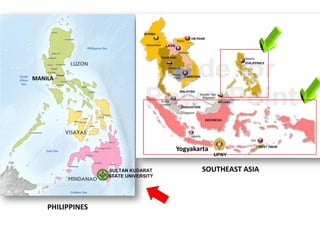
SULTAN KUDARAT
STATE UNIVERSITY
SOUTHEAST ASIA
PHILIPPINES
MANILA
Yogyakarta
UPNY
Presentation Outline
What is K to 12?
Rationale and Promises of K to 12
Implementation of K to 12
Legal & Philosophical Basis
Reform Issues
Government Response
Future Directions
Concluding Statements
What is K to 12?
K to 12 is an education system under the
Philippine’s Department of Education that
primarily aims to enhance learners’ basic
skills, produce more competent citizens,
and prepare graduates for lifelong learning
and employment.
K to 12 Program
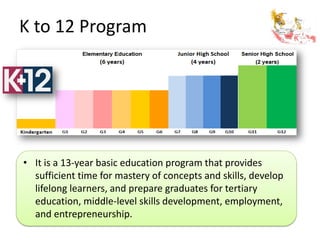
• It is a 13-year basic education program that provides
sufficient time for mastery of concepts and skills, develop
lifelong learners, and prepare graduates for tertiary
education, middle-level skills development, employment,
and entrepreneurship.
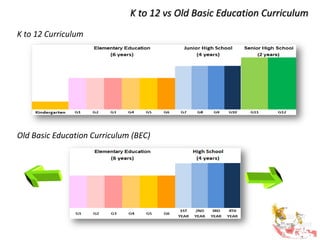
K to 12 vs Old Basic Education Curriculum
K to 12 Curriculum
Old Basic Education Curriculum (BEC)
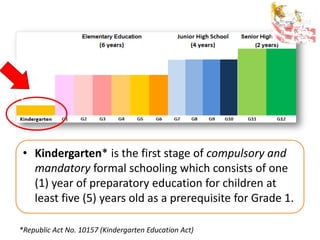
• Kindergarten* is the first stage of compulsory and
mandatory formal schooling which consists of one
(1) year of preparatory education for children at
least five (5) years old as a prerequisite for Grade 1.
*Republic Act No. 10157 (Kindergarten Education Act)
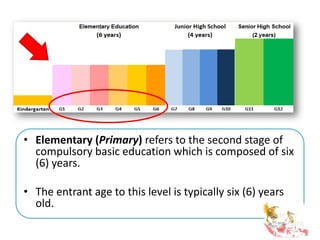
• Elementary (Primary) refers to the second stage of
compulsory basic education which is composed of six
(6) years.
• The entrant age to this level is typically six (6) years
old.
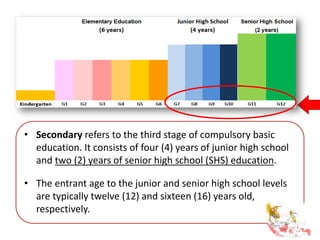
• Secondary refers to the third stage of compulsory basic
education. It consists of four (4) years of junior high school
and two (2) years of senior high school (SHS) education.
• The entrant age to the junior and senior high school levels
are typically twelve (12) and sixteen (16) years old,
respectively.
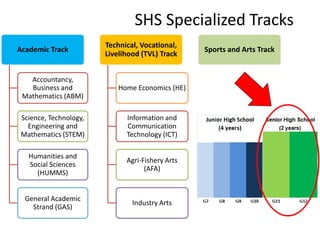
SHS Specialized Tracks
Academic Track
Accountancy,
Business and
Mathematics (ABM)
Science, Technology,
Engineering and
Mathematics (STEM)
Humanities and
Social Sciences
(HUMMS)
General Academic
Strand (GAS)
Technical, Vocational,
Livelihood (TVL) Track
Home Economics (HE)
Information and
Communication
Technology (ICT)
Agri-Fishery Arts
(AFA)
Industry Arts
Sports and Arts Track
Rationale and Promises
of K to 12 Program
Up Next…
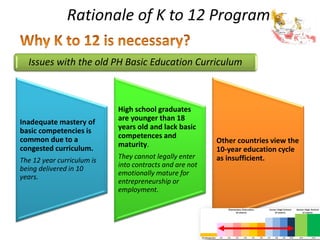
Inadequate mastery of
basic competencies is
common due to a
congested curriculum.
The 12 year curriculum is
being delivered in 10
years.
High school graduates
are younger than 18
years old and lack basic
competences and
maturity.
They cannot legally enter
into contracts and are not
emotionally mature for
entrepreneurship or
employment.
Other countries view the
10-year education cycle
as insufficient.
Rationale of K to 12 Program
Issues with the old PH Basic Education Curriculum
Promises of K to 12
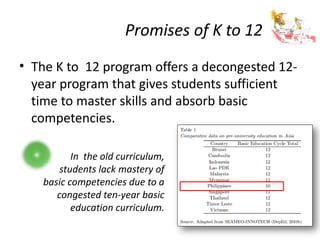
• The K to 12 program offers a decongested 12-
year program that gives students sufficient
time to master skills and absorb basic
competencies.
In the old curriculum,
students lack mastery of
basic competencies due to a
congested ten-year basic
education curriculum.
Promises of K to 12
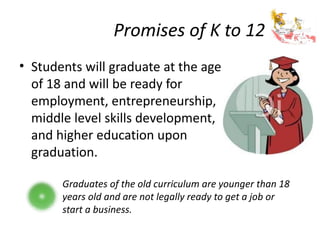
• Students will graduate at the age
of 18 and will be ready for
employment, entrepreneurship,
middle level skills development,
and higher education upon
graduation.
Graduates of the old curriculum are younger than 18
years old and are not legally ready to get a job or
start a business.
Promises of K to 12
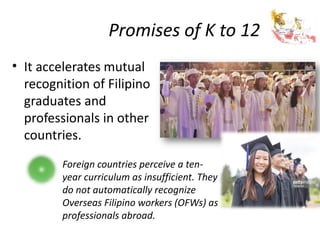
• It accelerates mutual
recognition of Filipino
graduates and
professionals in other
countries.
Foreign countries perceive a ten-
year curriculum as insufficient. They
do not automatically recognize
Overseas Filipino workers (OFWs) as
professionals abroad.
Promises of K to 12
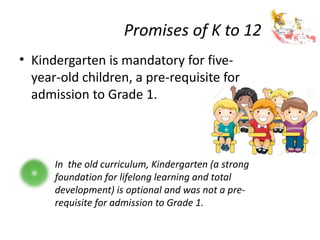
• Kindergarten is mandatory for five-
year-old children, a pre-requisite for
admission to Grade 1.
In the old curriculum, Kindergarten (a strong
foundation for lifelong learning and total
development) is optional and was not a pre-
requisite for admission to Grade 1.
Promises of K to 12
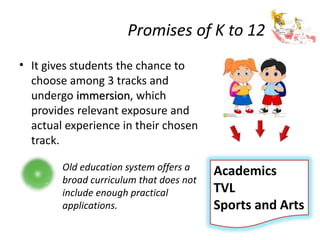
• It gives students the chance to
choose among 3 tracks and
undergo immersion, which
provides relevant exposure and
actual experience in their chosen
track.
Old education system offers a
broad curriculum that does not
include enough practical
applications.
Academics
TVL
Sports and Arts
Up Next…
• K to 12
Implementation
• Philosophical and
Legal Basis
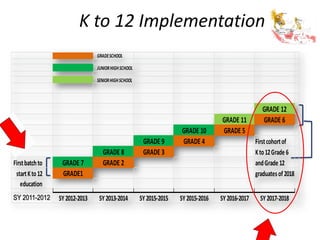
K to 12 Implementation
GRADESCHOOL
JUNIORHIGHSCHOOL
SENIORHIGHSCHOOL
GRADE 12
GRADE 11 GRADE 6
GRADE 10 GRADE 5
GRADE 9 GRADE 4 Firstcohortof
GRADE 8 GRADE 3 Kto12Grade 6
Firstbatchto GRADE 7 GRADE 2 andGrade 12
startKto12 GRADE1 graduatesof 2018
education
SY2012-2013 SY2013-2014 SY2015-2015 SY2015-2016 SY2016-2017 SY2017-2018SY 2011-2012
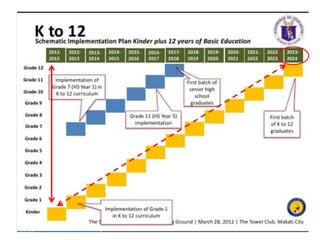
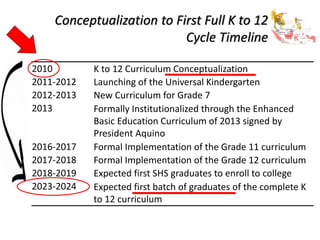
2010 K to 12 Curriculum Conceptualization
2011-2012 Launching of the Universal Kindergarten
2012-2013 New Curriculum for Grade 7
2013 Formally Institutionalized through the Enhanced
Basic Education Curriculum of 2013 signed by
President Aquino
2016-2017 Formal Implementation of the Grade 11 curriculum
2017-2018 Formal Implementation of the Grade 12 curriculum
2018-2019 Expected first SHS graduates to enroll to college
2023-2024 Expected first batch of graduates of the complete K
to 12 curriculum
Conceptualization to First Full K to 12
Cycle Timeline
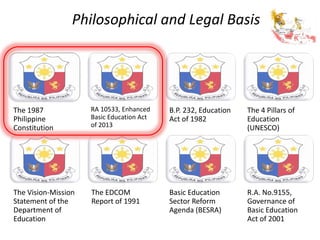
Philosophical and Legal Basis
The 1987
Philippine
Constitution
RA 10533, Enhanced
Basic Education Act
of 2013
B.P. 232, Education
Act of 1982
The 4 Pillars of
Education
(UNESCO)
The Vision-Mission
Statement of the
Department of
Education
The EDCOM
Report of 1991
Basic Education
Sector Reform
Agenda (BESRA)
R.A. No.9155,
Governance of
Basic Education
Act of 2001
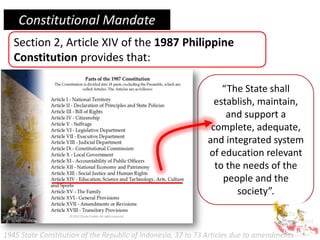
“The State shall
establish, maintain,
and support a
complete, adequate,
and integrated system
of education relevant
to the needs of the
people and the
society”.
Section 2, Article XIV of the 1987 Philippine
Constitution provides that:
Constitutional Mandate
1945 State Constitution of the Republic of Indonesia, 37 to 73 Articles due to amendments
The 1987 Philippine Constitution
RA 10533, Enhanced Basic Education Act of 2013
B.P. 232, Education Act of 1982
The 4 Pillars of Education (UNESCO)
The Vision-Mission Statement of the Department of
Education
The EDCOM Report of 1991
Basic Education Sector Reform Agenda (BESRA)
R.A. No.9155, Governance of Basic Education Act o2001
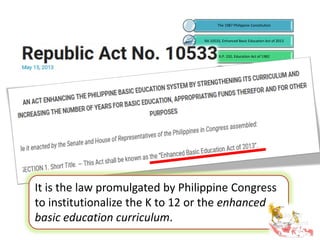
It is the law promulgated by Philippine Congress
to institutionalize the K to 12 or the enhanced
basic education curriculum.
Major Issues on K to 12
Program Implementation
Up Next…
In the next presentations, lead stories of
reliable newspapers in the Philippines
related to the state of K to 12 program are
used as material documents. This is to
show that a given issue, government
action or direction is widely publicized and
discussed; hence, generally acceptable.
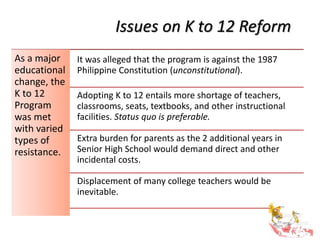
Issues on K to 12 Reform
As a major
educational
change, the
K to 12
Program
was met
with varied
types of
resistance.
It was alleged that the program is against the 1987
Philippine Constitution (unconstitutional).
Adopting K to 12 entails more shortage of teachers,
classrooms, seats, textbooks, and other instructional
facilities. Status quo is preferable.
Extra burden for parents as the 2 additional years in
Senior High School would demand direct and other
incidental costs.
Displacement of many college teachers would be
inevitable.
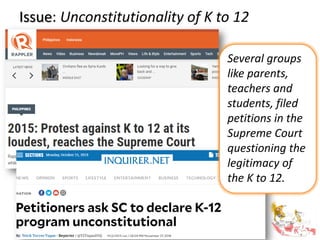
Issue: Unconstitutionality of K to 12
Several groups
like parents,
teachers and
students, filed
petitions in the
Supreme Court
questioning the
legitimacy of
the K to 12.
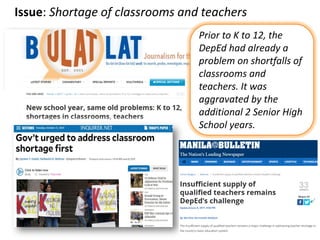
Issue: Shortage of classrooms and teachers
Prior to K to 12, the
DepEd had already a
problem on shortfalls of
classrooms and
teachers. It was
aggravated by the
additional 2 Senior High
School years.
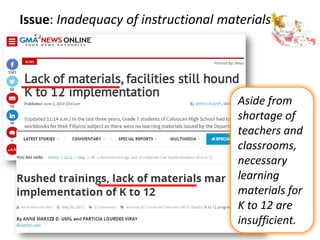
Issue: Inadequacy of instructional materials
Aside from
shortage of
teachers and
classrooms,
necessary
learning
materials for
K to 12 are
insufficient.
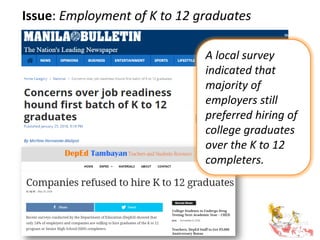
Issue: Employment of K to 12 graduates
A local survey
indicated that
majority of
employers still
preferred hiring of
college graduates
over the K to 12
completers.
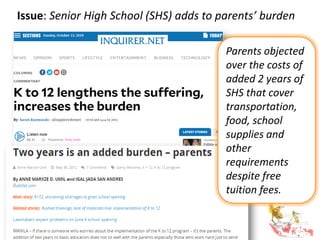
Issue: Senior High School (SHS) adds to parents’ burden
Parents objected
over the costs of
added 2 years of
SHS that cover
transportation,
food, school
supplies and
other
requirements
despite free
tuition fees.
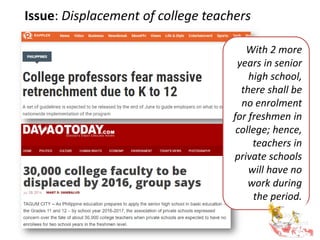
Issue: Displacement of college teachers
With 2 more
years in senior
high school,
there shall be
no enrolment
for freshmen in
college; hence,
teachers in
private schools
will have no
work during
the period.
Philippine (PH)
Government Responses to
K to 12 Issues
Up Next…
PH Government Responses
Despite many controversial issues, the Philippine government
stood firm and manage squarely the implementation of K to 12
program via:
• Defending its legitimacy
• Increasing the budget allocation for education
• Hiring and assisting the displaced teachers
• Recruiting new SHS teachers
• Making curriculum support system available and accessible to
teachers
• Massive teachers’ training
• Partnership with local governments and industries
• Collaboration with other government agencies
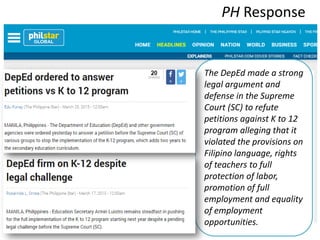
PH Response
The DepEd made a strong
legal argument and
defense in the Supreme
Court (SC) to refute
petitions against K to 12
program alleging that it
violated the provisions on
Filipino language, rights
of teachers to full
protection of labor,
promotion of full
employment and equality
of employment
opportunities.
PH Response
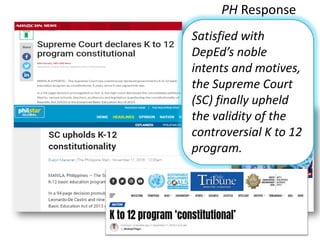
Satisfied with
DepEd’s noble
intents and motives,
the Supreme Court
(SC) finally upheld
the validity of the
controversial K to 12
program.
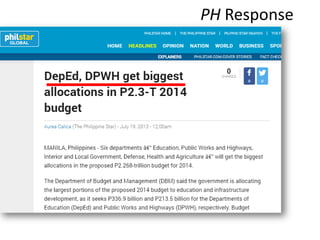
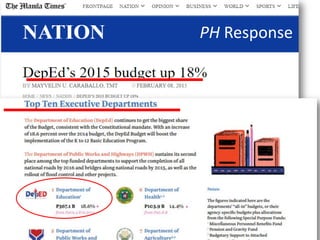
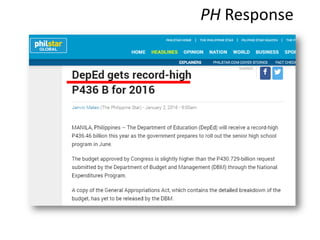
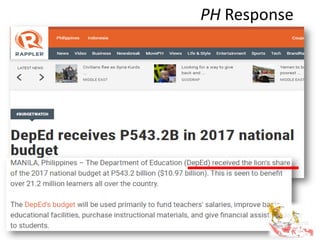
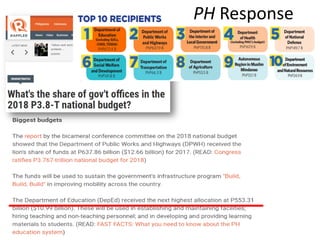
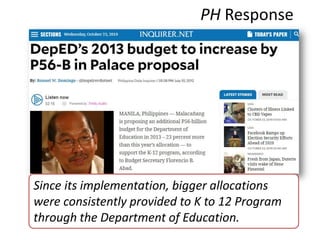
Since its implementation, bigger allocations
were consistently provided to K to 12 Program
through the Department of Education.
PH Response
PH Response
PH Response
PH Response
PH Response
PH Response
PH Response
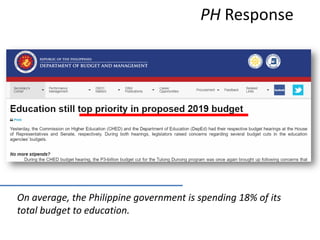
On average, the Philippine government is spending 18% of its
total budget to education.
PH Response
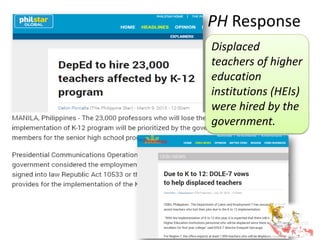
Displaced
teachers of higher
education
institutions (HEIs)
were hired by the
government.
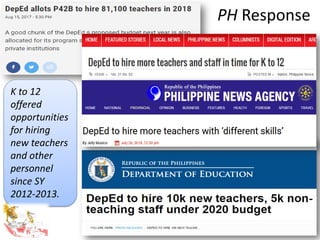
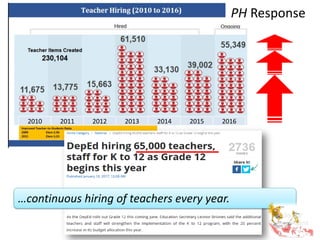
K to 12
offered
opportunities
for hiring
new teachers
and other
personnel
since SY
2012-2013.
PH Response
2010 2011 2012 2013 2014 2015 2016
…continuous hiring of teachers every year.
PH Response
PH Response
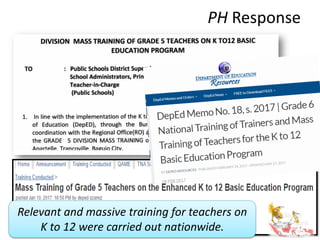
Relevant and massive training for teachers on
K to 12 were carried out nationwide.
PH Response
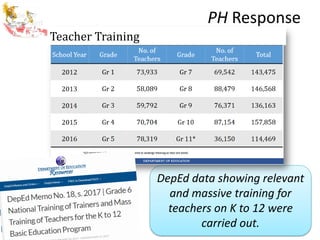
DepEd data showing relevant
and massive training for
teachers on K to 12 were
carried out.
Teacher Training
PH Response
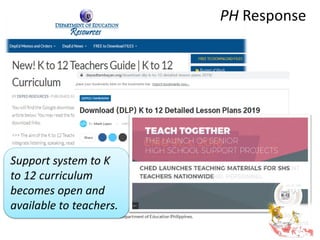
Support system to K
to 12 curriculum
becomes open and
available to teachers.
PH Response
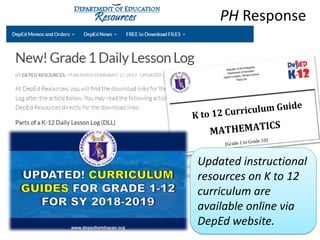
Updated instructional
resources on K to 12
curriculum are
available online via
DepEd website.
PH Response
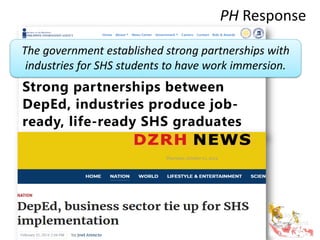
The government established strong partnerships with
industries for SHS students to have work immersion.
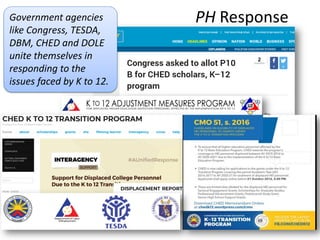
PH ResponseGovernment agencies
like Congress, TESDA,
DBM, CHED and DOLE
unite themselves in
responding to the
issues faced by K to 12.
PH Response
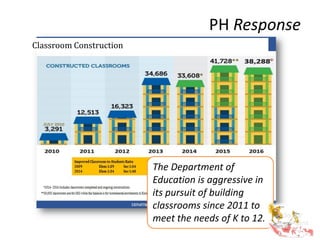
The Department of
Education is aggressive in
its pursuit of building
classrooms since 2011 to
meet the needs of K to 12.
Classroom Construction
PH Response
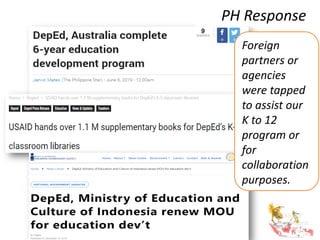
Foreign
partners or
agencies
were tapped
to assist our
K to 12
program or
for
collaboration
purposes.
PH Response
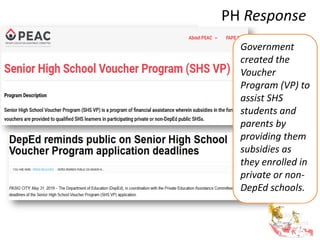
Government
created the
Voucher
Program (VP) to
assist SHS
students and
parents by
providing them
subsidies as
they enrolled in
private or non-
DepEd schools.
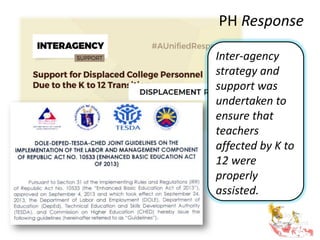
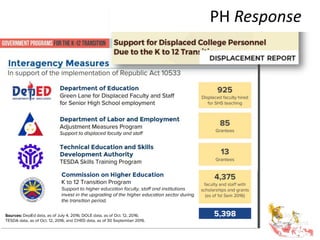
Inter-agency
strategy and
support was
undertaken to
ensure that
teachers
affected by K to
12 were
properly
assisted.
PH Response
PH Response
PH Response
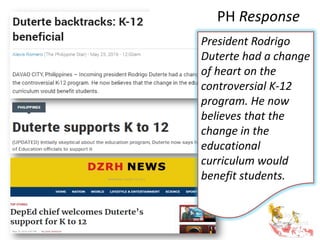
President Rodrigo
Duterte had a change
of heart on the
controversial K-12
program. He now
believes that the
change in the
educational
curriculum would
benefit students.
Up Next…
Future Directions of
K to 12
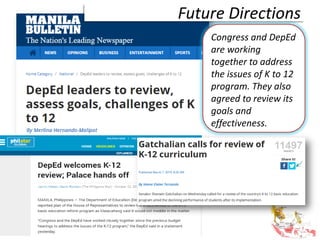
Congress and DepEd
are working
together to address
the issues of K to 12
program. They also
agreed to review its
goals and
effectiveness.
Future Directions
Future Directions
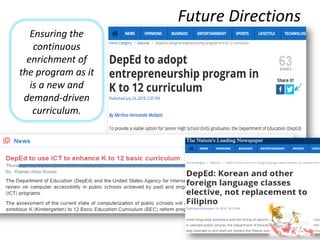
Ensuring the
continuous
enrichment of
the program as it
is a new and
demand-driven
curriculum.
Future Directions
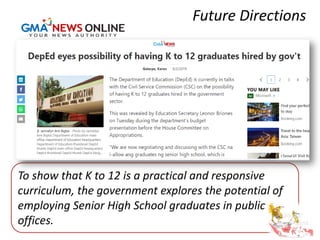
To show that K to 12 is a practical and responsive
curriculum, the government explores the potential of
employing Senior High School graduates in public
offices.
Future Directions
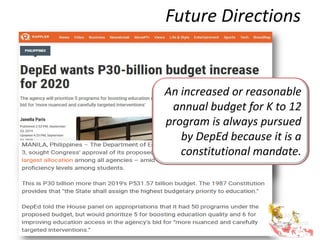
An increased or reasonable
annual budget for K to 12
program is always pursued
by DepEd because it is a
constitutional mandate.
Future Directions
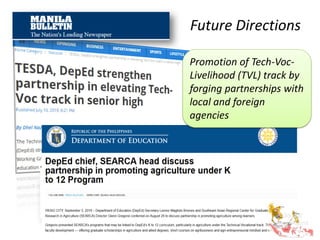
Promotion of Tech-Voc-
Livelihood (TVL) track by
forging partnerships with
local and foreign
agencies
Future Directions
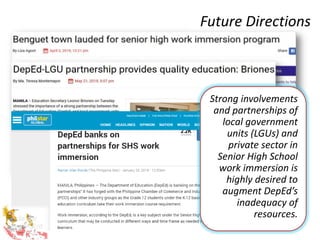
Strong involvements
and partnerships of
local government
units (LGUs) and
private sector in
Senior High School
work immersion is
highly desired to
augment DepEd’s
inadequacy of
resources.
Up Next…
Concluding
Statements
Concluding Statement
Despite the varied issues that
confronted the implementation of
Philippine’s K to 12 program, the
government through DepEd had
evidently addressed them to a large
extent.
Concluding Statement
The PH government had been
prudent in fulfilling the constitutional
mandate by sustaining generous
expenditures in education – a
consistent lion’s share in the annual
budget.
Concluding Statement
While the program is an idea of the
previous administration, the
apparent initial success of K to 12
Program can be attributed to the
significant support extended by the
new political leadership.
End…
Thank you for listening.
Email: erniecerado@sksu.edu.ph; eccphd@yahoo.com

A glimpse on k to 12 program in the philippines

  • 1.
    A Glimpse onK to 12 Program in the Philippines1 ERNIE C. CERADO, PhD SULTAN KUDARAT STATE UNIVERSITY 1Presented during the Lecture Series held on October 24, 2019 at the Universitas Pembangunan “Veterans” Nasional Yogyakarta, (UPVNY), Yogyakarta, Indonesia
  • 2.
    SULTAN KUDARAT STATE UNIVERSITY SOUTHEASTASIA PHILIPPINES MANILA Yogyakarta UPNY
  • 3.
    Presentation Outline What isK to 12? Rationale and Promises of K to 12 Implementation of K to 12 Legal & Philosophical Basis Reform Issues Government Response Future Directions Concluding Statements
  • 4.
    What is Kto 12? K to 12 is an education system under the Philippine’s Department of Education that primarily aims to enhance learners’ basic skills, produce more competent citizens, and prepare graduates for lifelong learning and employment.
  • 5.
    K to 12Program • It is a 13-year basic education program that provides sufficient time for mastery of concepts and skills, develop lifelong learners, and prepare graduates for tertiary education, middle-level skills development, employment, and entrepreneurship.
  • 6.
    K to 12vs Old Basic Education Curriculum K to 12 Curriculum Old Basic Education Curriculum (BEC)
  • 7.
    • Kindergarten* isthe first stage of compulsory and mandatory formal schooling which consists of one (1) year of preparatory education for children at least five (5) years old as a prerequisite for Grade 1. *Republic Act No. 10157 (Kindergarten Education Act)
  • 8.
    • Elementary (Primary)refers to the second stage of compulsory basic education which is composed of six (6) years. • The entrant age to this level is typically six (6) years old.
  • 9.
    • Secondary refersto the third stage of compulsory basic education. It consists of four (4) years of junior high school and two (2) years of senior high school (SHS) education. • The entrant age to the junior and senior high school levels are typically twelve (12) and sixteen (16) years old, respectively.
  • 10.
    SHS Specialized Tracks AcademicTrack Accountancy, Business and Mathematics (ABM) Science, Technology, Engineering and Mathematics (STEM) Humanities and Social Sciences (HUMMS) General Academic Strand (GAS) Technical, Vocational, Livelihood (TVL) Track Home Economics (HE) Information and Communication Technology (ICT) Agri-Fishery Arts (AFA) Industry Arts Sports and Arts Track
  • 11.
    Rationale and Promises ofK to 12 Program Up Next…
  • 12.
    Inadequate mastery of basiccompetencies is common due to a congested curriculum. The 12 year curriculum is being delivered in 10 years. High school graduates are younger than 18 years old and lack basic competences and maturity. They cannot legally enter into contracts and are not emotionally mature for entrepreneurship or employment. Other countries view the 10-year education cycle as insufficient. Rationale of K to 12 Program Issues with the old PH Basic Education Curriculum
  • 13.
    Promises of Kto 12 • The K to 12 program offers a decongested 12- year program that gives students sufficient time to master skills and absorb basic competencies. In the old curriculum, students lack mastery of basic competencies due to a congested ten-year basic education curriculum.
  • 14.
    Promises of Kto 12 • Students will graduate at the age of 18 and will be ready for employment, entrepreneurship, middle level skills development, and higher education upon graduation. Graduates of the old curriculum are younger than 18 years old and are not legally ready to get a job or start a business.
  • 15.
    Promises of Kto 12 • It accelerates mutual recognition of Filipino graduates and professionals in other countries. Foreign countries perceive a ten- year curriculum as insufficient. They do not automatically recognize Overseas Filipino workers (OFWs) as professionals abroad.
  • 16.
    Promises of Kto 12 • Kindergarten is mandatory for five- year-old children, a pre-requisite for admission to Grade 1. In the old curriculum, Kindergarten (a strong foundation for lifelong learning and total development) is optional and was not a pre- requisite for admission to Grade 1.
  • 17.
    Promises of Kto 12 • It gives students the chance to choose among 3 tracks and undergo immersion, which provides relevant exposure and actual experience in their chosen track. Old education system offers a broad curriculum that does not include enough practical applications. Academics TVL Sports and Arts
  • 18.
    Up Next… • Kto 12 Implementation • Philosophical and Legal Basis
  • 19.
    K to 12Implementation GRADESCHOOL JUNIORHIGHSCHOOL SENIORHIGHSCHOOL GRADE 12 GRADE 11 GRADE 6 GRADE 10 GRADE 5 GRADE 9 GRADE 4 Firstcohortof GRADE 8 GRADE 3 Kto12Grade 6 Firstbatchto GRADE 7 GRADE 2 andGrade 12 startKto12 GRADE1 graduatesof 2018 education SY2012-2013 SY2013-2014 SY2015-2015 SY2015-2016 SY2016-2017 SY2017-2018SY 2011-2012
  • 21.
    2010 K to12 Curriculum Conceptualization 2011-2012 Launching of the Universal Kindergarten 2012-2013 New Curriculum for Grade 7 2013 Formally Institutionalized through the Enhanced Basic Education Curriculum of 2013 signed by President Aquino 2016-2017 Formal Implementation of the Grade 11 curriculum 2017-2018 Formal Implementation of the Grade 12 curriculum 2018-2019 Expected first SHS graduates to enroll to college 2023-2024 Expected first batch of graduates of the complete K to 12 curriculum Conceptualization to First Full K to 12 Cycle Timeline
  • 22.
    Philosophical and LegalBasis The 1987 Philippine Constitution RA 10533, Enhanced Basic Education Act of 2013 B.P. 232, Education Act of 1982 The 4 Pillars of Education (UNESCO) The Vision-Mission Statement of the Department of Education The EDCOM Report of 1991 Basic Education Sector Reform Agenda (BESRA) R.A. No.9155, Governance of Basic Education Act of 2001
  • 23.
    “The State shall establish,maintain, and support a complete, adequate, and integrated system of education relevant to the needs of the people and the society”. Section 2, Article XIV of the 1987 Philippine Constitution provides that: Constitutional Mandate 1945 State Constitution of the Republic of Indonesia, 37 to 73 Articles due to amendments
  • 24.
    The 1987 PhilippineConstitution RA 10533, Enhanced Basic Education Act of 2013 B.P. 232, Education Act of 1982 The 4 Pillars of Education (UNESCO) The Vision-Mission Statement of the Department of Education The EDCOM Report of 1991 Basic Education Sector Reform Agenda (BESRA) R.A. No.9155, Governance of Basic Education Act o2001 It is the law promulgated by Philippine Congress to institutionalize the K to 12 or the enhanced basic education curriculum.
  • 25.
    Major Issues onK to 12 Program Implementation Up Next…
  • 26.
    In the nextpresentations, lead stories of reliable newspapers in the Philippines related to the state of K to 12 program are used as material documents. This is to show that a given issue, government action or direction is widely publicized and discussed; hence, generally acceptable.
  • 27.
    Issues on Kto 12 Reform As a major educational change, the K to 12 Program was met with varied types of resistance. It was alleged that the program is against the 1987 Philippine Constitution (unconstitutional). Adopting K to 12 entails more shortage of teachers, classrooms, seats, textbooks, and other instructional facilities. Status quo is preferable. Extra burden for parents as the 2 additional years in Senior High School would demand direct and other incidental costs. Displacement of many college teachers would be inevitable.
  • 28.
    Issue: Unconstitutionality ofK to 12 Several groups like parents, teachers and students, filed petitions in the Supreme Court questioning the legitimacy of the K to 12.
  • 29.
    Issue: Shortage ofclassrooms and teachers Prior to K to 12, the DepEd had already a problem on shortfalls of classrooms and teachers. It was aggravated by the additional 2 Senior High School years.
  • 30.
    Issue: Inadequacy ofinstructional materials Aside from shortage of teachers and classrooms, necessary learning materials for K to 12 are insufficient.
  • 31.
    Issue: Employment ofK to 12 graduates A local survey indicated that majority of employers still preferred hiring of college graduates over the K to 12 completers.
  • 32.
    Issue: Senior HighSchool (SHS) adds to parents’ burden Parents objected over the costs of added 2 years of SHS that cover transportation, food, school supplies and other requirements despite free tuition fees.
  • 33.
    Issue: Displacement ofcollege teachers With 2 more years in senior high school, there shall be no enrolment for freshmen in college; hence, teachers in private schools will have no work during the period.
  • 34.
    Philippine (PH) Government Responsesto K to 12 Issues Up Next…
  • 35.
    PH Government Responses Despitemany controversial issues, the Philippine government stood firm and manage squarely the implementation of K to 12 program via: • Defending its legitimacy • Increasing the budget allocation for education • Hiring and assisting the displaced teachers • Recruiting new SHS teachers • Making curriculum support system available and accessible to teachers • Massive teachers’ training • Partnership with local governments and industries • Collaboration with other government agencies
  • 36.
    PH Response The DepEdmade a strong legal argument and defense in the Supreme Court (SC) to refute petitions against K to 12 program alleging that it violated the provisions on Filipino language, rights of teachers to full protection of labor, promotion of full employment and equality of employment opportunities.
  • 37.
    PH Response Satisfied with DepEd’snoble intents and motives, the Supreme Court (SC) finally upheld the validity of the controversial K to 12 program.
  • 38.
    Since its implementation,bigger allocations were consistently provided to K to 12 Program through the Department of Education. PH Response
  • 39.
  • 40.
  • 41.
  • 42.
  • 43.
  • 44.
    PH Response On average,the Philippine government is spending 18% of its total budget to education.
  • 45.
    PH Response Displaced teachers ofhigher education institutions (HEIs) were hired by the government.
  • 46.
    K to 12 offered opportunities forhiring new teachers and other personnel since SY 2012-2013. PH Response
  • 47.
    2010 2011 20122013 2014 2015 2016 …continuous hiring of teachers every year. PH Response
  • 48.
    PH Response Relevant andmassive training for teachers on K to 12 were carried out nationwide.
  • 49.
    PH Response DepEd datashowing relevant and massive training for teachers on K to 12 were carried out. Teacher Training
  • 50.
    PH Response Support systemto K to 12 curriculum becomes open and available to teachers.
  • 51.
    PH Response Updated instructional resourceson K to 12 curriculum are available online via DepEd website.
  • 52.
    PH Response The governmentestablished strong partnerships with industries for SHS students to have work immersion.
  • 53.
    PH ResponseGovernment agencies likeCongress, TESDA, DBM, CHED and DOLE unite themselves in responding to the issues faced by K to 12.
  • 54.
    PH Response The Departmentof Education is aggressive in its pursuit of building classrooms since 2011 to meet the needs of K to 12. Classroom Construction
  • 55.
    PH Response Foreign partners or agencies weretapped to assist our K to 12 program or for collaboration purposes.
  • 56.
    PH Response Government created the Voucher Program(VP) to assist SHS students and parents by providing them subsidies as they enrolled in private or non- DepEd schools.
  • 57.
    Inter-agency strategy and support was undertakento ensure that teachers affected by K to 12 were properly assisted. PH Response
  • 58.
  • 59.
    PH Response President Rodrigo Dutertehad a change of heart on the controversial K-12 program. He now believes that the change in the educational curriculum would benefit students.
  • 60.
  • 61.
    Congress and DepEd areworking together to address the issues of K to 12 program. They also agreed to review its goals and effectiveness. Future Directions
  • 62.
    Future Directions Ensuring the continuous enrichmentof the program as it is a new and demand-driven curriculum.
  • 63.
    Future Directions To showthat K to 12 is a practical and responsive curriculum, the government explores the potential of employing Senior High School graduates in public offices.
  • 64.
    Future Directions An increasedor reasonable annual budget for K to 12 program is always pursued by DepEd because it is a constitutional mandate.
  • 65.
    Future Directions Promotion ofTech-Voc- Livelihood (TVL) track by forging partnerships with local and foreign agencies
  • 66.
    Future Directions Strong involvements andpartnerships of local government units (LGUs) and private sector in Senior High School work immersion is highly desired to augment DepEd’s inadequacy of resources.
  • 67.
  • 68.
    Concluding Statement Despite thevaried issues that confronted the implementation of Philippine’s K to 12 program, the government through DepEd had evidently addressed them to a large extent.
  • 69.
    Concluding Statement The PHgovernment had been prudent in fulfilling the constitutional mandate by sustaining generous expenditures in education – a consistent lion’s share in the annual budget.
  • 70.
    Concluding Statement While theprogram is an idea of the previous administration, the apparent initial success of K to 12 Program can be attributed to the significant support extended by the new political leadership.
  • 71.
    End… Thank you forlistening. Email: erniecerado@sksu.edu.ph; eccphd@yahoo.com