Society vs. Individuals

BILAL ATIE/ CLEMENTINE PIERROT
Outline


 I. Social context of the Victorian Society
  a.   Bourgeois Respectability
  b.   Position of Women in the society
  c.   Social Responsibility

 II. The Burden society puts on individuals
  a.   Appearances
  b.   Women are condemned
  c.   Mistakes

 III. Independence vs. Control / Manipulation
  a.     Independence seen through Nora’s escape
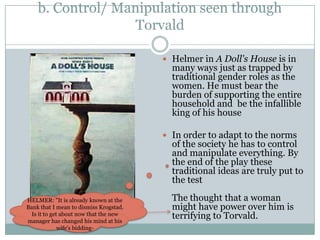
  b.    Control/ Manipulation seen through Torvald and Krogstad
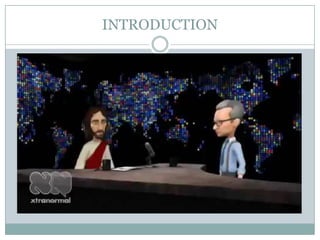
INTRODUCTION
I. Social context of the Victorian Society


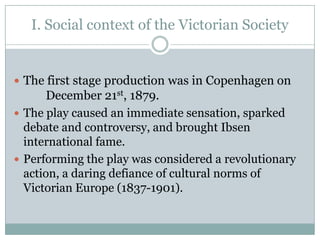
 The first stage production was in Copenhagen on
       December 21st, 1879.
 The play caused an immediate sensation, sparked
  debate and controversy, and brought Ibsen
  international fame.
 Performing the play was considered a revolutionary
  action, a daring defiance of cultural norms of
  Victorian Europe (1837-1901).
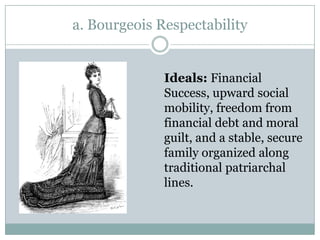
a. Bourgeois Respectability


              Ideals: Financial
              Success, upward social
              mobility, freedom from
              financial debt and moral
              guilt, and a stable, secure
              family organized along
              traditional patriarchal
              lines.
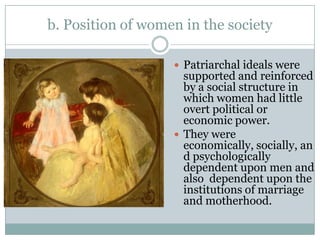
b. Position of women in the society

                    Patriarchal ideals were
                     supported and reinforced
                     by a social structure in
                     which women had little
                     overt political or
                     economic power.
                    They were
                     economically, socially, an
                     d psychologically
                     dependent upon men and
                     also dependent upon the
                     institutions of marriage
                     and motherhood.
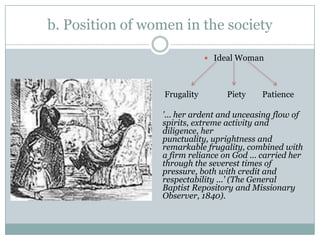
b. Position of women in the society

                               Ideal Woman


                  Frugality       Piety    Patience

                 '... her ardent and unceasing flow of
                 spirits, extreme activity and
                 diligence, her
                 punctuality, uprightness and
                 remarkable frugality, combined with
                 a firm reliance on God ... carried her
                 through the severest times of
                 pressure, both with credit and
                 respectability ...' (The General
                 Baptist Repository and Missionary
                 Observer, 1840).
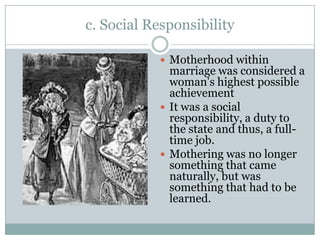
c. Social Responsibility

            Motherhood within
             marriage was considered a
             woman’s highest possible
             achievement
            It was a social
             responsibility, a duty to
             the state and thus, a full-
             time job.
            Mothering was no longer
             something that came
             naturally, but was
             something that had to be
             learned.
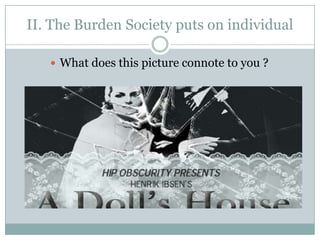
II. The Burden Society puts on individual

    What does this picture connote to you ?
a. Appearances
                                                                “Don’t laugh. I mean, of course, a time
                                                                will come when Torvald is not as devoted
                                                                to me, not quite so happy when I dance
                                                                for him, and dress for him, and play with
                                                                him.”


 Torvald defines his life by what society finds acceptable
  and respectable. He is more concerned about the
  attractive appearance of his wife and home than he is
  about his wife's happiness
 When Nora tries to convince him to keep Krogstad in his
  job, his main concern is what the bank employees will
  think of him if they believe he has been influenced by his
  wife.
  From now on, forget happiness.          Torvald’s reaction to Krogstad’s letter solidifies his
   Now it’s just about saving the         characterization as a shallow man concerned first and
    remains, the wreckage, the            foremost with appearances. Here, he states explicitly that the
            appearance.                   appearance of happiness is far more important to him than
                                          happiness itself.
b. Women are condemned

 Torvald symbolizes the male dominated society at
  that time. And Nora stereotypes of women at that
  time ( being crushed)  thug giving a universal
  meaning
 . Torvald seems to stereotype all women as frivolous
  spendthrifts
                                       HELMER: "That is like a
 NORA: "surely you can                 woman! […] you know
 understand that being                 what I think about that.
 with Torvald is a little              No debt, no borrowing.”
 like being with papa.

 Nora is dependent on a men and Linde begins to
 conform to the society                  Someone to work for and
                                         live for--a home to bring
                                         comfort into."
c. Mistakes

 http://www.youtube.com/watch?v=KD5wxVwSbB8


 Another mistake that Nora did was to not tell her
  husband about the loan.
 The Fact that she wasn’t able to handle this situation
  instead of doing it behind her husband’s back is a
  huge mistake.
 Unfortunately, society will make her pay this mistake
  thought the whole play.
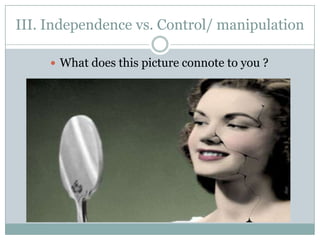
III. Independence vs. Control/ manipulation

      What does this picture connote to you ?
a. Nora’s escape

 In leaving Torvald and her children, she will outrage
  society and stigmatize herself.
 This is a terrible price to have to pay for self-
  fulfillment, but inevitable, given that society and the
  individual are so much at cross-purposes.
 Self-fulfillmentpushing and breaking boundaries.
                                 NORA: "What do you consider my most sacred
                                 duties?"
HELMER: "[…] your duties to your
 This idea was completely        husband and your children."
NORA: "I have other
 scandalous in Ibsen's           duties just as sacred. […] Duties to myself."
 time. The thought that a
 woman might have value
 other than homemaking
 and being a mother was
 outrageous.
b. Control/ Manipulation seen through
                   Torvald

                                         Helmer in A Doll's House is in
                                          many ways just as trapped by
                                          traditional gender roles as the
                                          women. He must bear the
                                          burden of supporting the entire
                                          household and be the infallible
                                          king of his house

                                         In order to adapt to the norms
                                          of the society he has to control
                                          and manipulate everything. By
                                          the end of the play these
                                          traditional ideas are truly put to
                                          the test

HELMER: "It is already known at the       The thought that a woman
Bank that I mean to dismiss Krogstad.     might have power over him is
  Is it to get about now that the new
manager has changed his mind at his
                                          terrifying to Torvald.
              wife's bidding-
b. Control/ Manipulation seen through Krogstad

 Society's moral standards affects Krogstad’s life
 He resorts to blackmail  in an attempt to keep his
  job mark of respectability.
 The threat of blackmail gains its power from the
  immense authority that individuals vested in
  society's moral standards: if nobody cared much
  what society thought, then Krogstad could tell all
  and no one would be harmed
Quiz

 Who said, “From now on, forget happiness.
  Now it’s just about saving the remains, the
  wreckage, the appearance”?
 Who said, "How painful and humiliating it
  would be for Torvald […] to know that he
  owed me anything!"?
 What does Torvald say are Nora's most
  sacred duties?
 What has damaged the Helmer household the
  most?

A doll's house pp

  • 1.
    Society vs. Individuals BILALATIE/ CLEMENTINE PIERROT
  • 2.
    Outline  I. Socialcontext of the Victorian Society a. Bourgeois Respectability b. Position of Women in the society c. Social Responsibility  II. The Burden society puts on individuals a. Appearances b. Women are condemned c. Mistakes  III. Independence vs. Control / Manipulation a. Independence seen through Nora’s escape b. Control/ Manipulation seen through Torvald and Krogstad
  • 3.
  • 4.
    I. Social contextof the Victorian Society  The first stage production was in Copenhagen on December 21st, 1879.  The play caused an immediate sensation, sparked debate and controversy, and brought Ibsen international fame.  Performing the play was considered a revolutionary action, a daring defiance of cultural norms of Victorian Europe (1837-1901).
  • 5.
    a. Bourgeois Respectability Ideals: Financial Success, upward social mobility, freedom from financial debt and moral guilt, and a stable, secure family organized along traditional patriarchal lines.
  • 6.
    b. Position ofwomen in the society  Patriarchal ideals were supported and reinforced by a social structure in which women had little overt political or economic power.  They were economically, socially, an d psychologically dependent upon men and also dependent upon the institutions of marriage and motherhood.
  • 7.
    b. Position ofwomen in the society  Ideal Woman Frugality Piety Patience '... her ardent and unceasing flow of spirits, extreme activity and diligence, her punctuality, uprightness and remarkable frugality, combined with a firm reliance on God ... carried her through the severest times of pressure, both with credit and respectability ...' (The General Baptist Repository and Missionary Observer, 1840).
  • 8.
    c. Social Responsibility  Motherhood within marriage was considered a woman’s highest possible achievement  It was a social responsibility, a duty to the state and thus, a full- time job.  Mothering was no longer something that came naturally, but was something that had to be learned.
  • 9.
    II. The BurdenSociety puts on individual  What does this picture connote to you ?
  • 10.
    a. Appearances “Don’t laugh. I mean, of course, a time will come when Torvald is not as devoted to me, not quite so happy when I dance for him, and dress for him, and play with him.”  Torvald defines his life by what society finds acceptable and respectable. He is more concerned about the attractive appearance of his wife and home than he is about his wife's happiness  When Nora tries to convince him to keep Krogstad in his job, his main concern is what the bank employees will think of him if they believe he has been influenced by his wife. From now on, forget happiness. Torvald’s reaction to Krogstad’s letter solidifies his Now it’s just about saving the characterization as a shallow man concerned first and remains, the wreckage, the foremost with appearances. Here, he states explicitly that the appearance. appearance of happiness is far more important to him than happiness itself.
  • 11.
    b. Women arecondemned  Torvald symbolizes the male dominated society at that time. And Nora stereotypes of women at that time ( being crushed)  thug giving a universal meaning  . Torvald seems to stereotype all women as frivolous spendthrifts HELMER: "That is like a NORA: "surely you can woman! […] you know understand that being what I think about that. with Torvald is a little No debt, no borrowing.” like being with papa.  Nora is dependent on a men and Linde begins to conform to the society Someone to work for and live for--a home to bring comfort into."
  • 12.
    c. Mistakes  http://www.youtube.com/watch?v=KD5wxVwSbB8 Another mistake that Nora did was to not tell her husband about the loan.  The Fact that she wasn’t able to handle this situation instead of doing it behind her husband’s back is a huge mistake.  Unfortunately, society will make her pay this mistake thought the whole play.
  • 13.
    III. Independence vs.Control/ manipulation  What does this picture connote to you ?
  • 14.
    a. Nora’s escape In leaving Torvald and her children, she will outrage society and stigmatize herself.  This is a terrible price to have to pay for self- fulfillment, but inevitable, given that society and the individual are so much at cross-purposes.  Self-fulfillmentpushing and breaking boundaries. NORA: "What do you consider my most sacred duties?"
HELMER: "[…] your duties to your This idea was completely husband and your children."
NORA: "I have other scandalous in Ibsen's duties just as sacred. […] Duties to myself." time. The thought that a woman might have value other than homemaking and being a mother was outrageous.
  • 15.
    b. Control/ Manipulationseen through Torvald  Helmer in A Doll's House is in many ways just as trapped by traditional gender roles as the women. He must bear the burden of supporting the entire household and be the infallible king of his house  In order to adapt to the norms of the society he has to control and manipulate everything. By the end of the play these traditional ideas are truly put to the test HELMER: "It is already known at the The thought that a woman Bank that I mean to dismiss Krogstad. might have power over him is Is it to get about now that the new manager has changed his mind at his terrifying to Torvald. wife's bidding-
  • 16.
    b. Control/ Manipulationseen through Krogstad  Society's moral standards affects Krogstad’s life  He resorts to blackmail  in an attempt to keep his job mark of respectability.  The threat of blackmail gains its power from the immense authority that individuals vested in society's moral standards: if nobody cared much what society thought, then Krogstad could tell all and no one would be harmed
  • 17.
    Quiz  Who said,“From now on, forget happiness. Now it’s just about saving the remains, the wreckage, the appearance”?  Who said, "How painful and humiliating it would be for Torvald […] to know that he owed me anything!"?  What does Torvald say are Nora's most sacred duties?  What has damaged the Helmer household the most?