A Distributed CTL Model Checker 
Laura Florentina Stoica1, Florian Mircea Boian2 and Florin Stoica1 
1 Department of Mathematics and Informatics, Lucian Blaga University, 5-7 Dr. Ratiu Street, Sibiu, Romania 
2 Department of Computer Science, Babes Bolyai University, 1 M. Kogalniceanu Street, Cluj Napoca, Romania 
{laura.cacovean, florin.stoica}@ulbsibiu.ro, florin@cs.ubbcluj.ro 
Keywords: Model Checking, CTL, Web services. 
Abstract: Model checking is nowadays being used as advanced technique to analyse, design and debug reactive systems. This paper gives an overview of our recent work on implementing a new interactive CTL model checker. In contrast to previous approaches, our tool permits an interactive design of the CTL models as state-transition graphs, and is based on client/server architecture. The server part embeds the core of the CTL model checker and is published as a Web service. A C# client provides an intuitive graphical interface for interactive design of CTL models. Java and C# APIs are available for programmatic construction of large models. Experimental results are encouraging, showing that our tool is able to handle large systems efficiently. 
1 INTRODUCTION 
Verification of a software system involves checking whether the system in question behaves as it was designed to behave. Design validation involves checking whether a system design satisfies the system requirements. Both of these tasks, system verification and design validation can be accomplished thoroughly and reliably using model- based formal methods, such as model checking (Rozier, 2011). 
Model checking is particularly well-suited for the automated verification of finite-state systems, both for software and for hardware. 
Main concern of formal methods in general, and model checking in particular, is helping to design correct systems (Barnat et al., 2010). Detecting and eliminating bugs as early in the design cycle as possible is clearly an economic imperative. For example, the Pentium FDIV bug (a bug in the Intel P5 Pentium floating point unit discovered in 1994) cost Intel Corporation a half billion dollars. 
Model checking is the formal process through which a given specification representing a desired behavioral property is verified to hold for a given system (the model). Two most common methods of performing model checking are explicit enumeration of states of the model and respectively the use of symbolic methods. 
In the following we consider that model is a directed graph where the nodes represent the states of the system and the edges represents the state transitions, more specifically a Kripke structure. 
The state explosion problem is widely agreed to be the most formidable challenge facing the application of model checking to large and complex real-world systems. In short, the number of states required by the model grows exponentially with the number of system components (or state variables), constituting the main practical limitation of model checking. Reducing the time required to verify models remains also a big challenge. This naturally raises interest in using parallelism to improve the performance of many formal model checkers. Much of the extensive research on the parallelization of model checking algorithms followed the distributed memory programming model which appeared from the necessity to eliminate the memory constraints of a single computer system. 
1.1 Related work 
Some examples of well-known explicit-state parallel model checkers are DiViNe and PSPIN. DiVinE (Barnat, Brim et al, 2010), (Barnat et al., 2010) is a distributed model checker for explicit state LTL (Linear Temporal Logic) model checking and is able to handle large systems consisting of as
many as 419 million states, as stated in (Bingham et al., 2010). PSPIN has also been used for performing distributed model checking with the capability of handling up to around 2.8 million states (Lerda and Sisto, 1999). 
The basic idea behind symbolic model checking is to use a more efficient “symbolic” representation for the Kripke structure being checked and for sets of states of the Kripke structure. 
Symbolic model checkers, such as CadenceSMV (Mir, 2000), NuSMV (Cimatti et al., 2002) analyse the state space symbolically using binary decision diagrams (BDDs), which were introduced in (Bryant, 1986). The binary decision diagram is a data structure for representing Boolean functions. In contrast with explicit-state model checking, states in symbolic model checking are represented implicitly, as a solution to a logical equation. This approach saves space in memory since syntactically small equations can represent comparatively large sets of states (Rozier, 2011). A symbolic model checker represents the Kripke structure itself symbolically using BDDs to represent transition relations by Boolean expressions. The key to symbolic model checking is to perform all calculations directly using these Boolean expressions, rather than using the Kripke structure explicitly. 
1.2 Comparing Symbolic and Explicit Model Checking 
In symbolic model checking, the space used to represent a state is limited by the internal data structures. However, because a symbolic approach uses a compact representation of the set of states, it can handle a larger state space size. In explicit model checking, the state size is not strictly limited, but is related with state space size in the total memory consumption. In (Eisner and Peled, 2002) is presented a comparison between RULEBASE, a symbolic model checker developed at IBM Haifa Research Laboratory and the explicit LTL model checker SPIN (Holzmann, 1997). The software verified was a distributed storage subsystem software application. The state space size handled by SPIN was 108 in a 3-process model. Using symbolic model checking, RULEBASE keeps a compressed representation of the state space and thus was able to manage 10150 states. On the other hand, because of the limit on state size, RULEBASE could not represent a state large enough to include the information needed for more than 2-process configuration (Eisner and Peled, 2002). 
An important reason why software model checking is still predominantly performed using explicit-state model checkers such as SPIN, is that these methods gain much of their efficiency from state-reduction techniques such as partial-order reduction (POR). The POR methods explore a reduced state space in a property-preserving way (Meulen and Pecheur, 2011). Partial-order reduction is useful only when the system has an asynchronous model of composition. 
Most hardware designs are based on a clocked- approach and thus are synchronous. For these systems, the symbolic model checking approach is more appropriate (Lerda et al., 2003). 
On the other hand, for nondeterministic, high- level models of hardware protocols, it has previously been argued that explicit model checking is better than symbolic model checking (Hu, 1995); this is because the communication mechanisms inherent in protocols tend to cause the BDDs in symbolic model checking to blow up (Bingham et al., 2010). 
In their basic form, symbolic approaches tend to perform poorly on asynchronous models where concurrent interleaving are the main source of explosion, and explicit-state model-checkers with POR have been the preferred approach for such models (Bingham et al., 2010). 
A detailed experimental comparison between performance of explicit-state model checkers and symbolic model checkers can be found in (Tabakov, 2005). The study follows an automata-theoretic approach in program verification, originally proposed in (Vardi and Wolper, 1986) and uses two approaches, explicit and symbolic, for solving the model-checking problem. 
In order to present a full comparison between the symbolic and the explicit algorithms, was performed a scaling comparison of Cadence SMV (Mir, 2000), NuSMV (Mir, 2000) as symbolic BDD-based model checkers and respectively SPIN. The direct comparison of the three model checkers shows that the explicit one (SPIN) is much faster than the symbolic ones. In conclusion, experimental results show that the explicit approach scales better than the symbolic one, which was rather surprising but confirms similar statements from (Bingham et al., 2010), (Hu, 1995). 
1.3 Motivation and objective 
The broad goal of our research was to develop a reliable, easy to maintain, scalable model checker tool to improve applicability of CTL (Computation
Tree Logic) model checking in design of general- purpose computer software. 
Concurrent software is asynchronous as the different components might be running on different processors or be interleaved by the scheduler of the operating system. Taking into account the above considerations, in our tool we are using an explicit- state model technique. 
The most pressing challenge in model checking today is scalability (Rozier, 2011). A model- checking tool must be efficient, in terms of the size of the models it can reason about and the time and space it requires, in order to scaling its verification ability to handle real-world applications. 
To address the state explosion problem, our tool is based on an efficient data structure for internal representation of the model to be verified (GraphStream, 2012). 
An orthogonal approach to increase the capacity of an explicit-state model checker tool is to exploit the memory and computational resources of multiple computers in a distributed computing environment (Bingham et al., 2010). Following this idea, our tool is based on Web Services technology to address the time constraints in verification of large models. 
The paper is organized as follows. In section 2 is introduced the Computation Tree Logic (CTL): first is defined the CTL model then are presented the CTL syntax and semantics. In section 3 is described the implementation of the CTL model checker in ANTLR. The architecture of the Web service which embeds the server part of our tool is presented in section 4. Section 5 presents some features of the CTL-Designer, a graphical client which allows interactive design of the CTL models. The performance evaluation of out tool is achieved in section 6. Conclusions are presented in section 7. 
2 COMPUTATION TREE LOGIC (CTL) 
Temporal logic has emerged as a main formalism for reactive systems. A temporal logic is essentially an ordinary predicate or propositional logic with the addition of modal operators for describing how the interpretation of symbols changes over time (Hu, 1995). Typical temporal operators include the next- time operator (X), the eventuality operator (F), the always operator (G) and until (U) operator. 
A CTL model checker is a tool which can be used to verify that a given system satisfies a given CTL logic formula. A CTL model is a Kripke structure represented by a directed graph where the nodes are the states of the system and the edges represents the state transitions. The nodes are labelled with atomic propositions. In order to be verified by a given model, a property is written as a temporal logic formula over the labelled propositions from the model. A model checker is an algorithm that determines the states of a model that satisfy a temporal logic formula. 
2.1 The CTL model 
A model is defined as a Kripke structure M=(S, Rel, P:S→2AP) where S is a finite sets of states also called nodes, Rel⊆S×S is a transition relation denoting a set of directed edges, and P is a labelling function that defines for each state s  S the set P(s) of all atomic propositions from AP that are valid in s. The transition relation Rel is left-total, i.e.,  s  S  s'  S such that (s,s')  Rel. 
For each sS, the notation succ(s)={s'S |(s,s')Rel} is used to denote the set of successors of s. From definition of Rel, each state from S must have at least one successor, that is sS, succ(s). A path in M is an infinite sequence of states (s0,s1, s2,…) such that i, i0, we have (si,si+1)Rel. 
We use s'  succ(s) to denote that there is a relation (s, s') in Rel. The labelling function P maps for each state s  S the set P(s) of all atomic propositions from AP that are valid in s (Huth and Ryan, 2000). 
2.2 CTL syntax and semantics 
A CTL formula has the following syntax given in Backus-Naur Form (BNF): 
 :: true|false|ap|(¬ 1)| 1∧2| 1∨2| 1 2| AX 1| EX 1| AG 1| EG 1| AF 1| EF 1|1AU2| 1EU2, ∀apAP. 
A CTL specification is interpreted over Kripke structures. The set of all paths through a Kripke structure is assumed to correspond to the set of all possible computations of a system. CTL logic is branching-time logic, meaning that its formulas are interpreted over all paths beginning in a given state (an initial state) of the Kripke structure. 
A CTL formula encodes properties that can occur along a particular temporal path as well as to the set of all possible paths. The CTL syntax include several operators for describing temporal properties of systems: A (for all paths), E (there is
a path), X (at the next moment), F (in future), G (always) and U (until) 
Syntactically, CTL formulas are divided into three categories: 
 those whose outermost operator, if any, is not a temporal operator; 
 those whose outermost operator is a temporal operator (X (next), U (until), F (eventually) or G (always)) prefixed with the existential path quantifier E, and 
 those whose outermost operator is a temporal operator prefixed with the universal path quantifier A. 
2.3 Fixed-point characterization of CTL 
Let M=(S, Rel, P:S→2AP) be an arbitrary finite Kripke structure. Given a state s in S, is defined a satisfaction relation (M, s)⊨  to specify that formula  holds in s. We denote by ⟦ ⟧ {  | } the set of all states from S which satisfy the formula  (the set of states at which  is true). ⟦ ⟧ is called the denotation of  in model M. Because often M is implicit, we write ⟦ ⟧ rather than ⟦ ⟧ . Thus (M, s)⊨   ⟦ ⟧. 
The universal and existential pre-image functions ∀ are defined by: 
∀ { | ⊆ { | 
(1) 
Table 1: Recursively computation of denotation ⟦ ⟧ of CTL formula . 
Formula  
Computation of ⟦ ⟧ 
ap 
{ s  S | ap P(s) } 
true (false) 
S ( ) 
S  ⟦ ⟧ 
⟦ ⟧ ⟦ ⟧ ⟦ ⟧ ⟦ ⟧ 
∀ ⟦ ⟧ 
⟦ ⟧ 
LFP of 
⟦ ⟧ ⟦ ⟧ ∀ 
LFP of 
⟦ ⟧ ⟦ ⟧ 
GFP of ⟦ ⟧ ∀ 
GFP of ⟦ ⟧ 
LFP of ⟦ ⟧ ∀ 
LFP of ⟦ ⟧ 
For a CTL formula , the model checker will compute ⟦ ⟧ recursivelly, using the rules described in the table 1, where LFP and GFP represent the least fixed point and respectively the greatest fixed point of the specified functions. 
The algorithm for effective computation of ⟦ ⟧ is presented in the following section. 
3 IMPLEMENTATION OF A MODEL CHECKER IN ANTLR 
The CTL model checker is provided as a compiler C:Ls→Lt, where Ls is the source language and Lt is the target language. The source language Ls is the language describing the CTL formulas and the target language Lt is a language which describes the set of nodes from the model M where the corresponding CTL formulas are satisfied. 
The compiler C translates a formula  of the CTL model to the set of nodes ⟦ ⟧ over which formula  is satisfied. That is, C()=⟦ ⟧ where ⟦ ⟧={sS| (M,s) }. 
The implementation of the compiler C is made in two steps. First, we need a syntactic parser to verify the syntactic correctness of a given formula . Then, we should deal with the semantics of the CTL language, respectively with the implementation of the CTL operators presented in table 1. 
Writing a translator for certain language is difficult to be achieved, requiring time and a considerable effort (Rus, 1991). Currently there are specialized tools which generate most of necessary code beginning from a specification grammar of the source language. 
For implementation of the algebraic compiler we choose the ANTLR (Another Tool for Language Recognition). ANTLR (Parr, 2007) is a compiler generator which takes as input a grammar - an exact description of the source language, and generates a recognizer for the language defined by the grammar. 
ANTLR support the EBNF (Extended BNF) notation, useful for specification of operations that requires the use of recursion. 
In order to translate a formula  of a CTL model to the set of nodes ⟦ ⟧ over which formula  is satisfied, is necessary to attach actions to grammatical constructions within specification grammar of CTL. 
The actions are written in target language of the generated parser (in our case, Java). These actions are incorporated in source code of the parser and are activated whenever the parser recognizes a valid syntactic construction in the translated CTL formula. In case of our compiler C, the actions define the semantics of the CTL model checker, i.e., the implementation of the CTL operators. 
The model checker generated by ANTLR from our specification grammar of CTL takes as input the
model M (where are defined the sets S, Rel, and P) 
and a formula , and provides as output the 
denotation of  – the set of states where the formula 
 is satisfied, using the following general algorithm: 
 assign atomic propositions by labelling 
function P; 
 handle Boolean operators by standard set 
operations; 
 handle temporal operators AX, EX by 
computing pre-images using expressions 
given in (1); 
 handle temporal operators AG, EG, AF, EF, 
AU, EU by applying rules described in table 
1, until a fixpoint is reached. 
The algorithm for computing ⟦ ⟧ is 
presented in figure 1 (Clarke et al., 1996). 
For the formal specification of the AG operator 
given in figure 1, the corresponding action 
included in our ANTLR grammar of CTL language 
is detailed in figure 2. 
Z:=; Z':= ⟦ ⟧; 
while (ZZ') do 
Z:=Z'; 
Z':=Z' ∀ ; 
endwhile 
⟦ AG φ ⟧:=Z'; 
Figure 1: Formal definition of the set expression ⟦ ⟧. 
private HashSet PreAll(HashSet Z) { 
HashSet rez = new HashSet(); 
for (Node n1 : model) { 
Iterator<Edge> it = 
n1.getLeavingEdgeIterator(); 
HashSet succ = new HashSet(); 
while (it.hasNext()) { 
Edge e = it.next(); 
Node n2 = e.getTargetNode(); 
succ.add(n2.getIndex()); 
} 
if (Z.containsAll(succ)) { 
rez.add(n1.getIndex()); 
} 
} 
return rez; 
} 
ctlFormula returns [HashSet set] 
@init { } 
: 'ag' e=implExpr { 
HashSet rez = new HashSet(); 
HashSet rez1 = new HashSet($e.set); 
while (!rez.equals(rez1)) { 
rez.clear(); 
rez.addAll(rez1); 
HashSet tmp = PreAll(rez1); 
rez1.retainAll(tmp); 
} 
$set = rez1; 
} 
Figure 2: Implementation of the AG operator in ANTLR. 
Analogue were implemented all CTL temporal 
operators. 
For efficient representation of CTL models, our 
tool is based on SingleGraph class from 
GraphStream package (GraphStream, 2012). 
4 EMBEDDING THE CTL 
MODEL CHECKER INTO A 
WEB SERVICE 
We choose to publish our implementation of 
CTL model checker as a Web service in order to 
utilize the combined resources of distributed 
computers and to bring advantages of distributed 
verification to various clients over the Web. As we 
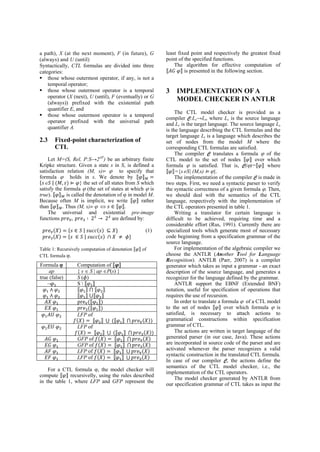
can see from the figure 3, the transport protocol 
(HTTP) used by the Web Service enables clients to 
invoke its methods through firewalls. 
The architecture of the Web service 
implementation is represented in figure 3. 
Figure 3: The architecture of the ATL model checker Web 
Service. 
The Web service will receive from a client the 
XML representation of a CTL model S and a CTL 
formula  to be verified. The original form of the 
CTL model S is then reconstructed and passed to the 
algebraic compiler C generated by ANTLR using 
our CTL extended grammar. For a syntactically 
correct formula , the compiler will return as result
C()={qQ| q }, the set of states in which the formula is satisfied. If as input is an erroneous formula , the model checker will return to client an message describing the error. In our tool is enabled a compression facility for large CTL models, to reduce the network traffic between client and server. 
Our Web service is using GlassFish or Tomcat as a Web container. For testing purposes, the CTL model checker described in this paper is available online via two Web services hosted by use-it.ro and respectively by mcheck-useit.rhcloud.com. 
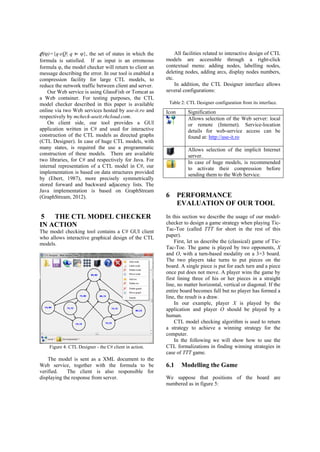
On client side, our tool provides a GUI application written in C# and used for interactive construction of the CTL models as directed graphs (CTL Designer). In case of huge CTL models, with many states, is required the use a programmatic construction of these models. There are available two libraries, for C# and respectively for Java. For internal representation of a CTL model in C#, our implementation is based on data structures provided by (Ebert, 1987), more precisely symmetrically stored forward and backward adjacency lists. The Java implementation is based on GraphStream (GraphStream, 2012). 
5 THE CTL MODEL CHECKER IN ACTION 
The model checking tool contains a C# GUI client who allows interactive graphical design of the CTL models. 
Figure 4: CTL Designer - the C# client in action. 
The model is sent as a XML document to the Web service, together with the formula to be verified. The client is also responsible for displaying the response from server. 
All facilities related to interactive design of CTL models are accessible through a right-click contextual menu: adding nodes, labelling nodes, deleting nodes, adding arcs, display nodes numbers, etc. 
In addition, the CTL Designer interface allows several configurations: 
Table 2: CTL Designer configuration from its interface. 
Icon 
Signification 
Allows selection of the Web server: local or remote (Internet). Service-location details for web-service access can be found at: http://use-it.ro 
Allows selection of the implicit Internet server. 
In case of huge models, is recommended to activate their compression before sending them to the Web Service. 
6 PERFORMANCE EVALUATION OF OUR TOOL 
In this section we describe the usage of our model- checker to design a game strategy when playing Tic- Tac-Toe (called TTT for short in the rest of this paper). 
First, let us describe the (classical) game of Tic- Tac-Toe. The game is played by two opponents, X and O, with a turn-based modality on a 3×3 board. The two players take turns to put pieces on the board. A single piece is put for each turn and a piece once put does not move. A player wins the game by first lining three of his or her pieces in a straight line, no matter horizontal, vertical or diagonal. If the entire board becomes full but no player has formed a line, the result is a draw. 
In our example, player X is played by the application and player O should be played by a human. 
CTL model checking algorithm is used to return a strategy to achieve a winning strategy for the computer. 
In the following we will show how to use the CTL formalizations in finding winning strategies in case of TTT game. 
6.1 Modelling the Game 
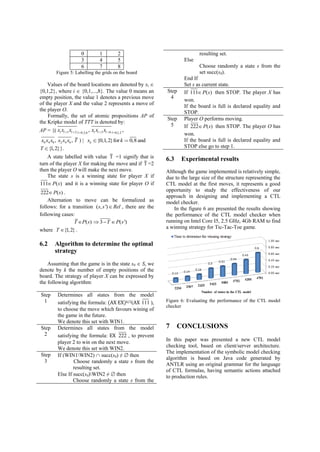
We suppose that positions of the board are numbered as in figure 5:
0 1 2 
3 4 5 
6 7 8 
Figure 5: Labelling the grids on the board 
Values of the board locations are denoted by xi  
{0,1,2}, where i  {0,1,...,8}. The value 0 means an 
empty position, the value 1 denotes a previous move 
of the player X and the value 2 represents a move of 
the player O. 
Formally, the set of atomic propositions AP of 
the Kripke model of TTT is denoted by: 
AP = {( 1 2 0,3,6 3 6 0,1,2 , , l l l l l l l l x x x x x x 
0 4 8 2 4 6 x x x , x x x , T ) | {0,1,2} for 0,8 and kx k 
T {1,2}}. 
A state labelled with value T =1 signify that is 
turn of the player X for making the move and if T =2 
then the player O will make the next move. 
The state s is a winning state for player X if 
111 P(s) and it is a winning state for player O if 
222 P(s) . 
Alternation to move can be formalized as 
follows: for a transition (s, s ')Rel , there are the 
following cases: 
T P(s) 3T P(s ') 
where T {1,2} . 
6.2 Algorithm to determine the optimal 
strategy 
Assuming that the game is in the state s0  S, we 
denote by k the number of empty positions of the 
board. The strategy of player X can be expressed by 
the following algorithm: 
Step 
1 
Determines all states from the model 
satisfying the formula: (AX EX)k/2(AX 111 ), 
to choose the move which favours wining of 
the game in the future. 
We denote this set with WIN1. 
Step 
2 
Determines all states from the model 
satisfying the formula: EX 222 , to prevent 
player 2 to win on the next move. 
We denote this set with WIN2. 
Step 
3 
If (WIN1WIN2)  succ(s0) ≠  then 
Choose randomly a state s from the 
resulting set. 
Else If succ(s0)WIN2 ≠  then 
Choose randomly a state s from the 
resulting set. 
Else 
Choose randomly a state s from the 
set succ(s0). 
End If 
Set s as current state. 
Step 
4 
If 111 P(s) then STOP. The player X has 
won. 
If the board is full is declared equality and 
STOP. 
Step 
5 
Player O performs moving. 
If 222 P(s) then STOP. The player O has 
won. 
If the board is full is declared equality and 
STOP else go to step 1. 
6.3 Experimental results 
Although the game implemented is relatively simple, 
due to the large size of the structure representing the 
CTL model at the first moves, it represents a good 
opportunity to study the effectiveness of our 
approach in designing and implementing a CTL 
model checker. 
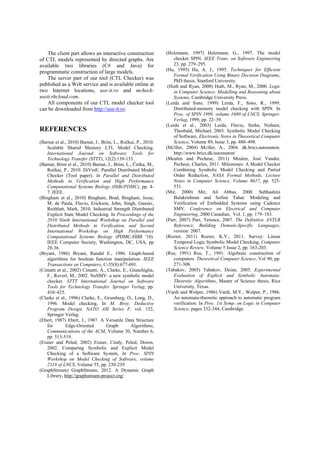
In the figure 6 are presented the results showing 
the performance of the CTL model checker when 
running on Intel Core I5, 2.5 GHz, 4Gb RAM to find 
a winning strategy for Tic-Tac-Toe game. 
Figure 6: Evaluating the performance of the CTL model 
checker 
7 CONCLUSIONS 
In this paper was presented a new CTL model 
checking tool, based on client/server architecture. 
The implementation of the symbolic model checking 
algorithm is based on Java code generated by 
ANTLR using an original grammar for the language 
of CTL formulas, having semantic actions attached 
to production rules.
The client part allows an interactive construction of CTL models represented by directed graphs. Are available two libraries (C# and Java) for programmatic construction of large models. 
The server part of our tool (CTL Checker) was published as a Web service and is available online at two Internet locations, use-it.ro and mcheck- useit.rhcloud.com. 
All components of our CTL model checker tool can be downloaded from http://use-it.ro. 
REFERENCES 
(Barnat et al., 2010) Barnat, J., Brim, L., Ročkai, P., 2010. Scalable Shared Memory LTL Model Checking. International Journal on Software Tools for Technology Transfer (STTT), 12(2):139-153. 
(Barnat, Brim et al., 2010) Barnat, J., Brim, L., Češka, M., Ročkai, P., 2010. DiVinE: Parallel Distributed Model Checker (Tool paper). In Parallel and Distributed Methods in Verification and High Performance Computational Systems Biology (HiBi/PDMC), pp. 4- 7. IEEE. 
(Bingham et al., 2010) Bingham, Brad, Bingham, Jesse, M. de Paula, Flavio, Erickson, John, Singh, Gaurav, Reitblatt, Mark, 2010. Industrial Strength Distributed Explicit State Model Checking. In Proceedings of the 2010 Ninth International Workshop on Parallel and Distributed Methods in Verification, and Second International Workshop on High Performance Computational Systems Biology (PDMC-HIBI '10). IEEE Computer Society, Washington, DC, USA, pp 28-36. 
(Bryant, 1986) Bryant, Randal E., 1986. Graph-based algorithms for boolean function manipulation. IEEE Transactions on Computers, C-35(8):677-691. 
(Cimatti et al., 2002) Cimatti, A., Clarke, E., Giunchiglia, F., Roveri, M., 2002. NuSMV: a new symbolic model checker. STTT International Journal on Software Tools for Technology Transfer. Springer Verlag, pp. 410–425. 
(Clarke et al., 1996) Clarke, E., Grumberg, O., Long, D., 1996. Model checking, In M. Broy, Deductive Program Design, NATO ASI Series F, vol. 152, Springer Verlag. 
(Ebert, 1987) Ebert, J., 1987. A Versatile Data Structure for Edge-Oriented Graph Algorithms, Communications of the ACM, Volume 30, Number 6, pp. 513-519. 
(Eisner and Peled, 2002) Eisner, Cindy, Peled, Doron, 2002. Comparing Symbolic and Explicit Model Checking of a Software System, In Proc. SPIN Workshop on Model Checking of Software, volume 2318 of LNCS, Volume 55, pp. 230-239. 
(GraphStream) GraphStream, 2012. A Dynamic Graph Library, http://graphstream-project.org/ 
(Holzmann, 1997) Holzmann, G., 1997. The model checker SPIN. IEEE Trans. on Software Engineering 23, pp. 279–295. 
(Hu, 1995) Hu, A. J., 1995. Techniques for Efficient Formal Verification Using Binary Decision Diagrams, PhD thesis, Stanford University. 
(Huth and Ryan, 2000) Huth, M., Ryan, M., 2000. Logic in Computer Science: Modelling and Reasoning about Systems, Cambridge University Press. 
(Lerda and Sisto, 1999) Lerda, F., Sisto, R., 1999. Distributed-memory model checking with SPIN. In Proc. of SPIN 1999, volume 1680 of LNCS. Springer- Verlag, 1999, pp. 22–39. 
(Lerda et al., 2003) Lerda, Flavio, Sinha, Nishant, Theobald, Michael, 2003. Symbolic Model Checking of Software, Electronic Notes in Theoretical Computer Science, Volume 89, Issue 3, pp. 480–498. 
(Mller, 2004) Mller, A., 2004. dk.brics.automaton. http://www.brics.dk/automaton/ 
(Meulen and Pecheur, 2011) Meulen, José Vander, Pecheur, Charles, 2011. Milestones: A Model Checker Combining Symbolic Model Checking and Partial Order Reduction, NASA Formal Methods, Lecture Notes in Computer Science, Volume 6617, pp. 525- 531. 
(Mir, 2000) Mir, Ali Abbas, 2000. Subhashini Balakrishnan and Sofine Tahar. Modeling and Verification of Embedded Systems using Cadence SMV. Conference on Electrical and Computer Engineering, 2000 Canadian, Vol. 1, pp. 179–183. 
(Parr, 2007) Parr, Terence, 2007. The Definitive ANTLR Reference, Building Domain-Specific Languages, version: 2007. 
(Rozier, 2011) Rozier, K.Y., 2011. Survey: Linear Temporal Logic Symbolic Model Checking, Computer Science Review, Volume 5 Issue 2, pp. 163-203. 
(Rus, 1991) Rus, T., 1991. Algebraic construction of computers. Theoretical Computer Science, Vol 90, pp. 271-308. 
(Tabakov, 2005) Tabakov, Deian, 2005. Experimental Evaluation of Explicit and Symbolic Automata- Theoretic Algorithms, Master of Science thesis, Rice University, Texas. 
(Vardi and Wolper, 1986) Vardi, M.Y., Wolper, P., 1986. An automata-theoretic approach to automatic program verification. In Proc. 1st Symp. on Logic in Computer Science, pages 332-344, Cambridge.

A Distributed CTL Model Checker

  • 1.
    A Distributed CTLModel Checker Laura Florentina Stoica1, Florian Mircea Boian2 and Florin Stoica1 1 Department of Mathematics and Informatics, Lucian Blaga University, 5-7 Dr. Ratiu Street, Sibiu, Romania 2 Department of Computer Science, Babes Bolyai University, 1 M. Kogalniceanu Street, Cluj Napoca, Romania {laura.cacovean, florin.stoica}@ulbsibiu.ro, florin@cs.ubbcluj.ro Keywords: Model Checking, CTL, Web services. Abstract: Model checking is nowadays being used as advanced technique to analyse, design and debug reactive systems. This paper gives an overview of our recent work on implementing a new interactive CTL model checker. In contrast to previous approaches, our tool permits an interactive design of the CTL models as state-transition graphs, and is based on client/server architecture. The server part embeds the core of the CTL model checker and is published as a Web service. A C# client provides an intuitive graphical interface for interactive design of CTL models. Java and C# APIs are available for programmatic construction of large models. Experimental results are encouraging, showing that our tool is able to handle large systems efficiently. 1 INTRODUCTION Verification of a software system involves checking whether the system in question behaves as it was designed to behave. Design validation involves checking whether a system design satisfies the system requirements. Both of these tasks, system verification and design validation can be accomplished thoroughly and reliably using model- based formal methods, such as model checking (Rozier, 2011). Model checking is particularly well-suited for the automated verification of finite-state systems, both for software and for hardware. Main concern of formal methods in general, and model checking in particular, is helping to design correct systems (Barnat et al., 2010). Detecting and eliminating bugs as early in the design cycle as possible is clearly an economic imperative. For example, the Pentium FDIV bug (a bug in the Intel P5 Pentium floating point unit discovered in 1994) cost Intel Corporation a half billion dollars. Model checking is the formal process through which a given specification representing a desired behavioral property is verified to hold for a given system (the model). Two most common methods of performing model checking are explicit enumeration of states of the model and respectively the use of symbolic methods. In the following we consider that model is a directed graph where the nodes represent the states of the system and the edges represents the state transitions, more specifically a Kripke structure. The state explosion problem is widely agreed to be the most formidable challenge facing the application of model checking to large and complex real-world systems. In short, the number of states required by the model grows exponentially with the number of system components (or state variables), constituting the main practical limitation of model checking. Reducing the time required to verify models remains also a big challenge. This naturally raises interest in using parallelism to improve the performance of many formal model checkers. Much of the extensive research on the parallelization of model checking algorithms followed the distributed memory programming model which appeared from the necessity to eliminate the memory constraints of a single computer system. 1.1 Related work Some examples of well-known explicit-state parallel model checkers are DiViNe and PSPIN. DiVinE (Barnat, Brim et al, 2010), (Barnat et al., 2010) is a distributed model checker for explicit state LTL (Linear Temporal Logic) model checking and is able to handle large systems consisting of as
  • 2.
    many as 419million states, as stated in (Bingham et al., 2010). PSPIN has also been used for performing distributed model checking with the capability of handling up to around 2.8 million states (Lerda and Sisto, 1999). The basic idea behind symbolic model checking is to use a more efficient “symbolic” representation for the Kripke structure being checked and for sets of states of the Kripke structure. Symbolic model checkers, such as CadenceSMV (Mir, 2000), NuSMV (Cimatti et al., 2002) analyse the state space symbolically using binary decision diagrams (BDDs), which were introduced in (Bryant, 1986). The binary decision diagram is a data structure for representing Boolean functions. In contrast with explicit-state model checking, states in symbolic model checking are represented implicitly, as a solution to a logical equation. This approach saves space in memory since syntactically small equations can represent comparatively large sets of states (Rozier, 2011). A symbolic model checker represents the Kripke structure itself symbolically using BDDs to represent transition relations by Boolean expressions. The key to symbolic model checking is to perform all calculations directly using these Boolean expressions, rather than using the Kripke structure explicitly. 1.2 Comparing Symbolic and Explicit Model Checking In symbolic model checking, the space used to represent a state is limited by the internal data structures. However, because a symbolic approach uses a compact representation of the set of states, it can handle a larger state space size. In explicit model checking, the state size is not strictly limited, but is related with state space size in the total memory consumption. In (Eisner and Peled, 2002) is presented a comparison between RULEBASE, a symbolic model checker developed at IBM Haifa Research Laboratory and the explicit LTL model checker SPIN (Holzmann, 1997). The software verified was a distributed storage subsystem software application. The state space size handled by SPIN was 108 in a 3-process model. Using symbolic model checking, RULEBASE keeps a compressed representation of the state space and thus was able to manage 10150 states. On the other hand, because of the limit on state size, RULEBASE could not represent a state large enough to include the information needed for more than 2-process configuration (Eisner and Peled, 2002). An important reason why software model checking is still predominantly performed using explicit-state model checkers such as SPIN, is that these methods gain much of their efficiency from state-reduction techniques such as partial-order reduction (POR). The POR methods explore a reduced state space in a property-preserving way (Meulen and Pecheur, 2011). Partial-order reduction is useful only when the system has an asynchronous model of composition. Most hardware designs are based on a clocked- approach and thus are synchronous. For these systems, the symbolic model checking approach is more appropriate (Lerda et al., 2003). On the other hand, for nondeterministic, high- level models of hardware protocols, it has previously been argued that explicit model checking is better than symbolic model checking (Hu, 1995); this is because the communication mechanisms inherent in protocols tend to cause the BDDs in symbolic model checking to blow up (Bingham et al., 2010). In their basic form, symbolic approaches tend to perform poorly on asynchronous models where concurrent interleaving are the main source of explosion, and explicit-state model-checkers with POR have been the preferred approach for such models (Bingham et al., 2010). A detailed experimental comparison between performance of explicit-state model checkers and symbolic model checkers can be found in (Tabakov, 2005). The study follows an automata-theoretic approach in program verification, originally proposed in (Vardi and Wolper, 1986) and uses two approaches, explicit and symbolic, for solving the model-checking problem. In order to present a full comparison between the symbolic and the explicit algorithms, was performed a scaling comparison of Cadence SMV (Mir, 2000), NuSMV (Mir, 2000) as symbolic BDD-based model checkers and respectively SPIN. The direct comparison of the three model checkers shows that the explicit one (SPIN) is much faster than the symbolic ones. In conclusion, experimental results show that the explicit approach scales better than the symbolic one, which was rather surprising but confirms similar statements from (Bingham et al., 2010), (Hu, 1995). 1.3 Motivation and objective The broad goal of our research was to develop a reliable, easy to maintain, scalable model checker tool to improve applicability of CTL (Computation
  • 3.
    Tree Logic) modelchecking in design of general- purpose computer software. Concurrent software is asynchronous as the different components might be running on different processors or be interleaved by the scheduler of the operating system. Taking into account the above considerations, in our tool we are using an explicit- state model technique. The most pressing challenge in model checking today is scalability (Rozier, 2011). A model- checking tool must be efficient, in terms of the size of the models it can reason about and the time and space it requires, in order to scaling its verification ability to handle real-world applications. To address the state explosion problem, our tool is based on an efficient data structure for internal representation of the model to be verified (GraphStream, 2012). An orthogonal approach to increase the capacity of an explicit-state model checker tool is to exploit the memory and computational resources of multiple computers in a distributed computing environment (Bingham et al., 2010). Following this idea, our tool is based on Web Services technology to address the time constraints in verification of large models. The paper is organized as follows. In section 2 is introduced the Computation Tree Logic (CTL): first is defined the CTL model then are presented the CTL syntax and semantics. In section 3 is described the implementation of the CTL model checker in ANTLR. The architecture of the Web service which embeds the server part of our tool is presented in section 4. Section 5 presents some features of the CTL-Designer, a graphical client which allows interactive design of the CTL models. The performance evaluation of out tool is achieved in section 6. Conclusions are presented in section 7. 2 COMPUTATION TREE LOGIC (CTL) Temporal logic has emerged as a main formalism for reactive systems. A temporal logic is essentially an ordinary predicate or propositional logic with the addition of modal operators for describing how the interpretation of symbols changes over time (Hu, 1995). Typical temporal operators include the next- time operator (X), the eventuality operator (F), the always operator (G) and until (U) operator. A CTL model checker is a tool which can be used to verify that a given system satisfies a given CTL logic formula. A CTL model is a Kripke structure represented by a directed graph where the nodes are the states of the system and the edges represents the state transitions. The nodes are labelled with atomic propositions. In order to be verified by a given model, a property is written as a temporal logic formula over the labelled propositions from the model. A model checker is an algorithm that determines the states of a model that satisfy a temporal logic formula. 2.1 The CTL model A model is defined as a Kripke structure M=(S, Rel, P:S→2AP) where S is a finite sets of states also called nodes, Rel⊆S×S is a transition relation denoting a set of directed edges, and P is a labelling function that defines for each state s  S the set P(s) of all atomic propositions from AP that are valid in s. The transition relation Rel is left-total, i.e.,  s  S  s'  S such that (s,s')  Rel. For each sS, the notation succ(s)={s'S |(s,s')Rel} is used to denote the set of successors of s. From definition of Rel, each state from S must have at least one successor, that is sS, succ(s). A path in M is an infinite sequence of states (s0,s1, s2,…) such that i, i0, we have (si,si+1)Rel. We use s'  succ(s) to denote that there is a relation (s, s') in Rel. The labelling function P maps for each state s  S the set P(s) of all atomic propositions from AP that are valid in s (Huth and Ryan, 2000). 2.2 CTL syntax and semantics A CTL formula has the following syntax given in Backus-Naur Form (BNF):  :: true|false|ap|(¬ 1)| 1∧2| 1∨2| 1 2| AX 1| EX 1| AG 1| EG 1| AF 1| EF 1|1AU2| 1EU2, ∀apAP. A CTL specification is interpreted over Kripke structures. The set of all paths through a Kripke structure is assumed to correspond to the set of all possible computations of a system. CTL logic is branching-time logic, meaning that its formulas are interpreted over all paths beginning in a given state (an initial state) of the Kripke structure. A CTL formula encodes properties that can occur along a particular temporal path as well as to the set of all possible paths. The CTL syntax include several operators for describing temporal properties of systems: A (for all paths), E (there is
  • 4.
    a path), X(at the next moment), F (in future), G (always) and U (until) Syntactically, CTL formulas are divided into three categories:  those whose outermost operator, if any, is not a temporal operator;  those whose outermost operator is a temporal operator (X (next), U (until), F (eventually) or G (always)) prefixed with the existential path quantifier E, and  those whose outermost operator is a temporal operator prefixed with the universal path quantifier A. 2.3 Fixed-point characterization of CTL Let M=(S, Rel, P:S→2AP) be an arbitrary finite Kripke structure. Given a state s in S, is defined a satisfaction relation (M, s)⊨  to specify that formula  holds in s. We denote by ⟦ ⟧ {  | } the set of all states from S which satisfy the formula  (the set of states at which  is true). ⟦ ⟧ is called the denotation of  in model M. Because often M is implicit, we write ⟦ ⟧ rather than ⟦ ⟧ . Thus (M, s)⊨   ⟦ ⟧. The universal and existential pre-image functions ∀ are defined by: ∀ { | ⊆ { | (1) Table 1: Recursively computation of denotation ⟦ ⟧ of CTL formula . Formula  Computation of ⟦ ⟧ ap { s  S | ap P(s) } true (false) S ( ) S ⟦ ⟧ ⟦ ⟧ ⟦ ⟧ ⟦ ⟧ ⟦ ⟧ ∀ ⟦ ⟧ ⟦ ⟧ LFP of ⟦ ⟧ ⟦ ⟧ ∀ LFP of ⟦ ⟧ ⟦ ⟧ GFP of ⟦ ⟧ ∀ GFP of ⟦ ⟧ LFP of ⟦ ⟧ ∀ LFP of ⟦ ⟧ For a CTL formula , the model checker will compute ⟦ ⟧ recursivelly, using the rules described in the table 1, where LFP and GFP represent the least fixed point and respectively the greatest fixed point of the specified functions. The algorithm for effective computation of ⟦ ⟧ is presented in the following section. 3 IMPLEMENTATION OF A MODEL CHECKER IN ANTLR The CTL model checker is provided as a compiler C:Ls→Lt, where Ls is the source language and Lt is the target language. The source language Ls is the language describing the CTL formulas and the target language Lt is a language which describes the set of nodes from the model M where the corresponding CTL formulas are satisfied. The compiler C translates a formula  of the CTL model to the set of nodes ⟦ ⟧ over which formula  is satisfied. That is, C()=⟦ ⟧ where ⟦ ⟧={sS| (M,s) }. The implementation of the compiler C is made in two steps. First, we need a syntactic parser to verify the syntactic correctness of a given formula . Then, we should deal with the semantics of the CTL language, respectively with the implementation of the CTL operators presented in table 1. Writing a translator for certain language is difficult to be achieved, requiring time and a considerable effort (Rus, 1991). Currently there are specialized tools which generate most of necessary code beginning from a specification grammar of the source language. For implementation of the algebraic compiler we choose the ANTLR (Another Tool for Language Recognition). ANTLR (Parr, 2007) is a compiler generator which takes as input a grammar - an exact description of the source language, and generates a recognizer for the language defined by the grammar. ANTLR support the EBNF (Extended BNF) notation, useful for specification of operations that requires the use of recursion. In order to translate a formula  of a CTL model to the set of nodes ⟦ ⟧ over which formula  is satisfied, is necessary to attach actions to grammatical constructions within specification grammar of CTL. The actions are written in target language of the generated parser (in our case, Java). These actions are incorporated in source code of the parser and are activated whenever the parser recognizes a valid syntactic construction in the translated CTL formula. In case of our compiler C, the actions define the semantics of the CTL model checker, i.e., the implementation of the CTL operators. The model checker generated by ANTLR from our specification grammar of CTL takes as input the
  • 5.
    model M (whereare defined the sets S, Rel, and P) and a formula , and provides as output the denotation of  – the set of states where the formula  is satisfied, using the following general algorithm:  assign atomic propositions by labelling function P;  handle Boolean operators by standard set operations;  handle temporal operators AX, EX by computing pre-images using expressions given in (1);  handle temporal operators AG, EG, AF, EF, AU, EU by applying rules described in table 1, until a fixpoint is reached. The algorithm for computing ⟦ ⟧ is presented in figure 1 (Clarke et al., 1996). For the formal specification of the AG operator given in figure 1, the corresponding action included in our ANTLR grammar of CTL language is detailed in figure 2. Z:=; Z':= ⟦ ⟧; while (ZZ') do Z:=Z'; Z':=Z' ∀ ; endwhile ⟦ AG φ ⟧:=Z'; Figure 1: Formal definition of the set expression ⟦ ⟧. private HashSet PreAll(HashSet Z) { HashSet rez = new HashSet(); for (Node n1 : model) { Iterator<Edge> it = n1.getLeavingEdgeIterator(); HashSet succ = new HashSet(); while (it.hasNext()) { Edge e = it.next(); Node n2 = e.getTargetNode(); succ.add(n2.getIndex()); } if (Z.containsAll(succ)) { rez.add(n1.getIndex()); } } return rez; } ctlFormula returns [HashSet set] @init { } : 'ag' e=implExpr { HashSet rez = new HashSet(); HashSet rez1 = new HashSet($e.set); while (!rez.equals(rez1)) { rez.clear(); rez.addAll(rez1); HashSet tmp = PreAll(rez1); rez1.retainAll(tmp); } $set = rez1; } Figure 2: Implementation of the AG operator in ANTLR. Analogue were implemented all CTL temporal operators. For efficient representation of CTL models, our tool is based on SingleGraph class from GraphStream package (GraphStream, 2012). 4 EMBEDDING THE CTL MODEL CHECKER INTO A WEB SERVICE We choose to publish our implementation of CTL model checker as a Web service in order to utilize the combined resources of distributed computers and to bring advantages of distributed verification to various clients over the Web. As we can see from the figure 3, the transport protocol (HTTP) used by the Web Service enables clients to invoke its methods through firewalls. The architecture of the Web service implementation is represented in figure 3. Figure 3: The architecture of the ATL model checker Web Service. The Web service will receive from a client the XML representation of a CTL model S and a CTL formula  to be verified. The original form of the CTL model S is then reconstructed and passed to the algebraic compiler C generated by ANTLR using our CTL extended grammar. For a syntactically correct formula , the compiler will return as result
  • 6.
    C()={qQ| q },the set of states in which the formula is satisfied. If as input is an erroneous formula , the model checker will return to client an message describing the error. In our tool is enabled a compression facility for large CTL models, to reduce the network traffic between client and server. Our Web service is using GlassFish or Tomcat as a Web container. For testing purposes, the CTL model checker described in this paper is available online via two Web services hosted by use-it.ro and respectively by mcheck-useit.rhcloud.com. On client side, our tool provides a GUI application written in C# and used for interactive construction of the CTL models as directed graphs (CTL Designer). In case of huge CTL models, with many states, is required the use a programmatic construction of these models. There are available two libraries, for C# and respectively for Java. For internal representation of a CTL model in C#, our implementation is based on data structures provided by (Ebert, 1987), more precisely symmetrically stored forward and backward adjacency lists. The Java implementation is based on GraphStream (GraphStream, 2012). 5 THE CTL MODEL CHECKER IN ACTION The model checking tool contains a C# GUI client who allows interactive graphical design of the CTL models. Figure 4: CTL Designer - the C# client in action. The model is sent as a XML document to the Web service, together with the formula to be verified. The client is also responsible for displaying the response from server. All facilities related to interactive design of CTL models are accessible through a right-click contextual menu: adding nodes, labelling nodes, deleting nodes, adding arcs, display nodes numbers, etc. In addition, the CTL Designer interface allows several configurations: Table 2: CTL Designer configuration from its interface. Icon Signification Allows selection of the Web server: local or remote (Internet). Service-location details for web-service access can be found at: http://use-it.ro Allows selection of the implicit Internet server. In case of huge models, is recommended to activate their compression before sending them to the Web Service. 6 PERFORMANCE EVALUATION OF OUR TOOL In this section we describe the usage of our model- checker to design a game strategy when playing Tic- Tac-Toe (called TTT for short in the rest of this paper). First, let us describe the (classical) game of Tic- Tac-Toe. The game is played by two opponents, X and O, with a turn-based modality on a 3×3 board. The two players take turns to put pieces on the board. A single piece is put for each turn and a piece once put does not move. A player wins the game by first lining three of his or her pieces in a straight line, no matter horizontal, vertical or diagonal. If the entire board becomes full but no player has formed a line, the result is a draw. In our example, player X is played by the application and player O should be played by a human. CTL model checking algorithm is used to return a strategy to achieve a winning strategy for the computer. In the following we will show how to use the CTL formalizations in finding winning strategies in case of TTT game. 6.1 Modelling the Game We suppose that positions of the board are numbered as in figure 5:
  • 7.
    0 1 2 3 4 5 6 7 8 Figure 5: Labelling the grids on the board Values of the board locations are denoted by xi  {0,1,2}, where i  {0,1,...,8}. The value 0 means an empty position, the value 1 denotes a previous move of the player X and the value 2 represents a move of the player O. Formally, the set of atomic propositions AP of the Kripke model of TTT is denoted by: AP = {( 1 2 0,3,6 3 6 0,1,2 , , l l l l l l l l x x x x x x 0 4 8 2 4 6 x x x , x x x , T ) | {0,1,2} for 0,8 and kx k T {1,2}}. A state labelled with value T =1 signify that is turn of the player X for making the move and if T =2 then the player O will make the next move. The state s is a winning state for player X if 111 P(s) and it is a winning state for player O if 222 P(s) . Alternation to move can be formalized as follows: for a transition (s, s ')Rel , there are the following cases: T P(s) 3T P(s ') where T {1,2} . 6.2 Algorithm to determine the optimal strategy Assuming that the game is in the state s0  S, we denote by k the number of empty positions of the board. The strategy of player X can be expressed by the following algorithm: Step 1 Determines all states from the model satisfying the formula: (AX EX)k/2(AX 111 ), to choose the move which favours wining of the game in the future. We denote this set with WIN1. Step 2 Determines all states from the model satisfying the formula: EX 222 , to prevent player 2 to win on the next move. We denote this set with WIN2. Step 3 If (WIN1WIN2)  succ(s0) ≠  then Choose randomly a state s from the resulting set. Else If succ(s0)WIN2 ≠  then Choose randomly a state s from the resulting set. Else Choose randomly a state s from the set succ(s0). End If Set s as current state. Step 4 If 111 P(s) then STOP. The player X has won. If the board is full is declared equality and STOP. Step 5 Player O performs moving. If 222 P(s) then STOP. The player O has won. If the board is full is declared equality and STOP else go to step 1. 6.3 Experimental results Although the game implemented is relatively simple, due to the large size of the structure representing the CTL model at the first moves, it represents a good opportunity to study the effectiveness of our approach in designing and implementing a CTL model checker. In the figure 6 are presented the results showing the performance of the CTL model checker when running on Intel Core I5, 2.5 GHz, 4Gb RAM to find a winning strategy for Tic-Tac-Toe game. Figure 6: Evaluating the performance of the CTL model checker 7 CONCLUSIONS In this paper was presented a new CTL model checking tool, based on client/server architecture. The implementation of the symbolic model checking algorithm is based on Java code generated by ANTLR using an original grammar for the language of CTL formulas, having semantic actions attached to production rules.
  • 8.
    The client partallows an interactive construction of CTL models represented by directed graphs. Are available two libraries (C# and Java) for programmatic construction of large models. The server part of our tool (CTL Checker) was published as a Web service and is available online at two Internet locations, use-it.ro and mcheck- useit.rhcloud.com. All components of our CTL model checker tool can be downloaded from http://use-it.ro. REFERENCES (Barnat et al., 2010) Barnat, J., Brim, L., Ročkai, P., 2010. Scalable Shared Memory LTL Model Checking. International Journal on Software Tools for Technology Transfer (STTT), 12(2):139-153. (Barnat, Brim et al., 2010) Barnat, J., Brim, L., Češka, M., Ročkai, P., 2010. DiVinE: Parallel Distributed Model Checker (Tool paper). In Parallel and Distributed Methods in Verification and High Performance Computational Systems Biology (HiBi/PDMC), pp. 4- 7. IEEE. (Bingham et al., 2010) Bingham, Brad, Bingham, Jesse, M. de Paula, Flavio, Erickson, John, Singh, Gaurav, Reitblatt, Mark, 2010. Industrial Strength Distributed Explicit State Model Checking. In Proceedings of the 2010 Ninth International Workshop on Parallel and Distributed Methods in Verification, and Second International Workshop on High Performance Computational Systems Biology (PDMC-HIBI '10). IEEE Computer Society, Washington, DC, USA, pp 28-36. (Bryant, 1986) Bryant, Randal E., 1986. Graph-based algorithms for boolean function manipulation. IEEE Transactions on Computers, C-35(8):677-691. (Cimatti et al., 2002) Cimatti, A., Clarke, E., Giunchiglia, F., Roveri, M., 2002. NuSMV: a new symbolic model checker. STTT International Journal on Software Tools for Technology Transfer. Springer Verlag, pp. 410–425. (Clarke et al., 1996) Clarke, E., Grumberg, O., Long, D., 1996. Model checking, In M. Broy, Deductive Program Design, NATO ASI Series F, vol. 152, Springer Verlag. (Ebert, 1987) Ebert, J., 1987. A Versatile Data Structure for Edge-Oriented Graph Algorithms, Communications of the ACM, Volume 30, Number 6, pp. 513-519. (Eisner and Peled, 2002) Eisner, Cindy, Peled, Doron, 2002. Comparing Symbolic and Explicit Model Checking of a Software System, In Proc. SPIN Workshop on Model Checking of Software, volume 2318 of LNCS, Volume 55, pp. 230-239. (GraphStream) GraphStream, 2012. A Dynamic Graph Library, http://graphstream-project.org/ (Holzmann, 1997) Holzmann, G., 1997. The model checker SPIN. IEEE Trans. on Software Engineering 23, pp. 279–295. (Hu, 1995) Hu, A. J., 1995. Techniques for Efficient Formal Verification Using Binary Decision Diagrams, PhD thesis, Stanford University. (Huth and Ryan, 2000) Huth, M., Ryan, M., 2000. Logic in Computer Science: Modelling and Reasoning about Systems, Cambridge University Press. (Lerda and Sisto, 1999) Lerda, F., Sisto, R., 1999. Distributed-memory model checking with SPIN. In Proc. of SPIN 1999, volume 1680 of LNCS. Springer- Verlag, 1999, pp. 22–39. (Lerda et al., 2003) Lerda, Flavio, Sinha, Nishant, Theobald, Michael, 2003. Symbolic Model Checking of Software, Electronic Notes in Theoretical Computer Science, Volume 89, Issue 3, pp. 480–498. (Mller, 2004) Mller, A., 2004. dk.brics.automaton. http://www.brics.dk/automaton/ (Meulen and Pecheur, 2011) Meulen, José Vander, Pecheur, Charles, 2011. Milestones: A Model Checker Combining Symbolic Model Checking and Partial Order Reduction, NASA Formal Methods, Lecture Notes in Computer Science, Volume 6617, pp. 525- 531. (Mir, 2000) Mir, Ali Abbas, 2000. Subhashini Balakrishnan and Sofine Tahar. Modeling and Verification of Embedded Systems using Cadence SMV. Conference on Electrical and Computer Engineering, 2000 Canadian, Vol. 1, pp. 179–183. (Parr, 2007) Parr, Terence, 2007. The Definitive ANTLR Reference, Building Domain-Specific Languages, version: 2007. (Rozier, 2011) Rozier, K.Y., 2011. Survey: Linear Temporal Logic Symbolic Model Checking, Computer Science Review, Volume 5 Issue 2, pp. 163-203. (Rus, 1991) Rus, T., 1991. Algebraic construction of computers. Theoretical Computer Science, Vol 90, pp. 271-308. (Tabakov, 2005) Tabakov, Deian, 2005. Experimental Evaluation of Explicit and Symbolic Automata- Theoretic Algorithms, Master of Science thesis, Rice University, Texas. (Vardi and Wolper, 1986) Vardi, M.Y., Wolper, P., 1986. An automata-theoretic approach to automatic program verification. In Proc. 1st Symp. on Logic in Computer Science, pages 332-344, Cambridge.