Pointcut Rejuvenation:
Recovering Pointcut Expressions
in Evolving Aspect-Oriented Software
Raffi Khatchadourian, Member, IEEE, Phil Greenwood,
Awais Rashid, Member, IEEE, and Guoqing Xu
Abstract—Pointcut fragility is a well-documented problem in Aspect-Oriented Programming; changes to the base code can lead to join
points incorrectly falling in or out of the scope of pointcuts. In this paper, we present an automated approach that limits fragility
problems by providing mechanical assistance in pointcut maintenance. The approach is based on harnessing arbitrarily deep structural
commonalities between program elements corresponding to join points selected by a pointcut. The extracted patterns are then applied
to later versions to offer suggestions of new join points that may require inclusion. To illustrate that the motivation behind our proposal
is well founded, we first empirically establish that join points captured by a single pointcut typically portray a significant amount of
unique structural commonality by analyzing patterns extracted from 23 AspectJ programs. Then, we demonstrate the usefulness of our
technique by rejuvenating pointcuts in multiple versions of three of these programs. The results show that our parameterized heuristic
algorithm was able to accurately and automatically infer the majority of new join points in subsequent software versions that were not
captured by the original pointcuts.
Index Terms—Software development environments, software maintenance, software tools.
Ç
1 INTRODUCTION
ASPECT-ORIENTED Programming (AOP) [23] has emerged
to reduce the scattering and tangling of crosscutting
concern (CCC) implementations. This is achieved through
specifying that certain behavior (advice) should be
composed at specific (join) points during the execution of
the underlying program (base code). Join point sets are
described by pointcut expressions (PCEs), which are
predicate-like expressions over various characteristics of
“events” that occur during the program’s execution. In
AspectJ [22], such characteristics may include calls to
certain methods, accesses to particular fields, and mod-
ifications to the runtime stack.
Consider an example PCE execution(* m*(..)) that selects
the execution of all methods whose name begins with m,
taking any number and type of arguments and returning
any type of value. Suppose that in one base code version the
above PCE selects the correct set of join points in which a
CCC applies. As the software evolves, this set of join points
may change as well. We say that a PCE is robust if in its
unaltered form it is able to continue to capture the correct set
of join points in future base code versions. Thus, the PCE
given above would be considered robust if the set of join
points in which the CCC applies always corresponded to
executions of methods whose name begins with m, taking
any number and type of arguments, and so forth. However,
with the requirements of typical software tending to change
over time, the corresponding source code may undergo
many alterations to accommodate such change, including
the addition of new elements in which existing CCCs should
also apply. Without a priori knowledge of future main-
tenance changes and additions, creating robust PCEs is a
daunting task. As such, there may easily exist situations
where the PCE itself must evolve along with the base code;
in these cases, we say that the PCE is fragile. Hence, the
fragile pointcut problem [25] manifests itself in such circum-
stances where join points incorrectly fall in or out of the
scope of PCEs.
Several approaches aim to combat this problem by
proposing new pointcut languages with improved expres-
siveness (e.g., [6], [24], [31], [36], [37]), limiting the scope of
where advice may apply through more clearly defined
interfaces (e.g., [14]), or enforcing structural and/or
behavioral constraints on advice application (e.g., [13],
[19], [40]). Yet others make points where advice may apply
more explicit in the base code [17], or remove PCEs
altogether [33]. However, each of these tend to require
some level of anticipation and, consequently, when using
PCEs there may nevertheless exist situations where PCEs
must be manually updated to capture new join points as the
software evolves.
Programmer-defined source code annotations can also be
used to “mark” relevant locations in the source code where a
CCC applies. PCEs then use these annotations to accurately
select the appropriate join points. If used properly, i.e., if all
642 IEEE TRANSACTIONS ON SOFTWARE ENGINEERING, VOL. 38, NO. 3, MAY/JUNE 2012
. R. Khatchadourian and G. Xu are with the Department of Computer
Science and Engineering, Ohio State University, Columbus, OH 43210.
E-mail: {khatchad, xug}@cse.ohio-state.edu.
. P. Greenwood and A. Rashid are with Computing Department, Lancaster
University, Lancaster LA1 4WA, United Kingdom.
E-mail: {greenwop, awais}@comp.lancs.ac.uk.
Manuscript received 27 Feb. 2010; revised 23 Aug. 2010; accepted 26 Jan.
2011; published online 7 Feb. 2011.
Recommended for acceptance by T. Tamai.
For information on obtaining reprints of this article, please send e-mail to:
tse@computer.org, and reference IEEECS Log Number TSE-2010-02-0054.
Digital Object Identifier no. 10.1109/TSE.2011.21.
0098-5589/12/$31.00 ß 2012 IEEE Published by the IEEE Computer Society
locations where the CCC applies are correctly annotated and
if the corresponding PCE correctly selects these elements,
this scheme can produce PCEs that are robust to changes
such as refactorings since names and organization of
program elements may change but the associated annota-
tions remains intact. However, refactoring is not the only
reason for PCE breaks. For example, adding a new element
but neglecting to annotate it properly with all CCCs that
apply to it will break an annotation-based pointcut.
It is important to note that, although this paper deals
with the particular case of AspectJ, a system written in any
language that allows developers to declare composition
specifications (like PCEs in AspectJ) is susceptible to this
predicament. Furthermore, this problem unfortunately
develops into a vicious cycle where these new PCEs may
also exhibit similar fragility problems.
To alleviate such problems, we propose an approach that
provides automated assistance in rejuvenating PCEs upon
changes to the base code. The technique is based on
harnessing unique and arbitrarily deep structural common-
alities between program elements corresponding to join
points selected by a PCE in a particular software version. To
illustrate, again consider the example PCE given earlier and
suppose that, in a certain base code version, the PCE selects
the execution of three methods, m1, m2, and m3. Further
suppose that facets pertaining to these methods exhibit
structural commonality, e.g., each of the methods’ bodies
may (textually) include a call to a common method y, or that
each includes a call to three other methods x, y, and z,
respectively, all of which have method bodies that include
an assignment to a common field f. Likewise, each method
may be declared in three different classes A, B, and C,
respectively, all of which are contained in a package p.
Moreover, if such characteristics are shared between
program elements corresponding to join points selected
by a PCE in one base code version, it is conceivable that
these relationships persist in subsequent versions. Conse-
quently, our proposal involves constructing patterns that
describe these kinds of relationships, assessing their
expressiveness in comparison with the input PCE, and
associating them with the PCE so that they may be applied
to later base code versions to offer suggestions of new join
points that may require inclusion.
Our insight into the fragile pointcut problem is as
follows: CCCs tend to crosscut traditional module bound-
aries. Thus, CCCs affect many heterogeneous modules
across a software system. Despite their differences, these
modules have at least one facet in common, i.e., that a
particular CCC applies to them. Our hypothesis is that
places in the source code corresponding to where a CCC
applies share a similar structure, and that this information
can be leveraged to maintain PCEs.
Our key contributions are as follows:
1. Commonality identification. We present a parame-
terized heuristic algorithm that automatically derives
arbitrarily deep structural patterns inherent to pro-
gram elements corresponding to join points selected
by the original PCE. This allows join points to be
suggested that may require inclusion into a revised
version of the PCE, ensuring that evolutionary
changes can be correctly applied by mechanically
assisting the developer in maintaining PCEs.
2. Correlation analysis. We empirically establish that
join points selected by a single PCE typically portray
a significant amount of unique structural common-
ality by applying our algorithm to automatically
extract and thereafter analyze patterns using PCEs
contained within single versions of 23 AspectJ
programs. We found that the derived patterns, on
average, were able to closely produce the majority of
join points selected by the analyzed PCE in the
original base code version with low  (false positive)
and
(false negative) error rates of 18 and 16 percent,
respectively.
3. Expression recovery. To ensure the applicability and
practicality of our approach, we implemented our
algorithm as an Eclipse (http://eclipse.org) IDE
plug-in and evaluated its usefulness by rejuvenating
PCEs in multiple versions of three of the aforemen-
tioned programs, which were of varying sizes and
domains and representative of typical AO software.
We found that, in exploiting the extracted patterns,
our tool was able to accurately and automatically
infer 90 percent of new join points that were selected
by PCEs in subsequent software versions that were
not selected by the original PCE, with a standard
deviation of 24 percent. This demonstrates that the
approach is indeed useful in alleviating the burden of
recovering PCEs upon base-code modifications that
took place in our subject programs, and the results
advance the state of the art in automated tool support
for coping with the evolution of AO programs.
A brief introduction of this work originally appeared in
[20], and a demonstration of our preliminary tool, along
with details of the implementation, appeared in [21]. In this
paper, we fully describe our complete approach, which has
been built upon the aforementioned previous work. This
complete approach includes thoroughly developed ideas
that have been incorporated into our initial algorithm. We
also present a new dimension of our experimental results to
comprehensively and accurately assess the overall useful-
ness of our approach.
The remainder of this paper is organized as follows:
Section 2 presents a motivating example that features a
fragile PCE. Section 3 highlights the key algorithmic facets
of our approach, while Section 4 discusses the details of our
implementation and evaluation. In Section 5, we compare
our proposal with related work and explore future work, as
well as conclude, in Section 6.
2 POINTCUT FRAGILITY EXAMPLE
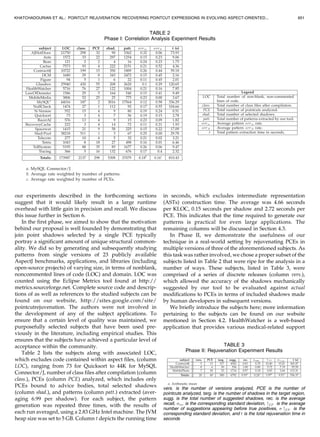
Fig. 1 shows an example AspectJ code snippet for a
hypothetical drive-by-wire programming of an all-wheel
drive, hybrid vehicle (line 2) which draws power from two
different sources, namely, a diesel engine (line 25) and an
electric motor (line 30), both of which contribute to the
overall speed (line 3).1
Fuel is distributed to the engine via
KHATCHADOURIAN ET AL.: POINTCUT REJUVENATION: RECOVERING POINTCUT EXPRESSIONS IN EVOLVING ASPECT-ORIENTED... 643
1. This example was inspired by one of the authors’ work at the Center
for Automotive Research (CAR) at Ohio State University.
the method DieselEngine.increase(Fuel) (line 27), while
electricity is distributed to the motor via the method
ElectricMotor.increase(Current) (line 32), whose method
bodies are abbreviated. The classes conform to the Observer
pattern, with the DieselEngine and ElectricMotor notifying
the HybridAutomobile of any change made to the energy
consumption of the respective components. The HybridAu-
tomobile in turn computes its new overall speed (lines 7-8,
13-14) and updates any attached observers, e.g., the Dash-
board (line 35). An accessor method (line 22) retrieves the
value of the private instance field overallSpeed, which
the method Dashboard.update() invokes (line 38) as part of
the design pattern to refresh the driver’s display.
Suppose now that roadways exhibit a new feature that
notifies traveling vehicles of the speed limit. As a result, an
aspect SpeedingViolationPrevention (Fig. 2) is introduced to
augment the existing functionality of the programming
depicted in Fig. 1 by limiting the vehicle’s energy intake by
declaring appropriate around advice (lines 2-4), which
conditionally bypasses the execution of methods that
contribute to the vehicle’s overall speed.2
The points at
which this advice is to apply are specified by its bound PCE
(line 3) that selects join points corresponding to the
execution of two of the aforementioned methods, namely,
DieselEngine.increase(Fuel) and ElectricMotor.increase
(Current). These methods have been underlined in Fig. 1.
Class Energy (not shown) is an abstract super class of which
both classes Fuel and Current (also not shown), parameters
to the methods, extend. The type pattern Energy+ is a wild
card that denotes object references of type Energy and its
subclasses. Note that facets related to the advice body are
abbreviated here to focus on the applicability of the advice.
Further suppose that the base code (Fig. 1) evolves to
accommodate a new vehicle energy source, namely, a fuel
cell, resulting in the creation of a FuelCell class (Fig. 3).
Contrary to the existing energy sources, requests to increase
power from the FuelCell require passing a numerical
(double) parameter, which is the amount of acceleration (in
miles/hour) that should result from the FuelCell internally
generating power, to a method (line 4) that, in turn, notifies
the HybridAutomobile of the change directly (line 5).
Intuitively, the SpeedingViolationPrevention aspect
should also apply to the execution of this method; however,
the PCE fails to select this new but semantically equivalent
join point. Although the new method’s signature is
consistent with the other join points, with only the
parameter type differing, i.e., double is a primitive type
that could not hold references to type Energy or any of its
subclasses, this difference causes the PCE not to select this
method’s execution. Worse, many such join points may
silently exhibit similar problems in evolving software with
larger code bases. It would be helpful to developers if join
points that may have been overlooked when manually
updating PCEs to reflect new changes in the base code
could be mechanically suggested. It would also be helpful
to mechanically suggest join points that should no longer be
selected by a PCE. We will continue to use this example to
demonstrate how our proposed approach can assist devel-
opers with these issues in an automated fashion.
3 HARNESSING COMMONALITY
We present a parameterized heuristic algorithm that assists
developers in maintaining PCEs upon changes to the base
code by inferring new join points that may require
inclusion by discovering structural commonality between
program elements corresponding to join points captured
by a PCE in a particular software version. For instance,
notice in the previous example that the two methods,
namely, DieselEngine.increase(Fuel) and ElectricMotor.in-
crease(Current), whose corresponding method executions
were selected by the PCE listed on line 3, Fig. 2, are both
644 IEEE TRANSACTIONS ON SOFTWARE ENGINEERING, VOL. 38, NO. 3, MAY/JUNE 2012
Fig. 1. Hybrid automobile example.
Fig. 2. Speeding prevention aspect.
Fig. 3. A new fuel cell class.
2. For this advice to properly function, the pointcut must expose
appropriate context pertaining to the join point. Specifically, both the
implicit and explicit arguments of the increase(Energy) method would need
to be exposed, perhaps by using the pointcut designators this() and args() to
perform the checks. We have omitted these designators for presentation
purposes.
declared in classes contained in package p. Additionally,
considering solely the code snipped characterized in Fig. 1,
both method bodies contain calls to methods, namely,
notifyChangeIn(Fuel fuel) and notifyChangeIn(Current cur-
rent), respectively, that read from the field HybridAutomo-
bile.overallSpeed. We capture such commonality by
constructing patterns that abstractly describe kinds of
relations that program elements have in common. Ex-
tracted patterns are then applied to later versions to offer
suggestions of new join points that require inclusion as
similar commonality may be exhibited in the future.
3.1 High-Level Overview
Our approach is divided into two conceptual phases:
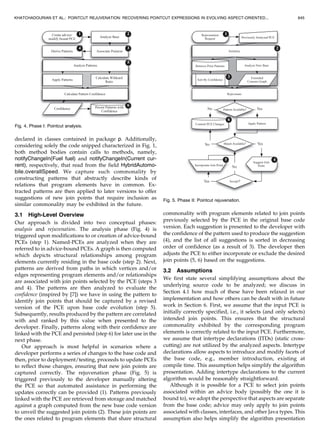
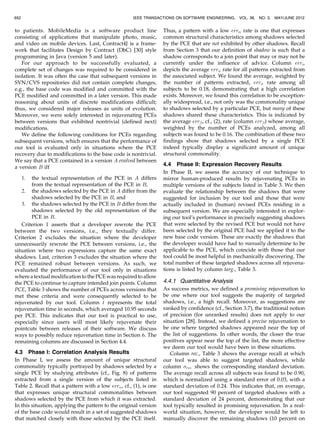
analysis and rejuvenation. The analysis phase (Fig. 4) is
triggered upon modifications to or creation of advice-bound
PCEs (step 1). Named-PCEs are analyzed when they are
referred to in advice-bound PCEs. A graph is then computed
which depicts structural relationships among program
elements currently residing in the base code (step 2). Next,
patterns are derived from paths in which vertices and/or
edges representing program elements and/or relationships
are associated with join points selected by the PCE (steps 3
and 4). The patterns are then analyzed to evaluate the
confidence (inspired by [7]) we have in using the pattern to
identify join points that should be captured by a revised
version of the PCE upon base code evolution (step 5).
Subsequently, results produced by the pattern are correlated
with and ranked by this value when presented to the
developer. Finally, patterns along with their confidence are
linked with the PCE and persisted (step 6) for later use in the
next phase.
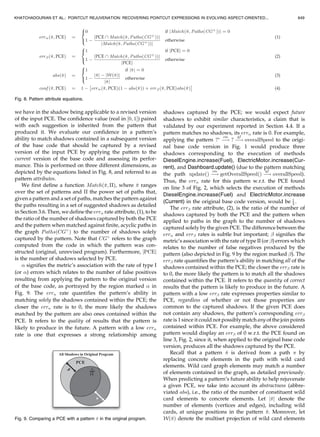
Our approach is most helpful in scenarios where a
developer performs a series of changes to the base code and
then, prior to deployment/testing, proceeds to update PCEs
to reflect those changes, ensuring that new join points are
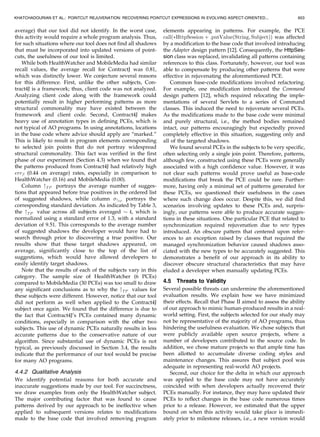
captured correctly. The rejuvenation phase (Fig. 5) is
triggered previously to the developer manually altering
the PCE so that automated assistance in performing the
updates correctly can be provided (1). Patterns previously
linked with the PCE are retrieved from storage and matched
against a graph computed from the new base code version
to unveil the suggested join points (2). These join points are
the ones related to program elements that share structural
commonality with program elements related to join points
previously selected by the PCE in the original base code
version. Each suggestion is presented to the developer with
the confidence of the pattern used to produce the suggestion
(4), and the list of all suggestions is sorted in decreasing
order of confidence (as a result of 3). The developer then
adjusts the PCE to either incorporate or exclude the desired
join points (5, 6) based on the suggestions.
3.2 Assumptions
We first state several simplifying assumptions about the
underlying source code to be analyzed; we discuss in
Section 4.1 how much of these have been relaxed in our
implementation and how others can be dealt with in future
work in Section 6. First, we assume that the input PCE is
initially correctly specified, i.e., it selects (and only selects)
intended join points. This ensures that the structural
commonality exhibited by the corresponding program
elements is correctly related to the input PCE. Furthermore,
we assume that intertype declarations (ITDs) (static cross-
cutting) are not utilized by the analyzed aspects. Intertype
declarations allow aspects to introduce and modify facets of
the base code, e.g., member introduction, existing at
compile time. This assumption helps simplify the algorithm
presentation. Adding intertype declarations to the current
algorithm would be reasonably straightforward.
Although it is possible for a PCE to select join points
associated within an advice body (possibly the one it is
bound to), we adopt the perspective that aspects are separate
from the base code; advice may only apply to join points
associated with classes, interfaces, and other Java types. This
assumption also helps simplify the algorithm presentation
KHATCHADOURIAN ET AL.: POINTCUT REJUVENATION: RECOVERING POINTCUT EXPRESSIONS IN EVOLVING ASPECT-ORIENTED... 645
Fig. 4. Phase I: Pointcut analysis.
Fig. 5. Phase II: Pointcut rejuvenation.
since it reduces both the kinds of entities and relations
between the entities existing in the input program that need
to be considered. Moreover, it frees us from resolving the
targets of proceed calls, which may exist in around advice.
We discuss adding advice bodies in Section 6. Last, we
assume that we can accurately resolve the declaration of the
advice a PCE is bound to across varying versions of the
software. This may be invalidated via the use of refactorings,
e.g., member relocation, being applied in between software
versions. Section 6 discusses plans for how our approach can
be made to cope with this issue.
3.3 Concern Graphs
To abstract the details of the underlying source code, a
representation of the program is first built using an
adaptation of a concern graph [35]. Concern graphs have
been used in previous work [34] to discover, describe, and
track concerns in evolving source code as they allow for
succinct program representations. We have chosen to use
concern graphs since they include information about the
structure of programs, and we are interested in unveiling
underlying structural patterns. We extended concern graphs
with several elements found in current Java languages, e.g.,
annotations, and adapted them for use with AOP.
We specify an extended concern graph CGþ
to be a labeled
multidigraph consisting of a 4-tuple CGþ
¼ ðV ; E; R; ‘Þ. The
vertices V represent program elements contained within the
analyzed program, specifically, packages, classes, interfaces,
enumeration types, annotations, methods, and fields. We do
not consider local variables and other parameters in our
analysis as crosscutting concerns tend to crosscut a larger
granularity of program elements. E is a multiset of directed
edges that connect vertices in V depending on various
relations that may hold between them as depicted in the
source code. For example, HybridAutomobile and over-
allSpeed (Fig. 1) are related in that the class HybridAutomobile
declares the field overallSpeed. In this case, there would exist
an edge connecting the vertex that represents HybridAuto-
mobile to the vertex representing overallSpeed. R is the set of
all such (binary) relations that we consider. Since two vertices
may berelated in several ways, i.e., they satisfy more than one
relation, there may exist multiple edges between them. As
such, ‘ : E ! R serves as a labeling function that distin-
guishes edges by labeling them with the satisfied relations.
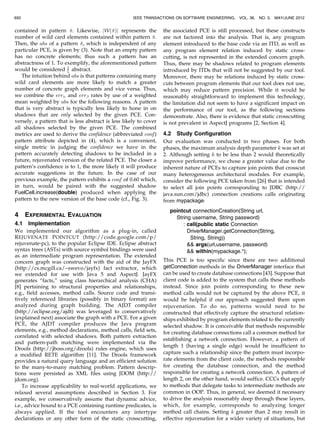
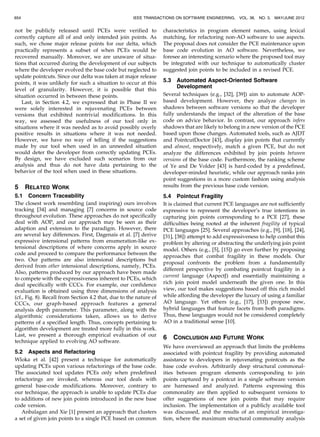
Fig. 6 portrays a subset of the graph computed from the
example given in Section 2.
Table 1 portrays the complete set of binary relations that
we consider as well as the program entity types in which
they relate. Either of these relations may hold in a structural
sense, e.g., field declarations, or possibly during a particular
execution of the program, e.g., method calls. Section 4.1
discusses how we conservatively approximated the truth
value of these relations in our implementation by using
exclusively static information, i.e., through examination of
the program text, while Section 6 touches upon future work
which could result in a more accurate approximation. Many
kinds of relations may be formulated; however, we mainly
focus on popular relations as used in previous work [5], [7],
[35], with the addition of relations useful for AO languages,
e.g., Annotates. Section 4 reports on the appropriateness of
using such relations for PCE rejuvenation in AspectJ
programs; adding additional relations is discussed in
Section 6.
3.4 Concern Graph/Pointcut Association
The next step in our approach involves discovering graph
elements (vertices and edges) that represent program
elements corresponding to join points captured by the
input PCE so that patterns capturing commonality existing
between these elements can be later extracted. Recall that a
PCE describes a set of join points, which are well-defined
points in the program’s execution. Thus, a join point is very
much dynamic in nature. A join point shadow, conversely,
refers to base code corresponding to a join point, i.e., a point
in the program text where the compiler may actually
perform the weaving [29]. Whether the base code is advised
at that point is dependent on advice being applicable and
possible dynamic conditions being met. We treat a program
as consisting of a set of join point shadows that may or may
646 IEEE TRANSACTIONS ON SOFTWARE ENGINEERING, VOL. 38, NO. 3, MAY/JUNE 2012
Fig. 6. A graph subset computed from the example.
TABLE 1
Analyzed Program Entity Types and Relations
not be currently advised. This definition differs slightly
from those typically given in the literature [16], [43] and
helps simplify the algorithm presentation. Moreover, we
treat a PCE as selecting a subset of these shadows, i.e., we
assume that the PCE is free of dynamic conditions. This
allows us to exploit solely static information in our analysis.
Section 4.1 discusses how our implementation conserva-
tively relaxes this assumption so that PCEs utilizing
dynamic conditions may nevertheless be used as input to
our tool. The evaluation results reported in Section 4.4
indicate that the impact of this limitation is minimal and
that our current approach can be useful. There is evidence
that suggests that most PCEs do not take advantage of
dynamic conditions [2].
Shadows corresponding to method declarations enable
method vertices, i.e., for a graph CGþ
¼ ðV ; E; R; ‘Þ we say
that a vertex v 2 V is associated with (or enabled w.r.t.) a
PCE iff v represents a method whose corresponding method
execution-join point shadow is selected by the PCE. Thus, a
vertex representing the method m would be considered
enabled w.r.t. a PCE that selects a method execution-join
point for m.
For a graph built from the example in Fig. 1, the vertices
representing the methods DieselEngine.increase(Fuel) and
ElectricMotor.increase(Current) would be considered en-
abled w.r.t. the PCE found on line 3, Fig. 2. The graph
subset in Fig. 6 illustrates this; the vertices representing
these methods are shaded.
While shadows corresponding to method declarations
enable method vertices, shadows corresponding to sites
(call-sites, field access, etc.) enable edges. We say that an
edge ðu; vÞ 2 E is enabled w.r.t. a PCE iff
. the edge is labeled as either a method call,
i.e., CallsMethodðu; vÞ holds, a field read, i.e.,
GetsFieldðu; vÞ holds, or a field write, i.e.,
SetsFieldðu; vÞ holds, and
. there exists a corresponding method call-, field get-,
or field set-join point shadow selected by the PCE
such that the called method, the read field, or the
written field, respectively, is the one represented by
vertex v, and the shadow resides within the body of
the method represented by vertex u.
For example, an edge representing a call from a method
m to a method n would be considered enabled w.r.t. a PCE
selecting a method call shadow for n originating in the body
(or in AspectJ terminology, withincode) of m. Note that the
difference between a method execution-join point and a
method call-join point is that in the former, the correspond-
ing shadow lies at the declaration of the invoked method,
while in the latter, it lies at the site of the method invocation,
i.e., the client code. Section 4.1 discusses how our
implementation leverages existing tool support to deduce
enabled graph elements.
3.5 Pattern Extraction
Once we associate (enable) graph elements with the input
PCE, (see Section 3.4), we analyze structural commonality
between these elements with the hope that future elements
whose shadows should be included in a new version of the
PCE may exhibit similar structural characteristics with a
particular level of confidence. Note that we only take
advantage of structural commonality between program
elements and not other kinds of commonality, e.g., string
similarity of method names. We are interested in exploiting
information pertaining to the structure and organization of
the base code when related to PCEs.
Recall that (increase(Fuel) and increase(Current)), whose
corresponding execution was selected by (execution(void
increase(Energy+))), both contained calls to (notifyChange-
In(Fuel) and notifyChangeIn(Current)), which read from
(overallSpeed). Deliberately, this information is expressed
by two paths (sequences of connected edges) increase(Fuel)
e
 overallSpeed and increase(Energy) e
 overallSpeed in
Fig. 6. We capture commonality associated with such graph
elements by extracting patterns from paths in which they are
contained. These patterns, which convey general “shapes”
(in terms of paths) of the graph surrounding the enabled
graph elements, i.e., graph elements representing program
elements corresponding to join point shadows selected by
the input PCE, will ultimately be applied to graphs
computed from subsequent versions to uncover new
elements displaying the captured commonality.
For each enabled (w.r.t. the input PCE) vertex v and edge
ðu; vÞ, we extract patterns from finite, acyclic paths of length
(in terms of edges) k passing through v and along ðu; vÞ,
respectively. The maximum analysis depth parameter k, an
input to the algorithm, controls tractability by restricting
the depth of satisfied relations analyzed and, conse-
quently, limits the length of the patterns derived. Section
4.2 discusses our choice for k in our evaluation. An
example of such a path when taking the enabled vertex
v ¼ increaseðFuelÞ a n d k ¼ 2 i s increaseFuelðFuelÞ cm
À!
notifyChangeInðFuelÞ gf
À! overallSpeed, where edge labels cm
and gf refer to the satisfied relations CallsMethod and
GetsField, respectively.
Intuitively, patterns are constructed from paths so that
paths matching the pattern are ones that share common
origins or sinks with the original path. Also, vertices in the
matching paths are connected via similar (in terms of labels)
edges as the vertices in the original path.
We consider two kinds of patterns, those derived from
enabled vertices, called vertex-based patterns, and those
from enabled edges, called edge-based patterns. A vertex-
based pattern is obtained from a path by replacing vertices
along the path with vertex wild cards. Vertex-based patterns
are used for suggesting method execution join points. An
edge-based pattern is obtained by not only replacing
vertices with vertex wild cards, but also a certain edge
with an edge wild card. Edge-based patterns are used for
suggesting site-based (e.g., call-site, field-set) join points.
The replacing edge wild card is related to the site-based
shadow to be suggested.
Vertex-based patterns will contain all but one (nonwild)
concrete vertex; this is the element representing the
common source or sink. Every edge in a vertex-based
pattern is concrete so that paths containing similarity
connected vertices can be matched with the pattern. There
are no edge wild cards in a vertex-based pattern. Edge-
based patterns are similar to vertex-based patterns with the
exception of the single edge wild card mentioned above.
KHATCHADOURIAN ET AL.: POINTCUT REJUVENATION: RECOVERING POINTCUT EXPRESSIONS IN EVOLVING ASPECT-ORIENTED... 647
While pattern matching is covered in Section 3.6, we
briefly discuss wild card matching here. Vertex wild cards
only match vertices, while edge wild cards only match
edges. Wild cards serve to express points of variation in
paths the encompassing pattern is matched against, as well
as to select shadows that are ultimately suggested for
incorporation. As such, wild cards may be enabled as
determined by their position relative to the enabled graph
element in the path used to create the pattern. Shadows
associated with graph elements (cf., Section 3.4) matched by
enabled wild cards are eventually suggested.
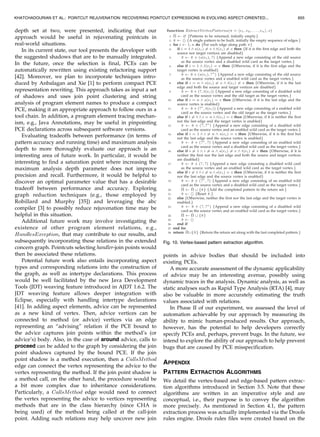
We extract vertex-based patterns from a path  ¼
he1; e2; . . . ; eni and an enabled vertex v along . Details of
the algorithm can be found in Fig. 10 in the Appendix. The
algorithm proceeds as follows: If v occurs in  as the source
vertex of the first edge, we extract a single pattern by
replacing this vertex with an enabled wild card. The
remaining vertices along the path are replaced by disabled
wild cards except for the target vertex of the last edge. To
illustrate, recall the path
increaseFuelðFuelÞ À!
cm
notifyChangeInðFuelÞ
À!
gf
overallSpeed
where the vertex increaseFuel(Fuel) is enabled w.r.t. the
PCE. f?Ã
À!
cm
? À!
gf
overallSpeedg would be the singleton
extracted from this path, where ? denotes a disabled wild
card and ?Ã
an enabled wild card.
Continuing, if v occurs in  as the target vertex of the first
edge, a similar action is performed as in the previous case;
however, we retain the source vertex of the first edge and
instead replace the target vertex of the first edge with an
enabled wild card. For the case that v occurs in  as either
the source or the target vertex of the last node, the reverse
process is performed. Finally, for the case in which v is not
involved with either the first or last edge of the path, we
split the path to extract two patterns: one with v as the
target vertex of the last edge and one with v as the source
vertex of the first edge and proceed as before.
Edge-based patterns are handled in a similar manner.
Details of the algorithm can be found in Fig. 11 in the
Appendix. The key difference between the vertex and edge
pattern extraction algorithms is that, in the case of edges,
the corresponding algorithm is intended to construct
patterns which produce other edges exhibiting common-
ality related to the input (enabled) edge. This requires
accounting for locations of where edges appear in paths, as
well as the labels of the edges.
3.6 Pattern Matching
We say that a pattern ^ matches a path  iff
. for each vertex u along  at position i, there is a
vertex v along ^ at position i s.t. either u ¼ v or v is a
wild card, and
. for each edge ðp; qÞ along  at position j, there is an
edge ðs; tÞ along ^ at position j s.t. either ‘ðp; qÞ ¼
‘ðs; tÞ or ðs; tÞ is a wild card.
To illustrate, suppose we augmented the graph in Fig. 6
with new vertices and edges representing facets of the
FuelCell class in Fig. 3. The resulting situation is depicted in
Fig. 7, where a new path
increaseðdoubleÞ À!
cm
notifyChangeInðdoubleÞ
À!
gf
overallSpeed
matches the previously extracted pattern ?Ã
À!
cm
? À!
gf
overallSpeed.
Given that a pattern matches a path, suggested shadows
are ones represented by graph elements along the path that
matched enabled wild cards in the pattern. Vertices
representing methods matched by enabled wild cards
produce suggested shadows corresponding to the execution
of those methods. Likewise, edges representing satisfied
relations, e.g., method calls, field reads, field writes,
between program elements matched by enabled wild cards
produce suggested shadows corresponding to the relation
which reside in the body (withincode) of the method
represented by the source vertex and operate (call, get, or
set) on program element represented by the target vertex.
For example, when matching the pattern ?Ã
À!
cm
? À!
gm
overallSpeed against the path
increaseðdoubleÞ À!
cm
notifyChangeInðdoubleÞ
À!
gf
overallSpeed;
the method FuelCell.increase(double) is represented by a
vertex that matches an enabled wild card element. The
situation is emphasized in Fig. 7 by a dashed line through the
vertices that induced the wild card. As a result, we suggest
that the CCC being realized by the advice on lines 2-4 of Fig. 2
applies to the shadow corresponding to the execution of this
method due to its semantic equivalence with other shadows
to which the same CCC applies, i.e., the ones selected by the
PCE on line 3. In AspectJ, however, multiple advice
declarations may to be responsible for realizing a particular
CCC, similar to how multiple methods may be responsible
for realizing a particular concern in Java. Such is the case
here since applying the CCC to the suggested shadow
would entail creating a new advice declaration to expose
context from incompatible parameter types in the same
position (in this case, Energy and double, both being the
first parameter). Thus, upon our suggestion, the developer
would proceed to create a new advice declaration bound to
the PCE execution(void FuelCell. increase(double)) that
properly implements the CCC corresponding to speeding
violation prevention.
3.7 Suggestion Sorting
Shadows suggested for incorporation are presented to the
developer in descending order of the degree of confidence
648 IEEE TRANSACTIONS ON SOFTWARE ENGINEERING, VOL. 38, NO. 3, MAY/JUNE 2012
Fig. 7. Evolving the base code with a FuelCell class.
we have in the shadow being applicable to a revised version
of the input PCE. The confidence value (real in ½0; 1Š) paired
with each suggestion is inherited from the pattern that
produced it. We evaluate our confidence in a pattern’s
ability to match shadows contained in a subsequent version
of the base code that should be captured by a revised
version of the input PCE by applying the pattern to the
current version of the base code and assessing its perfor-
mance. This is performed on three different dimensions, as
depicted by the equations listed in Fig. 8, and referred to as
pattern attributes.
We first define a function Matchð^; ÅÞ, where ^ ranges
over the set of patterns and Å the power set of paths that,
given a pattern and a set of paths, matches the pattern against
the paths resulting in a set of suggested shadows as detailed
in Section 3.6. Then, we define the err rate attribute, (1), to be
the ratio of the number of shadows captured by both the PCE
and the pattern when matched against finite, acyclic paths in
the graph PathsðCGþ
Þ to the number of shadows solely
captured by the pattern. Note that CGþ
refers to the graph
computed from the code in which the pattern was con-
structed (original, unrevised program). Furthermore, jPCEj
is the number of shadows selected by PCE.
 signifies the metric’s association with the rate of type I
(or ) errors which relates to the number of false positives
resulting from applying the pattern to the original version
of the base code, as portrayed by the region marked  in
Fig. 9. The err rate quantifies the pattern’s ability in
matching solely the shadows contained within the PCE; the
closer the err rate is to 0, the more likely the shadows
matched by the pattern are also ones contained within the
PCE. It refers to the quality of results that the pattern is
likely to produce in the future. A pattern with a low err
rate is one that expresses a strong relationship among
shadows captured by the PCE; we would expect future
shadows to exhibit similar characteristics, a claim that is
validated by our experiment reported in Section 4.4. If a
pattern matches no shadows, its err rate is 0. For example,
applying the pattern ?Ã
À!
cm
? À!
gf
overallSpeed to the origi-
nal base code version in Fig. 1 would produce three
shadows corresponding to the execution of methods
DieselEngine.increase(Fuel), ElectricMotor.increase(Cur-
rent), and Dashboard.update() (due to the pattern matching
the path updateðÞ À!
cm
getOverallSpeedðÞ À!
gf
overallSpeed).
Thus, the err rate for this pattern w.r.t. the PCE found
on line 3 of Fig. 2, which selects the execution of methods
DieselEngine.increase(Fuel) and ElectricMotor.increase
(Current) in the original base code version, would be 1
3 .
The err
rate attribute, (2), is the ratio of the number of
shadows captured by both the PCE and the pattern when
applied to paths in the graph to the number of shadows
captured solely by the given PCE. The difference between the
err and err
rates is subtle but important;
signifies the
metric’s association with the rate of type II (or
) errors which
relates to the number of false negatives produced by the
pattern (also depicted in Fig. 9 by the region marked
). The
err
rate quantifies the pattern’s ability in matching all of the
shadows contained within the PCE; the closer the err
rate is
to 0, the more likely the pattern is to match all the shadows
contained within the PCE. It refers to the quantity of correct
results that the pattern is likely to produce in the future. A
pattern with a low err

Pointcut rejuvenation

  • 1.
    Pointcut Rejuvenation: Recovering PointcutExpressions in Evolving Aspect-Oriented Software Raffi Khatchadourian, Member, IEEE, Phil Greenwood, Awais Rashid, Member, IEEE, and Guoqing Xu Abstract—Pointcut fragility is a well-documented problem in Aspect-Oriented Programming; changes to the base code can lead to join points incorrectly falling in or out of the scope of pointcuts. In this paper, we present an automated approach that limits fragility problems by providing mechanical assistance in pointcut maintenance. The approach is based on harnessing arbitrarily deep structural commonalities between program elements corresponding to join points selected by a pointcut. The extracted patterns are then applied to later versions to offer suggestions of new join points that may require inclusion. To illustrate that the motivation behind our proposal is well founded, we first empirically establish that join points captured by a single pointcut typically portray a significant amount of unique structural commonality by analyzing patterns extracted from 23 AspectJ programs. Then, we demonstrate the usefulness of our technique by rejuvenating pointcuts in multiple versions of three of these programs. The results show that our parameterized heuristic algorithm was able to accurately and automatically infer the majority of new join points in subsequent software versions that were not captured by the original pointcuts. Index Terms—Software development environments, software maintenance, software tools. Ç 1 INTRODUCTION ASPECT-ORIENTED Programming (AOP) [23] has emerged to reduce the scattering and tangling of crosscutting concern (CCC) implementations. This is achieved through specifying that certain behavior (advice) should be composed at specific (join) points during the execution of the underlying program (base code). Join point sets are described by pointcut expressions (PCEs), which are predicate-like expressions over various characteristics of “events” that occur during the program’s execution. In AspectJ [22], such characteristics may include calls to certain methods, accesses to particular fields, and mod- ifications to the runtime stack. Consider an example PCE execution(* m*(..)) that selects the execution of all methods whose name begins with m, taking any number and type of arguments and returning any type of value. Suppose that in one base code version the above PCE selects the correct set of join points in which a CCC applies. As the software evolves, this set of join points may change as well. We say that a PCE is robust if in its unaltered form it is able to continue to capture the correct set of join points in future base code versions. Thus, the PCE given above would be considered robust if the set of join points in which the CCC applies always corresponded to executions of methods whose name begins with m, taking any number and type of arguments, and so forth. However, with the requirements of typical software tending to change over time, the corresponding source code may undergo many alterations to accommodate such change, including the addition of new elements in which existing CCCs should also apply. Without a priori knowledge of future main- tenance changes and additions, creating robust PCEs is a daunting task. As such, there may easily exist situations where the PCE itself must evolve along with the base code; in these cases, we say that the PCE is fragile. Hence, the fragile pointcut problem [25] manifests itself in such circum- stances where join points incorrectly fall in or out of the scope of PCEs. Several approaches aim to combat this problem by proposing new pointcut languages with improved expres- siveness (e.g., [6], [24], [31], [36], [37]), limiting the scope of where advice may apply through more clearly defined interfaces (e.g., [14]), or enforcing structural and/or behavioral constraints on advice application (e.g., [13], [19], [40]). Yet others make points where advice may apply more explicit in the base code [17], or remove PCEs altogether [33]. However, each of these tend to require some level of anticipation and, consequently, when using PCEs there may nevertheless exist situations where PCEs must be manually updated to capture new join points as the software evolves. Programmer-defined source code annotations can also be used to “mark” relevant locations in the source code where a CCC applies. PCEs then use these annotations to accurately select the appropriate join points. If used properly, i.e., if all 642 IEEE TRANSACTIONS ON SOFTWARE ENGINEERING, VOL. 38, NO. 3, MAY/JUNE 2012 . R. Khatchadourian and G. Xu are with the Department of Computer Science and Engineering, Ohio State University, Columbus, OH 43210. E-mail: {khatchad, xug}@cse.ohio-state.edu. . P. Greenwood and A. Rashid are with Computing Department, Lancaster University, Lancaster LA1 4WA, United Kingdom. E-mail: {greenwop, awais}@comp.lancs.ac.uk. Manuscript received 27 Feb. 2010; revised 23 Aug. 2010; accepted 26 Jan. 2011; published online 7 Feb. 2011. Recommended for acceptance by T. Tamai. For information on obtaining reprints of this article, please send e-mail to: tse@computer.org, and reference IEEECS Log Number TSE-2010-02-0054. Digital Object Identifier no. 10.1109/TSE.2011.21. 0098-5589/12/$31.00 ß 2012 IEEE Published by the IEEE Computer Society
  • 2.
    locations where theCCC applies are correctly annotated and if the corresponding PCE correctly selects these elements, this scheme can produce PCEs that are robust to changes such as refactorings since names and organization of program elements may change but the associated annota- tions remains intact. However, refactoring is not the only reason for PCE breaks. For example, adding a new element but neglecting to annotate it properly with all CCCs that apply to it will break an annotation-based pointcut. It is important to note that, although this paper deals with the particular case of AspectJ, a system written in any language that allows developers to declare composition specifications (like PCEs in AspectJ) is susceptible to this predicament. Furthermore, this problem unfortunately develops into a vicious cycle where these new PCEs may also exhibit similar fragility problems. To alleviate such problems, we propose an approach that provides automated assistance in rejuvenating PCEs upon changes to the base code. The technique is based on harnessing unique and arbitrarily deep structural common- alities between program elements corresponding to join points selected by a PCE in a particular software version. To illustrate, again consider the example PCE given earlier and suppose that, in a certain base code version, the PCE selects the execution of three methods, m1, m2, and m3. Further suppose that facets pertaining to these methods exhibit structural commonality, e.g., each of the methods’ bodies may (textually) include a call to a common method y, or that each includes a call to three other methods x, y, and z, respectively, all of which have method bodies that include an assignment to a common field f. Likewise, each method may be declared in three different classes A, B, and C, respectively, all of which are contained in a package p. Moreover, if such characteristics are shared between program elements corresponding to join points selected by a PCE in one base code version, it is conceivable that these relationships persist in subsequent versions. Conse- quently, our proposal involves constructing patterns that describe these kinds of relationships, assessing their expressiveness in comparison with the input PCE, and associating them with the PCE so that they may be applied to later base code versions to offer suggestions of new join points that may require inclusion. Our insight into the fragile pointcut problem is as follows: CCCs tend to crosscut traditional module bound- aries. Thus, CCCs affect many heterogeneous modules across a software system. Despite their differences, these modules have at least one facet in common, i.e., that a particular CCC applies to them. Our hypothesis is that places in the source code corresponding to where a CCC applies share a similar structure, and that this information can be leveraged to maintain PCEs. Our key contributions are as follows: 1. Commonality identification. We present a parame- terized heuristic algorithm that automatically derives arbitrarily deep structural patterns inherent to pro- gram elements corresponding to join points selected by the original PCE. This allows join points to be suggested that may require inclusion into a revised version of the PCE, ensuring that evolutionary changes can be correctly applied by mechanically assisting the developer in maintaining PCEs. 2. Correlation analysis. We empirically establish that join points selected by a single PCE typically portray a significant amount of unique structural common- ality by applying our algorithm to automatically extract and thereafter analyze patterns using PCEs contained within single versions of 23 AspectJ programs. We found that the derived patterns, on average, were able to closely produce the majority of join points selected by the analyzed PCE in the original base code version with low (false positive) and
  • 3.
    (false negative) errorrates of 18 and 16 percent, respectively. 3. Expression recovery. To ensure the applicability and practicality of our approach, we implemented our algorithm as an Eclipse (http://eclipse.org) IDE plug-in and evaluated its usefulness by rejuvenating PCEs in multiple versions of three of the aforemen- tioned programs, which were of varying sizes and domains and representative of typical AO software. We found that, in exploiting the extracted patterns, our tool was able to accurately and automatically infer 90 percent of new join points that were selected by PCEs in subsequent software versions that were not selected by the original PCE, with a standard deviation of 24 percent. This demonstrates that the approach is indeed useful in alleviating the burden of recovering PCEs upon base-code modifications that took place in our subject programs, and the results advance the state of the art in automated tool support for coping with the evolution of AO programs. A brief introduction of this work originally appeared in [20], and a demonstration of our preliminary tool, along with details of the implementation, appeared in [21]. In this paper, we fully describe our complete approach, which has been built upon the aforementioned previous work. This complete approach includes thoroughly developed ideas that have been incorporated into our initial algorithm. We also present a new dimension of our experimental results to comprehensively and accurately assess the overall useful- ness of our approach. The remainder of this paper is organized as follows: Section 2 presents a motivating example that features a fragile PCE. Section 3 highlights the key algorithmic facets of our approach, while Section 4 discusses the details of our implementation and evaluation. In Section 5, we compare our proposal with related work and explore future work, as well as conclude, in Section 6. 2 POINTCUT FRAGILITY EXAMPLE Fig. 1 shows an example AspectJ code snippet for a hypothetical drive-by-wire programming of an all-wheel drive, hybrid vehicle (line 2) which draws power from two different sources, namely, a diesel engine (line 25) and an electric motor (line 30), both of which contribute to the overall speed (line 3).1 Fuel is distributed to the engine via KHATCHADOURIAN ET AL.: POINTCUT REJUVENATION: RECOVERING POINTCUT EXPRESSIONS IN EVOLVING ASPECT-ORIENTED... 643 1. This example was inspired by one of the authors’ work at the Center for Automotive Research (CAR) at Ohio State University.
  • 4.
    the method DieselEngine.increase(Fuel)(line 27), while electricity is distributed to the motor via the method ElectricMotor.increase(Current) (line 32), whose method bodies are abbreviated. The classes conform to the Observer pattern, with the DieselEngine and ElectricMotor notifying the HybridAutomobile of any change made to the energy consumption of the respective components. The HybridAu- tomobile in turn computes its new overall speed (lines 7-8, 13-14) and updates any attached observers, e.g., the Dash- board (line 35). An accessor method (line 22) retrieves the value of the private instance field overallSpeed, which the method Dashboard.update() invokes (line 38) as part of the design pattern to refresh the driver’s display. Suppose now that roadways exhibit a new feature that notifies traveling vehicles of the speed limit. As a result, an aspect SpeedingViolationPrevention (Fig. 2) is introduced to augment the existing functionality of the programming depicted in Fig. 1 by limiting the vehicle’s energy intake by declaring appropriate around advice (lines 2-4), which conditionally bypasses the execution of methods that contribute to the vehicle’s overall speed.2 The points at which this advice is to apply are specified by its bound PCE (line 3) that selects join points corresponding to the execution of two of the aforementioned methods, namely, DieselEngine.increase(Fuel) and ElectricMotor.increase (Current). These methods have been underlined in Fig. 1. Class Energy (not shown) is an abstract super class of which both classes Fuel and Current (also not shown), parameters to the methods, extend. The type pattern Energy+ is a wild card that denotes object references of type Energy and its subclasses. Note that facets related to the advice body are abbreviated here to focus on the applicability of the advice. Further suppose that the base code (Fig. 1) evolves to accommodate a new vehicle energy source, namely, a fuel cell, resulting in the creation of a FuelCell class (Fig. 3). Contrary to the existing energy sources, requests to increase power from the FuelCell require passing a numerical (double) parameter, which is the amount of acceleration (in miles/hour) that should result from the FuelCell internally generating power, to a method (line 4) that, in turn, notifies the HybridAutomobile of the change directly (line 5). Intuitively, the SpeedingViolationPrevention aspect should also apply to the execution of this method; however, the PCE fails to select this new but semantically equivalent join point. Although the new method’s signature is consistent with the other join points, with only the parameter type differing, i.e., double is a primitive type that could not hold references to type Energy or any of its subclasses, this difference causes the PCE not to select this method’s execution. Worse, many such join points may silently exhibit similar problems in evolving software with larger code bases. It would be helpful to developers if join points that may have been overlooked when manually updating PCEs to reflect new changes in the base code could be mechanically suggested. It would also be helpful to mechanically suggest join points that should no longer be selected by a PCE. We will continue to use this example to demonstrate how our proposed approach can assist devel- opers with these issues in an automated fashion. 3 HARNESSING COMMONALITY We present a parameterized heuristic algorithm that assists developers in maintaining PCEs upon changes to the base code by inferring new join points that may require inclusion by discovering structural commonality between program elements corresponding to join points captured by a PCE in a particular software version. For instance, notice in the previous example that the two methods, namely, DieselEngine.increase(Fuel) and ElectricMotor.in- crease(Current), whose corresponding method executions were selected by the PCE listed on line 3, Fig. 2, are both 644 IEEE TRANSACTIONS ON SOFTWARE ENGINEERING, VOL. 38, NO. 3, MAY/JUNE 2012 Fig. 1. Hybrid automobile example. Fig. 2. Speeding prevention aspect. Fig. 3. A new fuel cell class. 2. For this advice to properly function, the pointcut must expose appropriate context pertaining to the join point. Specifically, both the implicit and explicit arguments of the increase(Energy) method would need to be exposed, perhaps by using the pointcut designators this() and args() to perform the checks. We have omitted these designators for presentation purposes.
  • 5.
    declared in classescontained in package p. Additionally, considering solely the code snipped characterized in Fig. 1, both method bodies contain calls to methods, namely, notifyChangeIn(Fuel fuel) and notifyChangeIn(Current cur- rent), respectively, that read from the field HybridAutomo- bile.overallSpeed. We capture such commonality by constructing patterns that abstractly describe kinds of relations that program elements have in common. Ex- tracted patterns are then applied to later versions to offer suggestions of new join points that require inclusion as similar commonality may be exhibited in the future. 3.1 High-Level Overview Our approach is divided into two conceptual phases: analysis and rejuvenation. The analysis phase (Fig. 4) is triggered upon modifications to or creation of advice-bound PCEs (step 1). Named-PCEs are analyzed when they are referred to in advice-bound PCEs. A graph is then computed which depicts structural relationships among program elements currently residing in the base code (step 2). Next, patterns are derived from paths in which vertices and/or edges representing program elements and/or relationships are associated with join points selected by the PCE (steps 3 and 4). The patterns are then analyzed to evaluate the confidence (inspired by [7]) we have in using the pattern to identify join points that should be captured by a revised version of the PCE upon base code evolution (step 5). Subsequently, results produced by the pattern are correlated with and ranked by this value when presented to the developer. Finally, patterns along with their confidence are linked with the PCE and persisted (step 6) for later use in the next phase. Our approach is most helpful in scenarios where a developer performs a series of changes to the base code and then, prior to deployment/testing, proceeds to update PCEs to reflect those changes, ensuring that new join points are captured correctly. The rejuvenation phase (Fig. 5) is triggered previously to the developer manually altering the PCE so that automated assistance in performing the updates correctly can be provided (1). Patterns previously linked with the PCE are retrieved from storage and matched against a graph computed from the new base code version to unveil the suggested join points (2). These join points are the ones related to program elements that share structural commonality with program elements related to join points previously selected by the PCE in the original base code version. Each suggestion is presented to the developer with the confidence of the pattern used to produce the suggestion (4), and the list of all suggestions is sorted in decreasing order of confidence (as a result of 3). The developer then adjusts the PCE to either incorporate or exclude the desired join points (5, 6) based on the suggestions. 3.2 Assumptions We first state several simplifying assumptions about the underlying source code to be analyzed; we discuss in Section 4.1 how much of these have been relaxed in our implementation and how others can be dealt with in future work in Section 6. First, we assume that the input PCE is initially correctly specified, i.e., it selects (and only selects) intended join points. This ensures that the structural commonality exhibited by the corresponding program elements is correctly related to the input PCE. Furthermore, we assume that intertype declarations (ITDs) (static cross- cutting) are not utilized by the analyzed aspects. Intertype declarations allow aspects to introduce and modify facets of the base code, e.g., member introduction, existing at compile time. This assumption helps simplify the algorithm presentation. Adding intertype declarations to the current algorithm would be reasonably straightforward. Although it is possible for a PCE to select join points associated within an advice body (possibly the one it is bound to), we adopt the perspective that aspects are separate from the base code; advice may only apply to join points associated with classes, interfaces, and other Java types. This assumption also helps simplify the algorithm presentation KHATCHADOURIAN ET AL.: POINTCUT REJUVENATION: RECOVERING POINTCUT EXPRESSIONS IN EVOLVING ASPECT-ORIENTED... 645 Fig. 4. Phase I: Pointcut analysis. Fig. 5. Phase II: Pointcut rejuvenation.
  • 6.
    since it reducesboth the kinds of entities and relations between the entities existing in the input program that need to be considered. Moreover, it frees us from resolving the targets of proceed calls, which may exist in around advice. We discuss adding advice bodies in Section 6. Last, we assume that we can accurately resolve the declaration of the advice a PCE is bound to across varying versions of the software. This may be invalidated via the use of refactorings, e.g., member relocation, being applied in between software versions. Section 6 discusses plans for how our approach can be made to cope with this issue. 3.3 Concern Graphs To abstract the details of the underlying source code, a representation of the program is first built using an adaptation of a concern graph [35]. Concern graphs have been used in previous work [34] to discover, describe, and track concerns in evolving source code as they allow for succinct program representations. We have chosen to use concern graphs since they include information about the structure of programs, and we are interested in unveiling underlying structural patterns. We extended concern graphs with several elements found in current Java languages, e.g., annotations, and adapted them for use with AOP. We specify an extended concern graph CGþ to be a labeled multidigraph consisting of a 4-tuple CGþ ¼ ðV ; E; R; ‘Þ. The vertices V represent program elements contained within the analyzed program, specifically, packages, classes, interfaces, enumeration types, annotations, methods, and fields. We do not consider local variables and other parameters in our analysis as crosscutting concerns tend to crosscut a larger granularity of program elements. E is a multiset of directed edges that connect vertices in V depending on various relations that may hold between them as depicted in the source code. For example, HybridAutomobile and over- allSpeed (Fig. 1) are related in that the class HybridAutomobile declares the field overallSpeed. In this case, there would exist an edge connecting the vertex that represents HybridAuto- mobile to the vertex representing overallSpeed. R is the set of all such (binary) relations that we consider. Since two vertices may berelated in several ways, i.e., they satisfy more than one relation, there may exist multiple edges between them. As such, ‘ : E ! R serves as a labeling function that distin- guishes edges by labeling them with the satisfied relations. Fig. 6 portrays a subset of the graph computed from the example given in Section 2. Table 1 portrays the complete set of binary relations that we consider as well as the program entity types in which they relate. Either of these relations may hold in a structural sense, e.g., field declarations, or possibly during a particular execution of the program, e.g., method calls. Section 4.1 discusses how we conservatively approximated the truth value of these relations in our implementation by using exclusively static information, i.e., through examination of the program text, while Section 6 touches upon future work which could result in a more accurate approximation. Many kinds of relations may be formulated; however, we mainly focus on popular relations as used in previous work [5], [7], [35], with the addition of relations useful for AO languages, e.g., Annotates. Section 4 reports on the appropriateness of using such relations for PCE rejuvenation in AspectJ programs; adding additional relations is discussed in Section 6. 3.4 Concern Graph/Pointcut Association The next step in our approach involves discovering graph elements (vertices and edges) that represent program elements corresponding to join points captured by the input PCE so that patterns capturing commonality existing between these elements can be later extracted. Recall that a PCE describes a set of join points, which are well-defined points in the program’s execution. Thus, a join point is very much dynamic in nature. A join point shadow, conversely, refers to base code corresponding to a join point, i.e., a point in the program text where the compiler may actually perform the weaving [29]. Whether the base code is advised at that point is dependent on advice being applicable and possible dynamic conditions being met. We treat a program as consisting of a set of join point shadows that may or may 646 IEEE TRANSACTIONS ON SOFTWARE ENGINEERING, VOL. 38, NO. 3, MAY/JUNE 2012 Fig. 6. A graph subset computed from the example. TABLE 1 Analyzed Program Entity Types and Relations
  • 7.
    not be currentlyadvised. This definition differs slightly from those typically given in the literature [16], [43] and helps simplify the algorithm presentation. Moreover, we treat a PCE as selecting a subset of these shadows, i.e., we assume that the PCE is free of dynamic conditions. This allows us to exploit solely static information in our analysis. Section 4.1 discusses how our implementation conserva- tively relaxes this assumption so that PCEs utilizing dynamic conditions may nevertheless be used as input to our tool. The evaluation results reported in Section 4.4 indicate that the impact of this limitation is minimal and that our current approach can be useful. There is evidence that suggests that most PCEs do not take advantage of dynamic conditions [2]. Shadows corresponding to method declarations enable method vertices, i.e., for a graph CGþ ¼ ðV ; E; R; ‘Þ we say that a vertex v 2 V is associated with (or enabled w.r.t.) a PCE iff v represents a method whose corresponding method execution-join point shadow is selected by the PCE. Thus, a vertex representing the method m would be considered enabled w.r.t. a PCE that selects a method execution-join point for m. For a graph built from the example in Fig. 1, the vertices representing the methods DieselEngine.increase(Fuel) and ElectricMotor.increase(Current) would be considered en- abled w.r.t. the PCE found on line 3, Fig. 2. The graph subset in Fig. 6 illustrates this; the vertices representing these methods are shaded. While shadows corresponding to method declarations enable method vertices, shadows corresponding to sites (call-sites, field access, etc.) enable edges. We say that an edge ðu; vÞ 2 E is enabled w.r.t. a PCE iff . the edge is labeled as either a method call, i.e., CallsMethodðu; vÞ holds, a field read, i.e., GetsFieldðu; vÞ holds, or a field write, i.e., SetsFieldðu; vÞ holds, and . there exists a corresponding method call-, field get-, or field set-join point shadow selected by the PCE such that the called method, the read field, or the written field, respectively, is the one represented by vertex v, and the shadow resides within the body of the method represented by vertex u. For example, an edge representing a call from a method m to a method n would be considered enabled w.r.t. a PCE selecting a method call shadow for n originating in the body (or in AspectJ terminology, withincode) of m. Note that the difference between a method execution-join point and a method call-join point is that in the former, the correspond- ing shadow lies at the declaration of the invoked method, while in the latter, it lies at the site of the method invocation, i.e., the client code. Section 4.1 discusses how our implementation leverages existing tool support to deduce enabled graph elements. 3.5 Pattern Extraction Once we associate (enable) graph elements with the input PCE, (see Section 3.4), we analyze structural commonality between these elements with the hope that future elements whose shadows should be included in a new version of the PCE may exhibit similar structural characteristics with a particular level of confidence. Note that we only take advantage of structural commonality between program elements and not other kinds of commonality, e.g., string similarity of method names. We are interested in exploiting information pertaining to the structure and organization of the base code when related to PCEs. Recall that (increase(Fuel) and increase(Current)), whose corresponding execution was selected by (execution(void increase(Energy+))), both contained calls to (notifyChange- In(Fuel) and notifyChangeIn(Current)), which read from (overallSpeed). Deliberately, this information is expressed by two paths (sequences of connected edges) increase(Fuel) e overallSpeed and increase(Energy) e overallSpeed in Fig. 6. We capture commonality associated with such graph elements by extracting patterns from paths in which they are contained. These patterns, which convey general “shapes” (in terms of paths) of the graph surrounding the enabled graph elements, i.e., graph elements representing program elements corresponding to join point shadows selected by the input PCE, will ultimately be applied to graphs computed from subsequent versions to uncover new elements displaying the captured commonality. For each enabled (w.r.t. the input PCE) vertex v and edge ðu; vÞ, we extract patterns from finite, acyclic paths of length (in terms of edges) k passing through v and along ðu; vÞ, respectively. The maximum analysis depth parameter k, an input to the algorithm, controls tractability by restricting the depth of satisfied relations analyzed and, conse- quently, limits the length of the patterns derived. Section 4.2 discusses our choice for k in our evaluation. An example of such a path when taking the enabled vertex v ¼ increaseðFuelÞ a n d k ¼ 2 i s increaseFuelðFuelÞ cm À! notifyChangeInðFuelÞ gf À! overallSpeed, where edge labels cm and gf refer to the satisfied relations CallsMethod and GetsField, respectively. Intuitively, patterns are constructed from paths so that paths matching the pattern are ones that share common origins or sinks with the original path. Also, vertices in the matching paths are connected via similar (in terms of labels) edges as the vertices in the original path. We consider two kinds of patterns, those derived from enabled vertices, called vertex-based patterns, and those from enabled edges, called edge-based patterns. A vertex- based pattern is obtained from a path by replacing vertices along the path with vertex wild cards. Vertex-based patterns are used for suggesting method execution join points. An edge-based pattern is obtained by not only replacing vertices with vertex wild cards, but also a certain edge with an edge wild card. Edge-based patterns are used for suggesting site-based (e.g., call-site, field-set) join points. The replacing edge wild card is related to the site-based shadow to be suggested. Vertex-based patterns will contain all but one (nonwild) concrete vertex; this is the element representing the common source or sink. Every edge in a vertex-based pattern is concrete so that paths containing similarity connected vertices can be matched with the pattern. There are no edge wild cards in a vertex-based pattern. Edge- based patterns are similar to vertex-based patterns with the exception of the single edge wild card mentioned above. KHATCHADOURIAN ET AL.: POINTCUT REJUVENATION: RECOVERING POINTCUT EXPRESSIONS IN EVOLVING ASPECT-ORIENTED... 647
  • 8.
    While pattern matchingis covered in Section 3.6, we briefly discuss wild card matching here. Vertex wild cards only match vertices, while edge wild cards only match edges. Wild cards serve to express points of variation in paths the encompassing pattern is matched against, as well as to select shadows that are ultimately suggested for incorporation. As such, wild cards may be enabled as determined by their position relative to the enabled graph element in the path used to create the pattern. Shadows associated with graph elements (cf., Section 3.4) matched by enabled wild cards are eventually suggested. We extract vertex-based patterns from a path ¼ he1; e2; . . . ; eni and an enabled vertex v along . Details of the algorithm can be found in Fig. 10 in the Appendix. The algorithm proceeds as follows: If v occurs in as the source vertex of the first edge, we extract a single pattern by replacing this vertex with an enabled wild card. The remaining vertices along the path are replaced by disabled wild cards except for the target vertex of the last edge. To illustrate, recall the path increaseFuelðFuelÞ À! cm notifyChangeInðFuelÞ À! gf overallSpeed where the vertex increaseFuel(Fuel) is enabled w.r.t. the PCE. f?Ã À! cm ? À! gf overallSpeedg would be the singleton extracted from this path, where ? denotes a disabled wild card and ?Ã an enabled wild card. Continuing, if v occurs in as the target vertex of the first edge, a similar action is performed as in the previous case; however, we retain the source vertex of the first edge and instead replace the target vertex of the first edge with an enabled wild card. For the case that v occurs in as either the source or the target vertex of the last node, the reverse process is performed. Finally, for the case in which v is not involved with either the first or last edge of the path, we split the path to extract two patterns: one with v as the target vertex of the last edge and one with v as the source vertex of the first edge and proceed as before. Edge-based patterns are handled in a similar manner. Details of the algorithm can be found in Fig. 11 in the Appendix. The key difference between the vertex and edge pattern extraction algorithms is that, in the case of edges, the corresponding algorithm is intended to construct patterns which produce other edges exhibiting common- ality related to the input (enabled) edge. This requires accounting for locations of where edges appear in paths, as well as the labels of the edges. 3.6 Pattern Matching We say that a pattern ^ matches a path iff . for each vertex u along at position i, there is a vertex v along ^ at position i s.t. either u ¼ v or v is a wild card, and . for each edge ðp; qÞ along at position j, there is an edge ðs; tÞ along ^ at position j s.t. either ‘ðp; qÞ ¼ ‘ðs; tÞ or ðs; tÞ is a wild card. To illustrate, suppose we augmented the graph in Fig. 6 with new vertices and edges representing facets of the FuelCell class in Fig. 3. The resulting situation is depicted in Fig. 7, where a new path increaseðdoubleÞ À! cm notifyChangeInðdoubleÞ À! gf overallSpeed matches the previously extracted pattern ?Ã À! cm ? À! gf overallSpeed. Given that a pattern matches a path, suggested shadows are ones represented by graph elements along the path that matched enabled wild cards in the pattern. Vertices representing methods matched by enabled wild cards produce suggested shadows corresponding to the execution of those methods. Likewise, edges representing satisfied relations, e.g., method calls, field reads, field writes, between program elements matched by enabled wild cards produce suggested shadows corresponding to the relation which reside in the body (withincode) of the method represented by the source vertex and operate (call, get, or set) on program element represented by the target vertex. For example, when matching the pattern ?Ã À! cm ? À! gm overallSpeed against the path increaseðdoubleÞ À! cm notifyChangeInðdoubleÞ À! gf overallSpeed; the method FuelCell.increase(double) is represented by a vertex that matches an enabled wild card element. The situation is emphasized in Fig. 7 by a dashed line through the vertices that induced the wild card. As a result, we suggest that the CCC being realized by the advice on lines 2-4 of Fig. 2 applies to the shadow corresponding to the execution of this method due to its semantic equivalence with other shadows to which the same CCC applies, i.e., the ones selected by the PCE on line 3. In AspectJ, however, multiple advice declarations may to be responsible for realizing a particular CCC, similar to how multiple methods may be responsible for realizing a particular concern in Java. Such is the case here since applying the CCC to the suggested shadow would entail creating a new advice declaration to expose context from incompatible parameter types in the same position (in this case, Energy and double, both being the first parameter). Thus, upon our suggestion, the developer would proceed to create a new advice declaration bound to the PCE execution(void FuelCell. increase(double)) that properly implements the CCC corresponding to speeding violation prevention. 3.7 Suggestion Sorting Shadows suggested for incorporation are presented to the developer in descending order of the degree of confidence 648 IEEE TRANSACTIONS ON SOFTWARE ENGINEERING, VOL. 38, NO. 3, MAY/JUNE 2012 Fig. 7. Evolving the base code with a FuelCell class.
  • 9.
    we have inthe shadow being applicable to a revised version of the input PCE. The confidence value (real in ½0; 1Š) paired with each suggestion is inherited from the pattern that produced it. We evaluate our confidence in a pattern’s ability to match shadows contained in a subsequent version of the base code that should be captured by a revised version of the input PCE by applying the pattern to the current version of the base code and assessing its perfor- mance. This is performed on three different dimensions, as depicted by the equations listed in Fig. 8, and referred to as pattern attributes. We first define a function Matchð^; ÅÞ, where ^ ranges over the set of patterns and Å the power set of paths that, given a pattern and a set of paths, matches the pattern against the paths resulting in a set of suggested shadows as detailed in Section 3.6. Then, we define the err rate attribute, (1), to be the ratio of the number of shadows captured by both the PCE and the pattern when matched against finite, acyclic paths in the graph PathsðCGþ Þ to the number of shadows solely captured by the pattern. Note that CGþ refers to the graph computed from the code in which the pattern was con- structed (original, unrevised program). Furthermore, jPCEj is the number of shadows selected by PCE. signifies the metric’s association with the rate of type I (or ) errors which relates to the number of false positives resulting from applying the pattern to the original version of the base code, as portrayed by the region marked in Fig. 9. The err rate quantifies the pattern’s ability in matching solely the shadows contained within the PCE; the closer the err rate is to 0, the more likely the shadows matched by the pattern are also ones contained within the PCE. It refers to the quality of results that the pattern is likely to produce in the future. A pattern with a low err rate is one that expresses a strong relationship among shadows captured by the PCE; we would expect future shadows to exhibit similar characteristics, a claim that is validated by our experiment reported in Section 4.4. If a pattern matches no shadows, its err rate is 0. For example, applying the pattern ?Ã À! cm ? À! gf overallSpeed to the origi- nal base code version in Fig. 1 would produce three shadows corresponding to the execution of methods DieselEngine.increase(Fuel), ElectricMotor.increase(Cur- rent), and Dashboard.update() (due to the pattern matching the path updateðÞ À! cm getOverallSpeedðÞ À! gf overallSpeed). Thus, the err rate for this pattern w.r.t. the PCE found on line 3 of Fig. 2, which selects the execution of methods DieselEngine.increase(Fuel) and ElectricMotor.increase (Current) in the original base code version, would be 1 3 . The err
  • 10.
    rate attribute, (2),is the ratio of the number of shadows captured by both the PCE and the pattern when applied to paths in the graph to the number of shadows captured solely by the given PCE. The difference between the err and err
  • 11.
    rates is subtlebut important;
  • 12.
    signifies the metric’s associationwith the rate of type II (or
  • 13.
    ) errors which relatesto the number of false negatives produced by the pattern (also depicted in Fig. 9 by the region marked
  • 14.
  • 15.
    rate quantifies thepattern’s ability in matching all of the shadows contained within the PCE; the closer the err
  • 16.
    rate is to 0,the more likely the pattern is to match all the shadows contained within the PCE. It refers to the quantity of correct results that the pattern is likely to produce in the future. A pattern with a low err