Strategic grant-making – a conversation
FOR GREAT GRANT-MAKING PROFESSIONAL DEVELOPMENT PROGRAMME BY PHI LANTHROPY NZ
F R O M K A T E F R Y K B E R G , T H I N K T A N K C O N S U L T I N G
K A T E @ T H I N K T A N K . C O . N Z
1 2 J U N E 2 0 1 8
Outline
1. Scene setting and common ground
2. What does being strategic mean in philanthropy?
3. Exploring our key strategic challenges
4. Strategic grantmaking tools – when to use, when not use
5. Tips for strategic grantmaking
17/06/2018 2KATE.FRYKBERG.NZ
Common experiences in grantmaking
3
 “There’s lots of buzzwords in philanthropy and it is
hard to know which approaches are best”
 “Saying no to good applicants is no fun at all”
 “Sometimes I worry that the grant decisions our trust
makes are not necessarily the best decisions”
 “Sometimes I worry whether the advice I give is
necessarily the best advice”
 “There must be ways we could do this better”
17/06/2018 KATE.FRYKBERG.NZ
What is strategic grant-making?
4
 Strategy is:
 “a high-level plan to achieve one or more goals
under conditions of uncertainty…” (Wikipedia)
 Usually includes some combo of vision / values /
mission / goals / actions / measurements etc
 Strategic Grantmaking involves:
 Clearly defining the change(s) in the world which your
organisation will contribute to, where you focus, how
you do things and how you measure progress
17/06/2018 KATE.FRYKBERG.NZ
Some challenges of strategic grantmaking
5
 Constraints – eg donor wishes, geographic
restrictions, conflicting worldviews
 Measuring impact is a minefield
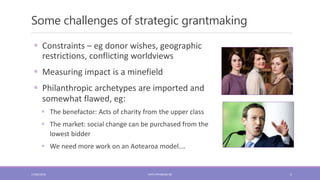
 Philanthropic archetypes are imported and
somewhat flawed, eg:
 The benefactor: Acts of charity from the upper class
 The market: social change can be purchased from the
lowest bidder
 We need more work on an Aotearoa model….
17/06/2018 KATE.FRYKBERG.NZ
ADDRESSING CHALLENGES AND ACCESSING THE WISDOM OF
OTHERS….
17/06/2018 KATE.FRYKBERG.NZ 6
The practical challenges of strategic philanthropy
7
Peer Support Exercise:
 What is one concrete question or challenge you puzzle over
in your daily work which would improve your grantmaking?
 Groups of 3:
 One minute for sharing your question or challenge
 Four minutes for others to give feedback
 Offer a sounding board rather than advice – eg “have you
thoughts about…” “what would happen if….” “when I faced
something similar, what I tried was ….”
 Swap so each person has a turn
17/06/2018 KATE.FRYKBERG.NZ
Samples from the Strategic
Grantmaking Toolkit
17/06/2018 KATE.FRYKBERG.NZ 8
1) Supporting Advocacy
9
 What it involves:
 Working to create policy and system change on an issue
 Eg Law change on hitting children vs funding anti violence services
 At its best:
 Changes our systems and world views
 Challenges:
 Do funders always know what is best?
 Could we abuse our power?
 Suggested approach
 Research carefully and follow the lead of the community
 Be transparent
17/06/2018 KATE.FRYKBERG.NZ
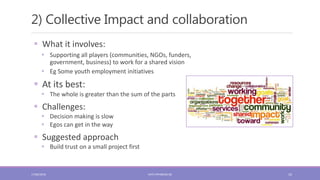
2) Collective Impact and collaboration
10
 What it involves:
 Supporting all players (communities, NGOs, funders,
government, business) to work for a shared vision
 Eg Some youth employment initiatives
 At its best:
 The whole is greater than the sum of the parts
 Challenges:
 Decision making is slow
 Egos can get in the way
 Suggested approach
 Build trust on a small project first
17/06/2018 KATE.FRYKBERG.NZ
3) Venture Philanthropy
11
 What it involves:
 Long term, hands-on support and funding to scale impact
 At its best:
 Provides multi-dimensional and long-term support
 Provides partnership and opportunities for growth
 Challenges:
 Not everything should scale
 Funder capture – do funders always know what is best?
 Venture Capital model – maximising profit vs community
driven
 Suggested approach
 Stay humble and take your lead from the community
17/06/2018 KATE.FRYKBERG.NZ
4) Piloting innovative approaches
12
 What it involves:
 Supporting new ways of addressing wicked problems
 At its best:
 Seeds new ways of doing things – eg hospices and
women's refuges
 Challenges:
 Usually require 3 – 5 years commitment to test
 Will government or other funders come in after you?
 Suggested approach
 Success is good and failure is learning
17/06/2018 KATE.FRYKBERG.NZ
5) Participatory Philanthropy
13
 What it involves:
 Funding decisions are made by the communities served
 Eg Youth advisory groups, recipients decide the split
 At its best:
 Democratises philanthropy
 Nothing about us without us
 Challenges:
 Who is / is not in the room?
 Time consuming to organise
 Suggested approach
 Be prepared to cede power….
17/06/2018 KATE.FRYKBERG.NZ
Kate’s tips for strategic grantmaking
14
1. Be clear on the change(s) in the world you want to contribute to
2. Use vision, values and goals constantly – they are your touchstone
3. Get out in the community to listen and learn
4. Staff and board should reflect the communities served. In particular
we need to be engaging with Māori and considering Te Tiriti
5. Understanding and increasing impact is about learning:
◦ Look in – how can you optimise your board, staff, processes & relationships?
◦ Look out – what have your grantees achieved? Failed at? Learned?
◦ Look forward – what does this mean for what you try next?
6. There is no one right way and no-one has all the answers
17/06/2018 KATE.FRYKBERG.NZ
Strategic grant-making – a conversation
FOR GREAT GRANT-MAKING PROFESSIONAL DEVELOPMENT PROGRAMME BY PHI LANTHROPY NZ
F R O M K A T E F R Y K B E R G , T H I N K T A N K C O N S U L T I N G
K A T E @ T H I N K T A N K . C O . N Z
1 2 J U N E 2 0 1 8

A conversation about strategic grantmaking

  • 1.
    Strategic grant-making –a conversation FOR GREAT GRANT-MAKING PROFESSIONAL DEVELOPMENT PROGRAMME BY PHI LANTHROPY NZ F R O M K A T E F R Y K B E R G , T H I N K T A N K C O N S U L T I N G K A T E @ T H I N K T A N K . C O . N Z 1 2 J U N E 2 0 1 8
  • 2.
    Outline 1. Scene settingand common ground 2. What does being strategic mean in philanthropy? 3. Exploring our key strategic challenges 4. Strategic grantmaking tools – when to use, when not use 5. Tips for strategic grantmaking 17/06/2018 2KATE.FRYKBERG.NZ
  • 3.
    Common experiences ingrantmaking 3  “There’s lots of buzzwords in philanthropy and it is hard to know which approaches are best”  “Saying no to good applicants is no fun at all”  “Sometimes I worry that the grant decisions our trust makes are not necessarily the best decisions”  “Sometimes I worry whether the advice I give is necessarily the best advice”  “There must be ways we could do this better” 17/06/2018 KATE.FRYKBERG.NZ
  • 4.
    What is strategicgrant-making? 4  Strategy is:  “a high-level plan to achieve one or more goals under conditions of uncertainty…” (Wikipedia)  Usually includes some combo of vision / values / mission / goals / actions / measurements etc  Strategic Grantmaking involves:  Clearly defining the change(s) in the world which your organisation will contribute to, where you focus, how you do things and how you measure progress 17/06/2018 KATE.FRYKBERG.NZ
  • 5.
    Some challenges ofstrategic grantmaking 5  Constraints – eg donor wishes, geographic restrictions, conflicting worldviews  Measuring impact is a minefield  Philanthropic archetypes are imported and somewhat flawed, eg:  The benefactor: Acts of charity from the upper class  The market: social change can be purchased from the lowest bidder  We need more work on an Aotearoa model…. 17/06/2018 KATE.FRYKBERG.NZ
  • 6.
    ADDRESSING CHALLENGES ANDACCESSING THE WISDOM OF OTHERS…. 17/06/2018 KATE.FRYKBERG.NZ 6
  • 7.
    The practical challengesof strategic philanthropy 7 Peer Support Exercise:  What is one concrete question or challenge you puzzle over in your daily work which would improve your grantmaking?  Groups of 3:  One minute for sharing your question or challenge  Four minutes for others to give feedback  Offer a sounding board rather than advice – eg “have you thoughts about…” “what would happen if….” “when I faced something similar, what I tried was ….”  Swap so each person has a turn 17/06/2018 KATE.FRYKBERG.NZ
  • 8.
    Samples from theStrategic Grantmaking Toolkit 17/06/2018 KATE.FRYKBERG.NZ 8
  • 9.
    1) Supporting Advocacy 9 What it involves:  Working to create policy and system change on an issue  Eg Law change on hitting children vs funding anti violence services  At its best:  Changes our systems and world views  Challenges:  Do funders always know what is best?  Could we abuse our power?  Suggested approach  Research carefully and follow the lead of the community  Be transparent 17/06/2018 KATE.FRYKBERG.NZ
  • 10.
    2) Collective Impactand collaboration 10  What it involves:  Supporting all players (communities, NGOs, funders, government, business) to work for a shared vision  Eg Some youth employment initiatives  At its best:  The whole is greater than the sum of the parts  Challenges:  Decision making is slow  Egos can get in the way  Suggested approach  Build trust on a small project first 17/06/2018 KATE.FRYKBERG.NZ
  • 11.
    3) Venture Philanthropy 11 What it involves:  Long term, hands-on support and funding to scale impact  At its best:  Provides multi-dimensional and long-term support  Provides partnership and opportunities for growth  Challenges:  Not everything should scale  Funder capture – do funders always know what is best?  Venture Capital model – maximising profit vs community driven  Suggested approach  Stay humble and take your lead from the community 17/06/2018 KATE.FRYKBERG.NZ
  • 12.
    4) Piloting innovativeapproaches 12  What it involves:  Supporting new ways of addressing wicked problems  At its best:  Seeds new ways of doing things – eg hospices and women's refuges  Challenges:  Usually require 3 – 5 years commitment to test  Will government or other funders come in after you?  Suggested approach  Success is good and failure is learning 17/06/2018 KATE.FRYKBERG.NZ
  • 13.
    5) Participatory Philanthropy 13 What it involves:  Funding decisions are made by the communities served  Eg Youth advisory groups, recipients decide the split  At its best:  Democratises philanthropy  Nothing about us without us  Challenges:  Who is / is not in the room?  Time consuming to organise  Suggested approach  Be prepared to cede power…. 17/06/2018 KATE.FRYKBERG.NZ
  • 14.
    Kate’s tips forstrategic grantmaking 14 1. Be clear on the change(s) in the world you want to contribute to 2. Use vision, values and goals constantly – they are your touchstone 3. Get out in the community to listen and learn 4. Staff and board should reflect the communities served. In particular we need to be engaging with Māori and considering Te Tiriti 5. Understanding and increasing impact is about learning: ◦ Look in – how can you optimise your board, staff, processes & relationships? ◦ Look out – what have your grantees achieved? Failed at? Learned? ◦ Look forward – what does this mean for what you try next? 6. There is no one right way and no-one has all the answers 17/06/2018 KATE.FRYKBERG.NZ
  • 15.
    Strategic grant-making –a conversation FOR GREAT GRANT-MAKING PROFESSIONAL DEVELOPMENT PROGRAMME BY PHI LANTHROPY NZ F R O M K A T E F R Y K B E R G , T H I N K T A N K C O N S U L T I N G K A T E @ T H I N K T A N K . C O . N Z 1 2 J U N E 2 0 1 8

Editor's Notes