A combined approach for anomaly detection in production systems
using machine learning techniques
Università degli Studi di Trieste
Dipartimento di Ingegneria e Architettura
Corso di Laurea Magistrale in Ingegneria Informatica
Laureando:
David Fanjkutić
Relatore:
prof. Eric Medvet
Correlatori:
dott. Alexander Maier
dott. Andreas Bunte
Anno accademico 2014/2015
Sessione straordinaria
Problem
Detect anomalies in a production system in real-time
Production system:
- many components interdependent with each other
- very difficult to model manually
- expert knowledge required
- usually simulation models are built
- very time-consuming and expensive
How to build a model of a system automatically, without knowing its components
or structure, so reducing the need of expert knowledge?
Data-driven modelling
Why is it important?
Detect anomalies in RT:
- Fast reaction in production system’s failures
- Big saves in money
Ignore system’s components and structure:
- Independency of the physical components of a system
-> implementable in any production system
(needs only sensor measurements, actuator actions…)
Objective
Given measurements:
1. Learn models that represent the production system
2. Use those models for real-time anomaly detection and diagnosisand diagnosis
Anomaly detection – realize that the system is not working properly
Anomaly diagnosis – identify why the system isn’t working properly
Production system used
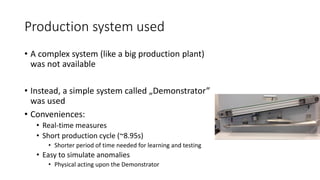
• A complex system (like a big production plant)
was not available
• Instead, a simple system called „Demonstrator”
was used
• Conveniences:
• Real-time measures
• Short production cycle (~8.95s)
• Shorter period of time needed for learning and testing
• Easy to simulate anomalies
• Physical acting upon the Demonstrator
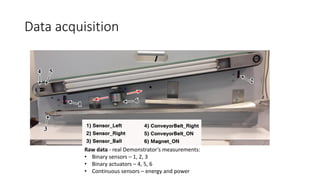
Data acquisition
Raw data - real Demonstrator’s measurements:
• Binary sensors – 1, 2, 3
• Binary actuators – 4, 5, 6
• Continuous sensors – energy and power
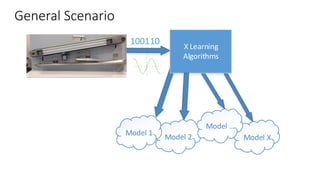
General Scenario
100110
X Learning
Algorithms
Model XModel 2
Model 1
Model …
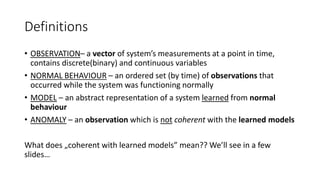
Definitions
• OBSERVATION– a vector of system’s measurements at a point in time,
contains discrete(binary) and continuous variables
• NORMAL BEHAVIOUR – an ordered set (by time) of observations that
occurred while the system was functioning normally
• MODEL – an abstract representation of a system learned from normal
behaviour
• ANOMALY – an observation which is not coherent with the learned models
What does „coherent with learned models” mean?? We’ll see in a few
slides…
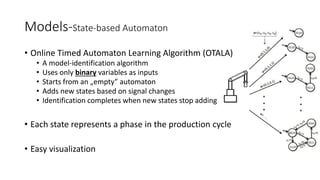
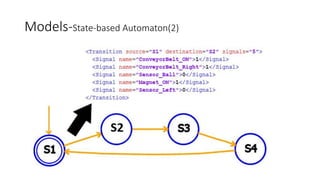
Models-State-based Automaton
• Online Timed Automaton Learning Algorithm (OTALA)
• A model-identification algorithm
• Uses only binary variables as inputs
• Starts from an „empty” automaton
• Adds new states based on signal changes
• Identification completes when new states stop adding
• Each state represents a phase in the production cycle
• Easy visualization
Models-State-based Automaton(2)
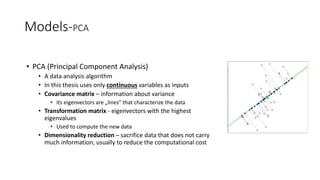
Models-PCA
• PCA (Principal Component Analysis)
• A data analysis algorithm
• In this thesis uses only continuous variables as inputs
• Covariance matrix – information about variance
• Its eigenvectors are „lines” that characterize the data
• Transformation matrix - eigenvectors with the highest
eigenvalues
• Used to compute the new data
• Dimensionality reduction – sacrifice data that does not carry
much information, usually to reduce the computational cost
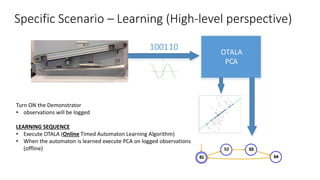
100110
OTALA
PCA
Specific Scenario – Learning (High-level perspective)
Turn ON the Demonstrator
• observations will be logged
LEARNING SEQUENCE
• Execute OTALA (Online Timed Automaton Learning Algorithm)
• When the automaton is learned execute PCA on logged observations
(offline)
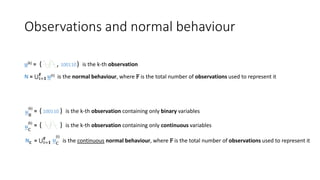
Observations and normal behaviour
( ) is the k-th observation containing only binary variables= 100110
NC = t=𝟏
𝐅
is the continuous normal behaviour, where F is the total number of observations used to represent ituC
(t)
( ) is the k-th observation containing only continuous variables=
uB
(k)
uC
(k)
( , ) is the k-th observationu(k) = 100110
N = t=𝟏
𝐅
𝐮(t) is the normal behaviour, where F is the total number of observations used to represent it
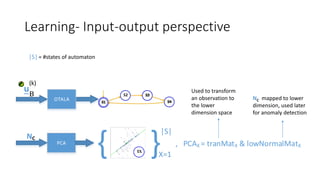
Learning- Input-output perspective
|S|= #states of automaton
Used to transform
an observation to
the lower
dimension space
NC mapped to lower
dimension, used later
for anomaly detection
PCA
OTALA
NC
{ }X=1
|S|
, PCAX = tranMatX & lowNormalMatX
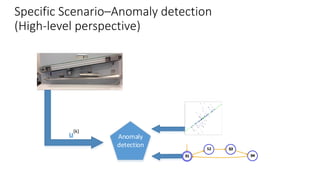
Specific Scenario–Anomaly detection
(High-level perspective)
Anomaly
detection
u(k)
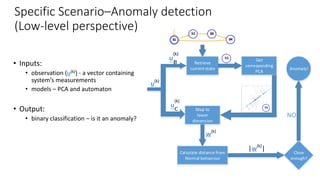
• Inputs:
• observation (u(k)) - a vector containing
system’s measurements
• models – PCA and automaton
• Output:
• binary classification – is it an anomaly?
Specific Scenario–Anomaly detection
(Low-level perspective)
Retrieve
current state
Map to
lower
dimension
Calculate distance from
Normal behaviour
Close
enough?
NO
Anomaly!
u(k)
Get
corresponding
PCA
w(k)
|w(k)
|
|𝒘| =
𝑖=1
𝑑
𝑤𝑖
2
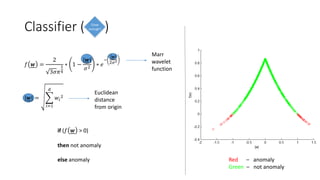
Classifier ( )
Euclidean
distance
from origin
Marr
wavelet
function
if (𝑓 𝒘 > 0)
then not anomaly
else anomaly Red – anomaly
Green – not anomaly
Close
enough?
𝑓 𝒘 =
2
3𝜎𝜋
1
4
∗ 1 −
|𝒘|
𝜎2 ∗ 𝑒
−
𝒘
2𝜎2
Interpretation of anomalies
• Anomaly – non positive output of the Marr wavelet function
• What does it mean to have 1 anomaly?
• Probably just some noise, wrong measurements…
• Multiple consequent anomalies?
• Probably a real failure
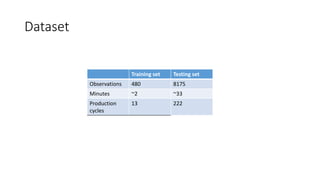
Dataset
Training set Testing set
Observations 480 8175
Minutes ~2 ~33
Production
cycles
13 222
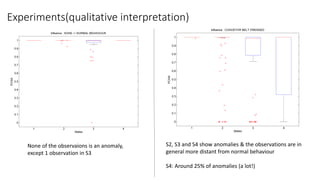
None of the observaions is an anomaly,
except 1 observation in S3
S2, S3 and S4 show anomalies & the observations are in
general more distant from normal behaviour
S4: Around 25% of anomalies (a lot!)
Experiments(qualitative interpretation)
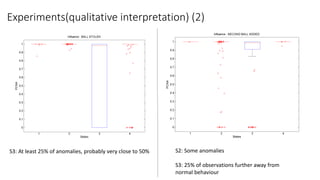
S3: At least 25% of anomalies, probably very close to 50% S2: Some anomalies
S3: 25% of observations further away from
normal behaviour
Experiments(qualitative interpretation) (2)
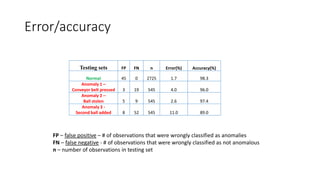
Error/accuracy
Testing sets FP FN n Error(%) Accuracy(%)
Normal 45 0 2725 1.7 98.3
Anomaly 1 –
Conveyor belt pressed 3 19 545 4.0 96.0
Anomaly 2 –
Ball stolen 5 9 545 2.6 97.4
Anomaly 3 -
Second ball added 8 52 545 11.0 89.0
FP – false positive – # of observations that were wrongly classified as anomalies
FN – false negative - # of observations that were wrongly classified as not anomalous
n – number of observations in testing set
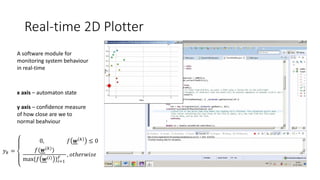
Real-time 2D Plotter
A software module for
monitoring system behaviour
in real-time
x axis – automaton state
y axis – confidence measure
of how close are we to
normal beahviour
𝑦 𝑘 =
0, 𝑓 𝒘 𝑘 ≤ 0
𝑓(𝒘(𝑘))
max{𝑓 𝒘(𝑖) }𝑖=1
𝐹
, 𝑜𝑡ℎ𝑒𝑟𝑤𝑖𝑠𝑒
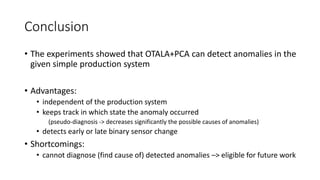
Conclusion
• The experiments showed that OTALA+PCA can detect anomalies in the
given simple production system
• Advantages:
• independent of the production system
• keeps track in which state the anomaly occurred
(pseudo-diagnosis -> decreases significantly the possible causes of anomalies)
• detects early or late binary sensor change
• Shortcomings:
• cannot diagnose (find cause of) detected anomalies –> eligible for future work
La presente tesi è prodotto dello scambio internazionale
presso la Hochschule-Ostwestfalen Lin a Lemgo, Germania
in collaborazione con
Infine
Grazie per l’attenzione

A combined approach for anomaly detection in production systems using ML techniques

  • 1.
    A combined approachfor anomaly detection in production systems using machine learning techniques Università degli Studi di Trieste Dipartimento di Ingegneria e Architettura Corso di Laurea Magistrale in Ingegneria Informatica Laureando: David Fanjkutić Relatore: prof. Eric Medvet Correlatori: dott. Alexander Maier dott. Andreas Bunte Anno accademico 2014/2015 Sessione straordinaria
  • 2.
    Problem Detect anomalies ina production system in real-time Production system: - many components interdependent with each other - very difficult to model manually - expert knowledge required - usually simulation models are built - very time-consuming and expensive How to build a model of a system automatically, without knowing its components or structure, so reducing the need of expert knowledge? Data-driven modelling
  • 3.
    Why is itimportant? Detect anomalies in RT: - Fast reaction in production system’s failures - Big saves in money Ignore system’s components and structure: - Independency of the physical components of a system -> implementable in any production system (needs only sensor measurements, actuator actions…)
  • 4.
    Objective Given measurements: 1. Learnmodels that represent the production system 2. Use those models for real-time anomaly detection and diagnosisand diagnosis Anomaly detection – realize that the system is not working properly Anomaly diagnosis – identify why the system isn’t working properly
  • 5.
    Production system used •A complex system (like a big production plant) was not available • Instead, a simple system called „Demonstrator” was used • Conveniences: • Real-time measures • Short production cycle (~8.95s) • Shorter period of time needed for learning and testing • Easy to simulate anomalies • Physical acting upon the Demonstrator
  • 6.
    Data acquisition Raw data- real Demonstrator’s measurements: • Binary sensors – 1, 2, 3 • Binary actuators – 4, 5, 6 • Continuous sensors – energy and power
  • 7.
  • 8.
    Definitions • OBSERVATION– avector of system’s measurements at a point in time, contains discrete(binary) and continuous variables • NORMAL BEHAVIOUR – an ordered set (by time) of observations that occurred while the system was functioning normally • MODEL – an abstract representation of a system learned from normal behaviour • ANOMALY – an observation which is not coherent with the learned models What does „coherent with learned models” mean?? We’ll see in a few slides…
  • 9.
    Models-State-based Automaton • OnlineTimed Automaton Learning Algorithm (OTALA) • A model-identification algorithm • Uses only binary variables as inputs • Starts from an „empty” automaton • Adds new states based on signal changes • Identification completes when new states stop adding • Each state represents a phase in the production cycle • Easy visualization
  • 10.
  • 11.
    Models-PCA • PCA (PrincipalComponent Analysis) • A data analysis algorithm • In this thesis uses only continuous variables as inputs • Covariance matrix – information about variance • Its eigenvectors are „lines” that characterize the data • Transformation matrix - eigenvectors with the highest eigenvalues • Used to compute the new data • Dimensionality reduction – sacrifice data that does not carry much information, usually to reduce the computational cost
  • 12.
    100110 OTALA PCA Specific Scenario –Learning (High-level perspective) Turn ON the Demonstrator • observations will be logged LEARNING SEQUENCE • Execute OTALA (Online Timed Automaton Learning Algorithm) • When the automaton is learned execute PCA on logged observations (offline)
  • 13.
    Observations and normalbehaviour ( ) is the k-th observation containing only binary variables= 100110 NC = t=𝟏 𝐅 is the continuous normal behaviour, where F is the total number of observations used to represent ituC (t) ( ) is the k-th observation containing only continuous variables= uB (k) uC (k) ( , ) is the k-th observationu(k) = 100110 N = t=𝟏 𝐅 𝐮(t) is the normal behaviour, where F is the total number of observations used to represent it
  • 14.
    Learning- Input-output perspective |S|=#states of automaton Used to transform an observation to the lower dimension space NC mapped to lower dimension, used later for anomaly detection PCA OTALA NC { }X=1 |S| , PCAX = tranMatX & lowNormalMatX
  • 15.
    Specific Scenario–Anomaly detection (High-levelperspective) Anomaly detection u(k)
  • 16.
    • Inputs: • observation(u(k)) - a vector containing system’s measurements • models – PCA and automaton • Output: • binary classification – is it an anomaly? Specific Scenario–Anomaly detection (Low-level perspective) Retrieve current state Map to lower dimension Calculate distance from Normal behaviour Close enough? NO Anomaly! u(k) Get corresponding PCA w(k) |w(k) |
  • 17.
    |𝒘| = 𝑖=1 𝑑 𝑤𝑖 2 Classifier () Euclidean distance from origin Marr wavelet function if (𝑓 𝒘 > 0) then not anomaly else anomaly Red – anomaly Green – not anomaly Close enough? 𝑓 𝒘 = 2 3𝜎𝜋 1 4 ∗ 1 − |𝒘| 𝜎2 ∗ 𝑒 − 𝒘 2𝜎2
  • 18.
    Interpretation of anomalies •Anomaly – non positive output of the Marr wavelet function • What does it mean to have 1 anomaly? • Probably just some noise, wrong measurements… • Multiple consequent anomalies? • Probably a real failure
  • 19.
    Dataset Training set Testingset Observations 480 8175 Minutes ~2 ~33 Production cycles 13 222
  • 20.
    None of theobservaions is an anomaly, except 1 observation in S3 S2, S3 and S4 show anomalies & the observations are in general more distant from normal behaviour S4: Around 25% of anomalies (a lot!) Experiments(qualitative interpretation)
  • 21.
    S3: At least25% of anomalies, probably very close to 50% S2: Some anomalies S3: 25% of observations further away from normal behaviour Experiments(qualitative interpretation) (2)
  • 22.
    Error/accuracy Testing sets FPFN n Error(%) Accuracy(%) Normal 45 0 2725 1.7 98.3 Anomaly 1 – Conveyor belt pressed 3 19 545 4.0 96.0 Anomaly 2 – Ball stolen 5 9 545 2.6 97.4 Anomaly 3 - Second ball added 8 52 545 11.0 89.0 FP – false positive – # of observations that were wrongly classified as anomalies FN – false negative - # of observations that were wrongly classified as not anomalous n – number of observations in testing set
  • 23.
    Real-time 2D Plotter Asoftware module for monitoring system behaviour in real-time x axis – automaton state y axis – confidence measure of how close are we to normal beahviour 𝑦 𝑘 = 0, 𝑓 𝒘 𝑘 ≤ 0 𝑓(𝒘(𝑘)) max{𝑓 𝒘(𝑖) }𝑖=1 𝐹 , 𝑜𝑡ℎ𝑒𝑟𝑤𝑖𝑠𝑒
  • 24.
    Conclusion • The experimentsshowed that OTALA+PCA can detect anomalies in the given simple production system • Advantages: • independent of the production system • keeps track in which state the anomaly occurred (pseudo-diagnosis -> decreases significantly the possible causes of anomalies) • detects early or late binary sensor change • Shortcomings: • cannot diagnose (find cause of) detected anomalies –> eligible for future work
  • 25.
    La presente tesiè prodotto dello scambio internazionale presso la Hochschule-Ostwestfalen Lin a Lemgo, Germania in collaborazione con Infine Grazie per l’attenzione