A CASE PRESENTATION ON ACUTE
DECOMPENSATE HEART FAILURE
INTRODUCTION
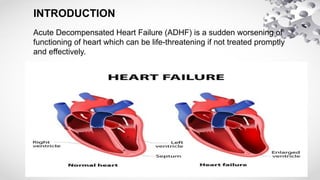
Acute Decompensated Heart Failure (ADHF) is a sudden worsening of
functioning of heart which can be life-threatening if not treated promptly
and effectively.
EPIDEMIOLOGY:
Heart failure is a significant public health concern globally, with
approximately 26 million people affected worldwide. In India, the estimated
prevalence of heart failure is around 4.5 million cases, with a significant
annual incidence of 491,600 new cases. The mortality rate due to heart
failure in India is also substantial, accounting for approximately 235,000
deaths each year. The prevalence of heart failure increases with age,
ranging from 3.4% in those aged 60-69 years to 12.4% in those aged 80
years and above. Regional variations also exist, with higher prevalence
rates observed in urban areas (5.5%) compared to rural areas (3.4%), and
in North India (5.8%) compared to South India (4.3%).
ETIOLOGY:
1. Coronary artery disease
2. Hypertension
3. Cardiomyopathy
4. Heart valve disorders: Stenosis, regurgitation.
5. Cardiac arrhythmias: Atrial fibrillation, ventricular tachycardia.
Non-Cardiac Causes:
1. Chronic kidney disease
2. Chronic obstructive pulmonary disease
3. Obesity
PATHOPHYSIOLOGY:
1. Ventricular remodeling: Chamber dilation, hypertrophy, or fibrosis.
2. Neurohormonal activation: Release of catecholamines, renin-angiotensin-
aldosterone system (RAAS), and vasopressin.
3. Inflammation: Activation of inflammatory pathways, cytokine release, and
oxidative stress.
4. Endothelial dysfunction: Impaired vasodilation, increased vascular
resistance
Compensatory Mechanisms:
1. Sympathetic nervous system activation: Increased heart rate, contractility,
and vasoconstriction.
2. RAAS activation: Increased aldosterone, sodium retention, and fluid
overload.
3. 3. Vasopressin release: Increased water reabsorption, fluid overload, and
vasoconstriction.
CLINICAL MANIFESTATIONS
1. Shortness of breath
2. Fatigue
3. Swelling (edema): Fluid buildup in legs, ankles, feet, or abdomen
4. Cough
5. Chest pain: Pressure, tightness, or discomfort in the chest.
6 Palpitations
7 Dizziness or lightheadedness
8 Nausea and vomiting
9 Decreased urine output
DIAGNOSIS
Laboratory Tests:
1. Complete Blood Count
2. Serum electrolytes
3. Kidney function tests
4. Liver function tests
5. Thyroid function tests
Imaging Tests:
1. Chest X-ray
2. Echocardiogram
3. Cardiac MRI
Other Tests:
1. Electrocardiogram
4. Cardiac biopsy
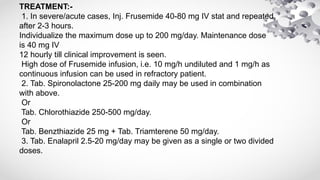
TREATMENT:-
1. In severe/acute cases, Inj. Frusemide 40-80 mg IV stat and repeated
after 2-3 hours.
Individualize the maximum dose up to 200 mg/day. Maintenance dose
is 40 mg IV
12 hourly till clinical improvement is seen.
High dose of Frusemide infusion, i.e. 10 mg/h undiluted and 1 mg/h as
continuous infusion can be used in refractory patient.
2. Tab. Spironolactone 25-200 mg daily may be used in combination
with above.
Or
Tab. Chlorothiazide 250-500 mg/day.
Or
Tab. Benzthiazide 25 mg + Tab. Triamterene 50 mg/day.
3. Tab. Enalapril 2.5-20 mg/day may be given as a single or two divided
doses.
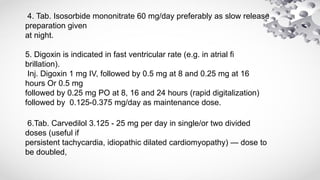
4. Tab. Isosorbide mononitrate 60 mg/day preferably as slow release
preparation given
at night.
5. Digoxin is indicated in fast ventricular rate (e.g. in atrial fi
brillation).
Inj. Digoxin 1 mg IV, followed by 0.5 mg at 8 and 0.25 mg at 16
hours Or 0.5 mg
followed by 0.25 mg PO at 8, 16 and 24 hours (rapid digitalization)
followed by 0.125-0.375 mg/day as maintenance dose.
6.Tab. Carvedilol 3.125 - 25 mg per day in single/or two divided
doses (useful if
persistent tachycardia, idiopathic dilated cardiomyopathy) — dose to
be doubled,
DEMOGRAPHIC DATA:
Patient name :- XXX Age/Gender :- 70Y/ male
Admission No :- 20183 Department/Ward :- Male Medical Ward
Date Of Admission :-23-10-24 Consultant Doctor:- Dr Sreenivasulu MD
SOAP NOTES
⮚ SUBJECTIVE EVIDENCE :
⮚ A 70yrs old male patient was admitted in the Male medical ward under the consultant doctor Dr.Sreenivasulu
M.D with the chief complaints of SOB since 20 days, pedal edema since 1 week( pitting type), fever since one
week high grade ass with chills
⮚ The Past Medical History of the patient include that the patient is a k/c/o HTN on unkowmedication k/c/o HF
not on medication, takes symptomatic treatment for SOB ocassionally since 3 yrsThe Personal history &
habits of patient includes mixed diet, sleep & appetite was normal, bowel &bladder habit was regular , not an
alcoholic & smoker.The Family History shows nothing significant data.
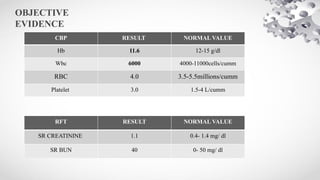
OBJECTIVE
EVIDENCE
RFT RESULT NORMAL VALUE
SR CREATININE 1.1 0.4- 1.4 mg/ dl
SR BUN 40 0- 50 mg/ dl
CBP RESULT NORMAL VALUE
Hb 11.6 12-15 g/dl
Wbc 6000 4000-11000cells/cumm
RBC 4.0 3.5-5.5millions/cumm
Platelet 3.0 1.5-4 L/cumm
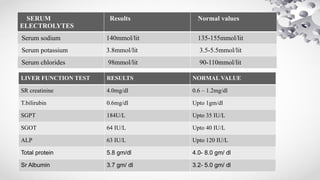
SERUM
ELECTROLYTES
Results Normal values
Serum sodium 140mmol/lit 135-155mmol/lit
Serum potassium 3.8mmol/lit 3.5-5.5mmol/lit
Serum chlorides 98mmol/lit 90-110mmol/lit
LIVER FUNCTION TEST RESULTS NORMAL VALUE
SR creatinine 4.0mg/dl 0.6 – 1.2mg/dl
T.bilirubin 0.6mg/dl Upto 1gm/dl
SGPT 184U/L Upto 35 IU/L
SGOT 64 IU/L Upto 40 IU/L
ALP 63 IU/L Upto 120 IU/L
Total protein 5.8 gm/dl 4.0- 8.0 gm/ dl
Sr Albumin 3.7 gm/ dl 3.2- 5.0 gm/ dl
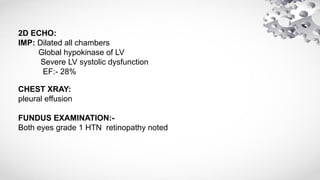
2D ECHO:
IMP: Dilated all chambers
Global hypokinase of LV
Severe LV systolic dysfunction
EF:- 28%
CHEST XRAY:
pleural effusion
FUNDUS EXAMINATION:-
Both eyes grade 1 HTN retinopathy noted
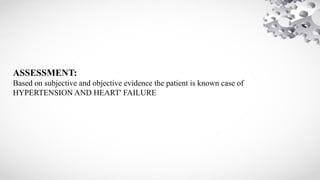
ASSESSMENT:
Based on subjective and objective evidence the patient is known case of
HYPERTENSION AND HEART' FAILURE
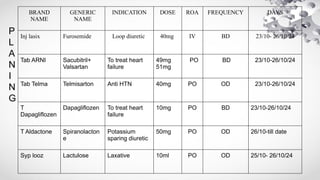
BRAND
NAME
GENERIC
NAME
INDICATION DOSE ROA FREQUENCY DAYS
Inj lasix Furosemide Loop diuretic 40mg IV BD 23/10- 26/10/24
Tab ARNI Sacubitril+
Valsartan
To treat heart
failure
49mg
51mg
PO BD 23/10-26/10/24
Tab Telma Telmisarton Anti HTN 40mg PO OD 23/10-26/10/24
T
Dapagliflozen
Dapagliflozen To treat heart
failure
10mg PO BD 23/10-26/10/24
T Aldactone Spiranolacton
e
Potassium
sparing diuretic
50mg PO OD 26/10-till date
Syp looz Lactulose Laxative 10ml PO OD 25/10- 26/10/24
P
L
A
N
I
N
G
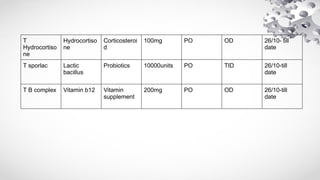
T
Hydrocortiso
ne
Hydrocortiso
ne
Corticosteroi
d
100mg PO OD 26/10- till
date
T sporlac Lactic
bacillus
Probiotics 10000units PO TID 26/10-till
date
T B complex Vitamin b12 Vitamin
supplement
200mg PO OD 26/10-till
date
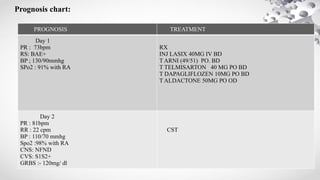
Prognosis chart:
PROGNOSIS TREATMENT
Day 1
PR : 73bpm
RS: BAE+
BP ; 130/90mmhg
SPo2 : 91% with RA
RX
INJ LASIX 40MG IV BD
T ARNI (49/51) PO. BD
T TELMISARTON 40 MG PO BD
T DAPAGLIFLOZEN 10MG PO BD
T ALDACTONE 50MG PO OD
Day 2
PR : 81bpm
RR : 22 cpm
BP : 110/70 mmhg
Spo2 :98% with RA
CNS: NFND
CVS: S1S2+
GRBS :- 120mg/ dl
CST
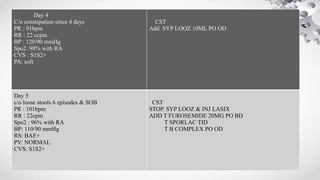
Day 4
C/o constipation since 4 days
PR : 91bpm
RR : 22 ccpm
BP : 120/90 mmHg
Spo2 :98% with RA
CVS : S1S2+
PA: soft
CST
Add SYP LOOZ 10ML PO OD
Day 5
c/o loose stools 6 episodes & SOB
PR : 101bpm
RR : 22cpm
Spo2 : 96% with RA
BP: 110/90 mmHg
RS: BAE+
PV: NORMAL
CVS: S1S2+
CST
STOP. SYP LOOZ & INJ LASIX
ADD T FUROSEMIDE 20MG PO BD
T SPORLAC TID
T B COMPLEX PO OD
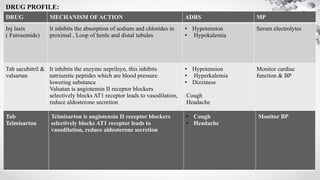
DRUG MECHANISM OF ACTION ADRS MP
Inj lasix
( Furosemide)
It inhibits the absorption of sodium and chlorides in
proximal , Loop of henle and distal tubules
• Hypotension
• Hypokalemia
Serum electrolytes
Tab sacubitril &
valsartan
It inhibits the enzyme neprilsyn, this inhibits
natriuretic peptides which are blood pressure
lowering substance
Valsatan is angiotensin II receptor blockers
selectively blocks AT1 receptor leads to vasodilation,
reduce aldosterone secretion
• Hypotension
• Hyperkalemia
• Dizziness
Cough
Headache
Monitor cardiac
function & BP
DRUG PROFILE:
Tab
Telmisarton
Telmisarton is angiotensin II receptor blockers
selectively blocks AT1 receptor leads to
vasodilation, reduce aldosterone secretion
• Cough
• Headache
Monitor BP
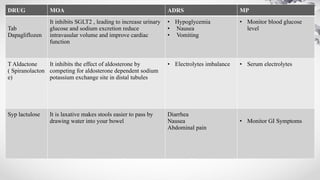
DRUG MOA ADRS MP
Tab
Dapagliflozen
It inhibits SGLT2 , leading to increase urinary
glucose and sodium excretion reduce
intravasular volume and improve cardiac
function
• Hypoglycemia
• Nausea
• Vomiting
• Monitor blood glucose
level
T Aldactone
( Spiranolacton
e)
It inhibits the effect of aldosterone by
competing for aldosterone dependent sodium
potassium exchange site in distal tubules
• Electrolytes imbalance • Serum electrolytes
Syp lactulose It is laxative makes stools easier to pass by
drawing water into your bowel
Diarrhea
Nausea
Abdominal pain
• Monitor GI Symptoms
DRUG MOA ADRS MP
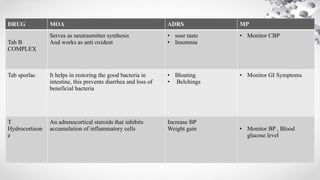
Tab B
COMPLEX
Serves as neutrasmitter synthesis
And works as anti oxident
• sour taste
• Insomnia
• Monitor CBP
Tab sporlac It helps in restoring the good bacteria in
intestine, this prevents diarrhea and loss of
beneficial bacteria
• Bloating
• Belchings
• Monitor GI Symptoms
T
Hydrocortison
e
An adrenocortical steroids that inhibits
accumulation of inflammatory cells
Increase BP
Weight gain • Monitor BP , Blood
glucose level
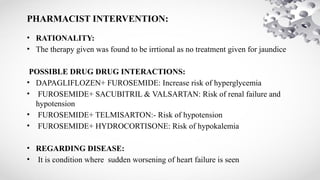
• RATIONALITY:
• The therapy given was found to be irrtional as no treatment given for jaundice
POSSIBLE DRUG DRUG INTERACTIONS:
• DAPAGLIFLOZEN+ FUROSEMIDE: Increase risk of hyperglycemia
• FUROSEMIDE+ SACUBITRIL & VALSARTAN: Risk of renal failure and
hypotension
• FUROSEMIDE+ TELMISARTON:- Risk of hypotension
• FUROSEMIDE+ HYDROCORTISONE: Risk of hypokalemia
• REGARDING DISEASE:
• It is condition where sudden worsening of heart failure is seen
PHARMACIST INTERVENTION:
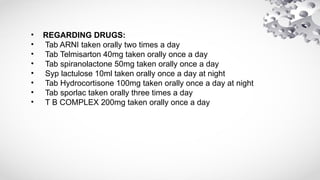
• REGARDING DRUGS:
• Tab ARNI taken orally two times a day
• Tab Telmisarton 40mg taken orally once a day
• Tab spiranolactone 50mg taken orally once a day
• Syp lactulose 10ml taken orally once a day at night
• Tab Hydrocortisone 100mg taken orally once a day at night
• Tab sporlac taken orally three times a day
• T B COMPLEX 200mg taken orally once a day
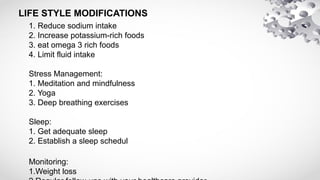
LIFE STYLE MODIFICATIONS
1. Reduce sodium intake
2. Increase potassium-rich foods
3. eat omega 3 rich foods
4. Limit fluid intake
Stress Management:
1. Meditation and mindfulness
2. Yoga
3. Deep breathing exercises
Sleep:
1. Get adequate sleep
2. Establish a sleep schedul
Monitoring:
1.Weight loss
REFERENCE:
1.Micromedex solutions.com
2.Standard treatment guidelines from sangeeta sharrma
THANK
YOU

A CASE PRESENTATION ON ACUTE DECOMPENSATE HEART FAILURE.pptx

  • 1.
    A CASE PRESENTATIONON ACUTE DECOMPENSATE HEART FAILURE
  • 2.
    INTRODUCTION Acute Decompensated HeartFailure (ADHF) is a sudden worsening of functioning of heart which can be life-threatening if not treated promptly and effectively.
  • 3.
    EPIDEMIOLOGY: Heart failure isa significant public health concern globally, with approximately 26 million people affected worldwide. In India, the estimated prevalence of heart failure is around 4.5 million cases, with a significant annual incidence of 491,600 new cases. The mortality rate due to heart failure in India is also substantial, accounting for approximately 235,000 deaths each year. The prevalence of heart failure increases with age, ranging from 3.4% in those aged 60-69 years to 12.4% in those aged 80 years and above. Regional variations also exist, with higher prevalence rates observed in urban areas (5.5%) compared to rural areas (3.4%), and in North India (5.8%) compared to South India (4.3%).
  • 4.
    ETIOLOGY: 1. Coronary arterydisease 2. Hypertension 3. Cardiomyopathy 4. Heart valve disorders: Stenosis, regurgitation. 5. Cardiac arrhythmias: Atrial fibrillation, ventricular tachycardia. Non-Cardiac Causes: 1. Chronic kidney disease 2. Chronic obstructive pulmonary disease 3. Obesity
  • 5.
    PATHOPHYSIOLOGY: 1. Ventricular remodeling:Chamber dilation, hypertrophy, or fibrosis. 2. Neurohormonal activation: Release of catecholamines, renin-angiotensin- aldosterone system (RAAS), and vasopressin. 3. Inflammation: Activation of inflammatory pathways, cytokine release, and oxidative stress. 4. Endothelial dysfunction: Impaired vasodilation, increased vascular resistance Compensatory Mechanisms: 1. Sympathetic nervous system activation: Increased heart rate, contractility, and vasoconstriction. 2. RAAS activation: Increased aldosterone, sodium retention, and fluid overload. 3. 3. Vasopressin release: Increased water reabsorption, fluid overload, and vasoconstriction.
  • 6.
    CLINICAL MANIFESTATIONS 1. Shortnessof breath 2. Fatigue 3. Swelling (edema): Fluid buildup in legs, ankles, feet, or abdomen 4. Cough 5. Chest pain: Pressure, tightness, or discomfort in the chest. 6 Palpitations 7 Dizziness or lightheadedness 8 Nausea and vomiting 9 Decreased urine output
  • 7.
    DIAGNOSIS Laboratory Tests: 1. CompleteBlood Count 2. Serum electrolytes 3. Kidney function tests 4. Liver function tests 5. Thyroid function tests Imaging Tests: 1. Chest X-ray 2. Echocardiogram 3. Cardiac MRI Other Tests: 1. Electrocardiogram 4. Cardiac biopsy
  • 8.
    TREATMENT:- 1. In severe/acutecases, Inj. Frusemide 40-80 mg IV stat and repeated after 2-3 hours. Individualize the maximum dose up to 200 mg/day. Maintenance dose is 40 mg IV 12 hourly till clinical improvement is seen. High dose of Frusemide infusion, i.e. 10 mg/h undiluted and 1 mg/h as continuous infusion can be used in refractory patient. 2. Tab. Spironolactone 25-200 mg daily may be used in combination with above. Or Tab. Chlorothiazide 250-500 mg/day. Or Tab. Benzthiazide 25 mg + Tab. Triamterene 50 mg/day. 3. Tab. Enalapril 2.5-20 mg/day may be given as a single or two divided doses.
  • 9.
    4. Tab. Isosorbidemononitrate 60 mg/day preferably as slow release preparation given at night. 5. Digoxin is indicated in fast ventricular rate (e.g. in atrial fi brillation). Inj. Digoxin 1 mg IV, followed by 0.5 mg at 8 and 0.25 mg at 16 hours Or 0.5 mg followed by 0.25 mg PO at 8, 16 and 24 hours (rapid digitalization) followed by 0.125-0.375 mg/day as maintenance dose. 6.Tab. Carvedilol 3.125 - 25 mg per day in single/or two divided doses (useful if persistent tachycardia, idiopathic dilated cardiomyopathy) — dose to be doubled,
  • 10.
    DEMOGRAPHIC DATA: Patient name:- XXX Age/Gender :- 70Y/ male Admission No :- 20183 Department/Ward :- Male Medical Ward Date Of Admission :-23-10-24 Consultant Doctor:- Dr Sreenivasulu MD SOAP NOTES ⮚ SUBJECTIVE EVIDENCE : ⮚ A 70yrs old male patient was admitted in the Male medical ward under the consultant doctor Dr.Sreenivasulu M.D with the chief complaints of SOB since 20 days, pedal edema since 1 week( pitting type), fever since one week high grade ass with chills ⮚ The Past Medical History of the patient include that the patient is a k/c/o HTN on unkowmedication k/c/o HF not on medication, takes symptomatic treatment for SOB ocassionally since 3 yrsThe Personal history & habits of patient includes mixed diet, sleep & appetite was normal, bowel &bladder habit was regular , not an alcoholic & smoker.The Family History shows nothing significant data.
  • 11.
    OBJECTIVE EVIDENCE RFT RESULT NORMALVALUE SR CREATININE 1.1 0.4- 1.4 mg/ dl SR BUN 40 0- 50 mg/ dl CBP RESULT NORMAL VALUE Hb 11.6 12-15 g/dl Wbc 6000 4000-11000cells/cumm RBC 4.0 3.5-5.5millions/cumm Platelet 3.0 1.5-4 L/cumm
  • 12.
    SERUM ELECTROLYTES Results Normal values Serumsodium 140mmol/lit 135-155mmol/lit Serum potassium 3.8mmol/lit 3.5-5.5mmol/lit Serum chlorides 98mmol/lit 90-110mmol/lit LIVER FUNCTION TEST RESULTS NORMAL VALUE SR creatinine 4.0mg/dl 0.6 – 1.2mg/dl T.bilirubin 0.6mg/dl Upto 1gm/dl SGPT 184U/L Upto 35 IU/L SGOT 64 IU/L Upto 40 IU/L ALP 63 IU/L Upto 120 IU/L Total protein 5.8 gm/dl 4.0- 8.0 gm/ dl Sr Albumin 3.7 gm/ dl 3.2- 5.0 gm/ dl
  • 13.
    2D ECHO: IMP: Dilatedall chambers Global hypokinase of LV Severe LV systolic dysfunction EF:- 28% CHEST XRAY: pleural effusion FUNDUS EXAMINATION:- Both eyes grade 1 HTN retinopathy noted
  • 14.
    ASSESSMENT: Based on subjectiveand objective evidence the patient is known case of HYPERTENSION AND HEART' FAILURE
  • 15.
    BRAND NAME GENERIC NAME INDICATION DOSE ROAFREQUENCY DAYS Inj lasix Furosemide Loop diuretic 40mg IV BD 23/10- 26/10/24 Tab ARNI Sacubitril+ Valsartan To treat heart failure 49mg 51mg PO BD 23/10-26/10/24 Tab Telma Telmisarton Anti HTN 40mg PO OD 23/10-26/10/24 T Dapagliflozen Dapagliflozen To treat heart failure 10mg PO BD 23/10-26/10/24 T Aldactone Spiranolacton e Potassium sparing diuretic 50mg PO OD 26/10-till date Syp looz Lactulose Laxative 10ml PO OD 25/10- 26/10/24 P L A N I N G
  • 16.
    T Hydrocortiso ne Hydrocortiso ne Corticosteroi d 100mg PO OD26/10- till date T sporlac Lactic bacillus Probiotics 10000units PO TID 26/10-till date T B complex Vitamin b12 Vitamin supplement 200mg PO OD 26/10-till date
  • 17.
    Prognosis chart: PROGNOSIS TREATMENT Day1 PR : 73bpm RS: BAE+ BP ; 130/90mmhg SPo2 : 91% with RA RX INJ LASIX 40MG IV BD T ARNI (49/51) PO. BD T TELMISARTON 40 MG PO BD T DAPAGLIFLOZEN 10MG PO BD T ALDACTONE 50MG PO OD Day 2 PR : 81bpm RR : 22 cpm BP : 110/70 mmhg Spo2 :98% with RA CNS: NFND CVS: S1S2+ GRBS :- 120mg/ dl CST
  • 18.
    Day 4 C/o constipationsince 4 days PR : 91bpm RR : 22 ccpm BP : 120/90 mmHg Spo2 :98% with RA CVS : S1S2+ PA: soft CST Add SYP LOOZ 10ML PO OD Day 5 c/o loose stools 6 episodes & SOB PR : 101bpm RR : 22cpm Spo2 : 96% with RA BP: 110/90 mmHg RS: BAE+ PV: NORMAL CVS: S1S2+ CST STOP. SYP LOOZ & INJ LASIX ADD T FUROSEMIDE 20MG PO BD T SPORLAC TID T B COMPLEX PO OD
  • 19.
    DRUG MECHANISM OFACTION ADRS MP Inj lasix ( Furosemide) It inhibits the absorption of sodium and chlorides in proximal , Loop of henle and distal tubules • Hypotension • Hypokalemia Serum electrolytes Tab sacubitril & valsartan It inhibits the enzyme neprilsyn, this inhibits natriuretic peptides which are blood pressure lowering substance Valsatan is angiotensin II receptor blockers selectively blocks AT1 receptor leads to vasodilation, reduce aldosterone secretion • Hypotension • Hyperkalemia • Dizziness Cough Headache Monitor cardiac function & BP DRUG PROFILE: Tab Telmisarton Telmisarton is angiotensin II receptor blockers selectively blocks AT1 receptor leads to vasodilation, reduce aldosterone secretion • Cough • Headache Monitor BP
  • 20.
    DRUG MOA ADRSMP Tab Dapagliflozen It inhibits SGLT2 , leading to increase urinary glucose and sodium excretion reduce intravasular volume and improve cardiac function • Hypoglycemia • Nausea • Vomiting • Monitor blood glucose level T Aldactone ( Spiranolacton e) It inhibits the effect of aldosterone by competing for aldosterone dependent sodium potassium exchange site in distal tubules • Electrolytes imbalance • Serum electrolytes Syp lactulose It is laxative makes stools easier to pass by drawing water into your bowel Diarrhea Nausea Abdominal pain • Monitor GI Symptoms
  • 21.
    DRUG MOA ADRSMP Tab B COMPLEX Serves as neutrasmitter synthesis And works as anti oxident • sour taste • Insomnia • Monitor CBP Tab sporlac It helps in restoring the good bacteria in intestine, this prevents diarrhea and loss of beneficial bacteria • Bloating • Belchings • Monitor GI Symptoms T Hydrocortison e An adrenocortical steroids that inhibits accumulation of inflammatory cells Increase BP Weight gain • Monitor BP , Blood glucose level
  • 22.
    • RATIONALITY: • Thetherapy given was found to be irrtional as no treatment given for jaundice POSSIBLE DRUG DRUG INTERACTIONS: • DAPAGLIFLOZEN+ FUROSEMIDE: Increase risk of hyperglycemia • FUROSEMIDE+ SACUBITRIL & VALSARTAN: Risk of renal failure and hypotension • FUROSEMIDE+ TELMISARTON:- Risk of hypotension • FUROSEMIDE+ HYDROCORTISONE: Risk of hypokalemia • REGARDING DISEASE: • It is condition where sudden worsening of heart failure is seen PHARMACIST INTERVENTION:
  • 23.
    • REGARDING DRUGS: •Tab ARNI taken orally two times a day • Tab Telmisarton 40mg taken orally once a day • Tab spiranolactone 50mg taken orally once a day • Syp lactulose 10ml taken orally once a day at night • Tab Hydrocortisone 100mg taken orally once a day at night • Tab sporlac taken orally three times a day • T B COMPLEX 200mg taken orally once a day
  • 24.
    LIFE STYLE MODIFICATIONS 1.Reduce sodium intake 2. Increase potassium-rich foods 3. eat omega 3 rich foods 4. Limit fluid intake Stress Management: 1. Meditation and mindfulness 2. Yoga 3. Deep breathing exercises Sleep: 1. Get adequate sleep 2. Establish a sleep schedul Monitoring: 1.Weight loss
  • 25.
  • 26.