A BEGINNER’S GUIDE TO
MACHINE LEARNING
ALGORITHMS
iabac.org
INTRODUCTION TO
MACHINE LEARNING
Machine Learning (ML) is a type of AI where computers
learn from data to identify patterns, make predictions,
and improve. Used in recommendations, medical
research, and fraud detection, ML enables data-driven
decision-making across industries.
iabac.org
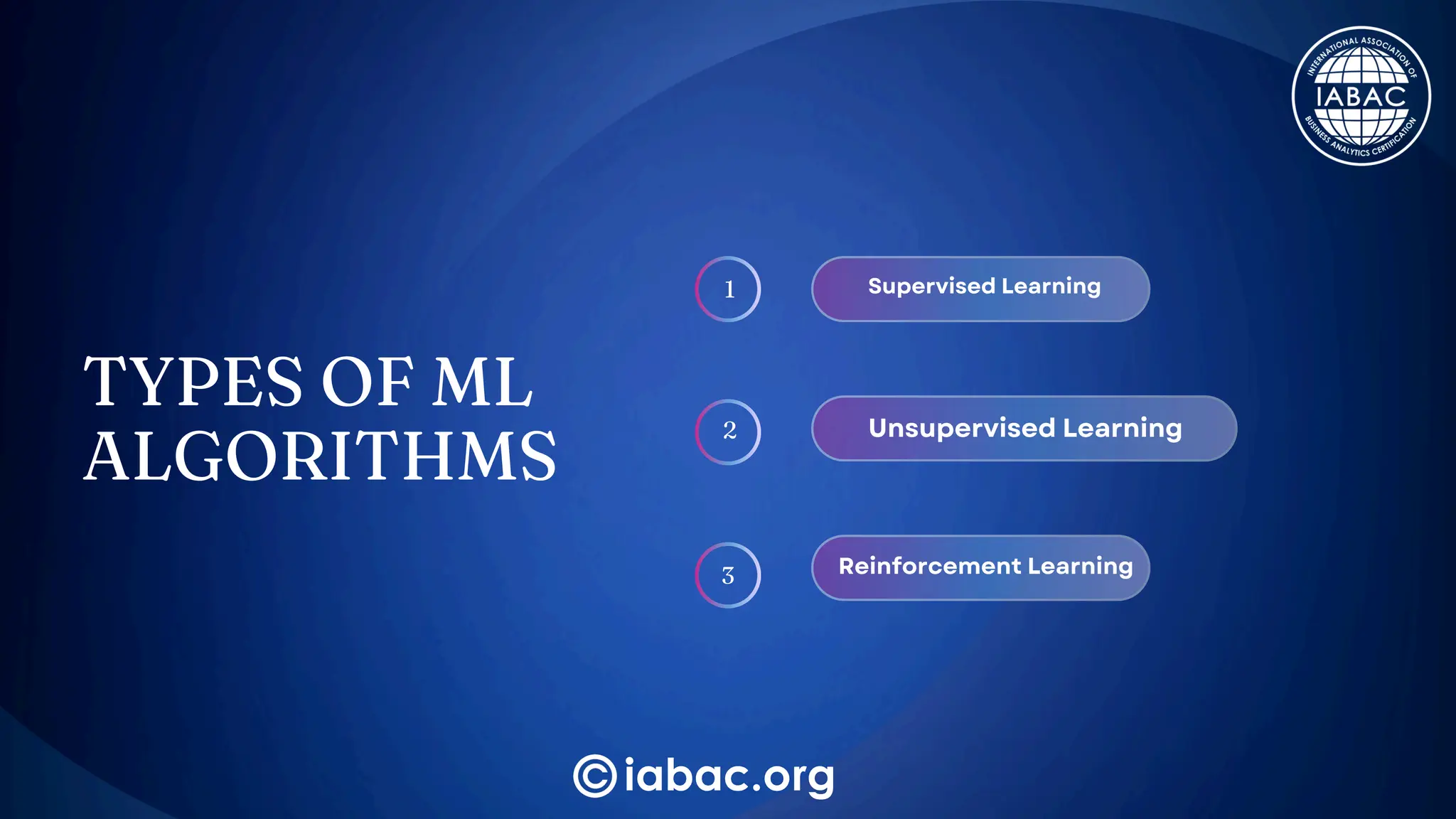
TYPES OF ML
ALGORITHMS
2
3
Supervised Learning
Unsupervised Learning
Reinforcement Learning
1
iabac.org
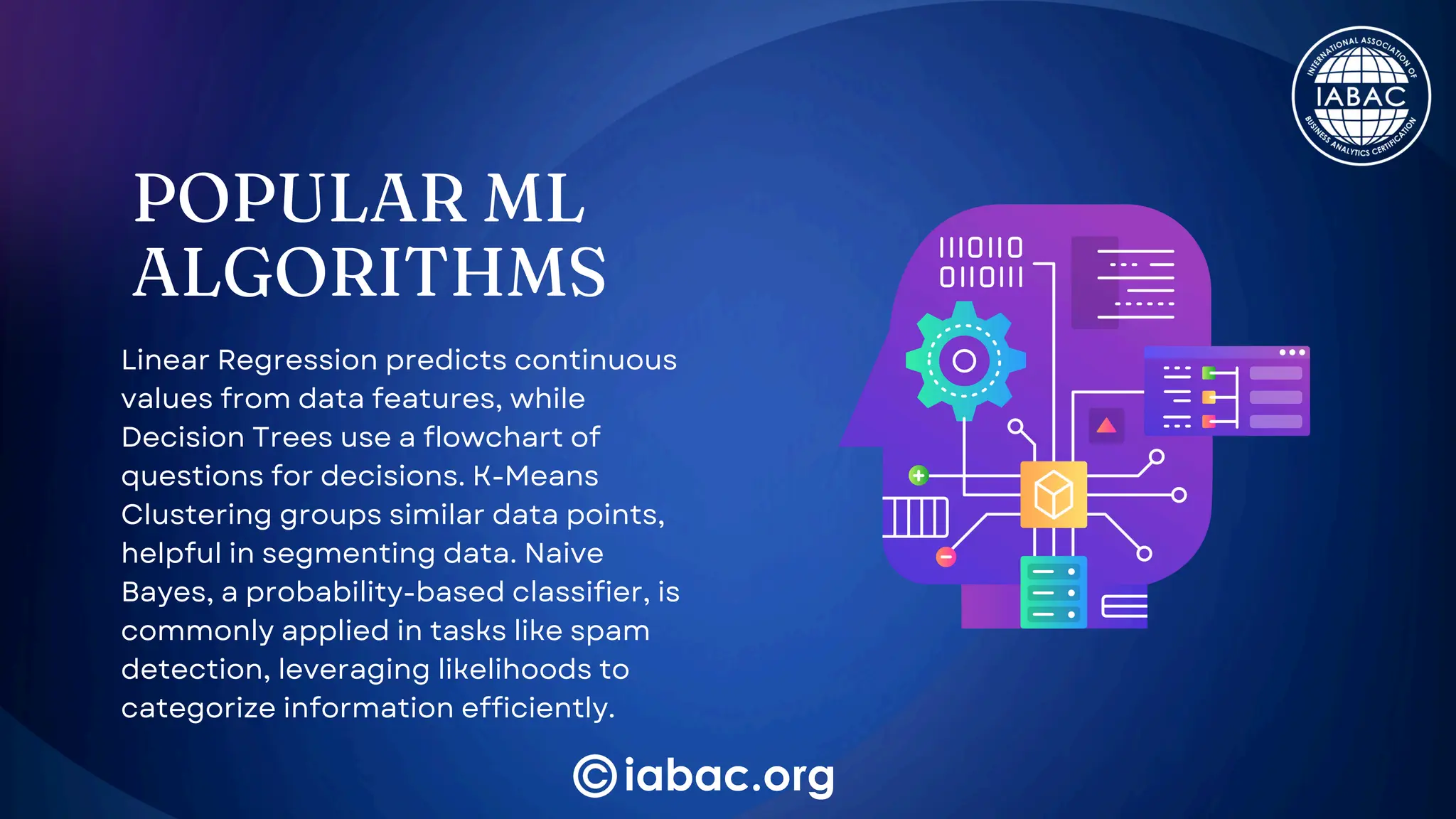
POPULAR ML
ALGORITHMS
Linear Regression predicts continuous
values from data features, while
Decision Trees use a flowchart of
questions for decisions. K-Means
Clustering groups similar data points,
helpful in segmenting data. Naive
Bayes, a probability-based classifier, is
commonly applied in tasks like spam
detection, leveraging likelihoods to
categorize information efficiently.
iabac.org
TRAINING AND
TESTING
Data is divided into training sets for learning and testing sets for
evaluation. This separation checks model accuracy on new data.
Overfitting can happen if a model learns details too closely from the
training data, causing it to perform poorly on unseen data, as it fails to
generalize broader patterns accurately.
iabac.org
CHALLENGES IN ML
Bias in Data: Can lead to unfair or inaccurate
predictions.
Data Requirements: Large, quality datasets are
essential.
Computational Power: Complex models require high
processing power.
iabac.org
TOOLS FOR BUILDING ML
MODELS
Scikit-Learn: Simple Python library for data analysis.
TensorFlow and PyTorch: Used for advanced models, like neural
networks.
No-Code Tools: Tools like Google’s Teachable Machine allow
beginners to experiment.
iabac.org
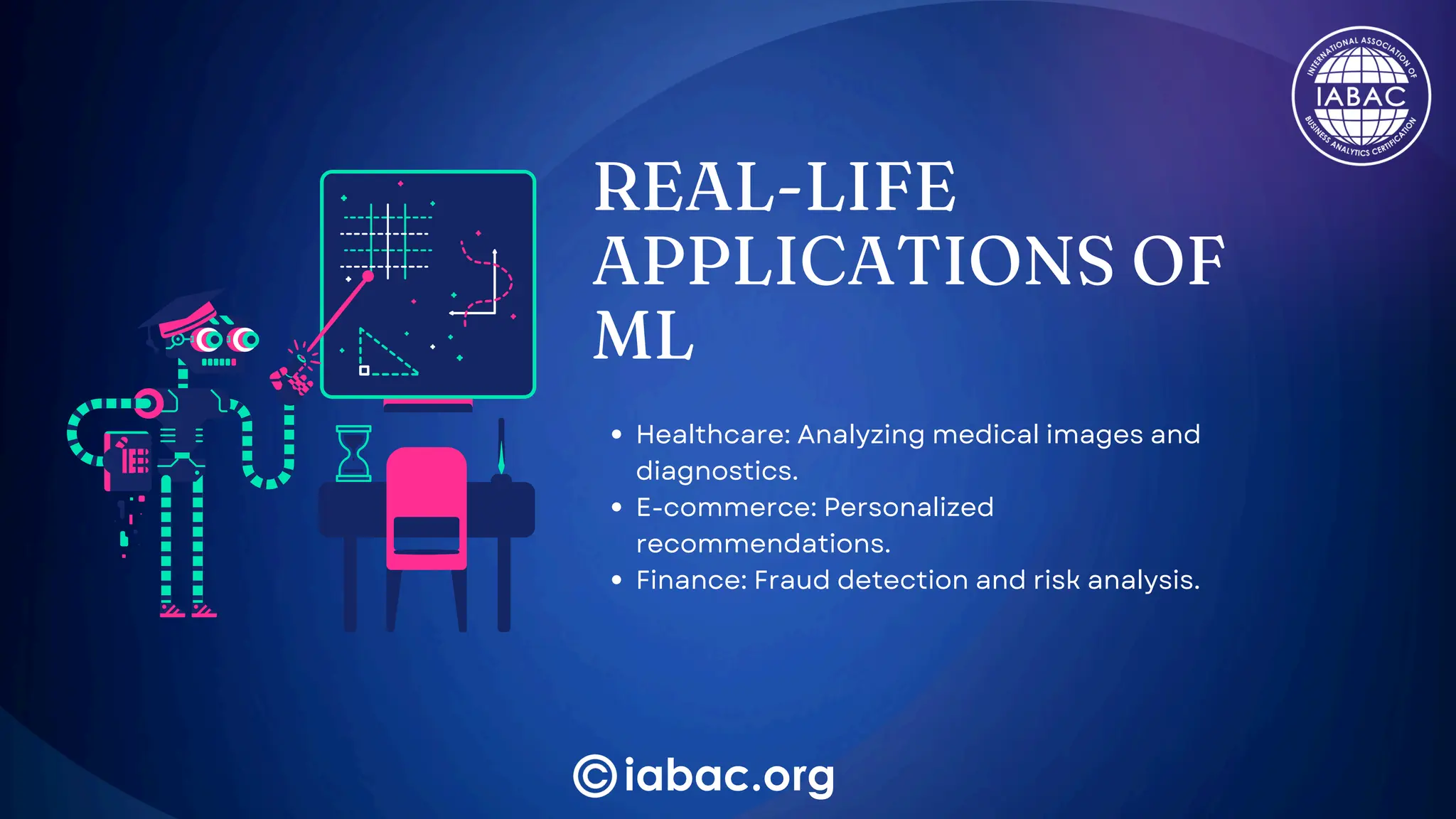
REAL-LIFE
APPLICATIONS OF
ML
Healthcare: Analyzing medical images and
diagnostics.
E-commerce: Personalized
recommendations.
Finance: Fraud detection and risk analysis.
iabac.org
FUTURE OF MACHINE
LEARNING
Enhanced Healthcare through diagnostics
and personalized treatments.
Autonomous Systems like self-driving cars
and drones.
Quantum Computing Integration for faster,
complex data processing.
Ethics and Responsible AI ensuring fairness
and transparency.
Proactive ML systems anticipating user
needs in real time.
iabac.org
GETTING STARTED IN ML
Take online courses (DataMites, YouTube).
Begin with small projects (Kaggle datasets).
Explore no-code tools to ease into ML concepts.
iabac.org
THANK YOU
Visit www.iabac.org

A Beginner’s Guide to Machine Learning Algorithms | IABAC

  • 1.
    A BEGINNER’S GUIDETO MACHINE LEARNING ALGORITHMS iabac.org
  • 2.
    INTRODUCTION TO MACHINE LEARNING MachineLearning (ML) is a type of AI where computers learn from data to identify patterns, make predictions, and improve. Used in recommendations, medical research, and fraud detection, ML enables data-driven decision-making across industries. iabac.org
  • 3.
    TYPES OF ML ALGORITHMS 2 3 SupervisedLearning Unsupervised Learning Reinforcement Learning 1 iabac.org
  • 4.
    POPULAR ML ALGORITHMS Linear Regressionpredicts continuous values from data features, while Decision Trees use a flowchart of questions for decisions. K-Means Clustering groups similar data points, helpful in segmenting data. Naive Bayes, a probability-based classifier, is commonly applied in tasks like spam detection, leveraging likelihoods to categorize information efficiently. iabac.org
  • 5.
    TRAINING AND TESTING Data isdivided into training sets for learning and testing sets for evaluation. This separation checks model accuracy on new data. Overfitting can happen if a model learns details too closely from the training data, causing it to perform poorly on unseen data, as it fails to generalize broader patterns accurately. iabac.org
  • 6.
    CHALLENGES IN ML Biasin Data: Can lead to unfair or inaccurate predictions. Data Requirements: Large, quality datasets are essential. Computational Power: Complex models require high processing power. iabac.org
  • 7.
    TOOLS FOR BUILDINGML MODELS Scikit-Learn: Simple Python library for data analysis. TensorFlow and PyTorch: Used for advanced models, like neural networks. No-Code Tools: Tools like Google’s Teachable Machine allow beginners to experiment. iabac.org
  • 8.
    REAL-LIFE APPLICATIONS OF ML Healthcare: Analyzingmedical images and diagnostics. E-commerce: Personalized recommendations. Finance: Fraud detection and risk analysis. iabac.org
  • 9.
    FUTURE OF MACHINE LEARNING EnhancedHealthcare through diagnostics and personalized treatments. Autonomous Systems like self-driving cars and drones. Quantum Computing Integration for faster, complex data processing. Ethics and Responsible AI ensuring fairness and transparency. Proactive ML systems anticipating user needs in real time. iabac.org
  • 10.
    GETTING STARTED INML Take online courses (DataMites, YouTube). Begin with small projects (Kaggle datasets). Explore no-code tools to ease into ML concepts. iabac.org
  • 11.