MACHINE LEARNING
BY: SHRUTI PATEL
IT DEPT
12102080501068
SUB: SEMINAR
SUB CODE: 102040404
OVERVIEW
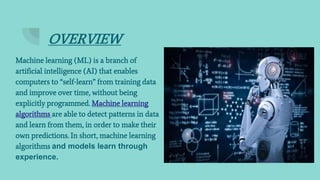
Machine learning (ML) is a branch of
artificial intelligence (AI) that enables
computers to “self-learn” from training data
and improve over time, without being
explicitly programmed. Machine learning
algorithms are able to detect patterns in data
and learn from them, in order to make their
own predictions. In short, machine learning
algorithms and models learn through
experience.
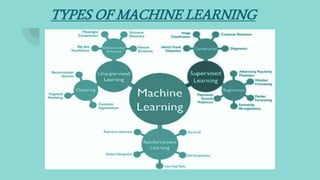
TYPES OF MACHINE LEARNING
SUPERVISED LEARNING
Supervised learning is a technique where the program is given labelled
input data and the expected output data. It gets the data from training data
containing sets of examples.
UNSUPERVISED LEARNING
This type of algorithm consists of input data without labelled response.
There will not be any pre existing labels and human intervention is also
less. It is mostly used in exploratory analysis as it can automatically
identify the structure in data.
REINFORCEMENT LEARNING
This model is used in making a sequence of decisions. It is an learning by
interacting with the environment. It is based on the observation that
intelligent agents tend to repeat the action that are rewarded for and
refrain from action that are punished for. It can be said that it is an trail
and error method in finding the best outcome based on experience.
How does Machine Learning work
A Machine Learning system learns from historical data, builds the prediction models, and whenever
it receives new data, predicts the output for it. The accuracy of predicted output depends upon the
amount of data, as the huge amount of data helps to build a better model which predicts the output
more accurately.
Suppose we have a complex problem, where we need to perform some predictions, so instead of
writing a code for it, we just need to feed the data to generic algorithms, and with the help of these
algorithms, machine builds the logic as per the data and predict the output. Machine learning has
changed our way of thinking about the problem. The below block diagram explains the working of
Machine Learning algorithm:
USES OF MACHINE LEARNING
● Traffic prediction
● Virtual Personal Assistant
● Speech recognition
● Email spam and malware filtering
● Bioinformatics
● Natural language processing
Real Time Examples for Machine Learning
Traffic prediction:
By using GPS navigation service out location are saved at the
central server for managing traffic.
Virtual Personal Assistant
Smart Speakers, Smartphones and apps like google allo.
Online Transportation
In apps like uber the available vehicle near our area, the
estimated cost and distance of the travel are computed using
this technique.
● Fast, Accurate, Efficient.
● Automation of most applications.
● Wide range of real life applications.
● Enhanced cyber security and spam detection.
● No human Intervention is needed.
● Handling multi dimensional data.
ADVANTAGES OF ML
THANKYOU

machine learning.pptx

  • 1.
    MACHINE LEARNING BY: SHRUTIPATEL IT DEPT 12102080501068 SUB: SEMINAR SUB CODE: 102040404
  • 2.
    OVERVIEW Machine learning (ML)is a branch of artificial intelligence (AI) that enables computers to “self-learn” from training data and improve over time, without being explicitly programmed. Machine learning algorithms are able to detect patterns in data and learn from them, in order to make their own predictions. In short, machine learning algorithms and models learn through experience.
  • 3.
  • 4.
    SUPERVISED LEARNING Supervised learningis a technique where the program is given labelled input data and the expected output data. It gets the data from training data containing sets of examples. UNSUPERVISED LEARNING This type of algorithm consists of input data without labelled response. There will not be any pre existing labels and human intervention is also less. It is mostly used in exploratory analysis as it can automatically identify the structure in data. REINFORCEMENT LEARNING This model is used in making a sequence of decisions. It is an learning by interacting with the environment. It is based on the observation that intelligent agents tend to repeat the action that are rewarded for and refrain from action that are punished for. It can be said that it is an trail and error method in finding the best outcome based on experience.
  • 5.
    How does MachineLearning work A Machine Learning system learns from historical data, builds the prediction models, and whenever it receives new data, predicts the output for it. The accuracy of predicted output depends upon the amount of data, as the huge amount of data helps to build a better model which predicts the output more accurately. Suppose we have a complex problem, where we need to perform some predictions, so instead of writing a code for it, we just need to feed the data to generic algorithms, and with the help of these algorithms, machine builds the logic as per the data and predict the output. Machine learning has changed our way of thinking about the problem. The below block diagram explains the working of Machine Learning algorithm:
  • 6.
    USES OF MACHINELEARNING ● Traffic prediction ● Virtual Personal Assistant ● Speech recognition ● Email spam and malware filtering ● Bioinformatics ● Natural language processing
  • 7.
    Real Time Examplesfor Machine Learning Traffic prediction: By using GPS navigation service out location are saved at the central server for managing traffic. Virtual Personal Assistant Smart Speakers, Smartphones and apps like google allo. Online Transportation In apps like uber the available vehicle near our area, the estimated cost and distance of the travel are computed using this technique.
  • 8.
    ● Fast, Accurate,Efficient. ● Automation of most applications. ● Wide range of real life applications. ● Enhanced cyber security and spam detection. ● No human Intervention is needed. ● Handling multi dimensional data. ADVANTAGES OF ML
  • 9.