Preserving, Diversifying and Growing Assets Trust Deed & Mortgage Fund Investing In Self-Directed IRAs
The Current Investment Landscape: Disquiet  Fear, seems like nothing but bad news Savings & investments down Real estate values and stock markets down Government policies seem to change by the day “ Another 6, 12, 18 months ‘til it’s over…” How does someone retired, on  a fixed income adjust? Whom to trust? Where’s the good information?
Where We Are New administration, experienced advisors Democrats running the show Problems have been identified, actions taken: Housing: the no. of unsold new homes is falling; bad loans are working their way out of the system; already at low % level of GDP Credit Crisis: solutions appear to be working; bank lending increasing 9% Economic drags are easing: lower gas prices, lower inflation, dollar gaining value Further fiscal stimulus: fed rate hike likely, below 1% by year-end; gov’t guarantees
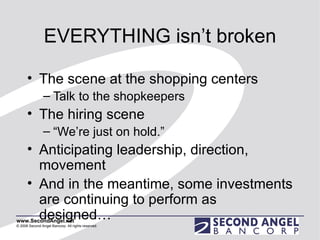
EVERYTHING isn’t broken The scene at the shopping centers Talk to the shopkeepers The hiring scene “ We’re just on hold.” Anticipating leadership, direction, movement And in the meantime, some investments are continuing to perform as designed…
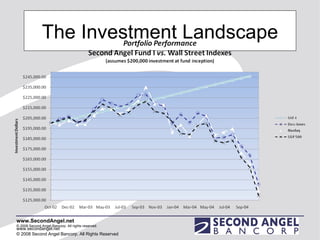
The Investment Landscape www.secondangel.net    © 2008 Second Angel Bancorp. All Rights Reserved
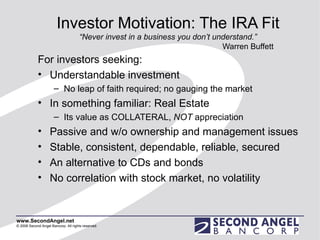
Investor Motivation: The IRA Fit “Never invest in a business you don’t understand.” Warren Buffett For investors seeking: Understandable investment No leap of faith required; no gauging the market In something familiar: Real Estate Its value as COLLATERAL,  NOT  appreciation Passive and w/o ownership and management issues Stable, consistent, dependable, reliable, secured An alternative to CDs and bonds No correlation with stock market, no volatility
Historical Investment Results 9 percent to 12 percent returns (2x to 3x returns of CDs)  [10% avg across various economic cycles] Compounding interest  [doubles every 6 1/2 years] “ The most powerful force in the universe is compound interest.” Albert Einstein Monthly dividends [ paid approx. $2,000/month per $200,000 account] High reinvestment rate by investors Reasons: Feel secure, like the returns
This is Private Money Loans based on and secured by the protective equity of real property The focus is on the PROPERTY:  equity  and the  borrower , not extraneous factors: Equity lending vs cash flow lending Loan To Value (“LTV”) ratios/ “protective equity” Exit Strategy: Property’s marketability & liquidation value Two investment approaches Fractional Trust Deeds/ Buying Notes Mortgage Funds See  www.Wikipedia.com , “ Private Money Investing .”  [We wrote the entry…]
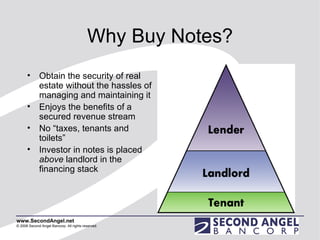
Why Buy Notes? Obtain the security of real estate without the hassles of managing and maintaining it Enjoys the benefits of a secured revenue stream  No “taxes, tenants and toilets” Investor in notes is placed  above  landlord in the financing stack
Investing in Notes The traditional approach Still prevalent on East Coast When property is sold without full payment, Buyer signs mortgage or deed of trust (“trust deed”) Can be multiples ex: “1st trust deeds,” “2nd trust deeds” Property is pledged to the lender of the money as security for payment Note (“promissory note”) is the promise to pay Ties the Borrower to the loan and its terms Notes can be bought and sold
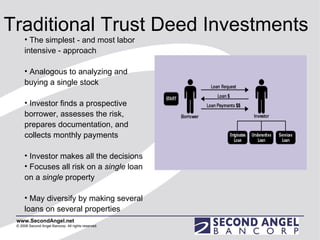
Traditional Trust Deed Investments The simplest - and most labor intensive - approach Analogous to analyzing and buying a single stock Investor finds a prospective borrower, assesses the risk, prepares documentation, and collects monthly payments Investor makes all the decisions  Focuses all risk on a  single  loan on a  single  property May diversify by making several loans on several properties
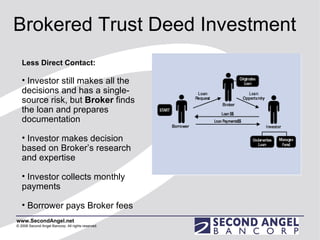
Brokered Trust Deed Investment Less Direct Contact: Investor still makes all the decisions and has a single-source risk, but  Broker  finds the loan and prepares documentation  Investor makes decision based on Broker’s research and expertise Investor collects monthly payments Borrower pays Broker fees
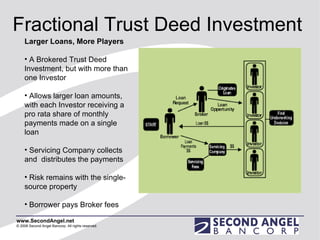
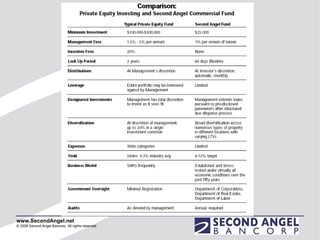
Fractional Trust Deed Investment Larger Loans, More Players A Brokered Trust Deed Investment, but with more than one Investor Allows larger loan amounts, with each Investor receiving a pro rata share of monthly payments made on a single loan Servicing Company collects and  distributes the payments  Risk remains with the single-source property Borrower pays Broker fees
Fractional Considerations Investor makes final decision…but at a price: Size and complexity issues Smaller loans, weaker borrowers 2”-3” of loan documentation to review per loan Investment $ not deployed 365 days/year (minimum 1% return penalty) No anonymity No autonomy Subject to capital calls No compound interest Liability issues Licensing issues (CA) Biggest Issue: Diversification
The Lending Process There’s more to it than you’d think… Multiple levels to consider during underwriting Experience counts Increasing complexity ex: documentation requirements Servicing and collection issues never end REGULATIONS
The Alternative to Fractionals: Mortgage Funds Resemble equity mutual funds More prevalent on West Coast Managed by licensed Private Lenders “ Non-bank banks”  Investment secured by first (or second) deeds of trust  Deeds name the  fund , not individual investors, as the actual holder As interest is earned from monthly mortgage payments, the fund generates income Income is compounded or paid out to investors monthly or quarterly
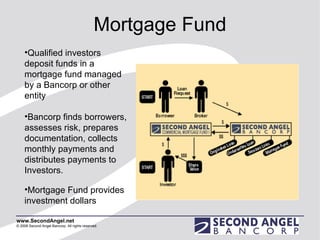
Mortgage Fund Qualified investors deposit funds in a mortgage fund managed by a Bancorp or other entity Bancorp finds borrowers, assesses risk, prepares documentation, collects monthly payments and distributes payments to Investors.   Mortgage Fund provides investment dollars
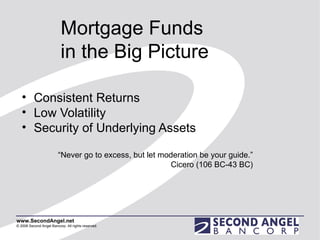
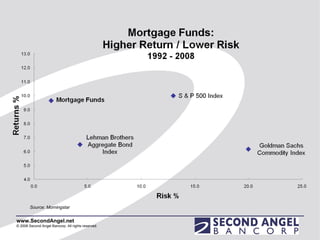
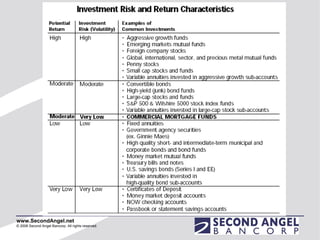
Mortgage Funds  in the Big Picture Consistent Returns Low Volatility Security of Underlying Assets “ Never go to excess, but let moderation be your guide.” Cicero (106 BC-43 BC)
Source: Morningstar
Sample Returns Annualized, by month Note consistency, low volatility
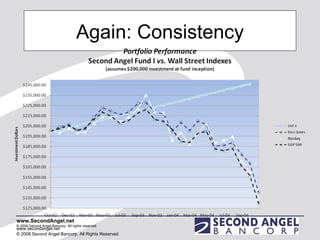
Again: Consistency www.secondangel.net    © 2008 Second Angel Bancorp. All Rights Reserved
Mortgage Fund Loan Parameters Ground Rules : Investors know what Fund is investing in. Offering Circular sets out lending criteria Property types loaned on LTV ratios for each type Loan type Location Loan size Generally fall within narrow range BUT…varies by each fund’s loan risk parameters: first, second, mezzanine, etc.
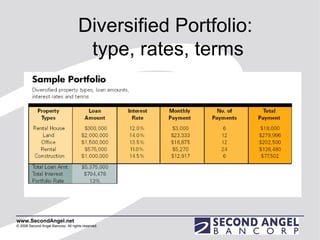
Diversified Portfolio:  type, rates, terms
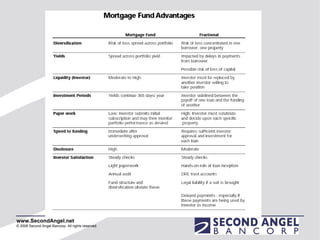
Mortgage Fund Advantages:  Investor Instant diversified portfolio Simplicity: little/no involvement with individual loans or borrowers Higher Yield Funds at work 365 days/year Liquidity Payment Options Compound interest Monthly Dividend payments No capital calls Anonymity/Liability
Mortgage Fund Advantages:  Borrower More and better loan opportunities because of: SPEED: From analysis through funding. Enables opportunities NOW 1-2 weeks (sometimes days) vs 60 days for institutional lenders Cheaper than a partner  More flexible, no bureaucracy Minimal delegation of lending authority: deal directly with decision makers Loans are “custom made” to work with the unique needs of each situation Cost differential from institutional lenders not that substantial


Private Lending  Niche Lending Specialties [examples] Residential  First and Seconds Rehabs REOs Commercial Retail, Office, Warehouses, Churches, Gas Stations  Commercial Construction-Completion Land Acquisition & Entitlement (not too popular…)
The Commercial Property Advantage Commercial Property Outlook  STABLE Reasons: Steady absorption cycle Known supply (vs housing) Limited supply going forward (land, entitlements) Evidence:  Rising rental rates across different property categories Slowly rising cap rates Low default rate: .04% vs 28.00% for subprime residential
Finding & Selecting a Fractional  or  Mortgage Fund Investment Decide: Fractional or Fund (or both) Geographical area Investment size Property type: residential/commercial Risk appetite: [note that yields fall within narrow range…] Investor Eligibility/Amount to invest ***MANAGER TRACK RECORD*** Philosophy Response to queries Starting point:  www.Scotsmanguide.com The industry’s bible
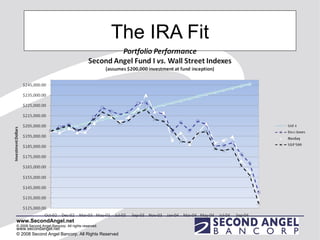
The IRA Fit www.secondangel.net    © 2008 Second Angel Bancorp. All Rights Reserved
Thanks Questions: Richard Zahm (415) 730-1042 [email_address] www.SecondAngel.net

Second Angel Ira Investment Webinar

  • 1.
    Preserving, Diversifying andGrowing Assets Trust Deed & Mortgage Fund Investing In Self-Directed IRAs
  • 2.
    The Current InvestmentLandscape: Disquiet Fear, seems like nothing but bad news Savings & investments down Real estate values and stock markets down Government policies seem to change by the day “ Another 6, 12, 18 months ‘til it’s over…” How does someone retired, on a fixed income adjust? Whom to trust? Where’s the good information?
  • 3.
    Where We AreNew administration, experienced advisors Democrats running the show Problems have been identified, actions taken: Housing: the no. of unsold new homes is falling; bad loans are working their way out of the system; already at low % level of GDP Credit Crisis: solutions appear to be working; bank lending increasing 9% Economic drags are easing: lower gas prices, lower inflation, dollar gaining value Further fiscal stimulus: fed rate hike likely, below 1% by year-end; gov’t guarantees
  • 4.
    EVERYTHING isn’t brokenThe scene at the shopping centers Talk to the shopkeepers The hiring scene “ We’re just on hold.” Anticipating leadership, direction, movement And in the meantime, some investments are continuing to perform as designed…
  • 5.
    The Investment Landscapewww.secondangel.net © 2008 Second Angel Bancorp. All Rights Reserved
  • 6.
    Investor Motivation: TheIRA Fit “Never invest in a business you don’t understand.” Warren Buffett For investors seeking: Understandable investment No leap of faith required; no gauging the market In something familiar: Real Estate Its value as COLLATERAL, NOT appreciation Passive and w/o ownership and management issues Stable, consistent, dependable, reliable, secured An alternative to CDs and bonds No correlation with stock market, no volatility
  • 7.
    Historical Investment Results9 percent to 12 percent returns (2x to 3x returns of CDs) [10% avg across various economic cycles] Compounding interest [doubles every 6 1/2 years] “ The most powerful force in the universe is compound interest.” Albert Einstein Monthly dividends [ paid approx. $2,000/month per $200,000 account] High reinvestment rate by investors Reasons: Feel secure, like the returns
  • 8.
    This is PrivateMoney Loans based on and secured by the protective equity of real property The focus is on the PROPERTY: equity and the borrower , not extraneous factors: Equity lending vs cash flow lending Loan To Value (“LTV”) ratios/ “protective equity” Exit Strategy: Property’s marketability & liquidation value Two investment approaches Fractional Trust Deeds/ Buying Notes Mortgage Funds See www.Wikipedia.com , “ Private Money Investing .” [We wrote the entry…]
  • 9.
    Why Buy Notes?Obtain the security of real estate without the hassles of managing and maintaining it Enjoys the benefits of a secured revenue stream No “taxes, tenants and toilets” Investor in notes is placed above landlord in the financing stack
  • 10.
    Investing in NotesThe traditional approach Still prevalent on East Coast When property is sold without full payment, Buyer signs mortgage or deed of trust (“trust deed”) Can be multiples ex: “1st trust deeds,” “2nd trust deeds” Property is pledged to the lender of the money as security for payment Note (“promissory note”) is the promise to pay Ties the Borrower to the loan and its terms Notes can be bought and sold
  • 11.
    Traditional Trust DeedInvestments The simplest - and most labor intensive - approach Analogous to analyzing and buying a single stock Investor finds a prospective borrower, assesses the risk, prepares documentation, and collects monthly payments Investor makes all the decisions Focuses all risk on a single loan on a single property May diversify by making several loans on several properties
  • 12.
    Brokered Trust DeedInvestment Less Direct Contact: Investor still makes all the decisions and has a single-source risk, but Broker finds the loan and prepares documentation Investor makes decision based on Broker’s research and expertise Investor collects monthly payments Borrower pays Broker fees
  • 13.
    Fractional Trust DeedInvestment Larger Loans, More Players A Brokered Trust Deed Investment, but with more than one Investor Allows larger loan amounts, with each Investor receiving a pro rata share of monthly payments made on a single loan Servicing Company collects and distributes the payments Risk remains with the single-source property Borrower pays Broker fees
  • 14.
    Fractional Considerations Investormakes final decision…but at a price: Size and complexity issues Smaller loans, weaker borrowers 2”-3” of loan documentation to review per loan Investment $ not deployed 365 days/year (minimum 1% return penalty) No anonymity No autonomy Subject to capital calls No compound interest Liability issues Licensing issues (CA) Biggest Issue: Diversification
  • 15.
    The Lending ProcessThere’s more to it than you’d think… Multiple levels to consider during underwriting Experience counts Increasing complexity ex: documentation requirements Servicing and collection issues never end REGULATIONS
  • 16.
    The Alternative toFractionals: Mortgage Funds Resemble equity mutual funds More prevalent on West Coast Managed by licensed Private Lenders “ Non-bank banks” Investment secured by first (or second) deeds of trust Deeds name the fund , not individual investors, as the actual holder As interest is earned from monthly mortgage payments, the fund generates income Income is compounded or paid out to investors monthly or quarterly
  • 17.
    Mortgage Fund Qualifiedinvestors deposit funds in a mortgage fund managed by a Bancorp or other entity Bancorp finds borrowers, assesses risk, prepares documentation, collects monthly payments and distributes payments to Investors. Mortgage Fund provides investment dollars
  • 18.
    Mortgage Funds in the Big Picture Consistent Returns Low Volatility Security of Underlying Assets “ Never go to excess, but let moderation be your guide.” Cicero (106 BC-43 BC)
  • 19.
  • 20.
    Sample Returns Annualized,by month Note consistency, low volatility
  • 21.
    Again: Consistency www.secondangel.net © 2008 Second Angel Bancorp. All Rights Reserved
  • 22.
    Mortgage Fund LoanParameters Ground Rules : Investors know what Fund is investing in. Offering Circular sets out lending criteria Property types loaned on LTV ratios for each type Loan type Location Loan size Generally fall within narrow range BUT…varies by each fund’s loan risk parameters: first, second, mezzanine, etc.
  • 23.
    Diversified Portfolio: type, rates, terms
  • 24.
    Mortgage Fund Advantages: Investor Instant diversified portfolio Simplicity: little/no involvement with individual loans or borrowers Higher Yield Funds at work 365 days/year Liquidity Payment Options Compound interest Monthly Dividend payments No capital calls Anonymity/Liability
  • 25.
    Mortgage Fund Advantages: Borrower More and better loan opportunities because of: SPEED: From analysis through funding. Enables opportunities NOW 1-2 weeks (sometimes days) vs 60 days for institutional lenders Cheaper than a partner More flexible, no bureaucracy Minimal delegation of lending authority: deal directly with decision makers Loans are “custom made” to work with the unique needs of each situation Cost differential from institutional lenders not that substantial
  • 26.
  • 27.
  • 28.
  • 29.
    Private Lending Niche Lending Specialties [examples] Residential First and Seconds Rehabs REOs Commercial Retail, Office, Warehouses, Churches, Gas Stations Commercial Construction-Completion Land Acquisition & Entitlement (not too popular…)
  • 30.
    The Commercial PropertyAdvantage Commercial Property Outlook STABLE Reasons: Steady absorption cycle Known supply (vs housing) Limited supply going forward (land, entitlements) Evidence: Rising rental rates across different property categories Slowly rising cap rates Low default rate: .04% vs 28.00% for subprime residential
  • 31.
    Finding & Selectinga Fractional or Mortgage Fund Investment Decide: Fractional or Fund (or both) Geographical area Investment size Property type: residential/commercial Risk appetite: [note that yields fall within narrow range…] Investor Eligibility/Amount to invest ***MANAGER TRACK RECORD*** Philosophy Response to queries Starting point: www.Scotsmanguide.com The industry’s bible
  • 32.
    The IRA Fitwww.secondangel.net © 2008 Second Angel Bancorp. All Rights Reserved
  • 33.
    Thanks Questions: RichardZahm (415) 730-1042 [email_address] www.SecondAngel.net