Management Information Systems Pragmatyx Solutions
About Us Pragmatyx Solutions  is a Management Information Systems company promoted by Praxis Advisors. The company’s core service offering is to help its clients build MIS solutions that support effective business decision making.  Praxis Advisors  is a management advisory firm with a focus on corporate and business strategy, capital structuring and management process towards driving business growth and dynamism.
MIS Defined We define Management Information Systems (MIS) as a process of extracting and organizing meaningful information from data available within a company. Such meaningful information is then structured into management reports that can be used by middle and senior level management for effective business decision making. Pragmatyx helps drive both the process of building an MIS framework within the company as well as helping management interpret the information.
MIS Dimensions We look at building an MIS framework along 4 key dimensions: 1. Financial 2. Customer 3. People 4. Process
Financial MIS Framework Top-down driver is a Return on Equity (ROE) framework. ROE in turn can be viewed as having 3 key drivers  margin on sales asset turnover financial leverage ROE = NP/Equity = NP/Sales    Sales/Assets    Assets/Equity   (Profit Margin)    (Asset T/O)    (Fin. Leverage) Each of these drivers need to be optimized (not necessarily maximized) as each carries its own risks.
Financial MIS Income Analysis Aggregate Contribution Contribution  = Sales less Variable Costs Net Profit  = Contribution less Fixed Costs Contribution  = Fixed Cost => Break Even Point (BEP) Capacity Utilization level at which BEP achieved  Sector-wise Contribution Contribution by product or business division Measured as multiple of Aggregate Fixed Cost (1x, 2x etc.) Fixed Cost allocation often subjective and contentious
Financial MIS Cuts of Profitability Profitability or contribution can and should be measured along multiple dimensions to facilitate a good understanding of strengths and weaknesses in the business. At a minimum: Product-wise profitability Branch or geography-wise profitability Customer-wise profitability
Financial MIS Balance Sheet Analysis The following indicators extracted from the balance sheet are key indicators of business efficiency: Days Receivables Days Payables Debt to Equity Ratio Current Ratio / Quick Ratio Debt Service Coverage (EBITDA to Debt Service) Total Outside Liabilities / Total Net Worth
Financial MIS Cash Flow Analysis Cash flows provide a unique insight into the operations of a company I.e. its ability to run as a going concern on a sustainable basis: Operational Cash Flows Investment Cash Flows Financing Cash Flows
Customer MIS A thorough understanding of customers helps provide strategic insights into the business in terms of where and how it should be positioned for maximum impact: Ticket Size Wallet Size Market Share Customer base growth Revenue per customer Sales per employee New product sales vs. existing products Customer dependency ratio (ABC analysis) Customers acquired vs. lost / ticket size gained vs. lost
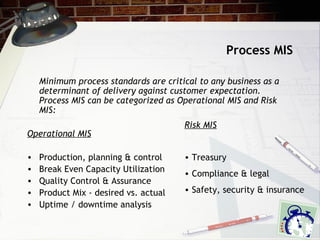
Process MIS Minimum process standards are critical to any business as a determinant of delivery against customer expectation. Process MIS can be categorized as Operational MIS and Risk MIS: Operational MIS Production, planning & control Break Even Capacity Utilization  Quality Control & Assurance Product Mix - desired vs. actual Uptime / downtime analysis Risk MIS Treasury  Compliance & legal  Safety, security & insurance
People MIS Management of Human Resources is a top management priority for any business. Tracking certain key indicators can help management anticipate and address challenges before they impact business: Entry Process - People & Skill Gaps Exit Process - feedback analysis  Attrition analysis Training & Development data
Pragmatyx  Modus Operandi Pragmatyx follows a 5-step approach: Discussions with senior management to understand business model, key business drivers and critical information needs Understand state of current financial information and MIS in the company including information flows and ERP, if any. Define the scope of work required to bring the MIS framework in the company to a minimum standard. Agree on terms of engagement with promoters/management including fees and interaction schedule  Pragmatyx team commences work on executing against the agreed MIS plan and updates management periodically.

Pragmatyx Solutions MIS

  • 1.
    Management Information SystemsPragmatyx Solutions
  • 2.
    About Us PragmatyxSolutions is a Management Information Systems company promoted by Praxis Advisors. The company’s core service offering is to help its clients build MIS solutions that support effective business decision making. Praxis Advisors is a management advisory firm with a focus on corporate and business strategy, capital structuring and management process towards driving business growth and dynamism.
  • 3.
    MIS Defined Wedefine Management Information Systems (MIS) as a process of extracting and organizing meaningful information from data available within a company. Such meaningful information is then structured into management reports that can be used by middle and senior level management for effective business decision making. Pragmatyx helps drive both the process of building an MIS framework within the company as well as helping management interpret the information.
  • 4.
    MIS Dimensions Welook at building an MIS framework along 4 key dimensions: 1. Financial 2. Customer 3. People 4. Process
  • 5.
    Financial MIS FrameworkTop-down driver is a Return on Equity (ROE) framework. ROE in turn can be viewed as having 3 key drivers margin on sales asset turnover financial leverage ROE = NP/Equity = NP/Sales  Sales/Assets  Assets/Equity (Profit Margin)  (Asset T/O)  (Fin. Leverage) Each of these drivers need to be optimized (not necessarily maximized) as each carries its own risks.
  • 6.
    Financial MIS IncomeAnalysis Aggregate Contribution Contribution = Sales less Variable Costs Net Profit = Contribution less Fixed Costs Contribution = Fixed Cost => Break Even Point (BEP) Capacity Utilization level at which BEP achieved Sector-wise Contribution Contribution by product or business division Measured as multiple of Aggregate Fixed Cost (1x, 2x etc.) Fixed Cost allocation often subjective and contentious
  • 7.
    Financial MIS Cutsof Profitability Profitability or contribution can and should be measured along multiple dimensions to facilitate a good understanding of strengths and weaknesses in the business. At a minimum: Product-wise profitability Branch or geography-wise profitability Customer-wise profitability
  • 8.
    Financial MIS BalanceSheet Analysis The following indicators extracted from the balance sheet are key indicators of business efficiency: Days Receivables Days Payables Debt to Equity Ratio Current Ratio / Quick Ratio Debt Service Coverage (EBITDA to Debt Service) Total Outside Liabilities / Total Net Worth
  • 9.
    Financial MIS CashFlow Analysis Cash flows provide a unique insight into the operations of a company I.e. its ability to run as a going concern on a sustainable basis: Operational Cash Flows Investment Cash Flows Financing Cash Flows
  • 10.
    Customer MIS Athorough understanding of customers helps provide strategic insights into the business in terms of where and how it should be positioned for maximum impact: Ticket Size Wallet Size Market Share Customer base growth Revenue per customer Sales per employee New product sales vs. existing products Customer dependency ratio (ABC analysis) Customers acquired vs. lost / ticket size gained vs. lost
  • 11.
    Process MIS Minimumprocess standards are critical to any business as a determinant of delivery against customer expectation. Process MIS can be categorized as Operational MIS and Risk MIS: Operational MIS Production, planning & control Break Even Capacity Utilization Quality Control & Assurance Product Mix - desired vs. actual Uptime / downtime analysis Risk MIS Treasury Compliance & legal Safety, security & insurance
  • 12.
    People MIS Managementof Human Resources is a top management priority for any business. Tracking certain key indicators can help management anticipate and address challenges before they impact business: Entry Process - People & Skill Gaps Exit Process - feedback analysis Attrition analysis Training & Development data
  • 13.
    People MIS Managementof Human Resources is a top management priority for any business. Tracking certain key indicators can help management anticipate and address challenges before they impact business: Entry Process - People & Skill Gaps Exit Process - feedback analysis Attrition analysis Training & Development data
  • 14.
    Pragmatyx ModusOperandi Pragmatyx follows a 5-step approach: Discussions with senior management to understand business model, key business drivers and critical information needs Understand state of current financial information and MIS in the company including information flows and ERP, if any. Define the scope of work required to bring the MIS framework in the company to a minimum standard. Agree on terms of engagement with promoters/management including fees and interaction schedule Pragmatyx team commences work on executing against the agreed MIS plan and updates management periodically.