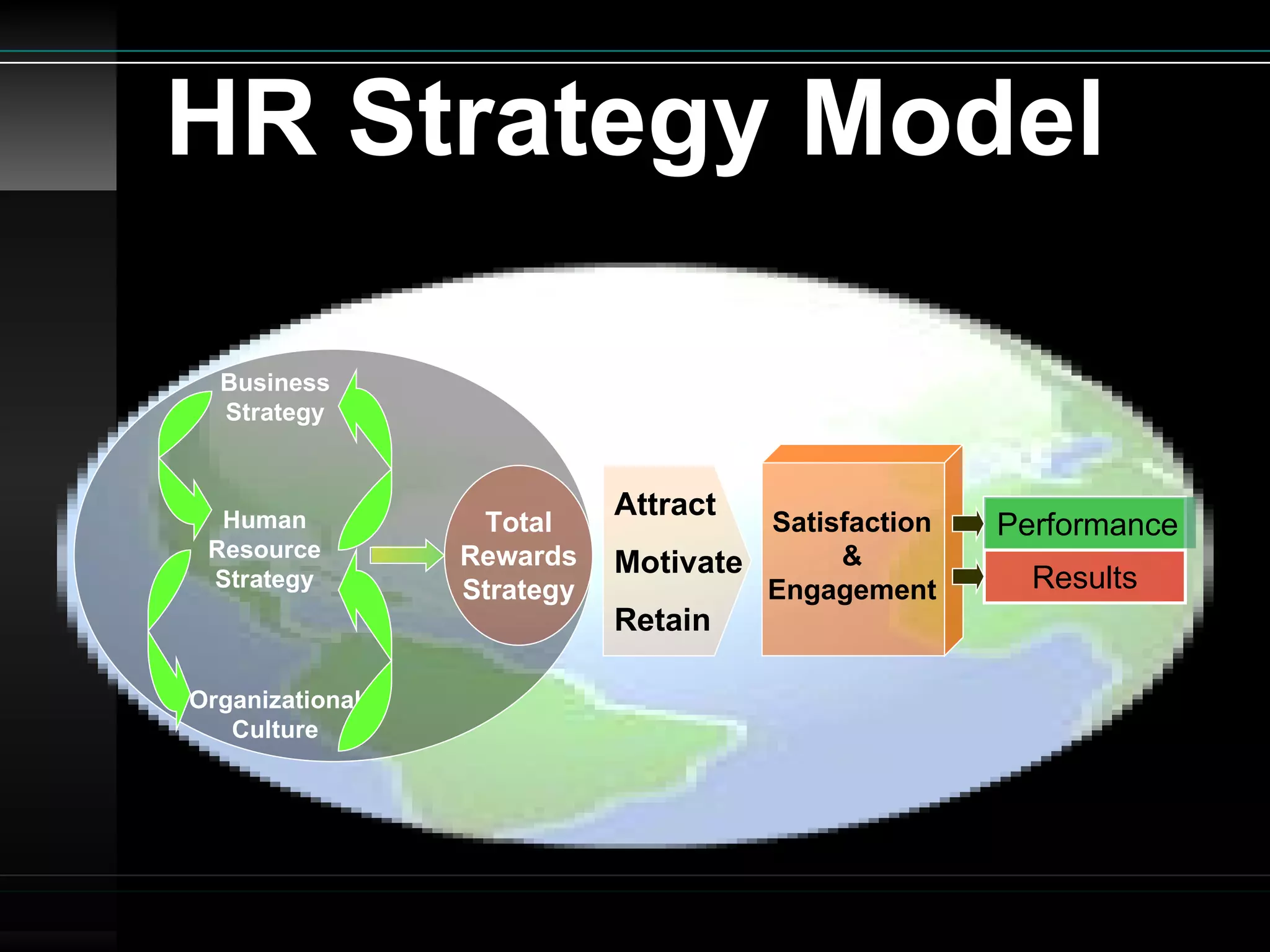
HR Strategy Model Organizational Culture Business Strategy Human Resource Strategy Attract  Motivate Retain Satisfaction & Engagement Performance Results Total Rewards Strategy
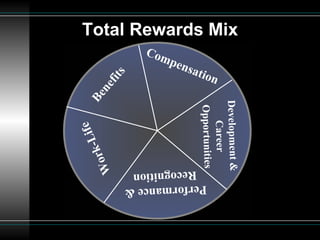
Compensation Benefits Work-Life Performance & Recognition Development & Career Opportunities Total Rewards Mix
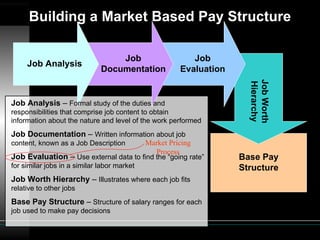
Building a Market Based Pay Structure Job Analysis Job Documentation Job Evaluation Job Worth Hierarchy Base Pay Structure Job Analysis  –  Formal study of the duties and responsibilities that comprise job content to obtain information about the nature and level of the work performed Job Documentation  –  Written information about job content, known as a Job Description Job Evaluation  –  Use external data to find the “going rate” for similar jobs in a similar labor market Job Worth Hierarchy  –  Illustrates where each job fits relative to other jobs Base Pay Structure  –  Structure of salary ranges for each job used to make pay decisions Market Pricing Process
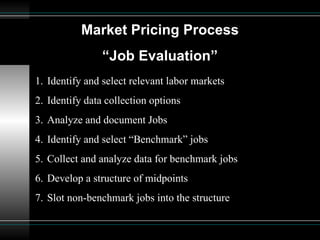
Market Pricing Process “ Job Evaluation” Identify and select relevant labor markets Identify data collection options Analyze and document Jobs Identify and select “Benchmark” jobs Collect and analyze data for benchmark jobs Develop a structure of midpoints Slot non-benchmark jobs into the structure
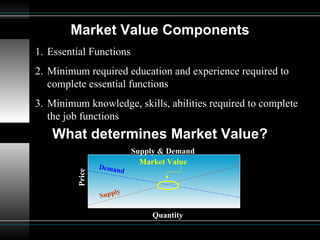
Market Value Components Essential Functions Minimum required education and experience required to complete essential functions Minimum knowledge, skills, abilities required to complete the job functions What determines Market Value? Market Value Demand Supply Price Quantity Supply & Demand
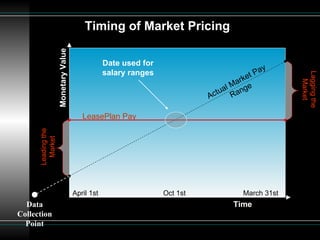
Timing of Market Pricing LeasePlan Pay Actual Market Pay Range April 1st Monetary Value Leading the Market Lagging the Market March 31st Time Oct 1st Date used for salary ranges Data Collection Point
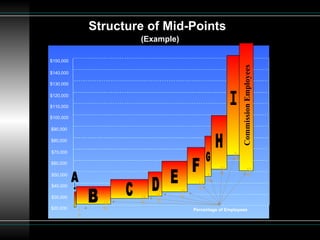
B C D E F H I G 1% 12% 14% 9% 16% 13% 4% 10% 9% 12% $20,000 $30,000 $40,000 $50,000 $60,000 $70,000 $80,000 $90,000 $100,000 $110,000 $120,000 $130,000 $140,000 $150,000 A Percentage of Employees Structure of Mid-Points (Example) Commission Employees

Market Pricing

  • 1.
    HR Strategy ModelOrganizational Culture Business Strategy Human Resource Strategy Attract Motivate Retain Satisfaction & Engagement Performance Results Total Rewards Strategy
  • 2.
    Compensation Benefits Work-LifePerformance & Recognition Development & Career Opportunities Total Rewards Mix
  • 3.
    Building a MarketBased Pay Structure Job Analysis Job Documentation Job Evaluation Job Worth Hierarchy Base Pay Structure Job Analysis – Formal study of the duties and responsibilities that comprise job content to obtain information about the nature and level of the work performed Job Documentation – Written information about job content, known as a Job Description Job Evaluation – Use external data to find the “going rate” for similar jobs in a similar labor market Job Worth Hierarchy – Illustrates where each job fits relative to other jobs Base Pay Structure – Structure of salary ranges for each job used to make pay decisions Market Pricing Process
  • 4.
    Market Pricing Process“ Job Evaluation” Identify and select relevant labor markets Identify data collection options Analyze and document Jobs Identify and select “Benchmark” jobs Collect and analyze data for benchmark jobs Develop a structure of midpoints Slot non-benchmark jobs into the structure
  • 5.
    Market Value ComponentsEssential Functions Minimum required education and experience required to complete essential functions Minimum knowledge, skills, abilities required to complete the job functions What determines Market Value? Market Value Demand Supply Price Quantity Supply & Demand
  • 6.
    Timing of MarketPricing LeasePlan Pay Actual Market Pay Range April 1st Monetary Value Leading the Market Lagging the Market March 31st Time Oct 1st Date used for salary ranges Data Collection Point
  • 7.
    B C DE F H I G 1% 12% 14% 9% 16% 13% 4% 10% 9% 12% $20,000 $30,000 $40,000 $50,000 $60,000 $70,000 $80,000 $90,000 $100,000 $110,000 $120,000 $130,000 $140,000 $150,000 A Percentage of Employees Structure of Mid-Points (Example) Commission Employees