Applying the traditions of Feng Shui to Home Staging
Feng shui is the ancient Chinese art of placement used to create balance, harmony and well-being Feng Shui dates back thousands of years. The practice of Feng Shui began in the West Han dynasty around the third century BC.  Feng Shui allows us to live in harmony with the natural world The #1 Goal of Feng Shui – to make sure Chi or energy moves and flows smoothly Chi – energy, life spirit Feng Shui supports the theories of Quantum Physics – everything is made up of particles of energy that are vibrating at different speeds
Feng Shui is known throughout by different names  India – “Vastu Shastra” Vietnam – “Phong Thuy”(fong twee) Thailand – “Hong Jewee” Korea – “Poonsgoo” Far East, Europe and U.S.  - “Feng Shui”
1 st  Century A.D.  - The practice of Feng Shui was used at grave sites of relatives Objective: for the dead to rest in peace while the living family enjoyed prosperity Landscape: Used so that the structure or building on the site would be in harmony and  balance with it’s surroundings
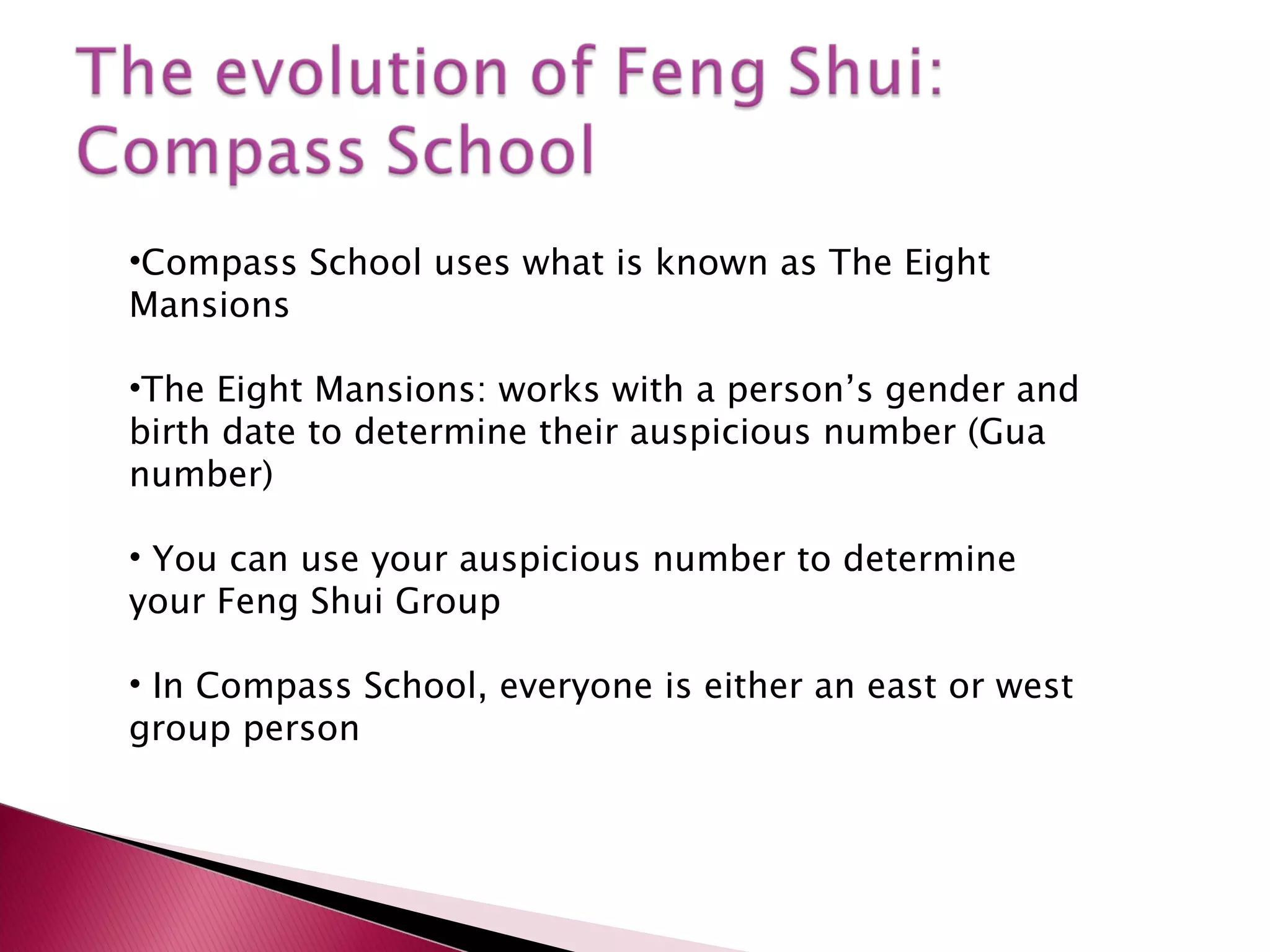
Compass School uses what is known as The Eight Mansions The Eight Mansions: works with a person’s gender and birth date to determine their auspicious number (Gua number) You can use your auspicious number to determine your Feng Shui Group In Compass School, everyone is either an east or west group person
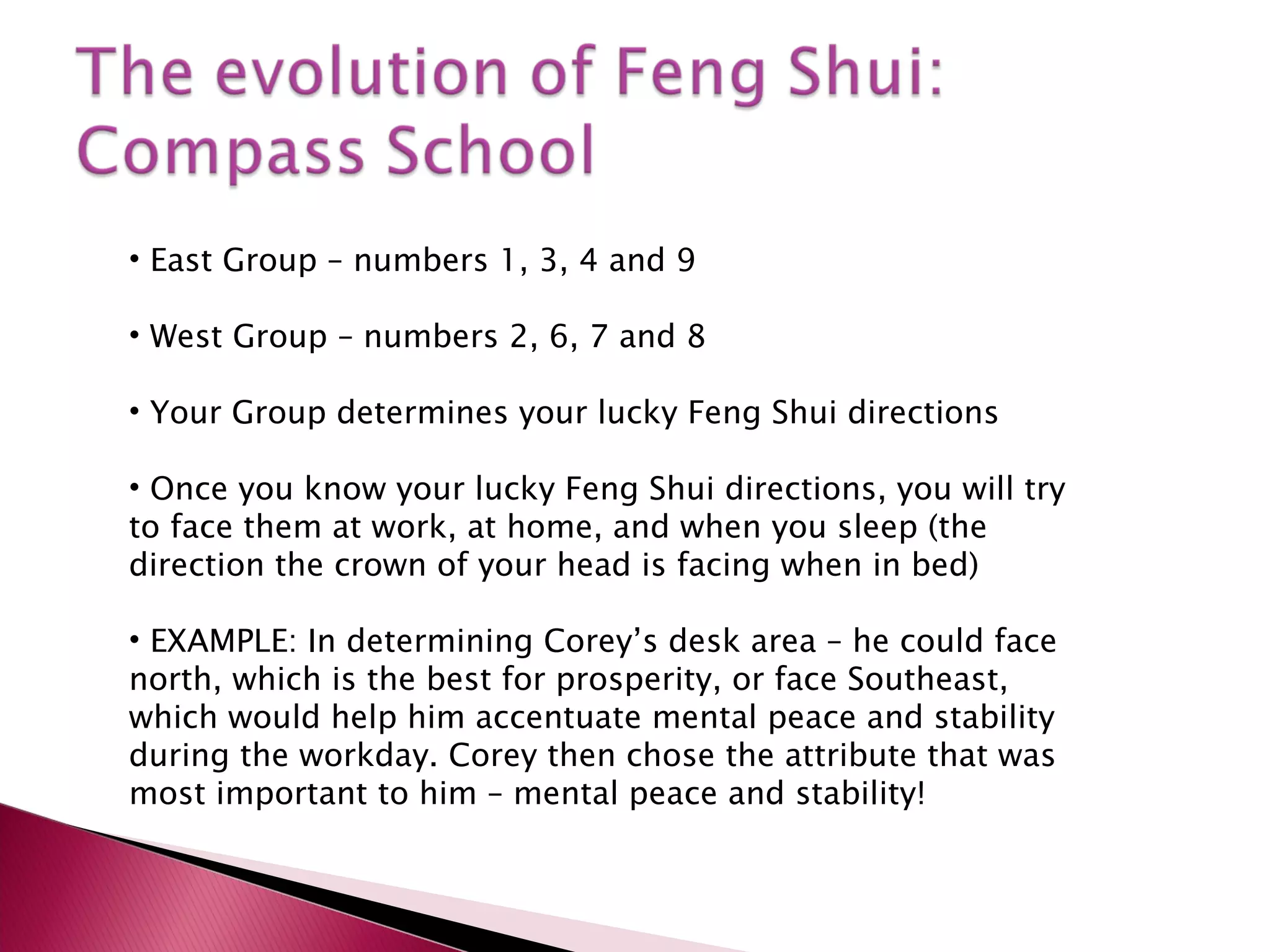
East Group – numbers 1, 3, 4 and 9 West Group – numbers 2, 6, 7 and 8 Your Group determines your lucky Feng Shui directions Once you know your lucky Feng Shui directions, you will try to face them at work, at home, and when you sleep (the direction the crown of your head is facing when in bed) EXAMPLE: In determining Corey’s desk area – he could face north, which is the best for prosperity, or face Southeast, which would help him accentuate mental peace and stability during the workday. Corey then chose the attribute that was most important to him – mental peace and stability!
Developed in the U.S. by Grandmaster Thomas Lin Yun This is a combination of Tibetan Buddhism, Taoism, and Classical Feng Shui My training and certification focused on the application of the principles of this particular school
Staged homes sell  faster  than homes that aren’t staged Staging can add value to your home
Credit crunch: upside down home owners False expectations about the true value of a home Sellers are often unwilling to update or fix problems in order to sell Less buyers are qualifying for mortgages There are more sellers than buyers – it is a buyers market
Home staging often focuses ONLY on the way the house looks to a potential buyer Feng Shui introduces the five senses and considers the buyer’s emotional response to the environment Feng Shui creates a balanced environment where the buyer feels comfortable and “at home” More buyers are becoming Feng Shui “savvy”
Smells or scents can conjure up scenes, emotions  and memories from the past Universally perceived pleasant aromas: vanilla (used widely in perfumes reduces stress and anxiety) and cinnamon (memories, more yang, increases a buyer’s focus)
Pleasant sounds can create harmonic balance Use sounds to mask undesirable noises (traffic, etc) Music is a good marketing tool (customers remain longer in stores where pleasant music is pleasing) For real estate, an extra 5 or 10 minutes can be the deciding factor in the purchase of your home by a potential buyer
Maintain comfortable temperature Optimal temperature for 85% of humans is 68 to 72 degrees Can influence the customer to remain for the extra 5 or 10 minutes
Snacks that can be put out for the buyer can create focus - or promote sleep We want Yang focused feelings
De-cluttering Deep Cleaning Detailing Depersonalizing Dynamizing
Clutter = postponed decisions Resistance to making a decision traps energy De-cluttering improves the flow of Chi
A clean house offers relaxation – messes make us tense. Cleanliness relaxes us.  It takes more energy to deal with a dirty house occasionally than a clean one regularly
Detailing means taking care of necessary repairs Buyers routinely overestimate the severity of problems and the cost of repairs. This creates worry, which is bad for Chi.
Our goal is to create universal appeal Eliminate items that are controversial, religious, potentially offensive or have strong emotional connections Buyers are distracted – they have trouble seeing themselves in a house that they can identify with someone else
Tying all of it together to optimize flow of Chi
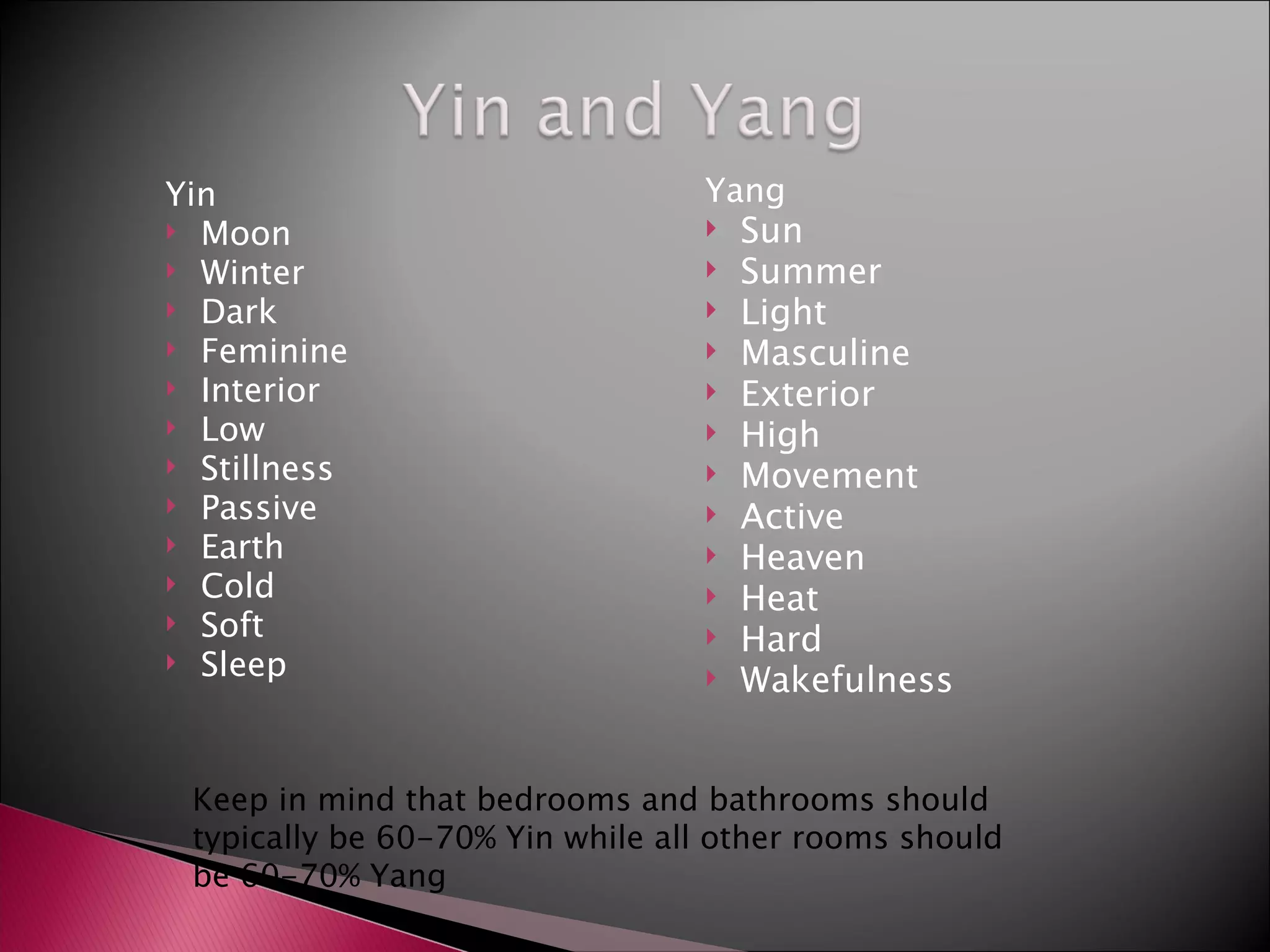
Yin Moon Winter Dark Feminine Interior Low Stillness Passive Earth Cold Soft Sleep Yang Sun Summer Light Masculine Exterior High Movement Active Heaven Heat Hard Wakefulness Keep in mind that bedrooms and bathrooms should typically be 60-70% Yin while all other rooms should be 60-70% Yang
The most important element to the Feng Shui of a house is the surrounding environment A classic Feng Shui locations looks like an “armchair”; - It should have a hill for a back while the side have smaller hills or stand of trees. A perfect Feng Shui site has:  Lush trees Clean water Warm sunshine Gentle breezes These same elements can also work on the interior of a home for example the bedroom. Your bed would be the mountain flanked by matching night stands for the arms or smaller hills.
Curb Appeal Walk to Front Door Front Door Foyer Room of 1 st  Impression Overall Maintenance The Kitchen The Master Suite
Red: most emotionally intense (Yang) Orange: very energetic, stimulates appetite (Very Yang) Yellow: speeds up metabolism, increases appetite (Yang) Remember that neutralized shades of these have broader appeal. Purple: luxury, wealth, calming and gender specific Earth Tone: browns, taupes are solid and reliable and earthy Men like brown. Green: currently the most popular décor color, tranquil but can be vibrant and lively as well (Yin, typically) Blue: cool, calming and relaxing but dark blues can be cold, depressing least gender specific (Yin) White: cleanliness, purity, sterile and harsh Black: authority, power, stylish, timeless, mourning and death  Gray: elegance and humility, makes a wonderful neutral, cozier than white which can be harsh and is the only color that doesn’t elicit a physiological response
Use the rule of 60-30-10 Think of a man dressed formally in a suit: - 60% of his look is the suit color - 30% is the shirt color - 10% is the tie. Use the same proportions in your home. The dominant color (painted walls) should be the 60% of the color in the room. The secondary color (rugs, upholstered furniture, window treatments) should be 30% An accent color (pillows, lamps, art) should be 10%. Improve flow by using the same three colors in all the public areas, but in varying proportions.
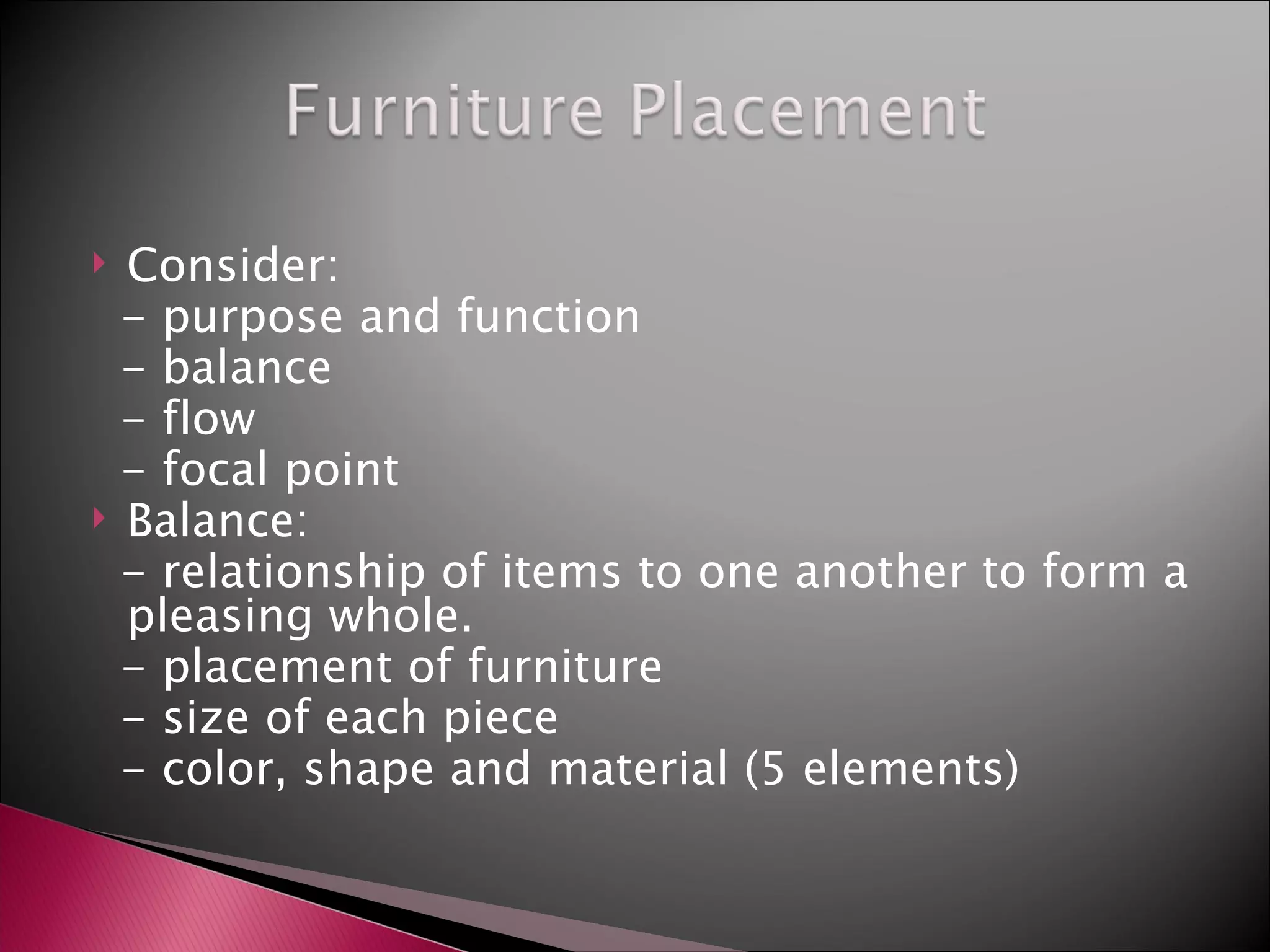
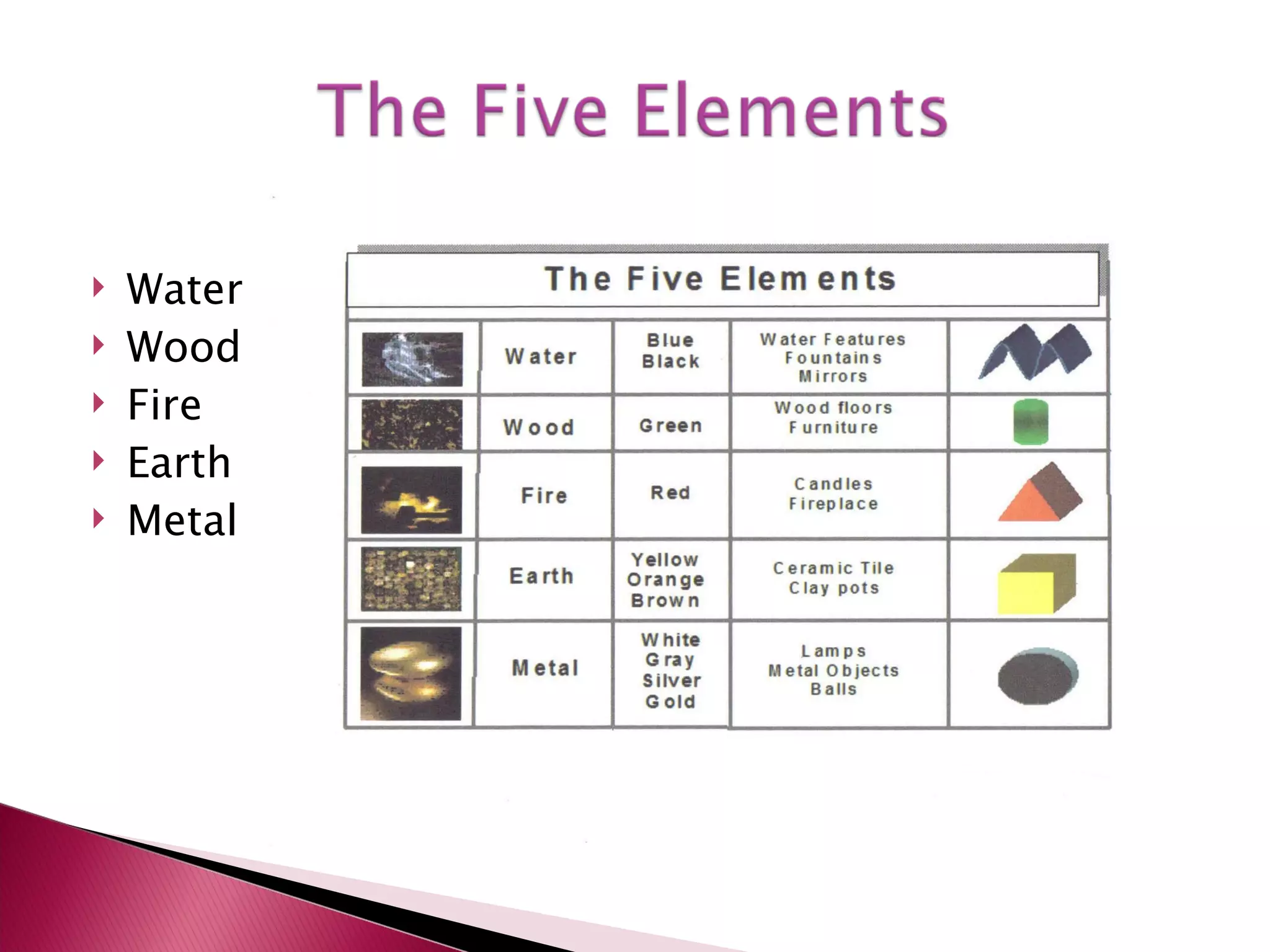
Consider: - purpose and function - balance - flow - focal point Balance: - relationship of items to one another to form a pleasing whole. - placement of furniture - size of each piece - color, shape and material (5 elements)
Water Wood Fire Earth Metal
 
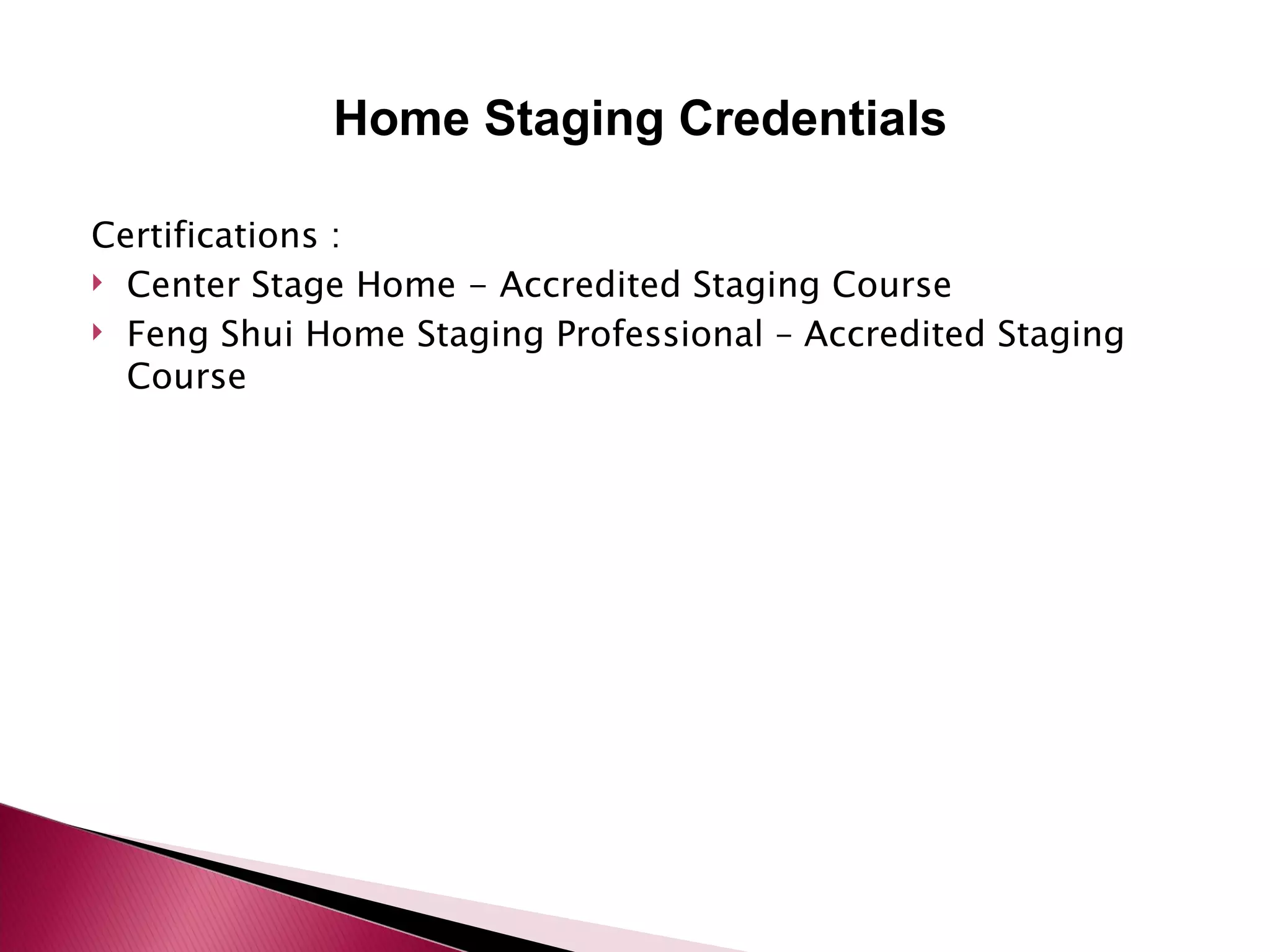
Certifications :  Center Stage Home - Accredited Staging Course Feng Shui Home Staging Professional – Accredited Staging Course Home Staging Credentials

Feng Shui Presentation

  • 1.
    Applying the traditionsof Feng Shui to Home Staging
  • 2.
    Feng shui isthe ancient Chinese art of placement used to create balance, harmony and well-being Feng Shui dates back thousands of years. The practice of Feng Shui began in the West Han dynasty around the third century BC. Feng Shui allows us to live in harmony with the natural world The #1 Goal of Feng Shui – to make sure Chi or energy moves and flows smoothly Chi – energy, life spirit Feng Shui supports the theories of Quantum Physics – everything is made up of particles of energy that are vibrating at different speeds
  • 3.
    Feng Shui isknown throughout by different names India – “Vastu Shastra” Vietnam – “Phong Thuy”(fong twee) Thailand – “Hong Jewee” Korea – “Poonsgoo” Far East, Europe and U.S. - “Feng Shui”
  • 4.
    1 st Century A.D. - The practice of Feng Shui was used at grave sites of relatives Objective: for the dead to rest in peace while the living family enjoyed prosperity Landscape: Used so that the structure or building on the site would be in harmony and balance with it’s surroundings
  • 5.
    Compass School useswhat is known as The Eight Mansions The Eight Mansions: works with a person’s gender and birth date to determine their auspicious number (Gua number) You can use your auspicious number to determine your Feng Shui Group In Compass School, everyone is either an east or west group person
  • 6.
    East Group –numbers 1, 3, 4 and 9 West Group – numbers 2, 6, 7 and 8 Your Group determines your lucky Feng Shui directions Once you know your lucky Feng Shui directions, you will try to face them at work, at home, and when you sleep (the direction the crown of your head is facing when in bed) EXAMPLE: In determining Corey’s desk area – he could face north, which is the best for prosperity, or face Southeast, which would help him accentuate mental peace and stability during the workday. Corey then chose the attribute that was most important to him – mental peace and stability!
  • 7.
    Developed in theU.S. by Grandmaster Thomas Lin Yun This is a combination of Tibetan Buddhism, Taoism, and Classical Feng Shui My training and certification focused on the application of the principles of this particular school
  • 8.
    Staged homes sell faster than homes that aren’t staged Staging can add value to your home
  • 9.
    Credit crunch: upsidedown home owners False expectations about the true value of a home Sellers are often unwilling to update or fix problems in order to sell Less buyers are qualifying for mortgages There are more sellers than buyers – it is a buyers market
  • 10.
    Home staging oftenfocuses ONLY on the way the house looks to a potential buyer Feng Shui introduces the five senses and considers the buyer’s emotional response to the environment Feng Shui creates a balanced environment where the buyer feels comfortable and “at home” More buyers are becoming Feng Shui “savvy”
  • 11.
    Smells or scentscan conjure up scenes, emotions and memories from the past Universally perceived pleasant aromas: vanilla (used widely in perfumes reduces stress and anxiety) and cinnamon (memories, more yang, increases a buyer’s focus)
  • 12.
    Pleasant sounds cancreate harmonic balance Use sounds to mask undesirable noises (traffic, etc) Music is a good marketing tool (customers remain longer in stores where pleasant music is pleasing) For real estate, an extra 5 or 10 minutes can be the deciding factor in the purchase of your home by a potential buyer
  • 13.
    Maintain comfortable temperatureOptimal temperature for 85% of humans is 68 to 72 degrees Can influence the customer to remain for the extra 5 or 10 minutes
  • 14.
    Snacks that canbe put out for the buyer can create focus - or promote sleep We want Yang focused feelings
  • 15.
    De-cluttering Deep CleaningDetailing Depersonalizing Dynamizing
  • 16.
    Clutter = postponeddecisions Resistance to making a decision traps energy De-cluttering improves the flow of Chi
  • 17.
    A clean houseoffers relaxation – messes make us tense. Cleanliness relaxes us. It takes more energy to deal with a dirty house occasionally than a clean one regularly
  • 18.
    Detailing means takingcare of necessary repairs Buyers routinely overestimate the severity of problems and the cost of repairs. This creates worry, which is bad for Chi.
  • 19.
    Our goal isto create universal appeal Eliminate items that are controversial, religious, potentially offensive or have strong emotional connections Buyers are distracted – they have trouble seeing themselves in a house that they can identify with someone else
  • 20.
    Tying all ofit together to optimize flow of Chi
  • 21.
    Yin Moon WinterDark Feminine Interior Low Stillness Passive Earth Cold Soft Sleep Yang Sun Summer Light Masculine Exterior High Movement Active Heaven Heat Hard Wakefulness Keep in mind that bedrooms and bathrooms should typically be 60-70% Yin while all other rooms should be 60-70% Yang
  • 22.
    The most importantelement to the Feng Shui of a house is the surrounding environment A classic Feng Shui locations looks like an “armchair”; - It should have a hill for a back while the side have smaller hills or stand of trees. A perfect Feng Shui site has: Lush trees Clean water Warm sunshine Gentle breezes These same elements can also work on the interior of a home for example the bedroom. Your bed would be the mountain flanked by matching night stands for the arms or smaller hills.
  • 23.
    Curb Appeal Walkto Front Door Front Door Foyer Room of 1 st Impression Overall Maintenance The Kitchen The Master Suite
  • 24.
    Red: most emotionallyintense (Yang) Orange: very energetic, stimulates appetite (Very Yang) Yellow: speeds up metabolism, increases appetite (Yang) Remember that neutralized shades of these have broader appeal. Purple: luxury, wealth, calming and gender specific Earth Tone: browns, taupes are solid and reliable and earthy Men like brown. Green: currently the most popular décor color, tranquil but can be vibrant and lively as well (Yin, typically) Blue: cool, calming and relaxing but dark blues can be cold, depressing least gender specific (Yin) White: cleanliness, purity, sterile and harsh Black: authority, power, stylish, timeless, mourning and death Gray: elegance and humility, makes a wonderful neutral, cozier than white which can be harsh and is the only color that doesn’t elicit a physiological response
  • 25.
    Use the ruleof 60-30-10 Think of a man dressed formally in a suit: - 60% of his look is the suit color - 30% is the shirt color - 10% is the tie. Use the same proportions in your home. The dominant color (painted walls) should be the 60% of the color in the room. The secondary color (rugs, upholstered furniture, window treatments) should be 30% An accent color (pillows, lamps, art) should be 10%. Improve flow by using the same three colors in all the public areas, but in varying proportions.
  • 26.
    Consider: - purposeand function - balance - flow - focal point Balance: - relationship of items to one another to form a pleasing whole. - placement of furniture - size of each piece - color, shape and material (5 elements)
  • 27.
    Water Wood FireEarth Metal
  • 28.
  • 29.
    Certifications : Center Stage Home - Accredited Staging Course Feng Shui Home Staging Professional – Accredited Staging Course Home Staging Credentials