Diabetic Seminar QUENTIN PARK, O.D PARK FAMILY EYE CARE  9 S. LINCOLNWAY NORTH AURORA, IL 60542 OFFICE #: (630) 844-2500
 
Table of Contents Definition of Diabetes The Statistics What is Pre-Diabetes? Optometrist’s Role in Diabetes Managing Diabetic Retinopathy Quick Guide to Eating Out Preventative Health Care and Final Thoughts
Definition of Diabetes Diabetes is a disease in which the body does not produce or properly use insulin. Insulin is a hormone that is needed to convert sugar, starches and other food into energy needed for daily life. The cause of diabetes still remains a mystery, however both genetics and environmental factors such as obesity and lack of exercise appear to play roles.
The Stats Diabetes is one of this nation’s most prevalent, debilitating, deadly and costly diseases 20.8 Million people which is equivalent to 7.0% of the population have diabetes (up from 18.2 million in 2003)
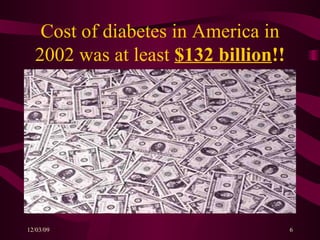
Cost of diabetes in America in 2002 was at least  $132 billion !!
14.6 million people are diagnosed and 6.2 million people are undiagnosed 1.5 million new cases of diabetes were diagnosed in people aged 20 years or older
10.9 million men and 9.7 women aged 20 years or older have diabetes and nearly 1/3 of them do not know it Prevalence of diabetes is at least 2 to 4 times higher among non-Hispanic Black, Hispanic/Latino American, American Indian, and Asian/Pacific Islander
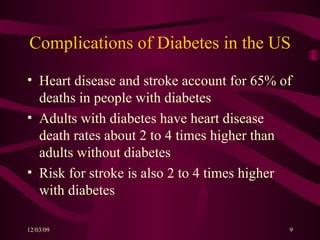
Complications of Diabetes in the US Heart disease and stroke account for 65% of deaths in people with diabetes Adults with diabetes have heart disease death rates about 2 to 4 times higher than adults without diabetes Risk for stroke is also 2 to 4 times higher with diabetes
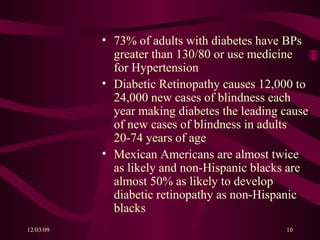
73% of adults with diabetes have BPs greater than 130/80 or use medicine for Hypertension Diabetic Retinopathy causes 12,000 to 24,000 new cases of blindness each year making diabetes the leading cause of new cases of blindness in adults 20-74 years of age Mexican Americans are almost twice as likely and non-Hispanic blacks are almost 50% as likely to develop diabetic retinopathy as non-Hispanic blacks
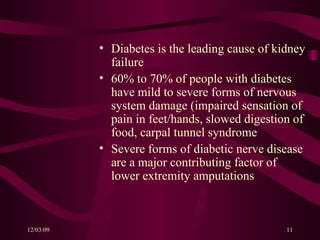
Diabetes is the leading cause of kidney failure 60% to 70% of people with diabetes have mild to severe forms of nervous system damage (impaired sensation of pain in feet/hands, slowed digestion of food, carpal tunnel syndrome Severe forms of diabetic nerve disease are a major contributing factor of lower extremity amputations
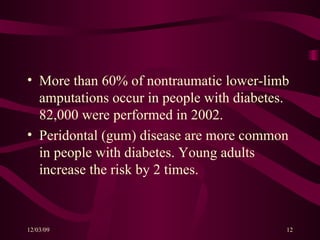
More than 60% of nontraumatic lower-limb amputations occur in people with diabetes. 82,000 were performed in 2002. Peridontal (gum) disease are more common in people with diabetes. Young adults increase the risk by 2 times.
Poor controlled diabetes before conception and during 1 st  trimester can cause major birth defects in 5% to 10% of pregnancies and spontaneous abortions in 15% to 20% of pregnancies Poorly controlled diabetes during the second and third trimesters of pregnancy can result in excessively large babies a risk for both mother and child
What is a Pre Diabetic  Definition: A pre-diabetic is someone whose blood glucose that are higher than normal but not high enough to be diagnosed as diabetes 41 million people in the United States, ages 40 to 74, have pre-diabetes.
How to Tell if You Have    Pre-Diabetes While diabetes and pre-diabetes occur in people of all ages and races, some groups have a higher risk for developing disease than others. Diabetes is more common in the AA, HA, NA, and AA/PI as well as the aged population. This means there are also at  increased risk  for develop Pre-Diabetes.
Test to determine Pre-Diabetes Two test to determine pre-diabetes : fasting plasma glucose  (FPG)   or the oral glucose tolerance test  (OGTT)   Results determine whether you have normal metabolism, pre-diabetes or diabetes. Failure of FPG=> Impaired fasting glucose (IFG) Failure of OGTT => Impaired glucose tolerance (IGT)
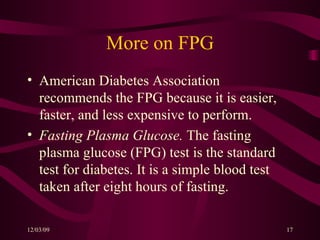
More on FPG American Diabetes Association recommends the FPG because it is easier, faster, and less expensive to perform. Fasting Plasma Glucose.  The fasting plasma glucose (FPG) test is the standard test for diabetes. It is a simple blood test taken after eight hours of fasting.
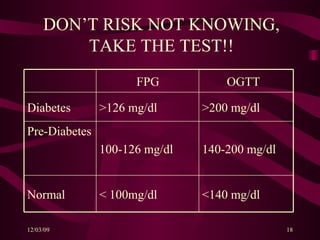
DON’T RISK NOT KNOWING, TAKE THE TEST!! >200 mg/dl >126 mg/dl Diabetes < 100mg/dl 100-126 mg/dl FPG <140 mg/dl Normal 140-200 mg/dl Pre-Diabetes OGTT

Diabetic Seminar

  • 1.
    Diabetic Seminar QUENTINPARK, O.D PARK FAMILY EYE CARE 9 S. LINCOLNWAY NORTH AURORA, IL 60542 OFFICE #: (630) 844-2500
  • 2.
  • 3.
    Table of ContentsDefinition of Diabetes The Statistics What is Pre-Diabetes? Optometrist’s Role in Diabetes Managing Diabetic Retinopathy Quick Guide to Eating Out Preventative Health Care and Final Thoughts
  • 4.
    Definition of DiabetesDiabetes is a disease in which the body does not produce or properly use insulin. Insulin is a hormone that is needed to convert sugar, starches and other food into energy needed for daily life. The cause of diabetes still remains a mystery, however both genetics and environmental factors such as obesity and lack of exercise appear to play roles.
  • 5.
    The Stats Diabetesis one of this nation’s most prevalent, debilitating, deadly and costly diseases 20.8 Million people which is equivalent to 7.0% of the population have diabetes (up from 18.2 million in 2003)
  • 6.
    Cost of diabetesin America in 2002 was at least $132 billion !!
  • 7.
    14.6 million peopleare diagnosed and 6.2 million people are undiagnosed 1.5 million new cases of diabetes were diagnosed in people aged 20 years or older
  • 8.
    10.9 million menand 9.7 women aged 20 years or older have diabetes and nearly 1/3 of them do not know it Prevalence of diabetes is at least 2 to 4 times higher among non-Hispanic Black, Hispanic/Latino American, American Indian, and Asian/Pacific Islander
  • 9.
    Complications of Diabetesin the US Heart disease and stroke account for 65% of deaths in people with diabetes Adults with diabetes have heart disease death rates about 2 to 4 times higher than adults without diabetes Risk for stroke is also 2 to 4 times higher with diabetes
  • 10.
    73% of adultswith diabetes have BPs greater than 130/80 or use medicine for Hypertension Diabetic Retinopathy causes 12,000 to 24,000 new cases of blindness each year making diabetes the leading cause of new cases of blindness in adults 20-74 years of age Mexican Americans are almost twice as likely and non-Hispanic blacks are almost 50% as likely to develop diabetic retinopathy as non-Hispanic blacks
  • 11.
    Diabetes is theleading cause of kidney failure 60% to 70% of people with diabetes have mild to severe forms of nervous system damage (impaired sensation of pain in feet/hands, slowed digestion of food, carpal tunnel syndrome Severe forms of diabetic nerve disease are a major contributing factor of lower extremity amputations
  • 12.
    More than 60%of nontraumatic lower-limb amputations occur in people with diabetes. 82,000 were performed in 2002. Peridontal (gum) disease are more common in people with diabetes. Young adults increase the risk by 2 times.
  • 13.
    Poor controlled diabetesbefore conception and during 1 st trimester can cause major birth defects in 5% to 10% of pregnancies and spontaneous abortions in 15% to 20% of pregnancies Poorly controlled diabetes during the second and third trimesters of pregnancy can result in excessively large babies a risk for both mother and child
  • 14.
    What is aPre Diabetic Definition: A pre-diabetic is someone whose blood glucose that are higher than normal but not high enough to be diagnosed as diabetes 41 million people in the United States, ages 40 to 74, have pre-diabetes.
  • 15.
    How to Tellif You Have Pre-Diabetes While diabetes and pre-diabetes occur in people of all ages and races, some groups have a higher risk for developing disease than others. Diabetes is more common in the AA, HA, NA, and AA/PI as well as the aged population. This means there are also at increased risk for develop Pre-Diabetes.
  • 16.
    Test to determinePre-Diabetes Two test to determine pre-diabetes : fasting plasma glucose (FPG) or the oral glucose tolerance test (OGTT) Results determine whether you have normal metabolism, pre-diabetes or diabetes. Failure of FPG=> Impaired fasting glucose (IFG) Failure of OGTT => Impaired glucose tolerance (IGT)
  • 17.
    More on FPGAmerican Diabetes Association recommends the FPG because it is easier, faster, and less expensive to perform. Fasting Plasma Glucose. The fasting plasma glucose (FPG) test is the standard test for diabetes. It is a simple blood test taken after eight hours of fasting.
  • 18.
    DON’T RISK NOTKNOWING, TAKE THE TEST!! >200 mg/dl >126 mg/dl Diabetes < 100mg/dl 100-126 mg/dl FPG <140 mg/dl Normal 140-200 mg/dl Pre-Diabetes OGTT