ASSISTIVE TECHNOLOGY The Final Piece of The Puzzle
What is it & Why is it necessary? “ The term 'assistive technology device' means any item, piece of equipment, or product system, whether acquired commercially off the shelf, modified, or customized, that is used to increase, maintain, or improve functional capabilities of a child with a disability.” (IDEA) Any item, piece of equipment, or product system, whether acquired commercially or off the shelf, modified, or customized, that is used to increase, maintain, or improve functional capabilities of individuals with disabilities.  www.buffalostate.edu/disabilityservices/glossary.htm A term used to describe all of the tools, products, and devices, from the simplest to the most complex, that can make a particular function easier or possible to perform.  www.nationalmsociety.org/A%20-%20C.asp
Why is AT necessary? “ Consider AT as a bridge between the functional abilities an individual has and what they want to do but cannot due to a disability.”  -- Shelley Haven  http://www.stanford.edu/~rmhaven/philosophy.html#skipATastranslator
Universal Design What is it? - Universal design is the design of products and environments to be usable by all people, to the greatest extent possible, without the need for adaptation or specialized design. –Ron Mace   Seven Principles of? 1.  Equitable Use 2.  Flexibility in Use  3.  Simple and Intuitive Use  4.  Perceptible Information  5.  Tolerance for Error  6.  Low Physical Effort  7.  Size and Space for 8.  Approach and Use  Examples of? - http://www.adaptiveenvironments.org/universal/imagesofud.php?f=7 http://en.wikipedia.org/wiki/Universal_design
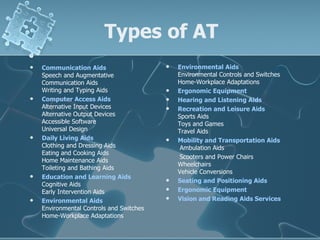
Types of AT Communication Aids   Speech and Augmentative Communication Aids Writing and Typing Aids Computer Access Aids   Alternative Input Devices Alternative Output Devices Accessible Software Universal Design Daily Living Aids   Clothing and Dressing Aids Eating and Cooking Aids Home Maintenance Aids Toileting and Bathing Aids Education and Learning Aids   Cognitive Aids Early Intervention Aids Environmental Aids   Environmental Controls and Switches Home-Workplace Adaptations Environmental Aids   Environmental Controls and Switches Home-Workplace Adaptations Ergonomic Equipment   Hearing and Listening Aids   Recreation and Leisure Aids   Sports Aids Toys and Games Travel Aids Mobility and Transportation Aids    Ambulation Aids     Scooters and Power Chairs Wheelchairs Vehicle Conversions Seating and Positioning Aids Ergonomic Equipment   Vision and Reading Aids Services
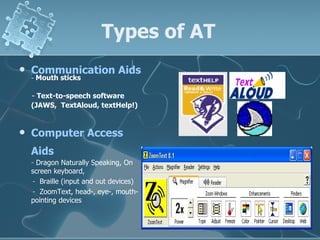
Types of AT  Communication Aids -  Mouth sticks -  Text-to-speech software (JAWS,  TextAloud, textHelp!) Computer Access Aids   -  Dragon Naturally Speaking, On screen keyboard,  -  Braille (input and out devices) -  ZoomText, head-, eye-, mouth-pointing devices
Types  of AT Education and Learning Aids   -   Universal reader, talking word processor, Kurzweil 1000/3000, Word prediction software( WordQ) Inspiration Hearing and Listening Aids -  TTY devices, FM systems, video phones, TV amplifiers Vision and Reading Aids Services -   Braille devices, Screen magnifiers, CCTV units (close-circuit TV), Books on cd/tape (RFBD)
Types of AT Mobility and Transportation Aids -  Scooter, Power Chairs, Vehicle Conversions Recreation and Leisure Aid   -  Sports, Travel, Games
Thinking Outside the Box
ATEC Lab Tour of the lab Equipment available (for use, loan, etc.) Electronic-Text (e-text) Reading Services  Braille Conversion

Assistive Technology

  • 1.
    ASSISTIVE TECHNOLOGY TheFinal Piece of The Puzzle
  • 2.
    What is it& Why is it necessary? “ The term 'assistive technology device' means any item, piece of equipment, or product system, whether acquired commercially off the shelf, modified, or customized, that is used to increase, maintain, or improve functional capabilities of a child with a disability.” (IDEA) Any item, piece of equipment, or product system, whether acquired commercially or off the shelf, modified, or customized, that is used to increase, maintain, or improve functional capabilities of individuals with disabilities. www.buffalostate.edu/disabilityservices/glossary.htm A term used to describe all of the tools, products, and devices, from the simplest to the most complex, that can make a particular function easier or possible to perform. www.nationalmsociety.org/A%20-%20C.asp
  • 3.
    Why is ATnecessary? “ Consider AT as a bridge between the functional abilities an individual has and what they want to do but cannot due to a disability.” -- Shelley Haven http://www.stanford.edu/~rmhaven/philosophy.html#skipATastranslator
  • 4.
    Universal Design Whatis it? - Universal design is the design of products and environments to be usable by all people, to the greatest extent possible, without the need for adaptation or specialized design. –Ron Mace Seven Principles of? 1. Equitable Use 2. Flexibility in Use 3. Simple and Intuitive Use 4. Perceptible Information 5. Tolerance for Error 6. Low Physical Effort 7. Size and Space for 8. Approach and Use Examples of? - http://www.adaptiveenvironments.org/universal/imagesofud.php?f=7 http://en.wikipedia.org/wiki/Universal_design
  • 5.
    Types of ATCommunication Aids Speech and Augmentative Communication Aids Writing and Typing Aids Computer Access Aids Alternative Input Devices Alternative Output Devices Accessible Software Universal Design Daily Living Aids Clothing and Dressing Aids Eating and Cooking Aids Home Maintenance Aids Toileting and Bathing Aids Education and Learning Aids Cognitive Aids Early Intervention Aids Environmental Aids Environmental Controls and Switches Home-Workplace Adaptations Environmental Aids Environmental Controls and Switches Home-Workplace Adaptations Ergonomic Equipment Hearing and Listening Aids Recreation and Leisure Aids Sports Aids Toys and Games Travel Aids Mobility and Transportation Aids  Ambulation Aids     Scooters and Power Chairs Wheelchairs Vehicle Conversions Seating and Positioning Aids Ergonomic Equipment Vision and Reading Aids Services
  • 6.
    Types of AT Communication Aids - Mouth sticks - Text-to-speech software (JAWS, TextAloud, textHelp!) Computer Access Aids - Dragon Naturally Speaking, On screen keyboard, - Braille (input and out devices) - ZoomText, head-, eye-, mouth-pointing devices
  • 7.
    Types ofAT Education and Learning Aids - Universal reader, talking word processor, Kurzweil 1000/3000, Word prediction software( WordQ) Inspiration Hearing and Listening Aids - TTY devices, FM systems, video phones, TV amplifiers Vision and Reading Aids Services - Braille devices, Screen magnifiers, CCTV units (close-circuit TV), Books on cd/tape (RFBD)
  • 8.
    Types of ATMobility and Transportation Aids - Scooter, Power Chairs, Vehicle Conversions Recreation and Leisure Aid - Sports, Travel, Games
  • 9.
  • 10.
    ATEC Lab Tourof the lab Equipment available (for use, loan, etc.) Electronic-Text (e-text) Reading Services Braille Conversion