Today we will learn our ABCDs!!!
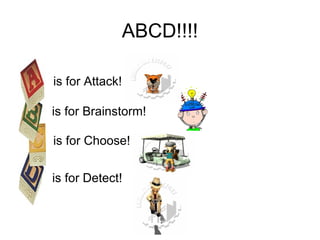
ABCD!!!! A  is for Attack! B  is for Brainstorm! C  is for Choose! D  is for Detect!
When given a writing prompt… You need to remember your ABCDs Attack the prompt Brainstorm possible answers Choose the order of your response Detect errors before turning the draft in
A is for Attack the Prompt! If students don’t know how to attack a prompt they may find themselves distracted by the verbiage. The first half of the prompt sets the situation The second half of the prompt contains the writing directions
Attack the Prompt! Identify the portion of the prompt that contains the directions and mark that.  2. Highlight any words that ask you to do something (verbs). 3. Underline what the verbs ask you to do. 4. Summarize your directions under the prompt adding a spot for the author’s full name and your thesis. 5. Underline the author’s main points in the prompt and identify the author’s thesis.
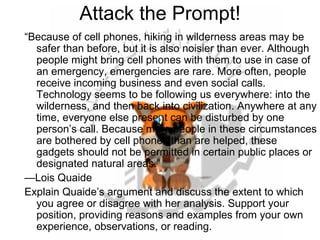
Attack the Prompt! “ Because of cell phones, hiking in wilderness areas may be safer than before, but it is also noisier than ever. Although people might bring cell phones with them to use in case of an emergency, emergencies are rare. More often, people receive incoming business and even social calls. Technology seems to be following us everywhere: into the wilderness, and then back into civilization. Anywhere at any time, everyone else present can be disturbed by one person’s call. Because more people in these circumstances are bothered by cell phones than are helped, these gadgets should not be permitted in certain public places or designated natural areas.” — Lois Quaide Explain Quaide’s argument and discuss the extent to which you agree or disagree with her analysis. Support your position, providing reasons and examples from your own experience, observations, or reading.
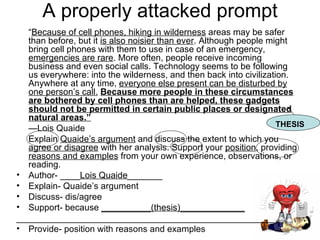
A properly attacked prompt “ Because of cell phones, hiking in wilderness  areas may be safer than before, but it  is also noisier than ever . Although people might bring cell phones with them to use in case of an emergency,  emergencies are rare . More often, people receive incoming business and even social calls. Technology seems to be following us everywhere: into the wilderness, and then back into civilization. Anywhere at any time,  everyone else present can be disturbed by one person’s call.   Because more people in these circumstances are bothered by cell phones than are helped, these gadgets should not be permitted in certain public places or designated natural areas.”   — Lois Quaide Explain  Quaide’s argument  and discuss the extent to which you  agree or disagree  with her analysis. Support your  position , providing  reasons and examples  from your own experience, observations, or reading. Author- ____ Lois Quaide _______ Explain- Quaide’s argument Discuss- dis/agree  Support- because  __________(thesis)_____________ ____________________________________________________ Provide- position with reasons and examples THESIS
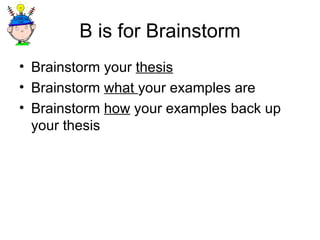
B is for Brainstorm Brainstorm your  thesis Brainstorm  what  your examples are Brainstorm  how  your examples back up your thesis
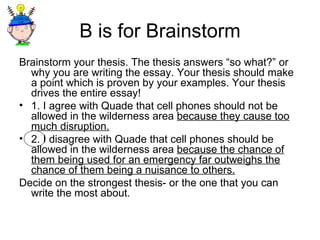
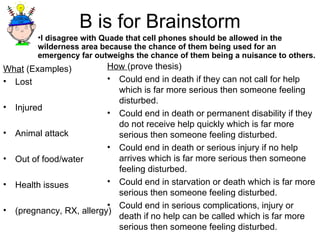
B is for Brainstorm Brainstorm your thesis. The thesis answers “so what?” or why you are writing the essay. Your thesis should make a point which is proven by your examples. Your thesis drives the entire essay! 1. I agree with Quade that cell phones should not be allowed in the wilderness area  because they cause too much disruption. 2. I disagree with Quade that cell phones should be allowed in the wilderness area  because the chance of them being used for an emergency far outweighs the chance of them being a nuisance to others. Decide on the strongest thesis- or the one that you can write the most about.
B is for Brainstorm What  (Examples) Lost Injured Animal attack Out of food/water Health issues  (pregnancy, RX, allergy) How  (prove thesis) Could end in death if they can not call for help which is far more serious then someone feeling disturbed. Could end in death or permanent disability if they do not receive help quickly which is far more serious then someone feeling disturbed. Could end in death or serious injury if no help arrives which is far more serious then someone feeling disturbed. Could end in starvation or death which is far more serious then someone feeling disturbed. Could end in serious complications, injury or death if no help can be called which is far more serious then someone feeling disturbed. I disagree with Quade that cell phones should be allowed in the wilderness area because the chance of them being used for an emergency far outweighs the chance of them being a nuisance to others.
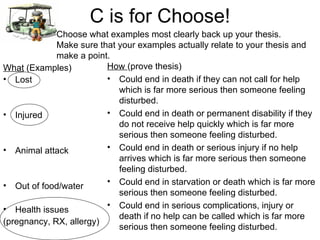
C is for Choose! What  (Examples) Lost Injured Animal attack Out of food/water Health issues  (pregnancy, RX, allergy) How  (prove thesis) Could end in death if they can not call for help which is far more serious then someone feeling disturbed. Could end in death or permanent disability if they do not receive help quickly which is far more serious then someone feeling disturbed. Could end in death or serious injury if no help arrives which is far more serious then someone feeling disturbed. Could end in starvation or death which is far more serious then someone feeling disturbed. Could end in serious complications, injury or death if no help can be called which is far more serious then someone feeling disturbed. Choose what examples most clearly back up your thesis.  Make sure that your examples actually relate to your thesis and make a point.
D is for Detect Errors  After writing your first draft, take the time to reread the essay out loud to detect any errors. Often times your brain knows what you mean to say and will self edit your paper as you read, unfortunately many of these edits you do not make it to your paper. Turn your self edit off by reading the paper out loud (mumble to yourself) which will force your ears to edit the paper instead of your brain. Your ears to not know what your brain means and so it will catch many more errors in your paper then rereading the essay silently to yourself.
What I expect- I do not expect my students to write mistake-free essays in on-demand writing situations; I do, however, expect them to reread their essays carefully before turning them in, in order to detect at least some of their first-draft errors. Common errors include Using symbols instead of words- 24/7 instead of twenty-four hours, seven days a week. Leaving words out your sentence because don’t reread your essay. CaptiaLizinG thinGS thAt Should not BE capitalizeD because it is apart of your “handwriting”.
ABCDs A is for__________ B is for _________ C is for _________ D is for _________ Why is this important? When do you use the ABCDs?
Let’s Practice "It is painfully apparent today that millions of Americans who would never think of themselves as lawbreakers, let alone criminals, are taking increasing liberties with all sorts of ’minor’ laws that are nonetheless designed to protect and nourish society. When it comes to tax codes, or laws against littering or speeding or noise pollution, more and more ordinary citizens are becoming scofflaws [people who casually break the law]. The slogan of the day seems to be, 'You're a fool if you obey the rules.' Americans are used to thinking that law-and-order is threatened mainly by violent crime. But the foundations of social order are more profoundly shaken when ordinary law-abiding citizens take to skirting the law."  ---Adapted from Frank Trippett’s "A Red Light for Scofflaws"  Explain Trippett's argument and discuss the extent to which you agree or disagree with his analysis. Support your position, providing reasons and examples from your own experience, observations, or reading.
The Canterbury Tales Essay Prompt #3 “ Chaucer's long poem follows the journey of a group of pilgrims, 31 including Chaucer himself, from the Tabard Inn in Southwark to St Thomas à Becket's shrine at Canterbury Cathedral. The host at the inn suggests each pilgrim tell two tales on the way out and two on the way home to help while away their time on the road. The best storyteller is to be rewarded with a free supper on their return.  [Using the literary device of a frame story] gives Chaucer the opportunity to paint a series of vivid word portraits of a cross-section of his society, from a knight and prioress, to a carpenter and cook; a much-married wife of Bath, to a bawdy miller - an occupation regarded in Chaucer's day as shifty and dishonest.  Chaucer mixes satire and realism in lively characterizations of his pilgrims. The tone of their tales ranges from pious to comic, with humor veering between erudite wit and good honest vulgarity. Taken together, the tales offer a fascinating insight into English life during the late 14th century.”  - British Library Explain the British Library’s argument and discuss the extent to which you agree or disagree with their analysis. Support your position, providing reasons and examples from your own experience, observations, or reading. More Practice…
Today’s lesson is brought to you by the letters

EAP Essay Prep

  • 1.
    Today we willlearn our ABCDs!!!
  • 2.
    ABCD!!!! A is for Attack! B is for Brainstorm! C is for Choose! D is for Detect!
  • 3.
    When given awriting prompt… You need to remember your ABCDs Attack the prompt Brainstorm possible answers Choose the order of your response Detect errors before turning the draft in
  • 4.
    A is forAttack the Prompt! If students don’t know how to attack a prompt they may find themselves distracted by the verbiage. The first half of the prompt sets the situation The second half of the prompt contains the writing directions
  • 5.
    Attack the Prompt!Identify the portion of the prompt that contains the directions and mark that. 2. Highlight any words that ask you to do something (verbs). 3. Underline what the verbs ask you to do. 4. Summarize your directions under the prompt adding a spot for the author’s full name and your thesis. 5. Underline the author’s main points in the prompt and identify the author’s thesis.
  • 6.
    Attack the Prompt!“ Because of cell phones, hiking in wilderness areas may be safer than before, but it is also noisier than ever. Although people might bring cell phones with them to use in case of an emergency, emergencies are rare. More often, people receive incoming business and even social calls. Technology seems to be following us everywhere: into the wilderness, and then back into civilization. Anywhere at any time, everyone else present can be disturbed by one person’s call. Because more people in these circumstances are bothered by cell phones than are helped, these gadgets should not be permitted in certain public places or designated natural areas.” — Lois Quaide Explain Quaide’s argument and discuss the extent to which you agree or disagree with her analysis. Support your position, providing reasons and examples from your own experience, observations, or reading.
  • 7.
    A properly attackedprompt “ Because of cell phones, hiking in wilderness areas may be safer than before, but it is also noisier than ever . Although people might bring cell phones with them to use in case of an emergency, emergencies are rare . More often, people receive incoming business and even social calls. Technology seems to be following us everywhere: into the wilderness, and then back into civilization. Anywhere at any time, everyone else present can be disturbed by one person’s call. Because more people in these circumstances are bothered by cell phones than are helped, these gadgets should not be permitted in certain public places or designated natural areas.” — Lois Quaide Explain Quaide’s argument and discuss the extent to which you agree or disagree with her analysis. Support your position , providing reasons and examples from your own experience, observations, or reading. Author- ____ Lois Quaide _______ Explain- Quaide’s argument Discuss- dis/agree Support- because __________(thesis)_____________ ____________________________________________________ Provide- position with reasons and examples THESIS
  • 8.
    B is forBrainstorm Brainstorm your thesis Brainstorm what your examples are Brainstorm how your examples back up your thesis
  • 9.
    B is forBrainstorm Brainstorm your thesis. The thesis answers “so what?” or why you are writing the essay. Your thesis should make a point which is proven by your examples. Your thesis drives the entire essay! 1. I agree with Quade that cell phones should not be allowed in the wilderness area because they cause too much disruption. 2. I disagree with Quade that cell phones should be allowed in the wilderness area because the chance of them being used for an emergency far outweighs the chance of them being a nuisance to others. Decide on the strongest thesis- or the one that you can write the most about.
  • 10.
    B is forBrainstorm What (Examples) Lost Injured Animal attack Out of food/water Health issues (pregnancy, RX, allergy) How (prove thesis) Could end in death if they can not call for help which is far more serious then someone feeling disturbed. Could end in death or permanent disability if they do not receive help quickly which is far more serious then someone feeling disturbed. Could end in death or serious injury if no help arrives which is far more serious then someone feeling disturbed. Could end in starvation or death which is far more serious then someone feeling disturbed. Could end in serious complications, injury or death if no help can be called which is far more serious then someone feeling disturbed. I disagree with Quade that cell phones should be allowed in the wilderness area because the chance of them being used for an emergency far outweighs the chance of them being a nuisance to others.
  • 11.
    C is forChoose! What (Examples) Lost Injured Animal attack Out of food/water Health issues (pregnancy, RX, allergy) How (prove thesis) Could end in death if they can not call for help which is far more serious then someone feeling disturbed. Could end in death or permanent disability if they do not receive help quickly which is far more serious then someone feeling disturbed. Could end in death or serious injury if no help arrives which is far more serious then someone feeling disturbed. Could end in starvation or death which is far more serious then someone feeling disturbed. Could end in serious complications, injury or death if no help can be called which is far more serious then someone feeling disturbed. Choose what examples most clearly back up your thesis. Make sure that your examples actually relate to your thesis and make a point.
  • 12.
    D is forDetect Errors After writing your first draft, take the time to reread the essay out loud to detect any errors. Often times your brain knows what you mean to say and will self edit your paper as you read, unfortunately many of these edits you do not make it to your paper. Turn your self edit off by reading the paper out loud (mumble to yourself) which will force your ears to edit the paper instead of your brain. Your ears to not know what your brain means and so it will catch many more errors in your paper then rereading the essay silently to yourself.
  • 13.
    What I expect-I do not expect my students to write mistake-free essays in on-demand writing situations; I do, however, expect them to reread their essays carefully before turning them in, in order to detect at least some of their first-draft errors. Common errors include Using symbols instead of words- 24/7 instead of twenty-four hours, seven days a week. Leaving words out your sentence because don’t reread your essay. CaptiaLizinG thinGS thAt Should not BE capitalizeD because it is apart of your “handwriting”.
  • 14.
    ABCDs A isfor__________ B is for _________ C is for _________ D is for _________ Why is this important? When do you use the ABCDs?
  • 15.
    Let’s Practice "Itis painfully apparent today that millions of Americans who would never think of themselves as lawbreakers, let alone criminals, are taking increasing liberties with all sorts of ’minor’ laws that are nonetheless designed to protect and nourish society. When it comes to tax codes, or laws against littering or speeding or noise pollution, more and more ordinary citizens are becoming scofflaws [people who casually break the law]. The slogan of the day seems to be, 'You're a fool if you obey the rules.' Americans are used to thinking that law-and-order is threatened mainly by violent crime. But the foundations of social order are more profoundly shaken when ordinary law-abiding citizens take to skirting the law." ---Adapted from Frank Trippett’s "A Red Light for Scofflaws" Explain Trippett's argument and discuss the extent to which you agree or disagree with his analysis. Support your position, providing reasons and examples from your own experience, observations, or reading.
  • 16.
    The Canterbury TalesEssay Prompt #3 “ Chaucer's long poem follows the journey of a group of pilgrims, 31 including Chaucer himself, from the Tabard Inn in Southwark to St Thomas à Becket's shrine at Canterbury Cathedral. The host at the inn suggests each pilgrim tell two tales on the way out and two on the way home to help while away their time on the road. The best storyteller is to be rewarded with a free supper on their return. [Using the literary device of a frame story] gives Chaucer the opportunity to paint a series of vivid word portraits of a cross-section of his society, from a knight and prioress, to a carpenter and cook; a much-married wife of Bath, to a bawdy miller - an occupation regarded in Chaucer's day as shifty and dishonest. Chaucer mixes satire and realism in lively characterizations of his pilgrims. The tone of their tales ranges from pious to comic, with humor veering between erudite wit and good honest vulgarity. Taken together, the tales offer a fascinating insight into English life during the late 14th century.” - British Library Explain the British Library’s argument and discuss the extent to which you agree or disagree with their analysis. Support your position, providing reasons and examples from your own experience, observations, or reading. More Practice…
  • 17.
    Today’s lesson isbrought to you by the letters