MANAGEMENT

RICHARD L. DAFT
Managing in a Global
      Environment
CHAPTER 4
chapter4                            Learning Outcomes
•   Describe the emerging borderless world and some issues of particular
    concern for today’s managers.
•   Describe market entry strategies that business use to develop foreign
    markets.
•   Define international management and explain how it differs from the
    management of domestic business operations.
•   Indicate how dissimilarities in the economic, sociocultural, and legal-
    political environments throughout the world can affect business
    operations.
•   Describe how regional trading alliances are reshaping the international
    business environment.
•   Describe the characteristics of a multinational corporation.
•   Explain cultural intelligence and why it is necessary for managers working
    in foreign countries.
                                                           3
Are You Ready To Work
chapter4
                           Internationally?
 • Cross-cultural skills are extremely important

 • Every manager needs to think globally

 • The future of business and society is being
   shaped by global relationships

 • A global mind-set is becoming a prerequisite
   for managers

                                     4
chapter4                A Borderless World

 • Isolation from international forces is no
   longer possible
   – Trade barriers are falling
   – Communication is faster and cheaper
   – Consumer tastes are converging

 • Virtual connections enable close, rapid
   coordination among people working in
   different parts of the world
                                      5
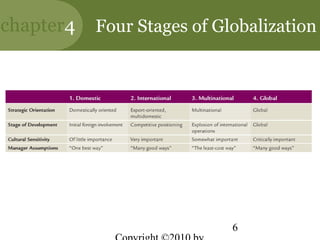
chapter4   Four Stages of Globalization


                            6
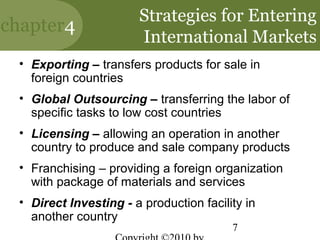
Strategies for Entering
chapter4
                       International Markets
 • Exporting – transfers products for sale in
   foreign countries
 • Global Outsourcing – transferring the labor of
   specific tasks to low cost countries
 • Licensing – allowing an operation in another
   country to produce and sale company products
 • Franchising – providing a foreign organization
   with package of materials and services
 • Direct Investing - a production facility in
   another country
                                         7
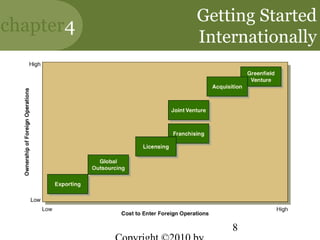
Getting Started
chapter4
           Internationally


               8
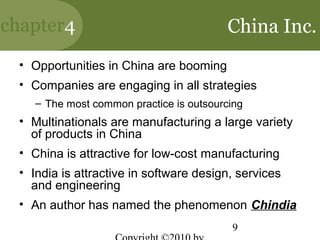
chapter4                                 China Inc.
 • Opportunities in China are booming
 • Companies are engaging in all strategies
    – The most common practice is outsourcing
 • Multinationals are manufacturing a large variety
   of products in China
 • China is attractive for low-cost manufacturing
 • India is attractive in software design, services
   and engineering
 • An author has named the phenomenon Chindia
                                          9
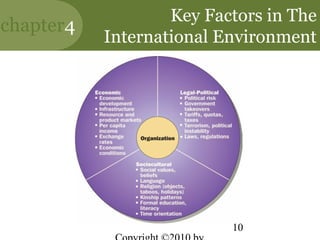
Key Factors in The
chapter4
           International Environment


                          10
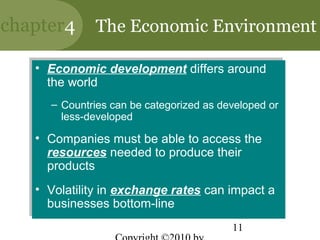
chapter4      The Economic Environment

   •• Economic development differs around
       Economic development differs around
      the world
       the world
     – Countries can be categorized as developed or
     – Countries can be categorized as developed or
       less-developed
        less-developed
   •• Companies must be able to access the
       Companies must be able to access the
      resources needed to produce their
       resources needed to produce their
      products
       products
   •• Volatility in exchange rates can impact a
      Volatility in exchange rates can impact a
      businesses bottom-line
      businesses bottom-line
                                         11
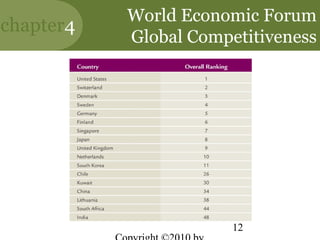
World Economic Forum
chapter4
           Global Competitiveness


                       12
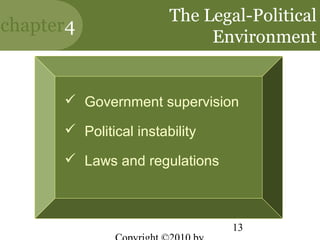
The Legal-Political
chapter4
                             Environment


       Government supervision

       Political instability

       Laws and regulations


                                13
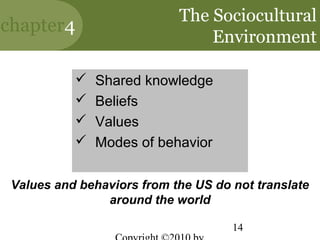
The Sociocultural
chapter4
                                Environment

              Shared knowledge
              Beliefs
              Values
              Modes of behavior

 Values and behaviors from the US do not translate
                around the world

                                     14
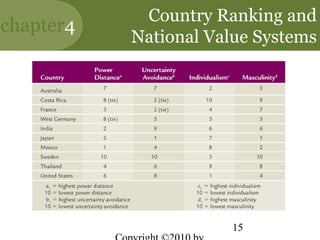
Country Ranking and
chapter4
           National Value Systems


                       15
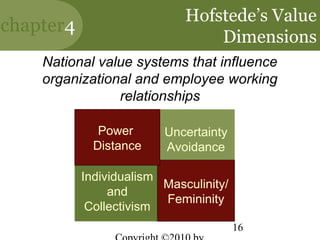
Hofstede’s Value
chapter4
                                 Dimensions
    National value systems that influence
    organizational and employee working
                relationships

              Power      Uncertainty
             Distance    Avoidance

           Individualism
                         Masculinity/
                and
                         Femininity
            Collectivism
                                        16
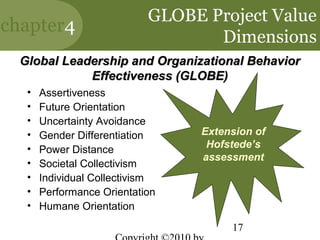
GLOBE Project Value
chapter4
                                   Dimensions
  Global Leadership and Organizational Behavior
             Effectiveness (GLOBE)
   •   Assertiveness
   •   Future Orientation
   •   Uncertainty Avoidance
   •   Gender Differentiation     Extension of
   •   Power Distance              Hofstede’s
                                  assessment
   •   Societal Collectivism
   •   Individual Collectivism
   •   Performance Orientation
   •   Humane Orientation
                                       17
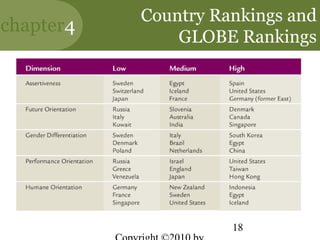
Country Rankings and
chapter4
               GLOBE Rankings


                     18
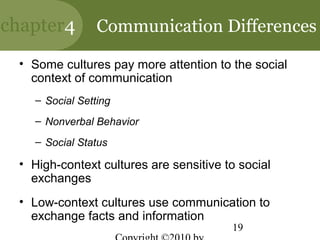
chapter4        Communication Differences

 • Some cultures pay more attention to the social
   context of communication
   – Social Setting
   – Nonverbal Behavior
   – Social Status

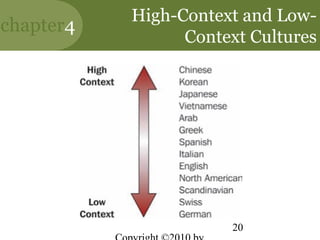
 • High-context cultures are sensitive to social
   exchanges
 • Low-context cultures use communication to
   exchange facts and information
                                        19
High-Context and Low-
chapter4
                 Context Cultures


                      20
Other Cultural
chapter4
                            Characteristics
            Language
            Religion
            Social Organization
            Education
            Attitudes


                                   21
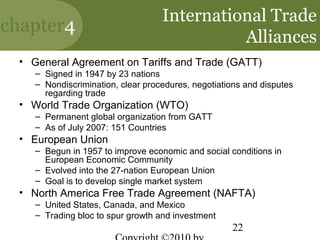
International Trade
chapter4
                                             Alliances
 • General Agreement on Tariffs and Trade (GATT)
    – Signed in 1947 by 23 nations
    – Nondiscrimination, clear procedures, negotiations and disputes
      regarding trade
 • World Trade Organization (WTO)
    – Permanent global organization from GATT
    – As of July 2007: 151 Countries
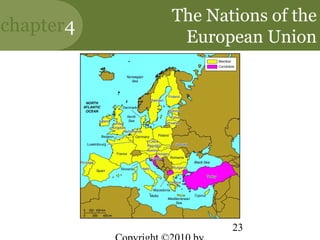
 • European Union
    – Begun in 1957 to improve economic and social conditions in
      European Economic Community
    – Evolved into the 27-nation European Union
    – Goal is to develop single market system
 • North America Free Trade Agreement (NAFTA)
    – United States, Canada, and Mexico
    – Trading bloc to spur growth and investment
                                                    22
The Nations of the
chapter4
            European Union


                  23
chapter4      The Globalization Backlash

 • As the world becomes more global, a
   backlash is growing
 • 68% of American say other countries
   benefit more from trade
 • One of the key concerns is job loss
 • Many argue that globalization benefits the
   economy
                                   24
chapter4      Multinational Corporations
    • More than 25% of its total sales revenue
      come from outside the home country
    • In 2007, 42% of the global sales of US
      multinationals come from their foreign
      affiliates
    • An MNC is managed as an integrated
      business system
    • MNCs are controlled by a single
      management authority
    • MNC managers have a global
      perspective
                                        25
Managing In A Global
chapter4
                                Environment
 • Developing Cultural Intelligence
   – Cultural flexibility and ability to adapt
   – Cognitive, emotional and physical
 • Managing Cross-Culturally
   – Expatriates can be successful by focusing on:
      •   Human Resources
      •   Leading
      •   Decision Making
      •   Motivating

                                           26

9e daftchapter4

  • 1.
  • 2.
    Managing in aGlobal Environment CHAPTER 4
  • 3.
    chapter4 Learning Outcomes • Describe the emerging borderless world and some issues of particular concern for today’s managers. • Describe market entry strategies that business use to develop foreign markets. • Define international management and explain how it differs from the management of domestic business operations. • Indicate how dissimilarities in the economic, sociocultural, and legal- political environments throughout the world can affect business operations. • Describe how regional trading alliances are reshaping the international business environment. • Describe the characteristics of a multinational corporation. • Explain cultural intelligence and why it is necessary for managers working in foreign countries. 3
  • 4.
    Are You ReadyTo Work chapter4 Internationally? • Cross-cultural skills are extremely important • Every manager needs to think globally • The future of business and society is being shaped by global relationships • A global mind-set is becoming a prerequisite for managers 4
  • 5.
    chapter4 A Borderless World • Isolation from international forces is no longer possible – Trade barriers are falling – Communication is faster and cheaper – Consumer tastes are converging • Virtual connections enable close, rapid coordination among people working in different parts of the world 5
  • 6.
    chapter4 Four Stages of Globalization 6
  • 7.
    Strategies for Entering chapter4 International Markets • Exporting – transfers products for sale in foreign countries • Global Outsourcing – transferring the labor of specific tasks to low cost countries • Licensing – allowing an operation in another country to produce and sale company products • Franchising – providing a foreign organization with package of materials and services • Direct Investing - a production facility in another country 7
  • 8.
    Getting Started chapter4 Internationally 8
  • 9.
    chapter4 China Inc. • Opportunities in China are booming • Companies are engaging in all strategies – The most common practice is outsourcing • Multinationals are manufacturing a large variety of products in China • China is attractive for low-cost manufacturing • India is attractive in software design, services and engineering • An author has named the phenomenon Chindia 9
  • 10.
    Key Factors inThe chapter4 International Environment 10
  • 11.
    chapter4 The Economic Environment •• Economic development differs around Economic development differs around the world the world – Countries can be categorized as developed or – Countries can be categorized as developed or less-developed less-developed •• Companies must be able to access the Companies must be able to access the resources needed to produce their resources needed to produce their products products •• Volatility in exchange rates can impact a Volatility in exchange rates can impact a businesses bottom-line businesses bottom-line 11
  • 12.
    World Economic Forum chapter4 Global Competitiveness 12
  • 13.
    The Legal-Political chapter4 Environment  Government supervision  Political instability  Laws and regulations 13
  • 14.
    The Sociocultural chapter4 Environment  Shared knowledge  Beliefs  Values  Modes of behavior Values and behaviors from the US do not translate around the world 14
  • 15.
    Country Ranking and chapter4 National Value Systems 15
  • 16.
    Hofstede’s Value chapter4 Dimensions National value systems that influence organizational and employee working relationships Power Uncertainty Distance Avoidance Individualism Masculinity/ and Femininity Collectivism 16
  • 17.
    GLOBE Project Value chapter4 Dimensions Global Leadership and Organizational Behavior Effectiveness (GLOBE) • Assertiveness • Future Orientation • Uncertainty Avoidance • Gender Differentiation Extension of • Power Distance Hofstede’s assessment • Societal Collectivism • Individual Collectivism • Performance Orientation • Humane Orientation 17
  • 18.
  • 19.
    chapter4 Communication Differences • Some cultures pay more attention to the social context of communication – Social Setting – Nonverbal Behavior – Social Status • High-context cultures are sensitive to social exchanges • Low-context cultures use communication to exchange facts and information 19
  • 20.
  • 21.
    Other Cultural chapter4 Characteristics  Language  Religion  Social Organization  Education  Attitudes 21
  • 22.
    International Trade chapter4 Alliances • General Agreement on Tariffs and Trade (GATT) – Signed in 1947 by 23 nations – Nondiscrimination, clear procedures, negotiations and disputes regarding trade • World Trade Organization (WTO) – Permanent global organization from GATT – As of July 2007: 151 Countries • European Union – Begun in 1957 to improve economic and social conditions in European Economic Community – Evolved into the 27-nation European Union – Goal is to develop single market system • North America Free Trade Agreement (NAFTA) – United States, Canada, and Mexico – Trading bloc to spur growth and investment 22
  • 23.
    The Nations ofthe chapter4 European Union 23
  • 24.
    chapter4 The Globalization Backlash • As the world becomes more global, a backlash is growing • 68% of American say other countries benefit more from trade • One of the key concerns is job loss • Many argue that globalization benefits the economy 24
  • 25.
    chapter4 Multinational Corporations • More than 25% of its total sales revenue come from outside the home country • In 2007, 42% of the global sales of US multinationals come from their foreign affiliates • An MNC is managed as an integrated business system • MNCs are controlled by a single management authority • MNC managers have a global perspective 25
  • 26.
    Managing In AGlobal chapter4 Environment • Developing Cultural Intelligence – Cultural flexibility and ability to adapt – Cognitive, emotional and physical • Managing Cross-Culturally – Expatriates can be successful by focusing on: • Human Resources • Leading • Decision Making • Motivating 26