!1Student Name: Click here to enter text.
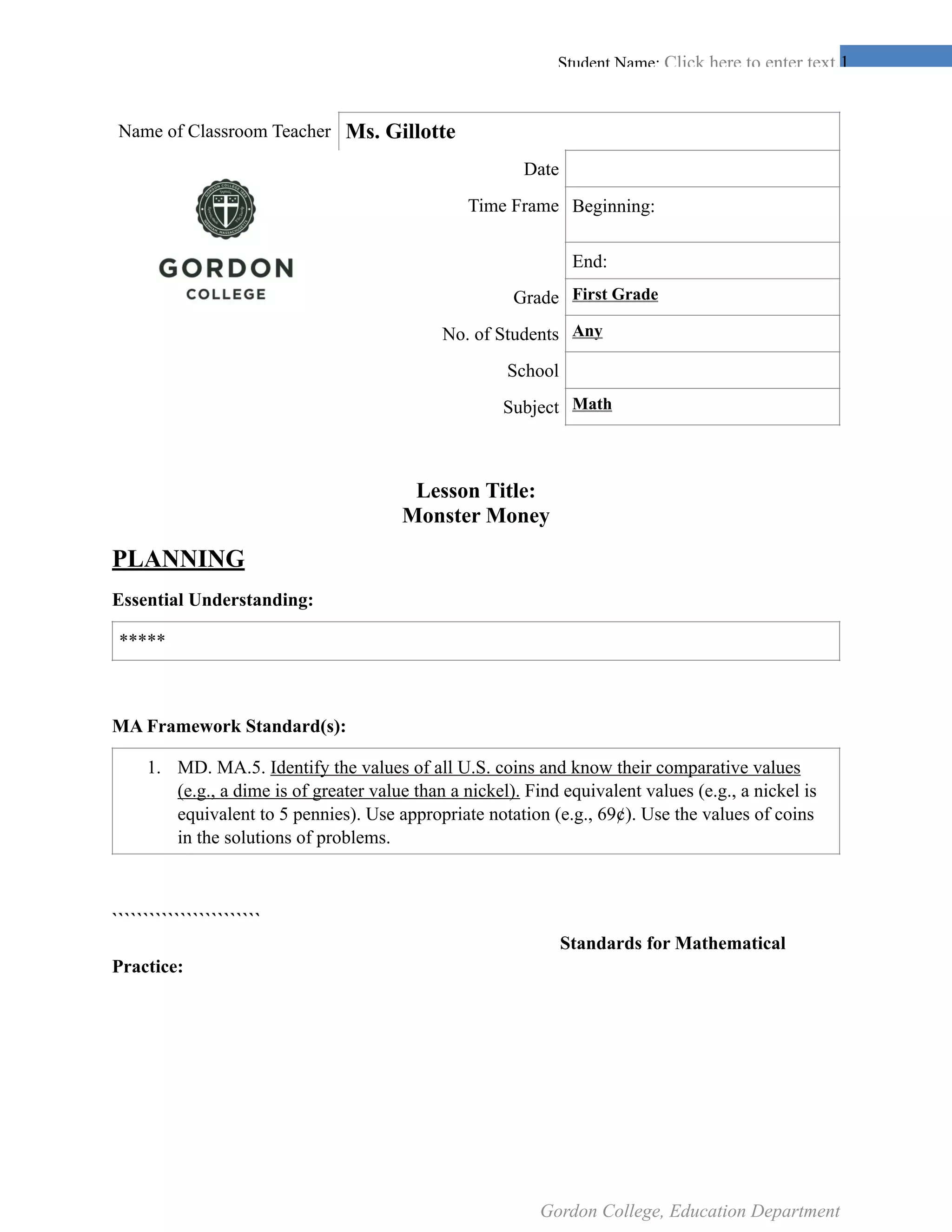
Lesson Title:
Monster Money
PLANNING
Essential Understanding:
MA Framework Standard(s):
````````````````````````
Standards for Mathematical
Practice:
Name of Classroom Teacher Ms. Gillotte
Date
Time Frame Beginning:
End:
Grade First Grade
No. of Students Any
School
Subject Math
!
*****
1. MD. MA.5. Identify the values of all U.S. coins and know their comparative values
(e.g., a dime is of greater value than a nickel). Find equivalent values (e.g., a nickel is
equivalent to 5 pennies). Use appropriate notation (e.g., 69¢). Use the values of coins
in the solutions of problems.
Gordon College, Education Department
!2Student Name: Click here to enter text.
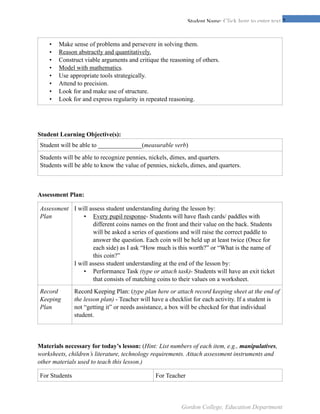
Student Learning Objective(s):
Assessment Plan:
Materials necessary for today’s lesson: (Hint: List numbers of each item, e.g., manipulatives,
worksheets, children’s literature, technology requirements. Attach assessment instruments and
other materials used to teach this lesson.)
• Make sense of problems and persevere in solving them.
• Reason abstractly and quantitatively.
• Construct viable arguments and critique the reasoning of others.
• Model with mathematics.
• Use appropriate tools strategically.
• Attend to precision.
• Look for and make use of structure.
• Look for and express regularity in repeated reasoning.
Student will be able to ______________(measurable verb)
Students will be able to recognize pennies, nickels, dimes, and quarters.
Students will be able to know the value of pennies, nickels, dimes, and quarters.
Assessment
Plan
I will assess student understanding during the lesson by:
• Every pupil response- Students will have flash cards/ paddles with
different coins names on the front and their value on the back. Students
will be asked a series of questions and will raise the correct paddle to
answer the question. Each coin will be held up at least twice (Once for
each side) as I ask “How much is this worth?” or “What is the name of
this coin?”
I will assess student understanding at the end of the lesson by:
• Performance Task (type or attach task)- Students will have an exit ticket
that consists of matching coins to their values on a worksheet.
Record
Keeping
Plan
Record Keeping Plan: (type plan here or attach record keeping sheet at the end of
the lesson plan) - Teacher will have a checklist for each activity. If a student is
not “getting it” or needs assistance, a box will be checked for that individual
student.
For Students For Teacher
Gordon College, Education Department
!3Student Name: Click here to enter text.
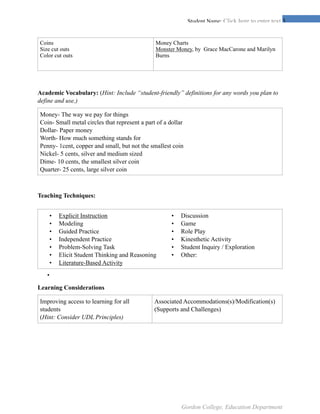
Academic Vocabulary: (Hint: Include “student-friendly” definitions for any words you plan to
define and use.)
Teaching Techniques:
•
Learning Considerations
Coins
Size cut outs
Color cut outs
Money Charts
Monster Money, by Grace MacCarone and Marilyn
Burns
Money- The way we pay for things
Coin- Small metal circles that represent a part of a dollar
Dollar- Paper money
Worth- How much something stands for
Penny- 1cent, copper and small, but not the smallest coin
Nickel- 5 cents, silver and medium sized
Dime- 10 cents, the smallest silver coin
Quarter- 25 cents, large silver coin
• Explicit Instruction
• Modeling
• Guided Practice
• Independent Practice
• Problem-Solving Task
• Elicit Student Thinking and Reasoning
• Literature-Based Activity
• Discussion
• Game
• Role Play
• Kinesthetic Activity
• Student Inquiry / Exploration
• Other:
Improving access to learning for all
students
(Hint: Consider UDL Principles)
Associated Accommodations(s)/Modification(s)
(Supports and Challenges)
Gordon College, Education Department
!4Student Name: Click here to enter text.
THE LEARNING ACTIVITY
Motivational and Review Procedures (the “hook”):
Procedures to Accomplish Objectives:
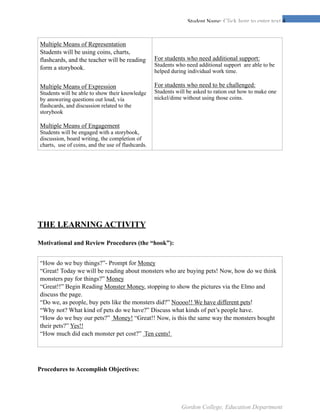
Multiple Means of Representation
Students will be using coins, charts,
flashcards, and the teacher will be reading
form a storybook.
Multiple Means of Expression
Students will be able to show their knowledge
by answering questions out loud, via
flashcards, and discussion related to the
storybook
Multiple Means of Engagement
Students will be engaged with a storybook,
discussion, board writing, the completion of
charts, use of coins, and the use of flashcards.
For students who need additional support:
Students who need additional support are able to be
helped during individual work time.
For students who need to be challenged:
Students will be asked to ration out how to make one
nickel/dime without using those coins.
“How do we buy things?”- Prompt for Money
“Great! Today we will be reading about monsters who are buying pets! Now, how do we think
monsters pay for things?” Money
“Great!!” Begin Reading Monster Money, stopping to show the pictures via the Elmo and
discuss the page.
“Do we, as people, buy pets like the monsters did?” Noooo!! We have different pets!
“Why not? What kind of pets do we have?” Discuss what kinds of pet’s people have.
“How do we buy our pets?” Money! “Great!! Now, is this the same way the monsters bought
their pets?” Yes!!
“How much did each monster pet cost?” Ten cents!
Gordon College, Education Department
!5Student Name: Click here to enter text.
Closing Procedures:
Extension ideas:
• Play ‘Heads Up’ the following day with coins.
	
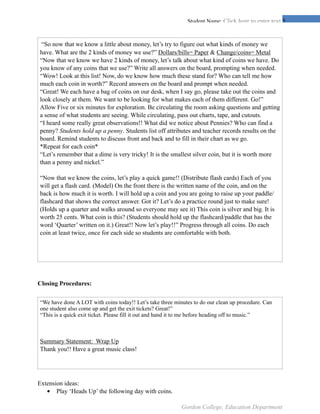
  “So now that we know a little about money, let’s try to figure out what kinds of money we
have. What are the 2 kinds of money we use?” Dollars/bills= Paper & Change/coins= Metal
“Now that we know we have 2 kinds of money, let’s talk about what kind of coins we have. Do
you know of any coins that we use?” Write all answers on the board, prompting when needed.
“Wow! Look at this list! Now, do we know how much these stand for? Who can tell me how
much each coin in worth?” Record answers on the board and prompt when needed.
“Great! We each have a bag of coins on our desk, when I say go, please take out the coins and
look closely at them. We want to be looking for what makes each of them different. Go!”
Allow Five or six minutes for exploration. Be circulating the room asking questions and getting
a sense of what students are seeing. While circulating, pass out charts, tape, and cutouts.
“I heard some really great observations!! What did we notice about Pennies? Who can find a
penny? Students hold up a penny. Students list off attributes and teacher records results on the
board. Remind students to discuss front and back and to fill in their chart as we go.
*Repeat for each coin*
“Let’s remember that a dime is very tricky! It is the smallest silver coin, but it is worth more
than a penny and nickel.”
“Now that we know the coins, let’s play a quick game!! (Distribute flash cards) Each of you
will get a flash card. (Model) On the front there is the written name of the coin, and on the
back is how much it is worth. I will hold up a coin and you are going to raise up your paddle/
flashcard that shows the correct answer. Got it? Let’s do a practice round just to make sure!
(Holds up a quarter and walks around so everyone may see it) This coin is silver and big. It is
worth 25 cents. What coin is this? (Students should hold up the flashcard/paddle that has the
word ‘Quarter’ written on it.) Great!! Now let’s play!!” Progress through all coins. Do each
coin at least twice, once for each side so students are comfortable with both.
“We have done A LOT with coins today!! Let’s take three minutes to do our clean up procedure. Can
one student also come up and get the exit tickets? Great!”
“This is a quick exit ticket. Please fill it out and hand it to me before heading off to music.”
Summary Statement: Wrap Up
Thank you!! Have a great music class!
Gordon College, Education Department
!6Student Name: Click here to enter text.
• Revisit the storybook.
• Half dollars and golden one dollar coins.
Gordon College, Education Department

893169224799965600 math lesson1

  • 1.
    !1Student Name: Clickhere to enter text. Lesson Title: Monster Money PLANNING Essential Understanding: MA Framework Standard(s): ```````````````````````` Standards for Mathematical Practice: Name of Classroom Teacher Ms. Gillotte Date Time Frame Beginning: End: Grade First Grade No. of Students Any School Subject Math ! ***** 1. MD. MA.5. Identify the values of all U.S. coins and know their comparative values (e.g., a dime is of greater value than a nickel). Find equivalent values (e.g., a nickel is equivalent to 5 pennies). Use appropriate notation (e.g., 69¢). Use the values of coins in the solutions of problems. Gordon College, Education Department
  • 2.
    !2Student Name: Clickhere to enter text. Student Learning Objective(s): Assessment Plan: Materials necessary for today’s lesson: (Hint: List numbers of each item, e.g., manipulatives, worksheets, children’s literature, technology requirements. Attach assessment instruments and other materials used to teach this lesson.) • Make sense of problems and persevere in solving them. • Reason abstractly and quantitatively. • Construct viable arguments and critique the reasoning of others. • Model with mathematics. • Use appropriate tools strategically. • Attend to precision. • Look for and make use of structure. • Look for and express regularity in repeated reasoning. Student will be able to ______________(measurable verb) Students will be able to recognize pennies, nickels, dimes, and quarters. Students will be able to know the value of pennies, nickels, dimes, and quarters. Assessment Plan I will assess student understanding during the lesson by: • Every pupil response- Students will have flash cards/ paddles with different coins names on the front and their value on the back. Students will be asked a series of questions and will raise the correct paddle to answer the question. Each coin will be held up at least twice (Once for each side) as I ask “How much is this worth?” or “What is the name of this coin?” I will assess student understanding at the end of the lesson by: • Performance Task (type or attach task)- Students will have an exit ticket that consists of matching coins to their values on a worksheet. Record Keeping Plan Record Keeping Plan: (type plan here or attach record keeping sheet at the end of the lesson plan) - Teacher will have a checklist for each activity. If a student is not “getting it” or needs assistance, a box will be checked for that individual student. For Students For Teacher Gordon College, Education Department
  • 3.
    !3Student Name: Clickhere to enter text. Academic Vocabulary: (Hint: Include “student-friendly” definitions for any words you plan to define and use.) Teaching Techniques: • Learning Considerations Coins Size cut outs Color cut outs Money Charts Monster Money, by Grace MacCarone and Marilyn Burns Money- The way we pay for things Coin- Small metal circles that represent a part of a dollar Dollar- Paper money Worth- How much something stands for Penny- 1cent, copper and small, but not the smallest coin Nickel- 5 cents, silver and medium sized Dime- 10 cents, the smallest silver coin Quarter- 25 cents, large silver coin • Explicit Instruction • Modeling • Guided Practice • Independent Practice • Problem-Solving Task • Elicit Student Thinking and Reasoning • Literature-Based Activity • Discussion • Game • Role Play • Kinesthetic Activity • Student Inquiry / Exploration • Other: Improving access to learning for all students (Hint: Consider UDL Principles) Associated Accommodations(s)/Modification(s) (Supports and Challenges) Gordon College, Education Department
  • 4.
    !4Student Name: Clickhere to enter text. THE LEARNING ACTIVITY Motivational and Review Procedures (the “hook”): Procedures to Accomplish Objectives: Multiple Means of Representation Students will be using coins, charts, flashcards, and the teacher will be reading form a storybook. Multiple Means of Expression Students will be able to show their knowledge by answering questions out loud, via flashcards, and discussion related to the storybook Multiple Means of Engagement Students will be engaged with a storybook, discussion, board writing, the completion of charts, use of coins, and the use of flashcards. For students who need additional support: Students who need additional support are able to be helped during individual work time. For students who need to be challenged: Students will be asked to ration out how to make one nickel/dime without using those coins. “How do we buy things?”- Prompt for Money “Great! Today we will be reading about monsters who are buying pets! Now, how do we think monsters pay for things?” Money “Great!!” Begin Reading Monster Money, stopping to show the pictures via the Elmo and discuss the page. “Do we, as people, buy pets like the monsters did?” Noooo!! We have different pets! “Why not? What kind of pets do we have?” Discuss what kinds of pet’s people have. “How do we buy our pets?” Money! “Great!! Now, is this the same way the monsters bought their pets?” Yes!! “How much did each monster pet cost?” Ten cents! Gordon College, Education Department
  • 5.
    !5Student Name: Clickhere to enter text. Closing Procedures: Extension ideas: • Play ‘Heads Up’ the following day with coins.  “So now that we know a little about money, let’s try to figure out what kinds of money we have. What are the 2 kinds of money we use?” Dollars/bills= Paper & Change/coins= Metal “Now that we know we have 2 kinds of money, let’s talk about what kind of coins we have. Do you know of any coins that we use?” Write all answers on the board, prompting when needed. “Wow! Look at this list! Now, do we know how much these stand for? Who can tell me how much each coin in worth?” Record answers on the board and prompt when needed. “Great! We each have a bag of coins on our desk, when I say go, please take out the coins and look closely at them. We want to be looking for what makes each of them different. Go!” Allow Five or six minutes for exploration. Be circulating the room asking questions and getting a sense of what students are seeing. While circulating, pass out charts, tape, and cutouts. “I heard some really great observations!! What did we notice about Pennies? Who can find a penny? Students hold up a penny. Students list off attributes and teacher records results on the board. Remind students to discuss front and back and to fill in their chart as we go. *Repeat for each coin* “Let’s remember that a dime is very tricky! It is the smallest silver coin, but it is worth more than a penny and nickel.” “Now that we know the coins, let’s play a quick game!! (Distribute flash cards) Each of you will get a flash card. (Model) On the front there is the written name of the coin, and on the back is how much it is worth. I will hold up a coin and you are going to raise up your paddle/ flashcard that shows the correct answer. Got it? Let’s do a practice round just to make sure! (Holds up a quarter and walks around so everyone may see it) This coin is silver and big. It is worth 25 cents. What coin is this? (Students should hold up the flashcard/paddle that has the word ‘Quarter’ written on it.) Great!! Now let’s play!!” Progress through all coins. Do each coin at least twice, once for each side so students are comfortable with both. “We have done A LOT with coins today!! Let’s take three minutes to do our clean up procedure. Can one student also come up and get the exit tickets? Great!” “This is a quick exit ticket. Please fill it out and hand it to me before heading off to music.” Summary Statement: Wrap Up Thank you!! Have a great music class! Gordon College, Education Department
  • 6.
    !6Student Name: Clickhere to enter text. • Revisit the storybook. • Half dollars and golden one dollar coins. Gordon College, Education Department