Enclosure No.___ toDepEd Memorandum No. ___s, 2025
2025 NATIONAL FESTIVAL
OF TALENTS
Implementing Guidelines on
Technolympics
The categories, components, number of learner-participants and teacher-
coaches, and time allotment for Technolympics per region are the following:
Category Component
No. of
Learner-
Participant
No. of
Teacher-
Coach
Time
Allotment
Elementary
Invitation Card
Making using MS
Productivity Tools
ICT 1 1 3 hours
Extension Cord
with Switch
Assembly
IA 1 1 3 hours
Food Preparation
and Presentation
FCS 2 1 4 hours
Dish Gardening AFA 1 1 4 hours
Secondary
Technical Drafting ICT 1 1 4 hours
Electrical
Installation and
Maintenance (EIM)
IA 2 1 4 hours
Bread and Pastry
Production
FCS 2 1 4 hours
Food Processing
(Meat, Fish &
Vegetable)
AFA 2 1 4 hours
Total 12 8
2.
Enclosure No.___ toDepEd Memorandum No. ___s, 2025
TECHNOLYMPICS
(A Showcase of Marketable Products and Performances)
INVITATION CARD MAKING USING MICROSOFT PRODUCTIVITY TOOLS
COMPONENT
AREA
INFORMATION AND COMMUNICATION TECHNOLOGY (ICT)
KEY STAGE Elementary Grades 4-6)
EVENT TITLE Invitation Card Making Using Microsoft Productivity Tools
NO. OF
PARTICIPANT/S
One (1) learner-participant
TIME ALLOTMENT Three (3) Hours, excluding interview
PERFORMANCE
STANDARD
Ang mga mag-aaral ay nakagagawa ng iba’t ibang dokumento
gamit ang computing devices at productivity tools. [MATATAG,
Grade 4]
Nakagagawa ng knowledge products gamit ang productivity tools.
[Kto12 Curriculum, Grade 5, Content 7]
21ST CENTURY
SKILL/S
Creativity, Communication, Critical Thinking, ICT for Learning,
Self-Regulation, Digital Literacy, Adaptability
CREATIVE
INDUSTRIES
DOMAIN
Publishing, Printed Media, ICT, and Digital Communication
DESCRIPTION Invitation Card Making Using Microsoft Productivity Tools is
an NFOT event category of Technolympics that allows learner-
participants to utilize several Microsoft Productivity Tools to make
unique invitation cards based on the given topic or theme.
TECHNICAL SPECIFICATIONS
A. MATERIALS,
TOOLS AND
EQUIPMENT
To be provided by the
participants:
• None
To be provided by the event
organizers:
• Desktop/Laptop with
Windows 10 or higher
installed with MS Office
Standards or higher
version
• Printer with colored
cartridges
• Filed Photos on the
computer
• Extension wire and UPS
• Laid paper in A4
• Mouse
• Scissors/ Handheld Cutter
• Plastic /Metal Ruler
• Curling Ribbon, 2 meters
per participant
B. VENUE Airconditioned/Well-ventilated Computer Laboratory/ Room
CRITERIA FOR
JUDGING
Criteria Percentage
Creativity of Design 30%
Exceptional
− with outstanding creativity and
originality
− showcased innovative design
elements that effectively capture the
theme
30%
3.
Enclosure No.___ toDepEd Memorandum No. ___s, 2025
− layout, color scheme, fonts, and
graphic elements are harmoniously
integrated, showing a high skill level
in using MS productivity tools to create
a visually appealing and unique
design.
Proficient
− displayed good creativity and
originality
− design elements were thoughtfully
selected and well-coordinated, with a
clear theme or purpose evident
− used MS productivity tools skillfully,
resulting in a polished, attractive
design that engages the viewer
25%
Adequate
− showed moderate creativity with some
original elements
− design choices were conventional but
still reflected the theme or purpose
− with a basic level of proficiency in
using MS productivity tools, resulting
in a functional and visually pleasing
invitation card.
20%
Basic
− showed limited creativity, with design
elements that are mostly generic or
predictable
− The theme or purpose was not
conveyed
− MS productivity tools are all basic,
resulting in a simple design lacking
visual appeal
15%
Technical Use of the Productivity
Tools
20%
Exceptional
− demonstrated expert-level proficiency
in the use of MS productivity tools.
− advanced features, such as precise
formatting, layering, alignment, and
graphic manipulation.
− tools were used seamlessly to
enhance the design, polished, with no
technical errors, and reflect a high
level of technical skill.
20%
Proficient
− solid technical skills in using MS
productivity tools were shown
− used intermediate features effectively
in design, such as consistent
formatting, text alignment, and basic
graphic adjustments.
− has minimal technical errors and
displayed a good command of the
software.
15%
Adequate
− demonstrated basic technical
competence in MS productivity tools
10%
4.
Enclosure No.___ toDepEd Memorandum No. ___s, 2025
− used simple formatting and layout
tools effectively, with minor errors in
alignment or spacing
− the design met the functional
requirements, showing a reasonable
understanding of the tools
Basic
− displayed limited technical skills in
MS productivity tools, with minimum
difficulty applying basic features such
as text alignment, resizing, or
formatting.
− contained noticeable errors and
technical limitations that somewhat
affected the quality of the final
product
5%
Relevance to the Theme 15%
Exceptional
− aligned perfectly with the theme, with
every element, such as colors,
graphics, fonts, and layout carefully
chosen to enhance and convey the
theme
− captured the intended mood or
message in a highly effective and
impactful way
15%
Proficient
− well-aligned with the theme, using
appropriate colors, graphics, and fonts
that convey the message effectively
− reflected the theme accurately and is
visually cohesive, though with minor
room for enhancement
10%
Adequate
− generally reflected the theme, with
some design choices like colors,
graphics, and fonts related to the
theme
− has an apparent message, though
certain elements may feel less
cohesive or relevant, affecting the
overall impact
5%
Basic
− showed limited relevance to the
theme, with only a few elements that
supported the intended message or
mood.
− disconnected from the theme, that the
viewer may need to interpret the
intended message
1%
Layout and Measurement 15%
Exceptional
− expertly organized, with precise
measurements and spacing
− All elements like text, images, and
graphics are perfectly aligned,
balanced, and proportionate,
15%
5.
Enclosure No.___ toDepEd Memorandum No. ___s, 2025
enhancing readability and overall
design quality
− visually pleasing and reflected keen
attention to detail
Proficient
− well-organized, with mostly accurate
measurements and spacing
− elements are generally aligned and
balanced, supporting good readability
and a cohesive design.
− minor adjustments can improve visual
harmony. Overall, the layout is strong
and effective
10%
Adequate
− functional and mostly organized, with
measurements and spacing that are
reasonably accurate
− some elements are slightly misaligned
or unevenly spaced, but the overall
design remains readable and visually
acceptable
5%
Basic
− with noticeable issues with alignment,
spacing, or proportions, making the
design appear cluttered or uneven
− with measurement inaccuracies that
affect the readability, and
adjustments to achieve a balanced
and organized appearance
1%
Wise use of time/speed 15%
Exceptional
− completed the task efficiently within
the allotted time, demonstrating
excellent time management
− with high quality and no compromise
on design or technical accuracy
− showed a strong ability to balance
speed with attention to detail
5%
Proficient
− completed the task within the allotted
time, with good time management
− met quality standards with only minor
refinements, need effective balancing
speed with accuracy
4%
Adequate
− completed the task with minor delays
or adjustments and showed basic
time management
− met functional standards, though
some aspects lacked refinement due
to time constraints
3%
Basic
− required additional time beyond the
allotted period, with signs of rushed
work
2%
6.
Enclosure No.___ toDepEd Memorandum No. ___s, 2025
− with noticeable areas for
improvement, indicating a need for
better time management
Ability to Present the Process 15%
Exceptional
− presented the design process in a
clear, organized, and engaging
manner, as he/she provided detailed
explanations for each design choice
− demonstrated a strong understanding
of each step, including planning, tool
selection, and revisions, and
answered questions with confidence
and depth
15%
Proficient
− provided a well-structured and
informative presentation of the
process and explained most design
choices and steps clearly
− showed a solid understanding of the
workflow and responded to questions
accurately, with minor room for
clarification
10%
Adequate
− presented the process in a generally
understandable way, covering basic
steps and design choices
− some aspects of the process lacked
details, but the main workflow was
communicated.
− responded with the questions showing
a basic understanding
5%
Basic
− process presentation was somewhat
unclear or incomplete, with a limited
explanation of design choices
− showed a minimal understanding of
the workflow, and responses to
questions were vague or lacked detail
1%
Total 100%
MECHANICS
A. All officially enrolled Grades 4 to 6 including elementary ALS learners with
LRN can join the contest.
B. The Event Administrator, Members of the Technical Committee, and Board of
Judges shall be at the venue sixty (60) minutes ahead of the event schedule.
C. The materials, supplies, tools, equipment, data, and photos needed at the venue
shall be made ready by the Event Administrator sixty (60) minutes before the event
schedule.
D. The Technical Committee shall inspect the resource requirements for the contest.
E. All participants are expected to arrive at the designated venue at least thirty (30)
minutes before the event begins. Late participants may be permitted to join upon
thorough review and assessment of their reasons by the Technical Committee.
F. Briefing of participants shall be done thirty (30) minutes before the start of the
event. Questions, clarifications, and points of order shall be entertained during the
briefing.
G. The Event Administrator shall let the participants draw lots to determine their
respective entry numbers and places.
7.
Enclosure No.___ toDepEd Memorandum No. ___s, 2025
H. The learner-participants may use any of the following Microsoft Productivity Tools
(Word, Excel, PowerPoint, Publisher, Paint, Picture Manager)
I. The layout size of the invitation card and the theme shall be announced by the
Event Administrator during the preliminaries.
J. Borrowing of materials, supplies, tools, and equipment is strictly prohibited.
K. The Event Administrator will signal the start of the event. Once underway, teacher-
coaches and other delegates will no longer be permitted to communicate with the
participants.
L. Only the Event Administrator, Technical Committee Members, Judges, Official
photographers, and participants are allowed to be at the contest venue.
M. Participants shall go through a panel interview and deliberation by the Board of
Judges after the four (4) hour time allotment.
N. Participants are advised to bring their food as they are not allowed to go out of the
venue.
O. Filename shall be using this format:
InvitationCard# (participant’s number)
Example: InvitationCard#01
P. The working area shall be cleaned by the participants immediately after the contest.
8.
Enclosure No.___ toDepEd Memorandum No. ___s, 2025
TECHNOLYMPICS
(A Showcase of Marketable Products and Performances)
EXTENSION CORD WITH SWITCH ASSEMBLY
COMPONENT
AREA
INDUSTRIAL ARTS (IA)
KEY STAGE Key Stage Two (2): Grades 4-6
EVENT TITLE Extension Cord with Switch Assembly
NO. OF
PARTICIPANT/S
One (1) learner-participant
TIME ALLOTMENT Three (3) Hours, including interview
PERFORMANCE
STANDARD
The learner constructs simple electrical gadgets with ease and
dexterity.
21ST CENTURY
SKILL/S
Creativity, Critical Thinking, Self-Regulation, Adaptability
CREATIVE
INDUSTRIES
DOMAIN
Design
DESCRIPTION Extension cord with switch assembly is an NFOT event category
of Technolympics that allows learner-participant to demonstrates
an understanding of and skills in making simple electrical
gadgets.
TECHNICAL SPECIFICATIONS
A. MATERIALS,
TOOLS AND
EQUIPMENT
To be provided by the
participants:
• Appropriate Personal
Protective Equipment (PPE)
To be provided by the event
organizers:
Materials
• 6 meters # 16 stranded
wire
• 1foot # 16 THHN
electrical wire
• 1 pc surface type utility
box
• 1 pc single pole single
throw switch
• 2 pcs convenience
outlet
• 1 set 3-gang plate
• 1 pc male plug (15A)
Tools
• Electrical tools (long
nose, pliers, phillips
and flathead
screwdriver)
• Multi Tester
B. VENUE Well-ventilated covered-area/room with electrical
outlets/extension wires, fire extinguishers, and first-aid kits.
CRITERIA FOR
JUDGING
Criteria Percentage
Quality of the output/ 15%
Accuracy 15%
Functionality 30%
Use of tools 15%
Safety 10%
Speed 5%
Ability to explain 10%
9.
Enclosure No.___ toDepEd Memorandum No. ___s, 2025
Total 100%
MECHANICS
A. All officially enrolled Grades 4 to 6 including elementary ALS learners with LRN can
join the contest.
B. The Event Administrator, Members of the Technical Committee, and Board of
Judges shall be at the venue sixty (60) minutes ahead of the event schedule.
C. The materials, supplies, tools, equipment, data, and photos needed at the venue
shall be made ready by the Event Administrator sixty (60) minutes before the event
schedule.
D. The Technical Committee shall inspect the resource requirements for the contest.
E. All learner-participants are expected to arrive at the designated venue at least thirty
(30) minutes before the event begins. Late participants may be permitted to join
upon thorough review and assessment of their reasons by the Technical Committee.
F. The learner-participants shall adhere to all health and safety requirements.
G. Briefing of participants shall be done thirty (30) minutes before the start of the
event. Questions, clarifications, and points of order shall be entertained during the
briefing.
H. The Event Administrator shall let the participants draw lots to determine their
respective entry numbers and places.
I. The Event Administrator will signal the start of the event. Once underway, teacher-
coaches and other delegates will no longer be permitted to communicate with the
participants.
J. Only the Event Administrator, Technical Committee Members, Judges, Official
photographers, and participants are allowed to be at the contest venue.
K. Participants shall go through a panel interview and deliberation by the Board of
Judges within the three (3) hour time allotment.
L. Participants are advised to bring their food as they are not allowed to go out of the
venue.
M. The working area shall be cleaned by the participants immediately after the contest.
10.
Enclosure No.___ toDepEd Memorandum No. ___s, 2025
TECHNOLYMPICS
(A Showcase of Marketable Products and Performances)
FOOR PREPARATION AND PRESENTATION
COMPONENT
AREA
FAMILY AND CONSUMER SCIENCE/HOME ECONOMICS
KEY STAGE Key Stage Two (2): Grades 4-6
EVENT TITLE Food Preparation and Presentation
NO. OF
PARTICIPANT/S
Two (2) learner-participants
TIME ALLOTMENT Four (4) Hours, excluding interview
PERFORMANCE
STANDARD
The learners use and maintain appropriate kitchen tools and
equipment and follows the Occupational Health and Standard
(OHS) in food preparation and presentation.
21ST CENTURY
SKILL/S
Use of appropriate technology, learning and innovative skills and
abilities where learners think critically, reflectively, and creatively.
CREATIVE
INDUSTRIES
DOMAIN
Creative Services
DESCRIPTION Food Preparation and Presentation is an NFOT event category
of Technolympics that allows learner-participants to apply the
principles of food preparation and presentation. It includes food
preparation, designing, and presentation of a main course with
chicken as the main ingredient.
TECHNICAL SPECIFICATIONS
A. MATERIALS,
TOOLS AND
EQUIPMENT
To be provided by the
participants:
• Appropriate Personal
Protective Equipment (PPE)
To be provided by the event
organizers:
• 1 kg Chicken (leg part)
• Marketable ingredients
• Cooking utensils
• Gas Stove/LPG
• Dinner Plate for plating
presentation
• Extension Cords
• Working Table
• Presentation Table
• Provision of Oven
B. VENUE Preferably HE Room with tiled floors, well-lighted and fully
ventilated cooking area, sufficient water supply, medical kit and
fire extinguishers.
CRITERIA FOR
JUDGING
Criteria Percentage
Quality of the output/ 15%
Accuracy 15%
Functionality 30%
Use of tools 15%
Safety 10%
Speed 5%
Ability to explain 10%
Total 100%
MECHANICS
A. All officially enrolled Grades 4 to 6 including elementary ALS learners with LRN can
join the contest.
11.
Enclosure No.___ toDepEd Memorandum No. ___s, 2025
B. The Event Administrator, Members of the Technical Committee, and Board of
Judges shall be at the venue sixty (60) minutes ahead of the event schedule.
C. The materials, supplies, tools, equipment, data, and photos needed at the venue
shall be made ready by the Event Administrator sixty (60) minutes before the event
schedule.
D. The Technical Committee shall inspect the resource requirements for the contest.
E. All learner-participants are expected to arrive at the designated venue at least thirty
(30) minutes before the event begins. Late participants may be permitted to join
upon thorough review and assessment of their reasons by the Technical Committee.
F. The learner-participants shall adhere to all health and safety requirements.
G. Briefing of participants shall be done thirty (30) minutes before the start of the
event. Questions, clarifications, and points of order shall be entertained during the
briefing.
H. The Event Administrator shall let the participants draw lots to determine their
respective entry numbers and places.
I. The Event Administrator will signal the start of the event. Once underway, teacher-
coaches and other delegates will no longer be permitted to communicate with the
participants.
J. Each learner-participants will receive a mystery box containing a set of ingredients.
K. The learner-participants will have four (4) hours to create a dish using the
ingredients from the mystery box.
L. Participants are not allowed to use ingredients that are not provided in the mystery
box.
M. During the event proper, the panel of experts shall observe the processes but not
ask questions to participants to avoid disruption.
N. Only the Event Administrator, Technical Committee Members, Judges, Official
photographers, and participants are allowed to be at the contest venue.
O. The learner-participants shall go through a panel interview and deliberation by the
Board of Judges after the four (4) hour time allotment.
P. The learner-participants are advised to bring their food as they are not allowed to
go out of the venue.
Q. The working area shall be cleaned by the participants immediately after the contest.
12.
Enclosure No.___ toDepEd Memorandum No. ___s, 2025
TECHNOLYMPICS
(A Showcase of Marketable Products and Performances)
DISH GARDENING
COMPONENT
AREA
AGRI-FISHERY ARTS
KEY STAGE Key Stage Two (2): Grades 4-6
EVENT TITLE Dish Gardening
NO. OF
PARTICIPANT/S
One (1) learner-participants
TIME ALLOTMENT Four (4) Hours, excluding interview
PERFORMANCE
STANDARD
Application of the most applicable dish gardening technique.
21ST CENTURY
SKILL/S
Creative skills, problem-solving skills, communication skills,
promotion of techniques and technological skills, procedural
skills, operating tools, occupational safety and health (OSH)
CREATIVE
INDUSTRIES
DOMAIN
Design and Creative industries, Landscape Architecture, Agri-
tourism Industry, Agri-entrepreneurial Industry.
DESCRIPTION A dish garden is a miniature garden which uses a shallow dish or
bowl for a container. It is landscaped to depict a scene in nature.
Different plants can be used in the dish garden but these have to
be compatible with each other
(https://aggie-horticulture.tamu.edu/syllabi/302/new/topic/dish.htm).
TECHNICAL SPECIFICATIONS
A. MATERIALS,
TOOLS AND
EQUIPMENT
To be provided by the
participants:
• Appropriate Personal
Protective Equipment (PPE)
To be provided by the event
organizers:
• Dish Garden Plants
(Assorted Minimum of
6 kinds
• Decorative object
• Colored rocks
• Horticultural charcoal
• Potting Soil
• Moss or sand
• Wide, low sided
container (without a
drainage hole, any
design)
• Working table
• Hand Trowel
• Shovel
• Sprinkler
• Pliers
• Spade
• Cutter
• Tie Wire
• Hand Sprayer
B. VENUE Covered court/Open Area
CRITERIA FOR
JUDGING
Criteria Percentage
Originality of Sketch Plan 10%
Combination and design of plants and
materials
20%
Use of tools and equipment 10%
13.
Enclosure No.___ toDepEd Memorandum No. ___s, 2025
Methods and safety work-habit 10%
Visual Impact 20%
Followed the Sketch Plan 10%
Speed 5%
Ability to present ideas 15%
Total 100%
MECHANICS
A. All officially enrolled Grades 4 to 6 including elementary ALS learners with LRN can
join the contest.
B. The Event Administrator, Members of the Technical Committee, and Board of
Judges shall be at the venue sixty (60) minutes ahead of the event schedule.
C. The materials, supplies, tools, equipment, data, and photos needed at the venue
shall be made ready by the Event Administrator sixty (60) minutes before the event
schedule.
D. The Technical Committee shall inspect the resource requirements for the contest.
E. All learner-participants are expected to arrive at the designated venue at least thirty
(30) minutes before the event begins. Late participants may be permitted to join
upon thorough review and assessment of their reasons by the Technical Committee.
F. The learner-participants shall adhere to all health and safety requirements.
G. Briefing of participants shall be done thirty (30) minutes before the start of the
event. Questions, clarifications, and points of order shall be entertained during the
briefing.
H. The Event Administrator shall let the participants draw lots to determine their
respective entry numbers and places.
I. The Event Administrator will signal the start of the event. Once underway, teacher-
coaches and other delegates will no longer be permitted to communicate with the
participants.
J. The finished dish garden should be ready for photography, sketching, after all the
members of the Board of Judges shall have finished their individual judging.
K. A blueprint or a sketch or plan must be submitted by the contestant using a long
size bond paper.
L. The dish garden shall remain unaltered and on display until the closing ceremony.
M. During the event proper, the panel of experts shall observe the processes but not
ask questions to participants to avoid disruption.
N. Only the Event Administrator, Technical Committee Members, Judges, Official
photographers, and participants are allowed to be at the contest venue.
O. The learner-participants shall go through a panel interview and deliberation by the
Board of Judges after the four (4) hour time allotment.
P. The learner-participants are advised to bring their food as they are not allowed to
go out of the venue.
Q. The working area shall be cleaned by the participants immediately after the contest.
14.
Enclosure No.___ toDepEd Memorandum No. ___s, 2025
TECHNOLYMPICS
(A Showcase of Marketable Products and Performances)
TECHNICAL DRAFTING
COMPONENT
AREA
INFORMATION AND COMMUNICATIONS TECHNOLOGY (ICT)
KEY STAGE Key Stage Three (3): Grades 9 to 10; Key Stage Four (4): Grades 11
to 12
EVENT TITLE Technical Drafting: Prepare Computer-Aided Design of a House
- Floor Plan (scale 1:100m)
- Elevations (front, left, right, and rear elevation)
- Perspective
NO. OF
PARTICIPANT/S
One (1) learner-participant from either of the key stages or grade
levels or from one key stage or grade level alone per region
TIME ALLOTMENT Four (4) Hours, excluding interview
PERFORMANCE
STANDARD
The learners create a house plan following architectural
standards.
21ST CENTURY
SKILL/S
Core skills supported using ICT, technical, information
management, communication, collaboration, creativity, critical
thinking, and problem-solving
CREATIVE
INDUSTRIES
DOMAIN
Design
DESCRIPTION Technical Drafting is an NFOT event category of Technolympics
that allows learner-participants to perform mensuration and
calculations, interpret technical drawings and plans, and prepare
computer-aided drawings with structural layout and details.
TECHNICAL SPECIFICATIONS
A. MATERIALS,
TOOLS AND
EQUIPMENT
To be provided by the
participants:
• None
To be provided by the event
organizers:
• Desktop computer (16
gigabyte RAM, i5
processor or higher)
• Printer (ratio 1:1)
• AutoCAD 2019 Version
or higher (uniform
version)
• Printing cost
B. VENUE Airconditioned/Well-ventilated Computer Laboratory/
Room
CRITERIA FOR
JUDGING
Criteria Percentage
Accuracy 40%
Floor Plan 15%
Elevations 15%
Perspective 10%
Aesthetic/Architectural/Originality
and Creativity of Design
40%
Architectural 15%
Aesthetic 5%
Structural 10%
Originality 5%
Details 5%
Ability to Present the Process 10%
15.
Enclosure No.___ toDepEd Memorandum No. ___s, 2025
Speed 10%
Total 100%
MECHANICS
A. All learners in the Junior High School (JHS) specifically grades 9 and 10, Technical-
Vocational Education/Technology and Livelihood Education (TVE/TLE) and Senior
High School (SHS) Technical-Vocational-Livelihood (TVL) including ALS who are
previously or currently enrolled in the school offering specialization in technical
drafting are eligible to join.
B. The Event Administrator, Members of the Technical Committee, and Board of
Judges shall be at the venue sixty (60) minutes ahead of the event schedule.
C. The materials, supplies, tools, equipment, data, and photos needed at the venue
shall be made ready by the Event Administrator sixty (60) minutes before the event
schedule.
D. The Technical Committee shall inspect the resource requirements for the contest.
E. All learner-participants are expected to arrive at the designated venue at least thirty
(30) minutes before the event begins. Late participants may be permitted to join
upon thorough review and assessment of their reasons by the Technical Committee.
F. The learner-participants shall adhere to all health and safety requirements.
G. Briefing of participants shall be done thirty (30) minutes before the start of the
event. Questions, clarifications, and points of order shall be entertained during the
briefing.
H. The Event Administrator shall let the participants draw lots to determine their
respective entry numbers and places.
I. The Event Administrator will distribute a task requirement and learner-participants
will be given 15 minutes to read and analyze it.
J. The Event Administrator will signal the start of the event. Once underway, teacher-
coaches and other delegates will no longer be permitted to communicate with the
participants.
K. During the event proper, the panel of experts shall observe the processes but not
ask questions to participants to avoid disruption.
L. Only the Event Administrator, Technical Committee Members, Judges, Official
photographers, and participants are allowed to be at the contest venue.
M. The learner-participants shall go through a panel interview and deliberation by the
Board of Judges after the four (4) hour time allotment.
N. The learner-participants are advised to bring their food as they are not allowed to
go out of the venue.
O. The working area shall be cleaned by the participants immediately after the contest.
Note: All outputs (soft and hard copies) shall be collected by the Event Secretary and
shall be endorsed to the Organizers.
16.
Enclosure No.___ toDepEd Memorandum No. ___s, 2025
TECHNOLYMPICS
(A Showcase of Marketable Products and Performances)
ELECTRICAL INSTALLATION AND MAINTENANCE (EIM)
COMPONENT
AREA
INDUSTRIAL ARTS (IA)
KEY STAGE Key Stage Three (3): Grades 9 to 10; Key Stage Four (4): Grades 11
to 12
EVENT TITLE Electrical Installation and Maintenance (EIM)
NO. OF
PARTICIPANT/S
One (1) learner-participant from either of the key stages or grade
levels or from one key stage or grade level alone per region
TIME ALLOTMENT Four (4) Hours, excluding interview
PERFORMANCE
STANDARD
The learners perform electrical installation and maintenance
which involve reading and installing schematic wiring diagrams
based on the Philippine Electrical Code (PEC) and national
Electrical Code (NEC).
21ST CENTURY
SKILL/S
It is essential for learners to manifest learning and innovation
skills and abilities where they think critically, reflectively, and
creatively, analyze and solve problems, create and implement
innovations using a variety of techniques or methods, and
generate functional knowledge that supports varying degrees of
thinking skills and metacognition.
CREATIVE
INDUSTRIES
DOMAIN
Design
DESCRIPTION Electrical Installation and Maintenance (EIM) is an NFOT event
category of Technolympics that allows learner-participants to read
and install wiring diagrams based on a given schematic diagram.
Knowledge of schematic diagrams and installation skills may be
handy in establishing a business or landing a job.
TECHNICAL SPECIFICATIONS
A. MATERIALS,
TOOLS AND
EQUIPMENT
To be provided by the
participants:
• Personal Protective
Equipment (PPE)
To be provided by the event
organizers:
• Electrical tape
• No. 14 stranded wire
• No. 12 stranded wire
• Lighting fixture
• SPST switch
• Junction box
• And other materials
• Floor Plan single storey
residential house)
• All tools/equipment
needed for the wiring
installation
• Working board 4’ X 8’
• Utility expenses
B. VENUE Well-ventilated covered-area/room with electrical
outlets/extension wires, fire extinguishers, and first-aid kits.
CRITERIA FOR
JUDGING
Criteria Percentage
Accuracy of interpretation of
schematic diagram
25%
Accuracy of installation 30%
Use of tools 15%
17.
Enclosure No.___ toDepEd Memorandum No. ___s, 2025
Safety 15%
Speed 10%
Ability to Explain Process 5%
Total 100%
MECHANICS
A. All learners in the Junior High School (JHS) specifically grades 9 and 10, Technical-
Vocational Education/Technology and Livelihood Education (TVE/TLE) and Senior
High School (SHS) Technical-Vocational-Livelihood (TVL) including ALS who are
previously or currently enrolled in the school offering specialization in technical
drafting are eligible to join.
B. The Event Administrator, Members of the Technical Committee, and Board of
Judges shall be at the venue sixty (60) minutes ahead of the event schedule.
C. The materials, supplies, tools, equipment, data, and photos needed at the venue
shall be made ready by the Event Administrator sixty (60) minutes before the event
schedule.
D. The Technical Committee shall inspect the resource requirements for the contest.
E. All learner-participants are expected to arrive at the designated venue at least thirty
(30) minutes before the event begins. Late participants may be permitted to join
upon thorough review and assessment of their reasons by the Technical Committee.
F. The learner-participants shall adhere to all health and safety requirements.
G. Briefing of participants shall be done thirty (30) minutes before the start of the
event. Questions, clarifications, and points of order shall be entertained during the
briefing.
H. The Event Administrator shall let the participants draw lots to determine their
respective entry numbers and places.
I. All provided event materials shall be used by participants for their outputs.
J. Alteration of the event materials by the participants is not allowed.
K. The schematic diagram will be provided on the day of the event.
L. The Event Administrator will signal the start of the event. Once underway, teacher-
coaches and other delegates will no longer be permitted to communicate with the
participants.
M. During the event proper, the panel of experts shall observe the processes but not
ask questions to participants to avoid disruption.
N. Only the Event Administrator, Technical Committee Members, Judges, Official
photographers, and participants are allowed to be at the contest venue.
O. The learner-participants shall go through a panel interview and deliberation by the
Board of Judges after the four (4) hour time allotment.
P. The learner-participants are advised to bring their food as they are not allowed to
go out of the venue.
Q. The working area shall be cleaned by the participants immediately after the contest.
18.
Enclosure No.___ toDepEd Memorandum No. ___s, 2025
TECHNOLYMPICS
(A Showcase of Marketable Products and Performances)
BREAD AND PASTRY PRODUCTION (BAKING AND DECORATING)
COMPONENT
AREA
FAMILY AND CONSUMER SCIENCE/HOME ECONOMICS
KEY STAGE Key Stage Three (3): Grades 9 to 10; Key Stage Four (4): Grades 11
to 12
EVENT TITLE Bread and Pastry Production (Baking and Decorating)
NO. OF
PARTICIPANT/S
One (1) learner-participant from either of the key stages or grade
levels or from one key stage or grade level alone per region
TIME ALLOTMENT Four (4) Hours, excluding interview
PERFORMANCE
STANDARD
The learners use and maintain appropriate baking tools and
equipment and follows the Occupational Health and Standard
(OHS) in baking and decorating cake.
21ST CENTURY
SKILL/S
Communication in the workplace, use of appropriate technology,
learning and innovative skills and abilities where learners think
critically, reflectively, and creatively, and analyze and solve
problems
CREATIVE
INDUSTRIES
DOMAIN
Baking and Design
DESCRIPTION Applying the principles in Bread and Pastry Production
including Decorating. The task involves preparation of chiffon
cake and decoration through basic icing. One-layer cake with a
mold size: 6 inch.
TECHNICAL SPECIFICATIONS
A. MATERIALS,
TOOLS AND
EQUIPMENT
To be provided by the
participants:
• Personal Protective
Equipment (PPE)
• Packaging Materials
To be provided by the event
organizers:
• Baking ingredients
• Marketable ingredients
(confectioner sugar)
• Stove
• Oven
• LPG
• Baking utensils
• Working table
• Cooking area
• Water outlet/supply
• Utility expenses
B. VENUE Preferably HE Room/laboratory/covered area
• with sufficient water supply
• medical kit
• fire extinguisher
• well lighted and ventilated
CRITERIA FOR
JUDGING
Criteria Percentage
Process on the Product Development 20%
Proper use of tools and equipment 15%
Palatability 20%
Product Presentation 15%
Speed 10%
Safety/Sanitation and Hygiene 10%
Ability to Present Idea/Process 10%
Total 100%
19.
Enclosure No.___ toDepEd Memorandum No. ___s, 2025
MECHANICS
A. All learners in the Junior High School (JHS) specifically grades 9 and 10, Technical-
Vocational Education/Technology and Livelihood Education (TVE/TLE) and Senior
High School (SHS) Technical-Vocational-Livelihood (TVL) including ALS who are
previously or currently enrolled in the school offering specialization in Bread and
Pastry Production are eligible to join.
B. The Event Administrator, Members of the Technical Committee, and Board of
Judges shall be at the venue sixty (60) minutes ahead of the event schedule.
C. The materials, supplies, tools, equipment, data, and photos needed at the venue
shall be made ready by the Event Administrator sixty (60) minutes before the event
schedule.
D. The Technical Committee shall inspect the resource requirements for the contest.
E. All learner-participants are expected to arrive at the designated venue at least thirty
(30) minutes before the event begins. Late participants may be permitted to join
upon thorough review and assessment of their reasons by the Technical Committee.
F. The learner-participants shall adhere to all health and safety requirements.
G. Briefing of participants shall be done thirty (30) minutes before the start of the
event. Questions, clarifications, and points of order shall be entertained during the
briefing.
H. The Event Administrator shall let the participants draw lots to determine their
respective entry numbers and places.
I. The Event Administrator will signal the start of the event. Once underway, teacher-
coaches and other delegates will no longer be permitted to communicate with the
participants.
J. During the event proper, the panel of experts shall observe the processes but not
ask questions to participants to avoid disruption.
K. Only the Event Administrator, Technical Committee Members, Judges, Official
photographers, and participants are allowed to be at the contest venue.
L. The learner-participants shall go through a panel interview and deliberation by the
Board of Judges after the four (4) hour time allotment.
M. The learner-participants shall submit copies of the recipe to the Event
Administrator.
N. The learner-participants are advised to bring their food as they are not allowed to
go out of the venue.
O. The working area shall be cleaned by the participants immediately after the contest.
20.
Enclosure No.___ toDepEd Memorandum No. ___s, 2025
TECHNOLYMPICS
(A Showcase of Marketable Products and Performances)
FOOD PROCESSING (MEAT, FISH, AND VEGETABLE)
COMPONENT
AREA
AGRI-FISHERY ARTS
KEY STAGE Key Stage Three (3): Grades 9 to 10; Key Stage Four (4): Grades 11
to 12
EVENT TITLE Food Processing (Meat, Fish, and Vegetable)
NO. OF
PARTICIPANT/S
Two (2) learner-participant from either of the key stages or grade
levels or from one key stage or grade level alone per region
TIME ALLOTMENT Four (4) Hours, excluding interview
PERFORMANCE
STANDARD
The learners independently develop the skills in food processing
and demonstrate the core competencies in food processing
prescribed in the K to 12 Basic Education Curriculum as of May
2016.
21ST CENTURY
SKILL/S
Communication in the workplace, use of appropriate technology,
learning and innovative skills and abilities where learners think
critically, reflectively, and creatively, and analyze and solve
problems
CREATIVE
INDUSTRIES
DOMAIN
Traditional Cultural Expressions
DESCRIPTION Food Processing (Meat, Fish, and Vegetable) is an NFOT event
category of Technolympics that allows learner-participants to
apply the principles of food preservation. This includes
preparation and processing of various types of meats, fruits, and
vegetables: (Chicken Longanisa), Fish (Bangus–Spanish Sardines),
Vegetables (Pickling-Sayote, Papaya, Sitaw, Ampalaya, & Carrots)
TECHNICAL SPECIFICATIONS
A. MATERIALS,
TOOLS AND
EQUIPMENT
To be provided by the
participants:
• Personal Protective
Equipment (PPE)
To be provided by the event
organizers:
Materials
• Cooking utensils
• 12 oz. Jar, with wide
opening (4 bottles)
• rubberized cap/lid
• Polyethylene
• 2 pcs bangus (approx. 2
pcs per half kg.) per
participant (1 for
presentation, 1 for
tasting)
• 1 kg whole dressed
chicken
• Ingredients (vegetable,
fruits & others) binder
ingredients (ex. egg and
cornstarch)
Tools and Equipment
• Working Tables
• Cooking Area
• Stove
• Water outlets
21.
Enclosure No.___ toDepEd Memorandum No. ___s, 2025
• Knife
• Chopping Board
• Pressure Cooker
• Gas stove
• LPG
• Utility expenses
B. VENUE Preferably HE Room/laboratory/ covered area
• with sufficient water supply
• medical kit
• fire extinguisher
• well lighted and ventilated
CRITERIA FOR
JUDGING
Criteria Percentage
Palatability 15%
Process used in preservation 25%
Product Presentation and Packaging 10%
Use of tools and equipment 15%
Sanitation Procedures,
Methods & Safety work habits
15%
Speed 10%
Ability to Present the Process 10%
Total 100%
MECHANICS
A. All learners in the Junior High School (JHS) specifically grades 9 and 10, Technical-
Vocational Education/Technology and Livelihood Education (TVE/TLE) and Senior
High School (SHS) Technical-Vocational-Livelihood (TVL) including ALS who are
previously or currently enrolled in the school offering specialization in Food
Processing are eligible to join.
B. The Event Administrator, Members of the Technical Committee, and Board of
Judges shall be at the venue sixty (60) minutes ahead of the event schedule.
C. The materials, supplies, tools, equipment, data, and photos needed at the venue
shall be made ready by the Event Administrator sixty (60) minutes before the event
schedule.
D. The Technical Committee shall inspect the resource requirements for the contest.
E. All learner-participants are expected to arrive at the designated venue at least thirty
(30) minutes before the event begins. Late participants may be permitted to join
upon thorough review and assessment of their reasons by the Technical Committee.
F. The learner-participants shall adhere to all health and safety requirements.
G. Briefing of participants shall be done thirty (30) minutes before the start of the
event. Questions, clarifications, and points of order shall be entertained during the
briefing.
H. The Event Administrator shall let the participants draw lots to determine their
respective entry numbers and places.
I. The Event Administrator will signal the start of the event. Once underway, teacher-
coaches and other delegates will no longer be permitted to communicate with the
participants.
J. During the event proper, the panel of experts shall observe the processes but not
ask questions to participants to avoid disruption.
K. Only the Event Administrator, Technical Committee Members, Judges, Official
photographers, and participants are allowed to be at the contest venue.
L. The products shall be displayed on the table prepared by the host region for
appreciation and tasting of the panel of experts. Other table set up/accessories
are strictly not allowed.
M. The learner-participants shall go through a panel interview and deliberation by the
Board of Judges after the four (4) hour time allotment with presentation of the
output:
• For Meat (Chicken): Present 1 pack at 250g and remaining cooked sample for
evaluation.
22.
Enclosure No.___ toDepEd Memorandum No. ___s, 2025
• For Sardines and Pickles: Prepare 1 bottle for tasting and 1 bottle for display.
(A plate for tasting shall be provided at the display area intended for each entry).
N. The learner-participants are advised to bring their food as they are not allowed to
go out of the venue.
O. The working area shall be cleaned by the participants immediately after the contest.
23.
Enclosure No.___ toDepEd Memorandum No. ___s, 2025
2025 NATIONAL FESTIVAL
OF TALENTS
Implementing Guidelines on
Sining Tanghalan
The categories, components, number of learner-participants and teacher-
coaches, and time allotment for Sining Tanghalan per region are provided
as follows:
Category Component
No. of
Learner-
Participant
No. of
Teacher-
Coach
Time
Allotment
Elementary
Katutubong Sayaw Dance 8 2
5 Hours (Half
Day)
Guhit Salaysay Visual Arts 1 1
4 Hours (Half
Day)
Secondary
Direk Ko, Ganap
Mo
Theater 2 1
8 Hours
(Whole Day)
Bayle Sa Kalye at
Eksibisyon
Dance 16 2
8 Hours
(Whole Day)
Sineliksik Media Arts 3 1
12 Hours (1.5
Days)
Likhawitan Music 2 1
8 Hours
(Whole Day)
Total 32 8
24.
Enclosure No.___ toDepEd Memorandum No. ___s, 2025
SINING TANGHALAN
(A Celebration of Talents and Skills Through Performances and Showcases
in Various Art Disciplines)
COMPONENT
AREA
DANCE
KEY STAGE Key Stages Three (3) and Four (4)
EVENT TITLE BAYLE SA KALYE AT EKSIBISYON
NO. OF
PARTICIPANT/S
16 learners + 2 teacher-coaches
TIME
ALLOTMENT
A. BAYLE SA KALYE = Grand dance parade
B. BAYLE EKSIBISYON = Five (5) minutes performance with 1-
minute entrance and 1-minute exit
PERFORMANCE
STANDARD
SPA 7- FOLK DANCE & BALLET STRAND
Performance Standards
● exhibits skills in the different dance forms/genres.
● performs basic dance movement combinations (locomotor and
non-locomotor) in relation to space.
● creates basic movement combinations using the elements of
dance in accordance with the movement framework of
Rudolph Laban
● creates movement combinations inspired by the local cultural
experiences and/or a regional dance.
SPA 8 - FOLK DANCE STRAND
● performs skillfully selected local/regional/national dances
from Luzon, Visayas, and Mindanao, based on dance
literature.
● showcases and skillfully performs selected local and national
dances.
SPA 8 - BALLET STRAND
● performs correctly some ballet steps and movements using
the principles of classical ballet.
● performs contemporary dance movements using the
Cunningham technique.
● showcases and skillfully performs selected
classical/contemporary dances.
SPA 9 - DANCE – FOLK DANCE STRAND
● performs at least three (3) dances from different countries.
● executes the different ballroom/ dancesport movements with
precision.
● interprets at least one (1) Philippine or foreign dance
literature.
● conducts documentation of selected local dances through
videos and other multimedia facilities.
SPA 9- DANCE – BALLET STRAND
● performs choreographed ballet movement phrases.
● creates dance pieces utilizing the modern dance technique.
● creates a collaborative ballet dance composition according to
a “thematic concept.”
SPA 10- DANCE – FOLK DANCE & BALLET STRAND
● prepares a design for mounting a dance production.
● creates a plan for the ballet and folk dance production.
● organizes appropriate production rehearsal for the dance
production.
● develops an understanding of quality dance production.
PE 4-10 (Quarters 3 & 4)
25.
Enclosure No.___ toDepEd Memorandum No. ___s, 2025
● Executes the skills involved in the dance.
SHS ARTS & DESIGN (DANCE)
21ST CENTURY
SKILL/S
1. critical thinking;
2. creativity;
3. collaboration;
4. communication;
5. character education (discipline);
6. citizenship; and
7. cultural literacy
CREATIVE
INDUSTRIES
DOMAIN
1. Performing Arts
2. Traditional Cultural Expressions
DESCRIPTION Bayle sa Kalye at Eksibisyon is an NFOT event category of Sining
Tanghalan that allows learner-participants to present a fusion of
dances inspired by the culture of the region.
TECHNICAL SPECIFICATIONS
A. MATERIALS,
TOOLS AND
EQUIPMENT
To be provided by the
participants:
• Costume
• Props
• Music for Dance
Exhibition
To be provided by the event
organizers:
• Music for Grand Dance
Parade
• 6 pcs Two-way radio
• Sound System for
Showcase
• Audio speakers installed in
strategic areas along the
dance parade
• LED Wall during the
showcase
• Tables and chairs for
experts and TWG
• Extension cords for the
TWG table
• Stopwatch
• Signboards
B. VENUE A. One (1) fully air-conditioned/well-ventilated hall that can
accommodate dancers and coaches as a holding area.
B. One (1) fully air-conditioned/well-ventilated hall that can
accommodate audience of 3000 pax (for NFOT Opening
Program and Bayle Eksibisyon event)
C. Dance Parade Route (maximum of 500 meters distance)
CRITERIA FOR
JUDGING Criteria
Percentage
for Dance
Parade
Percentage
for Dance
Showcase
Choreography
(Creativity/ Composition/
Originality/ Style)
35% 20%
Performance
(Skills and Technique, Timing
and Coordination, Showmanship
and Mastery)
40% 50%
Production Design (costume/
props) and Music
15% 10%
Theme/Concept 10% 20%
Total 100% 100%
MECHANICS
A. A. The “Bayle” is a dance parade and showcase presenting a fusion of dances
inspired by the culture of the region. The concept or theme for performance,
26.
Enclosure No.___ toDepEd Memorandum No. ___s, 2025
costume, and props must be reflective and relevant to their region but not limited
to the festivals.
B. The “Bayle” shall have two (2) separate categories:
a. Grand Dance Parade - It is the choreographed parade routine performed by
each group as they enter the festival venue.
b. Dance Exhibition - It is the full presentation of the group’s choreographed
dance performance.
C. Only one (1) entry per region is allowed. The region shall combine the results of the
dance parade and dance showcase to determine the regional entry to the national
level.
D. Sixteen (16) dancers and 2 teacher-coaches per region shall be allowed.
E. The group may use any music of their choice during the dance showcase, but the
dance routines should be purely transformational in nature which is characterized
by the use of dance steps and movements which could be a fusion of two or more
dance forms such as classical ballet, contemporary/modern dance, jazz, hip-hop,
folk dance, neo-ethnic, and other genres.
F. The following are strictly prohibited:
a. tossing of dancers
b. lifting of dancers
c. use of flammable materials (fireworks/pyrotechnics)
d. live animals as part of the performance
e. props that do not fit inside a 160L storage box or beyond the following
dimensions: L:69cm x W:51.5cm x H:42cm or L:29in x W:22in x H:19.5in.
f. provision for pre-set stage
G. Participants are encouraged to use costumes and props that may represent their
culture. (Costume changes/transitions and props that extend/fold/detach/expand
but can fit to the prescribed storage dimensions are allowed)
H. Sound system shall be provided by the host division/region.
I. In the event of inclement weather, the grand dance parade shall be performed inside
the covered venue.
27.
Enclosure No.___ toDepEd Memorandum No. ___s, 2025
SINING TANGHALAN
(A Celebration of Talents and Skills Through Performances and Showcases
in Various Art Disciplines)
COMPONENT AREA THEATER
KEY STAGE Key Stage Three (3): Grades 7 to 10
Key Stage Four (4): Grades 11 to 12
EVENT TITLE Direk Ko, Ganap Mo
NO. OF
PARTICIPANT/S
2 learner-participants either from Key Stage Three (3) or Four (4);
1 teacher-coach
TIME ALLOTMENT 1 day
PERFORMANCE
STANDARD
1. The learner performs creative pieces using body movements
and vocal improvisations in the integrated arts process that
exhibit understanding of the different elements of artistic
expressions and principles of organization.
2. The learner performs tasks and activities in the pre-production
phase based on the criteria set.
21ST CENTURY
SKILL/S
1. critical thinking;
2. creativity;
3. collaboration;
4. communication;
5. character education (discipline);
6. citizenship; and
7. cultural literacy
CREATIVE
INDUSTRIES
DOMAIN
Performing Arts and Creative Services
DESCRIPTION The Direk Ko, Ganap Mo is an NFOT event category of Sining
Tanghalan relevant to acting showcase that allows learner-
participants to follow the direction and instructions given by a
theater director in relation to the script and scene provided.
TECHNICAL SPECIFICATIONS
A. MATERIALS,
TOOLS AND
EQUIPMENT
To be provided by the
participants:
-
To be provided by the event
organizers:
• Copy of the script
• NFOT shirt for learner-
participant
• 1 ream A4 size bond
paper
• 10 pcs long folders
• Pencils
• Black Ballpens
• One (1) HD video camera
• Memory card for video
camera
• One (1) unit TV Monitor
• Cable connectors for
camera to TV monitor for
holding area
• Portable sound system
• 2 wireless microphones
B. VENUE Two (2) fully air-conditioned/well-ventilated rooms that can
accommodate 50 pax (1 for holding area; 1 for event proper)
CRITERIA FOR
JUDGING
Criteria Percentage
Interpretation of the whole script 25%
Acting technique 40%
Delivery (voice, clarity, projection etc.) 35%
28.
Enclosure No.___ toDepEd Memorandum No. ___s, 2025
Total 100%
MECHANICS
A. “Direk Ko, Ganap Mo”’ is an on-the-spot acting competition.
B. Each region shall be represented by two (2) learner-participants and one (1) teacher-
coach.
C. Participants must not be previously declared winners in any international acting
competition.
D. Participants must not have prior professional acting experience with established
theater companies or talent agencies such as, but not limited to, Philippine
Educational Theater Association (PETA), Repertory Philippines, Tanghalang Pilipino,
ABS-CBN Talent Center, etc.
E. Participants shall use the copy of the 2024 Sulatanghal winning script.
F. During the event, theater directors/ event judges shall give instructions to
participants as to how they want the script performed.
G. Performance shall be done in a closed room with only the event judges and
organizers. A video camera shall record all proceedings inside the room and transmit
the live feed to a TV monitor for viewing in the holding area.
H. Other participants waiting for their turn to perform shall be contained in a holding
room together with other coaches.
I. Participants must come on time; thus, late participants shall no longer be
entertained.
29.
Enclosure No.___ toDepEd Memorandum No. ___s, 2025
SINING TANGHALAN
(A Celebration of Talents and Skills Through Performances and Showcases
in Various Art Disciplines)
COMPONENT AREA MUSIC
KEY STAGE Key Stage Three (3): Grades 7 to 10; Key Stage Four (4): Grades 11
to 12
EVENT TITLE Likhawitan
NO. OF
PARTICIPANT/S
2 learner-participants either from Key Stage Three (3) or Four (4)
per region
TIME ALLOTMENT 4 hours for songwriting (A.M.)
3 to 5 minutes performance per group (P.M.)
PERFORMANCE
STANDARD
The learner creates a musical work using media and technology, performs
music in solo and with accompaniment, and demonstrates musical skills in
voice and/or instrument-playing.
21ST CENTURY
SKILL/S
1. critical thinking;
2. creativity;
3. collaboration;
4. communication;
5. character education (discipline);
6. citizenship; and
7. cultural literacy
CREATIVE
INDUSTRIES
DOMAIN
Audiovisual Media
Performing Arts
Creative Services
DESCRIPTION Likhawitan is an NFOT event category of Sining Tanghalan that
allows learner-participants to showcase their talents in an on-the-
spot event on songwriting, singing, and playing musical
instruments.
TECHNICAL SPECIFICATIONS
A. MATERIALS,
TOOLS AND
EQUIPMENT
To be provided by the
participants:
- Musical instruments
- copy of lyrics
To be provided by the event
organizers:
- NFOT shirt for learner-
participant
- 1 ream A4 size bond paper
- One (1) Printer with scanner
- One (1) Laptop
- 10 pcs long folders
- 20 pcs Pencils
- 15 pcs Black Ballpens
- sound system
- amplifiers for music
instruments
- 2 wireless microphones
- 2 mic stands
B. VENUE One (1) fully air-conditioned/well-ventilated rooms that can
accommodate 100 pax for event proper;
One (1) well-ventilated room as holding area of performers and
coaches
CRITERIA FOR
JUDGING
Criteria Percentage
Song Writing
Lyrics (Relevance to the theme) 25%
Music (Arrangement and melody) 25%
Originality (Authenticity of the piece) 15%
30.
Enclosure No.___ toDepEd Memorandum No. ___s, 2025
Performance
Vocal quality 15%
Accompaniment 15%
Showmanship (Stage presence
interpretation)
5%
Total 100%
MECHANICS
A. There shall be one (1) entry per region composed of two (2) learner-participants from
either Key Stage Three (3) and/or Four (4) and accompanied by 1 coach.
B. Participants shall showcase their musical skills including composition writing,
singing, and playing musical accompaniment.
C. Participants should have not previously joined any professional group or
performed/won in any international songwriting competition.
D. Participants should have not previously published works in any professional recording
company.
E. Songs can be in English, Filipino or local language. Should the song be written in a
local language, an English or Filipino translation of the lyrics shall be provided to the
judges.
F. Song composition may be interpreted in solo or duet with music accompaniment.
G. The lyrics should be relevant to the given theme and/or depict local culture and
heritage.
H. Participants may choose any type of music genre (ballad, rock, etc.) for the
composition.
I. Each participant shall be given 4 hours to compose the song based on the theme which
shall be provided during the event orientation.
J. A live accompaniment must be played during the performance. Participants shall bring
their preferred musical accompaniment like guitar, ukulele, piano/keyboard, rhythm
instruments, etc.
K. The handwritten composition with the lyrics and chords shall be submitted to the
event administrator prior the performance for reproduction and judging purposes.
L. Participants may use a copy of their composition during performance.
M. Participants shall wear the NFOT shirt during the competition.
31.
Enclosure No.___ toDepEd Memorandum No. ___s, 2025
SINING TANGHALAN
(A Celebration of Talents and Skills Through Performances and Showcases
in Various Art Disciplines)
COMPONENT AREA MEDIA ARTS
KEY STAGE Key Stage Three (3): Grades 7 to 10; Key Stage Four (4): Grades 11
to 12
EVENT TITLE Sineliksik
NO. OF
PARTICIPANT/S
3 learner-participants either from Key Stage Three (3) or Four (4)
per region; and 1 teacher-coach
TIME ALLOTMENT • Four (4) hours for shooting
• Four (4) hours for editing
• Showcase (the next day)
PERFORMANCE
STANDARD
The learner:
MAPEH Grade 7
produces creative works about contemporary and emerging
popular music and arts of the Philippines and selected Southeast
Asian countries using relevant concepts, processes, techniques,
and/or practices
MAPEH Grade 8
integrates relevant concepts, techniques, processes, and/or
practices of emerging and contemporary Asian popular music and
arts in the production of one’s creative work.
MAPEH Grade 9
produces creative works about emerging popular music and arts
of the world and their cultural influences using available
technologybased mediums or indigenized materials in relation to
Filipino culture and identity.
MAPEH Grade 10
utilizes digital/available technologies in a collaborative creative
work
SPA MEDIA ARTS
SHS ARTS AND DESIGN TRACK
21ST CENTURY
SKILL/S
1. critical thinking;
2. creativity;
3. collaboration;
4. communication;
5. character education (discipline);
6. citizenship; and
7. cultural literacy
CREATIVE
INDUSTRIES
DOMAIN
Audiovisual Media
Creative Services
DESCRIPTION Sineliksik is an NFOT event category of Sining Tanghalan that
allows learner-participants to produce and showcase a short film.
TECHNICAL SPECIFICATIONS
A. MATERIALS,
TOOLS AND
EQUIPMENT
To be provided by the
participants:
- laptop/s or computers
with video editing
software
To be provided by the event
organizers:
- NFOT shirt for learner-
participant
- 1 ream A4 size bond paper
- One (1) Laptop
32.
Enclosure No.___ toDepEd Memorandum No. ___s, 2025
- digital cameras or video
cameras with computer
cable for file transfer
- camera tripod
- extension cord/s
- other tools and
equipment for video
editing
- 2 USB Flash Drive for saving
final videos
- 10 pcs long folders
- Pencils
- Black Ballpens
- Stopwatch
- Actor’s Consent Form
- One (1) LED screens for
the public viewing of
the finished short films;
- chairs for judges and
audience
- Judge’s Table
C. VENUE 1. Filming location in a safe public space such as tourist
attraction, city square, market, festival, or any other
crowded location.
2. Fully air-conditioned computer laboratory that can
accommodate 70 participants during the film editing;
3. Fully air-conditioned hall with LED wall that can
accommodate 1000 pax during the public viewing.
CRITERIA FOR
JUDGING Criteria Percentage
Interpretation of the whole script 25%
Acting technique 40%
Delivery (voice, clarity, projection etc.) 35%
Total 100%
MECHANICS
A. Sineliksik is a short film competition.
B. Each region will showcase one (1) entry.
C. Three learner-participants per region are allowed. They may be accompanied by one
(1) teacher-coach provided that they should not assist the participants in the
development, conceptualization, production, and/or editing of the video.
D. Participants are required to bring their own laptop/s or computers with video editing
software, digital cameras or video cameras with computer cable for uploading,
tripod, extension cords and other paraphernalia related to video shooting and
editing. Use of drones is not allowed.
E. Films must:
● be cut and edited according to the creative direction of the team;
● use music, live sound, and/or narration; music must be original or
royalty-free; and
● only use primary footages taken/captured during the actual conduct of
NFOT and music used must be acknowledged accordingly in the end
credits.
F. The films may:
● incorporate color correction and visual effects; and
● use b-roll or establish footage taken outside the competition period but
these must be taken/produced during the NFOT days and from the
designated location/s (e.g. traffic shots, time lapses, sunrise/sunset
scenes.)
G. The finished output must be:
● 4-5 minutes in duration not including opening/closing credits
● a maximum of 30 seconds (0.5 minutes) for opening credits
● a maximum of 60 seconds (1 minute) for closing credits
● total output duration must not exceed 6 minutes and 30 seconds (390
seconds)
33.
Enclosure No.___ toDepEd Memorandum No. ___s, 2025
H. Submitted entries must not include any indication such as name of the school,
division, region, or other identifying marks. Only the film's title may be used to
identify the project. Teams are allowed to produce a version with complete titles and
credits for their personal consumption, but this copy should not be submitted to the
showcase.
I. Entries should be saved in a flash drive encoded in MP4, M4A, WMV, AVI or MOV
format submitted on the event date before the specified deadline.
J. Medium of communication should be in Filipino and/or English. However, subtitles
may be used ONLY for films in local languages. Videos should be an original work of
the learner-participants and shall not infringe any copyrights or any rights of any
third party.
K. Images shown and presented in the film must be taken during the 2025 NFOT. If
the output requires pre-existing stock or news footage, these may be used to a
maximum of 20% of the film and must:
● be royalty-free, in the public domain, or under a Creative Commons license for
attribution (BY) and non-commercial use (NC);
● be obtained from a recognized news or information agency (e.g. CNN, GMA,
News, etc.); and
● properly cite artists and works in the closing credits (Artist Title, website/
source).
L. Films are encouraged to use music or sound elements taken or produced during the
2025 NFOT. Films are also allowed to use non-original music and sounds provided
that:
● The works are available for use royalty-free, in the public domain, or under a
Creative Commons license for attribution (BY) and non -commercial use (NC)
and these are obtained from recognized royalty-free or Creative Commons
sources (e.g. SoundCloud, Jamendo, WikiMedia); and
● The artists and works are properly cited in the closing credits (Artist, Title,
website/ source).
M. Participants may use to choose any style (e.g. observational, participative, or
reflexive) or utilize various tools to deliver content (e.g. narration, on-camera, music,
dramatization/s, etc.) but it must be noted that the emphasis of the showcase is on
visual storytelling rather than narrative or textual stories.
N. Participants shall be briefed on the rules and parameters of the showcase. They shall
be given access to the same general film location and a space for post-production.
O. NTWG shall prepare a theme for the draw lots to be used in the actual competition
during the orientation.
P. The official showcase time shall begin and end at a time allotted by the NTWG. All
participants shall start from a location designated by the NTWG. Films must be
submitted to the marshals at the assigned date and time.
Q. An additional three (3) actors with written consent (learners/spectators in the
location) may be requested to take part in the film.
R. Roles of Teacher-Coaches:
● They are responsible for managing the participants, keeping them focused and
on-track, maintaining team dynamics, and ensuring completion and
adherence to the rules;
● They may secure and manage production equipment but are not allowed to set
up or configure equipment such as cameras, tripods, or editing systems; and
● They should not interfere, influence, or be involved in the creative and technical
development of the film during the shooting and editing.
S. Teacher-coaches are not allowed to edit, do camera or sound work, or similar
involvement in the production process.
34.
Enclosure No.___ toDepEd Memorandum No. ___s, 2025
SINING TANGHALAN
(A Celebration of Talents and Skills Through Performances and Showcases
in Various Art Disciplines)
COMPONENT AREA DANCE
KEY STAGE Key Stage Two (2): Grades 4 to 6
EVENT TITLE Katutubong Sayaw
NO. OF
PARTICIPANT/S
8 learner-participants; and 2 teacher-coaches
TIME ALLOTMENT Maximum of five (5) minutes
• In dances where the literature does not specify the
entrance/ exit, the trainer may arrange one, however both
must not exceed sixteen measures.
PERFORMANCE
STANDARD
PE 4 (Q3 & Q4): The learners participate in rhythmic activities
and dances promoting community wellness for active and
healthy living.
PE 5-6 (Q3 & Q4): The learner participates and assesses
performance in physical activities.
Music and Arts 4 (Q4): The learner produces a creative work
based on performing and visual arts in their province.
Music and Arts 6 (Q4): The learner integrate their
understanding of their Filipino identity informed by history,
culture, and nationhood in a creative work using contemporary
concepts, processes, practices, and technology in Music and
Arts.
21ST CENTURY
SKILL/S
1. critical thinking;
2. creativity;
3. collaboration;
4. communication;
5. character education (discipline);
6. citizenship; and
7. cultural literacy
CREATIVE
INDUSTRIES
DOMAIN
Performing Arts, Traditional Cultural Expressions
DESCRIPTION Katutubong Sayaw is an NFOT event category of Sining
Tanghalan that allows learner-participants to showcase published
dances from the rural communities/from the countryside and
occupational in nature.
TECHNICAL SPECIFICATIONS
B. MATERIALS,
TOOLS AND
EQUIPMENT
To be provided by the
participants:
- Costumes
- Props (if any)
- Canned music for
dance
To be provided by the event
organizers:
- 1 ream A4 size bond paper
- One (1) Laptop
- 1 USB Flash Drive for saving
music
- 5 pcs long folders
- Pencils
- Black Ballpens
- Stopwatch
- Sound System
- One (1) LED Screens
during exhibition
35.
Enclosure No.___ toDepEd Memorandum No. ___s, 2025
- Tables and chairs for
judges and TWG
- Stopwatch
D. VENUE - One (1) fully air-conditioned hall that can accommodate at
least 300 pax
- One (1) big room adjacent to the contest hall that can
accommodate 120 pax to be used as holding area for the
performers.
CRITERIA FOR
JUDGING Criteria Percentage
Performance (Showmanship) 40%
Interpretation of Dance Literature 25%
Staging (Spacing, Formations, Execution) 25%
Appropriate Costume and Props 10 %
Total 100%
MECHANICS
A. The objective of this showcase is to promote appreciation and understanding for folk
dances of the region. It aims to raise the awareness of the people on culture and the
arts through folk dance performances.
B. Only one (1) entry per region is allowed.
C. Eight (8) performers and one (2) teacher-coaches shall be allowed per region.
D. The dance literature is a rural folk dance highlighting occupational activity.
E. The dance may be from any of the following published Philippine folk dance books:
● Philippine Folk Dances, Volumes 1-6 by Francisca Reyes Aquino
● Philippine National Dances by Francis Reyes Aquino
● Visayan Folk Dances, Volumes 1-3 by Libertad Fajardo
● Pangasinan Folk Dances by Jovita Sison Friese
● Samar Folk Dances by Juan C. Miel
● Handumanan by Jose Balcena
● Philippine Folk Dances and Songs by the Bureau of Public Schools, 1965
● Sayaw: Dances of the Philippine Islands, Volume 1-9 by the Philippine Folk
Dance Society
● Classic Collection of the Philippine Folk Dances by the Philippine Folk Dance
Society Volumes 1-11
● And other published Philippine Folk Dance books
F. The dance must be accompanied by canned music prescribed by the book. Live
accompaniment is not allowed.
G. Medley (combination) of different dances is not allowed.
H. In dances where the literature does not specify or describe the entrance/ exit, the
trainer must arrange one, however, both must not exceed 16 measures.
I. Each group must submit 3 copies of the dance literature in long folder labeled with
their contestant number before the start of the event.
36.
Enclosure No.___ toDepEd Memorandum No. ___s, 2025
SINING TANGHALAN
(A Showcase of Talents and Skills in Arts Areas and Performances)
COMPONENT
AREA
VISUAL ARTS
KEY STAGE Kindergarten
EVENT TITLE Guhit Salaysay
NO. OF
PARTICIPANT/S
1 Kindergarten learner-participant; and 1 teacher-coach per region
TIME ALLOTMENT Part 1 Draw and Color: Maximum of two (2) hours
Part 2 Tell: Maximum of 5 minutes per learner-participant
PERFORMANCE
STANDARD
Malikhaing Pagpapahayag (Creative Expression)
Pagpapahayag ng kaisipan at imahinasyon sa malikhaing at
malayang pamamaraan.
21ST CENTURY
SKILL/S
1. critical thinking;
2. creativity;
3. collaboration;
4. communication;
5. character education (discipline);
6. citizenship; and
7. cultural literacy
CREATIVE
INDUSTRIES
DOMAIN
Visual Arts, Audiovisual Media, Performing Arts
DESCRIPTION Guhit Salaysay is an event for Kindergarten learners that follow
the principles of “Show and Tell”. Kindergarten participants are
asked to draw and color on 1/8 illustration board and describe their
drawing using their own words. This event showcases learners’
aesthetic expression and fine motor skills through drawing and
coloring, as well as oral communication skills through oral
presentation of their work.
TECHNICAL SPECIFICATIONS
A. MATERIALS,
TOOLS AND
EQUIPMENT
To be provided by the
participants:
- NFOT shirt
To be provided by the event
organizers:
- 1 ream A4 size bond paper
- 5 pcs long folders
- Pencils
- 15pcs Black Ballpens
- Stopwatch
- Sound System
- Tables and chairs for
judges and TWG
- Stopwatch
- 17 pcs 1/8 illustration
board
- 17 boxes of crayons
(16pcs per box)
- 34 pcs. No. 2 Pencils
- 17 pcs sharpeners
- 2 marking pens (black)
- 17 pcs. rulers (12
inches)
- 17 pcs erasers (box
type)
B. VENUE - One (1) fully air-conditioned/well-ventilated room for the
showcasing of talents that can accommodate 50 pax
37.
Enclosure No.___ toDepEd Memorandum No. ___s, 2025
- One (1) holding area for teacher-coaches.
CRITERIA FOR
JUDGING
Criteria Percentage
Draw and Color
Relevance to the theme 15%
Visual organization 15%
Color harmony 20%
Workmanship 20%
Tell
Delivery (Fluency, expression, confidence) 30%
Total 100%
MECHANICS
A. Guhit Salaysay is open to all learners who are officially enrolled in Kindergarten.
B. Only one (1) Kindergarten learner-participant per region is allowed.
C. Participants may be accompanied by one (1) teacher-coach. However, they are only
allowed to assist the participants during the setting up of materials during the event.
D. Participants should be at the venue on time.
E. Materials shall be provided by the RTWG/NTWG.
F. Participants are not allowed to bring photos for reference of their entries.
G. The subject of the drawing shall be based on the theme which shall be given during
the event.
H. Participants shall use pencil, ruler, crayons and 1/8 illustration board.
I. Participants shall be given two (2) hours to finish their artworks/outputs.
J. The delivery is in English or Filipino for a maximum of five (5) minutes (Tell). The
teacher-coach may assist in interpreting the learner should they use local language
during the oral presentation.
K. The RTWG/NTWG shall facilitate the drawing of lots and provide the necessary
instructions for the smooth conduct of the contest.
38.
Enclosure No.___ toDepEd Memorandum No. ___s, 2025
2025 NATIONAL FESTIVAL
OF TALENTS
Implementing Guidelines on
Read-A-Thon (English)
The categories, components, number of learner-participants and teacher-
coaches, and time allotment for Read-A-Thon (English) per region are
provided as follows:
Category Component
No. of
Learner-
Participant
No. of
Teacher-
Coach
Time
Allotment
Elementary
Story Retelling
Read-A-
Thon
1 1 30 minutes
Story Resolution
Challenge
Read-A-
Thon
1 1 25 minutes
Secondary
Five-Minute Pecha Kucha Read-A-Thon 1 1 96 minutes
Total 3 3
39.
Enclosure No.___ toDepEd Memorandum No. ___s, 2025
READ-A-THON (ENGLISH)
(A Showcase of English Language Skills Contest)
STORY RETELLING
COMPONENT AREA READ-A-THON
KEY STAGE Key Stage One (1): Grade Three (3)
EVENT TITLE Story Retelling
NO. OF
PARTICIPANT/S
1 Grade Three (3) learner-participant per region
TIME ALLOTMENT 30 minutes including preparation
PERFORMANCE
STANDARDS
The learner uses speaking skills and strategies appropriately to
communicate ideas in varied theme-based tasks (oral language);
accurately, fluently, and creatively reads aloud literary texts
(fluency); and proficiently uses English vocabulary in varied and
creative oral and written activities (vocabulary).
21ST CENTURY
SKILL/S
Communication Skills and Learning & Innovation Skills
CREATIVE
INDUSTRIES
DOMAIN
Performing Arts Domain
DESCRIPTION Story Retelling is an NFOT event category of Read-A-Thon that
determines how well learner-participants have comprehended a
specific story read by retelling it using their own words and
expressions.
TECHNICAL SPECIFICATIONS
A. MATERIALS,
TOOLS AND
EQUIPMENT
To be provided by the
participants:
None
To be provided by the event
organizers:
• Supplies and materials
• Timer and flags
• Strips of paper for drawing
of lots
• Number identifier
• Wireless microphone with
stand
• Sound system
• Certificates
• Pencils
• Ball pens
• Folders
• Calculators
• Bond paper
• Holding Area, Preparation
Area, and Contest Area
• Signages (e.g., Preparation
Area, Holding Area, and
Contest Area)
B. VENUE • Holding Area
• Preparation Room
• Contest Room
CRITERIA FOR
JUDGING Criteria Percentage
Mastery of the Story
● Retell accurately the significant
details and elements of the story
read.
50%
40.
Enclosure No.___ toDepEd Memorandum No. ___s, 2025
● Communicate the story in a
sequential order within the allotted
time.
Voice Projection
● Retell the story creatively with correct
use of language and loudly enough for
the audience to hear.
● Observe proper stress, intonation,
and juncture.
30%
Stage Presence
● Show confidence and appropriate
posture/projection, facial
expressions, and gestures.
● Engage the audience with a strong
and suitable presence.
20%
Total 100%
MECHANICS
A. Story Retelling event is open to all Grade Three (3) learners who are officially
enrolled in public or private schools. This shall be done under the contest
category. Each region shall register one (1) learner-participant and one (1) teacher-
coach.
B. A printed copy of a story in English, a pen, and paper shall be provided to the
learner-participants by the National Technical Working Group (NTWG) during the
event. These shall be retrieved from them before their actual performance.
C. All learner-participants will stay in the Holding Area without hearing the
performance of other learner-participants, while the next learner-participant will
stay in the Preparation Room before the performance.
D. Drawing of lots by the learner-participants for their number identifier shall be done
thirty (30) minutes before the event proper.
E. At the event venue, learner-participants shall be given twenty-five (25) minutes to
silently read the given story. They may use pen and paper to organize their
thoughts. Then, they shall retell the story read using their own words which shall
not exceed five (5) minutes.
F. Learner-participants shall not be allowed to read the story again during their
performance.
G. Colored flags shall be raised by the NTWG to cue the learner-participant during the
event proper:
• Green flag - start of performance
• Yellow flag - 30 seconds remaining
• Red flag - end of performance
H. Using and bringing of any of the following are prohibited in the entire event:
• cellphone or any gadget
• reference materials/handouts
• copy of any story
• costumes and props
• musical instrument/accompaniment
I. Learner-participants are required to wear plain white t-shirt (no
school/division/region identification) and jeans (maong) during the event.
41.
Enclosure No.___ toDepEd Memorandum No. ___s, 2025
READ-A-THON (ENGLISH)
(A Showcase of English Language Skills Contest)
STORY RESOLUTION CHALLENGE
COMPONENT
AREA
READ-A-THON
KEY STAGE Key Stage Two (2): Grade Six (6)
EVENT TITLE Story Resolution Challenge
NO. OF
PARTICIPANT/S
1 Grade six (6) learner-participant per region
TIME
ALLOTMENT
25 minutes including preparation
PERFORMANCE
STANDARDS
The learner uses speaking skills and strategies appropriately to
communicate ideas in varied theme-based tasks (oral language); uses
knowledge of stress and intonation of speech to appropriately
evaluate the speaker’s intention, purpose and meaning (fluency);
uses linguistic cues to appropriately construct meaning from a
variety of texts for a variety of purposes (reading comprehension);
and publishes texts using appropriate text types for a variety of
audiences and purposes (writing and composition).
21ST CENTURY
SKILL/S
Communication, Learning and Innovation Skills
CREATIVE
INDUSTRIES
DOMAIN
Performing Arts Domain
DESCRIPTION Story Resolution Challenge is an NFOT event category of Read-A-
Thon that allows learner-participants to demonstrate their creative
and interpretive skills in reading aloud the story and ability to
provide logical ending using effective verbal and non-verbal
strategies.
TECHNICAL SPECIFICATIONS
A. MATERIALS,
TOOLS AND
EQUIPMENT
To be provided by the
participants:
None
To be provided by the event
organizers:
• Supplies and materials
• Timer and flags
• Strips of paper for drawing
of lots
• Number identifier
• Sound system
• Certificates
• Pencils
• Ball pens
• Folders
• Calculators
• Bond paper
• Lapel
• Holding Area, Preparation
Area, and Contest Area
• Signages (e.g., Preparation
Area, Holding Area, and
Contest Area)
B. VENUE • Holding Area
• Preparation Room
• Contest Room
42.
Enclosure No.___ toDepEd Memorandum No. ___s, 2025
CRITERIA FOR
PRESENTATION
Criteria Percentage
Oral Interpretation
• Read aloud creatively and accurately the
message/theme, emotions, mood,
character, and all other elements of the
story.
• Establish creative and dramatic impact throughout
the presentation to connect and engage with the
audience.
35%
Story Extension
• Demonstrate originality and innovative
ideas in the resolution.
• Provide logical and consistent story
ending that connects with the original
narrative.
• Align character actions with their
established traits in the story.
• Use correct language conventions in
conveying message.
35%
Voice Projection
• Speak clearly, distinctly, and with appropriate and
varied pauses, pitch, and tone modulation.
• Recite loudly enough for the audience to hear.
15%
Stage Presence
• Show confidence, authenticity, appropriate
posture/projection, facial expressions, and gestures.
15%
Total 100%
EVENT RULES AND MECHANICS
A. Story Resolution Challenge event is open to all Grade six (6) learners who are
officially enrolled in public or private schools. This shall be done under the contest
category. Each region shall register one (1) learner-participant and one (1) teacher-
coach.
B. All learner-participants shall stay in the Holding Area without hearing the
presentation of other participants, while the next learner-participant shall stay in
the Preparation Room to prepare for the presentation.
C. Drawing of lots by the participants for their number identifier shall be done thirty
(30) minutes before the event proper. A printed copy of an open-ended and
developmentally-appropriate story in English shall be provided to the participants
one at a time by the National Technical Working Group (NTWG) during the event.
D. At the Preparation Room, participants shall be given twenty (20) minutes to study
the story and write the story resolution.
E. The learner-participant shall read aloud the given story and its logical ending all
within the 5-minute allotment in the Contest Room.
F. Colored flags shall be raised by the NTWG to cue the learner-participant during the
event proper:
• Green flag - start of performance
• Yellow flag - 30 seconds remaining
• Red flag - end of performance
43.
Enclosure No.___ toDepEd Memorandum No. ___s, 2025
G. Using and bringing of any of the following are prohibited in the entire event:
a. cellphone or any gadget
b. reference materials/handouts
c. copy of any story
d. costumes and props
e. musical instrument/accompaniment
H. Learner-participants are required to wear plain white t-shirt (no
school/division/region identification) and jeans (maong) during the event.
RESOURCE REQUIREMENTS
● Supplies and materials
● Timer and flags
● Strips of paper for drawing of lots
● Number identifier
● Wireless microphone/lapel
● Sound system
● Certificates
● Pencils
● Ball pens
● Folders
● Calculators
● Bond paper
● Holding Area, Preparation Area, and Contest Room
Signages (Preparation Area, Holding Area, Contest Area, Coaches and Parents’ Area)
44.
Enclosure No.___ toDepEd Memorandum No. ___s, 2025
READ-A-THON (ENGLISH)
(A Showcase of English Language Skills Contest)
FIVE-MINUTE PECHA KUCHA
COMPONENT AREA READ-A-THON
KEY STAGE Key Stage Three (3): Grade Ten (10)
EVENT TITLE Five-Minute Pecha Kucha
NO. OF
PARTICIPANT/S
1 Grade Ten (10) learner-participant per region
TIME ALLOTMENT 96 minutes
PERFORMANCE
STANDARD
The learner skillfully delivers a speech for a special occasion
through utilizing effective verbal and non-verbal strategies and
ICT resources.
21ST CENTURY
SKILL/S
Communication Skills
Information, Media and Technology Skills,
Learning and Innovation Skills
Life and Career Skills
CREATIVE
INDUSTRIES
DOMAIN
Performing Arts Domain
DESCRIPTION Five-Minute Pecha Kucha is an NFOT event category of Read-A-
Thon that determines how well learners deliver a speech for a
special occasion through utilizing effective verbal and non-verbal
strategies, and Information and Communications Technology
resources.
TECHNICAL SPECIFICATIONS
A. MATERIALS,
TOOLS AND
EQUIPMENT
To be provided by the
participants:
• Laptop installed with MS
PowerPoint 2010 or latest
version
• Lapel
To be provided by the event
organizers:
• Projector/ LED Screen/ TV
55” or better
• Extension cords
• HDMI/VGA Cables
• Flash Drives
B. VENUE Holding Room
Preparation Room
Contest Room
CRITERIA FOR
JUDGING
Criteria Percentage
Composition
• Compose a short, logical, and
coherent speech relevant to given
topic or theme.
• Use words that represent own
thoughts, feelings, and
expressions.
• Cite sources properly.
40%
Delivery and Voice Projection
• Speak clearly, distinctly, and with
appropriate and varied poses,
pitch, and tone modulation.
• Project loudly enough for the
audience to hear.
• Deliver the speech in a formal,
dignified, engaging, and persuasive
manner.
• Perform within the allotted time.
30%
45.
Enclosure No.___ toDepEd Memorandum No. ___s, 2025
Media Presentation
• Use appropriate and effective
presentation standards (color,
effects/animation, number of lines
per slide, images)
20%
Stage Presence
• Show confidence and appropriate
posture or projection, facial
expressions, and gestures
10%
Total 100%
MECHANICS
A. Five-Minute Pecha Kucha event is open to all Grade Ten (10) learners who are
officially enrolled in public or private schools. This shall be done under the contest
category. Each region shall register one (1) learner-participant and one (1) teacher-
coach.
B. Drawing of lots by the participants for their number identifier shall be done thirty
(30) minutes before the event proper.
C. There shall be four (4) Phases in this event:
Phase 1 – Text Immersion (30 Minutes)
1. Three (3) grade-level appropriate informational texts stored in the flash
drive shall be provided to the participants by the National Technical
Working Group (NTWG) during the event in the Holding Room. This shall
be retrieved from them before their presentation.
2. Learner-participant shall be given thirty (30) minutes to read the texts.
Phase 2 - Topic Outlining (20 Minutes)
1. Learner-participant shall be given twenty (20) minutes to outline his/her
presentation using laptops.
Phase 3 – Presentation Preparation (40 Minutes)
1. Learner-participant shall use MS PowerPoint applying the presentation
standards and utilize available text resources like images, graphics, or any
found in the MS PowerPoint.
2. Each presentation shall be limited to 15 slides and each slide shall be
automatically timed 20 seconds. Presentation time shall be 5 minutes only.
3. Learner-participant is given 30 minutes to prepare his/her presentation
and 10 minutes to rehearse and finalize his/her output.
4. Learner-participant shall save the file using the filename format: Entry
Number_Event Contest Code (ex: 01_PK).
5. NTWG shall collect and save the file in his/her laptop and ensure that the
file is working and ready for presentation. Once saved, learner-participant
shall not be allowed to open his/her laptop.
Phase 4 – Presentation Proper (6 Minutes)
1. Before the delivery, the learner is given 1 minute for technical check and
rehearsal and five (5) minutes for presentation.
2. The NTWG shall raise the green flag to cue the start of the slide
presentation.
D. Using and bringing of any of the following are prohibited in the entire event:
• cellphone or any gadget
• reference materials/handouts
• copy of any story
• costumes and props
• musical instrument/accompaniment.
E. Learner-participant shall wear corporate attire during the contest.
46.
Enclosure No.___ toDepEd Memorandum No. ___s, 2025
RESOURCE REQUIREMENTS
• Supplies and materials
• Timer and flaglet (green only)
• Strips of paper for drawing of lots
• Number identifier
• Sound system
• Certificates
• Pencils
• Ball pens
• Folders
• Calculators
• Bond paper
• Projector/ LED Screen/ TV 55” or better
• Extension cords
• HDMI/VGA Cables
• Flash Drives
• Laptop
• Holding Area, Preparation Area, and Contest Area Signages (e.g., Preparation Area,
Holding Area, and Contest Area)
47.
Enclosure No.___ toDepEd Memorandum No. ___s, 2025
2025 NATIONAL FESTIVAL
OF TALENTS
Implementing Guidelines on
Read-A-Thon (Filipino)
The categories, components, number of learner-participants and teacher-
coaches, and time allotment for Read-A-Thon (English) per region are provided
as follows:
Category Component
No. of
Learner-
Participant
No. of
Teacher-
Coach
Time
Allotment
Elementary
LikhWento
Read-A-
Thon
1 1 30 minutes
TahiRawan
Read-A-
Thon
1 1 25 minutes
Secondary
Bidyokasiya Read-A-Thon 1 1 4 hours
Total 3 3
48.
Enclosure No.___ toDepEd Memorandum No. ___s, 2025
READ-A-THON (FILIPINO)
(A Showcase of Filipino Language Skills Contest)
LIKHAWENTO
SAKLAW NA
KOMPONENT
TAGISAN NG HUSAY/TALENTO
READ-A-THON FILIPINO
YUGTONG
KINABIBILANGAN
Unang Yugto – Ikatlong Baitang
PAMAGAT NG
TIMPALAK
LikhaWento
BILANG NG KALAHOK Isang (1) Mag-aaral at Isang (1) Tagapagsanay
LAANG ORAS 30 minuto para sa paghahanda at pagtatanghal
PAMANTAYAN SA
PAGGANAP
Naipamamalas ng mag-aaral ang sariling mga ideya at
nagagamit ang mga kasanayan at estratehiya sa pagbasa at
pagsasalita nang naaangkop upang maipahayag ang sariling
pag-unawa sa mga simbolo at larawang-kuwento sa
pamamagitan ng malikhaing pagkukuwento.
IKA-21 SIGLONG
KASANAYAN
Komunikasyon, Pagkamalikhain, at Kritikal/ Mapanuring
Pag-iisip
DOMEYN SA CREATIVE
INDUSTRIES
Performing & Visual Arts Domain
DESKRIPSIYON Isang kategorya ng Read-A-Thon ang LikhaWento na
tinataya ang pag-unawa ng kalahok sa larawang-kuwento o
wordless story sa pamamagitan ng malikhaing pagkukuwento
o pagsasalaysay ng mahahalagang pangyayaring nakapaloob
dito.
TEKNIKAL NA KAILANGANIN
A. KAGAMITAN AT IBA
PANG
KASANGKAPAN
Dadalhin ng mga kalahok
Galing sa Tagapamahala:
• Kaugnay na mga suplay at materyal para sa
pagtatanghal
• Kopya ng kuwento (wordless story)
• Book stand (opsyonal)
• Orasan at flaglets
• Mga opisyal na papel para sa palabunutan
• Wireless na mikropono na may stand
• Sound system
• mga sertipiko
• mga lapis
B. LUGAR NA
PAGGAGANAPAN
Maaaring gamitin ang kahit na anong silid-aralan/ entablado
basta’t panatilihin ang katahimikan ng lugar. Mahalagang
magkaroon ng sumusunod na mga silid: paghihintay,
paghahanda, pagsasanay at paligsahan tugon sa proseso ng
timpalak.
C. MGA PAMANTAYAN
SA PAGTATANGHAL
Mga Pamantayan Bahagdan
Kaalaman/Pag- unawa sa Kuwento
• Malikhaing naisasalaysay ang
sumusunod:
A. mahahalagang detalye at
pangyayari;
B. elemento ng larawang-kuwento;
at
C. kaangkupan ng pagsasalaysay sa
mga biswal/ imahe/larawan ng
kuwento
50%
49.
Enclosure No.___ toDepEd Memorandum No. ___s, 2025
Paggamit ng Tinig (Tamang Tono, Tatas at
Ekspresyon sa Pagsasalaysay)
• Naisasalaysay ang kuwento nang
may wastong paggamit ng salita at
tamang lakas para sa pandinig ng
mga manonood
• Naipamamalas ang wastong diin,
intonasyon at pagbigkas
30%
Pagganap sa Entablado
• Naipakikita ang kumpiyansa at
angkop na tindig/pagganap,
ekspresyon ng mukha at kilos/galaw
• Nakapagtatanghal sa itinakdang oras
20%
Kabuoan 100%
MGA GABAY NA TUNTUNIN AT MEKANIKS
A. Isang timpalak ang LikhaWento sa lahat ng mag-aaral sa Ikatlong Baitang na opisyal
na nakapagpatala sa publiko o pribadong paaralan. Dapat magparehistro ang bawat
rehiyon ng isang (1) mag-aaral at isang (1) tagapagsanay.
B. Ang pagbunot ng mga kalahok para sa kanilang bilang ng pagkakakilanlan ay gagawin
sa unang silid (holding area) bago magsimula ang pagganap. Awtomatikong
diskuwalipikado sa timpalak ang kalahok na mahuhuli o darating habang nagsisimula na
ang pagganap.
C. Ang unang kalahok ay mamamalagi sa kasunod na silid ng paghahanda (preparation
area) sa loob ng labinlimang (15) minuto upang pag-aralan ang larawang-kuwento o
wordless story na ipagkakaloob ng National Technical Working Group (NTWG). Maaaring
gumamit ng panulat at papel upang maiayos ang mga naiisip na interpretasyon ng kalahok
batay sa kuwento.
D. Pagkatapos ng labinlimang (15) minuto, papasok ang kalahok sa silid-sanayan (practice
area) upang magsanay sa loob ng sampung (10) minuto. Ibibigay ng kalahok ang panulat
at papel sa National Technical Working Group (NTWG) na ginamit sa pagsasanay bago
pumasok sa silid-paligsahan.
E. Sa silid-paligsahan (contest area), muling isasalaysay ang nabasang kuwento gamit ang
sariling mga salita mula sa nabuong interpretasyon na hindi lalagpas ng limang (5) minuto.
G. Magtataas ang NTWG ng flaglet na kulay berde bilang hudyat ng simula ng itinakdang
oras ng pagganap; dilaw na flaglet para sa natitirang tatlumpung (30) segundo; at pulang
flaglet kung tapos na ang inilaang oras ng pagtatanghal. Ang bawat isang (1) segundong
lalabis sa pagganap ay katumbas ng isang (1) puntos na kabawasan sa kabuoang marka.
H. Hindi na kailangang gumamit ng mikropono ang mga kalahok habang idinadaos ang
timpalak upang mabigyang diin ang kanilang tono at bigkas.
I. Ang paggamit ng cellphone o anomang gadyet at/o pagdadala ng sanggunian/babasahin,
sipi ng kuwento, kasuotan, props, kagamitang pangmusika/accompaniment ay hindi
pinahihintulutan sa loob ng silid-paligsahan.
J. Puting t-shirt (walang pagkakakilanlan ng paaralan/sangay/rehiyon) at maong na
pantalon ang suot ng mga kalahok.
50.
Enclosure No.___ toDepEd Memorandum No. ___s, 2025
READ-A-THON (FILIPINO)
(A Showcase of Filipino Language Skills Contest)
TAHIRAWAN
SAKLAW NA KOMPONENT READ-A-THON FILIPINO
YUGTONG
KINABIBILANGAN
Ikalawang Yugto – Ikaanim na Baitang
PAMAGAT NG TIMPALAK TahiRawan
BILANG NG KALAHOK Isang (1) Mag-aaral at Isang (1) Tagapagsanay
LAANG ORAS 30 minuto para sa paghahanda at pagtatanghal
PAMANTAYAN SA
PAGGANAP
Naipamamalas ng mga mag-aaral ang katatasan sa pagbasa
at paglalahad ng mensahe na may tamang lakas,
damdamin at ekspresyon sa pamamagitan ng kasanayan sa
pagbalangkas ng isang kuwento gamit ang palarawang
teksto.
IKA-21 SIGLONG
KASANAYAN
Komunikasyon, Pagkamalikhain, at Kritikal/ Mapanuring
Pag-iisip
DOMEYN SA CREATIVE
INDUSTRIES
Performing & Visual Arts Domain
DESKRIPSIYON Isang kategorya ng Read-A-Thon ang TahiRawan na
nagbibigay ng pagkakataon sa mga mag-aaral na
maipamalas ang kanilang kasanayan at kakayahan sa pag-
unawa at pag-uugnay ng mga larawan upang makabuo ng
sariling kuwento nang malikhain.
TEKNIKAL NA KAILANGANIN
A. KAGAMITAN AT IBA
PANG
KASANGKAPAN
Dadalhin ng mga Kalahok:
Galing sa Tagapamahala:
• Kaugnay na mga suplay at materyal para sa
pagtatanghal
• 2 sets ng limang (5) Komik Istrip (1 gagamitin sa
pagganap, 1 gagamitin sa paghahanda)
• Orasan at mga flaglet
• Mga opisyal na papel para sa palabunutan
• Wireless na mikropono na may stand
• sound system
• mga sertipiko
• mga lapis
• mga ballpen
• mga folder
• bond paper
• holding area, silid ng paghahanda at silid-paligsahan
• mga karatula/paskil (holding area, silid ng
paghahanda at silid-paligsahan)
B. LUGAR NA
PAGDADAUSAN
Maaaring gamitin ang kahit na anong silid-aralan/ entablado
basta’t panatilihin ang katahimikan ng lugar. Mahalagang
magkaroon ng sumusunod na mga silid: paghihintay,
paghahanda, pagsasanay at paligsahan tugon sa proseso ng
timpalak.
MGA PAMANTAYAN SA
PAGTATANGHAL
Mga Pamantayan Bahagdan
Kaalaman/Pag- unawa sa Kuwento
• Malikhaing naisasalaysay ang
sumusunod:
A. lohikal na pagkakasunod-sunod
ng mahahalagang detalye at
pangyayari;
50%
51.
Enclosure No.___ toDepEd Memorandum No. ___s, 2025
B. elemento ng kuwento; at
C. kaangkupan ng pagsasalaysay sa
mga biswal/ imahe/larawan.
Paggamit ng Tinig (Tamang Tono, Tatas at
Ekspresyon sa Pagsasalaysay)
• Naisasalaysay ang kuwento nang
may wastong paggamit ng salita at
tamang lakas para sa pandinig ng
mga manonood
• Naipapamalas ang wastong diin,
intonasyon at pagbigkas
30%
Pagganap sa Entablado
• Naipakikita ang kumpiyansa at
angkop na tindig/pagganap,
ekspresyon ng mukha at kilos/galaw
• Nakapagtatanghal sa itinakdang oras
20%
Kabuoan 100%
MGA GABAY NA TUNTUNIN AT MEKANIKS
A. Isang paligsahan ang TahiRawan sa lahat ng mag-aaral sa Ikaanim na Baitang na
opisyal na nakapagpatala sa publiko o pribadong paaralan. Dapat magparehistro ang
bawat rehiyon ng isang (1) mag-aaral at isang (1) tagapagsanay.
B. Ang pagbunot ng mga kalahok para sa kanilang bilang ng pagkakakilanlan ay gagawin
sa unang silid (holding area) bago magsimula ang pagganap. Awtomatikong
diskuwalipikado sa timpalak ang kalahok na mahuhuli o darating habang nagsisimula na
ang pagganap.
C. Ang unang kalahok ay mamamalagi sa kasunod na silid ng paghahanda (preparation
area) sa loob ng labinlimang (15) minuto upang pumili ng limang (5) larawan mula sa
sampung larawan na ipagkakaloob ng National Technical Working Group (NTWG).
Maaaring gumamit ng panulat at papel upang makabuo ng kuwento mula sa napiling
larawan.
D. Pagkatapos ng labinlimang (15) minuto, papasok ang kalahok sa silid-sanayan (practice
area) upang magsanay sa loob ng sampung (10) minuto. Ibibigay ng kalahok ang panulat
at papel sa National Technical Working Group (NTWG) na ginamit sa pagsasanay bago
pumasok sa silid-paligsahan.
E. Sa silid-paligsahan (contest area), isasalaysay ang nabuong kuwento na hindi lalagpas
ng limang (5) minuto.
F. Magtataas ang NTWG ng flaglet na kulay berde bilang hudyat ng simula ng itinakdang
oras ng pagganap; dilaw na flaglet para sa natitirang tatlumpung (30) segundo; at pulang
flaglet kung tapos na ang inilaang oras ng pagtatanghal. Ang bawat isang (1) segundong
lalabis sa pagganap ay katumbas ng isang (1) puntos na kabawasan sa kabuoang marka.
G. Hindi na kailangang gumamit ng mikropono ang mga kalahok habang idinadaos ang
timpalak upang mabigyang diin ang kanilang tono at bigkas.
H. Ang paggamit ng cellphone o anomang gadyet at/o pagdadala ng
sanggunian/babasahin, sipi ng kuwento, kasuotan, props, kagamitang
pangmusika/accompaniment ay hindi pinahihintulutan sa loob ng silid-paligsahan.
I. Puting t-shirt (walang pagkakakilanlan ng paaralan/sangay/rehiyon) at maong na
pantalon ang suot ng mga kalahok.
52.
Enclosure No.___ toDepEd Memorandum No. ___s, 2025
READ-A-THON (FILIPINO)
(A Showcase of Filipino Language Skills Contest)
BIDYOKASIYA
SAKLAW NA
KOMPONENT
READ-A-THON FILIPINO
YUGTONG
KINABIBILANGAN
Ikatlong Yugto- Ikasampung Baitang
PAMAGAT NG
TIMPALAK
BidyoKasiya
BILANG NG KALAHOK Isang (1) Mag-aaral at Isang (1) Tagapagsanay
LAANG ORAS 4 na oras: isang (1) oras sa pagsusuri ng saliksik at pagbuo
ng iskrip at tatlong (3) oras sa pagbuo ng video at iba pang
teknikal na kailanganin
PAMANTAYAN SA
PAGGANAP
Nakabubuo ng sariling photo/video documentary na
nagmumungkahi ng solusyon sa kasalukuyang suliraning
panlipunan. Sa pamamagitan nito naipamamalas ng mag-
aaral ang kakayahang komunikatibo, mapanuring pag-iisip,
pag-unawa at pagpapahalagang pampanitikan gamit ang
teknolohiya at iba’t ibang uri ng teksto tungo sa pagkakaroon
ng kamalayang global.
IKA-21 SIGLONG
KASANAYAN
Komunikasyon, Pagkamalikhain, at Kritikal/Mapanuring
Pag-iisip
DOMEYN SA CREATIVE
INDUSTRIES
Performing, Audio-Visual and Digital Domain
DESKRIPSIYON Isang kategorya ng Read-A-Thon ang BidyoKasiya na tinataya
ang kritikal na pag-unawa ng mga mag-aaral sa mga isyung
panlipunan mula sa binasang tekstong impormatibo. Mula sa
binasa, bubuo ng isang adbokasiya ang mga kalahok tungkol
sa mahalagang kaisipan o mensahe na nakapaloob dito. Ang
adbokasiya ay isasagawa sa pamamagitan ng short video gaya
ng reels na nakikita sa iba’t ibang platform ng social media.
Layunin ng timpalak na ito na ipamalas ang gamit ng wikang
Filipino sa mundo ng Social Media na behikulo sa
pagpapalaganap ng pagpapahalagang panlipunan.
TEKNIKAL NA KAILANGANIN
A. KAGAMITAN AT IBA
PANG
KASANGKAPAN
Dadalhin ng mga kalahok: Mobile Phone, Mobile Phone
Tripod, Wireless Lapel, Flash drive , Power bank at cord na
akma sa laptop para sa paglipat ng file.
Technical Specification ng Mobile Phone
✓ 8 gb ram
✓ 128 storage
✓ 8-12 core processor
✓ 1080p-4k camera resolution
✓ capable to install video editing applications like
Capcut (free) and Adobe Premier Rush
✓ Adobe license from DepEd
Galing sa Tagapamahala:
• Kaugnay na mga suplay at materyal para sa
pagtatanghal
• Kaugnay na artikulo, batas, balita, at iba pang teksto
• orasan at flaglets
• Mga opisyal na papel sa pagtatala ng marka
• Wireless na mikropono na may stand
• Sound system
53.
Enclosure No.___ toDepEd Memorandum No. ___s, 2025
• mga sertipiko
• mga lapis
• mga ballpen
• mga folder
• mga larawan o kagamitang nakatuon sa tema at
layunin
• bond paper
• holding area, silid ng paghahanda at silid-paligsahan
B. LUGAR NA
PAGDADAUSAN
1. Silid kung saan bubuoin ang storyboard at/ o
konsepto ng BIDYOKASIYA. Mahalagang komportable
ang mga mag-aaral na makapag-isip at hindi
siksikan ang silid.
2. Gymnasium o isang maluwang na lugar kung saan
nila gagawin ang BIDYOKASIYA.
MGA PAMANTAYAN SA
PAGTATANGHAL
Mga Pamantayan Bahagdan
Nilalaman
▪ Natutukoy ang angkop na adbokasiya
tungkol sa mahalagang kaisipan o
mensaheng nakapaloob sa binasa
▪ Holistiko ang pagkakabuo ng bidyo
▪ Malinaw ang ugnayan ng mga
konsepto at kaisipan
▪ Kaangkupan ng mga salitang ginamit
40%
Kalidad/ Presentasyon
• Malikhain ang pagkakabuo
• Natatangi ang teknik na ginamit
• Naipakita ang lalim ng kahulugan sa
paraang magaan
30%
Hikayat/ Dating sa madla
▪ Nakapanghihikayat ang bidyo sa
madla
• Kapana-panabik
20%
Nakasunod sa Takdang Oras
▪ Naipasa ang bidyo sa naitakdang
oras
▪ Nakasunod sa isang (1) minutong
bidyo
10%
Kabuoan 100%
MGA GABAY NA TUNTUNIN AT MEKANIKS
A. Isang timpalak ang BIDYOKASIYA sa lahat ng mag-aaral mula ikasampung (10) Baitang
sa pampubliko o pampribadong paaralan. Dapat magparehistro ang bawat rehiyon ng
isang (1) mag-aaral at isang (1) tagapagsanay.
B. Isang araw bago ang timpalak iinspeksiyunin ng National Technical Working Group
(NTWG) ang mga mobile phone kung ang mga ito ay sumunod sa teknikal na kailanganin
ng timpalak. Tiyaking fully charge ang mga mobile phone bago ibigay ang mga ito sa NTWG.
Pagkatapos ng inspeksyon, patayin ang mga mobile phone para maka-save ng battery.
Lalagyan ng bilang ng kalahok bilang tanda ang mga mobile phone at ibibigay lamang sa
oras ng timpalak.
C. Bubuoin ng kalahok ang BIDYOKASIYA sa loob ng apat (4) na oras.
D. Ilalaan ang unang isang (1) oras sa itinakdang silid upang basahin at suriin ang
tekstong impormatibo at tukuyin ang adbokasiyang maaaring makuha mula sa kaisipan o
mensaheng nakapaloob dito. Ang NTWG ang titiyak sa kaangkupan ng teksto sa antas ng
mga kalahok. Pagkatapos matukoy ang adbokasiya, susulat ang kalahok ng balangkas ng
54.
Enclosure No.___ toDepEd Memorandum No. ___s, 2025
konsepto, iskrip o story board sa bubuoing bidyo. Gagamitin ang panulat at papel na
ibibigay ng National Technical Working Group (NTWG).
E. Ang natitirang tatlong (3) oras ay ilalaan sa pag-shoot at editing na gaganapin sa isang
maluwang na silid-paligsahan/ espasyo o gymnasium. Tiyakin na malayang makagagalaw
ang mga kalahok upang mag-shoot ng kanilang bubuoing BIDYOKASIYA at sila ay
babantayan ng NTWG. Mahigpit na ipinagbabawal na pumunta o makipag-usap ang mga
kalahok sa kani-kanilang mga tagapagsanay. Lahat din ng tagapagsanay ay hindi na
pinahihintulutan na makalapit sa kanilang mga mag-aaral.
F. Itataas ng NTWG ang berdeng flaglet tanda ng pagsisimula ng kanilang pagsho-shoot.
Malayang magagamit ng mga kalahok ang tatlong (3) oras sa pagkuha ng larawan at video,
pag-shoot at pag-edit. Itataas ang kahel na flaglet biglang hudyat sa nalalabing tatlumpung
(30) minuto. Ang video na gagawin ay hindi lalagpas ng isang (1) minuto. Sa huling
sampung minuto, itataas ng NTWG ang pulang flaglet hudyat ng pagsasapinal at pag-save
ng bidyo. Mahigpit na ipinapaalala na ang pagsi-save ng file ay bahagi ng kabuoang oras.
Ibabawas sa probisyon sa pamantayan na: Nakasunod sa Takdang Oras sa mga minutong
huli sa pagpasa.
Labis na Oras sa Pagpasa Kabawasan
1-10 segundo 1 puntos
11-20 segundo 2 puntos
21-30 segundo 3 puntos
31-40 segundo 4 puntos
41-pataas 5 puntos
G. Sa hudyat ng NTWG, sabay-sabay na ipapasa ang lahat ng mobile phone. Ililipat ng
NTWG sa itinakdang laptop ang lahat ng nabuong bidyo.
H. Sa itinakdang oras, ipalalabas ang lahat ng nabuong bidyo sa isang silid-paligsahan
ayon sa pagkakasunod-sunod. Bibigyan ito ng kapasiyahan ayon sa pamantayan.
I. Dapat tandaan na lahat ng gagamiting kagamitan ay pasok sa technical specification na
itinakda ng Kagawaran. Ang paggamit ng mga applications na may ready-made templates
ay mahigpit na pinagbabawal at maaaring maging dahilan ng diskwalipikasyon ng kalahok.
J. Puting t-shirt (walang pagkakakilanlan ng paaralan/sangay/rehiyon) at maong na
pantalon ang suot ng mga kalahok.
K. Ang mga BIDYOKASIYA na lalampas sa itinakdang isang (1) minuto ay ibabawas sa
probisyon sa pamantayan na: Nakasunod sa Takdang Oras:
Labis na Oras Kabawasan
1-3 segundo 1 puntos
4-20 segundo 2 puntos
21-40 segundo 3 puntos
41-60 segundo 4 puntos
61-pataas 5 puntos
J. Ang desisyon ng hurado ay pinal at hindi mapasusubalian.
55.
Enclosure No.___ toDepEd Memorandum No. ___s, 2025
2025 NATIONAL FESTIVAL
OF TALENTS
Implementing Guidelines on
Lingo Stars
The categories, mode of delivery, number of learner-participants and teacher-
coaches, and time allotment for Lingo Stars per region are the following:
Category Mode of
Delivery
No. of Learner-
Participant
No. of
Teacher-
Coach
Time
Allotment
Foreign
Language
Composition
(FLC)
(1) Spanish
(2) Mandarin
(3) Nihongo
(4) Korean
in-person 4 4 1 hour
Foreign
Language
Exposition
(FLE)
(1) Spanish
(2) Mandarin
(3) Nihongo
(4) Korean
in-person 4 4 8 minutes
Total 8 8
56.
Enclosure No.___ toDepEd Memorandum No. ___s, 2025
LINGO STARS
(A Showcase of Foreign Language Skills)
FOREIGN LANGUAGE COMPOSITION
COMPONENT
AREA
SPECIAL PROGRAM IN FOREIGN LANGUAGE (SPFL)
KEY STAGE Key Stage Three (3) Grades 7 to 10
EVENT TITLE Foreign Language Composition
NO. OF
PARTICIPANT/S
One (1) learner-participant per foreign language per region
TIME ALLOTMENT One (1) hour
PERFORMANCE
STANDARD
The learner communicates correctly and creatively, in written
form, various words, phrases, and expressions from visual and
textual materials
21ST CENTURY
SKILL/S
Communication, Creativity, and Critical Thinking
CREATIVE
INDUSTRIES
DOMAIN
Performing Arts Domain
DESCRIPTION The Foreign Language Composition is an NFOT event category
of Lingo Stars where learner-participants develop/compose a
descriptive essay on the presented visual material using the
following foreign language writing systems:
Spanish - Castillan
Mandarin - Chinese Pinyin
Nihongo - Katakana/Kanji/Hiragana
Korean - Hangul
TECHNICAL SPECIFICATIONS
A. MATERIALS,
TOOLS AND
EQUIPMENT
To be provided by the
participants:
• None
To be provided by the event
organizers:
• Supplies and materials
• Number identifier
• Certificates
• Pencils
• Ballpens
• Folders
• Bond paper
• Holding Area
• Signages (Preparation
Area, Holding Area,
Viewing Area, Coaches
and Parents’ Area)
B. VENUE 4 Contest Rooms with tables and chairs, well-ventilated and
well-lighted
CRITERIA FOR
JUDGING
Criteria Percentage
Content and Structure
• Construct simple sentences or short
passages in a coherent and cohesive
manner
• Present a clear description of the
picture/object using the foreign
language writing system
70%
57.
Enclosure No.___ toDepEd Memorandum No. ___s, 2025
• Observe accurate use of the foreign
language
• Balance presentation of ideas on the
presented picture/object
• Exhibit cultural sensitivity
Form and Style
• Observe rules of grammar,
mechanics, and punctuation
• Use appropriate vocabulary
30%
Total 100%
EVENT RULES AND MECHANICS
A. The Foreign Language Composition event is open to all Key Stage 3 (Grades 7 to
10) learner-participants who are officially enrolled in basic education offering Special
Program in Foreign Language (SPFL) duly recognized by DepEd. This shall be done
under contest category. Each region shall register one (1) participant (learner) and
one (1) teacher-coach per foreign language.
B. Foreign languages included in the Foreign Language Composition are (1) Spanish,
(2) Mandarin, (3) Nihongo, and (4) Korean. This shall be participated by the
implementing regions.
C. The NTWG shall provide participants with materials (pen, paper, and contest
picture/object/task). These shall be retrieved from them after the allotted time.
D. Participants are not allowed to bring a copy of any reference materials, cellphones,
or any gadgets.
E. Plain white t-shirt shall be worn by participants during the event.
58.
Enclosure No.___ toDepEd Memorandum No. ___s, 2025
LINGO STARS
(A Showcase of Foreign Language Skills)
FOREIGN LANGUAGE EXPOSITION
COMPONENT
AREA
SPECIAL PROGRAM IN FOREIGN LANGUAGE (SPFL)
KEY STAGE Key Stage Three (3) Grades 7 to 10
EVENT TITLE Foreign Language Exposition (FLE)
NO. OF
PARTICIPANT/S
One (1) learner-participant per foreign language per region
TIME ALLOTMENT 8 minutes
• Picture and Speech Preparation (3 minutes)
• Character Introduction (1 minute)
• Picture Analysis (2 minutes)
• Conversational Engagement with Panel of Experts (2
minutes)
PERFORMANCE
STANDARD
The learner communicates correctly and creatively, in oral
and written form, various words, phrases, and expressions
from visual and textual materials
21ST CENTURY
SKILL/S
Communication, Creativity, and Critical Thinking
CREATIVE
INDUSTRIES
DOMAIN
Performing Arts Domain
DESCRIPTION The Foreign Language Exposition (FLE) is an NFOT event
category of Lingo Stars where learner-participants engage in
a conversation and deliver a speech accurately and
creatively using a foreign language (Spanish, Mandarin,
Nihongo, and Korean) based on the presented visual
materials while wearing a costume and portraying a famous
character from Spain, China, Japan, or Korea.
TECHNICAL SPECIFICATIONS
A. MATERIALS,
TOOLS AND
EQUIPMENT
To be provided by the
participants:
• Costume, accessories,
and handy props
To be provided by the event
organizers:
• Supplies and
materials
• Microphone clip
• Timer and flaglets
• Strips of paper for
drawing of lots
• Number identifier
• Wireless microphone
with stand
• Sound system
• Certificates
• Pencils
• Ballpens
• Folders
• Calculators
• Bond paper
• Headphone
59.
Enclosure No.___ toDepEd Memorandum No. ___s, 2025
• AI language
translator
• Signages (Preparation
Area, Holding Area,
Viewing Area,
Coaches and Parents’
Area)
B. VENUE • Hall (performance area)
-airconditioned
-enclosed
-with stage
-can accommodate at least 100 pax
• 2 Holding Areas (for waiting and preparation)
-airconditioned
• Tables
• Chairs
• 2 LCD projectors (for picture and AI language
translator)
• 2 LCD wide screens
• Sound system
CRITERIA FOR
JUDGING
Criteria Percentage
Costume
• Relatedness to the character
being portrayed
• Appropriateness and decency
10%
Oral Presentation
• Describe the picture presented
creatively and accurately
• Present the character clearly and
fluently
30%
Language Proficiency
• Use foreign language with
accuracy and proficiency in
conversation
40%
Stage Presence
• Show confidence and good and
appropriate posture/projection,
facial expressions, gestures
• Perform within the allotted time
20%
Total 100%
EVENT RULES AND MECHANICS
GENERAL MECHANICS
A. The Foreign Language Exposition (FLE) event is open to all Key Stage 3
(Grades 7 to 10) learner-participants who are officially enrolled in basic
education schools offering Special Program in Foreign Language (SPFL) and
duly recognized by DepEd. This shall be done under contest category. Each
region shall register one (1) participant (learner) and one (1) teacher-coach
per foreign language.
B. Foreign languages included in the FLE are (1) Spanish, (2) Mandarin, (3)
Nihongo, and (4) Korean. This shall be participated by the implementing
regions.
C. Participants shall wear the costume of the famous character of their choice
relevant to their foreign language (Spanish, Mandarin, Nihongo, or Korean’s
60.
Enclosure No.___ toDepEd Memorandum No. ___s, 2025
film, politics, history, literature, culture, and religion). Only accessories as
part of the costume and handy props (accessories and props that can only
be carried by the contestant himself/herself and that no assistance shall be
required from others starting from the holding area) are allowed.
D. Teacher-coaches may assist their participants and provide their snacks (30)
minutes prior to the start of the event.
E. The provided time allotment per phase of the contest shall be used up before
proceeding to the next phase of performance.
F. Colored flags shall be raised by the NTWG to cue the participants during the
contest proper. Green flag shall be raised to inform the participants on the
‘start of their allotted time,’ yellow flag to signal the remaining ‘30 seconds,’
and red flag to signal that their ‘time is up.’ When the red flag is raised, the
participants are expected to stop their speech delivery.
G. Using cellphone or any gadget and/or bringing reference
materials/handouts, props, musical instrument/accompaniment are not
allowed inside the holding area and contest venue.
SPECIFIC CONTEST MECHANICS
A. PREPARATION
• Drawing of lots by coaches for the number identifier of the participants shall
be done thirty (30) minutes before the event proper.
B. PARADE
• Before the start of the event, participants shall parade before the audience
following their sequence of presentation.
• After the parade, participants shall proceed to Holding Area 1.
C. PICTURE AND SPEECH PREPARATION
• Each participant shall be assisted one after the other by the NTWG to the
Holding Area 2 for the picture and speech preparation.
• Each participant shall be given three (3) minutes to study a picture (e.g.
about oneself and others, family and home, friends, school, and community)
one after the other. The NTWG shall provide participants with materials
(pen, paper, and contest picture). After three (3) minutes, the aforesaid
materials shall be collected from participants.
• The NTWG shall then guide the participants to the stage/performance area.
D. CHARACTER PORTRAYAL and INTRODUCTION
• The participant shall deliver a one-minute portrayal and introduction of the
chosen character that includes gestures, facial expressions, and other non-
verbal cues.
E. PICTURE ANALYSIS
• The participant shall describe the given picture using the foreign language
in a maximum of two (2) minutes.
F. CONVERSATIONAL ENGAGEMENT WITH PANEL OF EXPERTS
• The participant shall engage in a two-minute conversation with the panel of
experts through Q and A using the foreign language.
• There shall be a maximum of three questions to be asked by the panel of
experts using the foreign language.
61.
Enclosure No.___ toDepEd Memorandum No. ___s, 2025
2025 NATIONAL FESTIVAL
OF TALENTS
Implementing Guidelines on
MUSABAQAH
The categories, components, number of learner-participants and teacher-
coaches, and time allotment for Musabaqah per region are provided as follows:
Category Event
No. of
Learner-
Participant
No. of
Teacher-
Coach
Time
Allotment
Elementary
Oration
(Naseehah)
1 1 7 minutes
Harf Touch 1 1 1 minute
Qur’an Reading 1 1 5 minutes
Arabic
Language
Spelling (Imlah)
1 1 10 minutes
Total 4 4
62.
Enclosure No.___ toDepEd Memorandum No. ___s, 2025
MUSABAQAH
(A Showcase of Talents and Skills in Arabic Language and Islamic Values)
General Guidelines:
1. The Musabaqah is open to all learners in the public schools who are enrolled
and tagged in LIS as ALIVE learners in the current school year.
2. Participants should have registered and complied with the following
requirements prior to the activity:
a. Certification as Winner/Regional Memorandum;
b. Parents’ Consent;
c. Accomplished Entry Form;
d. School Form 10 (for Verification);
e. Medical Certificate, and;
f. School ID
3. Any participant who fails to comply with the requirements and the
qualifications specific to each category shall be disqualified.
4. Filled out entry form should be submitted at least two weeks before the
conduct of the activity. (possible goggle form)
5. The participants shall be given a control number to conceal the region they
represent.
6. Winners in each category shall receive medals for 1st to 3rd places, while
participants in 4th and 5th places shall receive a certificate of recognition.
7. Winning coaches shall receive certificate of recognition while non-winning
coaches will be given a certificate of participation.
8. The top 5 regions shall be awarded with a plaque of recognition.
9. Only official coaches can file an appeal to the Grievance Committee, should
there be contest.
10.The whole proceedings shall be recorded by the NTWG.
11.The decision of the judges is final and irrevocable.
63.
Enclosure No.___ toDepEd Memorandum No. ___s, 2025
MUSABAQAH
(A Showcase of Talents and Skills in Arabic Language and Islamic Values)
ORATION (Naseehah)
COMPONENT
AREA
SPECIAL PROGRAM IN FOREIGN LANGUAGE (SPFL)
KEY STAGE Key Stage Two (2) Grades 4 to 6
EVENT TITLE Oration (Naseehah)
NO. OF
PARTICIPANT/S
One (1) learner-participant
TIME ALLOTMENT 5 to 7 minutes, including preparations
PERFORMANCE
STANDARD
The learner exhibits multi-lingual skills in Arabic and
Filipino in expressing his/her thoughts relevant to the
Muslim culture, traditions, and practices.
21ST CENTURY
SKILL/S
Critical Thinking, Communication, Literacy
CREATIVE
INDUSTRIES
DOMAIN
Traditional Cultural Expressions
DESCRIPTION An oration is an act of performing a speech to a live audience
such as “Naseehah” (Speech) to inform, persuade, and
entertain.
TECHNICAL SPECIFICATIONS
A. MATERIALS,
TOOLS AND
EQUIPMENT
To be provided by the
participants:
• Three (3) printed copies
of the oratorical piece (in
A4-sized bond paper)
• Muslim attire
(Jubah/Thawb for male,
Abaya for female); with
head hijab and tutob
To be provided by the event
organizers:
• Microphone with
stand
• Stop Watch
• Bell/Buzzer
• Video recorder
• Score sheets
• Rubrics
B. VENUE Gymnasium with bleachers, 1 holding room
CRITERIA FOR
JUDGING
The criteria for judging the contest will be based on the
substance or content of the piece, delivery, and stage
presence. Contestants must strictly observe the time limit of
five to seven (5-7) minutes to avoid penalty deductions from
their overall scores.
Criteria Percentage
Substance
Relevance of the Topic or Focus on the
Theme (15)
Originality/Creativity (15)
Rhetorical Organization (10)
Grammar (10)
50%
Delivery
Quality of Voice (10)
Diction (10)
Fluency/Mastery of the Speech (10)
Pronunciation (10)
40%
Stage Presence 10%
64.
Enclosure No.___ toDepEd Memorandum No. ___s, 2025
Stage Poise (3)
Gestures (3)
Proper Attire (2)
Appropriate Use of the Stage (2)
Total 100%
EVENT RULES AND MECHANICS
A. There shall be one (1) participant, Grade 5, male or female.
B. The participant shall be given five to seven (5-7) minutes including
preparations.
C. At the first bell, the participant shall get ready. At the second bell, the
participant shall start the “Muqaddimah” (Introduction). At the third bell, the
participant may stop as he/she already consumed the minimum number of
minutes or continue until the fourth bell for the maximum number of
minutes. The participant whose speech is shorter than the minimum
requirement of five (5) minutes as well as those who exceeded the maximum
of seven (7) minutes will get a deduction of one (1) point from his/her total
score for every minute or a fraction thereof in excess/deficit of the allotted
time.
D. The participant shall use Filipino as a medium of delivery.
E. “Adillah” (evidences) from the Qur’an and Hadith should be recited in the
Arabic Language.
F. The printed copy of the entry shall be submitted to the NTWG Secretariat
during the Solidarity Meeting, a day before the competition.
G. The oration (naseehah) shall not, in whole or in part, expressly or impliedly,
subvert the principles of democracy, offend any religion, sect, or creed, or
violate either the standards of decency or the laws on libel and oral
defamation.
65.
Enclosure No.___ toDepEd Memorandum No. ___s, 2025
Rubrics for Oration (Naseehah)
Criteria 1 2 3 4
Substance (50%)
• Relevance of the
topic or focused
on the theme(15%)
No surah/verses
/ahadith recited
are relevant to
the theme
1 surah/verses
/ahadith
recited are
relevant to the
theme
2
surah/verses
/ahadith are
relevant to the
theme
3
surah/verses
/ahadith
recited are
relevant to the
theme
• Originality/
Creativity (15%)
The oration piece
lacks originality
and creativity in
its interpretation
of the Surah or
Ayah, presenting
a predictable and
conventional
perspective.
Audience
engagement is
minimal.
The oration
piece displays
some
originality and
creativity in
expounding
the Surah or
Ayah, although
it may be
somewhat
limited, with a
more
conventional
approach.
Audience
engagement is
moderate.
The oration
piece is
notably
original and
creative in its
interpretation
of the Surah
or Ayah,
providing a
fresh
perspective
and
incorporating
creative
elements that
engage the
audience
effectively.
The oration
piece is
notably
original and
creative in its
interpretation
of the Surah or
Ayah,
providing a
fresh
perspective
and
incorporating
creative
elements that
engage the
audience
effectively.
• Rhetorical
Organization
(10%)
The sequence of
ideas from
general (Ayah) to
specific (Hadith)
is not evident.
The sequence
from general
(Ayah) to
specific
(Hadith) is
evident but not
consistently
maintained.
The sequence
of ideas
generally
follows a
progression
from general
(Ayah) to
specific
(Hadith).
The sequence
of ideas is
presented
seamlessly,
starting from
general
concepts
(Ayah) and
progressing to
specific
examples
(Hadith).
• Grammar (10%) 5 and more
grammatical
errors in Arabic
and Filipino
3-4
grammatical
errors in
Arabic and
Filipino
1-2
grammatical
errors in
Arabic and
Filipino
no
grammatical
errors in
Arabic and
Filipino
Delivery (40%)
• Quality of Voice
(10%)
Voice lacks
clarity and is
heavily affected
by fluctuations in
pitch or tone. 5 or
more modulation
issues which
significantly
Voice is
somewhat
clear but has
noticeable
fluctuations in
pitch or tone.
3-4 variations
in modulation
that may
mildly affect
Voice is
generally clear
and well-
modulated,
with only
minor
fluctuations.
1-2 instances
of variation in
pitch or tone,
Voice is
consistently
clear and well-
modulated
throughout the
speech. No
significant
fluctuations in
pitch or tone.
The voice is
66.
Enclosure No.___ toDepEd Memorandum No. ___s, 2025
hinder audience
engagement.
the audience's
engagement.
which do not
significantly
affect the
overall quality.
The voice
maintains
audience
engagement.
engaging and
effectively
captures the
audience's
attention.
• Diction (10%) Diction is unclear
and often
includes
inappropriate or
irrelevant word
choices.
5 or more issues
with word choice
which
significantly
hinder the
speech's
effectiveness.
Choice of
words is
somewhat
unclear at
times, affecting
the speech's
overall
effectiveness.
Vocabulary
may lack
consistency or
relevance in 3-
4 instances.
Diction is
generally
good, with
1-2
instances
of less
precise
word
choice.
Vocabulary is
mostly
relevant,
though minor
inconsistencie
s may be
present.
Choice of
words is
consistently
precise and
well-
articulated.
No
instances
of
unclear
or
inapprop
riate
word
choices.
• Fluency/Mastery
of the Speech
(10%)
Delivery is heavily
disrupted by 5 or
more hesitations,
making the
speech difficult to
follow.
Hesitations
significantly
hinder the
speech's overall
effectiveness.
Delivery is
somewhat
hesitant, with
3-4 noticeable
disruptions in
fluency.
Hesitations
may affect the
overall flow
but not to a
severe extent.
The
participant
delivers the
speech with
good fluency
and
confidence,
with only 1-2
hesitations.
Hesitations do
not
significantly
impact the
overall flow of
the speech.
The
participant
demonstrates
complete
mastery of the
speech, with
no hesitations
or disruptions.
Delivers the
speech with
exceptional
fluency and
unwavering
confidence.
• Pronunciation
(10%)
Pronunciation is
poor, with 5 or
more errors and
mispronunciation
s. Clarity is
significantly
compromised due
to consistent
pronunciation
issues.
Pronunciation
is somewhat
unclear at
times, with 3-4
noticeable
errors and
mispronunciati
ons.
Mispronunciati
ons may affect
clarity but not
overwhelmingl
y so.
Pronunciation
is generally
accurate and
clear, with
only 1-2
minor errors.
Rare instances
of
mispronunciat
ions, which do
not
significantly
affect clarity.
Pronunciati
on is
perfect,
with no
errors or
mispron
unciation
s.
Every word is
articulated
clearly and
accurately.
Stage Presence (10%)
• Stage Poise (3%) The participant's
stage poise is
poor, and there
The
participant's
stage poise is
The
participant
demonstrates
The participant
maintains
excellent stage
67.
Enclosure No.___ toDepEd Memorandum No. ___s, 2025
are frequent
disruptions in
composure.
somewhat
inconsistent
and may need
occasional
adjustments.
good stage
poise with
occasional
minor
adjustments.
poise
throughout the
performance,
exhibiting
confidence and
control.
• Gestures (3%) Gestures are
inappropriate or
overly distracting,
negatively
impacting the
speech.
Gestures are
somewhat
distracting or
less purposeful
at times.
Gestures are
generally
appropriate
and contribute
positively to
the speech.
Gestures are
natural,
purposeful,
and enhance
the speech,
effectively
engaging the
audience.
• Proper Attire (2%) The attire is
unsuitable or
highly
distracting,
significantly
affecting the
overall stage
presence.
The attire may
have some
noticeable
issues, but it
does not
significantly
detract from
the
presentation.
The attire is
generally
appropriate,
with only
minor
deviations.
The
participant's
attire is
perfectly
suitable for the
occasion and
adds to the
overall stage
presence.
• Appropriate Use of
the Stage (2%)
The participant's
use of the stage is
poor, and it
negatively
impacts the
overall
presentation.
The use of the
stage is
somewhat
awkward or
inconsistent,
but it does not
seriously
weaken the
speech.
The
participant
uses the stage
appropriately,
with minor
adjustments
needed.
The
participant
makes
excellent use
of the stage,
moving
purposefully
and effectively,
enhancing the
speech.
68.
Enclosure No.___ toDepEd Memorandum No. ___s, 2025
MUSABAQAH
(A Showcase of Talents and Skills in Arabic Language and Islamic Values)
HARF TOUCH
COMPONENT
AREA
ARABIC LANGUAGE
KEY STAGE Key Stage One (1) Grades 1 to 3
EVENT TITLE Harf Touch
NO. OF
PARTICIPANT/S
One (1) learner-participant
TIME ALLOTMENT One (1) minute
PERFORMANCE
STANDARD
The learner demonstrates oral fluency on Arabic phonemes,
phonetics, and alphabets by pronouncing the letters correctly with
speed and accuracy through cognition and psychomotor.
21ST CENTURY
SKILL/S
Literacy Skills
Thinking Skills
Global Awareness
CREATIVE
INDUSTRIES
DOMAIN
Traditional Cultural Expressions
DESCRIPTION Harf Touch is an NFOT event category of Musabaqah that allows
blind-folded learner-participants to touch the surface of the
illustration board with engraved Arabic letters. Learner-
participants are expected to identify, recognize, and pronounce
Arabic letters correctly with speed and accuracy within the allotted
time.
This activity enhances familiarization of the Arabic letter through
cognition and psychomotor.
TECHNICAL SPECIFICATIONS
A. MATERIALS,
TOOLS AND
EQUIPMENT
To be provided by the
participants:
To be provided by the event
organizers:
• Engraved Arabic
Alphabet in A-4 size,
landscape illustration
board (white colored on
top and mounted in black
colored illustration
board) Font type:
Traditional Arabic
• Font size: 720 except for
letters kha (700) and
ghayn (600).
Note: prepare the letters
in power point prior to
printing to produce the
precise measurement
• Goggles covered with
black cloth
• Table and chair where
Arabic letters will be
placed
• Microphone
• Stopwatch
• Bell/Buzzer
69.
Enclosure No.___ toDepEd Memorandum No. ___s, 2025
• Tally board and marker
• Tally sheets/pen/pencil
• Video recorder
B. VENUE Gymnasium with bleachers, 1 holding room
CRITERIA FOR
JUDGING
There shall be one (1) point given for every Arabic letter that is
correctly identified and pronounced by learner-participants.
EVENT RULES AND MECHANICS
A. There shall be one (1) participant per region, Grade 2, male or female.
B. During the contest proper, the participants shall be seated at the designated
holding area. They should not see the process undergone by the contestant
on stage.
C. The participants take turns on stage to identify the letters engraved/cut on
illustration board within one (1) minute. The facilitator mixes the 28 letters
as they take their turns.
D. There shall be one (1) timekeeper/buzzer, one (1) recorder, one (1) tabulator
and a panel of judges.
E. Timekeeper shall signal the start and the end of time allotted for each
participant.
F. Missed letters shall not be counted.
G. Panel of judges shall confirm the number of the correctly identified Arabic
letters.
H. The recorder tallies the scores.
I. The corresponding time of each participant shall be flashed on the screen.
J. The three participants with the highest number of correctly identified Arabic
letters in a shortest recorded time shall be declared as the winner. There
shall be first, second and third winners. In case of tie, another round will be
administered.
K. The whole proceedings shall be recorded by the NTWG.
70.
Enclosure No.___ toDepEd Memorandum No. ___s, 2025
MUSABAQAH
(A Showcase of Talents and Skills in Arabic Language and Islamic Values)
QUR’AN READING
COMPONENT
AREA
ARABIC LANGUAGE AND ISLAMIC VALUES
KEY STAGE Key Stage Two (2) Grades 4 to 6
EVENT TITLE Qur’an Reading
NO. OF
PARTICIPANT/S
One (1) learner-participant
TIME ALLOTMENT Five (5) minutes
PERFORMANCE
STANDARD
The learner demonstrates the proper way to pause, continue and
full stop in reading and reciting the verse (Ayah)/chapter (surah)
with proper Tajweed, clear voice in Tawasot and stage presence.
21ST CENTURY
SKILL/S
Communication, Literacy, Global Awareness
CREATIVE
INDUSTRIES
DOMAIN
Traditional Cultural Expressions
DESCRIPTION Qur’an Reading is an NFOT event category of Musabaqah that
allows learner-participants to showcase their reading skills while
developing their good speech habits. The Qur’an is the material to
be used as it is an authentic source of stories and literature for
Muslims.
TECHNICAL SPECIFICATIONS
A. MATERIALS,
TOOLS AND
EQUIPMENT
To be provided by the
participants:
• black abayah and white
kombong/hijab for female
and kimon with
totob/kopya for male
To be provided by the event
organizers:
• Holy Qur’an
• Book stand
• Microphone
• Stopwatch
• Video recorder
B. VENUE Gymnasium with bleachers, 1 holding room
CRITERIA FOR
JUDGING
Criteria Percentage
Tajweed/Pronunciation 40%
Tawasot/Chant 30%
Sawt/Voice Clarity 20%
Hay’ah/Stage Presence 10%
Total 100%
EVENT RULES MECHANICS
A. There shall be one (1) participant per region, Grade 6, male or female.
B. During the contest proper, the participants shall be seated at the designated
holding area. They should not see the process undergone by the contestant
on stage.
C. The panel of judges shall choose the surah to be read by the learner-
participants.
D. The participants shall read the selected surah in Tawasot.
E. Participants should wear proper attire (black abayah and white
kombong/hijab for female and kimon with totob/kopya for male).
F. The participant shall be seated on the floor with the book stand and use the
microphone in the actual reading of the selected surah.
71.
Enclosure No.___ toDepEd Memorandum No. ___s, 2025
G. The participant shall read the surah or ayah in tawasot within five (5)
minutes.
72.
Enclosure No.___ toDepEd Memorandum No. ___s, 2025
MUSABAQAH
(A Showcase of Talents and Skills in Arabic Language and Islamic Values)
ARABIC LANGUAGE SPELLING (Imlah)
COMPONENT
AREA
ARABIC LANGUAGE
KEY STAGE Key Stage Two (2) Grades 4 to 6
EVENT TITLE Qur’an Reading
NO. OF
PARTICIPANT/S
One (1) learner-participant
TIME ALLOTMENT Easy Round: 10 seconds per word
Average Round: 15 seconds per word
Difficult Round: 30 seconds per word
PERFORMANCE
STANDARD
The learner demonstrates proficiency in Arabic language through
accurate spelling, proper handwriting in both nuskhah and
cursive forms, and correct placement of vowel marks.
21ST CENTURY
SKILL/S
Communication, Literacy, Global Awareness
CREATIVE
INDUSTRIES
DOMAIN
Traditional Cultural Expressions
DESCRIPTION Arabic Spelling (Imlah) is an NFOT event category of Musabaqah
that showcases learners' listening and writing skills in Arabic
Language. Participants demonstrate their ability to accurately
spell Arabic words and write them in both nuskhah and cursive
forms with proper vowel marks.
TECHNICAL SPECIFICATIONS
A. MATERIALS,
TOOLS AND
EQUIPMENT
To be provided by the
participants:
• black abayah and white
kombong/hijab for female
and kimon with
totob/kopya for male
To be provided by the event
organizers:
Central Office:
- 3 Judges (to be
identified by the
CO)
- 1 Quizmaster
Host Region:
Office Supplies:
• Meta-strips (4.25 by 13
- half lengthwise legal-
sized neon paper) -
815 pieces total:
o Easy Round
(yellow) - 255
pieces
o Average Round
(light blue) -
255 pieces
o Difficult Round
(light pink) -
255 pieces
o Clincher Round
(light green) -
50 pieces
• Permanent markers
(broad tip) - 17 pieces
73.
Enclosure No.___ toDepEd Memorandum No. ___s, 2025
• Envelopes - 20 pieces
• Bell/buzzer - 1 piece
• Tally sheets - 10 pieces
Furniture and Equipment:
• 17 tables with chairs
for the contestants
• 3 tables with chairs for
the judges
• Sound system with
microphone
• Video recorder - 1 unit
Personnel:
• Proctor
• Timekeeper
• Video Recorder
• Tabulator
• Event Facilitator
B. VENUE Gymnasium with bleachers, 1 holding room
CRITERIA FOR
JUDGING
Scoring System
Easy Round (3-syllable nouns)
Average Round (4-syllable nouns)
Difficult Round (5-syllable nouns)
1 point per word
2 points per word
3 points per word
Deductions
Incorrect spelling
Missing/incorrect vowel marks
Improper handwriting form
0 points
0.25 points
0.25oints
EVENT RULES AND MECHANICS
A. There shall be one (1) participant per region, Grade 4, male or female.
B. During the contest proper, the participants shall be seated at the designated area
with their whiteboards and markers.
C. The competition consists of three rounds:
- Easy Round: 10 words (3-syllable nouns)
- Average Round: 10 words (4-syllable nouns)
- Difficult Round: 10 words (5-syllable nouns)
D. The board of judges shall:
- Determine and prepare the word list for each round prior to the competition.
- Ensure words are appropriate for the grade level and align with the Arabic
Language and Islamic Values Education (ALIVE) curriculum competencies
for Grade 4
- Keep the selected words confidential until the actual competition.
- Provide three (3) copies of the master list to the NTWG secretariat before the
competition proper.
E. The medium of instruction shall be Arabic language.
F. For each word:
- The word will be read twice.
- Participants shall start writing after hearing the word "uktubu".
- Participants write in both nuskhah and cursive forms with complete vowel
marks
- Time limits:
o Easy Round: 10 seconds per word
o Average Round: 15 seconds per word
o Difficult Round: 30 seconds per word
- Participants must immediately raise their meta-strips after the buzzer.
G. The scores shall be summed up after each round and posted in the tally board/score
board.
74.
Enclosure No.___ toDepEd Memorandum No. ___s, 2025
H. In case of appeal, the contestant/official coach may raise the question/clarification
immediately after the item before the next word is read. Queries/clarifications done
after the entire contest shall not be entertained.
I. The three participants with the highest total points shall be declared winners. In
case of tie:
a. A clincher round shall be conducted between the tied participants only.
b. Clincher round procedure:
• The board of judges shall prepare a separate set of two-word phrases
specifically for potential clincher rounds.
• Phrases will be given one at a time from this clincher phrase list.
• Each phrase follows the same format: read twice, 30 seconds to write
both nuskhah and cursive forms.
• Each correctly spelled phrase with proper vowel marks earns 1 point.
• The first participant to score 3 points shall be declared the winner for
that ranking.
• If no participant reaches 3 points after 5 phrases, the participant with
the highest points in the clincher round wins.
a. If still tied after 5 phrases, do or die round begins where the first participant
to correctly spell a phrase wins.
b. Separate clincher rounds shall be conducted for each tied ranking (i.e., if
there is a tie for both first and second place).
J. The whole proceedings shall be recorded by the NTWG.
75.
Enclosure No.___ toDepEd Memorandum No. ___s, 2025
2025 NATIONAL FESTIVAL
OF TALENTS
Implementing Guidelines on
STEMazing
The categories, components, number of learner-participants and teacher-
coaches, and time allotment for STEMazing per region are provided as follows:
Category Mode of
Delivery
No. of
Learner-
Participant
No. of
Teacher-
Coach
Time
Allotment
NumberTrek:
Navigate,
Investigate,
Calculate!
in-person 3 1 4.5 hrs
AGHAMazing in-person 2-3 members 1
3 hours
writing, 1
minute
presentation
and 5 minutes
Q and A
Total 8 2
76.
Enclosure No.___ toDepEd Memorandum No. ___s, 2025
STEMazing
(A Showcase of Science, Technological, and Mathematical Outputs)
NUMBERTREK: NAVIGATE, INVESTIGATE, CALCULATE!
COMPONENT
AREA
MATHEMATICS AND PROBLEM SOLVING
KEY STAGE Key Stage Two (2) Grades 4 to 6
EVENT TITLE NumberTrek: Navigate, Investigate, Calculate!
NO. OF
PARTICIPANT/S
3 students per team (one from each grade level 4-6)
TIME ALLOTMENT 4.5 hours total (Phase 1: 90 mins, Phase 2: 120 mins, Phase
3: 60 mins)
PERFORMANCE
STANDARD
The learners:
• demonstrate proficiency in applying mathematical
concepts to solve authentic real-world challenges;
• exhibit analytical and strategic thinking skills in
approaching complex mathematical problems;
• manifest effective communication and collaborative
skills in mathematical discourse and team problem-
solving; and
• show mastery in integrating concepts across various
mathematical domains (Number & Number Sense,
Measurement and Geometry, Data and Probability) in
practical applications
21ST CENTURY
SKILL/S
Critical Thinking and Problem Solving
Collaboration and Communication
Digital Literacy
CREATIVE
INDUSTRIES
DOMAIN
▪ Digital Interactive Media Domain (through educational
gaming and interactive mathematical applications)
▪ Creative Services Domain (through creative research and
development, cultural and recreational services)
▪ Design Domain (through the creation of solutions that
address mathematical and spatial problems)
Audiovisual Media Domain (through educational content
development)
DESCRIPTION NumberTrek is a three-phase mathematical adventure
competition designed for Grades 4-6 students that combines
physical exploration, mathematical investigation, and
problem-solving in real-world contexts.
TECHNICAL SPECIFICATIONS
C. MATERIALS,
TOOLS AND
EQUIPMENT
To be provided by the
participants:
• Basic calculator
• Measuring tools (ruler,
tape measure)
• Writing materials
• Digital device for QR
codes (if allowed by
organizers)
• Safety equipment (as
specified in
orientation)
To be provided by the event
organizers:
• Team identification
badges
• Station markers and
QR code printouts
• Scoring sheets and
evaluation forms
• Investigation tools
and materials
• Data collection forms
77.
Enclosure No.___ toDepEd Memorandum No. ___s, 2025
• Emergency and first
aid equipment
• Digital tracking
system
• Maps and route
guides
D. VENUE School grounds or designated competition area with:
• Multiple checkpoint stations
• Investigation areas
• Presentation space
• Rest areas and first aid stations
• Emergency assembly points
CRITERIA FOR
JUDGING
Criteria Percentage
Phase 1: Navigation Challenge
• Checkpoint completion: 20%
• Mathematical accuracy: 10%
• Time management: 5%
• Team collaboration: 5%
40%
Phase 2: Investigation Mission
• Data collection methods: 10%
• Analysis depth: 10%
• Problem-solving approach: 10%
• Documentation: 5%
35%
Phase 3: Calculation Challenge (25%)
• Solution accuracy: 10%
• Presentation clarity: 5%
• Innovation: 5%
• Real-world applicability: 5%
Total 100%
EVENT RULES AND MECHANICS
A. Pre-Competition Requirements
1. Teams must complete registration 2 weeks before the event
Registration Process (2 Weeks Before)
• Submission of Regional Team Registration Forms including:
o Region number and name
o Division/Schools Division Office
o Name of Regional Mathematics Supervisor
o Name of Division Mathematics Supervisor
• Team Composition Details:
o Official team name representing the region
o Grade levels of members (one each from Grades 4-6)
o Certified true copy of school records proving grade levels
o Regional team coach/adviser information with designation
• Regional Endorsement Requirements:
o Endorsement letter from Regional Director
o Certification from Schools Division Superintendent
o Regional screening competition results
o Proof of winning at division and regional levels
2. Mandatory orientation session 1 week before
2-hour mandatory session covering:
78.
Enclosure No.___ toDepEd Memorandum No. ___s, 2025
• Competition mechanics
• Safety protocols
• Equipment usage
• Scoring system
• Emergency procedures
Hands-on practice activities
Q&A portion
Equipment familiarization
3. Practice Session (3 Days Before)
• Mini challenges
• Equipment testing
• Route familiarization
• Team strategy development
4. Equipment and Documentation Verification
• Pre-Event Documentation Checklist:
o Team Registration Form
o Individual Participant Forms
o Medical Certificates
o Consent Forms
o Equipment Checklist
• Equipment Inspection:
o Basic calculator
o Measuring tools
o Writing materials
o Digital devices (if allowed)
o Safety equipment
B. Competition Structure
1. Phase 1: Navigation Challenge (90 minutes)
o Teams navigate through multiple checkpoints
o Solve mathematical challenges at each station
o Complete measurement, geometry, and data collection tasks
o Use QR codes to verify completion
2. Phase 2: Investigation Mission (120 minutes)
o Teams select and conduct one investigation topic
o Collect and analyze real-world data
o Develop mathematical solutions
o Document findings and approach
3. Phase 3: Calculation Challenge (60 minutes)
o Teams solve complex problems using collected data
o Present solutions and mathematical models
o Demonstrate practical applications
C. Safety and Compliance
General Safety Protocols
• Teams must stay within designated safe zones
• Mandatory use of specified safety equipment
• Access to water stations and rest areas
• Compliance with station-specific safety guidelines
Supervision and Support
• Station Masters present at each checkpoint
79.
Enclosure No.___ toDepEd Memorandum No. ___s, 2025
• Medical team on standby throughout the competition
• Safety Officer overseeing all activities
• Technical support team for digital components
Emergency Response Procedures
• Medical emergency response protocol
• Weather emergency contingency plans
• Technical failure backup systems
• Lost team search and recovery procedure
Incident Management
• Immediate reporting to Safety Officer
• Documentation through incident report forms
• Implementation of appropriate response measures
• Post-incident analysis and documentation
D. Scoring and Awards
Scoring System Implementation
• Digital real-time scoring through station verification
• Individual judge scoring followed by panel consensus
• Final verification by Head Judge and Technical Committee
Award Categories
• Main Awards:
o Overall Champion (Trophy + Certificates)
o First Runner-up (Medals + Certificates)
o Second Runner-up (Medals + Certificates)
• Special Awards:
o Best Navigation Team
o Outstanding Investigation
o Excellence in Calculation
o Innovation Award
o Team Spirit Award
• Recognition:
o Certificates of participation for all competing students
o Certificates of appreciation for all coaches
o
E. Documentation Requirements
1. Team registration forms
2. Medical and consent forms
3. Competition worksheets
4. Final presentation materials
80.
Enclosure No.___ toDepEd Memorandum No. ___s, 2025
STEMazing
(A Showcase of Science, Technological, and Mathematical Outputs)
AGHAMazing
COMPONENT
AREA
SCIENCE, TECHNOLOGY, ENGINEERING, AND MATHEMATICS
KEY STAGE Key Stage 3 (Grades 7 to 10) and Key Stage 4 (Grades 11 to 12)
EVENT TITLE AGHAMazing
NO. OF
PARTICIPANT/S
A team shall be composed of two or three learner-participants per
region
TIME ALLOTMENT 3 Hours (Creation of Outputs), 1 Minute Presentation and 5
Minutes of Question and Answer
PERFORMANCE
STANDARD
Obtain scientific and technological information from varied
sources about global issues that have impact on the country.
Acquire scientific attitudes that will allow them to innovate
and/or create products useful to the community or country.
Process information to get relevant data for a problem at hand
21ST CENTURY
SKILL/S
Critical thinking, Communication skills, Creativity, Problem
solving, Collaboration. Information and digital literacy and
Technology and Engineering skills.
CREATIVE
INDUSTRIES
DOMAIN
Technology and Engineering
DESCRIPTION AGHAMazing is an NFOT event category of STEMazing which
involves on-the-spot development of research proposal that allows
learner-participants to apply science and mathematics thinking
skills to solve problems that have local, national, and global
impact. It allows them to become problem solvers by addressing
social, scientific, cultural, and environmental issues through the
application of STEM and 21st century skills.
In this activity, participants will be presenting oral and written
proposed solution to a given scenario.
TECHNICAL SPECIFICATIONS
A. MATERIALS,
TOOLS AND
EQUIPMENT
To be provided by the
participants:
• Computer/ Laptop/
• Notebook/ books and
other printed resources,
pocket Wi-Fi
To be provided by the event
organizers:
• Timer
• 2 multimedia
projectors,
• Printer
• fast internet
connection,
• Sound System
• Adequate electrical
outlets, extension cords
• 2 reams bond paper A4
B. VENUE Hall with stage, three holding rooms
CRITERIA FOR
JUDGING Criteria Percentage
Written Proposal 50%
Content/Organization/Thematic Relevance
Content 25%
Organization 10%
Feasibility of the proposed solution 15%
81.
Enclosure No.___ toDepEd Memorandum No. ___s, 2025
(Based on scientific, technological, and
other valid assumptions, Feasibility of the
proposed solution)
Relevance of data used 15%
Oral Presentation
Discussion/Arguments/Delivery
(Based on scientific, technological, and
other valid assumptions, feasibility of the
proposed solution)
20%
Ability to answer the questions 15%
Total 100%
EVENT RULES AND MECHANICS
General Guidelines
A. The competition shall consist of on-the-spot proposal writing and One-Minute
Presentation. Each team which is composed of 2-3 student members in which the
3 members could all be coming from senior high school, or could all come from
junior high school, or combination shall develop and present their proposal to the
panel of judges of their solution about a real-world problem/scenario of local or
global importance. The situation concerning the problem should be given on-site
during the competition.
B. The participants are given 3 hours to conceptualize and prepare the written
description of their proposed solution.
C. All entries submitted shall not bear any markings that identify their regions.
D. The participants may use the internet and other printed resources in developing
their written solution, however, the teams are not allowed to confer with their
coaches while the activity is on – going. Any form of communication between the
participants and other parties (coach, parents, classmates, teachers, etc.) shall
warrant automatic disqualification.
E. The proposed solution shall have the following components:
Title
Summary (100 – 200 Words)
Background and Problem (200 – 300 Words)
(Describe the challenges and how the proposed solution addresses the
problem presented. Scientific Principles and Technology applicable to the
resolution of the problem.)
Beneficiaries
Proposed Solution to the Problem Presented (300 – 500 words)
Methods/Details of the proposed solution including the Cost -Analysis as
applicable.
Include illustrations, figures, and charts.
References: May use any format as long as consistency is observed.
Note: for every 1 to 10 excess words from the maximum and/or lacking
number of words from the minimum number of words shall be given a
deduction of 1 point from the total score per judge.
F. The teams shall encode their proposals in word processing software, double-spaced
using Bookman Old style font size eleven set in A4 size paper. Margins shall be 1
inch on all sides of the paper. Within 3 hours, the teams shall submit their outputs
(electronic copy) to the facilitators.
G. The proposals shall be subjected to plagiarism and AI-generated check. Any
proposal which will exceed 20% AI-generated content and exceed 15% similarity
index (uncited) shall be deducted 2 points from the total score for every percent in
excess for both areas.
82.
Enclosure No.___ toDepEd Memorandum No. ___s, 2025
H. After the 3-hour proposal development, the members of each team will be separately
placed in different waiting areas. They will only meet once they are called to present
their proposal in the Presentation Room.
I. The submitted proposals shall be evaluated by the judges before the oral
presentation.
J. During the presentation, a timer board shall be shown to the public as well as to
the participants.
K. At the end of one minute, a buzzer shall signal that the time for presentation is up,
and the participants shall immediately stop presenting.
L. After the presentation, a 5-minute question and answer will be asked by the judges
for clarifications.
M. To evaluate the results, each judge shall add the scores. The judge will then ask the
NTWG for any deduction point from the entries, after which the entries will be
ranked based on their total final scores. The summary of rank results will be
consolidated to determine the final ranking. The judges or NTWG will add the ranks
of each entry from each judge and get the total rank score. The total rank scores
will be set in descending order in which the lowest total rank score will be declared
as the winner (Top 1), followed by the team with the next lowest total rank, and so
on. In case of ties, the chairman of the Board of Judges with the consent of the
other judges shall decide.
N. An NFOT medal and Certificate of Recognition shall be awarded to each participant
as National Finalist.
O. The Top 5 shall be awarded as First, Second, Third, Fourth, and Fifth winners.
83.
Enclosure No.___ toDepEd Memorandum No. ___s, 2025
2025 NATIONAL FESTIVAL
OF TALENTS
Implementing Guidelines on
SNED Abilympics
The categories, modes of delivery, number of learner-contestants and
teacher-coaches, and time allotment per event for SNED Abilympics are the
following:
Category Component
No. of
Learner-
Participant
No. of
Teacher-
Coach
Time
Allotment
Elementary
Story
Interpretation
in Filipino Sign
Language
SNED 1 1 10 mins.
Secondary
Story
Interpretation
in in Braille
Reading using
Unified English
Braille
SNED 1 1 10 mins.
Total 2 2
84.
Enclosure No.___ toDepEd Memorandum No. ___s, 2025
SPECIAL NEEDS EDUCATION
Abilympics
(Uncovering the Unique Talents of LWDs)
STORY INTERPRETATION IN FILIPINO SIGN LANGUAGE
COMPONENT
AREA
SPECIAL NEEDS EDUCATION
KEY STAGE Key Stage 2 (Grades 4-6)
EVENT TITLE Story Interpretation in Filipino Sign Language
NO. OF
PARTICIPANT/S
1 Deaf learner-participant per region
TIME ALLOTMENT Following the standard number of hours in LWDs maximum of ten
(10) minutes
PERFORMANCE
STANDARD
1. Identifying author's/speaker’s point of view (EN4LR-I-1)
2. Applying the important story elements to one’s schema:
relating story to one’s experiences (EN4LR-I-1.12)
21ST CENTURY
SKILL/S
Creativity, Collaboration, Communication, Critical Thinking (4Cs)
CREATIVE
INDUSTRIES
DOMAIN
Creative services (creative research, development, and real-time
artistic performances)
DESCRIPTION Story Interpretation in Filipino Sign Language is an NFOT
event category of Special Needs Education (SNED) that allows
learners with disabilities (LWDs) to perform Filipino Sign
Language through story reading and interpretation of the point of
view of the writer.
TECHNICAL SPECIFICATIONS
C. MATERIALS,
TOOLS AND
EQUIPMENT
To be provided by the
participants:
None
To be provided by the event
organizers:
• Copy of the story from
the Gawad Teodora
Alonzo Story Book
(English – KS2)
• tripod
• 2 projectors or SMART
TV (at least 60 inches)
• 2 laptops
• 5 extension wires
• 1 long table for judges
with chairs
• 1 small table and chair
for contestant at the
practice room
• 1 adjustable bookstand
• sound system
• stage
• flaglets (red, yellow,
green)
• 3 rooms
• Live Streaming
Equipment
D. VENUE • Contest area which can hold 50 pax (at least)
• Holding Area which can hold 20 pax
85.
Enclosure No.___ toDepEd Memorandum No. ___s, 2025
CRITERIA FOR
JUDGING
Criteria Percentage
Space Referents 20%
Grammar – Use of NMS 30%
Sign Production and Formation 30%
Fluency/Accuracy 10%
Contextual Understanding 10%
Total 100%
EVENT RULES AND MECHANICS
A. The contest is open for Grades 4 to 6 Deaf learners who are officially enrolled in the
public school.
B. Each region shall have 1 participant (Deaf – Key Stage 2) for Filipino Sign Language.
(The participant with the highest score during the RFOT shall automatically represent
the region in the NFOT.)
C. The NTWG shall provide the Published Story to be interpreted. The story should be
aligned with the 2025 NFOT theme and must not have more than 400 words. This
shall be given to the contestant during the actual event.
D. Order of performance shall be identified through drawing of lots. An orientation of
the guidelines, process flow and house rules shall be conducted before the contest
proper.
Story Interpretation proper
E. Each contestant is given 10 minutes to read and understand the story. This includes
the following: scanning, skimming and familiarizing the content of the story piece
F. The contestant shall not introduce herself/himself.
G. The contestant shall interpret the story through FSL. The storybook shall be placed
on the bookstand and shall be flipped by the contestant as s/he progresses. The
story shall also be projected in a wide screen (at the side of the contestant) for the
judges and audience.
H. The story interpretation should end with a lesson derived from the story read.
I. The judges shall be provided with the printed copy of the story during the contest
proper.
J. Only participants shall be allowed in the designated holding area and practice one
hour before the event.
K. Judging of winners shall be based on DO 36, 2016 (Awards and Recognition). The
following awards shall be given:
Story Interpretation in Filipino Sign Language (FSL)
Categories Range of Scores
1. Exceptional 76-100%
2. Proficient 51-75%
3. Developing 26-50%
4. Certificate of Participation 1-25%
A. The top three (3) contestants with the highest scores shall receive
the following medals:
Top 1 – Gold Medal
Top 2 – Silver Medal
Top 3 – Bronze Medal
B. All contestants who have reached the three different categories
(Developing – Exceptional) shall receive the Certificate of
Recognition.
L. In case of tie, the Judges shall decide on this matter.
M. Coaches shall receive Certificates of Recognition and Participation.
N. Participants shall observe health and safety protocol.
O. Participants and coaches are expected to practice utmost honesty and camaraderie.
Any form of dishonesty shall be ground for disqualification.
P. Final scores of the contestants shall be projected after the awards are given.
86.
Enclosure No.___ toDepEd Memorandum No. ___s, 2025
Contestants
Space Referents
Grammar – Use
of NMS
Sign Production
& Formation
Fluency/
Accuracy
Contextual
Understanding
Total
Score 20% Score 30% Score 30% Score 10% Score 10%
Juan dela
Cruz
75
15
(75x0.2)
25
7.5
(25x0.3)
50
15
(50x0.3)
75
7.5
(75x0.1)
100
10
(100x0.1)
55
NFOT 2025 Criteria for Story Interpretation in Filipino Sign Language (FSL)
Requiremen
ts/ Task
Completion
Limited Developing Proficient Exceptional
25 50 75 100
Space
Referents
(20%)
Does not
attempt to
use space
in
collaborat
ion with
messages.
Difficulty
with
setting up
points in
space to
refer to
objects
and
people;
Difficulty
with
maintaini
ng eye
contact:
Lacks
expressive
behaviors
when
signing
Limited
use of
setting up
points in
space to
refer to
objects
and
people:
sometime
s makes
errors;
Limited
eye
contact;
Limited
use of
expressive
behaviors
Frequentl
y sets up
points in
space to
refer to
objects
and
people:
make no
errors;
Maintains
some eye
contact;
Some use
of
expressive
behaviors
Grammar -
Use of
NMS
(30%)
Location
Negation
Contrastiv
e
Structure
(listing
and
ordering,
time, etc.)
Lacks facial
expressio
ns when
signing;
Difficulty
using
non-
manual
signals;
Difficulty
using
listing
and
ordering
Some
appropriat
e use of
facial
expression
s;
Limited
use of
non-
manual
signals;
Limited
use of
listing and
ordering
Appropriate
use of
facial
expressio
ns when
signing;
Inconsiste
nt use of
non-
manual
signals;
Inconsiste
nt use of
listing
and
ordering
Uses good
facial
expressio
ns
correctly
and
consistent
ly;
Appropria
te use of
non-
manual
signals;
Appropria
te use of
listing
and
ordering
87.
Enclosure No.___ toDepEd Memorandum No. ___s, 2025
Sign
Productio
n &
Formatio
n
(30%)
Handshape
Palm
Orientatio
n
Movement
Location
Frequent
incorrect
formation
s of signs;
Very
difficult to
understan
d signs
Some errors,
but is
understan
dable;
Errors are
usually
not
corrected
Self-corrects:
few
mistakes
made;
Easily
understoo
d
Consistent
use of
correct
signs;
Clear,
easily
understoo
d
Fluency/Acc
uracy
(10%)
Smoothness
and
Fluency of
Signs
Conceptua
lly
Accurate
Ideas/Mes
sages
Irregular
hand
movement
s and
choppy
use of
signs;
Unable to
sign
conceptua
lly
accurate
ideas/me
ssages
Hesitates
and self-
corrects
when
signing;
Signs
conceptua
lly
accurate
ideas/mes
sages on a
limited
basis
Smooth flow
of signs
with
confidenc
e most of
the time;
Signs
conceptua
lly
accurate
ideas/me
ssages the
majority
of the
time
Communicat
es with
fluency
and
confidenc
e;
Signs
conceptua
lly
accurate
ideas/me
ssages
consistent
ly
Contextual
Understan
ding
(10%)
Limited
understan
ding of
text in
context.
Struggles
with
context,
some
understan
ding.
Understands
text
context
fairly well.
Demonstrate
s a deep
understan
ding of
the text in
context.
Total (100%)
88.
Enclosure No.___ toDepEd Memorandum No. ___s, 2025
SPECIAL NEEDS EDUCATION
Abilympics
(Uncovering the Unique Talents of LWDs)
STORY INTERPRETATION IN BRAILLE
USING UNIFIED ENGLISH BRAILLE
COMPONENT
AREA
SPECIAL NEEDS EDUCATION
KEY STAGE Key Stage 3 (Grades 7 to 10)
EVENT TITLE Story Interpretation in in Braille Reading using Unified English
Braille
NO. OF
PARTICIPANT/S
1 learner-participant (Blind) per region
TIME ALLOTMENT Following the standard number of hours in LWDs maximum of ten
(10) minutes
PERFORMANCE
STANDARD
1. Use the appropriate reading style (scanning, skimming, speed
reading, intensive reading, etc.) one’s purpose (EN7RC-IV-b-
10)
2. Analyze literature as a means of understanding unchanging
values in the VUCA world (G9_Q2_MELC)
21ST CENTURY
SKILL/S
Creativity, Collaboration, Communication, Critical Thinking (4Cs)
CREATIVE
INDUSTRIES
DOMAIN
Creative services (creative research, development, and real-time
artistic performances)
DESCRIPTION Story Interpretation in Braille Reading using Unified English
Braille is an NFOT event category of Special Needs Education
(SNED) Expo that allows learners with visual impairment (LVI) to
interpret story in Braille Reading.
TECHNICAL SPECIFICATIONS
E. MATERIALS,
TOOLS AND
EQUIPMENT
To be provided by the
participants:
None
To be provided by the event
organizers:
• Copy of the Story for
the contestant and
judges
• Braille Copy of the
Story (Hard Copy to be
provided the NTWG)
produced by the BLR
• The number of
materials should be
equivalent to the
number of contestants
(1:1)
• 3 lapels (to be provided
by the host region)
• 1 laptop
• 5 extension wire
• 1 long table for judges
and NTWG with chairs
• 1 table and chair for the
contestant
• sound system
• stage
89.
Enclosure No.___ toDepEd Memorandum No. ___s, 2025
• 1 buzzer/timer/bell
• Live Streaming
Equipment
F. VENUE • Contest area which can hold 50 pax (at least)
• Holding Area which can hold 20 pax
CRITERIA FOR
JUDGING
Criteria Percentage
Accurate Reading of Words or
Contractions
15%
Reading Speed 25%
Fluency 5%
Consistency 5%
Contextual Understanding 5%
Quality of Voice (Pronunciation,
Enunciation of words/Intonation
30%
Voice Expressions 15%
Total 100%
EVENT RULES AND MECHANICS
A. The contest is open for Grades 7 to 10 Blind learners who are officially enrolled in
the public school.
B. Each region shall have 1 participant (Blind– Key Stage 3) for Story Interpretation
in Braille Reading using Unified English Braille
C. (The participant with the highest score shall automatically represent the region in
the NFOT.)
D. The NTWG shall provide the Published Story to be interpreted. The story should
be aligned with the 2025 NFOT theme and must not have more than 450-500
words. This shall be given to the contestant during the actual event.
E. Order of performance shall be identified through draw lots. An orientation of the
guidelines, process flow and house rules shall be conducted before the contest
proper
Story Interpretation proper
F. Each contestant is given 10 minutes to read and understand the story. This
includes the following: scanning, skimming, familiarizing and delivery of the
contest piece.
G. The contestant shall not introduce herself/himself.
H. The contestant shall interpret the story through Braille Reading using Unified
English Braille. The embossed copy of the story shall be placed on the table and
shall be flipped by the contestant as s/he progresses.
I. The story interpretation should end with a lesson derived from the story read.
J. The judges shall also be provided with the printed story piece during the contest
proper.
K. Only participants shall be allowed in the designated holding area one hour before
the event.
L. Judging of winners shall be based on DO 36, 2016 (Awards and Recognition). The
following awards shall be given:
Story Interpretation in Braille Reading using Unified English
Braille
Categories Range of Scores
1. Exceptional 76-100%
2. Proficient 51-75%
3. Developing 26-50%
4. Certificate of Participation 1-25%
C. The top three (3) contestants with the highest scores shall
receive the following medals:
Top 1 – Gold Medal
Top 2 – Silver Medal
Top 3 – Bronze Medal
90.
Enclosure No.___ toDepEd Memorandum No. ___s, 2025
D. All contestants who have reached the three different
categories (Developing – Exceptional) shall receive the
Certificate of Recognition.
M. In case of tie, the panel of judges shall decide on this matter.
N. Coaches shall also receive Certificates of Recognition and Participation.
O. Participants shall observe health and safety protocol.
P. Participants and coaches are expected to practice utmost honesty and
camaraderie. Any form of dishonesty shall be ground for disqualification.
Q. Final scores of the contestants shall be presented to the Regional Focal Persons
after the consolidation of results.
Cont
estan
ts
Accurate
Reading of
Words or
Contractions
Reading
Speed
Fluency Consistency
Contextual
Understandin
g
Quality of
Voice
(Pronunciatio
n,
Enunciation
of
words/Intonat
ion
Voice
Expressions
Total
Score 15% Score 25% Score 5% Score 5% Score 5% Score 30% Score 15%
Juan
dela
Cruz 75
11.25
(75x0.
15)
25
6.25
(25x0.
25)
50
2.5
(50x0.
05)
75
3.75
(75x0.
05)
100
5
(100x
0.05)
80
24
(80x0.
30)
60
9
(60x0.
15)
61.75
NFOT 2025 Rubric for Story Interpretation in Braille Reading using Unified English
Braille
Requirements/
Task Completion
Limited Developing Proficient Exceptional
1 2 3 4
Accurate
Reading of Words
or Contractions
(15%)
More than 15
errors in
reading words
11 – 15 errors
in reading
words
6-10 errors in
reading words
5 below errors in
reading words
Reading
Speed
(25%)
Reads very
slowly with
extended
pauses
Reads slowly
with frequent
pauses
Reads at a
moderate pace
with minimal
hesitations
Reads braille
fluently at a fast
pace
Fluency
(5%)
Difficulty
tracking,
substantial
skipping
Struggles with
tracking,
frequent
skipping
Follows lines
adequately,
occasional
skipping
Follows lines
smoothly, rarely
skips or jumps
Consistency
(5%)
Highly
inconsistent
with frequent
errors
Inconsistent
with noticeable
errors
Generally
consistent but
with some
errors
Reads braille
consistently,
rarely making
errors
Contextual
Understanding
(5%)
Limited
understanding
of text in
context
Struggles with
context, some
understanding
Understands
text context
fairly well
Demonstrates a
deep
understanding of
the text in
context
91.
Enclosure No.___ toDepEd Memorandum No. ___s, 2025
Quality of
Voice
(Pronunciation,
Enunciation of
words/Intonation
(30%)
The quality of
voice is
monotonous.
Mispronounced
words can be
heard
Demonstrate
considerable
variations of
voice. There are
few
mispronounced
words that can
be heard.
Demonstrate
good and
appropriate
variations of
voice. Most
words are
properly
pronounced.
Demonstrate
very clear and
appropriate
variations of
voice. All words
are correctly
pronounced.
Voice
Expressions
(15%)
The emotions
in the voice
expression are
still lacking
and
demonstrates
little
internalization
of the piece.
Some emotions
in the voice
expressions are
present and
demonstrates
considerable
internalization
of the piece.
Most emotions
in the voice
expressions
are present
and
demonstrates
powerful
internalization
of the piece.
The emotions are
flowing freely
and can be felt
by the audience
and
demonstrates
powerful
internalization of
the piece.
TOTAL SCORE
(100%)
92.
Enclosure No.___ toDepEd Memorandum No. ___s, 2025
2025 NATIONAL FESTIVAL
OF TALENTS
Implementing Guidelines on
HistoPop
The categories, modes of delivery, number of learner-contestants and
teacher-coaches, and time aalotment per event for HistoPop are the
following:
Category Component
No. of
Learner-
Participant
No. of
Teacher-
Coach
Time
Allotment
Elementary
Kasaysayan
ng Pilipinas
Kwiz
Araling
Panlipunan
1 1 3 hrs.
Secondary
PopDev
Quizbee
Araling
Panlipunan
1 1 3 hrs.
Speak Up!
(Impromptu)
Araling
Panlipunan
1 1 3 hrs.
Total 3 3
93.
Enclosure No.___ toDepEd Memorandum No. ___s, 2025
HISTOPOP
(A Showcase of Talent and Skills in Araling Panlipunan)
KASAYSAYAN NG PILIPINAS KWIZ
COMPONENT
AREA
ARALING PANLIPUNAN
KEY STAGE Key Stage 2 (Grade 6)
EVENT TITLE Kasaysayan ng Pilipinas Kwiz
NO. OF
PARTICIPANT/S
One (1) learner-participant
TIME ALLOTMENT Three (3) Hours
PERFORMANCE
STANDARD
Naipamamalas ang patuloy na pag-unawa at pagpapahalaga sa
kasaysayan ng Pilipinas mula sa ika-20 siglo hanggang sa
kasalukuyan, tungo sa pagbuo ng tiyak na pagkakakilanlan
bilang Pilipino at mamamayan ng Pilipinas. Naipamamalas ang
malalim na pag-unawa sa kasaysayan ng Pilipinas base sa
pagsusuri ng sipi ng mga piling primaryang sangguniang
nakasulat, pasalita, awdyo-biswal at kumbinasyon ng mga ito,
mula sa iba-ibang panahon, tungo sa pagbuo ng makabansang
kaisipan na siyang magsisilbing basehan ng mas malawak na
pananaw tungkol sa mundo
21ST CENTURY
SKILL/S
Communication, Creativity, Critical Thinking Skills, Global
Citizenship, Technology Literacy
CREATIVE
INDUSTRIES
DOMAIN
Traditional Cultural Expression and Performing Arts
DESCRIPTION The quiz shall be based on the concepts of Philippine Geography,
History, and Culture from Araling Panlipunan Grade 6.
TECHNICAL SPECIFICATIONS
A. MATERIALS,
TOOLS AND
EQUIPMENT
To be provided by the
participants:
• Plain white t-shirt
and denim pants
To be provided by the event
organizers:
• Timer
• Sound System
• Tables and chairs
• LCD Projector
B. VENUE • Contest area which can hold 50 pax (at least)
• Holding Area which can hold 20 pax
CRITERIA FOR
JUDGING
Round
Presentation
(point/s per item)
Easy (8 items) 1 (8 points)
Average (7 items) 2 (14 points)
Difficult (6 items) 3 (18 points)
Total = 21 items 40 points
EVENT RULES AND MECHANICS
A. The quiz is open to all learners officially enrolled in grade 6.
B. There shall be one learner contestant from Grade 6.
C. The test questions shall be based on the Grade 6 Araling Panlipunan competencies
which shall be provided by the Bureau of Learning Delivery (BLD). Also, the official
list of references will be provided by the Bureau of Curriculum Development (BCD)
through the Bureau of Learning Delivery (BLD). Each answer slide deck must
include the specific competency and reference.
94.
Enclosure No.___ toDepEd Memorandum No. ___s, 2025
D. Learner-contestants shall be provided with whiteboards,marker and eraser.
E. Filipino shall be used as the official language in the quiz.
A. Learner-contestants shall be given a total of twenty-one (21) questions, divided into
three categories: eight (8) "easy," seven (7) "average," and six (6) "difficult"
questions.
B. Points shall be awarded for each correct answer as follows: one (1) point for an "easy"
question, two (2) points for an "average" question, and three (3) points for a "difficult"
question. In the event of a tie, a clincher question shall be asked until a winner is
determined.
C. Learner-contestants shall have ten (10) seconds to answer "easy" questions, twelve
(12) seconds for "average" questions, and fifteen (15) seconds for "difficult"
questions.
D. The quizmaster shall read each question twice. Countdown shall start after the
question has been read the second time and the quizmaster says “GO”. When the
quizmaster says “STOP “or “TIME IS UP”, contestants must raise their answers to
the audience and the Board of Judges until the proctors have verified or confirmed
the answer. Those who are unable to observe the instructions shall not earn a point.
E. The Chair of the Board of Judges will decide whether or not the instruction is
observed.
F. The learner-contestants are allowed to change their answer within the allotted time.
G. National winners shall be proclaimed based on cumulative scoring.
H. In case of a protest or inquiry during the actual quiz proceedings, the following
procedures shall be observed:
• Only the learner-contestants or the official coaches are allowed to raise a
protest or inquiry before the next question is read.
• The protest or inquiry shall be addressed orally to the chair of the Board of
Judges who shall recognize the protest or inquiry after validating the
proof/evidence presented.
• The chair shall announce the decision upon deliberation with the members
of the board of judges.
I. The decision of the Board of Judges is final.
95.
Enclosure No.___ toDepEd Memorandum No. ___s, 2025
HISTOPOP
(A Showcase of Talent and Skills in Araling Panlipunan)
POP QUIZ
COMPONENT
AREA
ARALING PANLIPUNAN
KEY STAGE Key Stage Three (3): Grades 7 to 10
EVENT TITLE Pop Quiz
NO. OF
PARTICIPANT/S
1 learner-contestant from Key Stage Three 3 (Grades 7-10)
TIME ALLOTMENT 3 hours
PERFORMANCE
STANDARD
Ang mag-aaral ay… may pag-unawa sa mga epekto ng mga isyu
at hamon na may kaugnayan sa kasarian at lipunan upang
maging aktibong tagapagtaguyod ng pagkakapantay-pantay at
paggalang sa kapwa bilang kasapi ng pamayanan. AP10-Q3w1-8
21ST CENTURY
SKILL/S
Communication, Creativity and Critical Thinking Skills
CREATIVE
INDUSTRIES
DOMAIN
Traditional Cultural Expression and Performing Arts
DESCRIPTION Quiz based on the following Population Education Core
Messages/Key Concepts:
• Family Life and Responsible Parenthood
• Gender and Development
• Population and Reproductive Health
Population, Environment, Resources, and Sustainable
Development
TECHNICAL SPECIFICATIONS
A. MATERIALS,
TOOLS AND
EQUIPMENT
To be provided by the
participants:
• Plain white t-shirt
and denim pants
To be provided by the event
organizers:
• Timer
• Sound System
• Tables and chairs
• LCD Projector
B. VENUE • Contest area which can hold 50 pax (at least)
• Holding Area which can hold 20 pax
CRITERIA FOR
JUDGING
Round
Presentation
(point/s per item)
Easy (8 items) 1 (8 points)
Average (7 items) 2 (14 points)
Difficult (6 items) 3 (18 points)
Total = 21 items 40 points
EVENT RULES AND MECHANICS
A. The formulation of test questions at the local and national levels shall be based on the
following Population Education Core Messages/Key Concepts:
• Family Life and Responsible Parenthood;
• Gender and Development;
• Population and Reproductive Health; and
• Population, Environment, Resources, and Sustainable Development.
B. The Department of Education (DepEd) and the Commission on Population and
Development (CPD) shall prepare and provide the questions and review materials for
96.
Enclosure No.___ toDepEd Memorandum No. ___s, 2025
the Pop Quiz. Each answer slide deck must include the specific competency and
reference.
C. During the quiz, learner-contestants shall be provided with whiteboards, markers, and
erasers.
D. Questions shall be constructed using the English language.
E. Learner-contestants shall be given a total of twenty-one (21) questions, divided into
three categories: eight (8) "easy," seven (7) "average," and six (6) "difficult" questions.
F. Points for every correct answer shall be given as follows:
One (1) point shall be given to the correct answer for each “easy” question, two (2)
points for each “average” question, and three (3) points for each “difficult” question.
G. Participants shall be given ten (10) seconds to answer each question. For questions that
require computation, participants shall be given a maximum of thirty (30) seconds.
H. The quizmaster shall only read each question twice. Countdown shall start after the
question has been read for the second time and the quizmaster says GO. When the
quizmaster says “STOP “or “TIME IS UP.”, participants must raise their answers to the
audience and to the Assessing Committee until such time that the Proctors have
verified or confirmed the answer. A general reminder shall be given to all. However, if
the participant still violates, his /her answer shall not be considered.
I. A participant shall be allowed to change his/her answer within the allotted time.
J. In case of a tie, a clincher question shall be asked.
K. In case of inquiry during the actual quiz proceedings, the following procedures shall
be observed:
• Only the participant or the official coach is allowed to raise an inquiry before the
next question is read. The inquiry shall be addressed orally to the assessing
committee which shall recognize the inquiry.
• The chair shall announce the decision upon deliberation with the members of the
committee.
J. The decision of the board of judges is final.
97.
Enclosure No.___ toDepEd Memorandum No. ___s, 2025
HISTOPOP
(A Showcase of Talent and Skills in Araling Panlipunan)
SPEAK UP! (IMPROMPTU SPEECH)
COMPONENT
AREA
ARALING PANLIPUNAN
KEY STAGE Key Stage Four (4): Grades 11 to 12
EVENT TITLE Speak Up! (Impromptu)
NO. OF
PARTICIPANT/S
1 learner-contestant from Key Stage Four (4)
TIME ALLOTMENT Three (3) minutes per learner contestant
PERFORMANCE
STANDARD
Develop students’ awareness of cultural, social, and political
dynamics, and sensitivity to cultural diversity; provide them with
an understanding of how culture, human agency, society, and
politics work; and engage them in examining the country’s
current human development goals. Students should acquire ideas
about human cultures, human agency, society, and politics;
recognize cultural relativism and social inclusiveness to overcome
prejudices; and develop social and cultural competence to guide
their interactions with groups, communities, networks, and
institutions.
21ST CENTURY
SKILL/S
Communication, Creativity and Critical Thinking Skills
CREATIVE
INDUSTRIES
DOMAIN
Traditional Cultural Expression and Performing Arts
DESCRIPTION The Speak Up! is an impromptu speech competition of the
National Festival of Talents (NFOT) designed to showcase their
communication, creativity, and critical thinking skills in public
speaking on topics of human cultures, human agency, society,
and politics; recognize cultural relativism and social inclusiveness
to overcome prejudices; and develop social and cultural
competence to guide their interactions with groups, communities,
networks, and institutions.
TECHNICAL SPECIFICATIONS
C. MATERIALS,
TOOLS AND
EQUIPMENT
To be provided by the
participants:
• Plain white t-shirt
and denim pants
To be provided by the event
organizers:
• Timer
• Sound System
• Tables and chairs
• LCD Projector
D. VENUE • Contest area which can hold 50 pax (at least)
• Holding Area which can hold 20 pax
CRITERIA FOR
JUDGING
Rubrics Presentation
Message and Content
• Relevance to the specific
content in the mechanics.
• Bases of arguments
• Unity and Coherence are
evident.
• Powerful and meaningful
message.
50 %
Delivery and Performance 30 %
98.
Enclosure No.___ toDepEd Memorandum No. ___s, 2025
• Facial expression, hand
gestures.
• Emphasized the different
elements of the performance.
• Words are pronounced
distinctly and correctly.
• Projection of authentic emotion.
Originality
• The piece has a unique central
idea and innovative supporting
points.
10 %
Over-all Impact
• Voice and articulation,
dramatic appropriateness, and
evidence of understanding are
in unison to convey the
message effectively and with
great impact.
10 %
Total 100%
EVENT RULES AND MECHANICS
A. The Speak Up! (Impromptu) competition is open to all Senior High School learners,
both from private and public schools, who are enrolled for the school year 2024-
2025.
B. There shall be one learner-contestant per region.
C. The competition shall use English as the primary language however, learner-
contestants may incorporate Filipino terms or phrases when citing sources,
quotations, or emphasizing key ideas to support their claims and arguments.
D. Each learner-contestant shall draw a topic from the box prepared by the National
Technical Working Group (NTWG). The moderator shall read aloud the topic twice.
E. Each learner-contestant shall deliver his/her speech in 2-3 minutes.
F. The decision of the Board of Judges is final.

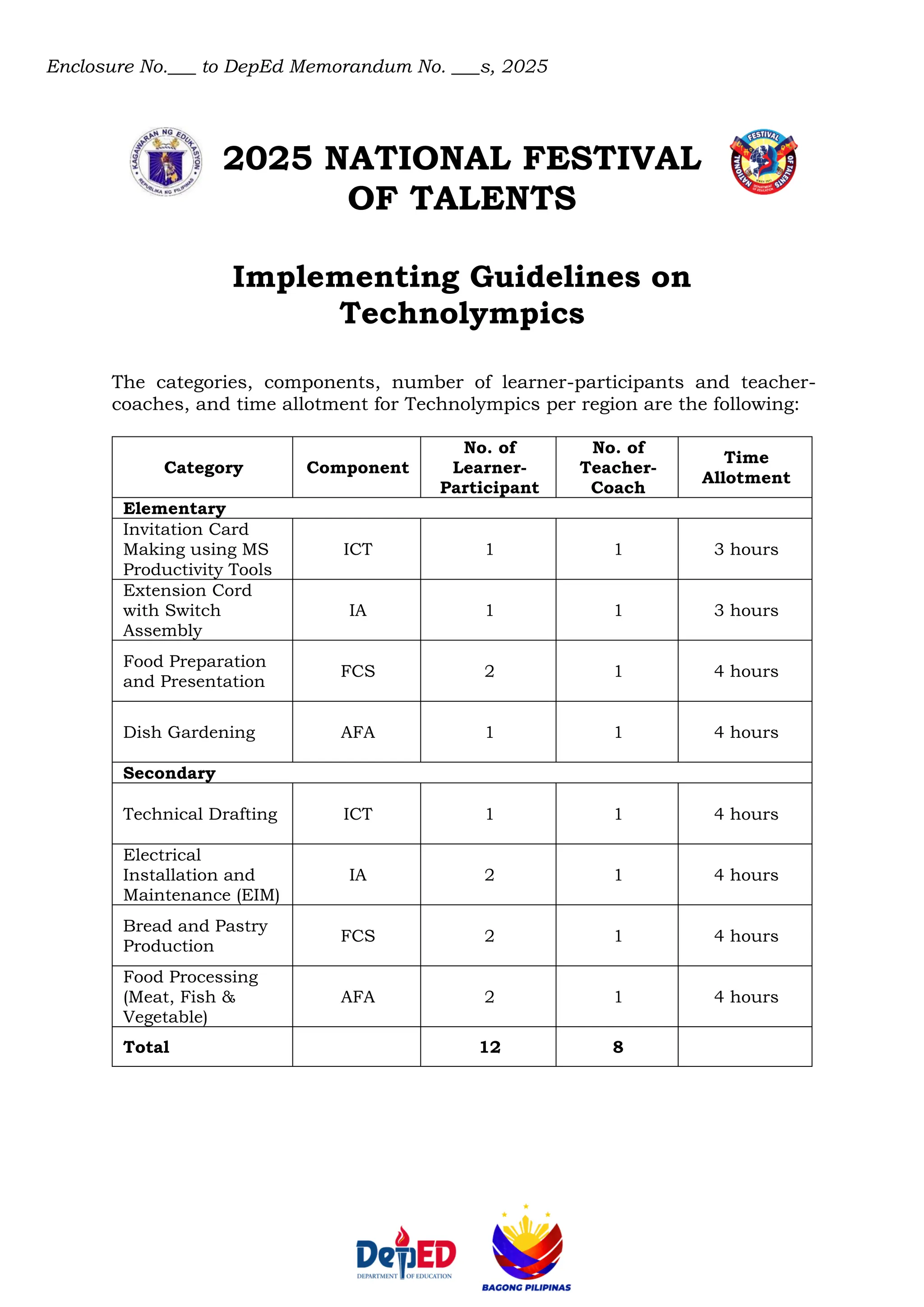
![Enclosure No.___ to DepEd Memorandum No. ___s, 2025
TECHNOLYMPICS
(A Showcase of Marketable Products and Performances)
INVITATION CARD MAKING USING MICROSOFT PRODUCTIVITY TOOLS
COMPONENT
AREA
INFORMATION AND COMMUNICATION TECHNOLOGY (ICT)
KEY STAGE Elementary Grades 4-6)
EVENT TITLE Invitation Card Making Using Microsoft Productivity Tools
NO. OF
PARTICIPANT/S
One (1) learner-participant
TIME ALLOTMENT Three (3) Hours, excluding interview
PERFORMANCE
STANDARD
Ang mga mag-aaral ay nakagagawa ng iba’t ibang dokumento
gamit ang computing devices at productivity tools. [MATATAG,
Grade 4]
Nakagagawa ng knowledge products gamit ang productivity tools.
[Kto12 Curriculum, Grade 5, Content 7]
21ST CENTURY
SKILL/S
Creativity, Communication, Critical Thinking, ICT for Learning,
Self-Regulation, Digital Literacy, Adaptability
CREATIVE
INDUSTRIES
DOMAIN
Publishing, Printed Media, ICT, and Digital Communication
DESCRIPTION Invitation Card Making Using Microsoft Productivity Tools is
an NFOT event category of Technolympics that allows learner-
participants to utilize several Microsoft Productivity Tools to make
unique invitation cards based on the given topic or theme.
TECHNICAL SPECIFICATIONS
A. MATERIALS,
TOOLS AND
EQUIPMENT
To be provided by the
participants:
• None
To be provided by the event
organizers:
• Desktop/Laptop with
Windows 10 or higher
installed with MS Office
Standards or higher
version
• Printer with colored
cartridges
• Filed Photos on the
computer
• Extension wire and UPS
• Laid paper in A4
• Mouse
• Scissors/ Handheld Cutter
• Plastic /Metal Ruler
• Curling Ribbon, 2 meters
per participant
B. VENUE Airconditioned/Well-ventilated Computer Laboratory/ Room
CRITERIA FOR
JUDGING
Criteria Percentage
Creativity of Design 30%
Exceptional
− with outstanding creativity and
originality
− showcased innovative design
elements that effectively capture the
theme
30%](https://image.slidesharecdn.com/804813811-2025-nfot-specific-guidelines-1-250303061612-d3be4a3d/85/804813811-2025-NFOT-Specific-Guidelines-1-pdf-2-320.jpg)

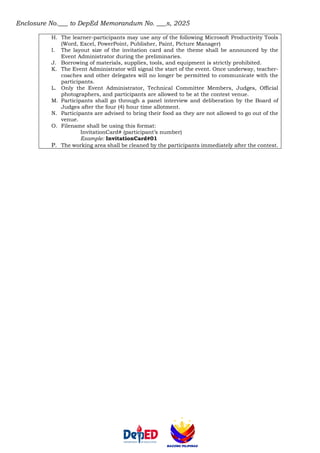
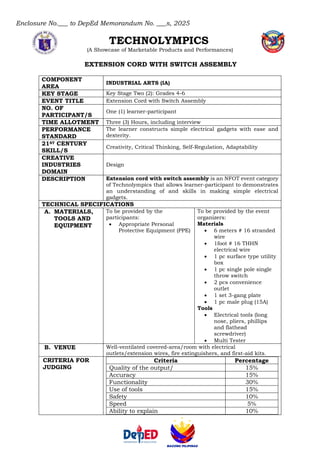
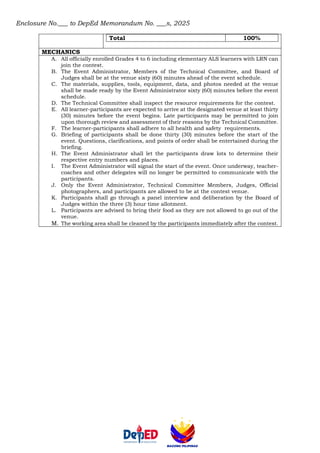
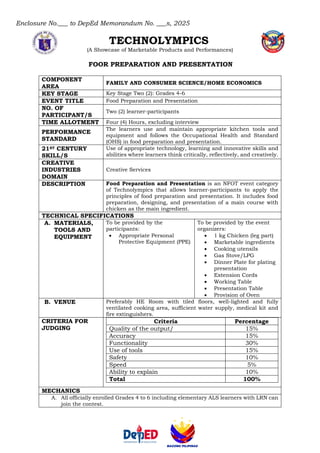
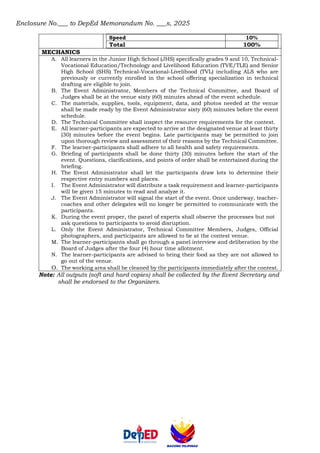
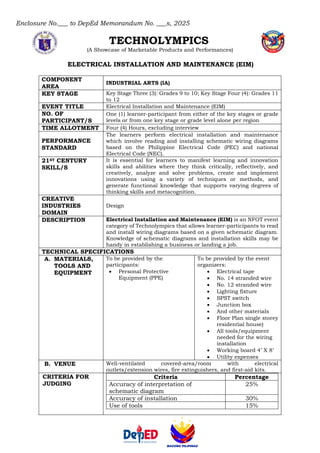
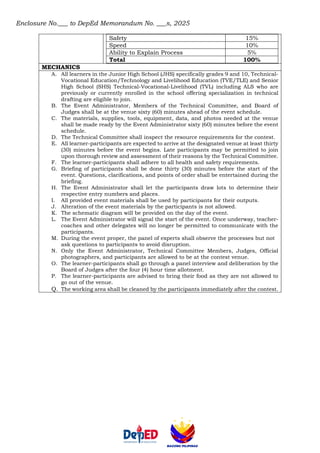
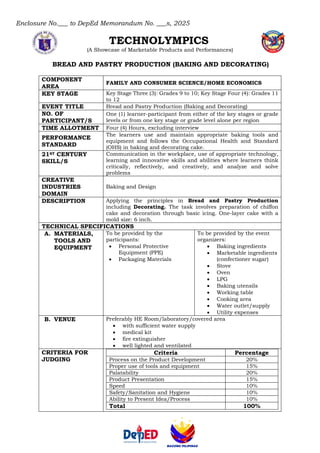
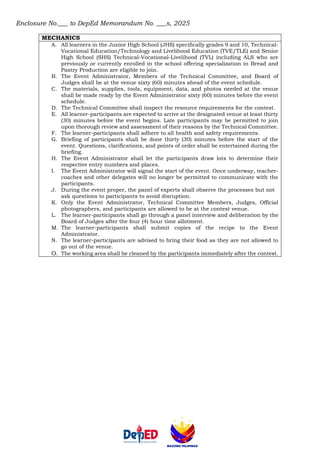
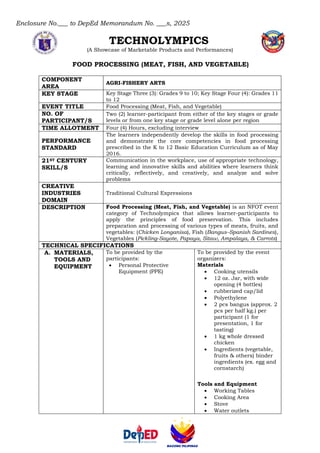
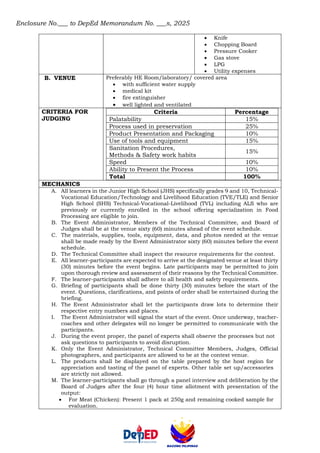

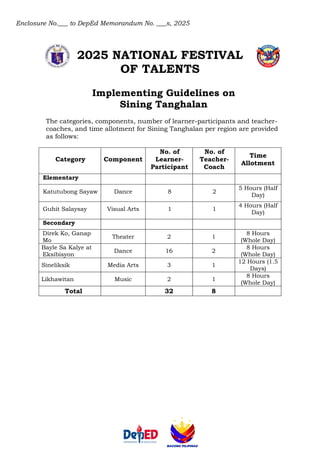
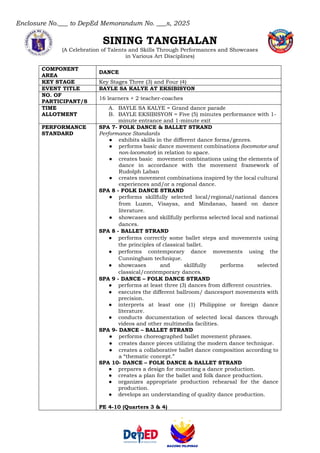
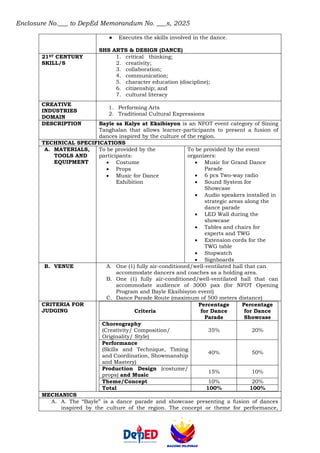
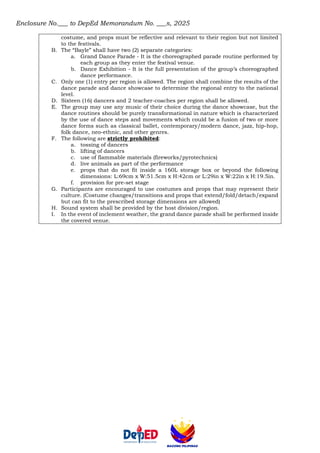
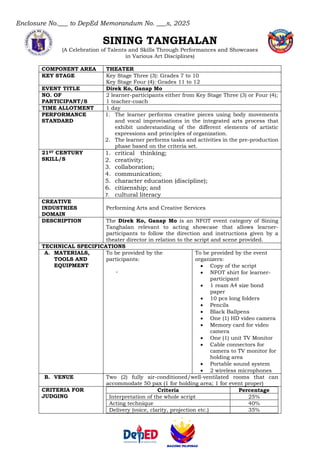
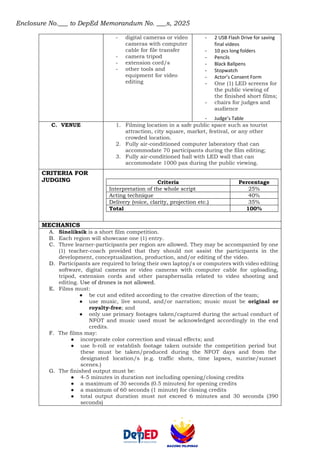
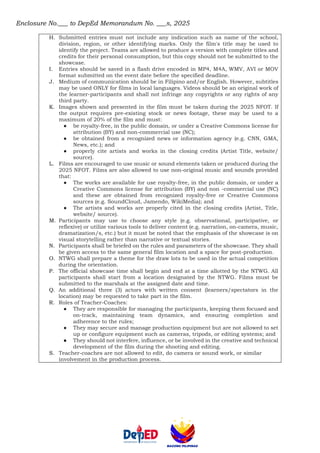
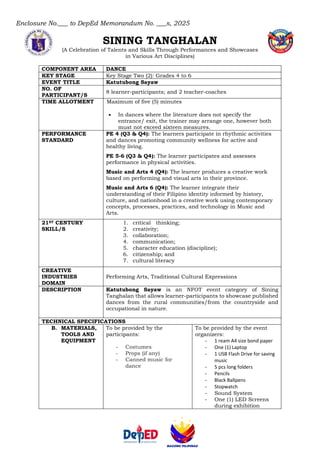
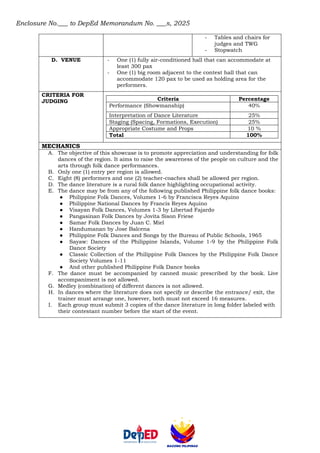
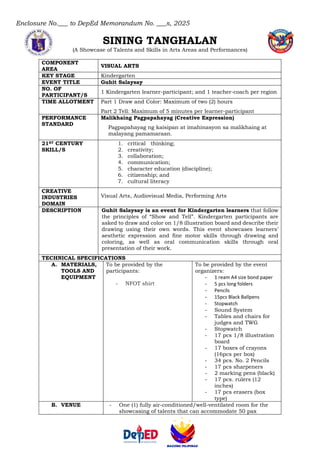
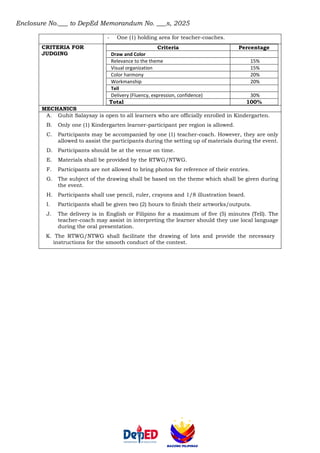
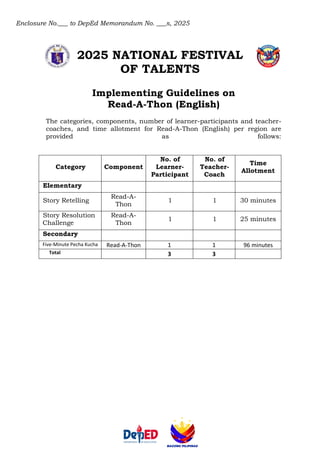
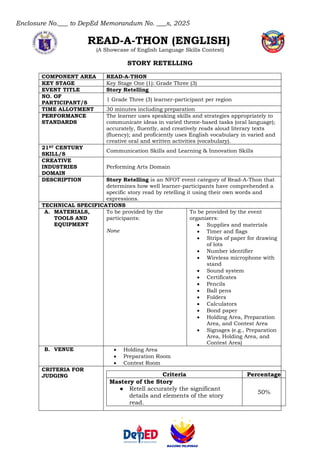
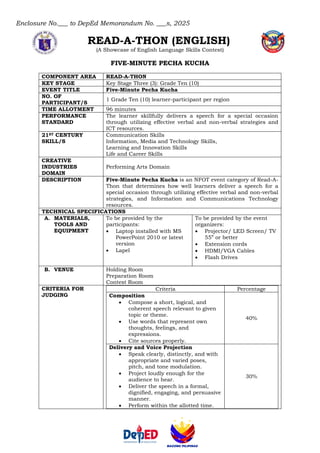
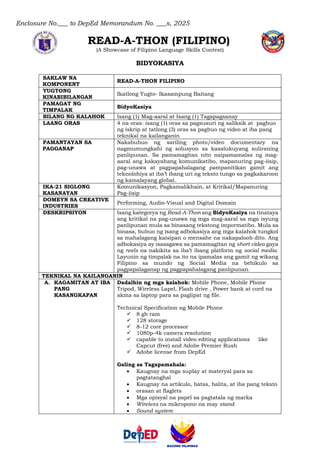
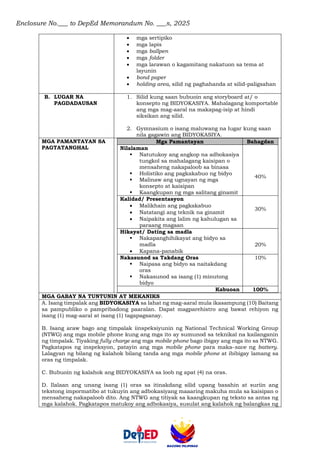
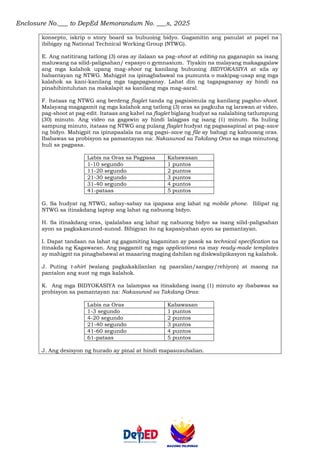
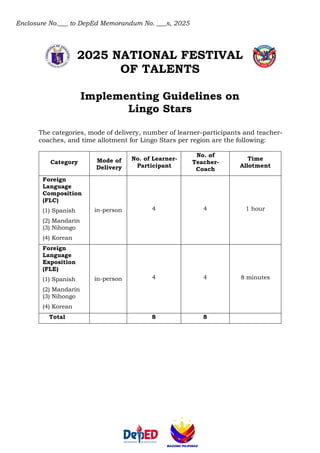
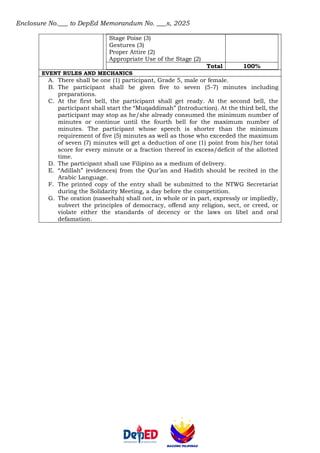
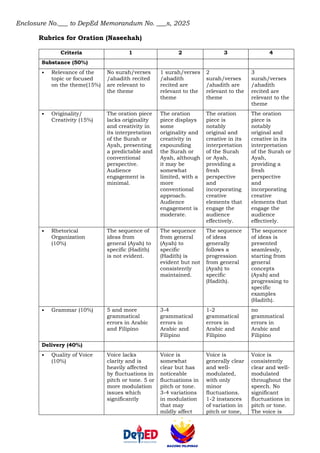
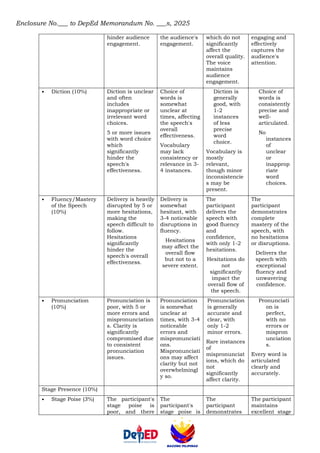
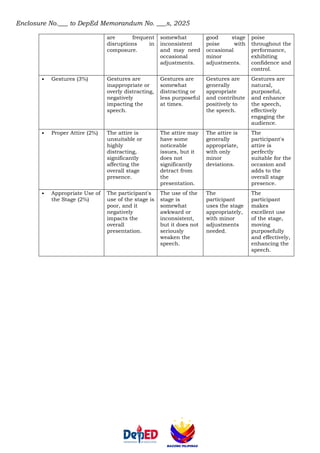
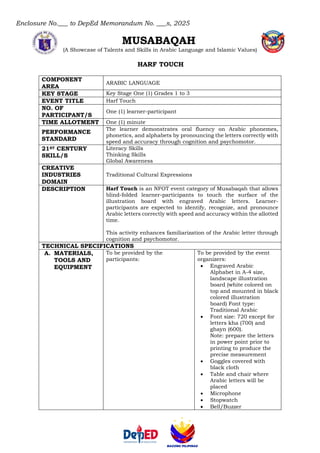
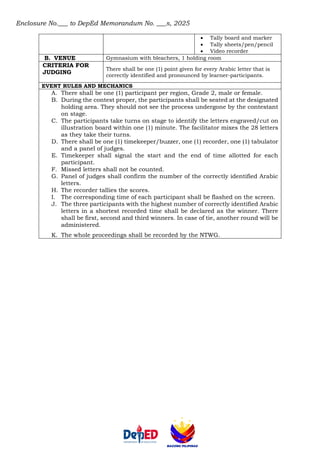
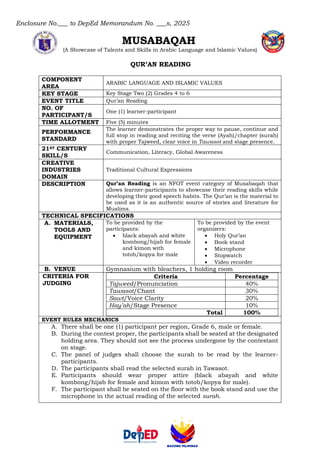
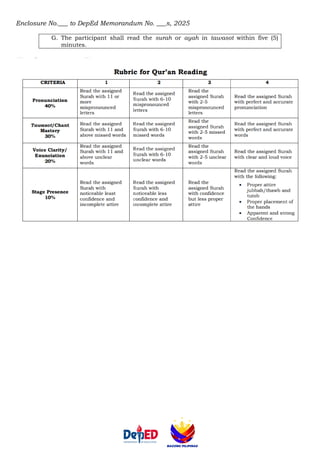
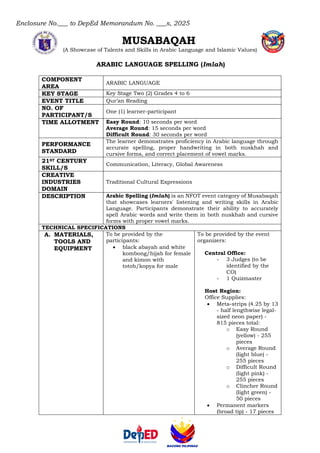
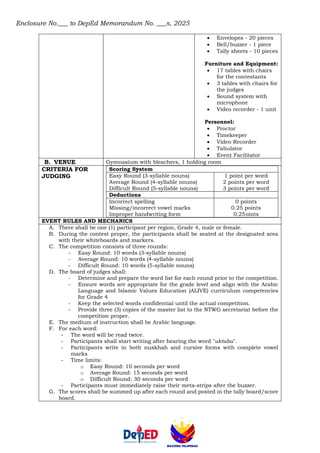
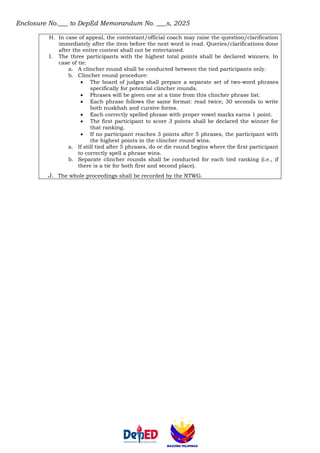
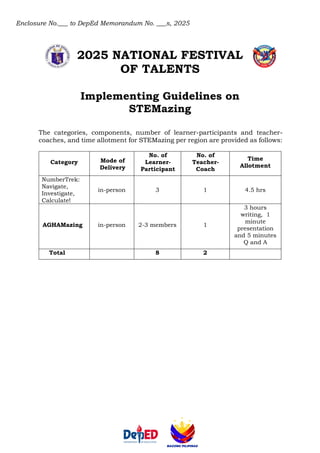
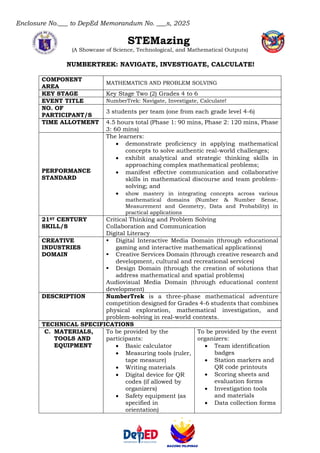
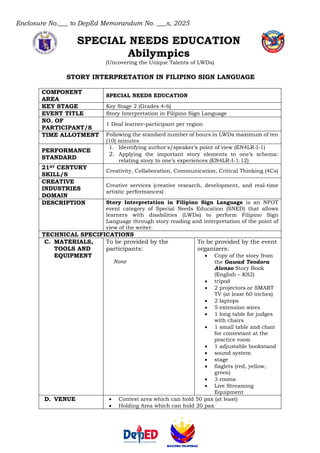
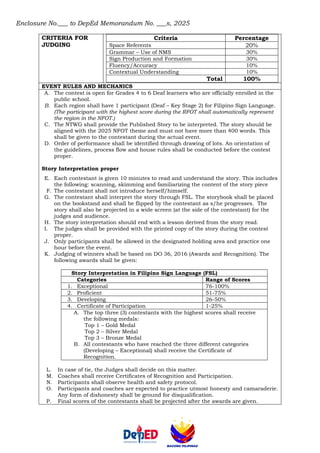
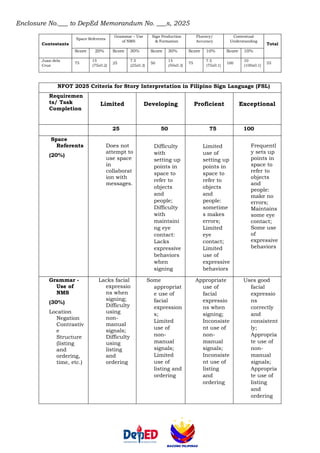
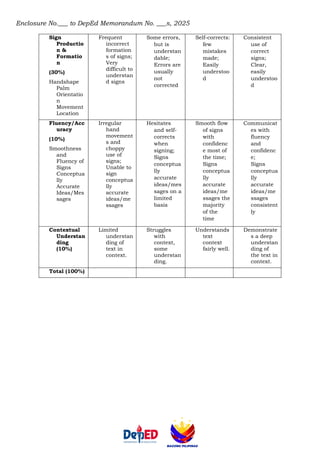
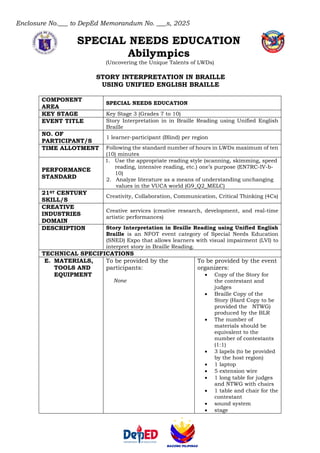
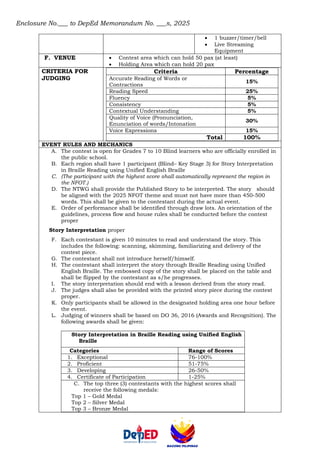
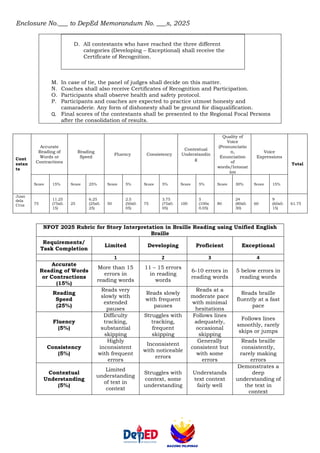
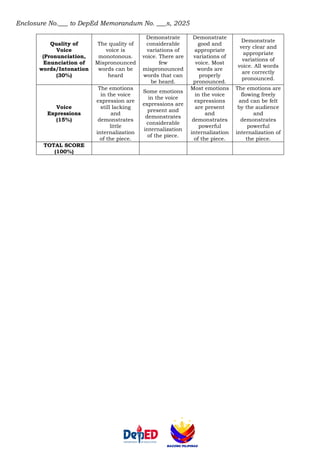
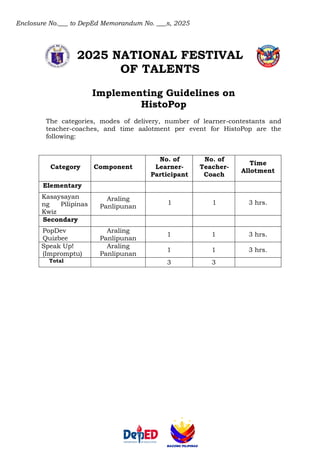


![Gulayaan sa Paaralan Project [GPP] - Project Proposal for FY 2014](https://cdn.slidesharecdn.com/ss_thumbnails/gppprojectproposal-130817112142-phpapp01-thumbnail.jpg?width=640&height=640&fit=bounds)


