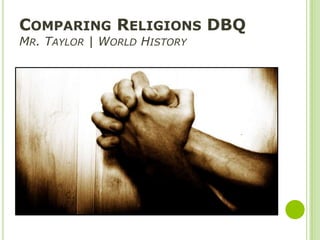
Comparing Religions DBQMr. Taylor | World History
Historical ContextA religion is defined as an organized system of beliefs, ceremonies, practices, and worship that centers around one or more gods. Throughout the centuries, religion has guided the beliefs and actions of millions of people in patterned and predictable ways.ESSAY PROMPT Using the information from the textbook and the documents provided, compare and contrast at least two religions.
More directionsWrite a well-organized essay that includes an introduction, several paragraphs, and a conclusion. Address all aspects of the task by accurately analyzing at least four documents. Support your response with relevant facts, examples and details. Include additional outside information.Using the textbook will be critical: See next slide.No outside research is necessary. Use the documents, your textbook and class notes.Compare the religions in at least three ways.Follow the high school essay format expectations.
World Religions and Ethical SystemsUse your textbook’s special section on “World Religions and Ethical Systems,” Page 282.AlsoBuddhism: pages 68-71Christianity: pages 168-172Hinduism: pages 66-67Islam: pages 263-272Judaism: pages 77-80Confucianism: pages 104-105Current locationsOriginsSacred textsRitualLeadershipWorship practicesCelebrationTextbook resourcesPossible topics
Possible thesis and conclusion topicsWhere are your selected religions common around the world?What basic principles do all of the religions have in common?What role does religion play in people’s everyday lives.Why do you think ritual and celebrations are an important part of all religions?What do you think people hope to gain from their religion?
Abraham LincolnNov. 19, 1863Fifth HourGettysburg AddressFour score and seven years ago our fathers brought forth on this continent, a new nation, conceived in Liberty, and dedicated to the proposition that all men are created equal. Now we are engaged in a great civil war, testing whether that nation, or any nation so conceived and so dedicated, can long endure. We are met on a great battlefield of that war. We have come to dedicate a portion of that field, as a final resting place for those who here gave their lives that that nation might live. It is altogether fitting and proper that we should do this (document #3).But, in a larger sense, we cannot dedicate—we cannot consecrate—we cannot hallow—this ground (Patterns of Interaction, Page 234). The brave men, living and dead, who struggled here, have consecrated it, far above our poor power to add or detract. The world will little note, nor long remember what we say here, but it can never forget what they did here. It is for us the living, rather, to be dedicated here to the unfinished work which they who fought here have thus far so nobly advanced.HIGH SCHOOLESSAY FORMAT Name information
 Title (not “essay”)
 No word art
 Paragraphs
 Indents
 Double spaced
Textbook-style font
10-12 size font
1-inch margins

7-religion-dbq

  • 1.
    Comparing Religions DBQMr.Taylor | World History
  • 2.
    Historical ContextA religionis defined as an organized system of beliefs, ceremonies, practices, and worship that centers around one or more gods. Throughout the centuries, religion has guided the beliefs and actions of millions of people in patterned and predictable ways.ESSAY PROMPT Using the information from the textbook and the documents provided, compare and contrast at least two religions.
  • 3.
    More directionsWrite awell-organized essay that includes an introduction, several paragraphs, and a conclusion. Address all aspects of the task by accurately analyzing at least four documents. Support your response with relevant facts, examples and details. Include additional outside information.Using the textbook will be critical: See next slide.No outside research is necessary. Use the documents, your textbook and class notes.Compare the religions in at least three ways.Follow the high school essay format expectations.
  • 4.
    World Religions andEthical SystemsUse your textbook’s special section on “World Religions and Ethical Systems,” Page 282.AlsoBuddhism: pages 68-71Christianity: pages 168-172Hinduism: pages 66-67Islam: pages 263-272Judaism: pages 77-80Confucianism: pages 104-105Current locationsOriginsSacred textsRitualLeadershipWorship practicesCelebrationTextbook resourcesPossible topics
  • 5.
    Possible thesis andconclusion topicsWhere are your selected religions common around the world?What basic principles do all of the religions have in common?What role does religion play in people’s everyday lives.Why do you think ritual and celebrations are an important part of all religions?What do you think people hope to gain from their religion?
  • 6.
    Abraham LincolnNov. 19,1863Fifth HourGettysburg AddressFour score and seven years ago our fathers brought forth on this continent, a new nation, conceived in Liberty, and dedicated to the proposition that all men are created equal. Now we are engaged in a great civil war, testing whether that nation, or any nation so conceived and so dedicated, can long endure. We are met on a great battlefield of that war. We have come to dedicate a portion of that field, as a final resting place for those who here gave their lives that that nation might live. It is altogether fitting and proper that we should do this (document #3).But, in a larger sense, we cannot dedicate—we cannot consecrate—we cannot hallow—this ground (Patterns of Interaction, Page 234). The brave men, living and dead, who struggled here, have consecrated it, far above our poor power to add or detract. The world will little note, nor long remember what we say here, but it can never forget what they did here. It is for us the living, rather, to be dedicated here to the unfinished work which they who fought here have thus far so nobly advanced.HIGH SCHOOLESSAY FORMAT Name information
  • 7.
    Title (not“essay”)
  • 8.
  • 9.
  • 10.
  • 11.
  • 12.
  • 13.
  • 14.