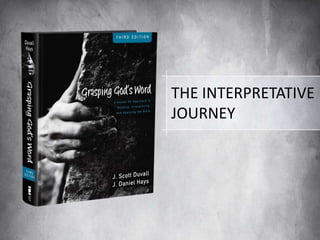
THE INTERPRETATIVE
JOURNEY
Introduction
WHY DO PEOPLE
ALL OVER THE WORLD
READ THE BIBLE?
Introduction
WHY DO YOU
READ THE BIBLE?
Introduction
Three Methods of Biblical Interpretation
• Intuitive or Feels-right Approach
• Spiritualizing Approach
• Shrug Your Shoulders Approach
Introduction
LESSONS FROM THE WEST WING
• All Christians must be able to interpret
Scripture.
• An Intuitive Approach will ultimately fail!
Basics of the Journey
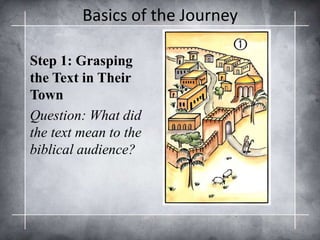
Step 1: Grasping
the Text in Their
Town
Question: What did
the text mean to the
biblical audience?
Basics of the Journey
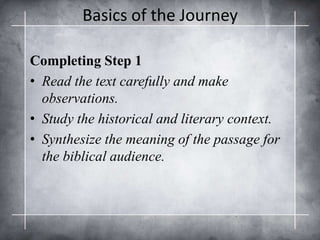
Completing Step 1
• Read the text carefully and make
observations.
• Study the historical and literary context.
• Synthesize the meaning of the passage for
the biblical audience.
Basics of the Journey
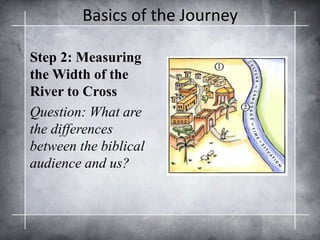
Step 2: Measuring
the Width of the
River to Cross
Question: What are
the differences
between the biblical
audience and us?
Basics of the Journey
Completing Step 2
• Account for common differences: culture,
language situation, time and covenant.
• Focus on the unique differences found in a
specific text.
• If you are studying an Old Testament
passage, you must account for the life and
work of Jesus Christ.
Basics of the Journey
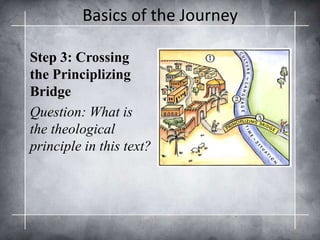
Step 3: Crossing
the Principlizing
Bridge
Question: What is
the theological
principle in this text?
Basics of the Journey
Completing Step 3
• Recall the differences identified in Step 2.
• Identify any similarities between the
biblical audience and contemporary life.
• Holding the differences and similarities
together, identify a broad theological
principle.
• Write out the theological principle, using
present tense verbs.
Basics of the Journey
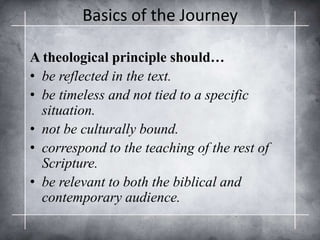
A theological principle should…
• be reflected in the text.
• be timeless and not tied to a specific
situation.
• not be culturally bound.
• correspond to the teaching of the rest of
Scripture.
• be relevant to both the biblical and
contemporary audience.
Basics of the Journey
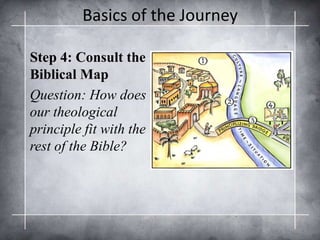
Step 4: Consult the
Biblical Map
Question: How does
our theological
principle fit with the
rest of the Bible?
Basics of the Journey
Completing Step 4
• Does this principle correlate with the rest
of the Bible?
• If in the Old Testament, run your
theological principle through the grid of
the New Testament.
Basics of the Journey
Step 5: Grasping the Text in Our Town
Question: How should individual Christians
today live out the theological principles?
Basics of the Journey
Completing Step 5
• Apply the theological principle to the
specific situation of a contemporary
Christian.
• There are numerous applicational
possibilities, because Christians today find
themselves in a variety of situations.
The Interpretative Journey
AN EXAMPLE
JOSHUA 1:1-9
The Interpretative Journey
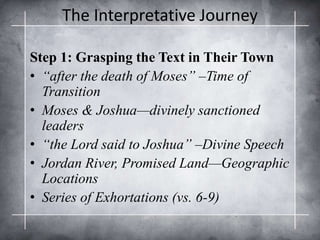
Step 1: Grasping the Text in Their Town
• “after the death of Moses” –Time of
Transition
• Moses & Joshua—divinely sanctioned
leaders
• “the Lord said to Joshua” –Divine Speech
• Jordan River, Promised Land—Geographic
Locations
• Series of Exhortations (vs. 6-9)
The Interpretative Journey
Step 1: Grasping the Text in Their Town
• Presence –vs. 5, 9
• Strength & Courage –vs. 6, 7, 9
• Law –vs. 7, 8
• Success –vs. 7, 8
The Interpretative Journey
Step 1: Grasping the Text in Their Town
The Lord commanded Joshua, the new leader
of Israel, to draw strength and courage from
God’s empowering presence, to be obedient
to the law of Moses, and to mediate on the
law so that he would be successful in the
conquest of the Promised Land.
The Interpretative Journey
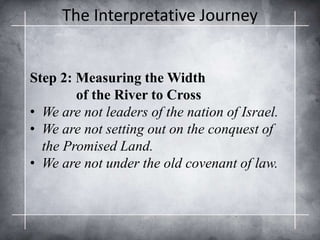
Step 2: Measuring the Width
of the River to Cross
• We are not leaders of the nation of Israel.
• We are not setting out on the conquest of
the Promised Land.
• We are not under the old covenant of law.
The Interpretative Journey
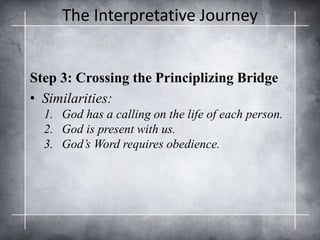
Step 3: Crossing the Principlizing Bridge
• Similarities:
1. God has a calling on the life of each person.
2. God is present with us.
3. God’s Word requires obedience.
The Interpretative Journey
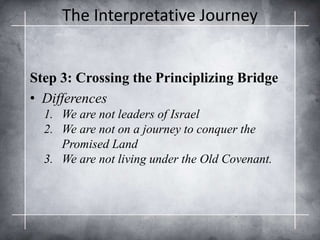
Step 3: Crossing the Principlizing Bridge
• Differences
1. We are not leaders of Israel
2. We are not on a journey to conquer the
Promised Land
3. We are not living under the Old Covenant.
The Interpretative Journey
Step 3: Crossing the Principlizing Bridge
To be effective in serving God and successful
in the task to which he has called us, we must
draw strength and courage from his
presence. We must also be obedient to God’s
Word, meditating on it constantly.
The Interpretative Journey
Step 4: Consult the Biblical Map
The whole of Scripture affirms that God’s
people can draw strength and courage from
his presence. In the New Testament the Holy
Spirit mediates God’s presence to his People.
Also, in both the Old and New Testament
God’s people are exhorted to mediate on
Scripture.
The Interpretive Journey
Step 5: Grasping the Text in Our Town
• Spend more time meditating on God’s Word
by listening to Christian music in your car.
• If God calls you to a new, scary ministry
be strengthened and encouraged by his
presence.
• A common misunderstanding of Leviticus. There are three types of laws in Leviticus, but people
lump them together and confuse which ones they should follow.
• 1st type: The commands that have the phrase "speak to the sons of Israel" are addressed to Jews
only, and never applied to non-Jews.
• Example: "Speak to the sons of Israel, saying, ‘You shall not eat any fat from an ox, a sheep or a
goat' (Levi 7:23) The food restrictions in this category expired with Acts 10:13-16 (God made all
foods clean after Jesus died and rose again).
• 2nd type: The laws specific to the system of the Jewish civil government (comprised of judges).
This government was disintegrated when Israel became a monarchy through King Saul. So its laws
also expired.
• Example: 'You may even bequeath them to your sons after you, to receive as a possession; you can
use them as permanent slaves. But in respect to your countrymen, the sons of Israel, you shall not
rule with severity over one another.' (Levi 25:46)
• 3rd type: The parts of Leviticus that have "I am the Lord" are derived from God's character, so
they apply to every human being, regardless of race. It's clarified by verses outside Leviticus (like
Ecclesiastes 12:13 and Micah 6:8).
• Example: 'The foreigner residing among you must be treated as your native-born. Love them as
yourself, for you were foreigners in Egypt.' (Levi 19:34) Homosexuality (Levi 18:22), along with
incest, bestiality are in this “I am the Lord Category, which is why they still apply to today’s morality.
THE INTERPRETATIVE
JOURNEY

Chapter 2 the interpretative journey

  • 1.
  • 2.
    Introduction WHY DO PEOPLE ALLOVER THE WORLD READ THE BIBLE?
  • 3.
  • 4.
    Introduction Three Methods ofBiblical Interpretation • Intuitive or Feels-right Approach • Spiritualizing Approach • Shrug Your Shoulders Approach
  • 5.
    Introduction LESSONS FROM THEWEST WING • All Christians must be able to interpret Scripture. • An Intuitive Approach will ultimately fail!
  • 6.
  • 7.
    Basics of theJourney Step 1: Grasping the Text in Their Town Question: What did the text mean to the biblical audience?
  • 8.
    Basics of theJourney Completing Step 1 • Read the text carefully and make observations. • Study the historical and literary context. • Synthesize the meaning of the passage for the biblical audience.
  • 9.
    Basics of theJourney Step 2: Measuring the Width of the River to Cross Question: What are the differences between the biblical audience and us?
  • 10.
    Basics of theJourney Completing Step 2 • Account for common differences: culture, language situation, time and covenant. • Focus on the unique differences found in a specific text. • If you are studying an Old Testament passage, you must account for the life and work of Jesus Christ.
  • 11.
    Basics of theJourney Step 3: Crossing the Principlizing Bridge Question: What is the theological principle in this text?
  • 12.
    Basics of theJourney Completing Step 3 • Recall the differences identified in Step 2. • Identify any similarities between the biblical audience and contemporary life. • Holding the differences and similarities together, identify a broad theological principle. • Write out the theological principle, using present tense verbs.
  • 13.
    Basics of theJourney A theological principle should… • be reflected in the text. • be timeless and not tied to a specific situation. • not be culturally bound. • correspond to the teaching of the rest of Scripture. • be relevant to both the biblical and contemporary audience.
  • 14.
    Basics of theJourney Step 4: Consult the Biblical Map Question: How does our theological principle fit with the rest of the Bible?
  • 15.
    Basics of theJourney Completing Step 4 • Does this principle correlate with the rest of the Bible? • If in the Old Testament, run your theological principle through the grid of the New Testament.
  • 16.
    Basics of theJourney Step 5: Grasping the Text in Our Town Question: How should individual Christians today live out the theological principles?
  • 17.
  • 18.
    Basics of theJourney Completing Step 5 • Apply the theological principle to the specific situation of a contemporary Christian. • There are numerous applicational possibilities, because Christians today find themselves in a variety of situations.
  • 19.
    The Interpretative Journey ANEXAMPLE JOSHUA 1:1-9
  • 20.
    The Interpretative Journey Step1: Grasping the Text in Their Town • “after the death of Moses” –Time of Transition • Moses & Joshua—divinely sanctioned leaders • “the Lord said to Joshua” –Divine Speech • Jordan River, Promised Land—Geographic Locations • Series of Exhortations (vs. 6-9)
  • 21.
    The Interpretative Journey Step1: Grasping the Text in Their Town • Presence –vs. 5, 9 • Strength & Courage –vs. 6, 7, 9 • Law –vs. 7, 8 • Success –vs. 7, 8
  • 22.
    The Interpretative Journey Step1: Grasping the Text in Their Town The Lord commanded Joshua, the new leader of Israel, to draw strength and courage from God’s empowering presence, to be obedient to the law of Moses, and to mediate on the law so that he would be successful in the conquest of the Promised Land.
  • 23.
    The Interpretative Journey Step2: Measuring the Width of the River to Cross • We are not leaders of the nation of Israel. • We are not setting out on the conquest of the Promised Land. • We are not under the old covenant of law.
  • 24.
    The Interpretative Journey Step3: Crossing the Principlizing Bridge • Similarities: 1. God has a calling on the life of each person. 2. God is present with us. 3. God’s Word requires obedience.
  • 25.
    The Interpretative Journey Step3: Crossing the Principlizing Bridge • Differences 1. We are not leaders of Israel 2. We are not on a journey to conquer the Promised Land 3. We are not living under the Old Covenant.
  • 26.
    The Interpretative Journey Step3: Crossing the Principlizing Bridge To be effective in serving God and successful in the task to which he has called us, we must draw strength and courage from his presence. We must also be obedient to God’s Word, meditating on it constantly.
  • 27.
    The Interpretative Journey Step4: Consult the Biblical Map The whole of Scripture affirms that God’s people can draw strength and courage from his presence. In the New Testament the Holy Spirit mediates God’s presence to his People. Also, in both the Old and New Testament God’s people are exhorted to mediate on Scripture.
  • 28.
    The Interpretive Journey Step5: Grasping the Text in Our Town • Spend more time meditating on God’s Word by listening to Christian music in your car. • If God calls you to a new, scary ministry be strengthened and encouraged by his presence.
  • 29.
    • A commonmisunderstanding of Leviticus. There are three types of laws in Leviticus, but people lump them together and confuse which ones they should follow. • 1st type: The commands that have the phrase "speak to the sons of Israel" are addressed to Jews only, and never applied to non-Jews. • Example: "Speak to the sons of Israel, saying, ‘You shall not eat any fat from an ox, a sheep or a goat' (Levi 7:23) The food restrictions in this category expired with Acts 10:13-16 (God made all foods clean after Jesus died and rose again). • 2nd type: The laws specific to the system of the Jewish civil government (comprised of judges). This government was disintegrated when Israel became a monarchy through King Saul. So its laws also expired. • Example: 'You may even bequeath them to your sons after you, to receive as a possession; you can use them as permanent slaves. But in respect to your countrymen, the sons of Israel, you shall not rule with severity over one another.' (Levi 25:46) • 3rd type: The parts of Leviticus that have "I am the Lord" are derived from God's character, so they apply to every human being, regardless of race. It's clarified by verses outside Leviticus (like Ecclesiastes 12:13 and Micah 6:8). • Example: 'The foreigner residing among you must be treated as your native-born. Love them as yourself, for you were foreigners in Egypt.' (Levi 19:34) Homosexuality (Levi 18:22), along with incest, bestiality are in this “I am the Lord Category, which is why they still apply to today’s morality.
  • 30.

Editor's Notes

  • #3 To begin the lecture ask this question to help students begin thinking of the different reasons people turn to Scripture.
  • #4 As students share reasons why they read the Bible, you will want to explain that as they read the Bible they are actually “interpreting” Scripture.
  • #5 As you discuss these common methods, be careful to point out the weaknesses of these approaches. As a result of these weaknesses, it is important for us to have a consistent method of biblical interpretation that helps us understand the whole of Scripture. If you choose, you may show the following clip from The West Wing. This clip demonstrates why it is imperative to have a consistent approach to biblical interpretation. (http://www.youtube.com/watch?v=S1-ip47WYWc)
  • #6 Point 1: Dr. Jacobs is not a biblical scholar; rather, she is student of English Literature, yet she is still expected to know how to interpret Scripture. Point 2: Dr. Jacobs says, “I don’t say homosexuality is an abomination, Mr. President, the Bible does.” This statement reveals her intuitive approach. The weakness of this approach is demonstrated by her inability to mount any response to the President’s queries regarding Exodus 21:7, Exodus 35:2 or Leviticus 11:7. If Dr. Jacobs would have applied a spiritualizing approach, then she would be disregarding the very concrete nature that these injunctions address. And, she didn’t have the option of ignoring these difficult texts, because she is getting asked these questions by the President. We must have a consistent approach that grasps the original meaning, then attempts to apply this meaning by accounting for cultural differences and formulating a theological principle.
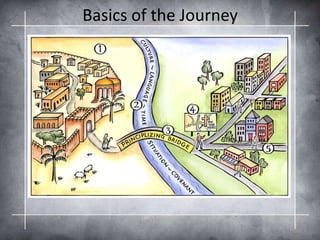
  • #7 Above is a pictorial representation of our consistent approach to biblical interpretation. We call it the Interpretative Journey. There are 5 steps on this journey: Grasping the Text in Their Town Measuring the Width of the River to Cross Crossing the Principlizing Bridge Consult the Biblical Map Grasping the Text in Our Town By embarking on this journey we commit to the goal of grasping the meaning of text. We do not create meaning out of a text; rather, we seek to find the meaning that is already there.
  • #9 The synthesis statement should use past tense verbs and refer to the biblical audience.
  • #11 Students often get bogged down in the common differences that possibly have little impact on the interpretation of a passage. It is important for them to realize that to take the Interpretative Journey means that we must account for the unique set of differences that we find in any given text.
  • #12 This theological principle is connected to the meaning that was discovered in Step 1.
  • #14 Above is a list of 5 criteria that describe a good theological principle.
  • #16 Point 1 describes the parts-whole spiral. Point 2 forces us to ask if the New Testament adds to or modifies our principle.
  • #17 This step moves an abstract principle to concrete application.
  • #18 Above is a pictorial representation of our consistent approach to biblical interpretation. We call it the Interpretative Journey. There are 5 steps on this journey: Grasping the Text in Their Town Measuring the Width of the River to Cross Crossing the Principlizing Bridge Consult the Biblical Map Grasping the Text in Our Town By embarking on this journey we commit to the goal of grasping the meaning of text. We do not create meaning out of a text; rather, we seek to find the meaning that is already there.
  • #20 Have your students open their textbook or Bible to this passage. Read this passage aloud at least one time as a class, then have students share what details of this passage stand out. On the next slide is a list of important details.
  • #22 The bulleted points on this slide are words that are repeated in this text. Before advancing to the next slide ask your class to synthesize the meaning of this passage.
  • #23 Synthesized meaning.
  • #24 Before revealing the cultural differences, ask the class what cultural differences they can identify.
  • #25 Ask your class what similarities exist between the biblical audience and contemporary audience.
  • #26 Before advancing to the next slide, ask you class to formulate a theological principle. Remind the class that this principle must be connected to the meaning that was discovered in Step 1.
  • #27 Before advancing to the next slide, ask the class whether this principle from correlates with the rest of Scripture.
  • #29 What other applications of this text can your class brainstorm?