7 
WONDERS 
OF 
WORLD 
‘‘THE 
CHICHEN ITZA’’ 
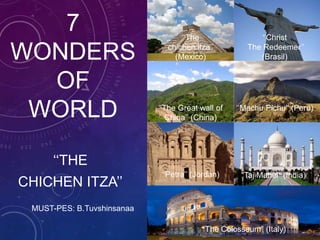
‘‘The 
chichen itza’’ 
(Mexico) 
‘‘The Great wall of 
China’’ (China) 
‘‘Petra’’ (Jordan) 
‘‘Christ 
The Redeemer’’ 
(Brasil) 
‘‘Machu Pichu’’ (Peru) 
“Taj Mahel” (India) 
“The Colosseum” (Italy) 
MUST-PES: B.Tuvshinsanaa
WHAT IS CHICHEN ITZA
HISTORY OF CHICHEN ITZA 
• Northern Yucatan few surface water and the river 
is very low, dry climate. Chichen favorable, with a 
single resource pool of water in the region, so 
people began to settle more.From the city water 
is precious, as its worships owner Chaak. Rainy 
Memorial is a person you want to include. The 
Maya built jungle pyramids to worship their gods.
COMPLEX OF CHICHEN ITZA
CHICHEN ITZA’S CENTER 
IS EL CASTILO (KUKULKAN)
PARTS OF CHICHEN ITZA 
Great North 
Platform 
Ossario 
Group 
Central 
Group 
Caves of 
Balankanche
El Castillo 
The kukulkan Pyramid……… 
• The center of the 
ceremony
Kukulcan jaguar throne, El 
Castillo church’s interior 
decoration 
El Castillo, located at the 
bottom level plumed snake 
of Kukulcan
Great Ball Court 
• Archaeologists have identified thirteen ballcourts for playing 
the Mesoamerican ballgame in Chichen Itza, but the Great Ball Court 
about 150 meters (490 ft) to the north-west of the Castillo is by far the 
most impressive. It is the largest and best preserved ball court in 
ancient Mesoamerica. 
Cenote Sagrado 
• The Yucatán Peninsula is a limestone plain, with no rivers or streams. 
The region is pockmarked with natural sinkholes, called cenotes, which 
expose the water table to the surface. One of the most impressive of 
these is the Cenote Sagrado, which is 60 metres (200 ft) in diameter, and 
sheer cliffs that drop to the water table some 27 metres (89 ft) below 
Temple Of the Warriors 
• The Temple of the Warriors complex consists of a large stepped pyramid 
fronted and flanked by rows of carved columns depicting warriors. This 
complex is analogous to Temple B at the Toltec capital of Tula.
….
Las Monjas.. (Built for the rain god Chaak) 
• The history of Chichen Itza as with many aspects of 
Mayan history is obscure: Written records are scarce. 
In the historical records which is exist, dates that were 
several years apart were often given the same name, 
due to the organization of the old Mayan calendar. 
El Caracol.. (Astronomical Center) 
• El Caracol means winding staircase or snail. This 
building is dated between 600 AD to 850 AD. 
It was remodeled also from 800 AD to 1200 AD. The 
tower is 48 feet high with many windows which 
allowed for observing the equinoxes and summer 
solstice.
The Mayan Civilization……..
7 wonders "Chichen Itza"

7 wonders "Chichen Itza"

  • 1.
    7 WONDERS OF WORLD ‘‘THE CHICHEN ITZA’’ ‘‘The chichen itza’’ (Mexico) ‘‘The Great wall of China’’ (China) ‘‘Petra’’ (Jordan) ‘‘Christ The Redeemer’’ (Brasil) ‘‘Machu Pichu’’ (Peru) “Taj Mahel” (India) “The Colosseum” (Italy) MUST-PES: B.Tuvshinsanaa
  • 2.
  • 3.
    HISTORY OF CHICHENITZA • Northern Yucatan few surface water and the river is very low, dry climate. Chichen favorable, with a single resource pool of water in the region, so people began to settle more.From the city water is precious, as its worships owner Chaak. Rainy Memorial is a person you want to include. The Maya built jungle pyramids to worship their gods.
  • 4.
  • 5.
    CHICHEN ITZA’S CENTER IS EL CASTILO (KUKULKAN)
  • 6.
    PARTS OF CHICHENITZA Great North Platform Ossario Group Central Group Caves of Balankanche
  • 7.
    El Castillo Thekukulkan Pyramid……… • The center of the ceremony
  • 8.
    Kukulcan jaguar throne,El Castillo church’s interior decoration El Castillo, located at the bottom level plumed snake of Kukulcan
  • 9.
    Great Ball Court • Archaeologists have identified thirteen ballcourts for playing the Mesoamerican ballgame in Chichen Itza, but the Great Ball Court about 150 meters (490 ft) to the north-west of the Castillo is by far the most impressive. It is the largest and best preserved ball court in ancient Mesoamerica. Cenote Sagrado • The Yucatán Peninsula is a limestone plain, with no rivers or streams. The region is pockmarked with natural sinkholes, called cenotes, which expose the water table to the surface. One of the most impressive of these is the Cenote Sagrado, which is 60 metres (200 ft) in diameter, and sheer cliffs that drop to the water table some 27 metres (89 ft) below Temple Of the Warriors • The Temple of the Warriors complex consists of a large stepped pyramid fronted and flanked by rows of carved columns depicting warriors. This complex is analogous to Temple B at the Toltec capital of Tula.
  • 10.
  • 11.
    Las Monjas.. (Builtfor the rain god Chaak) • The history of Chichen Itza as with many aspects of Mayan history is obscure: Written records are scarce. In the historical records which is exist, dates that were several years apart were often given the same name, due to the organization of the old Mayan calendar. El Caracol.. (Astronomical Center) • El Caracol means winding staircase or snail. This building is dated between 600 AD to 850 AD. It was remodeled also from 800 AD to 1200 AD. The tower is 48 feet high with many windows which allowed for observing the equinoxes and summer solstice.
  • 13.