Featuresandprocessof
communication
By:
KhushbuGupta
BUSINESS
COMMUNICATION
Introduction of
communication
The word ‘communication’ is derived from the latin word
‘communicare’
Which means ‘to make common, to share, to transmit or to
impart’.
Thus communication can be considered as process that involves
the transfer of information, ideas, emotions, feelings etc.
between people.
‘Business communication differs from other types of
communication, not by its means of communicating but by its
objectives’
Meaning and definition
According to Allen, “ Communication is the sum of all
things, one person does when he wants to create
understanding in the mind of another. It is a bridge of
meaning. It involves a systematic and continuous process
of telling, listening and understanding.”
Thus it is the exchange of facts, ideas
and viewpoints which bring about commonness of
interest, purpose and efforts.
Features of Communication
The characteristics of communication are as follows:
• Two-way Process
• Information sharing and understanding
• Verbal and Non-verbal
• Circular flow
• Goal oriented
• Continuous Process
• Pervasive Activity
Components of
Communication
➢
➢Sender – Encoder
Message
➢
➢
Medium(channel)
Receiver Decoder
➢Feedback
The Communication Process
Objectives of Communication
• Exchange of Information
• Issue of orders and instructions
• Education
• Advices and counselling
• Persuasion
• Suggestions
• Motivation
• Raising Morale
• Warning
Need for Communication
• Giant Organizations
• Global Business Environment
• Technological Advancement
• Timely Information
• Better Human Relations
• Better Public Relations
Role and Importance of
Communication
• Facilitates Planning
• Basis for Decision making
• Achieves Effective Co-ordination
• Facilitates Better Administration
• Creation of Mutual Trust and Confidence
• Motivation of Employees
• Building Employee Morale
• Binding force or commitment
• Facilitates Effective Control
Feedback
■ Feedback is the
response or reply which
the receiver of a
■
message gives back to
the sender. Sometimes
its possible to get
feedback immediately.
Feedback can be
immediate as in the case
of face to face
communication.
Group and Mass
Communication
Mass communication is the
academic studyof how individuals and entities
relayinformation through mass media to large
segmentsof the population at the sametime. It is
usuallyunderstood to relate to newspaper and
magazine publishing, radio, television and
film, as these are usedboth for disseminating
news and for advertising.
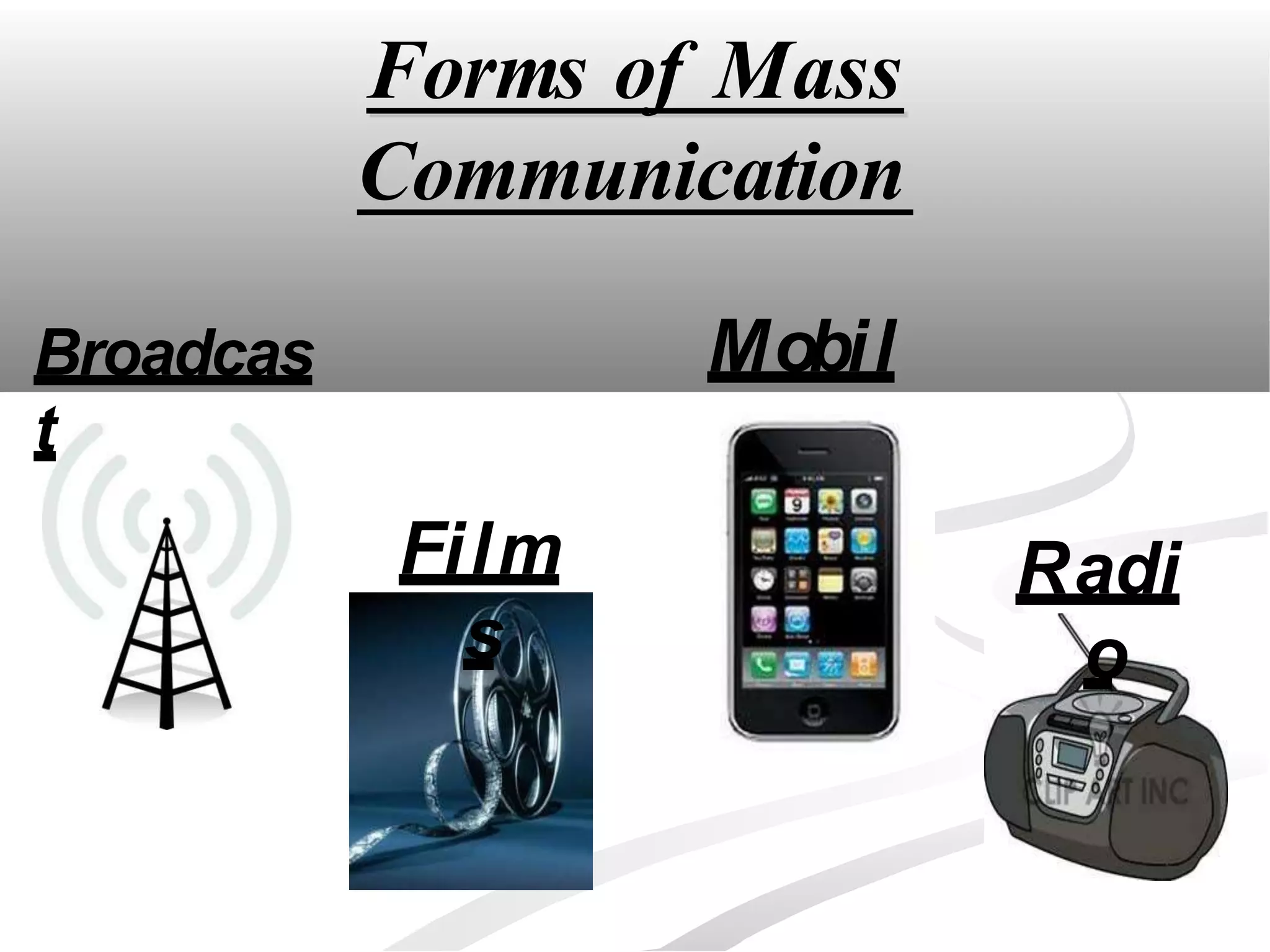
Forms of Mass
Communication
Broadcas
t
Film
s
Mobil
e
Radi
o
Print Media
Newspaper
Magazines
Books
Advertisement
■ Advertisingor as a common typographical error, advertisingis
a form of communication for marketing and used to
encourage or persuade an audience (viewers, readers or
listeners; sometimes a specific group) to continue or take some
new action.
Conclusion
■ With the help of the following topics we came to know
how communication is important in our day-to-day life.
■ Communication is said to be effective only when
the message received by the receiver is understood
as intended by the sender, and accordingly acted
By the receiver.
■ The mass communication is said to be the media
communication the newspaper, books etc and the
forms of the mass communication.
Introduction of communication.pptx

Introduction of communication.pptx

  • 1.
  • 2.
    Introduction of communication The word‘communication’ is derived from the latin word ‘communicare’ Which means ‘to make common, to share, to transmit or to impart’. Thus communication can be considered as process that involves the transfer of information, ideas, emotions, feelings etc. between people. ‘Business communication differs from other types of communication, not by its means of communicating but by its objectives’
  • 3.
    Meaning and definition Accordingto Allen, “ Communication is the sum of all things, one person does when he wants to create understanding in the mind of another. It is a bridge of meaning. It involves a systematic and continuous process of telling, listening and understanding.” Thus it is the exchange of facts, ideas and viewpoints which bring about commonness of interest, purpose and efforts.
  • 4.
    Features of Communication Thecharacteristics of communication are as follows: • Two-way Process • Information sharing and understanding • Verbal and Non-verbal • Circular flow • Goal oriented • Continuous Process • Pervasive Activity
  • 5.
    Components of Communication ➢ ➢Sender –Encoder Message ➢ ➢ Medium(channel) Receiver Decoder ➢Feedback
  • 6.
  • 7.
    Objectives of Communication •Exchange of Information • Issue of orders and instructions • Education • Advices and counselling • Persuasion • Suggestions • Motivation • Raising Morale • Warning
  • 8.
    Need for Communication •Giant Organizations • Global Business Environment • Technological Advancement • Timely Information • Better Human Relations • Better Public Relations
  • 9.
    Role and Importanceof Communication • Facilitates Planning • Basis for Decision making • Achieves Effective Co-ordination • Facilitates Better Administration • Creation of Mutual Trust and Confidence • Motivation of Employees • Building Employee Morale • Binding force or commitment • Facilitates Effective Control
  • 10.
    Feedback ■ Feedback isthe response or reply which the receiver of a ■ message gives back to the sender. Sometimes its possible to get feedback immediately. Feedback can be immediate as in the case of face to face communication.
  • 11.
    Group and Mass Communication Masscommunication is the academic studyof how individuals and entities relayinformation through mass media to large segmentsof the population at the sametime. It is usuallyunderstood to relate to newspaper and magazine publishing, radio, television and film, as these are usedboth for disseminating news and for advertising.
  • 12.
  • 13.
  • 14.
    Advertisement ■ Advertisingor asa common typographical error, advertisingis a form of communication for marketing and used to encourage or persuade an audience (viewers, readers or listeners; sometimes a specific group) to continue or take some new action.
  • 15.
    Conclusion ■ With thehelp of the following topics we came to know how communication is important in our day-to-day life. ■ Communication is said to be effective only when the message received by the receiver is understood as intended by the sender, and accordingly acted By the receiver. ■ The mass communication is said to be the media communication the newspaper, books etc and the forms of the mass communication.