Redesigning our Combine Harvester

   Experimenting with Metalib’s X-server:
      ideas, attempts and realisations


               Ane W. van der Leij
      Dpts of Information & Collection Development /
                 Digital Library Facilities
                   University Library
    University of Groningen (RUG), the Netherlands
Outline
•Introductory
•Our Metalib
•Statistics-modules
Metalib Statistics
(SFX-statistics)
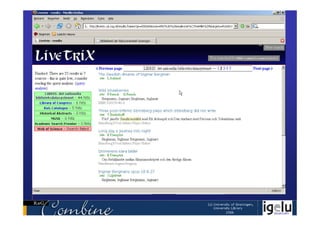
•Experimenting with the X-server: LiveTrix
Demo
Summarizing: Front features
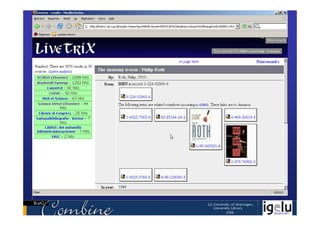
Summarizing: Rear features
Under the hood
•Concluding

(if time allows)
•Extras
Introductory
                         University of Groningen -
                     Rijksuniversiteit Groningen (RUG)

•founded 1614
•22,000 students, 6,000 staff
•494.2 mln EUR expenditure (2005)        (632 mUSD, 4.5 mdSEK)


                            University Library
•Central library, in addition to 10 faculty libraries
•130 staff
•Collection: 2.2 mln printed vols., 24,000 e-journals, 450 licenced
electronic databases
•1.36 mln EUR expenditure on collection development (incl. co-
financing of electronic resources by faculty libraries) (1.74 mUSD, 12.53 mSEK)
Our Metalib: RUG Combine
•Introduced v2 as pilot 2004, Faculty of Medicine and University
Medical Centre (Hospital staff)
•Migrated to v3 in January 2005, completing introduction to the
whole of the University september 2005
•NOT only gateway (OPAC, Guide, Lists); usage modest so far


                         Our SFX: RUGlinks
•Introduced 2002, v3 since 2005
Statistics (1)
            2 Modules: RUGlinks and RUG Combine
•Built upon logfiles, stored in MySQL-database
•Home made search software
•Available through HTML-webapplication
•Extract data that meet our needs and wishes
•Database and software on separate server
•Not interfering with production environment for Metalib and SFX
•Online webinterface; moved away from admin-module
•Username/Password access for library staff and management
Statistics (2)
                        What we found
15% errors:
technical measures > reducing to 1.5% errors/flaws
50% zero or false results:

•Misspellings and typos in search terms
•Picking databases at random
•Unable to understand QuickSearch, MetaSearch, Find Database
•Using the wrong search keys
•Using search keys wrong
•Using Dutch search terms in English language databases
•Using non-specific terms, phrases that are too broad
•Lack of understanding of Boolean logic or database peculiarities

                       Metalib statistics
Complex phrases


Dutch ! (obesity)


Quotes


Name handling


Name handling
What if...
•we could users make to understand the work flow
•we could clear away misspellings
•we could suggest other or related search terms
•we could make users pick the right databases
or better still…
•users wouldn’t have to bother which databases to choose

                            We can!
By building new applications around Metalib’s XML-server (X-server)
X-server
If Metalib is the car, then the X-server is the engine.


                                        It’s a Volvo!
          We like the engine!


      The car itself,                      … a DAF?
        though...

We could have power steering, ABS, a navigation system, cruise
control, keyless entry, air bags all around us and a nice car
stereo. We build our own car!
X-server: LiveTrix Front
•Ticking one or several Subject Areas          (if you want)
•Primary, Secondary (and Tertiary) resources (if you want)

•Suggest-mode                                  (if you want)

•Select resources                              (if you want)

•Help texts, search hints, explanation
•No Meta, no Quick
•Filling in search fields; no Simple, no Advanced
•Spelling check
•Graphical representation
X-server: LiveTrix Rear
•Search progress
•Presentation of hits
•Immediate access, even during retrieval process
•Help texts, search hints, explanation
•Short (table) view
•Long view, featuring: Book covers, Inline SFX services (link resolving to
full text, inline catalogue lookup, searching Google, Google Scholar, A9, export to
RefMan), Generate persistent tiny URL, Delivering extra metadata from
external resources, e.g. local library systems
LiveTrix: under the hood
Search terms are sent to all databases in the background.
The first 30 titles from each database are retrieved. These titles are
indexed both as a string and word for word, as well as counted. A
relation network is built up. From then on, the system knows in which
databases these terms occur.
In the next query, suggestions about databases (“likely sources”) are
given on the basis of these ever expanding indexes.
Dito for suggestions about word relations.
The indexes are also used for correcting typos and word/phrase
suggestions.
Suggestions about similar sounding phrases are given upon phonetic
matches (“Soundex”).
Concluding
How do we continue?
Uncertain
- Our funding
- Our manpower
- Maybe seeking cooperation/partners (inter)nationally
- What does ExLibris come up with?
Aim to make it a working system for end users.
- Completing it with personalization, alerting tool, solutions
for “link-only” resources
- Improving the interface
- Usability tests
Thank you for your attention!
                 Tack för uppmärksamheten!
                            Ane van der Leij
                         a.w.van.der.leij@rug.nl


                             Project group:
André Keyzer (UL)                         Bart Alewijnse (UL - trainee)
Tom Blikslager (Library of Arts)          Roxana Popistasu (UL - trainee)
Guus van den Brekel                       Peter van Rees (UL)
  (Central Medical Library)


      University of Groningen Libraries: http://www.rug.nl/bibliotheek
                  RUG Combine: http://combine.ub.rug.nl
                     LiveTrix: http://livetrix.ub.rug.nl

Redesigning our Combine Harvester

  • 1.
    Redesigning our CombineHarvester Experimenting with Metalib’s X-server: ideas, attempts and realisations Ane W. van der Leij Dpts of Information & Collection Development / Digital Library Facilities University Library University of Groningen (RUG), the Netherlands
  • 2.
    Outline •Introductory •Our Metalib •Statistics-modules Metalib Statistics (SFX-statistics) •Experimentingwith the X-server: LiveTrix Demo Summarizing: Front features Summarizing: Rear features Under the hood •Concluding (if time allows) •Extras
  • 3.
    Introductory University of Groningen - Rijksuniversiteit Groningen (RUG) •founded 1614 •22,000 students, 6,000 staff •494.2 mln EUR expenditure (2005) (632 mUSD, 4.5 mdSEK) University Library •Central library, in addition to 10 faculty libraries •130 staff •Collection: 2.2 mln printed vols., 24,000 e-journals, 450 licenced electronic databases •1.36 mln EUR expenditure on collection development (incl. co- financing of electronic resources by faculty libraries) (1.74 mUSD, 12.53 mSEK)
  • 4.
    Our Metalib: RUGCombine •Introduced v2 as pilot 2004, Faculty of Medicine and University Medical Centre (Hospital staff) •Migrated to v3 in January 2005, completing introduction to the whole of the University september 2005 •NOT only gateway (OPAC, Guide, Lists); usage modest so far Our SFX: RUGlinks •Introduced 2002, v3 since 2005
  • 5.
    Statistics (1) 2 Modules: RUGlinks and RUG Combine •Built upon logfiles, stored in MySQL-database •Home made search software •Available through HTML-webapplication •Extract data that meet our needs and wishes •Database and software on separate server •Not interfering with production environment for Metalib and SFX •Online webinterface; moved away from admin-module •Username/Password access for library staff and management
  • 6.
    Statistics (2) What we found 15% errors: technical measures > reducing to 1.5% errors/flaws 50% zero or false results: •Misspellings and typos in search terms •Picking databases at random •Unable to understand QuickSearch, MetaSearch, Find Database •Using the wrong search keys •Using search keys wrong •Using Dutch search terms in English language databases •Using non-specific terms, phrases that are too broad •Lack of understanding of Boolean logic or database peculiarities Metalib statistics
  • 8.
    Complex phrases Dutch !(obesity) Quotes Name handling Name handling
  • 9.
    What if... •we couldusers make to understand the work flow •we could clear away misspellings •we could suggest other or related search terms •we could make users pick the right databases or better still… •users wouldn’t have to bother which databases to choose We can! By building new applications around Metalib’s XML-server (X-server)
  • 10.
    X-server If Metalib isthe car, then the X-server is the engine. It’s a Volvo! We like the engine! The car itself, … a DAF? though... We could have power steering, ABS, a navigation system, cruise control, keyless entry, air bags all around us and a nice car stereo. We build our own car!
  • 22.
    X-server: LiveTrix Front •Tickingone or several Subject Areas (if you want) •Primary, Secondary (and Tertiary) resources (if you want) •Suggest-mode (if you want) •Select resources (if you want) •Help texts, search hints, explanation •No Meta, no Quick •Filling in search fields; no Simple, no Advanced •Spelling check •Graphical representation
  • 24.
    X-server: LiveTrix Rear •Searchprogress •Presentation of hits •Immediate access, even during retrieval process •Help texts, search hints, explanation •Short (table) view •Long view, featuring: Book covers, Inline SFX services (link resolving to full text, inline catalogue lookup, searching Google, Google Scholar, A9, export to RefMan), Generate persistent tiny URL, Delivering extra metadata from external resources, e.g. local library systems
  • 25.
    LiveTrix: under thehood Search terms are sent to all databases in the background. The first 30 titles from each database are retrieved. These titles are indexed both as a string and word for word, as well as counted. A relation network is built up. From then on, the system knows in which databases these terms occur. In the next query, suggestions about databases (“likely sources”) are given on the basis of these ever expanding indexes. Dito for suggestions about word relations. The indexes are also used for correcting typos and word/phrase suggestions. Suggestions about similar sounding phrases are given upon phonetic matches (“Soundex”).
  • 26.
    Concluding How do wecontinue? Uncertain - Our funding - Our manpower - Maybe seeking cooperation/partners (inter)nationally - What does ExLibris come up with? Aim to make it a working system for end users. - Completing it with personalization, alerting tool, solutions for “link-only” resources - Improving the interface - Usability tests
  • 27.
    Thank you foryour attention! Tack för uppmärksamheten! Ane van der Leij a.w.van.der.leij@rug.nl Project group: André Keyzer (UL) Bart Alewijnse (UL - trainee) Tom Blikslager (Library of Arts) Roxana Popistasu (UL - trainee) Guus van den Brekel Peter van Rees (UL) (Central Medical Library) University of Groningen Libraries: http://www.rug.nl/bibliotheek RUG Combine: http://combine.ub.rug.nl LiveTrix: http://livetrix.ub.rug.nl