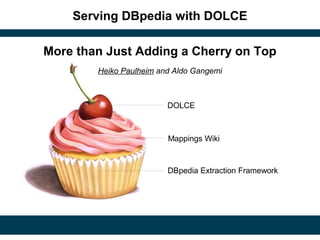
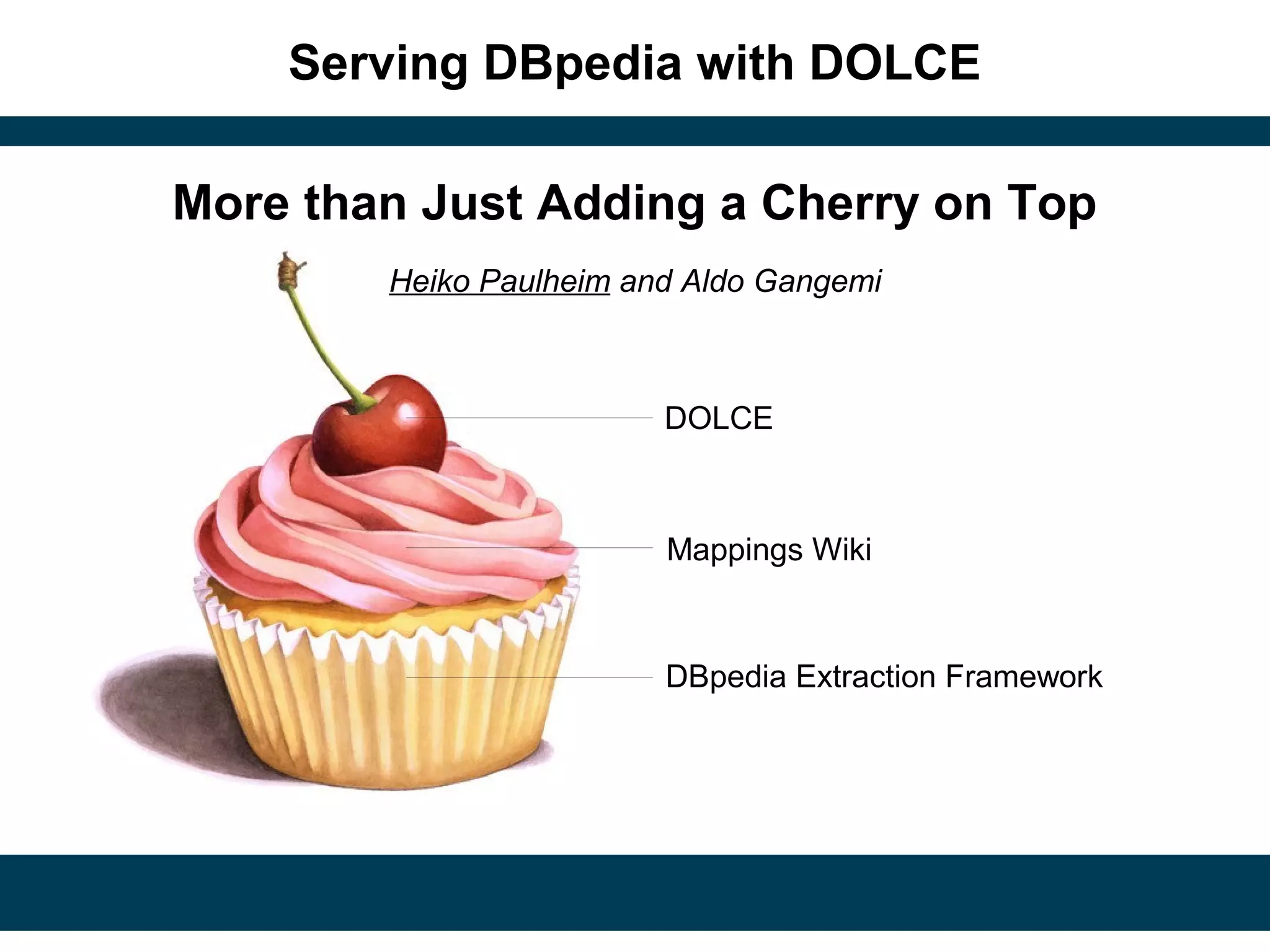
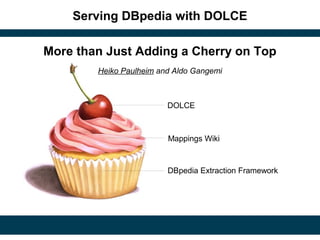
Serving DBpedia with DOLCE
More than Just Adding a Cherry on Top
DBpedia Extraction Framework
Mappings Wiki
DOLCE
Heiko Paulheim and Aldo Gangemi
10/13/15 Heiko Paulheim and Aldo Gangemi 2
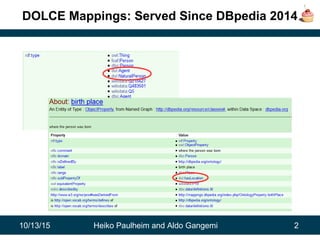
DOLCE Mappings: Served Since DBpedia 2014
10/13/15 Heiko Paulheim and Aldo Gangemi 3
More than Just a Cherry on Top
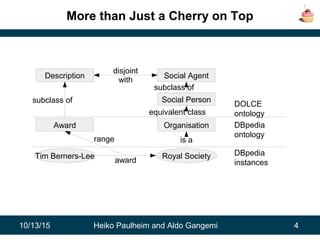
• DOLCE adds a layer of formalization
– high level axioms
– additional domain and range restrictions
– fundamental disjointness (e.g., physical object vs. social object)
• Enriches DBpedia ontology
• Can be used for consistency checking
10/13/15 Heiko Paulheim and Aldo Gangemi 4
More than Just a Cherry on Top
Tim Berners-Lee Royal Society
Award
award
range
Description
subclass of
Social Agent
disjoint
with
DBpedia
ontology
DBpedia
instances
DOLCE
ontology
Organisation
is a
Social Person
equivalent class
subclass of
10/13/15 Heiko Paulheim and Aldo Gangemi 5
DBpedia in a Nutshell
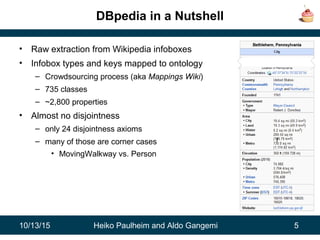
• Raw extraction from Wikipedia infoboxes
• Infobox types and keys mapped to ontology
– Crowdsourcing process (aka Mappings Wiki)
– 735 classes
– ~2,800 properties
• Almost no disjointness
– only 24 disjointness axioms
– many of those are corner cases
• MovingWalkway vs. Person
f
10/13/15 Heiko Paulheim and Aldo Gangemi 6
DOLCE in a Nutshell
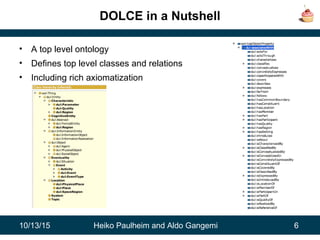
• A top level ontology
• Defines top level classes and relations
• Including rich axiomatization
10/13/15 Heiko Paulheim and Aldo Gangemi 7
DOLCE in a Nutshell
• Original DOLCE ontologies were too heavy weight
– thus: hardly used on the semantic web
– remember: a little semantics goes a long way!
• DOLCE-Zero
– Simplified version
– Contains both DOLCE and D&S (Descriptions and Situations)
– D&S introduces some high level design patterns
10/13/15 Heiko Paulheim and Aldo Gangemi 8
Systematic vs. Individual Errors in DBpedia
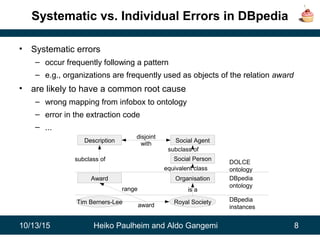
• Systematic errors
– occur frequently following a pattern
– e.g., organizations are frequently used as objects of the relation award
• are likely to have a common root cause
– wrong mapping from infobox to ontology
– error in the extraction code
– ...
Tim Berners-Lee Royal Society
Award
award
range
Description
subclass of
Social Agent
disjoint
with
DBpedia
ontology
DBpedia
instances
DOLCE
ontology
Organisation
is a
Social Person
equivalent class
subclass of
10/13/15 Heiko Paulheim and Aldo Gangemi 9
Overall Workflow
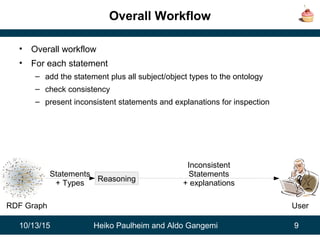
• Overall workflow
• For each statement
– add the statement plus all subject/object types to the ontology
– check consistency
– present inconsistent statements and explanations for inspection
; Reasoning 2
RDF Graph
Statements
+ Types
Inconsistent
Statements
+ explanations
User
10/13/15 Heiko Paulheim and Aldo Gangemi 10
Overall Workflow
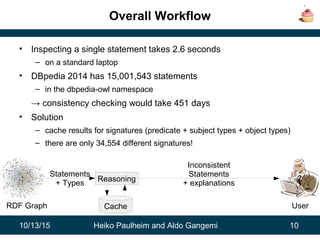
• Inspecting a single statement takes 2.6 seconds
– on a standard laptop
• DBpedia 2014 has 15,001,543 statements
– in the dbpedia-owl namespace
→ consistency checking would take 451 days
• Solution
– cache results for signatures (predicate + subject types + object types)
– there are only 34,554 different signatures!
; Reasoning 2
RDF Graph
Statements
+ Types
Inconsistent
Statements
+ explanations
UserCache
10/13/15 Heiko Paulheim and Aldo Gangemi 11
Overall Workflow
• Overall, we find 3,654,255 inconsistent statements (24.4%)
– cf.: only 97,749 (0.7%) without DOLCE
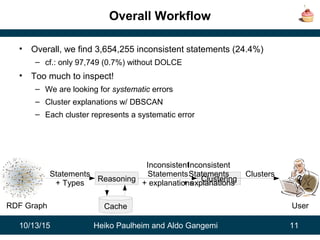
• Too much to inspect!
– We are looking for systematic errors
– Cluster explanations w/ DBSCAN
– Each cluster represents a systematic error
; Reasoning Clustering 2
RDF Graph
Statements
+ Types
Inconsistent
Statements
+ explanations
Clusters
UserCache
10/13/15 Heiko Paulheim and Aldo Gangemi 12
Clustering Inconsistent Statements
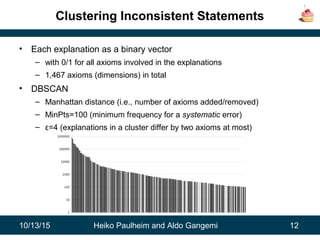
• Each explanation as a binary vector
– with 0/1 for all axioms involved in the explanations
– 1,467 axioms (dimensions) in total
• DBSCAN
– Manhattan distance (i.e., number of axioms added/removed)
– MinPts=100 (minimum frequency for a systematic error)
– ε=4 (explanations in a cluster differ by two axioms at most)
10/13/15 Heiko Paulheim and Aldo Gangemi 13
Major Systematic Errors
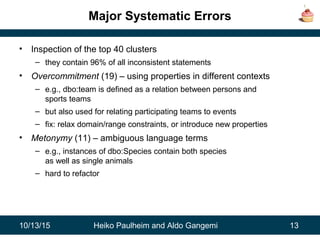
• Inspection of the top 40 clusters
– they contain 96% of all inconsistent statements
• Overcommitment (19) – using properties in different contexts
– e.g., dbo:team is defined as a relation between persons and
sports teams
– but also used for relating participating teams to events
– fix: relax domain/range constraints, or introduce new properties
• Metonymy (11) – ambiguous language terms
– e.g., instances of dbo:Species contain both species
as well as single animals
– hard to refactor
10/13/15 Heiko Paulheim and Aldo Gangemi 14
Major Systematic Errors
• Misalignment (5) – classes/properties mapped to
the wrong concept in DOLCE
– occasionally occurs if intended and actual use differ
– e.g., dbo:commander is more frequently used with events (e.g., battles)
than military units – d0:hasParticipant rather than d0:coparticipatesWith
– fix: change alignment
• Version branching (3) – semantics of dbo concepts have changed
– e.g., dbo:team in DBpedia 3.9: career stations and teams,
in DBpedia 2014: athletes and teams
– fix: change alignment
10/13/15 Heiko Paulheim and Aldo Gangemi 15
`
A Look at the Long Tail
• DBSCAN identifies clusters and “noise”
– i.e., statements that are not contained in clusters
• Manual inspection of a sample of 100 instances
– 64 are erroneous
– 30 are false negatives (i.e., correct statements)
– 6 are questionable
• Typical error sources in the long tail
– are expected to be cross-cutting, i.e.,
occurring with various classes and properties
10/13/15 Heiko Paulheim and Aldo Gangemi 16
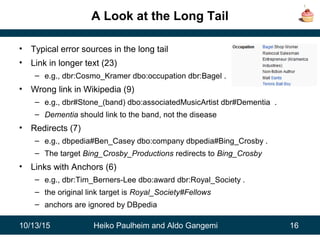
A Look at the Long Tail
• Typical error sources in the long tail
• Link in longer text (23)
– e.g., dbr:Cosmo_Kramer dbo:occupation dbr:Bagel .
• Wrong link in Wikipedia (9)
– e.g., dbr#Stone_(band) dbo:associatedMusicArtist dbr#Dementia .
– Dementia should link to the band, not the disease
• Redirects (7)
– e.g., dbpedia#Ben_Casey dbo:company dbpedia#Bing_Crosby .
– The target Bing_Crosby_Productions redirects to Bing_Crosby
• Links with Anchors (6)
– e.g., dbr:Tim_Berners-Lee dbo:award dbr:Royal_Society .
– the original link target is Royal_Society#Fellows
– anchors are ignored by DBpedia
10/13/15 Heiko Paulheim and Aldo Gangemi 17
Conclusions
• We have shown that
– DOLCE helps identifying inconsistent statements
– Cluster analysis allows for identifying systematic errors
– User interaction is minimized
• we analyzed one statement each from 40 clusters
• corresponding to 3,497,068 affected statements
• Outcomes for future DBpedia versions
– DBpedia ontology changes
– Mapping changes
– DOLCE alignment changes
– Bug reports
Serving DBpedia with DOLCE
More than Just Adding a Cherry on Top
DBpedia Extraction Framework
Mappings Wiki
DOLCE
Heiko Paulheim and Aldo Gangemi

Serving DBpedia with DOLCE - More Than Just Adding a Cherry on Top

  • 1.
    Serving DBpedia withDOLCE More than Just Adding a Cherry on Top DBpedia Extraction Framework Mappings Wiki DOLCE Heiko Paulheim and Aldo Gangemi
  • 2.
    10/13/15 Heiko Paulheimand Aldo Gangemi 2 DOLCE Mappings: Served Since DBpedia 2014
  • 3.
    10/13/15 Heiko Paulheimand Aldo Gangemi 3 More than Just a Cherry on Top • DOLCE adds a layer of formalization – high level axioms – additional domain and range restrictions – fundamental disjointness (e.g., physical object vs. social object) • Enriches DBpedia ontology • Can be used for consistency checking
  • 4.
    10/13/15 Heiko Paulheimand Aldo Gangemi 4 More than Just a Cherry on Top Tim Berners-Lee Royal Society Award award range Description subclass of Social Agent disjoint with DBpedia ontology DBpedia instances DOLCE ontology Organisation is a Social Person equivalent class subclass of
  • 5.
    10/13/15 Heiko Paulheimand Aldo Gangemi 5 DBpedia in a Nutshell • Raw extraction from Wikipedia infoboxes • Infobox types and keys mapped to ontology – Crowdsourcing process (aka Mappings Wiki) – 735 classes – ~2,800 properties • Almost no disjointness – only 24 disjointness axioms – many of those are corner cases • MovingWalkway vs. Person f
  • 6.
    10/13/15 Heiko Paulheimand Aldo Gangemi 6 DOLCE in a Nutshell • A top level ontology • Defines top level classes and relations • Including rich axiomatization
  • 7.
    10/13/15 Heiko Paulheimand Aldo Gangemi 7 DOLCE in a Nutshell • Original DOLCE ontologies were too heavy weight – thus: hardly used on the semantic web – remember: a little semantics goes a long way! • DOLCE-Zero – Simplified version – Contains both DOLCE and D&S (Descriptions and Situations) – D&S introduces some high level design patterns
  • 8.
    10/13/15 Heiko Paulheimand Aldo Gangemi 8 Systematic vs. Individual Errors in DBpedia • Systematic errors – occur frequently following a pattern – e.g., organizations are frequently used as objects of the relation award • are likely to have a common root cause – wrong mapping from infobox to ontology – error in the extraction code – ... Tim Berners-Lee Royal Society Award award range Description subclass of Social Agent disjoint with DBpedia ontology DBpedia instances DOLCE ontology Organisation is a Social Person equivalent class subclass of
  • 9.
    10/13/15 Heiko Paulheimand Aldo Gangemi 9 Overall Workflow • Overall workflow • For each statement – add the statement plus all subject/object types to the ontology – check consistency – present inconsistent statements and explanations for inspection ; Reasoning 2 RDF Graph Statements + Types Inconsistent Statements + explanations User
  • 10.
    10/13/15 Heiko Paulheimand Aldo Gangemi 10 Overall Workflow • Inspecting a single statement takes 2.6 seconds – on a standard laptop • DBpedia 2014 has 15,001,543 statements – in the dbpedia-owl namespace → consistency checking would take 451 days • Solution – cache results for signatures (predicate + subject types + object types) – there are only 34,554 different signatures! ; Reasoning 2 RDF Graph Statements + Types Inconsistent Statements + explanations UserCache
  • 11.
    10/13/15 Heiko Paulheimand Aldo Gangemi 11 Overall Workflow • Overall, we find 3,654,255 inconsistent statements (24.4%) – cf.: only 97,749 (0.7%) without DOLCE • Too much to inspect! – We are looking for systematic errors – Cluster explanations w/ DBSCAN – Each cluster represents a systematic error ; Reasoning Clustering 2 RDF Graph Statements + Types Inconsistent Statements + explanations Clusters UserCache
  • 12.
    10/13/15 Heiko Paulheimand Aldo Gangemi 12 Clustering Inconsistent Statements • Each explanation as a binary vector – with 0/1 for all axioms involved in the explanations – 1,467 axioms (dimensions) in total • DBSCAN – Manhattan distance (i.e., number of axioms added/removed) – MinPts=100 (minimum frequency for a systematic error) – ε=4 (explanations in a cluster differ by two axioms at most)
  • 13.
    10/13/15 Heiko Paulheimand Aldo Gangemi 13 Major Systematic Errors • Inspection of the top 40 clusters – they contain 96% of all inconsistent statements • Overcommitment (19) – using properties in different contexts – e.g., dbo:team is defined as a relation between persons and sports teams – but also used for relating participating teams to events – fix: relax domain/range constraints, or introduce new properties • Metonymy (11) – ambiguous language terms – e.g., instances of dbo:Species contain both species as well as single animals – hard to refactor
  • 14.
    10/13/15 Heiko Paulheimand Aldo Gangemi 14 Major Systematic Errors • Misalignment (5) – classes/properties mapped to the wrong concept in DOLCE – occasionally occurs if intended and actual use differ – e.g., dbo:commander is more frequently used with events (e.g., battles) than military units – d0:hasParticipant rather than d0:coparticipatesWith – fix: change alignment • Version branching (3) – semantics of dbo concepts have changed – e.g., dbo:team in DBpedia 3.9: career stations and teams, in DBpedia 2014: athletes and teams – fix: change alignment
  • 15.
    10/13/15 Heiko Paulheimand Aldo Gangemi 15 ` A Look at the Long Tail • DBSCAN identifies clusters and “noise” – i.e., statements that are not contained in clusters • Manual inspection of a sample of 100 instances – 64 are erroneous – 30 are false negatives (i.e., correct statements) – 6 are questionable • Typical error sources in the long tail – are expected to be cross-cutting, i.e., occurring with various classes and properties
  • 16.
    10/13/15 Heiko Paulheimand Aldo Gangemi 16 A Look at the Long Tail • Typical error sources in the long tail • Link in longer text (23) – e.g., dbr:Cosmo_Kramer dbo:occupation dbr:Bagel . • Wrong link in Wikipedia (9) – e.g., dbr#Stone_(band) dbo:associatedMusicArtist dbr#Dementia . – Dementia should link to the band, not the disease • Redirects (7) – e.g., dbpedia#Ben_Casey dbo:company dbpedia#Bing_Crosby . – The target Bing_Crosby_Productions redirects to Bing_Crosby • Links with Anchors (6) – e.g., dbr:Tim_Berners-Lee dbo:award dbr:Royal_Society . – the original link target is Royal_Society#Fellows – anchors are ignored by DBpedia
  • 17.
    10/13/15 Heiko Paulheimand Aldo Gangemi 17 Conclusions • We have shown that – DOLCE helps identifying inconsistent statements – Cluster analysis allows for identifying systematic errors – User interaction is minimized • we analyzed one statement each from 40 clusters • corresponding to 3,497,068 affected statements • Outcomes for future DBpedia versions – DBpedia ontology changes – Mapping changes – DOLCE alignment changes – Bug reports
  • 18.
    Serving DBpedia withDOLCE More than Just Adding a Cherry on Top DBpedia Extraction Framework Mappings Wiki DOLCE Heiko Paulheim and Aldo Gangemi