Concept of Modern Physics                                A. Beiser


Sunday, October 02, 2011   Dr. Sushil Kumar, Chitkara University               1
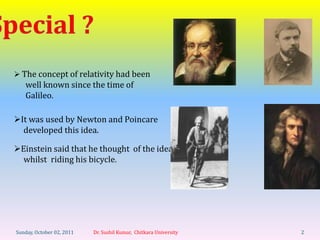
 The concept of relativity had been
   well known since the time of
   Galileo.

It was used by Newton and Poincare
  developed this idea.

Einstein said that he thought of the idea
  whilst riding his bicycle.


Sunday, October 02, 2011   Dr. Sushil Kumar, Chitkara University   2
Special Relativity


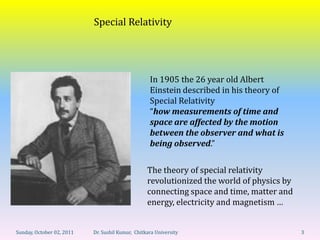
                                                   In 1905 the 26 year old Albert
                                                   Einstein described in his theory of
                                                   Special Relativity
                                                   “how measurements of time and
                                                   space are affected by the motion
                                                   between the observer and what is
                                                   being observed.”

                                                  The theory of special relativity
                                                  revolutionized the world of physics by
                                                  connecting space and time, matter and
                                                  energy, electricity and magnetism …


Sunday, October 02, 2011   Dr. Sushil Kumar, Chitkara University                           3
Introduction of the chapter
After completing the chapter you will be familiar with
    the
1. Two basic postulates of the STR
2. Frame of reference, concept of ether and Michelson-
    Morley Interferometer
3. Galilean transformation
4. Lorentz transformation
5. Time dilation
6. Length contraction
7. Velocity transformation
8. Relativistic momentum and energy
Postulates of Special Relativity

Einstein built the special theory of relativity on two postulates:


     1. The Relativity Principle: The laws of motion are the same
         in every inertial frame of reference.


       2. Constancy of the speed of light: The speed of light
          in a vacuum is the same independent of the speed
          of the source or the observer.

Sunday, October 02, 2011      Dr. Sushil Kumar, Chitkara University   5
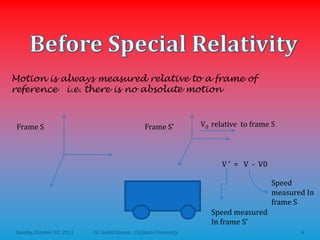
Motion is always measured relative to a frame of
reference i.e. there is no absolute motion


 Frame S                                         Frame S’          V0 relative to frame S


                                                                         V ’ = V - V0

                                                                                        Speed
                                                                                        measured In
                                                                                        frame S
                                                                      Speed measured
                                                                      In frame S’
Sunday, October 02, 2011   Dr. Sushil Kumar, Chitkara University                               6
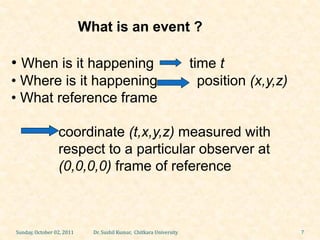
What is an event ?

• When is it happening                                               time t
• Where is it happening                                                position (x,y,z)
• What reference frame

                 coordinate (t,x,y,z) measured with
                 respect to a particular observer at
                 (0,0,0,0) frame of reference


Sunday, October 02, 2011     Dr. Sushil Kumar, Chitkara University                        7
Measuring an event

  An event is something that happens, to which
   an observer can assign three space coordinates
   and one time coordinate
  A given event may be recorded by any number
   of observers, each in a different reference
   frame
  In general different observers will assign
   different space-time coordinates for the same
   event.
Sunday, October 02, 2011   Dr. Sushil Kumar, Chitkara University   8
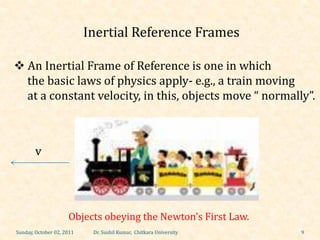
Inertial Reference Frames

 An Inertial Frame of Reference is one in which
  the basic laws of physics apply- e.g., a train moving
  at a constant velocity, in this, objects move “ normally”.


       v


                     Objects obeying the Newton’s First Law.
Sunday, October 02, 2011    Dr. Sushil Kumar, Chitkara University   9
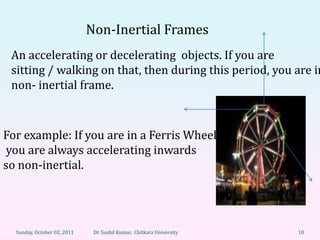
Non-Inertial Frames
 An accelerating or decelerating objects. If you are
 sitting / walking on that, then during this period, you are in
 non- inertial frame.


For example: If you are in a Ferris Wheel
you are always accelerating inwards
so non-inertial.


  Sunday, October 02, 2011    Dr. Sushil Kumar, Chitkara University   10
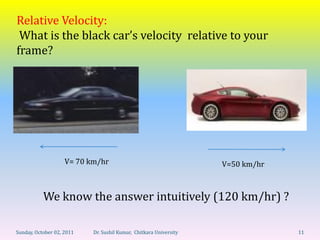
Relative Velocity:
 What is the black car’s velocity relative to your
frame?


                    V= 70 km/hr                                    V=50 km/hr


           We know the answer intuitively (120 km/hr) ?

Sunday, October 02, 2011   Dr. Sushil Kumar, Chitkara University                11
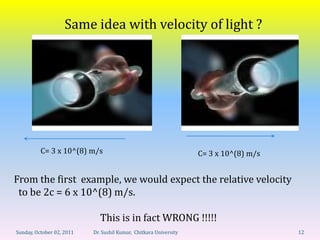
Same idea with velocity of light ?


          C= 3 x 10^(8) m/s                                        C= 3 x 10^(8) m/s


From the first example, we would expect the relative velocity
 to be 2c = 6 x 10^(8) m/s.

                             This is in fact WRONG !!!!!
Sunday, October 02, 2011   Dr. Sushil Kumar, Chitkara University                       12
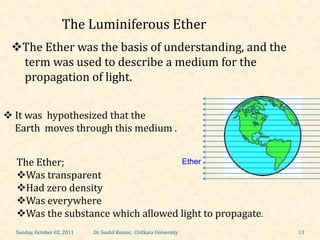
The Luminiferous Ether
 The Ether was the basis of understanding, and the
  term was used to describe a medium for the
  propagation of light.


 It was hypothesized that the
  Earth moves through this medium .


  The Ether;                       Ether
  Was transparent
  Had zero density
  Was everywhere
  Was the substance which allowed light to propagate.
  Sunday, October 02, 2011   Dr. Sushil Kumar, Chitkara University   13
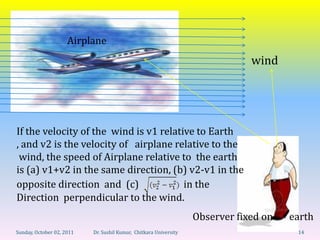
Airplane
                                                                               wind


If the velocity of the wind is v1 relative to Earth
, and v2 is the velocity of airplane relative to the
 wind, the speed of Airplane relative to the earth
is (a) v1+v2 in the same direction, (b) v2-v1 in the
opposite direction and (c)              in the
Direction perpendicular to the wind.
                                                                   Observer fixed on   earth
Sunday, October 02, 2011   Dr. Sushil Kumar, Chitkara University                        14
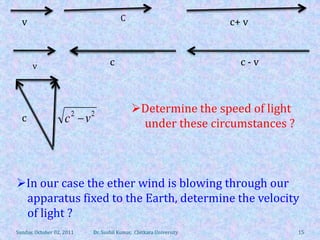
v                                        C                            c+ v


      v                                c                                  c-v


                        2       2               Determine the speed of light
  c                 c       v                    under these circumstances ?


In our case the ether wind is blowing through our
 apparatus fixed to the Earth, determine the velocity
 of light ?
Sunday, October 02, 2011        Dr. Sushil Kumar, Chitkara University           15
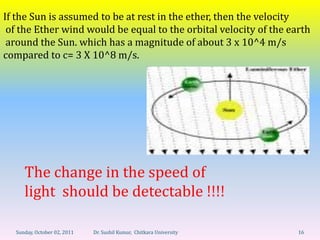
If the Sun is assumed to be at rest in the ether, then the velocity
 of the Ether wind would be equal to the orbital velocity of the earth
 around the Sun. which has a magnitude of about 3 x 10^4 m/s
compared to c= 3 X 10^8 m/s.


     The change in the speed of
     light should be detectable !!!!

  Sunday, October 02, 2011   Dr. Sushil Kumar, Chitkara University   16
The Michelson-Morley Experiment
                           The Famous experiment designed to detect
                           small changes in the speed of light with motion
                           of an observer through the ether .

                           It was performed in 1887.
Albert A. Michelson
                            The negative results of the experiment not only
                             meant that the speed of light does not depend on
                            the direction of light propagated but also
                            contradicted the ether hypothesis.

                            Light is now understood to be a phenomenon
                            that requires no medium for its propagation.
   Edward W. Morley
Sunday, October 02, 2011    Dr. Sushil Kumar, Chitkara University        17
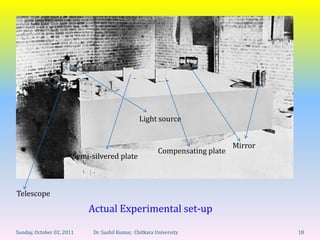
Light source


                                                                              Mirror
                                                         Compensating plate
                       Semi-silvered plate


Telescope
                           Actual Experimental set-up

Sunday, October 02, 2011     Dr. Sushil Kumar, Chitkara University                     18
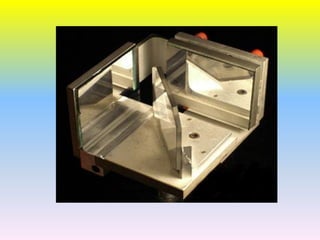
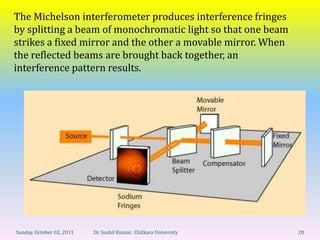
The Michelson interferometer produces interference fringes
by splitting a beam of monochromatic light so that one beam
strikes a fixed mirror and the other a movable mirror. When
the reflected beams are brought back together, an
interference pattern results.


Sunday, October 02, 2011   Dr. Sushil Kumar, Chitkara University   20
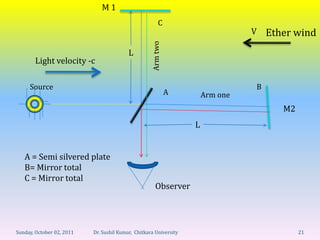
M1
                                                         C
                                                                                 V   Ether wind


                                                    Arm two
                                          L
       Light velocity -c

     Source                                                                      B
                                                              A        Arm one
                                                                                        M2
                                                                   L


   A = Semi silvered plate
   B= Mirror total
   C = Mirror total
                                                       Observer


Sunday, October 02, 2011   Dr. Sushil Kumar, Chitkara University                             21
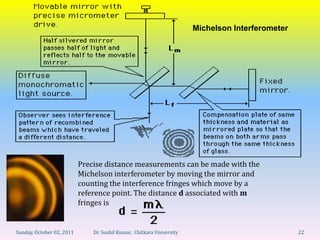
Michelson Interferometer


                           Precise distance measurements can be made with the
                           Michelson interferometer by moving the mirror and
                           counting the interference fringes which move by a
                           reference point. The distance d associated with m
                           fringes is


Sunday, October 02, 2011       Dr. Sushil Kumar, Chitkara University                              22
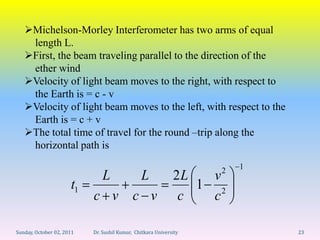
Michelson-Morley Interferometer has two arms of equal
    length L.
   First, the beam traveling parallel to the direction of the
    ether wind
   Velocity of light beam moves to the right, with respect to
    the Earth is = c - v
   Velocity of light beam moves to the left, with respect to the
    Earth is = c + v
   The total time of travel for the round –trip along the
    horizontal path is

                                                                   2   1
                               L               L             2L   v
                      t1                                        1 2
                           c v              c v               c   c

Sunday, October 02, 2011   Dr. Sushil Kumar, Chitkara University           23
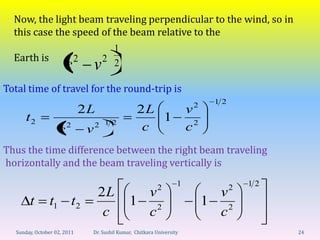
Now, the light beam traveling perpendicular to the wind, so in
  this case the speed of the beam relative to the
                                          1
  Earth is                  2           2 2
                       c            v
Total time of travel for the round-trip is
                                                                         2    12
                              2L                   2L                   v
       t2                                             1
                        2           2 12            c                   c2
                    c           v
Thus the time difference between the right beam traveling
horizontally and the beam traveling vertically is

                                                           2        1              2   12
                                    2L           v                             v
        t       t1 t2                          1 2                           1 2
                                     c           c                             c
   Sunday, October 02, 2011     Dr. Sushil Kumar, Chitkara University                       24
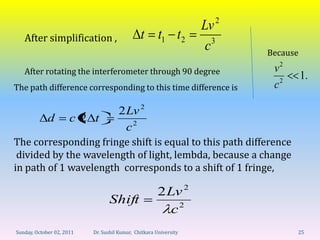
2
                                                                   Lv
   After simplification ,                      t t1 t 2               3
                                                                    c         Because

   After rotating the interferometer through 90 degree                         v2
                                                                                        1.
The path difference corresponding to this time difference is                   c2

                                      2 Lv 2
             d        c2 t
                                        c2
The corresponding fringe shift is equal to this path difference
 divided by the wavelength of light, lembda, because a change
in path of 1 wavelength corresponds to a shift of 1 fringe,

                                                       2 Lv 2
                                 Shift
                                                          c2
Sunday, October 02, 2011   Dr. Sushil Kumar, Chitkara University                    25
Change in path of the order of lambda = one fringe shift
If change is one then fringe shift is equal to 1 over lambda
If change is d in path then change in shift would be equal to d
into one upon lambda.
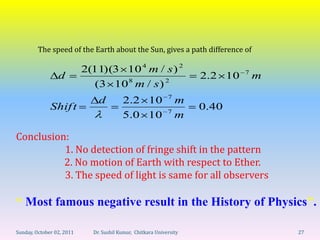
The speed of the Earth about the Sun, gives a path difference of

                           2(11)(3 10 4 m / s ) 2                             7
                 d                                                   2.2 10       m
                              (3 10 8 m / s ) 2
                                                             7
                               d         2.2 10                m
              Shif t                                         7
                                                                     0.40
                                         5.0 10                m

Conclusion:
          1. No detection of fringe shift in the pattern
          2. No motion of Earth with respect to Ether.
          3. The speed of light is same for all observers

“ Most famous negative result in the History of Physics”.

Sunday, October 02, 2011     Dr. Sushil Kumar, Chitkara University                    27
Questions/ doubts
  1)   How Michelson able detect change in the speed of light?
  2)   Concept of aether ?
  3)   Concept of frame of reference ?
  4)   How shifting of fringes decides whether the speed of light is same or not ?
  5)   In theory of relativity fourth coordinate Is of time , why we take it so?
        because to define position of particles only distance from 3 co-ordinates
        is needed?
  6)   How we come to know light is electromagnetic wave through
        Moreley Experiment?
  7)   In Morley experiment is source of light is moveable or mirror is moveable?
  8)   The basic points how Morely had thought before doing experiment ?
  9)   Is theory of relativity and special theory of relativity same?
  9)   Conclusion about the persences of aether from M-M expt.?


Sunday, October 02, 2011   Dr. Sushil Kumar, Chitkara University                     28
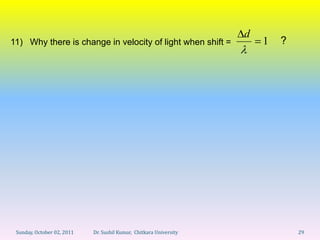
d
11) Why there is change in velocity of light when shift =               1   ?


 Sunday, October 02, 2011   Dr. Sushil Kumar, Chitkara University               29
12)     Why do hypothetical concept of ether was needed?
         13)     Mathematics of M-M Expt?
         14)     When Interferometer is rotated through 90 degree what happens then?
         15)     Derivation of M-M expt. ?


Sunday, October 02, 2011   Dr. Sushil Kumar, Chitkara University                 30
What Time Dilation means…………?
 • A moving clock ticks more slowly than a clock
 at rest

When two events are occurs at the same location in an inertial reference
  frame , the time interval between them, measured in that frame, is called
  the proper time interval or the “ proper time”

Measurements of the same time interval from any other inertial reference
  frame are always greater.

The amount by which a measured time interval is greater than the
  corresponding proper time interval is called time dilation.

 Sunday, October 02, 2011   Dr. Sushil Kumar, Chitkara University       31
v


Time Dilation


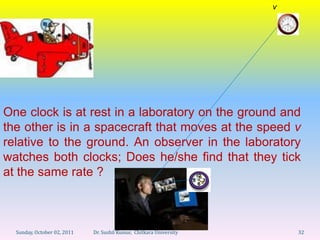
One clock is at rest in a laboratory on the ground and
the other is in a spacecraft that moves at the speed v
relative to the ground. An observer in the laboratory
watches both clocks; Does he/she find that they tick
at the same rate ?


  Sunday, October 02, 2011   Dr. Sushil Kumar, Chitkara University       32
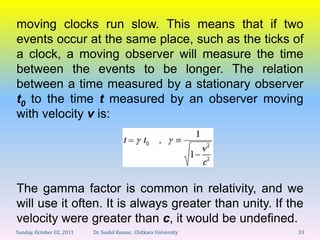
moving clocks run slow. This means that if two
events occur at the same place, such as the ticks of
a clock, a moving observer will measure the time
between the events to be longer. The relation
between a time measured by a stationary observer
t0 to the time t measured by an observer moving
with velocity v is:


The gamma factor is common in relativity, and we
will use it often. It is always greater than unity. If the
velocity were greater than c, it would be undefined.
Sunday, October 02, 2011   Dr. Sushil Kumar, Chitkara University   33
Show Me The Derivation?


For our derivation, we will consider two
measurements. One taken by a rider with the
clock and the other measurement for the
clock will be made by a stationary observer
(referred to as the stationary for the mover).


 Sunday, October 02, 2011   Dr. Sushil Kumar, Chitkara University   34
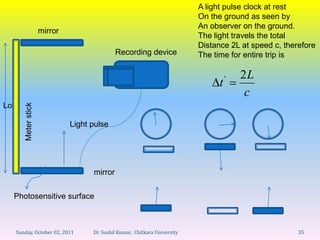
A light pulse clock at rest
                                                                             On the ground as seen by
                                                                             An observer on the ground.
                      mirror
                                                                             The light travels the total
                                                                             Distance 2L at speed c, therefore
                                              Recording device               The time for entire trip is

                                                                                       '   2L
                                                                                   t
                                                                                            c
Lo
        Meter stick


                               Light pulse


                                     mirror


     Photosensitive surface


     Sunday, October 02, 2011        Dr. Sushil Kumar, Chitkara University                               35
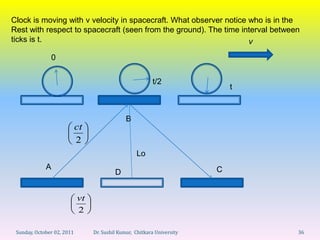
Clock is moving with v velocity in spacecraft. What observer notice who is in the
Rest with respect to spacecraft (seen from the ground). The time interval between
ticks is t.                                                         v

               0


                                                          t/2
                                                                             t


                                               B
                            ct
                            2
                                                   Lo
             A                                                           C
                                          D


                            vt
                            2

 Sunday, October 02, 2011        Dr. Sushil Kumar, Chitkara University           36
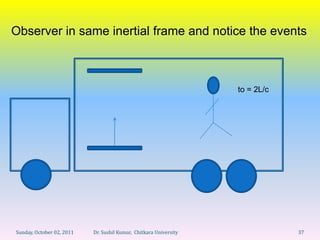
Observer in same inertial frame and notice the events


                                                                   to = 2L/c


Sunday, October 02, 2011   Dr. Sushil Kumar, Chitkara University               37
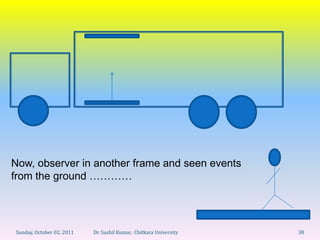
Now, observer in another frame and seen events
from the ground …………


Sunday, October 02, 2011   Dr. Sushil Kumar, Chitkara University   38
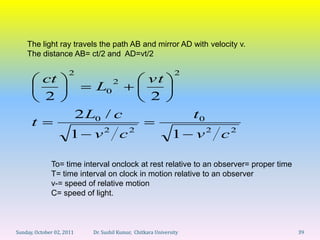
The light ray travels the path AB and mirror AD with velocity v.
    The distance AB= ct/2 and AD=vt/2

                     2                                           2
           ct                         2              vt
                               L0
           2                                         2
                           2 L0 / c                                   t0
      t
                      1       v2 c2                             1     v2 c2

              To= time interval onclock at rest relative to an observer= proper time
              T= time interval on clock in motion relative to an observer
              v-= speed of relative motion
              C= speed of light.


Sunday, October 02, 2011      Dr. Sushil Kumar, Chitkara University                    39
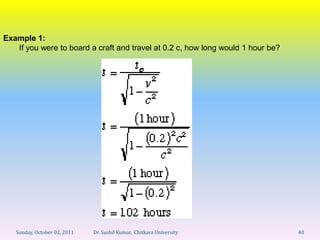
Example 1:
   If you were to board a craft and travel at 0.2 c, how long would 1 hour be?


   Sunday, October 02, 2011   Dr. Sushil Kumar, Chitkara University              40
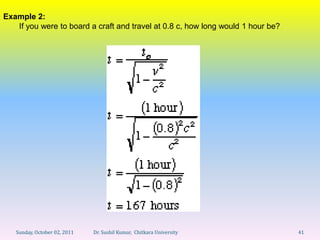
Example 2:
   If you were to board a craft and travel at 0.8 c, how long would 1 hour be?


   Sunday, October 02, 2011   Dr. Sushil Kumar, Chitkara University              41
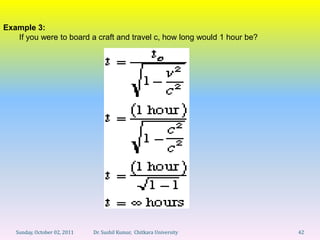
Example 3:
   If you were to board a craft and travel c, how long would 1 hour be?


   Sunday, October 02, 2011   Dr. Sushil Kumar, Chitkara University       42
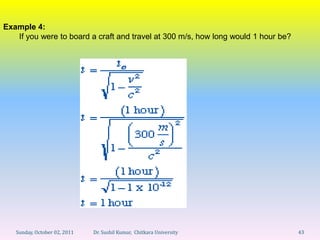
Example 4:
   If you were to board a craft and travel at 300 m/s, how long would 1 hour be?


   Sunday, October 02, 2011   Dr. Sushil Kumar, Chitkara University                43
Sunday, October 02, 2011   Dr. Sushil Kumar, Chitkara University   44
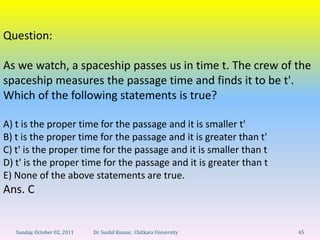
Question:

As we watch, a spaceship passes us in time t. The crew of the
spaceship measures the passage time and finds it to be t'.
Which of the following statements is true?

A) t is the proper time for the passage and it is smaller t'
B) t is the proper time for the passage and it is greater than t'
C) t' is the proper time for the passage and it is smaller than t
D) t' is the proper time for the passage and it is greater than t
E) None of the above statements are true.
Ans. C


   Sunday, October 02, 2011   Dr. Sushil Kumar, Chitkara University   45
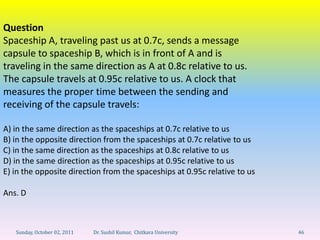
Question
Spaceship A, traveling past us at 0.7c, sends a message
capsule to spaceship B, which is in front of A and is
traveling in the same direction as A at 0.8c relative to us.
The capsule travels at 0.95c relative to us. A clock that
measures the proper time between the sending and
receiving of the capsule travels:

A) in the same direction as the spaceships at 0.7c relative to us
B) in the opposite direction from the spaceships at 0.7c relative to us
C) in the same direction as the spaceships at 0.8c relative to us
D) in the same direction as the spaceships at 0.95c relative to us
E) in the opposite direction from the spaceships at 0.95c relative to us

Ans. D


   Sunday, October 02, 2011   Dr. Sushil Kumar, Chitkara University        46
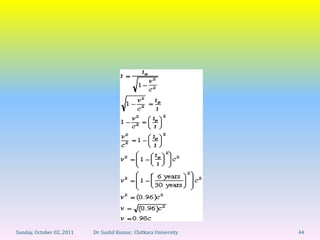
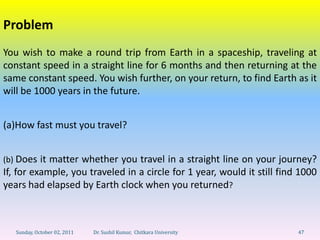
Problem
You wish to make a round trip from Earth in a spaceship, traveling at
constant speed in a straight line for 6 months and then returning at the
same constant speed. You wish further, on your return, to find Earth as it
will be 1000 years in the future.


(a)How fast must you travel?


(b) Does it matter whether you travel in a straight line on your journey?
If, for example, you traveled in a circle for 1 year, would it still find 1000
years had elapsed by Earth clock when you returned?


   Sunday, October 02, 2011   Dr. Sushil Kumar, Chitkara University      47
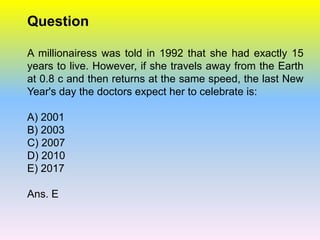
Question

A millionairess was told in 1992 that she had exactly 15
years to live. However, if she travels away from the Earth
at 0.8 c and then returns at the same speed, the last New
Year's day the doctors expect her to celebrate is:

A) 2001
B) 2003
C) 2007
D) 2010
E) 2017

Ans. E
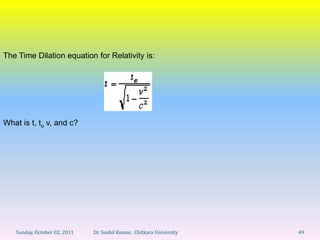
The Time Dilation equation for Relativity is:


What is t, to v, and c?


   Sunday, October 02, 2011   Dr. Sushil Kumar, Chitkara University   49
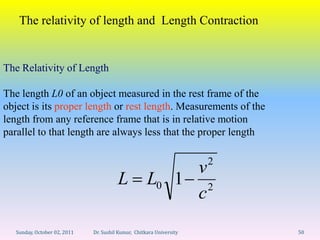
The relativity of length and Length Contraction


The Relativity of Length

The length L0 of an object measured in the rest frame of the
object is its proper length or rest length. Measurements of the
length from any reference frame that is in relative motion
parallel to that length are always less that the proper length

                                                                      2
                                                          v
                                        L            L0 1 2
                                                          c
   Sunday, October 02, 2011   Dr. Sushil Kumar, Chitkara University       50
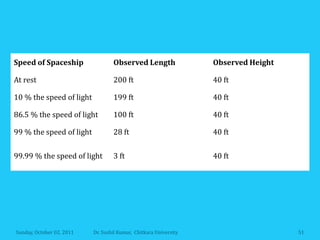
Speed of Spaceship                 Observed Length                 Observed Height

At rest                            200 ft                          40 ft

10 % the speed of light            199 ft                          40 ft

86.5 % the speed of light          100 ft                          40 ft

99 % the speed of light            28 ft                           40 ft

99.99 % the speed of light         3 ft                            40 ft


Sunday, October 02, 2011   Dr. Sushil Kumar, Chitkara University                     51
Question
A measurement of the length of an object that is moving
relative to the laboratory consists of noting the coordinates
of the front and back:

A) at different times according to clocks at rest in the
laboratory
B) at the same time according to clocks that move with
the object
C) at the same time according to clocks at rest in the
laboratory
D) at the same time according to clocks at rest with
respect to the fixed stars
E) none of the above
Ans. C

   Sunday, October 02, 2011   Dr. Sushil Kumar, Chitkara University   52
Question

A certain automobile is 6 m long if at rest. If it is
measured to be 4/5 as long, its speed is:

A) 0.1c
B) 0.3c
C) 0.6c
D) 0.8c
E) > 0.95c
Ans. C

  Sunday, October 02, 2011   Dr. Sushil Kumar, Chitkara University   53
Problem

A cubical box is 0.50 m on a side.

(a) What are the dimensions of the box as measured by an
observer moving with a speed of 0.88c parallel to one of the
edges of the box?

(b) What is the volume of the box as measured by this
observer?


  Sunday, October 02, 2011   Dr. Sushil Kumar, Chitkara University   54
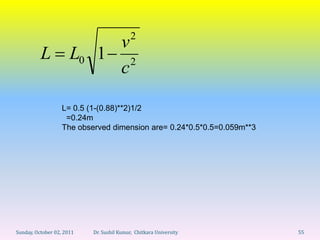
2
                           v
          L           L0 1 2
                           c

                   L= 0.5 (1-(0.88)**2)1/2
                    =0.24m
                   The observed dimension are= 0.24*0.5*0.5=0.059m**3


Sunday, October 02, 2011   Dr. Sushil Kumar, Chitkara University        55
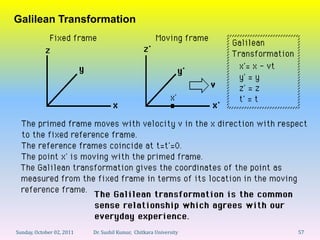
An Important general question:

 If we know the co-ordinate x, y, z and time t of an
event, as measured in a frame S, How can we find
the coordinates x’, y ’ , z ’ and t’ of the same event as
measured in a second frame S?


  Sunday, October 02, 2011   Dr. Sushil Kumar, Chitkara University   56
Galilean Transformation


Sunday, October 02, 2011   Dr. Sushil Kumar, Chitkara University   57
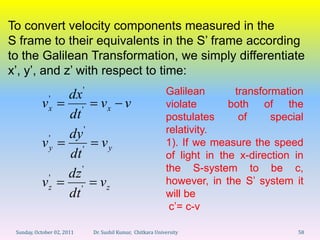
To convert velocity components measured in the
S frame to their equivalents in the S’ frame according
to the Galilean Transformation, we simply differentiate
x’, y’, and z’ with respect to time:
                            '                                  Galilean       transformation
               '      dx
           v   x                   vx v                        violate       both of the
                      dt '                                     postulates      of     special
                      dy '                                     relativity.
           v 'y                    vy                          1). If we measure the speed
                      dt '                                     of light in the x-direction in
                                                               the S-system to be c,
            '         dz '                                     however, in the S’ system it
           vz                     vz
                      dt '                                     will be
                                                                c’= c-v

 Sunday, October 02, 2011       Dr. Sushil Kumar, Chitkara University                      58
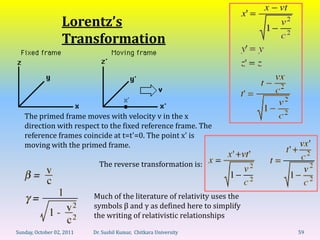
Lorentz’s
                   Transformation


   The primed frame moves with velocity v in the x
   direction with respect to the fixed reference frame. The
   reference frames coincide at t=t'=0. The point x' is
   moving with the primed frame.

                             The reverse transformation is:


                           Much of the literature of relativity uses the
                           symbols β and γ as defined here to simplify
                           the writing of relativistic relationships

Sunday, October 02, 2011   Dr. Sushil Kumar, Chitkara University           59
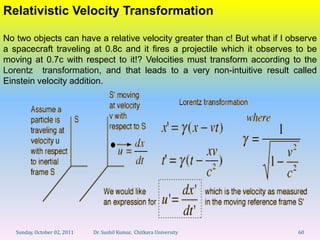
Relativistic Velocity Transformation

No two objects can have a relative velocity greater than c! But what if I observe
a spacecraft traveling at 0.8c and it fires a projectile which it observes to be
moving at 0.7c with respect to it!? Velocities must transform according to the
Lorentz transformation, and that leads to a very non-intuitive result called
Einstein velocity addition.


   Sunday, October 02, 2011   Dr. Sushil Kumar, Chitkara University         60
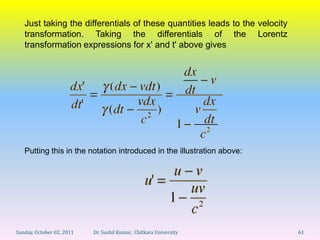
Just taking the differentials of these quantities leads to the velocity
   transformation. Taking the differentials of the Lorentz
   transformation expressions for x' and t' above gives


   Putting this in the notation introduced in the illustration above:


Sunday, October 02, 2011   Dr. Sushil Kumar, Chitkara University             61
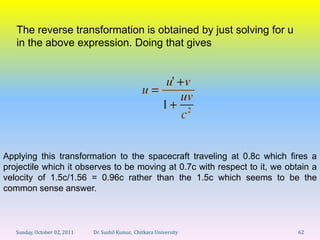
The reverse transformation is obtained by just solving for u
   in the above expression. Doing that gives


Applying this transformation to the spacecraft traveling at 0.8c which fires a
projectile which it observes to be moving at 0.7c with respect to it, we obtain a
velocity of 1.5c/1.56 = 0.96c rather than the 1.5c which seems to be the
common sense answer.


   Sunday, October 02, 2011   Dr. Sushil Kumar, Chitkara University         62
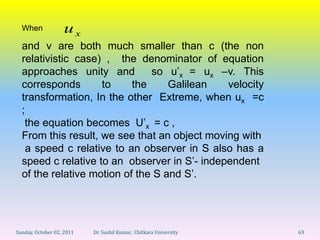
When             ux
  and v are both much smaller than c (the non
  relativistic case) , the denominator of equation
  approaches unity and         so u’x = ux –v. This
  corresponds       to     the     Galilean   velocity
  transformation, In the other Extreme, when ux =c
  ;
   the equation becomes U’x = c ,
  From this result, we see that an object moving with
    a speed c relative to an observer in S also has a
  speed c relative to an observer in S’- independent
  of the relative motion of the S and S’.


Sunday, October 02, 2011   Dr. Sushil Kumar, Chitkara University   63
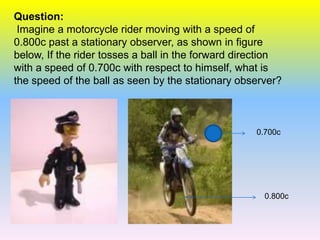
Question:
 Imagine a motorcycle rider moving with a speed of
0.800c past a stationary observer, as shown in figure
below, If the rider tosses a ball in the forward direction
with a speed of 0.700c with respect to himself, what is
the speed of the ball as seen by the stationary observer?


                                                    0.700c


                                                      0.800c
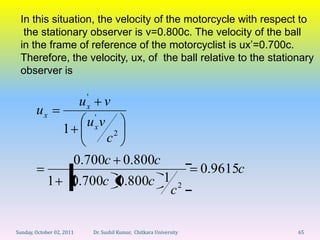
In this situation, the velocity of the motorcycle with respect to
  the stationary observer is v=0.800c. The velocity of the ball
 in the frame of reference of the motorcyclist is ux’=0.700c.
 Therefore, the velocity, ux, of the ball relative to the stationary
 observer is

                               '
                           u   x  v
        ux                      '
                               uxv
                   1
                                   c2
                       0.700c 0.800c
                                                                            0.9615c
            1          0.700c 0.800c 1                                  2
                                                                    c

Sunday, October 02, 2011           Dr. Sushil Kumar, Chitkara University              65
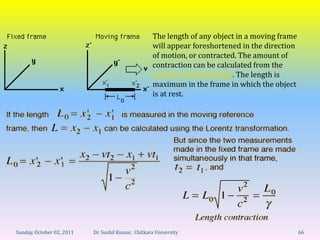
The length of any object in a moving frame
                                                    will appear foreshortened in the direction
                                                    of motion, or contracted. The amount of
                                                    contraction can be calculated from the
                                                    Lorentz transformation. The length is
                                                    maximum in the frame in which the object
                                                    is at rest.


Sunday, October 02, 2011   Dr. Sushil Kumar, Chitkara University                                 66
Questions/ Problems/ Doubts:

1). I know the derivation but I have problem in basic concept, I did not
    understand the application of Galilean and Lorentz transformation?
2.) I know the concept, but I face problem when I try to solve the numerical
    problem?
3.) No proper notes/material of subject?
4.) Problem in length contraction, when observer is moving or object is
    moving?
5.) Why Galilean transformation do not obey laws of physics?
6.) Transformation equation?
7.) When we move away from a building it becomes smaller and smaller, is it
    the case of length contraction or some other physical process?
8.) If object is in moving frame of reference, is there any change of
    dimension?
9.) Why there is need of transformation, what we get from it?
10.) How a large building contract, when seen in the glass/mirror of moving
      vehicle?
Questions/doubts:
 11. WHY THERE IS CHANGE IN VELOCITY OF LIGHT
     WHEN FRINGE SHIFT = 1 ?
 12. When an observer and object of length L is moving
     with velocity v1 and v2 respectively, what will be the
     length contraction, v2> v1 ?
 13. Not able to understand why the length seems less
     while moving……..Length contraction?
 14. How length contraction takes place in MUON’S
     DECAY ?

Sunday, October 02, 2011   Dr. Sushil Kumar, Chitkara University   68
Questions/ doubts……..417
  We consider earth an inertial frame of reference, and
     there are hardly any motions comparable to speed of
     light. Why do we refer to the relativity then ?

  does time, length and velocity all relativistic
       quantities?


Sunday, October 02, 2011   Dr. Sushil Kumar, Chitkara University   69
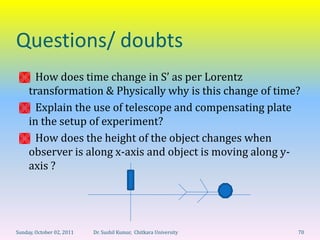
Questions/ doubts
  How does time change in S’ as per Lorentz
  transformation & Physically why is this change of time?
  Explain the use of telescope and compensating plate
  in the setup of experiment?
  How does the height of the object changes when
  observer is along x-axis and object is moving along y-
  axis ?


Sunday, October 02, 2011   Dr. Sushil Kumar, Chitkara University   70
Questions/ doubts/ problems
  How to implement these formulas in typical
  questions?
  Galilean & Lorentz transformation with numericals?
  Tried to understand the topic ‘ Length contraction’
  using text book but was unable to understand, also
  tried numerical problems on the topic ‘ time dilation’
  and was unable to solve them too…......!!!!!
  Explain length contraction of a thin road, when
  observer moves perpendicular to the rod ?

Sunday, October 02, 2011   Dr. Sushil Kumar, Chitkara University   71
 How much Do I know?


 What Do I need to learn?


 What I have Learned ?


Sunday, October 02, 2011   Dr. Sushil Kumar, Chitkara University   72
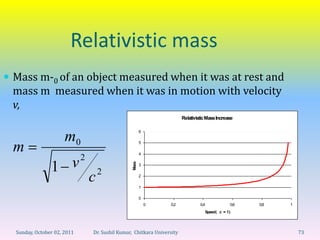
Relativistic mass
 Mass m-0 of an object measured when it was at rest and
 mass m measured when it was in motion with velocity
 v,
                                                                         Relativistic Mass Increase

                                                         6

                      m0
 m                                                       5

                                                         4
                             2
                1 v
                                                  Mass


                                                         3

                                     2
                                 c                       2

                                                         1

                                                         0
                                                             0    0.2             0.4            0.6   0.8   1
                                                                                    Speed( c = 1)


  Sunday, October 02, 2011       Dr. Sushil Kumar, Chitkara University                                           73
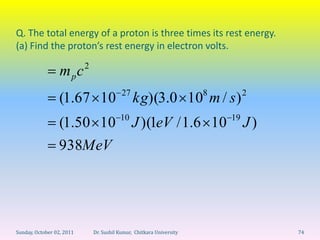
Q. The total energy of a proton is three times its rest energy.
(a) Find the proton’s rest energy in electron volts.
                           2
                  mpc
                                           27                          8        2
                 (1.67 10                       kg)(3.0 10 m / s )
                                          10                               19
                 (1.50 10                       J )(1eV / 1.6 10                J)
                 938MeV


Sunday, October 02, 2011       Dr. Sushil Kumar, Chitkara University                 74
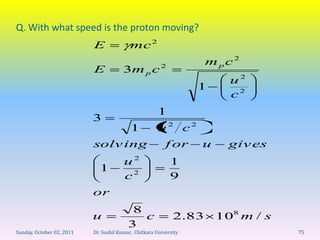
Q. With what speed is the proton moving?
                           E               mc 2
                                                                    mpc2
                           E            3m p c 2
                                                                         u2
                                                                   1
                                                                         c2
                                                       1
                           3
                                           1           u 2 c2
                           solv ing                       f or     u     giv es
                                        u2                  1
                             1
                                        c2                  9
                           or
                                           8
                           u                 c               2.83      108 m / s
                                          3
Sunday, October 02, 2011   Dr. Sushil Kumar, Chitkara University                   75
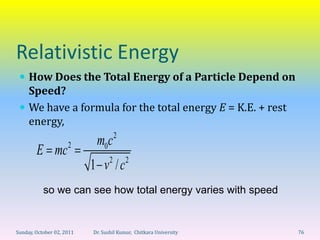
Relativistic Energy
  How Does the Total Energy of a Particle Depend on
   Speed?
  We have a formula for the total energy E = K.E. + rest
   energy,
                                      2
                     2      m0c
        E mc
                                  2       2
                           1 v /c
           so we can see how total energy varies with speed


Sunday, October 02, 2011   Dr. Sushil Kumar, Chitkara University   76
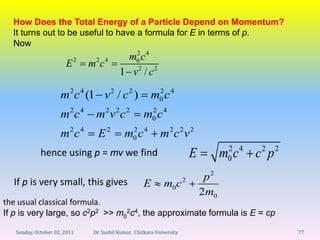
How Does the Total Energy of a Particle Depend on Momentum?
  It turns out to be useful to have a formula for E in terms of p.
  Now
                                           m0 c 4
                                             2
                       E2     m2c 4
                                          1 v2 / c2

                     m 2 c 4 (1 v 2 / c 2 )             m0 c 4
                                                         2


                     m2c 4      m2v 2c 2            m0 c 4
                                                     2


                     m2c 4       E2         m0 c 4
                                             2
                                                            m2c 2v 2
                                                                                 2 4    2    2
             hence using p = mv we find                                E         mc
                                                                                 0     c p

  If p is very small, this gives                                            p2
                                                    E        m0 c 2
                                                                           2m0
the usual classical formula.
If p is very large, so c2p2 >> m02c4, the approximate formula is E = cp

   Sunday, October 02, 2011    Dr. Sushil Kumar, Chitkara University                             77
The High Kinetic Energy Limit: Rest Mass Becomes
Unimportant!
Notice that this high energy limit is just the energy-momentum
relationship Maxwell found to be true for light, for all p. This could only
be true for all p if m02c4 = 0, that is, m0 = 0.
Light is in fact composed of “photons”—particles having zero “rest
mass”, as we shall discuss later. The “rest mass” of a photon is
meaningless, since they’re never at rest—the energy of a photon

                                                        m0c 2
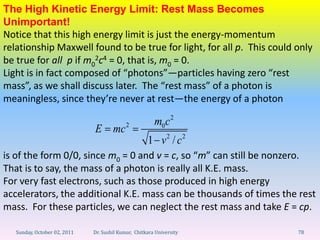
                              E mc 2
                                                     1 v2 / c2
is of the form 0/0, since m0 = 0 and v = c, so “m” can still be nonzero.
That is to say, the mass of a photon is really all K.E. mass.
For very fast electrons, such as those produced in high energy
accelerators, the additional K.E. mass can be thousands of times the rest
mass. For these particles, we can neglect the rest mass and take E = cp.

   Sunday, October 02, 2011   Dr. Sushil Kumar, Chitkara University    78

6593.relativity

  • 1.
    Concept of ModernPhysics A. Beiser Sunday, October 02, 2011 Dr. Sushil Kumar, Chitkara University 1
  • 2.
     The conceptof relativity had been well known since the time of Galileo. It was used by Newton and Poincare developed this idea. Einstein said that he thought of the idea whilst riding his bicycle. Sunday, October 02, 2011 Dr. Sushil Kumar, Chitkara University 2
  • 3.
    Special Relativity In 1905 the 26 year old Albert Einstein described in his theory of Special Relativity “how measurements of time and space are affected by the motion between the observer and what is being observed.” The theory of special relativity revolutionized the world of physics by connecting space and time, matter and energy, electricity and magnetism … Sunday, October 02, 2011 Dr. Sushil Kumar, Chitkara University 3
  • 4.
    Introduction of thechapter After completing the chapter you will be familiar with the 1. Two basic postulates of the STR 2. Frame of reference, concept of ether and Michelson- Morley Interferometer 3. Galilean transformation 4. Lorentz transformation 5. Time dilation 6. Length contraction 7. Velocity transformation 8. Relativistic momentum and energy
  • 5.
    Postulates of SpecialRelativity Einstein built the special theory of relativity on two postulates: 1. The Relativity Principle: The laws of motion are the same in every inertial frame of reference. 2. Constancy of the speed of light: The speed of light in a vacuum is the same independent of the speed of the source or the observer. Sunday, October 02, 2011 Dr. Sushil Kumar, Chitkara University 5
  • 6.
    Motion is alwaysmeasured relative to a frame of reference i.e. there is no absolute motion Frame S Frame S’ V0 relative to frame S V ’ = V - V0 Speed measured In frame S Speed measured In frame S’ Sunday, October 02, 2011 Dr. Sushil Kumar, Chitkara University 6
  • 7.
    What is anevent ? • When is it happening time t • Where is it happening position (x,y,z) • What reference frame coordinate (t,x,y,z) measured with respect to a particular observer at (0,0,0,0) frame of reference Sunday, October 02, 2011 Dr. Sushil Kumar, Chitkara University 7
  • 8.
    Measuring an event  An event is something that happens, to which an observer can assign three space coordinates and one time coordinate  A given event may be recorded by any number of observers, each in a different reference frame  In general different observers will assign different space-time coordinates for the same event. Sunday, October 02, 2011 Dr. Sushil Kumar, Chitkara University 8
  • 9.
    Inertial Reference Frames An Inertial Frame of Reference is one in which the basic laws of physics apply- e.g., a train moving at a constant velocity, in this, objects move “ normally”. v Objects obeying the Newton’s First Law. Sunday, October 02, 2011 Dr. Sushil Kumar, Chitkara University 9
  • 10.
    Non-Inertial Frames Anaccelerating or decelerating objects. If you are sitting / walking on that, then during this period, you are in non- inertial frame. For example: If you are in a Ferris Wheel you are always accelerating inwards so non-inertial. Sunday, October 02, 2011 Dr. Sushil Kumar, Chitkara University 10
  • 11.
    Relative Velocity: Whatis the black car’s velocity relative to your frame? V= 70 km/hr V=50 km/hr We know the answer intuitively (120 km/hr) ? Sunday, October 02, 2011 Dr. Sushil Kumar, Chitkara University 11
  • 12.
    Same idea withvelocity of light ? C= 3 x 10^(8) m/s C= 3 x 10^(8) m/s From the first example, we would expect the relative velocity to be 2c = 6 x 10^(8) m/s. This is in fact WRONG !!!!! Sunday, October 02, 2011 Dr. Sushil Kumar, Chitkara University 12
  • 13.
    The Luminiferous Ether The Ether was the basis of understanding, and the term was used to describe a medium for the propagation of light.  It was hypothesized that the Earth moves through this medium . The Ether; Ether Was transparent Had zero density Was everywhere Was the substance which allowed light to propagate. Sunday, October 02, 2011 Dr. Sushil Kumar, Chitkara University 13
  • 14.
    Airplane wind If the velocity of the wind is v1 relative to Earth , and v2 is the velocity of airplane relative to the wind, the speed of Airplane relative to the earth is (a) v1+v2 in the same direction, (b) v2-v1 in the opposite direction and (c) in the Direction perpendicular to the wind. Observer fixed on earth Sunday, October 02, 2011 Dr. Sushil Kumar, Chitkara University 14
  • 15.
    v C c+ v v c c-v 2 2 Determine the speed of light c c v under these circumstances ? In our case the ether wind is blowing through our apparatus fixed to the Earth, determine the velocity of light ? Sunday, October 02, 2011 Dr. Sushil Kumar, Chitkara University 15
  • 16.
    If the Sunis assumed to be at rest in the ether, then the velocity of the Ether wind would be equal to the orbital velocity of the earth around the Sun. which has a magnitude of about 3 x 10^4 m/s compared to c= 3 X 10^8 m/s. The change in the speed of light should be detectable !!!! Sunday, October 02, 2011 Dr. Sushil Kumar, Chitkara University 16
  • 17.
    The Michelson-Morley Experiment The Famous experiment designed to detect small changes in the speed of light with motion of an observer through the ether . It was performed in 1887. Albert A. Michelson The negative results of the experiment not only meant that the speed of light does not depend on the direction of light propagated but also contradicted the ether hypothesis. Light is now understood to be a phenomenon that requires no medium for its propagation. Edward W. Morley Sunday, October 02, 2011 Dr. Sushil Kumar, Chitkara University 17
  • 18.
    Light source Mirror Compensating plate Semi-silvered plate Telescope Actual Experimental set-up Sunday, October 02, 2011 Dr. Sushil Kumar, Chitkara University 18
  • 20.
    The Michelson interferometerproduces interference fringes by splitting a beam of monochromatic light so that one beam strikes a fixed mirror and the other a movable mirror. When the reflected beams are brought back together, an interference pattern results. Sunday, October 02, 2011 Dr. Sushil Kumar, Chitkara University 20
  • 21.
    M1 C V Ether wind Arm two L Light velocity -c Source B A Arm one M2 L A = Semi silvered plate B= Mirror total C = Mirror total Observer Sunday, October 02, 2011 Dr. Sushil Kumar, Chitkara University 21
  • 22.
    Michelson Interferometer Precise distance measurements can be made with the Michelson interferometer by moving the mirror and counting the interference fringes which move by a reference point. The distance d associated with m fringes is Sunday, October 02, 2011 Dr. Sushil Kumar, Chitkara University 22
  • 23.
    Michelson-Morley Interferometer hastwo arms of equal length L. First, the beam traveling parallel to the direction of the ether wind Velocity of light beam moves to the right, with respect to the Earth is = c - v Velocity of light beam moves to the left, with respect to the Earth is = c + v The total time of travel for the round –trip along the horizontal path is 2 1 L L 2L v t1 1 2 c v c v c c Sunday, October 02, 2011 Dr. Sushil Kumar, Chitkara University 23
  • 24.
    Now, the lightbeam traveling perpendicular to the wind, so in this case the speed of the beam relative to the 1 Earth is 2 2 2 c v Total time of travel for the round-trip is 2 12 2L 2L v t2 1 2 2 12 c c2 c v Thus the time difference between the right beam traveling horizontally and the beam traveling vertically is 2 1 2 12 2L v v t t1 t2 1 2 1 2 c c c Sunday, October 02, 2011 Dr. Sushil Kumar, Chitkara University 24
  • 25.
    2 Lv After simplification , t t1 t 2 3 c Because After rotating the interferometer through 90 degree v2 1. The path difference corresponding to this time difference is c2 2 Lv 2 d c2 t c2 The corresponding fringe shift is equal to this path difference divided by the wavelength of light, lembda, because a change in path of 1 wavelength corresponds to a shift of 1 fringe, 2 Lv 2 Shift c2 Sunday, October 02, 2011 Dr. Sushil Kumar, Chitkara University 25
  • 26.
    Change in pathof the order of lambda = one fringe shift If change is one then fringe shift is equal to 1 over lambda If change is d in path then change in shift would be equal to d into one upon lambda.
  • 27.
    The speed ofthe Earth about the Sun, gives a path difference of 2(11)(3 10 4 m / s ) 2 7 d 2.2 10 m (3 10 8 m / s ) 2 7 d 2.2 10 m Shif t 7 0.40 5.0 10 m Conclusion: 1. No detection of fringe shift in the pattern 2. No motion of Earth with respect to Ether. 3. The speed of light is same for all observers “ Most famous negative result in the History of Physics”. Sunday, October 02, 2011 Dr. Sushil Kumar, Chitkara University 27
  • 28.
    Questions/ doubts 1) How Michelson able detect change in the speed of light? 2) Concept of aether ? 3) Concept of frame of reference ? 4) How shifting of fringes decides whether the speed of light is same or not ? 5) In theory of relativity fourth coordinate Is of time , why we take it so? because to define position of particles only distance from 3 co-ordinates is needed? 6) How we come to know light is electromagnetic wave through Moreley Experiment? 7) In Morley experiment is source of light is moveable or mirror is moveable? 8) The basic points how Morely had thought before doing experiment ? 9) Is theory of relativity and special theory of relativity same? 9) Conclusion about the persences of aether from M-M expt.? Sunday, October 02, 2011 Dr. Sushil Kumar, Chitkara University 28
  • 29.
    d 11) Why thereis change in velocity of light when shift = 1 ? Sunday, October 02, 2011 Dr. Sushil Kumar, Chitkara University 29
  • 30.
    12) Why do hypothetical concept of ether was needed? 13) Mathematics of M-M Expt? 14) When Interferometer is rotated through 90 degree what happens then? 15) Derivation of M-M expt. ? Sunday, October 02, 2011 Dr. Sushil Kumar, Chitkara University 30
  • 31.
    What Time Dilationmeans…………? • A moving clock ticks more slowly than a clock at rest When two events are occurs at the same location in an inertial reference frame , the time interval between them, measured in that frame, is called the proper time interval or the “ proper time” Measurements of the same time interval from any other inertial reference frame are always greater. The amount by which a measured time interval is greater than the corresponding proper time interval is called time dilation. Sunday, October 02, 2011 Dr. Sushil Kumar, Chitkara University 31
  • 32.
    v Time Dilation One clockis at rest in a laboratory on the ground and the other is in a spacecraft that moves at the speed v relative to the ground. An observer in the laboratory watches both clocks; Does he/she find that they tick at the same rate ? Sunday, October 02, 2011 Dr. Sushil Kumar, Chitkara University 32
  • 33.
    moving clocks runslow. This means that if two events occur at the same place, such as the ticks of a clock, a moving observer will measure the time between the events to be longer. The relation between a time measured by a stationary observer t0 to the time t measured by an observer moving with velocity v is: The gamma factor is common in relativity, and we will use it often. It is always greater than unity. If the velocity were greater than c, it would be undefined. Sunday, October 02, 2011 Dr. Sushil Kumar, Chitkara University 33
  • 34.
    Show Me TheDerivation? For our derivation, we will consider two measurements. One taken by a rider with the clock and the other measurement for the clock will be made by a stationary observer (referred to as the stationary for the mover). Sunday, October 02, 2011 Dr. Sushil Kumar, Chitkara University 34
  • 35.
    A light pulseclock at rest On the ground as seen by An observer on the ground. mirror The light travels the total Distance 2L at speed c, therefore Recording device The time for entire trip is ' 2L t c Lo Meter stick Light pulse mirror Photosensitive surface Sunday, October 02, 2011 Dr. Sushil Kumar, Chitkara University 35
  • 36.
    Clock is movingwith v velocity in spacecraft. What observer notice who is in the Rest with respect to spacecraft (seen from the ground). The time interval between ticks is t. v 0 t/2 t B ct 2 Lo A C D vt 2 Sunday, October 02, 2011 Dr. Sushil Kumar, Chitkara University 36
  • 37.
    Observer in sameinertial frame and notice the events to = 2L/c Sunday, October 02, 2011 Dr. Sushil Kumar, Chitkara University 37
  • 38.
    Now, observer inanother frame and seen events from the ground ………… Sunday, October 02, 2011 Dr. Sushil Kumar, Chitkara University 38
  • 39.
    The light raytravels the path AB and mirror AD with velocity v. The distance AB= ct/2 and AD=vt/2 2 2 ct 2 vt L0 2 2 2 L0 / c t0 t 1 v2 c2 1 v2 c2 To= time interval onclock at rest relative to an observer= proper time T= time interval on clock in motion relative to an observer v-= speed of relative motion C= speed of light. Sunday, October 02, 2011 Dr. Sushil Kumar, Chitkara University 39
  • 40.
    Example 1: If you were to board a craft and travel at 0.2 c, how long would 1 hour be? Sunday, October 02, 2011 Dr. Sushil Kumar, Chitkara University 40
  • 41.
    Example 2: If you were to board a craft and travel at 0.8 c, how long would 1 hour be? Sunday, October 02, 2011 Dr. Sushil Kumar, Chitkara University 41
  • 42.
    Example 3: If you were to board a craft and travel c, how long would 1 hour be? Sunday, October 02, 2011 Dr. Sushil Kumar, Chitkara University 42
  • 43.
    Example 4: If you were to board a craft and travel at 300 m/s, how long would 1 hour be? Sunday, October 02, 2011 Dr. Sushil Kumar, Chitkara University 43
  • 44.
    Sunday, October 02,2011 Dr. Sushil Kumar, Chitkara University 44
  • 45.
    Question: As we watch,a spaceship passes us in time t. The crew of the spaceship measures the passage time and finds it to be t'. Which of the following statements is true? A) t is the proper time for the passage and it is smaller t' B) t is the proper time for the passage and it is greater than t' C) t' is the proper time for the passage and it is smaller than t D) t' is the proper time for the passage and it is greater than t E) None of the above statements are true. Ans. C Sunday, October 02, 2011 Dr. Sushil Kumar, Chitkara University 45
  • 46.
    Question Spaceship A, travelingpast us at 0.7c, sends a message capsule to spaceship B, which is in front of A and is traveling in the same direction as A at 0.8c relative to us. The capsule travels at 0.95c relative to us. A clock that measures the proper time between the sending and receiving of the capsule travels: A) in the same direction as the spaceships at 0.7c relative to us B) in the opposite direction from the spaceships at 0.7c relative to us C) in the same direction as the spaceships at 0.8c relative to us D) in the same direction as the spaceships at 0.95c relative to us E) in the opposite direction from the spaceships at 0.95c relative to us Ans. D Sunday, October 02, 2011 Dr. Sushil Kumar, Chitkara University 46
  • 47.
    Problem You wish tomake a round trip from Earth in a spaceship, traveling at constant speed in a straight line for 6 months and then returning at the same constant speed. You wish further, on your return, to find Earth as it will be 1000 years in the future. (a)How fast must you travel? (b) Does it matter whether you travel in a straight line on your journey? If, for example, you traveled in a circle for 1 year, would it still find 1000 years had elapsed by Earth clock when you returned? Sunday, October 02, 2011 Dr. Sushil Kumar, Chitkara University 47
  • 48.
    Question A millionairess wastold in 1992 that she had exactly 15 years to live. However, if she travels away from the Earth at 0.8 c and then returns at the same speed, the last New Year's day the doctors expect her to celebrate is: A) 2001 B) 2003 C) 2007 D) 2010 E) 2017 Ans. E
  • 49.
    The Time Dilationequation for Relativity is: What is t, to v, and c? Sunday, October 02, 2011 Dr. Sushil Kumar, Chitkara University 49
  • 50.
    The relativity oflength and Length Contraction The Relativity of Length The length L0 of an object measured in the rest frame of the object is its proper length or rest length. Measurements of the length from any reference frame that is in relative motion parallel to that length are always less that the proper length 2 v L L0 1 2 c Sunday, October 02, 2011 Dr. Sushil Kumar, Chitkara University 50
  • 51.
    Speed of Spaceship Observed Length Observed Height At rest 200 ft 40 ft 10 % the speed of light 199 ft 40 ft 86.5 % the speed of light 100 ft 40 ft 99 % the speed of light 28 ft 40 ft 99.99 % the speed of light 3 ft 40 ft Sunday, October 02, 2011 Dr. Sushil Kumar, Chitkara University 51
  • 52.
    Question A measurement ofthe length of an object that is moving relative to the laboratory consists of noting the coordinates of the front and back: A) at different times according to clocks at rest in the laboratory B) at the same time according to clocks that move with the object C) at the same time according to clocks at rest in the laboratory D) at the same time according to clocks at rest with respect to the fixed stars E) none of the above Ans. C Sunday, October 02, 2011 Dr. Sushil Kumar, Chitkara University 52
  • 53.
    Question A certain automobileis 6 m long if at rest. If it is measured to be 4/5 as long, its speed is: A) 0.1c B) 0.3c C) 0.6c D) 0.8c E) > 0.95c Ans. C Sunday, October 02, 2011 Dr. Sushil Kumar, Chitkara University 53
  • 54.
    Problem A cubical boxis 0.50 m on a side. (a) What are the dimensions of the box as measured by an observer moving with a speed of 0.88c parallel to one of the edges of the box? (b) What is the volume of the box as measured by this observer? Sunday, October 02, 2011 Dr. Sushil Kumar, Chitkara University 54
  • 55.
    2 v L L0 1 2 c L= 0.5 (1-(0.88)**2)1/2 =0.24m The observed dimension are= 0.24*0.5*0.5=0.059m**3 Sunday, October 02, 2011 Dr. Sushil Kumar, Chitkara University 55
  • 56.
    An Important generalquestion: If we know the co-ordinate x, y, z and time t of an event, as measured in a frame S, How can we find the coordinates x’, y ’ , z ’ and t’ of the same event as measured in a second frame S? Sunday, October 02, 2011 Dr. Sushil Kumar, Chitkara University 56
  • 57.
    Galilean Transformation Sunday, October02, 2011 Dr. Sushil Kumar, Chitkara University 57
  • 58.
    To convert velocitycomponents measured in the S frame to their equivalents in the S’ frame according to the Galilean Transformation, we simply differentiate x’, y’, and z’ with respect to time: ' Galilean transformation ' dx v x vx v violate both of the dt ' postulates of special dy ' relativity. v 'y vy 1). If we measure the speed dt ' of light in the x-direction in the S-system to be c, ' dz ' however, in the S’ system it vz vz dt ' will be c’= c-v Sunday, October 02, 2011 Dr. Sushil Kumar, Chitkara University 58
  • 59.
    Lorentz’s Transformation The primed frame moves with velocity v in the x direction with respect to the fixed reference frame. The reference frames coincide at t=t'=0. The point x' is moving with the primed frame. The reverse transformation is: Much of the literature of relativity uses the symbols β and γ as defined here to simplify the writing of relativistic relationships Sunday, October 02, 2011 Dr. Sushil Kumar, Chitkara University 59
  • 60.
    Relativistic Velocity Transformation Notwo objects can have a relative velocity greater than c! But what if I observe a spacecraft traveling at 0.8c and it fires a projectile which it observes to be moving at 0.7c with respect to it!? Velocities must transform according to the Lorentz transformation, and that leads to a very non-intuitive result called Einstein velocity addition. Sunday, October 02, 2011 Dr. Sushil Kumar, Chitkara University 60
  • 61.
    Just taking thedifferentials of these quantities leads to the velocity transformation. Taking the differentials of the Lorentz transformation expressions for x' and t' above gives Putting this in the notation introduced in the illustration above: Sunday, October 02, 2011 Dr. Sushil Kumar, Chitkara University 61
  • 62.
    The reverse transformationis obtained by just solving for u in the above expression. Doing that gives Applying this transformation to the spacecraft traveling at 0.8c which fires a projectile which it observes to be moving at 0.7c with respect to it, we obtain a velocity of 1.5c/1.56 = 0.96c rather than the 1.5c which seems to be the common sense answer. Sunday, October 02, 2011 Dr. Sushil Kumar, Chitkara University 62
  • 63.
    When ux and v are both much smaller than c (the non relativistic case) , the denominator of equation approaches unity and so u’x = ux –v. This corresponds to the Galilean velocity transformation, In the other Extreme, when ux =c ; the equation becomes U’x = c , From this result, we see that an object moving with a speed c relative to an observer in S also has a speed c relative to an observer in S’- independent of the relative motion of the S and S’. Sunday, October 02, 2011 Dr. Sushil Kumar, Chitkara University 63
  • 64.
    Question: Imagine amotorcycle rider moving with a speed of 0.800c past a stationary observer, as shown in figure below, If the rider tosses a ball in the forward direction with a speed of 0.700c with respect to himself, what is the speed of the ball as seen by the stationary observer? 0.700c 0.800c
  • 65.
    In this situation,the velocity of the motorcycle with respect to the stationary observer is v=0.800c. The velocity of the ball in the frame of reference of the motorcyclist is ux’=0.700c. Therefore, the velocity, ux, of the ball relative to the stationary observer is ' u x v ux ' uxv 1 c2 0.700c 0.800c 0.9615c 1 0.700c 0.800c 1 2 c Sunday, October 02, 2011 Dr. Sushil Kumar, Chitkara University 65
  • 66.
    The length ofany object in a moving frame will appear foreshortened in the direction of motion, or contracted. The amount of contraction can be calculated from the Lorentz transformation. The length is maximum in the frame in which the object is at rest. Sunday, October 02, 2011 Dr. Sushil Kumar, Chitkara University 66
  • 67.
    Questions/ Problems/ Doubts: 1).I know the derivation but I have problem in basic concept, I did not understand the application of Galilean and Lorentz transformation? 2.) I know the concept, but I face problem when I try to solve the numerical problem? 3.) No proper notes/material of subject? 4.) Problem in length contraction, when observer is moving or object is moving? 5.) Why Galilean transformation do not obey laws of physics? 6.) Transformation equation? 7.) When we move away from a building it becomes smaller and smaller, is it the case of length contraction or some other physical process? 8.) If object is in moving frame of reference, is there any change of dimension? 9.) Why there is need of transformation, what we get from it? 10.) How a large building contract, when seen in the glass/mirror of moving vehicle?
  • 68.
    Questions/doubts: 11. WHYTHERE IS CHANGE IN VELOCITY OF LIGHT WHEN FRINGE SHIFT = 1 ? 12. When an observer and object of length L is moving with velocity v1 and v2 respectively, what will be the length contraction, v2> v1 ? 13. Not able to understand why the length seems less while moving……..Length contraction? 14. How length contraction takes place in MUON’S DECAY ? Sunday, October 02, 2011 Dr. Sushil Kumar, Chitkara University 68
  • 69.
    Questions/ doubts……..417 We consider earth an inertial frame of reference, and there are hardly any motions comparable to speed of light. Why do we refer to the relativity then ?  does time, length and velocity all relativistic quantities? Sunday, October 02, 2011 Dr. Sushil Kumar, Chitkara University 69
  • 70.
    Questions/ doubts How does time change in S’ as per Lorentz transformation & Physically why is this change of time?  Explain the use of telescope and compensating plate in the setup of experiment?  How does the height of the object changes when observer is along x-axis and object is moving along y- axis ? Sunday, October 02, 2011 Dr. Sushil Kumar, Chitkara University 70
  • 71.
    Questions/ doubts/ problems  How to implement these formulas in typical questions?  Galilean & Lorentz transformation with numericals?  Tried to understand the topic ‘ Length contraction’ using text book but was unable to understand, also tried numerical problems on the topic ‘ time dilation’ and was unable to solve them too…......!!!!!  Explain length contraction of a thin road, when observer moves perpendicular to the rod ? Sunday, October 02, 2011 Dr. Sushil Kumar, Chitkara University 71
  • 72.
     How muchDo I know? What Do I need to learn? What I have Learned ? Sunday, October 02, 2011 Dr. Sushil Kumar, Chitkara University 72
  • 73.
    Relativistic mass  Massm-0 of an object measured when it was at rest and mass m measured when it was in motion with velocity v, Relativistic Mass Increase 6 m0 m 5 4 2 1 v Mass 3 2 c 2 1 0 0 0.2 0.4 0.6 0.8 1 Speed( c = 1) Sunday, October 02, 2011 Dr. Sushil Kumar, Chitkara University 73
  • 74.
    Q. The totalenergy of a proton is three times its rest energy. (a) Find the proton’s rest energy in electron volts. 2 mpc 27 8 2 (1.67 10 kg)(3.0 10 m / s ) 10 19 (1.50 10 J )(1eV / 1.6 10 J) 938MeV Sunday, October 02, 2011 Dr. Sushil Kumar, Chitkara University 74
  • 75.
    Q. With whatspeed is the proton moving? E mc 2 mpc2 E 3m p c 2 u2 1 c2 1 3 1 u 2 c2 solv ing f or u giv es u2 1 1 c2 9 or 8 u c 2.83 108 m / s 3 Sunday, October 02, 2011 Dr. Sushil Kumar, Chitkara University 75
  • 76.
    Relativistic Energy How Does the Total Energy of a Particle Depend on Speed?  We have a formula for the total energy E = K.E. + rest energy, 2 2 m0c E mc 2 2 1 v /c so we can see how total energy varies with speed Sunday, October 02, 2011 Dr. Sushil Kumar, Chitkara University 76
  • 77.
    How Does theTotal Energy of a Particle Depend on Momentum? It turns out to be useful to have a formula for E in terms of p. Now m0 c 4 2 E2 m2c 4 1 v2 / c2 m 2 c 4 (1 v 2 / c 2 ) m0 c 4 2 m2c 4 m2v 2c 2 m0 c 4 2 m2c 4 E2 m0 c 4 2 m2c 2v 2 2 4 2 2 hence using p = mv we find E mc 0 c p If p is very small, this gives p2 E m0 c 2 2m0 the usual classical formula. If p is very large, so c2p2 >> m02c4, the approximate formula is E = cp Sunday, October 02, 2011 Dr. Sushil Kumar, Chitkara University 77
  • 78.
    The High KineticEnergy Limit: Rest Mass Becomes Unimportant! Notice that this high energy limit is just the energy-momentum relationship Maxwell found to be true for light, for all p. This could only be true for all p if m02c4 = 0, that is, m0 = 0. Light is in fact composed of “photons”—particles having zero “rest mass”, as we shall discuss later. The “rest mass” of a photon is meaningless, since they’re never at rest—the energy of a photon m0c 2 E mc 2 1 v2 / c2 is of the form 0/0, since m0 = 0 and v = c, so “m” can still be nonzero. That is to say, the mass of a photon is really all K.E. mass. For very fast electrons, such as those produced in high energy accelerators, the additional K.E. mass can be thousands of times the rest mass. For these particles, we can neglect the rest mass and take E = cp. Sunday, October 02, 2011 Dr. Sushil Kumar, Chitkara University 78