By
SSDN Technologies
Call us at 0124-4018080 / +91-9999509970
Training Programs Available
Here’s the list of technologies for 6 weeks summer training
programs for live projects and Summer training during the
summer break.
• C & C++ Training Program
• Java Training Program
• Dot Net Training Program
• PHP Training Program
• Android Training Program
• MCITP/MCSA Training Program
Call us at 0124-4018080 / +91-9999509970
• What is JAVA?
• What is OOP?
• Why Java?
• Characteristics of JAVA
• Overview of Java.
• The difference between Java and C++?
• A Simple JAVA Program
Call us at 0124-4018080 / +91-9999509970
• Developed by Sun Microsystems (James Gosling)
• A general-purpose Object-Oriented language
• Based on C/C++
• Designed for easy Web/Internet applications
• Widespread acceptance
Call us at 0124-4018080 / +91-9999509970
Object-oriented programming is a method of
implementation in which programs are organized as
cooperative collections of objects, each of which
represents an instance of some class, and whose
classes
are all members of one or more hierarchy of classes
united via inheritance relationships.
Call us at 0124-4018080 / +91-9999509970
There are three main features of OOPS.
1) Encapsulation
2) Inheritance
3) Polymorphism
Let’s we discuss about the about features in details.
Call us at 0124-4018080 / +91-9999509970
Encapsulation means putting together all the
variables and the methods into a single unit called
Class. It also means hiding data and methods within
an Object. Encapsulation provides the security that
keeps data and methods safe from inadvertent
changes.
Advantages of Encapsulation
1. Protection
2. Consistency
3. Allows change
Call us at 0124-4018080 / +91-9999509970
An important feature of object-oriented programs is
inheritance— the ability to create classes that share
the attributes and methods of existing classes, but
with more specific features. Inheritance is mainly
used for code reusability
In general one line definition we can tell that
deriving a new class from existing class, it’s called as
Inheritance.
Call us at 0124-4018080 / +91-9999509970
Polymorphism is an object-oriented programming
concept that refers to the ability of a variable,
function or object to take on multiple forms. A
language that features polymorphism allows
developers to program in the general rather than
program in the specific.
2 ways to implement polymorphism.
1. Static Polymorphism (compile time)
2. Dynamic Polymorphism (run time)
Call us at 0124-4018080 / +91-9999509970
Compile time polymorphism is nothing but the
method overloading in java. In simple terms we can
say that a class can have more than one methods
with same name but with different number of
arguments or different types of arguments or both.
To know more about it refer method overloading in
java.
Call us at 0124-4018080 / +91-9999509970
Method overriding is a perfect example of runtime
polymorphism. In this kind of polymorphism,
reference of class X can hold object of class X or an
object of any sub classes of class X.
For e.g.
• If class Y extends class X then both of the
following statements are valid:
• Y obj = new Y();
• Parent class reference can be assigned to child
object X obj = new Y();
Call us at 0124-4018080 / +91-9999509970
An Object oriented programming language
developed in the early ‘90s.
The language itself takes much of its syntax from C
and C++ but has a simpler object model and
eliminates low-level tools.
It is platform independent. Early implementations of
Java had the slogan: “write once, run anywhere”
It has a system of automatic memory management.
Call us at 0124-4018080 / +91-9999509970
• Java Applets
• Java Web Applications
• Java can also be used to develop
applications for
• hand-held devices such as Palm and cell
phones
Call us at 0124-4018080 / +91-9999509970
•Java Is Simple
•Java Is Object-Oriented
•Java Is Distributed
•Java Is Interpreted
•Java Is Robust
•Java Is Secure
•Java Is Architecture-Neutral
•Java Is Portable
•Java's Performance
•Java Is Multithreaded
•Java Is Dynamic
Call us at 0124-4018080 / +91-9999509970
Slower than compiled language such
as C
An experiment in 1999 showed that
Java was 3 or 4
times slower than C or C++
Call us at 0124-4018080 / +91-9999509970
James Gosling & Patrick Naughton at 1990
Goal : To develop distributed system which is
applicable to electronic products (platform
independent)
Call us at 0124-4018080 / +91-9999509970
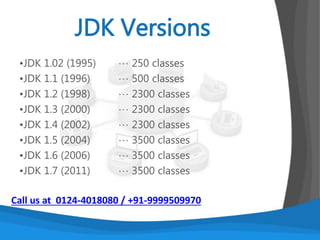
•JDK 1.02 (1995) … 250 classes
•JDK 1.1 (1996) … 500 classes
•JDK 1.2 (1998) … 2300 classes
•JDK 1.3 (2000) … 2300 classes
•JDK 1.4 (2002) … 2300 classes
•JDK 1.5 (2004) … 3500 classes
•JDK 1.6 (2006) … 3500 classes
•JDK 1.7 (2011) … 3500 classes
Call us at 0124-4018080 / +91-9999509970
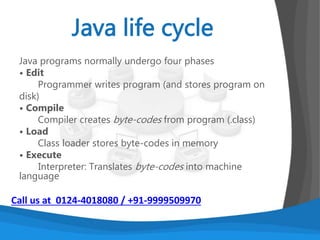
Java programs normally undergo four phases
• Edit
Programmer writes program (and stores program on
disk)
• Compile
Compiler creates byte-codes from program (.class)
• Load
Class loader stores byte-codes in memory
• Execute
Interpreter: Translates byte-codes into machine
language
Call us at 0124-4018080 / +91-9999509970
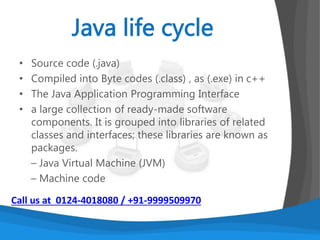
• Source code (.java)
• Compiled into Byte codes (.class) , as (.exe) in c++
• The Java Application Programming Interface
• a large collection of ready-made software
components. It is grouped into libraries of related
classes and interfaces; these libraries are known as
packages.
– Java Virtual Machine (JVM)
– Machine code
Call us at 0124-4018080 / +91-9999509970
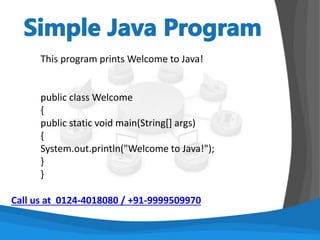
This program prints Welcome to Java!
public class Welcome
{
public static void main(String[] args)
{
System.out.println("Welcome to Java!");
}
}
Call us at 0124-4018080 / +91-9999509970

6 Weeks Summer Training on Java By SSDN Technologies

  • 1.
    By SSDN Technologies Call usat 0124-4018080 / +91-9999509970
  • 2.
    Training Programs Available Here’sthe list of technologies for 6 weeks summer training programs for live projects and Summer training during the summer break. • C & C++ Training Program • Java Training Program • Dot Net Training Program • PHP Training Program • Android Training Program • MCITP/MCSA Training Program Call us at 0124-4018080 / +91-9999509970
  • 3.
    • What isJAVA? • What is OOP? • Why Java? • Characteristics of JAVA • Overview of Java. • The difference between Java and C++? • A Simple JAVA Program Call us at 0124-4018080 / +91-9999509970
  • 4.
    • Developed bySun Microsystems (James Gosling) • A general-purpose Object-Oriented language • Based on C/C++ • Designed for easy Web/Internet applications • Widespread acceptance Call us at 0124-4018080 / +91-9999509970
  • 5.
    Object-oriented programming isa method of implementation in which programs are organized as cooperative collections of objects, each of which represents an instance of some class, and whose classes are all members of one or more hierarchy of classes united via inheritance relationships. Call us at 0124-4018080 / +91-9999509970
  • 6.
    There are threemain features of OOPS. 1) Encapsulation 2) Inheritance 3) Polymorphism Let’s we discuss about the about features in details. Call us at 0124-4018080 / +91-9999509970
  • 7.
    Encapsulation means puttingtogether all the variables and the methods into a single unit called Class. It also means hiding data and methods within an Object. Encapsulation provides the security that keeps data and methods safe from inadvertent changes. Advantages of Encapsulation 1. Protection 2. Consistency 3. Allows change Call us at 0124-4018080 / +91-9999509970
  • 8.
    An important featureof object-oriented programs is inheritance— the ability to create classes that share the attributes and methods of existing classes, but with more specific features. Inheritance is mainly used for code reusability In general one line definition we can tell that deriving a new class from existing class, it’s called as Inheritance. Call us at 0124-4018080 / +91-9999509970
  • 9.
    Polymorphism is anobject-oriented programming concept that refers to the ability of a variable, function or object to take on multiple forms. A language that features polymorphism allows developers to program in the general rather than program in the specific. 2 ways to implement polymorphism. 1. Static Polymorphism (compile time) 2. Dynamic Polymorphism (run time) Call us at 0124-4018080 / +91-9999509970
  • 10.
    Compile time polymorphismis nothing but the method overloading in java. In simple terms we can say that a class can have more than one methods with same name but with different number of arguments or different types of arguments or both. To know more about it refer method overloading in java. Call us at 0124-4018080 / +91-9999509970
  • 11.
    Method overriding isa perfect example of runtime polymorphism. In this kind of polymorphism, reference of class X can hold object of class X or an object of any sub classes of class X. For e.g. • If class Y extends class X then both of the following statements are valid: • Y obj = new Y(); • Parent class reference can be assigned to child object X obj = new Y(); Call us at 0124-4018080 / +91-9999509970
  • 12.
    An Object orientedprogramming language developed in the early ‘90s. The language itself takes much of its syntax from C and C++ but has a simpler object model and eliminates low-level tools. It is platform independent. Early implementations of Java had the slogan: “write once, run anywhere” It has a system of automatic memory management. Call us at 0124-4018080 / +91-9999509970
  • 13.
    • Java Applets •Java Web Applications • Java can also be used to develop applications for • hand-held devices such as Palm and cell phones Call us at 0124-4018080 / +91-9999509970
  • 14.
    •Java Is Simple •JavaIs Object-Oriented •Java Is Distributed •Java Is Interpreted •Java Is Robust •Java Is Secure •Java Is Architecture-Neutral •Java Is Portable •Java's Performance •Java Is Multithreaded •Java Is Dynamic Call us at 0124-4018080 / +91-9999509970
  • 15.
    Slower than compiledlanguage such as C An experiment in 1999 showed that Java was 3 or 4 times slower than C or C++ Call us at 0124-4018080 / +91-9999509970
  • 16.
    James Gosling &Patrick Naughton at 1990 Goal : To develop distributed system which is applicable to electronic products (platform independent) Call us at 0124-4018080 / +91-9999509970
  • 17.
    •JDK 1.02 (1995)… 250 classes •JDK 1.1 (1996) … 500 classes •JDK 1.2 (1998) … 2300 classes •JDK 1.3 (2000) … 2300 classes •JDK 1.4 (2002) … 2300 classes •JDK 1.5 (2004) … 3500 classes •JDK 1.6 (2006) … 3500 classes •JDK 1.7 (2011) … 3500 classes Call us at 0124-4018080 / +91-9999509970
  • 18.
    Java programs normallyundergo four phases • Edit Programmer writes program (and stores program on disk) • Compile Compiler creates byte-codes from program (.class) • Load Class loader stores byte-codes in memory • Execute Interpreter: Translates byte-codes into machine language Call us at 0124-4018080 / +91-9999509970
  • 19.
    • Source code(.java) • Compiled into Byte codes (.class) , as (.exe) in c++ • The Java Application Programming Interface • a large collection of ready-made software components. It is grouped into libraries of related classes and interfaces; these libraries are known as packages. – Java Virtual Machine (JVM) – Machine code Call us at 0124-4018080 / +91-9999509970
  • 20.
    Call us at0124-4018080 / +91-9999509970
  • 21.
    This program printsWelcome to Java! public class Welcome { public static void main(String[] args) { System.out.println("Welcome to Java!"); } } Call us at 0124-4018080 / +91-9999509970
  • 22.
    Call us at0124-4018080 / +91-9999509970