Definition
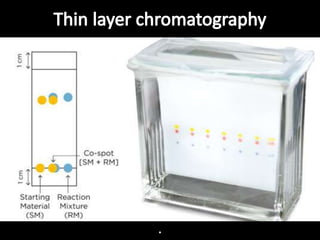
Thin layer chromatography(TLC) is a technique used to separate the
components of a mixture using a thin stationary phase supported by an inert .
Separation depends on competition between adsorption of solute onto the
solid surface and its desorption by the solvent needed to elute (wash off) it .
Stationary phase:
Solid
Mobile phase:
Liquid
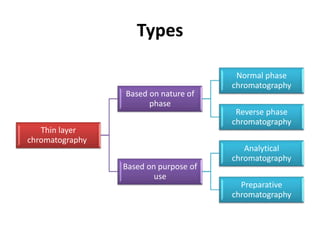
Types
Thin layer
chromatography
Based onnature of
phase
Normal phase
chromatography
Reverse phase
chromatography
Based on purpose of
use
Analytical
chromatography
Preparative
chromatography
6.
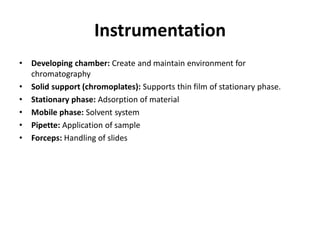
Instrumentation
• Developing chamber:Create and maintain environment for
chromatography
• Solid support (chromoplates): Supports thin film of stationary phase.
• Stationary phase: Adsorption of material
• Mobile phase: Solvent system
• Pipette: Application of sample
• Forceps: Handling of slides
7.
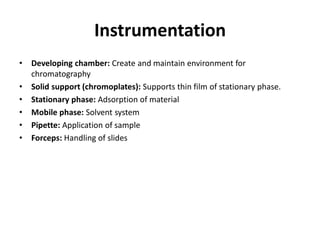
Instrumentation
• Developing chamber:Create and maintain environment for
chromatography
• Solid support (chromoplates): Supports thin film of stationary phase.
• Stationary phase: Adsorption of material
• Mobile phase: Solvent system
• Pipette: Application of sample
• Forceps: Handling of slides
8.
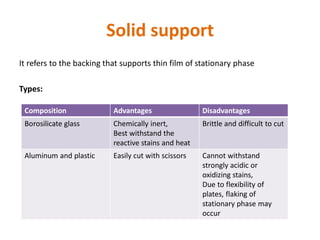
Solid support
It refersto the backing that supports thin film of stationary phase
Types:
Composition Advantages Disadvantages
Borosilicate glass Chemically inert,
Best withstand the
reactive stains and heat
Brittle and difficult to cut
Aluminum and plastic Easily cut with scissors Cannot withstand
strongly acidic or
oxidizing stains,
Due to flexibility of
plates, flaking of
stationary phase may
occur
Stationary phase
It refersto thin layer of adsorbent on TLC plate.
Selection of adsorbent:
Depends on;
• Characteristics of compound to be separated
• Solubility of substances to be chromatographed
• Nature of compound (acidic, basic, neutral)
• Reaction of compound with solvent and adsorbent
11.
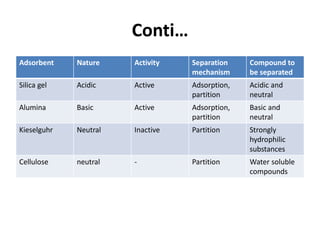
Conti…
Adsorbent Nature ActivitySeparation
mechanism
Compound to
be separated
Silica gel Acidic Active Adsorption,
partition
Acidic and
neutral
Alumina Basic Active Adsorption,
partition
Basic and
neutral
Kieselguhr Neutral Inactive Partition Strongly
hydrophilic
substances
Cellulose neutral - Partition Water soluble
compounds
12.
Conti…
Stationary phase withfluorescent indicators:
Stationary phases (Adsorbents) are also available with fluorescent indicators
e.g. zinc silicate. Addition of fluorescent indicator does not effect
chromatographic characteristics of material but helps in easy detection.
Examples include;
• Silica gel 60 F254
• Aluminum oxide 60 F254
• Cellulose F
13.
Conti…
Binders in stationaryphase:
Sometimes, binders are added in adsorbent to provide mechanical strength.
Examples of commonly used binders include;
• Calcium sulphate
• Starch
Example of adsorbents with binders are;
• Silica gel G (silica gel + calcium sulphate)
• Alumina G
14.
Practical experimentation
1. Preparationof thin layer on plate
2. Activation of adsorbent
3. Purification
4. Preparation of mobile phase
5. Marking on plate
6. Preparation of sample and standard
7. Spotting
8. Development
9. Drying
10. Detection
15.
Preparation of thinlayer on plate
Suspension or slurry of coating material is prepared and applied on plates in
one of following ways;
Pouring
Plate is kept on a level surface. Measured amount of slurry is put on plate.
Plate is tipped back and forth to spread slurry.
Dipping
Plates, two at a time, back to back are dipped in chloroform or chloroform-
methanol slurry of adsorbent.
Spraying
Small pointer sprayer is used to distribute slurry on plates.
Spreading
Spreading Slurry is placed in an applicator. This is moved either on stationary
plate or it is held static and plate is pushed or pulled through.
16.
Activation of adsorbentlayer
Thin layer plate is dried for 30minutes in air and then in oven for another
30minutes at 110C.
This drying makes the adsorbent layer active.
In order to obtain very active layers, silica gel and alumina plates can be
heated to 150C for about 4hours.
17.
Purification
Adsorbent e.g. silicagel G contains iron as an impurity so, It needs to be
purified.
Iron free layer can be obtained by giving the coated and air-dried plates a
preliminary development with methanol-conc. HCl (9:1 v/v).
Plates are again dried and activated at 110C.
18.
Preparation of mobilephase
Mixture of two or more solvents of different polarity often gives better
separation than chemically homogenous solvents.
So, a mixture of solvents in different proportions is used as mobile phase.
Mobile phase is filtered and added in jar and left to stand to achieve
saturation state.
19.
Marking on plate
Aline is marked about 1cm below the top.
A small point is marked on either side of spotting point about 2cm from the
bottom.
Avoid removing silica from sides, top or bottom.
20.
Preparation of sampleand standard
Sample:
One dosage unit or a composite of dosage units is placed in small plastic bag,
ground to powder and transferred to a suitable vessel. A proper solvent is
added to dissolve active ingredient. Stock and dilutions are prepared. Stock
solutions and dilutions must be calculated. Concentrations normally about
1mg/mL is used.
Standard:
A reference standard tablet if available should be used. Alternatively, a
primary or secondary standard which must be available can be used.
21.
Spotting
For spotting thesample and standard solution, any of following can be used;
• Capillary tube
• Micropipette
• Calibrated glass tube
• Microsyringe
Solvent used for sample preparation must be as non-polar and volatile as
possible. After spotting the sample and standards, the solvent is evaporated
from the spots before developing.
22.
Development
Solvent system isadded in the developing jar in such a way that the bottom is
covered to a height of at least 1mm by solvent system.
Inner sides of jar is lined with solvent impregnated paper and top is sealed
with lid.
The internal environment is allowed to be saturated with vapors of solvent. If
it is not done, the developing plate may lack reproducibility.
TLC plate is placed at an angle of 45 in jar
23.
Drying
Solvent is allowedto reach a proper distance (solvent front). This may take
few minutes i.e. 20-40minutes.
After the proper development of chromatogram, TLC plate is taken out and
solvent front is marked.
Slide is allowed to be air dried
24.
Detection
Detection If thesubstances are colored they are visually detected easily. But
for colorless substance, physical and chemical methods are used to detect the
spot.
25.
Applications
Analysis of pharmaceuticals:
TLCis used for;
1. Separation of mixture of drug of chemical, biological and plant origin
2. Identification of drug e.g. Amoxicillin, Levodopa
3. Detection of foreign substances
4. Detection of decomposition products of drug
5. Isolation of degraded products or impurities from sample
Environmental analysis:
TLC is used in environmental analysis e.g. for determination of selenium in water
and serum.
Natural product analysis: Determination of essential oils in herbal drugs and
assay of herbal medicine
Food industry: Isolation and identification of carotenoid pigments, Detection of
proteins and peptides that are important in cheese ripening, Identification of
pesticides and toxins, Separation of Carbohydrates, vitamins, lipids, proteins, etc.