6 READING PRACTICE TESTS FOR THE SSAT UPPER
Unauthorized coping or reuse of any part of this eBook is illegal.
Copyright September 2012
SSAT Upper Reading only!
*** Other SSAT Elementary / Middle / Upper exam preparation materials
from “Test Masters” are available for your Amazon Kindle.
Word Count: 26,300
This Kindle eBook only contains SSAT Upper Level READING selections
and questions. The actual SSAT Upper Level contains Math, Verbal and
Writing sections as well, but this eBook does NOT cover those sections.
This Kindle eBook is intended for use by current EIGHTH, NINTH and
TENTH graders applying for private schools that require the SSAT Upper.
SSAT Upper Level readings (40 Questions – 40 Minutes) include narratives
(excerpts from novels / short stories / poetry) and essays. Passages are also
drawn from humanities (arts / biographies / poetry), social science (history /
economics / sociology) and science (medicine / astronomy / zoology).
The four main types of Reading questions are:
– Identifying the Main Idea ( Author’s Purpose / Best Title )
– Locating Details
– Drawing Inferences
– Identifying Tone or Mood
In our experience, SSAT Upper Level reading selections and questions are
comparable to high school graduate equivalency and sometimes college
entrance standardized reading tests. Therefore, students should take their
time at first and always look back to the passage for answers. With adequate
practice, all students can become proficient at answering the main types of
SSAT reading questions.
What is the purpose of these 6 SSAT Upper Level READING Practice
Tests?
A pervasive characteristic of SSAT private school admission exams is that
they are very difficult, oftentimes featuring test questions one to four grade
levels above your child’s current public or private school curriculum. The
SSAT targets a small, highly competitive group of students applying for top
private schools across the nation.
Using our years of experience developing training guides for a national test
preparation company, we’ve created SSAT study materials that closely
approximate the sequence, scope, phrasing and difficulty level of actual
exams. We’ve accomplished this through years of meticulous research into
individual SSAT test questions and through information acquired from
former test participants.
The practice tests, used at schools and tutorial centers, show you how to
compute your child’s Raw Score and identify its corresponding Scaled
Score which can be compared (if available) to the average SSAT scaled score
ranges of students admitted to a top private school near you. Thousands of
applicants have worked through the 240 SSAT Upper Level Reading practice
problems contained within this Kindle eBook to enhance their candidacies in
the private school admission process.
How do I use this Kindle eBook?
Administer the practice tests to your child, keeping in mind the time
constraints for each section. Students are PENALIZED one-fourth point
for each incorrect response. Therefore, on an actual SSAT exam, all
unsolvable questions should be skipped. Wild guessing is arguably the
greatest contributor to low scores.
Some parents choose not to time their child at first. Instead, they allow for an
adjustment period to become accustomed to the style and difficulty level of
the Reading selections and questions. Have your child attempt all unfinished
problems. The parent or tutor should review all incorrect responses with the
child.
Use the Answer Keys at the beginning of this eBook to record the number of
correct / wrong responses for each practice test. This eBook shows you how
to compute your child’s Raw Score and then identify the corresponding
Scaled Score. To help parents gauge their child’s standing, some top private
schools provide average scaled score ranges for students admitted for the
previous school year.
Parents should not overreact to “lower-than-expected” results. (Easy for us to
say!) In addition to SSAT scores, most private schools take into account
academic performance, teacher / counselor / coach recommendations,
extracurricular activities and the personal interview / essay / portfolio in their
admissions decision. But, of course, high SSAT scores help immensely.
Remember that every child can improve his or her SSAT performance with
the right mix of effort, instruction, materials, experience and encouragement!
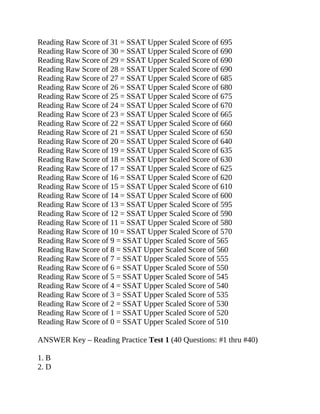
The RAW SCORE to SCALED SCORE Conversion Chart below is a “best
approximation” or “happy medium” based on thousands of student test
results. For the actual SSAT, Raw to Scaled Score conversions can vary
from test to test as there are “harder” and “easier” test months each with a
different conversion formula.
How do I calculate my child’s RAW SCORE?
RAW SCORE = Total Number Correct (Out of 40) – Total Number Wrong
Divided by 4
Reading Raw Score of 40 = SSAT Upper Scaled Score of 800
Reading Raw Score of 38 = SSAT Upper Scaled Score of 770
Reading Raw Score of 37 = SSAT Upper Scaled Score of 750
Reading Raw Score of 36 = SSAT Upper Scaled Score of 730
Reading Raw Score of 35 = SSAT Upper Scaled Score of 720
Reading Raw Score of 34 = SSAT Upper Scaled Score of 710
Reading Raw Score of 33 = SSAT Upper Scaled Score of 705
Reading Raw Score of 32 = SSAT Upper Scaled Score of 700
Reading Raw Score of 31 = SSAT Upper Scaled Score of 695
Reading Raw Score of 30 = SSAT Upper Scaled Score of 690
Reading Raw Score of 29 = SSAT Upper Scaled Score of 690
Reading Raw Score of 28 = SSAT Upper Scaled Score of 690
Reading Raw Score of 27 = SSAT Upper Scaled Score of 685
Reading Raw Score of 26 = SSAT Upper Scaled Score of 680
Reading Raw Score of 25 = SSAT Upper Scaled Score of 675
Reading Raw Score of 24 = SSAT Upper Scaled Score of 670
Reading Raw Score of 23 = SSAT Upper Scaled Score of 665
Reading Raw Score of 22 = SSAT Upper Scaled Score of 660
Reading Raw Score of 21 = SSAT Upper Scaled Score of 650
Reading Raw Score of 20 = SSAT Upper Scaled Score of 640
Reading Raw Score of 19 = SSAT Upper Scaled Score of 635
Reading Raw Score of 18 = SSAT Upper Scaled Score of 630
Reading Raw Score of 17 = SSAT Upper Scaled Score of 625
Reading Raw Score of 16 = SSAT Upper Scaled Score of 620
Reading Raw Score of 15 = SSAT Upper Scaled Score of 610
Reading Raw Score of 14 = SSAT Upper Scaled Score of 600
Reading Raw Score of 13 = SSAT Upper Scaled Score of 595
Reading Raw Score of 12 = SSAT Upper Scaled Score of 590
Reading Raw Score of 11 = SSAT Upper Scaled Score of 580
Reading Raw Score of 10 = SSAT Upper Scaled Score of 570
Reading Raw Score of 9 = SSAT Upper Scaled Score of 565
Reading Raw Score of 8 = SSAT Upper Scaled Score of 560
Reading Raw Score of 7 = SSAT Upper Scaled Score of 555
Reading Raw Score of 6 = SSAT Upper Scaled Score of 550
Reading Raw Score of 5 = SSAT Upper Scaled Score of 545
Reading Raw Score of 4 = SSAT Upper Scaled Score of 540
Reading Raw Score of 3 = SSAT Upper Scaled Score of 535
Reading Raw Score of 2 = SSAT Upper Scaled Score of 530
Reading Raw Score of 1 = SSAT Upper Scaled Score of 520
Reading Raw Score of 0 = SSAT Upper Scaled Score of 510
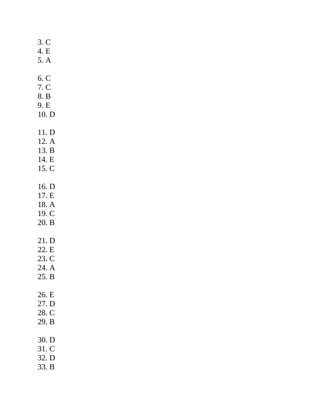
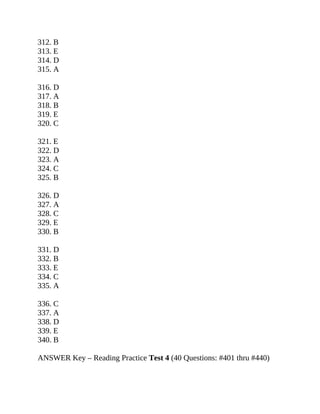
ANSWER Key – Reading Practice Test 1 (40 Questions: #1 thru #40)
1. B
2. D
3. C
4. E
5. A
6. C
7. C
8. B
9. E
10. D
11. D
12. A
13. B
14. E
15. C
16. D
17. E
18. A
19. C
20. B
21. D
22. E
23. C
24. A
25. B
26. E
27. D
28. C
29. B
30. D
31. C
32. D
33. B
34. E
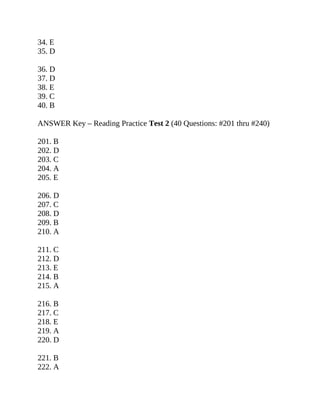
35. D
36. D
37. D
38. E
39. C
40. B
ANSWER Key – Reading Practice Test 2 (40 Questions: #201 thru #240)
201. B
202. D
203. C
204. A
205. E
206. D
207. C
208. D
209. B
210. A
211. C
212. D
213. E
214. B
215. A
216. B
217. C
218. E
219. A
220. D
221. B
222. A
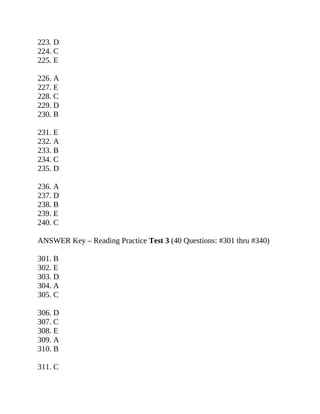
223. D
224. C
225. E
226. A
227. E
228. C
229. D
230. B
231. E
232. A
233. B
234. C
235. D
236. A
237. D
238. B
239. E
240. C
ANSWER Key – Reading Practice Test 3 (40 Questions: #301 thru #340)
301. B
302. E
303. D
304. A
305. C
306. D
307. C
308. E
309. A
310. B
311. C
312. B
313. E
314. D
315. A
316. D
317. A
318. B
319. E
320. C
321. E
322. D
323. A
324. C
325. B
326. D
327. A
328. C
329. E
330. B
331. D
332. B
333. E
334. C
335. A
336. C
337. A
338. D
339. E
340. B
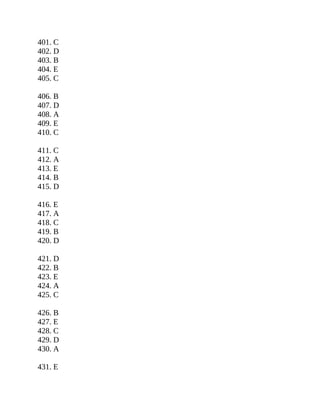
ANSWER Key – Reading Practice Test 4 (40 Questions: #401 thru #440)
401. C
402. D
403. B
404. E
405. C
406. B
407. D
408. A
409. E
410. C
411. C
412. A
413. E
414. B
415. D
416. E
417. A
418. C
419. B
420. D
421. D
422. B
423. E
424. A
425. C
426. B
427. E
428. C
429. D
430. A
431. E
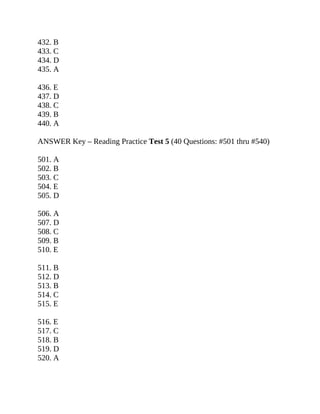
432. B
433. C
434. D
435. A
436. E
437. D
438. C
439. B
440. A
ANSWER Key – Reading Practice Test 5 (40 Questions: #501 thru #540)
501. A
502. B
503. C
504. E
505. D
506. A
507. D
508. C
509. B
510. E
511. B
512. D
513. B
514. C
515. E
516. E
517. C
518. B
519. D
520. A
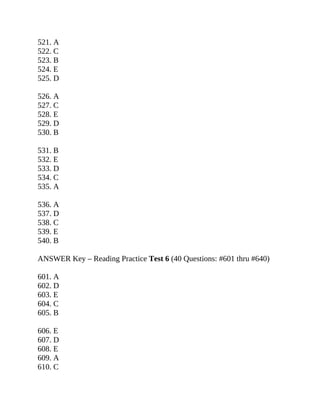
521. A
522. C
523. B
524. E
525. D
526. A
527. C
528. E
529. D
530. B
531. B
532. E
533. D
534. C
535. A
536. A
537. D
538. C
539. E
540. B
ANSWER Key – Reading Practice Test 6 (40 Questions: #601 thru #640)
601. A
602. D
603. E
604. C
605. B
606. E
607. D
608. E
609. A
610. C
611. D
612. B
613. A
614. E
615. C
616. D
617. A
618. E
619. B
620. C
621. A
622. C
623. E
624. D
625. B
626. C
627. E
628. B
629. A
630. D
631. E
632. B
633. A
634. C
635. D
636. A
637. E
638. D
639. B
640. C
SSAT UPPER LEVEL – READING PRACTICE TEST #1 (40 Questions
– 40 Minutes)
SSAT Upper Level – Reading Practice Test 1 (for Questions #1 thru #5)
A government office confirmed that the bird flu outbreak in a farm
town in South Korea was of the H5 strain, but further tests are needed to
determine whether it was the deadly N1 type. South Korea has had three
outbreaks of the bird flu virus at chicken and quail farms. This has resulted in
the slaughter of more than one million poultry in an attempt to keep the
disease from spreading. Although some complained, South Korean farmers
have been largely cooperative in the government’s decision to cull the birds
as the government later paid them for their losses.
Most of the 154 people who have died worldwide from the bird flu
virus came into direct contact with infected birds. Experts fear the virus could
mutate into a form that becomes easily passed among people, potentially
starting a human pandemic. Indonesia, which was the worst hit by the bird flu
virus, initially protested against having to slaughter birds in infected areas
and vaccinate flocks, citing a lack of funds. But it recently launched a large-
scale public education campaign, including TV commercials, urging people
to wash their hands after coming into contact with poultry and to report sick
or dying birds to authorities.
1. Which of the following is NOT mentioned as being used to help stop the
spread of the bird flu?
(A) Cleansing hands after touching poultry
(B) Thoroughly cooking meat before eating
(C) Telling authorities about sick or dying birds
(D) Educating the public through the media
(E) Slaughtering sick birds
2. The word cull at the end of the first paragraph most closely means
(A) redirect
(B) sanitize
(C) devour
(D) collect
(E) verify
3. The style of the passage is most like that found in a
(A) novel about the bird flu
(B) agriculturalists’ diary
(C) newspaper article
(D) journal on pandemics
(E) science textbook
4. According to the passage, Indonesia did which of the following?
I. Complained about having to kill birds
II. Reported cases of the virus in two provinces
III. Used television to tell people about the bird flu
(A) I only
(B) II only
(C) I and II only
(D) II and III only
(E) I and III only
5. It can be inferred from the passage that
(A) the bird flu virus can change into a more deadly form
(B) humid Southeast Asian weather helps spread the flu
(C) radio messages are not as useful as TV commercials
(D) the H5 strain spreads faster than the N1 strain
(E) farmers should not accept help from the government
GO ON TO THE NEXT SELECTION
SSAT Upper Level – Reading Practice Test 1 (for Questions #6 thru #10)
Historians place Caesar on the level of such military greats as
Alexander the Great, Hannibal, Genghis Khan, Napoleon Bonaparte and
Saladin. Although he suffered a few defeats, Caesar’s brilliance in war was
highlighted by the conquering of Alesia during the Gallic War, the defeat of
Pompey’s numerically superior forces at Pharsalus during the Civil War, and
the complete destruction of Pharnaces’ army at the Battle of Zela.
Caesar’s success on any land and under all weather conditions owes
much to the strict but fair discipline of his soldiers. Their admiration and
devotion to him were widely known due to his promotion of those of skill
over those of nobility. Additional factors that made him effective in war were
his army’s advanced engineering abilities and the legendary speed with
which he moved his troops. Caesar’s army sometimes marched as many as 40
miles a day. During an attack on one Gallic city built on a very steep and high
plateau, Caesar’s engineers were able to tunnel through solid rock. They
found the source of the spring that the town was drawing its water supply
from, and redirected it to their own army. The town, cut off from their water
supply, capitulated at once.
-
Wikipedia
6. The author’s main goal in this passage is to
(A) list several of Rome’s greatest military battles.
(B) compare Caesar against other military masterminds.
(C) report about Caesar’s great skill in war.
(D) describe Caesar’s defeat of a Gallic city.
(E) discuss the political motives of Caesar.
7. As used in the last line, capitulated most closely means
(A) attacked
(B) conquered
(C) surrendered
(D) abandoned
(E) passed away
8. Which of the following is true regarding the battle of Pharsalus during the
Civil War?
(A) Pompey’s body was never found.
(B) Caesar’s army was outnumbered.
(C) It was the last major conflict of the Civil War.
(D) Caesar could not take full credit for this victory.
(E) It occurred at the same time as the Battle of Zela.
9. According to the first few sentences of the second paragraph, Caesar’s
policy of basing promotion on skill rather than social position
(A) angered members of the Senate back in Rome.
(B) allowed his men to focus on war rather than politics.
(C) was his most admirable quality as a military leader.
(D) eased the suffering of the soldier’s family in Rome.
(E) helped gain him the favor and loyalty of his men.
10. According to the passage, Caesar’s engineers
I. fought despite limited water supplies.
II. were very highly skilled.
III. once tunneled through solid rock.
(A) II only
(B) I and II only
(C) I and III only
(D) II and III only
(E) I, II and III
GO ON TO THE NEXT SELECTION
SSAT Upper Level – Reading Practice Test 1 (for Questions #11 thru #15)
On August 16, 1896, George Washington Carmack and two Indian
friends in the Yukon pried a gold nugget from the bed of Rabbit Creek, a
tributary of Canada’s Klondike River, and set in motion one of the most
frenzied and famous gold rushes in history. Over the next two years, at least
100,000 eager would-be prospectors from all over the world set out for the
new gold fields with dreams of a quick fortune dancing in their heads. Only
about 40,000 actually made it to the Klondike, and a precious few ever found
their fortune.
Swept along on this tide of gold seekers was a smaller and more
clever group, also seeking their fortunes but in a far more practical way. They
were the entrepreneurs, the people who made business from Klondike fever.
George Carmack, the man who began it all, was neither a die-hard
prospector nor a keen businessman. The California native was simply in the
right place at the right time. Not that this son of a Forty-Niner had anything
against being rich. But, like most of the white men who drifted north in the
1870s and ‘80s, he came as much for the solitude as for the gold.
-Gary L. Blackwood
11. The “entrepreneurs” mentioned in the second paragraph most likely
(A) wanted to explore the uncharted lands of the Yukon.
(B) traveled with the gold seekers as guides.
(C) knew all the “hot spots” for gold nuggets.
(D) sold housing and prospecting tools to gold seekers.
(E) were friends and relatives of George Carmack.
12. Which of the following will the author most likely discuss next?
(A) The history of gold in the Yukon.
(B) A detailed life story of George Carmack.
(C) The origins of Canadian exploration.
(D) Why gold holds so much value.
(E) The geography of Rabbit Creek.
13. This passage is primarily about
(A) the early career of George Carmack.
(B) a single discovery that started a gold rush.
(C) techniques on how to find gold nuggets.
(D) the history of gold prospecting in the U.S.
(E) the people who journeyed to the Yukon.
14. It can be inferred from the last paragraph that George Carmack
(A) later regretted discovering his famous gold nugget.
(B) became known as a great Forty-Niner.
(C) passed away either in the 1870s or 1880s.
(D) continued to find gold for many years.
(E) also came to Klondike to avoid crowded city life.
15. According to the passage, why did people travel to Klondike after
Carmack found the nugget?
I. They hoped to meet George Carmack.
II. They wanted to make money off the prospectors.
III. They also wanted to find gold.
(A) III only
(B) I and II only
(C) II and III only
(D) I and III only
(E) I, II and III
GO ON TO THE NEXT SELECTION
SSAT Upper Level – Reading Practice Test 1 (for Questions #16 thru #20)
I’ve come this far to freedom and I won’t turn back
I’m climbing to the highway from my old dirt track
I’m coming and I’m going
And I’m stretching and I’m growing
And I’ll reap what I’ve been sowing or my skin’s not black
I’ve prayed and slaved and waited and I’ve sung my song
You’ve bled me and you’ve starved me but I’ve still grown strong
You’ve lashed me and you’ve treed me
And you’ve everything but freed me
But in time you’ll know you need me and it won’t be long.
I’ve seen the daylight breaking high above the bough
I’ve found my destination and I’ve made my vow;
so whether you abhor me
Or deride me or ignore me
Mighty mountains loom before me and I won’t stop now.
-Naomi Long Madgett
16. Which of the following words best characterizes the poet?
(A) furious
(B) mournful
(C) victorious
(D) determined
(E) obedient
17. In the poem, the narrator’s life can best be described as a(n)
(A) brisk journey
(B) cautionary tale
(C) educational experience
(D) hazardous highway
(E) uphill climb
18. All of the following are used by the poet to overcome slavery EXCEPT
(A) strength in numbers
(B) belief in God
(C) patience
(D) keeping a merry heart
(E) surviving physical hardship
19. The poet believes she will reach her goal because
(A) there are many more slaves than slave owners.
(B) the Civil War is finally coming to an end.
(C) her oppressors will need her one day.
(D) she will find safety behind mighty mountains.
(E) the government will pass laws abolishing slavery.
20. The pattern of rhyme in this poem is most similar to:
(A) Monday, Tuesday, Wednesday, Thursday, Friday
(B) apple, apple, banana, banana, apple
(C) black, white, black, white, black
(D) day, day, day, night, night
(E) girl, boy, boy, girl, girl
GO ON TO THE NEXT SELECTION
SSAT Upper Level – Reading Practice Test 1 (for Questions #21 thru #25)
As early as 1939, scientists Leo Szilard and Albert Einstein had
urged President Franklin D. Roosevelt to begin government-sponsored
research to develop an atomic bomb for the United States. They knew that the
German effort, led by their former colleague, the brilliant Nobel laureate
Werner Heisenberg, could be a great threat. As it turned out, Germany was
unsuccessful, perhaps because Adolf Hitler was more interested in
developing rockets than nuclear weapons. But that was in the future, and the
only future the physicists in America could see at that point was the danger of
a German atomic bomb.
In response to the plea of Einstein and Szilard, FDR initiated a
modest program of uranium research. By June 1940, interest in uranium had
increased to the point that the president created a larger organization, the
National Defense Research Committee. He named as director Vannevar
Bush, the president of the Carnegie Institution in Washington, D.C. The
slowly growing effort gained further strength in 1941 from a startling British
document. Based on British nuclear research, the report stated that a very
small amount of uranium could produce an explosion similar to that of
several thousand tons of TNT. Roosevelt responded by creating a still larger
organization, the Office of Scientific Research and Development, which
would mobilize scientific resources to create an atomic weapon.
-Robert LaRue
21. As it is used in the last sentence, “mobilize” most nearly means
(A) transport
(B) investigate
(C) clutter
(D) assemble
(E) construct
22. This passage is primarily concerned with
(A) Szilard and Einstein’s role in scientific research.
(B) why Germany failed to build the atomic bomb.
(C) various types of wartime organizations.
(D) important decisions made by President Roosevelt.
(E) the early background of a powerful weapon.
23. All of the following were motivating factors for America to build the
atomic bomb EXCEPT:
(A) A German bomb would be a direct threat to the U.S.
(B) A report showed the bomb’s devastating effects.
(C) Adolf Hitler made the atomic bomb a top priority.
(D) An increased interest in the benefits of uranium.
(E) Their chief enemy in war was also trying to build it.
24. It can be inferred that Leo Szilard and Albert Einstein
(A) believed Heisenberg was a very good scientist.
(B) upset President Roosevelt with their constant pleas.
(C) directed the National Defense Research Committee.
(D) were suspicious of other American scientists.
(E) eventually gave up on atomic bomb research.
25. According to the passage, President Franklin D. Roosevelt
(A) believed Adolf Hitler was not a major threat.
(B) made atomic bomb research increasingly important.
(C) attempted to accumulate large amounts of uranium.
(D) was a close friend of Director Vannevar Bush.
(E) was the United States president for about two years.
GO ON TO THE NEXT SELECTION
SSAT Upper Level – Reading Practice Test 1 (for Questions #26 thru #29)
It was Sunday afternoon. Beth was driving down the main street in
her community. It would be one of the most difficult days to get through
following the loss of Katie. Everywhere Beth looked, reminders of this
special occasion, Mother’s Day, decorated the fronts of stores, magazines and
flower shops. They all exhibited heartwarming advertisements of ways to
honor mothers. For Beth, a mother who had gone through the pain of losing a
daughter, these reminders continued to add hurt to a soul already grieving for
a child she loved so much.
Inside her home, Beth swathed her left palm and fingers around
Brad’s tiny cranium, and finished tucking in her infant son. Brad was only
nine months old, a stage when a young one is so vulnerable to the evils of the
world, but Beth intuitively knew her second child would be safe. She had
acquired this comforting through prayer. God had promised, she believed,
that nothing would happen to Brad. Her lone remaining child would see his
ninth birthday and beyond. He would graduate from high school, then
college, and set off into the world. He would live on past the deaths of his
parents.
Beth moved towards the carpeted staircase and walked downward
upon its steps one by one. There were family pictures hanging on the wall,
the times past they represented looking back upon her as she made the
discomfiting descent to the living room. Why was the emotional pain of
losing a child so severe? Why had God fused a mother’s love and a
daughter’s trust through potent spiritual intimacy only to allow the
severance of the bond with a single senseless gust of evil? Was this a test
and if so, were Beth and Lono facing the consequences of a sin as King
David had with the murder of Uriah?
26. In the last paragraph, Beth is
(A) trying to forget painful times of the past.
(B) hanging pictures of her daughter on the wall.
(C) searching for the right grief counselor.
(D) studying the history of King David and Uriah.
(E) struggling with why she lost her daughter.
27. All of the following add to Beth’s hurt EXCEPT
(A) memories evoked by pictures on the wall.
(B) going through Mother’s Day without her daughter.
(C) guilty feelings from possible disobedience to God.
(D) knowing her daughter will not graduate from school.
(E) the lingering pain of losing a family member.
28. It can be inferred from the passage that
(A) Beth’s daughter is older than nine years old.
(B) Beth is a single parent with one son.
(C) King David had also lost a child.
(D) Mother’s Day rarely falls on a Sunday.
(E) Beth’s daughter has been missing for some time.
29. The question, “Why had God fused…gust of evil?” in the last paragraph
refers to
(A) the momentary victory of evil over motherly love.
(B) a girl’s precious birth and later wasteful death.
(C) similarities between royal and normal families.
(D) the time it takes for emotional pain to subside.
(E) the nature of bonds between mothers and daughters.
GO ON TO THE NEXT SELECTION
SSAT Upper Level – Reading Practice Test 1 (for Questions #30 thru #35)
After several turns, he sat down again. As he threw his head back in
the chair, his glance happened to rest upon a bell, a disused bell, which hung
in the room, and communicated for some purpose now forgotten with a
chamber in the highest story of the building. It was with great astonishment,
and with a strange, inexplicable dread, that as he looked, he saw this bell
begin to swing. It swung so softly in the outset that it scarcely made a sound;
but soon it rang out loudly, and so did every bell in the house.
This might have lasted half a minute, or a minute, but it seemed an
hour. The bells ceased as they had begun, together. They were succeeded by
a clanking noise, deep down below; as if some person were dragging a heavy
chain over the casks in the wine-merchant’s cellar. Scrooge then remembered
to have heard that ghosts in haunted houses were described as dragging
chains.
The cellar-door flew open with a booming sound, and then he heard
the noise much louder, on the floors below; then coming up the stairs; then
coming straight towards his door.
“It’s humbug still!” said Scrooge. “I won’t believe it.”
His color changed though, when, without a pause, it came on through
the heavy door, and passed into the room before his eyes. Upon its coming in,
the dying flame leaped up, as though it cried, “I know him! Marley’s Ghost!”
and fell again.
-Charles Dickens
30. Most of the events in this passage take place as Scrooge is
(A) reading a book in his den.
(B) finishing work in his office.
(C) working in a store full of bells.
(D) sitting on a chair in his home.
(E) visiting a house that is haunted.
31. All of the following contribute to the suspense of the story EXCEPT
(A) clanking noises of a heavy chain being dragged.
(B) the very loud sound of the cellar door opening.
(C) faint cries from the highest story in the building.
(D) something mysterious moving towards Scrooge’s door.
(E) bells starting to ring all by themselves.
32. According to the passage, the first bell that began to swing
(A) was used by Scrooge as a type of fire alarm.
(B) rang loudly at first and then diminished in volume.
(C) was apparently the only bell in the building.
(D) had been used to communicate with another room.
(E) was frantically shaken by Scrooge out of sheer fright.
33. According to the selection, which of the following probably affected
Scrooge the most?
(A) The clanking sound of chains in the wine cellar.
(B) The sight of Marley’s ghost passing through a door.
(C) The report of ghosts living in haunted houses.
(D) The deafening noise of bells stopping all at once.
(E) An unidentified sound closing in on Scrooge’s location.
34. It can be inferred from the passage that
(A) Marley’s ghost has visited Scrooge many times.
(B) the ringing of the bells lasted for about an hour.
(C) Scrooge’s home would be an easy target for robbers.
(D) Marley is the original owner of Scrooge’s home.
(E) Scrooge does not reside in a one-story house.
35. All of the following words can be used to describe the mood of this
passage EXCEPT:
(A) mysterious
(B) absorbing
(C) escalating
(D) dynamic
(E) frightening
GO ON TO THE NEXT SELECTION
SSAT Upper Level – Reading Practice Test 1 (for Questions #36 thru #40)
Miami, Puerto Rico and Bermuda are prime holiday destinations
boasting sun, beaches and coral seas. But between these idyllic settings, there
is a dark side: countless ships and planes have mysteriously gone missing in
the one and a half million square miles of ocean separating them. About 60
years ago, the area was claiming about five planes every day and was
nicknamed the Bermuda Triangle by a magazine in 1964. Today, about that
many planes disappear in the region each year and there are a number of
theories explaining what could be happening.
Twins George and David Rothschild are among the first passengers
to have experienced bizarre effects in the Bermuda Triangle. In 1952, when
they were 19 years old, the two naval men had to make an emergency trip
home on a navy light aircraft, north over the Florida Keys, to attend their
father’s funeral. They had been flying for probably 20 or 30 minutes when all
of a sudden the pilot yelled out that the instruments were dead and he became
very frantic. The pilot had lost his bearings, and not only did he not know
where he was, he also had no idea how much gas was left in the fuel tanks.
After what seemed like hours, they landed safely in Norfolk, on the Florida
coast.
Some speculate that it had nothing to do with the location, but rather
the instruments that were available at the time. Pilot Robert Grant says that
back in the 1940s, navigating a plane involved a lot of guesswork since they
relied completely on a magnetic compass to guide them. ‘Dead reckoning’
was used, which means that pilots would trust their compass and then
estimate how the wind would influence their planned flight path to remain on
track. “No matter what your mind tells you, you must stay on that course,”
says Grant. “If you don’t, and you start turning to wherever you think you
should be going, then you’re toast.”
-Sandrine Ceurstemont
36. Which of the following is the best title for the selection?
(A) Perils of Miami, Puerto Rico, and Bermuda
(B) The Rothschild Incident
(C) Danger in the Open Seas
(D) Mysteries of the Bermuda Triangle
(E) Was it Location or Instruments?
37. The Rothschilds’ pilot became “frantic” for which of the following
reasons?
I. He did not know how much gas he had left.
II. The plane had arrived in the wrong place.
III. He lost his sense of direction.
(A) I only
(B) II only
(C) I and II only
(D) I and III only
(E) II and III only
38. Which of the following is the author most likely to discuss next?
(A) Other incidences of missing planes around the world.
(B) The advantages of spending the holidays in Bermuda.
(C) A detailed account of the Rothschild flight.
(D) What pilots can do in the event of an emergency.
(E) The weather conditions near the island of Bermuda.
39. This passage
(A) establishes a debate and then shows both sides of the argument.
(B) proposes a theory and then provides evidence on why it could be false.
(C) introduces a phenomenon and then offers insight based on facts.
(D) provides a conclusion and then moves on to different topics.
(E) describes a historical problem and then presents a few modern-day
solutions.
40. ‘Dead reckoning’ as described in the last paragraph is most like
(A) a chef looking for all the right ingredients for a very special dish.
(B) a blind girl trying to find her way by the sound of her mother’s voice.
(C) a coach devising a strategy on how to win without his best player.
(D) a politician searching for the proper words for a campaign speech.
(E) a surgeon using a new medical procedure to save a patient’s life.
STOP! DO NOT GO ON TO THE NEXT SECTION
SSAT UPPER LEVEL – READING PRACTICE TEST # 2 (40 Questions
– 40 Minutes)
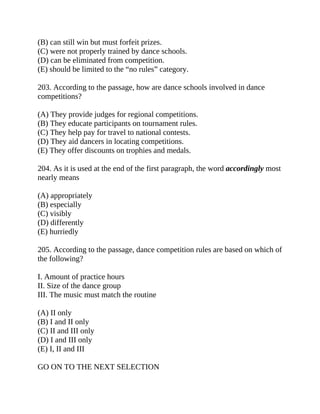
SSAT Upper Level – Reading Practice Test 2 (for Questions #201 thru
#205)
Dance schools often participate in dance competitions by sponsoring
teams that go to regional and national competitions. Competitive dancing
requires many months of dedication practicing and developing dance
routines. During competitions, dancers perform in front of judges who
evaluate their efforts and score each routine. The ranks awarded by different
judges are combined into a final score, and medals or trophies are awarded
accordingly.
Each routine is required to comply with certain rules. It must enter a
category which is consistent with the music, style, content, and dancers of the
routine. A common limitation is the number of dancers. There are different
categories for solos, duos & trios, small groups (4-9), large groups (10-19),
and super groups (20 or more). Other grouping factors include average age of
the dancer, average number of hours a week the dancer dances, appropriate
music, and style of dance. Routines which fail to comply with the
requirements the competition has laid out will be disqualified.
-Wikipedia
201. The author’s main purpose for writing the passage is
(A) to explain how dance schools help dancers.
(B) to inform people about dance competitions.
(C) to compare regional and national contests.
(D) to describe the basic rules of dance routines.
(E) to encourage dancers to enter tournaments.
202. It can be inferred that dance competitors who do not follow rules
(A) are usually the most inexperienced dancers.
(B) can still win but must forfeit prizes.
(C) were not properly trained by dance schools.
(D) can be eliminated from competition.
(E) should be limited to the “no rules” category.
203. According to the passage, how are dance schools involved in dance
competitions?
(A) They provide judges for regional competitions.
(B) They educate participants on tournament rules.
(C) They help pay for travel to national contests.
(D) They aid dancers in locating competitions.
(E) They offer discounts on trophies and medals.
204. As it is used at the end of the first paragraph, the word accordingly most
nearly means
(A) appropriately
(B) especially
(C) visibly
(D) differently
(E) hurriedly
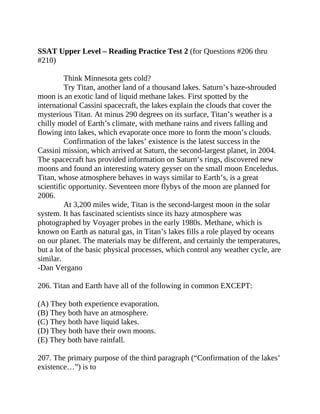
205. According to the passage, dance competition rules are based on which of
the following?
I. Amount of practice hours
II. Size of the dance group
III. The music must match the routine
(A) II only
(B) I and II only
(C) II and III only
(D) I and III only
(E) I, II and III
GO ON TO THE NEXT SELECTION
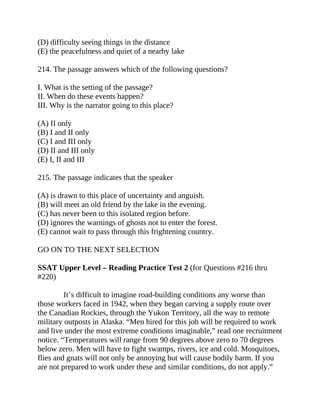
SSAT Upper Level – Reading Practice Test 2 (for Questions #206 thru
#210)
Think Minnesota gets cold?
Try Titan, another land of a thousand lakes. Saturn’s haze-shrouded
moon is an exotic land of liquid methane lakes. First spotted by the
international Cassini spacecraft, the lakes explain the clouds that cover the
mysterious Titan. At minus 290 degrees on its surface, Titan’s weather is a
chilly model of Earth’s climate, with methane rains and rivers falling and
flowing into lakes, which evaporate once more to form the moon’s clouds.
Confirmation of the lakes’ existence is the latest success in the
Cassini mission, which arrived at Saturn, the second-largest planet, in 2004.
The spacecraft has provided information on Saturn’s rings, discovered new
moons and found an interesting watery geyser on the small moon Enceledus.
Titan, whose atmosphere behaves in ways similar to Earth’s, is a great
scientific opportunity. Seventeen more flybys of the moon are planned for
2006.
At 3,200 miles wide, Titan is the second-largest moon in the solar
system. It has fascinated scientists since its hazy atmosphere was
photographed by Voyager probes in the early 1980s. Methane, which is
known on Earth as natural gas, in Titan’s lakes fills a role played by oceans
on our planet. The materials may be different, and certainly the temperatures,
but a lot of the basic physical processes, which control any weather cycle, are
similar.
-Dan Vergano
206. Titan and Earth have all of the following in common EXCEPT:
(A) They both experience evaporation.
(B) They both have an atmosphere.
(C) They both have liquid lakes.
(D) They both have their own moons.
(E) They both have rainfall.
207. The primary purpose of the third paragraph (“Confirmation of the lakes’
existence…”) is to
(A) explain how lakes form on Titan’s surface.
(B) clarify a few of the mysteries of Saturn ring’s.
(C) describe the findings of a spacecraft mission.
(D) compare the surface features of two moons.
(E) understand how scientists study moons and planets.
208. In the last paragraph, the author uses an analogy to illustrate that
methane in Titan’s lakes
(A) are the source of Titan’s clouds.
(B) can be photographed by Voyager probes.
(C) are an essential part of Titan’s weather cycle.
(D) serve a similar purpose to oceans on Earth.
(E) are unlike the lakes of Minnesota.
209. It can be inferred from the text that scientists are interested in Titan
because
(A) its closeness to Earth allows for more missions.
(B) it has similar atmospheric processes to Earth.
(C) its unique climate helps predict weather on Earth.
(D) it is the largest moon in the solar system.
(E) it was formed in the same way as Earth’s moon.
210. Which of the following is the author most likely to discuss next?
(A) The additional findings of a recent Titan flyby.
(B) The differences between methane and natural gas.
(C) The atmospheric conditions on Enceledus.
(D) The technical framework of the Cassini spacecraft.
(E) Climatic differences between Minnesota and Titan.
GO ON TO THE NEXT SELECTION
SSAT Upper Level – Reading Practice Test 2 (for Questions #211 thru
#215)
What is Weir Like?
The skies they were ashen and sober;
The leaves they were crisped and sere—
The leaves they were withering and sere:
It was night in the Lonesome October
Of my most immemorial year;
It was hard by the dim lake of Auber;
In the misty mid region of Weir—
It was down by the dank tarn of Auber
In the ghoul-haunted woodland of Weir
-from “Ulalume” by Edgar Allen Poe
211. The author uses adjectives throughout the passage to
(A) reveal his fondness of Auber.
(B) foreshadow his death in October.
(C) establish the mood of Weir.
(D) hide the true feelings of the main character.
(E) build to the climax of Ulalume.
212. The words “ashen” (line 1) and “sere” (line 2-3), respectively, most
nearly mean
(A) stormy and rough
(B) pale and moist
(C) distant and abundant
(D) gray and dry
(E) sunny and wrinkled
213. All of the following are mentioned in the passage EXCEPT
(A) nature displaying the changing of the seasons
(B) an atmosphere of loneliness and silence
(C) evidence that it is the end of the day
(D) difficulty seeing things in the distance
(E) the peacefulness and quiet of a nearby lake
214. The passage answers which of the following questions?
I. What is the setting of the passage?
II. When do these events happen?
III. Why is the narrator going to this place?
(A) II only
(B) I and II only
(C) I and III only
(D) II and III only
(E) I, II and III
215. The passage indicates that the speaker
(A) is drawn to this place of uncertainty and anguish.
(B) will meet an old friend by the lake in the evening.
(C) has never been to this isolated region before.
(D) ignores the warnings of ghosts not to enter the forest.
(E) cannot wait to pass through this frightening country.
GO ON TO THE NEXT SELECTION
SSAT Upper Level – Reading Practice Test 2 (for Questions #216 thru
#220)
It’s difficult to imagine road-building conditions any worse than
those workers faced in 1942, when they began carving a supply route over
the Canadian Rockies, through the Yukon Territory, all the way to remote
military outposts in Alaska. “Men hired for this job will be required to work
and live under the most extreme conditions imaginable,” read one recruitment
notice. “Temperatures will range from 90 degrees above zero to 70 degrees
below zero. Men will have to fight swamps, rivers, ice and cold. Mosquitoes,
flies and gnats will not only be annoying but will cause bodily harm. If you
are not prepared to work under these and similar conditions, do not apply.”
The idea of laying a roadway to connect the United States with the
continent’s “far north” can be traced all the way back to the Yukon gold
rushes of the 1890s. But it wasn’t until the 1930s that Alaska’s territorial
legislature commissioned a study of possible routes—and it took the Japanese
attack on Pearl Harbor to finally get the work started. Once drawn into World
War II, the U.S. government worried that Japan would follow the destruction
of the U.S. Pacific fleet in Hawaii with an invasion of Alaska. Within a few
weeks of the Pearl Harbor attack, President Franklin D. Roosevelt decided
that plans for a highway to Alaska deserved re-examination.
-J. Kingston Pierce
216. This passage deals primarily with the road’s
(A) route through the Yukon Territory.
(B) history leading up to it being built.
(C) construction from 1890 to 1942.
(D) design by President Roosevelt.
(E) building conditions in wintertime.
217. The “far north” mentioned at the beginning of the second paragraph
most likely refers to
(A) Japan
(B) the Pacific
(C) Alaska
(D) the Yukon
(E) Canada
218. All of the following are mentioned as working conditions of building the
road in 1942 EXCEPT:
(A) The insects were harmful.
(B) The surface was not all land.
(C) The temperatures were extreme.
(D) Workers had to live there.
(E) The pay was not very good.
219. It can be inferred from the passage that
(A) most of the road did not go through the U.S.
(B) construction of the road never got started.
(C) many men died while building the road.
(D) the gold rushes helped to buy materials for the road.
(E) Pearl Harbor was located near Alaskan posts.
220. The author would most likely agree that
(A) a Japanese invasion of Alaska was highly unlikely.
(B) Canada should have helped pay for the road.
(C) the road was not worth risking human life.
(D) a demand for gold first sparked interest in the road.
(E) President Franklin D. Roosevelt acted too slowly.
GO ON TO THE NEXT SELECTION
SSAT Upper Level – Reading Practice Test 2 (for Questions #221 thru
#225)
What constitutes an American? Not color nor race nor religion. Not
the pedigree of his family nor the place of his birth. Not his social status nor
his bank account. Not his trade nor his profession. An American is one who
loves justice and believes in the dignity of man. An American is one who will
fight for his freedom and that of his neighbor. An American is one who will
sacrifice property, ease and security in order that he and his children may
retain the rights of free men.
Americans have always known how to fight for their rights and their
way of life. Americans are not afraid to fight. They fight joyously in a just
cause.
We Americans know that freedom, like peace, is inseparable. We
cannot retain our liberty if three-fourths of the world is enslaved. Brutality,
injustice and slavery, if practiced as dictators would have them, universally
and systematically, in the long run would destroy us as surely as a fire raging
in our nearby neighbor’s house would burn ours if we didn’t help to put out
his.
-Harold Ickes from What is an American?
221. According to the speaker, all of the following describes an American
EXCEPT
(A) his desire to go to war for a good reason.
(B) his status in society.
(C) his readiness to fight for his friends.
(D) his love of justice.
(E) his willingness to sacrifice for his family.
222. The author’s tone can best be described as
(A) blunt
(B) ecstatic
(C) argumentative
(D) cunning
(E) sad
223. This passage is primarily about
(A) knowing how to identify an American imposter.
(B) the brutality and injustices of world dictators.
(C) rights contained in the Declaration of Independence.
(D) what does and does not define an American.
(E) the differences between Americans and foreigners.
224. In the last sentence, the speaker is urging Americans to
(A) avoid out-of-control forest fires.
(B) recognize the injustices practiced by dictators.
(C) fight with partnering countries against evil.
(D) realize that war is not the solution in the long run.
(E) know that neighbors can sometimes be the enemy.
225. As it is used at the beginning of the last paragraph, the statement
“freedom, like peace, is inseparable” means
(A) you must fight for freedom in order to obtain peace.
(B) freedom and peace are the same to true Americans.
(C) free will is guaranteed to people who fight for it.
(D) freedom and peace cannot be seen without sacrifice.
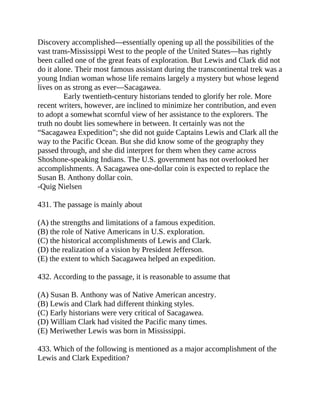
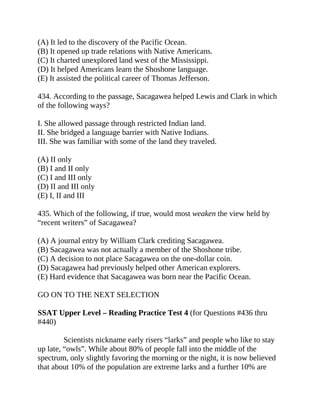
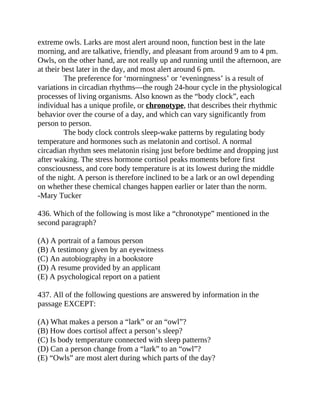
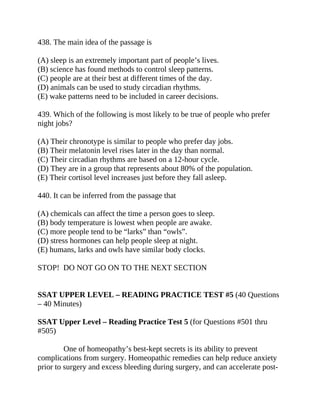
(E) America is not free if most of the world is not free.
GO ON TO THE NEXT SELECTION
SSAT Upper Level – Reading Practice Test 2 (for Questions #226 thru
#230)
Shortly Tom came upon the juvenile pariah of the village,
Huckleberry Finn, son of the town drunkard. Huckleberry was cordially hated
and dreaded by all the mothers of the town, because he was idle and lawless
and vulgar and bad—and because all their children admired him so, and
delighted in his forbidden society, and wished they dared to be like him. Tom
was like the rest of the respectable boys, in that he envied Huckleberry his
gaudy outcast condition, and was under strict orders not to play with him. So
he played with him every time he got a chance. Huckleberry was always
dressed in the cast-off clothes of full-grown men, and they were in perennial
bloom and fluttering with rags. His hat was a vast ruin with a wide crescent
lopped out of its brim; his coat, when he wore one, hung nearly to his heels
and had the rearward buttons far down the back; but one suspender supported
his trousers; the seat of the trousers bagged low and contained nothing, the
fringed legs dragged in the dirt when not rolled up.
Huckleberry came and went, at his own free will. He slept on
doorsteps in fine weather and in empty hogsheads in wet; he did not have to
go to school or to church, or call any being master or obey anybody; he could
go fishing or swimming when and where he chose, and stay as long as it
suited him; nobody forbade him to fight; he could sit up as late as he pleased;
he was always the first boy that went barefoot in the spring and the last to
resume leather in the fall; he never had to wash, nor put on clean clothes; he
could swear wonderfully. In a word, everything that goes to make life
precious that boy had. So thought every harassed, hampered, respectable boy
in St. Petersburg.
-Mark Twain from The Adventures of Tom Sawyer
226. As it is used in the first line, “pariah” most nearly means
(A) outsider
(B) convict
(C) adventurer
(D) student
(E) drifter
227. All of the following are true regarding items worn by Huckleberry Finn
EXCEPT:
(A) He sometimes rolled up his pants.
(B) A part of his hat had been cut out.
(C) His clothes had been worn by other people.
(D) His pants were held up by one suspender.
(E) He wore clothes he had made by himself.
228. The main purpose of this selection is to
(A) explain why Finn was not like other children.
(B) describe the dressing habits of a boy.
(C) introduce a new boy character in a book.
(D) portray Finn through the eyes of a mother.
(E) show a different side of a boy’s personality.
229. The mothers in the town disliked and feared Huckleberry Finn for which
of the following reasons?
I. The other children in the town looked up to him.
II. He said things that were inappropriate.
III. His club did not include all the children.
IV. He did not follow the rules of the town.
(A) I and II only
(B) II and III only
(C) I, II and III only
(D) I, II and IV only
(E) II, III and IV only
230. In the second paragraph, which of the following is NOT mentioned?
(A) Finn did not receive adult supervision.
(B) Finn did not eat his meals in the correct area.
(C) Finn did not follow a specific schedule.
(D) Finn did not have to answer to anybody.
(E) Finn did not always sleep in a bed.
GO ON TO THE NEXT SELECTION
SSAT Upper Level – Reading Practice Test 2 (for Questions #231 thru
#235)
The Battle of Iwo Jima represented to the Americans the pinnacle of
forcible entry from the sea. This particular amphibious assault was the
ultimate “storm landing,” the Japanese phrase describing the American
propensity for concentrating overwhelming force at the point of attack. The
huge striking force was more experienced, better armed and more powerfully
supported than any other offensive campaign to date in the Pacific War. The
Fifth Fleet enjoyed total domination of air and sea around the small, sulfuric
island, and the 74,000 Marines in the landing force would muster a healthy 3-
to-1 preponderance over the Japanese garrison. Seizing Iwo Jima would be
tough, planners admitted, but the operation should be over in a week, maybe
less.
By all logic, the force invading Iwo Jima should have prevailed,
quickly and violently. But the Japanese had also benefited from the
prolonged island campaigns in the Pacific. Lieutenant General Tadamichi
Kuribayashi commanded the 21,000 troops on the island. Formerly a cavalry
officer, Kuribayashi was a savvy fighter, one who could pick up realistic
lessons from previous combat disasters. Significantly, Japanese forces on Iwo
Jima would defend the island in depth—from hidden interior positions, not at
the water’s edge—and they would avoid the massive, suicidal banzai attacks.
Kuribayashi figured if the garrison could maintain camouflage and fire
discipline, husband its resources and exact disproportionate losses on the
invaders, maybe the Americans would lose heart. His senior subordinates
may have grumbled at this departure from tradition, but Kuribayashi’s plan
made intelligent use of Iwo Jima’s forbidding terrain and his troops’ fighting
skills.
-Colonel Joseph H. Alexander
231. All of the following are mentioned as advantages the Americans had
against the Japanese EXCEPT:
(A) The Americans had extensive experience in battle.
(B) The Americans had powerful weapons.
(C) The Americans outnumbered the Japanese.
(D) The Americans had better air and sea support.
(E) The Americans had better knowledge of Iwo Jima.
232. This passage is primarily about
(A) a battle for an island in the Pacific Ocean.
(B) how to engage the enemy in unfamiliar territory.
(C) why Iwo Jima was important to the Americans.
(D) General Kuribayashi’s military strategies.
(E) the final battle in a very long war.
233. It is reasonable to assume from the passage that
(A) Kuribayashi had the unanimous support of his men.
(B) the Japanese put up a stronger fight than expected.
(C) the Americans attacked with a few men at the start.
(D) the Japanese were successful in defending Iwo Jima.
(E) the Americans were hurt by suicidal banzai attacks.
234. According to the passage, the Japanese forces
(A) initially engaged the Americans from the air and sea.
(B) had more ammunition than the Americans.
(C) fought from locations that were not in plain sight.
(D) wanted the island for its sulfur deposits.
(E) tried to evacuate before the arrival of the Americans.
235. Which of the following is the author most likely to discuss next?
(A) The military history of General Kuribayashi
(B) Other battles fought on the Pacific front
(C) How marines prepare to fight on an island
(D) The results of the Battle of Iwo Jima
(E) The reasoning behind a “storm landing”
GO ON TO THE NEXT SELECTION
SSAT Upper Level – Reading Practice Test 2 (for Questions #236 thru
#240)
The Loch Ness is a lake in Scotland that holds the largest volume of
freshwater in the United Kingdom. But rather than being known for its size, it
is famous for the mysterious legend of the Loch Ness monster. For hundreds
of years, people have reported catching a glimpse of a huge creature in the
lake while others have shared photos they claim to have taken of this sea
creature. The legend is so great that even scientists have been intrigued and
many have conducted experiments and come up with theories to try and
explain what people could be witnessing.
It has been proposed that Nessie—as the Loch Ness monster is
commonly called—could be a prehistoric creature called a plesiosaur, an
animal that spanned up to ten meters in length and has long been considered
to be extinct. Adrian Shine, the leader of a British team called the Loch Ness
Project, has spent over 30 years trying to rationally explain the monster
sightings by researching the ecology of the region. If in fact a large creature
was living in the lake, there would have to be evidence of a food chain for it
to survive. A creature like the Loch Ness monster would most likely eat fish,
which in turn would live off large quantities of microscopic animals called
zooplankton. There would have to be enough zooplankton in the lake to
support populations of larger animals.
A way of estimating the amount of zooplankton in the lake is to
examine the quantities of green algae—the bottom rung of the food chain—
that zooplankton feed from. Green algae needs some light to thrive, and so by
examining how deep down in the lake sunlight can penetrate, researchers can
estimate the amount of green algae and following from this, the type of
population that could be sustained.
-Sandrine Ceurstemont
236. Which of the following is the best title for the selection?
(A) A Monster in the Lake?
(B) The Mysteries of Scotland
(C) What Could It Eat?
(D) The Loch Ness Lake
(E) Where is the Evidence?
237. It can be inferred from the passage that
(A) green algae feed off of zooplankton.
(B) the Loch Ness scientists work with dinosaur fossils.
(C) Loch Ness is one of the smallest lakes in Scotland.
(D) a plesiosaur was a creature that lived in the water.
(E) Adrian Shine is not looking in the right places.
238. According to the passage, why are scientists studying green algae in
Loch Ness lake?
(A) To know if it is good bait for the Loch Ness monster.
(B) To estimate the amount of zooplankton in the lake.
(C) Because sunlight is required to view underwater life.
(D) To prove that the food chain model is erroneous.
(E) To study how smaller animals survive in the lake.
239. The hypothetical Loch Ness food chain mentioned in the passage
includes which of the following?
I. Loch Ness monster
II. Green algae
III. Fish
IV. Zooplankton
(A) I, II and III only
(B) I, II and IV only
(C) I, III and IV only
(D) II, III and IV only
(E) I, II, III and IV
240. Which of the following strengthens the legend of the Loch Ness
monster?
(A) Tourists have claimed to have photos of a creature.
(B) A legitimate food chain exists in Loch Ness lake.
(C) Scientists have conducted experiments in the lake.
(D) The Loch Ness lake supports other aquatic life.
(E) Experts have found fossils of the plesiosaur creature.
STOP! DO NOT GO ON TO THE NEXT SECTION
SSAT UPPER LEVEL – READING PRACTICE TEST #3 (40 Questions
– 40 Minutes)
SSAT Upper Level – Reading Practice Test 3 (for Questions #301 thru
#305)
Backyard ponds and water gardens are for birds, butterflies, frogs,
fish—and you and your family. These ponds are typically three to four feet in
diameter, and may be built in barrels or other patio containers. Water is
effective in drawing wildlife to your backyard, and is a natural, relaxing and
scenic addition that can provide interest and enjoyment.
Consider locating your backyard pond where you can see it from a
deck or patio. There, it can blend in with its natural surroundings. Slightly
elevate the soil around the pond so excess water will flow away from the
pond. Plan to landscape around the pond to provide a habitat for frogs and
birds that need land and water. If you would like to use a pump to re-circulate
water, be sure electrical service is available in that area. Also, there will be
less maintenance if your pond is not under a tree, and most aquatic plants will
grow better in full sun.
If you do not have space in your yard for a built-in earthen pond,
consider a “tub” pond or a large water bowl. It can be placed on the patio and
provide many of the same benefits as a built-in pond. There are numerous tub
kits available that can be as simple as adding water, a pump and some plants.
They can also be moved inside in the winter as long as good lighting is
provided for plants.
-National Association of Conservation Districts
301. According to the passage, all of the following are benefits of backyard
ponds EXCEPT:
(A) It will attract animal life to the yard.
(B) It will increase the value of the home.
(C) It will be fun and interesting for the family.
(D) It will add to the beauty of the home.
(E) It will be a natural home for various pets.
302. The second paragraph is most concerned with
(A) why backyard ponds are so helpful.
(B) how to build a backyard pond.
(C) when to install the backyard pond.
(D) the advantages of backyard ponds.
(E) where to put a backyard pond.
303. According to the passage, a pump for the pond needs to go together with
(A) directions on how to use the pump.
(B) a tub or large water bowl.
(C) animals that are not harmed by the device.
(D) a power source that is nearby.
(E) knowledge on how to fix the pump.
304. It can be inferred from the last paragraph that
(A) there are alternatives to built-in ponds
(B) tub kits are available on a limited basis.
(C) water bowls are more expensive than built-in ponds.
(D) earthen ponds are only good in the winter.
(E) good lighting is not needed for earthen ponds.
305. Which of the following is the author most likely to discuss next?
(A) The differences between tubs and water bowls
(B) A detailed history of the water pump
(C) Instructions on how to install a backyard pond
(D) Food options for water-based animal life
(E) Possible reasons why patios are good for pets
GO ON TO THE NEXT SELECTION
SSAT Upper Level – Reading Practice Test 3 (for Questions #306 thru
#310)
Thomas Edison created many inventions, but his favorite was the
phonograph. While working on improvements to the telegraph and the
telephone, Edison figured out a way to record sound on tinfoil-coated
cylinders. In 1877, he created a machine with two needles: one for recording
and one for playback. When Edison spoke into the mouthpiece, the sound
vibrations of his voice would be indented onto the cylinder by the recording
needle.
“Mary had a little lamb” were the first words that Edison recorded on
the phonograph and he was amazed when he heard the machine play them
back to him. In 1878, Edison established a company to sell his new machine.
Edison suggested other uses for the phonograph, such as: letter
writing and dictation, phonographic books for blind people, a family record
(recording family members in their own voices), music boxes and toys,
clocks that announce the time, and a connection with the telephone so
communications could be recorded.
The phonograph also allowed soldiers to take music off to war with
them. During World War I, Edison’s company created a special phonograph
for the U.S. Army. Many Army units purchased these phonographs because it
meant a lot to the soldiers to have music remind them of home. In a
recording, Edison himself reminded Americans of the enormous sacrifice
made by the soldiers.
-America’s Library
306. This passage is primarily about
(A) the life of a great American inventor.
(B) the many inventions of Thomas Edison.
(C) the role of the phonograph in modern society.
(D) the origin and uses of an invention.
(E) how the phonograph changed World War I.
307. It can be inferred from the passage that
(A) Edison sold many of the phonographs all by himself.
(B) the phonograph was most important for letter writing.
(C) the phonograph had a positive effect on U.S. troops.
(D) Edison used tinfoil in the invention of the telephone.
(E) Edison loved to read nursery rhymes as a child.
308. Edison believed that a phonograph could be used for each of the
following reasons EXCEPT
(A) to help disabled people.
(B) to entertain children.
(C) to announce the time.
(D) to record voices.
(E) to interpret languages.
309. Each of the following words may be used to describe Edison EXCEPT:
(A) Submissive
(B) Appreciative
(C) Imaginative
(D) Spontaneous
(E) Predictive
310. According to the passage, needles were used to
(A) create the telegraph, but not the telephone.
(B) indent sound vibrations onto a cylinder.
(C) connect the mouthpiece to the playback button.
(D) produce sound vibrations.
(E) secure the tinfoil on each cylinder.
GO ON TO THE NEXT SELECTION
SSAT Upper Level – Reading Practice Test 3 (for Questions #311 thru
#315)
In the 1950s, Native Americans struggled with the government’s
policy of moving them into cities where they might assimilate into
mainstream America. Many had difficulties adjusting to urban life. When the
policy was discontinued in 1961, the government noted that “poverty and
deprivation are common” for Native Americans.
In the 1960s and 1970s, watching both Third World nationalism and
the civil rights movement, Native Americans became more aggressive in
fighting for rights. New leaders went to court to protect tribal lands or to
recover those which had been taken away. In 1967, they gained victories
guaranteeing long-abused land and water rights. The American Indian
Movement helped direct government funds to Native-American organizations
and assist neglected Native Americans in cities.
Confrontations became more common. In 1969 a landing party of 78
Native Americans took over Alcatraz Island and held it until federal officials
removed them in 1971. In 1973 AIM took over the South Dakota village of
Wounded Knee, where soldiers in the late 19th century had massacred a
Sioux camp. Militants hoped to dramatize the poverty and alcoholism in the
reservation surrounding the town. The episode ended after one Native
American was killed and another wounded, with a governmental agreement
to re-examine treaty rights.
-U.S. Dept. of State
311. According to the passage, all of the following were gained by Native
Americans EXCEPT
(A) a governmental review of treaty rights
(B) financial support for Native American groups
(C) equal opportunities in the military
(D) help for uncared for city-based Native Americans
(E) land and water rights
312. The word assimilate as used in the first sentence most closely means
(A) struggle
(B) adapt
(C) learn
(D) thrive
(E) connect
313. It can be inferred from the passage that one reason militants took over
Wounded Knee was
(A) it was the next logical target after Alcatraz Island.
(B) its location far away from South Dakota officials.
(C) they wanted to profit from alcohol sales in the town.
(D) this town did not have a strong police presence.
(E) it had historical meaning for Native Americans.
314. In the second paragraph, Native American leaders are described as
(A) mistreated
(B) disadvantaged
(C) unforgiving
(D) determined
(E) violent
315. According to the passage, Native Americans fought for which of the
following reasons?
I. To battle poverty among their people.
II. They were inspired by movements across the globe.
III. To support Native Americans in foreign countries.
(A) I and II only
(B) II and III only
(C) I and III only
(D) I, II and III
(E) II only
GO ON TO THE NEXT SELECTION
SSAT Upper Level – Reading Practice Test 3 (for Questions #316 thru
#320)
Life was exciting for Ensign Lee Royal in the summer of 1950. The
Texan had recently graduated from the U.S. Naval Academy and reported for
duty on the most famous warship in the world, the USS Missouri. Royal was
a commissioned officer, a step up from the previous year when he had served
on the same ship as a midshipman on a training cruise.
The Missouri had visited England during that cruise, and Royal and
two classmates had been brave enough to go to Winston Churchill’s country
home unannounced. The former British prime minister was very welcoming,
taking the three young midshipmen on a tour and then presenting them with
books, cigars, and wine. An amazed bodyguard told them privately that
Churchill had been much more hospitable to them than to many of his famous
visitors.
By 1950, the Missouri was the U.S. Navy’s only active battleship—
just a decade after the navy had considered battleships to be its foremost
fighting ships. The Japanese attack on Pearl Harbor in 1941, however, had
changed the situation. Soon aircraft carriers and submarines became the
navy’s primary offensive weapons. Battleships had been designed to fight
gun duels against large surface vessels, but those encounters rarely occurred
in World War II. The U.S. entered the war with a number of old, slow
battleships, which were primarily used for shore attack and to support
landings.
-Paul Stillwell
316. All of the following are true regarding Ensign Lee Royal EXCEPT:
(A) He was promoted while serving on the Missouri.
(B) He received gifts from Winston Churchill.
(C) He visited England while on a training cruise.
(D) He fought for the United States during World War II.
(E) His naval career had just begun in 1950.
317. It can be inferred from the second paragraph that Winston Churchill
(A) did not offer books, cigars and wine to all his guests.
(B) previously served in the United States Navy.
(C) sent out invitations to Royal and his classmates.
(D) employed more than one bodyguard.
(E) was on vacation from his job as prime minister.
318. An underlying theme throughout the passage is
(A) how World War II affected the U.S. Navy.
(B) a famous U.S. naval warship.
(C) an unexpected visit to a prime minister’s home.
(D) the early life of a naval officer.
(E) American and English relations in the 1950s.
319. All of the following contributed to why the USS Missouri “was the U.S.
Navy’s only active battleship” in 1950 EXCEPT:
(A) Battleships were rarely used in combat anymore.
(B) Most of the wartime battleships were old and slow.
(C) Submarines were more important during the war.
(D) The surprise Japanese attack on Pearl Harbor.
(E) Most battleships were converted to aircraft carriers.
320. The author would most likely agree with which of the following
statements?
(A) The Navy is the most popular of the armed forces.
(B) The U.S. should not have given up on battleships.
(C) Ensign Lee Royal is not afraid to take risks.
(D) Promotion in the Navy should be more difficult.
(E) Winston Churchill should not have retired so young.
GO ON TO THE NEXT SELECTION
SSAT Upper Level – Reading Practice Test 3 (for Questions #320 thru
#325)
What Happened to Ozymandias?
I met a traveler from an antique land
Who said: “Two vast and trunkless legs of stone
Stand in the desert, Near them, on the sand,
Half sunk, a shattered visage lies, whose frown
And wrinkled lip, and sneer of cold command,
Tell that its sculptor well those passions read
Which yet survive, stamped on these lifeless things,
The hand that mocked them, and the heart that fed:
And on the pedestal these words appear:
‘My name is Ozymandias, king of kings:
Look on my works ye Mighty, and despair!’
Nothing beside remains. Round the decay
Of that colossal wreck, boundless and bare
The lone and level sands stretch far away.”
-Percy Bysshe Shelley
321. The wrecked statue of Ozymandias indicates all of the following
EXCEPT:
(A) Ozymandias was sending a message to other kings.
(B) Ozymandias was a merciless leader.
(C) Ozymandias had great pride in his accomplishments.
(D) Ozymandias intended for his legacy to last.
(E) Ozymandias possessed great architectural skill.
322. Which statement would be most consistent with the message expressed
in the poem?
(A) It is wiser to build a house on rock than on sand.
(B) He who lives by the sword, dies by the sword.
(C) The bigger they are, the harder they fall.
(D) Art and language outlast power and kingdoms.
(E) The passage of time helps to heal old wounds.
323. The word them (line 8) most likely refers to
(A) Ozymandias’ people
(B) the traveler’s people
(C) historians
(D) builders of the statue
(E) Ozymandias’ enemies
324. The destruction of the statue demonstrates which of the following?
I. The destructive power of history
II. The lasting influence of humans throughout time
III. The temporary nature of political power
(A) I only
(B) I and II only
(C) I and III only
(D) II and III only
(E) I, II and III
325. The poet most likely has a tourist tell the tale of Ozymandias’ statue in
order to
(A) show that Ozymandias’ sculpture is just one of many sculptures.
(B) further reduce the power and influence of a great king.
(C) describe the facial features of Ozymandias’ statue in greater detail.
(D) strengthen the imagery of a country from ancient times.
(E) narrate this story from the viewpoint of a foreigner.
GO ON TO THE NEXT SELECTION
SSAT Upper Level – Reading Practice Test 3 (for Questions #326 thru
#330)
For the next eight or ten months, Oliver was the victim of a
systematic course of treachery and deception. He was brought up by hand.
The hungry and destitute situation of the infant orphan was duly reported by
the workhouse authorities to the parish authorities. The parish authorities
inquired with dignity of the workhouse authorities, whether there was no
female then established in “the house” who was in a situation to impart to
Oliver Twist, the consolation and nourishment of which he stood in need.
The workhouse authorities replied with humility, that there was not. Upon
this, the parish authorities magnanimously and humanely resolved, that
Oliver should be “farmed”, or, in other words, that he should be dispatched to
a branch-workhouse some three miles off, where twenty or thirty other
juvenile offenders against the poor-laws, rolled about the floor all day,
without the inconvenience of too much food or too much clothing, under the
parental superintendence of an elderly female, who received the culprits at
and for the consideration of sevenpence-halfpenny per small head per week.
Sevenpence-halfpenny’s worth per week is a good round diet for a child; a
great deal may be got for sevenpence-halfpenny, quite enough to overload its
stomach, and make it uncomfortable. The elderly female was a woman of
wisdom and experience; she knew what was good for children; and she had a
very accurate perception of what was good for herself. So, she appropriated
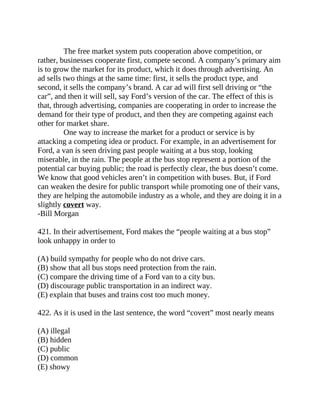
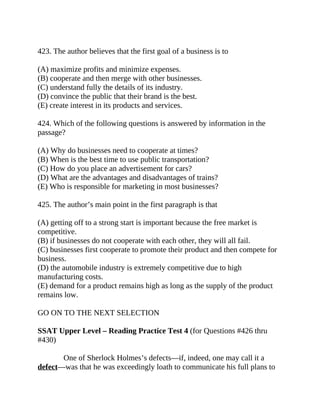
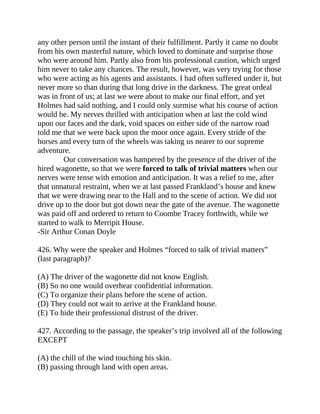
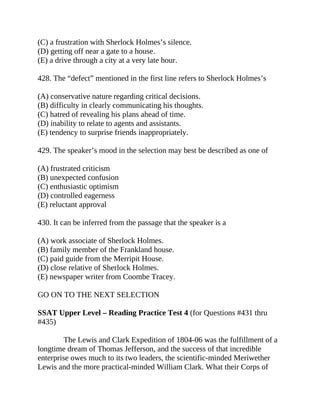
the greater part of the weekly stipend to her own use, and consigned the
rising parochial generation to even a shorter allowance than was originally
provided for them. Thereby finding in the lowest depth a deeper still; and
proving herself a very great experimental philosopher.
-Charles Dickens
326. This selection is primarily about
(A) the living conditions of a specific branch-workhouse.
(B) the early childhood and education of Oliver Twist.
(C) the history of young orphans in the 19th
century.
(D) the circumstances of a young child’s relocation.
(E) the philosophy of a workhouse superintendent.
327. It can be inferred from the passage that “sevenpence-halfpenny” was
(A) enough money to take care of a child for a week.
(B) the weekly pay of the branch-workhouse overseer.
(C) the cost of ownership of Oliver Twist.
(D) just enough money to pay for food for one day.
(E) used specifically to buy clothing for infant orphans.
328. According to the passage, the overseer of the branch-workhouse
(A) was too young to handle the raising of children.
(B) had a poor relationship with parish authorities.
(C) secretly stole money that was meant for child care.
(D) was trying to quit her job as a caregiver of children.
(E) had a particular dislike for young Oliver Twist.
329. The style of the passage is most like that found in a
(A) personal letter
(B) diary of an orphan
(C) history textbook
(D) philosopher’s manual
(E) novel about an orphan
330. In the last sentence, “finding in the lowest depth a deeper still” refers to
the
(A) great difficulty of adjusting to a branch-workhouse.
(B) highly immoral nature of a woman’s actions.
(C) amount of experience of an overseer of orphans.
(D) experimental aspect of a woman’s philosophy.
(E) extent to which orphaned children must suffer.
GO ON TO THE NEXT SELECTION
SSAT Upper Level – Reading Practice Test 3 (for Questions #331 thru
#335)
Of all the men who wore blue uniforms in the Civil War, none felt
more keenly the purpose of his mission than the African-American soldier.
Every marching step, every swing of a pick and every round fired at
Confederate enemies gave him a chance to strike a blow against slavery and
prove himself equal to his white comrades. U.S. Colored Troops were
consistently good fighters, performing well in every engagement in which
they fought. Even their enemies had to grudgingly admit that fact. One USCT
member, William H. Carney, transcended good to become great, and was the
first black U.S. soldier to earn the Medal of Honor.
On February 17, 1863, at age 23, Carney heeded the call for African
Americans to join a local militia unit, the Morgan Guards, with 45 other
volunteers from his hometown of New Bedford, Mass. That unit would later
become Company C of the 54th Massachusetts Infantry Regiment.
There was something unique about the new regiment, commanded by
Colonel Robert Gould Shaw; it was an all-black unit with the exception of
senior officers and a few senior noncommissioned sergeants. The 54th
Massachusetts was created to prove that black men could be good soldiers.
-Thomas Hammond
331. The main focus of this passage is
(A) how a few men changed the course of the Civil War.
(B) the strengths and flaws of African-American soldiers.
(C) the impact of the Civil War on American history.
(D) the achievement of black soldiers in the Civil War.
(E) the battles fought by a famous Civil War regiment.
332. According to the passage, the enemy’s attitude towards the U.S. Colored
Troops may best be described as
(A) sarcastic exaggeration
(B) reluctant respect
(C) enthusiastic optimism
(D) sincere criticism
(E) angry condemnation
333. In the selection, all of the following questions are answered regarding
William H. Carney EXCEPT:
(A) How old was he when he became a fighting man?
(B) Was he a member of the U.S. Colored Troops?
(C) Did he receive any awards for his actions in war?
(D) How many men volunteered for the unit with him?
(E) What rank did he hold in the infantry regiment?
334. According to the passage, the African-American soldier wanted to do
well in the Civil War for which of the following reasons?
I. To show he could fight as well as white soldiers.
II. To find better jobs after the war.
III. To help get rid of slavery.
(A) I only
(B) I and II only
(C) I and III only
(D) II and III only
(E) I, II and III
335. The passage implies that
(A) the soldiers with blue uniforms were fighting against slavery.
(B) Colonel Robert Gould Shaw was an African-American.
(C) the Confederate army also had many African-American soldiers.
(D) the Morgan Guards never met Company C of the 54th
Massachusetts.
(E) the Medal of Honor was given to only one soldier in the war.
GO ON TO THE NEXT SELECTION
SSAT Upper Level – Reading Practice Test 3 (for Questions #336 thru
#340)
The energy crisis has rocketed from a textbook concept into the most
pressing political issue of our time. Future energy supplies are increasingly
vulnerable and global consumption is expected to escalate dramatically,
increasing by 71% in 2030 and continuing to rise. Energy shortages would
have a dramatic impact on every area of modern life: business, transport,
food, health and communications. This looming crisis has drawn scientific
minds and encouraged radical research into other technologies, such as the
once-neglected area of nuclear fusion.
Our sun is powered by nuclear fusion. Similar to traditional nuclear
power, or fission, it can produce huge amounts of carbon-neutral energy. But
there is one vital difference: no dangerous, long-lasting radioactive waste.
Waste from nuclear fusion is only radioactive for 50–70 years, compared to
the thousands of years of radioactivity that result from fission. This is a long-
term supply of energy from a small amount of fuel, and the by-products are
harmless.
Raw materials for nuclear fusion—water and silicon—are plentiful
and widespread on Earth. This should prevent the situations where energy
supplies can be threatened by political instability; as demonstrated in January
2007 when Russia shut down a main oil pipeline to Europe after a political
spat with Belarus.
Nuclear fusion could also help meet international climate change
targets, such as those agreed by politicians in Washington last month. Current
zero-carbon technologies are unlikely to meet our energy demands this
century. Nuclear power is deeply unpopular while renewable energy sources
—wind, solar and tidal—yield relatively little energy for their high cost. But
nuclear fusion could render carbon dioxide-producing fossil fuels obsolete by
2100.
-Nigel Praities
336. According to the passage, an important difference between nuclear
fusion and nuclear fission is
(A) nuclear fusion produces both water and silicon.
(B) nuclear fission contributed more to the energy crisis.
(C) nuclear fusion has no harmful long-term side effects.
(D) nuclear fission will have a big impact on modern life.
(E) one draws energy from the sun and the other doesn’t.
337. The author’s main purpose in this passage is to
(A) show the advantages of an alternative energy source.
(B) describe the escalation of the energy crisis.
(C) compare the pros and cons of new energy sources.
(D) explain how nuclear power will help in the future.
(E) criticize an emerging trend in the energy crisis.
338. All of the following are mentioned as benefits of nuclear fusion
EXCEPT:
(A) It does not produce carbon dioxide.
(B) The raw materials for it are abundant on Earth.
(C) It will help meet environmental goals.
(D) It will generate ideas for new technologies.
(E) Its radioactive waste lasts must shorter than fission.
339. The author mentions “a political spat with Belarus” (third paragraph) in
order to
(A) determine how water and silicon are used in the process of nuclear
fusion.
(B) report about the political instability caused by the development of nuclear
power.
(C) illustrate the secondary role oil pipelines play to the actual oil reserves.
(D) show how different countries can cooperate to solve energy-related
problems.
(E) provide an example of a situation that would not happen with nuclear
fusion.
340. It can be inferred from the passage that nuclear fusion
(A) will not become a reality in the next 50-70 years due to radioactive waste.
(B) can produce more energy than wind, solar or tidal power at the same cost.
(C) is not being used by many countries due to the high amount of fuel it
consumes.
(D) will use the power of the sun to eliminate energy shortages worldwide.
(E) can produce carbon dioxide at a much lower cost than other fossil fuels.
STOP! DO NOT GO ON TO THE NEXT SECTION
SSAT UPPER LEVEL – READING PRACTICE TEST #4 (40 Questions
– 40 Minutes)
SSAT Upper Level – Reading Practice Test 4 (for Questions #401 thru
#405)
No man can fully grasp how far and how fast we have come in the
50,000 years of man’s recorded history. We know very little about the first
40,000 years, except at the end of them advanced man had learned to use the
skins of animals to cover them. Then about 10,000 years ago, man emerged
from his caves to construct other kinds of shelter. Only 5,000 years ago man
learned to write and use a cart with wheels. Christianity began less than 2,000
years ago. The printing press came within the last 1,000 years, and then less
than 200 years ago, during this whole span of human history, the steam
engine provided a new source of power. Newton explored the meaning of
gravity. In the last century, electric lights and telephones and automobiles and
airplanes became available. Only in the last 50 years did we develop
penicillin and television and nuclear power, and now if America’s new
spacecraft succeeds in reaching Venus, we will have literally reached the
stars.
-John F. Kennedy from “We choose to go to the moon…”
401. According to the speaker, man learned to write about how many years
ago?
(A) 300
(B) 1,000
(C) 5,000
(D) 10,000
(E) 20,000
402. The main idea of this passage is that
(A) space travel has been a goal for a very long time.
(B) man has learned from the past during each era.
(C) 50,000 years has gone by in a blink of an eye.
(D) mankind is learning at an increasingly faster rate.
(E) certain inventions have changed the course of history.
403. The speaker’s tone can best be described as
(A) serious
(B) inspirational
(C) casual
(D) argumentative
(E) nervous
404. It can be inferred from the passage that
(A) Venus was discovered only a few years ago.
(B) gravity has been studied for over ten thousand years.
(C) most major events occurred earlier in human history.
(D) Christianity had its origins about 1,000 years ago.
(E) nuclear power came after electric and steam power.
405. In the selection, all of the following are mentioned as turning points in
history EXCEPT
(A) the invention of new power sources.
(B) improvements in transportation.
(C) the discovery of America.
(D) the start of Christianity.
(E) faster ways of making books.
GO ON TO THE NEXT SELECTION
SSAT Upper Level – Reading Practice Test 4 (for Questions #406 thru
#410)
When large cruise ships get too close to harbor seals, the animals can
become distressed. A study found that when large ships got closer than 1,600
feet, seals were more likely to jump off the ice floes. The closer the ships got,
the more likely the seals were to dive into the water. One concern is that if
seals are routinely disturbed, it will drain their energy reserves, possibly
resulting in lower reproduction or reduced survival.
As a result, some cruise ship associations have practices in place to
minimize the disturbance of the animals. However, that is not always
possible because of weather, navigational and other reasons, including
not being able to see the seals. Also, the more time ships spend in bays, the
closer the seals come to one another. Such huddling behavior is common
among animals that feel threatened.
Another study compared harbor seal numbers in Disenchantment Bay
with those of Icy Bay, a nearby glacial fjord with similar characteristics. The
only major difference between the two bays is that cruise ships do not visit
Icy Bay. Both bays started out with roughly the same number of seals in
May. The study found that seal populations in Icy Bay increased from May to
August, while in Disenchantment Bay, they peaked in June and then declined
slightly.
-Associated Press
406. It can be inferred from the last paragraph that a fjord is a
(A) type of glacier
(B) body of water
(C) harbor with animals.
(D) series of piers.
(E) haven for seals.
407. Which of the following best states the main idea of the passage?
(A) Disenchantment Bay is safer for seals than Icy Bay.
(B) The disturbance of seals can happen to other species.
(C) Man is a major factor in the extinction of animals.
(D) Large cruise ships affect the welfare of harbor seals.
(E) The closer a ship, the more likely the seal will jump.
408. What message is the author sending in the second paragraph when he
says “However, that is not…see the seals.”?
(A) Despite efforts, avoiding seals is still difficult.
(B) Weather is very unpredictable in coastal areas.
(C) Cruise ships must keep away from seals at all costs.
(D) Weather and visibility should not be used as excuses.
(E) No animal should come before passenger safety.
409. The author suggests which of the following in the last paragraph?
(A) Icy Bay should harbor cruise ships, because few seals live there.
(B) Cruise ships should not visit Disenchantment Bay during the summer.
(C) Very few similarities exist between Icy Bay and Disenchantment Bay.
(D) It is abnormal for seal population to increase between May and August.
(E) Seal numbers fell off in Disenchantment Bay due to cruise ship activity.
410. According to the passage, large cruise ships getting too close to harbor
seals is a concern for which of the following reasons?
I. It hinders the seals’ ability to reproduce.
II. The seals move to colder areas in the summer.
III. Disturbing the seals could shorten their lifespan.
(A) III only
(B) I and II only
(C) I and III only
(D) II and III only
(E) I, II and III
GO ON TO THE NEXT SELECTION
SSAT Upper Level – Reading Practice Test 4 (for Questions #411 thru
#415)
The Bay of Pigs Invasion was an unsuccessful attempt by United
States-backed Cuban exiles to overthrow the government of Cuban dictator
Fidel Castro. Increasing conflict between the U.S. government and Castro’s
regime led President Dwight D. Eisenhower to break off diplomatic relations
with Cuba in January 1961. Even before that, the Central Intelligence Agency
had been training Cuban exiles for a possible invasion of the island. The
invasion plan was approved by Eisenhower’s successor, John F. Kennedy.
On April 17, 1961 about 1300 exiles, armed with U.S. weapons,
landed at the Bay of Pigs on Cuba. Hoping to find support from the local
population, they intended to cross the island to Havana. It was evident from
the first hours of fighting, however, that the exiles were likely to lose.
President Kennedy had the option of using the U.S. Air Force against the
Cubans but decided against it. Consequently, Castro’s army stopped the
invasion. By the time the fighting ended on April 19, ninety exiles had been
killed and the rest had been taken prisoner.
The failure of the invasion seriously embarrassed the young Kennedy
administration. Some critics blamed Kennedy for not giving it enough
support and others for allowing it to take place at all. Private groups in the
United States later ransomed the captured exiles. Additionally, the invasion
made Castro wary of the United States. From the Bay of Pigs on, Castro was
convinced that the Americans would try to take over Cuba again.
-America’s Library
411. This passage deals primarily with
(A) the consequences of mistakes in politics.
(B) diplomatic relations between the U.S. and Cuba.
(C) a failed U.S. raid on a foreign country.
(D) the early history of a presidential administration.
(E) an attempt to bargain with Fidel Castro.
412. The “exiles” mentioned in the first sentence refer to
(A) former Cuban citizens
(B) past employees of Fidel Castro
(C) government officials
(D) U.S. ambassadors to Cuba
(E) residents of the Bay of Pigs
413. Based on the passage, all of the following led to the Bay of Pigs
invasion EXCEPT
(A) a desire to remove Fidel Castro from power.
(B) the order of the invasion by President Kennedy.
(C) the training of Cuban exiles by the CIA.
(D) increased tension between Castro and Eisenhower.
(E) the imprisonment of U.S. citizens by Cuba.
414. It can be inferred from the passage that the 1,300 exiles
(A) were captured because they were not properly trained by the CIA.
(B) did not receive as much assistance from the Cuban people as hoped.
(C) fought bravely for about two months, but eventually yielded to the
enemy.
(D) were Cuban prisoners of war for many years before being killed.
(E) never forgave President Kennedy for not providing aircraft support.
415. According to the passage, results of the invasion included which of the
following?
I. President Kennedy’s reputation was strengthened.
II. The Cuban leader believed in a second attack.
III. Money was paid to free the surviving exiles.
(A) II only
(B) I and II only
(C) I and III only
(D) II and III only
(E) I, II and III
GO ON TO THE NEXT SELECTION
SSAT Upper Level – Reading Practice Test 4 (for Questions #416 thru
#420)
The Road Not Taken
Two roads diverged in a yellow wood,
And sorry I could not travel both
And be one traveler, long I stood
And looked down one as far as I could
To where it bent in the undergrowth;
Then took the other, as just as fair
And having perhaps the better claim,
Because it was grassy and wanted wear;
Though as for that, the passing there
Had worn them really about the same,
And both that morning equally lay
In leaves no step had trodden black
Oh, I kept the first for another day!
Yet knowing how way leads on to way,
I doubted if I should ever come back.
I shall be telling this with a sigh
Somewhere ages and ages hence:
Two roads diverged in a wood, and I—
I took the one less traveled by.
And that has made all the difference.
-Robert Frost
416. The poem suggests that if the speaker had traveled the road not taken,
his life would have been
(A) easier
(B) harder
(C) similar
(D) special
(E) different
417. In lines 9-12, the author is most likely saying that
(A) neither road is less traveled than the other.
(B) the goal is to find the road most people take.
(C) stepping on leaves is like stepping on people.
(D) travelers need to rest between making decisions.
(E) hesitation can lead people in the wrong direction.
418. The poem focuses mainly on
(A) hope for the future
(B) the nature of the roads we travel
(C) moments of decision
(D) learning from past mistakes
(E) the regret of wrong choices
419. The poet would most likely agree with all of the following EXCEPT:
(A) People are free to choose, but really don’t know their choices till later.
(B) People should offer advice on which road to travel.
(C) People cannot travel all the roads.
(D) Our lives are a mixture of choice and chance.
(E) Moments of decision, one after another, mark the passing of time.
420. It can be inferred from the last stanza (lines 16-20) that the speaker will
one day
(A) sigh that he even worried about the critical decisions in life.
(B) be too old to remember choices made in the distant past.
(C) yearn to go back in time and change the mistakes he made.
(D) wonder what awaited him down the path he didn’t choose.
(E) rejoice at his life built on good and bad choices.
GO ON TO THE NEXT SELECTION
SSAT Upper Level – Reading Practice Test 4 (for Questions #421 thru
#425)
The free market system puts cooperation above competition, or
rather, businesses cooperate first, compete second. A company’s primary aim
is to grow the market for its product, which it does through advertising. An
ad sells two things at the same time: first, it sells the product type, and
second, it sells the company’s brand. A car ad will first sell driving or “the
car”, and then it will sell, say Ford’s version of the car. The effect of this is
that, through advertising, companies are cooperating in order to increase the
demand for their type of product, and then they are competing against each
other for market share.
One way to increase the market for a product or service is by
attacking a competing idea or product. For example, in an advertisement for
Ford, a van is seen driving past people waiting at a bus stop, looking
miserable, in the rain. The people at the bus stop represent a portion of the
potential car buying public; the road is perfectly clear, the bus doesn’t come.
We know that good vehicles aren’t in competition with buses. But, if Ford
can weaken the desire for public transport while promoting one of their vans,
they are helping the automobile industry as a whole, and they are doing it in a
slightly covert way.
-Bill Morgan
421. In their advertisement, Ford makes the “people waiting at a bus stop”
look unhappy in order to
(A) build sympathy for people who do not drive cars.
(B) show that all bus stops need protection from the rain.
(C) compare the driving time of a Ford van to a city bus.
(D) discourage public transportation in an indirect way.
(E) explain that buses and trains cost too much money.
422. As it is used in the last sentence, the word “covert” most nearly means
(A) illegal
(B) hidden
(C) public
(D) common
(E) showy
423. The author believes that the first goal of a business is to
(A) maximize profits and minimize expenses.
(B) cooperate and then merge with other businesses.
(C) understand fully the details of its industry.
(D) convince the public that their brand is the best.
(E) create interest in its products and services.
424. Which of the following questions is answered by information in the
passage?
(A) Why do businesses need to cooperate at times?
(B) When is the best time to use public transportation?
(C) How do you place an advertisement for cars?
(D) What are the advantages and disadvantages of trains?
(E) Who is responsible for marketing in most businesses?
425. The author’s main point in the first paragraph is that
(A) getting off to a strong start is important because the free market is
competitive.
(B) if businesses do not cooperate with each other, they will all fail.
(C) businesses first cooperate to promote their product and then compete for
business.
(D) the automobile industry is extremely competitive due to high
manufacturing costs.
(E) demand for a product remains high as long as the supply of the product
remains low.
GO ON TO THE NEXT SELECTION
SSAT Upper Level – Reading Practice Test 4 (for Questions #426 thru
#430)
One of Sherlock Holmes’s defects—if, indeed, one may call it a
defect—was that he was exceedingly loath to communicate his full plans to
any other person until the instant of their fulfillment. Partly it came no doubt
from his own masterful nature, which loved to dominate and surprise those
who were around him. Partly also from his professional caution, which urged
him never to take any chances. The result, however, was very trying for those
who were acting as his agents and assistants. I had often suffered under it, but
never more so than during that long drive in the darkness. The great ordeal
was in front of us; at last we were about to make our final effort, and yet
Holmes had said nothing, and I could only surmise what his course of action
would be. My nerves thrilled with anticipation when at last the cold wind
upon our faces and the dark, void spaces on either side of the narrow road
told me that we were back upon the moor once again. Every stride of the
horses and every turn of the wheels was taking us nearer to our supreme
adventure.
Our conversation was hampered by the presence of the driver of the
hired wagonette, so that we were forced to talk of trivial matters when our
nerves were tense with emotion and anticipation. It was a relief to me, after
that unnatural restraint, when we at last passed Frankland’s house and knew
that we were drawing near to the Hall and to the scene of action. We did not
drive up to the door but got down near the gate of the avenue. The wagonette
was paid off and ordered to return to Coombe Tracey forthwith, while we
started to walk to Merripit House.
-Sir Arthur Conan Doyle
426. Why were the speaker and Holmes “forced to talk of trivial matters”
(last paragraph)?
(A) The driver of the wagonette did not know English.
(B) So no one would overhear confidential information.
(C) To organize their plans before the scene of action.
(D) They could not wait to arrive at the Frankland house.
(E) To hide their professional distrust of the driver.
427. According to the passage, the speaker’s trip involved all of the following
EXCEPT
(A) the chill of the wind touching his skin.
(B) passing through land with open areas.
(C) a frustration with Sherlock Holmes’s silence.
(D) getting off near a gate to a house.
(E) a drive through a city at a very late hour.
428. The “defect” mentioned in the first line refers to Sherlock Holmes’s
(A) conservative nature regarding critical decisions.
(B) difficulty in clearly communicating his thoughts.
(C) hatred of revealing his plans ahead of time.
(D) inability to relate to agents and assistants.
(E) tendency to surprise friends inappropriately.
429. The speaker’s mood in the selection may best be described as one of
(A) frustrated criticism
(B) unexpected confusion
(C) enthusiastic optimism
(D) controlled eagerness
(E) reluctant approval
430. It can be inferred from the passage that the speaker is a
(A) work associate of Sherlock Holmes.
(B) family member of the Frankland house.
(C) paid guide from the Merripit House.
(D) close relative of Sherlock Holmes.
(E) newspaper writer from Coombe Tracey.
GO ON TO THE NEXT SELECTION
SSAT Upper Level – Reading Practice Test 4 (for Questions #431 thru
#435)
The Lewis and Clark Expedition of 1804-06 was the fulfillment of a
longtime dream of Thomas Jefferson, and the success of that incredible
enterprise owes much to its two leaders, the scientific-minded Meriwether
Lewis and the more practical-minded William Clark. What their Corps of
Discovery accomplished—essentially opening up all the possibilities of the
vast trans-Mississippi West to the people of the United States—has rightly
been called one of the great feats of exploration. But Lewis and Clark did not
do it alone. Their most famous assistant during the transcontinental trek was a
young Indian woman whose life remains largely a mystery but whose legend
lives on as strong as ever—Sacagawea.
Early twentieth-century historians tended to glorify her role. More
recent writers, however, are inclined to minimize her contribution, and even
to adopt a somewhat scornful view of her assistance to the explorers. The
truth no doubt lies somewhere in between. It certainly was not the
“Sacagawea Expedition”; she did not guide Captains Lewis and Clark all the
way to the Pacific Ocean. But she did know some of the geography they
passed through, and she did interpret for them when they came across
Shoshone-speaking Indians. The U.S. government has not overlooked her
accomplishments. A Sacagawea one-dollar coin is expected to replace the
Susan B. Anthony dollar coin.
-Quig Nielsen
431. The passage is mainly about
(A) the strengths and limitations of a famous expedition.
(B) the role of Native Americans in U.S. exploration.
(C) the historical accomplishments of Lewis and Clark.
(D) the realization of a vision by President Jefferson.
(E) the extent to which Sacagawea helped an expedition.
432. According to the passage, it is reasonable to assume that
(A) Susan B. Anthony was of Native American ancestry.
(B) Lewis and Clark had different thinking styles.
(C) Early historians were very critical of Sacagawea.
(D) William Clark had visited the Pacific many times.
(E) Meriwether Lewis was born in Mississippi.
433. Which of the following is mentioned as a major accomplishment of the
Lewis and Clark Expedition?
(A) It led to the discovery of the Pacific Ocean.
(B) It opened up trade relations with Native Americans.
(C) It charted unexplored land west of the Mississippi.
(D) It helped Americans learn the Shoshone language.
(E) It assisted the political career of Thomas Jefferson.
434. According to the passage, Sacagawea helped Lewis and Clark in which
of the following ways?
I. She allowed passage through restricted Indian land.
II. She bridged a language barrier with Native Indians.
III. She was familiar with some of the land they traveled.
(A) II only
(B) I and II only
(C) I and III only
(D) II and III only
(E) I, II and III
435. Which of the following, if true, would most weaken the view held by
“recent writers” of Sacagawea?
(A) A journal entry by William Clark crediting Sacagawea.
(B) Sacagawea was not actually a member of the Shoshone tribe.
(C) A decision to not place Sacagawea on the one-dollar coin.
(D) Sacagawea had previously helped other American explorers.
(E) Hard evidence that Sacagawea was born near the Pacific Ocean.
GO ON TO THE NEXT SELECTION
SSAT Upper Level – Reading Practice Test 4 (for Questions #436 thru
#440)
Scientists nickname early risers “larks” and people who like to stay
up late, “owls”. While about 80% of people fall into the middle of the
spectrum, only slightly favoring the morning or the night, it is now believed
that about 10% of the population are extreme larks and a further 10% are
extreme owls. Larks are most alert around noon, function best in the late
morning, and are talkative, friendly, and pleasant from around 9 am to 4 pm.
Owls, on the other hand, are not really up and running until the afternoon, are
at their best later in the day, and most alert around 6 pm.
The preference for ‘morningness’ or ‘eveningness’ is a result of
variations in circadian rhythms—the rough 24-hour cycle in the physiological
processes of living organisms. Also known as the “body clock”, each
individual has a unique profile, or chronotype, that describes their rhythmic
behavior over the course of a day, and which can vary significantly from
person to person.
The body clock controls sleep-wake patterns by regulating body
temperature and hormones such as melatonin and cortisol. A normal
circadian rhythm sees melatonin rising just before bedtime and dropping just
after waking. The stress hormone cortisol peaks moments before first
consciousness, and core body temperature is at its lowest during the middle
of the night. A person is therefore inclined to be a lark or an owl depending
on whether these chemical changes happen earlier or later than the norm.
-Mary Tucker
436. Which of the following is most like a “chronotype” mentioned in the
second paragraph?
(A) A portrait of a famous person
(B) A testimony given by an eyewitness
(C) An autobiography in a bookstore
(D) A resume provided by an applicant
(E) A psychological report on a patient
437. All of the following questions are answered by information in the
passage EXCEPT:
(A) What makes a person a “lark” or an “owl”?
(B) How does cortisol affect a person’s sleep?
(C) Is body temperature connected with sleep patterns?
(D) Can a person change from a “lark” to an “owl”?
(E) “Owls” are most alert during which parts of the day?
438. The main idea of the passage is
(A) sleep is an extremely important part of people’s lives.
(B) science has found methods to control sleep patterns.
(C) people are at their best at different times of the day.
(D) animals can be used to study circadian rhythms.
(E) wake patterns need to be included in career decisions.
439. Which of the following is most likely to be true of people who prefer
night jobs?
(A) Their chronotype is similar to people who prefer day jobs.
(B) Their melatonin level rises later in the day than normal.
(C) Their circadian rhythms are based on a 12-hour cycle.
(D) They are in a group that represents about 80% of the population.
(E) Their cortisol level increases just before they fall asleep.
440. It can be inferred from the passage that
(A) chemicals can affect the time a person goes to sleep.
(B) body temperature is lowest when people are awake.
(C) more people tend to be “larks” than “owls”.
(D) stress hormones can help people sleep at night.
(E) humans, larks and owls have similar body clocks.
STOP! DO NOT GO ON TO THE NEXT SECTION
SSAT UPPER LEVEL – READING PRACTICE TEST #5 (40 Questions
– 40 Minutes)
SSAT Upper Level – Reading Practice Test 5 (for Questions #501 thru
#505)
One of homeopathy’s best-kept secrets is its ability to prevent
complications from surgery. Homeopathic remedies can help reduce anxiety
prior to surgery and excess bleeding during surgery, and can accelerate post-
surgical recovery. Also, remedies can help the body break down and
eliminate unsightly scars. Surgery represents both the astonishing
sophistication and scientific advancements in health care while also
demonstrating the inability of conventional medicine to provide
alternatives that would prevent this action of last resort.
On one hand, some conditions such as birth deformities, structural
problems, severe injuries, or life-threatening conditions are simply not
treatable without surgery. At the same time, surgery is often performed
unnecessarily. For example, it is used when the body, given a chance, could
heal itself using natural therapies. Successful surgery does not mean that the
person is “cured”. Surgery may remove a tumor, a gallstone, or other
diseased tissue or body parts but this removal doesn’t change the basic
processes that created them in the first place.
-Tamara Der-Ohanian
501. The author’s main purpose for writing the passage is to
(A) introduce the advantages of an alternative therapy.
(B) warn the reader of the dangers of surgery.
(C) compare homeopathy with other natural remedies.
(D) describe several modern medical discoveries.
(E) explain the role of surgery in specific circumstances.
502. According to the passage, surgery
(A) must be performed as soon as possible.
(B) cannot get rid of the source of certain problems.
(C) is not effective with birth deformities.
(D) should not be replaced by homeopathic remedies.
(E) is very risky considering its high costs.
503. All of the following are mentioned as benefits of homeopathy EXCEPT:
(A) It can prevent scarring.
(B) It aids in recovering after surgery.
(C) It is relatively inexpensive.
(D) It can prevent problems arising from surgery.
(E) It reduces stress before surgery.
504. What does the author mean by “Surgery represents…action of last
resort.” (first paragraph)?
(A) Surgery is the most technologically advanced science in the world.
(B) As health care costs rise, people need to find other methods of healing.
(C) Patients should consider homeopathy in their post-surgery recoveries.
(D) Surgery is extremely risky and should not be used in all situations.
(E) Modern medicine has come a long way, but limitations still exist.
505. It can be inferred from the passage that
(A) homeopathy can help remove tumors and gallstones.
(B) the more risky the surgery the higher the cost.
(C) life-threatening injuries are often exaggerated.
(D) surgery is absolutely necessary in some situations.
(E) the benefits of homeopathy are widely-known.
GO ON TO THE NEXT SELECTION
SSAT Upper Level – Reading Practice Test 5 (for Questions #506 thru
#510)
I’ve always had great faith in and respect for our space program, and
what happened today does nothing to diminish it. We don’t hide our space
program. We don’t keep secrets and cover things up. We do it all up front and
in public. That’s the way freedom is, and we wouldn’t change it for a minute.
We’ll continue our quest in space. There will be more shuttle flights and
more shuttle crews and, yes, more volunteers, more civilians, more teachers
in space. Nothing ends here; our hopes and our journeys continue. I want to
add that I wish I could talk to every man and woman who works for NASA
or who worked on this mission and tell them: “Your dedication and
professionalism have moved and impressed us for decades. And we know of
your anguish. We share it.”
There’s a coincidence today. On this day 390 years ago, the great
explorer Sir Francis Drake died aboard ship off the coast of Panama. In his
lifetime, the great frontiers were the oceans, and a historian later said, ‘He
lived by the sea, died on it, and was buried in it.’ Well, today we can say of
the Challenger crew: Their dedication was, like Drake’s, complete.
The crew of the space shuttle Challenger honored us by the manner
in which they lived their lives. We will never forget them, nor the last time
we saw them, this morning, as they prepared for the journey and waved
goodbye and ‘slipped the surly bonds of earth’ to ‘touch the face of God.’
Ronald Reagan - January 28, 1986
506. This passage can best be described as
(A) a tribute.
(B) an apology.
(C) a prayer.
(D) a festival.
(E) a ritual.
507. The speaker mentions Sir Francis Drake (second paragraph) in order to
(A) draw a parallel between the oceans and outer space.
(B) show how risky it is to search unknown frontiers.
(C) honor a distinguished Panamanian adventurer.
(D) relate great explorers from different time periods.
(E) explain that people’s lives are complete at death.
508. At the end of the first paragraph, “your” refers to
(A) the American public.
(B) the flight crew of the space shuttle Challenger.
(C) the workers at a space administration.
(D) the families of the dead passengers.
(E) the people listening to the speaker.
509. The speaker believes in which of the following regarding America’s
space program?
I. What you see is what you get with the space program.
II. Dangerous missions will no longer have civilians.
III. Outer space will continue to be explored.
IV. Major changes can be expected in the short-term.
(A) I and II only
(B) I and III only
(C) II and III only
(D) II and IV only
(E) III and IV only
510. The expression, “touch the face of God” is a reference to the space
shuttle crew’s
(A) lives
(B) flight
(C) jobs
(D) hopes
(E) deaths
GO ON TO THE NEXT SELECTION
SSAT Upper Level – Reading Practice Test 5 (for Questions #511 thru
#515)
Fans, for the past two weeks you have been reading about a bad
break I got. Yet today I consider myself the luckiest man on the face of the
earth. I have been in ballparks for seventeen years and have never received
anything but kindness and encouragement from you fans.
Look at these grand men. Which of you wouldn’t consider it the
highlight of his career to associate with them for even one day?
Sure, I’m lucky. Who wouldn’t consider it an honor to have known
Jacob Ruppert—also the builder of baseball’s greatest empire, Ed Barrow—
to have spent the next nine years with that wonderful little fellow Miller
Huggins—then to have spent the next nine years with that outstanding leader,
that smart student of psychology—the best manager in baseball today, Joe
McCarthy!
When you have a wonderful mother-in-law who takes sides with you
in arguments against her own daughter, that’s something. When you have a
father and mother who work all their lives so that you can have an education
and build your body, it’s a blessing! When you have a wife who has been a
tower of strength and shown more courage than you dreamed existed, that’s
the finest I know.
So I close in saying that I might have had a tough break—but I have
an awful lot to live for!
-Lou Gehrig
511. This passage is about
(A) a player starting his baseball career.
(B) a man giving a retirement speech.
(C) an interview after losing a final game.
(D) a hero accepting an award.
(E) a politician leaving after many years.
512. It can be inferred from the passage that the speaker
(A) did not achieve many of his goals.
(B) has spoken before many large crowds.
(C) studied psychology while in college.
(D) has won many championship games.
(E) played baseball for only a few years.
513. The mood of this passage is
(A) victorious
(B) emotional
(C) distressing
(D) undecided
(E) flattering
514. Regarding his family, the speaker mentions which of the following?
I. His wife’s strength has exceeded his expectations.
II. His parents have sacrificed for his success.
III. His daughter has argued with his mother-in-law.
(A) I only
(B) II only
(C) I and II only
(D) II and III only
(E) I and III only
515. The speaker calling himself the “luckiest man on the face of the earth” is
ironic for which of the following reasons?
(A) He had to work very hard to become a great player.
(B) He played on a team with a lot of good players.
(C) Every good person he has known has passed away.
(D) Having a supportive family is more than just luck.
(E) He has a health condition that has forced him to quit.
GO ON TO THE NEXT SELECTION
SSAT Upper Level – Reading Practice Test 5 (for Questions #516 thru
#520)
First Song
Then it was dusk in Illinois, the small boy
After an afternoon of carting dung
Hung on the rail fence, a sapped thing
Weary to crying. Dark was growing tall
And he began to hear the pond frogs all
Calling on his ear with what seemed their joy.
Soon their sound was pleasant for a boy
Listening in the smoky dusk and the nightfall
Of Illinois, and from the fields two small
Boys came bearing cornstalk violins
And they rubbed the cornstalk bows with resins
And the three sat there scraping of their joy.
It was now fine music the frogs and the boys
Did in the towering Illinois twilight make
And into dark in spite of a shoulder’s ache
A boy’s hunched body loved out of a stalk
The first song of his happiness, and the song woke
His heart to the darkness and into the sadness of joy.
-Galway Kinnell
516. The boy in the poem does all of the following EXCEPT
(A) meet with two other boys.
(B) play a musical instrument.
(C) experience physical discomfort.
(D) work hard during the day.
(E) chase frogs with cornstalks.
517. What causes the boy to be a “sapped thing” (line 3) and “weary to
crying” (line 4)?
(A) His two friends do not meet with him as scheduled
(B) Not having musical instruments of his own
(C) The exhaustion brought on by a hard day’s work
(D) Having to mend the rail fence all afternoon
(E) There is very little time to play before going home
518. Which of the following is a kind of contradiction mentioned in the
poem?
(A) the end of the afternoon and the start of nightfall
(B) the sadness of tiring work and the joy of first song
(C) the biting of tiny bugs and the music of pond frogs
(D) the uproar of the city and the peace of the country
(E) the harvesting of corn and the consuming of corn
519. The “small boy” (line 1) experiences happiness because of which of the
following?
I. His musical abilities
II. The sounds made by frogs
III. The music of the night
(A) III only
(B) I and II only
(C) I and III only
(D) II and III only
(E) I, II and III
520. It can be inferred from the poem that the boys
(A) made the violins themselves.
(B) take pride in working hard.
(C) work together on the farm.
(D) will be leaving Illinois soon.
(E) fear that it is getting too dark.
GO ON TO THE NEXT SELECTION
SSAT Upper Level – Reading Practice Test 5 (for Questions #521 thru
#525)
Petroleum (that is, oil and gas) is so ordinary that it takes an effort to
see what an unlikely and marvelous substance it is: raw liquid oil and high-
quality flammable gas, pumped in enormous quantities right out of the
ground. Only a few generations ago, oil for all uses—fuel, lubrication,
nutrition, medicine—was pressed from plant crops or made from animal fat.
Gas was manufactured from coal. And petroleum was almost totally hidden.
Natural leaks of crude oil are not especially rare. But the oil leaking
from the ground is usually a highly degraded substance, close to tar. It was
first used locally as a substitute for pitch or as a crude medicine. When
drillers learned to tap petroleum at depth starting in 1859, its benefits began
to be discovered, and over the next century oil transformed civilization.
Natural gas came into prominence at the same time.
Geologists have learned a lot about petroleum, but we still don’t
know in complete detail how it forms. Clearly it is derived from the remains
of living things, just as coal is. But before dead organic matter becomes
petroleum or coal it exists as a material called kerogen. With time in the
ground, kerogen matures into a variety of hydrocarbon molecules of all sizes
and weights. The lighter (smaller) hydrocarbon molecules become natural
gas, and the heavier (larger) ones make up an oily liquid.
-Andrew Alden
521. According to the passage, all of the following words can be used to
describe petroleum EXCEPT
(A) normal
(B) gaseous
(C) hidden
(D) natural
(E) oily
522. It can be inferred from the passage that kerogen
(A) is more practical than oil or gas.
(B) confuses geologists more than oil.
(C) eventually transforms into petroleum.
(D) lives inside dead matter.
(E) is more unstable than petroleum or coal.
523. Which of the following is NOT true regarding petroleum?
(A) Scientists do not know exactly how it forms.
(B) It can be obtained from living plants and animals.
(C) It exists as oil and as a gas.
(D) It is pumped out of the ground for human use.
(E) Humans have used it for over a hundred years.
524. According to the passage, the turning point in the history of petroleum
use occurred when
(A) coal no longer fit the needs of a growing population.
(B) hydrocarbon molecules were first discovered.
(C) natural gas became famous in the 1900s.
(D) tar started to substitute for pitch and medicine.
(E) humans learned to draw on underground petroleum.
525. The speaker would most likely agree with which of the following
statements?
(A) Oil is not as widely used as natural gas.
(B) Geologists know everything about petroleum.
(C) Coal was manufactured from tar from the start.
(D) Petroleum has had a great effect on the world.
(E) Most people do not appreciate petroleum.
GO ON TO THE NEXT SELECTION
SSAT Upper Level – Reading Practice Test 5 (for Questions #526 thru
#530)
Dorothy lived in the midst of the great Kansas prairies, with Uncle
Henry, who was a farmer, and Aunt Em, who was the farmer’s wife. Their
house was small, for the lumber to build it had to be carried by wagon many
miles. There were four walls, which made one room; and this room contained
a rusty looking cookstove, a cupboard for the dishes, a table, three or four
chairs, and the beds. Uncle Henry and Aunt Em had a big bed in one corner,
and Dorothy a little bed in another corner. There was no garret at all, and no
cellar—except a small hole dug in the ground, called a cyclone cellar, where
the family could go in case one of those great whirlwinds arose, mighty
enough to crush any building in its path.
When Dorothy stood in the doorway and looked around, she could
see nothing but the great gray prairie on every side. The sun had baked the
plowed land into a gray mass, with little cracks running through it. Once the
house had been painted, but the sun blistered the paint and the rains washed it
away, and now the house was as dull and gray as everything else.
When Aunt Em came there to live she was a young, pretty wife. The
sun and wind had changed her, too. They had taken the sparkle from her eyes
and left them a sober gray; they had taken the red from her cheeks and lips,
and they were gray also. When Dorothy, who was an orphan, first came to
her, Aunt Em had been so startled by the child’s laughter that she would
scream and press her hand upon her heart whenever Dorothy’s merry voice
reached her ears; and she still looked at the little girl with wonder that she
could find anything to laugh at.
-L. Frank Baum
526. All of the following words may be used to describe Uncle Henry and
Aunt Em’s life EXCEPT
(A) spontaneous
(B) confined
(C) agricultural
(D) monotonous
(E) colorless
527. According to the passage, Uncle Henry and Aunt Em’s house was small
most likely because
(A) larger homes were more vulnerable to tornados.
(B) close-knit families preferred smaller quarters.
(C) the nearest forest was many miles away.
(D) personal belongings were stored in the cellar.
(E) the sun and rain damaged it over the years.
528. In the last paragraph, why was Aunt Em surprised by Dorothy’s
laughter?
(A) Aunt Em did not have a good sense of humor.
(B) The sun had changed the color of Dorothy’s lips.
(C) Orphan children are oftentimes sad and lonely.
(D) Aunt Em would scream each time Dorothy laughed.
(E) It seemed so out of place with difficult farm life.
529. In the passage, the sun is mentioned as having affected which of the
following?
I. Uncle Henry’s hair
II. Aunt Em’s cheeks
III. Uncle Henry and Aunt Em’s house
IV. The farmland
(A) I, II and III only
(B) I, II and IV only
(C) I, III and IV only
(D) II, III and IV only
(E) I, II, III and IV
530. The author would most likely agree that Dorothy’s personality
(A) was most unusual for a girl from Kansas.
(B) infused unexpected energy into Aunt Em.
(C) varied according to the weather.
(D) produced mild irritation in Uncle Henry.
(E) was characteristic of most orphans.
GO ON TO THE NEXT SELECTION
SSAT Upper Level – Reading Practice Test 5 (for Questions #531 thru
#535)
At about 11:30 p.m. on December 28, 1881, some two months after
the so-called Gunfight at the O.K. Corral had rocked Tombstone, at least
three assassins opened fire on City Police Chief Virgil Earp outside the
Oriental Saloon in that same divided community. Virgil’s left side took most
of the pellets, and doctors were forced to remove several inches of shattered
bone from his upper left arm. Virgil’s distraught brother Wyatt was still
assuming the worst when he telegraphed Crawley P. Dake, the U.S. marshal
for Arizona Territory, a few hours later.
Marshal Dake readily agreed to grant Wyatt Earp the federal
authority to assemble a posse of gunmen to protect his family and to hunt for
the men who had shot his brother. One of the prime suspects was Ike
Clanton, who wanted revenge after an inquest had cleared the Earp brothers
of any wrongdoing in the O.K. Corral fight.
Deputy U.S. Marshal Wyatt Earp knew he must choose trustworthy
men who would not be intimidated by further threats or acts of violence by
the Cowboys, the group of alleged rustlers who had lost three of their own in
the October 26, 1881, street fight with three Earp brothers and Doc Holliday.
The possemen not only would help enforce the law but also would act as
bodyguards for the Earp brothers and their wives. Doc Holliday, a gambler
and a diehard friend, continued to stand by Wyatt during these dark days, and
now the deputy marshal gathered some more help—gunmen who had
mysterious, if not dubious, backgrounds and tough reputations. For $5 a day,
these men were willing to place themselves in extreme danger, though they
all probably had different motivations for riding with Wyatt Earp.
-Peter Brand
531. As it is used in the last paragraph, “dubious” most nearly means
(A) criminal
(B) suspicious
(C) vengeful
(D) public
(E) motivational
532. In the passage, all of the following are true regarding Virgil Earp
EXCEPT
(A) He was the head of police for a town in Arizona.
(B) He was a victim of retaliation after a gunfight.
(C) He was investigated after the O.K. Corral fight.
(D) He was shot multiple times in a bar late at night.
(E) He eventually died as a result of bullet wounds.
533. It can be inferred from the passage that Doc Holiday
(A) was not involved in the O.K. Corral fight.
(B) knew Marshall Crawley P. Dake.
(C) was a former member of the Cowboys.
(D) was not an official police officer.
(E) had gambling debts with Wyatt Earp.
534. This passage is mainly about
(A) a revenge-motivated shooting of Virgil Earp in the Oriental Saloon.
(B) the circumstances surrounding the Gunfight at the O.K. Corral.
(C) Wyatt Earp moving around the legal system in search of raw justice.
(D) how posses were assembled to capture outlaws in the Old West.
(E) a unique brand of justice practiced in the town of Tombstone.
535. According to the passage, the possemen
(A) helped protect the Earps and hunt down Cowboys.
(B) were involved in the Gunfight at the O.K. Corral.
(C) recruited Doc Holiday for his skills with a pistol.
(D) included former members of Ike Clanton’s gang.
(E) were appointed by Marshal Dake to help Wyatt Earp.
GO ON TO THE NEXT SELECTION
SSAT Upper Level – Reading Practice Test 5 (for Questions #536 thru
#540)
Infinity has long been treated with a mixture of fascination and awe.
Some have equated it with godhead—others see it as a concept with no
practical value in the real world, arguing that even mathematics apparently
dependent on infinity such as calculus could be made to work by resorting to
inexhaustible but finite quantities. The ancient Greeks were uncomfortable
with the concept, giving their word for it, apeiron, the same sort of negative
connotations we now apply to the word chaos. Apeiron was out of control,
wild and dangerous.
It took Aristotle to put infinity in its place so firmly that hardly
anyone would give it direct consideration again until the nineteenth century.
The approach he took was surprisingly pragmatic. Infinity, Aristotle decided
had to exist, because time appeared to have no beginning and no end. Nor
was it possible to say that the counting numbers ever finished. But on the
other hand infinity could not exist in the real world. If there were, for
example, a physical body that was infinite, he argued, it would be boundless
—yet to be a body, by definition an object has to have bounds.
The compromise Aristotle developed was to say that infinity both
existed and didn’t exist. Instead of being a true property of anything real, he
argued, there was just potential infinity. Infinity that could in principle be, but
in practice never was. Aristotle gives us an excellent example to illustrate
this. The Olympic Games exist—it is impossible to deny this. Yet were an
alien to beam in (Aristotle didn’t actually include an alien in his example)
and ask us ‘show me this Olympic Games of which you speak’, we couldn’t
do it. At the moment they don’t exist in reality but they do exist as a
potential. And infinity, Aristotle argued, was in exactly the same potential
state.
-Brian Clegg
536. What is the best title for this selection?
(A) A Brief History of Infinity
(B) How Infinity Influenced Aristotle
(C) Infinity and the Olympics
(D) Basic Facts About Infinity
(E) Infinity’s Role in Math
537. According to the selection, people have described infinity as being each
of the following EXCEPT:
(A) dangerous
(B) unnecessary
(C) divine
(D) obvious
(E) impractical
538. According to Aristotle, the Olympic Games are similar to infinity in
which of the following ways?
(A) They both repeat in regular intervals.
(B) They both have smaller parts that make up a whole.
(C) They both are and are not at the same time.
(D) They both exist in the world that we live in.
(E) They are both extremely difficult to explain.
539. Which of the following is closest to something in a “potential state” as
described in the passage?
(A) A personal computer
(B) An old automobile
(C) An animal in a zoo
(D) An alien from outer space
(E) A person’s birthday
540. Aristotle would most likely agree with which of the following
statements?
(A) The Olympic games is synonymous with infinity.
(B) Infinity is a truth that cannot be demonstrated.
(C) Counting to infinity will take a very long time.
(D) Infinity is dependent upon a person’s point of view.
(E) The truth behind infinity will change over the years.
STOP! DO NOT GO ON TO THE NEXT SECTION
SSAT UPPER LEVEL – READING PRACTICE TEST #6 (40 Questions
– 40 Minutes)
SSAT Upper Level – Reading Practice Test 6 (for Questions #601 thru
#605)
Tiny robots small enough to enter the human body are being
developed by researchers for a variety of purposes including treating cancer,
drug delivery, and even the growth of new cells and tissues.
Doctors are often faced with the challenge of performing
microsurgery to repair blood vessels, transplant tissue or reattach a severed
limb. These procedures are very intricate, and surgery is often not the most
effective solution since it can be very difficult to conduct. Soon, many
surgeons could be turning to nanotechnology and performing delicate tasks
by remotely controlling tiny robots, similar in size to a grain of rice that could
travel through the body.
Electrical engineers have designed tiny spinning screws that can
swim through veins in the body. They can potentially burrow into tumors to
kill them or deliver drugs to a specific tissue or organ. Since they are so
small, they could be injected into the body using a standard hypodermic
needle and once inside, could be magnetically steered around the body using
a 3D magnetic field supply and controller. The engineers believe that these
devices will be particularly useful for removing brain tumors since they are
difficult to operate on.
-Marie McCulloch
601. According to the passage, nanotechnology
(A) is extremely small machines doing complex tasks.
(B) has been used to treat humans for many years.
(C) involves tiny screws guided by trained nurses.
(D) is used primarily in the treatment of cancer.
(E) uses small robots about the size of apples.
602. According to the passage, the “tiny spinning screws” are especially
useful in removing brain tumors because
(A) they are injected with a hypodermic needle.
(B) drugs rarely work in the treatment of tumors.
(C) they can be magnetically steered with a device.
(D) it is hard to perform surgery on brain tumors.
(E) engineers are more precise than doctors.
603. Which of the following best expresses the main point of the second
paragraph?
(A) We must find inexpensive ways to use tiny robots.
(B) Size is especially important in nanotechnology.
(C) Specific surgeries are very difficult to conduct.
(D) Various methods are used to repair blood vessels.
(E) Nanotechnology could help in difficult surgeries.
604. Which of the following is the best title for the selection?
(A) Recent Technology
(B) Treating Diseases
(C) Microscopic Robots
(D) Repair and Growth
(E) Medical Advances
605. The author would most likely agree that
(A) a robot the size of a grain of rice is not realistic.
(B) nanotechnology can do things surgeons cannot.
(C) the magnetic field controller is the best technology.
(D) nanotechnology should only be used in surgeries.
(E) humans need to give less responsibility to machines.
GO ON TO THE NEXT SELECTION
SSAT Upper Level – Reading Practice Test 6 (for Questions #606 thru
#610)
The story of the Pony Express is a bit like the story of Paul Revere’s
ride—an actual historic event, rooted in fact and layered with centuries of
falsehoods, added extras and outright lies. In the mid-20th century, William
Floyd, one of many amateur historians to look into the tale of the Pony
Express, threw up his hands and observed, “It’s a tale of truth, half-truth and
no truth at all.” He was right on each account.
The business was called the Central Overland California and Pike’s
Peak Express Company, a name too wordy to appear on anything. The
company’s mail service across America in 1860 and 1861 became known as
the Pony Express, a legend in its own time. Americans living on the Pacific
slope in the new state of California, drawn there by the Gold Rush, were
desperate for news of home. The Pony Express dramatically filled that gap by
promising to deliver mail across the country from the end of the telegraph in
the East to the start of the telegraph in the West, in 10 days time or less.
Normal mail, brought overland or via ship, took months. The term “pony
express” had been used before, and, indeed, Americans had transmitted
information on the backs of fast horses since colonial times. Historians of
mail service always note that Genghis Khan used mounted couriers.
-Christopher Corbett
606. According to the passage, how did the Pony Express get its name?
(A) It sent messages faster than the telegraph.
(B) Horses were a common mode of transportation.
(C) It seemed to fit with the term Gold Rush.
(D) California was growing rapidly in the 1860s.
(E) The name of its company was too long.
607. The author’s main purpose is to
(A) compare the Pony Express with Paul Revere’s ride.
(B) explain the role of ponies in delivering mail.
(C) discuss William Floyd’s view of a historical event.
(D) describe a famous mail service of the 1800s.
(E) show how the Pony Express carried mail so fast.
608. According to the author, how is the story of Paul Revere’s ride similar to
the story of the Pony Express?
(A) They both occurred during the 1860s.
(B) They both involved a single rider on a pony.
(C) William Floyd was a witness to both events.
(D) They both involved American speed records.
(E) They both included some truths and some lies.
609. According to the author, Genghis Khan
(A) used horse riders to move information.
(B) started the original Pony Express.
(C) trained horses to travel long distances.
(D) sent messages during colonial times.
(E) was a historian of ancient mail services.
610. The Pony Express became popular for which of the following reasons?
I. It was much faster than normal mail.
II. Californians wanted to know of news back East.
III. Gold could be transported cross-country in days.
(A) I only
(B) II only
(C) I and II only
(D) II and III only
(E) I and III only
GO ON TO THE NEXT SELECTION
SSAT Upper Level – Reading Practice Test 6 (for Questions #611 thru
#615)
The current agreement among scientists on global warming is that
“most of the observed warming over the last 50 years is likely to have been
caused by human activities.” The main cause of the human-induced
component of warming is the increase in greenhouse gases, especially carbon
dioxide, due to activities such as burning of fossil fuels, land clearing, and
agriculture. Greenhouse gases are gases that contribute to the greenhouse
effect. This effect was first described by Joseph Fourier in 1824, and was first
investigated scientifically in 1896 by Svante Arrhenius.
Climate sensitivity is a measure of response to increased greenhouse
gases in the atmosphere. It is found by observational and model studies. This
measure is usually expressed as the expected temperature increase from a
doubling of carbon dioxide in the atmosphere. This increase is estimated to
be about 3 °C according to the 2001 Intergovernmental Panel on Climate
Change report. The IPCC, using different scenarios, projects that global
temperatures will increase about 3.5 °C between 1990 and 2100.
-Wikipedia
611. According to the passage, most of the scientific community believes that
(A) global temperatures will drop in the next century.
(B) climate sensitivity should be used more.
(C) Fourier’s research was very difficult to understand.
(D) humans have had the most effect on global warming.
(E) the IPCC needs to make less predictions.
612. The effect mentioned in the first paragraph most likely refers to
(A) the interaction between land clearing and agriculture.
(B) the result of greenhouse gases warming the Earth.
(C) the examination of deadly gases by two chemists.
(D) the distribution of carbon dioxide in fossil fuels.
(E) the relationship between Fourier and Arrhenius.
613. Which of the following is the author most likely to discuss next?
(A) A history of the warming of the Earth
(B) A discussion on measures of temperature
(C) Reasons why carbon dioxide is so toxic
(D) A mention of other atmospheric gases
(E) The advantages of burning fossil fuels
614. The main purpose of the first paragraph is to
(A) investigate the contributions two scientists made to the study of the
greenhouse effect
(B) explain the role carbon dioxide plays in the warming of the Earth
(C) list activities that humans can use to prevent the spread of greenhouse
gases
(D) determine why more federal funds are not devoted to fighting global
warming
(E) introduce the major sources of global warming caused by humans
615. According to the passage, climate sensitivity
(A) measures temperature change in the Earth’s oceans.
(B) must be calculated within a certain time frame.
(C) takes into account carbon dioxide increase.
(D) was recorded inaccurately in the 2001 IPCC report.
(E) rarely uses observational or model studies.
GO ON TO THE NEXT SELECTION
SSAT Upper Level – Reading Practice Test 6 (for Questions #616 thru
#620)
“We need you to come with us,” notified the detective. He paused for
a few seconds. “We need you to—we would like you to identify her.”
“Okay.” Daniel followed the men to the gurney. The detective pulled
away the white sheet so Daniel could see Maria’s angelic face one last time.
Daniel nodded his head in affirmation, but his heart sunk to the bottom of the
ocean. He then walked away.
“I know this is very difficult,” empathized the detective, “but we
need you to stay here for a while—to answer a few questions.”
“Okay.”
Daniel ambled to a now restricted area of the old bridge from which
Maria made her suicide jump. He recognized an item the police had
overlooked lying in the shadows of the wooden overpass. He stepped through
yellow tape to discover it was the Bible he had given to Maria this past
Christmas. The snow was heavy that day but two souls still managed to make
it out to a meeting. Daniel’s heart was comforted somewhat knowing Maria
had been reading the Word all the way up to her death. He picked up the
Good Book he had purchased six months ago at a Christian bookstore, and
read his handwritten words on the back of the front cover:
I dedicate this Bible to Maria. I truly believe you were sent to me from Above.
We met in the springtime and our hopes carried us into the summer.
Thankfully, our laughter and tears were enough to reunite us in autumn. It is
now wintertime and I give you this gift in the snowfall as if you were my very
own. It is very cold today but my heart is warmed by each moment with you
this morning. Merry Christmas…
616. This story takes place
(A) by the bookstore where Daniel and Maria often met.
(B) during rush hour on a busy city bridge.
(C) near the conclusion of a small funeral.
(D) at the scene of a police investigation.
(E) in the private office of a detective.
617. All of the following can be used to describe the tone of the story
EXCEPT
(A) content
(B) spiritual
(C) traumatic
(D) moving
(E) solemn
618. It can be inferred from the passage that
(A) Daniel is a pastor of a church near the old bridge.
(B) Maria and Daniel spent many Christmases together.
(C) Daniel and Maria first met at a Christian bookstore.
(D) Daniel and Maria were classmates for four quarters.
(E) Maria had her Bible with her when she passed away.
619. Daniel’s mood changes from the beginning of the passage to the end
from
(A) intense pain to mild discomfort
(B) tragic concern to comforting hope
(C) reluctant obedience to passive defiance
(D) hurried panic to calm thankfulness
(E) lingering doubt to quiet certainty
620. In the passage, the Bible (last paragraph) is a symbol of which of the
following?
I. Hope beyond death
II. The changing of the seasons
III. A past relationship
(A) I only
(B) I and II only
(C) I and III only
(D) II and III only
(E) I, II and III
GO ON TO THE NEXT SELECTION
SSAT Upper Level – Reading Practice Test 6 (for Questions #621 thru
#625)
In April of 1942, the Japanese basked in a sense of euphoria. During
the previous four and a half months their armed forces had scored triumph
after triumph on the war fronts of the Pacific. “Victory fever” swept the land.
Minutes after noon, the sense of peacefulness inside the capital
suddenly shattered. Here and there on the outskirts of Tokyo, dark-green
planes appeared, flying so low that they almost touched the ground. People
riding bicycles or walking along roads paused to glance up at the fleeting
planes.
A French journalist rushed outside: “I heard a rugged, powerful
sound of airplane engines. A raid at high noon! Explosions. I spotted a dark
airplane traveling very fast, at rooftop level. So they’ve come!”
Now air raid sirens belatedly sounded. Fighter planes took off. Bursts
of antiaircraft fire smudged the sky.
At first the people in the streets did not understand what they were
seeing. Then, when they understood, they could not quite believe. High noon
in Tokyo. Dark planes with white stars painted on them. Americans!
History would call it the “Doolittle Raid”—after its legendary leader,
Lieutenant Colonel James H. Doolittle. A startling attack by American
bombers that seemed to appear out of nowhere, only to vanish as suddenly as
they had appeared. A feat of flying that seemed impossible—yet one that
with daring had actually been achieved.
-Edward Oxford
621. As it is used in the first line, “euphoria” means
(A) joy
(B) surprise
(C) fear
(D) anticipation
(E) fury
622. According to the passage, all of the following are true regarding the
American bombers EXCEPT:
(A) They were identified by white stars.
(B) They were spotted by Japanese civilians.
(C) They did not drop any actual bombs.
(D) They were led by a Lieutenant Colonel.
(E) They flew relatively low to the ground.
623. The main purpose of this passage is to
(A) justify the superiority of American fighter planes.
(B) explain the advantages of surprise attacks in war.
(C) discuss the planning involved in the Doolittle Raid.
(D) emphasize the astonishment of the Japanese people.
(E) introduce a significant turning point in a world war.
624. The “Doolittle Raid” involved which of the following?
I. It was a surprise attack in the early evening.
II. There was a military response by the Japanese.
III. It was an assault on a major Japanese city.
(A) III only
(B) I and II only
(C) I and III only
(D) II and III only
(E) I, II and III only
625. It can be inferred from the passage that
(A) James Doolittle was the best pilot in the fleet.
(B) Japan had not been attacked in a very long time.
(C) there were many French journalists in Japan.
(D) the Japanese surrendered right after the Tokyo raid.
(E) Japan had expected the Doolittle Raid for months.
GO ON TO THE NEXT SELECTION
SSAT Upper Level – Reading Practice Test 6 (for Questions #626 thru
#630)
Cesar Chavez is best known for his efforts to gain better working
conditions for the thousands of workers who labored on farms for low wages
and under severe conditions. Chavez and his United Farm Workers union
battled California grape growers by holding nonviolent protests. Chavez got
the idea for nonviolent actions from Martin Luther King Jr., who was a leader
in the struggle for civil rights for African Americans. Chavez also went on
hunger strikes, protesting by refusing to eat for long periods of time. In 1968
he fasted for 25 days in support of the United Farm Workers’ commitment to
non-violence. He was inspired to fast by M.K. Gandhi of India.
Because of Chavez’s peaceful tactics and public support for the
union, he and the United Farm Workers Organizing Committee were able to
negotiate contracts for higher wages and better treatment of agricultural
workers with California grape producers.
Like his protests, Cesar Chavez died peacefully. In 1993, he died in
his sleep in San Luis, Arizona, where he had gone to testify against vegetable
growers. An estimated 50,000 mourners attended his funeral service. In
recognition of Chavez’s importance as a leader of the Mexican American
community and a champion of social justice, President Bill Clinton awarded
the Medal of Freedom, the nation’s highest civilian honor, to his widow,
Helen Chavez, in 1994.
-America’s Library
626. According to the passage, the main goal of Caesar Chavez was to
(A) earn the nation’s highest civilian honor.
(B) learn as much as he could from King and Gandhi.
(C) gain better working conditions for farm workers.
(D) be an honorable leader for the United Farm Workers.
(E) hold nonviolent protests and fast for three weeks.
627. Helen Chavez was awarded the Medal of Freedom because
(A) her father was busy testifying in court.
(B) she was also a leader in the Mexican community.
(C) of her dedicated support for her husband.
(D) she was a champion of social justice in Mexico.
(E) her husband was not alive to receive it.
628. Caesar Chavez and Martin Luther King Jr. had all of the following in
common EXCEPT:
(A) Both men fought for rights for their people.
(B) Both men were killed for what they believed in.
(C) Both men held nonviolent protests.
(D) Both men were of a different racial background.
(E) Both men became famous in their home country.
629. According to the passage, Chavez gained “higher wages and better
treatment” for farm workers in part due to
(A) backing from regular citizens.
(B) a law passed by the President.
(C) his wife’s position in the union.
(D) aid from Mexican politicians.
(E) his familiarity with grape production.
630. It is most reasonable to infer from the passage that
(A) Helen Chavez continued her husband’s work after his death.
(B) most of the 50,000 people at Chavez’s funeral were friends and relatives.
(C) Bill Clinton also battled for civil rights for Mexican Americans.
(D) California grape producers took advantage of their farm workers.
(E) Mexican American farm workers had the highest pay in the country.
GO ON TO THE NEXT PAGE
SSAT Upper Level – Reading Practice Test 6 (for Questions #631 thru
#635)
As I enter this place, there whispers a quiet reminder to me that all
things end. The inhabitants of this building, the elderly, the terminally ill,
have no place to go. Some of them have lived a full life but then again what
does it matter? It is an occasion to untangle from the complexities of human
existence and go quietly into the night. It is a time, if at all possible, to lay
down with dignity and grace.
I do not know why a certain woman, a very old woman, catches my
meandering attention. She is unremarkable in many ways, and not strikingly
wise to be sure. A nurse finished feeding the woman as I happen by her room.
My shallow heart goes out to this woman, my soul full of judgmental pity.
“Are you still looking for that hand mirror of yours, Mrs. Smith?” the
nurse queries. “Well, if not, no need to worry. I need you to get ready for
your bath, okay?” The nurse exits the room and proceeds down a long,
freshly mopped corridor. The old woman is now alone in her finality.
Then, just as I am about to move on with the rest of my
undistinguished morning, I spot the old woman’s mirror. I perforate the
confines of her room to retrieve her mirror, but the woman just sits there—
motionless, frail, weak—so reliant on the nursing home’s staff for all her
daily needs. I place the mirror on the bed beside her. Why does this old
woman hold on to this foreign item? I glimpse into the mirror, into its
reflections, for an answer. There, in the twinkling of an eye, I see the
unexpected.
I see a striking young girl, a chocolate box of innocence closing in on
eight, singing in the cane fields of Maui. She dashes along the countryside,
her youthful smile shimmering against the warm Hawaiian sun as a mother
and grandfather talk story outside a plantation home. I see a brother and sister
enjoying each other’s company without a worry in the world. In the girl, I see
boundless energy and potential—an unfilled life waiting ahead.
631. Which of the following is most likely to happen next?
(A) Mrs. Smith will be reunited with her grandfather
(B) The narrator will apply for a job at the nursing home
(C) The nurse will warn the narrator about his trespassing
(D) Mrs. Smith will return the mirror to the nursing home
(E) The narrator will become acquainted with Mrs. Smith
632. From the beginning of the excerpt to the end, the speaker changes from
(A) ignorant to wise
(B) pessimistic to optimistic
(C) compassionate to unfeeling
(D) uncooperative to helpful
(E) interested to apathetic
633. With which statement would the author most likely agree?
(A) The human soul can transcend age and time.
(B) The elderly still have the potential to do great things.
(C) A single act of kindness can transform a person’s life.
(D) Nursing homes possess many hidden treasures.
(E) It is important to face death with courage.
634. Indications that Mrs. Smith needs assistance from the nursing home
include which of the following?
I. Mrs. Smith cannot see her reflection in the mirror.
II. The nurse asks Mrs. Smith to prepare for a bath.
III. Mrs. Smith has been given food by the nurse.
(A) II only
(B) I and II only
(C) II and III only
(D) I and III only
(E) I, II and III
635. According to the passage, all of the following are true regarding the
mirror (fourth paragraph) EXCEPT:
(A) It acts as a kind of time machine of nostalgia.
(B) It draws the narrator into Mrs. Smith’s world.
(C) It “reflects” the real person inside an old woman.
(D) It tells of a special trip Mrs. Smith made to Maui.
(E) It allows the narrator to experience Mrs. Smith’s life.
GO ON TO THE NEXT PAGE
SSAT Upper Level – Reading Practice Test 6 (for Questions #636 thru
#640)
But I could not follow the world’s orders on this night of providence.
There was the Holy Spirit who required my services. I gazed squarely into
the astonishment of my superior officer and walked away, slowly
backpedaling at first, and then jogging out into a cacophony of smoke and
fire. I instinctively headed out into the direction where Chuck had gone to
fight, attempting to triangulate his soul with a single vertex and a spiritual
compass as artillery fire and deafening explosions shocked and awed me
from every conceivable angle. I was no longer afraid as I walked through the
valley of the shadow of death. I carried on into Hell’s core with ferocity of
step and vengeance of heart empowered by the leadership of the Holy Spirit.
I fought up and down the mounts of Iwo Jima, weaponless, searching for my
lost friend who desperately needed me at this time—who necessitated my
presence before the end.
I scoured as many nooks and crevices that the limits of my humanity
would allow me, but I could not find Chuck in or out of this world. I
collapsed upon my knees with my arms extended to brace my fall. My
physical and spiritual reserves were depleted and I could no longer pursue
eternity on adrenaline alone. The howls of my despondency endeavored to
make contact with the Divine as the smoke of our greed, and rage, and sin
escalated past the apex of Mount Suribachi and into the chilly Pacific
darkness. Then my eyes chanced to meander into a depression. I beheld
something so beautiful, so precious that tears began to trickle down my war-
torn face. My friend Chuck was spread out on the black volcanic ash, the
entirety of his left side seared by the weapons of war. I rushed up to him
quickly at first, and then a tad slower with joyously tormented eyes. I knelt
down upon the transitory and seized the hand of the everlasting.
636. All of the following add to the difficulty of the narrator’s search
EXCEPT:
(A) His friend has been a prisoner of war for a long time.
(B) He has no rifle in which to fight off the enemy.
(C) He is searching for his friend in the midst of war.
(D) The terrain of the island of Iwo Jima is harsh.
(E) He is suffering from exhaustion brought on by battle.
637. It can be inferred from the second paragraph that the narrator finally
finds his friend through
(A) human error
(B) technology
(C) sight and sound
(D) landmarks
(E) blind fortune
638. The main character’s emotional state changes from
(A) hidden panic to forced calm
(B) painful surprise to tempered joy
(C) stubborn doubt to passionate belief
(D) reckless desperation to anguished relief
(E) annoyed uncertainty to pleased confidence
639. In his quest to find his friend, the main character receives help from
which of the following?
I. Covering fire from his fellow soldiers
II. His belief in God
III. Support from his superior officer
(A) I only
(B) II only
(C) I and II only
(D) I and III only
(E) II and III only
640. In the second paragraph, the narrator calling what he saw “beautiful”
and “precious” is ironic because his friend
(A) no longer wishes to be saved.
(B) is only one soldier in the entire army.
(C) has been mortally wounded.
(D) disobeyed direct orders of their superior officer.
(E) is actually an enemy soldier.
STOP! DO NOT GO ON TO THE NEXT SECTION

6 reading practice test for the SSAT upper

  • 2.
    6 READING PRACTICETESTS FOR THE SSAT UPPER Unauthorized coping or reuse of any part of this eBook is illegal. Copyright September 2012 SSAT Upper Reading only! SSAT Upper Reading only! *** Other SSAT Elementary / Middle / Upper exam preparation materials from “Test Masters” are available for your Amazon Kindle. Word Count: 26,300 This Kindle eBook only contains SSAT Upper Level READING selections and questions. The actual SSAT Upper Level contains Math, Verbal and Writing sections as well, but this eBook does NOT cover those sections. This Kindle eBook is intended for use by current EIGHTH, NINTH and TENTH graders applying for private schools that require the SSAT Upper. SSAT Upper Level readings (40 Questions – 40 Minutes) include narratives (excerpts from novels / short stories / poetry) and essays. Passages are also drawn from humanities (arts / biographies / poetry), social science (history / economics / sociology) and science (medicine / astronomy / zoology). The four main types of Reading questions are: – Identifying the Main Idea ( Author’s Purpose / Best Title ) – Locating Details – Drawing Inferences – Identifying Tone or Mood In our experience, SSAT Upper Level reading selections and questions are comparable to high school graduate equivalency and sometimes college entrance standardized reading tests. Therefore, students should take their time at first and always look back to the passage for answers. With adequate practice, all students can become proficient at answering the main types of SSAT reading questions.
  • 3.
    What is thepurpose of these 6 SSAT Upper Level READING Practice Tests? A pervasive characteristic of SSAT private school admission exams is that they are very difficult, oftentimes featuring test questions one to four grade levels above your child’s current public or private school curriculum. The SSAT targets a small, highly competitive group of students applying for top private schools across the nation. Using our years of experience developing training guides for a national test preparation company, we’ve created SSAT study materials that closely approximate the sequence, scope, phrasing and difficulty level of actual exams. We’ve accomplished this through years of meticulous research into individual SSAT test questions and through information acquired from former test participants. The practice tests, used at schools and tutorial centers, show you how to compute your child’s Raw Score and identify its corresponding Scaled Score which can be compared (if available) to the average SSAT scaled score ranges of students admitted to a top private school near you. Thousands of applicants have worked through the 240 SSAT Upper Level Reading practice problems contained within this Kindle eBook to enhance their candidacies in the private school admission process. How do I use this Kindle eBook? Administer the practice tests to your child, keeping in mind the time constraints for each section. Students are PENALIZED one-fourth point for each incorrect response. Therefore, on an actual SSAT exam, all unsolvable questions should be skipped. Wild guessing is arguably the greatest contributor to low scores. Some parents choose not to time their child at first. Instead, they allow for an adjustment period to become accustomed to the style and difficulty level of the Reading selections and questions. Have your child attempt all unfinished problems. The parent or tutor should review all incorrect responses with the
  • 4.
    child. Use the AnswerKeys at the beginning of this eBook to record the number of correct / wrong responses for each practice test. This eBook shows you how to compute your child’s Raw Score and then identify the corresponding Scaled Score. To help parents gauge their child’s standing, some top private schools provide average scaled score ranges for students admitted for the previous school year. Parents should not overreact to “lower-than-expected” results. (Easy for us to say!) In addition to SSAT scores, most private schools take into account academic performance, teacher / counselor / coach recommendations, extracurricular activities and the personal interview / essay / portfolio in their admissions decision. But, of course, high SSAT scores help immensely. Remember that every child can improve his or her SSAT performance with the right mix of effort, instruction, materials, experience and encouragement! The RAW SCORE to SCALED SCORE Conversion Chart below is a “best approximation” or “happy medium” based on thousands of student test results. For the actual SSAT, Raw to Scaled Score conversions can vary from test to test as there are “harder” and “easier” test months each with a different conversion formula. How do I calculate my child’s RAW SCORE? RAW SCORE = Total Number Correct (Out of 40) – Total Number Wrong Divided by 4 Reading Raw Score of 40 = SSAT Upper Scaled Score of 800 Reading Raw Score of 38 = SSAT Upper Scaled Score of 770 Reading Raw Score of 37 = SSAT Upper Scaled Score of 750 Reading Raw Score of 36 = SSAT Upper Scaled Score of 730 Reading Raw Score of 35 = SSAT Upper Scaled Score of 720 Reading Raw Score of 34 = SSAT Upper Scaled Score of 710 Reading Raw Score of 33 = SSAT Upper Scaled Score of 705 Reading Raw Score of 32 = SSAT Upper Scaled Score of 700
  • 5.
    Reading Raw Scoreof 31 = SSAT Upper Scaled Score of 695 Reading Raw Score of 30 = SSAT Upper Scaled Score of 690 Reading Raw Score of 29 = SSAT Upper Scaled Score of 690 Reading Raw Score of 28 = SSAT Upper Scaled Score of 690 Reading Raw Score of 27 = SSAT Upper Scaled Score of 685 Reading Raw Score of 26 = SSAT Upper Scaled Score of 680 Reading Raw Score of 25 = SSAT Upper Scaled Score of 675 Reading Raw Score of 24 = SSAT Upper Scaled Score of 670 Reading Raw Score of 23 = SSAT Upper Scaled Score of 665 Reading Raw Score of 22 = SSAT Upper Scaled Score of 660 Reading Raw Score of 21 = SSAT Upper Scaled Score of 650 Reading Raw Score of 20 = SSAT Upper Scaled Score of 640 Reading Raw Score of 19 = SSAT Upper Scaled Score of 635 Reading Raw Score of 18 = SSAT Upper Scaled Score of 630 Reading Raw Score of 17 = SSAT Upper Scaled Score of 625 Reading Raw Score of 16 = SSAT Upper Scaled Score of 620 Reading Raw Score of 15 = SSAT Upper Scaled Score of 610 Reading Raw Score of 14 = SSAT Upper Scaled Score of 600 Reading Raw Score of 13 = SSAT Upper Scaled Score of 595 Reading Raw Score of 12 = SSAT Upper Scaled Score of 590 Reading Raw Score of 11 = SSAT Upper Scaled Score of 580 Reading Raw Score of 10 = SSAT Upper Scaled Score of 570 Reading Raw Score of 9 = SSAT Upper Scaled Score of 565 Reading Raw Score of 8 = SSAT Upper Scaled Score of 560 Reading Raw Score of 7 = SSAT Upper Scaled Score of 555 Reading Raw Score of 6 = SSAT Upper Scaled Score of 550 Reading Raw Score of 5 = SSAT Upper Scaled Score of 545 Reading Raw Score of 4 = SSAT Upper Scaled Score of 540 Reading Raw Score of 3 = SSAT Upper Scaled Score of 535 Reading Raw Score of 2 = SSAT Upper Scaled Score of 530 Reading Raw Score of 1 = SSAT Upper Scaled Score of 520 Reading Raw Score of 0 = SSAT Upper Scaled Score of 510 ANSWER Key – Reading Practice Test 1 (40 Questions: #1 thru #40) 1. B 2. D
  • 6.
    3. C 4. E 5.A 6. C 7. C 8. B 9. E 10. D 11. D 12. A 13. B 14. E 15. C 16. D 17. E 18. A 19. C 20. B 21. D 22. E 23. C 24. A 25. B 26. E 27. D 28. C 29. B 30. D 31. C 32. D 33. B
  • 7.
    34. E 35. D 36.D 37. D 38. E 39. C 40. B ANSWER Key – Reading Practice Test 2 (40 Questions: #201 thru #240) 201. B 202. D 203. C 204. A 205. E 206. D 207. C 208. D 209. B 210. A 211. C 212. D 213. E 214. B 215. A 216. B 217. C 218. E 219. A 220. D 221. B 222. A
  • 8.
    223. D 224. C 225.E 226. A 227. E 228. C 229. D 230. B 231. E 232. A 233. B 234. C 235. D 236. A 237. D 238. B 239. E 240. C ANSWER Key – Reading Practice Test 3 (40 Questions: #301 thru #340) 301. B 302. E 303. D 304. A 305. C 306. D 307. C 308. E 309. A 310. B 311. C
  • 9.
    312. B 313. E 314.D 315. A 316. D 317. A 318. B 319. E 320. C 321. E 322. D 323. A 324. C 325. B 326. D 327. A 328. C 329. E 330. B 331. D 332. B 333. E 334. C 335. A 336. C 337. A 338. D 339. E 340. B ANSWER Key – Reading Practice Test 4 (40 Questions: #401 thru #440)
  • 10.
    401. C 402. D 403.B 404. E 405. C 406. B 407. D 408. A 409. E 410. C 411. C 412. A 413. E 414. B 415. D 416. E 417. A 418. C 419. B 420. D 421. D 422. B 423. E 424. A 425. C 426. B 427. E 428. C 429. D 430. A 431. E
  • 11.
    432. B 433. C 434.D 435. A 436. E 437. D 438. C 439. B 440. A ANSWER Key – Reading Practice Test 5 (40 Questions: #501 thru #540) 501. A 502. B 503. C 504. E 505. D 506. A 507. D 508. C 509. B 510. E 511. B 512. D 513. B 514. C 515. E 516. E 517. C 518. B 519. D 520. A
  • 12.
    521. A 522. C 523.B 524. E 525. D 526. A 527. C 528. E 529. D 530. B 531. B 532. E 533. D 534. C 535. A 536. A 537. D 538. C 539. E 540. B ANSWER Key – Reading Practice Test 6 (40 Questions: #601 thru #640) 601. A 602. D 603. E 604. C 605. B 606. E 607. D 608. E 609. A 610. C
  • 13.
    611. D 612. B 613.A 614. E 615. C 616. D 617. A 618. E 619. B 620. C 621. A 622. C 623. E 624. D 625. B 626. C 627. E 628. B 629. A 630. D 631. E 632. B 633. A 634. C 635. D 636. A 637. E 638. D 639. B 640. C
  • 14.
    SSAT UPPER LEVEL– READING PRACTICE TEST #1 (40 Questions – 40 Minutes) SSAT Upper Level – Reading Practice Test 1 (for Questions #1 thru #5) A government office confirmed that the bird flu outbreak in a farm town in South Korea was of the H5 strain, but further tests are needed to determine whether it was the deadly N1 type. South Korea has had three outbreaks of the bird flu virus at chicken and quail farms. This has resulted in the slaughter of more than one million poultry in an attempt to keep the disease from spreading. Although some complained, South Korean farmers have been largely cooperative in the government’s decision to cull the birds as the government later paid them for their losses. Most of the 154 people who have died worldwide from the bird flu virus came into direct contact with infected birds. Experts fear the virus could mutate into a form that becomes easily passed among people, potentially starting a human pandemic. Indonesia, which was the worst hit by the bird flu virus, initially protested against having to slaughter birds in infected areas and vaccinate flocks, citing a lack of funds. But it recently launched a large- scale public education campaign, including TV commercials, urging people to wash their hands after coming into contact with poultry and to report sick or dying birds to authorities. 1. Which of the following is NOT mentioned as being used to help stop the spread of the bird flu? (A) Cleansing hands after touching poultry (B) Thoroughly cooking meat before eating (C) Telling authorities about sick or dying birds (D) Educating the public through the media (E) Slaughtering sick birds 2. The word cull at the end of the first paragraph most closely means (A) redirect (B) sanitize (C) devour
  • 15.
    (D) collect (E) verify 3.The style of the passage is most like that found in a (A) novel about the bird flu (B) agriculturalists’ diary (C) newspaper article (D) journal on pandemics (E) science textbook 4. According to the passage, Indonesia did which of the following? I. Complained about having to kill birds II. Reported cases of the virus in two provinces III. Used television to tell people about the bird flu (A) I only (B) II only (C) I and II only (D) II and III only (E) I and III only 5. It can be inferred from the passage that (A) the bird flu virus can change into a more deadly form (B) humid Southeast Asian weather helps spread the flu (C) radio messages are not as useful as TV commercials (D) the H5 strain spreads faster than the N1 strain (E) farmers should not accept help from the government GO ON TO THE NEXT SELECTION SSAT Upper Level – Reading Practice Test 1 (for Questions #6 thru #10) Historians place Caesar on the level of such military greats as Alexander the Great, Hannibal, Genghis Khan, Napoleon Bonaparte and
  • 16.
    Saladin. Although hesuffered a few defeats, Caesar’s brilliance in war was highlighted by the conquering of Alesia during the Gallic War, the defeat of Pompey’s numerically superior forces at Pharsalus during the Civil War, and the complete destruction of Pharnaces’ army at the Battle of Zela. Caesar’s success on any land and under all weather conditions owes much to the strict but fair discipline of his soldiers. Their admiration and devotion to him were widely known due to his promotion of those of skill over those of nobility. Additional factors that made him effective in war were his army’s advanced engineering abilities and the legendary speed with which he moved his troops. Caesar’s army sometimes marched as many as 40 miles a day. During an attack on one Gallic city built on a very steep and high plateau, Caesar’s engineers were able to tunnel through solid rock. They found the source of the spring that the town was drawing its water supply from, and redirected it to their own army. The town, cut off from their water supply, capitulated at once. - Wikipedia 6. The author’s main goal in this passage is to (A) list several of Rome’s greatest military battles. (B) compare Caesar against other military masterminds. (C) report about Caesar’s great skill in war. (D) describe Caesar’s defeat of a Gallic city. (E) discuss the political motives of Caesar. 7. As used in the last line, capitulated most closely means (A) attacked (B) conquered (C) surrendered (D) abandoned (E) passed away 8. Which of the following is true regarding the battle of Pharsalus during the Civil War?
  • 17.
    (A) Pompey’s bodywas never found. (B) Caesar’s army was outnumbered. (C) It was the last major conflict of the Civil War. (D) Caesar could not take full credit for this victory. (E) It occurred at the same time as the Battle of Zela. 9. According to the first few sentences of the second paragraph, Caesar’s policy of basing promotion on skill rather than social position (A) angered members of the Senate back in Rome. (B) allowed his men to focus on war rather than politics. (C) was his most admirable quality as a military leader. (D) eased the suffering of the soldier’s family in Rome. (E) helped gain him the favor and loyalty of his men. 10. According to the passage, Caesar’s engineers I. fought despite limited water supplies. II. were very highly skilled. III. once tunneled through solid rock. (A) II only (B) I and II only (C) I and III only (D) II and III only (E) I, II and III GO ON TO THE NEXT SELECTION SSAT Upper Level – Reading Practice Test 1 (for Questions #11 thru #15) On August 16, 1896, George Washington Carmack and two Indian friends in the Yukon pried a gold nugget from the bed of Rabbit Creek, a tributary of Canada’s Klondike River, and set in motion one of the most frenzied and famous gold rushes in history. Over the next two years, at least 100,000 eager would-be prospectors from all over the world set out for the new gold fields with dreams of a quick fortune dancing in their heads. Only
  • 18.
    about 40,000 actuallymade it to the Klondike, and a precious few ever found their fortune. Swept along on this tide of gold seekers was a smaller and more clever group, also seeking their fortunes but in a far more practical way. They were the entrepreneurs, the people who made business from Klondike fever. George Carmack, the man who began it all, was neither a die-hard prospector nor a keen businessman. The California native was simply in the right place at the right time. Not that this son of a Forty-Niner had anything against being rich. But, like most of the white men who drifted north in the 1870s and ‘80s, he came as much for the solitude as for the gold. -Gary L. Blackwood 11. The “entrepreneurs” mentioned in the second paragraph most likely (A) wanted to explore the uncharted lands of the Yukon. (B) traveled with the gold seekers as guides. (C) knew all the “hot spots” for gold nuggets. (D) sold housing and prospecting tools to gold seekers. (E) were friends and relatives of George Carmack. 12. Which of the following will the author most likely discuss next? (A) The history of gold in the Yukon. (B) A detailed life story of George Carmack. (C) The origins of Canadian exploration. (D) Why gold holds so much value. (E) The geography of Rabbit Creek. 13. This passage is primarily about (A) the early career of George Carmack. (B) a single discovery that started a gold rush. (C) techniques on how to find gold nuggets. (D) the history of gold prospecting in the U.S. (E) the people who journeyed to the Yukon. 14. It can be inferred from the last paragraph that George Carmack
  • 19.
    (A) later regretteddiscovering his famous gold nugget. (B) became known as a great Forty-Niner. (C) passed away either in the 1870s or 1880s. (D) continued to find gold for many years. (E) also came to Klondike to avoid crowded city life. 15. According to the passage, why did people travel to Klondike after Carmack found the nugget? I. They hoped to meet George Carmack. II. They wanted to make money off the prospectors. III. They also wanted to find gold. (A) III only (B) I and II only (C) II and III only (D) I and III only (E) I, II and III GO ON TO THE NEXT SELECTION SSAT Upper Level – Reading Practice Test 1 (for Questions #16 thru #20) I’ve come this far to freedom and I won’t turn back I’m climbing to the highway from my old dirt track I’m coming and I’m going And I’m stretching and I’m growing And I’ll reap what I’ve been sowing or my skin’s not black I’ve prayed and slaved and waited and I’ve sung my song You’ve bled me and you’ve starved me but I’ve still grown strong You’ve lashed me and you’ve treed me And you’ve everything but freed me But in time you’ll know you need me and it won’t be long. I’ve seen the daylight breaking high above the bough
  • 20.
    I’ve found mydestination and I’ve made my vow; so whether you abhor me Or deride me or ignore me Mighty mountains loom before me and I won’t stop now. -Naomi Long Madgett 16. Which of the following words best characterizes the poet? (A) furious (B) mournful (C) victorious (D) determined (E) obedient 17. In the poem, the narrator’s life can best be described as a(n) (A) brisk journey (B) cautionary tale (C) educational experience (D) hazardous highway (E) uphill climb 18. All of the following are used by the poet to overcome slavery EXCEPT (A) strength in numbers (B) belief in God (C) patience (D) keeping a merry heart (E) surviving physical hardship 19. The poet believes she will reach her goal because (A) there are many more slaves than slave owners. (B) the Civil War is finally coming to an end. (C) her oppressors will need her one day. (D) she will find safety behind mighty mountains. (E) the government will pass laws abolishing slavery.
  • 21.
    20. The patternof rhyme in this poem is most similar to: (A) Monday, Tuesday, Wednesday, Thursday, Friday (B) apple, apple, banana, banana, apple (C) black, white, black, white, black (D) day, day, day, night, night (E) girl, boy, boy, girl, girl GO ON TO THE NEXT SELECTION SSAT Upper Level – Reading Practice Test 1 (for Questions #21 thru #25) As early as 1939, scientists Leo Szilard and Albert Einstein had urged President Franklin D. Roosevelt to begin government-sponsored research to develop an atomic bomb for the United States. They knew that the German effort, led by their former colleague, the brilliant Nobel laureate Werner Heisenberg, could be a great threat. As it turned out, Germany was unsuccessful, perhaps because Adolf Hitler was more interested in developing rockets than nuclear weapons. But that was in the future, and the only future the physicists in America could see at that point was the danger of a German atomic bomb. In response to the plea of Einstein and Szilard, FDR initiated a modest program of uranium research. By June 1940, interest in uranium had increased to the point that the president created a larger organization, the National Defense Research Committee. He named as director Vannevar Bush, the president of the Carnegie Institution in Washington, D.C. The slowly growing effort gained further strength in 1941 from a startling British document. Based on British nuclear research, the report stated that a very small amount of uranium could produce an explosion similar to that of several thousand tons of TNT. Roosevelt responded by creating a still larger organization, the Office of Scientific Research and Development, which would mobilize scientific resources to create an atomic weapon. -Robert LaRue 21. As it is used in the last sentence, “mobilize” most nearly means
  • 22.
    (A) transport (B) investigate (C)clutter (D) assemble (E) construct 22. This passage is primarily concerned with (A) Szilard and Einstein’s role in scientific research. (B) why Germany failed to build the atomic bomb. (C) various types of wartime organizations. (D) important decisions made by President Roosevelt. (E) the early background of a powerful weapon. 23. All of the following were motivating factors for America to build the atomic bomb EXCEPT: (A) A German bomb would be a direct threat to the U.S. (B) A report showed the bomb’s devastating effects. (C) Adolf Hitler made the atomic bomb a top priority. (D) An increased interest in the benefits of uranium. (E) Their chief enemy in war was also trying to build it. 24. It can be inferred that Leo Szilard and Albert Einstein (A) believed Heisenberg was a very good scientist. (B) upset President Roosevelt with their constant pleas. (C) directed the National Defense Research Committee. (D) were suspicious of other American scientists. (E) eventually gave up on atomic bomb research. 25. According to the passage, President Franklin D. Roosevelt (A) believed Adolf Hitler was not a major threat. (B) made atomic bomb research increasingly important. (C) attempted to accumulate large amounts of uranium. (D) was a close friend of Director Vannevar Bush.
  • 23.
    (E) was theUnited States president for about two years. GO ON TO THE NEXT SELECTION SSAT Upper Level – Reading Practice Test 1 (for Questions #26 thru #29) It was Sunday afternoon. Beth was driving down the main street in her community. It would be one of the most difficult days to get through following the loss of Katie. Everywhere Beth looked, reminders of this special occasion, Mother’s Day, decorated the fronts of stores, magazines and flower shops. They all exhibited heartwarming advertisements of ways to honor mothers. For Beth, a mother who had gone through the pain of losing a daughter, these reminders continued to add hurt to a soul already grieving for a child she loved so much. Inside her home, Beth swathed her left palm and fingers around Brad’s tiny cranium, and finished tucking in her infant son. Brad was only nine months old, a stage when a young one is so vulnerable to the evils of the world, but Beth intuitively knew her second child would be safe. She had acquired this comforting through prayer. God had promised, she believed, that nothing would happen to Brad. Her lone remaining child would see his ninth birthday and beyond. He would graduate from high school, then college, and set off into the world. He would live on past the deaths of his parents. Beth moved towards the carpeted staircase and walked downward upon its steps one by one. There were family pictures hanging on the wall, the times past they represented looking back upon her as she made the discomfiting descent to the living room. Why was the emotional pain of losing a child so severe? Why had God fused a mother’s love and a daughter’s trust through potent spiritual intimacy only to allow the severance of the bond with a single senseless gust of evil? Was this a test and if so, were Beth and Lono facing the consequences of a sin as King David had with the murder of Uriah? 26. In the last paragraph, Beth is (A) trying to forget painful times of the past. (B) hanging pictures of her daughter on the wall.
  • 24.
    (C) searching forthe right grief counselor. (D) studying the history of King David and Uriah. (E) struggling with why she lost her daughter. 27. All of the following add to Beth’s hurt EXCEPT (A) memories evoked by pictures on the wall. (B) going through Mother’s Day without her daughter. (C) guilty feelings from possible disobedience to God. (D) knowing her daughter will not graduate from school. (E) the lingering pain of losing a family member. 28. It can be inferred from the passage that (A) Beth’s daughter is older than nine years old. (B) Beth is a single parent with one son. (C) King David had also lost a child. (D) Mother’s Day rarely falls on a Sunday. (E) Beth’s daughter has been missing for some time. 29. The question, “Why had God fused…gust of evil?” in the last paragraph refers to (A) the momentary victory of evil over motherly love. (B) a girl’s precious birth and later wasteful death. (C) similarities between royal and normal families. (D) the time it takes for emotional pain to subside. (E) the nature of bonds between mothers and daughters. GO ON TO THE NEXT SELECTION SSAT Upper Level – Reading Practice Test 1 (for Questions #30 thru #35) After several turns, he sat down again. As he threw his head back in the chair, his glance happened to rest upon a bell, a disused bell, which hung in the room, and communicated for some purpose now forgotten with a chamber in the highest story of the building. It was with great astonishment,
  • 25.
    and with astrange, inexplicable dread, that as he looked, he saw this bell begin to swing. It swung so softly in the outset that it scarcely made a sound; but soon it rang out loudly, and so did every bell in the house. This might have lasted half a minute, or a minute, but it seemed an hour. The bells ceased as they had begun, together. They were succeeded by a clanking noise, deep down below; as if some person were dragging a heavy chain over the casks in the wine-merchant’s cellar. Scrooge then remembered to have heard that ghosts in haunted houses were described as dragging chains. The cellar-door flew open with a booming sound, and then he heard the noise much louder, on the floors below; then coming up the stairs; then coming straight towards his door. “It’s humbug still!” said Scrooge. “I won’t believe it.” His color changed though, when, without a pause, it came on through the heavy door, and passed into the room before his eyes. Upon its coming in, the dying flame leaped up, as though it cried, “I know him! Marley’s Ghost!” and fell again. -Charles Dickens 30. Most of the events in this passage take place as Scrooge is (A) reading a book in his den. (B) finishing work in his office. (C) working in a store full of bells. (D) sitting on a chair in his home. (E) visiting a house that is haunted. 31. All of the following contribute to the suspense of the story EXCEPT (A) clanking noises of a heavy chain being dragged. (B) the very loud sound of the cellar door opening. (C) faint cries from the highest story in the building. (D) something mysterious moving towards Scrooge’s door. (E) bells starting to ring all by themselves. 32. According to the passage, the first bell that began to swing
  • 26.
    (A) was usedby Scrooge as a type of fire alarm. (B) rang loudly at first and then diminished in volume. (C) was apparently the only bell in the building. (D) had been used to communicate with another room. (E) was frantically shaken by Scrooge out of sheer fright. 33. According to the selection, which of the following probably affected Scrooge the most? (A) The clanking sound of chains in the wine cellar. (B) The sight of Marley’s ghost passing through a door. (C) The report of ghosts living in haunted houses. (D) The deafening noise of bells stopping all at once. (E) An unidentified sound closing in on Scrooge’s location. 34. It can be inferred from the passage that (A) Marley’s ghost has visited Scrooge many times. (B) the ringing of the bells lasted for about an hour. (C) Scrooge’s home would be an easy target for robbers. (D) Marley is the original owner of Scrooge’s home. (E) Scrooge does not reside in a one-story house. 35. All of the following words can be used to describe the mood of this passage EXCEPT: (A) mysterious (B) absorbing (C) escalating (D) dynamic (E) frightening GO ON TO THE NEXT SELECTION SSAT Upper Level – Reading Practice Test 1 (for Questions #36 thru #40) Miami, Puerto Rico and Bermuda are prime holiday destinations
  • 27.
    boasting sun, beachesand coral seas. But between these idyllic settings, there is a dark side: countless ships and planes have mysteriously gone missing in the one and a half million square miles of ocean separating them. About 60 years ago, the area was claiming about five planes every day and was nicknamed the Bermuda Triangle by a magazine in 1964. Today, about that many planes disappear in the region each year and there are a number of theories explaining what could be happening. Twins George and David Rothschild are among the first passengers to have experienced bizarre effects in the Bermuda Triangle. In 1952, when they were 19 years old, the two naval men had to make an emergency trip home on a navy light aircraft, north over the Florida Keys, to attend their father’s funeral. They had been flying for probably 20 or 30 minutes when all of a sudden the pilot yelled out that the instruments were dead and he became very frantic. The pilot had lost his bearings, and not only did he not know where he was, he also had no idea how much gas was left in the fuel tanks. After what seemed like hours, they landed safely in Norfolk, on the Florida coast. Some speculate that it had nothing to do with the location, but rather the instruments that were available at the time. Pilot Robert Grant says that back in the 1940s, navigating a plane involved a lot of guesswork since they relied completely on a magnetic compass to guide them. ‘Dead reckoning’ was used, which means that pilots would trust their compass and then estimate how the wind would influence their planned flight path to remain on track. “No matter what your mind tells you, you must stay on that course,” says Grant. “If you don’t, and you start turning to wherever you think you should be going, then you’re toast.” -Sandrine Ceurstemont 36. Which of the following is the best title for the selection? (A) Perils of Miami, Puerto Rico, and Bermuda (B) The Rothschild Incident (C) Danger in the Open Seas (D) Mysteries of the Bermuda Triangle (E) Was it Location or Instruments? 37. The Rothschilds’ pilot became “frantic” for which of the following
  • 28.
    reasons? I. He didnot know how much gas he had left. II. The plane had arrived in the wrong place. III. He lost his sense of direction. (A) I only (B) II only (C) I and II only (D) I and III only (E) II and III only 38. Which of the following is the author most likely to discuss next? (A) Other incidences of missing planes around the world. (B) The advantages of spending the holidays in Bermuda. (C) A detailed account of the Rothschild flight. (D) What pilots can do in the event of an emergency. (E) The weather conditions near the island of Bermuda. 39. This passage (A) establishes a debate and then shows both sides of the argument. (B) proposes a theory and then provides evidence on why it could be false. (C) introduces a phenomenon and then offers insight based on facts. (D) provides a conclusion and then moves on to different topics. (E) describes a historical problem and then presents a few modern-day solutions. 40. ‘Dead reckoning’ as described in the last paragraph is most like (A) a chef looking for all the right ingredients for a very special dish. (B) a blind girl trying to find her way by the sound of her mother’s voice. (C) a coach devising a strategy on how to win without his best player. (D) a politician searching for the proper words for a campaign speech. (E) a surgeon using a new medical procedure to save a patient’s life.
  • 29.
    STOP! DO NOTGO ON TO THE NEXT SECTION SSAT UPPER LEVEL – READING PRACTICE TEST # 2 (40 Questions – 40 Minutes) SSAT Upper Level – Reading Practice Test 2 (for Questions #201 thru #205) Dance schools often participate in dance competitions by sponsoring teams that go to regional and national competitions. Competitive dancing requires many months of dedication practicing and developing dance routines. During competitions, dancers perform in front of judges who evaluate their efforts and score each routine. The ranks awarded by different judges are combined into a final score, and medals or trophies are awarded accordingly. Each routine is required to comply with certain rules. It must enter a category which is consistent with the music, style, content, and dancers of the routine. A common limitation is the number of dancers. There are different categories for solos, duos & trios, small groups (4-9), large groups (10-19), and super groups (20 or more). Other grouping factors include average age of the dancer, average number of hours a week the dancer dances, appropriate music, and style of dance. Routines which fail to comply with the requirements the competition has laid out will be disqualified. -Wikipedia 201. The author’s main purpose for writing the passage is (A) to explain how dance schools help dancers. (B) to inform people about dance competitions. (C) to compare regional and national contests. (D) to describe the basic rules of dance routines. (E) to encourage dancers to enter tournaments. 202. It can be inferred that dance competitors who do not follow rules (A) are usually the most inexperienced dancers.
  • 30.
    (B) can stillwin but must forfeit prizes. (C) were not properly trained by dance schools. (D) can be eliminated from competition. (E) should be limited to the “no rules” category. 203. According to the passage, how are dance schools involved in dance competitions? (A) They provide judges for regional competitions. (B) They educate participants on tournament rules. (C) They help pay for travel to national contests. (D) They aid dancers in locating competitions. (E) They offer discounts on trophies and medals. 204. As it is used at the end of the first paragraph, the word accordingly most nearly means (A) appropriately (B) especially (C) visibly (D) differently (E) hurriedly 205. According to the passage, dance competition rules are based on which of the following? I. Amount of practice hours II. Size of the dance group III. The music must match the routine (A) II only (B) I and II only (C) II and III only (D) I and III only (E) I, II and III GO ON TO THE NEXT SELECTION
  • 31.
    SSAT Upper Level– Reading Practice Test 2 (for Questions #206 thru #210) Think Minnesota gets cold? Try Titan, another land of a thousand lakes. Saturn’s haze-shrouded moon is an exotic land of liquid methane lakes. First spotted by the international Cassini spacecraft, the lakes explain the clouds that cover the mysterious Titan. At minus 290 degrees on its surface, Titan’s weather is a chilly model of Earth’s climate, with methane rains and rivers falling and flowing into lakes, which evaporate once more to form the moon’s clouds. Confirmation of the lakes’ existence is the latest success in the Cassini mission, which arrived at Saturn, the second-largest planet, in 2004. The spacecraft has provided information on Saturn’s rings, discovered new moons and found an interesting watery geyser on the small moon Enceledus. Titan, whose atmosphere behaves in ways similar to Earth’s, is a great scientific opportunity. Seventeen more flybys of the moon are planned for 2006. At 3,200 miles wide, Titan is the second-largest moon in the solar system. It has fascinated scientists since its hazy atmosphere was photographed by Voyager probes in the early 1980s. Methane, which is known on Earth as natural gas, in Titan’s lakes fills a role played by oceans on our planet. The materials may be different, and certainly the temperatures, but a lot of the basic physical processes, which control any weather cycle, are similar. -Dan Vergano 206. Titan and Earth have all of the following in common EXCEPT: (A) They both experience evaporation. (B) They both have an atmosphere. (C) They both have liquid lakes. (D) They both have their own moons. (E) They both have rainfall. 207. The primary purpose of the third paragraph (“Confirmation of the lakes’ existence…”) is to
  • 32.
    (A) explain howlakes form on Titan’s surface. (B) clarify a few of the mysteries of Saturn ring’s. (C) describe the findings of a spacecraft mission. (D) compare the surface features of two moons. (E) understand how scientists study moons and planets. 208. In the last paragraph, the author uses an analogy to illustrate that methane in Titan’s lakes (A) are the source of Titan’s clouds. (B) can be photographed by Voyager probes. (C) are an essential part of Titan’s weather cycle. (D) serve a similar purpose to oceans on Earth. (E) are unlike the lakes of Minnesota. 209. It can be inferred from the text that scientists are interested in Titan because (A) its closeness to Earth allows for more missions. (B) it has similar atmospheric processes to Earth. (C) its unique climate helps predict weather on Earth. (D) it is the largest moon in the solar system. (E) it was formed in the same way as Earth’s moon. 210. Which of the following is the author most likely to discuss next? (A) The additional findings of a recent Titan flyby. (B) The differences between methane and natural gas. (C) The atmospheric conditions on Enceledus. (D) The technical framework of the Cassini spacecraft. (E) Climatic differences between Minnesota and Titan. GO ON TO THE NEXT SELECTION SSAT Upper Level – Reading Practice Test 2 (for Questions #211 thru #215)
  • 33.
    What is WeirLike? The skies they were ashen and sober; The leaves they were crisped and sere— The leaves they were withering and sere: It was night in the Lonesome October Of my most immemorial year; It was hard by the dim lake of Auber; In the misty mid region of Weir— It was down by the dank tarn of Auber In the ghoul-haunted woodland of Weir -from “Ulalume” by Edgar Allen Poe 211. The author uses adjectives throughout the passage to (A) reveal his fondness of Auber. (B) foreshadow his death in October. (C) establish the mood of Weir. (D) hide the true feelings of the main character. (E) build to the climax of Ulalume. 212. The words “ashen” (line 1) and “sere” (line 2-3), respectively, most nearly mean (A) stormy and rough (B) pale and moist (C) distant and abundant (D) gray and dry (E) sunny and wrinkled 213. All of the following are mentioned in the passage EXCEPT (A) nature displaying the changing of the seasons (B) an atmosphere of loneliness and silence (C) evidence that it is the end of the day
  • 34.
    (D) difficulty seeingthings in the distance (E) the peacefulness and quiet of a nearby lake 214. The passage answers which of the following questions? I. What is the setting of the passage? II. When do these events happen? III. Why is the narrator going to this place? (A) II only (B) I and II only (C) I and III only (D) II and III only (E) I, II and III 215. The passage indicates that the speaker (A) is drawn to this place of uncertainty and anguish. (B) will meet an old friend by the lake in the evening. (C) has never been to this isolated region before. (D) ignores the warnings of ghosts not to enter the forest. (E) cannot wait to pass through this frightening country. GO ON TO THE NEXT SELECTION SSAT Upper Level – Reading Practice Test 2 (for Questions #216 thru #220) It’s difficult to imagine road-building conditions any worse than those workers faced in 1942, when they began carving a supply route over the Canadian Rockies, through the Yukon Territory, all the way to remote military outposts in Alaska. “Men hired for this job will be required to work and live under the most extreme conditions imaginable,” read one recruitment notice. “Temperatures will range from 90 degrees above zero to 70 degrees below zero. Men will have to fight swamps, rivers, ice and cold. Mosquitoes, flies and gnats will not only be annoying but will cause bodily harm. If you are not prepared to work under these and similar conditions, do not apply.”
  • 35.
    The idea oflaying a roadway to connect the United States with the continent’s “far north” can be traced all the way back to the Yukon gold rushes of the 1890s. But it wasn’t until the 1930s that Alaska’s territorial legislature commissioned a study of possible routes—and it took the Japanese attack on Pearl Harbor to finally get the work started. Once drawn into World War II, the U.S. government worried that Japan would follow the destruction of the U.S. Pacific fleet in Hawaii with an invasion of Alaska. Within a few weeks of the Pearl Harbor attack, President Franklin D. Roosevelt decided that plans for a highway to Alaska deserved re-examination. -J. Kingston Pierce 216. This passage deals primarily with the road’s (A) route through the Yukon Territory. (B) history leading up to it being built. (C) construction from 1890 to 1942. (D) design by President Roosevelt. (E) building conditions in wintertime. 217. The “far north” mentioned at the beginning of the second paragraph most likely refers to (A) Japan (B) the Pacific (C) Alaska (D) the Yukon (E) Canada 218. All of the following are mentioned as working conditions of building the road in 1942 EXCEPT: (A) The insects were harmful. (B) The surface was not all land. (C) The temperatures were extreme. (D) Workers had to live there. (E) The pay was not very good.
  • 36.
    219. It canbe inferred from the passage that (A) most of the road did not go through the U.S. (B) construction of the road never got started. (C) many men died while building the road. (D) the gold rushes helped to buy materials for the road. (E) Pearl Harbor was located near Alaskan posts. 220. The author would most likely agree that (A) a Japanese invasion of Alaska was highly unlikely. (B) Canada should have helped pay for the road. (C) the road was not worth risking human life. (D) a demand for gold first sparked interest in the road. (E) President Franklin D. Roosevelt acted too slowly. GO ON TO THE NEXT SELECTION SSAT Upper Level – Reading Practice Test 2 (for Questions #221 thru #225) What constitutes an American? Not color nor race nor religion. Not the pedigree of his family nor the place of his birth. Not his social status nor his bank account. Not his trade nor his profession. An American is one who loves justice and believes in the dignity of man. An American is one who will fight for his freedom and that of his neighbor. An American is one who will sacrifice property, ease and security in order that he and his children may retain the rights of free men. Americans have always known how to fight for their rights and their way of life. Americans are not afraid to fight. They fight joyously in a just cause. We Americans know that freedom, like peace, is inseparable. We cannot retain our liberty if three-fourths of the world is enslaved. Brutality, injustice and slavery, if practiced as dictators would have them, universally and systematically, in the long run would destroy us as surely as a fire raging in our nearby neighbor’s house would burn ours if we didn’t help to put out his.
  • 37.
    -Harold Ickes fromWhat is an American? 221. According to the speaker, all of the following describes an American EXCEPT (A) his desire to go to war for a good reason. (B) his status in society. (C) his readiness to fight for his friends. (D) his love of justice. (E) his willingness to sacrifice for his family. 222. The author’s tone can best be described as (A) blunt (B) ecstatic (C) argumentative (D) cunning (E) sad 223. This passage is primarily about (A) knowing how to identify an American imposter. (B) the brutality and injustices of world dictators. (C) rights contained in the Declaration of Independence. (D) what does and does not define an American. (E) the differences between Americans and foreigners. 224. In the last sentence, the speaker is urging Americans to (A) avoid out-of-control forest fires. (B) recognize the injustices practiced by dictators. (C) fight with partnering countries against evil. (D) realize that war is not the solution in the long run. (E) know that neighbors can sometimes be the enemy. 225. As it is used at the beginning of the last paragraph, the statement “freedom, like peace, is inseparable” means
  • 38.
    (A) you mustfight for freedom in order to obtain peace. (B) freedom and peace are the same to true Americans. (C) free will is guaranteed to people who fight for it. (D) freedom and peace cannot be seen without sacrifice. (E) America is not free if most of the world is not free. GO ON TO THE NEXT SELECTION SSAT Upper Level – Reading Practice Test 2 (for Questions #226 thru #230) Shortly Tom came upon the juvenile pariah of the village, Huckleberry Finn, son of the town drunkard. Huckleberry was cordially hated and dreaded by all the mothers of the town, because he was idle and lawless and vulgar and bad—and because all their children admired him so, and delighted in his forbidden society, and wished they dared to be like him. Tom was like the rest of the respectable boys, in that he envied Huckleberry his gaudy outcast condition, and was under strict orders not to play with him. So he played with him every time he got a chance. Huckleberry was always dressed in the cast-off clothes of full-grown men, and they were in perennial bloom and fluttering with rags. His hat was a vast ruin with a wide crescent lopped out of its brim; his coat, when he wore one, hung nearly to his heels and had the rearward buttons far down the back; but one suspender supported his trousers; the seat of the trousers bagged low and contained nothing, the fringed legs dragged in the dirt when not rolled up. Huckleberry came and went, at his own free will. He slept on doorsteps in fine weather and in empty hogsheads in wet; he did not have to go to school or to church, or call any being master or obey anybody; he could go fishing or swimming when and where he chose, and stay as long as it suited him; nobody forbade him to fight; he could sit up as late as he pleased; he was always the first boy that went barefoot in the spring and the last to resume leather in the fall; he never had to wash, nor put on clean clothes; he could swear wonderfully. In a word, everything that goes to make life precious that boy had. So thought every harassed, hampered, respectable boy in St. Petersburg. -Mark Twain from The Adventures of Tom Sawyer
  • 39.
    226. As itis used in the first line, “pariah” most nearly means (A) outsider (B) convict (C) adventurer (D) student (E) drifter 227. All of the following are true regarding items worn by Huckleberry Finn EXCEPT: (A) He sometimes rolled up his pants. (B) A part of his hat had been cut out. (C) His clothes had been worn by other people. (D) His pants were held up by one suspender. (E) He wore clothes he had made by himself. 228. The main purpose of this selection is to (A) explain why Finn was not like other children. (B) describe the dressing habits of a boy. (C) introduce a new boy character in a book. (D) portray Finn through the eyes of a mother. (E) show a different side of a boy’s personality. 229. The mothers in the town disliked and feared Huckleberry Finn for which of the following reasons? I. The other children in the town looked up to him. II. He said things that were inappropriate. III. His club did not include all the children. IV. He did not follow the rules of the town. (A) I and II only (B) II and III only (C) I, II and III only
  • 40.
    (D) I, IIand IV only (E) II, III and IV only 230. In the second paragraph, which of the following is NOT mentioned? (A) Finn did not receive adult supervision. (B) Finn did not eat his meals in the correct area. (C) Finn did not follow a specific schedule. (D) Finn did not have to answer to anybody. (E) Finn did not always sleep in a bed. GO ON TO THE NEXT SELECTION SSAT Upper Level – Reading Practice Test 2 (for Questions #231 thru #235) The Battle of Iwo Jima represented to the Americans the pinnacle of forcible entry from the sea. This particular amphibious assault was the ultimate “storm landing,” the Japanese phrase describing the American propensity for concentrating overwhelming force at the point of attack. The huge striking force was more experienced, better armed and more powerfully supported than any other offensive campaign to date in the Pacific War. The Fifth Fleet enjoyed total domination of air and sea around the small, sulfuric island, and the 74,000 Marines in the landing force would muster a healthy 3- to-1 preponderance over the Japanese garrison. Seizing Iwo Jima would be tough, planners admitted, but the operation should be over in a week, maybe less. By all logic, the force invading Iwo Jima should have prevailed, quickly and violently. But the Japanese had also benefited from the prolonged island campaigns in the Pacific. Lieutenant General Tadamichi Kuribayashi commanded the 21,000 troops on the island. Formerly a cavalry officer, Kuribayashi was a savvy fighter, one who could pick up realistic lessons from previous combat disasters. Significantly, Japanese forces on Iwo Jima would defend the island in depth—from hidden interior positions, not at the water’s edge—and they would avoid the massive, suicidal banzai attacks. Kuribayashi figured if the garrison could maintain camouflage and fire discipline, husband its resources and exact disproportionate losses on the
  • 41.
    invaders, maybe theAmericans would lose heart. His senior subordinates may have grumbled at this departure from tradition, but Kuribayashi’s plan made intelligent use of Iwo Jima’s forbidding terrain and his troops’ fighting skills. -Colonel Joseph H. Alexander 231. All of the following are mentioned as advantages the Americans had against the Japanese EXCEPT: (A) The Americans had extensive experience in battle. (B) The Americans had powerful weapons. (C) The Americans outnumbered the Japanese. (D) The Americans had better air and sea support. (E) The Americans had better knowledge of Iwo Jima. 232. This passage is primarily about (A) a battle for an island in the Pacific Ocean. (B) how to engage the enemy in unfamiliar territory. (C) why Iwo Jima was important to the Americans. (D) General Kuribayashi’s military strategies. (E) the final battle in a very long war. 233. It is reasonable to assume from the passage that (A) Kuribayashi had the unanimous support of his men. (B) the Japanese put up a stronger fight than expected. (C) the Americans attacked with a few men at the start. (D) the Japanese were successful in defending Iwo Jima. (E) the Americans were hurt by suicidal banzai attacks. 234. According to the passage, the Japanese forces (A) initially engaged the Americans from the air and sea. (B) had more ammunition than the Americans. (C) fought from locations that were not in plain sight. (D) wanted the island for its sulfur deposits.
  • 42.
    (E) tried toevacuate before the arrival of the Americans. 235. Which of the following is the author most likely to discuss next? (A) The military history of General Kuribayashi (B) Other battles fought on the Pacific front (C) How marines prepare to fight on an island (D) The results of the Battle of Iwo Jima (E) The reasoning behind a “storm landing” GO ON TO THE NEXT SELECTION SSAT Upper Level – Reading Practice Test 2 (for Questions #236 thru #240) The Loch Ness is a lake in Scotland that holds the largest volume of freshwater in the United Kingdom. But rather than being known for its size, it is famous for the mysterious legend of the Loch Ness monster. For hundreds of years, people have reported catching a glimpse of a huge creature in the lake while others have shared photos they claim to have taken of this sea creature. The legend is so great that even scientists have been intrigued and many have conducted experiments and come up with theories to try and explain what people could be witnessing. It has been proposed that Nessie—as the Loch Ness monster is commonly called—could be a prehistoric creature called a plesiosaur, an animal that spanned up to ten meters in length and has long been considered to be extinct. Adrian Shine, the leader of a British team called the Loch Ness Project, has spent over 30 years trying to rationally explain the monster sightings by researching the ecology of the region. If in fact a large creature was living in the lake, there would have to be evidence of a food chain for it to survive. A creature like the Loch Ness monster would most likely eat fish, which in turn would live off large quantities of microscopic animals called zooplankton. There would have to be enough zooplankton in the lake to support populations of larger animals. A way of estimating the amount of zooplankton in the lake is to examine the quantities of green algae—the bottom rung of the food chain— that zooplankton feed from. Green algae needs some light to thrive, and so by
  • 43.
    examining how deepdown in the lake sunlight can penetrate, researchers can estimate the amount of green algae and following from this, the type of population that could be sustained. -Sandrine Ceurstemont 236. Which of the following is the best title for the selection? (A) A Monster in the Lake? (B) The Mysteries of Scotland (C) What Could It Eat? (D) The Loch Ness Lake (E) Where is the Evidence? 237. It can be inferred from the passage that (A) green algae feed off of zooplankton. (B) the Loch Ness scientists work with dinosaur fossils. (C) Loch Ness is one of the smallest lakes in Scotland. (D) a plesiosaur was a creature that lived in the water. (E) Adrian Shine is not looking in the right places. 238. According to the passage, why are scientists studying green algae in Loch Ness lake? (A) To know if it is good bait for the Loch Ness monster. (B) To estimate the amount of zooplankton in the lake. (C) Because sunlight is required to view underwater life. (D) To prove that the food chain model is erroneous. (E) To study how smaller animals survive in the lake. 239. The hypothetical Loch Ness food chain mentioned in the passage includes which of the following? I. Loch Ness monster II. Green algae III. Fish IV. Zooplankton
  • 44.
    (A) I, IIand III only (B) I, II and IV only (C) I, III and IV only (D) II, III and IV only (E) I, II, III and IV 240. Which of the following strengthens the legend of the Loch Ness monster? (A) Tourists have claimed to have photos of a creature. (B) A legitimate food chain exists in Loch Ness lake. (C) Scientists have conducted experiments in the lake. (D) The Loch Ness lake supports other aquatic life. (E) Experts have found fossils of the plesiosaur creature. STOP! DO NOT GO ON TO THE NEXT SECTION SSAT UPPER LEVEL – READING PRACTICE TEST #3 (40 Questions – 40 Minutes) SSAT Upper Level – Reading Practice Test 3 (for Questions #301 thru #305) Backyard ponds and water gardens are for birds, butterflies, frogs, fish—and you and your family. These ponds are typically three to four feet in diameter, and may be built in barrels or other patio containers. Water is effective in drawing wildlife to your backyard, and is a natural, relaxing and scenic addition that can provide interest and enjoyment. Consider locating your backyard pond where you can see it from a deck or patio. There, it can blend in with its natural surroundings. Slightly elevate the soil around the pond so excess water will flow away from the pond. Plan to landscape around the pond to provide a habitat for frogs and birds that need land and water. If you would like to use a pump to re-circulate water, be sure electrical service is available in that area. Also, there will be less maintenance if your pond is not under a tree, and most aquatic plants will
  • 45.
    grow better infull sun. If you do not have space in your yard for a built-in earthen pond, consider a “tub” pond or a large water bowl. It can be placed on the patio and provide many of the same benefits as a built-in pond. There are numerous tub kits available that can be as simple as adding water, a pump and some plants. They can also be moved inside in the winter as long as good lighting is provided for plants. -National Association of Conservation Districts 301. According to the passage, all of the following are benefits of backyard ponds EXCEPT: (A) It will attract animal life to the yard. (B) It will increase the value of the home. (C) It will be fun and interesting for the family. (D) It will add to the beauty of the home. (E) It will be a natural home for various pets. 302. The second paragraph is most concerned with (A) why backyard ponds are so helpful. (B) how to build a backyard pond. (C) when to install the backyard pond. (D) the advantages of backyard ponds. (E) where to put a backyard pond. 303. According to the passage, a pump for the pond needs to go together with (A) directions on how to use the pump. (B) a tub or large water bowl. (C) animals that are not harmed by the device. (D) a power source that is nearby. (E) knowledge on how to fix the pump. 304. It can be inferred from the last paragraph that (A) there are alternatives to built-in ponds
  • 46.
    (B) tub kitsare available on a limited basis. (C) water bowls are more expensive than built-in ponds. (D) earthen ponds are only good in the winter. (E) good lighting is not needed for earthen ponds. 305. Which of the following is the author most likely to discuss next? (A) The differences between tubs and water bowls (B) A detailed history of the water pump (C) Instructions on how to install a backyard pond (D) Food options for water-based animal life (E) Possible reasons why patios are good for pets GO ON TO THE NEXT SELECTION SSAT Upper Level – Reading Practice Test 3 (for Questions #306 thru #310) Thomas Edison created many inventions, but his favorite was the phonograph. While working on improvements to the telegraph and the telephone, Edison figured out a way to record sound on tinfoil-coated cylinders. In 1877, he created a machine with two needles: one for recording and one for playback. When Edison spoke into the mouthpiece, the sound vibrations of his voice would be indented onto the cylinder by the recording needle. “Mary had a little lamb” were the first words that Edison recorded on the phonograph and he was amazed when he heard the machine play them back to him. In 1878, Edison established a company to sell his new machine. Edison suggested other uses for the phonograph, such as: letter writing and dictation, phonographic books for blind people, a family record (recording family members in their own voices), music boxes and toys, clocks that announce the time, and a connection with the telephone so communications could be recorded. The phonograph also allowed soldiers to take music off to war with them. During World War I, Edison’s company created a special phonograph for the U.S. Army. Many Army units purchased these phonographs because it meant a lot to the soldiers to have music remind them of home. In a
  • 47.
    recording, Edison himselfreminded Americans of the enormous sacrifice made by the soldiers. -America’s Library 306. This passage is primarily about (A) the life of a great American inventor. (B) the many inventions of Thomas Edison. (C) the role of the phonograph in modern society. (D) the origin and uses of an invention. (E) how the phonograph changed World War I. 307. It can be inferred from the passage that (A) Edison sold many of the phonographs all by himself. (B) the phonograph was most important for letter writing. (C) the phonograph had a positive effect on U.S. troops. (D) Edison used tinfoil in the invention of the telephone. (E) Edison loved to read nursery rhymes as a child. 308. Edison believed that a phonograph could be used for each of the following reasons EXCEPT (A) to help disabled people. (B) to entertain children. (C) to announce the time. (D) to record voices. (E) to interpret languages. 309. Each of the following words may be used to describe Edison EXCEPT: (A) Submissive (B) Appreciative (C) Imaginative (D) Spontaneous (E) Predictive
  • 48.
    310. According tothe passage, needles were used to (A) create the telegraph, but not the telephone. (B) indent sound vibrations onto a cylinder. (C) connect the mouthpiece to the playback button. (D) produce sound vibrations. (E) secure the tinfoil on each cylinder. GO ON TO THE NEXT SELECTION SSAT Upper Level – Reading Practice Test 3 (for Questions #311 thru #315) In the 1950s, Native Americans struggled with the government’s policy of moving them into cities where they might assimilate into mainstream America. Many had difficulties adjusting to urban life. When the policy was discontinued in 1961, the government noted that “poverty and deprivation are common” for Native Americans. In the 1960s and 1970s, watching both Third World nationalism and the civil rights movement, Native Americans became more aggressive in fighting for rights. New leaders went to court to protect tribal lands or to recover those which had been taken away. In 1967, they gained victories guaranteeing long-abused land and water rights. The American Indian Movement helped direct government funds to Native-American organizations and assist neglected Native Americans in cities. Confrontations became more common. In 1969 a landing party of 78 Native Americans took over Alcatraz Island and held it until federal officials removed them in 1971. In 1973 AIM took over the South Dakota village of Wounded Knee, where soldiers in the late 19th century had massacred a Sioux camp. Militants hoped to dramatize the poverty and alcoholism in the reservation surrounding the town. The episode ended after one Native American was killed and another wounded, with a governmental agreement to re-examine treaty rights. -U.S. Dept. of State 311. According to the passage, all of the following were gained by Native Americans EXCEPT
  • 49.
    (A) a governmentalreview of treaty rights (B) financial support for Native American groups (C) equal opportunities in the military (D) help for uncared for city-based Native Americans (E) land and water rights 312. The word assimilate as used in the first sentence most closely means (A) struggle (B) adapt (C) learn (D) thrive (E) connect 313. It can be inferred from the passage that one reason militants took over Wounded Knee was (A) it was the next logical target after Alcatraz Island. (B) its location far away from South Dakota officials. (C) they wanted to profit from alcohol sales in the town. (D) this town did not have a strong police presence. (E) it had historical meaning for Native Americans. 314. In the second paragraph, Native American leaders are described as (A) mistreated (B) disadvantaged (C) unforgiving (D) determined (E) violent 315. According to the passage, Native Americans fought for which of the following reasons? I. To battle poverty among their people. II. They were inspired by movements across the globe.
  • 50.
    III. To supportNative Americans in foreign countries. (A) I and II only (B) II and III only (C) I and III only (D) I, II and III (E) II only GO ON TO THE NEXT SELECTION SSAT Upper Level – Reading Practice Test 3 (for Questions #316 thru #320) Life was exciting for Ensign Lee Royal in the summer of 1950. The Texan had recently graduated from the U.S. Naval Academy and reported for duty on the most famous warship in the world, the USS Missouri. Royal was a commissioned officer, a step up from the previous year when he had served on the same ship as a midshipman on a training cruise. The Missouri had visited England during that cruise, and Royal and two classmates had been brave enough to go to Winston Churchill’s country home unannounced. The former British prime minister was very welcoming, taking the three young midshipmen on a tour and then presenting them with books, cigars, and wine. An amazed bodyguard told them privately that Churchill had been much more hospitable to them than to many of his famous visitors. By 1950, the Missouri was the U.S. Navy’s only active battleship— just a decade after the navy had considered battleships to be its foremost fighting ships. The Japanese attack on Pearl Harbor in 1941, however, had changed the situation. Soon aircraft carriers and submarines became the navy’s primary offensive weapons. Battleships had been designed to fight gun duels against large surface vessels, but those encounters rarely occurred in World War II. The U.S. entered the war with a number of old, slow battleships, which were primarily used for shore attack and to support landings. -Paul Stillwell 316. All of the following are true regarding Ensign Lee Royal EXCEPT:
  • 51.
    (A) He waspromoted while serving on the Missouri. (B) He received gifts from Winston Churchill. (C) He visited England while on a training cruise. (D) He fought for the United States during World War II. (E) His naval career had just begun in 1950. 317. It can be inferred from the second paragraph that Winston Churchill (A) did not offer books, cigars and wine to all his guests. (B) previously served in the United States Navy. (C) sent out invitations to Royal and his classmates. (D) employed more than one bodyguard. (E) was on vacation from his job as prime minister. 318. An underlying theme throughout the passage is (A) how World War II affected the U.S. Navy. (B) a famous U.S. naval warship. (C) an unexpected visit to a prime minister’s home. (D) the early life of a naval officer. (E) American and English relations in the 1950s. 319. All of the following contributed to why the USS Missouri “was the U.S. Navy’s only active battleship” in 1950 EXCEPT: (A) Battleships were rarely used in combat anymore. (B) Most of the wartime battleships were old and slow. (C) Submarines were more important during the war. (D) The surprise Japanese attack on Pearl Harbor. (E) Most battleships were converted to aircraft carriers. 320. The author would most likely agree with which of the following statements? (A) The Navy is the most popular of the armed forces. (B) The U.S. should not have given up on battleships.
  • 52.
    (C) Ensign LeeRoyal is not afraid to take risks. (D) Promotion in the Navy should be more difficult. (E) Winston Churchill should not have retired so young. GO ON TO THE NEXT SELECTION SSAT Upper Level – Reading Practice Test 3 (for Questions #320 thru #325) What Happened to Ozymandias? I met a traveler from an antique land Who said: “Two vast and trunkless legs of stone Stand in the desert, Near them, on the sand, Half sunk, a shattered visage lies, whose frown And wrinkled lip, and sneer of cold command, Tell that its sculptor well those passions read Which yet survive, stamped on these lifeless things, The hand that mocked them, and the heart that fed: And on the pedestal these words appear: ‘My name is Ozymandias, king of kings: Look on my works ye Mighty, and despair!’ Nothing beside remains. Round the decay Of that colossal wreck, boundless and bare The lone and level sands stretch far away.” -Percy Bysshe Shelley 321. The wrecked statue of Ozymandias indicates all of the following EXCEPT: (A) Ozymandias was sending a message to other kings. (B) Ozymandias was a merciless leader. (C) Ozymandias had great pride in his accomplishments. (D) Ozymandias intended for his legacy to last. (E) Ozymandias possessed great architectural skill.
  • 53.
    322. Which statementwould be most consistent with the message expressed in the poem? (A) It is wiser to build a house on rock than on sand. (B) He who lives by the sword, dies by the sword. (C) The bigger they are, the harder they fall. (D) Art and language outlast power and kingdoms. (E) The passage of time helps to heal old wounds. 323. The word them (line 8) most likely refers to (A) Ozymandias’ people (B) the traveler’s people (C) historians (D) builders of the statue (E) Ozymandias’ enemies 324. The destruction of the statue demonstrates which of the following? I. The destructive power of history II. The lasting influence of humans throughout time III. The temporary nature of political power (A) I only (B) I and II only (C) I and III only (D) II and III only (E) I, II and III 325. The poet most likely has a tourist tell the tale of Ozymandias’ statue in order to (A) show that Ozymandias’ sculpture is just one of many sculptures. (B) further reduce the power and influence of a great king. (C) describe the facial features of Ozymandias’ statue in greater detail. (D) strengthen the imagery of a country from ancient times. (E) narrate this story from the viewpoint of a foreigner.
  • 54.
    GO ON TOTHE NEXT SELECTION SSAT Upper Level – Reading Practice Test 3 (for Questions #326 thru #330) For the next eight or ten months, Oliver was the victim of a systematic course of treachery and deception. He was brought up by hand. The hungry and destitute situation of the infant orphan was duly reported by the workhouse authorities to the parish authorities. The parish authorities inquired with dignity of the workhouse authorities, whether there was no female then established in “the house” who was in a situation to impart to Oliver Twist, the consolation and nourishment of which he stood in need. The workhouse authorities replied with humility, that there was not. Upon this, the parish authorities magnanimously and humanely resolved, that Oliver should be “farmed”, or, in other words, that he should be dispatched to a branch-workhouse some three miles off, where twenty or thirty other juvenile offenders against the poor-laws, rolled about the floor all day, without the inconvenience of too much food or too much clothing, under the parental superintendence of an elderly female, who received the culprits at and for the consideration of sevenpence-halfpenny per small head per week. Sevenpence-halfpenny’s worth per week is a good round diet for a child; a great deal may be got for sevenpence-halfpenny, quite enough to overload its stomach, and make it uncomfortable. The elderly female was a woman of wisdom and experience; she knew what was good for children; and she had a very accurate perception of what was good for herself. So, she appropriated the greater part of the weekly stipend to her own use, and consigned the rising parochial generation to even a shorter allowance than was originally provided for them. Thereby finding in the lowest depth a deeper still; and proving herself a very great experimental philosopher. -Charles Dickens 326. This selection is primarily about (A) the living conditions of a specific branch-workhouse. (B) the early childhood and education of Oliver Twist. (C) the history of young orphans in the 19th century.
  • 55.
    (D) the circumstancesof a young child’s relocation. (E) the philosophy of a workhouse superintendent. 327. It can be inferred from the passage that “sevenpence-halfpenny” was (A) enough money to take care of a child for a week. (B) the weekly pay of the branch-workhouse overseer. (C) the cost of ownership of Oliver Twist. (D) just enough money to pay for food for one day. (E) used specifically to buy clothing for infant orphans. 328. According to the passage, the overseer of the branch-workhouse (A) was too young to handle the raising of children. (B) had a poor relationship with parish authorities. (C) secretly stole money that was meant for child care. (D) was trying to quit her job as a caregiver of children. (E) had a particular dislike for young Oliver Twist. 329. The style of the passage is most like that found in a (A) personal letter (B) diary of an orphan (C) history textbook (D) philosopher’s manual (E) novel about an orphan 330. In the last sentence, “finding in the lowest depth a deeper still” refers to the (A) great difficulty of adjusting to a branch-workhouse. (B) highly immoral nature of a woman’s actions. (C) amount of experience of an overseer of orphans. (D) experimental aspect of a woman’s philosophy. (E) extent to which orphaned children must suffer. GO ON TO THE NEXT SELECTION
  • 56.
    SSAT Upper Level– Reading Practice Test 3 (for Questions #331 thru #335) Of all the men who wore blue uniforms in the Civil War, none felt more keenly the purpose of his mission than the African-American soldier. Every marching step, every swing of a pick and every round fired at Confederate enemies gave him a chance to strike a blow against slavery and prove himself equal to his white comrades. U.S. Colored Troops were consistently good fighters, performing well in every engagement in which they fought. Even their enemies had to grudgingly admit that fact. One USCT member, William H. Carney, transcended good to become great, and was the first black U.S. soldier to earn the Medal of Honor. On February 17, 1863, at age 23, Carney heeded the call for African Americans to join a local militia unit, the Morgan Guards, with 45 other volunteers from his hometown of New Bedford, Mass. That unit would later become Company C of the 54th Massachusetts Infantry Regiment. There was something unique about the new regiment, commanded by Colonel Robert Gould Shaw; it was an all-black unit with the exception of senior officers and a few senior noncommissioned sergeants. The 54th Massachusetts was created to prove that black men could be good soldiers. -Thomas Hammond 331. The main focus of this passage is (A) how a few men changed the course of the Civil War. (B) the strengths and flaws of African-American soldiers. (C) the impact of the Civil War on American history. (D) the achievement of black soldiers in the Civil War. (E) the battles fought by a famous Civil War regiment. 332. According to the passage, the enemy’s attitude towards the U.S. Colored Troops may best be described as (A) sarcastic exaggeration (B) reluctant respect (C) enthusiastic optimism
  • 57.
    (D) sincere criticism (E)angry condemnation 333. In the selection, all of the following questions are answered regarding William H. Carney EXCEPT: (A) How old was he when he became a fighting man? (B) Was he a member of the U.S. Colored Troops? (C) Did he receive any awards for his actions in war? (D) How many men volunteered for the unit with him? (E) What rank did he hold in the infantry regiment? 334. According to the passage, the African-American soldier wanted to do well in the Civil War for which of the following reasons? I. To show he could fight as well as white soldiers. II. To find better jobs after the war. III. To help get rid of slavery. (A) I only (B) I and II only (C) I and III only (D) II and III only (E) I, II and III 335. The passage implies that (A) the soldiers with blue uniforms were fighting against slavery. (B) Colonel Robert Gould Shaw was an African-American. (C) the Confederate army also had many African-American soldiers. (D) the Morgan Guards never met Company C of the 54th Massachusetts. (E) the Medal of Honor was given to only one soldier in the war. GO ON TO THE NEXT SELECTION SSAT Upper Level – Reading Practice Test 3 (for Questions #336 thru #340)
  • 58.
    The energy crisishas rocketed from a textbook concept into the most pressing political issue of our time. Future energy supplies are increasingly vulnerable and global consumption is expected to escalate dramatically, increasing by 71% in 2030 and continuing to rise. Energy shortages would have a dramatic impact on every area of modern life: business, transport, food, health and communications. This looming crisis has drawn scientific minds and encouraged radical research into other technologies, such as the once-neglected area of nuclear fusion. Our sun is powered by nuclear fusion. Similar to traditional nuclear power, or fission, it can produce huge amounts of carbon-neutral energy. But there is one vital difference: no dangerous, long-lasting radioactive waste. Waste from nuclear fusion is only radioactive for 50–70 years, compared to the thousands of years of radioactivity that result from fission. This is a long- term supply of energy from a small amount of fuel, and the by-products are harmless. Raw materials for nuclear fusion—water and silicon—are plentiful and widespread on Earth. This should prevent the situations where energy supplies can be threatened by political instability; as demonstrated in January 2007 when Russia shut down a main oil pipeline to Europe after a political spat with Belarus. Nuclear fusion could also help meet international climate change targets, such as those agreed by politicians in Washington last month. Current zero-carbon technologies are unlikely to meet our energy demands this century. Nuclear power is deeply unpopular while renewable energy sources —wind, solar and tidal—yield relatively little energy for their high cost. But nuclear fusion could render carbon dioxide-producing fossil fuels obsolete by 2100. -Nigel Praities 336. According to the passage, an important difference between nuclear fusion and nuclear fission is (A) nuclear fusion produces both water and silicon. (B) nuclear fission contributed more to the energy crisis. (C) nuclear fusion has no harmful long-term side effects. (D) nuclear fission will have a big impact on modern life.
  • 59.
    (E) one drawsenergy from the sun and the other doesn’t. 337. The author’s main purpose in this passage is to (A) show the advantages of an alternative energy source. (B) describe the escalation of the energy crisis. (C) compare the pros and cons of new energy sources. (D) explain how nuclear power will help in the future. (E) criticize an emerging trend in the energy crisis. 338. All of the following are mentioned as benefits of nuclear fusion EXCEPT: (A) It does not produce carbon dioxide. (B) The raw materials for it are abundant on Earth. (C) It will help meet environmental goals. (D) It will generate ideas for new technologies. (E) Its radioactive waste lasts must shorter than fission. 339. The author mentions “a political spat with Belarus” (third paragraph) in order to (A) determine how water and silicon are used in the process of nuclear fusion. (B) report about the political instability caused by the development of nuclear power. (C) illustrate the secondary role oil pipelines play to the actual oil reserves. (D) show how different countries can cooperate to solve energy-related problems. (E) provide an example of a situation that would not happen with nuclear fusion. 340. It can be inferred from the passage that nuclear fusion (A) will not become a reality in the next 50-70 years due to radioactive waste. (B) can produce more energy than wind, solar or tidal power at the same cost. (C) is not being used by many countries due to the high amount of fuel it
  • 60.
    consumes. (D) will usethe power of the sun to eliminate energy shortages worldwide. (E) can produce carbon dioxide at a much lower cost than other fossil fuels. STOP! DO NOT GO ON TO THE NEXT SECTION SSAT UPPER LEVEL – READING PRACTICE TEST #4 (40 Questions – 40 Minutes) SSAT Upper Level – Reading Practice Test 4 (for Questions #401 thru #405) No man can fully grasp how far and how fast we have come in the 50,000 years of man’s recorded history. We know very little about the first 40,000 years, except at the end of them advanced man had learned to use the skins of animals to cover them. Then about 10,000 years ago, man emerged from his caves to construct other kinds of shelter. Only 5,000 years ago man learned to write and use a cart with wheels. Christianity began less than 2,000 years ago. The printing press came within the last 1,000 years, and then less than 200 years ago, during this whole span of human history, the steam engine provided a new source of power. Newton explored the meaning of gravity. In the last century, electric lights and telephones and automobiles and airplanes became available. Only in the last 50 years did we develop penicillin and television and nuclear power, and now if America’s new spacecraft succeeds in reaching Venus, we will have literally reached the stars. -John F. Kennedy from “We choose to go to the moon…” 401. According to the speaker, man learned to write about how many years ago? (A) 300 (B) 1,000 (C) 5,000 (D) 10,000 (E) 20,000
  • 61.
    402. The mainidea of this passage is that (A) space travel has been a goal for a very long time. (B) man has learned from the past during each era. (C) 50,000 years has gone by in a blink of an eye. (D) mankind is learning at an increasingly faster rate. (E) certain inventions have changed the course of history. 403. The speaker’s tone can best be described as (A) serious (B) inspirational (C) casual (D) argumentative (E) nervous 404. It can be inferred from the passage that (A) Venus was discovered only a few years ago. (B) gravity has been studied for over ten thousand years. (C) most major events occurred earlier in human history. (D) Christianity had its origins about 1,000 years ago. (E) nuclear power came after electric and steam power. 405. In the selection, all of the following are mentioned as turning points in history EXCEPT (A) the invention of new power sources. (B) improvements in transportation. (C) the discovery of America. (D) the start of Christianity. (E) faster ways of making books. GO ON TO THE NEXT SELECTION SSAT Upper Level – Reading Practice Test 4 (for Questions #406 thru #410)
  • 62.
    When large cruiseships get too close to harbor seals, the animals can become distressed. A study found that when large ships got closer than 1,600 feet, seals were more likely to jump off the ice floes. The closer the ships got, the more likely the seals were to dive into the water. One concern is that if seals are routinely disturbed, it will drain their energy reserves, possibly resulting in lower reproduction or reduced survival. As a result, some cruise ship associations have practices in place to minimize the disturbance of the animals. However, that is not always possible because of weather, navigational and other reasons, including not being able to see the seals. Also, the more time ships spend in bays, the closer the seals come to one another. Such huddling behavior is common among animals that feel threatened. Another study compared harbor seal numbers in Disenchantment Bay with those of Icy Bay, a nearby glacial fjord with similar characteristics. The only major difference between the two bays is that cruise ships do not visit Icy Bay. Both bays started out with roughly the same number of seals in May. The study found that seal populations in Icy Bay increased from May to August, while in Disenchantment Bay, they peaked in June and then declined slightly. -Associated Press 406. It can be inferred from the last paragraph that a fjord is a (A) type of glacier (B) body of water (C) harbor with animals. (D) series of piers. (E) haven for seals. 407. Which of the following best states the main idea of the passage? (A) Disenchantment Bay is safer for seals than Icy Bay. (B) The disturbance of seals can happen to other species. (C) Man is a major factor in the extinction of animals. (D) Large cruise ships affect the welfare of harbor seals. (E) The closer a ship, the more likely the seal will jump.
  • 63.
    408. What messageis the author sending in the second paragraph when he says “However, that is not…see the seals.”? (A) Despite efforts, avoiding seals is still difficult. (B) Weather is very unpredictable in coastal areas. (C) Cruise ships must keep away from seals at all costs. (D) Weather and visibility should not be used as excuses. (E) No animal should come before passenger safety. 409. The author suggests which of the following in the last paragraph? (A) Icy Bay should harbor cruise ships, because few seals live there. (B) Cruise ships should not visit Disenchantment Bay during the summer. (C) Very few similarities exist between Icy Bay and Disenchantment Bay. (D) It is abnormal for seal population to increase between May and August. (E) Seal numbers fell off in Disenchantment Bay due to cruise ship activity. 410. According to the passage, large cruise ships getting too close to harbor seals is a concern for which of the following reasons? I. It hinders the seals’ ability to reproduce. II. The seals move to colder areas in the summer. III. Disturbing the seals could shorten their lifespan. (A) III only (B) I and II only (C) I and III only (D) II and III only (E) I, II and III GO ON TO THE NEXT SELECTION SSAT Upper Level – Reading Practice Test 4 (for Questions #411 thru #415) The Bay of Pigs Invasion was an unsuccessful attempt by United
  • 64.
    States-backed Cuban exilesto overthrow the government of Cuban dictator Fidel Castro. Increasing conflict between the U.S. government and Castro’s regime led President Dwight D. Eisenhower to break off diplomatic relations with Cuba in January 1961. Even before that, the Central Intelligence Agency had been training Cuban exiles for a possible invasion of the island. The invasion plan was approved by Eisenhower’s successor, John F. Kennedy. On April 17, 1961 about 1300 exiles, armed with U.S. weapons, landed at the Bay of Pigs on Cuba. Hoping to find support from the local population, they intended to cross the island to Havana. It was evident from the first hours of fighting, however, that the exiles were likely to lose. President Kennedy had the option of using the U.S. Air Force against the Cubans but decided against it. Consequently, Castro’s army stopped the invasion. By the time the fighting ended on April 19, ninety exiles had been killed and the rest had been taken prisoner. The failure of the invasion seriously embarrassed the young Kennedy administration. Some critics blamed Kennedy for not giving it enough support and others for allowing it to take place at all. Private groups in the United States later ransomed the captured exiles. Additionally, the invasion made Castro wary of the United States. From the Bay of Pigs on, Castro was convinced that the Americans would try to take over Cuba again. -America’s Library 411. This passage deals primarily with (A) the consequences of mistakes in politics. (B) diplomatic relations between the U.S. and Cuba. (C) a failed U.S. raid on a foreign country. (D) the early history of a presidential administration. (E) an attempt to bargain with Fidel Castro. 412. The “exiles” mentioned in the first sentence refer to (A) former Cuban citizens (B) past employees of Fidel Castro (C) government officials (D) U.S. ambassadors to Cuba (E) residents of the Bay of Pigs
  • 65.
    413. Based onthe passage, all of the following led to the Bay of Pigs invasion EXCEPT (A) a desire to remove Fidel Castro from power. (B) the order of the invasion by President Kennedy. (C) the training of Cuban exiles by the CIA. (D) increased tension between Castro and Eisenhower. (E) the imprisonment of U.S. citizens by Cuba. 414. It can be inferred from the passage that the 1,300 exiles (A) were captured because they were not properly trained by the CIA. (B) did not receive as much assistance from the Cuban people as hoped. (C) fought bravely for about two months, but eventually yielded to the enemy. (D) were Cuban prisoners of war for many years before being killed. (E) never forgave President Kennedy for not providing aircraft support. 415. According to the passage, results of the invasion included which of the following? I. President Kennedy’s reputation was strengthened. II. The Cuban leader believed in a second attack. III. Money was paid to free the surviving exiles. (A) II only (B) I and II only (C) I and III only (D) II and III only (E) I, II and III GO ON TO THE NEXT SELECTION SSAT Upper Level – Reading Practice Test 4 (for Questions #416 thru #420)
  • 66.
    The Road NotTaken Two roads diverged in a yellow wood, And sorry I could not travel both And be one traveler, long I stood And looked down one as far as I could To where it bent in the undergrowth; Then took the other, as just as fair And having perhaps the better claim, Because it was grassy and wanted wear; Though as for that, the passing there Had worn them really about the same, And both that morning equally lay In leaves no step had trodden black Oh, I kept the first for another day! Yet knowing how way leads on to way, I doubted if I should ever come back. I shall be telling this with a sigh Somewhere ages and ages hence: Two roads diverged in a wood, and I— I took the one less traveled by. And that has made all the difference. -Robert Frost 416. The poem suggests that if the speaker had traveled the road not taken, his life would have been (A) easier (B) harder (C) similar (D) special (E) different
  • 67.
    417. In lines9-12, the author is most likely saying that (A) neither road is less traveled than the other. (B) the goal is to find the road most people take. (C) stepping on leaves is like stepping on people. (D) travelers need to rest between making decisions. (E) hesitation can lead people in the wrong direction. 418. The poem focuses mainly on (A) hope for the future (B) the nature of the roads we travel (C) moments of decision (D) learning from past mistakes (E) the regret of wrong choices 419. The poet would most likely agree with all of the following EXCEPT: (A) People are free to choose, but really don’t know their choices till later. (B) People should offer advice on which road to travel. (C) People cannot travel all the roads. (D) Our lives are a mixture of choice and chance. (E) Moments of decision, one after another, mark the passing of time. 420. It can be inferred from the last stanza (lines 16-20) that the speaker will one day (A) sigh that he even worried about the critical decisions in life. (B) be too old to remember choices made in the distant past. (C) yearn to go back in time and change the mistakes he made. (D) wonder what awaited him down the path he didn’t choose. (E) rejoice at his life built on good and bad choices. GO ON TO THE NEXT SELECTION SSAT Upper Level – Reading Practice Test 4 (for Questions #421 thru #425)
  • 68.
    The free marketsystem puts cooperation above competition, or rather, businesses cooperate first, compete second. A company’s primary aim is to grow the market for its product, which it does through advertising. An ad sells two things at the same time: first, it sells the product type, and second, it sells the company’s brand. A car ad will first sell driving or “the car”, and then it will sell, say Ford’s version of the car. The effect of this is that, through advertising, companies are cooperating in order to increase the demand for their type of product, and then they are competing against each other for market share. One way to increase the market for a product or service is by attacking a competing idea or product. For example, in an advertisement for Ford, a van is seen driving past people waiting at a bus stop, looking miserable, in the rain. The people at the bus stop represent a portion of the potential car buying public; the road is perfectly clear, the bus doesn’t come. We know that good vehicles aren’t in competition with buses. But, if Ford can weaken the desire for public transport while promoting one of their vans, they are helping the automobile industry as a whole, and they are doing it in a slightly covert way. -Bill Morgan 421. In their advertisement, Ford makes the “people waiting at a bus stop” look unhappy in order to (A) build sympathy for people who do not drive cars. (B) show that all bus stops need protection from the rain. (C) compare the driving time of a Ford van to a city bus. (D) discourage public transportation in an indirect way. (E) explain that buses and trains cost too much money. 422. As it is used in the last sentence, the word “covert” most nearly means (A) illegal (B) hidden (C) public (D) common (E) showy
  • 69.
    423. The authorbelieves that the first goal of a business is to (A) maximize profits and minimize expenses. (B) cooperate and then merge with other businesses. (C) understand fully the details of its industry. (D) convince the public that their brand is the best. (E) create interest in its products and services. 424. Which of the following questions is answered by information in the passage? (A) Why do businesses need to cooperate at times? (B) When is the best time to use public transportation? (C) How do you place an advertisement for cars? (D) What are the advantages and disadvantages of trains? (E) Who is responsible for marketing in most businesses? 425. The author’s main point in the first paragraph is that (A) getting off to a strong start is important because the free market is competitive. (B) if businesses do not cooperate with each other, they will all fail. (C) businesses first cooperate to promote their product and then compete for business. (D) the automobile industry is extremely competitive due to high manufacturing costs. (E) demand for a product remains high as long as the supply of the product remains low. GO ON TO THE NEXT SELECTION SSAT Upper Level – Reading Practice Test 4 (for Questions #426 thru #430) One of Sherlock Holmes’s defects—if, indeed, one may call it a defect—was that he was exceedingly loath to communicate his full plans to
  • 70.
    any other personuntil the instant of their fulfillment. Partly it came no doubt from his own masterful nature, which loved to dominate and surprise those who were around him. Partly also from his professional caution, which urged him never to take any chances. The result, however, was very trying for those who were acting as his agents and assistants. I had often suffered under it, but never more so than during that long drive in the darkness. The great ordeal was in front of us; at last we were about to make our final effort, and yet Holmes had said nothing, and I could only surmise what his course of action would be. My nerves thrilled with anticipation when at last the cold wind upon our faces and the dark, void spaces on either side of the narrow road told me that we were back upon the moor once again. Every stride of the horses and every turn of the wheels was taking us nearer to our supreme adventure. Our conversation was hampered by the presence of the driver of the hired wagonette, so that we were forced to talk of trivial matters when our nerves were tense with emotion and anticipation. It was a relief to me, after that unnatural restraint, when we at last passed Frankland’s house and knew that we were drawing near to the Hall and to the scene of action. We did not drive up to the door but got down near the gate of the avenue. The wagonette was paid off and ordered to return to Coombe Tracey forthwith, while we started to walk to Merripit House. -Sir Arthur Conan Doyle 426. Why were the speaker and Holmes “forced to talk of trivial matters” (last paragraph)? (A) The driver of the wagonette did not know English. (B) So no one would overhear confidential information. (C) To organize their plans before the scene of action. (D) They could not wait to arrive at the Frankland house. (E) To hide their professional distrust of the driver. 427. According to the passage, the speaker’s trip involved all of the following EXCEPT (A) the chill of the wind touching his skin. (B) passing through land with open areas.
  • 71.
    (C) a frustrationwith Sherlock Holmes’s silence. (D) getting off near a gate to a house. (E) a drive through a city at a very late hour. 428. The “defect” mentioned in the first line refers to Sherlock Holmes’s (A) conservative nature regarding critical decisions. (B) difficulty in clearly communicating his thoughts. (C) hatred of revealing his plans ahead of time. (D) inability to relate to agents and assistants. (E) tendency to surprise friends inappropriately. 429. The speaker’s mood in the selection may best be described as one of (A) frustrated criticism (B) unexpected confusion (C) enthusiastic optimism (D) controlled eagerness (E) reluctant approval 430. It can be inferred from the passage that the speaker is a (A) work associate of Sherlock Holmes. (B) family member of the Frankland house. (C) paid guide from the Merripit House. (D) close relative of Sherlock Holmes. (E) newspaper writer from Coombe Tracey. GO ON TO THE NEXT SELECTION SSAT Upper Level – Reading Practice Test 4 (for Questions #431 thru #435) The Lewis and Clark Expedition of 1804-06 was the fulfillment of a longtime dream of Thomas Jefferson, and the success of that incredible enterprise owes much to its two leaders, the scientific-minded Meriwether Lewis and the more practical-minded William Clark. What their Corps of
  • 72.
    Discovery accomplished—essentially openingup all the possibilities of the vast trans-Mississippi West to the people of the United States—has rightly been called one of the great feats of exploration. But Lewis and Clark did not do it alone. Their most famous assistant during the transcontinental trek was a young Indian woman whose life remains largely a mystery but whose legend lives on as strong as ever—Sacagawea. Early twentieth-century historians tended to glorify her role. More recent writers, however, are inclined to minimize her contribution, and even to adopt a somewhat scornful view of her assistance to the explorers. The truth no doubt lies somewhere in between. It certainly was not the “Sacagawea Expedition”; she did not guide Captains Lewis and Clark all the way to the Pacific Ocean. But she did know some of the geography they passed through, and she did interpret for them when they came across Shoshone-speaking Indians. The U.S. government has not overlooked her accomplishments. A Sacagawea one-dollar coin is expected to replace the Susan B. Anthony dollar coin. -Quig Nielsen 431. The passage is mainly about (A) the strengths and limitations of a famous expedition. (B) the role of Native Americans in U.S. exploration. (C) the historical accomplishments of Lewis and Clark. (D) the realization of a vision by President Jefferson. (E) the extent to which Sacagawea helped an expedition. 432. According to the passage, it is reasonable to assume that (A) Susan B. Anthony was of Native American ancestry. (B) Lewis and Clark had different thinking styles. (C) Early historians were very critical of Sacagawea. (D) William Clark had visited the Pacific many times. (E) Meriwether Lewis was born in Mississippi. 433. Which of the following is mentioned as a major accomplishment of the Lewis and Clark Expedition?
  • 73.
    (A) It ledto the discovery of the Pacific Ocean. (B) It opened up trade relations with Native Americans. (C) It charted unexplored land west of the Mississippi. (D) It helped Americans learn the Shoshone language. (E) It assisted the political career of Thomas Jefferson. 434. According to the passage, Sacagawea helped Lewis and Clark in which of the following ways? I. She allowed passage through restricted Indian land. II. She bridged a language barrier with Native Indians. III. She was familiar with some of the land they traveled. (A) II only (B) I and II only (C) I and III only (D) II and III only (E) I, II and III 435. Which of the following, if true, would most weaken the view held by “recent writers” of Sacagawea? (A) A journal entry by William Clark crediting Sacagawea. (B) Sacagawea was not actually a member of the Shoshone tribe. (C) A decision to not place Sacagawea on the one-dollar coin. (D) Sacagawea had previously helped other American explorers. (E) Hard evidence that Sacagawea was born near the Pacific Ocean. GO ON TO THE NEXT SELECTION SSAT Upper Level – Reading Practice Test 4 (for Questions #436 thru #440) Scientists nickname early risers “larks” and people who like to stay up late, “owls”. While about 80% of people fall into the middle of the spectrum, only slightly favoring the morning or the night, it is now believed that about 10% of the population are extreme larks and a further 10% are
  • 74.
    extreme owls. Larksare most alert around noon, function best in the late morning, and are talkative, friendly, and pleasant from around 9 am to 4 pm. Owls, on the other hand, are not really up and running until the afternoon, are at their best later in the day, and most alert around 6 pm. The preference for ‘morningness’ or ‘eveningness’ is a result of variations in circadian rhythms—the rough 24-hour cycle in the physiological processes of living organisms. Also known as the “body clock”, each individual has a unique profile, or chronotype, that describes their rhythmic behavior over the course of a day, and which can vary significantly from person to person. The body clock controls sleep-wake patterns by regulating body temperature and hormones such as melatonin and cortisol. A normal circadian rhythm sees melatonin rising just before bedtime and dropping just after waking. The stress hormone cortisol peaks moments before first consciousness, and core body temperature is at its lowest during the middle of the night. A person is therefore inclined to be a lark or an owl depending on whether these chemical changes happen earlier or later than the norm. -Mary Tucker 436. Which of the following is most like a “chronotype” mentioned in the second paragraph? (A) A portrait of a famous person (B) A testimony given by an eyewitness (C) An autobiography in a bookstore (D) A resume provided by an applicant (E) A psychological report on a patient 437. All of the following questions are answered by information in the passage EXCEPT: (A) What makes a person a “lark” or an “owl”? (B) How does cortisol affect a person’s sleep? (C) Is body temperature connected with sleep patterns? (D) Can a person change from a “lark” to an “owl”? (E) “Owls” are most alert during which parts of the day?
  • 75.
    438. The mainidea of the passage is (A) sleep is an extremely important part of people’s lives. (B) science has found methods to control sleep patterns. (C) people are at their best at different times of the day. (D) animals can be used to study circadian rhythms. (E) wake patterns need to be included in career decisions. 439. Which of the following is most likely to be true of people who prefer night jobs? (A) Their chronotype is similar to people who prefer day jobs. (B) Their melatonin level rises later in the day than normal. (C) Their circadian rhythms are based on a 12-hour cycle. (D) They are in a group that represents about 80% of the population. (E) Their cortisol level increases just before they fall asleep. 440. It can be inferred from the passage that (A) chemicals can affect the time a person goes to sleep. (B) body temperature is lowest when people are awake. (C) more people tend to be “larks” than “owls”. (D) stress hormones can help people sleep at night. (E) humans, larks and owls have similar body clocks. STOP! DO NOT GO ON TO THE NEXT SECTION SSAT UPPER LEVEL – READING PRACTICE TEST #5 (40 Questions – 40 Minutes) SSAT Upper Level – Reading Practice Test 5 (for Questions #501 thru #505) One of homeopathy’s best-kept secrets is its ability to prevent complications from surgery. Homeopathic remedies can help reduce anxiety prior to surgery and excess bleeding during surgery, and can accelerate post-
  • 76.
    surgical recovery. Also,remedies can help the body break down and eliminate unsightly scars. Surgery represents both the astonishing sophistication and scientific advancements in health care while also demonstrating the inability of conventional medicine to provide alternatives that would prevent this action of last resort. On one hand, some conditions such as birth deformities, structural problems, severe injuries, or life-threatening conditions are simply not treatable without surgery. At the same time, surgery is often performed unnecessarily. For example, it is used when the body, given a chance, could heal itself using natural therapies. Successful surgery does not mean that the person is “cured”. Surgery may remove a tumor, a gallstone, or other diseased tissue or body parts but this removal doesn’t change the basic processes that created them in the first place. -Tamara Der-Ohanian 501. The author’s main purpose for writing the passage is to (A) introduce the advantages of an alternative therapy. (B) warn the reader of the dangers of surgery. (C) compare homeopathy with other natural remedies. (D) describe several modern medical discoveries. (E) explain the role of surgery in specific circumstances. 502. According to the passage, surgery (A) must be performed as soon as possible. (B) cannot get rid of the source of certain problems. (C) is not effective with birth deformities. (D) should not be replaced by homeopathic remedies. (E) is very risky considering its high costs. 503. All of the following are mentioned as benefits of homeopathy EXCEPT: (A) It can prevent scarring. (B) It aids in recovering after surgery. (C) It is relatively inexpensive. (D) It can prevent problems arising from surgery.
  • 77.
    (E) It reducesstress before surgery. 504. What does the author mean by “Surgery represents…action of last resort.” (first paragraph)? (A) Surgery is the most technologically advanced science in the world. (B) As health care costs rise, people need to find other methods of healing. (C) Patients should consider homeopathy in their post-surgery recoveries. (D) Surgery is extremely risky and should not be used in all situations. (E) Modern medicine has come a long way, but limitations still exist. 505. It can be inferred from the passage that (A) homeopathy can help remove tumors and gallstones. (B) the more risky the surgery the higher the cost. (C) life-threatening injuries are often exaggerated. (D) surgery is absolutely necessary in some situations. (E) the benefits of homeopathy are widely-known. GO ON TO THE NEXT SELECTION SSAT Upper Level – Reading Practice Test 5 (for Questions #506 thru #510) I’ve always had great faith in and respect for our space program, and what happened today does nothing to diminish it. We don’t hide our space program. We don’t keep secrets and cover things up. We do it all up front and in public. That’s the way freedom is, and we wouldn’t change it for a minute. We’ll continue our quest in space. There will be more shuttle flights and more shuttle crews and, yes, more volunteers, more civilians, more teachers in space. Nothing ends here; our hopes and our journeys continue. I want to add that I wish I could talk to every man and woman who works for NASA or who worked on this mission and tell them: “Your dedication and professionalism have moved and impressed us for decades. And we know of your anguish. We share it.” There’s a coincidence today. On this day 390 years ago, the great explorer Sir Francis Drake died aboard ship off the coast of Panama. In his
  • 78.
    lifetime, the greatfrontiers were the oceans, and a historian later said, ‘He lived by the sea, died on it, and was buried in it.’ Well, today we can say of the Challenger crew: Their dedication was, like Drake’s, complete. The crew of the space shuttle Challenger honored us by the manner in which they lived their lives. We will never forget them, nor the last time we saw them, this morning, as they prepared for the journey and waved goodbye and ‘slipped the surly bonds of earth’ to ‘touch the face of God.’ Ronald Reagan - January 28, 1986 506. This passage can best be described as (A) a tribute. (B) an apology. (C) a prayer. (D) a festival. (E) a ritual. 507. The speaker mentions Sir Francis Drake (second paragraph) in order to (A) draw a parallel between the oceans and outer space. (B) show how risky it is to search unknown frontiers. (C) honor a distinguished Panamanian adventurer. (D) relate great explorers from different time periods. (E) explain that people’s lives are complete at death. 508. At the end of the first paragraph, “your” refers to (A) the American public. (B) the flight crew of the space shuttle Challenger. (C) the workers at a space administration. (D) the families of the dead passengers. (E) the people listening to the speaker. 509. The speaker believes in which of the following regarding America’s space program? I. What you see is what you get with the space program.
  • 79.
    II. Dangerous missionswill no longer have civilians. III. Outer space will continue to be explored. IV. Major changes can be expected in the short-term. (A) I and II only (B) I and III only (C) II and III only (D) II and IV only (E) III and IV only 510. The expression, “touch the face of God” is a reference to the space shuttle crew’s (A) lives (B) flight (C) jobs (D) hopes (E) deaths GO ON TO THE NEXT SELECTION SSAT Upper Level – Reading Practice Test 5 (for Questions #511 thru #515) Fans, for the past two weeks you have been reading about a bad break I got. Yet today I consider myself the luckiest man on the face of the earth. I have been in ballparks for seventeen years and have never received anything but kindness and encouragement from you fans. Look at these grand men. Which of you wouldn’t consider it the highlight of his career to associate with them for even one day? Sure, I’m lucky. Who wouldn’t consider it an honor to have known Jacob Ruppert—also the builder of baseball’s greatest empire, Ed Barrow— to have spent the next nine years with that wonderful little fellow Miller Huggins—then to have spent the next nine years with that outstanding leader, that smart student of psychology—the best manager in baseball today, Joe McCarthy! When you have a wonderful mother-in-law who takes sides with you
  • 80.
    in arguments againsther own daughter, that’s something. When you have a father and mother who work all their lives so that you can have an education and build your body, it’s a blessing! When you have a wife who has been a tower of strength and shown more courage than you dreamed existed, that’s the finest I know. So I close in saying that I might have had a tough break—but I have an awful lot to live for! -Lou Gehrig 511. This passage is about (A) a player starting his baseball career. (B) a man giving a retirement speech. (C) an interview after losing a final game. (D) a hero accepting an award. (E) a politician leaving after many years. 512. It can be inferred from the passage that the speaker (A) did not achieve many of his goals. (B) has spoken before many large crowds. (C) studied psychology while in college. (D) has won many championship games. (E) played baseball for only a few years. 513. The mood of this passage is (A) victorious (B) emotional (C) distressing (D) undecided (E) flattering 514. Regarding his family, the speaker mentions which of the following? I. His wife’s strength has exceeded his expectations. II. His parents have sacrificed for his success.
  • 81.
    III. His daughterhas argued with his mother-in-law. (A) I only (B) II only (C) I and II only (D) II and III only (E) I and III only 515. The speaker calling himself the “luckiest man on the face of the earth” is ironic for which of the following reasons? (A) He had to work very hard to become a great player. (B) He played on a team with a lot of good players. (C) Every good person he has known has passed away. (D) Having a supportive family is more than just luck. (E) He has a health condition that has forced him to quit. GO ON TO THE NEXT SELECTION SSAT Upper Level – Reading Practice Test 5 (for Questions #516 thru #520) First Song Then it was dusk in Illinois, the small boy After an afternoon of carting dung Hung on the rail fence, a sapped thing Weary to crying. Dark was growing tall And he began to hear the pond frogs all Calling on his ear with what seemed their joy. Soon their sound was pleasant for a boy Listening in the smoky dusk and the nightfall Of Illinois, and from the fields two small Boys came bearing cornstalk violins And they rubbed the cornstalk bows with resins And the three sat there scraping of their joy.
  • 82.
    It was nowfine music the frogs and the boys Did in the towering Illinois twilight make And into dark in spite of a shoulder’s ache A boy’s hunched body loved out of a stalk The first song of his happiness, and the song woke His heart to the darkness and into the sadness of joy. -Galway Kinnell 516. The boy in the poem does all of the following EXCEPT (A) meet with two other boys. (B) play a musical instrument. (C) experience physical discomfort. (D) work hard during the day. (E) chase frogs with cornstalks. 517. What causes the boy to be a “sapped thing” (line 3) and “weary to crying” (line 4)? (A) His two friends do not meet with him as scheduled (B) Not having musical instruments of his own (C) The exhaustion brought on by a hard day’s work (D) Having to mend the rail fence all afternoon (E) There is very little time to play before going home 518. Which of the following is a kind of contradiction mentioned in the poem? (A) the end of the afternoon and the start of nightfall (B) the sadness of tiring work and the joy of first song (C) the biting of tiny bugs and the music of pond frogs (D) the uproar of the city and the peace of the country (E) the harvesting of corn and the consuming of corn 519. The “small boy” (line 1) experiences happiness because of which of the
  • 83.
    following? I. His musicalabilities II. The sounds made by frogs III. The music of the night (A) III only (B) I and II only (C) I and III only (D) II and III only (E) I, II and III 520. It can be inferred from the poem that the boys (A) made the violins themselves. (B) take pride in working hard. (C) work together on the farm. (D) will be leaving Illinois soon. (E) fear that it is getting too dark. GO ON TO THE NEXT SELECTION SSAT Upper Level – Reading Practice Test 5 (for Questions #521 thru #525) Petroleum (that is, oil and gas) is so ordinary that it takes an effort to see what an unlikely and marvelous substance it is: raw liquid oil and high- quality flammable gas, pumped in enormous quantities right out of the ground. Only a few generations ago, oil for all uses—fuel, lubrication, nutrition, medicine—was pressed from plant crops or made from animal fat. Gas was manufactured from coal. And petroleum was almost totally hidden. Natural leaks of crude oil are not especially rare. But the oil leaking from the ground is usually a highly degraded substance, close to tar. It was first used locally as a substitute for pitch or as a crude medicine. When drillers learned to tap petroleum at depth starting in 1859, its benefits began to be discovered, and over the next century oil transformed civilization. Natural gas came into prominence at the same time.
  • 84.
    Geologists have learneda lot about petroleum, but we still don’t know in complete detail how it forms. Clearly it is derived from the remains of living things, just as coal is. But before dead organic matter becomes petroleum or coal it exists as a material called kerogen. With time in the ground, kerogen matures into a variety of hydrocarbon molecules of all sizes and weights. The lighter (smaller) hydrocarbon molecules become natural gas, and the heavier (larger) ones make up an oily liquid. -Andrew Alden 521. According to the passage, all of the following words can be used to describe petroleum EXCEPT (A) normal (B) gaseous (C) hidden (D) natural (E) oily 522. It can be inferred from the passage that kerogen (A) is more practical than oil or gas. (B) confuses geologists more than oil. (C) eventually transforms into petroleum. (D) lives inside dead matter. (E) is more unstable than petroleum or coal. 523. Which of the following is NOT true regarding petroleum? (A) Scientists do not know exactly how it forms. (B) It can be obtained from living plants and animals. (C) It exists as oil and as a gas. (D) It is pumped out of the ground for human use. (E) Humans have used it for over a hundred years. 524. According to the passage, the turning point in the history of petroleum use occurred when
  • 85.
    (A) coal nolonger fit the needs of a growing population. (B) hydrocarbon molecules were first discovered. (C) natural gas became famous in the 1900s. (D) tar started to substitute for pitch and medicine. (E) humans learned to draw on underground petroleum. 525. The speaker would most likely agree with which of the following statements? (A) Oil is not as widely used as natural gas. (B) Geologists know everything about petroleum. (C) Coal was manufactured from tar from the start. (D) Petroleum has had a great effect on the world. (E) Most people do not appreciate petroleum. GO ON TO THE NEXT SELECTION SSAT Upper Level – Reading Practice Test 5 (for Questions #526 thru #530) Dorothy lived in the midst of the great Kansas prairies, with Uncle Henry, who was a farmer, and Aunt Em, who was the farmer’s wife. Their house was small, for the lumber to build it had to be carried by wagon many miles. There were four walls, which made one room; and this room contained a rusty looking cookstove, a cupboard for the dishes, a table, three or four chairs, and the beds. Uncle Henry and Aunt Em had a big bed in one corner, and Dorothy a little bed in another corner. There was no garret at all, and no cellar—except a small hole dug in the ground, called a cyclone cellar, where the family could go in case one of those great whirlwinds arose, mighty enough to crush any building in its path. When Dorothy stood in the doorway and looked around, she could see nothing but the great gray prairie on every side. The sun had baked the plowed land into a gray mass, with little cracks running through it. Once the house had been painted, but the sun blistered the paint and the rains washed it away, and now the house was as dull and gray as everything else. When Aunt Em came there to live she was a young, pretty wife. The sun and wind had changed her, too. They had taken the sparkle from her eyes
  • 86.
    and left thema sober gray; they had taken the red from her cheeks and lips, and they were gray also. When Dorothy, who was an orphan, first came to her, Aunt Em had been so startled by the child’s laughter that she would scream and press her hand upon her heart whenever Dorothy’s merry voice reached her ears; and she still looked at the little girl with wonder that she could find anything to laugh at. -L. Frank Baum 526. All of the following words may be used to describe Uncle Henry and Aunt Em’s life EXCEPT (A) spontaneous (B) confined (C) agricultural (D) monotonous (E) colorless 527. According to the passage, Uncle Henry and Aunt Em’s house was small most likely because (A) larger homes were more vulnerable to tornados. (B) close-knit families preferred smaller quarters. (C) the nearest forest was many miles away. (D) personal belongings were stored in the cellar. (E) the sun and rain damaged it over the years. 528. In the last paragraph, why was Aunt Em surprised by Dorothy’s laughter? (A) Aunt Em did not have a good sense of humor. (B) The sun had changed the color of Dorothy’s lips. (C) Orphan children are oftentimes sad and lonely. (D) Aunt Em would scream each time Dorothy laughed. (E) It seemed so out of place with difficult farm life. 529. In the passage, the sun is mentioned as having affected which of the following?
  • 87.
    I. Uncle Henry’shair II. Aunt Em’s cheeks III. Uncle Henry and Aunt Em’s house IV. The farmland (A) I, II and III only (B) I, II and IV only (C) I, III and IV only (D) II, III and IV only (E) I, II, III and IV 530. The author would most likely agree that Dorothy’s personality (A) was most unusual for a girl from Kansas. (B) infused unexpected energy into Aunt Em. (C) varied according to the weather. (D) produced mild irritation in Uncle Henry. (E) was characteristic of most orphans. GO ON TO THE NEXT SELECTION SSAT Upper Level – Reading Practice Test 5 (for Questions #531 thru #535) At about 11:30 p.m. on December 28, 1881, some two months after the so-called Gunfight at the O.K. Corral had rocked Tombstone, at least three assassins opened fire on City Police Chief Virgil Earp outside the Oriental Saloon in that same divided community. Virgil’s left side took most of the pellets, and doctors were forced to remove several inches of shattered bone from his upper left arm. Virgil’s distraught brother Wyatt was still assuming the worst when he telegraphed Crawley P. Dake, the U.S. marshal for Arizona Territory, a few hours later. Marshal Dake readily agreed to grant Wyatt Earp the federal authority to assemble a posse of gunmen to protect his family and to hunt for the men who had shot his brother. One of the prime suspects was Ike Clanton, who wanted revenge after an inquest had cleared the Earp brothers
  • 88.
    of any wrongdoingin the O.K. Corral fight. Deputy U.S. Marshal Wyatt Earp knew he must choose trustworthy men who would not be intimidated by further threats or acts of violence by the Cowboys, the group of alleged rustlers who had lost three of their own in the October 26, 1881, street fight with three Earp brothers and Doc Holliday. The possemen not only would help enforce the law but also would act as bodyguards for the Earp brothers and their wives. Doc Holliday, a gambler and a diehard friend, continued to stand by Wyatt during these dark days, and now the deputy marshal gathered some more help—gunmen who had mysterious, if not dubious, backgrounds and tough reputations. For $5 a day, these men were willing to place themselves in extreme danger, though they all probably had different motivations for riding with Wyatt Earp. -Peter Brand 531. As it is used in the last paragraph, “dubious” most nearly means (A) criminal (B) suspicious (C) vengeful (D) public (E) motivational 532. In the passage, all of the following are true regarding Virgil Earp EXCEPT (A) He was the head of police for a town in Arizona. (B) He was a victim of retaliation after a gunfight. (C) He was investigated after the O.K. Corral fight. (D) He was shot multiple times in a bar late at night. (E) He eventually died as a result of bullet wounds. 533. It can be inferred from the passage that Doc Holiday (A) was not involved in the O.K. Corral fight. (B) knew Marshall Crawley P. Dake. (C) was a former member of the Cowboys. (D) was not an official police officer.
  • 89.
    (E) had gamblingdebts with Wyatt Earp. 534. This passage is mainly about (A) a revenge-motivated shooting of Virgil Earp in the Oriental Saloon. (B) the circumstances surrounding the Gunfight at the O.K. Corral. (C) Wyatt Earp moving around the legal system in search of raw justice. (D) how posses were assembled to capture outlaws in the Old West. (E) a unique brand of justice practiced in the town of Tombstone. 535. According to the passage, the possemen (A) helped protect the Earps and hunt down Cowboys. (B) were involved in the Gunfight at the O.K. Corral. (C) recruited Doc Holiday for his skills with a pistol. (D) included former members of Ike Clanton’s gang. (E) were appointed by Marshal Dake to help Wyatt Earp. GO ON TO THE NEXT SELECTION SSAT Upper Level – Reading Practice Test 5 (for Questions #536 thru #540) Infinity has long been treated with a mixture of fascination and awe. Some have equated it with godhead—others see it as a concept with no practical value in the real world, arguing that even mathematics apparently dependent on infinity such as calculus could be made to work by resorting to inexhaustible but finite quantities. The ancient Greeks were uncomfortable with the concept, giving their word for it, apeiron, the same sort of negative connotations we now apply to the word chaos. Apeiron was out of control, wild and dangerous. It took Aristotle to put infinity in its place so firmly that hardly anyone would give it direct consideration again until the nineteenth century. The approach he took was surprisingly pragmatic. Infinity, Aristotle decided had to exist, because time appeared to have no beginning and no end. Nor was it possible to say that the counting numbers ever finished. But on the other hand infinity could not exist in the real world. If there were, for
  • 90.
    example, a physicalbody that was infinite, he argued, it would be boundless —yet to be a body, by definition an object has to have bounds. The compromise Aristotle developed was to say that infinity both existed and didn’t exist. Instead of being a true property of anything real, he argued, there was just potential infinity. Infinity that could in principle be, but in practice never was. Aristotle gives us an excellent example to illustrate this. The Olympic Games exist—it is impossible to deny this. Yet were an alien to beam in (Aristotle didn’t actually include an alien in his example) and ask us ‘show me this Olympic Games of which you speak’, we couldn’t do it. At the moment they don’t exist in reality but they do exist as a potential. And infinity, Aristotle argued, was in exactly the same potential state. -Brian Clegg 536. What is the best title for this selection? (A) A Brief History of Infinity (B) How Infinity Influenced Aristotle (C) Infinity and the Olympics (D) Basic Facts About Infinity (E) Infinity’s Role in Math 537. According to the selection, people have described infinity as being each of the following EXCEPT: (A) dangerous (B) unnecessary (C) divine (D) obvious (E) impractical 538. According to Aristotle, the Olympic Games are similar to infinity in which of the following ways? (A) They both repeat in regular intervals. (B) They both have smaller parts that make up a whole. (C) They both are and are not at the same time.
  • 91.
    (D) They bothexist in the world that we live in. (E) They are both extremely difficult to explain. 539. Which of the following is closest to something in a “potential state” as described in the passage? (A) A personal computer (B) An old automobile (C) An animal in a zoo (D) An alien from outer space (E) A person’s birthday 540. Aristotle would most likely agree with which of the following statements? (A) The Olympic games is synonymous with infinity. (B) Infinity is a truth that cannot be demonstrated. (C) Counting to infinity will take a very long time. (D) Infinity is dependent upon a person’s point of view. (E) The truth behind infinity will change over the years. STOP! DO NOT GO ON TO THE NEXT SECTION SSAT UPPER LEVEL – READING PRACTICE TEST #6 (40 Questions – 40 Minutes) SSAT Upper Level – Reading Practice Test 6 (for Questions #601 thru #605) Tiny robots small enough to enter the human body are being developed by researchers for a variety of purposes including treating cancer, drug delivery, and even the growth of new cells and tissues. Doctors are often faced with the challenge of performing microsurgery to repair blood vessels, transplant tissue or reattach a severed limb. These procedures are very intricate, and surgery is often not the most effective solution since it can be very difficult to conduct. Soon, many
  • 92.
    surgeons could beturning to nanotechnology and performing delicate tasks by remotely controlling tiny robots, similar in size to a grain of rice that could travel through the body. Electrical engineers have designed tiny spinning screws that can swim through veins in the body. They can potentially burrow into tumors to kill them or deliver drugs to a specific tissue or organ. Since they are so small, they could be injected into the body using a standard hypodermic needle and once inside, could be magnetically steered around the body using a 3D magnetic field supply and controller. The engineers believe that these devices will be particularly useful for removing brain tumors since they are difficult to operate on. -Marie McCulloch 601. According to the passage, nanotechnology (A) is extremely small machines doing complex tasks. (B) has been used to treat humans for many years. (C) involves tiny screws guided by trained nurses. (D) is used primarily in the treatment of cancer. (E) uses small robots about the size of apples. 602. According to the passage, the “tiny spinning screws” are especially useful in removing brain tumors because (A) they are injected with a hypodermic needle. (B) drugs rarely work in the treatment of tumors. (C) they can be magnetically steered with a device. (D) it is hard to perform surgery on brain tumors. (E) engineers are more precise than doctors. 603. Which of the following best expresses the main point of the second paragraph? (A) We must find inexpensive ways to use tiny robots. (B) Size is especially important in nanotechnology. (C) Specific surgeries are very difficult to conduct. (D) Various methods are used to repair blood vessels.
  • 93.
    (E) Nanotechnology couldhelp in difficult surgeries. 604. Which of the following is the best title for the selection? (A) Recent Technology (B) Treating Diseases (C) Microscopic Robots (D) Repair and Growth (E) Medical Advances 605. The author would most likely agree that (A) a robot the size of a grain of rice is not realistic. (B) nanotechnology can do things surgeons cannot. (C) the magnetic field controller is the best technology. (D) nanotechnology should only be used in surgeries. (E) humans need to give less responsibility to machines. GO ON TO THE NEXT SELECTION SSAT Upper Level – Reading Practice Test 6 (for Questions #606 thru #610) The story of the Pony Express is a bit like the story of Paul Revere’s ride—an actual historic event, rooted in fact and layered with centuries of falsehoods, added extras and outright lies. In the mid-20th century, William Floyd, one of many amateur historians to look into the tale of the Pony Express, threw up his hands and observed, “It’s a tale of truth, half-truth and no truth at all.” He was right on each account. The business was called the Central Overland California and Pike’s Peak Express Company, a name too wordy to appear on anything. The company’s mail service across America in 1860 and 1861 became known as the Pony Express, a legend in its own time. Americans living on the Pacific slope in the new state of California, drawn there by the Gold Rush, were desperate for news of home. The Pony Express dramatically filled that gap by promising to deliver mail across the country from the end of the telegraph in the East to the start of the telegraph in the West, in 10 days time or less.
  • 94.
    Normal mail, broughtoverland or via ship, took months. The term “pony express” had been used before, and, indeed, Americans had transmitted information on the backs of fast horses since colonial times. Historians of mail service always note that Genghis Khan used mounted couriers. -Christopher Corbett 606. According to the passage, how did the Pony Express get its name? (A) It sent messages faster than the telegraph. (B) Horses were a common mode of transportation. (C) It seemed to fit with the term Gold Rush. (D) California was growing rapidly in the 1860s. (E) The name of its company was too long. 607. The author’s main purpose is to (A) compare the Pony Express with Paul Revere’s ride. (B) explain the role of ponies in delivering mail. (C) discuss William Floyd’s view of a historical event. (D) describe a famous mail service of the 1800s. (E) show how the Pony Express carried mail so fast. 608. According to the author, how is the story of Paul Revere’s ride similar to the story of the Pony Express? (A) They both occurred during the 1860s. (B) They both involved a single rider on a pony. (C) William Floyd was a witness to both events. (D) They both involved American speed records. (E) They both included some truths and some lies. 609. According to the author, Genghis Khan (A) used horse riders to move information. (B) started the original Pony Express. (C) trained horses to travel long distances. (D) sent messages during colonial times.
  • 95.
    (E) was ahistorian of ancient mail services. 610. The Pony Express became popular for which of the following reasons? I. It was much faster than normal mail. II. Californians wanted to know of news back East. III. Gold could be transported cross-country in days. (A) I only (B) II only (C) I and II only (D) II and III only (E) I and III only GO ON TO THE NEXT SELECTION SSAT Upper Level – Reading Practice Test 6 (for Questions #611 thru #615) The current agreement among scientists on global warming is that “most of the observed warming over the last 50 years is likely to have been caused by human activities.” The main cause of the human-induced component of warming is the increase in greenhouse gases, especially carbon dioxide, due to activities such as burning of fossil fuels, land clearing, and agriculture. Greenhouse gases are gases that contribute to the greenhouse effect. This effect was first described by Joseph Fourier in 1824, and was first investigated scientifically in 1896 by Svante Arrhenius. Climate sensitivity is a measure of response to increased greenhouse gases in the atmosphere. It is found by observational and model studies. This measure is usually expressed as the expected temperature increase from a doubling of carbon dioxide in the atmosphere. This increase is estimated to be about 3 °C according to the 2001 Intergovernmental Panel on Climate Change report. The IPCC, using different scenarios, projects that global temperatures will increase about 3.5 °C between 1990 and 2100. -Wikipedia 611. According to the passage, most of the scientific community believes that
  • 96.
    (A) global temperatureswill drop in the next century. (B) climate sensitivity should be used more. (C) Fourier’s research was very difficult to understand. (D) humans have had the most effect on global warming. (E) the IPCC needs to make less predictions. 612. The effect mentioned in the first paragraph most likely refers to (A) the interaction between land clearing and agriculture. (B) the result of greenhouse gases warming the Earth. (C) the examination of deadly gases by two chemists. (D) the distribution of carbon dioxide in fossil fuels. (E) the relationship between Fourier and Arrhenius. 613. Which of the following is the author most likely to discuss next? (A) A history of the warming of the Earth (B) A discussion on measures of temperature (C) Reasons why carbon dioxide is so toxic (D) A mention of other atmospheric gases (E) The advantages of burning fossil fuels 614. The main purpose of the first paragraph is to (A) investigate the contributions two scientists made to the study of the greenhouse effect (B) explain the role carbon dioxide plays in the warming of the Earth (C) list activities that humans can use to prevent the spread of greenhouse gases (D) determine why more federal funds are not devoted to fighting global warming (E) introduce the major sources of global warming caused by humans 615. According to the passage, climate sensitivity (A) measures temperature change in the Earth’s oceans.
  • 97.
    (B) must becalculated within a certain time frame. (C) takes into account carbon dioxide increase. (D) was recorded inaccurately in the 2001 IPCC report. (E) rarely uses observational or model studies. GO ON TO THE NEXT SELECTION SSAT Upper Level – Reading Practice Test 6 (for Questions #616 thru #620) “We need you to come with us,” notified the detective. He paused for a few seconds. “We need you to—we would like you to identify her.” “Okay.” Daniel followed the men to the gurney. The detective pulled away the white sheet so Daniel could see Maria’s angelic face one last time. Daniel nodded his head in affirmation, but his heart sunk to the bottom of the ocean. He then walked away. “I know this is very difficult,” empathized the detective, “but we need you to stay here for a while—to answer a few questions.” “Okay.” Daniel ambled to a now restricted area of the old bridge from which Maria made her suicide jump. He recognized an item the police had overlooked lying in the shadows of the wooden overpass. He stepped through yellow tape to discover it was the Bible he had given to Maria this past Christmas. The snow was heavy that day but two souls still managed to make it out to a meeting. Daniel’s heart was comforted somewhat knowing Maria had been reading the Word all the way up to her death. He picked up the Good Book he had purchased six months ago at a Christian bookstore, and read his handwritten words on the back of the front cover: I dedicate this Bible to Maria. I truly believe you were sent to me from Above. We met in the springtime and our hopes carried us into the summer. Thankfully, our laughter and tears were enough to reunite us in autumn. It is now wintertime and I give you this gift in the snowfall as if you were my very own. It is very cold today but my heart is warmed by each moment with you this morning. Merry Christmas… 616. This story takes place
  • 98.
    (A) by thebookstore where Daniel and Maria often met. (B) during rush hour on a busy city bridge. (C) near the conclusion of a small funeral. (D) at the scene of a police investigation. (E) in the private office of a detective. 617. All of the following can be used to describe the tone of the story EXCEPT (A) content (B) spiritual (C) traumatic (D) moving (E) solemn 618. It can be inferred from the passage that (A) Daniel is a pastor of a church near the old bridge. (B) Maria and Daniel spent many Christmases together. (C) Daniel and Maria first met at a Christian bookstore. (D) Daniel and Maria were classmates for four quarters. (E) Maria had her Bible with her when she passed away. 619. Daniel’s mood changes from the beginning of the passage to the end from (A) intense pain to mild discomfort (B) tragic concern to comforting hope (C) reluctant obedience to passive defiance (D) hurried panic to calm thankfulness (E) lingering doubt to quiet certainty 620. In the passage, the Bible (last paragraph) is a symbol of which of the following? I. Hope beyond death II. The changing of the seasons
  • 99.
    III. A pastrelationship (A) I only (B) I and II only (C) I and III only (D) II and III only (E) I, II and III GO ON TO THE NEXT SELECTION SSAT Upper Level – Reading Practice Test 6 (for Questions #621 thru #625) In April of 1942, the Japanese basked in a sense of euphoria. During the previous four and a half months their armed forces had scored triumph after triumph on the war fronts of the Pacific. “Victory fever” swept the land. Minutes after noon, the sense of peacefulness inside the capital suddenly shattered. Here and there on the outskirts of Tokyo, dark-green planes appeared, flying so low that they almost touched the ground. People riding bicycles or walking along roads paused to glance up at the fleeting planes. A French journalist rushed outside: “I heard a rugged, powerful sound of airplane engines. A raid at high noon! Explosions. I spotted a dark airplane traveling very fast, at rooftop level. So they’ve come!” Now air raid sirens belatedly sounded. Fighter planes took off. Bursts of antiaircraft fire smudged the sky. At first the people in the streets did not understand what they were seeing. Then, when they understood, they could not quite believe. High noon in Tokyo. Dark planes with white stars painted on them. Americans! History would call it the “Doolittle Raid”—after its legendary leader, Lieutenant Colonel James H. Doolittle. A startling attack by American bombers that seemed to appear out of nowhere, only to vanish as suddenly as they had appeared. A feat of flying that seemed impossible—yet one that with daring had actually been achieved. -Edward Oxford 621. As it is used in the first line, “euphoria” means
  • 100.
    (A) joy (B) surprise (C)fear (D) anticipation (E) fury 622. According to the passage, all of the following are true regarding the American bombers EXCEPT: (A) They were identified by white stars. (B) They were spotted by Japanese civilians. (C) They did not drop any actual bombs. (D) They were led by a Lieutenant Colonel. (E) They flew relatively low to the ground. 623. The main purpose of this passage is to (A) justify the superiority of American fighter planes. (B) explain the advantages of surprise attacks in war. (C) discuss the planning involved in the Doolittle Raid. (D) emphasize the astonishment of the Japanese people. (E) introduce a significant turning point in a world war. 624. The “Doolittle Raid” involved which of the following? I. It was a surprise attack in the early evening. II. There was a military response by the Japanese. III. It was an assault on a major Japanese city. (A) III only (B) I and II only (C) I and III only (D) II and III only (E) I, II and III only 625. It can be inferred from the passage that
  • 101.
    (A) James Doolittlewas the best pilot in the fleet. (B) Japan had not been attacked in a very long time. (C) there were many French journalists in Japan. (D) the Japanese surrendered right after the Tokyo raid. (E) Japan had expected the Doolittle Raid for months. GO ON TO THE NEXT SELECTION SSAT Upper Level – Reading Practice Test 6 (for Questions #626 thru #630) Cesar Chavez is best known for his efforts to gain better working conditions for the thousands of workers who labored on farms for low wages and under severe conditions. Chavez and his United Farm Workers union battled California grape growers by holding nonviolent protests. Chavez got the idea for nonviolent actions from Martin Luther King Jr., who was a leader in the struggle for civil rights for African Americans. Chavez also went on hunger strikes, protesting by refusing to eat for long periods of time. In 1968 he fasted for 25 days in support of the United Farm Workers’ commitment to non-violence. He was inspired to fast by M.K. Gandhi of India. Because of Chavez’s peaceful tactics and public support for the union, he and the United Farm Workers Organizing Committee were able to negotiate contracts for higher wages and better treatment of agricultural workers with California grape producers. Like his protests, Cesar Chavez died peacefully. In 1993, he died in his sleep in San Luis, Arizona, where he had gone to testify against vegetable growers. An estimated 50,000 mourners attended his funeral service. In recognition of Chavez’s importance as a leader of the Mexican American community and a champion of social justice, President Bill Clinton awarded the Medal of Freedom, the nation’s highest civilian honor, to his widow, Helen Chavez, in 1994. -America’s Library 626. According to the passage, the main goal of Caesar Chavez was to (A) earn the nation’s highest civilian honor.
  • 102.
    (B) learn asmuch as he could from King and Gandhi. (C) gain better working conditions for farm workers. (D) be an honorable leader for the United Farm Workers. (E) hold nonviolent protests and fast for three weeks. 627. Helen Chavez was awarded the Medal of Freedom because (A) her father was busy testifying in court. (B) she was also a leader in the Mexican community. (C) of her dedicated support for her husband. (D) she was a champion of social justice in Mexico. (E) her husband was not alive to receive it. 628. Caesar Chavez and Martin Luther King Jr. had all of the following in common EXCEPT: (A) Both men fought for rights for their people. (B) Both men were killed for what they believed in. (C) Both men held nonviolent protests. (D) Both men were of a different racial background. (E) Both men became famous in their home country. 629. According to the passage, Chavez gained “higher wages and better treatment” for farm workers in part due to (A) backing from regular citizens. (B) a law passed by the President. (C) his wife’s position in the union. (D) aid from Mexican politicians. (E) his familiarity with grape production. 630. It is most reasonable to infer from the passage that (A) Helen Chavez continued her husband’s work after his death. (B) most of the 50,000 people at Chavez’s funeral were friends and relatives. (C) Bill Clinton also battled for civil rights for Mexican Americans. (D) California grape producers took advantage of their farm workers.
  • 103.
    (E) Mexican Americanfarm workers had the highest pay in the country. GO ON TO THE NEXT PAGE SSAT Upper Level – Reading Practice Test 6 (for Questions #631 thru #635) As I enter this place, there whispers a quiet reminder to me that all things end. The inhabitants of this building, the elderly, the terminally ill, have no place to go. Some of them have lived a full life but then again what does it matter? It is an occasion to untangle from the complexities of human existence and go quietly into the night. It is a time, if at all possible, to lay down with dignity and grace. I do not know why a certain woman, a very old woman, catches my meandering attention. She is unremarkable in many ways, and not strikingly wise to be sure. A nurse finished feeding the woman as I happen by her room. My shallow heart goes out to this woman, my soul full of judgmental pity. “Are you still looking for that hand mirror of yours, Mrs. Smith?” the nurse queries. “Well, if not, no need to worry. I need you to get ready for your bath, okay?” The nurse exits the room and proceeds down a long, freshly mopped corridor. The old woman is now alone in her finality. Then, just as I am about to move on with the rest of my undistinguished morning, I spot the old woman’s mirror. I perforate the confines of her room to retrieve her mirror, but the woman just sits there— motionless, frail, weak—so reliant on the nursing home’s staff for all her daily needs. I place the mirror on the bed beside her. Why does this old woman hold on to this foreign item? I glimpse into the mirror, into its reflections, for an answer. There, in the twinkling of an eye, I see the unexpected. I see a striking young girl, a chocolate box of innocence closing in on eight, singing in the cane fields of Maui. She dashes along the countryside, her youthful smile shimmering against the warm Hawaiian sun as a mother and grandfather talk story outside a plantation home. I see a brother and sister enjoying each other’s company without a worry in the world. In the girl, I see boundless energy and potential—an unfilled life waiting ahead. 631. Which of the following is most likely to happen next?
  • 104.
    (A) Mrs. Smithwill be reunited with her grandfather (B) The narrator will apply for a job at the nursing home (C) The nurse will warn the narrator about his trespassing (D) Mrs. Smith will return the mirror to the nursing home (E) The narrator will become acquainted with Mrs. Smith 632. From the beginning of the excerpt to the end, the speaker changes from (A) ignorant to wise (B) pessimistic to optimistic (C) compassionate to unfeeling (D) uncooperative to helpful (E) interested to apathetic 633. With which statement would the author most likely agree? (A) The human soul can transcend age and time. (B) The elderly still have the potential to do great things. (C) A single act of kindness can transform a person’s life. (D) Nursing homes possess many hidden treasures. (E) It is important to face death with courage. 634. Indications that Mrs. Smith needs assistance from the nursing home include which of the following? I. Mrs. Smith cannot see her reflection in the mirror. II. The nurse asks Mrs. Smith to prepare for a bath. III. Mrs. Smith has been given food by the nurse. (A) II only (B) I and II only (C) II and III only (D) I and III only (E) I, II and III 635. According to the passage, all of the following are true regarding the
  • 105.
    mirror (fourth paragraph)EXCEPT: (A) It acts as a kind of time machine of nostalgia. (B) It draws the narrator into Mrs. Smith’s world. (C) It “reflects” the real person inside an old woman. (D) It tells of a special trip Mrs. Smith made to Maui. (E) It allows the narrator to experience Mrs. Smith’s life. GO ON TO THE NEXT PAGE SSAT Upper Level – Reading Practice Test 6 (for Questions #636 thru #640) But I could not follow the world’s orders on this night of providence. There was the Holy Spirit who required my services. I gazed squarely into the astonishment of my superior officer and walked away, slowly backpedaling at first, and then jogging out into a cacophony of smoke and fire. I instinctively headed out into the direction where Chuck had gone to fight, attempting to triangulate his soul with a single vertex and a spiritual compass as artillery fire and deafening explosions shocked and awed me from every conceivable angle. I was no longer afraid as I walked through the valley of the shadow of death. I carried on into Hell’s core with ferocity of step and vengeance of heart empowered by the leadership of the Holy Spirit. I fought up and down the mounts of Iwo Jima, weaponless, searching for my lost friend who desperately needed me at this time—who necessitated my presence before the end. I scoured as many nooks and crevices that the limits of my humanity would allow me, but I could not find Chuck in or out of this world. I collapsed upon my knees with my arms extended to brace my fall. My physical and spiritual reserves were depleted and I could no longer pursue eternity on adrenaline alone. The howls of my despondency endeavored to make contact with the Divine as the smoke of our greed, and rage, and sin escalated past the apex of Mount Suribachi and into the chilly Pacific darkness. Then my eyes chanced to meander into a depression. I beheld something so beautiful, so precious that tears began to trickle down my war- torn face. My friend Chuck was spread out on the black volcanic ash, the entirety of his left side seared by the weapons of war. I rushed up to him
  • 106.
    quickly at first,and then a tad slower with joyously tormented eyes. I knelt down upon the transitory and seized the hand of the everlasting. 636. All of the following add to the difficulty of the narrator’s search EXCEPT: (A) His friend has been a prisoner of war for a long time. (B) He has no rifle in which to fight off the enemy. (C) He is searching for his friend in the midst of war. (D) The terrain of the island of Iwo Jima is harsh. (E) He is suffering from exhaustion brought on by battle. 637. It can be inferred from the second paragraph that the narrator finally finds his friend through (A) human error (B) technology (C) sight and sound (D) landmarks (E) blind fortune 638. The main character’s emotional state changes from (A) hidden panic to forced calm (B) painful surprise to tempered joy (C) stubborn doubt to passionate belief (D) reckless desperation to anguished relief (E) annoyed uncertainty to pleased confidence 639. In his quest to find his friend, the main character receives help from which of the following? I. Covering fire from his fellow soldiers II. His belief in God III. Support from his superior officer (A) I only
  • 107.
    (B) II only (C)I and II only (D) I and III only (E) II and III only 640. In the second paragraph, the narrator calling what he saw “beautiful” and “precious” is ironic because his friend (A) no longer wishes to be saved. (B) is only one soldier in the entire army. (C) has been mortally wounded. (D) disobeyed direct orders of their superior officer. (E) is actually an enemy soldier. STOP! DO NOT GO ON TO THE NEXT SECTION