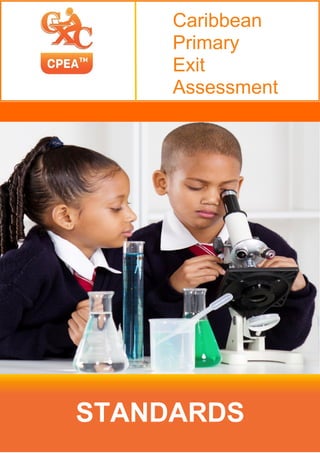
STANDARDS
Caribbean
Primary
Exit
Assessment
Published by Caribbean Examinations Council
Caenwood Centre
37 Arnold Road
Kingston 5
JAMAICA
Telephone Number: + 1 (876) 630-5200
Facsimile Number: + 1 (876) 967-4972
E-mail Address: cxcwzo@cxc.org
Website: www.cxc.org
Copyright ©2020 by Caribbean Examinations Council
Prince Road, Pine Plantation Road, St Michael BB11091
CARIBBEAN PRIMARY
EXIT ASSESSMENT
(CPEA™)
STANDARDS
CPEATM Framework……………………………………………………...………………………………………………….2
Language Arts...................................................................................................................2
Mathematics....................................................................................................................2
Science.............................................................................................................................2
Social Studies ...................................................................................................................2
TABLE OF CONTENTS
Page | 1
CARIBBEAN PRIMARY EXIT ASSESSMENT (CPEATM
)
The Caribbean Examinations Council (CXC®) in consultation with policy makers and educators in CXC®
Participating Countries identified the need for a Caribbean Primary Exit Examination (CPEE). A sound
primary education is imperative for further education and training and preparation for life.
All Participating Countries have existing national programmes at the primary level. The Council is
involved in the examination process for three of these countries. However, through consultations at
the regional level, policy makers and educators have recognised that a regional primary exit
examination by CXC® would have several benefits including improved efficiency, cost-effectiveness,
standard-setting, portability of certification and regional and international recognition.
Primary education is concerned with developing fundamental knowledge and skills in literacy and
numeracy as well as ensuring secondary socialisation. It should foster in children an awareness of
themselves as members of a society and should provide them with opportunities to cooperate with
others in their social environment. This education should cater to the holistic development of children
without compromising their individuality. It should promote life-long learning, prepare them for
higher levels of education, and sensitise them to learning as a continuous process. On completion,
learners should acquire the knowledge, skills, competencies, values and attitudes that are desired.
CXC® has responded and through its consultative processes has developed the CPEE. Preparation for
this examination will assist students to complete critical areas of the school curriculum as they
transition to secondary education. The assessment focuses on critical literacies, with a sharper
emphasis on skills and competencies than on content. The range of literacies has been grouped under
the following headings: language, mathematical, civic, scientific and technological and also includes,
aesthetic and personal literacies.
In developing this primary level examination, CXC®, working with its partners, took into consideration
the cultural context and the aspirations of regional governments to meet the targets set for social and
economic development as enshrined in the CARICOM document, “The Ideal Caribbean Person (2000)”.
A sound primary education is seen as the starting point of healthy democracies, sustainable
development, and a necessity for the economic survival of the small states of the region.
The knowledge, skills, attitudes, values and attributes that the programme will assess are fundamental
literacies that cut across all subjects. The literacies targeted for development in the programme are
given below.
CPEATM
Framework
LANGUAGE
ARTS
Page | 3
LANGUAGE ARTS can be described as the ability to understand and use language to communicate
effectively.
Listening and Speaking
Listening and speaking skills include, but are not limited to the skills necessary in formal presentations,
but include a range of skills that are useful for oral communication and the development of
interpersonal skills.
Listening and speaking standards require students to listen to and express ideas clearly, incorporate
information received from various sources, critically assess what has been heard, adapt speech to suit
context and use visual tools and media to support the communicative process.
Target 1: Listening with a high degree of understanding to instructions, descriptions,
explanations and narration in Caribbean Standard English, in a familiar accent
in the vocabulary and sentence structure appropriate to the age of the
student.
1. Listen to identify main ideas, cause and effect and sequential order of
points presented.
2. Discriminate between Creole and Standard English usage according to
place and circumstance.
3. Actively seek to understand other perspectives and cultures through
listening.
4. Listen to critically and constructively evaluate other points of view.
5. Listen carefully to ideas and integrate information from oral, visual and
quantitative and media sources.
6. Listen to critically evaluate what you hear though asking and answering
questions.
7. Demonstrate/confirm understanding of a piece read aloud or
information presented orally by asking and answering questions about
key details in the piece heard.
Target 2: Speaking by using words exactly and precisely for his/her age to
communicate thoughts and feelings; demonstrating spontaneity in speaking
in a variety of situations.
1. Use knowledge of language and language conventions when speaking
and listening.
2. Choose words and phrases for effect and to convey ideas precisely.
3. Compare and contrast different varieties of English (such as dialects)
used in stories, plays or poems.
Page | 4
4. Speak confidently in different contexts and situations for a variety of
purposes.
5. Use appropriate features of Standard English, vocabulary and grammar
in formal contexts.
6. Identify features of language used for a specific purpose, or example,
to persuade, inform or entertain.
7. Discriminate between Creole and Standard English usage according to
place and circumstance.
8. Engage collaboratively in discussion with diverse partners on a range
of issues by building on others ideas and expressing their own ideas
clearly.
9. Following predetermined, agreed-upon rules for discussion; listening
to others and taking turn to speak.
Reading and Viewing
Target 1: Reading effectively and for different purposes a variety of print and
electronic media.
Responding sensitively to varied and meaningful literature and other forms
of art at the appropriate level.
1. Read and respond to literary and informational pieces.
2. Identify and use ideas and information at the literal level, inferential
level and critical level.
3. Read to collect and interpret data, facts and ideas from multiple
sources.
4. Recognize organizational formats to assist in comprehension of
informational.
5. Make generalizations, draw conclusions and provide conclusions with
justifications from the text.
6. Read, view and interpret literary texts from a variety of genres.
7. Read to make logical inferences by citing specific textual evidence to
support conclusions drawn.
8. Identify main ideas (themes) from literary pieces and show evidence
of how the writer develops these themes.
Page | 5
9. Interpret words and phrases used in written pieces.
10. Compare and contrast characters or events in a story by making
reference to specific details in the story.
11. Use various forms of visual media to interpret and gain information.
Writing
Target 1: Expressing oneself legibly and accurately in the following forms of writing:
explanations, narratives, descriptions, explanations.
1. Use different forms of writing appropriately.
2. Use basic grammatical sentence structures correctly, spell common
polysyllabic words accurately.
3. Punctuate accurately using full stops, capital letters, question marks,
commas, apostrophes and inverted commas.
4. Use technological support to enhance simple documents.
5. Use strategies to revise work, change ideas and rewrite sentences for
clarity.
6. Thinking creatively, critically and constructively.
MATHEMATICS
Page | 7
MATHEMATICS
The ability to understand mathematical concepts and procedures and to approach problems from
different perspectives using a variety of problem-solving strategies.
Target 1:
Number and
Operations
Recognising and using numbers and number concepts.
Understanding and using fractions, percentages, proportions and decimals.
1. Develop an understanding of numbers, the relationship among numbers and
the number systems.
2. Know the value of numerals, associate them with their names-nominal, ordinal
and use real life situations and examples to show expression of these values.
3. Compare and order fractions, decimals and percent.
4. Perform computations accurately and make reasonable estimates.
5. Classify numbers using concepts such as square, prime, composite, odd, even,
factor and multiple.
6. Solve problems using the four basic operations.
Target 2:
Measurement
and Geometry
Applying mathematical concepts, facts and algorithms related to number, money,
measurement and geometry (space and shape).
1. Use non-standard and standard units competently.
2. Solve problems involving scale factors, ratio and proportion.
3. Develop, understand, and use formulae to find the perimeter and area of
simple polygons.
4. Select and apply appropriate standard units and tools to measure length, area,
mass, capacity, temperature and time.
5. Classify and identify two- and three- dimensional shapes according to their
attributes.
Target 3:
Statistics and
Probability
Collecting, recording and analysing data using tables, charts and diagrams.
1. Collect data on an area of interest.
2. Illustrate data using appropriate tables, graphs and charts.
3. Interpret information given in data and diagrams.
4. Determine the mode, mean and median for a set of data.
5. Use probability to make predictions.
Target 4:
Problem
Solving
Approaching problem solving and inquiry at a level appropriate to the age of the
student.
Applying principles to solve worded problems and everyday problems.
SCIENCE
Page | 9
SCIENCE
Target 1:
Science, Technology
and the Environment
Relate science and technology to the society and the environment.
1. Use knowledge of science and technology to inform decision
making and to solve everyday problems.
2. Engage in science-related issues and discussions as a reflective
citizen.
3. Develop an appreciation for the society and the environment
that will foster a better quality of life.
Target 2:
Problem-solving and
communication Skills
and Strategies
Develop skills and strategies required for problem-solving and
communicating information.
1. Use the senses to observe and classify organisms and objects.
2. Use scientific knowledge to form and test hypothesis and
interpret results.
3. Predict or describe the outcome in advance of an event.
4. Measure by using instruments and appropriate units.
5. Develop and use models.
6. Design procedures to obtain information.
7. Collect and record data using tables, charts and diagrams.
8. Analyse data to form conclusions.
9. Evaluate and communicate information.
Target 3:
Utilising Scientific
Knowledge
Understand the basic concepts of science and technology.
1. Use scientific vocabulary to ask questions, define problems and
explain scientific phenomena.
2. Use scientific knowledge to identify concepts such as patterns;
cause and effects; structure and functions; matter and energy;
and stability and change.
SOCIAL
STUDIES
Page | 11
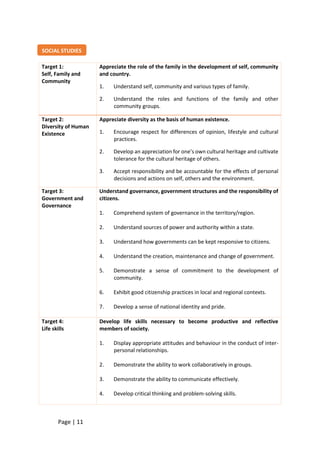
SOCIAL STUDIES
Target 1:
Self, Family and
Community
Appreciate the role of the family in the development of self, community
and country.
1. Understand self, community and various types of family.
2. Understand the roles and functions of the family and other
community groups.
Target 2:
Diversity of Human
Existence
Appreciate diversity as the basis of human existence.
1. Encourage respect for differences of opinion, lifestyle and cultural
practices.
2. Develop an appreciation for one’s own cultural heritage and cultivate
tolerance for the cultural heritage of others.
3. Accept responsibility and be accountable for the effects of personal
decisions and actions on self, others and the environment.
Target 3:
Government and
Governance
Understand governance, government structures and the responsibility of
citizens.
1. Comprehend system of governance in the territory/region.
2. Understand sources of power and authority within a state.
3. Understand how governments can be kept responsive to citizens.
4. Understand the creation, maintenance and change of government.
5. Demonstrate a sense of commitment to the development of
community.
6. Exhibit good citizenship practices in local and regional contexts.
7. Develop a sense of national identity and pride.
Target 4:
Life skills
Develop life skills necessary to become productive and reflective
members of society.
1. Display appropriate attitudes and behaviour in the conduct of inter-
personal relationships.
2. Demonstrate the ability to work collaboratively in groups.
3. Demonstrate the ability to communicate effectively.
4. Develop critical thinking and problem-solving skills.
Page | 12
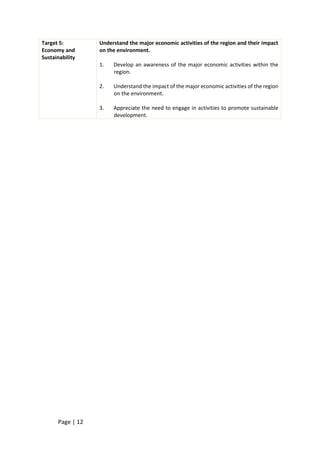
Target 5:
Economy and
Sustainability
Understand the major economic activities of the region and their impact
on the environment.
1. Develop an awareness of the major economic activities within the
region.
2. Understand the impact of the major economic activities of the region
on the environment.
3. Appreciate the need to engage in activities to promote sustainable
development.
CPEA Standards Revised Handbook

CPEA Standards Revised Handbook

  • 1.
  • 2.
    Published by CaribbeanExaminations Council Caenwood Centre 37 Arnold Road Kingston 5 JAMAICA Telephone Number: + 1 (876) 630-5200 Facsimile Number: + 1 (876) 967-4972 E-mail Address: cxcwzo@cxc.org Website: www.cxc.org Copyright ©2020 by Caribbean Examinations Council Prince Road, Pine Plantation Road, St Michael BB11091
  • 3.
  • 4.
  • 5.
    Page | 1 CARIBBEANPRIMARY EXIT ASSESSMENT (CPEATM ) The Caribbean Examinations Council (CXC®) in consultation with policy makers and educators in CXC® Participating Countries identified the need for a Caribbean Primary Exit Examination (CPEE). A sound primary education is imperative for further education and training and preparation for life. All Participating Countries have existing national programmes at the primary level. The Council is involved in the examination process for three of these countries. However, through consultations at the regional level, policy makers and educators have recognised that a regional primary exit examination by CXC® would have several benefits including improved efficiency, cost-effectiveness, standard-setting, portability of certification and regional and international recognition. Primary education is concerned with developing fundamental knowledge and skills in literacy and numeracy as well as ensuring secondary socialisation. It should foster in children an awareness of themselves as members of a society and should provide them with opportunities to cooperate with others in their social environment. This education should cater to the holistic development of children without compromising their individuality. It should promote life-long learning, prepare them for higher levels of education, and sensitise them to learning as a continuous process. On completion, learners should acquire the knowledge, skills, competencies, values and attitudes that are desired. CXC® has responded and through its consultative processes has developed the CPEE. Preparation for this examination will assist students to complete critical areas of the school curriculum as they transition to secondary education. The assessment focuses on critical literacies, with a sharper emphasis on skills and competencies than on content. The range of literacies has been grouped under the following headings: language, mathematical, civic, scientific and technological and also includes, aesthetic and personal literacies. In developing this primary level examination, CXC®, working with its partners, took into consideration the cultural context and the aspirations of regional governments to meet the targets set for social and economic development as enshrined in the CARICOM document, “The Ideal Caribbean Person (2000)”. A sound primary education is seen as the starting point of healthy democracies, sustainable development, and a necessity for the economic survival of the small states of the region. The knowledge, skills, attitudes, values and attributes that the programme will assess are fundamental literacies that cut across all subjects. The literacies targeted for development in the programme are given below. CPEATM Framework
  • 6.
  • 7.
    Page | 3 LANGUAGEARTS can be described as the ability to understand and use language to communicate effectively. Listening and Speaking Listening and speaking skills include, but are not limited to the skills necessary in formal presentations, but include a range of skills that are useful for oral communication and the development of interpersonal skills. Listening and speaking standards require students to listen to and express ideas clearly, incorporate information received from various sources, critically assess what has been heard, adapt speech to suit context and use visual tools and media to support the communicative process. Target 1: Listening with a high degree of understanding to instructions, descriptions, explanations and narration in Caribbean Standard English, in a familiar accent in the vocabulary and sentence structure appropriate to the age of the student. 1. Listen to identify main ideas, cause and effect and sequential order of points presented. 2. Discriminate between Creole and Standard English usage according to place and circumstance. 3. Actively seek to understand other perspectives and cultures through listening. 4. Listen to critically and constructively evaluate other points of view. 5. Listen carefully to ideas and integrate information from oral, visual and quantitative and media sources. 6. Listen to critically evaluate what you hear though asking and answering questions. 7. Demonstrate/confirm understanding of a piece read aloud or information presented orally by asking and answering questions about key details in the piece heard. Target 2: Speaking by using words exactly and precisely for his/her age to communicate thoughts and feelings; demonstrating spontaneity in speaking in a variety of situations. 1. Use knowledge of language and language conventions when speaking and listening. 2. Choose words and phrases for effect and to convey ideas precisely. 3. Compare and contrast different varieties of English (such as dialects) used in stories, plays or poems.
  • 8.
    Page | 4 4.Speak confidently in different contexts and situations for a variety of purposes. 5. Use appropriate features of Standard English, vocabulary and grammar in formal contexts. 6. Identify features of language used for a specific purpose, or example, to persuade, inform or entertain. 7. Discriminate between Creole and Standard English usage according to place and circumstance. 8. Engage collaboratively in discussion with diverse partners on a range of issues by building on others ideas and expressing their own ideas clearly. 9. Following predetermined, agreed-upon rules for discussion; listening to others and taking turn to speak. Reading and Viewing Target 1: Reading effectively and for different purposes a variety of print and electronic media. Responding sensitively to varied and meaningful literature and other forms of art at the appropriate level. 1. Read and respond to literary and informational pieces. 2. Identify and use ideas and information at the literal level, inferential level and critical level. 3. Read to collect and interpret data, facts and ideas from multiple sources. 4. Recognize organizational formats to assist in comprehension of informational. 5. Make generalizations, draw conclusions and provide conclusions with justifications from the text. 6. Read, view and interpret literary texts from a variety of genres. 7. Read to make logical inferences by citing specific textual evidence to support conclusions drawn. 8. Identify main ideas (themes) from literary pieces and show evidence of how the writer develops these themes.
  • 9.
    Page | 5 9.Interpret words and phrases used in written pieces. 10. Compare and contrast characters or events in a story by making reference to specific details in the story. 11. Use various forms of visual media to interpret and gain information. Writing Target 1: Expressing oneself legibly and accurately in the following forms of writing: explanations, narratives, descriptions, explanations. 1. Use different forms of writing appropriately. 2. Use basic grammatical sentence structures correctly, spell common polysyllabic words accurately. 3. Punctuate accurately using full stops, capital letters, question marks, commas, apostrophes and inverted commas. 4. Use technological support to enhance simple documents. 5. Use strategies to revise work, change ideas and rewrite sentences for clarity. 6. Thinking creatively, critically and constructively.
  • 10.
  • 11.
    Page | 7 MATHEMATICS Theability to understand mathematical concepts and procedures and to approach problems from different perspectives using a variety of problem-solving strategies. Target 1: Number and Operations Recognising and using numbers and number concepts. Understanding and using fractions, percentages, proportions and decimals. 1. Develop an understanding of numbers, the relationship among numbers and the number systems. 2. Know the value of numerals, associate them with their names-nominal, ordinal and use real life situations and examples to show expression of these values. 3. Compare and order fractions, decimals and percent. 4. Perform computations accurately and make reasonable estimates. 5. Classify numbers using concepts such as square, prime, composite, odd, even, factor and multiple. 6. Solve problems using the four basic operations. Target 2: Measurement and Geometry Applying mathematical concepts, facts and algorithms related to number, money, measurement and geometry (space and shape). 1. Use non-standard and standard units competently. 2. Solve problems involving scale factors, ratio and proportion. 3. Develop, understand, and use formulae to find the perimeter and area of simple polygons. 4. Select and apply appropriate standard units and tools to measure length, area, mass, capacity, temperature and time. 5. Classify and identify two- and three- dimensional shapes according to their attributes. Target 3: Statistics and Probability Collecting, recording and analysing data using tables, charts and diagrams. 1. Collect data on an area of interest. 2. Illustrate data using appropriate tables, graphs and charts. 3. Interpret information given in data and diagrams. 4. Determine the mode, mean and median for a set of data. 5. Use probability to make predictions. Target 4: Problem Solving Approaching problem solving and inquiry at a level appropriate to the age of the student. Applying principles to solve worded problems and everyday problems.
  • 12.
  • 13.
    Page | 9 SCIENCE Target1: Science, Technology and the Environment Relate science and technology to the society and the environment. 1. Use knowledge of science and technology to inform decision making and to solve everyday problems. 2. Engage in science-related issues and discussions as a reflective citizen. 3. Develop an appreciation for the society and the environment that will foster a better quality of life. Target 2: Problem-solving and communication Skills and Strategies Develop skills and strategies required for problem-solving and communicating information. 1. Use the senses to observe and classify organisms and objects. 2. Use scientific knowledge to form and test hypothesis and interpret results. 3. Predict or describe the outcome in advance of an event. 4. Measure by using instruments and appropriate units. 5. Develop and use models. 6. Design procedures to obtain information. 7. Collect and record data using tables, charts and diagrams. 8. Analyse data to form conclusions. 9. Evaluate and communicate information. Target 3: Utilising Scientific Knowledge Understand the basic concepts of science and technology. 1. Use scientific vocabulary to ask questions, define problems and explain scientific phenomena. 2. Use scientific knowledge to identify concepts such as patterns; cause and effects; structure and functions; matter and energy; and stability and change.
  • 14.
  • 15.
    Page | 11 SOCIALSTUDIES Target 1: Self, Family and Community Appreciate the role of the family in the development of self, community and country. 1. Understand self, community and various types of family. 2. Understand the roles and functions of the family and other community groups. Target 2: Diversity of Human Existence Appreciate diversity as the basis of human existence. 1. Encourage respect for differences of opinion, lifestyle and cultural practices. 2. Develop an appreciation for one’s own cultural heritage and cultivate tolerance for the cultural heritage of others. 3. Accept responsibility and be accountable for the effects of personal decisions and actions on self, others and the environment. Target 3: Government and Governance Understand governance, government structures and the responsibility of citizens. 1. Comprehend system of governance in the territory/region. 2. Understand sources of power and authority within a state. 3. Understand how governments can be kept responsive to citizens. 4. Understand the creation, maintenance and change of government. 5. Demonstrate a sense of commitment to the development of community. 6. Exhibit good citizenship practices in local and regional contexts. 7. Develop a sense of national identity and pride. Target 4: Life skills Develop life skills necessary to become productive and reflective members of society. 1. Display appropriate attitudes and behaviour in the conduct of inter- personal relationships. 2. Demonstrate the ability to work collaboratively in groups. 3. Demonstrate the ability to communicate effectively. 4. Develop critical thinking and problem-solving skills.
  • 16.
    Page | 12 Target5: Economy and Sustainability Understand the major economic activities of the region and their impact on the environment. 1. Develop an awareness of the major economic activities within the region. 2. Understand the impact of the major economic activities of the region on the environment. 3. Appreciate the need to engage in activities to promote sustainable development.