Bone density for dental
implants
Dr.Ahmad Jawed “Safi”
Safi dental clinic
Factors related to bone density
 Treatment planning
 Drilling speed during osteotomy prep
 Saline irrigation flow during osteotomy pre
 Implant design with predictable success rate
 Implant surface for predictable osseointegration
 Surgical approach for implant insertion
 Healing protocol(submerged or open)
 The number of implants required to support multiple
unit prosthesis
 Primary stability of the implant
 Loading protocol- immediate/early/delayed
Safi dental clinic
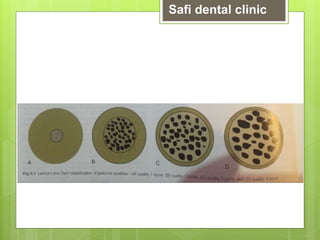
Lekhom and Zarb classification
for jawbone qualities
 Quality 1– homogenous compact bone
 Quality 2– thick layer of compact bone
surrounding a core of dense trabecular bone
 Quality 3- a thin layer of cortical bone surrounding
a dense trabecular bone of favorable strength
 Quality 4- a thin layer of cortical bone surrounding
a core of low-density trabecular bone
Safi dental clinic
Safi dental clinic
Misch bone density
classification
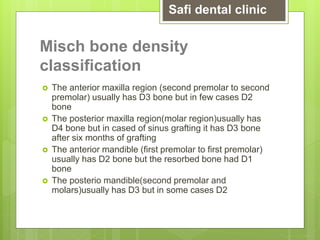
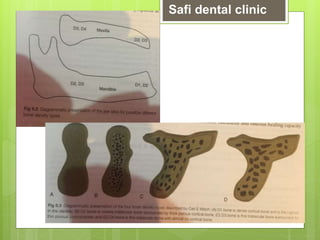
 The anterior maxilla region (second premolar to second
premolar) usually has D3 bone but in few cases D2
bone
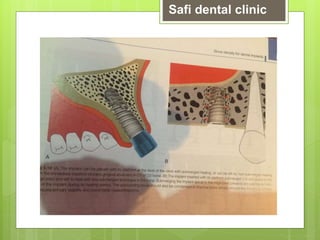
 The posterior maxilla region(molar region)usually has
D4 bone but in cased of sinus grafting it has D3 bone
after six months of grafting
 The anterior mandible (first premolar to first premolar)
usually has D2 bone but the resorbed bone had D1
bone
 The posterio mandible(second premolar and
molars)usually has D3 but in some cases D2
Safi dental clinic
Safi dental clinic
Determination of bone density
 Computed tomography(CT)
 Tactile determination during bone drilling
 Bone gauge (measurable )
Safi dental clinic
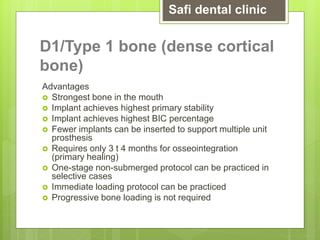
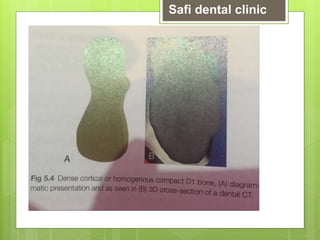
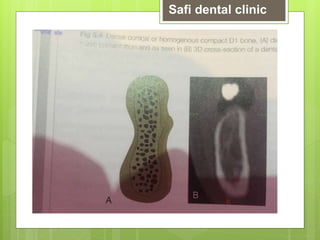
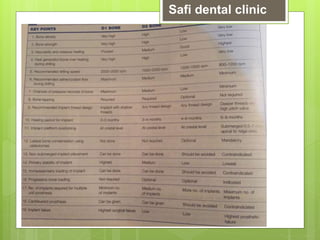
D1/Type 1 bone (dense cortical
bone)
Advantages
 Strongest bone in the mouth
 Implant achieves highest primary stability
 Implant achieves highest BIC percentage
 Fewer implants can be inserted to support multiple unit
prosthesis
 Requires only 3 t 4 months for osseointegration
(primary healing)
 One-stage non-submerged protocol can be practiced in
selective cases
 Immediate loading protocol can be practiced
 Progressive bone loading is not required
Safi dental clinic
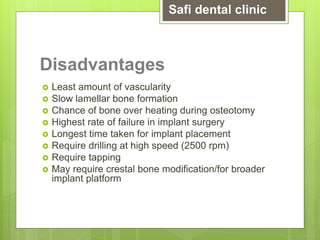
Disadvantages
 Least amount of vascularity
 Slow lamellar bone formation
 Chance of bone over heating during osteotomy
 Highest rate of failure in implant surgery
 Longest time taken for implant placement
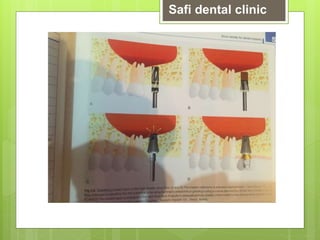
 Require drilling at high speed (2500 rpm)
 Require tapping
 May require crestal bone modification/for broader
implant platform
Safi dental clinic
Safi dental clinic
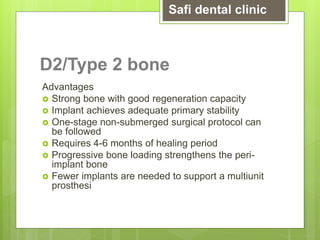
D2/Type 2 bone
Advantages
 Strong bone with good regeneration capacity
 Implant achieves adequate primary stability
 One-stage non-submerged surgical protocol can
be followed
 Requires 4-6 months of healing period
 Progressive bone loading strengthens the peri-
implant bone
 Fewer implants are needed to support a multiunit
prosthesi
Safi dental clinic
Continue…
Disadvantages
 May require tapping for implants with non-
cutting thread implants
 May require crestal bone modification
Safi dental clinic
Safi dental clinic
D3/type 3 bone
 Advantages
 Faster osteotomy preparation at lower speed
 Bone tapping is optional
 Crestal bone drilling is optional
 Excellent vascularity
 Chance of bone overheating are small
Safi dental clinic
Continue…
 Disadvantages
 Healing period of 6-8 months
 Implant may achieves inadequate primary stability
 More implants are required to be inserted to
support multiunit prosthesis
 Immediate/early bone loading protocol should be
avoided
 Longer progressive loading period is required to
improve bone quality
Safi dental clinic
Safi dental clinic
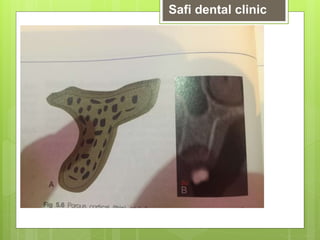
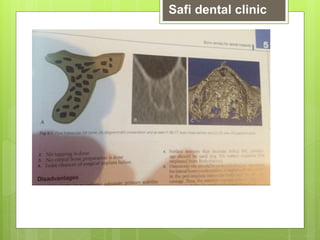
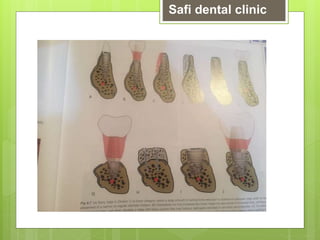
D4/type 4 bone
 Advantages
 Only initail or no drilling is done but only
osteotomes can be used
 No tapping is done
 No crestal bone preparation is done
 Least chance of surgical implant failure
Safi dental clinic
Continue..
 Disadvantages
 Often difficult to achieve adequate primary
stability for the implant
 Long healing period (8-10 months)
 More implants need to be inserted to support
a multiunit prosthesis
 Long period of progressive loading is required
 Highest rate of prosthetic implant failure
Safi dental clinic
Safi dental clinic
Safi dental clinic
Safi dental clinic
Safi dental clinic
Safi dental clinic
Safi dental clinic
Role of available bone in dental
implants
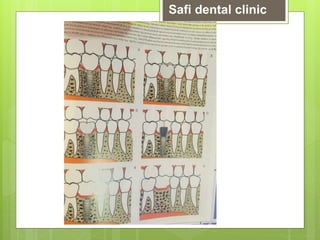
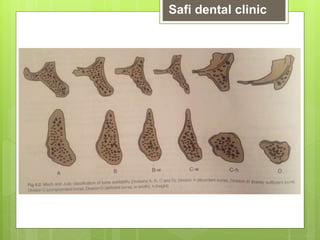
 Mish and Judy classification of bone
avialibility
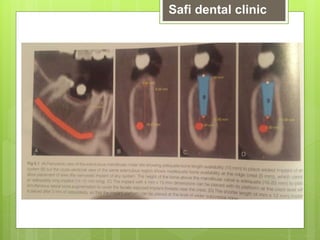
 Division A (Abundant) bone
 Division B (barely adequate)bone
 Division C (compromised) bone
 Division D (deficient bone)
Safi dental clinic
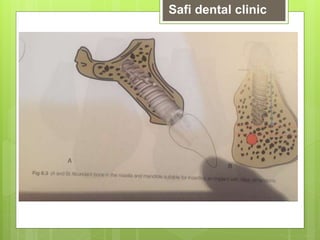
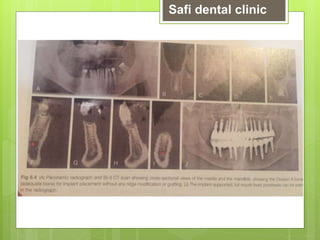
Division A (abundant bone)
 Division A bone is three-dimentionally
abundant for the ideal impalnt insertion
 Bone is this category should be
 5 mm or more in width
 12 mm or more in height
 7 mm or more in length
 Less than 30o in angulation
 15 mm or less in crown height
Safi dental clinic
Prosthetic option for division A
bone
 Is the best bone for any prosthetic option
 May need osteoplasty for implant overdenture
to achieve more vertical height
Safi dental clinic
Safi dental clinic
Safi dental clinic
Safi dental clinic
Safi dental clinic
Division B (barely adequate
bone)
 Bone in this category should be
 2.5 – 5 mm in width
 12 mm or more in height
 6 mm or more in length
 Less than 20 degree in angulation
 15 mm or less in crown height
Safi dental clinic
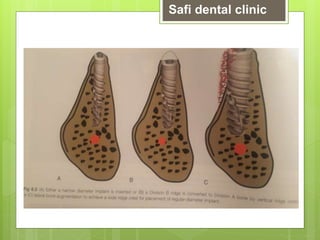
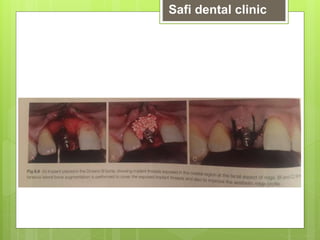
Prosthetic option for division B
bone
 By osteoplasty of ridge we could reach to the
division A bone
 Lateral bone augmentation can also be
performed
Safi dental clinic
Safi dental clinic
Safi dental clinic
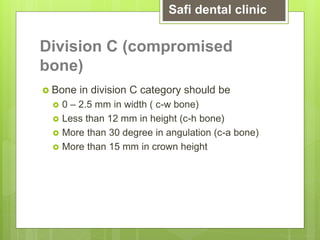
Division C (compromised
bone)
 Bone in division C category should be
 0 – 2.5 mm in width ( c-w bone)
 Less than 12 mm in height (c-h bone)
 More than 30 degree in angulation (c-a bone)
 More than 15 mm in crown height
Safi dental clinic
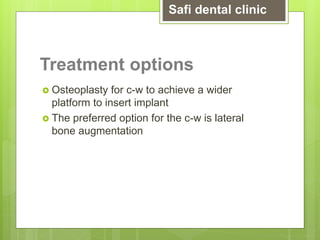
Treatment options
 Osteoplasty for c-w to achieve a wider
platform to insert implant
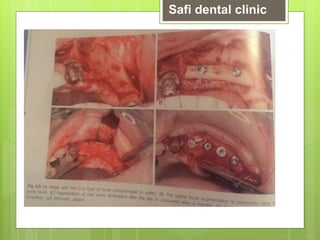
 The preferred option for the c-w is lateral
bone augmentation
Safi dental clinic
Safi dental clinic
Safi dental clinic
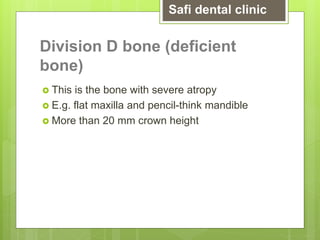
Division D bone (deficient
bone)
 This is the bone with severe atropy
 E.g. flat maxilla and pencil-think mandible
 More than 20 mm crown height
Safi dental clinic
Treatment options for deficient
ridge
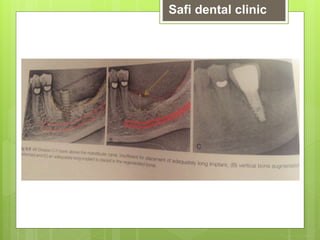
 Vertical block grafting
 Nerve transpositoning
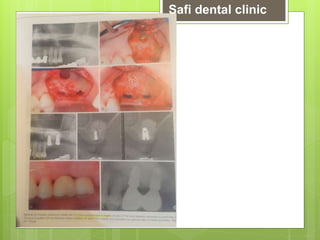
 Sinus/nasal floor elevation
 Ridge split
 All on 4/6
Safi dental clinic
Prosthetic options for division D
bone
 Implant overdenture is the treatment of choice
Safi dental clinic
Safi dental clinic
Safi dental clinic
Safi dental clinic
Safi dental clinic
Thank you
Safi dental clinic

[5]bone density for dental implants [ 5 ].pptx

  • 1.
    Bone density fordental implants Dr.Ahmad Jawed “Safi” Safi dental clinic
  • 2.
    Factors related tobone density  Treatment planning  Drilling speed during osteotomy prep  Saline irrigation flow during osteotomy pre  Implant design with predictable success rate  Implant surface for predictable osseointegration  Surgical approach for implant insertion  Healing protocol(submerged or open)  The number of implants required to support multiple unit prosthesis  Primary stability of the implant  Loading protocol- immediate/early/delayed Safi dental clinic
  • 3.
    Lekhom and Zarbclassification for jawbone qualities  Quality 1– homogenous compact bone  Quality 2– thick layer of compact bone surrounding a core of dense trabecular bone  Quality 3- a thin layer of cortical bone surrounding a dense trabecular bone of favorable strength  Quality 4- a thin layer of cortical bone surrounding a core of low-density trabecular bone Safi dental clinic
  • 4.
  • 5.
    Misch bone density classification The anterior maxilla region (second premolar to second premolar) usually has D3 bone but in few cases D2 bone  The posterior maxilla region(molar region)usually has D4 bone but in cased of sinus grafting it has D3 bone after six months of grafting  The anterior mandible (first premolar to first premolar) usually has D2 bone but the resorbed bone had D1 bone  The posterio mandible(second premolar and molars)usually has D3 but in some cases D2 Safi dental clinic
  • 6.
  • 7.
    Determination of bonedensity  Computed tomography(CT)  Tactile determination during bone drilling  Bone gauge (measurable ) Safi dental clinic
  • 8.
    D1/Type 1 bone(dense cortical bone) Advantages  Strongest bone in the mouth  Implant achieves highest primary stability  Implant achieves highest BIC percentage  Fewer implants can be inserted to support multiple unit prosthesis  Requires only 3 t 4 months for osseointegration (primary healing)  One-stage non-submerged protocol can be practiced in selective cases  Immediate loading protocol can be practiced  Progressive bone loading is not required Safi dental clinic
  • 9.
    Disadvantages  Least amountof vascularity  Slow lamellar bone formation  Chance of bone over heating during osteotomy  Highest rate of failure in implant surgery  Longest time taken for implant placement  Require drilling at high speed (2500 rpm)  Require tapping  May require crestal bone modification/for broader implant platform Safi dental clinic
  • 10.
  • 11.
    D2/Type 2 bone Advantages Strong bone with good regeneration capacity  Implant achieves adequate primary stability  One-stage non-submerged surgical protocol can be followed  Requires 4-6 months of healing period  Progressive bone loading strengthens the peri- implant bone  Fewer implants are needed to support a multiunit prosthesi Safi dental clinic
  • 12.
    Continue… Disadvantages  May requiretapping for implants with non- cutting thread implants  May require crestal bone modification Safi dental clinic
  • 13.
  • 14.
    D3/type 3 bone Advantages  Faster osteotomy preparation at lower speed  Bone tapping is optional  Crestal bone drilling is optional  Excellent vascularity  Chance of bone overheating are small Safi dental clinic
  • 15.
    Continue…  Disadvantages  Healingperiod of 6-8 months  Implant may achieves inadequate primary stability  More implants are required to be inserted to support multiunit prosthesis  Immediate/early bone loading protocol should be avoided  Longer progressive loading period is required to improve bone quality Safi dental clinic
  • 16.
  • 17.
    D4/type 4 bone Advantages  Only initail or no drilling is done but only osteotomes can be used  No tapping is done  No crestal bone preparation is done  Least chance of surgical implant failure Safi dental clinic
  • 18.
    Continue..  Disadvantages  Oftendifficult to achieve adequate primary stability for the implant  Long healing period (8-10 months)  More implants need to be inserted to support a multiunit prosthesis  Long period of progressive loading is required  Highest rate of prosthetic implant failure Safi dental clinic
  • 19.
  • 20.
  • 21.
  • 22.
  • 23.
  • 24.
  • 25.
    Role of availablebone in dental implants  Mish and Judy classification of bone avialibility  Division A (Abundant) bone  Division B (barely adequate)bone  Division C (compromised) bone  Division D (deficient bone) Safi dental clinic
  • 26.
    Division A (abundantbone)  Division A bone is three-dimentionally abundant for the ideal impalnt insertion  Bone is this category should be  5 mm or more in width  12 mm or more in height  7 mm or more in length  Less than 30o in angulation  15 mm or less in crown height Safi dental clinic
  • 27.
    Prosthetic option fordivision A bone  Is the best bone for any prosthetic option  May need osteoplasty for implant overdenture to achieve more vertical height Safi dental clinic
  • 28.
  • 29.
  • 30.
  • 31.
  • 32.
    Division B (barelyadequate bone)  Bone in this category should be  2.5 – 5 mm in width  12 mm or more in height  6 mm or more in length  Less than 20 degree in angulation  15 mm or less in crown height Safi dental clinic
  • 33.
    Prosthetic option fordivision B bone  By osteoplasty of ridge we could reach to the division A bone  Lateral bone augmentation can also be performed Safi dental clinic
  • 34.
  • 35.
  • 36.
    Division C (compromised bone) Bone in division C category should be  0 – 2.5 mm in width ( c-w bone)  Less than 12 mm in height (c-h bone)  More than 30 degree in angulation (c-a bone)  More than 15 mm in crown height Safi dental clinic
  • 37.
    Treatment options  Osteoplastyfor c-w to achieve a wider platform to insert implant  The preferred option for the c-w is lateral bone augmentation Safi dental clinic
  • 38.
  • 39.
  • 40.
    Division D bone(deficient bone)  This is the bone with severe atropy  E.g. flat maxilla and pencil-think mandible  More than 20 mm crown height Safi dental clinic
  • 41.
    Treatment options fordeficient ridge  Vertical block grafting  Nerve transpositoning  Sinus/nasal floor elevation  Ridge split  All on 4/6 Safi dental clinic
  • 42.
    Prosthetic options fordivision D bone  Implant overdenture is the treatment of choice Safi dental clinic
  • 43.
  • 44.
  • 45.
  • 46.
  • 47.