Pre-Production
Rhys Sadler-Scott
Style sheet (Poster)
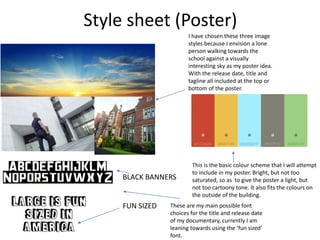
I have chosen these three image
styles because I envision a lone
person walking towards the
school against a visually
interesting sky as my poster idea.
With the release date, title and
tagline all included at the top or
bottom of the poster.
BLACK BANNERS
FUN SIZED These are my main possible font
choices for the title and release date
of my documentary, currently I am
leaning towards using the ‘fun sized’
font.
This is the basic colour scheme that I will attempt
to include in my poster. Bright, but not too
saturated, so as to give the poster a light, but
not too cartoony tone. It also fits the colours on
the outside of the building.
Style sheet (Documentary and trailer)
These images show how I want to interview the
subjects in my own documentary, each will be filmed in
a different location and different angles when
necessary, as well as having any relevant stock footage
inserted when possible. I will alternate between
showing what questions they were asked and dropping
into the interview cold when possible, to save time.
The documentary will feature a few sections where the
presenter tours around and outside the building, giving
information about the history of the place and the
students. This will feature tours and panning shots of
both the inside and outside of all of the school
buildings. To make the sure viewer has a good, solid
idea of where they are.
Style sheet (documentary and trailer)
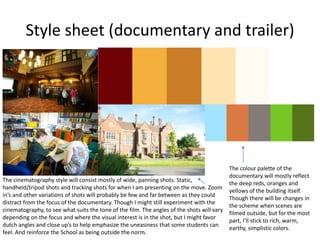
The colour palette of the
documentary will mostly reflect
the deep reds, oranges and
yellows of the building itself.
Though there will be changes in
the scheme when scenes are
filmed outside, but for the most
part, I’ll stick to rich, warm,
earthy, simplistic colors.
The cinematography style will consist mostly of wide, panning shots. Static,
handheld/tripod shots and tracking shots for when I am presenting on the move. Zoom
in’s and other variations of shots will probably be few and far between as they could
distract from the focus of the documentary. Though I might still experiment with the
cinematography, to see what suits the tone of the film. The angles of the shots will vary
depending on the focus and where the visual interest is in the shot, but I might favor
dutch angles and close up’s to help emphasize the uneasiness that some students can
feel. And reinforce the School as being outside the norm.
Layout (Poster)
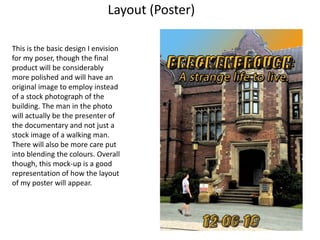
This is the basic design I envision
for my poser, though the final
product will be considerably
more polished and will have an
original image to employ instead
of a stock photograph of the
building. The man in the photo
will actually be the presenter of
the documentary and not just a
stock image of a walking man.
There will also be more care put
into blending the colours. Overall
though, this mock-up is a good
representation of how the layout
of my poster will appear.
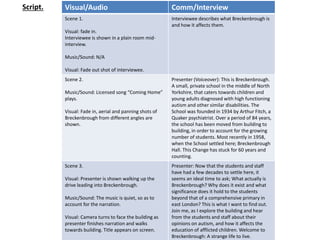
Script. Visual/Audio Comm/Interview
Scene 1.
Visual: fade in.
Interviewee is shown in a plain room mid-
interview.
Music/Sound: N/A
Visual: Fade out shot of interviewee.
Interviewee describes what Breckenbrough is
and how it affects them.
Scene 2.
Music/Sound: Licensed song “Coming Home”
plays.
Visual: Fade in, aerial and panning shots of
Breckenbrough from different angles are
shown.
Presenter (Voiceover): This is Breckenbrough.
A small, private school in the middle of North
Yorkshire, that caters towards children and
young adults diagnosed with high functioning
autism and other similar disabilities. The
School was founded in 1934 by Arthur Fitch, a
Quaker psychiatrist. Over a period of 84 years,
the school has been moved from building to
building, in order to account for the growing
number of students. Most recently in 1958,
when the School settled here; Breckenbrough
Hall. This Change has stuck for 60 years and
counting.
Scene 3.
Visual: Presenter is shown walking up the
drive leading into Breckenbrough.
Music/Sound: The music is quiet, so as to
account for the narration.
Visual: Camera turns to face the building as
presenter finishes narration and walks
towards building. Title appears on screen.
Presenter: Now that the students and staff
have had a few decades to settle here, it
seems an ideal time to ask; What actually is
Breckenbrough? Why does it exist and what
significance does it hold to the students
beyond that of a comprehensive primary in
east London? This is what I want to find out.
Join me, as I explore the building and hear
from the students and staff about their
opinions on autism, and how it affects the
education of afflicted children. Welcome to
Breckenbrough: A strange life to live.
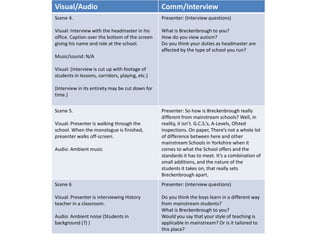
Visual/Audio Comm/Interview
Scene 4.
Visual: Interview with the headmaster in his
office. Caption over the bottom of the screen
giving his name and role at the school.
Music/sound: N/A
Visual: (interview is cut up with footage of
students in lessons, corridors, playing, etc.)
(Interview in its entirety may be cut down for
time.)
Presenter: (Interview questions)
What is Breckenbrough to you?
How do you view autism?
Do you think your duties as headmaster are
affected by the type of school you run?
Scene 5.
Visual: Presenter is walking through the
school. When the monologue is finished,
presenter walks off-screen.
Audio: Ambient music
Presenter: So how is Breckenbrough really
different from mainstream schools? Well, in
reality, it isn’t. G.C.S.’s, A-Levels, Ofsted
inspections. On paper, There’s not a whole lot
of difference between here and other
mainstream Schools in Yorkshire when it
comes to what the School offers and the
standards it has to meet. It’s a combination of
small additions, and the nature of the
students it takes on, that really sets
Breckenbrough apart.
Scene 6
Visual: Presenter is interviewing History
teacher in a classroom.
Audio: Ambient noise (Students in
background (?) )
Presenter: (Interview questions)
Do you think the boys learn in a different way
from mainstream students?
What is Breckenbrough to you?
Would you say that your style of teaching is
applicable in mainstream? Or is it tailored to
this place?
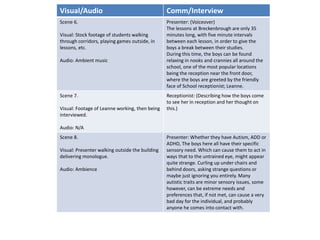
Visual/Audio Comm/Interview
Scene 6.
Visual: Stock footage of students walking
through corridors, playing games outside, in
lessons, etc.
Audio: Ambient music
Presenter: (Voiceover)
The lessons at Breckenbrough are only 35
minutes long, with five minute intervals
between each lesson, in order to give the
boys a break between their studies.
During this time, the boys can be found
relaxing in nooks and crannies all around the
school, one of the most popular locations
being the reception near the front door,
where the boys are greeted by the friendly
face of School receptionist; Leanne.
Scene 7.
Visual: Footage of Leanne working, then being
interviewed.
Audio: N/A
Receptionist: (Describing how the boys come
to see her in reception and her thought on
this.)
Scene 8.
Visual: Presenter walking outside the building
delivering monologue.
Audio: Ambience
Presenter: Whether they have Autism, ADD or
ADHD, The boys here all have their specific
sensory need. Which can cause them to act in
ways that to the untrained eye, might appear
quite strange. Curling up under chairs and
behind doors, asking strange questions or
maybe just ignoring you entirely. Many
autistic traits are minor sensory issues, some
however, can be extreme needs and
preferences that, if not met, can cause a very
bad day for the individual, and probably
anyone he comes into contact with.
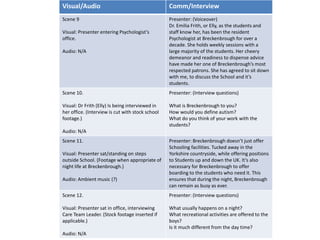
Visual/Audio Comm/Interview
Scene 9
Visual: Presenter entering Psychologist’s
office.
Audio: N/A
Presenter: (Voiceover)
Dr. Emilia Frith, or Elly, as the students and
staff know her, has been the resident
Psychologist at Breckenbrough for over a
decade. She holds weekly sessions with a
large majority of the students. Her cheery
demeanor and readiness to dispense advice
have made her one of Breckenbrough’s most
respected patrons. She has agreed to sit down
with me, to discuss the School and it’s
students.
Scene 10.
Visual: Dr Frith (Elly) Is being interviewed in
her office. (Interview is cut with stock school
footage.)
Audio: N/A
Presenter: (Interview questions)
What is Breckenbrough to you?
How would you define autism?
What do you think of your work with the
students?
Scene 11.
Visual: Presenter sat/standing on steps
outside School. (Footage when appropriate of
night life at Breckenbrough.)
Audio: Ambient music (?)
Presenter: Breckenbrough doesn’t just offer
Schooling facilities. Tucked away in the
Yorkshire countryside, while offering positions
to Students up and down the UK. It’s also
necessary for Breckenbrough to offer
boarding to the students who need it. This
ensures that during the night, Breckenbrough
can remain as busy as ever.
Scene 12.
Visual: Presenter sat in office, interviewing
Care Team Leader. (Stock footage inserted if
applicable.)
Audio: N/A
Presenter: (Interview questions)
What usually happens on a night?
What recreational activities are offered to the
boys?
Is it much different from the day time?
Visual/Audio Comm/Interview
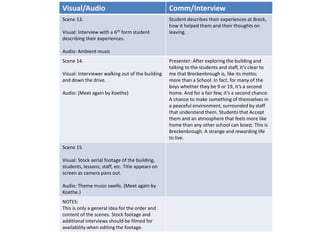
Scene 13.
Visual: Interview with a 6th form student
describing their experiences.
Audio: Ambient music
Student describes their experiences at Breck,
how it helped them and their thoughts on
leaving.
Scene 14.
Visual: Interviewer walking out of the building
and down the drive.
Audio: (Meet again by Koethe)
Presenter: After exploring the building and
talking to the students and staff, it’s clear to
me that Breckenbrough is, like its motto;
more than a School. In fact, for many of the
boys whether they be 9 or 19, it’s a second
home. And for a fair few, it’s a second chance.
A chance to make something of themselves in
a peaceful environment, surrounded by staff
that understand them. Students that Accept
them and an atmosphere that feels more like
home than any other school can boast. This is
Breckenbrough. A strange and rewarding life
to live.
Scene 15
Visual: Stock aerial footage of the building,
students, lessons, staff, etc. Title appears on
screen as camera pans out.
Audio: Theme music swells. (Meet again by
Koethe.)
NOTES:
This is only a general idea for the order and
content of the scenes. Stock footage and
additional interviews should be filmed for
availability when editing the footage.
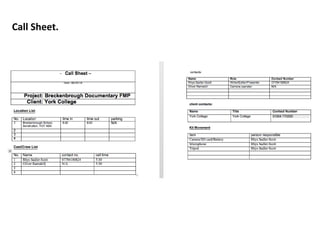
Call Sheet.
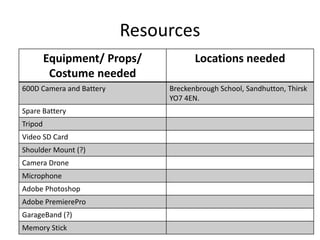
Resources
Equipment/ Props/
Costume needed
Locations needed
600D Camera and Battery Breckenbrough School, Sandhutton, Thirsk
YO7 4EN.
Spare Battery
Tripod
Video SD Card
Shoulder Mount (?)
Camera Drone
Microphone
Adobe Photoshop
Adobe PremierePro
GarageBand (?)
Memory Stick
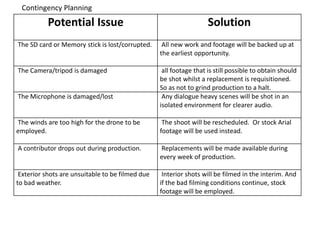
Contingency Planning
Potential Issue Solution
The SD card or Memory stick is lost/corrupted. All new work and footage will be backed up at
the earliest opportunity.
The Camera/tripod is damaged all footage that is still possible to obtain should
be shot whilst a replacement is requisitioned.
So as not to grind production to a halt.
The Microphone is damaged/lost Any dialogue heavy scenes will be shot in an
isolated environment for clearer audio.
The winds are too high for the drone to be
employed.
The shoot will be rescheduled. Or stock Arial
footage will be used instead.
A contributor drops out during production. Replacements will be made available during
every week of production.
Exterior shots are unsuitable to be filmed due
to bad weather.
Interior shots will be filmed in the interim. And
if the bad filming conditions continue, stock
footage will be employed.
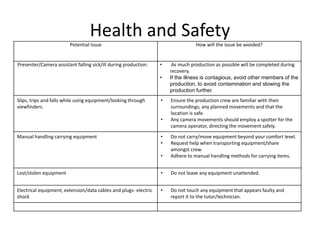
Health and Safety
Potential Issue How will the issue be avoided?
Presenter/Camera assistant falling sick/ill during production. • As much production as possible will be completed during
recovery.
• If the illness is contagious, avoid other members of the
production, to avoid contamination and slowing the
production further.
Slips, trips and falls while using equipment/looking through
viewfinders.
• Ensure the production crew are familiar with their
surroundings, any planned movements and that the
location is safe.
• Any camera movements should employ a spotter for the
camera operator, directing the movement safely.
Manual handling carrying equipment • Do not carry/move equipment beyond your comfort level.
• Request help when transporting equipment/share
amongst crew.
• Adhere to manual handling methods for carrying items.
Lost/stolen equipment • Do not leave any equipment unattended.
Electrical equipment, extension/data cables and plugs- electric
shock
• Do not touch any equipment that appears faulty and
report it to the tutor/technician.

5. pre production fmp

  • 1.
  • 2.
    Style sheet (Poster) Ihave chosen these three image styles because I envision a lone person walking towards the school against a visually interesting sky as my poster idea. With the release date, title and tagline all included at the top or bottom of the poster. BLACK BANNERS FUN SIZED These are my main possible font choices for the title and release date of my documentary, currently I am leaning towards using the ‘fun sized’ font. This is the basic colour scheme that I will attempt to include in my poster. Bright, but not too saturated, so as to give the poster a light, but not too cartoony tone. It also fits the colours on the outside of the building.
  • 3.
    Style sheet (Documentaryand trailer) These images show how I want to interview the subjects in my own documentary, each will be filmed in a different location and different angles when necessary, as well as having any relevant stock footage inserted when possible. I will alternate between showing what questions they were asked and dropping into the interview cold when possible, to save time. The documentary will feature a few sections where the presenter tours around and outside the building, giving information about the history of the place and the students. This will feature tours and panning shots of both the inside and outside of all of the school buildings. To make the sure viewer has a good, solid idea of where they are.
  • 4.
    Style sheet (documentaryand trailer) The colour palette of the documentary will mostly reflect the deep reds, oranges and yellows of the building itself. Though there will be changes in the scheme when scenes are filmed outside, but for the most part, I’ll stick to rich, warm, earthy, simplistic colors. The cinematography style will consist mostly of wide, panning shots. Static, handheld/tripod shots and tracking shots for when I am presenting on the move. Zoom in’s and other variations of shots will probably be few and far between as they could distract from the focus of the documentary. Though I might still experiment with the cinematography, to see what suits the tone of the film. The angles of the shots will vary depending on the focus and where the visual interest is in the shot, but I might favor dutch angles and close up’s to help emphasize the uneasiness that some students can feel. And reinforce the School as being outside the norm.
  • 5.
    Layout (Poster) This isthe basic design I envision for my poser, though the final product will be considerably more polished and will have an original image to employ instead of a stock photograph of the building. The man in the photo will actually be the presenter of the documentary and not just a stock image of a walking man. There will also be more care put into blending the colours. Overall though, this mock-up is a good representation of how the layout of my poster will appear.
  • 6.
    Script. Visual/Audio Comm/Interview Scene1. Visual: fade in. Interviewee is shown in a plain room mid- interview. Music/Sound: N/A Visual: Fade out shot of interviewee. Interviewee describes what Breckenbrough is and how it affects them. Scene 2. Music/Sound: Licensed song “Coming Home” plays. Visual: Fade in, aerial and panning shots of Breckenbrough from different angles are shown. Presenter (Voiceover): This is Breckenbrough. A small, private school in the middle of North Yorkshire, that caters towards children and young adults diagnosed with high functioning autism and other similar disabilities. The School was founded in 1934 by Arthur Fitch, a Quaker psychiatrist. Over a period of 84 years, the school has been moved from building to building, in order to account for the growing number of students. Most recently in 1958, when the School settled here; Breckenbrough Hall. This Change has stuck for 60 years and counting. Scene 3. Visual: Presenter is shown walking up the drive leading into Breckenbrough. Music/Sound: The music is quiet, so as to account for the narration. Visual: Camera turns to face the building as presenter finishes narration and walks towards building. Title appears on screen. Presenter: Now that the students and staff have had a few decades to settle here, it seems an ideal time to ask; What actually is Breckenbrough? Why does it exist and what significance does it hold to the students beyond that of a comprehensive primary in east London? This is what I want to find out. Join me, as I explore the building and hear from the students and staff about their opinions on autism, and how it affects the education of afflicted children. Welcome to Breckenbrough: A strange life to live.
  • 7.
    Visual/Audio Comm/Interview Scene 4. Visual:Interview with the headmaster in his office. Caption over the bottom of the screen giving his name and role at the school. Music/sound: N/A Visual: (interview is cut up with footage of students in lessons, corridors, playing, etc.) (Interview in its entirety may be cut down for time.) Presenter: (Interview questions) What is Breckenbrough to you? How do you view autism? Do you think your duties as headmaster are affected by the type of school you run? Scene 5. Visual: Presenter is walking through the school. When the monologue is finished, presenter walks off-screen. Audio: Ambient music Presenter: So how is Breckenbrough really different from mainstream schools? Well, in reality, it isn’t. G.C.S.’s, A-Levels, Ofsted inspections. On paper, There’s not a whole lot of difference between here and other mainstream Schools in Yorkshire when it comes to what the School offers and the standards it has to meet. It’s a combination of small additions, and the nature of the students it takes on, that really sets Breckenbrough apart. Scene 6 Visual: Presenter is interviewing History teacher in a classroom. Audio: Ambient noise (Students in background (?) ) Presenter: (Interview questions) Do you think the boys learn in a different way from mainstream students? What is Breckenbrough to you? Would you say that your style of teaching is applicable in mainstream? Or is it tailored to this place?
  • 8.
    Visual/Audio Comm/Interview Scene 6. Visual:Stock footage of students walking through corridors, playing games outside, in lessons, etc. Audio: Ambient music Presenter: (Voiceover) The lessons at Breckenbrough are only 35 minutes long, with five minute intervals between each lesson, in order to give the boys a break between their studies. During this time, the boys can be found relaxing in nooks and crannies all around the school, one of the most popular locations being the reception near the front door, where the boys are greeted by the friendly face of School receptionist; Leanne. Scene 7. Visual: Footage of Leanne working, then being interviewed. Audio: N/A Receptionist: (Describing how the boys come to see her in reception and her thought on this.) Scene 8. Visual: Presenter walking outside the building delivering monologue. Audio: Ambience Presenter: Whether they have Autism, ADD or ADHD, The boys here all have their specific sensory need. Which can cause them to act in ways that to the untrained eye, might appear quite strange. Curling up under chairs and behind doors, asking strange questions or maybe just ignoring you entirely. Many autistic traits are minor sensory issues, some however, can be extreme needs and preferences that, if not met, can cause a very bad day for the individual, and probably anyone he comes into contact with.
  • 9.
    Visual/Audio Comm/Interview Scene 9 Visual:Presenter entering Psychologist’s office. Audio: N/A Presenter: (Voiceover) Dr. Emilia Frith, or Elly, as the students and staff know her, has been the resident Psychologist at Breckenbrough for over a decade. She holds weekly sessions with a large majority of the students. Her cheery demeanor and readiness to dispense advice have made her one of Breckenbrough’s most respected patrons. She has agreed to sit down with me, to discuss the School and it’s students. Scene 10. Visual: Dr Frith (Elly) Is being interviewed in her office. (Interview is cut with stock school footage.) Audio: N/A Presenter: (Interview questions) What is Breckenbrough to you? How would you define autism? What do you think of your work with the students? Scene 11. Visual: Presenter sat/standing on steps outside School. (Footage when appropriate of night life at Breckenbrough.) Audio: Ambient music (?) Presenter: Breckenbrough doesn’t just offer Schooling facilities. Tucked away in the Yorkshire countryside, while offering positions to Students up and down the UK. It’s also necessary for Breckenbrough to offer boarding to the students who need it. This ensures that during the night, Breckenbrough can remain as busy as ever. Scene 12. Visual: Presenter sat in office, interviewing Care Team Leader. (Stock footage inserted if applicable.) Audio: N/A Presenter: (Interview questions) What usually happens on a night? What recreational activities are offered to the boys? Is it much different from the day time?
  • 10.
    Visual/Audio Comm/Interview Scene 13. Visual:Interview with a 6th form student describing their experiences. Audio: Ambient music Student describes their experiences at Breck, how it helped them and their thoughts on leaving. Scene 14. Visual: Interviewer walking out of the building and down the drive. Audio: (Meet again by Koethe) Presenter: After exploring the building and talking to the students and staff, it’s clear to me that Breckenbrough is, like its motto; more than a School. In fact, for many of the boys whether they be 9 or 19, it’s a second home. And for a fair few, it’s a second chance. A chance to make something of themselves in a peaceful environment, surrounded by staff that understand them. Students that Accept them and an atmosphere that feels more like home than any other school can boast. This is Breckenbrough. A strange and rewarding life to live. Scene 15 Visual: Stock aerial footage of the building, students, lessons, staff, etc. Title appears on screen as camera pans out. Audio: Theme music swells. (Meet again by Koethe.) NOTES: This is only a general idea for the order and content of the scenes. Stock footage and additional interviews should be filmed for availability when editing the footage.
  • 11.
  • 12.
    Resources Equipment/ Props/ Costume needed Locationsneeded 600D Camera and Battery Breckenbrough School, Sandhutton, Thirsk YO7 4EN. Spare Battery Tripod Video SD Card Shoulder Mount (?) Camera Drone Microphone Adobe Photoshop Adobe PremierePro GarageBand (?) Memory Stick
  • 13.
    Contingency Planning Potential IssueSolution The SD card or Memory stick is lost/corrupted. All new work and footage will be backed up at the earliest opportunity. The Camera/tripod is damaged all footage that is still possible to obtain should be shot whilst a replacement is requisitioned. So as not to grind production to a halt. The Microphone is damaged/lost Any dialogue heavy scenes will be shot in an isolated environment for clearer audio. The winds are too high for the drone to be employed. The shoot will be rescheduled. Or stock Arial footage will be used instead. A contributor drops out during production. Replacements will be made available during every week of production. Exterior shots are unsuitable to be filmed due to bad weather. Interior shots will be filmed in the interim. And if the bad filming conditions continue, stock footage will be employed.
  • 14.
    Health and Safety PotentialIssue How will the issue be avoided? Presenter/Camera assistant falling sick/ill during production. • As much production as possible will be completed during recovery. • If the illness is contagious, avoid other members of the production, to avoid contamination and slowing the production further. Slips, trips and falls while using equipment/looking through viewfinders. • Ensure the production crew are familiar with their surroundings, any planned movements and that the location is safe. • Any camera movements should employ a spotter for the camera operator, directing the movement safely. Manual handling carrying equipment • Do not carry/move equipment beyond your comfort level. • Request help when transporting equipment/share amongst crew. • Adhere to manual handling methods for carrying items. Lost/stolen equipment • Do not leave any equipment unattended. Electrical equipment, extension/data cables and plugs- electric shock • Do not touch any equipment that appears faulty and report it to the tutor/technician.

Editor's Notes

  • #3 Explore colours, fonts and image styles similar to what you want to produce. Discuss all three elements in relation to why you chose them and where you may use them in your project. Go over as many pages as you need to
  • #6 Mock up of a potential design using the colours and fonts established in your style sheet and sourced images Alter this slide to make it appropriate for your planned product types. Add further layout slides to create at least one for each product you plan to make.