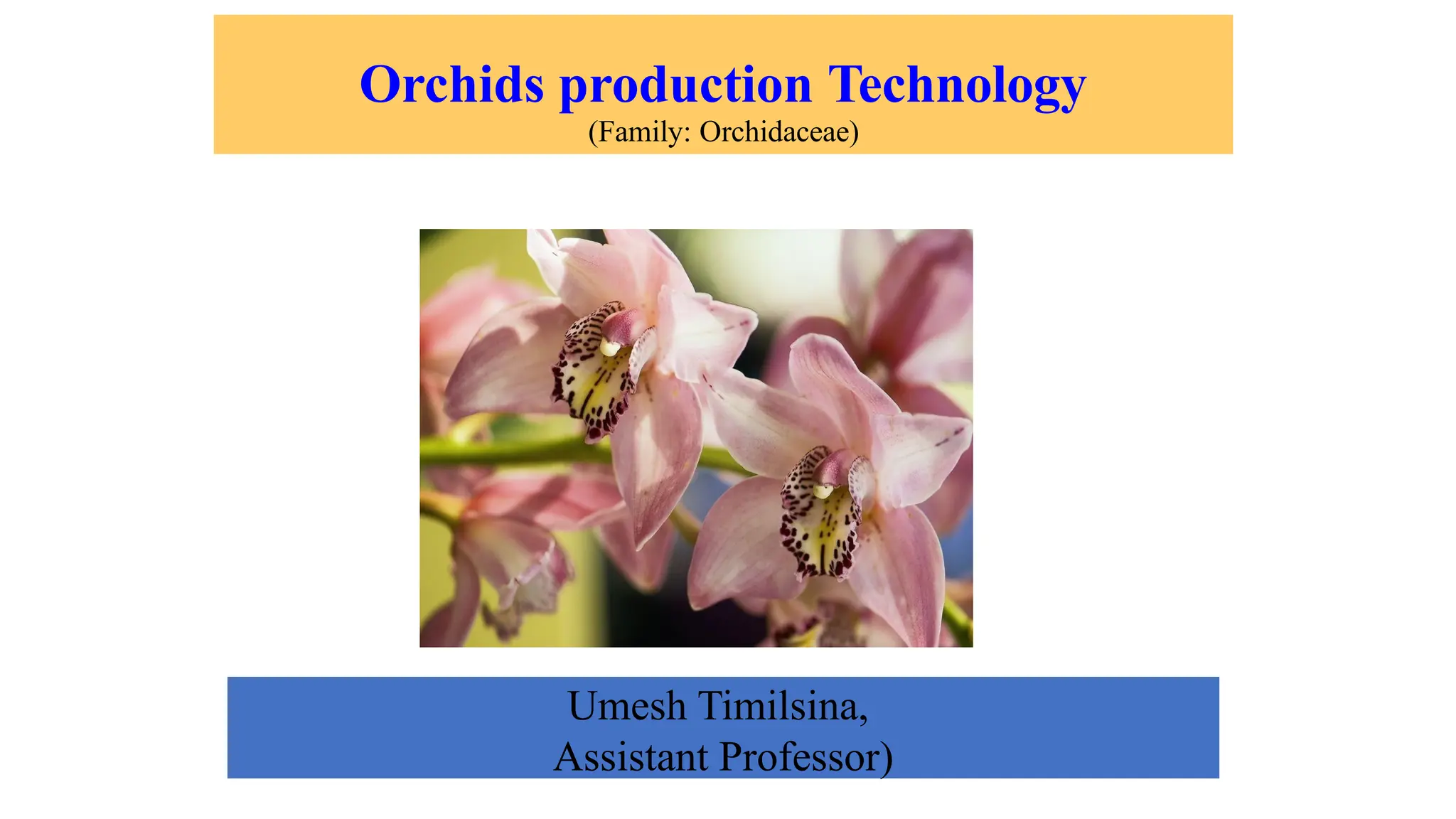
Orchids production Technology
(Family: Orchidaceae)
Umesh Timilsina,
Assistant Professor)
Presentation outline
• Introduction
• Types of Orchids
• Orchid Business
• Climate
• Propagation of orchids
• Growing Structures
• Containers for growing orchids
• Potting materials
• Potting, Repotting and aftercare of orchids
• Manuring and Fertilization
• Watering
• Pests and Diseases
• Harvesting
• Post harvest operations
• Packing and Transporting and marketing
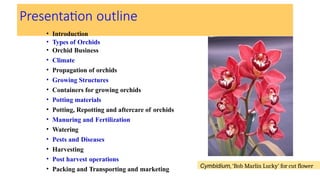
Cymbidium, ‘Bob Marlin Lucky’ for cut flower
Introductio
n
• Orchids are monocots belonging to the family orchidaceae.
• is one of the largest families of flowering plants, has 30,000
species and 100,000 hybrids.
• Orchids are highly valued for their cut flowers in commercial
floriculture owing to
• the wide range of colours, shapes, sizes and fragrance they
display,
• with long vase life.
• These plants differ from other flowering plants due to their pollen
that is formed into a mass, their stamens and pistils, which are
joined together in a structure called a “column”, and their seeds,
which are very small, do not contain endosperm and have no
organized embryo.
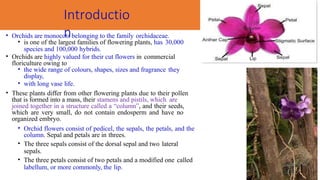
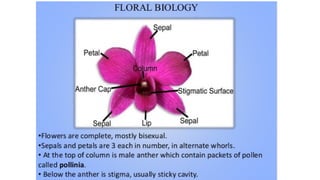
• Orchid flowers consist of pedicel, the sepals, the petals, and the
column. Sepal and petals are in threes.
• The three sepals consist of the dorsal sepal and two lateral
sepals.
• The three petals consist of two petals and a modified one called
labellum, or more commonly, the lip.
• Nepal harbors about 457 spp of native orchids
belonging to 105 genera, out of which 18
species are endemic to Nepal (Pradhan et al.,
2014).
• The main genus of commercially cultivate orchid
in Nepal is Cymbidium.
• Thirteen species of Cymbidium have been
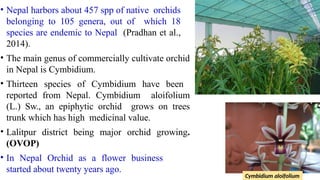
reported from Nepal. Cymbidium aloifolium
(L.) Sw., an epiphytic orchid grows on trees
trunk which has high medicinal value.
• Lalitpur district being major orchid growing.
(OVOP)
• In Nepal Orchid as a flower business
started about twenty years ago.
Cymbidium aloifolium
Interesting Fact about Orchid
Classification of orchid
1. On the basis of growth habit:
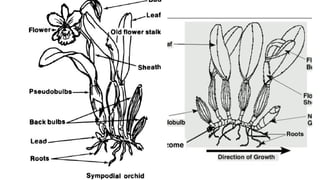
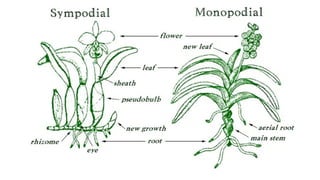
Orchids have two distinct patterns of growth – monopodial and
sympodial.
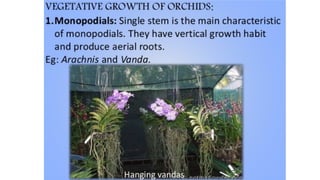
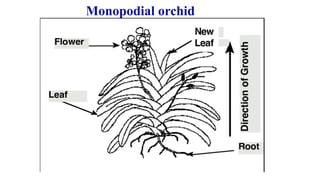
• Monopodial: single growth, growing in one direction, upright,
may be fairly short (e.g. Phalaenopsis), or reach several feet
long (e.g. Vanda, Renanthera or vanilla).
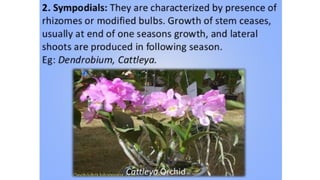
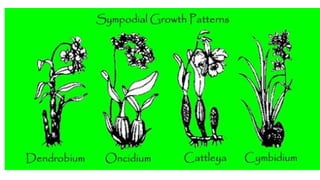
• Sympodial: have several, sometimes dozens of successive
growths, growing sideways, pseudo bulbs formed in chain (e.g.
Cymbidium, Dendrobium, Cattleyas, Oncidiums,
Paphiopedilums).
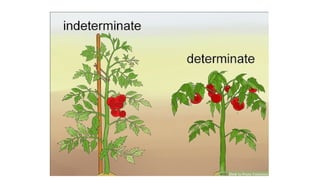
• In sympodial orchids the life of each growth is determinate.
Monopodial orchid
2. Based on Habitat
 Orchids differ from other plants by the way they grow
in nature.
 Different Orchids can have different habitats.
•Epiphytes: Plant adheres or clings to a tree, does not
penetrate into the cambium layers (Cymbidium).
•Saprophytes or semi-terrestrial: Plant grows in the
dead or decomposing organic matter.
•Terrestrials: Plant grows in the ground or soil.
•Lithophytes: Plant grows on stones.
3. Based on growing temperature
1. Cool orchid:
 Day temperature: 15.5-21°C
 Night temperature: 10-12.5°C
 Cynbidium, Paphiopedilium and some Dendrobium
2. Warm orchids
 Day temperature: 21-29°C
 Night temp: 18-21°C
 Example: Phalaenopsis, Rhynchostylis, Vanda, Dendrobium
 3.Intermediate orchid
 Day temp: 18-21°C
 Night temp: 15.5-18°C
 Example: Cattleya, Oncidium, Laelia and Epidendrum
Orchid Business
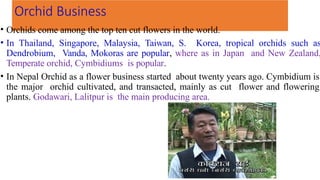
• Orchids come among the top ten cut flowers in the world.
• In Thailand, Singapore, Malaysia, Taiwan, S. Korea, tropical orchids such as
Dendrobium, Vanda, Mokoras are popular, where as in Japan and New Zealand,
Temperate orchid, Cymbidiums is popular.
• In Nepal Orchid as a flower business started about twenty years ago. Cymbidium is
the major orchid cultivated, and transacted, mainly as cut flower and flowering
plants. Godawari, Lalitpur is the main producing area.
Climate
• In nature, orchids inhabit various habitats, from low
land in forests to mountain slopes, to swampy areas.
• In general they require less light intensity and
prefers high humidity.
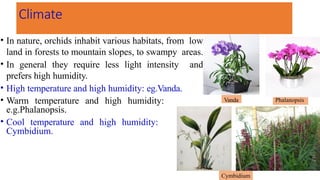
• High temperature and high humidity: eg.Vanda.
• Warm temperature and high humidity:
e.g.Phalanopsis.
• Cool temperature and high humidity:
Cymbidium.
Phalanopsis
Vanda
Cymbidium
Light and temperature: Light and temperature are positively
correlated.
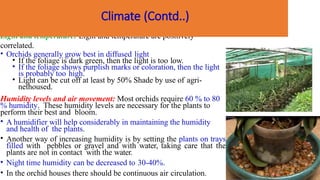
• Orchids generally grow best in diffused light
• If the foliage is dark green, then the light is too low.
• If the foliage shows purplish marks or coloration, then the light
is probably too high.
• Light can be cut off at least by 50% Shade by use of agri-
nethoused.
Humidity levels and air movement: Most orchids require 60 % to 80
% humidity. These humidity levels are necessary for the plants to
perform their best and bloom.
• A humidifier will help considerably in maintaining the humidity
and health of the plants.
• Another way of increasing humidity is by setting the plants on trays
filled with pebbles or gravel and with water, taking care that the
plants are not in contact with the water.
• Night time humidity can be decreased to 30-40%.
• In the orchid houses there should be continuous air circulation.
Climate (Contd..)
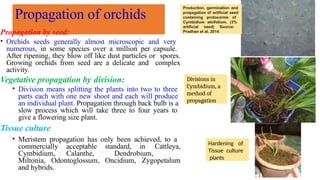
Propagation of orchids
Propagation by seed:
• Orchids seeds generally almost microscopic and very
numerous, in some species over a million per capsule.
After ripening, they blow off like dust particles or spores.
Growing orchids from seed are a delicate and complex
activity.
Vegetative propagation by division:
• Division means splitting the plants into two to three
parts each with one new shoot and each will produce
an individual plant. Propagation through back bulb is a
slow process which will take three to four years to
give a flowering size plant.
Tissue culture
• Meristem propagation has only been achieved, to a
commercially acceptable standard, in Cattleya,
Cymbidium, Calanthe, Dendrobium,
Miltonia, Odontoglossum, Oncidium, Zygopetalum
and hybrids.
Production, germination and
propagation of artificial seed
containing protocorms of
Cymbidium aloifolium. (3%
artificial seed) Source:
Pradhan et al. 2014
Divisions in
Cymbidium, a
method of
propagation
Hardening of
Tissue culture
plants
Growing Structures
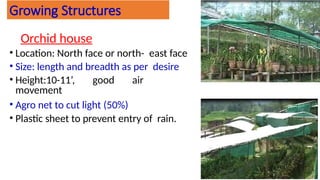
Orchid house
• Location: North face or north- east face
• Size: length and breadth as per desire
• Height:10-11’, good air
movement
• Agro net to cut light (50%)
• Plastic sheet to prevent entry of rain.
Containers for growing orchids
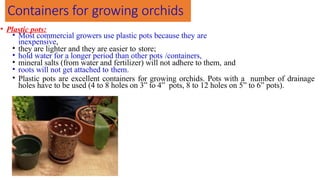
• Plastic pots:
• Most commercial growers use plastic pots because they are
inexpensive,
• they are lighter and they are easier to store;
• hold water for a longer period than other pots /containers,
• mineral salts (from water and fertilizer) will not adhere to them, and
• roots will not get attached to them.
• Plastic pots are excellent containers for growing orchids. Pots with a number of drainage
holes have to be used (4 to 8 holes on 3” to 4” pots, 8 to 12 holes on 5” to 6” pots).
• Clay pots:
• The advantage of clay pots is the stability due to their weight and their porosity, which
allows the potting material to dry faster. Of course, drying faster can also be a
disadvantage.
• A possible disadvantage is that roots tend to attach themselves to the pot.
• Clay pots with holes or slits on their sides to allow more air circulation
are better than regular clay pots.
• Baskets:
• can be used for most orchid Genera.
• Most baskets are made of teak wood.
Potting media/ materials
• The potting materials for orchids must:
• Hold the plant in place, hold enough moisture
(water) for the needs of particular orchid,
• provide an environment that will enhance the development
of roots (aeration).
• The nutrients are added either through foliar sprays or
by soil application near the root zone.
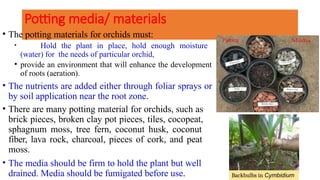
• There are many potting material for orchids, such as
brick pieces, broken clay pot pieces, tiles, cocopeat,
sphagnum moss, tree fern, coconut husk, coconut
fiber, lava rock, charcoal, pieces of cork, and peat
moss.
• The media should be firm to hold the plant but well
drained. Media should be fumigated before use.
Potting media
Backbulbs in Cymbidium
Potting, Repotting and aftercare of orchids
• Potting should be done when the plants are in
active stage, April to June.
• Active stage can be identified by pale green
growing points at the tip of the aerial roots.
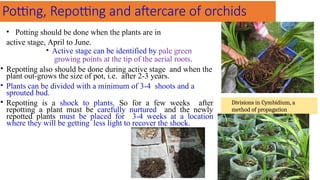
• Repotting also should be done during active stage and when the
plant out-grows the size of pot, i.e. after 2-3 years.
• Plants can be divided with a minimum of 3-4 shoots and a
sprouted bud.
• Repotting is a shock to plants. So for a few weeks after
repotting a plant must be carefully nurtured and the newly
repotted plants must be placed for 3-4 weeks at a location
where they will be getting less light to recover the shock.
Divisions in Cymbidium, a
method of propagation
Manuring and Fertilization
• Three basic principles apply to Fertilizing orchids:
• Only well rooted plants should be fed.
• The feed is preferable in small but frequent doses, can be done at forth nightly
interval.
• It should only be applied during the period of maximum active growth , during
spring, summer and autumn.
• A fertilizer complex containing NPK applied depending on the stage of the crop.
• During vegetative phase, 30:10:10 combination may be used
• Changed to 10:20:20 during blooming stage.
• Organic manure like cowdung, neem oil cake, poultry manure and so on soaked in
water for 4-5 days for fermentation and subsequently diluted 10- 15 times can also
be used.
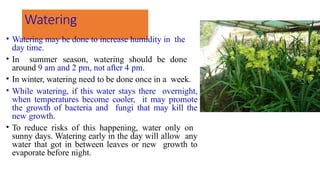
Watering
• Watering may be done to increase humidity in the
day time.
• In summer season, watering should be done
around 9 am and 2 pm, not after 4 pm.
• In winter, watering need to be done once in a week.
• While watering, if this water stays there overnight,
when temperatures become cooler, it may promote
the growth of bacteria and fungi that may kill the
new growth.
• To reduce risks of this happening, water only on
sunny days. Watering early in the day will allow any
water that got in between leaves or new growth to
evaporate before night.
Insect Pests
1.Mite: The all active stages (nymph and adult) of mite feed on under surface of leaves and flowers by
sucking the cell sap from epidermal layer, especially along with midrib and the base. Use of Dicofol
2ml/lit or Omite 1 ml/lit or wettable sulfur 5 ml/lit provide effective control.
2.Scale insects: Both the stages of scale insects suck the cell sap from leaves, pseudobulbs, flower buds
and flowers cause yellowing of leaves, vigor loss and stunted new growth. Botanical products from neem
viz. azadirachtin (neem oil 0.03% EC) at the rate of 5 ml/L and Allium sativum give effective management.
3. Thrips: Thrips, Dichromothrips nakahari suck the cell sap from tender portion of plants and on
leaves, it become discolored and shrivels.
4.Grass hopper (Hieroglyphus banian) feed on young leaves, un-opened flower buds and flowers by
cutting in irregular shape with their biting and chewing type of mouth parts and ultimately flowers
quality affected.
5.Aphid: Two species of aphids like yellow aphid, Macrosiphum luteus and black aphid, Toxoptera
aurantii mainly cause damage to orchids. The nymphs and adults suck the cell sap usually from new
flower spike and foliage. Management of Aphids, is effectively managed with neem oil (5 ml/l) and
Metarhizium anisopliae (2 ml/l).
Harvesting
• Stage of harvest: Harvesting should be done in general when most of
the flowers on the spike have opened fully with two or three
unopened buds, it adds the charm of the spikes. The number of
unopened buds to be retained may be lesser in smaller spikes.
• Method of harvest:
• The spikes that are ready for harvest are cut at the base as close to
the pseudo
bulb as possible.
• A sharp knife or secateurs can be used for making the cut surface
smooth.
• This operation is generally done early in the morning or in the
evenings and
• the stalks have to be pre-cooled in water before packaging and
storage.
• When several spikes are cut on the same day using a single knife,
there are chances that the diseases are transmitted through the sap.
The cut surface may act as substrate for disease causing organisms.
Dipping the knife in an antibiotic- fungicide mixture and pasting
the mixture on the cut surfaces can help in the prevention of this.
Alternatively, flaming the cut surface can also be done. This will
help in the sealing of the wound too.
Packaging and Transportation for market
• The stalks are usually packed in cartons. The size of the carton is
determined by the size and the number of spikes to be packed.
• The cartons are to be provided with sufficient number of holes all around
to facilitate good aeration.
• The prepared spikes are tied in bundles of ten before packing the cartons.
• It is preferable to provide a lining with newspaper inside the carton.
• After filling the cartons the top may be covered with a layer of newspaper.
• The carton is then closed and the joints sealed with adhesive tapes.
• Proper labeling on the boxes (cartons) will help careful handling of the
boxes.
• Refrigerated transport facilities are always more advantageous to
conventional means.
Post harvest operations
• In order to improve the quality of flower spike and increase in the
vase life pulsing treatments are given to the cut spikes.
• Treat with STS (Sodium Thiosulphate) or sucrose solution.
• Cotton dipped in water and placed around the base of the flower stalk.
A piece of polythene sheet is then kept in place around the base of the
stalk using a rubber band. Small narrow bottles filled with water can also
be used. The stalk end is inserted into the bottle and sealed with a
cellophane tape around the stalk and the mouth of the bottle.
Diseases
• 1. Black rot, Crown rot or heart rot (Pythium ultimum, P. splendens, Phytophthora palmivora and P.
parasitica): Water soaked small brown spot on the aerial parts of plants, which quickly turn black.
Fungicides spray viz Captan at the rate of 2 g/l or Zineb at the rate of 2 g/l water controls it.
• 2. Anthracnose (Colletotrichum gloeosporioides and C. orchidacearum): Initial symptom appears as the
small oblong to circular oval, sunken and reddish brown to dark brown or gray coloured spots. Die back
of leaves are also observed if the leaf tip is attacked. Spraying of Carbendazim (Bavistin) at the rate of 1
g/ litre in 10 days interval checks the disease.
• 3. Blossom Blight (Botrytis cinerea): The pathogens produce numerous small dark spots on petals,
especially on older flowers. Sometimes shot hole effect is found on infected flower petals. Spraying with
Bavistin at the rate of 1 g/l liter or indofil Z at the rate of 2 g/litre at 7 days intervals are effective.
• 4. Bacterial soft rot (Erwinia carotovora pv.carotovora and E. chrysanthi): Deep greyish grey lesions on
leaves. It causes leaf spot, soft rot and stem rot with fishy smell. Treating of infected plants with
streptomycin or oxy tetracycline solution before planting.
• 5. Cymbidium mosaic virus (Cymbidium mosaic potexvirus): The virus produces variable symptoms on
different hosts. It produces mild or severe mosaic symptoms followed by necrosis.
• Start with certified and virus free plant material,
• proper sterilization of tools used in cultural practices and proper sanitation
• proper distance among plants has to be maintained to avoid virus infection,
• Keep growing area free from plant debris.
• Quarantine new plants and Control of insect vectors.
References
• Ananda, M., Sankari, A. and R. Arulmozhiyan. (2013).
Production technology of orchids. Rastriya Krishi, Vol 8,
Issue 2. Hill Agricultural Research and Training Institute.
• http://agriinfo.in/default.aspx?page=topic&superid=2&t
opicid=1318 accessed on 29 April 2018
• https://en.wikipedia.org/wiki/Orchidaceae accessed on
29 April 2018
• Pun, U.(2015). Orchid Production Technology, PPT,
Presented on 3rd Nov, 2015.
• De, LC and R.Singh (2018). Organic production of
Cymbidium Orchids. ACTA Scientific Agriculture, 2.4
(2018): 30-35.
• Pradhan, S., Tiruwa, B.L., Subedee, B.R., and B.Pant
(2014). Micropropagation of Cymbidium aloifolium (L.)
SW., A medicinal orchid by artificial seed technology.
Journal of Natural History Musium, Vol 28, 2014: 42-48.
Cymbidium bouquet
Thank You

5. Orchids production Technology final.pptx

  • 1.
    Orchids production Technology (Family:Orchidaceae) Umesh Timilsina, Assistant Professor)
  • 2.
    Presentation outline • Introduction •Types of Orchids • Orchid Business • Climate • Propagation of orchids • Growing Structures • Containers for growing orchids • Potting materials • Potting, Repotting and aftercare of orchids • Manuring and Fertilization • Watering • Pests and Diseases • Harvesting • Post harvest operations • Packing and Transporting and marketing Cymbidium, ‘Bob Marlin Lucky’ for cut flower
  • 3.
    Introductio n • Orchids aremonocots belonging to the family orchidaceae. • is one of the largest families of flowering plants, has 30,000 species and 100,000 hybrids. • Orchids are highly valued for their cut flowers in commercial floriculture owing to • the wide range of colours, shapes, sizes and fragrance they display, • with long vase life. • These plants differ from other flowering plants due to their pollen that is formed into a mass, their stamens and pistils, which are joined together in a structure called a “column”, and their seeds, which are very small, do not contain endosperm and have no organized embryo. • Orchid flowers consist of pedicel, the sepals, the petals, and the column. Sepal and petals are in threes. • The three sepals consist of the dorsal sepal and two lateral sepals. • The three petals consist of two petals and a modified one called labellum, or more commonly, the lip.
  • 4.
    • Nepal harborsabout 457 spp of native orchids belonging to 105 genera, out of which 18 species are endemic to Nepal (Pradhan et al., 2014). • The main genus of commercially cultivate orchid in Nepal is Cymbidium. • Thirteen species of Cymbidium have been reported from Nepal. Cymbidium aloifolium (L.) Sw., an epiphytic orchid grows on trees trunk which has high medicinal value. • Lalitpur district being major orchid growing. (OVOP) • In Nepal Orchid as a flower business started about twenty years ago. Cymbidium aloifolium
  • 6.
  • 28.
    Classification of orchid 1.On the basis of growth habit: Orchids have two distinct patterns of growth – monopodial and sympodial. • Monopodial: single growth, growing in one direction, upright, may be fairly short (e.g. Phalaenopsis), or reach several feet long (e.g. Vanda, Renanthera or vanilla). • Sympodial: have several, sometimes dozens of successive growths, growing sideways, pseudo bulbs formed in chain (e.g. Cymbidium, Dendrobium, Cattleyas, Oncidiums, Paphiopedilums). • In sympodial orchids the life of each growth is determinate.
  • 32.
  • 36.
    2. Based onHabitat  Orchids differ from other plants by the way they grow in nature.  Different Orchids can have different habitats. •Epiphytes: Plant adheres or clings to a tree, does not penetrate into the cambium layers (Cymbidium). •Saprophytes or semi-terrestrial: Plant grows in the dead or decomposing organic matter. •Terrestrials: Plant grows in the ground or soil. •Lithophytes: Plant grows on stones.
  • 37.
    3. Based ongrowing temperature 1. Cool orchid:  Day temperature: 15.5-21°C  Night temperature: 10-12.5°C  Cynbidium, Paphiopedilium and some Dendrobium 2. Warm orchids  Day temperature: 21-29°C  Night temp: 18-21°C  Example: Phalaenopsis, Rhynchostylis, Vanda, Dendrobium  3.Intermediate orchid  Day temp: 18-21°C  Night temp: 15.5-18°C  Example: Cattleya, Oncidium, Laelia and Epidendrum
  • 38.
    Orchid Business • Orchidscome among the top ten cut flowers in the world. • In Thailand, Singapore, Malaysia, Taiwan, S. Korea, tropical orchids such as Dendrobium, Vanda, Mokoras are popular, where as in Japan and New Zealand, Temperate orchid, Cymbidiums is popular. • In Nepal Orchid as a flower business started about twenty years ago. Cymbidium is the major orchid cultivated, and transacted, mainly as cut flower and flowering plants. Godawari, Lalitpur is the main producing area.
  • 39.
    Climate • In nature,orchids inhabit various habitats, from low land in forests to mountain slopes, to swampy areas. • In general they require less light intensity and prefers high humidity. • High temperature and high humidity: eg.Vanda. • Warm temperature and high humidity: e.g.Phalanopsis. • Cool temperature and high humidity: Cymbidium. Phalanopsis Vanda Cymbidium
  • 40.
    Light and temperature:Light and temperature are positively correlated. • Orchids generally grow best in diffused light • If the foliage is dark green, then the light is too low. • If the foliage shows purplish marks or coloration, then the light is probably too high. • Light can be cut off at least by 50% Shade by use of agri- nethoused. Humidity levels and air movement: Most orchids require 60 % to 80 % humidity. These humidity levels are necessary for the plants to perform their best and bloom. • A humidifier will help considerably in maintaining the humidity and health of the plants. • Another way of increasing humidity is by setting the plants on trays filled with pebbles or gravel and with water, taking care that the plants are not in contact with the water. • Night time humidity can be decreased to 30-40%. • In the orchid houses there should be continuous air circulation. Climate (Contd..)
  • 41.
    Propagation of orchids Propagationby seed: • Orchids seeds generally almost microscopic and very numerous, in some species over a million per capsule. After ripening, they blow off like dust particles or spores. Growing orchids from seed are a delicate and complex activity. Vegetative propagation by division: • Division means splitting the plants into two to three parts each with one new shoot and each will produce an individual plant. Propagation through back bulb is a slow process which will take three to four years to give a flowering size plant. Tissue culture • Meristem propagation has only been achieved, to a commercially acceptable standard, in Cattleya, Cymbidium, Calanthe, Dendrobium, Miltonia, Odontoglossum, Oncidium, Zygopetalum and hybrids. Production, germination and propagation of artificial seed containing protocorms of Cymbidium aloifolium. (3% artificial seed) Source: Pradhan et al. 2014 Divisions in Cymbidium, a method of propagation Hardening of Tissue culture plants
  • 42.
    Growing Structures Orchid house •Location: North face or north- east face • Size: length and breadth as per desire • Height:10-11’, good air movement • Agro net to cut light (50%) • Plastic sheet to prevent entry of rain.
  • 43.
    Containers for growingorchids • Plastic pots: • Most commercial growers use plastic pots because they are inexpensive, • they are lighter and they are easier to store; • hold water for a longer period than other pots /containers, • mineral salts (from water and fertilizer) will not adhere to them, and • roots will not get attached to them. • Plastic pots are excellent containers for growing orchids. Pots with a number of drainage holes have to be used (4 to 8 holes on 3” to 4” pots, 8 to 12 holes on 5” to 6” pots).
  • 44.
    • Clay pots: •The advantage of clay pots is the stability due to their weight and their porosity, which allows the potting material to dry faster. Of course, drying faster can also be a disadvantage. • A possible disadvantage is that roots tend to attach themselves to the pot. • Clay pots with holes or slits on their sides to allow more air circulation are better than regular clay pots. • Baskets: • can be used for most orchid Genera. • Most baskets are made of teak wood.
  • 45.
    Potting media/ materials •The potting materials for orchids must: • Hold the plant in place, hold enough moisture (water) for the needs of particular orchid, • provide an environment that will enhance the development of roots (aeration). • The nutrients are added either through foliar sprays or by soil application near the root zone. • There are many potting material for orchids, such as brick pieces, broken clay pot pieces, tiles, cocopeat, sphagnum moss, tree fern, coconut husk, coconut fiber, lava rock, charcoal, pieces of cork, and peat moss. • The media should be firm to hold the plant but well drained. Media should be fumigated before use. Potting media Backbulbs in Cymbidium
  • 46.
    Potting, Repotting andaftercare of orchids • Potting should be done when the plants are in active stage, April to June. • Active stage can be identified by pale green growing points at the tip of the aerial roots. • Repotting also should be done during active stage and when the plant out-grows the size of pot, i.e. after 2-3 years. • Plants can be divided with a minimum of 3-4 shoots and a sprouted bud. • Repotting is a shock to plants. So for a few weeks after repotting a plant must be carefully nurtured and the newly repotted plants must be placed for 3-4 weeks at a location where they will be getting less light to recover the shock. Divisions in Cymbidium, a method of propagation
  • 47.
    Manuring and Fertilization •Three basic principles apply to Fertilizing orchids: • Only well rooted plants should be fed. • The feed is preferable in small but frequent doses, can be done at forth nightly interval. • It should only be applied during the period of maximum active growth , during spring, summer and autumn. • A fertilizer complex containing NPK applied depending on the stage of the crop. • During vegetative phase, 30:10:10 combination may be used • Changed to 10:20:20 during blooming stage. • Organic manure like cowdung, neem oil cake, poultry manure and so on soaked in water for 4-5 days for fermentation and subsequently diluted 10- 15 times can also be used.
  • 48.
    Watering • Watering maybe done to increase humidity in the day time. • In summer season, watering should be done around 9 am and 2 pm, not after 4 pm. • In winter, watering need to be done once in a week. • While watering, if this water stays there overnight, when temperatures become cooler, it may promote the growth of bacteria and fungi that may kill the new growth. • To reduce risks of this happening, water only on sunny days. Watering early in the day will allow any water that got in between leaves or new growth to evaporate before night.
  • 49.
    Insect Pests 1.Mite: Theall active stages (nymph and adult) of mite feed on under surface of leaves and flowers by sucking the cell sap from epidermal layer, especially along with midrib and the base. Use of Dicofol 2ml/lit or Omite 1 ml/lit or wettable sulfur 5 ml/lit provide effective control. 2.Scale insects: Both the stages of scale insects suck the cell sap from leaves, pseudobulbs, flower buds and flowers cause yellowing of leaves, vigor loss and stunted new growth. Botanical products from neem viz. azadirachtin (neem oil 0.03% EC) at the rate of 5 ml/L and Allium sativum give effective management. 3. Thrips: Thrips, Dichromothrips nakahari suck the cell sap from tender portion of plants and on leaves, it become discolored and shrivels. 4.Grass hopper (Hieroglyphus banian) feed on young leaves, un-opened flower buds and flowers by cutting in irregular shape with their biting and chewing type of mouth parts and ultimately flowers quality affected. 5.Aphid: Two species of aphids like yellow aphid, Macrosiphum luteus and black aphid, Toxoptera aurantii mainly cause damage to orchids. The nymphs and adults suck the cell sap usually from new flower spike and foliage. Management of Aphids, is effectively managed with neem oil (5 ml/l) and Metarhizium anisopliae (2 ml/l).
  • 50.
    Harvesting • Stage ofharvest: Harvesting should be done in general when most of the flowers on the spike have opened fully with two or three unopened buds, it adds the charm of the spikes. The number of unopened buds to be retained may be lesser in smaller spikes. • Method of harvest: • The spikes that are ready for harvest are cut at the base as close to the pseudo bulb as possible. • A sharp knife or secateurs can be used for making the cut surface smooth. • This operation is generally done early in the morning or in the evenings and • the stalks have to be pre-cooled in water before packaging and storage. • When several spikes are cut on the same day using a single knife, there are chances that the diseases are transmitted through the sap. The cut surface may act as substrate for disease causing organisms. Dipping the knife in an antibiotic- fungicide mixture and pasting the mixture on the cut surfaces can help in the prevention of this. Alternatively, flaming the cut surface can also be done. This will help in the sealing of the wound too.
  • 51.
    Packaging and Transportationfor market • The stalks are usually packed in cartons. The size of the carton is determined by the size and the number of spikes to be packed. • The cartons are to be provided with sufficient number of holes all around to facilitate good aeration. • The prepared spikes are tied in bundles of ten before packing the cartons. • It is preferable to provide a lining with newspaper inside the carton. • After filling the cartons the top may be covered with a layer of newspaper. • The carton is then closed and the joints sealed with adhesive tapes. • Proper labeling on the boxes (cartons) will help careful handling of the boxes. • Refrigerated transport facilities are always more advantageous to conventional means.
  • 52.
    Post harvest operations •In order to improve the quality of flower spike and increase in the vase life pulsing treatments are given to the cut spikes. • Treat with STS (Sodium Thiosulphate) or sucrose solution. • Cotton dipped in water and placed around the base of the flower stalk. A piece of polythene sheet is then kept in place around the base of the stalk using a rubber band. Small narrow bottles filled with water can also be used. The stalk end is inserted into the bottle and sealed with a cellophane tape around the stalk and the mouth of the bottle.
  • 53.
    Diseases • 1. Blackrot, Crown rot or heart rot (Pythium ultimum, P. splendens, Phytophthora palmivora and P. parasitica): Water soaked small brown spot on the aerial parts of plants, which quickly turn black. Fungicides spray viz Captan at the rate of 2 g/l or Zineb at the rate of 2 g/l water controls it. • 2. Anthracnose (Colletotrichum gloeosporioides and C. orchidacearum): Initial symptom appears as the small oblong to circular oval, sunken and reddish brown to dark brown or gray coloured spots. Die back of leaves are also observed if the leaf tip is attacked. Spraying of Carbendazim (Bavistin) at the rate of 1 g/ litre in 10 days interval checks the disease. • 3. Blossom Blight (Botrytis cinerea): The pathogens produce numerous small dark spots on petals, especially on older flowers. Sometimes shot hole effect is found on infected flower petals. Spraying with Bavistin at the rate of 1 g/l liter or indofil Z at the rate of 2 g/litre at 7 days intervals are effective. • 4. Bacterial soft rot (Erwinia carotovora pv.carotovora and E. chrysanthi): Deep greyish grey lesions on leaves. It causes leaf spot, soft rot and stem rot with fishy smell. Treating of infected plants with streptomycin or oxy tetracycline solution before planting. • 5. Cymbidium mosaic virus (Cymbidium mosaic potexvirus): The virus produces variable symptoms on different hosts. It produces mild or severe mosaic symptoms followed by necrosis. • Start with certified and virus free plant material, • proper sterilization of tools used in cultural practices and proper sanitation • proper distance among plants has to be maintained to avoid virus infection, • Keep growing area free from plant debris. • Quarantine new plants and Control of insect vectors.
  • 54.
    References • Ananda, M.,Sankari, A. and R. Arulmozhiyan. (2013). Production technology of orchids. Rastriya Krishi, Vol 8, Issue 2. Hill Agricultural Research and Training Institute. • http://agriinfo.in/default.aspx?page=topic&superid=2&t opicid=1318 accessed on 29 April 2018 • https://en.wikipedia.org/wiki/Orchidaceae accessed on 29 April 2018 • Pun, U.(2015). Orchid Production Technology, PPT, Presented on 3rd Nov, 2015. • De, LC and R.Singh (2018). Organic production of Cymbidium Orchids. ACTA Scientific Agriculture, 2.4 (2018): 30-35. • Pradhan, S., Tiruwa, B.L., Subedee, B.R., and B.Pant (2014). Micropropagation of Cymbidium aloifolium (L.) SW., A medicinal orchid by artificial seed technology. Journal of Natural History Musium, Vol 28, 2014: 42-48.
  • 55.