MODULE 12 STRATEGIC MANAGEMENT “ Insights and hard work deliver results” What types of strategies are used by organizations? How are strategies formulated and implemented in strategic management?
STRATEGIC MANAGEMENT   Types Of Strategies MODULE GUIDE 12.1  Strategy is a comprehensive plan for achieving competitive advantage.  Organizations use strategy at the corporate, business and functional levels.  Growth and diversification strategies focus on expansion.  Restructuring and divestiture strategies focus on consolidation.  Global strategies focus on international business initiatives.  E-business strategies focus on using the Internet for business transactions.
STRATEGIC MANAGEMENT   Types Of Strategies Strategy  a comprehensive plan guiding resource allocation to achieve long-term organization goals.  Strategic Intent  focuses organizational energies on achieving a compelling goal.  Competitive Advantage operating in successful ways that are difficult to duplicate
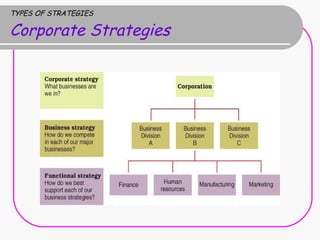
TYPES OF STRATEGIES Corporate Strategies Corporate Strategy Sets long-term direction for the total enterprise Business Strategy Identifies how a strategic business unit or division will compete in its product or service domain Functional Strategy Guides activities within one specific area of operations
TYPES OF STRATEGIES Corporate Strategies
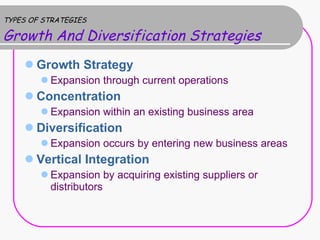
TYPES OF STRATEGIES Growth And Diversification Strategies Growth Strategy Expansion through current operations Concentration Expansion within an existing business area Diversification Expansion occurs by entering new business areas Vertical Integration Expansion by acquiring existing suppliers or distributors
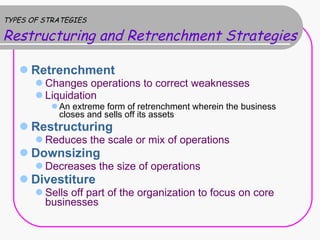
TYPES OF STRATEGIES Restructuring and Retrenchment Strategies   Retrenchment Changes operations to correct weaknesses Liquidation An extreme form of retrenchment wherein the business closes and sells off its assets Restructuring Reduces the scale or mix of operations Downsizing Decreases the size of operations Divestiture Sells off part of the organization to focus on core businesses
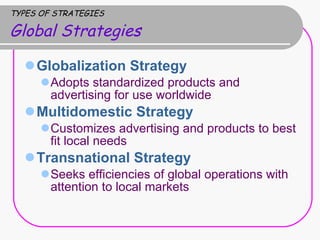
TYPES OF STRATEGIES Global Strategies Globalization Strategy Adopts standardized products and advertising for use worldwide Multidomestic Strategy Customizes advertising and products to best fit local needs Transnational Strategy Seeks efficiencies of global operations with attention to local markets
TYPES OF STRATEGIES E-Business Strategies E-Business Strategies  Focus on Using the Internet for Business Transactions B2B Business Strategies  use IT and Web portals to vertically link organizations with members of their supply chains. B2C Business Strategies  use IT and Web portals to vertically link organizations with members of their customers.
STRATEGIC MANAGEMENT Strategic Management MODULE GUIDE 12.2 Strategy formulation begins with the organization’s mission and objectives.  SWOT analysis identifies strengths, weaknesses, opportunities, and threats.  Porter’s five forces model examines industry attractiveness.  Porter’s competitive strategies model examines business or product strategies.  Portfolio planning examines strategies across multiple businesses or products.  Strategic leadership activates organizations for strategy implementation.
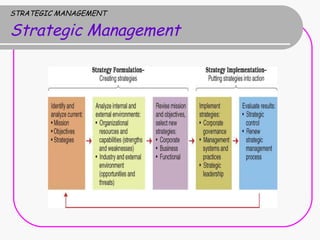
STRATEGIC MANAGEMENT Strategic Management Strategic management  the process of formulating and implementing strategies.  Strategy Formulation  the process of creating strategies  Strategy Implementation  the process of putting strategies into action.
STRATEGIC MANAGEMENT Strategic Management
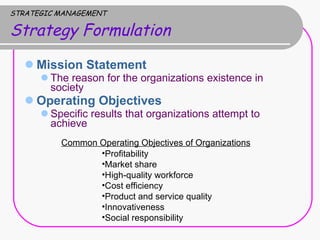
STRATEGIC MANAGEMENT Strategy Formulation Mission Statement The reason for the organizations existence in society Operating Objectives Specific results that organizations attempt to achieve Common Operating Objectives of Organizations   Profitability  Market share  High-quality workforce  Cost efficiency  Product and service quality  Innovativeness  Social responsibility
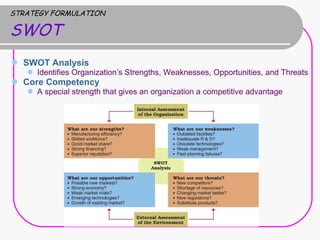
STRATEGY FORMULATION SWOT SWOT Analysis  Identifies Organization’s Strengths, Weaknesses, Opportunities, and Threats Core Competency A special strength that gives an organization a competitive advantage
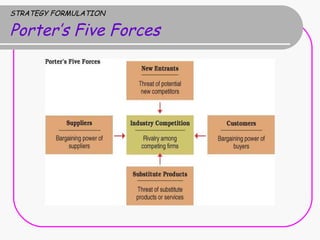
STRATEGY FORMULATION Porter’s Five Forces
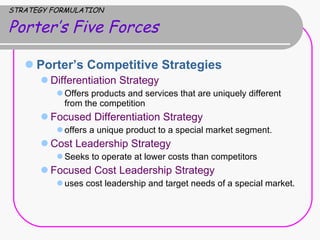
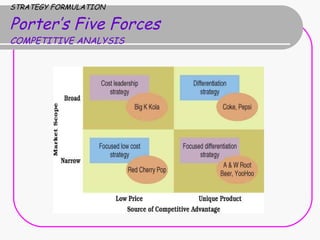
STRATEGY FORMULATION Porter’s Five Forces Porter’s Competitive Strategies  Differentiation Strategy  Offers products and services that are uniquely different from the competition Focused Differentiation Strategy offers a unique product to a special market segment.  Cost Leadership Strategy Seeks to operate at lower costs than competitors Focused Cost Leadership Strategy uses cost leadership and target needs of a special market.
STRATEGY FORMULATION Porter’s Five Forces COMPETITIVE ANALYSIS
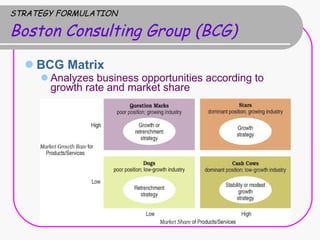
STRATEGY FORMULATION Boston Consulting Group (BCG) BCG Matrix Analyzes business opportunities according to growth rate and market share
STRATEGIC MANAGEMENT Strategy Implementation Strategic Leadership  the capability to inspire people to successfully engage in a process of continuous change, performance enhancement, and implementation of organizational strategies.
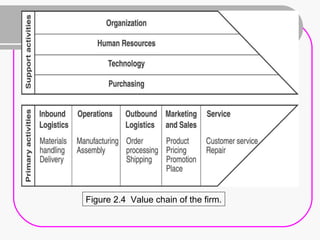
Porter’s Value Chain Model Value chain model addresses the activities that create, deliver, and support a company’s product or service. Two broad categories: Primary activities – relate directly to the value created in a product or service. Support activities – make it possible for the primary activities to exist and remain coordinated.
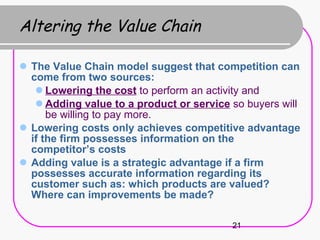
Altering the Value Chain The Value Chain model suggest that competition can come from two sources: Lowering the cost  to perform an activity and  Adding value to a product or service  so buyers will be willing to pay more. Lowering costs only achieves competitive advantage if the firm possesses information on the competitor’s costs Adding value is a strategic advantage if a firm possesses accurate information regarding its customer such as: which products are valued? Where can improvements be made?
Figure 2.4  Value chain of the firm.

5 forces & swot

  • 1.
    MODULE 12 STRATEGICMANAGEMENT “ Insights and hard work deliver results” What types of strategies are used by organizations? How are strategies formulated and implemented in strategic management?
  • 2.
    STRATEGIC MANAGEMENT Types Of Strategies MODULE GUIDE 12.1 Strategy is a comprehensive plan for achieving competitive advantage. Organizations use strategy at the corporate, business and functional levels. Growth and diversification strategies focus on expansion. Restructuring and divestiture strategies focus on consolidation. Global strategies focus on international business initiatives. E-business strategies focus on using the Internet for business transactions.
  • 3.
    STRATEGIC MANAGEMENT Types Of Strategies Strategy a comprehensive plan guiding resource allocation to achieve long-term organization goals. Strategic Intent focuses organizational energies on achieving a compelling goal. Competitive Advantage operating in successful ways that are difficult to duplicate
  • 4.
    TYPES OF STRATEGIESCorporate Strategies Corporate Strategy Sets long-term direction for the total enterprise Business Strategy Identifies how a strategic business unit or division will compete in its product or service domain Functional Strategy Guides activities within one specific area of operations
  • 5.
    TYPES OF STRATEGIESCorporate Strategies
  • 6.
    TYPES OF STRATEGIESGrowth And Diversification Strategies Growth Strategy Expansion through current operations Concentration Expansion within an existing business area Diversification Expansion occurs by entering new business areas Vertical Integration Expansion by acquiring existing suppliers or distributors
  • 7.
    TYPES OF STRATEGIESRestructuring and Retrenchment Strategies Retrenchment Changes operations to correct weaknesses Liquidation An extreme form of retrenchment wherein the business closes and sells off its assets Restructuring Reduces the scale or mix of operations Downsizing Decreases the size of operations Divestiture Sells off part of the organization to focus on core businesses
  • 8.
    TYPES OF STRATEGIESGlobal Strategies Globalization Strategy Adopts standardized products and advertising for use worldwide Multidomestic Strategy Customizes advertising and products to best fit local needs Transnational Strategy Seeks efficiencies of global operations with attention to local markets
  • 9.
    TYPES OF STRATEGIESE-Business Strategies E-Business Strategies Focus on Using the Internet for Business Transactions B2B Business Strategies use IT and Web portals to vertically link organizations with members of their supply chains. B2C Business Strategies use IT and Web portals to vertically link organizations with members of their customers.
  • 10.
    STRATEGIC MANAGEMENT StrategicManagement MODULE GUIDE 12.2 Strategy formulation begins with the organization’s mission and objectives. SWOT analysis identifies strengths, weaknesses, opportunities, and threats. Porter’s five forces model examines industry attractiveness. Porter’s competitive strategies model examines business or product strategies. Portfolio planning examines strategies across multiple businesses or products. Strategic leadership activates organizations for strategy implementation.
  • 11.
    STRATEGIC MANAGEMENT StrategicManagement Strategic management the process of formulating and implementing strategies. Strategy Formulation the process of creating strategies Strategy Implementation the process of putting strategies into action.
  • 12.
  • 13.
    STRATEGIC MANAGEMENT StrategyFormulation Mission Statement The reason for the organizations existence in society Operating Objectives Specific results that organizations attempt to achieve Common Operating Objectives of Organizations Profitability Market share High-quality workforce Cost efficiency Product and service quality Innovativeness Social responsibility
  • 14.
    STRATEGY FORMULATION SWOTSWOT Analysis Identifies Organization’s Strengths, Weaknesses, Opportunities, and Threats Core Competency A special strength that gives an organization a competitive advantage
  • 15.
  • 16.
    STRATEGY FORMULATION Porter’sFive Forces Porter’s Competitive Strategies Differentiation Strategy Offers products and services that are uniquely different from the competition Focused Differentiation Strategy offers a unique product to a special market segment. Cost Leadership Strategy Seeks to operate at lower costs than competitors Focused Cost Leadership Strategy uses cost leadership and target needs of a special market.
  • 17.
    STRATEGY FORMULATION Porter’sFive Forces COMPETITIVE ANALYSIS
  • 18.
    STRATEGY FORMULATION BostonConsulting Group (BCG) BCG Matrix Analyzes business opportunities according to growth rate and market share
  • 19.
    STRATEGIC MANAGEMENT StrategyImplementation Strategic Leadership the capability to inspire people to successfully engage in a process of continuous change, performance enhancement, and implementation of organizational strategies.
  • 20.
    Porter’s Value ChainModel Value chain model addresses the activities that create, deliver, and support a company’s product or service. Two broad categories: Primary activities – relate directly to the value created in a product or service. Support activities – make it possible for the primary activities to exist and remain coordinated.
  • 21.
    Altering the ValueChain The Value Chain model suggest that competition can come from two sources: Lowering the cost to perform an activity and Adding value to a product or service so buyers will be willing to pay more. Lowering costs only achieves competitive advantage if the firm possesses information on the competitor’s costs Adding value is a strategic advantage if a firm possesses accurate information regarding its customer such as: which products are valued? Where can improvements be made?
  • 22.
    Figure 2.4 Value chain of the firm.

Editor's Notes

  • #2 There are as many types of strategies as there are plans. Every plan has its own objectives, strategies and tactics.
  • #3 Keep in mind that a strategy is how to achieve the objective. Many people confuse the strategy with the objective.
  • #4 The internet is making it harder to find ways that are difficult to duplicate. Everyone has more easy access to information than ever before.
  • #5 Strategies follow the same organizational structure as objectives.
  • #6 It is important that the functional strategies support each other as well as the Division and Corporate strategies.
  • #7 All of these are growth strategies. It’s a matter of how you plan to grow.
  • #8 All of these strategies are decline or going out of business strategies.
  • #9 These are all strategies for participating in global markets. Again, it’s a matter of how you wish to do it.
  • #10 E-Business is replacing older technologies such as the fax and telephone as a means of communication.
  • #11 Whatever model is used, the strategy chosen must be one that can be implemented with a minimum disruption to the organization.
  • #12 There are many processes for developing strategies. Key to which process is used and which strategy is chosen is the ability to implement the strategy.
  • #13 Be careful, if your business is doing well, there may be no need to changing your strategy. Changing strategies can be very difficult and dangerous.
  • #14 Many of these objectives depend on whether your goal is growth, status quo or decline.
  • #15 SWOT analysis has been a much used model. However, with the environment changing more and more rapidly, it may be less useful in the future.
  • #16 Porter’s five forces provide a unique and thorough way to view your position. Each of these forces provide different strategies for achieving your objectives.
  • #17 Wal-Mart is the best example of a cost leadership position and they know how to leverage it.
  • #18 Wal-Mart gains its cost leadership position through a proprietary inventory and ordering system that allows the company to buy the right products at the right time from the right people.
  • #19 It is important to remember that even cash cows need to be fed. Under investing in the cows can be very dangerous.
  • #20 Strategic leadership can be learned. It helps if you have some natural leadership ability to start with.