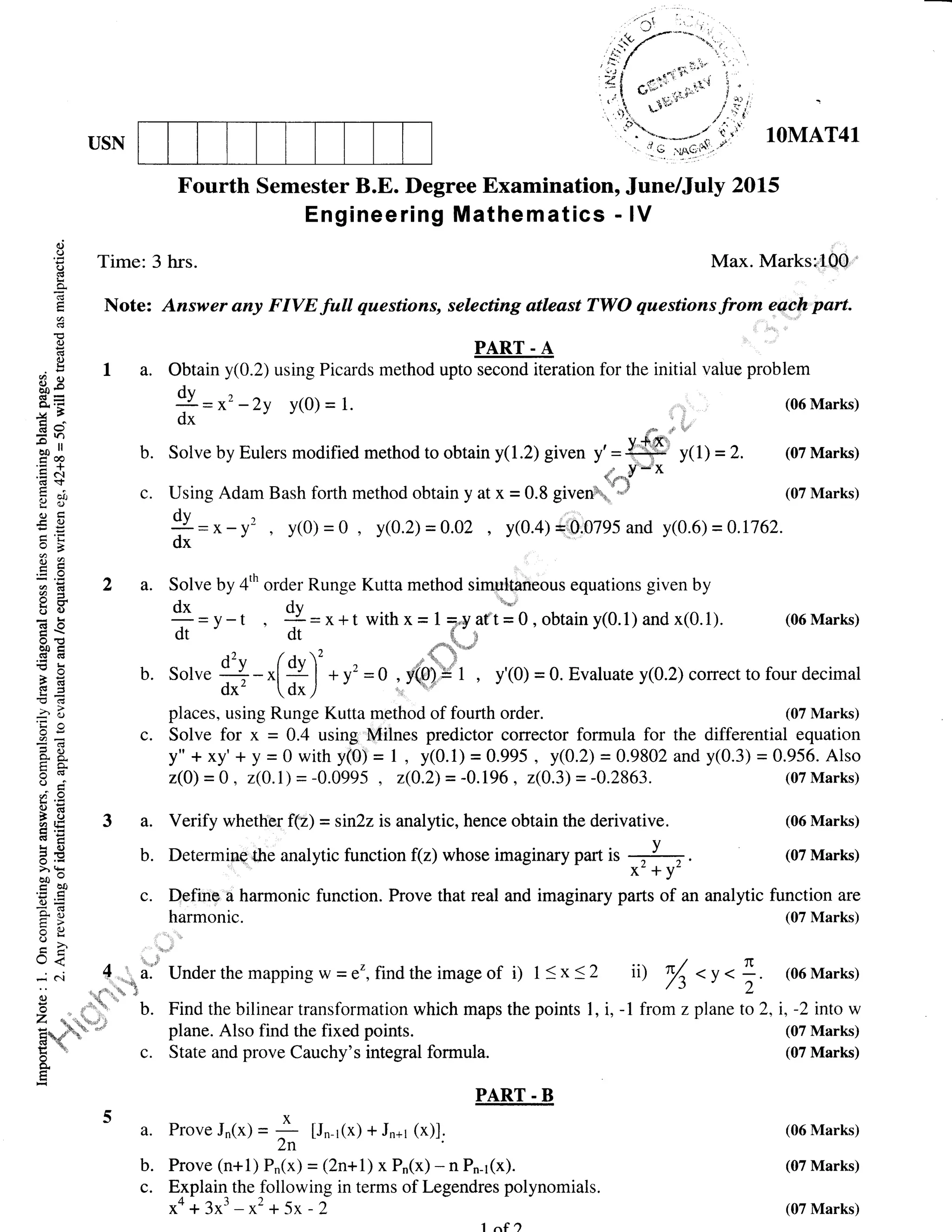
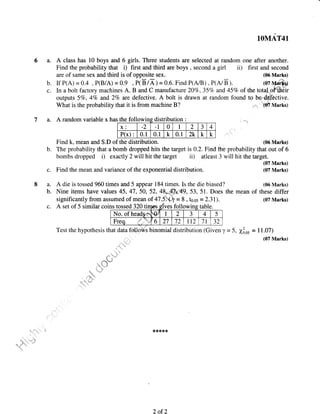
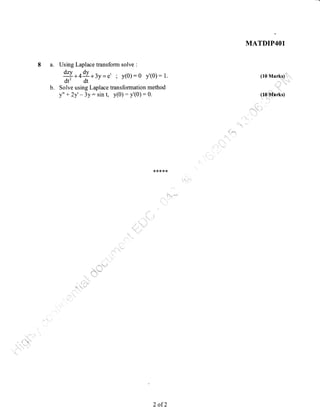
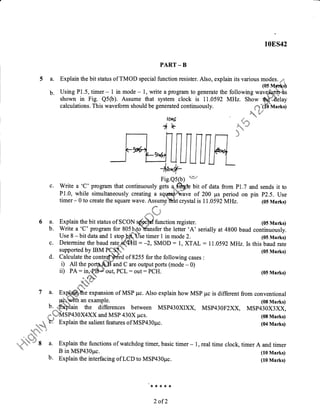
USN lOMAT41
(06 Marks)
i, -2 into w
(07 Marks)
(07 Marks)
(06 Marks)
(07 Marks)
(07 Marks)
TT
2
to 2,
o
E rime: 3
E Note:a
(3
()
cg
G)
ui I a.
oX
bo*(€=
Or 'ava
cl (J
=l'ao ll h
c@
.=N
(€+
ts.F
i c{l v.
()c
-c c)
oB
*a
;'E 2 a.Or
ET
.rl O
oroootrcl((l
!b h
BE r,.
Gl -t
->a
5A ^a-V.
d"&
tra.
or!oj
?io
-oE
Ad 3 a.
tr.HGl=
r<o
IE D.
>' t+<
aoo
cbo
'.=trr.
+. 0)
=6Jur<
Esa
-LJ < ';,..;'
,i 4'a,.
, ".,,o.."to}ol "!1 -,*''
9 1! 'J.. I
o ji'- 'rl J).>7'ir:"
a< r[ ::'u-;'r;
!qih';-+
,"'
cg i6
Et: c
ov.o
Fourth Semester B.E. Degree Examination, June/July zOLs
Engineering Mathematics - lV
hrs. Max. Marks:,,100
Answer any FIVE full questions, selecting atleast TWO questions from eq.ch part.
::i:
:l
PART. A
Obtain y(0.2) using Picards method upto second iteration for the initial value problem
+= x'-2y y(0) = 1. i i (06Marks).J
dx
''-' t 1"
Solve by Eulers modified method to obtain y(1.2) given ,:, ffi
yQ) = 2. (07 Marks)
nrr.
.
Using Adam Bash forth method obtain y at x = 0.8 giveni%- "''* (07 Marks)
dv ) ^.
--x-y' , y(0)=0 , y(0.2)=0.02 , y(0.4)=$,0795and y(0.6)=0.1762.
ox
Solve by 4tn order Runge Kutta method simuh.aneous equations given by
dxdv-'u
-= y-t, z= X*t with x = 1
=-yaf't=
0, obtainy(0.1) andx(0.1). (06Marks)
dt J dt .**.,-1,.i,-*j
solve b=-.f q)' * r'= 0 , ,t#; , y'(0) = 0. Evaluate y(0.2) correct to four decimal
dx' d*/ " :J!i"t:::'
places, using Runge Kutta method of fourth order. (07 Marks)
Solve for x = 0.4 using Milnes predictor corrector formula for the differential equation
y" + xy' + y = 0 with y(0) = l, y(0.1) = 0.995, y(0.2) = 0.9802 and y(0.3) = 0.956. Also
z(0)=9, z(0.1)=-0.0995, z(0.2)=-Q.196,2(0.3)=-0.2863. (07Marks)
Verify whether f(z) = srnZz is analytic, hence obtain the derivative. (06 Marks)
DetermiBQ.'theanalyticfunctionf(z)whoseimaginarypartis*(07Marks)
x-+y-
Define a harmonic function. Prove that real and imaginary parts of an analytic function are
harmonic. (07 Marks)
a.
b.
c.
Underthemappingw =a',,findtheimageof i) l<x<2 ii) %.t.
Find the bilinear transformation which maps the points l, i, - I from z plane
plane. Also find the fixed points.
State and prove Cauchy's integral formula.
PART . B
Prove Jn(x) =
* U"-r(x) * Jn+r (x)l;
Prove (n+l) P"(x) - (2n+1) x Pn(x) - n Pn-r(x).
Explain the following in terms of Legendres polynomials.
*o+3x3-^'+ 5x-2
8a.
b.
lOMAT41
a. A class has 10 boys and 6 girls. Three students are selected at random one after another.
Find the probability that i) first and third are boys , second a girl ii) first and second
are of same sex and third is of opposite sex. (06 Marks)
b. If P(A) =0.4, P(B/A)=0.9 ,P(B/A)=0.6. FindP(A/B), P(A/B). (07Mni"*b
c. In a bolt factory machines A, B and C manufacture 2A7o,357a and 457o of the totalofffidir
outputs 57o, 47o and 27o are defective. A bolt is drawn at random found to be,*dgfeCtive.
What is the probability that it is from machine B? (07 Marks)
a. A random variable x has the follo distributi
Find k, mean and S.D of the distribution. (06 Marks)
b. The probability that a bomb dropped hits the target is 0.2. Find the probability that out of 6
bombs dropped i) exactly 2 will hit the target ii) atleast 3 will hit the target.
c. Find the mean and variance of the exponential distribution.
(07 Marks)
(07 Marks)
(06 Marks)
the mean of these differ
(07 Marks)
c. A set of 5 similar coins tossed 320 tinlos gtves following table.
No. of heads,.,v -Ot 1 2 3 4 5
Freq. ,d ,*"+ 6 27 72 tt2 7t 32
Test the hypothesis that data folloWs binomial distribution (Given y = 5,, Xloos = 11.07)
. li'
**{€{€{€
A die is tossed 960 times and 5 appear 184 times. Is the die biased?
Nine items have values 45, 47, 50, 52, 48*",,Mu49, 53, 5 1. Does
significantly from assumed of mean of 07.5--'@ = 8 , h.os = 2.31).
w 10n :
x: -2 -1 0 I 2 3 4
P(x) : 0.1 0.1 k 0.1 2k k k
2 of 2
f €'*' ELc
USN MATDIP4Ol
Fourth Semester B.E. Degree Examination, June/July 2Ol5
Advanced Mathematics - !l
Time: 3 hrs. Max. Marks:10,0
Note: Answer any FIVE full qaestions.
a. Find the angle between 2 diagonals of a cube. (06 Marks)
b. If A(0 9 6), B(l 2 3) , C(7 - 25) are vertices of a triangle. Find the coordinates of the foot of
XVZI J r
-l-t---r-
abc,,r'
a.
b.
da
o
a
o
o)
ERbo-
cde
-o
oo ll
troo
.! ol(g$
xbo
YC)'
otr
_tr(.)+jH
o>
8q
C,)=
gd
cic.>
-L(R0
50E(!(O
!k
> +,f
/(g(ll -1
E(n
->r
Or=A-
o-X
6r€oj
,r; 6L. 'n
9i;5.)(,L=
l- 6.1)
6.v>'ti
bo-troo
()=
o-U
ET
o-
(r<
-
C.l
c.)
o
zi
,o
the perpendicular drawn from A to BC.
c. Find the equation of the plane in the lntercept form
(07 Marks)
(07 Marks)
(07 Marks)
(07 Marks)
(05 Marks)
(15 Marks)
(05 Marks)
(15 Marks)
a. Find the equation of the plane passing through the three pointS (2,3,4) , (-3, 5, ,),[1,*rr;i]i
b. Find the equation of the plane through the points (1, 2, *l) and perpendicular to the planes
x + y -22: 5 and 3x- y + 4z: 12. (07 Marks)
c. Find the equation of the plane through the points (-1, 2,0) and containing the plane
2x+ 3y+ 5z-l:0 and3x+ y-z+2:0. (07Marks)
a. Findtheunitvectorparalleltothesumofthevector A:2i+4j-5kand 6 :i+ 2j+3k.
- (06 Marks)
b. Determine l, such that A : i + j rk',4 : 2i - 4k . e - i + ),j + 3k are coplanar.
't
c. Provethat(a"6; " d :(e.c) U -fU.e)a.
Provettut 1[F.G]: F.
dG*dF.
G.
dt dt dt
Find the velocity and acceleration for the curve i
and also find.th'eir magnitude.
(06 Marks)
: (1-t3) i + (1+t2)j + (2t - 5)k at t: I
(07 Marks)
(07 Marks)
a. Findthedirectionalderivativeof $:xzyz+4x22 at(1, -2,-1,)atong 2i-j-2k. (06Marks)
b. .If F : (x+ y+ 1)i +j -(*+ y)k.Find F.curlF. (o7Marks)
o.' Show that V.(V " A )
: 0. (07 Marks)
c. tt*.,=*;a u,ra !9=frx6 thenshowthat
*[d
x6]: ,fr,x(ax6).
a. FindL(t) giventhat(t): lt : o<t<4
tt' t>4
b. Find i) L[e3'sin5t sin3t] ii) L[t5 cosh3t] iii) L[t3 e-3'].
a Findt[f]
Lt-1
4s+5
b. Find i)r- '[(s-1)2(s+2)
1 of )
8 a. Using Laplace transform solve :
g-*4y+3y-e' ; y(o):o y'(o):1.
dt2
'dt -J
b. Solve using Laplace transformation method
y" + 2y', - 3y : sin t, y(0) : Y'(0)
: 0.
MATDIP4Ol
(10 Marks)
,,,..
'"t'
,
(10'Mart<s)
2 of 2
USN 108S42
(05 Marks)
(05 Marks)
Fourth Semester B.E. Degree Examination, June/July 2015
a.
b.
o
c)
oC6
tr
(n
t,
(€
0)
(t
oa
.J3 I
EPbo-
E=
JiLr
-o--il
E" oo
.=N(6$
Es, 2
otr-caP:=
8E
AR
ca=
bU
GrO
o<,b0ccg (s
>.Yt, Gl
tq5
€d
->ts
Or=
i 0;)
r]6
trE .
5.s J
oj
ul^O
I 'i6
4()ir, tE
H'E
3-t ()
3B>r !=
bo-trbot- F ,1
i .- 5
v-!.r.11s
:i 9 ,,-,,*, "rii u ., "_
+
v ! sr{r
9 -'l ..I }4)iL +R
H'i_F..4..+.1;'/ *
pja" *"4
*'t*.6i
()
=
z
6
L
Time: 3 hrs.
2. fnclude suitable comments to your programsi6.,);{fi
'li "'l
PARr-A
{l.,si' '
a. Compare 8051 ,8052 and 8031 microcontrollers qW
b. Explain the intemal RAM section of 8051 prc with requirqgqFq.lffims.
c. For the following pc ICS, determine the ROM memo{Fqbdress of AT89C51
DS89C420 with 16 KB and DS5000 with 32K8. ffi,
iii'1:u*
ki*i'''l
n"'l fu u
a. What are the merits and demerits of indirected#r€ii-sing mode?
b. State the type of addressing mode used for tho.ftllowing instructions :
i) ADD A,30h,
ii) CJNE A,#29L,AGHAIN
iii) rNC @ R0
iv) XCH A, R3
v) CLR C.
1, with a crystal frequency of 22 MHz, write a program to generate
,fl-'F*'
'tr Explain the calculation of checksum byte in ROM with an example.
Microcontrollers
,,,',.*
Max.tutuffi,bd
Note: 7. Answer any FIVE full questions, selecting -
rg-?:}*t
atleast TWO qaestions from each part. 'fl'*.",''d
(05 Marks)
(10 Marks)
with 4KB,
(05 Marks)
(05 Marks)
(05 Marks)
c. Explain the working of Dffiihstruction with an example. Assume that datais 99h and 99h.
(05 Marks)
d. Write a program to poffh-n.xadecimal number to decimal. Include suitable comments.
|L$
(osMarks)
a. Write a to load accumulator with the value 55h and complement the content of
(05 Marks)
a delay of
(05 Marks)
cr-{,;Qxplaln me worlillg ot JL LAIJEL msffuctlon wlth an example. Is zeto flag present m EU5l'l
Explain the features of ADC 0804. Also explain the working of its various pins. (10 Marks)
Explain the principle of stepper motor. Write a program to rotate motor 64o tn clockwise
direction. The motor has step angle of 2o. Write the 4 step sequence also. The motor has
steps per revolution : 180, number of rotor teeth : 45, movement per 4 step sequence : 8o.
(10 Marks)
I of 2
5a.
b.
10ES42
PART _ B
Explain the bit status of TMOD special function resister. Also, explain its various modes. -sri
(0s Mp{i}
Using P1.5, timer - 1 in mode - 1, write a program to generate the following wave&rftqhs
shown in Fig. Q5O). Assume that system clock is 11.0592 MHz. Show $qffi"flelay
calculations. This waveform should be generated continuously. r*t-(fb vrarks)
1,ns
ck
Fig.Qs(b) **/
c. Write a 'C' program that continuously gets affih bit of data from P1.7 and sends it to
P1.0, while simultaneously creating a sqr4am$&ave of 200 ps period on pin P2.5. Use
timer- 0 to create the square wave. Assunle"thht crystal is 11 .0592}/rHa. (05 Marks)
flu
,. i" 'i*"'
6 a. Explain the bit status of SCON {i*H function register. (0s Marks)
b. Write a'C' program for 805*hxlo-%nsfer the letter 'A' serially at 4800 baud .oriin.rously.
Use 8 - bit data and I stopp{(.Use timer 1 in mode 2. (05 Marks)
c. Determine the baud rate_,i{S*Il: -2, SMOD: 1, XTAL: l1 .0592MHz.Is this baud rate
supported by IBM PCSh* (05 Marks)
d. Calculate the contr#*b$rd of 8255 for the following cases :
i) All the port-ffiF-and C are output ports (mode - 0)
ii) PA : in,.tB#'out, PCL : out : PCH. (0S Marks)
#hd#i& '!r,
7 a. nxgffie expansion of MSP pc. Also explain how MSP pc is different from conventional
. t+grWh an example. (08 Marks)
b..-,#xblain the differences between MSP430XXX, MSP430F2XX, MSP430X3XX,
*,*''3.,-tMSP430x4xX and MSP 430X pcs. (08 Marks)
*&"
* Explain the salient features ofMSP430pc. (04 Marks)
-.-,-*#fr:*.
*
'r.,i,h#l'r 8 a. Explain the functions of watchdog timer, basic timer -..*ai.i
B in MSP430pc.
b. Explain ttre interfacing of LCD to MSP430pc.
1, real time clock, timer A and timer
(10 Marks)
(10 Marks)
rl. ,1. * ,( ,F
2 of 2
USN 108s43
Fourth Semester B.E. Degree Examination, Jliire/July 201,5
Gontrol Systems
Time: 3 hrs. Max. Marks:100
Note: Answer any FIW full questions, selecting ,u #,,
atleast TWo questions from each parl
{,*::p,f;#-*
PARr-A ^(J(d:'
$ t a. With the help of neat block diagram, define open loop and closed loop contro@m.
E b. For a mechanical system shown in Fig.Qt(b) obtain force *ttng"-eqhg*rt5##l}
E nemork. ;At 108lr"r*ry"{.4e
.qu
tu4*
E K# :fiH *,*l j*" *u. ffi-C)
J:
.<
+_ I t{! f--, F
E f risqp*y
g.g c. Draw the electrical network based on torgullurrent analogy and give all the performance
.E b'?l l*" Y"3 ffids rr . h#
s= llr_._ Yf*^'i lt I l-'c-Wyi
Eo
-o ..'
-^ il
S,ii
-l
I I UB"'=+ lr ll I I
8s
-'E
BS
bU
(€o
OE ir
!p q *h(trt6#r'€16 .dq
.r1 lr P.qL 
;€ t%"G! -t 'q. 'i&'
E .- tr-- ',aM
B f 2 a. Define the follory#&4-.r*s related to signal flow graph with aneatschematic :
E : i) Fonvard patffi Feedback loop iiil s*trloop- iv) Source nodeE ; !, r orward pgtl'1.)t1t) teedbac!( Ioop lu) Sett Ioop !v) Source !!ode, (04 Mad$)
3 B b. Obtain th9 gfofer function for the block diagram, shown in Fig .Q2(b). Using :
H I i) Blogf,iliJgram reduction technique ii) Mason's gain forrnula. (08 Markg
B€ .crS 8(9
^ l'f-1,,n rr1 A r.-'r !(t)i:.= ;ttu+'
0) E { Sdr
B U ,r&'s*dar: tE 6. 3*
E 'H '{". 's,l.e-*l
ad E _*tt"'h."
l+ () .:#{.+. '{.
t E **l***ht= & *-
bD e ,f,* -3-d
tr b0 4..).- F .. '++Sc
4
lg '= n r,." ?EE +'*""h t:J l
"r
E H ---,4J% Fig.e2(b)5 $i .,*"4.r s
6 : #%'% o For the signal flow graph shown in Fig. Q2(c), find the overall tansfer function by :--
h%. $h v.
La'Yrrraa 'a&rrj| S
A "Eau ,,+r : nl , r. 1 ,. , t
;rl DrEu.rr uuw Br4pu suuwu ut f tg. vz({.r,r, ulrq ulg oyElau uaJlsler Iuncuon oy:
?$ " i) Block diagram reduction technique
:= ii) Verift the result by mason's gain forrnula. (08 Mar*i)c.)
z
Fig.Q2(c)
1 nf )
tsa-
Fig.Ql (c)
Fig.Q2(b)
108S43
Define and derive the expression fur : i) Rise time ii) Peak o.;ershoct of an under-dampeC
second order control system subjected to step input. (06 Marks)
For a unit feedback confrol system with : G(s) -
19(s + 2)
, Find : i) The static error
s'(s + 1)
coefficients ii) Steady state error when the input is R(s) = 1- +.+ (06 Marks)
S s' 3s'
_#ffi
c. A system is given by differential equation
#.4*+8y=8x,
where y: orr,p+S#S
x - input. Determine : i) Peak overshoot ii) Settling time iii) Peak time for unit
"&#*ihput.#hq6g *arks)
"
4 a. Explain Routh - Hunvitz cntenon for determining the stability of the sVf$n--,ant[ mention its
limitations. *&^ *d (06 Marks)
b. Forasystem sa +22s3+ 10s2+ s *k:0, findKmarand o atK-*. --?m (06 Marks)
c. Determine the value of ok'
and 'b' so that the system whose opeqlgpffiransfer function rs :
G(s) = , I(t,
*
? , oscillates at a frequency of oscillatio;rrffi*a/sec. (08 Marks)
PART-B i*Yee. W
fl#k;
5 a. Fcr a uniti, fbedback system, the open loop trsnsfbr f}fttion is given by:
2^J (t.
b.
b.
6a.
b.
r-m-- "'/ s(s + 2)(s' + 6s + 25) #'%* ',#
i) Sketch the root locus for 0 < k < o iD S.ffirhat value of 'k' the system becomes unstable
iii) At thispointofinstability,determffi$re frequencyofoscillationsofthesystem. (15 Marks)
,# *tts.
"tfrs{fr l
k
Consider the system with G(s) L-}:, find whether s : -0.75 is point on root
s(s+2)(s+a)
Iocus or not usmg angle con*qwl. (05 Marks)
Explain the procedure fo;dftSfitigating the stability using Nyquist criterion. (05 Marks)
.#*
Foracertaincontro;ffi3m:G(s)H(s)=*.SketchtheNyquistp1otandhence
^fu#* s(s + 2)(s + l0). #uw
calculate the rffi{f values of ok'
for stability.
s'W
(15 Marks)
a. Sketch the
+ 0.2s)(1 + 0.021s)
- , Find the range of .k, forclosed loop stability. (14 Marks)
margin ii) Phase margin iii) Gain and phase cross over frequency. (06 Marks)
8* ffiOetne the ftrllowrng ternos : i) State ii) State variable iii) State space iv) State transition.
(04 Marks)
"ffi- b.'"k ru
A system is described by the differential equation,
gI *
39
.f * 1
y , Ja-y . Ltoyi^- d'y , 3d'y .lTdy
dt3 dt2 dt
is the output and'u'is input to the system. Determine the state space representation of the
system.
c. Obtain the state equations for the electricalnetworkshown in Fig. Q8(c).
:f**rfrf
2 of2
(06 Marks)
(10 Marks)
[,
Fig.Q8(c)
USN rt
o'
ro
10EC44
2015
Max. Marks:100
*dq#
.i:r ,1 .
|::
:::..:
,'!;'tt, irit'1
;
n; (06 Marks)
Dccn)
I
Time: 3 hrs.
PART _ A
1 a. If x(t) and y(t) are as shown Fie.Ql(a), sketch x (1 - t). y(tl}).
$igmals amrJ Systerms
Note: Answey upty FI'VtE f,ull qaestions, selecting
atleast TYV'O qwestions f,rorn each part"
()
I
()
(€
3i
a
(.)
0)
lr
EEoo-cBi
Q;-
-yi
tll t-,
=n
ico
.= c
d$
9d(l)tr
-c c)
8?
a=
()o)
(rlo
o'o@idcS
!b
}E!u5
'13 co
5ts
5jro-
=;ir. 5.
Fii
()J
9E3()i, li=
(tr;
t.,!()
5?t
>i q-
oo-tr qrl
()=!v
=9
'*,
F)t i : "4-
U
(J
-rLr d.
o{
-
c.l
c)
z
(g
f
oq
-l
3&>
_r-*[L.di o I
Fig. Q 1 (a.1 Fig.1Q(b)
b. If x(n) is as shown Fig.l(b), find the enerq), of the signal x(2n - I ). (04 Marks)
c- Find whether the system represented by :'(t) - x(tl'2) is lifiear, T'I, causal substantiate your
answers. (05 iviarks)
d. Express x(t) in terms of g(t) if x(t) and g(t) are as shown in FigQl(d): (05 Marks)
aLo
r--1
;l__=>taJ
Fig.Q i (d)
,,..*.'-
3a.
b.
a. Perform the convolution of the t,.vo signals.
hc+;
Fig.Q2(a)
method only :
Find natural, forced a.nd total resDonses ibr the dift'erential equaticn :
y"(t) + 4y'(t) + ay(t) - r-'it,,rnit), assume 1,((i,i: 1,)r(0) - 0.
Find whether LTI system given by : y(n) :Zx(n + 2) + 3x(n) + x(n - 1) is
your answer.
Draw DF - I and DF - II irnplementations ior the differential equation :
@* Sdv(t)
+ 4y(t) - x(r) *
o"j,)
.
dt" dt r/ dt
_ .J.i
U-$ing the formula : y(t) - J h(.r)x(t - t)rlr.
Perform the convolution of two finite sequences using graphical
f)r)ttll
x(n) - J-1, 1, Q, 1, -l i ;r(n) =, jl, 7. :^'f .
t 'f 1 i I
(10 Marks)
(10 Marks)
(09 Marks)
causal. Justify
(04 Marks)
(07 Marks)
c.
a. Consiier th.-: i;erioci,ic yi,'a'rofbrrn x(t) ,- 4 + 2 cos 3t + 3 sin 4t
i) Finri period 'T'
ii) What is the total average power
iii) Finrl the comptrex Fourier- coeffic:ients
iv) Using Parsevai's theorem. frnd the power spectnirn
v) Shcrv that total a.,,era.ge power r:sing Parseval's theorern is same as
of the questicn.
b. Find FT ot'tlie follc,wrng :
i) ,r-if')
._.*..i_ "l__*_,.}".5 o."5
ii) x(t) :6it - 2) iii) ;<(t) : .-3"1 u(t).
Solve the dif {brence equatiorr using i:L - transform, y(n) - y(n -
initial conCitions : y(-2): 1, )/(-1):2.
Consider the system described by dif-ference equation,
y(n) - 2y(n- 1) + Zy(n- 2) : x(n) -r *x(n - 1)
i) find system function l{(z)
ii) find the sta.bilit5,of 'lhe systern
PAR.[ _ E
a. Find inverse F t of x(o) =
{ jc,,2}2
b. Find tire D'f!-'T of the recta.ngular pul-ue s?qLrerlce shcrr,,n in Fig .Q5(b).
Fig'Q'5(r)
Also Pht Xi:.r).
Find DIFT cf x(n) : 6(4 - 2n).
State sarnpiing theorei: . '{hat s atiasing exptrzrin ?
SpeciS, the Nyquist rate ancl N1'quisl. i'r;ervals 1,:'' eilr;}i of the following signals :
i) g(r) : sinc2 (200 t) ii)'g(t) .= sin c (2:00 r) - sin c' IZOO t;.
Find the f''f cf t.tre sign*m ftinctic,n, x(t) - sgn(t). Also draw the amplitude
specrra.
.11'114.r
!
c. . Ffud lzT , if ,1r1 =
for ail possibtre RoC's.
J(c
t0Bc44
obtained in part (2)
(12 Marks)
,i,"t,, ,.
,*, 108 Marks)
(06 Marks)
(10 Marks)
(04 Marks)
(04 Marks)
(06 Marks)
and phase
(10 Marks)
(06 Marks)
(08 Marks)
(06 Marks)
6a.
b.
c.
c.
a.
L
U.
Sate and pi'cve the fbllowlng propertles of Z - trarisform :
i) Muitiplitation by ?L R amp u) Convolution in time domain.
pinA 7 f-rr,-,f^-'- ^f +L^ f^II^..,;- - ^^A ^-^^if., i+^ D ^tal'lrru zJ - Llc"rrDRrllll r1 Lrru tUtiuWirix r;iiU SpUUiiy iLS ihU'r-.
(r, - 1t'1
x(n)-=i't{ }n-alu(n-2) i xtnl=i* i u(n)x2rru(-n-3).
4 2)  / :rl
Ll ,-',
i,-;,- ) ['-; {1)
,.Q(, a.
b.
s
iii) find h(n) of the system.
Perfornr. IZT ilsing long dirzision method. : x(z) --a- RoClzl>lal.
z--a
1)-y(n-2)+2;n>0with
(08 Marks)
(08 Marks)
(04 Marks)c.
*: :t * :i( {<
lt g t^J I 2_ E L 0 O 3USN
Fourth Semester B.E. Degree Examinatior,
Fundamentals of HDL
Time: 3 hrs.
June/July 2015
10EC45
and Boolean
(08 Marks)
data type in
(06 Marks)
in VHDL.
(06 Marks)
write the VHDL
(10 Marks)
(10 Marks)
Max. Marks: I00
a.
b.
C.
a.
b.
c.
b.
5a.
b.
c.
(,
()
o
!v
e
a(3
0)
C)
:-
C)X
i=
(g q,
=l.a--tt
.= c(Bt
OEa C:)
o;
82
aX
q;()
o0=CB Cg
>s
-CE
!cS
r?o
a-
c- F-
av
9E3()
, (.)
6.=>!
coe
tr' o0
o)=
=g)
L/<
-
C..l
c)
z
1i
g
Note: Answer any FIVE full questions, selecting
otleast TWO questions from each purt.
PART _ A
Natne the different types of operations in HDL. Explain the bitwise, unary
logical operations present in verilog with example. ,,,
Name the VHDL data t1pes. Explain the physical data fype and composite
VHDL.
Write the result of the following operation if A : 1 001001 1 and B : 0 1 101 1 1 1 :
i)Asr/04 ii)Bsla03 iii)A<<02 iv)A%2 v)!(&B) vi)A&B
With the help of booth atrgorithm multiply the numbers (-8)
" (7). Also
code to realize the same.
Write an HDL code to reahze the positive edge triggered JK flip flop.
i) Use if statement in VHDL.
ii) Use case statement in verilog HDL.
Write the VHDL code for 2 x 2 unsigned combinational array multiplier using dataflow
Write the verilog description for 4 bit ripple caffy adder. Assume 5ns delay for all the gates
and description using dataflow. (08 Marks)
Explain how signal declaration is done in VHDL and verilog. (06 Marks)
Write the logic circuit for performing 3 bit comparision using 3 fulI adder. Also write the
structural description to realize the same in VHDL (10 Marks)
b. What is binding? Explain how binding between entity and architecture is done in VHDL and
also binding between library and module in VHDL. (05 Marks)
c. Write the truth table of a logic system having 3 input and when the odd number of inputs are
high then the output of the system will be high. Also write the verilog code to reahze the
same using structural description. (05 Marks)
PART - B
What is the need of procedure and task? Explain the declaration and body of the task.
(04 Marks)
Write the procedure for converting an unsigned binary to an integer. (08 Marks)
What is a function? Write the code for finding greater of two signed numbers in verilog
using function. (08 Marki)
I of 2
6a.
b.
c.
b.
8. "a.
What is the need for mixed types description?
10EC45
(04 Marks)
Using package declaration declare one dimensional array tlpe with N of elements and
L number of bits in each element. Write a VHDL code for finding the largest element
present in one dimensio nal array declared using package. (08 Marks)
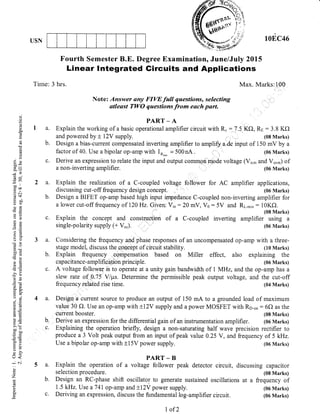
Write the truth table for the SRAM shown in Fig.Q.6(c). Write a verilog HDL code to read
or write the data from SRAM. (08 Marks)
g 1
^odrr^
Bus
R.l t^l
Fig.Q.6(c) ,
...
7 a. Write the mixed language description of an adder shown in
adder from verilog.
cS
Fig.Q.7(a). Invoke a VHDL tull
(10 Marks)
ffiwntq
IB3 I A3
JJ
6L *L
J
{<r<{<**
80 A0
IJ
Bl
J
Ar
T
Wiite the truth table of JK flipflop with clear. Describe the JK flipflop with clear using
mixed language description. (10 Marks)
Write the general steps of synthesis in form of a flowchart and explain it. (10 Marks)
Write VHDL and verilog code for signal assignment statement y - 3x with x as of size
2 bits. Also show the mapping of this signal assignment to gate level. (l0Marks)
lzzx l6
SR.AM
Dout
Fig.Q.7(a)
2 of 2
USN 10EC46
Fourth Semester B.E. Degree Examination, June/July 2015
Linear lntegrated Gircuits and Applications
Tirne: 3 hrs. Max. Marks:100
Note: Answer sny FIVE full questions, selecting
atleast TWO questions from each part.
PART _ A
Explain the working of a basic operational amplifier circuit with R.: 7.5 Kf2, Rr,:3.8 Kf)
and powered by t 12V supply. (08 Marks)
Design a bias-current compensated inverting amplifier to amplify a dc input of 150 mV by a
factor of 40. Use a bipolar op-amp with lr*u* = 500nA (06 Marks)
Derive an expression to relate the input and output common mode voltage (Vi.* and Vo.,r) of
a non-inverting amplifier. , (06 Marks)
Explain the realization of a C-coupled voltage follower for AC amplifier applications,
discussing cut-off frequency design concept. (06 Marks)
Design a BIFET op-amp based high input impedance C-coupled non-inverting amplifier for
a lower cut-off frequency of l20Hz. Given: Vin:20 mV, V6:5V and RL-*in: 10Kf).
(08 Marks)
Explain the concept and construciion of a C-couplecl inverting amplifier using a
single-polarrty supply (+ V..). (06 Nrarks)
Considering the frequenc y undphase responses of an uncompensated op-amp with a three-
stage model, discuss the concept of circuit stability. (10 Marks)
Explain frequency compensation based on Miller effect, also explaining the
capacitance-amplififfon principle. (06 Marks)
c. A voltage follower is to operate at a unity gain bandwidth of I MHz, and the op-amp has a
slew rate of 0.75 V/prs. Determine the permissible peak output voltage, and the cut-off
frequency related rise time (04 Marks)
a. Destgn a cuffent source to produce an output of 150 mA to a grounded load of maximum
value 30 C). Use an op-amp with +IzY supply and apower MOSFET with Ro-on : 6f) as the
current booster. (08 Marks)
b- Derive an expression for the differential gain of an instrumentation amplifier. (06 Marks)
c- Explaining the operation briefly, design a non-saturating half wave precision rectifier to
produce a 3 Volt peak output from an input of peak value 0.25 V, and frequency of 5 kHz.
Use a bipolar op-amp with +15V power supply. (06 Marks)
PART _ B
Explain the operation of a voltage follower peak detector circuit, discussing capacitor
selection procedure. (08 Marks)
Design an RC-phase shift oscillator to generate sustained oscillations at a frequency of
1.5 kHz. Use a 741 op-amp and +IzY power supply. (06 Marks)
Deriving an expression, discuss the fundamental log-amplifier circuit. (06 Marks)
a.
b.
c.
a.
b
c.
a.
b.
a.
b.
()
.()
Q
3i
F
a
()
I
0.lX
(g-
(g q,
ii(,1
=oo
.= c
dsf,
c)=
EO
ots
*. ch
(r=
oO
(sO
c0=
)s)(E
!tr)
Ecg
'Es
ar
a_x
Q;
o=
5o
-lE
:-()
5.e>"!
=9
=d)(.).
>l
t<
; c.i
(-)
zI
d
ts
o
c.
L of 2
a. Explain the operation of an inverting Schmitt trigger circuit with the help
transfbr characteristics.
b. Design an op-amp based monostable multivibrator to generate
The trigger is a pulse of amplitude 3V and duration 150 ps.
supply of +12V.
voltage regulator.
108 C46
of waveforms and
(08 Marks)
a pulse of width PW : 2ms.
Use a bipolar op-amp and a
(08 Marks)
(04 Marks)
(0'6 Marks)
c. Design a first order high pass active filter for a cut-off frequency of 2 kHz.
a. Briefly explain the operation of a series
b. Design a voltage regulator circuit using
c. Explain the basic principle of operation
b. Discuss the operating principle of PLLS
c. Explain the binary weighted technique
disadvantage?
LM723 to obtain Vo : 5V, and Is:2A. (06 Marks)
of switching regulators. Also list any four merits.
:i':'. (08 Marks)
and define the lock-in"and capture ranges. (08 Marks)
of digital to analog conversion. What is its major
,r,, (06 Marks)
a. Design an astable multivibrator using 555 timer to obtain a square wave of frequency 5 kHz
at 50o/o duty cycle. (06 Marks)
{<{<**:f
2 of 2

4th Semester Electronic and Communication Engineering (June/July-2015) Question Papers

  • 1.
    USN lOMAT41 (06 Marks) i,-2 into w (07 Marks) (07 Marks) (06 Marks) (07 Marks) (07 Marks) TT 2 to 2, o E rime: 3 E Note:a (3 () cg G) ui I a. oX bo*(€= Or 'ava cl (J =l'ao ll h c@ .=N (€+ ts.F i c{l v. ()c -c c) oB *a ;'E 2 a.Or ET .rl O oroootrcl((l !b h BE r,. Gl -t ->a 5A ^a-V. d"& tra. or!oj ?io -oE Ad 3 a. tr.HGl= r<o IE D. >' t+< aoo cbo '.=trr. +. 0) =6Jur< Esa -LJ < ';,..;' ,i 4'a,. , ".,,o.."to}ol "!1 -,*'' 9 1! 'J.. I o ji'- 'rl J).>7'ir:" a< r[ ::'u-;'r; !qih';-+ ,"' cg i6 Et: c ov.o Fourth Semester B.E. Degree Examination, June/July zOLs Engineering Mathematics - lV hrs. Max. Marks:,,100 Answer any FIVE full questions, selecting atleast TWO questions from eq.ch part. ::i: :l PART. A Obtain y(0.2) using Picards method upto second iteration for the initial value problem += x'-2y y(0) = 1. i i (06Marks).J dx ''-' t 1" Solve by Eulers modified method to obtain y(1.2) given ,:, ffi yQ) = 2. (07 Marks) nrr. . Using Adam Bash forth method obtain y at x = 0.8 giveni%- "''* (07 Marks) dv ) ^. --x-y' , y(0)=0 , y(0.2)=0.02 , y(0.4)=$,0795and y(0.6)=0.1762. ox Solve by 4tn order Runge Kutta method simuh.aneous equations given by dxdv-'u -= y-t, z= X*t with x = 1 =-yaf't= 0, obtainy(0.1) andx(0.1). (06Marks) dt J dt .**.,-1,.i,-*j solve b=-.f q)' * r'= 0 , ,t#; , y'(0) = 0. Evaluate y(0.2) correct to four decimal dx' d*/ " :J!i"t:::' places, using Runge Kutta method of fourth order. (07 Marks) Solve for x = 0.4 using Milnes predictor corrector formula for the differential equation y" + xy' + y = 0 with y(0) = l, y(0.1) = 0.995, y(0.2) = 0.9802 and y(0.3) = 0.956. Also z(0)=9, z(0.1)=-0.0995, z(0.2)=-Q.196,2(0.3)=-0.2863. (07Marks) Verify whether f(z) = srnZz is analytic, hence obtain the derivative. (06 Marks) DetermiBQ.'theanalyticfunctionf(z)whoseimaginarypartis*(07Marks) x-+y- Define a harmonic function. Prove that real and imaginary parts of an analytic function are harmonic. (07 Marks) a. b. c. Underthemappingw =a',,findtheimageof i) l<x<2 ii) %.t. Find the bilinear transformation which maps the points l, i, - I from z plane plane. Also find the fixed points. State and prove Cauchy's integral formula. PART . B Prove Jn(x) = * U"-r(x) * Jn+r (x)l; Prove (n+l) P"(x) - (2n+1) x Pn(x) - n Pn-r(x). Explain the following in terms of Legendres polynomials. *o+3x3-^'+ 5x-2
  • 2.
    8a. b. lOMAT41 a. A classhas 10 boys and 6 girls. Three students are selected at random one after another. Find the probability that i) first and third are boys , second a girl ii) first and second are of same sex and third is of opposite sex. (06 Marks) b. If P(A) =0.4, P(B/A)=0.9 ,P(B/A)=0.6. FindP(A/B), P(A/B). (07Mni"*b c. In a bolt factory machines A, B and C manufacture 2A7o,357a and 457o of the totalofffidir outputs 57o, 47o and 27o are defective. A bolt is drawn at random found to be,*dgfeCtive. What is the probability that it is from machine B? (07 Marks) a. A random variable x has the follo distributi Find k, mean and S.D of the distribution. (06 Marks) b. The probability that a bomb dropped hits the target is 0.2. Find the probability that out of 6 bombs dropped i) exactly 2 will hit the target ii) atleast 3 will hit the target. c. Find the mean and variance of the exponential distribution. (07 Marks) (07 Marks) (06 Marks) the mean of these differ (07 Marks) c. A set of 5 similar coins tossed 320 tinlos gtves following table. No. of heads,.,v -Ot 1 2 3 4 5 Freq. ,d ,*"+ 6 27 72 tt2 7t 32 Test the hypothesis that data folloWs binomial distribution (Given y = 5,, Xloos = 11.07) . li' **{€{€{€ A die is tossed 960 times and 5 appear 184 times. Is the die biased? Nine items have values 45, 47, 50, 52, 48*",,Mu49, 53, 5 1. Does significantly from assumed of mean of 07.5--'@ = 8 , h.os = 2.31). w 10n : x: -2 -1 0 I 2 3 4 P(x) : 0.1 0.1 k 0.1 2k k k 2 of 2
  • 3.
    f €'*' ELc USNMATDIP4Ol Fourth Semester B.E. Degree Examination, June/July 2Ol5 Advanced Mathematics - !l Time: 3 hrs. Max. Marks:10,0 Note: Answer any FIVE full qaestions. a. Find the angle between 2 diagonals of a cube. (06 Marks) b. If A(0 9 6), B(l 2 3) , C(7 - 25) are vertices of a triangle. Find the coordinates of the foot of XVZI J r -l-t---r- abc,,r' a. b. da o a o o) ERbo- cde -o oo ll troo .! ol(g$ xbo YC)' otr _tr(.)+jH o> 8q C,)= gd cic.> -L(R0 50E(!(O !k > +,f /(g(ll -1 E(n ->r Or=A- o-X 6r€oj ,r; 6L. 'n 9i;5.)(,L= l- 6.1) 6.v>'ti bo-troo ()= o-U ET o- (r< - C.l c.) o zi ,o the perpendicular drawn from A to BC. c. Find the equation of the plane in the lntercept form (07 Marks) (07 Marks) (07 Marks) (07 Marks) (05 Marks) (15 Marks) (05 Marks) (15 Marks) a. Find the equation of the plane passing through the three pointS (2,3,4) , (-3, 5, ,),[1,*rr;i]i b. Find the equation of the plane through the points (1, 2, *l) and perpendicular to the planes x + y -22: 5 and 3x- y + 4z: 12. (07 Marks) c. Find the equation of the plane through the points (-1, 2,0) and containing the plane 2x+ 3y+ 5z-l:0 and3x+ y-z+2:0. (07Marks) a. Findtheunitvectorparalleltothesumofthevector A:2i+4j-5kand 6 :i+ 2j+3k. - (06 Marks) b. Determine l, such that A : i + j rk',4 : 2i - 4k . e - i + ),j + 3k are coplanar. 't c. Provethat(a"6; " d :(e.c) U -fU.e)a. Provettut 1[F.G]: F. dG*dF. G. dt dt dt Find the velocity and acceleration for the curve i and also find.th'eir magnitude. (06 Marks) : (1-t3) i + (1+t2)j + (2t - 5)k at t: I (07 Marks) (07 Marks) a. Findthedirectionalderivativeof $:xzyz+4x22 at(1, -2,-1,)atong 2i-j-2k. (06Marks) b. .If F : (x+ y+ 1)i +j -(*+ y)k.Find F.curlF. (o7Marks) o.' Show that V.(V " A ) : 0. (07 Marks) c. tt*.,=*;a u,ra !9=frx6 thenshowthat *[d x6]: ,fr,x(ax6). a. FindL(t) giventhat(t): lt : o<t<4 tt' t>4 b. Find i) L[e3'sin5t sin3t] ii) L[t5 cosh3t] iii) L[t3 e-3']. a Findt[f] Lt-1 4s+5 b. Find i)r- '[(s-1)2(s+2) 1 of )
  • 4.
    8 a. UsingLaplace transform solve : g-*4y+3y-e' ; y(o):o y'(o):1. dt2 'dt -J b. Solve using Laplace transformation method y" + 2y', - 3y : sin t, y(0) : Y'(0) : 0. MATDIP4Ol (10 Marks) ,,,.. '"t' , (10'Mart<s) 2 of 2
  • 5.
    USN 108S42 (05 Marks) (05Marks) Fourth Semester B.E. Degree Examination, June/July 2015 a. b. o c) oC6 tr (n t, (€ 0) (t oa .J3 I EPbo- E= JiLr -o--il E" oo .=N(6$ Es, 2 otr-caP:= 8E AR ca= bU GrO o<,b0ccg (s >.Yt, Gl tq5 €d ->ts Or= i 0;) r]6 trE . 5.s J oj ul^O I 'i6 4()ir, tE H'E 3-t () 3B>r != bo-trbot- F ,1 i .- 5 v-!.r.11s :i 9 ,,-,,*, "rii u ., "_ + v ! sr{r 9 -'l ..I }4)iL +R H'i_F..4..+.1;'/ * pja" *"4 *'t*.6i () = z 6 L Time: 3 hrs. 2. fnclude suitable comments to your programsi6.,);{fi 'li "'l PARr-A {l.,si' ' a. Compare 8051 ,8052 and 8031 microcontrollers qW b. Explain the intemal RAM section of 8051 prc with requirqgqFq.lffims. c. For the following pc ICS, determine the ROM memo{Fqbdress of AT89C51 DS89C420 with 16 KB and DS5000 with 32K8. ffi, iii'1:u* ki*i'''l n"'l fu u a. What are the merits and demerits of indirected#r€ii-sing mode? b. State the type of addressing mode used for tho.ftllowing instructions : i) ADD A,30h, ii) CJNE A,#29L,AGHAIN iii) rNC @ R0 iv) XCH A, R3 v) CLR C. 1, with a crystal frequency of 22 MHz, write a program to generate ,fl-'F*' 'tr Explain the calculation of checksum byte in ROM with an example. Microcontrollers ,,,',.* Max.tutuffi,bd Note: 7. Answer any FIVE full questions, selecting - rg-?:}*t atleast TWO qaestions from each part. 'fl'*.",''d (05 Marks) (10 Marks) with 4KB, (05 Marks) (05 Marks) (05 Marks) c. Explain the working of Dffiihstruction with an example. Assume that datais 99h and 99h. (05 Marks) d. Write a program to poffh-n.xadecimal number to decimal. Include suitable comments. |L$ (osMarks) a. Write a to load accumulator with the value 55h and complement the content of (05 Marks) a delay of (05 Marks) cr-{,;Qxplaln me worlillg ot JL LAIJEL msffuctlon wlth an example. Is zeto flag present m EU5l'l Explain the features of ADC 0804. Also explain the working of its various pins. (10 Marks) Explain the principle of stepper motor. Write a program to rotate motor 64o tn clockwise direction. The motor has step angle of 2o. Write the 4 step sequence also. The motor has steps per revolution : 180, number of rotor teeth : 45, movement per 4 step sequence : 8o. (10 Marks) I of 2
  • 6.
    5a. b. 10ES42 PART _ B Explainthe bit status of TMOD special function resister. Also, explain its various modes. -sri (0s Mp{i} Using P1.5, timer - 1 in mode - 1, write a program to generate the following wave&rftqhs shown in Fig. Q5O). Assume that system clock is 11.0592 MHz. Show $qffi"flelay calculations. This waveform should be generated continuously. r*t-(fb vrarks) 1,ns ck Fig.Qs(b) **/ c. Write a 'C' program that continuously gets affih bit of data from P1.7 and sends it to P1.0, while simultaneously creating a sqr4am$&ave of 200 ps period on pin P2.5. Use timer- 0 to create the square wave. Assunle"thht crystal is 11 .0592}/rHa. (05 Marks) flu ,. i" 'i*"' 6 a. Explain the bit status of SCON {i*H function register. (0s Marks) b. Write a'C' program for 805*hxlo-%nsfer the letter 'A' serially at 4800 baud .oriin.rously. Use 8 - bit data and I stopp{(.Use timer 1 in mode 2. (05 Marks) c. Determine the baud rate_,i{S*Il: -2, SMOD: 1, XTAL: l1 .0592MHz.Is this baud rate supported by IBM PCSh* (05 Marks) d. Calculate the contr#*b$rd of 8255 for the following cases : i) All the port-ffiF-and C are output ports (mode - 0) ii) PA : in,.tB#'out, PCL : out : PCH. (0S Marks) #hd#i& '!r, 7 a. nxgffie expansion of MSP pc. Also explain how MSP pc is different from conventional . t+grWh an example. (08 Marks) b..-,#xblain the differences between MSP430XXX, MSP430F2XX, MSP430X3XX, *,*''3.,-tMSP430x4xX and MSP 430X pcs. (08 Marks) *&" * Explain the salient features ofMSP430pc. (04 Marks) -.-,-*#fr:*. * 'r.,i,h#l'r 8 a. Explain the functions of watchdog timer, basic timer -..*ai.i B in MSP430pc. b. Explain ttre interfacing of LCD to MSP430pc. 1, real time clock, timer A and timer (10 Marks) (10 Marks) rl. ,1. * ,( ,F 2 of 2
  • 7.
    USN 108s43 Fourth SemesterB.E. Degree Examination, Jliire/July 201,5 Gontrol Systems Time: 3 hrs. Max. Marks:100 Note: Answer any FIW full questions, selecting ,u #,, atleast TWo questions from each parl {,*::p,f;#-* PARr-A ^(J(d:' $ t a. With the help of neat block diagram, define open loop and closed loop contro@m. E b. For a mechanical system shown in Fig.Qt(b) obtain force *ttng"-eqhg*rt5##l} E nemork. ;At 108lr"r*ry"{.4e .qu tu4* E K# :fiH *,*l j*" *u. ffi-C) J: .< +_ I t{! f--, F E f risqp*y g.g c. Draw the electrical network based on torgullurrent analogy and give all the performance .E b'?l l*" Y"3 ffids rr . h# s= llr_._ Yf*^'i lt I l-'c-Wyi Eo -o ..' -^ il S,ii -l I I UB"'=+ lr ll I I 8s -'E BS bU (€o OE ir !p q *h(trt6#r'€16 .dq .r1 lr P.qL ;€ t%"G! -t 'q. 'i&' E .- tr-- ',aM B f 2 a. Define the follory#&4-.r*s related to signal flow graph with aneatschematic : E : i) Fonvard patffi Feedback loop iiil s*trloop- iv) Source nodeE ; !, r orward pgtl'1.)t1t) teedbac!( Ioop lu) Sett Ioop !v) Source !!ode, (04 Mad$) 3 B b. Obtain th9 gfofer function for the block diagram, shown in Fig .Q2(b). Using : H I i) Blogf,iliJgram reduction technique ii) Mason's gain forrnula. (08 Markg B€ .crS 8(9 ^ l'f-1,,n rr1 A r.-'r !(t)i:.= ;ttu+' 0) E { Sdr B U ,r&'s*dar: tE 6. 3* E 'H '{". 's,l.e-*l ad E _*tt"'h." l+ () .:#{.+. '{. t E **l***ht= & *- bD e ,f,* -3-d tr b0 4..).- F .. '++Sc 4 lg '= n r,." ?EE +'*""h t:J l "r E H ---,4J% Fig.e2(b)5 $i .,*"4.r s 6 : #%'% o For the signal flow graph shown in Fig. Q2(c), find the overall tansfer function by :-- h%. $h v. La'Yrrraa 'a&rrj| S A "Eau ,,+r : nl , r. 1 ,. , t ;rl DrEu.rr uuw Br4pu suuwu ut f tg. vz({.r,r, ulrq ulg oyElau uaJlsler Iuncuon oy: ?$ " i) Block diagram reduction technique := ii) Verift the result by mason's gain forrnula. (08 Mar*i)c.) z Fig.Q2(c) 1 nf ) tsa- Fig.Ql (c) Fig.Q2(b)
  • 8.
    108S43 Define and derivethe expression fur : i) Rise time ii) Peak o.;ershoct of an under-dampeC second order control system subjected to step input. (06 Marks) For a unit feedback confrol system with : G(s) - 19(s + 2) , Find : i) The static error s'(s + 1) coefficients ii) Steady state error when the input is R(s) = 1- +.+ (06 Marks) S s' 3s' _#ffi c. A system is given by differential equation #.4*+8y=8x, where y: orr,p+S#S x - input. Determine : i) Peak overshoot ii) Settling time iii) Peak time for unit "&#*ihput.#hq6g *arks) " 4 a. Explain Routh - Hunvitz cntenon for determining the stability of the sVf$n--,ant[ mention its limitations. *&^ *d (06 Marks) b. Forasystem sa +22s3+ 10s2+ s *k:0, findKmarand o atK-*. --?m (06 Marks) c. Determine the value of ok' and 'b' so that the system whose opeqlgpffiransfer function rs : G(s) = , I(t, * ? , oscillates at a frequency of oscillatio;rrffi*a/sec. (08 Marks) PART-B i*Yee. W fl#k; 5 a. Fcr a uniti, fbedback system, the open loop trsnsfbr f}fttion is given by: 2^J (t. b. b. 6a. b. r-m-- "'/ s(s + 2)(s' + 6s + 25) #'%* ',# i) Sketch the root locus for 0 < k < o iD S.ffirhat value of 'k' the system becomes unstable iii) At thispointofinstability,determffi$re frequencyofoscillationsofthesystem. (15 Marks) ,# *tts. "tfrs{fr l k Consider the system with G(s) L-}:, find whether s : -0.75 is point on root s(s+2)(s+a) Iocus or not usmg angle con*qwl. (05 Marks) Explain the procedure fo;dftSfitigating the stability using Nyquist criterion. (05 Marks) .#* Foracertaincontro;ffi3m:G(s)H(s)=*.SketchtheNyquistp1otandhence ^fu#* s(s + 2)(s + l0). #uw calculate the rffi{f values of ok' for stability. s'W (15 Marks) a. Sketch the + 0.2s)(1 + 0.021s) - , Find the range of .k, forclosed loop stability. (14 Marks) margin ii) Phase margin iii) Gain and phase cross over frequency. (06 Marks) 8* ffiOetne the ftrllowrng ternos : i) State ii) State variable iii) State space iv) State transition. (04 Marks) "ffi- b.'"k ru A system is described by the differential equation, gI * 39 .f * 1 y , Ja-y . Ltoyi^- d'y , 3d'y .lTdy dt3 dt2 dt is the output and'u'is input to the system. Determine the state space representation of the system. c. Obtain the state equations for the electricalnetworkshown in Fig. Q8(c). :f**rfrf 2 of2 (06 Marks) (10 Marks) [, Fig.Q8(c)
  • 9.
    USN rt o' ro 10EC44 2015 Max. Marks:100 *dq# .i:r,1 . |:: :::..: ,'!;'tt, irit'1 ; n; (06 Marks) Dccn) I Time: 3 hrs. PART _ A 1 a. If x(t) and y(t) are as shown Fie.Ql(a), sketch x (1 - t). y(tl}). $igmals amrJ Systerms Note: Answey upty FI'VtE f,ull qaestions, selecting atleast TYV'O qwestions f,rorn each part" () I () (€ 3i a (.) 0) lr EEoo-cBi Q;- -yi tll t-, =n ico .= c d$ 9d(l)tr -c c) 8? a= ()o) (rlo o'o@idcS !b }E!u5 '13 co 5ts 5jro- =;ir. 5. Fii ()J 9E3()i, li= (tr; t.,!() 5?t >i q- oo-tr qrl ()=!v =9 '*, F)t i : "4- U (J -rLr d. o{ - c.l c) z (g f oq -l 3&> _r-*[L.di o I Fig. Q 1 (a.1 Fig.1Q(b) b. If x(n) is as shown Fig.l(b), find the enerq), of the signal x(2n - I ). (04 Marks) c- Find whether the system represented by :'(t) - x(tl'2) is lifiear, T'I, causal substantiate your answers. (05 iviarks) d. Express x(t) in terms of g(t) if x(t) and g(t) are as shown in FigQl(d): (05 Marks) aLo r--1 ;l__=>taJ Fig.Q i (d) ,,..*.'- 3a. b. a. Perform the convolution of the t,.vo signals. hc+; Fig.Q2(a) method only : Find natural, forced a.nd total resDonses ibr the dift'erential equaticn : y"(t) + 4y'(t) + ay(t) - r-'it,,rnit), assume 1,((i,i: 1,)r(0) - 0. Find whether LTI system given by : y(n) :Zx(n + 2) + 3x(n) + x(n - 1) is your answer. Draw DF - I and DF - II irnplementations ior the differential equation : @* Sdv(t) + 4y(t) - x(r) * o"j,) . dt" dt r/ dt _ .J.i U-$ing the formula : y(t) - J h(.r)x(t - t)rlr. Perform the convolution of two finite sequences using graphical f)r)ttll x(n) - J-1, 1, Q, 1, -l i ;r(n) =, jl, 7. :^'f . t 'f 1 i I (10 Marks) (10 Marks) (09 Marks) causal. Justify (04 Marks) (07 Marks) c.
  • 10.
    a. Consiier th.-:i;erioci,ic yi,'a'rofbrrn x(t) ,- 4 + 2 cos 3t + 3 sin 4t i) Finri period 'T' ii) What is the total average power iii) Finrl the comptrex Fourier- coeffic:ients iv) Using Parsevai's theorem. frnd the power spectnirn v) Shcrv that total a.,,era.ge power r:sing Parseval's theorern is same as of the questicn. b. Find FT ot'tlie follc,wrng : i) ,r-if') ._.*..i_ "l__*_,.}".5 o."5 ii) x(t) :6it - 2) iii) ;<(t) : .-3"1 u(t). Solve the dif {brence equatiorr using i:L - transform, y(n) - y(n - initial conCitions : y(-2): 1, )/(-1):2. Consider the system described by dif-ference equation, y(n) - 2y(n- 1) + Zy(n- 2) : x(n) -r *x(n - 1) i) find system function l{(z) ii) find the sta.bilit5,of 'lhe systern PAR.[ _ E a. Find inverse F t of x(o) = { jc,,2}2 b. Find tire D'f!-'T of the recta.ngular pul-ue s?qLrerlce shcrr,,n in Fig .Q5(b). Fig'Q'5(r) Also Pht Xi:.r). Find DIFT cf x(n) : 6(4 - 2n). State sarnpiing theorei: . '{hat s atiasing exptrzrin ? SpeciS, the Nyquist rate ancl N1'quisl. i'r;ervals 1,:'' eilr;}i of the following signals : i) g(r) : sinc2 (200 t) ii)'g(t) .= sin c (2:00 r) - sin c' IZOO t;. Find the f''f cf t.tre sign*m ftinctic,n, x(t) - sgn(t). Also draw the amplitude specrra. .11'114.r ! c. . Ffud lzT , if ,1r1 = for ail possibtre RoC's. J(c t0Bc44 obtained in part (2) (12 Marks) ,i,"t,, ,. ,*, 108 Marks) (06 Marks) (10 Marks) (04 Marks) (04 Marks) (06 Marks) and phase (10 Marks) (06 Marks) (08 Marks) (06 Marks) 6a. b. c. c. a. L U. Sate and pi'cve the fbllowlng propertles of Z - trarisform : i) Muitiplitation by ?L R amp u) Convolution in time domain. pinA 7 f-rr,-,f^-'- ^f +L^ f^II^..,;- - ^^A ^-^^if., i+^ D ^tal'lrru zJ - Llc"rrDRrllll r1 Lrru tUtiuWirix r;iiU SpUUiiy iLS ihU'r-. (r, - 1t'1 x(n)-=i't{ }n-alu(n-2) i xtnl=i* i u(n)x2rru(-n-3). 4 2) / :rl Ll ,-', i,-;,- ) ['-; {1) ,.Q(, a. b. s iii) find h(n) of the system. Perfornr. IZT ilsing long dirzision method. : x(z) --a- RoClzl>lal. z--a 1)-y(n-2)+2;n>0with (08 Marks) (08 Marks) (04 Marks)c. *: :t * :i( {<
  • 11.
    lt g t^JI 2_ E L 0 O 3USN Fourth Semester B.E. Degree Examinatior, Fundamentals of HDL Time: 3 hrs. June/July 2015 10EC45 and Boolean (08 Marks) data type in (06 Marks) in VHDL. (06 Marks) write the VHDL (10 Marks) (10 Marks) Max. Marks: I00 a. b. C. a. b. c. b. 5a. b. c. (, () o !v e a(3 0) C) :- C)X i= (g q, =l.a--tt .= c(Bt OEa C:) o; 82 aX q;() o0=CB Cg >s -CE !cS r?o a- c- F- av 9E3() , (.) 6.=>! coe tr' o0 o)= =g) L/< - C..l c) z 1i g Note: Answer any FIVE full questions, selecting otleast TWO questions from each purt. PART _ A Natne the different types of operations in HDL. Explain the bitwise, unary logical operations present in verilog with example. ,,, Name the VHDL data t1pes. Explain the physical data fype and composite VHDL. Write the result of the following operation if A : 1 001001 1 and B : 0 1 101 1 1 1 : i)Asr/04 ii)Bsla03 iii)A<<02 iv)A%2 v)!(&B) vi)A&B With the help of booth atrgorithm multiply the numbers (-8) " (7). Also code to realize the same. Write an HDL code to reahze the positive edge triggered JK flip flop. i) Use if statement in VHDL. ii) Use case statement in verilog HDL. Write the VHDL code for 2 x 2 unsigned combinational array multiplier using dataflow Write the verilog description for 4 bit ripple caffy adder. Assume 5ns delay for all the gates and description using dataflow. (08 Marks) Explain how signal declaration is done in VHDL and verilog. (06 Marks) Write the logic circuit for performing 3 bit comparision using 3 fulI adder. Also write the structural description to realize the same in VHDL (10 Marks) b. What is binding? Explain how binding between entity and architecture is done in VHDL and also binding between library and module in VHDL. (05 Marks) c. Write the truth table of a logic system having 3 input and when the odd number of inputs are high then the output of the system will be high. Also write the verilog code to reahze the same using structural description. (05 Marks) PART - B What is the need of procedure and task? Explain the declaration and body of the task. (04 Marks) Write the procedure for converting an unsigned binary to an integer. (08 Marks) What is a function? Write the code for finding greater of two signed numbers in verilog using function. (08 Marki) I of 2
  • 12.
    6a. b. c. b. 8. "a. What isthe need for mixed types description? 10EC45 (04 Marks) Using package declaration declare one dimensional array tlpe with N of elements and L number of bits in each element. Write a VHDL code for finding the largest element present in one dimensio nal array declared using package. (08 Marks) Write the truth table for the SRAM shown in Fig.Q.6(c). Write a verilog HDL code to read or write the data from SRAM. (08 Marks) g 1 ^odrr^ Bus R.l t^l Fig.Q.6(c) , ... 7 a. Write the mixed language description of an adder shown in adder from verilog. cS Fig.Q.7(a). Invoke a VHDL tull (10 Marks) ffiwntq IB3 I A3 JJ 6L *L J {<r<{<** 80 A0 IJ Bl J Ar T Wiite the truth table of JK flipflop with clear. Describe the JK flipflop with clear using mixed language description. (10 Marks) Write the general steps of synthesis in form of a flowchart and explain it. (10 Marks) Write VHDL and verilog code for signal assignment statement y - 3x with x as of size 2 bits. Also show the mapping of this signal assignment to gate level. (l0Marks) lzzx l6 SR.AM Dout Fig.Q.7(a) 2 of 2
  • 13.
    USN 10EC46 Fourth SemesterB.E. Degree Examination, June/July 2015 Linear lntegrated Gircuits and Applications Tirne: 3 hrs. Max. Marks:100 Note: Answer sny FIVE full questions, selecting atleast TWO questions from each part. PART _ A Explain the working of a basic operational amplifier circuit with R.: 7.5 Kf2, Rr,:3.8 Kf) and powered by t 12V supply. (08 Marks) Design a bias-current compensated inverting amplifier to amplify a dc input of 150 mV by a factor of 40. Use a bipolar op-amp with lr*u* = 500nA (06 Marks) Derive an expression to relate the input and output common mode voltage (Vi.* and Vo.,r) of a non-inverting amplifier. , (06 Marks) Explain the realization of a C-coupled voltage follower for AC amplifier applications, discussing cut-off frequency design concept. (06 Marks) Design a BIFET op-amp based high input impedance C-coupled non-inverting amplifier for a lower cut-off frequency of l20Hz. Given: Vin:20 mV, V6:5V and RL-*in: 10Kf). (08 Marks) Explain the concept and construciion of a C-couplecl inverting amplifier using a single-polarrty supply (+ V..). (06 Nrarks) Considering the frequenc y undphase responses of an uncompensated op-amp with a three- stage model, discuss the concept of circuit stability. (10 Marks) Explain frequency compensation based on Miller effect, also explaining the capacitance-amplififfon principle. (06 Marks) c. A voltage follower is to operate at a unity gain bandwidth of I MHz, and the op-amp has a slew rate of 0.75 V/prs. Determine the permissible peak output voltage, and the cut-off frequency related rise time (04 Marks) a. Destgn a cuffent source to produce an output of 150 mA to a grounded load of maximum value 30 C). Use an op-amp with +IzY supply and apower MOSFET with Ro-on : 6f) as the current booster. (08 Marks) b- Derive an expression for the differential gain of an instrumentation amplifier. (06 Marks) c- Explaining the operation briefly, design a non-saturating half wave precision rectifier to produce a 3 Volt peak output from an input of peak value 0.25 V, and frequency of 5 kHz. Use a bipolar op-amp with +15V power supply. (06 Marks) PART _ B Explain the operation of a voltage follower peak detector circuit, discussing capacitor selection procedure. (08 Marks) Design an RC-phase shift oscillator to generate sustained oscillations at a frequency of 1.5 kHz. Use a 741 op-amp and +IzY power supply. (06 Marks) Deriving an expression, discuss the fundamental log-amplifier circuit. (06 Marks) a. b. c. a. b c. a. b. a. b. () .() Q 3i F a () I 0.lX (g- (g q, ii(,1 =oo .= c dsf, c)= EO ots *. ch (r= oO (sO c0= )s)(E !tr) Ecg 'Es ar a_x Q; o= 5o -lE :-() 5.e>"! =9 =d)(.). >l t< ; c.i (-) zI d ts o c. L of 2
  • 14.
    a. Explain theoperation of an inverting Schmitt trigger circuit with the help transfbr characteristics. b. Design an op-amp based monostable multivibrator to generate The trigger is a pulse of amplitude 3V and duration 150 ps. supply of +12V. voltage regulator. 108 C46 of waveforms and (08 Marks) a pulse of width PW : 2ms. Use a bipolar op-amp and a (08 Marks) (04 Marks) (0'6 Marks) c. Design a first order high pass active filter for a cut-off frequency of 2 kHz. a. Briefly explain the operation of a series b. Design a voltage regulator circuit using c. Explain the basic principle of operation b. Discuss the operating principle of PLLS c. Explain the binary weighted technique disadvantage? LM723 to obtain Vo : 5V, and Is:2A. (06 Marks) of switching regulators. Also list any four merits. :i':'. (08 Marks) and define the lock-in"and capture ranges. (08 Marks) of digital to analog conversion. What is its major ,r,, (06 Marks) a. Design an astable multivibrator using 555 timer to obtain a square wave of frequency 5 kHz at 50o/o duty cycle. (06 Marks) {<{<**:f 2 of 2