27th of September
Istanbul, Turkey

Becoming a Lean Agile Enterprise
why a focus on becoming faster is the essence

David Bogaerts - ING
Who am I?

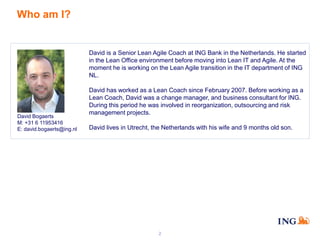
David is a Senior Lean Agile Coach at ING Bank in the Netherlands. He started
in the Lean Office environment before moving into Lean IT and Agile. At the
moment he is working on the Lean Agile transition in the IT department of ING
NL.

David Bogaerts
M: +31 6 11953416
E: david.bogaerts@ing.nl

David has worked as a Lean Coach since February 2007. Before working as a
Lean Coach, David was a change manager, and business consultant for ING.
During this period he was involved in reorganization, outsourcing and risk
management projects.

David lives in Utrecht, the Netherlands with his wife and 9 months old son.

2
About ING
ING Profile
• ING is a global financial institution of Dutch origin, offering banking, investments,
a variety of life insurance, non-life insurance and retirement services to meet the
needs of a broad customer base
• With more than 94,000* employees, we serve over 67 million* private, corporate
and institutional customers in over 40 countries in Europe, North America and
Latin America, Asia and Australia
*including Insurance Asia & IM Asia

ING NL
• 27,201 employees serve 8.2 million private and 66,000 corporate customers
• CIO NL is responsible for maintaining and developing IT applications for ING NL
• ~1,500 employees work for CIO NL

3
Content

Our Lean Agile journey from my point of view

Why becoming faster is the essence

Wrap-up

4
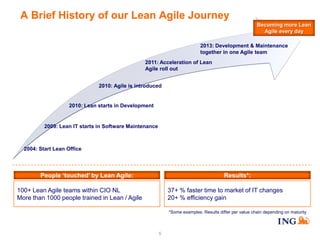
A Brief History of our Lean Agile Journey
Becoming more Lean
Agile every day
2013: Development & Maintenance
together in one Agile team
2011: Acceleration of Lean
Agile roll out
2010: Agile is introduced

2010: Lean starts in Development

2009: Lean IT starts in Software Maintenance

2004: Start Lean Office

People ‘touched’ by Lean Agile:

Results*:
37+ % faster time to market of IT changes
20+ % efficiency gain

100+ Lean Agile teams within CIO NL
More than 1000 people trained in Lean / Agile

*Some examples. Results differ per value chain depending on maturity

5
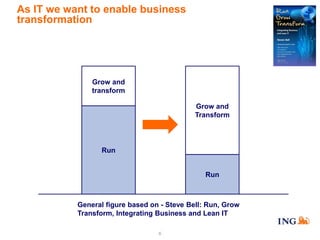
As IT we want to enable business
transformation

Grow and
transform
Grow and
Transform

Run

Run

General figure based on - Steve Bell: Run, Grow
Transform, Integrating Business and Lean IT
6
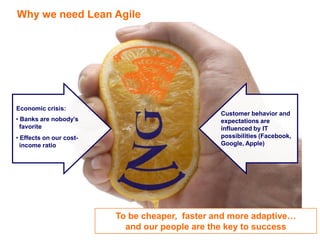
Why we need Lean Agile

Economic crisis:

Customer behavior and
expectations are
influenced by IT
possibilities (Facebook,
Google, Apple)

• Banks are nobody’s
favorite
• Effects on our costincome ratio

To be cheaper, faster and more adaptive…
and our people are the key to success
7
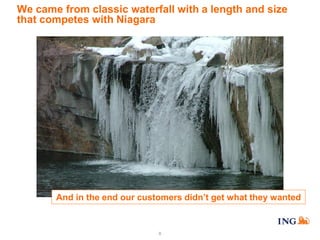
We came from classic waterfall with a length and size
that competes with Niagara

And in the end our customers didn’t get what they wanted

8
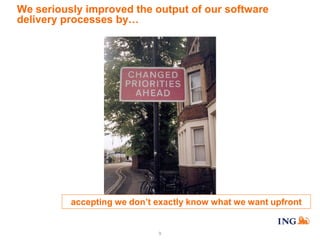
We seriously improved the output of our software
delivery processes by…

accepting we don’t exactly know what we want upfront

9
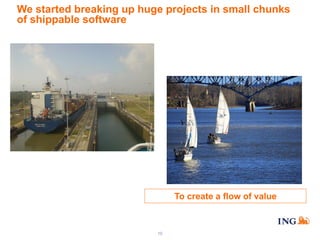
We started breaking up huge projects in small chunks
of shippable software

To create a flow of value

10
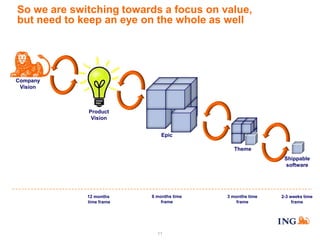
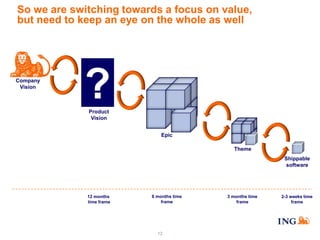
So we are switching towards a focus on value,
but need to keep an eye on the whole as well

Company
Vision

Product
Vision
Epic
Theme
Shippable
software

12 months
time frame

6 months time
frame

11

3 months time
frame

2-3 weeks time
frame
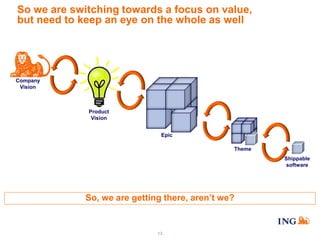
So we are switching towards a focus on value,
but need to keep an eye on the whole as well

Company
Vision

?
Product
Vision
Epic
Theme
Shippable
software

12 months
time frame

6 months time
frame

12

3 months time
frame

2-3 weeks time
frame
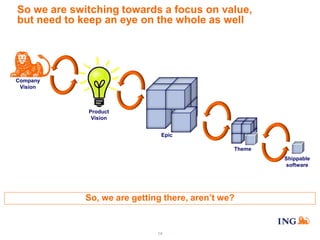
So we are switching towards a focus on value,
but need to keep an eye on the whole as well

Company
Vision

Product
Vision
Epic
Theme
Shippable
software

6 months
3 months
12 months
So,frame are gettingframetime aren’t we? frametime
we
there,
time

13

2-3 weeks time
frame
Well, we encountered some issues getting our value
So we are switching towards a focus on value,
easily in production eye on the whole as well
but need to keep an

Company
Vision

Product
Vision
Epic
Theme
Shippable
software

6 months
3 months
So, we are gettingframetime aren’t we? frametime
there,

12 months
time frame

14

2-3 weeks time
frame
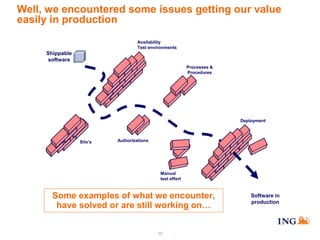
Well, we encountered some issues getting our value
easily in production
Availability
Test environments

Shippable
software
Processes &
Procedures

Deployment

Silo’s

Authorizations

Manual
test effort

Some examples of what we encounter,
have solved or are still working on…
15

Software in
production
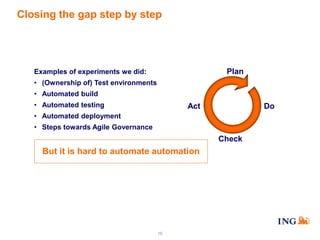
Closing the gap step by step

Plan

Examples of experiments we did:
• (Ownership of) Test environments

• Automated build
• Automated testing

Act

Do

• Automated deployment
• Steps towards Agile Governance

Check

But it is hard to automate automation

16
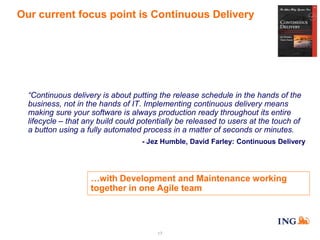
Our current focus point is Continuous Delivery

“Continuous delivery is about putting the release schedule in the hands of the
business, not in the hands of IT. Implementing continuous delivery means
making sure your software is always production ready throughout its entire
lifecycle – that any build could potentially be released to users at the touch of
a button using a fully automated process in a matter of seconds or minutes.
- Jez Humble, David Farley: Continuous Delivery

…with Development and Maintenance working
together in one Agile team

17
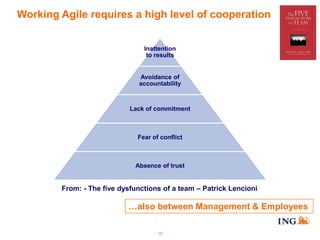
Working Agile requires a high level of cooperation
Inattention
to results

Avoidance of
accountability

Lack of commitment

Fear of conflict

Absence of trust

From: - The five dysfunctions of a team – Patrick Lencioni

…also between Management & Employees
18
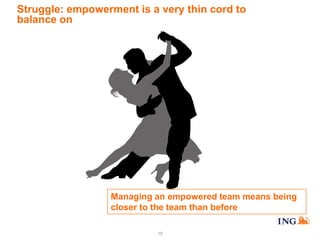
Struggle: empowerment is a very thin cord to
balance on

Managing an empowered team means being
closer to the team than before
19
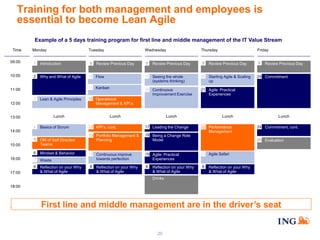
Training for both management and employees is
essential to become Lean Agile
Example of a 5 days training program for first line and middle management of the IT Value Stream
Time

Monday

Tuesday

09:00

1

Introduction

10:00

2

Why and What of Agile

9

Wednesday

Review Previous Day

3

Lean & Agile Principles

12:00

4

Basics of Scrum

5

OM of Self Directed
Teams

6

Mindset & Behavior

7

Waste

8

Reflection on your Why
& What of Agile

9

9

9

Review Previous Day

20 Starting Agile & Scaling
up

16 Continuous
Improvement Exercise

16:00

17:00

Review Previous Day

21 Agile: Practical
Experiences

Lunch

Lunch

Lunch

12 KPI’s, cont.

17 Leading the Change

13 Portfolio Management &
Planning

18 Being a Change Role
Model

14 Continuous improve
towards perfection

19 Agile: Practical
Experiences

24 Commitment

8

8

Lunch

23 Agile Safari

14:00

15:00

Review Previous Day

12 Operational
Management & KPI’s

Lunch

13:00

Friday

15 Seeing the whole
(systems thinking)

10 Flow
11 Kanban

11:00

Thursday

8

Reflection on your Why
& What of Agile

Reflection on your Why
& What of Agile

22 Performance
Management

24 Commitment, cont.
25 Evaluation

Reflection on your Why
& What of Agile

Drinks
18:00

19:00

First line and middle management are in the driver’s seat

20
When the going gets tough
…we have to prevent falling back in our
old behavior

21
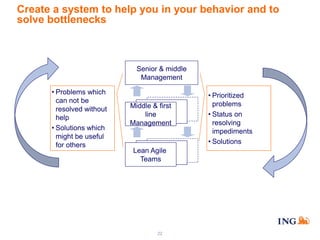
Create a system to help you in your behavior and to
solve bottlenecks

Senior & middle
Management
• Problems which
can not be
resolved without
help
• Solutions which
might be useful
for others

Middle & first
line
Management

Lean Agile
Teams

22

• Prioritized
problems
• Status on
resolving
impediments
• Solutions
Content

Our Lean Agile journey from my point of view

Why becoming faster is the essence

Wrap-up

23
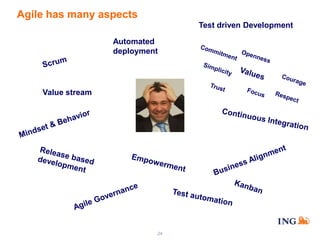
Agile has many aspects
Test driven Development
Automated
deployment

Value stream

24
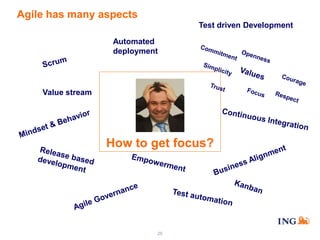
Agile has many aspects
Test driven Development
Automated
deployment

Value stream

How to get focus?

25
Focus on accelerating creation of value

Accelerate:

not just once, but a sustainable
speed

Value:

something that is actually useful
for your customer (incl. stability)

26
Focus on Speed, e.g.
Automation of all repetitive work
Governance focus on speed
Reduce hand overs
Remove unnecessary bureaucracy which hinder
the experts

A mindset focus on speed
---

27
Speed is the absence of waste*

Speed means flow: Just-in-Time delivery
Speed requires high quality
Speed requires a sustainable pace

*From Mary & Tom Poppendieck
28
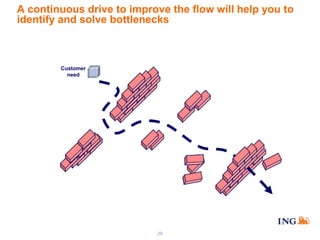
A continuous drive to improve the flow will help you to
identify and solve bottlenecks

Customer
need

29
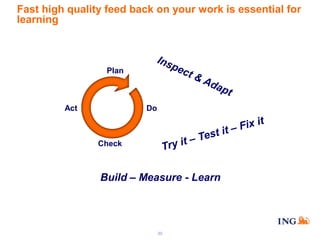
Fast high quality feed back on your work is essential for
learning

Plan

Act

Do

Check

Build – Measure - Learn

30
My utopia

‘The endless quest for excellence stimulates everyone in the
organization to make things better. People no longer see a
difference between performing the work they do, improving the
work they do, and improving themselves’
- Steve Bell & Mike Orzen, Lean IT

31
Content

Our Lean Agile journey from my point of view

Why becoming faster is the essence

Wrap-up

32
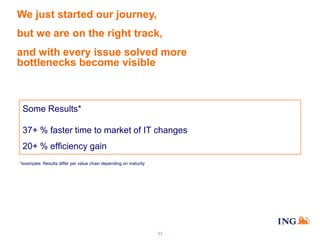
We just started our journey,
but we are on the right track,
and with every issue solved more
bottlenecks become visible

Some Results*
37+ % faster time to market of IT changes
20+ % efficiency gain
*examples. Results differ per value chain depending on maturity

33
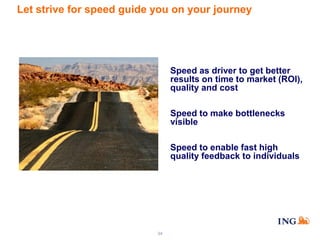
Let strive for speed guide you on your journey

Speed as driver to get better
results on time to market (ROI),
quality and cost
Speed to make bottlenecks
visible
Speed to enable fast high
quality feedback to individuals

34
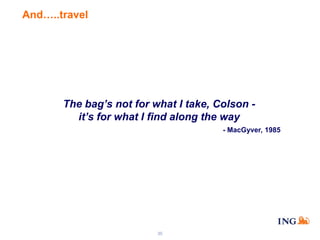
And…..travel

The bag’s not for what I take, Colson it’s for what I find along the way
- MacGyver, 1985

35
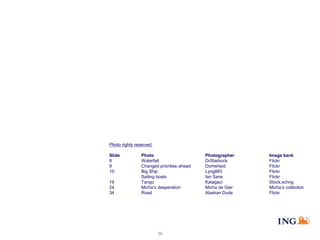
Photo rights reserved:
Slide
8
9
10
19
24
34

Photo
Waterfall
Changed priorities ahead
Big Ship
Sailing boats
Tango
Micha’s desperation
Road

36

Photographer
DrStarbuck
Domeheid
Lyng883
Ian Sane
Katagaci
Micha de Gier
Alaskan Dude

Image bank
Flickr
Flickr
Flickr
Flickr
Stock.xchng
Micha’s collection
Flickr

David Bogaerts, ING Bank | Agile Turkey Summit 2013

  • 1.
    27th of September Istanbul,Turkey Becoming a Lean Agile Enterprise why a focus on becoming faster is the essence David Bogaerts - ING
  • 2.
    Who am I? Davidis a Senior Lean Agile Coach at ING Bank in the Netherlands. He started in the Lean Office environment before moving into Lean IT and Agile. At the moment he is working on the Lean Agile transition in the IT department of ING NL. David Bogaerts M: +31 6 11953416 E: david.bogaerts@ing.nl David has worked as a Lean Coach since February 2007. Before working as a Lean Coach, David was a change manager, and business consultant for ING. During this period he was involved in reorganization, outsourcing and risk management projects. David lives in Utrecht, the Netherlands with his wife and 9 months old son. 2
  • 3.
    About ING ING Profile •ING is a global financial institution of Dutch origin, offering banking, investments, a variety of life insurance, non-life insurance and retirement services to meet the needs of a broad customer base • With more than 94,000* employees, we serve over 67 million* private, corporate and institutional customers in over 40 countries in Europe, North America and Latin America, Asia and Australia *including Insurance Asia & IM Asia ING NL • 27,201 employees serve 8.2 million private and 66,000 corporate customers • CIO NL is responsible for maintaining and developing IT applications for ING NL • ~1,500 employees work for CIO NL 3
  • 4.
    Content Our Lean Agilejourney from my point of view Why becoming faster is the essence Wrap-up 4
  • 5.
    A Brief Historyof our Lean Agile Journey Becoming more Lean Agile every day 2013: Development & Maintenance together in one Agile team 2011: Acceleration of Lean Agile roll out 2010: Agile is introduced 2010: Lean starts in Development 2009: Lean IT starts in Software Maintenance 2004: Start Lean Office People ‘touched’ by Lean Agile: Results*: 37+ % faster time to market of IT changes 20+ % efficiency gain 100+ Lean Agile teams within CIO NL More than 1000 people trained in Lean / Agile *Some examples. Results differ per value chain depending on maturity 5
  • 6.
    As IT wewant to enable business transformation Grow and transform Grow and Transform Run Run General figure based on - Steve Bell: Run, Grow Transform, Integrating Business and Lean IT 6
  • 7.
    Why we needLean Agile Economic crisis: Customer behavior and expectations are influenced by IT possibilities (Facebook, Google, Apple) • Banks are nobody’s favorite • Effects on our costincome ratio To be cheaper, faster and more adaptive… and our people are the key to success 7
  • 8.
    We came fromclassic waterfall with a length and size that competes with Niagara And in the end our customers didn’t get what they wanted 8
  • 9.
    We seriously improvedthe output of our software delivery processes by… accepting we don’t exactly know what we want upfront 9
  • 10.
    We started breakingup huge projects in small chunks of shippable software To create a flow of value 10
  • 11.
    So we areswitching towards a focus on value, but need to keep an eye on the whole as well Company Vision Product Vision Epic Theme Shippable software 12 months time frame 6 months time frame 11 3 months time frame 2-3 weeks time frame
  • 12.
    So we areswitching towards a focus on value, but need to keep an eye on the whole as well Company Vision ? Product Vision Epic Theme Shippable software 12 months time frame 6 months time frame 12 3 months time frame 2-3 weeks time frame
  • 13.
    So we areswitching towards a focus on value, but need to keep an eye on the whole as well Company Vision Product Vision Epic Theme Shippable software 6 months 3 months 12 months So,frame are gettingframetime aren’t we? frametime we there, time 13 2-3 weeks time frame
  • 14.
    Well, we encounteredsome issues getting our value So we are switching towards a focus on value, easily in production eye on the whole as well but need to keep an Company Vision Product Vision Epic Theme Shippable software 6 months 3 months So, we are gettingframetime aren’t we? frametime there, 12 months time frame 14 2-3 weeks time frame
  • 15.
    Well, we encounteredsome issues getting our value easily in production Availability Test environments Shippable software Processes & Procedures Deployment Silo’s Authorizations Manual test effort Some examples of what we encounter, have solved or are still working on… 15 Software in production
  • 16.
    Closing the gapstep by step Plan Examples of experiments we did: • (Ownership of) Test environments • Automated build • Automated testing Act Do • Automated deployment • Steps towards Agile Governance Check But it is hard to automate automation 16
  • 17.
    Our current focuspoint is Continuous Delivery “Continuous delivery is about putting the release schedule in the hands of the business, not in the hands of IT. Implementing continuous delivery means making sure your software is always production ready throughout its entire lifecycle – that any build could potentially be released to users at the touch of a button using a fully automated process in a matter of seconds or minutes. - Jez Humble, David Farley: Continuous Delivery …with Development and Maintenance working together in one Agile team 17
  • 18.
    Working Agile requiresa high level of cooperation Inattention to results Avoidance of accountability Lack of commitment Fear of conflict Absence of trust From: - The five dysfunctions of a team – Patrick Lencioni …also between Management & Employees 18
  • 19.
    Struggle: empowerment isa very thin cord to balance on Managing an empowered team means being closer to the team than before 19
  • 20.
    Training for bothmanagement and employees is essential to become Lean Agile Example of a 5 days training program for first line and middle management of the IT Value Stream Time Monday Tuesday 09:00 1 Introduction 10:00 2 Why and What of Agile 9 Wednesday Review Previous Day 3 Lean & Agile Principles 12:00 4 Basics of Scrum 5 OM of Self Directed Teams 6 Mindset & Behavior 7 Waste 8 Reflection on your Why & What of Agile 9 9 9 Review Previous Day 20 Starting Agile & Scaling up 16 Continuous Improvement Exercise 16:00 17:00 Review Previous Day 21 Agile: Practical Experiences Lunch Lunch Lunch 12 KPI’s, cont. 17 Leading the Change 13 Portfolio Management & Planning 18 Being a Change Role Model 14 Continuous improve towards perfection 19 Agile: Practical Experiences 24 Commitment 8 8 Lunch 23 Agile Safari 14:00 15:00 Review Previous Day 12 Operational Management & KPI’s Lunch 13:00 Friday 15 Seeing the whole (systems thinking) 10 Flow 11 Kanban 11:00 Thursday 8 Reflection on your Why & What of Agile Reflection on your Why & What of Agile 22 Performance Management 24 Commitment, cont. 25 Evaluation Reflection on your Why & What of Agile Drinks 18:00 19:00 First line and middle management are in the driver’s seat 20
  • 21.
    When the goinggets tough …we have to prevent falling back in our old behavior 21
  • 22.
    Create a systemto help you in your behavior and to solve bottlenecks Senior & middle Management • Problems which can not be resolved without help • Solutions which might be useful for others Middle & first line Management Lean Agile Teams 22 • Prioritized problems • Status on resolving impediments • Solutions
  • 23.
    Content Our Lean Agilejourney from my point of view Why becoming faster is the essence Wrap-up 23
  • 24.
    Agile has manyaspects Test driven Development Automated deployment Value stream 24
  • 25.
    Agile has manyaspects Test driven Development Automated deployment Value stream How to get focus? 25
  • 26.
    Focus on acceleratingcreation of value Accelerate: not just once, but a sustainable speed Value: something that is actually useful for your customer (incl. stability) 26
  • 27.
    Focus on Speed,e.g. Automation of all repetitive work Governance focus on speed Reduce hand overs Remove unnecessary bureaucracy which hinder the experts A mindset focus on speed --- 27
  • 28.
    Speed is theabsence of waste* Speed means flow: Just-in-Time delivery Speed requires high quality Speed requires a sustainable pace *From Mary & Tom Poppendieck 28
  • 29.
    A continuous driveto improve the flow will help you to identify and solve bottlenecks Customer need 29
  • 30.
    Fast high qualityfeed back on your work is essential for learning Plan Act Do Check Build – Measure - Learn 30
  • 31.
    My utopia ‘The endlessquest for excellence stimulates everyone in the organization to make things better. People no longer see a difference between performing the work they do, improving the work they do, and improving themselves’ - Steve Bell & Mike Orzen, Lean IT 31
  • 32.
    Content Our Lean Agilejourney from my point of view Why becoming faster is the essence Wrap-up 32
  • 33.
    We just startedour journey, but we are on the right track, and with every issue solved more bottlenecks become visible Some Results* 37+ % faster time to market of IT changes 20+ % efficiency gain *examples. Results differ per value chain depending on maturity 33
  • 34.
    Let strive forspeed guide you on your journey Speed as driver to get better results on time to market (ROI), quality and cost Speed to make bottlenecks visible Speed to enable fast high quality feedback to individuals 34
  • 35.
    And…..travel The bag’s notfor what I take, Colson it’s for what I find along the way - MacGyver, 1985 35
  • 36.
    Photo rights reserved: Slide 8 9 10 19 24 34 Photo Waterfall Changedpriorities ahead Big Ship Sailing boats Tango Micha’s desperation Road 36 Photographer DrStarbuck Domeheid Lyng883 Ian Sane Katagaci Micha de Gier Alaskan Dude Image bank Flickr Flickr Flickr Flickr Stock.xchng Micha’s collection Flickr