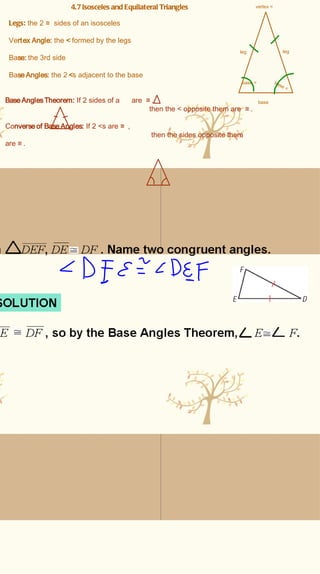
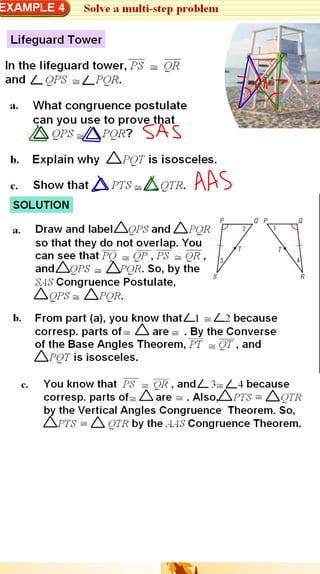
4.7 Isosceles and Equilateral Triangles Legs:  the 2  ≅  sides of an isosceles  Ve rtex Angle:  the  <  formed by the legs Ba se:  the 3rd side Ba se Angles:  the 2  < s adjacent to the base Base Angles Theorem:  If 2 sides of a  are  ≅ ,  then the < opposite them are  ≅ . Co nverse of Base Angles:  If 2 <s are  ≅  ,   then the sides opposite them are  ≅ . vertex < leg leg base base < base <
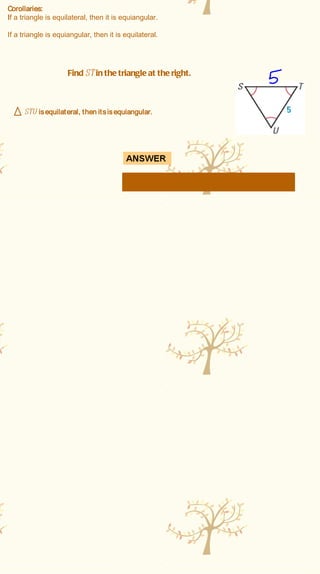
Corollaries: I f a triangle is equilateral, then it is equiangular. If a triangle is equiangular, then it is equilateral. Find  ST   in the triangle at the right. STU   is equilateral, then its is equiangular.
 
 
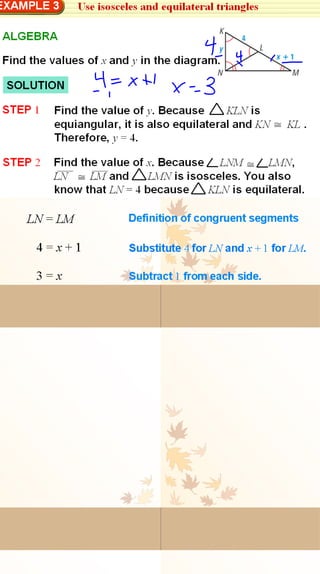
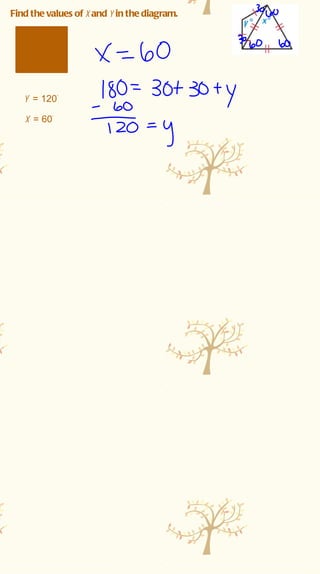
Find the values of  x  and  y   in the diagram. x °  = 60 ° y °  = 120 °
HW pg. 267 #3-27 odd

4.7 notes

  • 1.
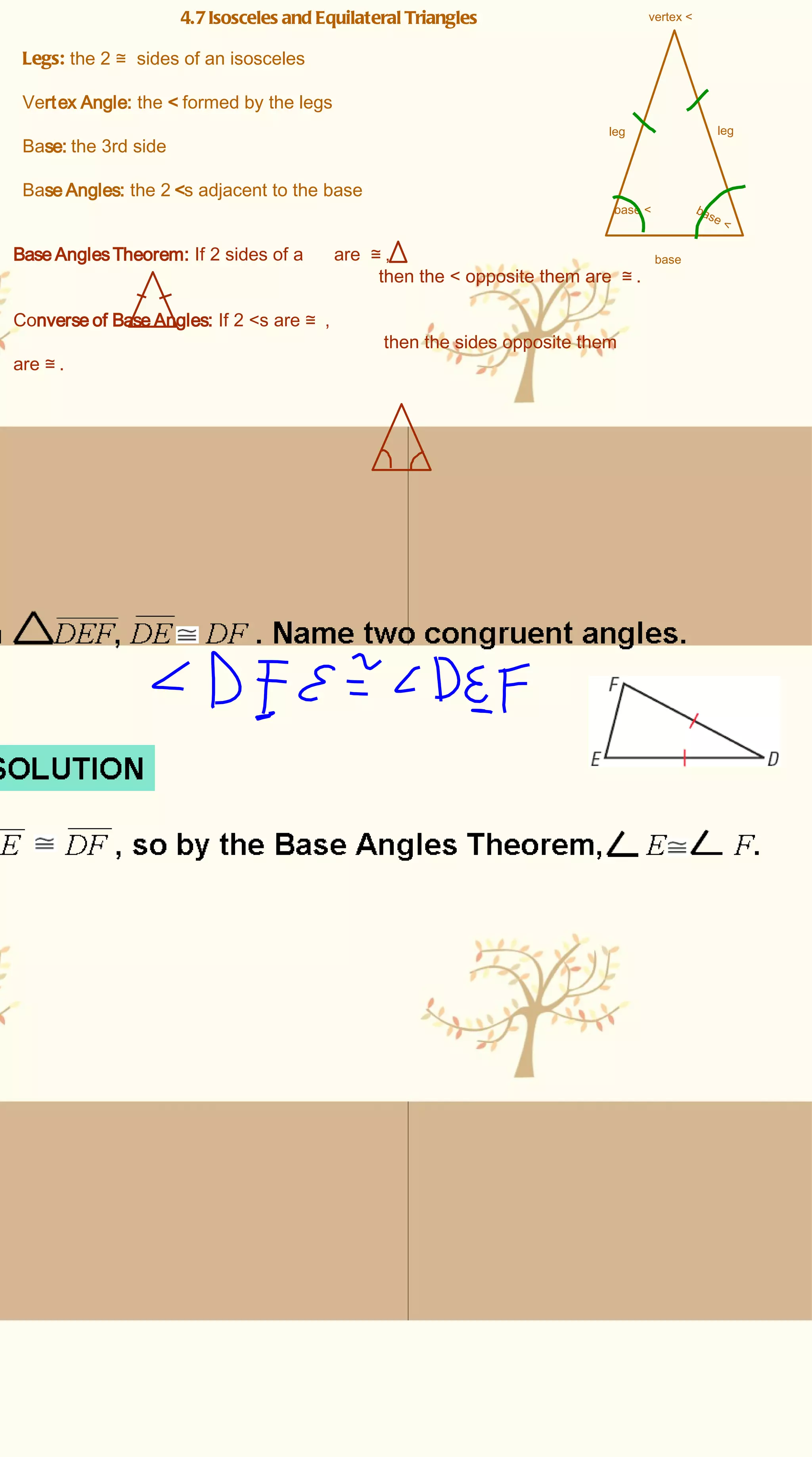
    4.7 Isosceles andEquilateral Triangles Legs: the 2 ≅ sides of an isosceles Ve rtex Angle: the < formed by the legs Ba se: the 3rd side Ba se Angles: the 2 < s adjacent to the base Base Angles Theorem: If 2 sides of a are ≅ , then the < opposite them are ≅ . Co nverse of Base Angles: If 2 <s are ≅ , then the sides opposite them are ≅ . vertex < leg leg base base < base <
  • 2.
    Corollaries: I fa triangle is equilateral, then it is equiangular. If a triangle is equiangular, then it is equilateral. Find ST in the triangle at the right. STU is equilateral, then its is equiangular.
  • 3.
  • 4.
  • 5.
    Find the valuesof x and y in the diagram. x ° = 60 ° y ° = 120 °
  • 6.
    HW pg. 267#3-27 odd