© Ohio Resource Center for Mathematics, Science, and Reading, 2008                    Page 1 of 4 
Self­Check 23 
Laws of Sines and Cosines 
 
1. In ∆XYZ, angle X measures 48.5°, side x measures 8.1 feet, and angle Z measures 25°. Apply the 
law of sines to find the length of side z. Include a sketch with your answer.  
2. In ∆ABC, angle C measures 125°, side b measures 5.3 cm, and side c measures 8.9 cm. Find all 
missing parts of the triangle. This is a two‐step question that requires the use of the inverse 
sine. (See guy‐wire problem in tutorial #22 for calculator directions for finding an inverse trig 
function.) Include a sketch with your answer. 
 
 
3. Given ∆KLM with angle K equal to 141.43°, side l measuring 6.5 cm, and side m measuring 7.9 
cm. Find the length of side k.  Include a sketch with your answer. 
 
4. In ∆ABC, side a measures 8.2 cm, side b is 3.7 cm, and side c measures 10.8 cm. Find the 
measure of angle C. Don’t forget that the largest angle of a triangle is opposite the longest side 
and the smallest angle is opposite the shortest side. (See guy‐wire problem in tutorial #22 for 
calculator directions for finding an inverse function.) Include a sketch with your answer. 
 
 
5. Using information and sketch from problem 4, find the measures of angles A and B.  
 
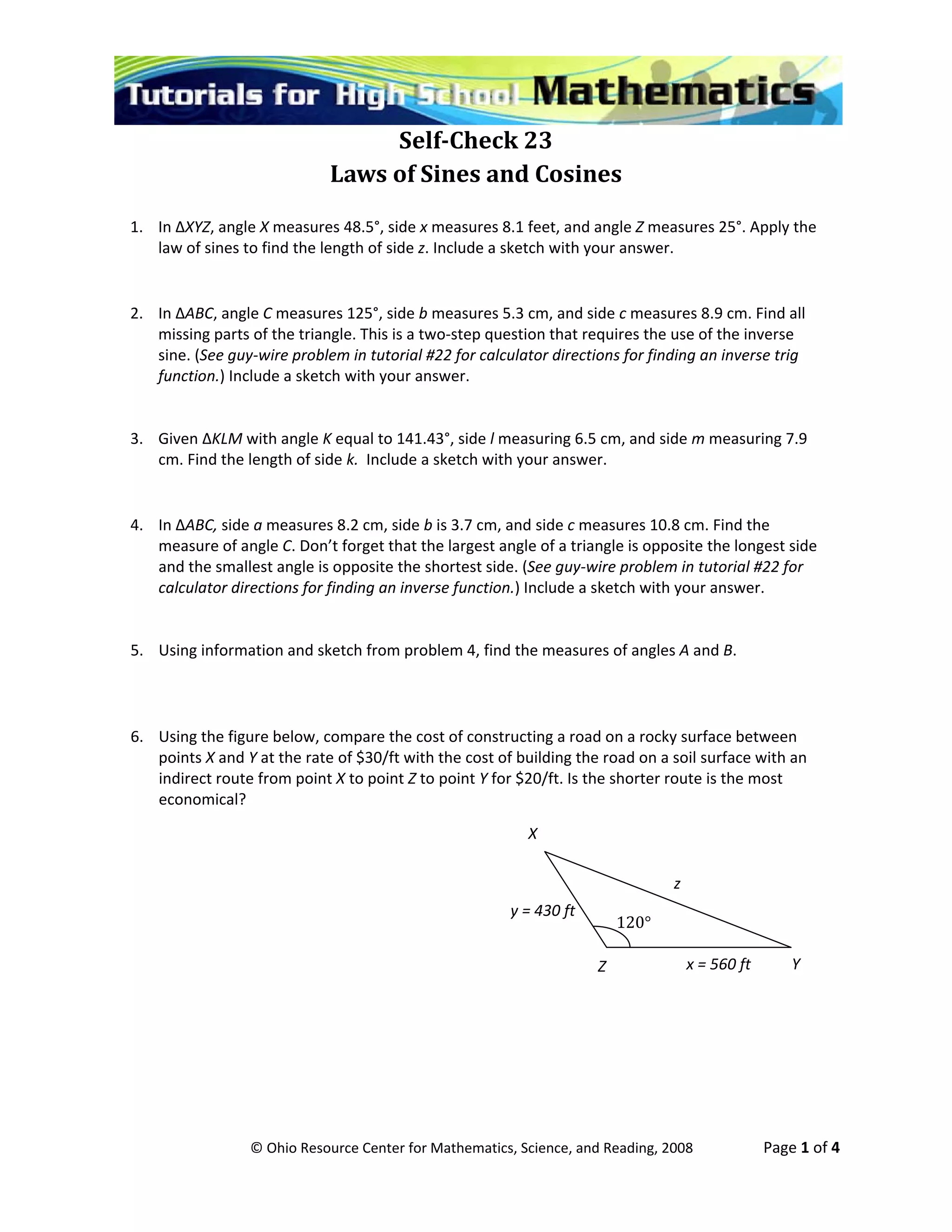
6. Using the figure below, compare the cost of constructing a road on a rocky surface between 
points X and Y at the rate of $30/ft with the cost of building the road on a soil surface with an 
indirect route from point X to point Z to point Y for $20/ft. Is the shorter route is the most 
economical? 
 
X
120°
x = 560 ft 
y = 430 ft 
z 
YZ
 
© Ohio Resource Center for Mathematics, Science, and Reading, 2008                    Page 2 of 4 
Solutions to Self­Check 23 
Laws of Sines and Cosines 
 
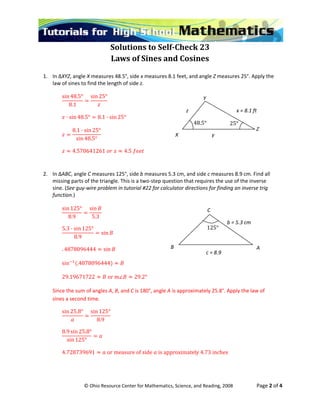
1. In ∆XYZ, angle X measures 48.5°, side x measures 8.1 feet, and angle Z measures 25°. Apply the 
law  o fi the  of side z.   of sines t nd   length
sin 48.5°
 
8.1
sin 25°
 
 
· si 8 .1 · sin 25° n 4 .5° 8
 
8.1 · sin 25°
sin 48.5°
 
 
4.570641261    4.5   
 
 
2. In ∆ABC, angle C measures 125°, side b measures 5.3 cm, and side c measures 8.9 cm. Find all 
missing parts of the triangle. This is a two‐step question that requires the use of the inverse 
sine. (See guy‐wire problem in tutorial #22 for calculator directions for finding an inverse trig 
function.) 
sin 125°
 
8.9 5.3
sin
 
 
5.3 · sin 125°
8.9
sin
 
78
 
. 48 096444 sin  
 
sin .4878096444  
 
29.19671722  or m 29.2° 
 
Since the sum of angles A, B, and C is 180°, angle A is approximately 25.8°. Apply the law of 
sine d ti .s a secon me   
sin 25.8°
8.9
sin 125°
 
 
8.9 sin 25.8°
sin 125°
 
 
4.728739691  or measure of side is approximately 4.73 inches 
 
z  x = 8.1 ft 
y X 
Y 
Z 
48.5° 25° 
C 
B  A 
c = 8.9 
b = 5.3 cm 
125°
 
 
© Ohio Resource Center for Mathematics, Science, and Reading, 2008                    Page 3 of 4 
Solutions to Self­Check 23 
Laws of Sines and Cosines 
 
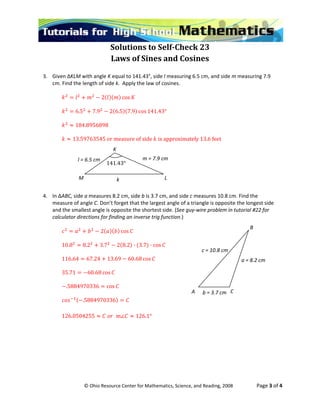
3. Given ∆KLM with angle K equal to 141.43°, side l measuring 6.5 cm, and side m measuring 7.9 
cm.  n    the law of cosines.  Fi d the length of side k.  Apply
 
2 cos  
 
2 6.5 7.9 cos 141.43° 6.5 7.9
 
184.8956898 
 
13.59763545 or measure of side   is approximately 13.6 feet 


4. In ∆ABC, side a measures 8.2 cm, side b is 3.7 cm, and side c measures 10.8 cm. Find the 
measure of angle C. Don’t forget that the largest angle of a triangle is opposite the longest side 
and the smallest angle is opposite the shortest side. (See guy‐wire problem in tutorial #22 for 
calcula inverse trig function.) tor directions for finding an 
 
2 cos  
 
. os  10.8 8.2 3.7 2 8.2 · 3 7 · c
 
69 60.68 cos  116.64 67.24 13.
 
35.71 60.68 cos  
 
.5884970336 cos  
 
.5884970336  
 
126.0504255    U m 126.1° 
 
K 
L M 
m = 7.9 cm 
k 
l = 6.5 cm 
141.43° 
B 
A  C b = 3.7 cm 
c = 10.8 cm 
a = 8.2 cm 


© Ohio Resource Center for Mathematics, Science, and Reading, 2008                    Page 4 of 4 
Solutions to Self­Check 23 
Laws of Sines and Cosines 
 
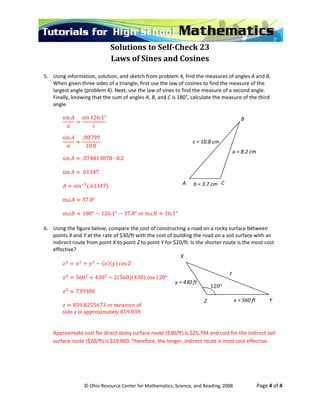
5. Using information, solution, and sketch from problem 4, find the measures of angles A and B. 
When given three sides of a triangle, first use the law of cosines to find the measure of the 
largest angle (problem 4). Next, use the law of sines to find the measure of a second angle. 
Finally, knowing that the sum of angles A, B, and C is 180°, calculate the measure of the third 
angle.  
sin
 
sin 126.1°
 
 
sin . 80799
10.8
 
 
3878 · 8.2 sin . 07481
6
 
sin . 1347 
 
347  sin .61
 
m 37.8° 
 
m 180° 126.1° 37.8° or m 16.1° 
 
6. Using the figure below, compare the cost of constructing a road on a rocky surface between 
points X and Y at the rate of $30/ft with the cost of building the road on a soil surface with an 
indirect route from point X to point Z to point Y for $20/ft. Is the shorter route is the most cost 
effe ivct e? 
 
cos  
 
430 2 560 430 cos 120° 560
 
739300 
  
 
859.8255673 or measure of
side   is approximately 859.83ft 
 
Approximate cost for direct stony surface route ($30/ft) is $25,794 and cost for the indirect soil 
surface route ($20/ft) is $19,860. Therefore, the longer, indirect route is most cost effective.  
 
B 
A  C b = 3.7 cm 
c = 10.8 cm 
a = 8.2 cm 
X
120°
x = 560 ft 
y = 430 ft 
z 
YZ
 

43 selfcheck