4 Ways
IT Can Drive
Innovation
VMware Executive Programs
Disruption rules.
Today, every industry is experiencing disruption at some level.
Business leaders must keep pace — often looking to the CIO and IT
organization to bring technical innovations to the table.
Business leaders want fast solutions
and true partnership. If your team
can’t deliver, they’ll build it themselves
or buy it externally.
Business Wants:
Speed and Partnership
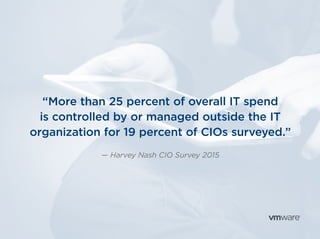
ā€œMore than 25 percent of overall IT spend
is controlled by or managed outside the IT
organization for 19 percent of CIOs surveyed.ā€
— Harvey Nash CIO Survey 2015
If IT can’t provide what the business wants
or give an equally viable option, the business
will purchase solutions externally.
Business Wants:
Choice
Business users expect technology to stay out
of the way of work. They want to pick up
a device to get to their data — easily
and securely.
Business Wants:
Simplicity + Security
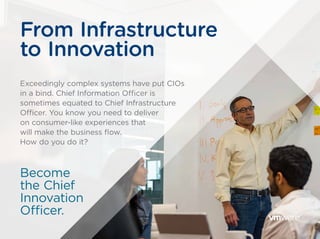
Exceedingly complex systems have put CIOs
in a bind. Chief Information Officer is
sometimes equated to Chief Infrastructure
Officer. You know you need to deliver
on consumer-like experiences that
will make the business flow.
How do you do it?
From Infrastructure
to Innovation
Become
the Chief
Innovation
Officer.
It’s the Cloud Economy.
You can clear the way to innovation
with a software-defined approach, or cloud economics.
Realize its benefits in four key ways.
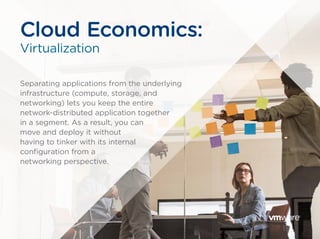
Separating applications from the underlying
infrastructure (compute, storage, and
networking) lets you keep the entire
network-distributed application together
in a segment. As a result, you can
move and deploy it without
having to tinker with its internal
configuration from a
networking perspective.
Cloud Economics:
Virtualization
With applications in virtual segments —
whether that segment is a virtual machine,
a virtual network, or a virtual storage
type — you radically simplify the number
of different types of things that must
be managed in your data center.
Cloud Economics:
Simplified Management
Instead of needing to automate the life of 3, 4,
or 5,000 different applications, you need
to automate the lifecycle of only a few
segment types. And by automating the
lifecycle of an individual segment,
you can automate the lifecycle of
all the applications you put into
that segment.
Cloud Economics:
Automation
Once the application — and all that goes with
it — is separate from the infrastructure, you
can choose to run it in the cloud. That cloud
doesn’t have to be a private cloud or a
public cloud. You can deploy a hybrid
cloud for flexibility and manage it
as a single, unified cloud, using
the same people, processes,
and tool sets.
Cloud Economics:
Choice
Why software-defined?
The simplification realized by the software-defined approach gets you
closer to what you want IT to be: self-service, instantly provisioned,
pay per use, elastic, and cost-efficient. It also frees up IT budget to be
redirected to innovation that will drive your businesses’ top-line growth.
Follow CIO Exchange
on Twitter
@vmwcioexchange
Apply to
Join CIO Exchange
on LinkedIn
Subscribe to CIO
Vantage Magazine
on Flipboard
Brought to you by VMware CIO Exchange
Stay informed. Get engaged.
Join us on your preferred social platform for content and conversation
around topics designed to help tech execs stay on top of the game.

4 Ways IT Can Drive Innovation

  • 1.
    4 Ways IT CanDrive Innovation VMware Executive Programs
  • 2.
    Disruption rules. Today, everyindustry is experiencing disruption at some level. Business leaders must keep pace — often looking to the CIO and IT organization to bring technical innovations to the table.
  • 3.
    Business leaders wantfast solutions and true partnership. If your team can’t deliver, they’ll build it themselves or buy it externally. Business Wants: Speed and Partnership
  • 4.
    ā€œMore than 25percent of overall IT spend is controlled by or managed outside the IT organization for 19 percent of CIOs surveyed.ā€ — Harvey Nash CIO Survey 2015
  • 5.
    If IT can’tprovide what the business wants or give an equally viable option, the business will purchase solutions externally. Business Wants: Choice
  • 6.
    Business users expecttechnology to stay out of the way of work. They want to pick up a device to get to their data — easily and securely. Business Wants: Simplicity + Security
  • 7.
    Exceedingly complex systemshave put CIOs in a bind. Chief Information Officer is sometimes equated to Chief Infrastructure Officer. You know you need to deliver on consumer-like experiences that will make the business flow. How do you do it? From Infrastructure to Innovation Become the Chief Innovation Officer.
  • 8.
    It’s the CloudEconomy. You can clear the way to innovation with a software-defined approach, or cloud economics. Realize its benefits in four key ways.
  • 9.
    Separating applications fromthe underlying infrastructure (compute, storage, and networking) lets you keep the entire network-distributed application together in a segment. As a result, you can move and deploy it without having to tinker with its internal configuration from a networking perspective. Cloud Economics: Virtualization
  • 10.
    With applications invirtual segments — whether that segment is a virtual machine, a virtual network, or a virtual storage type — you radically simplify the number of different types of things that must be managed in your data center. Cloud Economics: Simplified Management
  • 11.
    Instead of needingto automate the life of 3, 4, or 5,000 different applications, you need to automate the lifecycle of only a few segment types. And by automating the lifecycle of an individual segment, you can automate the lifecycle of all the applications you put into that segment. Cloud Economics: Automation
  • 12.
    Once the application— and all that goes with it — is separate from the infrastructure, you can choose to run it in the cloud. That cloud doesn’t have to be a private cloud or a public cloud. You can deploy a hybrid cloud for flexibility and manage it as a single, unified cloud, using the same people, processes, and tool sets. Cloud Economics: Choice
  • 13.
    Why software-defined? The simplificationrealized by the software-defined approach gets you closer to what you want IT to be: self-service, instantly provisioned, pay per use, elastic, and cost-efficient. It also frees up IT budget to be redirected to innovation that will drive your businesses’ top-line growth.
  • 14.
    Follow CIO Exchange onTwitter @vmwcioexchange Apply to Join CIO Exchange on LinkedIn Subscribe to CIO Vantage Magazine on Flipboard Brought to you by VMware CIO Exchange Stay informed. Get engaged. Join us on your preferred social platform for content and conversation around topics designed to help tech execs stay on top of the game.