HUAWEI TECHNOLOGIES CO.,LTD.
VoLTE eSRVCC Optimization
This document is for internal reference only. Do not transfer this document directly to customers.
2.
HUAWEI TECHNOLOGIES CO.,LTD. Huawei Confidential Page 2
Principles Criterion Factors
Identification and
optimization
IMS EPC
Radio
network
eSRVCC Procedure
Radio resource
preparation
IST flow
Radio handover
execution
Sv interface SIP signaling interface
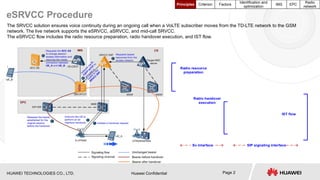
The SRVCC solution ensures voice continuity during an ongoing call when a VoLTE subscriber moves from the TD-LTE network to the GSM
network. The live network supports the eSRVCC, aSRVCC, and mid-call SRVCC.
The eSRVCC flow includes the radio resource preparation, radio handover execution, and IST flow.
3.
HUAWEI TECHNOLOGIES CO.,LTD. Huawei Confidential Page 3
SRVCC Development and Category
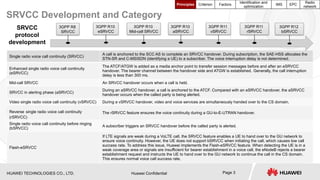
Single radio voice call continuity (SRVCC)
A call is anchored to the SCC AS to complete an SRVCC handover. During subscription, the SAE-HSS allocates the
STN-SR and C-MSISDN (identifying a UE) to a subscriber. The voice interruption delay is not determined.
Enhanced single radio voice call continuity
(eSRVCC)
The ATCF/ATGW is added as a media anchor point to transfer session messages before and after an eSRVCC
handover. The bearer channel between the handover side and ATGW is established. Generally, the call interruption
delay is less than 300 ms.
Mid-call SRVCC An SRVCC handover occurs when a call is held.
SRVCC in alerting phase (aSRVCC)
During an aSRVCC handover, a call is anchored to the ATCF. Compared with an eSRVCC handover, the aSRVCC
handover occurs when the called party is being alerted.
Video single radio voice call continuity (vSRVCC) During a vSRVCC handover, video and voice services are simultaneously handed over to the CS domain.
Reverse single radio voice call continuity
(rSRVCC)
The rSRVCC feature ensures the voice continuity during a GU-to-E-UTRAN handover.
Single radio voice call continuity before ringing
(bSRVCC)
A subscriber triggers an SRVCC handover before the called party is alerted.
Flash-eSRVCC
If LTE signals are weak during a VoLTE call, the SRVCC feature enables a UE to hand over to the GU network to
ensure voice continuity. However, the UE does not support bSRVCC when initiating the call, which causes low call
success rate. To address this issue, Huawei implements the Flash-eSRVCC feature. When detecting the UE is in a
weak coverage area or signals are insufficient for bearer establishment in a voice call, the eNodeB rejects a bearer
establishment request and instructs the UE to hand over to the GU network to continue the call in the CS domain.
This ensures normal voice call success rate.
SRVCC
protocol
development
3GPP R8
SRVCC
3GPP R10
eSRVCC
3GPP R10
Mid-call SRVCC
3GPP R10
aSRVCC
3GPP R11
vSRVCC
3GPP R11
rSRVCC
3GPP R12
bSRVCC
Principles Criterion Factors
Identification and
optimization
IMS EPC
Radio
network
4.
HUAWEI TECHNOLOGIES CO.,LTD. Huawei Confidential Page 4
Preparations
on the eNodeB
Preparations
on the MME
Preparations
on the eMSC
Preparations
on the 2G
radio network
Preparations
on the ATCF
Preparations on
the SCC AS
Handover
preparation phase
ATCF
(200 OK)
eMSC
(response)
MME
(execution)
eNodeB
(execution)
Handover
execution phase
eNodeB
(completion)
MME
(completion)
eMSC
(completion)
Handover
completion phase
eNodeB
(cancellation)
MME
(cancellation)
UE
(re-INVITE)
SCC AS
(200 OK)
Handover
cancellation
eNodeB
(cancellation)
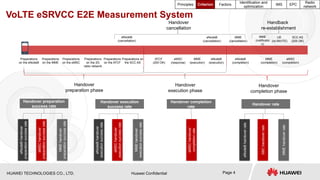
VoLTE eSRVCC E2E Measurement System
Handback
re-establishment
MME
(notificatio
n)
Handover preparation
success rate
Handover execution
success rate
Handover completion
rate
Handover rate
eMSC
handover
preparation
success
rate
MME
handover
preparation
success
rate
eNodeB
handover
preparation
success
rate
eMSC
handover
execution
success
rate
MME
handover
execution
success
rate
eNodeB
handover
execution
success
rate
eMSC
handover
completion
rate
SBC
handover
rate
MME
handover
rate
eNodeB
handover
rate
Principles Criterion Factors
Identification and
optimization
IMS EPC
Radio
network
5.
HUAWEI TECHNOLOGIES CO.,LTD. Huawei Confidential Page 5
VoLTE eSRVCC Measurement on the LTE Network
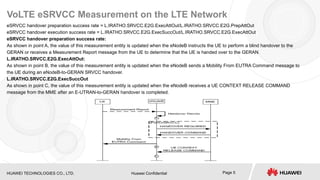
eSRVCC handover preparation success rate = L.IRATHO.SRVCC.E2G.ExecAttOut/L.IRATHO.SRVCC.E2G.PrepAttOut
eSRVCC handover execution success rate = L.IRATHO.SRVCC.E2G.ExecSuccOut/L.IRATHO.SRVCC.E2G.ExecAttOut
eSRVCC handover preparation success rate:
As shown in point A, the value of this measurement entity is updated when the eNodeB instructs the UE to perform a blind handover to the
GERAN or receives a Measurement Report message from the UE to determine that the UE is handed over to the GERAN.
L.IRATHO.SRVCC.E2G.ExecAttOut:
As shown in point B, the value of this measurement entity is updated when the eNodeB sends a Mobility From EUTRA Command message to
the UE during an eNodeB-to-GERAN SRVCC handover.
L.IRATHO.SRVCC.E2G.ExecSuccOut
As shown in point C, the value of this measurement entity is updated when the eNodeB receives a UE CONTEXT RELEASE COMMAND
message from the MME after an E-UTRAN-to-GERAN handover is completed.
6.
HUAWEI TECHNOLOGIES CO.,LTD. Huawei Confidential Page 6
VoLTE eSRVCC Measurement on the EPC Network (1)
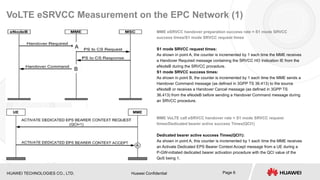
MME eSRVCC handover preparation success rate = S1 mode SRVCC
success times/S1 mode SRVCC request times
S1 mode SRVCC request times:
As shown in point A, the counter is incremented by 1 each time the MME receives
a Handover Required message containing the SRVCC HO Indication IE from the
eNodeB during the SRVCC procedure.
S1 mode SRVCC success times:
As shown in point B, the counter is incremented by 1 each time the MME sends a
Handover Command message (as defined in 3GPP TS 36.413) to the source
eNodeB or receives a Handover Cancel message (as defined in 3GPP TS
36.413) from the eNodeB before sending a Handover Command message during
an SRVCC procedure.
MME VoLTE call eSRVCC handover rate = S1 mode SRVCC request
times/Dedicated bearer active success Times(QCI1)
Dedicated bearer active success Times(QCI1):
As shown in point A, this counter is incremented by 1 each time the MME receives
an Activate Dedicated EPS Bearer Context Accept message from a UE during a
P-GW-initiated dedicated bearer activation procedure with the QCI value of the
QoS being 1.
A
B
7.
HUAWEI TECHNOLOGIES CO.,LTD. Huawei Confidential Page 7
VoLTE eSRVCC Measurement on the EPC Network (2)
MME eSRVCC handover execution success rate = [Times of MME-received
SRVCC PS to CS Complete Notification Messages - Times of MME-received
SRVCC PS to CS Complete Notification Messages (#9 Permanent session leg
establishment error) - Times of MME-received SRVCC PS to CS Complete
Notification Messages (#10 Temporary session leg establishment error)]/[Times
of MME-received SRVCC PS to CS Response Messages - Times of MME-
received SRVCC PS to CS Response Messages (#1 Unspecified) - Times of
MME-received SRVCC PS to CS Response Messages (#2 Handover/Relocation
cancelled by source system) - Times of MME-received SRVCC PS to CS
Response Messages (#3 Handover/Relocation Failure with Target system) -
Times of MME-received SRVCC PS to CS Response Messages (#4
Handover/Relocation Target not allowed) - Times of MME-received SRVCC PS
to CS Response Messages (#5 Unknown Target ID) - Times of MME-received
SRVCC PS to CS Response Messages (#6 Target Cell not available) - Times of
MME-received SRVCC PS to CS Response Messages (#7 No Radio Resources
Available in Target Cell) - Times of MME-received SRVCC PS to CS Response
Messages (#8 Failure in Radio Interface Procedure)]
Times of MME-received SRVCC PS to CS Response Messages:
As shown in point A, the counter is incremented by 1 each time the MME
receives an SRVCC PS to CS Response message (as defined in 3GPP TS
29.280) from the SRVCC IWF during the SRVCC procedure.
Times of MME-received SRVCC PS to CS Complete Notification Messages:
As shown in point B, the counter is incremented by 1 each time the MME
receives an SRVCC PS to CS Complete Notification message (as defined in
3GPP TS 29.280) from the SRVCC IWF during the SRVCC procedure.
A
B
8.
HUAWEI TECHNOLOGIES CO.,LTD. Huawei Confidential Page 8
VoLTE eSRVCC Measurement on the Core Network (1)
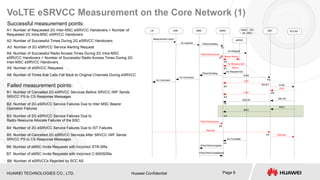
A4: Number of Successful Radio Access Times During 2G Intra-MSC
eSRVCC Handovers + Number of Successful Radio Access Times During 2G
Inter-MSC eSRVCC Handovers
A1: Number of Requested 2G Inter-MSC eSRVCC Handovers + Number of
Requested 2G Intra-MSC eSRVCC Handovers
B1: Number of Cancelled 2G eSRVCC Services Before SRVCC IWF Sends
SRVCC PS to CS Response Messages
B2: Number of 2G eSRVCC Service Failures Due to Inter MSC Bearer
Operation Failures
B3: Number of 2G eSRVCC Service Failures Due to
Radio Resource Allocate Failures of the BSC
B5: Number of Cancelled 2G eSRVCC Services After SRVCC IWF Sends
SRVCC PS to CS Response Messages
A3: Number of 2G eSRVCC Service Alerting Request
A2: Number of Successful Times During 2G eSRVCC Handovers
B4: Number of 2G eSRVCC Service Failures Due to IST Failures
B6: Number of eMSC Invite Requests with Incorrect STN-SRs
B7: Number of eMSC Invite Requests with Incorrect C-MSISDNs
B8: Number of eSRVCCs Rejected by SCC AS
A6: Number of Times that Calls Fall Back to Original Channels During eSRVCC
A5: Number of eSRVCC Requests
Successful measurement points:
Failed measurement points:
UE eNB MME eMSC GMSC /VM
SC / BSC
SBC SCCAS
Measurement report
Ho required PStoCSHoReq
Ho Request
Ho Request Ack
failure
Ho Request Ack
PStoCSHoRsp
Ho Command
Ho Command
Invite
Invite
Ho Complete
PStoCSHoComplete
PStoCSHoCompleteAck
OXX
OXX
OXX
PStoCSHoCancel
eMGW
Bearer failure
A1
B3
PStoCSHoCancel
B 1
B2
200 OK
200 OK
INFO
INFO
A4
A2
A3
A5
B4
B6/B7
B4
B5
B8
ReInvite
ReInvite
A6
9.
HUAWEI TECHNOLOGIES CO.,LTD. Huawei Confidential Page 9
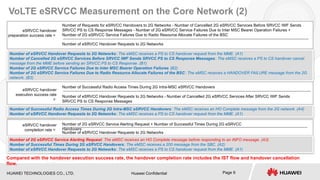
eSRVCC handover
preparation success rate =
Number of Requests for eSRVCC Handovers to 2G Networks - Number of Cancelled 2G eSRVCC Services Before SRVCC IWF Sends
SRVCC PS to CS Response Messages - Number of 2G eSRVCC Service Failures Due to Inter MSC Bearer Operation Failures +
Number of 2G eSRVCC Service Failures Due to Radio Resource Allocate Failures of the BSC
Number of eSRVCC Handover Requests to 2G Networks
eSRVCC handover
completion rate =
Number of 2G eSRVCC Service Alerting Request + Number of Successful Times During 2G eSRVCC
Handovers
Number of eSRVCC Handover Requests to 2G Networks
Number of eSRVCC Handover Requests to 2G Networks: The eMSC receives a PS to CS handover request from the MME. (A1)
Number of Cancelled 2G eSRVCC Services Before SRVCC IWF Sends SRVCC PS to CS Response Messages: The eMSC receives a PS to CS handover cancel
message from the MME before sending an SRVCC PS to CS Response. (B1)
Number of 2G eSRVCC Service Failures Due to Inter MSC Bearer Operation Failures (B2)
Number of 2G eSRVCC Service Failures Due to Radio Resource Allocate Failures of the BSC: The eMSC receives a HANDOVER FAILURE message from the 2G
network. (B3)
Number of Successful Radio Access Times During 2G Intra-MSC eSRVCC Handovers: The eMSC receives an HO Complete message from the 2G network. (A4)
Number of eSRVCC Handover Requests to 2G Networks: The eMSC receives a PS to CS handover request from the MME. (A1)
eSRVCC handover
execution success rate
=
Number of Successful Radio Access Times During 2G Intra-MSC eSRVCC Handovers
Number of eSRVCC Handover Requests to 2G Networks - Number of Cancelled 2G eSRVCC Services After SRVCC IWF Sends
SRVCC PS to CS Response Messages
Number of 2G eSRVCC Service Alerting Request: The eMSC receives an HO Complete message before responding to an INFO message. (A3)
Number of Successful Times During 2G eSRVCC Handovers: The eMSC receives a 200 message from the SBC. (A2)
Number of eSRVCC Handover Requests to 2G Networks: The eMSC receives a PS to CS handover request from the MME. (A1)
Compared with the handover execution success rate, the handover completion rate includes the IST flow and handover cancellation
flow.
VoLTE eSRVCC Measurement on the Core Network (2)
10.
HUAWEI TECHNOLOGIES CO.,LTD. Huawei Confidential Page 10
Assessment Analysis System for VoLTE eSRVCC Measurement on the
EMS
If
(L2.3+L2.4)/(L2.5+L
2.6+L2.7) result is
greater than 50%,
the handover failure
is mainly caused by
faults of the inter-
RAT neighboring
cell or 2G network.
Otherwise, the
handover failure is
mainly caused by
IST flow faults.
L1.3 eSRVCC handback
L1.1 eSRVCC handover
preparation success rate
L1.2 eSRVCC handover
execution success rate
L2.15 EPC temporary session
path establishment failures
L2.14 EPC permanent session
path establishment failures
L2.13 Handover cancellation
requests sent by the eNodeB
L2.10 Handover failures caused
by subscribers
If L3.2+L3.3 result is
greater than 50%,
the handover failure
is mainly caused by
faults of the inter-
RAT neighboring cell
or 2G network.
EPC SRVCC
analysis
CN SRVCC
analysis
eSRVCC
assessment
eMSC statistics
EPC statistics
LTE statistics
Number of failed E-UTRAN-to-
GERAN outgoing handover
execution times
[2G] SR1005: SRVCC handover
failures (TCH)
Cell SRVCC
analysis
L2.1 Unavailable eMSC 2G cells
L2.2 Inter eMSC bearer operation
failures
L2.7 Number of eMSC-to-ATGW
media switch failures
L2.9 Re-INVITE times (cause value
487)
L2.16 EPC eSRVCC cancellation
times (after receiving an RSP
from the eMSC)
eNodeB eSRVCC re-establishment
times due to failures
Number of failed outgoing E-UTRAN-
to-GERAN CS-only SRVCC
handover execution times
L1.3 eSRVCC handover
completion rate
L2.1 Number of failed E-UTRAN-to-
GERAN outgoing handover attempts
Number of failed outgoing E-UTRAN-
to-GERAN CS-only SRVCC handover
attempts
L2.11 Handover failures caused
by the MME
L2.12 Handover failures caused
by the MSC server
L2.3 Number of successful radio
access times during intra-MSC
eSRVCC handovers
L2.4 Number of successful radio
access times during inter-MSC
eSRVCC handovers
L2.5 Number of eMSC Invite
Requests with Incorrect C-MSISDNs
L2.6 Number of eSRVCCs Rejected
by SCC AS
If the L2.1 result is
greater than 50%,
the handover failure
is mainly caused by
radio network faults.
L2.8 Number of eMSC Invite
Requests with Incorrect STN-SRs
11.
HUAWEI TECHNOLOGIES CO.,LTD. Huawei Confidential Page 11
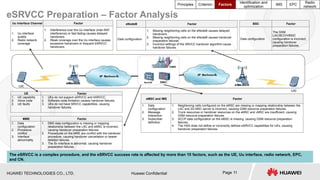
eSRVCC Preparation – Factor Analysis
UE Factor
1. UE capability
2. Voice code
3. UE faults
1. UEs do not support aSRVCC and bSRVCC.
2. Software code limitation causes handover failures.
3. UEs do not have SRVCC capabilities, causing
handover failures.
Uu Interface Channel Factor
1. Uu interface
quality
2. Radio network
coverage
1. Interference over the Uu interface (inter-RAT
interference) or fast fading causes delayed
handovers.
2. Weak coverage over the Uu interface causes
excessive handovers or frequent bSRVCC
handovers.
eNodeB Factor
Data configuration
1. Missing neighboring cells on the eNodeB causes delayed
handovers.
2. Missing neighboring cells on the eNodeB causes handover
preparation failures.
3. Incorrect settings of the SRVCC handover algorithm cause
handover failures.
The eSRVCC is a complex procedure, and the eSRVCC success rate is affected by more than 10 factors, such as the UE, Uu interface, radio network, EPC,
and CN.
eMSC and IMS Factor
1. Data
configuration
2. Message
interaction
3. Subscriber
definition
1. Neighboring cells configured on the eMSC are missing or mapping relationship between the
LAC and 2G MSC server is incorrect, causing GSM resource preparation failures.
2. Trunk resources or handover resources on the eMSC and vMSC are insufficient, causing
GSM resource preparation failures.
3. SCCP data configuration on the eMSC is missing, causing GSM resource preparation
failures.
4. The HSS does not define or incorrectly defines eSRVCC capabilities for UEs, causing
handover preparation failures.
MME Factor
1. Data
configuration
2. Procedure
conflict
3. Interface
abnormality
1. DNS data configuration is missing or mapping
relationship between the LAC and eMSC is incorrect,
causing handover preparation failures.
2. Procedures on the MME are conflict with the handover
procedure, causing handover cancellation or bearer
deletion failures.
3. The Sv interface is abnormal, causing handover
preparation failures.
BSC Factor
Data configuration
The GSM
LAC/BCCH/BSIC
configuration is incorrect,
causing handover
preparation failures.
Principles Criterion Factors
Identification and
optimization
IMS EPC
Radio
network
12.
HUAWEI TECHNOLOGIES CO.,LTD. Huawei Confidential Page 12
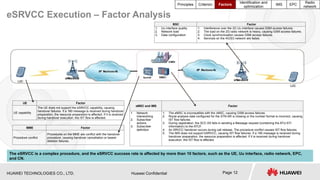
eSRVCC Execution – Factor Analysis
The eSRVCC is a complex procedure, and the eSRVCC success rate is affected by more than 10 factors, such as the UE, Uu interface, radio network, EPC,
and CN.
eMSC and IMS Factor
1. Network
interworking
2. Subscriber
actions
3. Subscriber
definition
1. The eMSC is incompatible with the vMSC, causing GSM access failures.
2. Route analysis data configured for the STN-SR is missing or the number format is incorrect, causing
IST flow failures.
3. During registration, the SCC AS fails in sending a Message request (containing the ATU-STI
information) to the ATCF.
4. An SRVCC handover occurs during call release. The procedure conflict causes IST flow failures.
5. The IMS does not support bSRVCC, causing IST flow failures. If a 180 message is received during
handover preparation, the resource preparation is affected. If it is received during handover
execution, the IST flow is affected.
MME Factor
Procedure conflict
Procedures on the MME are conflict with the handover
procedure, causing handover cancellation or bearer
deletion failures.
UE Factor
UE capability
The UE does not support the bSRVCC capability, causing
handover failures. If a 180 message is received during handover
preparation, the resource preparation is affected. If it is received
during handover execution, the IST flow is affected.
BSC Factor
1. Uu interface quality
2. Network load
3. Data configuration
1. Interference over the 2G Uu interface causes GSM access failures.
2. The load on the 2G radio network is heavy, causing GSM access failures.
3. Clock synchronization causes GSM access failures.
4. Services on the 4G/2G network are faded.
Principles Criterion Factors
Identification and
optimization
IMS EPC
Radio
network
13.
HUAWEI TECHNOLOGIES CO.,LTD. Huawei Confidential Page 13
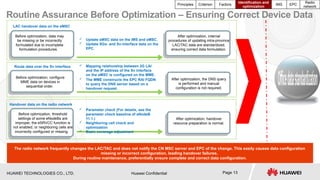
The radio network frequently changes the LAC/TAC and does not notify the CN MSC server and EPC of the change. This easily causes data configuration
missing or incorrect configuration, leading handover failures.
During routine maintenance, preferentially ensure complete and correct data configuration.
Routine Assurance Before Optimization – Ensuring Correct Device Data
Before optimization, configure
MME data on devices in
sequential order.
Before optimization, data may
be missing or be incorrectly
formulated due to incomplete
formulation procedures.
After optimization, internal
procedures of updating intra-province
LAC/TAC data are standardized,
ensuring correct data formulation.
Update eMSC data on the IMS and eMSC.
Update SGs- and Sv-interface data on the
EPC.
Route data over the Sv interface
After optimization, the DNS query
is performed and manual
configuration is not required.
Mapping relationship between 2G LAI
and the IP address of the Sv interface
on the eMSC is configured on the MME.
The MME constructs the EPC RAI FQDN
to query the DNS server based on a
handover request.
LAC handover data on the eMSC
Handover data on the radio network
Before optimization, threshold
settings of some eNodeBs are
improper, the eSRVCC function is
not enabled, or neighboring cells are
incorrectly configured or missing.
Parameter check (For details, see the
parameter check baseline of eNodeB
11.1.)
Neighboring cell check and
optimization
Basic coverage adjustment
After optimization, handover
resource preparation is normal.
Principles Criterion Factors
Identification and
optimization
IMS EPC
Radio
network
14.
HUAWEI TECHNOLOGIES CO.,LTD. Huawei Confidential Page 14
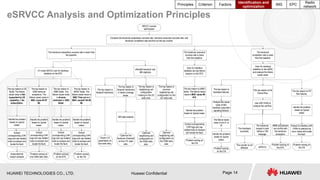
eSRVCC Analysis and Optimization Principles
Principles Criterion Factors
Identification and
optimization
IMS EPC
Radio
network
View Sv-interface
statistics and top failure
reasons on the EPC.
Compare the handover preparation success rate, handover execution success rate, and
handover completion rate and find out the top counter.
Use xDR CHRs to
analyze the call flow.
Problem solving on
the EPC
bSRVCC
Problem solving on
the CN
View Sv-interface
statistics on the eMSC
and analyze the failure
cause value.
SRVCC counter
optimization
Problem solving on
the CN
Extract I2-interface xDR
CHRs to analyze top
error codes and locate
the fault.
The handover preparation success rate is lower than
the baseline.
The handover execution
success rate is lower
than the baseline.
The handover
completion rate is lower
than the baseline.
The top reason is eMSC
faults. The failure cause
value is MSC cause #9
#10.
Extract corresponding
CHR logs and use
related tools to analyze
and locate the fault.
The handover
request is sent
before a 180
message.
MME procedures
are conflict with
the handover
procedure.
The top reason is the
Cancel flow.
The top reason is IST
flow failures.
The handback
succeeds.
The counter is not
affected.
The top reason is
handback failures.
Analyze the cause
value of Mw-
interface subscriber
signaling failures.
The failure cause
value is not 31 or
16.
Problem solving
on the CN
S1 mode SRVCC and Sv interface
statistics on the EPC
The top reason is
delayed handovers.
Subscriber/UE
reason analysis
Problem solving
on the EPC
Problem solving on
the GSM radio side
Problem solving
on the CN
Extract
corresponding CHR
logs and use related
tools to analyze and
locate the fault.
The top reason is UE
faults. The failure
cause value is Not
supported by UE
capability or No
subscription.
The top reason is
GSM resource
exceptions. The
failure cause value is
MSC cause #3 #7
#8.
The top reason is
MME faults. The
failure cause value
is Access
restricted or DNS
failed.
The top reason is
eMSC faults. The
failure cause value is
MSC Time out and
MSC cause#1 #4 #5
#6.
Extract
corresponding CHR
logs and use related
tools to analyze and
locate the fault.
Extract
corresponding CHR
logs and use related
tools to analyze and
locate the fault.
Extract
corresponding CHR
logs and use related
tools to analyze and
locate the fault.
eNodeB handover and
MR statistics
The top reason is
frequent handovers
in weak coverage
areas.
The top reason is
incorrect
neighboring cell
configuration on the
2G radio side.
The top reason is
neighboring cell
configuration
missing on the 2G
radio side.
Check LTE
parameters on
the radio side.
Optimize the
handover threshold
on the LTE radio
side.
MR data analysis
Optimize
neighboring cell
configuration on
the GSM radio
side.
Optimize
neighboring cell
configuration on
the GSM radio
side.
Handle the problem
based on typical
cases.
Handle the problem
based on typical
cases.
Handle the problem
based on typical
cases.
Handle the problem
based on typical
cases.
Handle the problem
based on typical cases.
Handle the problem
based on typical
cases.
Handle the problem
based on typical
cases.
15.
HUAWEI TECHNOLOGIES CO.,LTD. Huawei Confidential Page 15
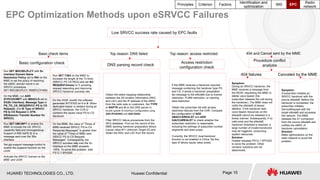
EPC Optimization Methods upon eSRVCC Failures
404 and Cancel sent by the MME
Top reason: access restricted
Basic check items
404 failures Canceled by the MME
Top reason: DNS failed
DNS parsing record check
Access restriction
configuration check
Procedure conflict
analysis
Basic configuration check
Run SET T3N3 on the MME to
increase the length of the T3 timer
(SRVCC PS CS REQ) and set N3-
REQUEST(times) to 1, avoiding
request resending and improving
SRVCC handover success rate.
On the UGW, modify the software
parameter BYTE502 bit 8 to 0. When
dedicated bearer is deleted during an
SRVCC handover, the CCR-U
contains the cause value PS to CS
handover.
Run SET MSCSELPLCY with Sv
Interface Domain Name
Resolution Policy set to RAI on the
MME to set the policy of resolving
the eMSC domain name in an
SRVCC procedure.
SET MSCSELPLCY: DNSPLCY=RAI
On the MME, run ADD
GTPCV2CMPT with MSGCLS set to
SV(Sv Interface), Message Type to
PS_TO_CS_REQ(SRVCC PS to CS
Request), and IE Type of SRVCC
PS to CS Request to STN-
SR(Session Transfer Number for
SRVCC).
Run SET DMCMPT to enable the
MME to include the UE SRVCC
capability field and Homogeneous
Support of IMS VoPS IE in a
message sent over the S6a
interface.
Set gtp-support message-control to
enable the suspend function on the
UGW.
Activate the SRVCC license on the
MME and UGW.
Symptom:
During an SRVCC handover, the
MME receives a message from
the MGW, requesting the MME to
delete voice bearer (the
subscriber releases the call during
the handover). The MME does not
notify the eNodeB of bearer
deletion. If the handover fails,
voice bearer resources on the
eNodeB cannot be released in a
timely manner. Subsequently, if no
calls exist and the eNodeB
handover threshold is reached, a
large number of invalid handovers
may be triggered, consuming
system resources.
Solution:
Huawei releases PS12.1 SPH323
to solve the problem. Other
vendors' solutions are not
determined.
Symptom:
A subscriber initiates an
SRVCC handover with the
source eNodeB. Before the
handover is completed, the
subscriber initiates
ServiceRequest with the
target eNodeB and accesses
the network. The MME
releases the S1 connection
from the source eNodeB and
notifies the eMSC of
handover cancellation.
Solution:
Make optimizations on the
radio network to avoid the
problem.
On the MME, the value of "Times of
MME-received SRVCC PS to CS
Response Messages" is greater than
the value of "Times of MME-sent
SRVCC PS to CS Request
Messages". Consequently, the
SRVCC success rate over the Sv
interface on the MME exceeds
100%. To solve this problem, load
PS12.1 SPH330.
Low SRVCC success rate caused by EPC faults
Obtain the latest mapping relationship
between the 2G location information (RAC
and LAC) and the IP address of the eMSC
from the radio side or customers. Set TYPE
to NAPTR and A on the DNS server or
locally update Sv interface configuration using
ADD IPV4DNSH and ADD DNSN.
Filter SRVCC failure procedures from the
SEQ database. Find out the record of the
MME sending handover preparation failure
(cause value #11 Unknown Target ID) and
obtain the RAC and LAC from the record.
If the MME receives a handover required
message containing the handover type PS
and CS, it sends a handover preparation
fail message to the eNodeB due to license
restriction, PLMN restriction, or roaming
area restriction.
Obtain the subscriber list with access
restriction failures from the CHR. Compare
the configuration of ADD
GBACCAREALST and ADD
IUACCAREALST to check whether the
subscriber restriction is reasonable,
including the settings of subscriber number
segments and area scope.
Currently, the SRVCC dual-handover
function is not enabled in China. No this
type of failure cause value exists.
Principles Criterion Factors
Identification and
optimization
IMS EPC
Radio
network
16.
HUAWEI TECHNOLOGIES CO.,LTD. Huawei Confidential Page 16
Scenario A2 B2 B2 Delay B2 Duration
Outdoor -105 -115/-90 1 dB 640 ms
Indoor -105 -115/-90 1 dB 640 ms
Elevator -85 -115/-90 1 dB 320 ms
High-speed
railway
-100 -115/-90 1 dB 320 ms
Subway -95 -115/-90 1 dB 320 ms
...
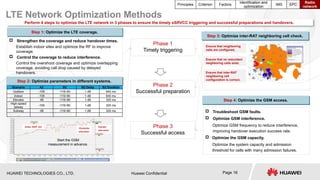
Step 2: Optimize parameters in different systems.
Step 3: Optimize inter-RAT neighboring cell check.
Step 1: Optimize the LTE coverage.
Strengthen the coverage and reduce handover times.
Establish indoor sites and optimize the RF to improve
coverage.
Control the coverage to reduce interference.
Control the overshoot coverage and optimize overlapping
coverage, avoiding call drop caused by delayed
handovers.
Step 4: Optimize the GSM access.
Troubleshoot GSM faults.
Optimize GSM interference.
Optimize GSM frequency to reduce interference,
improving handover execution success rate.
Optimize the GSM capacity.
Optimize the system capacity and admission
threshold for cells with many admission failures.
Ensure that no redundant
neighboring cells exist.
Ensure that inter-RAT
neighboring cell
configuration is correct.
Ensure that neighboring
cells are configured.
Phase 2
Successful preparation
Phase 3
Successful access
Phase 1
Timely triggering
Perform 4 steps to optimize the LTE network in 3 phases to ensure the timely eSRVCC triggering and successful preparations and handovers.
LTE Network Optimization Methods
Start the GSM
measurement in advance.
Principles Criterion Factors
Identification and
optimization
IMS EPC
Radio
network
17.
HUAWEI TECHNOLOGIES CO.,LTD. Huawei Confidential Page 17
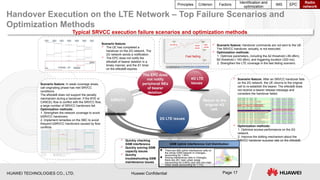
Handover Execution on the LTE Network – Top Failure Scenarios and
Optimization Methods
bSRVCC
2G LTE issues
Return to the
original 4G
cell.
The EPC does
not notify
peripheral NEs
of bearer
deletion.
4G LTE
issues
Quickly checking
GSM interference
Quickly solving GSM
capacity issues
Quickly
troubleshooting GSM
maintenance issues
Scenario feature: After an SRVCC handover fails
on the 2G network, the UE returns to the original
cell to re-establish the bearer. The eNodeB does
not receive a bearer release message and
considers the handover failed.
Optimization methods:
1. Optimize access performance on the 2G
network.
2. Improve the dotting mechanism about the
SRVCC handover success rate on the eNodeB.
Scenario feature: In weak coverage areas,
call originating phase has met SRVCC
conditions.
The eNodeB does not support the penalty
mechanism during a handover. If the BYE or
CANCEL flow is conflict with the SRVCC flow,
a large number of SRVCC handovers fail.
Optimization methods:
1. Strengthen the network coverage to avoid
bSRVCC handovers.
2. Implement remedies on the SBC to avoid
frequent bSRVCC handovers caused by flow
conflicts.
Scenario feature:
The UE has completed a
handover on the 2G network. The
2G network sends a notification.
The EPC does not notify the
eNodeB of bearer deletion in a
timely manner, and the S1 timer
on the eNodeB expires.
Scenario feature: Handover commands are not sent to the UE.
The SRVCC handover, actually, is not executed.
Optimization methods:
1. Optimize parameters, including the A2 threshold (-85 dBm),
B2 threshold (-100 dBm), and triggering duration (320 ms).
2. Strengthen the LTE coverage in the fast fading scenario.
Typical SRVCC execution failure scenarios and optimization methods
Fast fading
There are 606 uplink interference cells on
the whole GSM network in Chengdu,
accounting for 1.94%.
Among interference cells in Chengdu,
there are 261 main urban areas
(accounting for 0.84%) and 345 non-main
urban areas (accounting for 1.1%).
GSM Uplink Interference Cell Distribution
Principles Criterion Factors
Identification and
optimization
IMS EPC
Radio
network
18.
HUAWEI TECHNOLOGIES CO.,LTD. Huawei Confidential Page 18
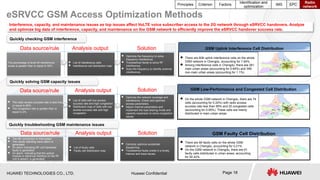
eSRVCC GSM Access Optimization Methods
Interference, capacity, and maintenance issues as top issues affect VoLTE voice subscriber access to the 2G network through eSRVCC handovers. Analyze
and optimize big data of interference, capacity, and maintenance on the GSM network to efficiently improve the eSRVCC handover success rate.
Quickly checking GSM interference
Quickly troubleshooting GSM maintenance issues
Quickly solving GSM capacity issues
The percentage of level-45 interference
scope is greater than or equal to 30%.
Optimize the frequency to solve
frequency interference.
Troubleshoot faults to solve RF
interference.
Scan the frequency to identify external
interference.
Data source/rule Analysis output Solution
The radio access success rate is less than
or equal to 95%.
The congestion rate is greater than or
equal to 2%.
Optimize the network coverage and
interference. Check and optimize
access parameters.
Adjust channel parameters and
implement the load sharing mode and
capacity expansion to solve congestion
issues.
Data source/rule Analysis output Solution
The NE connection is interrupted.
The carrier standing wave alarm is
generated.
An alarm indicating RF unit hardware
faults is generated.
An alarm, indicating that the optical
module or electrical interface on the RF
unit is absent, is generated.
Centrally optimize worksheet
dispatching.
Troubleshoot faults onsite in a timely
manner and trace issues.
Data source/rule Analysis output Solution
List of interference cells
Interference cell distribution map
List of cells with low access
success rate and high congestion
Distribution map of cells with low
access success rate and high
congestion
List of faulty cells
Faulty cell distribution map
…
There are 606 uplink interference cells on the whole
GSM network in Chengdu, accounting for 1.94%.
Among interference cells in Chengdu, there are 261
main urban areas (accounting for 0.84%) and 345
non-main urban areas (accounting for 1.1%).
GSM Uplink Interference Cell Distribution
…
On the whole GSM network in Chengdu, there are 74
cells (accounting for 0.24%) with radio access
success rate less than 95% and 20 congested cells
(accounting for 0.06%). These cells are mainly
distributed in main urban areas.
GSM Low-Performance and Congested Cell Distribution
…
There are 66 faulty cells on the whole GSM
network in Chengdu, accounting for 0.21%.
On the GSM network in Chengdu, there are 61
faulty cells distributed in urban areas, accounting
for 92.42%.
GSM Faulty Cell Distribution
Principles Criterion Factors
Identification and
optimization
IMS EPC
Radio
network
19.
HUAWEI TECHNOLOGIES CO.,LTD. Huawei Confidential Page 19
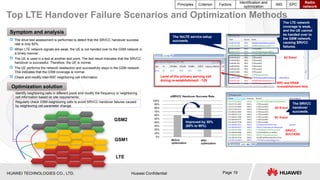
Top LTE Handover Failure Scenarios and Optimization Methods
The drive test assessment is performed to detect that the SRVCC handover success
rate is only 60%.
When LTE network signals are weak, the UE is not handed over to the GSM network in
a timely manner.
The UE is used in a test at another test point. The test result indicates that the SRVCC
handover is successful. Therefore, the UE is normal.
The UE performs the network reselection and successfully stays in the GSM network.
This indicates that the GSM coverage is normal.
Check and modify inter-RAT neighboring cell information.
LTE
GSM1
GSM2
Identify neighboring cells in different pools and modify the frequency or neighboring
cell information based on site requirements.
Regularly check GSM neighboring cells to avoid SRVCC handover failures caused
by neighboring cell parameter change.
Symptom and analysis
Optimization solution
The VoLTE service setup
succeeds.
Level of the primary serving cell
during re-establishment: -125
A2 Event
RRC and ERAB
re-establishment fails.
The LTE network
coverage is weak,
and the UE cannot
be handed over to
the GSM network,
causing SRVCC
failures.
A2 Event
B1 Event
SRVCC
SUCCESS
The SRVCC
handover
succeeds.
Principles Criterion Factors
Identification and
optimization
IMS EPC
Radio
network
Improved by 30%
(60% to 90%)
20.
HUAWEI TECHNOLOGIES CO.,LTD. Huawei Confidential Page 20
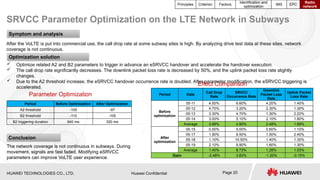
After the VoLTE is put into commercial use, the call drop rate at some subway sites is high. By analyzing drive test data at these sites, network
coverage is not continuous.
Parameter Optimization
Effect Comparison
Optimize related A2 and B2 parameters to trigger in advance an eSRVCC handover and accelerate the handover execution.
The call drop rate significantly decreases. The downlink packet loss rate is decreased by 50%, and the uplink packet loss rate slightly
changes.
Due to the A2 threshold increase, the eSRVCC handover occurrence rate is doubled. After parameter modification, the eSRVCC triggering is
accelerated.
The network coverage is not continuous in subways. During
movement, signals are fast faded. Modifying eSRVCC
parameters can improve VoLTE user experience.
Symptom and analysis
Optimization solution
Conclusion
SRVCC Parameter Optimization on the LTE Network in Subways
Period Before Optimization After Optimization
A2 threshold -105 -97
B2 threshold -110 -105
B2 triggering duration 640 ms 320 ms
Period Date
Call Drop
Rate
SRVCC
Occurrence Rate
Downlink
Packet Loss
Rate
Uplink Packet
Loss Rate
Before
optimization
05-11 4.50% 6.60% 4.20% 1.40%
05-12 4.70% 3.20% 2.30% 1.30%
05-13 3.30% 4.70% 1.30% 2.20%
05-14 3.00% 5.10% 2.10% 1.80%
Average 3.88% 4.90% 2.48% 1.68%
After
optimization
05-15 0.50% 5.00% 0.60% 1.10%
05-17 1.90% 9.50% 1.50% 2.40%
05-18 1.10% 10.50% 1.40% 1.30%
05-19 2.10% 9.90% 1.60% 1.30%
Average 1.40% 8.73% 1.28% 1.53%
Gain -2.48% 3.83% -1.20% -0.15%
Principles Criterion Factors
Identification and
optimization
IMS EPC
Radio
network

![HUAWEI TECHNOLOGIES CO., LTD. Huawei Confidential Page 7
VoLTE eSRVCC Measurement on the EPC Network (2)
MME eSRVCC handover execution success rate = [Times of MME-received
SRVCC PS to CS Complete Notification Messages - Times of MME-received
SRVCC PS to CS Complete Notification Messages (#9 Permanent session leg
establishment error) - Times of MME-received SRVCC PS to CS Complete
Notification Messages (#10 Temporary session leg establishment error)]/[Times
of MME-received SRVCC PS to CS Response Messages - Times of MME-
received SRVCC PS to CS Response Messages (#1 Unspecified) - Times of
MME-received SRVCC PS to CS Response Messages (#2 Handover/Relocation
cancelled by source system) - Times of MME-received SRVCC PS to CS
Response Messages (#3 Handover/Relocation Failure with Target system) -
Times of MME-received SRVCC PS to CS Response Messages (#4
Handover/Relocation Target not allowed) - Times of MME-received SRVCC PS
to CS Response Messages (#5 Unknown Target ID) - Times of MME-received
SRVCC PS to CS Response Messages (#6 Target Cell not available) - Times of
MME-received SRVCC PS to CS Response Messages (#7 No Radio Resources
Available in Target Cell) - Times of MME-received SRVCC PS to CS Response
Messages (#8 Failure in Radio Interface Procedure)]
Times of MME-received SRVCC PS to CS Response Messages:
As shown in point A, the counter is incremented by 1 each time the MME
receives an SRVCC PS to CS Response message (as defined in 3GPP TS
29.280) from the SRVCC IWF during the SRVCC procedure.
Times of MME-received SRVCC PS to CS Complete Notification Messages:
As shown in point B, the counter is incremented by 1 each time the MME
receives an SRVCC PS to CS Complete Notification message (as defined in
3GPP TS 29.280) from the SRVCC IWF during the SRVCC procedure.
A
B](https://image.slidesharecdn.com/4volteesrvccoptimization-250320114956-34c03d51/85/4-Vo-LTE-e-SRVCC-Optimization-guide-pptx-7-320.jpg)
![HUAWEI TECHNOLOGIES CO., LTD. Huawei Confidential Page 10
Assessment Analysis System for VoLTE eSRVCC Measurement on the
EMS
If
(L2.3+L2.4)/(L2.5+L
2.6+L2.7) result is
greater than 50%,
the handover failure
is mainly caused by
faults of the inter-
RAT neighboring
cell or 2G network.
Otherwise, the
handover failure is
mainly caused by
IST flow faults.
L1.3 eSRVCC handback
L1.1 eSRVCC handover
preparation success rate
L1.2 eSRVCC handover
execution success rate
L2.15 EPC temporary session
path establishment failures
L2.14 EPC permanent session
path establishment failures
L2.13 Handover cancellation
requests sent by the eNodeB
L2.10 Handover failures caused
by subscribers
If L3.2+L3.3 result is
greater than 50%,
the handover failure
is mainly caused by
faults of the inter-
RAT neighboring cell
or 2G network.
EPC SRVCC
analysis
CN SRVCC
analysis
eSRVCC
assessment
eMSC statistics
EPC statistics
LTE statistics
Number of failed E-UTRAN-to-
GERAN outgoing handover
execution times
[2G] SR1005: SRVCC handover
failures (TCH)
Cell SRVCC
analysis
L2.1 Unavailable eMSC 2G cells
L2.2 Inter eMSC bearer operation
failures
L2.7 Number of eMSC-to-ATGW
media switch failures
L2.9 Re-INVITE times (cause value
487)
L2.16 EPC eSRVCC cancellation
times (after receiving an RSP
from the eMSC)
eNodeB eSRVCC re-establishment
times due to failures
Number of failed outgoing E-UTRAN-
to-GERAN CS-only SRVCC
handover execution times
L1.3 eSRVCC handover
completion rate
L2.1 Number of failed E-UTRAN-to-
GERAN outgoing handover attempts
Number of failed outgoing E-UTRAN-
to-GERAN CS-only SRVCC handover
attempts
L2.11 Handover failures caused
by the MME
L2.12 Handover failures caused
by the MSC server
L2.3 Number of successful radio
access times during intra-MSC
eSRVCC handovers
L2.4 Number of successful radio
access times during inter-MSC
eSRVCC handovers
L2.5 Number of eMSC Invite
Requests with Incorrect C-MSISDNs
L2.6 Number of eSRVCCs Rejected
by SCC AS
If the L2.1 result is
greater than 50%,
the handover failure
is mainly caused by
radio network faults.
L2.8 Number of eMSC Invite
Requests with Incorrect STN-SRs](https://image.slidesharecdn.com/4volteesrvccoptimization-250320114956-34c03d51/85/4-Vo-LTE-e-SRVCC-Optimization-guide-pptx-10-320.jpg)


![[Deck] What's New in Spark-Iceberg Integration via DSV2.pptx](https://cdn.slidesharecdn.com/ss_thumbnails/deckwhatsnewinspark-icebergintegrationviadsv2-260210005337-25955b12-thumbnail.jpg?width=640&height=640&fit=bounds)


