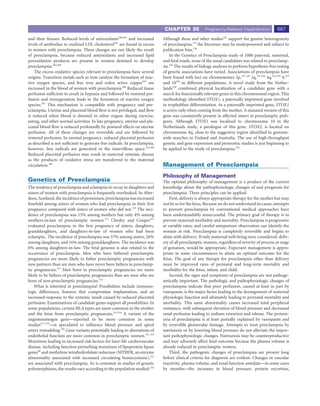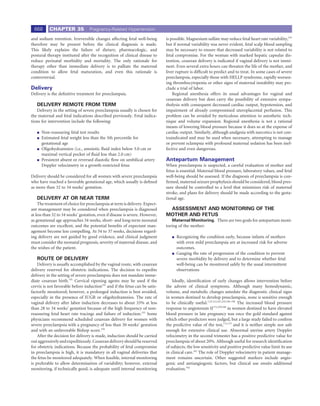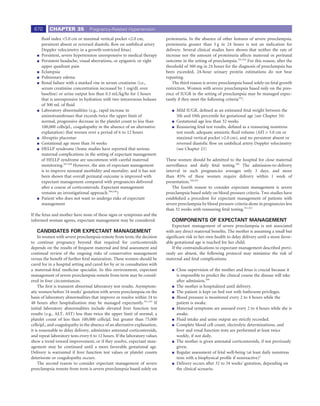
Chapter 35
Pregnancy-Related Hypertension
                                                                           James M. Roberts, MD, and Edmund F. Funai, MD


                                                                            mination. Because of the discrepancy between random protein deter-
                                                                            minations and 24-hour urine protein values in women with
Classification of                                                            preeclampsia (which can be higher or lower),7-9 the diagnosis should
Hypertensive Disorders                                                      be based on a 24-hour urine specimen or on a timed collection
                                                                            corrected for creatinine excretion if a 24-hour collection is not
Interpreting epidemiologic studies of the hypertensive disorders of         feasible.3
pregnancy is difficult because the terminology is inconsistent.1 Several         Preeclampsia occurs as a spectrum but is arbitrarily divided into
systems of nomenclature are in use around the world. The system             mild and severe forms. This terminology is useful for descriptive pur-
prepared by the National Institutes of Health (NIH) Working Group           poses but does not indicate specific diseases, nor should it indicate
on Hypertension in Pregnancy,2 although imperfect, has the advantage        arbitrary cutoff points for therapy. The diagnosis of severe preeclamp-
of clarity and is available in published form for investigators through-    sia is confirmed when any of the following criteria are met10:
out the world. The NIH system has four main classes: chronic hyper-
tension, preeclampsia and eclampsia, preeclampsia superimposed on                Blood pressure of 160 mm Hg systolic or higher or 110 mm Hg
chronic hypertension, and gestational hypertension.                              diastolic or higher on two occasions at least 6 hours apart
                                                                                 while the patient is on bed rest
                                                                                 Proteinuria of 5 g or higher in a 24-hour urine specimen or 3+
Chronic Hypertension                                                             or greater on two random urine samples collected at least 4
Chronic hypertension is defined as hypertension that is observable                hours apart
before pregnancy or that is diagnosed before the 20th week of gesta-             Oliguria of less than 500 mL in 24 hours
tion. Hypertension is defined as a persistent blood pressure greater              Cerebral or visual disturbances
than 140/90 mm Hg. Hypertension for which a diagnosis is confirmed                Pulmonary edema or cyanosis
for the first time during pregnancy and that persists beyond the 84th             Epigastric or right upper quadrant pain
day after delivery is also classified as chronic hypertension.                    Impaired liver function
                                                                                 Thrombocytopenia
                                                                                 Fetal growth restriction
Preeclampsia and Eclampsia
The diagnosis of preeclampsia is determined by increased blood pres-            Eclampsia is the occurrence of seizures that cannot be attributed to
sure accompanied by proteinuria. The diagnosis requires a systolic          other causes in a woman with preeclampsia.
pressure of 140 mm Hg or higher or a diastolic pressure of 90 mm Hg             Edema occurs in too many normal pregnant women to be discrimi-
or higher. Diastolic blood pressure is defined as the Korotkoff phase V      nant and has been abandoned as a marker in preeclampsia by the
value (i.e., disappearance of sounds). Gestational blood pressure eleva-    National High Blood Pressure Education Program and by other clas-
tion should be determined by at least two measurements, with the            sification schemes.11,12 Edema of the hands and face occurs in 10% to
repeat blood pressure performed in a manner that reduces the likeli-        15% of women whose blood pressure remains normal throughout
hood of artifact and patient anxiety.3 Absent from the diagnostic cri-      pregnancy.13 Edema can be massive in women with severe preeclamp-
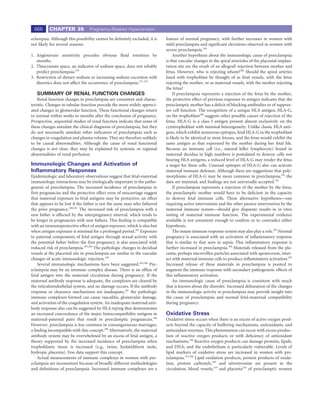
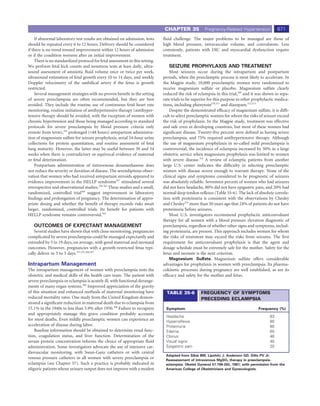
teria is the former inclusion of an increment of 30 mm Hg in systolic       sia, rendering the patient virtually unrecognizable (Fig. 35-1).
or 15 mm Hg in diastolic blood pressure, even when absolute values
are below 140/90 mm Hg. This definition was excluded because avail-
able evidence shows that women in this group are not likely to suffer
                                                                            Preeclampsia Superimposed on
increased adverse outcomes.4,5 Nonetheless, women who have an               Chronic Hypertension
increase of 30 mm Hg in systolic or 15 mm Hg in diastolic blood pres-       There is ample evidence that preeclampsia can occur in women who
sure warrant close observation, especially if proteinuria and hyperuri-     are already hypertensive and that the prognosis for mother and fetus
cemia (i.e., uric acid ≥ 5.5 mg/dL)6 are also present.3                     is much worse with both conditions than with either alone. Distin-
    Proteinuria is defined as the urinary excretion of at least 300 mg of    guishing superimposed preeclampsia from worsening chronic hyper-
protein in a 24-hour specimen. This usually correlates with 30 mg/dL        tension tests the skills of the clinician. For clinical management, the
of protein (i.e., 1+ dipstick reading) or more in a random urine deter-     principles of high sensitivity and unavoidable overdiagnosis are appro-
652      CHAPTER 35             Pregnancy-Related Hypertension


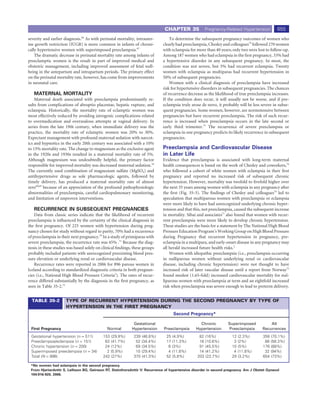
                    A                                                              B
                  FIGURE 35-1 Facial edema in severe preeclampsia. Markedly edematous facies of this severely
                  preeclamptic woman (A) is especially evident when compared with her appearance 6 weeks after delivery
                  (B).


priate, especially with advancing gestational age. The suspicion of        be assigned. If blood pressure elevation persists, the diagnosis is chronic
superimposed preeclampsia mandates close observation, with delivery        hypertension. The diagnosis of gestational hypertension is used during
indicated by the overall assessment of maternal and fetal well-being       pregnancy only until a more specific diagnosis can be assigned after
rather than by any fixed end point. The diagnosis of superimposed           delivery.3
preeclampsia is highly likely with the following findings:

1. In women with documented hypertension and no proteinuria                Problems with Classification
   before 20 weeks’ gestation                                              The degree of blood pressure elevation that constitutes gestational
     New-onset proteinuria, defined as the urinary excretion of 0.3 g       hypertension is controversial. Because average blood pressure in
     of protein or more in a 24-hour specimen                              women younger than 30 years is 120/60 mm Hg, the standard defini-
2. In women with hypertension and proteinuria before 20 weeks’             tion of hypertension (i.e., blood pressure >140/90 mm Hg) is judged
   gestation                                                               by some to be too high,14 resulting in the suggestion that women with
     A sudden increase in proteinuria                                      blood pressure increases greater than 30 mm Hg systolic or 15 mm Hg
     A sudden increase in blood pressure in a woman whose blood            diastolic should be observed closely even if absolute blood pressure has
     pressure has previously been well controlled                          not exceeded 140/90 mm Hg.3
     Objective evidence of involvement of multiple organ systems,              Blood pressures measured in early pregnancy to diagnose chronic
     such as thrombocytopenia (platelet count < 100,000/mm3), an           hypertension are problematic. Blood pressure usually decreases early
     increase in liver transaminases to abnormal levels,3 or sudden        in pregnancy, reaching its nadir at about the time women often present
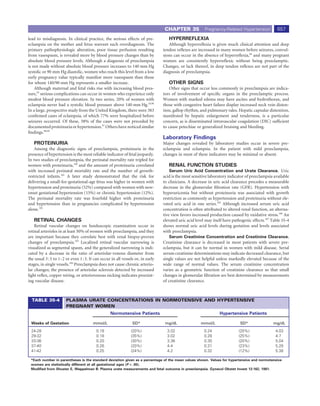
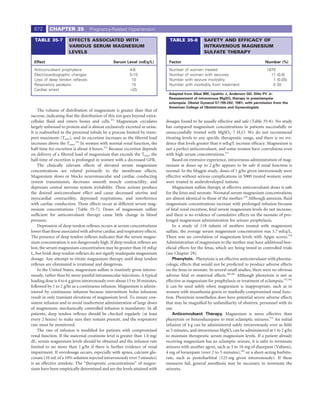
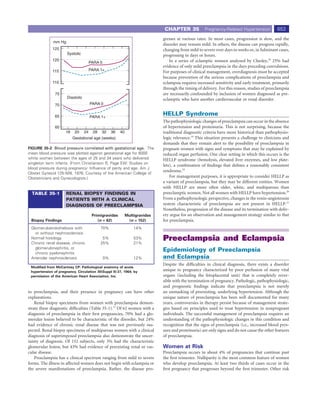
     worsening of renal function                                           for obstetric care (Fig. 35-2). The decrease averages 7 mm Hg for dia-
                                                                           stolic and systolic readings. In some women, blood pressure may
                                                                           decline by more than 7 mm Hg; in others, the early decline and sub-
Gestational Hypertension                                                   sequent return of blood pressure to pre-pregnant levels in late gesta-
A woman who has no proteinuria and a blood pressure elevation              tion may satisfy criteria for a diagnosis of preeclampsia. Women with
detected for the first time during pregnancy is classified as having ges-    hypertension before pregnancy have a greater decrease in blood pres-
tational hypertension. This is a provisional diagnosis that includes       sure in early pregnancy than do normotensive women,15 and they are
women with preeclampsia who have not yet manifested proteinuria            more likely to be misdiagnosed as preeclamptic according to blood
and women who do not have preeclampsia. The hypertension may be            pressure criteria.
accompanied by other concerning signs or symptoms that can influ-               The diagnosis of chronic hypertension based on the failure of blood
ence management. A final determination that the woman does not              pressure to return to normal by 84 days after delivery can be in error.
have preeclampsia can be made only after delivery. If preeclampsia has     In a long-range, prospective study by Chesley,16 many women who
not developed and blood pressure has returned to normal by 12 weeks        remained hypertensive 6 weeks after delivery were normotensive at
after delivery, the diagnosis of transient hypertension of pregnancy can   long-term follow-up. Neither proteinuria nor hypertension is specific
CHAPTER 35             Pregnancy-Related Hypertension            653
                                                                               gresses at various rates. In most cases, progression is slow, and the
              mm Hg
                                                                               disorder may remain mild. In others, the disease can progress rapidly,
             125                                                               changing from mild to severe over days to weeks or, in fulminant cases,
                      Systolic                                                 progressing in days or hours.
             120
                                       PARA 0                                      In a series of eclamptic women analyzed by Chesley,18 25% had
                                                                               evidence of only mild preeclampsia in the days preceding convulsions.
             115                       PARA 1+                                 For purposes of clinical management, overdiagnosis must be accepted
                                                                               because prevention of the serious complications of preeclampsia and
             110                                                               eclampsia requires increased sensitivity and early treatment, primarily
                                                                               through the timing of delivery. For this reason, studies of preeclampsia
               75                                                              are necessarily confounded by inclusion of women diagnosed as pre-
                      Diastolic                                                eclamptic who have another cardiovascular or renal disorder.
               70                      PARA 0


               65                      PARA 1+
                                                                               HELLP Syndrome
                                                                               The pathophysiologic changes of preeclampsia can occur in the absence
               60                                                              of hypertension and proteinuria. This is not surprising, because the
                     16    20     24    28   32      36   40                   traditional diagnostic criteria have more historical than pathophysio-
                          Gestational age (weeks)                              logic relevance.18 This situation presents a challenge to clinicians and
                                                                               demands that they remain alert to the possibility of preeclampsia in
FIGURE 35-2 Blood pressure correlated with gestational age. The                pregnant women with signs and symptoms that may be explained by
mean blood pressure was plotted against gestational age for 6000               reduced organ perfusion. One clear setting in which this occurs is the
white women between the ages of 25 and 34 years who delivered                  HELLP syndrome (hemolysis, elevated liver enzymes, and low plate-
singleton term infants. (From Christianson R, Page EW: Studies on
                                                                               lets), a combination of findings that defines a reasonably consistent
blood pressure during pregnancy: Influence of parity and age. Am J
                                                                               syndrome.19
Obstet Gynecol 125:509, 1976. Courtesy of the American College of
Obstetricians and Gynecologists.)                                                  For management purposes, it is appropriate to consider HELLP as
                                                                               a variant of preeclampsia, but they may be different entities. Women
                                                                               with HELLP are more often older, white, and multiparous than
  TABLE 35-1          RENAL BIOPSY FINDINGS IN                                 preeclamptic women. Not all women with HELLP have hypertension.20
                      PATIENTS WITH A CLINICAL                                 From a pathophysiologic perspective, changes in the renin-angiotensin
                      DIAGNOSIS OF PREECLAMPSIA                                system characteristic of preeclampsia are not present in HELLP.21
                                                                               Nonetheless, progression of the disease and its termination with deliv-
                                        Primigravidas          Multigravidas   ery argue for an observation and management strategy similar to that
 Biopsy Findings                           (n = 62)             (n = 152)      for preeclampsia.
 Glomeruloendotheliosis with                 70%                   14%
   or without nephrosclerosis
 Normal histology
 Chronic renal disease, chronic
                                              5%
                                             25%
                                                                   53%
                                                                   21%
                                                                               Preeclampsia and Eclampsia
   glomerulonephritis, or
   chronic pyelonephritis
                                                                               Epidemiology of Preeclampsia
 Arteriolar nephrosclerosis                     0%                 12%         and Eclampsia
                                                                               Despite the difficulties in clinical diagnosis, there exists a disorder
 Modified from McCartney CP: Pathological anatomy of acute
 hypertension of pregnancy. Circulation 30(Suppl II):37, 1964; by              unique to pregnancy characterized by poor perfusion of many vital
 permission of the American Heart Association, Inc.                            organs (including the fetoplacental unit) that is completely rever-
                                                                               sible with the termination of pregnancy. Pathologic, pathophysiologic,
                                                                               and prognostic findings indicate that preeclampsia is not merely
to preeclampsia, and their presence in pregnancy can have other                an unmasking of preexisting, underlying hypertension. Although the
explanations.                                                                  unique nature of preeclampsia has been well documented for many
    Renal biopsy specimens from women with preeclampsia demon-                 years, controversies in therapy persist because of management strate-
strate these diagnostic difficulties (Table 35-1).17 Of 62 women with a         gies based on principles used to treat hypertension in nonpregnant
diagnosis of preeclampsia in their first pregnancies, 70% had a glo-            individuals. The successful management of preeclampsia requires an
merular lesion believed to be characteristic of the disorder, but 24%          understanding of the pathophysiologic changes in this condition and
had evidence of chronic renal disease that was not previously sus-             recognition that the signs of preeclampsia (i.e., increased blood pres-
pected. Renal biopsy specimens of multiparous women with a clinical            sure and proteinuria) are only signs and do not cause the other features
diagnosis of superimposed preeclampsia also demonstrate the uncer-             of preeclampsia.
tainty of diagnosis. Of 152 subjects, only 3% had the characteristic
glomerular lesion, but 43% had evidence of preexisting renal or vas-           Women at Risk
cular disease.                                                                 Preeclampsia occurs in about 4% of pregnancies that continue past
    Preeclampsia has a clinical spectrum ranging from mild to severe           the first trimester. Nulliparity is the most common feature of women
forms. The illness in affected women does not begin with eclampsia or          who develop preeclampsia. At least two thirds of cases occur in the
the severe manifestations of preeclampsia. Rather, the disease pro-            first pregnancy that progresses beyond the first trimester. Other risk
654      CHAPTER 35              Pregnancy-Related Hypertension

factors for preeclampsia are similar in nulliparous and parous                      Obesity is a risk factor for preeclampsia.28,51 In the National Insti-
women.22                                                                        tute of Child Health and Human Development (NICHD) study of
    Although preeclampsia was thought to be more common among                   aspirin to prevent preeclampsia in low-risk pregnancies,31 the inci-
women of lower socioeconomic status, this impression may be a con-              dence of preeclampsia increased with maternal body mass index. Even
sequence of the associations of preeclampsia with age, race, and parity.        in women of normal weight, there is a linear relationship between
Studies of pregnant women in Scotland23 from Aberdeen,24 Finland,25             pre-pregnancy body mass index and the frequency of preeclampsia.52
and Israel26 found that preeclampsia was not related to socioeconomic           The mechanism may be related to increased insulin resistance, because
status. Eclampsia, in contrast, is clearly more common in women of              preeclampsia is more common in another setting of increased insulin
lower socioeconomic status,23,25,26 related to the lack of availability of      resistance: gestational diabetes.53 With a threefold increased risk for
quality obstetric care for indigent women. Remarkably, preeclampsia             obese women and with 35% to 50% of women of reproductive age in
and eclampsia were once thought to occur more frequently in women               the United States being obese, obesity has become a major attributable
of higher socioeconomic status.18                                               risk factor for preeclampsia, which is associated with more than one
    There is a relationship between the extremes of childbearing age            third of cases of preeclampsia.
and the incidence of eclampsia and preeclampsia. Because most first                  Certain conditions of pregnancy increase the risk of preeclampsia.
pregnancies occur in young women, most cases of preeclampsia and                The incidence is increased among parous and nulliparous women with
eclampsia occur in this age group, but the association with young               multiple gestations, although to a larger degree in the latter.36,54 In a
maternal age is lost when parity is considered. In the studies cited,23,25,26   study of 34,374 pregnancies with singleton, twin, triplet, or quadruplet
a higher incidence of preeclampsia was found in older women inde-               pregnancies, the incidence of preeclampsia increased with each addi-
pendent of parity.                                                              tional fetus. The incidences were 6.7%, 12.7%, 20.0%, and 19.6%,
    The relationship of preeclampsia and eclampsia to race is compli-           respectively.55 The disease process may be initiated earlier and may be
cated by the higher prevalence of chronic hypertension in African               more severe in these cases.54
Americans and the difficulty in differentiating preeclampsia from                    Preeclampsia affects 70% of women with large, rapidly growing
unrecognized preexisting chronic hypertension. Some studies indicate            hydatidiform moles and occurs earlier than usual during gestation.56
a relationship.26,27 In a small case-control study of carefully defined          In cases of preeclampsia occurring before 24 weeks’ gestation, hyda-
preeclampsia, black race was a significant risk factor only in nullipa-          tidiform mole should be suspected and sought.
rous women (odds ratio [OR] = 12.3; 95% confidence interval [CI],                    An interesting variant of preeclampsia is the mirror syndrome, in
1.6 to 100.8).28 Other studies support a more modest increased risk in          which the mother’s peripheral edema mirrors the fetal hydrops. It
African-American women.29,30 Studies that include the more severe               occurs with fetal hydrops, although not with erythroblastosis uncom-
forms of preeclampsia more often suggest an increased incidence                 plicated by hydrops. The incidence approaches 50% of pregnancies
among African-American women.28                                                 complicated by hydrops. The mirror syndrome is not confined to
    In contrast, the incidence of rigorously defined preeclampsia did            hydrops resulting from isoimmunization. In one series, mirror syn-
not differ by race after other risk factors were controlled in two large,       drome occurred in 9 of 11 pregnancies with hydropic infants of non-
prospective trials of medical prophylaxis that enrolled 294731 and              immune origin.57 This condition can manifest early in pregnancy with
431432 nulliparous women. Maternal nonwhite race appears to be                  severe signs and symptoms of preeclampsia, and it has resolved with
related more to the severity than the incidence of disease.                     treatment of the underlying process.58-60 Proteinuria is massive, and
    A diverse array of medical disorders that often coexist with preg-          blood pressure elevation and edema are marked. Eclampsia occurs
nancy, including diabetes, chronic hypertension, chronic renal disor-           rarely (see Chapter 26).
ders, and rheumatologic conditions, have been associated with
preeclampsia. The existence and severity of diabetes have been
associated with an increased risk for preeclampsia, and diabetic                Short-Term Prognosis for Preeclampsia
microvascular disease further increases this risk. This relationship               PERINATAL MORTALITY
has been found in Sweden33 and in the United States.34 Both                         The perinatal mortality rate is increased in infants of preeclamptic
studies33,34 demonstrated that the risk of preeclampsia was approxi-            women.61-63 In a study that examined 10,614,679 singleton pregnancies
mately 20% and 21% in 491 and 462 pregnancies, respectively. This               in the United States from 1995 to 1997 after 24 weeks’ gestation, the
estimate is far more modest than the 50% incidence reported in his-             relative risk for fetal death was 1.4 for infants born to women with any
torical cohorts.18 The preeclampsia risk increased according to the             of the gestational hypertensive disorders and 2.7 for those born to
severity of disease, with an 11% to 12% risk among women with class             women with chronic hypertensive disorders compared with low-risk
B diabetes and 21% to 23% with class C and D diabetes. Microvascular            controls. Causes of perinatal death are placental insufficiency and
disease increased this risk to 36% to 54% in diabetics with class F or          abruptio placentae,64 which cause intrauterine death before or during
R disease.33,34                                                                 labor, and prematurity. Predictably, the mortality rate is higher for
    Chronic renal insufficiency and hypertension are well-recognized             infants of women with more severe forms of the disorder. At any level
risk factors. Of women with hypertension antedating pregnancy, 25%              of disease severity, the perinatal mortality rate is greatest for women
develop preeclampsia.35,36 Renal insufficiency with33,37 and without dia-        with preeclampsia superimposed on preexisting vascular disease.
betes38-40 also is an important risk factor.38,40                                   The stillbirth rate attributable to preeclampsia has declined dra-
    Connective tissue disorders such as systemic lupus erythe-                  matically in the past 35 years. However, infants born of preeclamptic
matosus41,42 and antiphospholipid antibody syndrome43-45 have been              pregnancies continue to have an approximately twofold increased risk
reported as risk factors for preeclampsia. With lupus, the risk is par-         for neonatal death.65 Although neonatal survival rates have improved
ticularly elevated with hypertension or nephropathy.46,47 However,              dramatically, delivery before 34 weeks’ gestation continues to be associ-
data concerning an association between isolated antiphospholipid                ated with an increased risk of long-range neurologic disability (see
antibodies and preeclampsia have been conflicting, with some                     Chapter 58).
studies demonstrating no relationship48,49 and others confirming the                 Growth restriction is more common in infants born to preeclamp-
association.44,50                                                               tic women (see Chapter 34) and more pronounced with increasing
CHAPTER 35             Pregnancy-Related Hypertension            655
severity and earlier diagnosis.66 As with perinatal mortality, intrauter-        To determine the subsequent pregnancy outcomes of women who
ine growth restriction (IUGR) is more common in infants of chroni-           clearly had preeclampsia, Chesley and colleagues74 followed 270 women
cally hypertensive women with superimposed preeclampsia.67                   with eclampsia for more than 40 years; only two were lost to follow-up.
    The dramatic decrease in perinatal mortality rate among infants of       Among 187 women who had eclampsia in the first pregnancy, 33% had
preeclamptic women is the result in part of improved medical and             a hypertensive disorder in any subsequent pregnancy. In most, the
obstetric management, including improved assessment of fetal well-           condition was not severe, but 5% had recurrent eclampsia. Twenty
being in the antepartum and intrapartum periods. The primary effect          women with eclampsia as multiparas had recurrent hypertension in
on the perinatal mortality rate, however, has come from improvements         50% of subsequent pregnancies.
in neonatal care.                                                                Women with a clinical diagnosis of preeclampsia have increased
                                                                             risk for hypertensive disorders in subsequent pregnancies. The chances
   MATERNAL MORTALITY                                                        of recurrence decrease as the likelihood of true preeclampsia increases.
    Maternal death associated with preeclampsia predominantly re-            If the condition does recur, it will usually not be worse, and if pre-
sults from complications of abruptio placentae, hepatic rupture, and         eclampsia truly arose de novo, it probably will be less severe in subse-
eclampsia. Historically, the mortality rate of eclamptic women was           quent pregnancies. Some women, however, are normotensive between
most effectively reduced by avoiding iatrogenic complications related        pregnancies but have recurrent preeclampsia. The risk of such recur-
to overmedication and overzealous attempts at vaginal delivery. In           rence is increased when preeclampsia occurs in the late second or
series from the late 19th century, when immediate delivery was the           early third trimester.73 The recurrence of severe preeclampsia or
practice, the mortality rate of eclamptic women was 20% to 30%.              eclampsia in one pregnancy predicts its likely recurrence in subsequent
Expectant management with profound maternal sedation with narcot-            pregnancies.
ics and hypnotics in the early 20th century was associated with a 10%
to 15% mortality rate. The change to magnesium as the exclusive agent        Preeclampsia and Cardiovascular Disease
in the 1920s and 1930s resulted in a maternal mortality rate of 5%.          in Later Life
Although magnesium was undoubtedly helpful, the primary factor               Evidence that preeclampsia is associated with long-term maternal
responsible for improved mortality was decreased maternal sedation.18        health consequences is based on the work of Chesley and coworkers,74
The currently used combination of magnesium sulfate (MgSO4) and              who followed a cohort of white women with eclampsia in their first
antihypertensive drugs as sole pharmacologic agents, followed by             pregnancy and reported no increased risk of subsequent chronic
timely delivery, has produced a maternal mortality rate of almost            hypertension. However, mortality was twofold to fivefold higher over
zero68,69 because of an appreciation of the profound pathophysiologic        the next 35 years among women with eclampsia in any pregnancy after
abnormalities of preeclampsia, careful cardiopulmonary monitoring,           the first (Fig. 35-3). The findings of Chesley and colleagues74 led to
and limitation of unproven interventions.                                    speculation that multiparous women with preeclampsia or eclampsia
                                                                             were more likely to have had unrecognized underlying chronic hyper-
   RECURRENCE IN SUBSEQUENT PREGNANCIES                                      tension and that this, not preeclampsia, caused the subsequent increase
    Data from classic series indicate that the likelihood of recurrent       in mortality. Sibai and associates71 also found that women with recur-
preeclampsia is influenced by the certainty of the clinical diagnosis in      rent preeclampsia were more likely to develop chronic hypertension.
the first pregnancy. Of 225 women with hypertension during preg-              These studies are the basis for a statement by The National High Blood
nancy chosen for study without regard to parity, 70% had a recurrence        Pressure Education Program’s Working Group on High Blood Pressure
of preeclampsia in their next pregnancy.70 In a study of primiparas with     during Pregnancy that recurrent hypertension in pregnancy, pre-
severe preeclampsia, the recurrence rate was 45% .71 Because the diag-       eclampsia in a multipara, and early-onset disease in any pregnancy may
nosis in these studies was based solely on clinical findings, these groups    all herald increased future health risks.2
probably included patients with unrecognized preexisting blood pres-             Women with idiopathic preeclampsia (i.e., preeclampsia occurring
sure elevation or underlying renal or cardiovascular disease.                in nulliparous women without underlying renal or cardiovascular
    Recurrence rates were reported in 2006 for 896 parous women in           disease, including chronic hypertension) were not thought to have
Iceland according to standardized diagnostic criteria in both pregnan-       increased risk of later vascular disease until a report from Norway75
cies (i.e., National High Blood Pressure Criteria3). The rates of recur-     found modest (1.65-fold) increased cardiovascular mortality for nul-
rence differed substantially by the diagnosis in the first pregnancy, as      liparous women with preeclampsia at term and an eightfold increased
seen in Table 35-2.72                                                        risk when preeclampsia was severe enough to lead to preterm delivery.


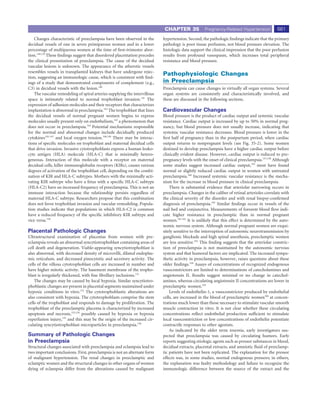
  TABLE 35-2          TYPE OF RECURRENT HYPERTENSION DURING THE SECOND PREGNANCY BY TYPE OF
                      HYPERTENSION IN THE FIRST PREGNANCY
                                                                                   Second Pregnancy*

                                                             Gestational                          Chronic          Superimposed            All
 First Pregnancy                             Normal         Hypertension      Preeclampsia      Hypertension       Preeclampsia        Recurrences
 Gestational hypertension (n = 511)        153 (29.9%)       239 (46.8%)       25 (4.9%)          82 (16%)           12 (2.3%)         358 (70.1%)
 Preeclampsia/eclampsia (n = 151)           63 (41.7%)        52 (34.4%)       17 (11.3%)         16 (10.6%)          3 (2%)            88 (58.3%)
 Chronic hypertension (n = 200)             24 (12%)          69 (34.5%)        6 (3%)            91 (45.5%)         10 (5%)           176 (88%)
 Superimposed preeclampsia (n = 34)          2 (5.9%)         10 (29.4%)        4 (11.8%)         14 (41.2%)          4 (11.8%)         32 (94%)
 Total (N = 896)                           242 (27%)         370 (41.3%)       52 (5.8%)         203 (22.7%)         29 (3.2%)         654 (73%)

 *No women had eclampsia in the second pregnancy.
 From Hjartardottir S, Leifsson BG, Geirsson RT, Steinthorsdottir V: Recurrence of hypertensive disorder in second pregnancy. Am J Obstet Gynecol
 194:916-920, 2006.
656                           CHAPTER 35   Pregnancy-Related Hypertension

                             100                                                TABLE 35-3          SIGNS AND SYMPTOMS OF
                                                                                                    PREECLAMPSIA OR ECLAMPSIA
                             90
                                                                               Cerebral                                Blurred vision
                                                                                 Headache                              Amaurosis
                             80
     Percentages surviving


                                                                                 Dizziness                           Gastrointestinal
                                                                                 Tinnitus                              Nausea
                             70                                                  Drowsiness                            Vomiting
                                                                                 Change in respiratory rate            Epigastric pain
                             60                                                  Tachycardia                           Hematemesis
                                                                                 Fever                               Renal
                             50                                                Visual                                  Oliguria
                                                                                 Diplopia                              Anuria
                             40                                                  Scotomata                             Hematuria
                                                                                                                     Hemoglobinuria
                             30

                                                                              dyslipidemia,92 altered angiogenic factors,93 and increased antibodies
                                     10      20       30        40   45
                                                                              to the angiotensin-2 receptor.94 These data may explain the common
                                              Years
                                                                              risk factors for preeclampsia and cardiovascular disease, but alternative
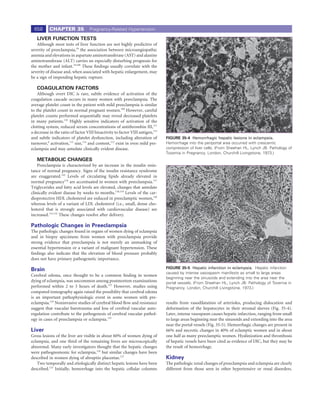
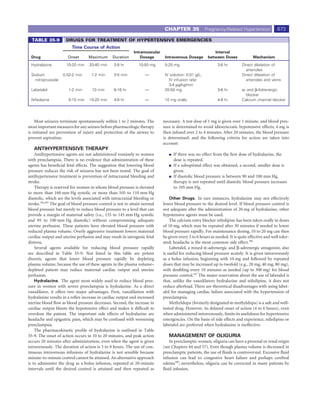
FIGURE 35-3 Eclampsia survivorship. Survival times are plotted
                                                                              explanations, such as that preeclampsia causes vascular injury that
for women with eclampsia in the first pregnancy (solid line) and those         increases cardiovascular risk or that normal pregnancies have a protec-
with eclampsia in a later pregnancy (dashed line). Survival of women          tive effect, cannot be excluded.
with first-pregnancy eclampsia was not different from survival of a
control group. (From Chesley LC, Annitto JE, Cosgrove RA: The
remote prognosis of eclamptic women: Sixth periodic report. Am J              Clinical Presentation
Obstet Gynecol 124:446, 1976, Courtesy of the American College of             Preeclampsia can manifest with a wide spectrum of disease, ranging
Obstetricians and Gynecologists.)                                             from life-threatening neurologic, renal, hepatic, and coagulation
                                                                              abnormalities to mild findings of preeclampsia with minimal end-
                                                                              organ involvement. The fetus may be severely compromised by the
Scottish investigators reported a fourfold increased risk of subsequent       maternal condition and by extreme preterm delivery or only minimally
hypertension in nulliparous women with preeclampsia2,76,77 (OR =              affected. These variations have puzzled clinicians and researchers for
3.98; CI, 2.82 to 5.61). Funai and colleagues78 described excess long-        many years. An understanding of the pathophysiology of the disorder
term mortality in women with prior preeclampsia that was largely              provides insight into the diverse clinical presentations.
attributed to a threefold increase in deaths due to cardiovascular
disease. Other reports support a link between preeclampsia and mater-         Symptoms
nal ischemic heart disease,79,80 which is sometimes evident 20 years          Most women with early preeclampsia are asymptomatic. The absence
after the preeclamptic pregnancy and coincident with the onset of             of symptoms is the rationale for frequent obstetric visits in late preg-
menopause.78,80 A family history of cardiovascular disease increases the      nancy. In most cases, signs such as increased blood pressure and pro-
association between preeclampsia and cardiovascular outcomes.81               teinuria antedate overt symptoms.
Obesity is a known risk factor for preeclampsia and cardiovascular                The various symptoms associated with preeclampsia, especially
disease. Although controlling for obesity attenuates the increased risk       preeclampsia of increasing severity, are listed in Table 35-3. Because
of death for postmenopausal women, this risk is not fully explained by        preeclampsia is a disease of generalized poor perfusion, the diversity
obesity alone.82                                                              of symptoms related to many organ systems is not surprising. Symp-
    The relationships among obesity, insulin resistance, and preeclamp-       toms suggesting hepatic, neurologic, and visual involvement are par-
sia are part of an interesting relationship of preeclampsia to the meta-      ticularly worrisome. They include epigastric pain, “stomach upset,” and
bolic or insulin resistance syndrome.83 This syndrome predisposes to          pain penetrating to the back. Headache and mental confusion indicate
cardiovascular disease in later life and consists of obesity, hypertension,   poor cerebral perfusion and may be precursors of convulsions. Visual
dyslipidemia (i.e., increased low-density lipoprotein [LDL] cholesterol,      symptoms ranging from scotomata to blindness indicate retinal arte-
decreased high-density lipoprotein [HDL] cholesterol, and increased           rial spasm and edema. Symptoms suggesting congestive heart failure
triglycerides), and increased uric acid, all of which are found in women      or abruptio placentae also represent significant complications of pre-
with preeclampsia.83 Other conditions predisposing to later-life cardio-      eclampsia. Other symptoms, such as tightness of hands and feet and
vascular disease—including elevated levels of homocysteine,84 evidence        paresthesias resulting from medial or ulnar nerve compression, may
of androgen excess (including polycystic ovarian syndrome),85 elevated        alarm the patient but have little prognostic significance.
testosterone levels,86 male fat distribution (i.e., increased waist-to-hip
ratio),87 and lipoprotein lipase mutations88—are also linked to an            Signs
increased risk for preeclampsia.                                              Signs of preeclampsia usually antedate symptoms. The most common
    Women who appear normal years after a preeclamptic pregnancy              sequence is increased blood pressure followed by proteinuria.18
may nevertheless demonstrate subtle metabolic and cardiovascular
abnormalities. Compared with women with uncomplicated pregnan-                   BLOOD PRESSURE CHANGE
cies, formerly preeclamptic women have evidence of endothelial dys-              An increase in blood pressure is required for the diagnosis of
function,89,90 higher blood pressures,89 increased insulin resistance,91      preeclampsia. Blood pressure variation in normal pregnancy can
CHAPTER 35             Pregnancy-Related Hypertension             657
lead to misdiagnosis. In clinical practice, the serious effects of pre-               HYPERREFLEXIA
eclampsia on the mother and fetus warrant such overdiagnosis. The                     Although hyperreflexia is given much clinical attention and deep
primary pathophysiologic alteration, poor tissue perfusion resulting               tendon reflexes are increased in many women before seizures, convul-
from vasospasm, is revealed more by blood pressure changes than by                 sions can occur in the absence of hyperreflexia,68 and many pregnant
absolute blood pressure levels. Although a diagnosis of preeclampsia               women are consistently hyperreflexic without being preeclamptic.
is not made without absolute blood pressure increases to 140 mm Hg                 Changes, or lack thereof, in deep tendon reflexes are not part of the
systolic or 90 mm Hg diastolic, women who reach this level from a low              diagnosis of preeclampsia.
early pregnancy value typically manifest more vasospasm than those
for whom 140/90 mm Hg represents a smaller increase.                                  OTHER SIGNS
    Although maternal and fetal risks rise with increasing blood pres-                 Other signs that occur less commonly in preeclampsia are indica-
sure,95 serious complications can occur in women who experience only               tors of involvement of specific organs in the preeclamptic process.
modest blood pressure elevation. In two series, 20% of women with                  Women with marked edema may have ascites and hydrothorax, and
eclampsia never had a systolic blood pressure above 140 mm Hg.18,96                those with congestive heart failure display increased neck vein disten-
In a large, prospective study from the United Kingdom, there were 383              tion, gallop rhythm, and pulmonary rales. Hepatic capsular distention,
confirmed cases of eclampsia, of which 77% were hospitalized before                 manifested by hepatic enlargement and tenderness, is a particular
seizures occurred. Of these, 38% of the cases were not preceded by                 concern, as is disseminated intravascular coagulation (DIC) sufficient
documented proteinuria or hypertension.97 Others have noticed similar              to cause petechiae or generalized bruising and bleeding.
findings.98,99
                                                                                   Laboratory Findings
   PROTEINURIA                                                                     Major changes revealed by laboratory studies occur in severe pre-
    Among the diagnostic signs of preeclampsia, proteinuria in the                 eclampsia and eclampsia. In the patient with mild preeclampsia,
presence of hypertension is the most reliable indicator of fetal jeopardy.         changes in most of these indicators may be minimal or absent.
In two studies of preeclampsia, the perinatal mortality rate tripled for
women with proteinuria,100 and the amount of proteinuria correlated                   RENAL FUNCTION STUDIES
with increased perinatal mortality rate and the number of growth-                      Serum Uric Acid Concentration and Urate Clearance. Uric
restricted infants.101 A later study demonstrated that the risk for                acid is the most sensitive laboratory indicator of preeclampsia available
delivering a small-for-gestational-age fetus was higher in women with              to clinicians. A decrease in uric acid clearance precedes a measurable
hypertension and proteinuria (52%) compared with women with new-                   decrease in the glomerular filtration rate (GFR). Hypertension with
onset gestational hypertension (15%) or chronic hypertension (12%).                hyperuricemia but without proteinuria was associated with growth
The perinatal mortality rate was fourfold higher with proteinuria                  restriction as commonly as hypertension and proteinuria without ele-
and hypertension than in pregnancies complicated by hypertension                   vated uric acid in one series.105 Although increased serum uric acid
alone.102                                                                          concentration is often attributed to altered renal function, an alterna-
                                                                                   tive view favors increased production caused by oxidative stress.106 An
   RETINAL CHANGES                                                                 elevated uric acid level may itself have pathogenic effects.107 Table 35-4
    Retinal vascular changes on funduscopic examination occur in                   shows normal uric acid levels during gestation and levels associated
retinal arterioles in at least 50% of women with preeclampsia, and they            with preeclampsia.
are important because they correlate best with renal biopsy-proven                    Serum Creatinine Concentration and Creatinine Clearance.
changes of preeclampsia.103 Localized retinal vascular narrowing is                Creatinine clearance is decreased in most patients with severe pre-
visualized as segmental spasm, and the generalized narrowing is indi-              eclampsia, but it can be normal in women with mild disease. Serial
cated by a decrease in the ratio of arteriolar-venous diameter from                serum creatinine determinations may indicate decreased clearance, but
the usual 3 : 5 to 1 : 2 or even 1 : 3. It can occur in all vessels or, in early   single values are not helpful unless markedly elevated because of the
stages, in single vessels.104 Preeclampsia does not cause chronic arterio-         wide range of normal values. The serum creatinine concentration
lar changes; the presence of arteriolar sclerosis detected by increased            varies as a geometric function of creatinine clearance so that small
light reflex, copper wiring, or arteriovenous nicking indicates preexist-           changes in glomerular filtration are best determined by measurements
ing vascular disease.                                                              of creatinine clearance.


  TABLE 35-4            PLASMA URATE CONCENTRATIONS IN NORMOTENSIVE AND HYPERTENSIVE
                        PREGNANT WOMEN
                                                    Normotensive Patients                                           Hypertensive Patients

  Weeks of Gestation                     mmol/L                   SD*               mg/dL                mmol/L                 SD*                mg/dL
  24-28                                    0.18                  (20%)               3.02                  0.24                (20%)                 4.03
  29-32                                    0.18                  (35%)               3.02                  0.28                (25%)                 4.7
  33-36                                    0.20                  (30%)               3.36                  0.30                (20%)                 5.04
  37-40                                    0.26                  (20%)               4.4                   0.31                (23%)                 5.28
  41-42                                    0.25                  (24%)               4.2                   0.32                (12%)                 5.38

 *Each number in parentheses is the standard deviation given as a percentage of the mean values shown. Values for hypertensive and normotensive
 women are statistically different at all gestational ages (P < .05).
 Modified from Shuster E, Weppelman B: Plasma urate measurements and fetal outcome in preeclampsia. Gynecol Obstet Invest 12:162, 1981.
658      CHAPTER 35              Pregnancy-Related Hypertension

   LIVER FUNCTION TESTS
   Although most tests of liver function are not highly predictive of
severity of preeclampsia,18 the association between microangiopathic
anemia and elevations in aspartate aminotransferase (AST) and alanine
aminotransferase (ALT) carries an especially disturbing prognosis for
the mother and infant.19,108 These findings usually correlate with the
severity of disease and, when associated with hepatic enlargement, may
be a sign of impending hepatic rupture.

   COAGULATION FACTORS
    Although overt DIC is rare, subtle evidence of activation of the
coagulation cascade occurs in many women with preeclampsia. The
average platelet count in the patient with mild preeclampsia is similar
to the platelet count in normal pregnant women.109 However, careful
platelet counts performed sequentially may reveal decreased platelets
in many patients.110 Highly sensitive indicators of activation of the
clotting system, reduced serum concentrations of antithrombin III,111
a decrease in the ratio of factor VIII bioactivity to factor VIII antigen,112
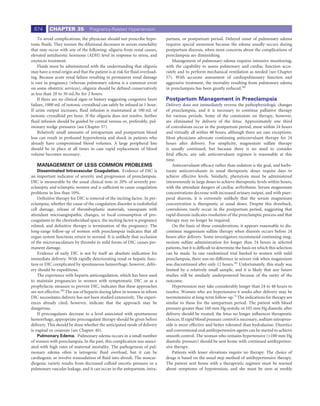
and subtle indicators of platelet dysfunction, including alteration of          FIGURE 35-4 Hemorrhagic hepatic lesions in eclampsia.
turnover,6 activation,113 size,114 and content,115 exist in even mild pre-      Hemorrhage into the periportal area occurred with crescentic
eclampsia and may antedate clinically evident disease.                          compression of liver cells. (From Sheehan HL, Lynch JB: Pathology of
                                                                                Toxemia in Pregnancy. London, Churchill Livingstone, 1973.)
   METABOLIC CHANGES
    Preeclampsia is characterized by an increase in the insulin resis-
tance of normal pregnancy. Signs of the insulin resistance syndrome
are exaggerated.110 Levels of circulating lipids already elevated in
normal pregnancy116 are accentuated in women with preeclampsia.117
Triglycerides and fatty acid levels are elevated, changes that antedate
clinically evident disease by weeks to months.118,119 Levels of the car-
dioprotective HDL cholesterol are reduced in preeclamptic women,120
whereas levels of a variant of LDL cholesterol (i.e., small, dense cho-
lesterol that is strongly associated with cardiovascular disease) are
increased.121,122 These changes resolve after delivery.

Pathologic Changes in Preeclampsia
The pathologic changes found in organs of women dying of eclampsia
and in biopsy specimens from women with preeclampsia provide
strong evidence that preeclampsia is not merely an unmasking of
essential hypertension or a variant of malignant hypertension. These
findings also indicate that the elevation of blood pressure probably
does not have primary pathogenetic importance.

Brain                                                                           FIGURE 35-5 Hepatic infarction in eclampsia. Hepatic infarction
                                                                                caused by intense vasospasm manifests as small to large areas
Cerebral edema, once thought to be a common finding in women
                                                                                beginning near the sinusoids and extending into the area near the
dying of eclampsia, was uncommon among postmortem examinations                  portal vessels. (From Sheehan HL, Lynch JB: Pathology of Toxemia in
performed within 2 to 3 hours of death.123 However, studies using               Pregnancy. London, Churchill Livingstone, 1973.)
computed tomography again raised the possibility that cerebral edema
is an important pathophysiologic event in some women with pre-
eclampsia.124 Noninvasive studies of cerebral blood flow and resistance          results from vasodilatation of arterioles, producing dislocation and
suggest that vascular barotrauma and loss of cerebral vascular auto-            deformation of the hepatocytes in their stromal sleeves (Fig. 35-4).
regulation contribute to the pathogenesis of cerebral vascular pathol-          Later, intense vasospasm causes hepatic infarction, ranging from small
ogy in cases of preeclampsia or eclampsia.125                                   to large areas beginning near the sinusoids and extending into the area
                                                                                near the portal vessels (Fig. 35-5). Hemorrhagic changes are present in
Liver                                                                           66% and necrotic changes in 40% of eclamptic women and in about
Gross lesions of the liver are visible in about 60% of women dying of           one half as many preeclamptic women. Hyalinization and thrombosis
eclampsia, and one third of the remaining livers are microscopically            of hepatic vessels have been cited as evidence of DIC, but they may be
abnormal. Many early investigators thought that the hepatic changes             the result of hemorrhage.
were pathognomonic for eclampsia,126 but similar changes have been
described in women dying of abruptio placentae.127                              Kidney
    Two temporally and etiologically distinct hepatic lesions have been         The pathologic renal changes of preeclampsia and eclampsia are clearly
described.123 Initially, hemorrhage into the hepatic cellular columns           different from those seen in other hypertensive or renal disorders.
CHAPTER 35             Pregnancy-Related Hypertension            659


                                                                                            EN


                                                                                                   BM


                                                                                R


FIGURE 35-6 Glomerular changes in preeclampsia are identified                A
by light microscopy. The enlarged glomerulus completely fills
Bowman’s capsule. Diffuse edema of the glomerular wall is indicated                  Ep                      Cy
by the vacuolated appearance. The visible capillary loops are
extremely narrow, and there are virtually no red blood cells in the
capillary tuft.
                                                                                                                                              En

Glomerular, tubular, and arteriolar changes have been described. The
glomerular lesion is considered by some to be pathognomonic of pre-
eclampsia and eclampsia, but identical changes have been seen in pla-       BS                     R
cental abruption without evident preeclampsia.128 This change is not
                                                                                                                                                En
seen in any other form of hypertension.
                                                                                    Ep
   GLOMERULAR CHANGES
    Changes seen by light microscopy in glomeruli that are character-
istic of preeclampsia include103 decreased glomerular size, with protru-
sion of the glomerular tuft into the proximal tubule. The diameter of                                   P
the glomerular capillary lumen is decreased and contains few blood
cells. The endothelial-mesangial cells have increased cytoplasmic
                                                                            B
volume and can contain lipoid droplets (Fig. 35-6).
    Electron microscopic examination of glomeruli provides more evi-       FIGURE 35-7 Electron photomicrographs of renal glomeruli.
dence that the primary pathologic change occurs in endothelial cells,      A, Normal anatomy. B, Biopsy specimen from a preeclamptic woman.
which are greatly increased in size and can occlude the capillary lumen;   Endothelial cells (En) are markedly enlarged, obstruct the capillary
their cytoplasm contains electron-dense material.129 The basement          lumen, and contain electron-dense inclusions. The basement
membrane bordering the epithelial cell may be slightly thickened, and      membrane (BM) is slightly thickened with inclusions, but the
it also contains electron-dense material. The epithelial cell podocytes    epithelial foot processes (EP) are normal. BM, basement membrane;
are not altered (Fig. 35-7). These changes are collectively called glo-    BS, Bowman’s space; Cy, cytoplasmic inclusions; EN, capillary
                                                                           endothelial cells that line the glomeruli; Ep, renal epithelial cells; L,
merular capillary endotheliosis.
                                                                           capillary lumen containing red blood cells; P, podocytes; R, red blood
    Characteristic glomerular changes occur in 70% of primiparas
                                                                           cell. (From McCartney CP: Pathological anatomy of acute
but in only 14% of multiparas with a diagnosis of preeclampsia.17 The      hypertension of pregnancy. Circulation 30[Suppl II]:37, 1964. By
more likely the diagnosis of preeclampsia, the more common the glo-        permission of the American Heart Association, Inc.)
merular lesion. As the clinical condition worsens, the magnitude of the
glomerular lesion increases. The glomerular lesions are reversible after
delivery and are not present in subsequent biopsy specimens obtained
5 to 10 weeks later.103                                                       NONGLOMERULAR CHANGES
    The glomerular changes correlate more consistently with protein-           Pathologic changes in renal tubules include dilatation of proximal
uria than with hypertension, suggesting that proteins identified immu-      tubules with thinning of the epithelium,123 tubular necrosis,103 enlarge-
nohistochemically may be trapped in the glomerulus. These staining         ment of the juxtaglomerular apparatus,131 and hyaline deposition in
patterns are not found in other renal disorders with proteinuria. The      renal tubules.123 Fat deposition in women with prolonged heavy pro-
glomerular changes of preeclampsia can be mimicked in animal studies       teinuria has been reported.123 Necrosis of the loop of Henle, a change
by reducing the renal concentration of vascular endothelial growth         that correlates with the degree of hyperuricemia, has also been
factor (VEGF), which usually exists in high concentration in this tissue   described.131
by increasing the synthesis of the VEGF antagonist soluble Fms-like            Thickening of renal arterioles may be seen in preeclampsia, espe-
tyrosine kinase 1 (sFlt1).130                                              cially in women with preexisting hypertension. Unlike the glomerular
660        CHAPTER 35                Pregnancy-Related Hypertension


                                 Spinal
Endometrium


                           Basal


                        Radial


              Arcuate
Myometrium


                                                                                 A


FIGURE 35-8 Schematic representation of uterine arteries. The
characteristic changes occur in the decidual vessels supplying the
placental site in a normal pregnancy. (From Okkels H, Engle ET:
Studies of the finer structure of the uterine vessels of the Macacus
monkey. Acta Pathol Microbiol Scand 15:150, 1938.)


lesion, it does not regress after delivery,103 suggesting that the arteriolar
change results from coincident disease, not preeclampsia.
                                                                                 B
Vascular Changes in the Placental Site                                          FIGURE 35-9 Spiral arterial changes in normal pregnancy. A, In
The characteristic changes in the decidual vessels supplying the pla-           the section of spiral arterioles at the junction of the endometrium and
cental site in normal pregnancy are depicted in Figure 35-8. In normal          myometrium in a nonpregnant woman, notice the inner elastic lamina
pregnancy, the spiral arteries (Fig. 35-9) increase greatly in diameter.132     and smooth muscle. B, In a section of a spiral arteriole at the same
Morphologically, the endothelium is replaced by trophoblast, and the            scale and from the same location during pregnancy, notice the
internal elastic lamina and smooth muscle of the media are replaced             markedly increased diameter and absence of inner elastic lamina and
by trophoblast and an amorphous matrix-containing fibrin (see                    smooth muscle. (From Sheppard BL, Bonnar J: Uteroplacental
Fig. 35-9).133 These changes occur originally in the decidual portion of        arteries and hypertensive pregnancy. In Bonnar J, MacGillivray I,
                                                                                Symonds G [eds]: Pregnancy Hypertension. Baltimore, University Park
the spiral arteries but extend into the myometrium as pregnancy
                                                                                Press, 1980, p 205.)
advances and can even involve the distal portion of the uterine radial
artery. The basal arteries are not affected. These morphologic changes
are considered to be a vascular reaction to the trophoblast, occurring
directly or humorally, that results in increased perfusion of the placen-
tal site.
    In placental-site vessels of women with preeclampsia, the normal
physiologic changes do not occur, or they are limited to the decidual
portion of the vessels. Myometrial segments of spiral arteries retain the
nonpregnant component of intima and smooth muscle, and the diam-
eter of these arteries is about 40% that of vessels in normal preg-
nancy.134 Spiral arterioles in decidua and myometrium and basal and                                                                     F
radial arterioles may become necrotic, with components of the normal
vessel wall replaced by amorphous material and foam cells, a change
called acute atherosis (Fig. 35-10).135 This lesion is best seen in the basal
arteries because they do not undergo the normal changes of pregnancy.
It is also present in decidual and myometrial spiral arteries and can
progress to vessel obliteration. The obliterated vessels correspond to
areas of placental infarction.
    Failed vascular remodeling and atherotic changes may be seen
with fetal growth restriction in women without clinical evidence of
                                                                                FIGURE 35-10 Atherosis. Numerous lipid-laden cells (L) and fibrin
preeclampsia. Atherotic changes occur in decidual vessels of some dia-          deposition (F) are present in the media of this occluded decidual
betic women,136 and failed vascular remodeling is present in about              vessel. (From Sheppard BL, Bonnar J: Uteroplacental arteries and
one third of women who experience preterm labor.137 It appears                  hypertensive pregnancy. In Bonnar J, MacGillivray I, Symonds G
that abnormal invasion may be necessary but is not sufficient to cause           [eds]: Pregnancy Hypertension. Baltimore, University Park Press,
preeclampsia.                                                                   1980, p 205.)
CHAPTER 35             Pregnancy-Related Hypertension            661
   Changes characteristic of preeclampsia have been observed in the        hypertension. Second, the pathologic findings indicate that the primary
decidual vessels of one in seven primiparous women and in a lower          pathology is poor tissue perfusion, not blood pressure elevation. The
percentage of multiparous women at the time of first-trimester abor-        histologic data support the clinical impression that the poor perfusion
tion.138,139 These findings suggest that disordered placentation precedes   results from profound vasospasm, which increases total peripheral
the clinical presentation of preeclampsia. The cause of the decidual       resistance and blood pressure.
vascular lesions is unknown. The appearance of the atherotic vessels
resembles vessels in transplanted kidneys that have undergone rejec-
tion, suggesting an immunologic cause, which is consistent with find-
                                                                           Pathophysiologic Changes
ings of a study that demonstrated components of complement (e.g.,          in Preeclampsia
C3) in decidual vessels with the lesion.140                                Preeclampsia can cause changes in virtually all organ systems. Several
   The vascular remodeling of spiral arteries supplying the intervillous   organ systems are consistently and characteristically involved, and
space is intimately related to normal trophoblast invasion.141 The         these are discussed in the following sections.
expression of adhesion molecules and their receptors that characterizes
implantation is abnormal in preeclampsia.142 The trophoblast that lines    Cardiovascular Changes
the decidual vessels of normal pregnant women begins to express            Blood pressure is the product of cardiac output and systemic vascular
molecules usually present only on endothelium,143 a phenomenon that        resistance. Cardiac output is increased by up to 50% in normal preg-
does not occur in preeclampsia.144 Potential mechanisms responsible        nancy, but blood pressure does not usually increase, indicating that
for the normal and abnormal changes include decidually produced            systemic vascular resistance decreases. Blood pressure is lower in the
cytokines145-147 and local oxygen tension.148,149 There may be interac-    first half of pregnancy than in the postpartum period, when cardiac
tions of specific molecules on trophoblast and maternal decidual cells      output returns to nonpregnant levels (see Fig. 35-2). Some women
that drive invasion. Invasive cytotrophoblasts express a human leuko-      destined to develop preeclampsia have a higher cardiac output before
cyte antigen (HLA) molecule (HLA-C) that is minimally hetero-              clinically evident disease. However, cardiac output is reduced to pre-
geneous. Interaction of this molecule with a receptor on maternal          pregnancy levels with the onset of clinical preeclampsia.157,158 Although
decidual cells, killer immunoglobulin receptors (KIRs), causes various     some studies suggest increased cardiac output,159 most have found
degrees of activation of the trophoblast cell, depending on the combi-     normal or slightly reduced cardiac output in women with untreated
nation of KIR and HLA-C subtypes. Mothers with the minimally acti-         preeclampsia.160 Increased systemic vascular resistance is the mecha-
vating KIR subtype who have a fetus with a specific HLA-C subtype           nism for the increase in blood pressure in clinical preeclampsia.
(HLA-C2) have an increased frequency of preeclampsia. This is not an           There is substantial evidence that arteriolar narrowing occurs in
immune interaction because the relationship persists regardless of         preeclampsia. Changes in the caliber of retinal arterioles correlate with
maternal HLA-C subtype. Researchers propose that this combination          the clinical severity of the disorder and with renal biopsy-confirmed
does not favor trophoblast invasion and vascular remodeling. Popula-       diagnosis of preeclampsia.103 Similar findings occur in vessels of the
tion studies indicate that populations in which HLA-C2 is common           nail bed and conjunctiva. Measurements of forearm blood flow indi-
have a reduced frequency of the specific inhibitory KIR subtype and         cate higher resistance in preeclamptic than in normal pregnant
vice versa.150                                                             women.161,162 It is unlikely that this effect is determined by the auto-
                                                                           nomic nervous system. Although normal pregnant women are exqui-
Placental Pathologic Changes                                               sitely sensitive to the interruption of autonomic neurotransmission by
Ultrastructural examination of placentas from women with pre-              ganglionic blockade and high spinal anesthesia, preeclamptic women
eclampsia reveals an abnormal syncytiotrophoblast containing areas of      are less sensitive.163 This finding suggests that the arteriolar constric-
cell death and degeneration. Viable-appearing syncytiotrophoblast is       tion of preeclampsia is not maintained by the autonomic nervous
also abnormal, with decreased density of microvilli, dilated endoplas-     system and that humoral factors are implicated. The increased sympa-
mic reticulum, and decreased pinocytotic and secretory activity. The       thetic activity in preeclampsia, however, raises questions about these
cells of the villous cytotrophoblast cells are increased in number and     older findings.164 Assays of concentrations of recognized endogenous
have higher mitotic activity. The basement membrane of the tropho-         vasoconstrictors are limited to determinations of catecholamines and
blast is irregularly thickened, with fine fibrillary inclusions.151          angiotensin II. Results suggest minimal or no change in catechol-
    The changes may be caused by local hypoxia. Similar syncytiotro-       amines, whereas circulating angiotensin II concentrations are lower in
phoblastic changes are present in placental segments maintained under      preeclamptic women.165
hypoxic conditions in vitro.152 The cytotrophoblastic alterations are          Levels of endothelin-1, a vasoconstrictor produced by endothelial
also consistent with hypoxia. The cytotrophoblasts comprise the stem       cells, are increased in the blood of preeclamptic women166 at concen-
cells of the trophoblast and responds to damage by proliferation. The      trations much lower than those necessary to stimulate vascular smooth
trophoblast of the preeclamptic placenta is characterized by increased     muscle contraction in vitro. It is not clear whether these circulating
apoptosis and necrosis,153,154 possibly caused by hypoxia or hypoxia       concentrations reflect endothelial production sufficient to stimulate
reperfusion injury,155 and this may be the origin of the increased cir-    local vasoconstriction or low concentrations of endothelin potentiate
culating syncytiotrophoblast microparticles in preeclampsia.156            contractile responses to other agonists.
                                                                               As indicated by the older term toxemia, early investigators sus-
Summary of Pathologic Changes                                              pected that preeclampsia was caused by circulating humors. Early
in Preeclampsia                                                            reports suggesting etiologic agents such as pressor substances in blood,
Structural changes associated with preeclampsia and eclampsia lead to      decidual extracts, placental extracts, and amniotic fluid of preeclamp-
two important conclusions. First, preeclampsia is not an alternate form    tic patients have not been replicated. The explanation for the pressor
of malignant hypertension. The renal changes in preeclamptic and           effects was, in some studies, normal endogenous pressors; in others,
eclamptic women and the structural changes in other organs of women        the explanation was faulty methodology and failure to recognize the
dying of eclampsia differ from the alterations caused by malignant         immunologic difference between the source of the extract and the
662                CHAPTER 35    Pregnancy-Related Hypertension


                    50                                                                              50        Preeclampsia
                          Preeclampsia
                                                                                                              Nonpregnant
                          Nonpregnant
                    40                                                                                        Normal pregnancy
       MBP, mm Hg

                          Normal pregnancy                                                          40


                                                                                       MBP, mm Hg
                    30                                                                              30

                    20                                                                              20

                    10                                                                              10


                              5    10 15 25       50    100   200                                                     5      10 15 25      50    100   200
                                  Dose, ng/kg                                                                                Dose, ng/kg

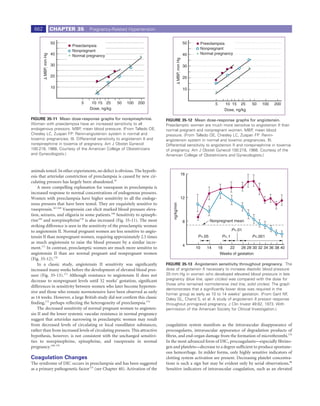
FIGURE 35-11 Mean dose-response graphs for norepinephrine.                   FIGURE 35-12 Mean dose-response graphs for angiotensin.
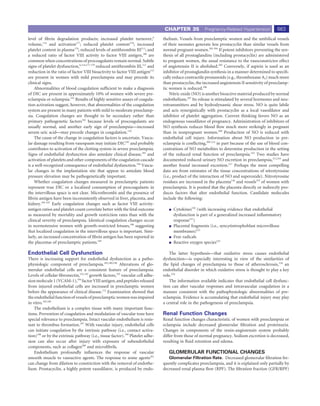
Women with preeclampsia have an increased sensitivity to all                 Preeclamptic women are much more sensitive to angiotensin II than
endogenous pressors. MBP, mean blood pressure. (From Talledo OE,             normal pregnant and nonpregnant women. MBP, mean blood
Chesley LC, Zuspan FP: Renin-angiotensin system in normal and                pressure. (From Talledo OE, Chesley LC, Zuspan FP: Renin-
toxemic pregnancies. III. Differential sensitivity to angiotensin II and     angiotensin system in normal and toxemic pregnancies. III.
norepinephrine in toxemia of pregnancy. Am J Obstet Gynecol                  Differential sensitivity to angiotensin II and norepinephrine in toxemia
100:218, 1968. Courtesy of the American College of Obstetricians             of pregnancy. Am J Obstet Gynecol 100:218, 1968. Courtesy of the
and Gynecologists.)                                                          American College of Obstetricians and Gynecologists.)


animals tested. In other experiments, no defect is obvious. The hypoth-
                                                                                                16
esis that arteriolar constriction of preeclampsia is caused by new cir-
culating pressors has largely been abandoned.18
    A more compelling explanation for vasospasm in preeclampsia is
increased response to normal concentrations of endogenous pressors.
Women with preeclampsia have higher sensitivity to all the endoge-                              12
nous pressors that have been tested. They are exquisitely sensitive to
                                                                                 ng/kg/min


vasopressin.167,168 Vasopressin can elicit marked blood pressure eleva-
tion, seizures, and oliguria in some patients.168 Sensitivity to epineph-
rine169 and norepinephrine170 is also increased (Fig. 35-11). The most                              8             Nonpregnant mean
striking difference is seen in the sensitivity of the preeclamptic woman
to angiotensin II. Normal pregnant women are less sensitive to angio-                                                              P<.01
tensin II than nonpregnant women, requiring approximately 2.5 times                                      P<.05              P<.1           P<.001
as much angiotensin to raise the blood pressure by a similar incre-
                                                                                                    4
ment.171 In contrast, preeclamptic women are much more sensitive to                                      10      14       18   22     26 28 30 32 34 36 38 40
angiotensin II than are normal pregnant and nonpregnant women                                                              Weeks of gestation
(Fig. 35-12).170
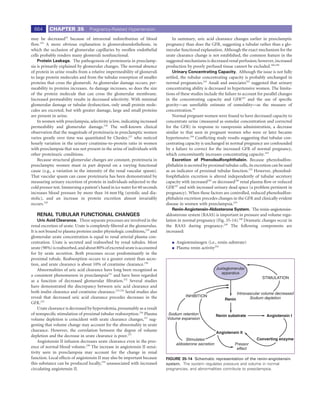
    In a classic study, angiotensin II sensitivity was significantly          FIGURE 35-13 Angiotensin sensitivity throughout pregnancy. The
increased many weeks before the development of elevated blood pres-          dose of angiotensin II necessary to increase diastolic blood pressure
sure (Fig. 35-13).172 Although resistance to angiotensin II does not         20 mm Hg in women who developed elevated blood pressure in late
decrease to nonpregnant levels until 32 weeks’ gestation, significant         pregnancy (blue line, open circles) was compared with the dose for
                                                                             those who remained normotensive (red line, solid circles). The graph
differences in sensitivity between women who later become hyperten-
                                                                             demonstrates that a significantly lower dose was required in the
sive and those who remain normotensive have been observed as early           former group as early as 10 to 14 weeks’ gestation. (From Gant NF,
as 14 weeks. However, a large British study did not confirm this classic      Daley GL, Chand S, et al: A study of angiotensin II pressor response
finding,173 perhaps reflecting the heterogeneity of preeclampsia.174           throughout primigravid pregnancy. J Clin Invest 49:82, 1973. With
    The decreased sensitivity of normal pregnant women to angioten-          permission of the American Society for Clinical Investigation.)
sin II and the lower systemic vascular resistance in normal pregnancy
suggest that arteriolar narrowing in preeclamptic women may result
from decreased levels of circulating or local vasodilator substances,        coagulation system manifests as the intravascular disappearance of
rather than from increased levels of circulating pressors. This attractive   procoagulants, intravascular appearance of degradation products of
hypothesis, however, is not consistent with the unchanged sensitivi-         fibrin, and end-organ damage from the formation of microthrombi.176
ties to norepinephrine, epinephrine, and vasopressin in normal               In the most advanced form of DIC, procoagulants—especially fibrino-
pregnancy.168-170                                                            gen and platelets—decrease to a degree sufficient to produce spontane-
                                                                             ous hemorrhage. In milder forms, only highly sensitive indicators of
Coagulation Changes                                                          clotting system activation are present. Decreasing platelet concentra-
The syndrome of DIC occurs in preeclampsia and has been suggested            tions is such a sign but may be evident only by serial observations.96
as a primary pathogenetic factor175 (see Chapter 40). Activation of the      Sensitive indicators of intravascular coagulation, such as an elevated
CHAPTER 35             Pregnancy-Related Hypertension            663
level of fibrin degradation products; increased platelet turnover,6              thelium. Vessels from preeclamptic women and the umbilical vessels
volume,114 and activation177; reduced platelet content178; increased            of their neonates generate less prostacyclin than similar vessels from
platelet content in plasma179; reduced levels of antithrombin III111; and       normal pregnant women.202-204 If potent inhibitors preventing the syn-
a reduced ratio of factor VIII activity to factor VIII antigen,180 are          thesis of all prostaglandins (including prostacyclin) are administered
common when concentrations of procoagulants remain normal. Subtle               to pregnant women, the usual resistance to the vasoconstrictor effect
signs of platelet dysfunction,6,114,177-179 reduced antithrombin III,111 and    of angiotensin II is abolished.205 Conversely, if aspirin is used as an
reduction in the ratio of factor VIII bioactivity to factor VIII antigen112     inhibitor of prostaglandin synthesis in a manner determined to specifi-
are present in women with mild preeclampsia and may precede its                 cally reduce contractile prostanoids (e.g., thromboxane A2) much more
clinical signs.                                                                 than prostacyclin, the increased angiotensin II sensitivity of preeclamp-
    Abnormalities of blood coagulation sufficient to make a diagnosis            tic women is reduced.206
of DIC are present in approximately 10% of women with severe pre-                   Nitric oxide (NO) is another bioactive material produced by normal
eclampsia or eclampsia.181 Results of highly sensitive assays of coagula-       endothelium.207 Its release is stimulated by several hormones and neu-
tion activation suggest, however, that abnormalities of the coagulation         rotransmitters and by hydrodynamic shear stress. NO is quite labile
system are present in many patients with mild to moderate preeclamp-            and acts synergistically with prostacyclin as a local vasodilator and
sia. Coagulation changes are thought to be secondary rather than                inhibitor of platelet aggregation. Current thinking favors NO as an
primary pathogenetic factors182 because levels of procoagulants are             endogenous vasodilator of pregnancy. Administration of inhibitors of
usually normal, and another early sign of preeclampsia—increased                NO synthesis reduces blood flow much more strikingly in pregnant
serum uric acid—may precede changes in coagulation.110                          than in nonpregnant women.208 Production of NO is reduced with
    The cause of the change in coagulation factors is uncertain. Vascu-         endothelial cell injury. Information about NO production in pre-
lar damage resulting from vasospasm may initiate DIC182 and probably            eclampsia is conflicting,209-214 in part because of the use of blood con-
contributes to activation of the clotting system in severe preeclampsia.        centrations of NO metabolites to determine production in the setting
Signs of endothelial dysfunction also antedate clinical disease,183 and         of the reduced renal function of preeclampsia.215 Two studies have
activation of platelets and other components of the coagulation cascade         documented reduced urinary NO excretion in preeclampsia,212,216 and
is a well-recognized consequence of endothelial dysfunction.184 Vascu-          another found increased excretion.217 Perhaps the most compelling
lar changes in the implantation site that appear to antedate blood              data are from estimates of the tissue concentrations of nitrotyrosine
pressure elevation may be pathogenetically important.                           (i.e., product of the interaction of NO and superoxide). Nitrotyrosine
    Whether coagulation changes measured in preeclamptic patients               residues are increased in the placenta218 and vessels219 of women with
represent true DIC or a localized consumption of procoagulants in               preeclampsia. It is posited that the placenta directly or indirectly pro-
the intervillous space is not clear. Microthrombi and the presence of           duces factors that alter endothelial function. Candidate molecules
fibrin antigen have been inconsistently observed in liver, placenta, and         include the following:
kidney.185-187 Early coagulation changes such as factor VIII activity-
antigen ratios and platelet count correlate better with the fetal outcome             Cytokines220 (with increasing evidence that endothelial
as measured by mortality and growth restriction rates than with the                   dysfunction is part of a generalized increased inflammatory
clinical severity of preeclampsia. Identical coagulation changes occur                response221)
in normotensive women with growth-restricted fetuses,188 suggesting                   Placental fragments (i.e., syncytiotrophoblast microvillous
that localized coagulation in the intervillous space is important. Simi-              membranes)222
larly, an increased concentration of fibrin antigen has been reported in               Free radicals
the placentas of preeclamptic patients.185                                            Reactive oxygen species223

Endothelial Cell Dysfunction                                                        The latter hypothesis—that oxidative stress causes endothelial
There is increasing support for endothelial dysfunction as a patho-             dysfunction—is especially interesting in view of the similarities of
physiologic component of preeclampsia.183,189,190 Alterations of glo-           the lipid changes of preeclampsia to those of atherosclerosis,118 an
merular endothelial cells are a consistent feature of preeclampsia.             endothelial disorder in which oxidative stress is thought to play a key
Levels of cellular fibronectin,191,192 growth factors,193 vascular cell adhe-    role.224
sion molecule 1 (VCAM-1),194 factor VIII antigen, and peptides released             The information available indicates that endothelial cell dysfunc-
from injured endothelial cells are increased in preeclamptic women              tion can alter vascular responses and intravascular coagulation in a
before the appearance of clinical disease.112 Examination showed that           manner consistent with the pathophysiologic abnormalities of pre-
the endothelial function of vessels of preeclamptic women was impaired          eclampsia. Evidence is accumulating that endothelial injury may play
in vitro.195,196                                                                a central role in the pathogenesis of preeclampsia.
    The endothelium is a complex tissue with many important func-
tions. Prevention of coagulation and modulation of vascular tone have           Renal Function Changes
special relevance to preeclampsia. Intact vascular endothelium is resis-        Renal function changes characteristic of women with preeclampsia or
tant to thrombus formation.197 With vascular injury, endothelial cells          eclampsia include decreased glomerular filtration and proteinuria.
can initiate coagulation by the intrinsic pathway (i.e., contact activa-        Changes in components of the renin-angiotensin system probably
tion)198 or by the extrinsic pathway (i.e., tissue factor).199 Platelet adhe-   differ from those of normal pregnancy. Sodium excretion is decreased,
sion can also occur after injury with exposure of subendothelial                resulting in fluid retention and edema.
components, such as collagen200 and microfibrils.
    Endothelium profoundly influences the response of vascular                      GLOMERULAR FUNCTIONAL CHANGES
smooth muscle to vasoactive agents. The response to some agents201                 Glomerular Filtration Rate. Decreased glomerular filtration fre-
can change from dilation to constriction with the removal of endothe-           quently complicates preeclampsia, and it is explained only partially by
lium. Prostacyclin, a highly potent vasodilator, is produced by endo-           decreased renal plasma flow (RPF). The filtration fraction (GFR/RPF)
664      CHAPTER 35              Pregnancy-Related Hypertension

may be decreased18 because of intrarenal redistribution of blood                 In summary, uric acid clearance changes earlier in preeclamptic
flow.225 A more obvious explanation is glomeruloendotheliosis, in             pregnancy than does the GFR, suggesting a tubular rather than a glo-
which the occlusion of glomerular capillaries by swollen endothelial         merular functional explanation. Although the exact mechanism for the
cells probably renders many glomeruli nonfunctional.                         urate clearance change is not established, the common feature in the
    Protein Leakage. The pathogenesis of proteinuria in preeclamp-           suggested mechanisms is decreased renal perfusion; however, increased
sia is primarily explained by glomerular changes. The normal absence         production by poorly perfused tissue cannot be excluded.106,240
of protein in urine results from a relative impermeability of glomeruli          Urinary Concentrating Capacity. Although the issue is not fully
to large protein molecules and from the tubular resorption of smaller        settled, the tubular concentrating capacity is probably unchanged in
proteins that cross the glomeruli. As glomerular damage occurs, per-         normal pregnancies.241 Assali and associates242 suggested that urinary
meability to proteins increases. As damage increases, so does the size       concentrating ability is decreased in hypertensive women. The limita-
of the protein molecule that can cross the glomerular membrane.              tions of these studies include the failure to account for parallel changes
Increased permeability results in decreased selectivity. With minimal        in the concentrating capacity and GFR243 and the use of specific
glomerular damage or tubular dysfunction, only small protein mole-           gravity—an unreliable estimate of osmolality—as the measure of
cules are excreted, but with greater damage, large and small proteins        concentration.18
are present in urine.                                                            Normal pregnant women were found to have decreased capacity to
    In women with preeclampsia, selectivity is low, indicating increased     concentrate urine (measured as osmolar concentration and corrected
permeability and glomerular damage.226 The well-known clinical               for the GFR) in response to vasopressin administration, a decrease
observation that the magnitude of proteinuria in preeclamptic women          similar to that seen in pregnant women who were or later became
varies greatly over time was quantitated by Chesley,227 who noticed          hypertensive.244 Conflicting study results suggesting that tubular con-
hourly variation in the urinary creatinine-to-protein ratio in women         centrating capacity is unchanged in normal pregnancy are confounded
with preeclampsia that was not present in the urine of individuals with      by a failure to correct for the increased GFR of normal pregnancy,
other proteinuric conditions.                                                which concomitantly increases concentrating capacity.243
    Because structural glomerular changes are constant, proteinuria in           Excretion of Phenolsulfonphthalein. Because phenolsulfon-
preeclamptic women must in part depend on a varying functional               phthalein is secreted by proximal tubular cells, its excretion can be used
cause (e.g., a variation in the intensity of the renal vascular spasm).      as an indicator of proximal tubular function.235 However, phenolsul-
That vascular spasm can cause proteinuria has been demonstrated by           fonphthalein excretion is altered independently of tubular secretory
measuring urinary excretion of protein in individuals subjected to the       capacity with increased245 or decreased246 renal plasma flow or reduced
cold pressor test. Immersing a patient’s hand in ice water for 60 seconds    GFR247 and with increased urinary dead space (a problem pertinent in
increases blood pressure by more than 16 mm Hg (systolic and dia-            pregnancy). When these factors are controlled, reduced phenolsulfon-
stolic), and an increase in protein excretion almost invariably              phthalein excretion precedes changes in the GFR and clinically evident
occurs.228                                                                   disease in women with preeclampsia.235
                                                                                 Renin-Angiotensin-Aldosterone System. The renin-angiotensin-
   RENAL TUBULAR FUNCTIONAL CHANGES                                          aldosterone system (RAAS) is important in pressure and volume regu-
     Uric Acid Clearance. Three separate processes are involved in the       lation in normal pregnancy (Fig. 35-14).248 Dramatic changes occur in
renal excretion of urate. Urate is completely filtered at the glomerulus.     the RAAS during pregnancy.249 The following components are
It is not bound to plasma proteins under physiologic conditions,229 and      increased:
glomerular urate concentration is equal to renal arterial plasma con-
centration. Urate is secreted and reabsorbed by renal tubules. Most                Angiotensinogen (i.e., renin substrate)
urate (98%) is reabsorbed, and about 80% of excreted urate is accounted            Plasma renin activity250
for by urate secretion. Both processes occur predominantly in the
proximal tubule. Reabsorption occurs to a greater extent than secre-
tion, and urate clearance is about 10% of creatinine clearance.230
     Abnormalities of uric acid clearance have long been recognized as                                    Juxtaglomerular
                                                                                                             apparatus
a consistent phenomenon in preeclampsia231 and have been regarded
                                                                                                                                     STIMULATION
as a function of decreased glomerular filtration.232 Several studies
have demonstrated the discrepancy between uric acid clearance and
both inulin clearance and creatinine clearance.233,234 Serial studies also                                             Intravascular volume decreased
reveal that decreased uric acid clearance precedes decreases in the                     INHIBITION                            Sodium depletion
                                                                                                               Renin
GFR.235
     Urate clearance is decreased by hypovolemia, presumably as a result
of nonspecific stimulation of proximal tubular reabsorption.236 Plasma         Sodium retention            Renin substrate               Angiotensin I
volume depletion is coincident with urate clearance changes,237 sug-         Volume expansion
gesting that volume change may account for the abnormality in urate
clearance. However, the correlation between the degree of volume                                          Angiotensin II
depletion and the decrease in urate clearance is poor.237
                                                                                       Stimulates                                 Converting enzyme
     Angiotensin II infusion decreases urate clearance even in the pres-
                                                                                  aldosterone secretion              Pressor
ence of normal blood volume.238 The increase in angiotensin II sensi-                                                 effect
tivity seen in preeclampsia may account for the change in renal
function. Local effects of angiotensin II may also be important because      FIGURE 35-14 Schematic representation of the renin-angiotensin
this substance can be produced locally,239 unassociated with increased       system. The system regulates pressure and volume in normal
circulating angiotensin II.                                                  pregnancies, and abnormalities contribute to preeclampsia.
CHAPTER 35             Pregnancy-Related Hypertension            665
      Plasma renin concentration                                                Atrial Natriuretic Factor. Atrial natriuretic factor (ANF), a
      Angiotensin II concentration250,251                                   peptide produced in response to atrial stretch with hypervolemia, regu-
      Aldosterone252                                                        lates intravascular volume by several mechanisms. ANF increases
                                                                            sodium excretion and the egress of fluid from the intravascular com-
    Abnormalities of the RAAS have been proposed as causal factors in       partment. Although the reduced plasma volume of preeclampsia pre-
preeclampsia253 because angiotensin II is a potent vasoconstrictor, it      dicts reduced ANF concentration, the concentration is increased,270
influences aldosterone secretion and consequent sodium retention,            and the increase precedes clinical disease.271 The stimulus for this
and at high concentrations, it can cause proteinuria. Myometrium and        increase is unclear, but the paradoxical finding of increased circulating
chorion can synthesize renin, which is stimulated in experimental           ANF levels and reduced renin concentration with reduced plasma
animals by uterine ischemia.254                                             volume in preeclamptic women suggests that the reduced plasma
    Most investigators agree that the angiotensinogen level remains         volume is increased relative to the constricted vascular compartment.
elevated in preeclampsia.250,255 The plasma renin activity and plasma           Changes in Sodium Excretion. Sodium retention has long been
renin concentration are reduced in preeclampsia compared with               considered an integral part of the pathophysiology of preeclampsia.
normal pregnancy.256 In a prospective study of women with chronic           Women with eclampsia and severe preeclampsia have very little chlo-
hypertension, plasma renin activity was lower when superimposed             ride and sodium in the urine.272 After delivery, however, chloride
preeclampsia developed (i.e., diagnostic blood pressure increase and        excretion increases dramatically. Infusion of hypertonic saline into
proteinuria) than in chronic hypertensive women without superim-            preeclamptic women results in excretion of the infused sodium at
posed preeclampsia and in normal pregnant women. Concentrations             about one half of the rate seen in normal pregnant women.167 Similar
were similar in early pregnancy in all groups and decreased only            results occur in women with glomeruloendotheliosis identified on
slightly before the increase in blood pressure.257                          renal biopsy.273 Most studies of exchangeable sodium have indicated an
    The reduced renin activity in preeclampsia suggests suppression of      increase in total body sodium in preeclamptic patients.274,275
renin release. This is puzzling in view of the reduced plasma volume            The cause of sodium retention in preeclamptic women is difficult
that is characteristic of preeclampsia. There is no apparent nonphysi-      to determine because of the enormous number of factors that influ-
ologic suppression of renin activity, because usual physiologic pertur-     ence sodium excretion in normal pregnancy and because of the many
bations result in appropriately increased and decreased concentrations      demonstrated anomalies of renal function in preeclampsia that can
of plasma renin activity (i.e., renin is increased with upright posture     cause sodium retention (Table 35-5). Any or all of the demonstrated
and head-up tilt258 and falls with volume expansion259). Despite the        changes in plasma volume, angiotensin sensitivity, and renal function
reduced content of the vascular compartment in preeclampsia, the            may act on several of the factors listed in Table 35-5 to cause sodium
intense vasoconstriction characteristic of preeclampsia results in a        retention.
physiologic perception of overfill, suppressing renin release. The               Several investigators have considered the increased sodium reten-
reduced renin activity in preeclampsia results in reduced angiotensin       tion to be a primary factor inciting the pathogenetic changes in pre-
II165 and aldosterone concentrations260 compared with concentrations
in normal pregnancy.
    Attempts to test the role of the renin-angiotensin system (RAS) by        TABLE 35-5         FACTORS AFFECTING SODIUM
using angiotensin II antagonists or by converting enzyme inhibitors                              BALANCE IN NORMAL
have not clarified this point. Administration of the angiotensin antago-                          PREGNANCY
nist (1-Sar-8-Ile-angiotensin II) to pregnant hypertensive women
increases blood pressure,261 and because this antagonist is a partial        Factors Affecting Glomerular Filtration
                                                                             Blood pressure in critical areas of the kidney
agonist, the increase in blood pressure may reflect the increased angio-
                                                                             Relative tonus of afferent and efferent glomerular arterioles
tensin sensitivity of hypertensive pregnant women. The administration
                                                                             Plasma oncotic pressure
of the angiotensin antagonist saralasin262 or the angiotensin-converting     Intrarenal redistribution of blood flow
enzyme inhibitor SQ 20,881263 in the postpartum period did not have          Central nervous system effects
significant effects on blood pressure in a mixed group of women with
hypertension.                                                                Factors Affecting Tubular Reabsorption
    Interest in the role of the RAS in preeclampsia has increased as the     Aldosterone
effects of angiotensin on responses other than blood pressure have           Progesterone (an aldosterone antagonist)
been recognized.264 The activation of NADPH oxidase in several tissues       Renal vascular resistance
by angiotensin II can generate oxidative stress.264-266 Hypoxia-inducing     Perfusion pressure in peritubular capillaries
                                                                             Oncotic pressure in peritubular capillaries
factors (HIFs) induce molecules responsible for many of the responses
                                                                             Non-reabsorbable anions in the filtrate
to hypoxia. These factors are upregulated in the placenta of a woman         Velocity of flow in tubules
with preeclampsia267 and can be activated by angiotensin II.268 Anti-        Reabsorptive capacity of tubules
bodies to angiotensin II that activate angiotensin receptors and likely      Estrogens (stimulate sodium reabsorption, possibly indirectly, by
increase the sensitivity of these receptors to angiotensin II are present      effects on vascular permeability)
in women with preeclampsia.269                                               Plasma sodium concentration
    Studies indicate that no simple relationship exists between compo-       Hematocrit (viscosity effects)
nents of the RAS and preeclampsia. The significance, however,                 Changes of plasma volume
of reduced plasma renin activity, plasma renin concentration, and            Angiotensin
angiotensin II concentration on blood pressure and sodium excretion          Sympathetic nervous system
                                                                             Possibly a natriuretic hormone (“third factor”)
in this group of women—who show apparent volume constriction
and who are exquisitely sensitive to angiotensin II—deserves                 Modified from Chesley LC: Hypertensive Disorders in Pregnancy. New
elucidation.                                                                 York, Appleton-Century-Crofts, 1978.
666      CHAPTER 35             Pregnancy-Related Hypertension

eclampsia. Although this possibility cannot be definitely excluded, it is    feature of normal pregnancy, with further increases in women with
not likely for several reasons:                                             mild preeclampsia and significant elevations observed in women with
                                                                            severe preeclampsia.289
1. Angiotensin sensitivity precedes obvious fluid retention by                    Another hypothesis about the immunologic cause of preeclampsia
   months.                                                                  is that vascular changes in the spiral arterioles of the placental implan-
2. Thiocyanate space, an indicator of sodium space, does not reliably       tation site are the result of an allograft rejection between mother and
   predict preeclampsia.276                                                 fetus. However, who is rejecting whom?286 Should the spiral arteries
3. Restriction of dietary sodium or increasing sodium excretion with        lined with trophoblast be thought of as fetal vessels, with the fetus
   diuretics does not affect the occurrence of preeclampsia.277-279         rejecting the mother, or as maternal vessels, with the mother rejecting
                                                                            the fetus?
   SUMMARY OF RENAL FUNCTION CHANGES                                             If preeclampsia represents a rejection of the fetus by the mother,
    Renal function changes in preeclampsia are consistent and charac-       the protective effect of previous exposure to antigen indicates that the
teristic. Changes in tubular function precede the more widely appreci-      preeclamptic mother has a deficit of blocking antibodies or of suppres-
ated changes in glomerular function. These functional changes return        sor cell function. The recognition of a unique HLA antigen, HLA-G,
to normal within weeks to months after the conclusion of pregnancy.         on the trophoblast290 suggests other possible causes of rejection of the
Prospective, sequential studies of renal function indicate that some of     fetus. HLA-G is a class I antigen present almost exclusively on the
these changes antedate the clinical diagnosis of preeclampsia, but they     cytotrophoblast with minimal heterogeneity. Unlike classic HLA anti-
do not necessarily antedate other indicators of preeclampsia such as        gens, which exhibit numerous epitopes, fetal HLA-G in the trophoblast
changes in coagulation and plasma volume. They are therefore unlikely       is likely to be identical in most fetuses, and the fetus would exhibit the
to be causal abnormalities. Although the cause of renal functional          same antigen as that expressed by the mother during her fetal life.
changes is not clear, they may be explained by systemic or regional         Because an immune cell (i.e., natural killer lymphocyte) found in
abnormalities of renal perfusion.                                           maternal decidua in high numbers is postulated to destroy cells not
                                                                            bearing HLA antigens, a reduced level of HLA-G may render the fetus
Immunologic Changes and Activation of                                       a target for these cells. Unusual epitopes of HLA-G also can activate
Inflammatory Responses                                                       maternal immune defenses. Although there are suggestions that poly-
Epidemiologic and laboratory observations suggest that fetal-maternal       morphisms of HLA-G may be more common in preeclampsia,291 the
immunologic interactions may be etiologically important in the patho-       data are minimal, and findings are not universally accepted.292
genesis of preeclampsia. The increased incidence of preeclampsia in              If preeclampsia represents a rejection of the mother by the fetus,
first pregnancies and the protective effect even of miscarriage suggest      the preeclamptic mother would have to be deficient in the capacity
that maternal exposure to fetal antigens may be protective, an effect       to destroy fetal immune cells. These alternative hypotheses—one
that appears to be lost if the father is not the same man who fathered      requiring active intervention and the other passive intervention by the
the prior pregnancy.280,281 The increased risk of preeclampsia with a       maternal immune system—should give disparate results in in vitro
new father is affected by the interpregnancy interval, which tends to       testing of maternal immune function. The experimental evidence
be longer in pregnancies with new fathers. This finding is compatible        available is not consistent enough to confirm or to contradict either
with an immunoprotective effect of antigen exposure, which is also lost     hypothesis.
when antigen exposure is minimal for a prolonged period.282 Exposure             The innate immune response system may also play a role.293 Normal
to paternal components of fetal antigen through sexual activity with        pregnancy is associated with an activation of inflammatory response
the potential father before the first pregnancy is also associated with      that is similar to that seen in sepsis. This inflammatory response is
reduced risk of preeclampsia.283,284 The pathologic changes in decidual     further increased in preeclampsia.294 Materials released from the pla-
vessels at the placental site in preeclampsia are similar to the vascular   centa, perhaps microvillus particles associated with aponecrosis, inter-
changes of acute immunologic rejection.140                                  act with maternal immune cells to produce inflammatory activation.295
    Several immunologic mechanisms have been suggested.285,286 Pre-         Increased release of these materials in preeclampsia is posited to
eclampsia may be an immune complex disease. There is an efflux of            augment the immune response with secondary pathogenetic effects of
fetal antigen into the maternal circulation during pregnancy. If the        this inflammatory activation.
maternal antibody response is adequate, the complexes are cleared by             An immunologic cause of preeclampsia is consistent with much
the reticuloendothelial system, and no damage occurs. If the antibody       that is known about the disorder. Increased delineation of the changes
response or clearance mechanisms are inadequate,287 the pathologic          in the immunologic activity in preeclampsia may provide insight into
immune complexes formed can cause vasculitis, glomerular damage,            the cause of preeclampsia and normal fetal-maternal compatibility
and activation of the coagulation system. An inadequate maternal anti-      during pregnancy.
body response also can be suggested by HLA typing that demonstrates
an increased concordance of the major histocompatibility antigens in        Oxidative Stress
maternal-paternal pairs that result in preeclamptic pregnancies.286         Oxidative stress occurs when there is an excess of active oxygen prod-
However, preeclampsia is less common in consanguineous marriages,           ucts beyond the capacity of buffering mechanisms, antioxidants, and
a finding incompatible with this concept.288 Alternatively, the maternal     antioxidant enzymes. This phenomenon can occur with excess produc-
antibody system may be overwhelmed by an excess of fetal antigen, a         tion of reactive oxygen products or with deficiency of antioxidant
theory supported by the increased incidence of preeclampsia when            mechanisms.296 Reactive oxygen products can damage proteins, lipids,
trophoblastic tissue is increased (e.g., twins, hydatidiform mole,          and DNA, and the endothelium is particularly vulnerable. Levels of
hydropic placenta). Few data support this concept.                          lipid markers of oxidative stress are increased in women with pre-
    Actual measurements of immune complexes in women with pre-              eclampsia.297,298 Lipid oxidation products, protein products of oxida-
eclampsia are inconsistent because of broadly different methodologies       tion, protein carbonyls,299 and nitrotyrosine are present in the
and definitions of preeclampsia. Increased immune complexes are a            circulation, blood vessels,219 and placenta218 of preeclamptic women
CHAPTER 35             Pregnancy-Related Hypertension             667
and their fetuses. Reduced levels of antioxidants300,301 and increased      Although these and other studies325 support the genetic heterogeneity
levels of antibodies to oxidized LDL cholesterol302 are found in excess     of preeclampsia,174 the literature may be underpowered and subject to
in women with preeclampsia. These changes are not likely the result         publication bias.326
of preeclampsia, because reduced antioxidants and increased lipid               In the Genetics of Preeclampsia study of 1000 paternal, maternal,
peroxidation products are present in women destined to develop              and fetal triads, none of the usual candidates was related to preeclamp-
preeclampsia.303,304                                                        sia.326 The results of linkage analyses to perform hypothesis-free testing
    The excess oxidative species relevant to preeclampsia have several      of genetic associations have varied. Associations of preeclampsia have
origins. Transition metals such as iron catalyze the formation of reac-     been found with loci on chromosomes 2p,327,328 2q,327,328 4q,325,329 9,329
tive oxygen species, and free iron and redox active copper305 are           and 10330 in different populations. A novel study from the Nether-
increased in the blood of women with preeclampsia.306 Reduced tissue        lands330 combined physical localization of a candidate gene with a
perfusion sufficient to result in hypoxia and followed by restored per-      search for functionally relevant genes in this chromosomal region. This
fusion and reoxygenation leads to the formation of reactive oxygen          methodology identified STOX1, a paternally imprinted gene involved
species.307 This mechanism is compatible with pregnancy and pre-            in trophoblast differentiation. As a paternally imprinted gene, STOX1
eclampsia. Uterine and placental blood flow is not privileged, and flow       is active only when coming from the mother. A mutated version of this
is reduced when blood is shunted to other organs during exercise,           gene was consistently present in affected sisters in preeclamptic pedi-
eating, and other normal activities. In late pregnancy, uterine and pla-    grees. Although STOX1 was localized to chromosome 10 in the
cental blood flow is reduced profoundly by postural effects on uterine       Netherlands study, a paralogue of this gene, STOX2, is located on
perfusion. All of these changes are reversible and are followed by          chromosome 4q, close to the suggestive region identified in genome-
restored perfusion. In normal pregnancy, reduced placental perfusion        wide searches in Finland and Australia. The use of high-throughput
as described is not sufficient to generate free radicals. In preeclampsia,   genetic and gene expression and proteomic studies is just beginning to
however, free radicals are generated in the intervillous space.218,308      be applied to the study of preeclampsia.326
Reduced placental perfusion may result in maternal systemic disease
as the products of oxidative stress are transferred to the maternal
circulation.309                                                             Management of Preeclampsia
                                                                            Philosophy of Management
Genetics of Preeclampsia                                                    The optimal philosophy of management is a product of the current
The tendency of preeclampsia and eclampsia to occur in daughters and        knowledge about the pathophysiologic changes of and prognosis for
sisters of women with preeclampsia is frequently overlooked. In Aber-       preeclampsia. Three principles can be applied.
deen, Scotland, the incidence of proteinuric preeclampsia was increased         First, delivery is always appropriate therapy for the mother but may
fourfold among sisters of women who had preeclampsia in their first          not be so for the fetus. Because we do not understand its cause, attempts
pregnancy compared with sisters of women who did not.310 The inci-          to prevent preeclampsia by conventional medical approaches have
dence of preeclampsia was 15% among mothers but only 4% among               been understandably unsuccessful. The primary goal of therapy is to
mothers-in-law of preeclamptic women.311 Chesley and Cooper312              prevent maternal morbidity and mortality. Preeclampsia is progressive
evaluated preeclampsia in the first pregnancy of sisters, daughters,         at variable rates, and careful antepartum observation can identify the
granddaughters, and daughters-in-law of women who had been                  woman at risk. Preeclampsia is completely reversible and begins to
eclamptic. The incidence of preeclampsia was 37% among sisters, 26%         abate with delivery. If only maternal well-being were considered, deliv-
among daughters, and 16% among granddaughters. The incidence was            ery of all preeclamptic women, regardless of severity of process or stage
6% among daughters-in-law. The fetal genome is also related to the          of gestation, would be appropriate. Expectant management is appro-
occurrence of preeclampsia. Men who have fathered preeclamptic              priate in some circumstances to attain an optimal outcome for the
pregnancies are more likely to father preeclamptic pregnancies with         fetus. The goal of any therapy for preeclampsia other than delivery
new partners than are men who have never been fathers in preeclamp-         must be improved rates of perinatal and long-term mortality and
tic pregnancies.313 Men born to preeclamptic pregnancies are more           morbidity for the fetus, infant, and child.
likely to be fathers of preeclamptic pregnancies than are men who are           Second, the signs and symptoms of preeclampsia are not pathoge-
born of non-preeclamptic pregnancies.314                                    netically important. The pathologic and pathophysiologic changes of
    What is inherited in preeclampsia? Possibilities include immuno-        preeclampsia indicate that poor perfusion, caused at least in part by
logic differences, features that compromise implantation, and an            vasospasm, is the major factor leading to the derangement of maternal
increased response to the systemic insult caused by reduced placental       physiologic function and ultimately leading to perinatal mortality and
perfusion. Examinations of candidate genes support all possibilities. In    morbidity. This same abnormality causes increased total peripheral
some populations, certain HLA types are more common in the mother           resistance, with subsequent elevation of blood pressure and decreased
and the fetus from preeclamptic pregnancies.315,316 A variant of the        renal perfusion leading to sodium retention and edema. The protein-
angiotensinogen gene—reported to be more common in some                     uria of preeclampsia is at least partially explained by vasospasm and
studies317-319—is speculated to influence blood pressure and spiral          by reversible glomerular damage. Attempts to treat preeclampsia by
artery remodeling.320 Gene variants potentially leading to aberrations of   natriuresis or by lowering blood pressure do not alleviate the impor-
endothelial function are more common in preeclamptic women.321-323          tant pathophysiologic changes. Natriuresis may be counterproductive
Mutations leading to increased risk factors for later-life cardiovascular   and may adversely affect fetal outcome because the plasma volume is
disease, including function-perturbing mutations of lipoprotein lipase      already reduced in preeclamptic women.
genes88 and methylene tetrahydrofolate reductase (MTHFR, an enzyme              Third, the pathogenic changes of preeclampsia are present long
abnormality associated with increased circulating homocysteine),322         before clinical criteria for diagnosis are evident. Changes in vascular
are associated with preeclampsia. As is common in studies of genetic        reactivity, plasma volume, and renal function antedate—in some cases
polymorphisms, the results vary according to the population studied.324     by months—the increases in blood pressure, protein excretion,
668       CHAPTER 35             Pregnancy-Related Hypertension

and sodium retention. Irreversible changes affecting fetal well-being         is possible. Magnesium sulfate may reduce fetal heart rate variability,335
therefore may be present before the clinical diagnosis is made.               but if normal variability was never evident, fetal scalp blood sampling
This likely explains the failure of dietary, pharmacologic, and               may be necessary to ensure that decreased variability is not related to
postural therapy instituted after the recognition of clinical disease to      fetal compromise. For the woman with marked hepatic capsular dis-
reduce perinatal morbidity and mortality. The only rationale for              tention, cesarean delivery is indicated if vaginal delivery is not immi-
therapy other than immediate delivery is to palliate the maternal             nent. Even several extra hours can threaten the life of the mother, and
condition to allow fetal maturation, and even this rationale is               liver rupture is difficult to predict and to treat. In some cases of severe
controversial.                                                                preeclampsia, especially those with HELLP syndrome, rapidly worsen-
                                                                              ing thrombocytopenia or other signs of maternal instability may pre-
Delivery                                                                      clude a trial of labor.
Delivery is the definitive treatment for preeclampsia.                             Regional anesthesia offers its usual advantages for vaginal and
                                                                              cesarean delivery but does carry the possibility of extensive sympa-
   DELIVERY REMOTE FROM TERM                                                  tholysis with consequent decreased cardiac output, hypotension, and
   Delivery in the setting of severe preeclampsia usually is chosen for       impairment of already compromised uteroplacental perfusion. This
the maternal and fetal indications described previously. Fetal indica-        problem can be avoided by meticulous attention to anesthetic tech-
tions for intervention include the following:                                 nique and volume expansion. Regional anesthesia is not a rational
                                                                              means of lowering blood pressure because it does so at the expense of
      Non-reassuring fetal test results                                       cardiac output. Similarly, although analgesia with narcotics is not con-
      Estimated fetal weight less than the 5th percentile for                 traindicated and may be used when necessary, attempting to manage
      gestational age                                                         or prevent eclampsia with profound maternal sedation has been inef-
      Oligohydramnios (i.e., amniotic fluid index below 5.0 cm or              fective and even dangerous.
      maximal vertical pocket of fluid less than 2.0 cm)
      Persistent absent or reversed diastolic flow on umbilical artery         Antepartum Management
      Doppler velocimetry in a growth-restricted fetus                        When preeclampsia is suspected, a careful evaluation of mother and
                                                                              fetus is essential. Maternal blood pressure, laboratory values, and fetal
Delivery should be considered for all women with severe preeclampsia          well-being should be assessed. If the diagnosis of preeclampsia is con-
who have reached a favorable gestational age, which usually is defined         firmed, maternal seizure prophylaxis should be considered, blood pres-
as more than 32 to 34 weeks’ gestation.                                       sure should be controlled to a level that minimizes risk of maternal
                                                                              stroke, and plans for delivery should be made according to the gesta-
   DELIVERY AT OR NEAR TERM                                                   tional age.
    The treatment of choice for preeclampsia at term is delivery. Expect-
ant management may be considered when preeclampsia is diagnosed                ASSESSMENT AND MONITORING OF THE
at less than 32 to 34 weeks’ gestation, even if disease is severe. However,   MOTHER AND FETUS
as gestational age approaches 34 weeks, short- and long-term neonatal            Maternal Monitoring. There are two goals for antepartum moni-
outcomes are excellent, and the potential benefits of expectant man-           toring of the mother:
agement become less compelling. At 34 to 37 weeks, decisions regard-
ing delivery are not guided by good evidence, and clinical judgment                 Recognizing the condition early, because infants of mothers
must consider the neonatal prognosis, severity of maternal disease, and             with even mild preeclampsia are at increased risk for adverse
the wishes of the patient.                                                          outcomes.
                                                                                    Gauging the rate of progression of the condition to prevent
   ROUTE OF DELIVERY                                                                severe morbidity by delivery and to determine whether fetal
    Delivery is usually accomplished by the vaginal route, with cesarean            well-being can be monitored safely by the usual intermittent
delivery reserved for obstetric indications. The decision to expedite               observations
delivery in the setting of severe preeclampsia does not mandate imme-
diate cesarean birth.331 Cervical ripening agents may be used if the              Ideally, identification of early changes allows intervention before
cervix is not favorable before induction332 and if the fetus can be satis-    the advent of clinical symptoms. Although many hemodynamic,
factorily monitored; however, a prolonged induction is best avoided,          volume, and metabolic changes antedate the diagnostic clinical signs
especially in the presence of IUGR or oligohydramnios. The rate of            in women destined to develop preeclampsia, none is sensitive enough
vaginal delivery after labor induction decreases to about 33% at less         to be clinically useful.7,33,112,167,235,336-338 The increased blood pressure
than 28 to 34 weeks’ gestation because of the high frequency of non-          response to angiotensin II172,339,340 in women destined to have elevated
reassuring fetal heart rate tracings and failure of induction.333 Some        blood pressure in late pregnancy was once the gold standard against
physicians recommend scheduled cesarean delivery for women with               which other predictors were judged, but a large study failed to confirm
severe preeclampsia with a pregnancy of less than 30 weeks’ gestation         the predictive value of the test,112,173 and it is neither simple nor safe
and with an unfavorable Bishop score.334                                      enough for extensive clinical use. Abnormal uterine artery Doppler
    After the decision for delivery is made, induction should be carried      velocimetry in the second trimester has a positive predictive value for
out aggressively and expeditiously. Cesarean delivery should be reserved      preeclampsia of about 20%. Although useful for research identification
for obstetric indications. Because the probability of fetal compromise        of subjects, the low sensitivity and positive predictive value limit its use
in preeclampsia is high, it is mandatory in all vaginal deliveries that       in clinical care.341 The role of Doppler velocimetry in patient manage-
the fetus be monitored adequately. When feasible, internal monitoring         ment remains uncertain. Other suggested markers include angio-
is preferable to allow determination of variability; however, external        genic and antiangiogenic factors, but clinical use awaits additional
monitoring, if technically good, is adequate until internal monitoring        evaluation.342
CHAPTER 35             Pregnancy-Related Hypertension             669
    Clinical management is dictated by the overt clinical signs of pre-     fetus with growth restriction. Fetal jeopardy, rather than lung maturity,
eclampsia. Proteinuria—the most valid clinical indicator of preeclamp-      is the fetal criterion to determine delivery when preeclampsia occurs
sia—is often a late change, sometimes even preceded by seizures, and        remote from term.
it is therefore not useful for early recognition of disease. Although
rapid weight gain and edema of the hands and face suggest fluid and          Expectant Management of Severe
sodium retention characteristic of preeclampsia, they are not univer-       Preeclampsia Remote from Term
sally present in or uniquely characteristic of preeclampsia. These signs    Prolonged expectant antepartum management of women with severe
are at most a reason for close observation of blood pressure and            preeclampsia is not practiced in most centers. With improvements in
urinary protein levels. Early recognition of preeclampsia is necessarily    neonatal care, many clinicians regard delivery of women with severe
based primarily on diagnostic blood pressure increases in the late          preeclampsia beyond 32 to 34 weeks’ gestation to be in the best inter-
second and early third trimesters compared with pressures in early          ests of the mother and fetus. When gestational age is critical (<32
pregnancy. Blood pressure changes without proteinuria undoubtedly           weeks), the physician may consider control of maternal blood pressure
occur in some normal women and in some with underlying renal or             along with meticulous observation of maternal and fetal conditions.
vascular disease. Because the goal of early diagnosis is to identify        This approach requires personnel and facilities for very close assess-
patients requiring more careful observation, overdiagnosis is prefera-      ment of both patients.
ble to underdiagnosis.                                                          The initial evaluation and management of a woman suspected to
    After blood pressure changes diagnostic of preeclampsia occur, evi-     have severe preeclampsia between 24 and 32 to 34 weeks’ gestation
dence of multiorgan involvement should be sought through laboratory         includes the following components:
assessment. A 24-hour or timed urine specimen should be collected,343
regardless of findings on urine dipstick evaluation.9 Because of the               The pregnant woman is admitted to the hospital.
hectic protein excretion characteristic of the disorder,344 24-hour urine         A course of antenatal corticosteroids is administered (see
collections may reveal excretion of more than 300 mg of protein, even             Chapter 23). Barring rapid deterioration of the maternal or
with only trace proteinuria identified on the dipstick evaluation.9                fetal status, reasonable efforts should be made to delay delivery
Platelet count and liver enzyme tests should also be obtained.2 To rule           for 48 hours to complete a full course of antenatal
out fulminant progression, repeated examination of pressure and                   corticosteroids. Neonates from preeclamptic pregnancies may
urinary protein is suggested within 24 hours. The frequency of subse-             have a reduced incidence of respiratory distress syndrome, but
quent observations is determined by these initial observations and the            this does not justify withholding antenatal corticosteroid
ensuing clinical progression. If the condition appears stable, once- or           therapy.345,346
twice-weekly observations may be appropriate. Any evidence of pro-                Seizure prophylaxis is undertaken with magnesium sulfate.
gression merits more frequent observations, perhaps in the hospital.              Blood pressure is monitored at least every 1 to 2 hours.
The appearance of proteinuria is an especially important sign of pro-             Fluid intake and urine output are strictly monitored.
gression and requires frequent observation.                                       A 24-hour urine collection is used to determine protein
    If deterioration in laboratory findings, symptoms, or clinical signs           excretion and creatinine clearance.
occurs, the decision to continue the pregnancy is determined day by               Laboratory studies include a complete blood cell count with a
day. Subjective evidence of central nervous system involvement (i.e.,             platelet count and smear and determinations of electrolytes,
headache, disorientation, and visual symptoms) and hepatic distention             creatinine, ALT, AST, lactic acid dehydrogenase (LDH), uric
(i.e., abdominal pain and right upper quadrant or epigastric tender-              acid, and albumin. A coagulopathy profile (i.e., prothrombin
ness) indicates worsening preeclampsia. Important clinical signs are              time [PT], partial thromboplastin time [PTT], and fibrinogen)
blood pressure, urinary output, and fluid retention as evidenced by                should be obtained if the ALT and AST values are more than
daily weight increase.                                                            twice normal or if the platelet count is less than 100,000 cells/μL.
    Laboratory studies are performed at intervals of no less often than           Assessment of fetal well-being includes a nonstress test,
every 48 hours. Tests should include a platelet count and fibrin split             amniotic fluid volume determination, and estimation of fetal
products, urinary protein excretion and serum creatinine levels, and              size. If growth restriction is recognized, umbilical artery
serum levels of transaminases.                                                    Doppler velocimetry is suggested.
    Fetal Observation. Assessment of fetal well-being is required to
determine whether continuing the pregnancy is safe (see Chapter 21).            After the complete assessment of the fetus and mother, the safety
With the diagnosis of gestational hypertension, fetal assessment for size   and potential utility of expectant management should be reassessed
by sonography and for function by nonstress testing is indicated. After     daily. Several factors mandate delivery regardless of gestational age.
the diagnosis of preeclampsia is made, it is mandatory to monitor the       Under these circumstances, the initial dose of antenatal steroids should
fetal condition. Ultrasound evaluation of fetal weight and amniotic         be administered, but pregnancy should not be unnecessarily prolonged
fluid volume and a nonstress test of the fetal heart rate should be per-     to give the second dose.
formed. Alternatively, a complete biophysical profile may be performed.
Doppler velocimetry is not recommended unless fetal growth restric-           CONTRAINDICATIONS TO
tion is identified.                                                          EXPECTANT MANAGEMENT
    As long as the maternal condition is mild and stable, weekly moni-         Immediate delivery should be considered if any of the following
toring of the fetus appears to be adequate. Unfortunately, no test of       conditions are present:
fetal well-being is satisfactory when the mother’s condition is unstable,
and testing should be repeated whenever the maternal status changes.              Maternal hemodynamic instability (e.g., shock)
Management of fetal growth restriction, a common complication of                  Non-reassuring fetal test results (e.g., persistently abnormal
preeclampsia, is discussed in Chapter 34. Amniotic fluid testing for               fetal heart rate testing, estimated fetal weight less than the 5th
fetal lung maturity (see Chapter 23) may aid the decision to deliver the          percentile for gestational age, oligohydramnios with amniotic
670      CHAPTER 35             Pregnancy-Related Hypertension

      fluid index <5.0 cm or maximal vertical pocket <2.0 cm,                proteinuria. In the absence of other features of severe preeclampsia,
      persistent absent or reversed diastolic flow on umbilical artery       proteinuria greater than 5 g in 24 hours is not an indication for
      Doppler velocimetry in a growth-restricted fetus)                     delivery. Several clinical studies have shown that neither the rate of
      Persistent, severe hypertension unresponsive to medical therapy       increase nor the amount of proteinuria affects maternal or perinatal
      Persistent headache, visual aberrations, or epigastric or right       outcome in the setting of preeclampsia.353,354 For this reason, after the
      upper quadrant pain                                                   threshold of 300 mg in 24 hours for the diagnosis of preeclampsia has
      Eclampsia                                                             been exceeded, 24-hour urinary protein estimations do not bear
      Pulmonary edema                                                       repeating.
      Renal failure with a marked rise in serum creatinine (i.e.,               The third reason is severe preeclampsia based solely on fetal growth
      serum creatinine concentration increased by 1 mg/dL over              restriction. Women with severe preeclampsia based only on the pres-
      baseline) or urine output less than 0.5 mL/kg/hr for 2 hours          ence of IUGR in the setting of preeclampsia may be managed expec-
      that is unresponsive to hydration with two intravenous boluses        tantly if they meet the following criteria355:
      of 500 mL of fluid
      Laboratory abnormalities (e.g., rapid increase in                           Mild IUGR, defined as an estimated fetal weight between the
      aminotransferases that exceeds twice the upper limit of                     5th and 10th percentile for gestational age (see Chapter 34)
      normal, progressive decrease in the platelet count to less than             Gestational age less than 32 weeks
      100,000 cells/μL, coagulopathy in the absence of an alternative             Reassuring fetal test results, defined as a reassuring nonstress
      explanation) that worsen over a period of 6 to 12 hours                     test result, adequate amniotic fluid volume (AFI > 5.0 cm or
      Abruptio placentae                                                          maximal vertical pocket >2.0 cm), and no persistent absent or
      Gestational age more than 34 weeks                                          reversed diastolic flow on umbilical artery Doppler velocimetry
      HELLP syndrome (Some studies have reported that serious                     (see Chapter 21)
      maternal complications in the setting of expectant management
      of HELLP syndrome are uncommon with careful maternal                  These women should be admitted to the hospital for close maternal
      monitoring.347,348 However, the aim of expectant management           surveillance and daily fetal testing.356 The admission-to-delivery
      is to improve neonatal morbidity and mortality, and it has not        interval in such pregnancies averages only 3 days, and more
      been shown that overall perinatal outcome is improved with            than 85% of these women require delivery within 1 week of
      expectant management compared with pregnancies delivered              presentation.350,355
      after a course of corticosteroids. Expectant management                   The fourth reason to consider expectant management is severe
      remains an investigational approach.349,350)                          preeclampsia based solely on blood pressure criteria. Two studies have
      Patient who does not want to undergo risks of expectant               established a precedent for expectant management of patients with
      management                                                            severe preeclampsia by blood pressure criteria alone in pregnancies less
                                                                            than 32 weeks with reassuring fetal testing.351,352
If the fetus and mother have none of these signs or symptoms and the
informed woman agrees, expectant management may be considered.                 COMPONENTS OF EXPECTANT MANAGEMENT
                                                                               Expectant management of severe preeclampsia is not associated
   CANDIDATES FOR EXPECTANT MANAGEMENT                                      with any direct maternal benefits. The mother is assuming a small but
     In women with severe preeclampsia remote from term, the decision       significant risk to her own health to delay delivery until a more favor-
to continue pregnancy beyond that required for corticosteroids              able gestational age is reached for her child.
depends on the results of frequent maternal and fetal assessment and           If the contraindications to expectant management described previ-
continual review of the ongoing risks of conservative management            ously are absent, the following protocol may minimize the risk of
versus the benefit of further fetal maturation. These women should be        maternal and fetal complications:
cared for in a hospital setting and cared for by or in consultation with
a maternal-fetal medicine specialist. In this environment, expectant              Close supervision of the mother and fetus is crucial because it
management of severe preeclampsia remote from term may be consid-                 is impossible to predict the clinical course the disease will take
ered in four circumstances.                                                       after admission.349
     The first is transient abnormal laboratory test results. Asymptom-            The mother is hospitalized until delivery.
atic women before 34 weeks’ gestation with severe preeclampsia on the             The patient is kept on bed rest with bathroom privileges.
basis of laboratory abnormalities that improve or resolve within 24 to            Blood pressure is monitored every 2 to 4 hours while the
48 hours after hospitalization may be managed expectantly.351,352 If              patient is awake.
initial laboratory abnormalities include elevated liver function test             Maternal symptoms are assessed every 2 to 4 hours while she is
results (e.g., ALT, AST) less than twice the upper limit of normal, a             awake.
platelet count of less than 100,000 cells/μL but greater than 75,000              Fluid intake and urine output are strictly recorded.
cells/μL, and coagulopathy in the absence of an alternative explanation,          Complete blood cell count, electrolyte determinations, and
it is reasonable to delay delivery, administer antenatal corticosteroids,         liver and renal function tests are performed at least twice
and repeat laboratory tests every 6 to 12 hours. If the laboratory values         weekly, if not daily.
show a trend toward improvement, or if they resolve, expectant man-               The mother is given antenatal corticosteroids, if not previously
agement may be continued until a more favorable gestational age.                  given.
Delivery is warranted if liver function test values or platelet counts            Regular assessment of fetal well-being (at least daily nonstress
deteriorate or coagulopathy occurs.                                               tests with a biophysical profile if nonreactive)3
     The second reason to consider expectant management of severe                 Delivery occurs after 32 to 34 weeks’ gestation, depending on
preeclampsia remote from term is severe preeclampsia based solely on              the clinical scenario.
CHAPTER 35             Pregnancy-Related Hypertension            671
    If abnormal laboratory test results are obtained on admission, tests      fluid challenge. The major problems to be managed are those of
should be repeated every 6 to 12 hours. Delivery should be considered         high blood pressure, intravascular volume, and convulsions. Less
if there is no trend toward improvement within 12 hours of admission          commonly, patients with DIC and myocardial dysfunction require
or if the condition worsens after an initial improvement.                     treatment.
    There is no standardized protocol for fetal assessment in this setting.
We perform fetal kick counts and nonstress tests at least daily, ultra-          SEIZURE PROPHYLAXIS AND TREATMENT
sound assessment of amniotic fluid volume once or twice per week,                  Most seizures occur during the intrapartum and postpartum
ultrasound estimation of fetal growth every 10 to 14 days, and weekly         periods, when the preeclamptic process is most likely to accelerate. In
Doppler velocimetry of the umbilical artery if the fetus is growth            the Magpie study, 10,000 preeclamptic women were randomized to
restricted.                                                                   receive magnesium sulfate or placebo. Magnesium sulfate clearly
    Several management strategies with no proven benefit in the setting        reduced the risk of eclampsia in this trial,369 and it was shown in sepa-
of severe preeclampsia are often recommended, but they are best               rate trials to be superior for this purpose to other prophylactic medica-
avoided. They include the routine use of continuous fetal heart rate          tions, including phenytoin370,371 and diazepam.372,373
monitoring, routine initiation of antihypertensive therapy (antihyper-            Despite the demonstrated efficacy of magnesium sulfate, it is diffi-
tensive therapy should be avoided, with the exception of women with           cult to select preeclamptic women for whom the risks of seizure exceed
chronic hypertension and those being managed according to standard            the risk of prophylaxis. In the Magpie study, treatment was effective
protocols for severe preeclampsia by blood pressure criteria only             and safe even in developing countries, but most of these women had
remote from term),352 prolonged (>48 hours) antepartum administra-            significant disease. Twenty-five percent were defined as having severe
tion of magnesium sulfate for seizure prophylaxis, serial 24-hour urine       preeclampsia, and 75% required antihypertensive therapy. Although
collections for protein quantitation, and routine assessment of fetal         the use of magnesium prophylaxis in so-called mild preeclampsia is
lung maturity. However, the latter may be useful between 30 and 34            controversial, the incidence of eclampsia increased by 50% in a large
weeks when there is contradictory or equivocal evidence of maternal           obstetric service when magnesium prophylaxis was limited to women
or fetal deterioration.                                                       with severe disease.374 A review of eclamptic patients from another
    Postpartum administration of intravenous dexamethasone does               large U.S. center indicates the difficulty in selecting preeclamptic
not reduce the severity or duration of disease. The serendipitous obser-      women with disease severe enough to warrant therapy. None of the
vation that women who had received antepartum steroids appeared to            clinical signs and symptoms considered to be prognostic of seizures
evidence improvement in the HELLP syndrome357 stimulated several              was absolutely reliable. Seventeen percent of women who had seizures
retrospective and observational studies.358-363 These studies and a small,    did not have headache, 80% did not have epigastric pain, and 20% had
randomized, controlled trial364 suggest improvement in laboratory             normal deep tendon reflexes (Table 35-6). The lack of absolute correla-
findings and prolongation of pregnancy. The determination of appro-            tion with proteinuria is consistent with the observations by Chesley
priate dosing and whether the benefit of therapy exceeds risks await           and Chesley276 more than 50 years ago that 24% of patients do not have
larger, randomized, controlled trials. Its benefit for patients with           proteinuria before seizures.
HELLP syndrome remains controversial.365                                          Most U.S. investigators recommend prophylactic anticonvulsant
                                                                              therapy for all women with a blood pressure elevation diagnostic of
   OUTCOMES OF EXPECTANT MANAGEMENT                                           preeclampsia, regardless of whether other signs and symptoms, includ-
    Several studies have shown that with close monitoring, pregnancies        ing proteinuria, are present. This approach includes women for whom
complicated by severe preeclampsia could be managed expectantly and           the risks of treatment may exceed the risks from seizures. The first
extended by 5 to 19 days, on average, with good maternal and neonatal         requirement for anticonvulsant prophylaxis is that the agent and
outcomes. However, pregnancies with a growth-restricted fetus typi-           dosage schedule must be extremely safe for the mother. Safety for the
cally deliver in 3 to 5 days.351,352,366,367                                  fetus and neonate is the next criterion.
                                                                                  Magnesium Sulfate. Magnesium sulfate offers considerable
Intrapartum Management                                                        advantages for prophylaxis in women with preeclampsia. Its pharma-
The intrapartum management of women with preeclampsia tests the               cokinetic processes during pregnancy are well established, as are its
obstetric and medical skills of the health care team. The patient with        efficacy and safety for the mother and fetus.
severe preeclampsia or eclampsia is acutely ill, with functional derange-
ments of many organ systems.368 Improved appreciation of the gravity
of this situation and enhanced methods of maternal monitoring have              TABLE 35-6          FREQUENCY OF SYMPTOMS
reduced mortality rates. One study from the United Kingdom demon-                                   PRECEDING ECLAMPSIA
strated a significant reduction in maternal death due to eclampsia from
15.1% in the 1940s to less than 3.9% after 1950.368 Failure to recognize       Symptom                                               Frequency (%)
and appropriately manage this grave condition probably accounts
                                                                               Headache                                                    83
for most deaths. Even mildly preeclamptic women can experience an              Hyperreflexia                                                80
acceleration of disease during labor.                                          Proteinuria                                                 80
    Baseline information should be obtained to determine renal func-           Edema                                                       60
tion, coagulation status, and liver function. Determination of the             Clonus                                                      46
serum protein concentration informs the choice of appropriate fluid             Visual signs                                                45
administration. Some investigators advocate the use of intensive car-          Epigastric pain                                             20
diovascular monitoring, with Swan-Ganz catheters or with central
                                                                               Adapted from Sibai BM, Lipshitz J, Anderson GD, Dilts PV Jr:
venous pressure catheters in all women with severe preeclampsia or             Reassessment of intravenous MgSO4 therapy in preeclampsia-
eclampsia (see Chapter 57). Such a practice is probably indicated in           eclampsia. Obstet Gynecol 57:199-202, 1981; with permission from the
oliguric patients whose urinary output does not improve with a modest          American College of Obstetricians and Gynecologists.
672      CHAPTER 35             Pregnancy-Related Hypertension

  TABLE 35-7          EFFECTS ASSOCIATED WITH                                 TABLE 35-8          SAFETY AND EFFICACY OF
                      VARIOUS SERUM MAGNESIUM                                                     INTRAVENOUS MAGNESIUM
                      LEVELS                                                                      SULFATE THERAPY

 Effect                                        Serum Level (mEq/L)           Factor                                                  Number (%)
 Anticonvulsant prophylaxis                              4-6                 Number    of women treated                               1870
 Electrocardiographic changes                            5-10                Number    of women with seizures                           11 (0.6)
 Loss of deep tendon reflexes                              10                 Number    with seizure morbidity                            1 (0.05)
 Respiratory paralysis                                    15                 Number    with morbidity from treatment                     0 (0)
 Cardiac arrest                                          >25
                                                                             Adapted from Sibai BM, Lipshitz J, Anderson GD, Dilts PV Jr:
                                                                             Reassessment of intravenous MgSO4 therapy in preeclampsia-
                                                                             eclampsia. Obstet Gynecol 57:199-202, 1981; with permission from the
                                                                             American College of Obstetricians and Gynecologists.
    The volume of distribution of magnesium is greater than that of
sucrose, indicating that the distribution of this ion goes beyond extra-
cellular fluid and enters bones and cells.375 Magnesium circulates           dosages found to be usually effective and safe (Table 35-8). No study
largely unbound to protein and is almost exclusively excreted in urine.     has compared magnesium concentrations in patients successfully or
It is reabsorbed in the proximal tubule by a process limited by trans-      unsuccessfully treated with MgSO4 · 7 H2O. We do not recommend
port maximum (Tmax), and its excretion increases as the filtered load        titrating levels to any specific therapeutic range, and there is no evi-
increases above the Tmax.376 In women with normal renal function, the       dence that levels greater than 6 mEq/L increase efficacy. Magnesium is
half-time for excretion is about 4 hours.375 Because excretion depends      not a perfect anticonvulsant, and some women have convulsions even
on delivery of a filtered load of magnesium that exceeds the Tmax, the       with high serum concentrations.377
half-time of excretion is prolonged in women with a decreased GFR.              Based on extensive experience, intravenous administration of mag-
    The clinically relevant effects of elevated serum magnesium             nesium at doses up to 2 g/hr appears to be safe if renal function is
concentrations are related primarily to the membrane effects.               normal. In the Magpie study, doses of 1 g/hr given intravenously were
Magnesium slows or blocks neuromuscular and cardiac conducting              effective without serious complications in 5000 treated women; some
system transmission, decreases smooth muscle contractility, and             were treated in underdeveloped nations.
depresses central nervous system irritability. These actions produce            Magnesium sulfate therapy at effective anticonvulsant doses is safe
the desired anticonvulsant effect and cause decreased uterine and           for the fetus and neonate. Neonatal serum magnesium concentrations
myocardial contractility, depressed respirations, and interference          are almost identical to those of the mother.378 Although amniotic fluid
with cardiac conduction. These effects occur at different serum mag-        magnesium concentrations increase with prolonged infusion because
nesium concentrations (Table 35-7). Doses of magnesium sulfate              of fetal renal excretion, fetal serum magnesium levels do not increase,
sufficient for anticonvulsant therapy cause little change in blood           and there is no evidence of cumulative effects on the neonate of pro-
pressure.                                                                   longed magnesium administration for seizure prophylaxis.
    Depression of deep tendon reflexes occurs at serum concentrations            In a study of 118 infants of mothers treated with magnesium
lower than those associated with adverse cardiac and respiratory effects.   sulfate, the average serum magnesium concentration was 3.7 mEq/L.
The presence of deep tendon reflexes indicates that the serum magne-         There was no correlation of magnesium levels with Apgar scores.379
sium concentration is not dangerously high. If deep tendon reflexes are      Administration of magnesium to the mother may have additional ben-
lost, the serum magnesium concentration may be greater than 10 mEq/         eficial effects for the fetus, which are being tested in controlled trials
L, but brisk deep tendon reflexes do not signify inadequate magnesium        (see Chapter 29).
dosage. Any attempt to titrate magnesium therapy until deep tendon              Phenytoin. Phenytoin is an effective anticonvulsant with pharma-
reflexes are eliminated is irrational and dangerous.                         cologic effects that would not be predicted to produce adverse effects
    In the United States, magnesium sulfate is routinely given intrave-     on the fetus or neonate. In several small studies, there were no obvious
nously, rather than by more painful intramuscular injections. A typical     adverse fetal or maternal effects.380,381 Although phenytoin is not as
loading dose is 4 to 6 g given intravenously over about 15 to 30 minutes,   effective as magnesium for prophylaxis or treatment of eclampsia,372,382
followed by 1 to 2 g/hr as a continuous infusion. Magnesium is admin-       it can be used safely when magnesium is inappropriate, such as in
istered by continuous infusion because intermittent bolus infusions         women with myasthenia gravis or markedly compromised renal func-
result in only transient elevations of magnesium level. To ensure con-      tion. Phenytoin nonetheless does have potential severe adverse effects
sistent infusion and to avoid inadvertent administration of large doses     that may be magnified by unfamiliarity of obstetric personnel with its
of magnesium, mechanically controlled infusion is mandatory. In all         use.
patients, deep tendon reflexes should be checked regularly (at least             Anticonvulsant Therapy. Magnesium is more effective than
every 2 hours) to make sure they remain present, and the respiratory        phenytoin or benzodiazepam to treat eclamptic seizures.372 An initial
rate must be monitored.                                                     infusion of 4 g can be administered safely intravenously over as little
    The rate of infusion is modified for patients with compromised           as 5 minutes, and intravenous MgSO4 can be administered at 1 to 2 g/hr
renal function. If the maternal creatinine level is greater than 1.0 mg/    to maintain therapeutic serum magnesium levels. If a patient already
dL, serum magnesium levels should be obtained and the infusion rate         receiving magnesium has an eclamptic seizure, it is safer to terminate
limited to no more than 1 g/hr if there is further evidence of renal        seizures with another agent, such as 5 to 10 mg of diazepam (Valium),
impairment. If overdosage occurs, especially with apnea, calcium glu-       4 mg of lorazepam (over 2 to 5 minutes),383 or a short-acting barbitu-
conate (10 mL of a 10% solution injected intravenously over 3 minutes)      rate, such as pentobarbital (125 mg given intravenously). If these
is an effective antidote. The “therapeutic concentrations” of magne-        measures fail, general anesthesia may be necessary to terminate the
sium have been empirically determined and are the levels attained with      seizures.
CHAPTER 35               Pregnancy-Related Hypertension            673

  TABLE 35-9          DRUGS FOR TREATMENT OF HYPERTENSIVE EMERGENCIES
                         Time Course of Action
                                                             Intramuscular                                 Interval
 Drug                  Onset       Maximum      Duration         Dosage       Intravenous Dosage        between Doses              Mechanism
 Hydralazine          10-20 min    20-40 min     3-8 hr         10-50 mg      5-25 mg                        3-6 hr         Direct dilatation of
                                                                                                                              arterioles
 Sodium             0.52-2 min      1-2 min      3-5 min           —          IV solution: 0.01 g/L;                        Direct dilatation of
   nitroprusside                                                                IV infusion rate:                             arterioles and veins
                                                                                3-4 μg/kg/min
 Labetalol             1-2 min       10 min      6-16 hr           —          20-50 mg                       3-6 hr         α- and β-Adrenergic
                                                                                                                              blocker
 Nifedipine            5-10 min    10-20 min     4-8 hr            —          10 mg orally                   4-8 hr         Calcium channel blocker


    Most seizures terminate spontaneously within 1 to 2 minutes. The         necessary. A test dose of 1 mg is given over 1 minute, and blood pres-
most important measures for any seizure before pharmacologic therapy         sure is determined to avoid idiosyncratic hypotensive effects; 4 mg is
is initiated are prevention of injury and protection of the airway to        then infused over 2 to 4 minutes. After 20 minutes, the blood pressure
prevent aspiration.                                                          is determined, and the following criteria for action are taken into
                                                                             account:
   ANTIHYPERTENSIVE THERAPY
    Antihypertensive agents are not administered routinely to women                If there was no effect from the first dose of hydralazine, the
with preeclampsia. There is no evidence that administration of these               dose is repeated.
agents has beneficial fetal effects. The suggestion that lowering blood             If a suboptimal effect was obtained, a second, smaller dose is
pressure reduces the risk of seizures has not been tested. The goal of             given.
antihypertensive treatment is prevention of intracranial bleeding and              If diastolic blood pressure is between 90 and 100 mm Hg,
stroke.                                                                            therapy is not repeated until diastolic blood pressure increases
    Therapy is reserved for women in whom blood pressure is elevated               to 105 mm Hg.
to more than 160 mm Hg systolic or more than 105 to 110 mm Hg
diastolic, which are the levels associated with intracranial bleeding or         Other Drugs. In rare instances, hydralazine may not effectively
stroke.384,385 The goal of blood pressure control is not to attain normal    lower blood pressure to the desired level. If blood pressure control is
blood pressure but merely to reduce blood pressure to a level that can       not adequate after the administration of 20 mg of hydralazine, other
provide a margin of maternal safety (i.e., 135 to 145 mm Hg systolic         hypotensive agents must be used.
and 95 to 100 mm Hg diastolic) without compromising adequate                     The calcium entry blocker nifedipine has been taken orally in doses
uterine perfusion. These patients have elevated blood pressure with          of 10 mg, which may be repeated after 30 minutes if needed to lower
reduced plasma volume. Overly aggressive treatment lowers maternal           blood pressure rapidly. For maintenance dosing, 10 to 20 mg can then
cardiac output and uterine perfusion and may result in iatrogenic fetal      be given every 3 to 6 hours as needed. It is quite effective and well toler-
distress.                                                                    ated; headache is the most common side effect.386
    Several agents available for reducing blood pressure rapidly                 Labetalol, a mixed α-adrenergic and β-adrenergic antagonist, also
are described in Table 35-9. Not listed in this table are potent             is useful for reducing blood pressure acutely. It is given intravenously
diuretic agents that lower blood pressure rapidly by depleting               as a bolus infusion, beginning with 10 mg and followed by repeated
plasma volume, because the use of these agents in the plasma volume–         doses that may be increased up to twofold (e.g., 20 mg, 40 mg, 80 mg),
depleted patient may reduce maternal cardiac output and uterine              with doubling every 10 minutes as needed (up to 300 mg) for blood
perfusion.                                                                   pressure control.387 The major reservation about the use of labetalol is
    Hydralazine. The agent most widely used to reduce blood pres-            that, unlike the vasodilators hydralazine and nifedipine, it does not
sure in women with severe preeclampsia is hydralazine. As a direct           reduce afterload. There are theoretical disadvantages with using labet-
vasodilator, it offers two major advantages. First, vasodilation with        alol for managing cardiac failure associated with the hypertension of
hydralazine results in a reflex increase in cardiac output and increased      preeclampsia.
uterine blood flow as blood pressure decreases. Second, the increase in           Methyldopa (formerly designated α-methyldopa) is a safe and well-
cardiac output blunts the hypotensive effect and makes it difficult to        tested drug. However, its delayed onset of action (4 to 6 hours), even
overdose the patient. The important side effects of hydralazine are          when administered intravenously, limits its usefulness for hypertensive
headache and epigastric pain, which may be confused with worsening           emergencies. On the basis of side effects and experience, nifedipine or
preeclampsia.                                                                labetalol are preferred when hydralazine is ineffective.
    The pharmacokinetic profile of hydralazine is outlined in Table
35-9. The onset of action occurs in 10 to 20 minutes, and peak action           MANAGEMENT OF OLIGURIA
occurs 20 minutes after administration, even when the agent is given            In preeclamptic women, oliguria can have a prerenal or renal origin
intravenously. The duration of action is 3 to 8 hours. The use of con-       (see Chapters 44 and 57). Even though plasma volume is decreased in
tinuous intravenous infusions of hydralazine is not sensible because         preeclamptic patients, the use of fluids is controversial. Excessive fluid
minute-to-minute control cannot be attained. An alternative approach         infusion can lead to congestive heart failure and perhaps cerebral
is to administer the drug as a bolus infusion, repeated at 20-minute         edema388; nevertheless, oliguria can be corrected in many patients by
intervals until the desired control is attained and then repeated as         fluid infusion.
674      CHAPTER 35              Pregnancy-Related Hypertension

    To avoid complications, the physician should not prescribe hypo-         partum, or postpartum period. Delayed onset of pulmonary edema
tonic fluids. They worsen the dilutional decreases in serum osmolality        requires special awareness because the edema usually occurs during
that may occur with any of the following: oliguria from renal causes,        postpartum diuresis, when most concerns about the complications of
elevated antidiuretic hormone (ADH) level in response to stress, and         preeclampsia are diminishing.
oxytocin treatment.                                                              Management of pulmonary edema requires intensive monitoring,
    Fluids must be administered with the understanding that oliguria         with the capability to assess pulmonary and cardiac function accu-
may have a renal origin and that the patient is at risk for fluid overload-   rately and to perform mechanical ventilation as needed (see Chapter
ing. Because acute renal failure resulting in permanent renal damage         57). With accurate assessment of cardiopulmonary function and
is rare in pregnancy (whereas pulmonary edema is a common event              aggressive treatment, the mortality resulting from pulmonary edema
on some obstetric services), oliguria should be defined conservatively        in preeclampsia has been greatly reduced.390
as less than 20 to 30 mL/hr for 2 hours.
    If there are no clinical signs or history suggesting congestive heart    Postpartum Management in Preeclampsia
failure, 1000 mL of isotonic crystalloid can safely be infused in 1 hour.    Delivery does not immediately reverse the pathophysiologic changes
If urine output increases, fluid infusion is maintained at 100 mL of          of preeclampsia, and it is necessary to continue palliative therapy
isotonic crystalloid per hour. If the oliguria does not resolve, further     for various periods. Some of the constraints on therapy, however,
fluid infusion should be guided by central venous or, preferably, pul-        are eliminated by delivery of the fetus. Approximately one third
monary wedge pressures (see Chapter 57).                                     of convulsions occur in the postpartum period, most within 24 hours
    Relatively small amounts of intrapartum and postpartum blood             and virtually all within 48 hours, although there are rare exceptions.
loss can result in profound hypovolemia and shock in patients who            Most physicians advocate continuing anticonvulsant therapy for 24
already have compromised blood volumes. A large peripheral line              hours after delivery. For simplicity, magnesium sulfate therapy
should be in place at all times in case rapid replacement of blood           is usually continued, but because there is no need to consider
volume becomes necessary.                                                    fetal effects, any safe anticonvulsant regimen is reasonable at this
                                                                             time.
   MANAGEMENT OF LESS COMMON PROBLEMS                                            Anticonvulsant efficacy rather than sedation is the goal, and barbi-
    Disseminated Intravascular Coagulation. Evidence of DIC is               turate anticonvulsants in usual therapeutic doses require days to
an important indicator of severity and progression of preeclampsia.          achieve effective levels. Similarly, phenytoin must be administered
DIC is measurable by the usual clinical tests in 20% of severely pre-        intravenously in large doses to achieve therapeutic levels within hours,
eclamptic and eclamptic women and is sufficient to cause coagulation          with the attendant dangers of cardiac arrhythmia. Serum magnesium
problems in less than 10%.                                                   concentrations decrease with increased urinary output, and with puer-
    Definitive therapy for DIC is removal of the inciting factor. In pre-     peral diuresis, it is extremely unlikely that the serum magnesium
eclampsia, whether the cause of the coagulation disorder is endothelial      concentration is therapeutic at usual doses. Despite this drawback,
cell damage, release of thromboplastic materials, vasospasm with             convulsions rarely occur in the postpartum period, suggesting that
attendant microangiopathic changes, or local consumption of pro-             rapid diuresis indicates resolution of the preeclamptic process and that
coagulants in the choriodecidual space, the inciting factor is pregnancy     therapy may no longer be required.
related, and definitive therapy is termination of the pregnancy. The              On the basis of these considerations, it appears reasonable to dis-
long-range follow-up of women with preeclampsia indicates that all           continue magnesium sulfate therapy when diuresis occurs before 24
organ system functions return to normal. It is unlikely that occlusion       hours after delivery. Some investigators recommend continuing mag-
of the microvasculature by thrombi in mild forms of DIC causes per-          nesium sulfate administration for longer than 24 hours in selected
manent damage.                                                               patients, but it is difficult to determine the basis on which this selection
    Evidence of early DIC is not by itself an absolute indication for        can be made. In one randomized trial limited to women with mild
immediate delivery. With rapidly deteriorating renal or hepatic func-        preeclampsia, there was no difference in seizure risk when magnesium
tion or DIC complicated by spontaneous hemorrhage, however, deliv-           was discontinued after only 12 hours.391 Unfortunately, this study was
ery should be expeditious.                                                   limited by a relatively small sample, and it is likely that any future
    The experience with heparin anticoagulation, which has been used         studies will be similarly underpowered because of the rarity of the
to maintain pregnancies in women with symptomatic DIC or as a                outcome.
prophylactic measure to prevent DIC, indicates that these approaches             Hypertension may take considerably longer than 24 to 48 hours to
are not effective.389 The use of heparin during labor in women in whom       resolve. Women who are hypertensive 6 weeks after delivery may be
DIC necessitates delivery has not been studied extensively. The experi-      normotensive at long-term follow-up.74 The indications for therapy are
ences already cited, however, indicate that the approach may be              similar to those for the antepartum period. The patient with blood
dangerous.                                                                   pressure greater than 160 mm Hg systolic or 105 mm Hg diastolic after
    If procoagulants decrease to a level associated with spontaneous         delivery should be treated; the fetus no longer influences therapeutic
hemorrhage, appropriate procoagulant therapy should be given before          choices. If rapid blood pressure control is necessary, sodium nitroprus-
delivery. This should be done whether the anticipated mode of delivery       side is more effective and better tolerated than hydralazine. Diuretics
is vaginal or cesarean (see Chapter 40).                                     and conventional oral antihypertensive agents can be started to achieve
    Pulmonary Edema. Pulmonary edema occurs in a small number                smooth control. The woman who remains hypertensive (>100 mm Hg
of women with preeclampsia. In the past, this complication was associ-       diastolic pressure) should be sent home with continued antihyperten-
ated with high rates of maternal mortality. The pathogenesis of pul-         sive therapy.
monary edema often is iatrogenic fluid overload, but it can be                    Patients with lesser elevations require no therapy. The choice of
cardiogenic or involve transudation of fluid into alveoli. The noncar-        drugs is based on the usual step method of antihypertensive therapy.
diogenic variety results from decreased colloid oncotic pressure or a        The patient sent home with a therapeutic regimen must be warned
pulmonary vascular leakage, and it can occur in the antepartum, intra-       about symptoms of hypotension, and she must be seen at weekly
CHAPTER 35             Pregnancy-Related Hypertension            675
intervals, because the need for therapy diminishes rapidly in some                Aspirin trials to prevent preeclampsia are a prototype. More than
cases.                                                                        35,000 women have been included in randomized, controlled trials of
                                                                              various sizes and quality to determine the benefit of aspirin.399 Small,
Therapies No Longer Recommended                                               single-center studies suggested benefit,400-402 but larger, multicenter
Strict sodium restriction and diuretic therapy have no role in the pre-       trials showed no effect.36,403 One potential explanation is publication
vention or treatment of preeclampsia. In women with marked sodium             bias in favor of positive results. Results also might have varied because
retention as manifested by significant edema, modest sodium restric-           of the heterogeneity of preeclampsia, with benefit of therapy evident
tion may not alter the course of the disease but can reduce discomfort.       in only a subset.
Diuretics should not be given because plasma volume is already                    A meta-analysis of trials that enrolled a large number of pregnant
decreased, and further volume depletion can affect the fetus adversely.       women found benefit for antiplatelet treatment (i.e., aspirin) to reduce
Attempts to modify the progression of the disease by volume expan-            the frequency of the diagnosis of preeclampsia, preterm delivery, and
sion have not been conclusively shown to be helpful and require               growth-restricted infants.399,404 There was a modest reduction of the
more thorough evaluation before being used in routine management              incidence of preeclampsia (17%), with 72 women needing treatment
of preeclampsia.392                                                           to prevent one case of preeclampsia. There was a 14% reduction in the
    Sodium nitroprusside is a potent, short-acting, direct vasodilator        rate of fetal and neonatal deaths, with a number needed to treat of 243
that allows excellent moment-to-moment blood pressure control.                to prevent one death. The investigators concluded that antiplatelet
However, because elevated fetal concentrations of serum cyanide,              agents such as aspirin have moderate benefits when used for preven-
sometimes to toxic levels, have been reported in animal studies,393 this      tion of preeclampsia and its consequences.
agent is rarely used in humans.                                                   Using another analytical strategy, meta-analysis of individual
    Diazoxide is a thiazide analogue that has no diuretic effect, but it      patient data, the Perinatal Antiplatelet Review of International Studies
is an extremely potent antihypertensive agent, acting as a direct vaso-       (PARIS) Collaborative Group attempted to differentiate the success of
dilator. It is rarely used because of effects on maternal and fetal carbo-    aspirin in subsets according to maternal diagnosis, dosage of aspirin,
hydrate metabolism and its profound and slowly reversible effect on           and time when therapy was initiated. Although the group did confirm
blood pressure.                                                               a reduction in preterm birth and the incidence of preeclampsia by 10%
    There is little evidence that therapeutic efforts alter the underlying    with aspirin, they did not identify any particular subgroups for whom
pathophysiology of preeclampsia. Therapeutic intervention for clini-          aspirin was more effective. There was no difference in perinatal death
cally evident preeclampsia is palliative. At best, it may slow the progres-   for women treated with prophylactic aspirin.405
sion of the condition, but it is more likely to allow continuation of the         The estimated number of women to treat to prevent one case of
pregnancy. Bed rest is a usual and reasonable recommendation for the          preterm birth in this study was 500 for low-risk pregnancies (incidence
woman with mild preeclampsia, although its efficacy is not clearly             of 2%) and 50 for high-risk pregnancies when the estimated incidence
established.394 Prophylactic hospitalization with increased bed rest may      of preeclampsia was 20%. Decisions about the choice of aspirin with
reduce the incidence of preeclampsia for women at high risk identified         this degree of efficacy must consider the short-term adverse effects on
by increased angiotensin sensitivity.395 It is unclear, however, which of     the mother and infant, which have not been evident in the large
the several behavioral modifications involved in hospital residence is         number of women treated, and the long-term outcome, which is
important. Anecdotal reports of clinical improvement with bed rest            largely unknown.406
must be tempered by the recognition of the unpredictable course of                Calcium supplementation to prevent preeclampsia was initiated
preeclampsia.                                                                 with similar enthusiasm. Calcium was tested in a large, randomized,
                                                                              controlled trial in the United States396 based on initial studies and
Follow-up Assessment for Preeclampsia                                         meta-analyses.407 The conclusion of this study was unequivocal, finding
Because the early recognition and treatment of significant blood pres-         no evidence that 2 g of supplemental calcium administered to preg-
sure elevation reduce morbidity, all women with a clinical diagnosis of       nant women from early gestation onward reduced the incidence of
preeclampsia deserve long-range follow-up. Decisions for evaluation           preeclampsia, altered blood pressure, or affected fetal weight. A review
and treatment should be deferred until 12 weeks after delivery because        of published studies concluded that any benefit of calcium was related
some women who are hypertensive at 6 weeks are normotensive years             to low calcium intake before pregnancy in some women.408 Based on
later. The woman who is normotensive 12 weeks after delivery should           this rationale, the World Health Organization conducted a trial of
be advised of her increased risk for hypertension in later life77 and         calcium supplementation in populations with low calcium intake.
should be counseled to have her blood pressure checked at least yearly.       Treatment did not reduce the diagnosis of preeclampsia but did reduce
Because of the association between preeclampsia and later cardiovas-          adverse outcomes.409 Calcium administration has therefore been pro-
cular disease,78 formal assessment of cardiovascular risk factors in such     posed as useful in low calcium consuming populations.410
patients is prudent.                                                              Oxidative stress has been suggested as important in preeclampsia.
                                                                              The results of antioxidant therapy are similar to those with calcium
                                                                              and aspirin; an initial small trial of antioxidant vitamins C and E sug-
Prevention of Preeclampsia                                                    gested benefit,411 but a subsequent, larger trial did not.397 There was
Since the preeclamptic syndrome was first recognized, prevention               concern about the safety of this therapy for the fetus because an excess
has been attempted. Sodium restriction and nutrient supplements               of low-birth-weight infants (but not IUGR or premature infants)
have been unsuccessful.18 Randomized, controlled trials based on              occurred in the antioxidant-treated group. The largest trial of low-risk
several hypotheses for preventing preeclampsia have been performed.           women is ongoing, with results expected in 2008. This study initiated
The sequence of studies for each intervention has been similar,               antioxidant treatment far earlier in pregnancy than the other studies
with initial small, single-center studies suggesting benefit and               (start date at 9 to 16 weeks), with 40% of women enrolled before 12
subsequent larger, well-powered studies finding no significant                  weeks, whereas the other studies began at an average of 18 weeks. This
benefit.36,396-398                                                             may be relevant because oxidative stress is known to accompany the
676      CHAPTER 35             Pregnancy-Related Hypertension

establishment of the intervillous circulation at 8 to 10 weeks’ gesta-     cies other than the first pregnancy, in which underlying hypertension
tion.412 The primary outcome in this study is a composite outcome of       is a more common predisposing factor.414
maternal and fetal morbidity. Final decisions about efficacy and safety         One review of 28 women with preeclampsia and stroke examined
await the conclusion of this trial.408                                     blood pressures before the event. The range of systolic values ranged
    The results of these studies of prophylaxis raise several important    from 159 to 198 mm Hg, and the range for diastolic values was much
points:                                                                    greater, from 81 to 133 mm Hg (mean, 98 mm Hg). Only five women
                                                                           had diastolic values greater than 105 mm Hg.385 Morbidity is difficult
     Randomized clinical trials of appropriate population and size         to predict by blood pressure, although it seems to be significantly
     to achieve sufficient power must guide clinical management.            increased when systolic pressures exceed 160 mm Hg and may be
     Nonetheless, the success in small trials and the failure in large,    increased when diastolic pressures exceed 100 mm Hg.385 The National
     multicenter trials may be related to the heterogeneity of             High Blood Pressure Education Program Working Group on High
     patients with preeclampsia.174 Prophylaxis may be effective in a      Blood Pressure in Pregnancy has recommended initiating therapy
     specific subset of women (e.g., calcium supplementation in             when systolic pressures exceed 150 to 160 mm Hg and diastolic pres-
     women with low average calcium intake).                               sures exceed 100 to 110 mm Hg.
     Because the diagnosis of preeclampsia is based on signs that
     usually have minimal causal significance, prophylactic therapy         Effects of Chronic Hypertension on the Fetus
     should be aimed at the pathophysiology and judged by effects          The perinatal mortality rate for infants born to hypertensive mothers
     on perinatal outcome.                                                 increases as maternal blood pressure rises.101 Without antihypertensive
     The aspirin and calcium data suggest that initiation of therapy       therapy, a woman with a systolic pressure of 200 mm Hg or a diastolic
     before disease is clinically evident may be successful if specific     pressure of 120 mm Hg had only a 50% chance of bearing a living
     interventions can be applied to appropriately selected subjects.      infant. The perinatal mortality rate is strikingly higher in hypertensive
                                                                           women with proteinuria, indicating the impact of superimposed pre-
                                                                           eclampsia on the fetus.
Chronic Hypertension                                                           The perinatal mortality rate for infants of women with superim-
                                                                           posed preeclampsia is greater than for infants of women in whom the
Differentiation of chronic hypertension from preeclampsia is complex       condition arises de novo.415 There are two explanations for this difference.
but essential. Even more important is the difficult discrimination              First, the decidual vessels of women with even mild preexisting
between exacerbation of preexisting hypertension and the onset of          hypertension demonstrate vascular changes similar to the changes in
superimposed preeclampsia. The rate of progression and the effect on       renal arterioles seen in women with long-standing hypertension.416
the mother and fetus of these conditions are different in the two dis-     Decreased uteroplacental perfusion resulting from this change may be
eases. Management of hypertension in early pregnancy requires early        additive and perhaps synergistic with the decidual vascular changes of
recognition of blood pressure elevation, baseline testing to aid in the    preeclampsia. The decidual vascular changes likely explain the higher
later diagnosis of superimposed preeclampsia, and meticulous mater-        incidence of abruptio placentae among women with superimposed
nal and fetal observation. If a decision is made to use antihypertensive   preeclampsia.
therapy, antihypertensive drugs must be chosen on the basis of con-            Second, preeclampsia appears earlier in pregnancies of hypertensive
siderations specific to pregnancy.                                          women than in those of normotensive women. Fetal growth restriction
                                                                           is common in infants of hypertensive women, and it increases in fre-
                                                                           quency and severity with increasing maternal blood pressure.101
Epidemiology                                                                   Some investigators suggest that hypertension without preeclampsia
The prevalence of chronic hypertension increases with advancing age.       has no adverse effect on the fetus,286,417 but this observation ignores the
In whites, the risk increases from 0.6% (18 to 29 years old) to 4.6%       effects of growth restriction. In a study of almost 300 pregnancies of
(30 to 39 years old). In African-American women, the risks increased       women with chronic hypertension, perinatal death occurred only in
to 2% and 22.3%, respectively.413 Preeclampsia occurs in 25% of hyper-     growth-restricted infants.418
tensive women, compared with 4% in previously normotensive
women.
                                                                           Diagnosis
                                                                           Chronic hypertension is defined as hypertension that is observable
Pathogenesis                                                               before pregnancy or that is diagnosed before the 20th week of gesta-
                                                                           tion. Hypertension is defined as a blood pressure greater than
Effects of Chronic Hypertension on the Mother                              140/90 mm Hg. If the diagnosis of hypertension is confirmed for the
Blood pressure elevation during pregnancy without the superimposi-         first time during pregnancy and it persists beyond the 84th day after
tion of preeclampsia has the same impact as blood pressure increases       delivery, it is classified as chronic hypertension.
in any other 10-month period. Systolic and diastolic blood pressures
that exceed 160 and 105 mm Hg, respectively, increase the risk of mor-
bidity even over this short period.
                                                                           Pharmacologic Management
    Maternal morbidity and mortality rates are greater among women         of Hypertension
with superimposed preeclampsia than among those with preeclampsia
arising de novo. Blood pressure elevation with superimposed pre-           Antihypertensive Therapy in the Reduction of
eclampsia is also greater, increasing the possibility of intracranial      Maternal and Fetal Morbidity and Mortality
bleeding. Two thirds of cases of eclampsia occur in first pregnancies,      Antihypertensive therapy reduces maternal mortality as effectively
but two thirds of maternal deaths due to eclampsia occur in pregnan-       during pregnancy as at any other time. Lowering of markedly elevated
CHAPTER 35             Pregnancy-Related Hypertension            677
blood pressure (>100 mm Hg diastolic pressure) can reduce the risk of        dosage for the mother may be excessive for the fetus.426 Drug effects of
morbid events even over 10 months, whereas the impact of such reduc-         minimal importance to the mother and fetus may be of great impor-
tion on the minimal morbidity associated with less elevated pressures        tance to the infant.
is unlikely. Antihypertensive therapy for women with mild to moderate
hypertension can reduce the risk for severe hypertension in later               EFFECT ON UTERINE BLOOD FLOW
pregnancy.419                                                                    Maternal medication may affect fetal well-being by altering uterine
    It has been postulated that antihypertensive therapy for the mother      blood flow. Antihypertensive drugs act by reducing cardiac output or
and fetus might reduce the incidence of superimposed preeclampsia,           systemic vascular resistance, which may affect blood flow to the uterus.
but there has been no evidence of that effect in large trials of antihy-     Optimal drug choice in pregnancy avoids agents that reduce uterine
pertensive therapy administered during pregnancy. A Cochrane review          and therefore uteroplacental blood flow. Agents that reduce cardiac
indicates no effect of antihypertensive therapy on the perinatal mortal-     output are best avoided because they almost inevitably reduce uterine
ity rate, but antihypertensive therapy was begun in the first trimester       blood flow. Antihypertensive drugs that act on total peripheral resis-
in only 2 of 46 studies included in the review.419 Because pathologic        tance may increase, decrease, or have no effect on uterine perfusion,
and pathophysiologic changes are present as early as 14 weeks’ gesta-        depending on the pattern of blood flow redistribution.
tion, it is possible that therapy was begun too late to have any effect          Reliable information on the effects of antihypertensive drugs on
on preeclampsia or fetal outcomes. There is no evidence that antihy-         human uterine blood flow is scant. Data on the potential effects of
pertensive therapy increased perinatal mortality rates in any of these       these drugs are based on studies in pregnant animals in which it was
studies.420,421 If therapy is indicated for maternal considerations (dia-    assumed that humans and sheep respond identically or in which blood
stolic pressure >100 mm Hg), it is safe for the fetus if the choice of       flow to the kidney—an exquisitely autoregulated organ that usually
drug is appropriate.422                                                      receives 10% of cardiac output—was compared with blood flow to the
    There is some suggestion that antihypertensive therapy may be            uterus, an organ whose perfusion increases 500-fold over several
associated with an increased risk of small infants. This increase is small   months. With these limitations, Table 35-10 outlines the available
and driven largely by therapy with β-blockers, specifically atenolol.423      information about antihypertensive agents used in pregnancy.

Overview of Therapy for Hypertension                                            USE OF DRUGS
in Pregnancy                                                                     Two common classes of antihypertensive medications—diuretics
Antihypertensive therapy can be used safely in pregnancy when indi-          and β-adrenergic blockers—warrant comment.
cated by the maternal condition. Therapy reduces the maternal risks              Diuretics. The indiscriminate use of diuretic agents during preg-
of markedly elevated pressures, and in women with mild to moderate           nancy has appropriately been condemned and is no longer common.
hypertension, it prevents severe hypertension later in pregnancy.            In an epidemiologic assessment of 8000 pregnancies, a small but sig-
The decision to use antihypertensive therapy is based on maternal            nificant increase in perinatal mortality rate was demonstrated in
considerations.                                                              women receiving continued or intermittent diuretic therapy, especially
    Antihypertensive medication is reserved for women with diastolic         when the drug was begun late in pregnancy.427 Lack of expansion of
pressures above 90 mm Hg. Women using hypertensive therapy when              intravascular volume during pregnancy also has adverse prognostic
they become pregnant, regardless of pretreatment blood pressure, are         significance.337,428 In women taking diuretics from early pregnancy
best served by continuation of therapy. There is no evidence that anti-      onward, plasma volume does not expand as much as in normal preg-
hypertensive therapy presents a substantial risk to the fetus, and dis-      nancy.429,430 Because of this, some physicians have recommended that
continuation of therapy may adversely affect long-range compliance           diuretics be avoided entirely during pregnancy.286,431 However, diuretics
with drug therapy, increasing the risk to the mother.                        are used frequently in nonpregnant patients for antihypertensive
    Perhaps in no other area of medicine is therapy with the potential       therapy, and their efficacy, safety, and infrequency of side effects are
for benefit or danger to two individuals so poorly evaluated. There is        extensively documented.432 The combination of diuretics with other
virtually no information from large, randomized, controlled trials           antihypertensive drugs allows the use of lower doses of the other agents
about the fetal and maternal benefits and risks of antihypertensive           by preventing sodium retention.
therapy for mild to moderate chronic hypertension in pregnancy.                  Despite these theoretical concerns, when continuous diuretic
                                                                             therapy is begun before 24 to 30 weeks’ gestation, there is no evidence
Choice of Antihypertensive Agents                                            of an increased perinatal mortality rate or decreased neonatal
   EFFECT ON THE FETUS                                                       weights.277,279 However, diuretic therapy should never be instituted if
   Fetal considerations, particularly teratogenic concerns, influence         there is any evidence of reduced uteroplacental perfusion, such as fetal
the choice of antihypertensive agents (see Chapter 20). Few of the           growth restriction or preeclampsia. Diuretic therapy increases the
available antihypertensive agents have been associated with morpho-          serum concentration of uric acid and thereby renders uric acid deter-
logic teratogenic effects; exceptions are the angiotensin-converting         minations invalid for evaluating superimposed preeclampsia.
enzyme (ACE) inhibitors (discussed later). Because development does              b-Adrenergic Antagonists. β-Adrenergic antagonists are the
not end with gross organ development, long-term follow-up of infants         initial antihypertensive agents for nonpregnant patients in many set-
and children treated in utero is needed. Such information is available       tings. These agents lower blood pressure by reducing cardiac output
only for methyldopa. Children of mothers treated with this agent             and perhaps by interfering with renin release.
during pregnancy showed no signs of neurologic or somatic abnor-                 Infants born to women treated with β-blockers in pregnancy are
malities when examined at age 7 years.424                                    more often growth restricted compared with infants born to women
   Maternal drug therapy can have pharmacologic effects on the fetus.        treated with placebo or other antihypertensive drugs.433,434 Most
For example, maternal treatment with propranolol reduced fetal and           growth-restricted infants were born to women who received ateno-
maternal cardiac output in animal studies.425 Because of the potential       lol.423 β-Adrenergic antagonists vary according to their β1-adrenergic
pharmacokinetic differences between mother and fetus, appropriate            subtype-specific (e.g., metoprolol, atenolol) and lipid solubility. For
678         CHAPTER 35           Pregnancy-Related Hypertension

 TABLE 35-10          ANTIHYPERTENSIVE AGENTS USED IN PREGNANCY
                                                                                                                 Side Effects

 Agent                    Mechanism                Cardiac Output      Renal Blood Flow               Maternal                      Neonatal
 Thiazide        Initial: decreased plasma         Decreased           Decreased            Electrolyte depletion, serum     Thrombocytopenia
                    volume and cardiac output                                                 uric acid increase,
                                                                                              thrombocytopenia,
                                                                                              hemorrhagic pancreatitis
                 Later: decreased total            Unchanged           Unchanged or
                   peripheral resistance                                 increased
 Methyldopa      False neurotransmission,          Unchanged           Unchanged            Lethargy, fever, hepatitis,
                   central nervous system                                                     hemolytic anemia, positive
                   effect                                                                     Coombs test result
 Hydralazine     Direct peripheral vasodilation    Increased           Unchanged or         Flushing, headache,
                                                                        increased             tachycardia, palpitations,
                                                                                              lupus syndrome
 Prazosin        Direct vasodilator and            Increased or        Unchanged            Hypotension with first dose;
                   cardiac effects                   unchanged                                little information on use in
                                                                                              pregnancy
 Clonidine       Central nervous system            Unchanged or        Unchanged            Rebound hypertension; little
                   effects                          increased                                 information on use in
                                                                                              pregnancy
 Propranolol     β-Adrenergic blockade             Decreased           Decreased            Increased uterine tone with      Depressed respiration
                                                                                              possible decrease in
                                                                                              placental perfusion
 Labetalol       α- and β-Adrenergic               Unchanged           Unchanged            Tremulousness, flushing,          See propranolol
                   blockade                                                                   headache
 Reserpine       Depletion of norepinephrine       Unchanged           Unchanged            Nasal stuffiness, depression,     Nasal congestion,
                   from sympathetic nerve                                                     increased sensitivity to         increased respiratory
                   endings                                                                    seizures                         tract secretions,
                                                                                                                               cyanosis, anorexia
 Enalapril       Angiotensin-converting            Unchanged           Unchanged            Hyperkalemia, dry cough          Neonatal anuria
                   enzyme inhibitor
 Nifedipine      Calcium channel blocker           Unchanged           Unchanged            Orthostatic hypotension,         None demonstrated in
                                                                                              headache, tachycardia            humans


example, atenolol more readily crosses the placenta compared with             infants whose mothers received methyldopa, there was a small but
metoprolol. Some of the β-adrenergic antagonists, such as oxprenolol,         statistically significant decrease in head circumference, although this
also have β-agonist effects. The decision, both theoretical and empiric,      effect was not found in follow-up studies.424
about the safety and efficacy of these drugs requires evaluation of the            Other Drugs. Several other antihypertensive drugs are available
pharmacologic characteristics of each drug rather than consideration          that may offer theoretical advantages for use in pregnancy. More data
of them as a class.                                                           are required about the efficacy and the immediate and long-range
    Labetalol. Unlike atenolol, labetalol possesses both α-adrenergic         safety of these drugs in pregnancy.
and β-adrenergic antagonist activity. It is commonly used during preg-            One agent that is widely used in nonpregnant patients is enalapril,
nancy for acute treatment of preeclampsia and as therapy for chronic          an ACE inhibitor. Unexplained fetal death in pregnant ewes and rabbit
hypertension. Although some reports have suggested potential growth           does treated with another ACE inhibitor, captopril, have been borne
restriction,433 other studies have not.435,436 Experience has not identified   out by clinical experience. Although there are no reports of fetal death,
it as a teratogen (see Pharmacologic Recommendations, later).                 renal agenesis and neonatal renal dysfunction have been reported.438
    Hydralazine. Although hydralazine seems to be an ideal antihy-            This class of drugs is now considered pregnancy category X. There is
pertensive drug for pregnant women, side effects, including headache          less experience with angiotensin II receptor blockers (ARBs) such as
and palpitations caused by reflex increase in cardiac output, usually          losartan and telmisartan, although case reports suggest problems
prevent its use in effective dosages for chronic hypertension. Tachy-         similar to those with ACE inhibitors.439-441 ACE inhibitors and ARBs
phylaxis has been described with hydralazine, making its use limited          should be discontinued before pregnancy or as soon as pregnancy is
to short-term blood pressure control.                                         detected.442
    Methyldopa. Methyldopa, the drug used in the largest study and
the only drug whose safety for infants has been demonstrated in long-         Pharmacologic Recommendations
range follow-up assessments, is the benchmark of antihypertensive             ACE inhibitors and ARBs should be discontinued during pregnancy.
therapy in pregnancy. It frequently causes drowsiness, however, espe-         No other drugs are absolutely contraindicated.
cially when used in the large doses necessary when diuretics are not             The drug regimens suggested in the following paragraphs are
used concomitantly, and occasionally to a degree that is incapacitating,      preferred because of the available information regarding efficacy,
particularly for ambulatory patients.437 In the original examination of       side effects, and long-term follow-up. If a woman has established
CHAPTER 35               Pregnancy-Related Hypertension               679
excellent blood pressure control, however, especially after unsuccessful     of these forms by physiologic changes of pregnancy and because of the
trials of other agents, she should continue the successful regimen on        risks of diagnostic procedures to the mother and fetus.
becoming pregnant. Women receiving atenolol should switch to                     Pheochromocytoma is a potentially lethal complication, especially
another β-adrenergic antagonist of equivalent efficacy, such as               during the intrapartum period. This condition can be simply, accu-
metoprolol.                                                                  rately, and inexpensively diagnosed in many individuals with fixed
    The use of diuretic therapy is associated with few acute adverse         hypertension by determination of the serum or urinary catecholamine
effects and potentiates other drug effects. Although the use of diuretics    concentration. Hypertensive women in whom this analyte has not
from early pregnancy onward appears safe,277-279 theoretical concerns        been measured in the past should undergo this determination in early
raised by the effects of these agents on plasma volume militate against      pregnancy.
their use as initial therapy. Diuretics are also contraindicated for             Coarctation of the aorta is a rare cause of hypertension in women
women with evidence of decreased uterine perfusion manifested as             of reproductive age. It can be detected readily by determination of a
IUGR or preeclampsia. If the pregnancy is less than 30 weeks’ gestation,     lag between radial and femoral pulses, which should be measured as
these drugs appear safe despite theoretical concerns. The initial dose       part of the physical examination of hypertensive patients.
should be 25 mg of hydrochlorothiazide equivalent, increasing at 2- to           Extensive antenatal fetal surveillance should be employed for preg-
4-day intervals to 50 mg/day. Sodium restriction should be avoided,          nancies with preeclampsia or growth-restricted infants.3 Because of the
and dietary potassium should be supplemented when diuretics are              controversy surrounding uncomplicated hypertension and perinatal
used.                                                                        mortality and because the origin of the increased mortality is placental
    Because of its established efficacy and fetal safety, methyldopa has      insufficiency, many clinicians employ some form of antenatal surveil-
for many years been chosen to initiate antihypertensive therapy in           lance for uncomplicated cases in the third trimester.
pregnancy. The initial dosage is 250 mg taken at night and then 250 mg
twice daily, increasing to a maximum of 1 g twice daily. If the maximal
dose is not tolerated or does not control blood pressure, another agent
should be added (not substituted). The addition of a diuretic usually        References
dramatically increases the efficacy of methyldopa.                             1. Rippman E: Pra-eklampsie oder Schwangerschaftsspatgestose? Gynaeco-
    Labetalol or nifedipine is commonly added to methyldopa therapy              logia 167:478, 1969.
                                                                              2. Gifford R, August P, Cunningham G, et al: The National High Blood Pres-
when a second agent is required, and they are increasingly used as
                                                                                 sure Education Program Working Group on High Blood Pressure in Preg-
first-line therapy. If three drugs appear to be necessary to control blood        nancy. Bethesda, National Institutes of Health and National Heart, Lung,
pressure, consultation with a cardiologist or nephrologist is prudent.           and Blood Institute, 2000.
Used as a primary or secondary agent, labetalol is begun at 100 mg            3. Report of the National High Blood Pressure Education Program Working
taken twice each day; it is given up to 2.4 g per day in divided doses,          Group on High Blood Pressure in Pregnancy. Am J Obstet Gynecol 183:
but the typical maximal dosage is 400 to 600 mg twice each day. Nife-            S1-S22, 2000.
dipine may be given 10 to 30 mg three times each day or as 30 to 60 mg        4. North RA, Taylor RS, Schellenberg JC: Evaluation of a definition of pre-
once each day in sustained-release form.                                         eclampsia. BJOG 106:767-773, 1999.
                                                                              5. Zhang J, Klebanoff MA, Roberts JM: Prediction of adverse outcomes
                                                                                 by common definitions of hypertension in pregnancy. Obstet Gynecol
Obstetric Management                                                             97:261-267, 2001.
of Hypertension                                                               6. Inglis TC, Stuart J, George AJ, Davies AJ: Haemostatic and rheological
                                                                                 changes in normal pregnancy and pre-eclampsia. Br J Haematol 50:461-
Obstetric management of the woman with chronic hypertension com-                 465, 1982.
prises the following measures:                                                7. Abuelo JG: Validity of dipstick analysis as a method of screening for pro-
                                                                                 teinuria in pregnancy. Am J Obstet Gynecol 169:1654, 1993.
      Recognizing superimposed preeclampsia early in the pregnancy            8. Kuo VS, Koumantakis G, Gallery ED: Proteinuria and its assessment in
      Monitoring fetal well-being                                                normal and hypertensive pregnancy. Am J Obstet Gynecol 167:723-728,
      Excluding pheochromocytoma                                                 1992.
                                                                              9. Meyer NL, Mercer BM, Friedman SA, Sibai BM: Urinary dipstick protein:
    Early in pregnancy, studies of renal function (i.e., creatinine clear-       A poor predictor of absent or severe proteinuria. Am J Obstet Gynecol
                                                                                 170(Pt 1):137-141, 1994.
ance and 24-hour protein excretion), a serum urate determination, and
                                                                             10. American College of Obstetricians and Gynecologists (ACOG): Diagnosis
a platelet count should be performed. These baseline studies may aid             and management of preeclampsia and eclampsia. ACOG practice bulletin
in differentiating exaggeration of the usual blood pressure changes              no. 33, January 2002. Obstet Gynecol 99:159-167, 2002.
of pregnancy from superimposed preeclampsia later in pregnancy.              11. Brown MA, Lindheimer MD, de Swiet M, et al: The classification and
Because preeclampsia occurs at earlier gestational ages in hypertensive          diagnosis of the hypertensive disorders of pregnancy: Statement from the
women, these patients should be seen more frequently, such as every              International Society for the Study of Hypertension in Pregnancy (ISSHP).
other week at 24 to 26 weeks’ gestation and weekly after 30 weeks.               Hypertens Pregnancy 20:IX-XIV, 2001.
    Ultrasonographic evaluation of the fetus between 18 and 24 weeks’        12. Helewa ME, Burrows RF, Smith J, et al: Report of the Canadian Hyperten-
gestation allows accurate dating and provides a baseline for determin-           sion Society Consensus Conference. 1. Definitions, evaluation and clas-
ing incremental growth when there is suspicion of growth restriction.            sification of hypertensive disorders in pregnancy. CMAJ 157:715-725,
                                                                                 1997.
Because precise knowledge of the gestational age may become critical
                                                                             13. Thomson AM, Hytten FE, Billewicz WZ: The epidemiology of oedema
if early delivery is needed, a first-trimester ultrasound scan to establish       during pregnancy. J Obstet Gynaecol Br Commonw 74:1-10, 1967.
accurately the due date is prudent.                                          14. Vartran C: Hypertension in pregnancy: A new look. Proc R Soc Med
    Most hypertensive pregnant women have essential hypertension.                59:841, 1966.
Thorough evaluation for most secondary forms of hypertension is best         15. Chesley L, Annitto J: Pregnancy in the patient with hypertensive disease.
reserved for the postpartum period because of the obfuscation of many            Am J Obstet Gynecol 53:372, 1947.
680      CHAPTER 35                Pregnancy-Related Hypertension

16. Chesley L: Toxemia of pregnancy in relation to chronic hypertension. West      39. Jones DC, Hayslett JP: Outcome of pregnancy in women with moderate
    J Surg Obstet Gynecol 64:284, 1956.                                                or severe renal insufficiency. N Engl J Med 335:226-232, 1996.
17. McCartney CP: Pathological anatomy of acute hypertension of pregnancy.         40. Cunningham FG, Cox SM, Harstad TW, et al: Chronic renal disease and
    Circulation 30(Suppl 2):37-42, 1964.                                               pregnancy outcome. Am J Obstet Gynecol 163:453-459, 1990.
18. Chesley L: Hypertensive Disorders in Pregnancy. New York, Appleton-            41. Egerman RS, Ramsey RD, Kao LW, et al: Hypertensive disease in pregnan-
    Century-Crofts, 1978.                                                              cies complicated by systemic lupus erythematosus. Am J Obstet Gynecol
19. Weinstein L: Syndrome of hemolysis, elevated liver enzymes, and low                193:1676-1679, 2005.
    platelet count: A severe consequence of hypertension in pregnancy. Am J        42. Chakravarty EF, Colon I, Langen ES, et al: Factors that predict prematurity
    Obstet Gynecol 142:159-167, 1982.                                                  and preeclampsia in pregnancies that are complicated by systemic lupus
20. Egerman RS, Sibai BM: HELLP syndrome. Clin Obstet Gynecol 42:381-                  erythematosus. Am J Obstet Gynecol 192:1897-1904, 2005.
    389, 1999.                                                                     43. Branch DW, Silver RM, Blackwell JL, et al: Outcome of treated pregnancies
21. Bussen SS, Sutterlin MW, Steck T: Plasma renin activity and aldosterone            in women with antiphospholipid syndrome: An update of the Utah expe-
    serum concentration are decreased in severe preeclampsia but not in the            rience. Obstet Gynecol 80:614-620, 1992.
    HELLP syndrome. Acta Obstet Gynecol Scand 77:609-613, 1998.                    44. Yasuda M, Takakuwa K, Tokunaga A, Tanaka K: Prospective studies of the
22. Funai EF, Paltiel OB, Malaspina D, et al: Risk factors for pre-eclampsia in        association between anticardiolipin antibody and outcome of pregnancy.
    nulliparous and parous women: The Jerusalem perinatal study. Paediatr              Obstet Gynecol 86(Pt 1):555-559, 1995.
    Perinat Epidemiol 19:59-68, 2005.                                              45. Lima F, Khamashta MA, Buchanan NM, et al: A study of sixty pregnancies
23. Nelson T: A clinical study of preeclampsia. Parts I and II. J Obstet Gynae-        in patients with the antiphospholipid syndrome. Clin Exp Rheumatol
    col Br Emp 62:48, 1955.                                                            14:131-136, 1996.
24. Lawlor DA, Morton SM, Nitsch D, Leon DA: Association between child-            46. Packham DK, Lam SS, Nicholls K, et al: Lupus nephritis and pregnancy.
    hood and adulthood socioeconomic position and pregnancy induced                    Q J Med 83:315-324, 1992.
    hypertension: Results from the Aberdeen children of the 1950s cohort           47. Julkunen H, Kaaja R, Palosuo T, et al: Pregnancy in lupus nephropathy.
    study. J Epidemiol Community Health 59:49-55, 2005.                                Acta Obstet Gynecol Scand 72:258-263, 1993.
25. Vara P, Timonen S, Lokki O: Toxaemia of late pregnancy. A statistical          48. Lockwood CJ, Romero R, Feinberg RF, et al: The prevalence and biologic
    study. Acta Obstet Gynecol Scand 44(Suppl):3-45, 1965.                             significance of lupus anticoagulant and anticardiolipin antibodies in a
26. Davies AM, Czaczkes JW, Sadovsky E, et al: Toxemia of pregnancy in                 general obstetric population. Am J Obstet Gynecol 161:369-373, 1989.
    Jerusalem. I. Epidemiological studies of a total community. Isr J Med Sci      49. Harris EN, Spinnato JA: Should anticardiolipin tests be performed in
    6:253-266, 1970.                                                                   otherwise healthy pregnant women? Am J Obstet Gynecol 165(Pt 1):1272-
27. Vollman RF: Rates of toxemia by age and parity. In Die Spät Gestose (E-            1277, 1991.
    and H-Gestose). Basel, Schwabe, 1970, p 338.                                   50. Branch DW, Porter TF, Rittenhouse L, et al: Antiphospholipid antibodies
28. Eskenazi B, Fenster L, Sidney S: A multivariate analysis of risk factors for       in women at risk for preeclampsia. Am J Obstet Gynecol 184:825-832;
    preeclampsia. JAMA 266:237-241, 1991.                                              discussion 832-834, 2001.
29. Mittendorf R, Lain KY, Williams MA, Walker CK: Preeclampsia. A nested,         51. Stone JL, Lockwood CJ, Berkowitz GS, et al: Risk factors for severe pre-
    case-control study of risk factors and their interactions. J Reprod Med            eclampsia. Obstet Gynecol 83:357-361, 1994.
    41:491-496, 1996.                                                              52. Bodnar LM, Ness RB, Markovic N, Roberts JM: The risk of preeclampsia
30. Knuist M, Bonsel GJ, Zondervan HA, Treffers PE: Risk factors for pre-              rises with increasing prepregnancy body mass index. Ann Epidemiol
    eclampsia in nulliparous women in distinct ethnic groups: A prospective            15:475-482, 2005.
    cohort study. Obstet Gynecol 92:174-178, 1998.                                 53. Roach VJ, Hin LY, Tam WH, et al: The incidence of pregnancy-induced
31. Sibai BM, Gordon T, Thom E, et al: Risk factors for preeclampsia in                hypertension among patients with carbohydrate intolerance. Hypertens
    healthy nulliparous women: A prospective multicenter study. The National           Pregnancy 19:183-189, 2000.
    Institute of Child Health and Human Development Network of Maternal-           54. Sibai BM, Hauth J, Caritis S, et al: Hypertensive disorders in twin versus
    Fetal Medicine Units. Am J Obstet Gynecol 172(Pt 1):642-648, 1995.                 singleton gestations. National Institute of Child Health and Human
32. Sibai BM, Ewell M, Levine RJ, et al: Risk factors associated with preeclamp-       Development Network of Maternal-Fetal Medicine Units. Am J Obstet
    sia in healthy nulliparous women. The Calcium for Preeclampsia                     Gynecol 182:938-942, 2000.
    Prevention (CPEP) Study Group. Am J Obstet Gynecol 177:1003-1010,              55. Day MC, Barton JR, O’Brien JM, et al: The effect of fetal number on the
    1997.                                                                              development of hypertensive conditions of pregnancy. Obstet Gynecol
33. Hanson U, Persson B: Outcome of pregnancies complicated by type 1                  106(Pt 1):927-931, 2005.
    insulin-dependent diabetes in Sweden: Acute pregnancy complications,           56. Page E: The relation between hydatid moles, relative ischemia of the gravid
    neonatal mortality and morbidity. Am J Perinatol 10:330-3333, 1993.                uterus, and placental origin of eclampsia. Am J Obstet Gynecol 37:291,
34. Sibai BM, Caritis S, Hauth J, et al: Risks of preeclampsia and adverse             1939.
    neonatal outcomes among women with pregestational diabetes mellitus.           57. Scott JS: Pregnancy toxaemia associated with hydrops foetalis, hydatidi-
    National Institute of Child Health and Human Development Network of                form mole and hydramnios. J Obstet Gynaecol Br Emp 65:689-701,
    Maternal-Fetal Medicine Units. Am J Obstet Gynecol 182:364-369, 2000.              1958.
35. Sibai BM, Lindheimer M, Hauth J, et al: Risk factors for preeclampsia,         58. Midgley DY, Harding K: The mirror syndrome. Eur J Obstet Gynecol
    abruptio placentae, and adverse neonatal outcomes among women with                 Reprod Biol 88:201-202, 2000.
    chronic hypertension. National Institute of Child Health and Human             59. Duthie SJ, Walkinshaw SA: Parvovirus associated fetal hydrops: Reversal
    Development Network of Maternal-Fetal Medicine Units. N Engl J Med                 of pregnancy induced proteinuric hypertension by in utero fetal transfu-
    339:667-671, 1998.                                                                 sion. BJOG 102:1011-1013, 1995.
36. Caritis S, Sibai B, Hauth J, et al: Low-dose aspirin to prevent preeclampsia   60. Rana S, Venkatesha S, DePaepe M, et al: Cytomegalovirus-induced mirror
    in women at high risk. National Institute of Child Health and Human                syndrome associated with elevated levels of circulating antiangiogenic
    Development Network of Maternal-Fetal Medicine Units. N Engl J Med                 factors. Obstet Gynecol 109(Pt 2):549-552, 2007.
    338:701-705, 1998.                                                             61. Plouin PF, Chatellier G, Breart G, et al: Frequency and perinatal conse-
37. Purdy LP, Hantsch CE, Molitch ME, et al: Effect of pregnancy on renal              quences of hypertensive disease of pregnancy. Adv Nephrol Necker Hosp
    function in patients with moderate-to-severe diabetic renal insufficiency.          15:57-69, 1986.
    Diabetes Care 19:1067-1074, 1996.                                              62. Smulian JC, Ananth CV, Vintzileos AM, et al: Fetal deaths in the United
38. Hou SH, Grossman SD, Madias NE: Pregnancy in women with renal                      States. Influence of high-risk conditions and implications for manage-
    disease and moderate renal insufficiency. Am J Med 78:185-194, 1985.                ment. Obstet Gynecol 100:1183-1189, 2002.
CHAPTER 35                Pregnancy-Related Hypertension                  681
63. Conde-Agudelo A, Belizan JM, Diaz-Rossello JL: Epidemiology of                    89. Agatisa PK, Ness RB, Roberts JM, et al: Impairment of endothelial
    fetal death in Latin America. Acta Obstet Gynecol Scand 79:371-378,                   function in women with a history of preeclampsia: An indicator of
    2000.                                                                                 cardiovascular risk. Am J Physiol Heart Circ Physiol 286:H1389-H1393,
64. Naeye RL, Friedman EA: Causes of perinatal death associated with gesta-               2004.
    tional hypertension and proteinuria. Am J Obstet Gynecol 133:8-10,                90. Chambers JC, Ueland PM, Obeid OA, et al: Improved vascular endothelial
    1979.                                                                                 function after oral B vitamins: An effect mediated through reduced
65. Basso O, Rasmussen S, Weinberg CR, et al: Trends in fetal and infant sur-             concentrations of free plasma homocysteine. Circulation 102:2479-2483,
    vival following preeclampsia. JAMA 296:1357-1362, 2006.                               2000.
66. Odegard RA, Vatten LJ, Nilsen ST, et al: Preeclampsia and fetal growth.           91. Laivuori H, Tikkanen MJ, Ylikorkala O: Hyperinsulinemia 17 years after
    Obstet Gynecol 96:950-955, 2000.                                                      preeclamptic first pregnancy. J Clin Endocrinol Metab 81:2908-2911,
67. Lopez-Llera M, Hernandez Horta JL: Perinatal mortality in eclampsia. J                1996.
    Reprod Med 8:281-287, 1972.                                                       92. Hubel CA, Snaedal S, Ness RB, et al: Dyslipoproteinaemia in postmeno-
68. Sibai BM, McCubbin JH, Anderson GD, et al: Eclampsia. I. Observations                 pausal women with a history of eclampsia. BJOG 107:776-784, 2000.
    from 67 recent cases. Obstet Gynecol 58:609-613, 1981.                            93. Wolf M, Hubel CA, Lam C, et al: Preeclampsia and future cardiovascular
69. Pritchard JA, Pritchard SA: Standardized treatment of 154 consecutive                 disease: Potential role of altered angiogenesis and insulin resistance. J Clin
    cases of eclampsia. Am J Obstet Gynecol 123:543-552, 1975.                            Endocrinol Metab 89:6239-6243, 2004.
70. Berman S: Observations in the toxemic clinic, Boston Lying-In Hospital,           94. Hubel CA, Wallukat G, Wolf M, et al: Agonistic angiotensin II type 1
    1923-1930. Obstet Gynecol 203:361, 1930.                                              receptor autoantibodies in postpartum women with a history of pre-
71. Sibai BM, el-Nazer A, Gonzalez-Ruiz A: Severe preeclampsia-eclampsia in               eclampsia. Hypertension 49:612-617, 2007.
    young primigravid women: Subsequent pregnancy outcome and remote                  95. Buchbinder A, Sibai BM, Caritis S, et al: Adverse perinatal outcomes are
    prognosis. Am J Obstet Gynecol 155:1011-1016, 1986.                                   significantly higher in severe gestational hypertension than in mild pre-
72. Hjartardottir S, Leifsson BG, Geirsson RT, Steinthorsdottir V: Recurrence             eclampsia. Am J Obstet Gynecol 186:66-71, 2002.
    of hypertensive disorder in second pregnancy. Am J Obstet Gynecol                 96. Dieckman W: The Toxemias of Pregnancy, 2nd ed. St Louis, CV Mosby,
    194:916-920, 2006.                                                                    1952.
73. Sibai BM, Mercer B, Sarinoglu C: Severe preeclampsia in the second tri-           97. Douglas KA, Redman CW: Eclampsia in the United Kingdom. BMJ
    mester: Recurrence risk and long-term prognosis. Am J Obstet Gynecol                  309:1395-400, 1994.
    165(Pt 1):1408-1412, 1991.                                                        98. Sibai BM: Eclampsia. VI. Maternal-perinatal outcome in 254 consecutive
74. Chesley SC, Annitto JE, Cosgrove RA: The remote prognosis of eclamptic                cases. Am J Obstet Gynecol 163:1049-1054; discussion 1054-1055, 1990.
    women. Sixth periodic report. Am J Obstet Gynecol 124:446-459, 1976.              99. Conde-Agudelo A, Kafury-Goeta AC: Epidemiology of eclampsia in
75. Irgens HU, Reisaeter L, Irgens LM, Lie RT: Long term mortality of mothers             Colombia. Int J Gynaecol Obstet 61:1-8, 1998.
    and fathers after pre-eclampsia: Population based cohort study. BMJ              100. Macgillivray I: Some observations on the incidence of pre-eclampsia. J
    323:1213-1217, 2001.                                                                  Obstet Gynaecol Br Emp 65:536-539, 1958.
76. Chesley LC, Annitto JE, Cosgrove RA: The remote prognosis of eclamptic           101. Tervila L, Goecke C, Timonen S: Estimation of gestosis of pregnancy
    women. Sixth periodic report. Am J Obstet Gynecol 124:448, 1976.                      (EPH-gestosis). Acta Obstet Gynecol Scand 52:235-443, 1973.
77. Wilson BJ, Watson MS, Prescott GJ, et al: Hypertensive diseases of preg-         102. Ferrazzani S, Caruso A, De Carolis S, et al: Proteinuria and outcome of
    nancy and risk of hypertension and stroke in later life: Results from cohort          444 pregnancies complicated by hypertension. Am J Obstet Gynecol
    study. BMJ 326:845, 2003.                                                             162:366-371, 1990.
78. Funai EF, Friedlander Y, Paltiel O, et al: Long-term mortality after pre-        103. Pollak VE, Nettles JB: The kidney in toxemia of pregnancy: A clinical and
    eclampsia. Epidemiology 16:206-215, 2005.                                             pathologic study based on renal biopsies. Medicine (Baltimore) 39:469-
79. Smith GC, Pell JP, Walsh D: Pregnancy complications and maternal risk                 526, 1960.
    of ischaemic heart disease: A retrospective cohort study of 129,290 births.      104. Jaffe G, Schatz H: Ocular manifestations of preeclampsia. Am J Ophthal-
    Lancet 357:2002-2006, 2001.                                                           mol 103(Pt 1):309-315, 1987.
80. Arnadottir GA, Geirsson RT, Arngrimsson R, et al: Cardiovascular death           105. Roberts JM, Bodnar LM, Lain KY, et al: Uric acid is as important as pro-
    in women who had hypertension in pregnancy: A case-control study.                     teinuria in identifying fetal risk in women with gestational hypertension
    BJOG 112:286-292, 2005.                                                               [see comment]. Hypertension 46:1263-1269, 2005.
81. Ness RB, Markovic N, Bass D, et al: Family history of hypertension, heart        106. Many A, Hubel CA, Roberts JM: Hyperuricemia and xanthine oxidase in
    disease, and stroke among women who develop hypertension in preg-                     preeclampsia, revisited. Am J Obstet Gynecol 174(Pt 1):288-291, 1996.
    nancy. Obstet Gynecol 102:1366-7131, 2003.                                       107. Johnson RJ, Kang DH, Feig D, et al: Is there a pathogenetic role for uric
82. Samuels-Kalow ME, Funai EF, Buhimschi C, et al: Prepregnancy body                     acid in hypertension and cardiovascular and renal disease? Hypertension
    mass index, hypertensive disorders of pregnancy, and long-term maternal               41:1183-1190, 2003.
    mortality. Am J Obstet Gynecol 197:490 e1-e6, 2007.                              108. Martin JN Jr, Blake PG, Perry KG Jr, et al: The natural history of HELLP
83. Barden AE, Beilin LJ, Ritchie J, et al: Does a predisposition to the metabolic        syndrome: Patterns of disease progression and regression. Am J Obstet
    syndrome sensitize women to develop pre-eclampsia? J Hypertens                        Gynecol 164(Pt 1):1500-1509; discussion 1509-1513, 1991.
    17:1307-1315, 1999.                                                              109. Burrows RF, Kelton JG: Thrombocytopenia at delivery: A prospective
84. Powers RW, Evans RW, Majors AK, et al: Plasma homocysteine concentra-                 survey of 6715 deliveries. Am J Obstet Gynecol 162:731-734, 1990.
    tion is increased in preeclampsia and is associated with evidence of endo-       110. Redman CW, Bonnar J, Beilin L: Early platelet consumption in pre-
    thelial activation. Am J Obstet Gynecol 179(Pt 1):1605-1611, 1998.                    eclampsia. BMJ 1:467-469, 1978.
85. Fridstrom M, Nisell H, Sjoblom P, Hillensjo T: Are women with polycystic         111. Weiner CP, Brandt J: Plasma antithrombin III activity: An aid in the
    ovary syndrome at an increased risk of pregnancy-induced hypertension                 diagnosis of preeclampsia-eclampsia. Am J Obstet Gynecol 142:275-281,
    and/or preeclampsia? Hypertens Pregnancy 18:73-80, 1999.                              1982.
86. Acromite MT, Mantzoros CS, Leach RE, et al: Androgens in preeclampsia.           112. Redman CW, Denson KW, Beilin LJ, et al: Factor-VIII consumption in
    Am J Obstet Gynecol 180(Pt 1):60-63, 1999.                                            pre-eclampsia. Lancet 2:1249-1252, 1977.
87. Sattar N, Clark P, Holmes A, et al: Antenatal waist circumference and            113. Lok CA, Nieuwland R, Sturk A, et al: Microparticle-associated P-selectin
    hypertension risk. Obstet Gynecol 97:268-271, 2001.                                   reflects platelet activation in preeclampsia. Platelets 18:68-72, 2007.
88. Hubel CA, Roberts JM, Ferrell RE: Association of pre-eclampsia with              114. Hutt R, Ogunniyi SO, Sullivan MH, Elder MG: Increased platelet volume
    common coding sequence variations in the lipoprotein lipase gene. Clin                and aggregation precede the onset of preeclampsia. Obstet Gynecol
    Genet 56:289-296, 1999.                                                               83:146-149, 1994.
682      CHAPTER 35               Pregnancy-Related Hypertension

115. Hayashi M, Inoue T, Hoshimoto K, et al: Characterization of five marker             labor and preterm ruptured membranes. Am J Obstet Gynecol 168:585-
     levels of the hemostatic system and endothelial status in normotensive             591, 1993.
     pregnancy and pre-eclampsia. Eur J Haematol 69:297-302, 2002.               138.   Lichtig C, Deutsch M, Brandes J: Immunofluorescent studies of the endo-
116. Knopp R: Lipid Metabolism in Pregnancy. New York, Springer-Verlag,                 metrial arteries in the first trimester of pregnancy. Am J Clin Pathol
     1991.                                                                              83:633-636, 1985.
117. Hubel C, Roberts J: Lipid metabolism and oxidative stress. In Lindheimer    139.   Nadji P, Sommers SC: Lesions of toxemia in first trimester pregnancies.
     M, Roberts J, Cunningham F (eds): Chesley’s Hypertensive Disorders in              Am J Clin Pathol 59:344-349, 1973.
     Pregnancy. Stamford, CT, Appleton & Lange, 1999, p 453.                     140.   Kitzmiller JL, Benirschke K: Immunofluorescent study of placental bed
118. Hubel CA, McLaughlin MK, Evans RW, et al: Fasting serum triglycerides,             vessels in pre-eclampsia of pregnancy. Am J Obstet Gynecol 115:248-251,
     free fatty acids, and malondialdehyde are increased in preeclampsia, are           1973.
     positively correlated, and decrease within 48 hours post partum. Am J       141.   Cross JC, Werb Z, Fisher SJ: Implantation and the placenta: Key pieces of
     Obstet Gynecol 174:975-982, 1996.                                                  the development puzzle. Science 266:1508-1518, 1994.
119. Lorentzen B, Endresen M, Clausen T, et al: Fasting serum free fatty acids   142.   Zhou Y, Damsky CH, Chiu K, et al: Cytotrophoblast expression of integrin
     and triglycerides are increased before 20 weeks of gestation in women who          extracellular matrix receptors is altered in preeclampsia. In Soars MJ,
     later develop preeclampsia. Hypertens Pregnancy 13:103, 1994.                      Handwerger S, Talamantes F (eds): Trophoblast Cells: Pathways for
120. Rosing U, Samsioe G, Olund A, et al: Serum levels of apolipoprotein A-I,           Maternal-Embryonic Communication. New York, Springer-Verlag, 1993,
     A-II and HDL-cholesterol in second half of normal pregnancy and in                 p 109.
     pregnancy complicated by pre-eclampsia. Horm Metab Res 21:376-382,          143.   Zhou Y, Fisher SJ, Janatpour M, et al: Human cytotrophoblasts adopt a
     1989.                                                                              vascular phenotype as they differentiate. A strategy for successful endo-
121. Hubel CA, Shakir Y, Gallaher MJ, et al: Low-density lipoprotein particle           vascular invasion? J Clin Invest 99:2139-2151.
     size decreases during normal pregnancy in association with triglyceride     144.   Zhou Y, Damsky CH, Fisher SJ: Preeclampsia is associated with failure of
     increases. J Soc Gynecol Investig 5:244-250, 1998.                                 human cytotrophoblasts to mimic a vascular adhesion phenotype. One
122. Sattar N, Bendomir A, Berry C, et al: Lipoprotein subfraction concentra-           cause of defective endovascular invasion in this syndrome? J Clin Invest
     tions in preeclampsia: Pathogenic parallels to atherosclerosis. Obstet             99:2152-2164, 1997.
     Gynecol 89:403-408, 1997.                                                   145.   Caniggia I, Grisaru-Gravnosky S, Kuliszewsky M, et al: Inhibition of TGF-
123. Sheehan H, Lynch J: Pathology of Toxemia in Pregnancy. London,                     beta 3 restores the invasive capability of extravillous trophoblasts in pre-
     Churchill Livingstone, 1973.                                                       eclamptic pregnancies. J Clin Invest 103:1641-1650, 1999.
124. Naheedy MH, Biller J, Schiffer M, et al: Toxemia of pregnancy: Cerebral     146.   Librach CL, Feigenbaum SL, Bass KE, et al: Interleukin-1 beta regulates
     CT findings. J Comput Assist Tomogr 9:497-501, 1985.                                human cytotrophoblast metalloproteinase activity and invasion in vitro. J
125. Belfort MA, Varner MW, Dizon-Townson DS, et al: Cerebral perfusion                 Biol Chem 269:17125-17131, 1994.
     pressure, and not cerebral blood flow, may be the critical determinant       147.   Bass KE, Morrish D, Roth I, et al: Human cytotrophoblast invasion is up-
     of intracranial injury in preeclampsia: A new hypothesis. Am J Obstet              regulated by epidermal growth factor: Evidence that paracrine factors
     Gynecol 187:626-634, 2002.                                                         modify this process. Dev Biol 164:550-561, 1994.
126. Schmorl G: Zur pathologischen Anatomie Untersuchung uber Puerperal-         148.   Caniggia I, Winter J, Lye SJ, Post M: Oxygen and placental development
     Eklampsie. Verhandl Dtsch Gesellsch Gyneakol 1901:203, 1901.                       during the first trimester: Implications for the pathophysiology of pre-
127. Sheehan H: Pathologic lesions in the hypertensive toxaemias of pregnancy.          eclampsia. Placenta 21(Suppl A):S25-S30, 2000.
     In Hammond J, Browne F, Wolstenholm G (eds): Toxaemias of Pregnancy,        149.   Genbacev O, Joslin R, Damsky CH, et al: Hypoxia alters early gestation
     Human and Veterinary. Philadelphia, Blakiston, 1950, p 16.                         human cytotrophoblast differentiation/invasion in vitro and models the
128. Thomson D, Paterson WG, Smart GE, et al: The renal lesions of toxaemia             placental defects that occur in preeclampsia. J Clin Invest 97:540-550,
     and abruptio placentae studied by light and electron microscopy. J Obstet          1996.
     Gynaecol Br Commonw 79:311-320, 1972.                                       150.   Hiby SE, Walker JJ, O’Shaughnessy KM, et al: Combinations of maternal
129. Spargo B, McCartney CP, Winemiller R: Glomerular capillary endothelio-             KIR and fetal HLA-C genes influence the risk of preeclampsia and repro-
     sis in toxemia of pregnancy. Arch Pathol 68:593-599, 1959.                         ductive success. J Exp Med 200:957-965, 2004.
130. Maynard SE, Min JY, Merchan J, et al: Excess placental soluble fms-like     151.   Jones CJ, Fox H: An ultrastructural and ultrahistochemical study of the
     tyrosine kinase 1 (sFlt1) may contribute to endothelial dysfunction,               human placenta in maternal pre-eclampsia. Placenta 1:61-76, 1980.
     hypertension, and proteinuria in preeclampsia [see comment]. J Clin         152.   Fox H, Kharkongor NF: The effect of hypoxia on human trophoblast in
     Invest 111:649-658, 2003.                                                          organ culture. J Pathol 101:v, 1970.
131. Altchek A, Albright NL, Sommers SC: The renal pathology of toxemia of       153.   Allaire AD, Ballenger KA, Wells SR, et al: Placental apoptosis in preeclamp-
     pregnancy. Obstet Gynecol 31:595-607, 1968.                                        sia. Obstet Gynecol 96:271-276, 2000.
132. Ramsey E, Harris H: Comparison of uteroplacental vasculature and cir-       154.   Huppertz B, Kingdom J, Caniggia I, et al: Hypoxia favours necrotic versus
     culation in the rhesus monkey and man. Carnegie Contrib Embryol 38:59-             apoptotic shedding of placental syncytiotrophoblast into the maternal
     70, 1966.                                                                          circulation. Placenta 24:181-190, 2003.
133. Brosens IA, Robertson WB, Dixon HG: The role of the spiral arteries         155.   Hung TH, Skepper JN, Charnock-Jones DS, Burton GJ: Hypoxia-
     in the pathogenesis of preeclampsia. Obstet Gynecol Annu 1:177-191,                reoxygenation: A potent inducer of apoptotic changes in the human pla-
     1972.                                                                              centa and possible etiological factor in preeclampsia. Circ Res 90:1274-1281,
134. Khong TY, De Wolf F, Robertson WB, Brosens I: Inadequate maternal                  2002.
     vascular response to placentation in pregnancies complicated by pre-        156.   Goswami D, Tannetta DS, Magee LA, et al: Excess syncytiotrophoblast
     eclampsia and by small-for-gestational age infants. BJOG 93:1049-1059,             microparticle shedding is a feature of early-onset pre-eclampsia, but not
     1986.                                                                              normotensive intrauterine growth restriction. Placenta 27:56-61, 2006.
135. Zeek PM, Assali NS: Vascular changes in the decidua associated with         157.   Bosio PM, McKenna PJ, Conroy R, O’Herlihy C: Maternal central hemo-
     eclamptogenic toxemia of pregnancy. Am J Clin Pathol 20:1099-1109,                 dynamics in hypertensive disorders of pregnancy. Obstet Gynecol 94:978-
     1950.                                                                              984, 1999.
136. Kitzmiller JL, Watt N, Driscoll SG: Decidual arteriopathy in hypertension   158.   Easterling TR, Benedetti TJ, Schmucker BC, Millard SP: Maternal hemo-
     and diabetes in pregnancy: Immunofluorescent studies. Am J Obstet                   dynamics in normal and preeclamptic pregnancies: A longitudinal study.
     Gynecol 141:773-779, 1981.                                                         Obstet Gynecol 76:1061-1069, 1990.
137. Arias F, Rodriquez L, Rayne SC, Kraus FT: Maternal placental vasculopa-     159.   Mabie WC, Ratts TE, Sibai BM: The central hemodynamics of severe pre-
     thy and infection: Two distinct subgroups among patients with preterm              eclampsia. Am J Obstet Gynecol 161(Pt 1):1443-1448, 1989.
CHAPTER 35               Pregnancy-Related Hypertension                 683
160. Wallenburg H: Hemodynamics in hypertensive pregnancy. In Rubin P                185. Matter L, Faulk W: Fibrinogen degradation products and factor VIII con-
     (ed): Hypertension in Pregnancy. Handbook of Hypertension, vol 10.                   sumption in normal pregnancy and preeclampsia: Role of the placenta. In
     Amsterdam, Elsevier, 1988, p 66.                                                     Bonnar M, MacGillivray I, Symonds M (eds): Pregnancy Hypertension.
161. Duncan SL, Ginsburg J: Arteriolar distensibility in hypertensive preg-               Baltimore, University Park Press, 1980, p 327.
     nancy. Am J Obstet Gynecol 100:222-229, 1968.                                   186. Arias F, Mancilla-Jimenez R: Hepatic fibrinogen deposits in pre-eclampsia.
162. Spetz S: Peripheral circulation in pregnancy complicated by toxaemia.                Immunofluorescent evidence. N Engl J Med 295:578-582, 1976.
     Acta Obstet Gynecol Scand 44:243-257, 1965.                                     187. Vassali P, Morris R, McCluskey R: The pathogenic role of fibrin deposition
163. Assali NS, Prystowsky H: Studies on autonomic blockade. I. Comparison                in the glomerular lesions of toxemia of pregnancy. J Exp Med 118:467,
     between the effects of tetraethylammonium chloride (TEAC) and high                   1963.
     selective spinal anesthesia on blood pressure of normal and toxemic preg-       188. Whigham KA, Howie PW, Shah MM, Prentice CR: Factor VIII related
     nancy. J Clin Invest 29:1354-1366, 1950.                                             antigen/coagulant activity ratio as a predictor of fetal growth retardation:
164. Schobel HP, Grassi G: Hypertensive disorders of pregnancy: A dysregula-              A comparison with hormone and uric acid measurements. BJOG 87:797-
     tion of the sympathetic nervous system? J Hypertens 16:569-570, 1998.                803, 1980.
165. Hanssens M, Keirse MJ, Spitz B, van Assche FA: Angiotensin II levels in         189. Roberts JM, Redman CW: Pre-eclampsia: More than pregnancy-induced
     hypertensive and normotensive pregnancies. BJOG 98:155-161, 1991.                    hypertension. Lancet 341:1447-1451, 1993.
166. Taylor RN, Varma M, Teng NN, Roberts JM: Women with preeclampsia                190. Roberts JM, Taylor RN, Musci TJ, et al: Preeclampsia: An endothelial cell
     have higher plasma endothelin levels than women with normal pregnan-                 disorder. Am J Obstet Gynecol 161:1200-1204, 1989.
     cies. J Clin Endocrinol Metab 71:1675-1677.                                     191. Taylor RN, Crombleholme WR, Friedman SA, et al: High plasma cellular
167. Chesley LC, Valenti C: The evaluation of tests to differentiate pre-                 fibronectin levels correlate with biochemical and clinical features of pre-
     eclampsia from hypertensive disease. Am J Obstet Gynecol 75:1165-1173,               eclampsia but cannot be attributed to hypertension alone. Am J Obstet
     1958.                                                                                Gynecol 165(Pt 1):895-901, 1991.
168. Dieckman W, Michel H: Vascular-renal effects of posterior pituitary             192. Lockwood CJ, Peters JH: Increased plasma levels of ED1+ cellular fibro-
     extracts in pregnant women. Am J Obstet Gynecol 33:131, 1937.                        nectin precede the clinical signs of preeclampsia. Am J Obstet Gynecol
169. Zuspan FP, Nelson GH, Ahlquist RP: Epinephrine infusions in normal and               162:358-362, 1990.
     toxemic pregnancy. I. Nonesterified fatty acids and cardiovascular altera-       193. Taylor RN, Heilbron DC, Roberts JM: Growth factor activity in
     tions. Am J Obstet Gynecol 90:88-98, 1964.                                           the blood of women in whom preeclampsia develops is elevated
170. Talledo O, Chesley L, Zuspan F: Renin-angiotensin system in normal and               from early pregnancy. Am J Obstet Gynecol 163(Pt 1):1839-1844,
     toxemic pregnancies: III. Differential sensitivity to angiotensin II and nor-        1990.
     epinephrine in toxemia of pregnancy. Am J Obstet Gynecol 100:218,               194. Krauss T, Kuhn W, Lakoma C, Augustin HG: Circulating endothelial cell
     1968.                                                                                adhesion molecules as diagnostic markers for the early identification of
171. Schwarz R, Retzke U: Cardiovascular response to infusions of angiotensin             pregnant women at risk for development of preeclampsia. Am J Obstet
     II in pregnant women. Obstet Gynecol 38:714-718, 1971.                               Gynecol 177:443-449, 1997.
172. Gant NF, Daley GL, Chand S, et al: A study of angiotensin II pressor            195. Cockell AP, Poston L: Flow-mediated vasodilatation is enhanced in normal
     response throughout primigravid pregnancy. J Clin Invest 52:2682-2689,               pregnancy but reduced in preeclampsia. Hypertension 30(Pt 1):247-251,
     1973.                                                                                1997.
173. Kyle PM, Buckley D, Kissane J, et al: The angiotensin sensitivity test and      196. Knock GA, Poston L: Bradykinin-mediated relaxation of isolated maternal
     low-dose aspirin are ineffective methods to predict and prevent hyperten-            resistance arteries in normal pregnancy and preeclampsia. Am J Obstet
     sive disorders in nulliparous pregnancy. Am J Obstet Gynecol 173(Pt                  Gynecol 175:1668-1674, 1996.
     1):865-872, 1995.                                                               197. Rodgers GM, Greenberg CS, Shuman MA: Characterization of the effects
174. Ness RB, Roberts JM: Heterogeneous causes constituting the single syn-               of cultured vascular cells on the activation of blood coagulation. Blood
     drome of preeclampsia: A hypothesis and its implications. Am J Obstet                61:1155-1162, 1983.
     Gynecol 175:1365-1370, 1996.                                                    198. Wiggins RC, Loskutoff DJ, Cochrane CG, et al: Activation of rabbit
175. McKay DG: Hematologic evidence of disseminated intravascular coagula-                Hageman factor by homogenates of cultured rabbit endothelial cells. J
     tion in eclampsia. Obstet Gynecol Surv 27:399-417, 1972.                             Clin Invest 65:197-206, 1980.
176. Bell WR: Disseminated intravascular coagulation. Johns Hopkins Med J            199. Maynard JR, Dreyer BE, Stemerman MB, Pitlick FA: Tissue-factor coagu-
     146:289-299, 1980.                                                                   lant activity of cultured human endothelial and smooth muscle cells and
177. Janes SL, Kyle PM, Redman C, Goodall AH: Flow cytometric detection of                fibroblasts. Blood 50:387-396, 1977.
     activated platelets in pregnant women prior to the development of pre-          200. Baumgartner H, Hardenschild C: Adhesion of platelets to subendothe-
     eclampsia. Thromb Haemost 74:1059-1063, 1995.                                        lium. Ann N Y Acad Sci 201:22, 1977.
178. Douglas JT, Shah M, Lowe GD, et al: Plasma fibrinopeptide A and beta-            201. Furchgott RF: Role of endothelium in responses of vascular smooth
     thromboglobulin in pre-eclampsia and pregnancy hypertension. Thromb                  muscle. Circ Res 53:557-573, 1983.
     Haemost 47:54-55, 1982.                                                         202. Dadak C, Kefalides A, Sinzinger H, Weber G: Reduced umbilical artery
179. Socol ML, Weiner CP, Louis G, et al: Platelet activation in preeclampsia.            prostacyclin formation in complicated pregnancies. Am J Obstet Gynecol
     Am J Obstet Gynecol 151:494-497, 1985.                                               144:792-795, 1982.
180. Denson KW: The ratio of factor VIII-related antigen and factor VIII bio-        203. Remuzzi G, Marchesi D, Zoja C, et al: Reduced umbilical and placental
     logical activity as an index of hypercoagulability and intravascular clot-           vascular prostacyclin in severe pre-eclampsia. Prostaglandins 20:105-110,
     ting. Thromb Res 10:107-119, 1977.                                                   1980.
181. Roberts JM, May WJ: Consumptive coagulopathy in severe preeclampsia.            204. Bussolino F, Benedetto C, Massobrio M, Camussi G: Maternal vascular
     Obstet Gynecol 48:163-166, 1976.                                                     prostacyclin activity in pre-eclampsia. Lancet 2:702, 1980.
182. Pritchard JA, Cunningham FG, Mason RA: Coagulation changes in                   205. Everett RB, Worley RJ, MacDonald PC, Gant NF: Effect of prostaglandin
     eclampsia: Their frequency and pathogenesis. Am J Obstet Gynecol                     synthetase inhibitors on pressor response to angiotensin II in human
     124:855-864, 1976.                                                                   pregnancy. J Clin Endocrinol Metab 46:1007-1010, 1978.
183. Roberts JM: Endothelial dysfunction in preeclampsia. Semin Reprod               206. Sanchez-Ramos L, O’Sullivan MJ, Garrido-Calderon J: Effect of low-dose
     Endocrinol 16:5-15, 1998.                                                            aspirin on angiotensin II pressor response in human pregnancy. Am J
184. Nachman RL: The 1994 Runme Shaw Memorial Lecture: Thrombosis and                     Obstet Gynecol 156:193-194, 1987.
     atherogenesis—molecular connections. Ann Acad Med Singapore 24:281-             207. Moncada S, Palmer RM, Higgs EA: Nitric oxide: Physiology, pathophysiol-
     289, 1995.                                                                           ogy, and pharmacology. Pharmacol Rev 43:109-142, 1991.
684      CHAPTER 35               Pregnancy-Related Hypertension

208. Williams DJ, Vallance PJ, Neild GH, et al: Nitric oxide-mediated vasodila-   233. Hayashi T: Uric acid and endogenous creatinine clearance studies in
     tion in human pregnancy. Am J Physiol 272(Pt 2):H748-H752, 1997.                  normal pregnancy and toxemias of pregnancy. Am J Obstet Gynecol
209. Pathak N, Sawhney H, Vasishta K, Majumdar S: Estimation of oxidative              71:859-870, 1956.
     products of nitric oxide (nitrates, nitrites) in preeclampsia. Aust N Z J    234. Seitchik J: Observations on the renal tubular reabsorption of uric acid. I.
     Obstet Gynaecol 39:484-487, 1999.                                                 Normal pregnancy and abnormal pregnancy with and without pre-
210. Smarason AK, Allman KG, Young D, Redman CW: Elevated levels of                    eclampsia. Am J Obstet Gynecol 65:981-985, 1953.
     serum nitrate, a stable end product of nitric oxide, in women with pre-      235. Gallery ED, Gyory AZ: Glomerular and proximal renal tubular function
     eclampsia. BJOG 104:538-543, 1997.                                                in pregnancy-associated hypertension: A prospective study. Eur J Obstet
211. Silver RK, Kupferminc MJ, Russell TL, et al: Evaluation of nitric oxide as        Gynecol Reprod Biol 9:3-12, 1979.
     a mediator of severe preeclampsia. Am J Obstet Gynecol 175(Pt 1):1013-       236. Suki W, Hull A, Rector FJ, et al: Mechanism of the effect of thiazide diuret-
     1017, 1996.                                                                       ics on calcium and uric acid. J Clin Invest 46:1121, 1967.
212. Davidge ST, Stranko CP, Roberts JM: Urine but not plasma nitric oxide        237. Gallery E, Saunders D, Boyce E, et al: Relation between plasma volume
     metabolites are decreased in women with preeclampsia. Am J Obstet                 and uric acid in the development of hypertension in pregnancy. In Bonnar
     Gynecol 174:1008-1013, 1996.                                                      M, MacGillivray I, Symonds M (eds): Pregnancy Hypertension. Baltimore,
213. Curtis N, Gude N, King R, et al: Nitric oxide metabolites in normal human         University Park Press, 1980, p 175.
     pregnancy and preeclampsia. Hypertens Pregnancy 14:339, 1995.                238. Ferris TF, Gorden P: Effect of angiotensin and norepinephrine upon urate
214. Seligman SP, Buyon JP, Clancy RM, et al: The role of nitric oxide in the          clearance in man. Am J Med 44:359-365, 1968.
     pathogenesis of preeclampsia. Am J Obstet Gynecol 171:944-948, 1994.         239. Sokabe H: Phylogeny of the renal effects of angiotensin. Kidney Int 6:263-
215. Roberts JM: Plasma nitrites as an indicator of nitric oxide production:           271, 1974.
     Unchanged production or reduced renal clearance in preeclampsia? Am J        240. Parks DA, Granger DN: Xanthine oxidase: Biochemistry, distribution and
     Obstet Gynecol 176:954-955, 1997.                                                 physiology. Acta Physiol Scand Suppl 548:87-99, 1986.
216. Begum S, Yamasaki M, Mochizuki M: Urinary levels of nitric oxide metab-      241. Kaitz AL: Urinary concentrating ability in pregnant women with asymp-
     olites in normal pregnancy and preeclampsia. J Obstet Gynaecol Res                tomatic bacteriuria. J Clin Invest 40:1331-1338, 1961.
     22:551-559, 1996.                                                            242. Assali NS, Kaplan SA, Fomon SJ, Douglass RA Jr: Renal function studies
217. Ranta V, Viinikka L, Halmesmaki E, Ylikorkala O: Nitric oxide production          in toxemia of pregnancy; excretion of solutes and renal hemodynamics
     with preeclampsia. Obstet Gynecol 93:442-445, 1999.                               during osmotic diuresis in hydropenia. J Clin Invest 32:44-51, 1953.
218. Myatt L, Rosenfield RB, Eis AL, et al: Nitrotyrosine residues in placenta.    243. Steele TW, Gyory AZ, Edwards KD: Renal function in analgesic nephropa-
     Evidence of peroxynitrite formation and action. Hypertension 28:488-              thy. BMJ 2:213-216, 1969.
     493, 1996.                                                                   244. Gallery EDM, Gyory AZ. Urinary concentration, white blood cell excre-
219. Roggensack AM, Zhang Y, Davidge ST: Evidence for peroxynitrite forma-             tion, acid excretion, and acid-base status in normal pregnancy: Alterations
     tion in the vasculature of women with preeclampsia. Hypertension 33:83-           in pregnancy-associated hypertension. Am J Obstet Gynecol 135:27-36,
     89, 1999.                                                                         1979.
220. Greer IA, Lyall F, Perera T, et al: Increased concentrations of cytokines    245. Ochwadt BK, Pitts RF: Disparity between phenol red and Diodrast clear-
     interleukin-6 and interleukin-1 receptor antagonist in plasma of women            ances in the dog. Am J Physiol 187:318-322, 1956.
     with preeclampsia: A mechanism for endothelial dysfunction? Obstet           246. Heidland A, Reidl E: Klinisch-experimentelle Untersuchung uber den
     Gynecol 84:937-940, 1994.                                                         renalen Phenolsulfonphthalein-Transport. Arch Klin Med 214:163, 1968.
221. Redman CW, Sargent IL: Latest advances in understanding preeclampsia.        247. Healy JK, Edwards KD, Whyte HM: Simple tests of renal function using
     Science 308:1592-1594, 2005.                                                      creatinine, phenolsulphonphthalein, and pitressin. J Clin Pathol 17:557-
222. Smarason AK, Sargent IL, Starkey PM, Redman CW: The effect of placen-             563, 1964.
     tal syncytiotrophoblast microvillous membranes from normal and pre-          248. Ehrlich EN, Lindheimer MD: Sodium metabolism, aldosterone and the
     eclamptic women on the growth of endothelial cells in vitro. BJOG                 hypertensive disorders of pregnancy. J Reprod Med 8:106-110, 1972.
     100:943-949, 1993.                                                           249. Brown MA, Wang J, Whitworth JA: The renin-angiotensin-aldosterone
223. Hubel CA, Roberts JM, Taylor RN, et al: Lipid peroxidation in pregnancy:          system in pre-eclampsia. Clin Exp Hypertens 19:713-726, 1997.
     New perspectives on preeclampsia. Am J Obstet Gynecol 161:1025-1034,         250. Weir RJ, Paintin DB, Brown JJ, et al: A serial study in pregnancy of the
     1989.                                                                             plasma concentrations of renin, corticosteroids, electrolytes and proteins
224. Witztum JL: The oxidation hypothesis of atherosclerosis. Lancet 344:793-          and of haematocrit and plasma volume. J Obstet Gynaecol Br Commonw
     795, 1994.                                                                        78:590-602, 1971.
225. Hollenberg NK, Epstein M, Rosen SM, et al: Acute oliguric renal failure      251. Gordon RD, Symonds EM, Wilmshurst EG, Pawsey CG: Plasma renin
     in man: Evidence for preferential renal cortical ischemia. Medicine (Bal-         activity, plasma angiotensin and plasma and urinary electrolytes in normal
     timore) 47:455-474, 1968.                                                         and toxaemic pregnancy, including a prospective study. Clin Sci 45:115-
226. Katz M, Berlyne GM: Differential renal protein clearance in toxaemia of           127, 1973.
     pregnancy. Nephron 13:212-220, 1974.                                         252. Bay WH, Ferris TF: Factors controlling plasma renin and aldosterone
227. Chesley L: Renal function tests in the differentiation of Bright’s disease        during pregnancy. Hypertension 1:410-415, 1979.
     from so-called specific toxemia of pregnancy. Surg Gynecol Obstet 67:481,     253. Langford HG, Pickering GW: The action of synthetic angiotensin on renal
     1938.                                                                             function in the unanesthetized rabbit. J Physiol 177:161-173, 1965.
228. Chesley LC, Markowitz I, Wetchler BB: Proteinuria following momentary        254. Ferris TF, Stein JH, Kauffman J: Uterine blood flow and uterine renin
     vascular constriction. J Clin Invest 18:51-58, 1939.                              secretion. J Clin Invest 51:2827-2833, 1972.
229. Farrell P: Protein binding of urate ions in vitro and in vivo. In Edwards    255. Tapia HR, Johnson CE, Strong CG: Renin-angiotensin system in normal
     D (ed): Drugs and the Kidney. Progress in Biochemistry and Pharmacol-             and in hypertensive disease of pregnancy. Lancet 2:847-850, 1972.
     ogy, vol 9. Basel, S Karger, 1974.                                           256. Nicholson E, Gallery E, Brown M, et al: Renin activation in normal and
230. Emmerson B: Effect of drugs on the renal handling of urate. In Edwards            hypertensive human pregnancy. Clin Exp Hypertens B 6:435, 1988.
     D (ed): Drugs and the Kidney. Progress in Biochemistry and Pharmacol-        257. August P, Lenz T, Ales KL, et al: Longitudinal study of the renin-angiotensin-
     ogy, vol 9. Basel, S Karger, 1974.                                                aldosterone system in hypertensive pregnant women: Deviations related
231. Stander H, Cadden J: Blood chemistry in preeclampsia and eclampsia. Am            to the development of superimposed preeclampsia. Am J Obstet Gynecol
     J Obstet Gynecol 28:856, 1934.                                                    163(Pt 1):1612-1621, 1990.
232. Schaffer N, Dill L, Cadden J: Uric acid clearance in normal pregnancy and    258. Brown M, Zammit V, Adsett D: Stimulation of active renin release in
     preeclampsia. J Clin Invest 22:201, 1943.                                         normal and hypertensive pregnancy. Clin Sci 79:505, 1990.
CHAPTER 35                Pregnancy-Related Hypertension                 685
259. Brown MA, Gallery ED, Ross MR, Esber RP: Sodium excretion in normal           284. Marti J, Herrman U: Immunogestosis: A new concept of “essential” EPH
     and hypertensive pregnancy: A prospective study. Am J Obstet Gynecol               gestosis, with special consideration of the primigravid patient. Am J
     159:297-307, 1988.                                                                 Obstet Gynecol 128:489, 1977.
260. Brown MA, Zammit VC, Mitar DA, Whitworth JA: Renin-aldosterone                285. Dekker GA, Sibai BM: The immunology of preeclampsia. Semin Perinatol
     relationships in pregnancy-induced hypertension. Am J Hypertens 5(Pt               23:24-33, 1999.
     1):366-371, 1992.                                                             286. Redman CW: Treatment of hypertension in pregnancy. Kidney Int 18:267-
261. Saruta T, Nakamura R, Nagahama S, et al: Effects of angiotensin II analog          278, 1980.
     on blood pressure, renin and aldosterone in women on oral contraceptives      287. Feinberg BB, Jack RM, Mok SC, Anderson DJ: Low erythrocyte comple-
     and toxemia. Gynecol Obstet Invest 12:11-20, 1981.                                 ment receptor type 1 (CR1, CD35) expression in preeclamptic gestations.
262. Pipkin F, Oats J, Symonds E: The effect of a specific AII antagonist (saral-        Am J Reprod Immunol 54:352-357, 2005.
     asin) on blood pressure in the immediate puerperium. In Bonnar M,             288. Stevenson AC, Davison BC, Say B, et al: Contribution of fetal/maternal
     MacGillivray I, Symonds M (eds): Pregnancy Hypertension. Baltimore,                incompatibility to aetiology of pre-eclamptic toxaemia. Lancet 2:1286-
     University Park Press, 1980, p 75.                                                 1289, 1971.
263. Sullivan JM, Palmer ET, Schoeneberger AA, et al: SQ 20,881: Effect on         289. Feinberg BB: Preeclampsia: The death of Goliath. Am J Reprod Immunol
     eclamptic–pre-eclamptic women with postpartum hypertension. Am J                   55:84-98, 2006.
     Obstet Gynecol 131:707-715, 1978.                                             290. Kovats S, Main EK, Librach C, et al: A class I antigen, HLA-G, expressed
264. Wolf G: Free radical production and angiotensin. Curr Hypertens Rep                in human trophoblasts. Science 248:220-223, 1990.
     2:167-173, 2000.                                                              291. O’Brien M, McCarthy T, Jenkins D, et al: Altered HLA-G transcription in
265. Griendling KK, Ushio-Fukai M: Reactive oxygen species as mediators of              pre-eclampsia is associated with allele specific inheritance: Possible role of
     angiotensin II signaling. Regul Pept 91:21-27, 2000.                               the HLA-G gene in susceptibility to the disease. Cell Mol Life Sci 58:1943-
266. Jaimes EA, Galceran JM, Raij L: Angiotensin II induces superoxide anion            1949, 2001.
     production by mesangial cells. Kidney Int 54:775-784, 1998.                   292. Aldrich C, Verp MS, Walker MA, Ober C: A null mutation in HLA-G is
267. Rajakumar A, Whitelock KA, Weissfeld LA, et al: Selective overexpression           not associated with preeclampsia or intrauterine growth retardation. J
     of the hypoxia-inducible transcription factor, HIF-2alpha, in placentas            Reprod Immunol 47:41-48, 2000.
     from women with preeclampsia. Biol Reprod 64:499-506, 2001.                   293. Sacks G, Sargent I, Redman C: An innate view of human pregnancy.
268. Richard DE, Berra E, Pouyssegur J: Nonhypoxic pathway mediates the                 Immunol Today 20:114-118, 1999.
     induction of hypoxia-inducible factor 1alpha in vascular smooth muscle        294. Sacks GP, Studena K, Sargent K, Redman CW: Normal pregnancy and
     cells. J Biol Chem 275:26765-26771, 2000.                                          preeclampsia both produce inflammatory changes in peripheral blood
269. Wallukat G, Homuth V, Fischer T, et al: Patients with preeclampsia develop         leukocytes akin to those of sepsis. Am J Obstet Gynecol 179:80-86,
     agonistic autoantibodies against the angiotensin AT1 receptor. J Clin              1998.
     Invest 103:945-952, 1999.                                                     295. Redman CW, Sacks GP, Sargent IL: Preeclampsia: An excessive maternal
270. Irons DW, Baylis PH, Butler TJ, Davison JM: Atrial natriuretic peptide in          inflammatory response to pregnancy. Am J Obstet Gynecol 180(Pt 1):499-
     preeclampsia: Metabolic clearance, sodium excretion and renal hemody-              506, 1999.
     namics. Am J Physiol 273(Pt 2):F483-F487, 1997.                               296. Hubel CA: Oxidative stress in the pathogenesis of preeclampsia. Proc Soc
271. Malee MP, Malee KM, Azuma SD, et al: Increases in plasma atrial natri-             Exp Biol Med 222:222-235, 1999.
     uretic peptide concentration antedate clinical evidence of preeclampsia. J    297. Maseki M, Nishigaki I, Hagihara M, et al: Lipid peroxide levels and
     Clin Endocrinol Metab 74:1095-1100, 1992.                                          lipids content of serum lipoprotein fractions of pregnant subjects with
272. Zangmeister W: Untersuchungen uber die Blutbeschaffenheit und                      or without pre-eclampsia. Clin Chim Acta 115:155-161, 1981.
     die Harnsekretion bei Eklampsie. Z Geburtschilfe Gynaekol 50:385,             298. Sekiba K, Yoshioka T: Changes of lipid peroxidation and superoxide dis-
     1903.                                                                              mutase activity in the human placenta. Am J Obstet Gynecol 135:368-371,
273. Sarles HE, Hil SS, LeBlanc AL, et al: Sodium excretion patterns during and         1979.
     following intravenous sodium chloride loads in normal and hypertensive        299. Zusterzeel PL, Rutten H, Roelofs HM, et al: Protein carbonyls in decidua
     pregnancies. Am J Obstet Gynecol 102:1-7, 1968.                                    and placenta of pre-eclamptic women as markers for oxidative stress.
274. Chesley L: Sodium retention and preeclampsia. Am J Obstet Gynecol                  Placenta 22:213-219, 2001.
     95:127, 1966.                                                                 300. Hubel CA, Kagan VE, Kisin ER, et al: Increased ascorbate radical forma-
275. Dieckman W, Pottinger R: Total exchangeable sodium and space in nor-               tion and ascorbate depletion in plasma from women with preeclampsia:
     mal and preeclamptic patients determined with sodium22. Am J Obstet                Implications for oxidative stress. Free Radic Biol Med 23:597-609, 1997.
     Gynecol 74:816, 1957.                                                         301. Mikhail MS, Anyaegbunam A, Garfinkel D, et al: Preeclampsia and anti-
276. Chesley L, Chesley E: An analysis of some factors associated with the              oxidant nutrients: Decreased plasma levels of reduced ascorbic acid,
     development of preeclampsia. Am J Obstet Gynecol 45:748, 1943.                     alpha-tocopherol, and beta-carotene in women with preeclampsia. Am J
277. Kraus GW, Marchese JR, Yen SS: Prophylactic use of hydrochlorothiazide             Obstet Gynecol 171:150-157, 1994.
     in pregnancy. JAMA 198:1150-1154, 1966.                                       302. Branch DW, Mitchell MD, Miller E, et al: Pre-eclampsia and serum anti-
278. Weseley AC, Douglas GW: Continuous use of chlorothiazide for preven-               bodies to oxidised low-density lipoprotein. Lancet 343:645-646, 1994.
     tion of toxemia of pregnancy. Obstet Gynecol 19:355-358, 1962.                303. Chappell LC, Seed PT, Kelly FJ, et al: Vitamin C and E supplementation
279. Flowers CE Jr, Grizzle JE, Easterling WE, Bonner OB: Chlorothiazide as a           in women at risk of preeclampsia is associated with changes in indices of
     prophylaxis against toxemia of pregnancy. A double-blind study. Am J               oxidative stress and placental function. Am J Obstet Gynecol 187:777-784,
     Obstet Gynecol 84:919-929, 1962.                                                   2002.
280. Trupin LS, Simon LP, Eskenazi B: Change in paternity: A risk factor for       304. Chappell LC, Seed PT, Briley A, et al: A longitudinal study of biochemical
     preeclampsia in multiparas. Epidemiology 7:240-244, 1996.                          variables in women at risk of preeclampsia. Am J Obstet Gynecol 187:127-
281. Need JA: Pre-eclampsia in pregnancies by different fathers: Immunologi-            136, 2002.
     cal studies. BMJ 1:548-549, 1975.                                             305. Kagan VE, Tyurin VA, Borisenko GG, et al: Mishandling of copper by
282. Basso O, Christensen K, Olsen J: Higher risk of pre-eclampsia after change         albumin: Role in redox-cycling and oxidative stress in preeclampsia
     of partner. An effect of longer interpregnancy intervals? Epidemiology             plasma. Hypertens Pregnancy 20:221-241, 2001.
     12:624-629, 2001.                                                             306. Entman SS, Moore RM, Richardson LD, Killam AP: Elevated serum iron
283. Robillard PY, Hulsey TC: Association of pregnancy-induced-hyperten-                in toxemia of pregnancy. Am J Obstet Gynecol 143:398-404, 1982.
     sion, pre-eclampsia, and eclampsia with duration of sexual cohabitation       307. Many A, Roberts JM: Increased xanthine oxidase during labour—implica-
     before conception. Lancet 347:619, 1996.                                           tions for oxidative stress. Placenta 18:725-726, 1997.
686      CHAPTER 35               Pregnancy-Related Hypertension

308. Many A, Hubel CA, Fisher SJ, et al: Invasive cytotrophoblasts manifest       333. Alexander JM, Bloom SL, McIntire DD, Leveno KJ: Severe preeclampsia
     evidence of oxidative stress in preeclampsia. Am J Pathol 156:321-331,            and the very low birth weight infant: Is induction of labor harmful? Obstet
     2000.                                                                             Gynecol 93:485-488, 1999.
309. Roberts JM, Hubel CA: Is oxidative stress the link in the two-stage model    334. Sibai BM: Diagnosis and management of gestational hypertension and
     of pre-eclampsia? Lancet 354:788-789, 1999.                                       preeclampsia. Obstet Gynecol 102:181-192, 2003.
310. Adams E, MacGillivray I: Long-term effect of pre-eclampsia on blood          335. Stallworth JC, Yeh SY, Petrie RH: The effect of magnesium sulfate on fetal
     pressure. Lancet 2:1373-1375, 1961.                                               heart rate variability and uterine activity. Am J Obstet Gynecol 140:702-
311. Sutherland A, Cooper DW, Howie PW, et al: The incidence of severe pre-            706, 1981.
     eclampsia amongst mothers and mothers-in-law of pre-eclamptics and           336. Browne F: The early signs of preeclampsia toxaemia, with special reference
     controls. BJOG 88:785-791, 1981.                                                  to the order of their appearance, and their interrelation. J Obstet Gynaecol
312. Chesley LC, Cooper DW: Genetics of hypertension in pregnancy: Possible            Br Emp 40:1160, 1933.
     single gene control of pre-eclampsia and eclampsia in the descendants of     337. Arias F: Expansion of intravascular volume and fetal outcome in patients
     eclamptic women. BJOG 93:898-908, 1986.                                           with chronic hypertension and pregnancy. Am J Obstet Gynecol 123:610-
313. Lie RT, Rasmussen S, Brunborg H, et al: Fetal and maternal contributions          616, 1975.
     to risk of pre-eclampsia: Population based study. BMJ 316:1343-1347,         338. Gallery ED, Hunyor SN, Ross M, Gyory AZ: Predicting the development
     1998.                                                                             of pregnancy-associated hypertension. The place of standardised blood-
314. Esplin MS, Fausett MB, Fraser A, et al: Paternal and maternal components          pressure measurement. Lancet 1:1273-1275, 1977.
     of the predisposition to preeclampsia. N Engl J Med 344:867-872, 2001.       339. Nakamura T, Ito M, Matsui K, et al: Significance of angiotensin sensitivity
315. Johnson N, Moodley J, Hammond M: HLA status of the fetus born to                  test for prediction of pregnancy-induced hypertension. Obstet Gynecol
     African women with eclampsia. Clin Exp Hypertens Pregnancy B 9:311,               67:388-394, 1986.
     1990.                                                                        340. Oney T, Kaulhausen H: The value of the angiotensin sensitivity test in the
316. Kilpatrick DC, Gibson F, Livingston J, Liston WA: Pre-eclampsia is associ-        early diagnosis of hypertensive disorders in pregnancy. Am J Obstet
     ated with HLA-DR4 sharing between mother and fetus. Tissue Antigens               Gynecol 142:17-20, 1982.
     35:178-181, 1990.                                                            341. Chien PF, Arnott N, Gordon A, et al: How useful is uterine artery Doppler
317. Ward K, Hata A, Jeunemaitre X, et al: A molecular variant of angioten-            flow velocimetry in the prediction of pre-eclampsia, intrauterine growth
     sinogen associated with preeclampsia. Nat Genet 4:59-61, 1993.                    retardation and perinatal death? An overview. BJOG 107:196-208,
318. Arngrimsson R, Purandare S, Connor M, et al: Angiotensinogen: A can-              2000.
     didate gene involved in preeclampsia? Nat Genet 4:114-115, 1993.             342. Myatt L, Miodovnik M: Prediction of preeclampsia. Semin Perinatol
319. Wilton A, Kaye J, Guo G, et al: Is angiotensinogen a good candidate gene          23:45-57, 1999.
     for preeclampsia? Hypertens Pregnancy 14:251, 1995.                          343. Adelberg AM, Miller J, Doerzbacher M, Lambers DS: Correlation of quan-
320. Morgan T, Craven C, Nelson L, et al: Angiotensinogen T235 expression is           titative protein measurements in 8-, 12-, and 24-hour urine samples
     elevated in decidual spiral arteries. J Clin Invest 100:1406-1415, 1997.          for the diagnosis of preeclampsia. Am J Obstet Gynecol 185:804-807,
321. Sohda S, Arinami T, Hamada H, et al: Methylenetetrahydrofolate                    2001.
     reductase polymorphism and pre-eclampsia. J Med Genet 34:525-526,            344. Chesley L: The variability of proteinuria in the hypertensive complications
     1997.                                                                             of pregnancy. J Clin Invest 18:617, 1939.
322. Grandone E, Margaglione M, Colaizzo D, et al: Factor V Leiden, C > T         345. Perlman JM, Risser RC, Gee JB: Pregnancy-induced hypertension and
     MTHFR polymorphism and genetic susceptibility to preeclampsia.                    reduced intraventricular hemorrhage in preterm infants. Pediatr Neurol
     Thromb Haemost 77:1052-1054, 1997.                                                17:29-33, 1997.
323. Arngrimsson R, Hayward C, Nadaud S, et al: Evidence for a familial preg-     346. American College of Obstetricians and Gynecologists (ACOG): Antenatal
     nancy-induced hypertension locus in the eNOS-gene region. Am J Hum                corticosteroid therapy for fetal maturation. ACOG committee opinion. Int
     Genet 61:354-362, 1997.                                                           J Gynaecol Obstet 78:95-97, 2002.
324. Roberts JM, Cooper DW: Pathogenesis and genetics of pre-eclampsia.           347. Visser W, Wallenburg HC: Temporising management of severe pre-
     Lancet 357:53-56, 2001.                                                           eclampsia with and without the HELLP syndrome. BJOG 102:111-117,
325. Harrison GA, Humphrey KE, Jones N, et al: A genomewide linkage study              1995.
     of preeclampsia/eclampsia reveals evidence for a candidate region on 4q.     348. van Pampus MG, Wolf H, Westenberg SM, et al: Maternal and perinatal
     Am J Hum Genet 60:1158-1167, 1997.                                                outcome after expectant management of the HELLP syndrome compared
326. Chappell S, Morgan L: Searching for genetic clues to the causes of pre-           with pre-eclampsia without HELLP syndrome. Eur J Obstet Gynecol
     eclampsia. Clin Sci 110:443-458, 2006.                                            Reprod Biol 76:31-36, 1998.
327. Arngrimsson R, Siguroardottir S, Frigge ML, et al: A genome-wide scan        349. Sibai BM: Diagnosis, controversies, and management of the syndrome of
     reveals a maternal susceptibility locus for pre-eclampsia on chromosome           hemolysis, elevated liver enzymes, and low platelet count. Obstet Gynecol
     2p13. Hum Mol Genet 8:1799-1805, 1999.                                            103(Pt 1):981-991, 2004.
328. Moses EK, Lade JA, Guo G, et al: A genome scan in families from Australia    350. Sibai BM, Barton JR: Expectant management of severe preeclampsia
     and New Zealand confirms the presence of a maternal susceptibility locus           remote from term: Patient selection, treatment, and delivery indications.
     for pre-eclampsia, on chromosome 2. Am J Hum Genet 67:1581-1585,                  Am J Obstet Gynecol 196:514 e1-e9, 2007.
     2000.                                                                        351. Odendaal HJ, Pattinson RC, Bam R, et al: Aggressive or expectant man-
329. Laivuori H, Lahermo P, Ollikainen V, et al: Susceptibility loci for pre-          agement for patients with severe preeclampsia between 28-34 weeks’
     eclampsia on chromosomes 2p25 and 9p13 in Finnish families. Am J Hum              gestation: A randomized controlled trial. Obstet Gynecol 76:1070-1075,
     Genet 72:168-177, 2003.                                                           1990.
330. Lachmeijer AM, Arngrimsson R, Bastiaans EJ, et al: A genome-wide             352. Sibai BM, Mercer BM, Schiff E, Friedman SA: Aggressive versus expectant
     scan for preeclampsia in the Netherlands. Eu J Hum Genet 9:758-764,               management of severe preeclampsia at 28 to 32 weeks’ gestation: A ran-
     2001.                                                                             domized controlled trial. Am J Obstet Gynecol 171:818-822, 1994.
331. Coppage KH, Polzin WJ: Severe preeclampsia and delivery outcomes: Is         353. Schiff E, Friedman SA, Kao L, Sibai BM: The importance of urinary
     immediate cesarean delivery beneficial? Am J Obstet Gynecol 186:921-923,           protein excretion during conservative management of severe preeclamp-
     2002.                                                                             sia. Am J Obstet Gynecol 175:1313-1316, 1996.
332. Nassar AH, Adra AM, Chakhtoura N, et al: Severe preeclampsia remote          354. Hall DR, Odendaal HJ, Steyn DW, Grove D: Urinary protein excretion and
     from term: Labor induction or elective cesarean delivery? Am J Obstet             expectant management of early onset, severe pre-eclampsia. Int J Gynaecol
     Gynecol 179:1210-1213, 1998.                                                      Obstet 77:1-6, 2002.
CHAPTER 35                Pregnancy-Related Hypertension                 687
355. Chammas MF, Nguyen TM, Li MA, et al: Expectant management of severe          378. Pritchard JA: The use of the magnesium ion in the management of
     preterm preeclampsia: Is intrauterine growth restriction an indication for        eclamptogenic toxemias. Surg Gynecol Obstet 100:131-140, 1955.
     immediate delivery? Am J Obstet Gynecol 183:853-858, 2000.                   379. Pritchard JA, Stone SR: Clinical and laboratory observations on eclampsia.
356. Chari RS, Friedman SA, O’Brien JM, Sibai BM: Daily antenatal testing in           Am J Obstet Gynecol 99:754-765, 1967.
     women with severe preeclampsia. Am J Obstet Gynecol 173:1207-1210,           380. Appleton MP, Kuehl TJ, Raebel MA, et al: Magnesium sulfate versus phe-
     1995.                                                                             nytoin for seizure prophylaxis in pregnancy-induced hypertension. Am J
357. Magann EF, Martin RW, Isaacs JD, et al: Corticosteroids for the enhance-          Obstet Gynecol 165(Pt 1):907-913, 1991.
     ment of fetal lung maturity: Impact on the gravida with preeclampsia and     381. Crowther C: Magnesium sulphate versus diazepam in the management of
     the HELLP syndrome. Aust N Z J Obstet Gynaecol 33:127-131, 1993.                  eclampsia: A randomized controlled trial. BJOG 97:110-117, 1990.
358. Magann EF, Martin JN Jr. Complicated postpartum preeclampsia-eclamp-         382. Lucas MJ, Leveno KJ, Cunningham FG: Magnesium sulfate versus phe-
     sia. Obstet Gynecol Clin North Am 22:337-356, 1995.                               nytoin for the prevention of eclampsia-reply. N Engl J Med 333:1639,
359. Martin JN Jr, Perry KG Jr, Blake PG, et al: Better maternal outcomes are          1995.
     achieved with dexamethasone therapy for postpartum HELLP (hemolysis,         383. Prasad K, Al-Roomi K, Krishnan PR, Sequeira R: Anticonvulsant therapy
     elevated liver enzymes, and thrombocytopenia) syndrome. Am J Obstet               for status epilepticus. Cochrane Database Syst Rev (4):CD003723,
     Gynecol 177:1011-1017, 1997.                                                      2005.
360. O’Brien JM, Milligan DA, Barton JR: Impact of high-dose corticosteroid       384. Lindenstrom E, Boysen G, Nyboe J: Influence of systolic and diastolic
     therapy for patients with HELLP (hemolysis, elevated liver enzymes, and           blood pressure on stroke risk: A prospective observational study. Am J
     low platelet count) syndrome. Am J Obstet Gynecol 183:921-924, 2000.              Epidemiol 142:1279-1290, 1995.
361. O’Brien JM, Shumate SA, Satchwell SL, et al: Maternal benefit of cortico-     385. Martin JN Jr, Thigpen BD, Moore RC, et al: Stroke and severe preeclampsia
     steroid therapy in patients with HELLP (hemolysis, elevated liver enzymes,        and eclampsia: A paradigm shift focusing on systolic blood pressure [see
     and low platelet count) syndrome: Impact on the rate of regional anes-            comment]. Obstet Gynecol 105:246-254, 2005.
     thesia. Am J Obstet Gynecol 186:475-479, 2002.                               386. Greer I, Walker J, Bjornsson S, et al: Second line therapy with nifedipine
362. Tompkins MJ, Thiagarajah S: HELLP (hemolysis, elevated liver enzymes,             in severe pregnancy induced hypertension. Clin Exp Hypertens B 8:277,
     and low platelet count) syndrome: The benefit of corticosteroids. Am J             1989.
     Obstet Gynecol 181:304-309, 1999.                                            387. Mabie WC, Gonzalez AR, Sibai BM, Amon E: A comparative trial of
363. Yalcin OT, Sener T, Hassa H, et al: Effects of postpartum corticosteroids         labetalol and hydralazine in the acute management of severe hypertension
     in patients with HELLP syndrome. Int J Gynaecol Obstet 61:141-148,                complicating pregnancy. Obstet Gynecol 70(Pt 1):328-333, 1987.
     1998.                                                                        388. Benedetti TJ, Quilligan EJ: Cerebral edema in severe pregnancy-induced
364. Magann EF, Bass D, Chauhan SP, et al: Antepartum corticosteroids: Disease         hypertension. Am J Obstet Gynecol 137:860-862, 1980.
     stabilization in patients with the syndrome of hemolysis, elevated liver     389. Howie PW, Prentice CR, Forbes CD: Failure of heparin therapy to affect
     enzymes, and low platelets (HELLP). Am J Obstet Gynecol 171:1148-1153,            the clinical course of severe pre-eclampsia. BJOG 82:711-717, 1975.
     1994.                                                                        390. Cotton DB, Benedetti TJ: Use of the Swan-Ganz catheter in obstetrics and
365. Barrilleaux PS, Martin JN Jr, Klauser CK, et al: Postpartum intravenous           gynecology. Obstet Gynecol 56:641-645, 1980.
     dexamethasone for severely preeclamptic patients without hemolysis,          391. Ehrenberg HM, Mercer BM: Abbreviated postpartum magnesium sulfate
     elevated liver enzymes, low platelets (HELLP) syndrome: A randomized              therapy for women with mild preeclampsia: A randomized controlled
     trial. Obstet Gynecol 105:843-848, 2005.                                          trial. Obstet Gynecol 108:833-838, 2006.
366. Hall DR, Odendaal HJ, Kirsten GF, Smith J, Grove D: Expectant manage-        392. Goodlin RC, Cotton DB, Haesslein HC: Severe edema-proteinuria-
     ment of early onset, severe pre-eclampsia: Perinatal outcome. BJOG                hypertension gestosis. Am J Obstet Gynecol 132:595-598, 1978.
     107:1258-1264, 2000.                                                         393. Naulty J, Cefalo RC, Lewis PE: Fetal toxicity of nitroprusside in the preg-
367. Haddad B, Deis S, Goffinet F, et al: Maternal and perinatal outcomes               nant ewe. Am J Obstet Gynecol 139:708-711, 1981.
     during expectant management of 239 severe preeclamptic women between         394. Mathews DD: A randomized controlled trial of bed rest and sedation or
     24 and 33 weeks’ gestation. Am J Obstet Gynecol 190:1590-1595; discus-            normal activity and non-sedation in the management of non-albuminuric
     sion 1595-1597, 2004.                                                             hypertension in late pregnancy. BJOG 84:108-114, 1977.
368. Leitch CR, Cameron AD, Walker JJ: The changing pattern of eclampsia          395. Hauth JC, Cunningham FG, Whalley PJ: Management of pregnancy-
     over a 60-year period. BJOG 104:917-922, 1997.                                    induced hypertension in the nullipara. Obstet Gynecol 48:253-259,
369. Altman D, Carroli G, Duley L, et al: Do women with pre-eclampsia, and             1976.
     their babies, benefit from magnesium sulphate? The Magpie trial: A ran-       396. Levine RJ, Hauth JC, Curet LB, et al: Trial of calcium to prevent pre-
     domised placebo-controlled trial. Lancet 359:1877-1890, 2002.                     eclampsia. N Engl J Med 337:69-76, 1997.
370. Lucas MJ, Leveno KJ, Cunningham FG: A comparison of magnesium                397. Poston L, Briley AL, Seed PT, et al, for the Vitamins in Pre-eclampsia Trial:
     sulfate with phenytoin for the prevention of eclampsia. N Engl J Med              Vitamin C and vitamin E in pregnant women at risk for pre-eclampsia
     333:201-205, 1995.                                                                (VIP trial): Randomised placebo-controlled trial [see comment]. Lancet
371. Duley L, Henderson-Smart D: Magnesium sulphate versus phenytoin for               367:1145-1154, 2006.
     eclampsia. Cochrane Database Syst Rev (4):CD000128, 2003.                    398. Rumbold AR, Crowther CA, Haslam RR, et al: Vitamins C and E and the
372. Which anticonvulsant for women with eclampsia? Evidence from the Col-             risks of preeclampsia and perinatal complications [see comment]. N Engl
     laborative Eclampsia Trial. Lancet 345:1455-1463, 1995.                           J Med 354:1796-1806, 2006.
373. Duley L, Henderson-Smart D: Magnesium sulphate versus diazepam for           399. Duley L, Henderson-Smart DJ, Knight M, King JF: Antiplatelet agents for
     eclampsia. Cochrane Database Syst Rev (4):CD000127, 2003.                         preventing pre-eclampsia and its complications. Cochrane Database Syst
374. Alexander JM, McIntire DD, Leveno KJ, Cunningham FG: Selective mag-               Rev (1):CD004659, 2004.
     nesium sulfate prophylaxis for the prevention of eclampsia in women with     400. Beaufils M, Uzan S, Donsimoni R, Colau JC: Prevention of pre-eclampsia
     gestational hypertension. Obstet Gynecol 108:826-832, 2006.                       by early antiplatelet therapy. Lancet 1:840-842, 1985.
375. Chesley LC: Parenteral magnesium sulfate and the distribution, plasma        401. Hauth JC, Goldenberg RL, Parker CR Jr, et al: Low-dose aspirin therapy
     levels, and excretion of magnesium. Am J Obstet Gynecol 133:1-7, 1979.            to prevent preeclampsia. Am J Obstet Gynecol 168:1083-1091; discussion
376. Massey S: Pharmacology of magnesium. Annu Rev Pharmacol Toxicol                   1091-1093, 1993.
     17:67, 1977.                                                                 402. Schiff E, Peleg E, Goldenberg M, et al: The use of aspirin to prevent preg-
377. Chesley LC, Tepper I: Plasma levels of magnesium attained in magnesium            nancy-induced hypertension and lower the ratio of thromboxane A2 to
     sulfate therapy for preeclampsia and eclampsia. Surg Clin North Am                prostacyclin in relatively high risk pregnancies. N Engl J Med 321:351-356,
     37:353-367, 1957.                                                                 1989.
688      CHAPTER 35                Pregnancy-Related Hypertension

403. Collaborative Low-dose Aspirin Study in Pregnancy (CLASP) Collabora-           424. Ounsted M, Cockburn J, Moar VA, Redman CW: Maternal hypertension
     tive Group: A randomised trial of low-dose aspirin for the prevention and           with superimposed pre-eclampsia: Effects on child development at 71/2
     treatment of pre-eclampsia among 9364 pregnant women. CLASP (Col-                   years. BJOG 90:644-649, 1983.
     laborative Low-dose Aspirin Study in Pregnancy) Collaborative Group.           425. Oakes G, Walker A, Ehrenkranz R, et al: Effect of propranolol infusion on
     Lancet 343:619-629, 1994.                                                           the umbilical and uterine circulations of pregnant sheep. Am J Obstet
404. Duley L, Henderson-Smart DJ, Meher S, King JF: Antiplatelet agents for              Gynecol 126:1038, 1976.
     preventing pre-eclampsia and its complications. Cochrane Database Syst         426. Rane A, Tomson G: Prenatal and neonatal drug metabolism in man. Eur
     Rev (2):CD004659, 2007.                                                             J Clin Pharmacol 18:9-15, 1980.
405. Askie LM, Duley L, Henderson-Smart DJ, et al: Antiplatelet agents for          427. Christianson R, Page E: Diuretic drugs and pregnancy. Obstet Gynecol
     prevention of pre-eclampsia: A meta-analysis of individual patient data.            48:647, 1976.
     Lancet 369:1791-1798, 2007.                                                    428. Soffronoff EC, Kaufmann BM, Connaughton JF: Intravascular volume
406. Roberts JM, Catov JM: Aspirin for pre-eclampsia: Compelling data on                 determinations and fetal outcome in hypertensive diseases of pregnancy.
     benefit and risk. Lancet 369:1765-1766, 2007.                                        Am J Obstet Gynecol 127:4-9, 1977.
407. Bucher HC, Guyatt GH, Cook RJ, et al: Effect of calcium supplementation        429. Sibai BM, Grossman RA, Grossman HG: Effects of diuretics on plasma
     on pregnancy-induced hypertension and preeclampsia: A meta-analysis                 volume in pregnancies with long-term hypertension. Am J Obstet Gynecol
     of randomized controlled trials. JAMA 275:1113-1117, 1996.                          150:831-835, 1984.
408. Villar J, Belizan JM: Same nutrient, different hypotheses: Disparities in      430. Sibai B, Abdella T, Anderson G, et al: Plasma volume Findings in pregnant
     trials of calcium supplementation during pregnancy. Am J Clin Nutr                  women with mild hypertension: Therapeutic considerations. Am J Obstet
     71:1375S-1379S, 2000.                                                               Gynecol 15:539, 1983.
409. Villar J, Abdel-Aleem H, Merialdi M, et al: World Health Organization          431. Feitelson PJ, Lindheimer MD: Management of hypertensive gravidas. J
     randomized trial of calcium supplementation among low calcium intake                Reprod Med 8:111-116, 1972.
     pregnant women. Am J Obstet Gynecol 194:639-649, 2006.                         432. Jandhyala B, Clarke D, Buckley J: Effects of prolonged administration of
410. Hofmeyr GJ, Atallah AN, Duley L: Calcium supplementation during                     certain antihypertensive agents. J Pharm Sci 63:1497, 1974.
     pregnancy for preventing hypertensive disorders and related problems.          433. Sibai BM, Gonzalez AR, Mabie WC, Moretti M: A comparison of labetalol
     Cochrane Database Syst Rev (1):CD001059, 2002.                                      plus hospitalization versus hospitalization alone in the management
411. Chappell LC, Seed PT, Briley AL, et al: Effect of antioxidants on the occur-        of preeclampsia remote from term. Obstet Gynecol 70(Pt 1):323-327,
     rence of pre-eclampsia in women at increased risk: A randomised trial.              1987.
     Lancet 354:810-816, 1999.                                                      434. Easterling TR, Brateng D, Schmucker B, et al: Prevention of preeclampsia:
412. Burton GJ, Jauniaux E: Placental oxidative stress: From miscarriage to              A randomized trial of atenolol in hyperdynamic patients before onset of
     preeclampsia. J Soc Gynecol Investig 11:342-352, 2004.                              hypertension. Obstet Gynecol 93(Pt 1):725-733, 1999.
413. Sibai BM: Chronic hypertension in pregnancy. Obstet Gynecol 100:369-           435. Plouin PF, Breart G, Maillard F, et al: Comparison of antihypertensive
     377, 2002.                                                                          efficacy and perinatal safety of labetalol and methyldopa in the treatment
414. Neutra R, Neff R: Fetal death in eclampsia. II. The effect of non-                  of hypertension in pregnancy: A randomized controlled trial. BJOG
     therapeutic factors. BJOG 82:390-396, 1975.                                         95:868-876, 1988.
415. Lin CC, Lindheimer MD, River P, Moawad AH: Fetal outcome in hyper-             436. Pickles CJ, Symonds EM, Broughton Pipkin F: The fetal outcome in a
     tensive disorders of pregnancy. Am J Obstet Gynecol 142:255-260, 1982.              randomized double-blind controlled trial of labetalol versus placebo in
416. Robertson WB, Brosens I, Dixon HG: The pathological response of the                 pregnancy-induced hypertension. BJOG 96:38-43, 1989.
     vessels of the placental bed to hypertensive pregnancy. J Pathol Bacteriol     437. Redman CW, Beilin LJ, Bonnar J: Treatment of hypertension in pregnancy
     93:581-592, 1967.                                                                   with methyldopa: Blood pressure control and side effects. BJOG 84:419-
417. Sibai BM, Abdella TN, Anderson GD: Pregnancy outcome in 211 patients                426, 1977.
     with mild chronic hypertension. Obstet Gynecol 61:571-576, 1983.               438. Rosa FW, Bosco LA, Graham CF, et al: Neonatal anuria with maternal
418. Rey E, Couturier A: The prognosis of pregnancy in women with chronic                angiotensin-converting enzyme inhibition. Obstet Gynecol 74(Pt 1):371-
     hypertension. Am J Obstet Gynecol 171:410-416, 1994.                                374, 1989.
419. Abalos E, Duley L, Steyn DW, Henderson-Smart DJ: Antihypertensive              439. Pietrement C, Malot L, Santerne B, et al: Neonatal acute renal failure sec-
     drug therapy for mild to moderate hypertension during pregnancy                     ondary to maternal exposure to telmisartan, angiotensin II receptor
     [update of Cochrane Database Syst Rev (2):CD002252, 2001]. Cochrane                 antagonist. J Perinatol 23:254-255, 2003.
     Database Syst Rev (1):CD002252, 2007.                                          440. Serreau R, Luton D, Macher MA, et al: Developmental toxicity of the
420. Naden RP, Redman CW: Antihypertensive drugs in pregnancy. Clin Peri-                angiotensin II type 1 receptor antagonists during human pregnancy: A
     natol 12:521-538, 1985.                                                             report of 10 cases. BJOG 112:710-712, 2005.
421. Roberts JM, Perloff DL: Hypertension and the obstetrician-gynecologist.        441. Saji H, Yamanaka M, Hagiwara A, Ijiri R: Losartan and fetal toxic effects.
     Am J Obstet Gynecol 127:316-325, 1977.                                              Lancet 357:363, 2001.
422. Kincaid-Smith P, Bullen M, Mills J: Prolonged use of methyldopa in severe      442. Burrows RF, Burrows EA: Assessing the teratogenic potential of angioten-
     hypertension in pregnancy. BMJ 1:274-276, 1966.                                     sin-converting enzyme inhibitors in pregnancy. Aust N Z J Obstet Gynae-
423. Duley L, Meher S, Abalos E: Management of pre-eclampsia. BMJ 332:463-               col 38:306-311, 1998.
     468, 2006.

4 u1.0-b978-1-4160-4224-2..50038-7..docpdf

  • 1.
    Chapter 35 Pregnancy-Related Hypertension James M. Roberts, MD, and Edmund F. Funai, MD mination. Because of the discrepancy between random protein deter- minations and 24-hour urine protein values in women with Classification of preeclampsia (which can be higher or lower),7-9 the diagnosis should Hypertensive Disorders be based on a 24-hour urine specimen or on a timed collection corrected for creatinine excretion if a 24-hour collection is not Interpreting epidemiologic studies of the hypertensive disorders of feasible.3 pregnancy is difficult because the terminology is inconsistent.1 Several Preeclampsia occurs as a spectrum but is arbitrarily divided into systems of nomenclature are in use around the world. The system mild and severe forms. This terminology is useful for descriptive pur- prepared by the National Institutes of Health (NIH) Working Group poses but does not indicate specific diseases, nor should it indicate on Hypertension in Pregnancy,2 although imperfect, has the advantage arbitrary cutoff points for therapy. The diagnosis of severe preeclamp- of clarity and is available in published form for investigators through- sia is confirmed when any of the following criteria are met10: out the world. The NIH system has four main classes: chronic hyper- tension, preeclampsia and eclampsia, preeclampsia superimposed on Blood pressure of 160 mm Hg systolic or higher or 110 mm Hg chronic hypertension, and gestational hypertension. diastolic or higher on two occasions at least 6 hours apart while the patient is on bed rest Proteinuria of 5 g or higher in a 24-hour urine specimen or 3+ Chronic Hypertension or greater on two random urine samples collected at least 4 Chronic hypertension is defined as hypertension that is observable hours apart before pregnancy or that is diagnosed before the 20th week of gesta- Oliguria of less than 500 mL in 24 hours tion. Hypertension is defined as a persistent blood pressure greater Cerebral or visual disturbances than 140/90 mm Hg. Hypertension for which a diagnosis is confirmed Pulmonary edema or cyanosis for the first time during pregnancy and that persists beyond the 84th Epigastric or right upper quadrant pain day after delivery is also classified as chronic hypertension. Impaired liver function Thrombocytopenia Fetal growth restriction Preeclampsia and Eclampsia The diagnosis of preeclampsia is determined by increased blood pres- Eclampsia is the occurrence of seizures that cannot be attributed to sure accompanied by proteinuria. The diagnosis requires a systolic other causes in a woman with preeclampsia. pressure of 140 mm Hg or higher or a diastolic pressure of 90 mm Hg Edema occurs in too many normal pregnant women to be discrimi- or higher. Diastolic blood pressure is defined as the Korotkoff phase V nant and has been abandoned as a marker in preeclampsia by the value (i.e., disappearance of sounds). Gestational blood pressure eleva- National High Blood Pressure Education Program and by other clas- tion should be determined by at least two measurements, with the sification schemes.11,12 Edema of the hands and face occurs in 10% to repeat blood pressure performed in a manner that reduces the likeli- 15% of women whose blood pressure remains normal throughout hood of artifact and patient anxiety.3 Absent from the diagnostic cri- pregnancy.13 Edema can be massive in women with severe preeclamp- teria is the former inclusion of an increment of 30 mm Hg in systolic sia, rendering the patient virtually unrecognizable (Fig. 35-1). or 15 mm Hg in diastolic blood pressure, even when absolute values are below 140/90 mm Hg. This definition was excluded because avail- able evidence shows that women in this group are not likely to suffer Preeclampsia Superimposed on increased adverse outcomes.4,5 Nonetheless, women who have an Chronic Hypertension increase of 30 mm Hg in systolic or 15 mm Hg in diastolic blood pres- There is ample evidence that preeclampsia can occur in women who sure warrant close observation, especially if proteinuria and hyperuri- are already hypertensive and that the prognosis for mother and fetus cemia (i.e., uric acid ≥ 5.5 mg/dL)6 are also present.3 is much worse with both conditions than with either alone. Distin- Proteinuria is defined as the urinary excretion of at least 300 mg of guishing superimposed preeclampsia from worsening chronic hyper- protein in a 24-hour specimen. This usually correlates with 30 mg/dL tension tests the skills of the clinician. For clinical management, the of protein (i.e., 1+ dipstick reading) or more in a random urine deter- principles of high sensitivity and unavoidable overdiagnosis are appro-
  • 2.
    652 CHAPTER 35 Pregnancy-Related Hypertension A B FIGURE 35-1 Facial edema in severe preeclampsia. Markedly edematous facies of this severely preeclamptic woman (A) is especially evident when compared with her appearance 6 weeks after delivery (B). priate, especially with advancing gestational age. The suspicion of be assigned. If blood pressure elevation persists, the diagnosis is chronic superimposed preeclampsia mandates close observation, with delivery hypertension. The diagnosis of gestational hypertension is used during indicated by the overall assessment of maternal and fetal well-being pregnancy only until a more specific diagnosis can be assigned after rather than by any fixed end point. The diagnosis of superimposed delivery.3 preeclampsia is highly likely with the following findings: 1. In women with documented hypertension and no proteinuria Problems with Classification before 20 weeks’ gestation The degree of blood pressure elevation that constitutes gestational New-onset proteinuria, defined as the urinary excretion of 0.3 g hypertension is controversial. Because average blood pressure in of protein or more in a 24-hour specimen women younger than 30 years is 120/60 mm Hg, the standard defini- 2. In women with hypertension and proteinuria before 20 weeks’ tion of hypertension (i.e., blood pressure >140/90 mm Hg) is judged gestation by some to be too high,14 resulting in the suggestion that women with A sudden increase in proteinuria blood pressure increases greater than 30 mm Hg systolic or 15 mm Hg A sudden increase in blood pressure in a woman whose blood diastolic should be observed closely even if absolute blood pressure has pressure has previously been well controlled not exceeded 140/90 mm Hg.3 Objective evidence of involvement of multiple organ systems, Blood pressures measured in early pregnancy to diagnose chronic such as thrombocytopenia (platelet count < 100,000/mm3), an hypertension are problematic. Blood pressure usually decreases early increase in liver transaminases to abnormal levels,3 or sudden in pregnancy, reaching its nadir at about the time women often present worsening of renal function for obstetric care (Fig. 35-2). The decrease averages 7 mm Hg for dia- stolic and systolic readings. In some women, blood pressure may decline by more than 7 mm Hg; in others, the early decline and sub- Gestational Hypertension sequent return of blood pressure to pre-pregnant levels in late gesta- A woman who has no proteinuria and a blood pressure elevation tion may satisfy criteria for a diagnosis of preeclampsia. Women with detected for the first time during pregnancy is classified as having ges- hypertension before pregnancy have a greater decrease in blood pres- tational hypertension. This is a provisional diagnosis that includes sure in early pregnancy than do normotensive women,15 and they are women with preeclampsia who have not yet manifested proteinuria more likely to be misdiagnosed as preeclamptic according to blood and women who do not have preeclampsia. The hypertension may be pressure criteria. accompanied by other concerning signs or symptoms that can influ- The diagnosis of chronic hypertension based on the failure of blood ence management. A final determination that the woman does not pressure to return to normal by 84 days after delivery can be in error. have preeclampsia can be made only after delivery. If preeclampsia has In a long-range, prospective study by Chesley,16 many women who not developed and blood pressure has returned to normal by 12 weeks remained hypertensive 6 weeks after delivery were normotensive at after delivery, the diagnosis of transient hypertension of pregnancy can long-term follow-up. Neither proteinuria nor hypertension is specific
  • 3.
    CHAPTER 35 Pregnancy-Related Hypertension 653 gresses at various rates. In most cases, progression is slow, and the mm Hg disorder may remain mild. In others, the disease can progress rapidly, 125 changing from mild to severe over days to weeks or, in fulminant cases, Systolic progressing in days or hours. 120 PARA 0 In a series of eclamptic women analyzed by Chesley,18 25% had evidence of only mild preeclampsia in the days preceding convulsions. 115 PARA 1+ For purposes of clinical management, overdiagnosis must be accepted because prevention of the serious complications of preeclampsia and 110 eclampsia requires increased sensitivity and early treatment, primarily through the timing of delivery. For this reason, studies of preeclampsia 75 are necessarily confounded by inclusion of women diagnosed as pre- Diastolic eclamptic who have another cardiovascular or renal disorder. 70 PARA 0 65 PARA 1+ HELLP Syndrome The pathophysiologic changes of preeclampsia can occur in the absence 60 of hypertension and proteinuria. This is not surprising, because the 16 20 24 28 32 36 40 traditional diagnostic criteria have more historical than pathophysio- Gestational age (weeks) logic relevance.18 This situation presents a challenge to clinicians and demands that they remain alert to the possibility of preeclampsia in FIGURE 35-2 Blood pressure correlated with gestational age. The pregnant women with signs and symptoms that may be explained by mean blood pressure was plotted against gestational age for 6000 reduced organ perfusion. One clear setting in which this occurs is the white women between the ages of 25 and 34 years who delivered HELLP syndrome (hemolysis, elevated liver enzymes, and low plate- singleton term infants. (From Christianson R, Page EW: Studies on lets), a combination of findings that defines a reasonably consistent blood pressure during pregnancy: Influence of parity and age. Am J syndrome.19 Obstet Gynecol 125:509, 1976. Courtesy of the American College of Obstetricians and Gynecologists.) For management purposes, it is appropriate to consider HELLP as a variant of preeclampsia, but they may be different entities. Women with HELLP are more often older, white, and multiparous than TABLE 35-1 RENAL BIOPSY FINDINGS IN preeclamptic women. Not all women with HELLP have hypertension.20 PATIENTS WITH A CLINICAL From a pathophysiologic perspective, changes in the renin-angiotensin DIAGNOSIS OF PREECLAMPSIA system characteristic of preeclampsia are not present in HELLP.21 Nonetheless, progression of the disease and its termination with deliv- Primigravidas Multigravidas ery argue for an observation and management strategy similar to that Biopsy Findings (n = 62) (n = 152) for preeclampsia. Glomeruloendotheliosis with 70% 14% or without nephrosclerosis Normal histology Chronic renal disease, chronic 5% 25% 53% 21% Preeclampsia and Eclampsia glomerulonephritis, or chronic pyelonephritis Epidemiology of Preeclampsia Arteriolar nephrosclerosis 0% 12% and Eclampsia Despite the difficulties in clinical diagnosis, there exists a disorder Modified from McCartney CP: Pathological anatomy of acute hypertension of pregnancy. Circulation 30(Suppl II):37, 1964; by unique to pregnancy characterized by poor perfusion of many vital permission of the American Heart Association, Inc. organs (including the fetoplacental unit) that is completely rever- sible with the termination of pregnancy. Pathologic, pathophysiologic, and prognostic findings indicate that preeclampsia is not merely to preeclampsia, and their presence in pregnancy can have other an unmasking of preexisting, underlying hypertension. Although the explanations. unique nature of preeclampsia has been well documented for many Renal biopsy specimens from women with preeclampsia demon- years, controversies in therapy persist because of management strate- strate these diagnostic difficulties (Table 35-1).17 Of 62 women with a gies based on principles used to treat hypertension in nonpregnant diagnosis of preeclampsia in their first pregnancies, 70% had a glo- individuals. The successful management of preeclampsia requires an merular lesion believed to be characteristic of the disorder, but 24% understanding of the pathophysiologic changes in this condition and had evidence of chronic renal disease that was not previously sus- recognition that the signs of preeclampsia (i.e., increased blood pres- pected. Renal biopsy specimens of multiparous women with a clinical sure and proteinuria) are only signs and do not cause the other features diagnosis of superimposed preeclampsia also demonstrate the uncer- of preeclampsia. tainty of diagnosis. Of 152 subjects, only 3% had the characteristic glomerular lesion, but 43% had evidence of preexisting renal or vas- Women at Risk cular disease. Preeclampsia occurs in about 4% of pregnancies that continue past Preeclampsia has a clinical spectrum ranging from mild to severe the first trimester. Nulliparity is the most common feature of women forms. The illness in affected women does not begin with eclampsia or who develop preeclampsia. At least two thirds of cases occur in the the severe manifestations of preeclampsia. Rather, the disease pro- first pregnancy that progresses beyond the first trimester. Other risk
  • 4.
    654 CHAPTER 35 Pregnancy-Related Hypertension factors for preeclampsia are similar in nulliparous and parous Obesity is a risk factor for preeclampsia.28,51 In the National Insti- women.22 tute of Child Health and Human Development (NICHD) study of Although preeclampsia was thought to be more common among aspirin to prevent preeclampsia in low-risk pregnancies,31 the inci- women of lower socioeconomic status, this impression may be a con- dence of preeclampsia increased with maternal body mass index. Even sequence of the associations of preeclampsia with age, race, and parity. in women of normal weight, there is a linear relationship between Studies of pregnant women in Scotland23 from Aberdeen,24 Finland,25 pre-pregnancy body mass index and the frequency of preeclampsia.52 and Israel26 found that preeclampsia was not related to socioeconomic The mechanism may be related to increased insulin resistance, because status. Eclampsia, in contrast, is clearly more common in women of preeclampsia is more common in another setting of increased insulin lower socioeconomic status,23,25,26 related to the lack of availability of resistance: gestational diabetes.53 With a threefold increased risk for quality obstetric care for indigent women. Remarkably, preeclampsia obese women and with 35% to 50% of women of reproductive age in and eclampsia were once thought to occur more frequently in women the United States being obese, obesity has become a major attributable of higher socioeconomic status.18 risk factor for preeclampsia, which is associated with more than one There is a relationship between the extremes of childbearing age third of cases of preeclampsia. and the incidence of eclampsia and preeclampsia. Because most first Certain conditions of pregnancy increase the risk of preeclampsia. pregnancies occur in young women, most cases of preeclampsia and The incidence is increased among parous and nulliparous women with eclampsia occur in this age group, but the association with young multiple gestations, although to a larger degree in the latter.36,54 In a maternal age is lost when parity is considered. In the studies cited,23,25,26 study of 34,374 pregnancies with singleton, twin, triplet, or quadruplet a higher incidence of preeclampsia was found in older women inde- pregnancies, the incidence of preeclampsia increased with each addi- pendent of parity. tional fetus. The incidences were 6.7%, 12.7%, 20.0%, and 19.6%, The relationship of preeclampsia and eclampsia to race is compli- respectively.55 The disease process may be initiated earlier and may be cated by the higher prevalence of chronic hypertension in African more severe in these cases.54 Americans and the difficulty in differentiating preeclampsia from Preeclampsia affects 70% of women with large, rapidly growing unrecognized preexisting chronic hypertension. Some studies indicate hydatidiform moles and occurs earlier than usual during gestation.56 a relationship.26,27 In a small case-control study of carefully defined In cases of preeclampsia occurring before 24 weeks’ gestation, hyda- preeclampsia, black race was a significant risk factor only in nullipa- tidiform mole should be suspected and sought. rous women (odds ratio [OR] = 12.3; 95% confidence interval [CI], An interesting variant of preeclampsia is the mirror syndrome, in 1.6 to 100.8).28 Other studies support a more modest increased risk in which the mother’s peripheral edema mirrors the fetal hydrops. It African-American women.29,30 Studies that include the more severe occurs with fetal hydrops, although not with erythroblastosis uncom- forms of preeclampsia more often suggest an increased incidence plicated by hydrops. The incidence approaches 50% of pregnancies among African-American women.28 complicated by hydrops. The mirror syndrome is not confined to In contrast, the incidence of rigorously defined preeclampsia did hydrops resulting from isoimmunization. In one series, mirror syn- not differ by race after other risk factors were controlled in two large, drome occurred in 9 of 11 pregnancies with hydropic infants of non- prospective trials of medical prophylaxis that enrolled 294731 and immune origin.57 This condition can manifest early in pregnancy with 431432 nulliparous women. Maternal nonwhite race appears to be severe signs and symptoms of preeclampsia, and it has resolved with related more to the severity than the incidence of disease. treatment of the underlying process.58-60 Proteinuria is massive, and A diverse array of medical disorders that often coexist with preg- blood pressure elevation and edema are marked. Eclampsia occurs nancy, including diabetes, chronic hypertension, chronic renal disor- rarely (see Chapter 26). ders, and rheumatologic conditions, have been associated with preeclampsia. The existence and severity of diabetes have been associated with an increased risk for preeclampsia, and diabetic Short-Term Prognosis for Preeclampsia microvascular disease further increases this risk. This relationship PERINATAL MORTALITY has been found in Sweden33 and in the United States.34 Both The perinatal mortality rate is increased in infants of preeclamptic studies33,34 demonstrated that the risk of preeclampsia was approxi- women.61-63 In a study that examined 10,614,679 singleton pregnancies mately 20% and 21% in 491 and 462 pregnancies, respectively. This in the United States from 1995 to 1997 after 24 weeks’ gestation, the estimate is far more modest than the 50% incidence reported in his- relative risk for fetal death was 1.4 for infants born to women with any torical cohorts.18 The preeclampsia risk increased according to the of the gestational hypertensive disorders and 2.7 for those born to severity of disease, with an 11% to 12% risk among women with class women with chronic hypertensive disorders compared with low-risk B diabetes and 21% to 23% with class C and D diabetes. Microvascular controls. Causes of perinatal death are placental insufficiency and disease increased this risk to 36% to 54% in diabetics with class F or abruptio placentae,64 which cause intrauterine death before or during R disease.33,34 labor, and prematurity. Predictably, the mortality rate is higher for Chronic renal insufficiency and hypertension are well-recognized infants of women with more severe forms of the disorder. At any level risk factors. Of women with hypertension antedating pregnancy, 25% of disease severity, the perinatal mortality rate is greatest for women develop preeclampsia.35,36 Renal insufficiency with33,37 and without dia- with preeclampsia superimposed on preexisting vascular disease. betes38-40 also is an important risk factor.38,40 The stillbirth rate attributable to preeclampsia has declined dra- Connective tissue disorders such as systemic lupus erythe- matically in the past 35 years. However, infants born of preeclamptic matosus41,42 and antiphospholipid antibody syndrome43-45 have been pregnancies continue to have an approximately twofold increased risk reported as risk factors for preeclampsia. With lupus, the risk is par- for neonatal death.65 Although neonatal survival rates have improved ticularly elevated with hypertension or nephropathy.46,47 However, dramatically, delivery before 34 weeks’ gestation continues to be associ- data concerning an association between isolated antiphospholipid ated with an increased risk of long-range neurologic disability (see antibodies and preeclampsia have been conflicting, with some Chapter 58). studies demonstrating no relationship48,49 and others confirming the Growth restriction is more common in infants born to preeclamp- association.44,50 tic women (see Chapter 34) and more pronounced with increasing
  • 5.
    CHAPTER 35 Pregnancy-Related Hypertension 655 severity and earlier diagnosis.66 As with perinatal mortality, intrauter- To determine the subsequent pregnancy outcomes of women who ine growth restriction (IUGR) is more common in infants of chroni- clearly had preeclampsia, Chesley and colleagues74 followed 270 women cally hypertensive women with superimposed preeclampsia.67 with eclampsia for more than 40 years; only two were lost to follow-up. The dramatic decrease in perinatal mortality rate among infants of Among 187 women who had eclampsia in the first pregnancy, 33% had preeclamptic women is the result in part of improved medical and a hypertensive disorder in any subsequent pregnancy. In most, the obstetric management, including improved assessment of fetal well- condition was not severe, but 5% had recurrent eclampsia. Twenty being in the antepartum and intrapartum periods. The primary effect women with eclampsia as multiparas had recurrent hypertension in on the perinatal mortality rate, however, has come from improvements 50% of subsequent pregnancies. in neonatal care. Women with a clinical diagnosis of preeclampsia have increased risk for hypertensive disorders in subsequent pregnancies. The chances MATERNAL MORTALITY of recurrence decrease as the likelihood of true preeclampsia increases. Maternal death associated with preeclampsia predominantly re- If the condition does recur, it will usually not be worse, and if pre- sults from complications of abruptio placentae, hepatic rupture, and eclampsia truly arose de novo, it probably will be less severe in subse- eclampsia. Historically, the mortality rate of eclamptic women was quent pregnancies. Some women, however, are normotensive between most effectively reduced by avoiding iatrogenic complications related pregnancies but have recurrent preeclampsia. The risk of such recur- to overmedication and overzealous attempts at vaginal delivery. In rence is increased when preeclampsia occurs in the late second or series from the late 19th century, when immediate delivery was the early third trimester.73 The recurrence of severe preeclampsia or practice, the mortality rate of eclamptic women was 20% to 30%. eclampsia in one pregnancy predicts its likely recurrence in subsequent Expectant management with profound maternal sedation with narcot- pregnancies. ics and hypnotics in the early 20th century was associated with a 10% to 15% mortality rate. The change to magnesium as the exclusive agent Preeclampsia and Cardiovascular Disease in the 1920s and 1930s resulted in a maternal mortality rate of 5%. in Later Life Although magnesium was undoubtedly helpful, the primary factor Evidence that preeclampsia is associated with long-term maternal responsible for improved mortality was decreased maternal sedation.18 health consequences is based on the work of Chesley and coworkers,74 The currently used combination of magnesium sulfate (MgSO4) and who followed a cohort of white women with eclampsia in their first antihypertensive drugs as sole pharmacologic agents, followed by pregnancy and reported no increased risk of subsequent chronic timely delivery, has produced a maternal mortality rate of almost hypertension. However, mortality was twofold to fivefold higher over zero68,69 because of an appreciation of the profound pathophysiologic the next 35 years among women with eclampsia in any pregnancy after abnormalities of preeclampsia, careful cardiopulmonary monitoring, the first (Fig. 35-3). The findings of Chesley and colleagues74 led to and limitation of unproven interventions. speculation that multiparous women with preeclampsia or eclampsia were more likely to have had unrecognized underlying chronic hyper- RECURRENCE IN SUBSEQUENT PREGNANCIES tension and that this, not preeclampsia, caused the subsequent increase Data from classic series indicate that the likelihood of recurrent in mortality. Sibai and associates71 also found that women with recur- preeclampsia is influenced by the certainty of the clinical diagnosis in rent preeclampsia were more likely to develop chronic hypertension. the first pregnancy. Of 225 women with hypertension during preg- These studies are the basis for a statement by The National High Blood nancy chosen for study without regard to parity, 70% had a recurrence Pressure Education Program’s Working Group on High Blood Pressure of preeclampsia in their next pregnancy.70 In a study of primiparas with during Pregnancy that recurrent hypertension in pregnancy, pre- severe preeclampsia, the recurrence rate was 45% .71 Because the diag- eclampsia in a multipara, and early-onset disease in any pregnancy may nosis in these studies was based solely on clinical findings, these groups all herald increased future health risks.2 probably included patients with unrecognized preexisting blood pres- Women with idiopathic preeclampsia (i.e., preeclampsia occurring sure elevation or underlying renal or cardiovascular disease. in nulliparous women without underlying renal or cardiovascular Recurrence rates were reported in 2006 for 896 parous women in disease, including chronic hypertension) were not thought to have Iceland according to standardized diagnostic criteria in both pregnan- increased risk of later vascular disease until a report from Norway75 cies (i.e., National High Blood Pressure Criteria3). The rates of recur- found modest (1.65-fold) increased cardiovascular mortality for nul- rence differed substantially by the diagnosis in the first pregnancy, as liparous women with preeclampsia at term and an eightfold increased seen in Table 35-2.72 risk when preeclampsia was severe enough to lead to preterm delivery. TABLE 35-2 TYPE OF RECURRENT HYPERTENSION DURING THE SECOND PREGNANCY BY TYPE OF HYPERTENSION IN THE FIRST PREGNANCY Second Pregnancy* Gestational Chronic Superimposed All First Pregnancy Normal Hypertension Preeclampsia Hypertension Preeclampsia Recurrences Gestational hypertension (n = 511) 153 (29.9%) 239 (46.8%) 25 (4.9%) 82 (16%) 12 (2.3%) 358 (70.1%) Preeclampsia/eclampsia (n = 151) 63 (41.7%) 52 (34.4%) 17 (11.3%) 16 (10.6%) 3 (2%) 88 (58.3%) Chronic hypertension (n = 200) 24 (12%) 69 (34.5%) 6 (3%) 91 (45.5%) 10 (5%) 176 (88%) Superimposed preeclampsia (n = 34) 2 (5.9%) 10 (29.4%) 4 (11.8%) 14 (41.2%) 4 (11.8%) 32 (94%) Total (N = 896) 242 (27%) 370 (41.3%) 52 (5.8%) 203 (22.7%) 29 (3.2%) 654 (73%) *No women had eclampsia in the second pregnancy. From Hjartardottir S, Leifsson BG, Geirsson RT, Steinthorsdottir V: Recurrence of hypertensive disorder in second pregnancy. Am J Obstet Gynecol 194:916-920, 2006.
  • 6.
    656 CHAPTER 35 Pregnancy-Related Hypertension 100 TABLE 35-3 SIGNS AND SYMPTOMS OF PREECLAMPSIA OR ECLAMPSIA 90 Cerebral Blurred vision Headache Amaurosis 80 Percentages surviving Dizziness Gastrointestinal Tinnitus Nausea 70 Drowsiness Vomiting Change in respiratory rate Epigastric pain 60 Tachycardia Hematemesis Fever Renal 50 Visual Oliguria Diplopia Anuria 40 Scotomata Hematuria Hemoglobinuria 30 dyslipidemia,92 altered angiogenic factors,93 and increased antibodies 10 20 30 40 45 to the angiotensin-2 receptor.94 These data may explain the common Years risk factors for preeclampsia and cardiovascular disease, but alternative FIGURE 35-3 Eclampsia survivorship. Survival times are plotted explanations, such as that preeclampsia causes vascular injury that for women with eclampsia in the first pregnancy (solid line) and those increases cardiovascular risk or that normal pregnancies have a protec- with eclampsia in a later pregnancy (dashed line). Survival of women tive effect, cannot be excluded. with first-pregnancy eclampsia was not different from survival of a control group. (From Chesley LC, Annitto JE, Cosgrove RA: The remote prognosis of eclamptic women: Sixth periodic report. Am J Clinical Presentation Obstet Gynecol 124:446, 1976, Courtesy of the American College of Preeclampsia can manifest with a wide spectrum of disease, ranging Obstetricians and Gynecologists.) from life-threatening neurologic, renal, hepatic, and coagulation abnormalities to mild findings of preeclampsia with minimal end- organ involvement. The fetus may be severely compromised by the Scottish investigators reported a fourfold increased risk of subsequent maternal condition and by extreme preterm delivery or only minimally hypertension in nulliparous women with preeclampsia2,76,77 (OR = affected. These variations have puzzled clinicians and researchers for 3.98; CI, 2.82 to 5.61). Funai and colleagues78 described excess long- many years. An understanding of the pathophysiology of the disorder term mortality in women with prior preeclampsia that was largely provides insight into the diverse clinical presentations. attributed to a threefold increase in deaths due to cardiovascular disease. Other reports support a link between preeclampsia and mater- Symptoms nal ischemic heart disease,79,80 which is sometimes evident 20 years Most women with early preeclampsia are asymptomatic. The absence after the preeclamptic pregnancy and coincident with the onset of of symptoms is the rationale for frequent obstetric visits in late preg- menopause.78,80 A family history of cardiovascular disease increases the nancy. In most cases, signs such as increased blood pressure and pro- association between preeclampsia and cardiovascular outcomes.81 teinuria antedate overt symptoms. Obesity is a known risk factor for preeclampsia and cardiovascular The various symptoms associated with preeclampsia, especially disease. Although controlling for obesity attenuates the increased risk preeclampsia of increasing severity, are listed in Table 35-3. Because of death for postmenopausal women, this risk is not fully explained by preeclampsia is a disease of generalized poor perfusion, the diversity obesity alone.82 of symptoms related to many organ systems is not surprising. Symp- The relationships among obesity, insulin resistance, and preeclamp- toms suggesting hepatic, neurologic, and visual involvement are par- sia are part of an interesting relationship of preeclampsia to the meta- ticularly worrisome. They include epigastric pain, “stomach upset,” and bolic or insulin resistance syndrome.83 This syndrome predisposes to pain penetrating to the back. Headache and mental confusion indicate cardiovascular disease in later life and consists of obesity, hypertension, poor cerebral perfusion and may be precursors of convulsions. Visual dyslipidemia (i.e., increased low-density lipoprotein [LDL] cholesterol, symptoms ranging from scotomata to blindness indicate retinal arte- decreased high-density lipoprotein [HDL] cholesterol, and increased rial spasm and edema. Symptoms suggesting congestive heart failure triglycerides), and increased uric acid, all of which are found in women or abruptio placentae also represent significant complications of pre- with preeclampsia.83 Other conditions predisposing to later-life cardio- eclampsia. Other symptoms, such as tightness of hands and feet and vascular disease—including elevated levels of homocysteine,84 evidence paresthesias resulting from medial or ulnar nerve compression, may of androgen excess (including polycystic ovarian syndrome),85 elevated alarm the patient but have little prognostic significance. testosterone levels,86 male fat distribution (i.e., increased waist-to-hip ratio),87 and lipoprotein lipase mutations88—are also linked to an Signs increased risk for preeclampsia. Signs of preeclampsia usually antedate symptoms. The most common Women who appear normal years after a preeclamptic pregnancy sequence is increased blood pressure followed by proteinuria.18 may nevertheless demonstrate subtle metabolic and cardiovascular abnormalities. Compared with women with uncomplicated pregnan- BLOOD PRESSURE CHANGE cies, formerly preeclamptic women have evidence of endothelial dys- An increase in blood pressure is required for the diagnosis of function,89,90 higher blood pressures,89 increased insulin resistance,91 preeclampsia. Blood pressure variation in normal pregnancy can
  • 7.
    CHAPTER 35 Pregnancy-Related Hypertension 657 lead to misdiagnosis. In clinical practice, the serious effects of pre- HYPERREFLEXIA eclampsia on the mother and fetus warrant such overdiagnosis. The Although hyperreflexia is given much clinical attention and deep primary pathophysiologic alteration, poor tissue perfusion resulting tendon reflexes are increased in many women before seizures, convul- from vasospasm, is revealed more by blood pressure changes than by sions can occur in the absence of hyperreflexia,68 and many pregnant absolute blood pressure levels. Although a diagnosis of preeclampsia women are consistently hyperreflexic without being preeclamptic. is not made without absolute blood pressure increases to 140 mm Hg Changes, or lack thereof, in deep tendon reflexes are not part of the systolic or 90 mm Hg diastolic, women who reach this level from a low diagnosis of preeclampsia. early pregnancy value typically manifest more vasospasm than those for whom 140/90 mm Hg represents a smaller increase. OTHER SIGNS Although maternal and fetal risks rise with increasing blood pres- Other signs that occur less commonly in preeclampsia are indica- sure,95 serious complications can occur in women who experience only tors of involvement of specific organs in the preeclamptic process. modest blood pressure elevation. In two series, 20% of women with Women with marked edema may have ascites and hydrothorax, and eclampsia never had a systolic blood pressure above 140 mm Hg.18,96 those with congestive heart failure display increased neck vein disten- In a large, prospective study from the United Kingdom, there were 383 tion, gallop rhythm, and pulmonary rales. Hepatic capsular distention, confirmed cases of eclampsia, of which 77% were hospitalized before manifested by hepatic enlargement and tenderness, is a particular seizures occurred. Of these, 38% of the cases were not preceded by concern, as is disseminated intravascular coagulation (DIC) sufficient documented proteinuria or hypertension.97 Others have noticed similar to cause petechiae or generalized bruising and bleeding. findings.98,99 Laboratory Findings PROTEINURIA Major changes revealed by laboratory studies occur in severe pre- Among the diagnostic signs of preeclampsia, proteinuria in the eclampsia and eclampsia. In the patient with mild preeclampsia, presence of hypertension is the most reliable indicator of fetal jeopardy. changes in most of these indicators may be minimal or absent. In two studies of preeclampsia, the perinatal mortality rate tripled for women with proteinuria,100 and the amount of proteinuria correlated RENAL FUNCTION STUDIES with increased perinatal mortality rate and the number of growth- Serum Uric Acid Concentration and Urate Clearance. Uric restricted infants.101 A later study demonstrated that the risk for acid is the most sensitive laboratory indicator of preeclampsia available delivering a small-for-gestational-age fetus was higher in women with to clinicians. A decrease in uric acid clearance precedes a measurable hypertension and proteinuria (52%) compared with women with new- decrease in the glomerular filtration rate (GFR). Hypertension with onset gestational hypertension (15%) or chronic hypertension (12%). hyperuricemia but without proteinuria was associated with growth The perinatal mortality rate was fourfold higher with proteinuria restriction as commonly as hypertension and proteinuria without ele- and hypertension than in pregnancies complicated by hypertension vated uric acid in one series.105 Although increased serum uric acid alone.102 concentration is often attributed to altered renal function, an alterna- tive view favors increased production caused by oxidative stress.106 An RETINAL CHANGES elevated uric acid level may itself have pathogenic effects.107 Table 35-4 Retinal vascular changes on funduscopic examination occur in shows normal uric acid levels during gestation and levels associated retinal arterioles in at least 50% of women with preeclampsia, and they with preeclampsia. are important because they correlate best with renal biopsy-proven Serum Creatinine Concentration and Creatinine Clearance. changes of preeclampsia.103 Localized retinal vascular narrowing is Creatinine clearance is decreased in most patients with severe pre- visualized as segmental spasm, and the generalized narrowing is indi- eclampsia, but it can be normal in women with mild disease. Serial cated by a decrease in the ratio of arteriolar-venous diameter from serum creatinine determinations may indicate decreased clearance, but the usual 3 : 5 to 1 : 2 or even 1 : 3. It can occur in all vessels or, in early single values are not helpful unless markedly elevated because of the stages, in single vessels.104 Preeclampsia does not cause chronic arterio- wide range of normal values. The serum creatinine concentration lar changes; the presence of arteriolar sclerosis detected by increased varies as a geometric function of creatinine clearance so that small light reflex, copper wiring, or arteriovenous nicking indicates preexist- changes in glomerular filtration are best determined by measurements ing vascular disease. of creatinine clearance. TABLE 35-4 PLASMA URATE CONCENTRATIONS IN NORMOTENSIVE AND HYPERTENSIVE PREGNANT WOMEN Normotensive Patients Hypertensive Patients Weeks of Gestation mmol/L SD* mg/dL mmol/L SD* mg/dL 24-28 0.18 (20%) 3.02 0.24 (20%) 4.03 29-32 0.18 (35%) 3.02 0.28 (25%) 4.7 33-36 0.20 (30%) 3.36 0.30 (20%) 5.04 37-40 0.26 (20%) 4.4 0.31 (23%) 5.28 41-42 0.25 (24%) 4.2 0.32 (12%) 5.38 *Each number in parentheses is the standard deviation given as a percentage of the mean values shown. Values for hypertensive and normotensive women are statistically different at all gestational ages (P < .05). Modified from Shuster E, Weppelman B: Plasma urate measurements and fetal outcome in preeclampsia. Gynecol Obstet Invest 12:162, 1981.
  • 8.
    658 CHAPTER 35 Pregnancy-Related Hypertension LIVER FUNCTION TESTS Although most tests of liver function are not highly predictive of severity of preeclampsia,18 the association between microangiopathic anemia and elevations in aspartate aminotransferase (AST) and alanine aminotransferase (ALT) carries an especially disturbing prognosis for the mother and infant.19,108 These findings usually correlate with the severity of disease and, when associated with hepatic enlargement, may be a sign of impending hepatic rupture. COAGULATION FACTORS Although overt DIC is rare, subtle evidence of activation of the coagulation cascade occurs in many women with preeclampsia. The average platelet count in the patient with mild preeclampsia is similar to the platelet count in normal pregnant women.109 However, careful platelet counts performed sequentially may reveal decreased platelets in many patients.110 Highly sensitive indicators of activation of the clotting system, reduced serum concentrations of antithrombin III,111 a decrease in the ratio of factor VIII bioactivity to factor VIII antigen,112 and subtle indicators of platelet dysfunction, including alteration of FIGURE 35-4 Hemorrhagic hepatic lesions in eclampsia. turnover,6 activation,113 size,114 and content,115 exist in even mild pre- Hemorrhage into the periportal area occurred with crescentic eclampsia and may antedate clinically evident disease. compression of liver cells. (From Sheehan HL, Lynch JB: Pathology of Toxemia in Pregnancy. London, Churchill Livingstone, 1973.) METABOLIC CHANGES Preeclampsia is characterized by an increase in the insulin resis- tance of normal pregnancy. Signs of the insulin resistance syndrome are exaggerated.110 Levels of circulating lipids already elevated in normal pregnancy116 are accentuated in women with preeclampsia.117 Triglycerides and fatty acid levels are elevated, changes that antedate clinically evident disease by weeks to months.118,119 Levels of the car- dioprotective HDL cholesterol are reduced in preeclamptic women,120 whereas levels of a variant of LDL cholesterol (i.e., small, dense cho- lesterol that is strongly associated with cardiovascular disease) are increased.121,122 These changes resolve after delivery. Pathologic Changes in Preeclampsia The pathologic changes found in organs of women dying of eclampsia and in biopsy specimens from women with preeclampsia provide strong evidence that preeclampsia is not merely an unmasking of essential hypertension or a variant of malignant hypertension. These findings also indicate that the elevation of blood pressure probably does not have primary pathogenetic importance. Brain FIGURE 35-5 Hepatic infarction in eclampsia. Hepatic infarction caused by intense vasospasm manifests as small to large areas Cerebral edema, once thought to be a common finding in women beginning near the sinusoids and extending into the area near the dying of eclampsia, was uncommon among postmortem examinations portal vessels. (From Sheehan HL, Lynch JB: Pathology of Toxemia in performed within 2 to 3 hours of death.123 However, studies using Pregnancy. London, Churchill Livingstone, 1973.) computed tomography again raised the possibility that cerebral edema is an important pathophysiologic event in some women with pre- eclampsia.124 Noninvasive studies of cerebral blood flow and resistance results from vasodilatation of arterioles, producing dislocation and suggest that vascular barotrauma and loss of cerebral vascular auto- deformation of the hepatocytes in their stromal sleeves (Fig. 35-4). regulation contribute to the pathogenesis of cerebral vascular pathol- Later, intense vasospasm causes hepatic infarction, ranging from small ogy in cases of preeclampsia or eclampsia.125 to large areas beginning near the sinusoids and extending into the area near the portal vessels (Fig. 35-5). Hemorrhagic changes are present in Liver 66% and necrotic changes in 40% of eclamptic women and in about Gross lesions of the liver are visible in about 60% of women dying of one half as many preeclamptic women. Hyalinization and thrombosis eclampsia, and one third of the remaining livers are microscopically of hepatic vessels have been cited as evidence of DIC, but they may be abnormal. Many early investigators thought that the hepatic changes the result of hemorrhage. were pathognomonic for eclampsia,126 but similar changes have been described in women dying of abruptio placentae.127 Kidney Two temporally and etiologically distinct hepatic lesions have been The pathologic renal changes of preeclampsia and eclampsia are clearly described.123 Initially, hemorrhage into the hepatic cellular columns different from those seen in other hypertensive or renal disorders.
  • 9.
    CHAPTER 35 Pregnancy-Related Hypertension 659 EN BM R FIGURE 35-6 Glomerular changes in preeclampsia are identified A by light microscopy. The enlarged glomerulus completely fills Bowman’s capsule. Diffuse edema of the glomerular wall is indicated Ep Cy by the vacuolated appearance. The visible capillary loops are extremely narrow, and there are virtually no red blood cells in the capillary tuft. En Glomerular, tubular, and arteriolar changes have been described. The glomerular lesion is considered by some to be pathognomonic of pre- eclampsia and eclampsia, but identical changes have been seen in pla- BS R cental abruption without evident preeclampsia.128 This change is not En seen in any other form of hypertension. Ep GLOMERULAR CHANGES Changes seen by light microscopy in glomeruli that are character- istic of preeclampsia include103 decreased glomerular size, with protru- sion of the glomerular tuft into the proximal tubule. The diameter of P the glomerular capillary lumen is decreased and contains few blood cells. The endothelial-mesangial cells have increased cytoplasmic B volume and can contain lipoid droplets (Fig. 35-6). Electron microscopic examination of glomeruli provides more evi- FIGURE 35-7 Electron photomicrographs of renal glomeruli. dence that the primary pathologic change occurs in endothelial cells, A, Normal anatomy. B, Biopsy specimen from a preeclamptic woman. which are greatly increased in size and can occlude the capillary lumen; Endothelial cells (En) are markedly enlarged, obstruct the capillary their cytoplasm contains electron-dense material.129 The basement lumen, and contain electron-dense inclusions. The basement membrane bordering the epithelial cell may be slightly thickened, and membrane (BM) is slightly thickened with inclusions, but the it also contains electron-dense material. The epithelial cell podocytes epithelial foot processes (EP) are normal. BM, basement membrane; are not altered (Fig. 35-7). These changes are collectively called glo- BS, Bowman’s space; Cy, cytoplasmic inclusions; EN, capillary endothelial cells that line the glomeruli; Ep, renal epithelial cells; L, merular capillary endotheliosis. capillary lumen containing red blood cells; P, podocytes; R, red blood Characteristic glomerular changes occur in 70% of primiparas cell. (From McCartney CP: Pathological anatomy of acute but in only 14% of multiparas with a diagnosis of preeclampsia.17 The hypertension of pregnancy. Circulation 30[Suppl II]:37, 1964. By more likely the diagnosis of preeclampsia, the more common the glo- permission of the American Heart Association, Inc.) merular lesion. As the clinical condition worsens, the magnitude of the glomerular lesion increases. The glomerular lesions are reversible after delivery and are not present in subsequent biopsy specimens obtained 5 to 10 weeks later.103 NONGLOMERULAR CHANGES The glomerular changes correlate more consistently with protein- Pathologic changes in renal tubules include dilatation of proximal uria than with hypertension, suggesting that proteins identified immu- tubules with thinning of the epithelium,123 tubular necrosis,103 enlarge- nohistochemically may be trapped in the glomerulus. These staining ment of the juxtaglomerular apparatus,131 and hyaline deposition in patterns are not found in other renal disorders with proteinuria. The renal tubules.123 Fat deposition in women with prolonged heavy pro- glomerular changes of preeclampsia can be mimicked in animal studies teinuria has been reported.123 Necrosis of the loop of Henle, a change by reducing the renal concentration of vascular endothelial growth that correlates with the degree of hyperuricemia, has also been factor (VEGF), which usually exists in high concentration in this tissue described.131 by increasing the synthesis of the VEGF antagonist soluble Fms-like Thickening of renal arterioles may be seen in preeclampsia, espe- tyrosine kinase 1 (sFlt1).130 cially in women with preexisting hypertension. Unlike the glomerular
  • 10.
    660 CHAPTER 35 Pregnancy-Related Hypertension Spinal Endometrium Basal Radial Arcuate Myometrium A FIGURE 35-8 Schematic representation of uterine arteries. The characteristic changes occur in the decidual vessels supplying the placental site in a normal pregnancy. (From Okkels H, Engle ET: Studies of the finer structure of the uterine vessels of the Macacus monkey. Acta Pathol Microbiol Scand 15:150, 1938.) lesion, it does not regress after delivery,103 suggesting that the arteriolar change results from coincident disease, not preeclampsia. B Vascular Changes in the Placental Site FIGURE 35-9 Spiral arterial changes in normal pregnancy. A, In The characteristic changes in the decidual vessels supplying the pla- the section of spiral arterioles at the junction of the endometrium and cental site in normal pregnancy are depicted in Figure 35-8. In normal myometrium in a nonpregnant woman, notice the inner elastic lamina pregnancy, the spiral arteries (Fig. 35-9) increase greatly in diameter.132 and smooth muscle. B, In a section of a spiral arteriole at the same Morphologically, the endothelium is replaced by trophoblast, and the scale and from the same location during pregnancy, notice the internal elastic lamina and smooth muscle of the media are replaced markedly increased diameter and absence of inner elastic lamina and by trophoblast and an amorphous matrix-containing fibrin (see smooth muscle. (From Sheppard BL, Bonnar J: Uteroplacental Fig. 35-9).133 These changes occur originally in the decidual portion of arteries and hypertensive pregnancy. In Bonnar J, MacGillivray I, Symonds G [eds]: Pregnancy Hypertension. Baltimore, University Park the spiral arteries but extend into the myometrium as pregnancy Press, 1980, p 205.) advances and can even involve the distal portion of the uterine radial artery. The basal arteries are not affected. These morphologic changes are considered to be a vascular reaction to the trophoblast, occurring directly or humorally, that results in increased perfusion of the placen- tal site. In placental-site vessels of women with preeclampsia, the normal physiologic changes do not occur, or they are limited to the decidual portion of the vessels. Myometrial segments of spiral arteries retain the nonpregnant component of intima and smooth muscle, and the diam- eter of these arteries is about 40% that of vessels in normal preg- nancy.134 Spiral arterioles in decidua and myometrium and basal and F radial arterioles may become necrotic, with components of the normal vessel wall replaced by amorphous material and foam cells, a change called acute atherosis (Fig. 35-10).135 This lesion is best seen in the basal arteries because they do not undergo the normal changes of pregnancy. It is also present in decidual and myometrial spiral arteries and can progress to vessel obliteration. The obliterated vessels correspond to areas of placental infarction. Failed vascular remodeling and atherotic changes may be seen with fetal growth restriction in women without clinical evidence of FIGURE 35-10 Atherosis. Numerous lipid-laden cells (L) and fibrin preeclampsia. Atherotic changes occur in decidual vessels of some dia- deposition (F) are present in the media of this occluded decidual betic women,136 and failed vascular remodeling is present in about vessel. (From Sheppard BL, Bonnar J: Uteroplacental arteries and one third of women who experience preterm labor.137 It appears hypertensive pregnancy. In Bonnar J, MacGillivray I, Symonds G that abnormal invasion may be necessary but is not sufficient to cause [eds]: Pregnancy Hypertension. Baltimore, University Park Press, preeclampsia. 1980, p 205.)
  • 11.
    CHAPTER 35 Pregnancy-Related Hypertension 661 Changes characteristic of preeclampsia have been observed in the hypertension. Second, the pathologic findings indicate that the primary decidual vessels of one in seven primiparous women and in a lower pathology is poor tissue perfusion, not blood pressure elevation. The percentage of multiparous women at the time of first-trimester abor- histologic data support the clinical impression that the poor perfusion tion.138,139 These findings suggest that disordered placentation precedes results from profound vasospasm, which increases total peripheral the clinical presentation of preeclampsia. The cause of the decidual resistance and blood pressure. vascular lesions is unknown. The appearance of the atherotic vessels resembles vessels in transplanted kidneys that have undergone rejec- tion, suggesting an immunologic cause, which is consistent with find- Pathophysiologic Changes ings of a study that demonstrated components of complement (e.g., in Preeclampsia C3) in decidual vessels with the lesion.140 Preeclampsia can cause changes in virtually all organ systems. Several The vascular remodeling of spiral arteries supplying the intervillous organ systems are consistently and characteristically involved, and space is intimately related to normal trophoblast invasion.141 The these are discussed in the following sections. expression of adhesion molecules and their receptors that characterizes implantation is abnormal in preeclampsia.142 The trophoblast that lines Cardiovascular Changes the decidual vessels of normal pregnant women begins to express Blood pressure is the product of cardiac output and systemic vascular molecules usually present only on endothelium,143 a phenomenon that resistance. Cardiac output is increased by up to 50% in normal preg- does not occur in preeclampsia.144 Potential mechanisms responsible nancy, but blood pressure does not usually increase, indicating that for the normal and abnormal changes include decidually produced systemic vascular resistance decreases. Blood pressure is lower in the cytokines145-147 and local oxygen tension.148,149 There may be interac- first half of pregnancy than in the postpartum period, when cardiac tions of specific molecules on trophoblast and maternal decidual cells output returns to nonpregnant levels (see Fig. 35-2). Some women that drive invasion. Invasive cytotrophoblasts express a human leuko- destined to develop preeclampsia have a higher cardiac output before cyte antigen (HLA) molecule (HLA-C) that is minimally hetero- clinically evident disease. However, cardiac output is reduced to pre- geneous. Interaction of this molecule with a receptor on maternal pregnancy levels with the onset of clinical preeclampsia.157,158 Although decidual cells, killer immunoglobulin receptors (KIRs), causes various some studies suggest increased cardiac output,159 most have found degrees of activation of the trophoblast cell, depending on the combi- normal or slightly reduced cardiac output in women with untreated nation of KIR and HLA-C subtypes. Mothers with the minimally acti- preeclampsia.160 Increased systemic vascular resistance is the mecha- vating KIR subtype who have a fetus with a specific HLA-C subtype nism for the increase in blood pressure in clinical preeclampsia. (HLA-C2) have an increased frequency of preeclampsia. This is not an There is substantial evidence that arteriolar narrowing occurs in immune interaction because the relationship persists regardless of preeclampsia. Changes in the caliber of retinal arterioles correlate with maternal HLA-C subtype. Researchers propose that this combination the clinical severity of the disorder and with renal biopsy-confirmed does not favor trophoblast invasion and vascular remodeling. Popula- diagnosis of preeclampsia.103 Similar findings occur in vessels of the tion studies indicate that populations in which HLA-C2 is common nail bed and conjunctiva. Measurements of forearm blood flow indi- have a reduced frequency of the specific inhibitory KIR subtype and cate higher resistance in preeclamptic than in normal pregnant vice versa.150 women.161,162 It is unlikely that this effect is determined by the auto- nomic nervous system. Although normal pregnant women are exqui- Placental Pathologic Changes sitely sensitive to the interruption of autonomic neurotransmission by Ultrastructural examination of placentas from women with pre- ganglionic blockade and high spinal anesthesia, preeclamptic women eclampsia reveals an abnormal syncytiotrophoblast containing areas of are less sensitive.163 This finding suggests that the arteriolar constric- cell death and degeneration. Viable-appearing syncytiotrophoblast is tion of preeclampsia is not maintained by the autonomic nervous also abnormal, with decreased density of microvilli, dilated endoplas- system and that humoral factors are implicated. The increased sympa- mic reticulum, and decreased pinocytotic and secretory activity. The thetic activity in preeclampsia, however, raises questions about these cells of the villous cytotrophoblast cells are increased in number and older findings.164 Assays of concentrations of recognized endogenous have higher mitotic activity. The basement membrane of the tropho- vasoconstrictors are limited to determinations of catecholamines and blast is irregularly thickened, with fine fibrillary inclusions.151 angiotensin II. Results suggest minimal or no change in catechol- The changes may be caused by local hypoxia. Similar syncytiotro- amines, whereas circulating angiotensin II concentrations are lower in phoblastic changes are present in placental segments maintained under preeclamptic women.165 hypoxic conditions in vitro.152 The cytotrophoblastic alterations are Levels of endothelin-1, a vasoconstrictor produced by endothelial also consistent with hypoxia. The cytotrophoblasts comprise the stem cells, are increased in the blood of preeclamptic women166 at concen- cells of the trophoblast and responds to damage by proliferation. The trations much lower than those necessary to stimulate vascular smooth trophoblast of the preeclamptic placenta is characterized by increased muscle contraction in vitro. It is not clear whether these circulating apoptosis and necrosis,153,154 possibly caused by hypoxia or hypoxia concentrations reflect endothelial production sufficient to stimulate reperfusion injury,155 and this may be the origin of the increased cir- local vasoconstriction or low concentrations of endothelin potentiate culating syncytiotrophoblast microparticles in preeclampsia.156 contractile responses to other agonists. As indicated by the older term toxemia, early investigators sus- Summary of Pathologic Changes pected that preeclampsia was caused by circulating humors. Early in Preeclampsia reports suggesting etiologic agents such as pressor substances in blood, Structural changes associated with preeclampsia and eclampsia lead to decidual extracts, placental extracts, and amniotic fluid of preeclamp- two important conclusions. First, preeclampsia is not an alternate form tic patients have not been replicated. The explanation for the pressor of malignant hypertension. The renal changes in preeclamptic and effects was, in some studies, normal endogenous pressors; in others, eclamptic women and the structural changes in other organs of women the explanation was faulty methodology and failure to recognize the dying of eclampsia differ from the alterations caused by malignant immunologic difference between the source of the extract and the
  • 12.
    662 CHAPTER 35 Pregnancy-Related Hypertension 50 50 Preeclampsia Preeclampsia Nonpregnant Nonpregnant 40 Normal pregnancy MBP, mm Hg Normal pregnancy 40 MBP, mm Hg 30 30 20 20 10 10 5 10 15 25 50 100 200 5 10 15 25 50 100 200 Dose, ng/kg Dose, ng/kg FIGURE 35-11 Mean dose-response graphs for norepinephrine. FIGURE 35-12 Mean dose-response graphs for angiotensin. Women with preeclampsia have an increased sensitivity to all Preeclamptic women are much more sensitive to angiotensin II than endogenous pressors. MBP, mean blood pressure. (From Talledo OE, normal pregnant and nonpregnant women. MBP, mean blood Chesley LC, Zuspan FP: Renin-angiotensin system in normal and pressure. (From Talledo OE, Chesley LC, Zuspan FP: Renin- toxemic pregnancies. III. Differential sensitivity to angiotensin II and angiotensin system in normal and toxemic pregnancies. III. norepinephrine in toxemia of pregnancy. Am J Obstet Gynecol Differential sensitivity to angiotensin II and norepinephrine in toxemia 100:218, 1968. Courtesy of the American College of Obstetricians of pregnancy. Am J Obstet Gynecol 100:218, 1968. Courtesy of the and Gynecologists.) American College of Obstetricians and Gynecologists.) animals tested. In other experiments, no defect is obvious. The hypoth- 16 esis that arteriolar constriction of preeclampsia is caused by new cir- culating pressors has largely been abandoned.18 A more compelling explanation for vasospasm in preeclampsia is increased response to normal concentrations of endogenous pressors. Women with preeclampsia have higher sensitivity to all the endoge- 12 nous pressors that have been tested. They are exquisitely sensitive to ng/kg/min vasopressin.167,168 Vasopressin can elicit marked blood pressure eleva- tion, seizures, and oliguria in some patients.168 Sensitivity to epineph- rine169 and norepinephrine170 is also increased (Fig. 35-11). The most 8 Nonpregnant mean striking difference is seen in the sensitivity of the preeclamptic woman to angiotensin II. Normal pregnant women are less sensitive to angio- P<.01 tensin II than nonpregnant women, requiring approximately 2.5 times P<.05 P<.1 P<.001 as much angiotensin to raise the blood pressure by a similar incre- 4 ment.171 In contrast, preeclamptic women are much more sensitive to 10 14 18 22 26 28 30 32 34 36 38 40 angiotensin II than are normal pregnant and nonpregnant women Weeks of gestation (Fig. 35-12).170 In a classic study, angiotensin II sensitivity was significantly FIGURE 35-13 Angiotensin sensitivity throughout pregnancy. The increased many weeks before the development of elevated blood pres- dose of angiotensin II necessary to increase diastolic blood pressure sure (Fig. 35-13).172 Although resistance to angiotensin II does not 20 mm Hg in women who developed elevated blood pressure in late decrease to nonpregnant levels until 32 weeks’ gestation, significant pregnancy (blue line, open circles) was compared with the dose for those who remained normotensive (red line, solid circles). The graph differences in sensitivity between women who later become hyperten- demonstrates that a significantly lower dose was required in the sive and those who remain normotensive have been observed as early former group as early as 10 to 14 weeks’ gestation. (From Gant NF, as 14 weeks. However, a large British study did not confirm this classic Daley GL, Chand S, et al: A study of angiotensin II pressor response finding,173 perhaps reflecting the heterogeneity of preeclampsia.174 throughout primigravid pregnancy. J Clin Invest 49:82, 1973. With The decreased sensitivity of normal pregnant women to angioten- permission of the American Society for Clinical Investigation.) sin II and the lower systemic vascular resistance in normal pregnancy suggest that arteriolar narrowing in preeclamptic women may result from decreased levels of circulating or local vasodilator substances, coagulation system manifests as the intravascular disappearance of rather than from increased levels of circulating pressors. This attractive procoagulants, intravascular appearance of degradation products of hypothesis, however, is not consistent with the unchanged sensitivi- fibrin, and end-organ damage from the formation of microthrombi.176 ties to norepinephrine, epinephrine, and vasopressin in normal In the most advanced form of DIC, procoagulants—especially fibrino- pregnancy.168-170 gen and platelets—decrease to a degree sufficient to produce spontane- ous hemorrhage. In milder forms, only highly sensitive indicators of Coagulation Changes clotting system activation are present. Decreasing platelet concentra- The syndrome of DIC occurs in preeclampsia and has been suggested tions is such a sign but may be evident only by serial observations.96 as a primary pathogenetic factor175 (see Chapter 40). Activation of the Sensitive indicators of intravascular coagulation, such as an elevated
  • 13.
    CHAPTER 35 Pregnancy-Related Hypertension 663 level of fibrin degradation products; increased platelet turnover,6 thelium. Vessels from preeclamptic women and the umbilical vessels volume,114 and activation177; reduced platelet content178; increased of their neonates generate less prostacyclin than similar vessels from platelet content in plasma179; reduced levels of antithrombin III111; and normal pregnant women.202-204 If potent inhibitors preventing the syn- a reduced ratio of factor VIII activity to factor VIII antigen,180 are thesis of all prostaglandins (including prostacyclin) are administered common when concentrations of procoagulants remain normal. Subtle to pregnant women, the usual resistance to the vasoconstrictor effect signs of platelet dysfunction,6,114,177-179 reduced antithrombin III,111 and of angiotensin II is abolished.205 Conversely, if aspirin is used as an reduction in the ratio of factor VIII bioactivity to factor VIII antigen112 inhibitor of prostaglandin synthesis in a manner determined to specifi- are present in women with mild preeclampsia and may precede its cally reduce contractile prostanoids (e.g., thromboxane A2) much more clinical signs. than prostacyclin, the increased angiotensin II sensitivity of preeclamp- Abnormalities of blood coagulation sufficient to make a diagnosis tic women is reduced.206 of DIC are present in approximately 10% of women with severe pre- Nitric oxide (NO) is another bioactive material produced by normal eclampsia or eclampsia.181 Results of highly sensitive assays of coagula- endothelium.207 Its release is stimulated by several hormones and neu- tion activation suggest, however, that abnormalities of the coagulation rotransmitters and by hydrodynamic shear stress. NO is quite labile system are present in many patients with mild to moderate preeclamp- and acts synergistically with prostacyclin as a local vasodilator and sia. Coagulation changes are thought to be secondary rather than inhibitor of platelet aggregation. Current thinking favors NO as an primary pathogenetic factors182 because levels of procoagulants are endogenous vasodilator of pregnancy. Administration of inhibitors of usually normal, and another early sign of preeclampsia—increased NO synthesis reduces blood flow much more strikingly in pregnant serum uric acid—may precede changes in coagulation.110 than in nonpregnant women.208 Production of NO is reduced with The cause of the change in coagulation factors is uncertain. Vascu- endothelial cell injury. Information about NO production in pre- lar damage resulting from vasospasm may initiate DIC182 and probably eclampsia is conflicting,209-214 in part because of the use of blood con- contributes to activation of the clotting system in severe preeclampsia. centrations of NO metabolites to determine production in the setting Signs of endothelial dysfunction also antedate clinical disease,183 and of the reduced renal function of preeclampsia.215 Two studies have activation of platelets and other components of the coagulation cascade documented reduced urinary NO excretion in preeclampsia,212,216 and is a well-recognized consequence of endothelial dysfunction.184 Vascu- another found increased excretion.217 Perhaps the most compelling lar changes in the implantation site that appear to antedate blood data are from estimates of the tissue concentrations of nitrotyrosine pressure elevation may be pathogenetically important. (i.e., product of the interaction of NO and superoxide). Nitrotyrosine Whether coagulation changes measured in preeclamptic patients residues are increased in the placenta218 and vessels219 of women with represent true DIC or a localized consumption of procoagulants in preeclampsia. It is posited that the placenta directly or indirectly pro- the intervillous space is not clear. Microthrombi and the presence of duces factors that alter endothelial function. Candidate molecules fibrin antigen have been inconsistently observed in liver, placenta, and include the following: kidney.185-187 Early coagulation changes such as factor VIII activity- antigen ratios and platelet count correlate better with the fetal outcome Cytokines220 (with increasing evidence that endothelial as measured by mortality and growth restriction rates than with the dysfunction is part of a generalized increased inflammatory clinical severity of preeclampsia. Identical coagulation changes occur response221) in normotensive women with growth-restricted fetuses,188 suggesting Placental fragments (i.e., syncytiotrophoblast microvillous that localized coagulation in the intervillous space is important. Simi- membranes)222 larly, an increased concentration of fibrin antigen has been reported in Free radicals the placentas of preeclamptic patients.185 Reactive oxygen species223 Endothelial Cell Dysfunction The latter hypothesis—that oxidative stress causes endothelial There is increasing support for endothelial dysfunction as a patho- dysfunction—is especially interesting in view of the similarities of physiologic component of preeclampsia.183,189,190 Alterations of glo- the lipid changes of preeclampsia to those of atherosclerosis,118 an merular endothelial cells are a consistent feature of preeclampsia. endothelial disorder in which oxidative stress is thought to play a key Levels of cellular fibronectin,191,192 growth factors,193 vascular cell adhe- role.224 sion molecule 1 (VCAM-1),194 factor VIII antigen, and peptides released The information available indicates that endothelial cell dysfunc- from injured endothelial cells are increased in preeclamptic women tion can alter vascular responses and intravascular coagulation in a before the appearance of clinical disease.112 Examination showed that manner consistent with the pathophysiologic abnormalities of pre- the endothelial function of vessels of preeclamptic women was impaired eclampsia. Evidence is accumulating that endothelial injury may play in vitro.195,196 a central role in the pathogenesis of preeclampsia. The endothelium is a complex tissue with many important func- tions. Prevention of coagulation and modulation of vascular tone have Renal Function Changes special relevance to preeclampsia. Intact vascular endothelium is resis- Renal function changes characteristic of women with preeclampsia or tant to thrombus formation.197 With vascular injury, endothelial cells eclampsia include decreased glomerular filtration and proteinuria. can initiate coagulation by the intrinsic pathway (i.e., contact activa- Changes in components of the renin-angiotensin system probably tion)198 or by the extrinsic pathway (i.e., tissue factor).199 Platelet adhe- differ from those of normal pregnancy. Sodium excretion is decreased, sion can also occur after injury with exposure of subendothelial resulting in fluid retention and edema. components, such as collagen200 and microfibrils. Endothelium profoundly influences the response of vascular GLOMERULAR FUNCTIONAL CHANGES smooth muscle to vasoactive agents. The response to some agents201 Glomerular Filtration Rate. Decreased glomerular filtration fre- can change from dilation to constriction with the removal of endothe- quently complicates preeclampsia, and it is explained only partially by lium. Prostacyclin, a highly potent vasodilator, is produced by endo- decreased renal plasma flow (RPF). The filtration fraction (GFR/RPF)
  • 14.
    664 CHAPTER 35 Pregnancy-Related Hypertension may be decreased18 because of intrarenal redistribution of blood In summary, uric acid clearance changes earlier in preeclamptic flow.225 A more obvious explanation is glomeruloendotheliosis, in pregnancy than does the GFR, suggesting a tubular rather than a glo- which the occlusion of glomerular capillaries by swollen endothelial merular functional explanation. Although the exact mechanism for the cells probably renders many glomeruli nonfunctional. urate clearance change is not established, the common feature in the Protein Leakage. The pathogenesis of proteinuria in preeclamp- suggested mechanisms is decreased renal perfusion; however, increased sia is primarily explained by glomerular changes. The normal absence production by poorly perfused tissue cannot be excluded.106,240 of protein in urine results from a relative impermeability of glomeruli Urinary Concentrating Capacity. Although the issue is not fully to large protein molecules and from the tubular resorption of smaller settled, the tubular concentrating capacity is probably unchanged in proteins that cross the glomeruli. As glomerular damage occurs, per- normal pregnancies.241 Assali and associates242 suggested that urinary meability to proteins increases. As damage increases, so does the size concentrating ability is decreased in hypertensive women. The limita- of the protein molecule that can cross the glomerular membrane. tions of these studies include the failure to account for parallel changes Increased permeability results in decreased selectivity. With minimal in the concentrating capacity and GFR243 and the use of specific glomerular damage or tubular dysfunction, only small protein mole- gravity—an unreliable estimate of osmolality—as the measure of cules are excreted, but with greater damage, large and small proteins concentration.18 are present in urine. Normal pregnant women were found to have decreased capacity to In women with preeclampsia, selectivity is low, indicating increased concentrate urine (measured as osmolar concentration and corrected permeability and glomerular damage.226 The well-known clinical for the GFR) in response to vasopressin administration, a decrease observation that the magnitude of proteinuria in preeclamptic women similar to that seen in pregnant women who were or later became varies greatly over time was quantitated by Chesley,227 who noticed hypertensive.244 Conflicting study results suggesting that tubular con- hourly variation in the urinary creatinine-to-protein ratio in women centrating capacity is unchanged in normal pregnancy are confounded with preeclampsia that was not present in the urine of individuals with by a failure to correct for the increased GFR of normal pregnancy, other proteinuric conditions. which concomitantly increases concentrating capacity.243 Because structural glomerular changes are constant, proteinuria in Excretion of Phenolsulfonphthalein. Because phenolsulfon- preeclamptic women must in part depend on a varying functional phthalein is secreted by proximal tubular cells, its excretion can be used cause (e.g., a variation in the intensity of the renal vascular spasm). as an indicator of proximal tubular function.235 However, phenolsul- That vascular spasm can cause proteinuria has been demonstrated by fonphthalein excretion is altered independently of tubular secretory measuring urinary excretion of protein in individuals subjected to the capacity with increased245 or decreased246 renal plasma flow or reduced cold pressor test. Immersing a patient’s hand in ice water for 60 seconds GFR247 and with increased urinary dead space (a problem pertinent in increases blood pressure by more than 16 mm Hg (systolic and dia- pregnancy). When these factors are controlled, reduced phenolsulfon- stolic), and an increase in protein excretion almost invariably phthalein excretion precedes changes in the GFR and clinically evident occurs.228 disease in women with preeclampsia.235 Renin-Angiotensin-Aldosterone System. The renin-angiotensin- RENAL TUBULAR FUNCTIONAL CHANGES aldosterone system (RAAS) is important in pressure and volume regu- Uric Acid Clearance. Three separate processes are involved in the lation in normal pregnancy (Fig. 35-14).248 Dramatic changes occur in renal excretion of urate. Urate is completely filtered at the glomerulus. the RAAS during pregnancy.249 The following components are It is not bound to plasma proteins under physiologic conditions,229 and increased: glomerular urate concentration is equal to renal arterial plasma con- centration. Urate is secreted and reabsorbed by renal tubules. Most Angiotensinogen (i.e., renin substrate) urate (98%) is reabsorbed, and about 80% of excreted urate is accounted Plasma renin activity250 for by urate secretion. Both processes occur predominantly in the proximal tubule. Reabsorption occurs to a greater extent than secre- tion, and urate clearance is about 10% of creatinine clearance.230 Abnormalities of uric acid clearance have long been recognized as Juxtaglomerular apparatus a consistent phenomenon in preeclampsia231 and have been regarded STIMULATION as a function of decreased glomerular filtration.232 Several studies have demonstrated the discrepancy between uric acid clearance and both inulin clearance and creatinine clearance.233,234 Serial studies also Intravascular volume decreased reveal that decreased uric acid clearance precedes decreases in the INHIBITION Sodium depletion Renin GFR.235 Urate clearance is decreased by hypovolemia, presumably as a result of nonspecific stimulation of proximal tubular reabsorption.236 Plasma Sodium retention Renin substrate Angiotensin I volume depletion is coincident with urate clearance changes,237 sug- Volume expansion gesting that volume change may account for the abnormality in urate clearance. However, the correlation between the degree of volume Angiotensin II depletion and the decrease in urate clearance is poor.237 Stimulates Converting enzyme Angiotensin II infusion decreases urate clearance even in the pres- aldosterone secretion Pressor ence of normal blood volume.238 The increase in angiotensin II sensi- effect tivity seen in preeclampsia may account for the change in renal function. Local effects of angiotensin II may also be important because FIGURE 35-14 Schematic representation of the renin-angiotensin this substance can be produced locally,239 unassociated with increased system. The system regulates pressure and volume in normal circulating angiotensin II. pregnancies, and abnormalities contribute to preeclampsia.
  • 15.
    CHAPTER 35 Pregnancy-Related Hypertension 665 Plasma renin concentration Atrial Natriuretic Factor. Atrial natriuretic factor (ANF), a Angiotensin II concentration250,251 peptide produced in response to atrial stretch with hypervolemia, regu- Aldosterone252 lates intravascular volume by several mechanisms. ANF increases sodium excretion and the egress of fluid from the intravascular com- Abnormalities of the RAAS have been proposed as causal factors in partment. Although the reduced plasma volume of preeclampsia pre- preeclampsia253 because angiotensin II is a potent vasoconstrictor, it dicts reduced ANF concentration, the concentration is increased,270 influences aldosterone secretion and consequent sodium retention, and the increase precedes clinical disease.271 The stimulus for this and at high concentrations, it can cause proteinuria. Myometrium and increase is unclear, but the paradoxical finding of increased circulating chorion can synthesize renin, which is stimulated in experimental ANF levels and reduced renin concentration with reduced plasma animals by uterine ischemia.254 volume in preeclamptic women suggests that the reduced plasma Most investigators agree that the angiotensinogen level remains volume is increased relative to the constricted vascular compartment. elevated in preeclampsia.250,255 The plasma renin activity and plasma Changes in Sodium Excretion. Sodium retention has long been renin concentration are reduced in preeclampsia compared with considered an integral part of the pathophysiology of preeclampsia. normal pregnancy.256 In a prospective study of women with chronic Women with eclampsia and severe preeclampsia have very little chlo- hypertension, plasma renin activity was lower when superimposed ride and sodium in the urine.272 After delivery, however, chloride preeclampsia developed (i.e., diagnostic blood pressure increase and excretion increases dramatically. Infusion of hypertonic saline into proteinuria) than in chronic hypertensive women without superim- preeclamptic women results in excretion of the infused sodium at posed preeclampsia and in normal pregnant women. Concentrations about one half of the rate seen in normal pregnant women.167 Similar were similar in early pregnancy in all groups and decreased only results occur in women with glomeruloendotheliosis identified on slightly before the increase in blood pressure.257 renal biopsy.273 Most studies of exchangeable sodium have indicated an The reduced renin activity in preeclampsia suggests suppression of increase in total body sodium in preeclamptic patients.274,275 renin release. This is puzzling in view of the reduced plasma volume The cause of sodium retention in preeclamptic women is difficult that is characteristic of preeclampsia. There is no apparent nonphysi- to determine because of the enormous number of factors that influ- ologic suppression of renin activity, because usual physiologic pertur- ence sodium excretion in normal pregnancy and because of the many bations result in appropriately increased and decreased concentrations demonstrated anomalies of renal function in preeclampsia that can of plasma renin activity (i.e., renin is increased with upright posture cause sodium retention (Table 35-5). Any or all of the demonstrated and head-up tilt258 and falls with volume expansion259). Despite the changes in plasma volume, angiotensin sensitivity, and renal function reduced content of the vascular compartment in preeclampsia, the may act on several of the factors listed in Table 35-5 to cause sodium intense vasoconstriction characteristic of preeclampsia results in a retention. physiologic perception of overfill, suppressing renin release. The Several investigators have considered the increased sodium reten- reduced renin activity in preeclampsia results in reduced angiotensin tion to be a primary factor inciting the pathogenetic changes in pre- II165 and aldosterone concentrations260 compared with concentrations in normal pregnancy. Attempts to test the role of the renin-angiotensin system (RAS) by TABLE 35-5 FACTORS AFFECTING SODIUM using angiotensin II antagonists or by converting enzyme inhibitors BALANCE IN NORMAL have not clarified this point. Administration of the angiotensin antago- PREGNANCY nist (1-Sar-8-Ile-angiotensin II) to pregnant hypertensive women increases blood pressure,261 and because this antagonist is a partial Factors Affecting Glomerular Filtration Blood pressure in critical areas of the kidney agonist, the increase in blood pressure may reflect the increased angio- Relative tonus of afferent and efferent glomerular arterioles tensin sensitivity of hypertensive pregnant women. The administration Plasma oncotic pressure of the angiotensin antagonist saralasin262 or the angiotensin-converting Intrarenal redistribution of blood flow enzyme inhibitor SQ 20,881263 in the postpartum period did not have Central nervous system effects significant effects on blood pressure in a mixed group of women with hypertension. Factors Affecting Tubular Reabsorption Interest in the role of the RAS in preeclampsia has increased as the Aldosterone effects of angiotensin on responses other than blood pressure have Progesterone (an aldosterone antagonist) been recognized.264 The activation of NADPH oxidase in several tissues Renal vascular resistance by angiotensin II can generate oxidative stress.264-266 Hypoxia-inducing Perfusion pressure in peritubular capillaries Oncotic pressure in peritubular capillaries factors (HIFs) induce molecules responsible for many of the responses Non-reabsorbable anions in the filtrate to hypoxia. These factors are upregulated in the placenta of a woman Velocity of flow in tubules with preeclampsia267 and can be activated by angiotensin II.268 Anti- Reabsorptive capacity of tubules bodies to angiotensin II that activate angiotensin receptors and likely Estrogens (stimulate sodium reabsorption, possibly indirectly, by increase the sensitivity of these receptors to angiotensin II are present effects on vascular permeability) in women with preeclampsia.269 Plasma sodium concentration Studies indicate that no simple relationship exists between compo- Hematocrit (viscosity effects) nents of the RAS and preeclampsia. The significance, however, Changes of plasma volume of reduced plasma renin activity, plasma renin concentration, and Angiotensin angiotensin II concentration on blood pressure and sodium excretion Sympathetic nervous system Possibly a natriuretic hormone (“third factor”) in this group of women—who show apparent volume constriction and who are exquisitely sensitive to angiotensin II—deserves Modified from Chesley LC: Hypertensive Disorders in Pregnancy. New elucidation. York, Appleton-Century-Crofts, 1978.
  • 16.
    666 CHAPTER 35 Pregnancy-Related Hypertension eclampsia. Although this possibility cannot be definitely excluded, it is feature of normal pregnancy, with further increases in women with not likely for several reasons: mild preeclampsia and significant elevations observed in women with severe preeclampsia.289 1. Angiotensin sensitivity precedes obvious fluid retention by Another hypothesis about the immunologic cause of preeclampsia months. is that vascular changes in the spiral arterioles of the placental implan- 2. Thiocyanate space, an indicator of sodium space, does not reliably tation site are the result of an allograft rejection between mother and predict preeclampsia.276 fetus. However, who is rejecting whom?286 Should the spiral arteries 3. Restriction of dietary sodium or increasing sodium excretion with lined with trophoblast be thought of as fetal vessels, with the fetus diuretics does not affect the occurrence of preeclampsia.277-279 rejecting the mother, or as maternal vessels, with the mother rejecting the fetus? SUMMARY OF RENAL FUNCTION CHANGES If preeclampsia represents a rejection of the fetus by the mother, Renal function changes in preeclampsia are consistent and charac- the protective effect of previous exposure to antigen indicates that the teristic. Changes in tubular function precede the more widely appreci- preeclamptic mother has a deficit of blocking antibodies or of suppres- ated changes in glomerular function. These functional changes return sor cell function. The recognition of a unique HLA antigen, HLA-G, to normal within weeks to months after the conclusion of pregnancy. on the trophoblast290 suggests other possible causes of rejection of the Prospective, sequential studies of renal function indicate that some of fetus. HLA-G is a class I antigen present almost exclusively on the these changes antedate the clinical diagnosis of preeclampsia, but they cytotrophoblast with minimal heterogeneity. Unlike classic HLA anti- do not necessarily antedate other indicators of preeclampsia such as gens, which exhibit numerous epitopes, fetal HLA-G in the trophoblast changes in coagulation and plasma volume. They are therefore unlikely is likely to be identical in most fetuses, and the fetus would exhibit the to be causal abnormalities. Although the cause of renal functional same antigen as that expressed by the mother during her fetal life. changes is not clear, they may be explained by systemic or regional Because an immune cell (i.e., natural killer lymphocyte) found in abnormalities of renal perfusion. maternal decidua in high numbers is postulated to destroy cells not bearing HLA antigens, a reduced level of HLA-G may render the fetus Immunologic Changes and Activation of a target for these cells. Unusual epitopes of HLA-G also can activate Inflammatory Responses maternal immune defenses. Although there are suggestions that poly- Epidemiologic and laboratory observations suggest that fetal-maternal morphisms of HLA-G may be more common in preeclampsia,291 the immunologic interactions may be etiologically important in the patho- data are minimal, and findings are not universally accepted.292 genesis of preeclampsia. The increased incidence of preeclampsia in If preeclampsia represents a rejection of the mother by the fetus, first pregnancies and the protective effect even of miscarriage suggest the preeclamptic mother would have to be deficient in the capacity that maternal exposure to fetal antigens may be protective, an effect to destroy fetal immune cells. These alternative hypotheses—one that appears to be lost if the father is not the same man who fathered requiring active intervention and the other passive intervention by the the prior pregnancy.280,281 The increased risk of preeclampsia with a maternal immune system—should give disparate results in in vitro new father is affected by the interpregnancy interval, which tends to testing of maternal immune function. The experimental evidence be longer in pregnancies with new fathers. This finding is compatible available is not consistent enough to confirm or to contradict either with an immunoprotective effect of antigen exposure, which is also lost hypothesis. when antigen exposure is minimal for a prolonged period.282 Exposure The innate immune response system may also play a role.293 Normal to paternal components of fetal antigen through sexual activity with pregnancy is associated with an activation of inflammatory response the potential father before the first pregnancy is also associated with that is similar to that seen in sepsis. This inflammatory response is reduced risk of preeclampsia.283,284 The pathologic changes in decidual further increased in preeclampsia.294 Materials released from the pla- vessels at the placental site in preeclampsia are similar to the vascular centa, perhaps microvillus particles associated with aponecrosis, inter- changes of acute immunologic rejection.140 act with maternal immune cells to produce inflammatory activation.295 Several immunologic mechanisms have been suggested.285,286 Pre- Increased release of these materials in preeclampsia is posited to eclampsia may be an immune complex disease. There is an efflux of augment the immune response with secondary pathogenetic effects of fetal antigen into the maternal circulation during pregnancy. If the this inflammatory activation. maternal antibody response is adequate, the complexes are cleared by An immunologic cause of preeclampsia is consistent with much the reticuloendothelial system, and no damage occurs. If the antibody that is known about the disorder. Increased delineation of the changes response or clearance mechanisms are inadequate,287 the pathologic in the immunologic activity in preeclampsia may provide insight into immune complexes formed can cause vasculitis, glomerular damage, the cause of preeclampsia and normal fetal-maternal compatibility and activation of the coagulation system. An inadequate maternal anti- during pregnancy. body response also can be suggested by HLA typing that demonstrates an increased concordance of the major histocompatibility antigens in Oxidative Stress maternal-paternal pairs that result in preeclamptic pregnancies.286 Oxidative stress occurs when there is an excess of active oxygen prod- However, preeclampsia is less common in consanguineous marriages, ucts beyond the capacity of buffering mechanisms, antioxidants, and a finding incompatible with this concept.288 Alternatively, the maternal antioxidant enzymes. This phenomenon can occur with excess produc- antibody system may be overwhelmed by an excess of fetal antigen, a tion of reactive oxygen products or with deficiency of antioxidant theory supported by the increased incidence of preeclampsia when mechanisms.296 Reactive oxygen products can damage proteins, lipids, trophoblastic tissue is increased (e.g., twins, hydatidiform mole, and DNA, and the endothelium is particularly vulnerable. Levels of hydropic placenta). Few data support this concept. lipid markers of oxidative stress are increased in women with pre- Actual measurements of immune complexes in women with pre- eclampsia.297,298 Lipid oxidation products, protein products of oxida- eclampsia are inconsistent because of broadly different methodologies tion, protein carbonyls,299 and nitrotyrosine are present in the and definitions of preeclampsia. Increased immune complexes are a circulation, blood vessels,219 and placenta218 of preeclamptic women
  • 17.
    CHAPTER 35 Pregnancy-Related Hypertension 667 and their fetuses. Reduced levels of antioxidants300,301 and increased Although these and other studies325 support the genetic heterogeneity levels of antibodies to oxidized LDL cholesterol302 are found in excess of preeclampsia,174 the literature may be underpowered and subject to in women with preeclampsia. These changes are not likely the result publication bias.326 of preeclampsia, because reduced antioxidants and increased lipid In the Genetics of Preeclampsia study of 1000 paternal, maternal, peroxidation products are present in women destined to develop and fetal triads, none of the usual candidates was related to preeclamp- preeclampsia.303,304 sia.326 The results of linkage analyses to perform hypothesis-free testing The excess oxidative species relevant to preeclampsia have several of genetic associations have varied. Associations of preeclampsia have origins. Transition metals such as iron catalyze the formation of reac- been found with loci on chromosomes 2p,327,328 2q,327,328 4q,325,329 9,329 tive oxygen species, and free iron and redox active copper305 are and 10330 in different populations. A novel study from the Nether- increased in the blood of women with preeclampsia.306 Reduced tissue lands330 combined physical localization of a candidate gene with a perfusion sufficient to result in hypoxia and followed by restored per- search for functionally relevant genes in this chromosomal region. This fusion and reoxygenation leads to the formation of reactive oxygen methodology identified STOX1, a paternally imprinted gene involved species.307 This mechanism is compatible with pregnancy and pre- in trophoblast differentiation. As a paternally imprinted gene, STOX1 eclampsia. Uterine and placental blood flow is not privileged, and flow is active only when coming from the mother. A mutated version of this is reduced when blood is shunted to other organs during exercise, gene was consistently present in affected sisters in preeclamptic pedi- eating, and other normal activities. In late pregnancy, uterine and pla- grees. Although STOX1 was localized to chromosome 10 in the cental blood flow is reduced profoundly by postural effects on uterine Netherlands study, a paralogue of this gene, STOX2, is located on perfusion. All of these changes are reversible and are followed by chromosome 4q, close to the suggestive region identified in genome- restored perfusion. In normal pregnancy, reduced placental perfusion wide searches in Finland and Australia. The use of high-throughput as described is not sufficient to generate free radicals. In preeclampsia, genetic and gene expression and proteomic studies is just beginning to however, free radicals are generated in the intervillous space.218,308 be applied to the study of preeclampsia.326 Reduced placental perfusion may result in maternal systemic disease as the products of oxidative stress are transferred to the maternal circulation.309 Management of Preeclampsia Philosophy of Management Genetics of Preeclampsia The optimal philosophy of management is a product of the current The tendency of preeclampsia and eclampsia to occur in daughters and knowledge about the pathophysiologic changes of and prognosis for sisters of women with preeclampsia is frequently overlooked. In Aber- preeclampsia. Three principles can be applied. deen, Scotland, the incidence of proteinuric preeclampsia was increased First, delivery is always appropriate therapy for the mother but may fourfold among sisters of women who had preeclampsia in their first not be so for the fetus. Because we do not understand its cause, attempts pregnancy compared with sisters of women who did not.310 The inci- to prevent preeclampsia by conventional medical approaches have dence of preeclampsia was 15% among mothers but only 4% among been understandably unsuccessful. The primary goal of therapy is to mothers-in-law of preeclamptic women.311 Chesley and Cooper312 prevent maternal morbidity and mortality. Preeclampsia is progressive evaluated preeclampsia in the first pregnancy of sisters, daughters, at variable rates, and careful antepartum observation can identify the granddaughters, and daughters-in-law of women who had been woman at risk. Preeclampsia is completely reversible and begins to eclamptic. The incidence of preeclampsia was 37% among sisters, 26% abate with delivery. If only maternal well-being were considered, deliv- among daughters, and 16% among granddaughters. The incidence was ery of all preeclamptic women, regardless of severity of process or stage 6% among daughters-in-law. The fetal genome is also related to the of gestation, would be appropriate. Expectant management is appro- occurrence of preeclampsia. Men who have fathered preeclamptic priate in some circumstances to attain an optimal outcome for the pregnancies are more likely to father preeclamptic pregnancies with fetus. The goal of any therapy for preeclampsia other than delivery new partners than are men who have never been fathers in preeclamp- must be improved rates of perinatal and long-term mortality and tic pregnancies.313 Men born to preeclamptic pregnancies are more morbidity for the fetus, infant, and child. likely to be fathers of preeclamptic pregnancies than are men who are Second, the signs and symptoms of preeclampsia are not pathoge- born of non-preeclamptic pregnancies.314 netically important. The pathologic and pathophysiologic changes of What is inherited in preeclampsia? Possibilities include immuno- preeclampsia indicate that poor perfusion, caused at least in part by logic differences, features that compromise implantation, and an vasospasm, is the major factor leading to the derangement of maternal increased response to the systemic insult caused by reduced placental physiologic function and ultimately leading to perinatal mortality and perfusion. Examinations of candidate genes support all possibilities. In morbidity. This same abnormality causes increased total peripheral some populations, certain HLA types are more common in the mother resistance, with subsequent elevation of blood pressure and decreased and the fetus from preeclamptic pregnancies.315,316 A variant of the renal perfusion leading to sodium retention and edema. The protein- angiotensinogen gene—reported to be more common in some uria of preeclampsia is at least partially explained by vasospasm and studies317-319—is speculated to influence blood pressure and spiral by reversible glomerular damage. Attempts to treat preeclampsia by artery remodeling.320 Gene variants potentially leading to aberrations of natriuresis or by lowering blood pressure do not alleviate the impor- endothelial function are more common in preeclamptic women.321-323 tant pathophysiologic changes. Natriuresis may be counterproductive Mutations leading to increased risk factors for later-life cardiovascular and may adversely affect fetal outcome because the plasma volume is disease, including function-perturbing mutations of lipoprotein lipase already reduced in preeclamptic women. genes88 and methylene tetrahydrofolate reductase (MTHFR, an enzyme Third, the pathogenic changes of preeclampsia are present long abnormality associated with increased circulating homocysteine),322 before clinical criteria for diagnosis are evident. Changes in vascular are associated with preeclampsia. As is common in studies of genetic reactivity, plasma volume, and renal function antedate—in some cases polymorphisms, the results vary according to the population studied.324 by months—the increases in blood pressure, protein excretion,
  • 18.
    668 CHAPTER 35 Pregnancy-Related Hypertension and sodium retention. Irreversible changes affecting fetal well-being is possible. Magnesium sulfate may reduce fetal heart rate variability,335 therefore may be present before the clinical diagnosis is made. but if normal variability was never evident, fetal scalp blood sampling This likely explains the failure of dietary, pharmacologic, and may be necessary to ensure that decreased variability is not related to postural therapy instituted after the recognition of clinical disease to fetal compromise. For the woman with marked hepatic capsular dis- reduce perinatal morbidity and mortality. The only rationale for tention, cesarean delivery is indicated if vaginal delivery is not immi- therapy other than immediate delivery is to palliate the maternal nent. Even several extra hours can threaten the life of the mother, and condition to allow fetal maturation, and even this rationale is liver rupture is difficult to predict and to treat. In some cases of severe controversial. preeclampsia, especially those with HELLP syndrome, rapidly worsen- ing thrombocytopenia or other signs of maternal instability may pre- Delivery clude a trial of labor. Delivery is the definitive treatment for preeclampsia. Regional anesthesia offers its usual advantages for vaginal and cesarean delivery but does carry the possibility of extensive sympa- DELIVERY REMOTE FROM TERM tholysis with consequent decreased cardiac output, hypotension, and Delivery in the setting of severe preeclampsia usually is chosen for impairment of already compromised uteroplacental perfusion. This the maternal and fetal indications described previously. Fetal indica- problem can be avoided by meticulous attention to anesthetic tech- tions for intervention include the following: nique and volume expansion. Regional anesthesia is not a rational means of lowering blood pressure because it does so at the expense of Non-reassuring fetal test results cardiac output. Similarly, although analgesia with narcotics is not con- Estimated fetal weight less than the 5th percentile for traindicated and may be used when necessary, attempting to manage gestational age or prevent eclampsia with profound maternal sedation has been inef- Oligohydramnios (i.e., amniotic fluid index below 5.0 cm or fective and even dangerous. maximal vertical pocket of fluid less than 2.0 cm) Persistent absent or reversed diastolic flow on umbilical artery Antepartum Management Doppler velocimetry in a growth-restricted fetus When preeclampsia is suspected, a careful evaluation of mother and fetus is essential. Maternal blood pressure, laboratory values, and fetal Delivery should be considered for all women with severe preeclampsia well-being should be assessed. If the diagnosis of preeclampsia is con- who have reached a favorable gestational age, which usually is defined firmed, maternal seizure prophylaxis should be considered, blood pres- as more than 32 to 34 weeks’ gestation. sure should be controlled to a level that minimizes risk of maternal stroke, and plans for delivery should be made according to the gesta- DELIVERY AT OR NEAR TERM tional age. The treatment of choice for preeclampsia at term is delivery. Expect- ant management may be considered when preeclampsia is diagnosed ASSESSMENT AND MONITORING OF THE at less than 32 to 34 weeks’ gestation, even if disease is severe. However, MOTHER AND FETUS as gestational age approaches 34 weeks, short- and long-term neonatal Maternal Monitoring. There are two goals for antepartum moni- outcomes are excellent, and the potential benefits of expectant man- toring of the mother: agement become less compelling. At 34 to 37 weeks, decisions regard- ing delivery are not guided by good evidence, and clinical judgment Recognizing the condition early, because infants of mothers must consider the neonatal prognosis, severity of maternal disease, and with even mild preeclampsia are at increased risk for adverse the wishes of the patient. outcomes. Gauging the rate of progression of the condition to prevent ROUTE OF DELIVERY severe morbidity by delivery and to determine whether fetal Delivery is usually accomplished by the vaginal route, with cesarean well-being can be monitored safely by the usual intermittent delivery reserved for obstetric indications. The decision to expedite observations delivery in the setting of severe preeclampsia does not mandate imme- diate cesarean birth.331 Cervical ripening agents may be used if the Ideally, identification of early changes allows intervention before cervix is not favorable before induction332 and if the fetus can be satis- the advent of clinical symptoms. Although many hemodynamic, factorily monitored; however, a prolonged induction is best avoided, volume, and metabolic changes antedate the diagnostic clinical signs especially in the presence of IUGR or oligohydramnios. The rate of in women destined to develop preeclampsia, none is sensitive enough vaginal delivery after labor induction decreases to about 33% at less to be clinically useful.7,33,112,167,235,336-338 The increased blood pressure than 28 to 34 weeks’ gestation because of the high frequency of non- response to angiotensin II172,339,340 in women destined to have elevated reassuring fetal heart rate tracings and failure of induction.333 Some blood pressure in late pregnancy was once the gold standard against physicians recommend scheduled cesarean delivery for women with which other predictors were judged, but a large study failed to confirm severe preeclampsia with a pregnancy of less than 30 weeks’ gestation the predictive value of the test,112,173 and it is neither simple nor safe and with an unfavorable Bishop score.334 enough for extensive clinical use. Abnormal uterine artery Doppler After the decision for delivery is made, induction should be carried velocimetry in the second trimester has a positive predictive value for out aggressively and expeditiously. Cesarean delivery should be reserved preeclampsia of about 20%. Although useful for research identification for obstetric indications. Because the probability of fetal compromise of subjects, the low sensitivity and positive predictive value limit its use in preeclampsia is high, it is mandatory in all vaginal deliveries that in clinical care.341 The role of Doppler velocimetry in patient manage- the fetus be monitored adequately. When feasible, internal monitoring ment remains uncertain. Other suggested markers include angio- is preferable to allow determination of variability; however, external genic and antiangiogenic factors, but clinical use awaits additional monitoring, if technically good, is adequate until internal monitoring evaluation.342
  • 19.
    CHAPTER 35 Pregnancy-Related Hypertension 669 Clinical management is dictated by the overt clinical signs of pre- fetus with growth restriction. Fetal jeopardy, rather than lung maturity, eclampsia. Proteinuria—the most valid clinical indicator of preeclamp- is the fetal criterion to determine delivery when preeclampsia occurs sia—is often a late change, sometimes even preceded by seizures, and remote from term. it is therefore not useful for early recognition of disease. Although rapid weight gain and edema of the hands and face suggest fluid and Expectant Management of Severe sodium retention characteristic of preeclampsia, they are not univer- Preeclampsia Remote from Term sally present in or uniquely characteristic of preeclampsia. These signs Prolonged expectant antepartum management of women with severe are at most a reason for close observation of blood pressure and preeclampsia is not practiced in most centers. With improvements in urinary protein levels. Early recognition of preeclampsia is necessarily neonatal care, many clinicians regard delivery of women with severe based primarily on diagnostic blood pressure increases in the late preeclampsia beyond 32 to 34 weeks’ gestation to be in the best inter- second and early third trimesters compared with pressures in early ests of the mother and fetus. When gestational age is critical (<32 pregnancy. Blood pressure changes without proteinuria undoubtedly weeks), the physician may consider control of maternal blood pressure occur in some normal women and in some with underlying renal or along with meticulous observation of maternal and fetal conditions. vascular disease. Because the goal of early diagnosis is to identify This approach requires personnel and facilities for very close assess- patients requiring more careful observation, overdiagnosis is prefera- ment of both patients. ble to underdiagnosis. The initial evaluation and management of a woman suspected to After blood pressure changes diagnostic of preeclampsia occur, evi- have severe preeclampsia between 24 and 32 to 34 weeks’ gestation dence of multiorgan involvement should be sought through laboratory includes the following components: assessment. A 24-hour or timed urine specimen should be collected,343 regardless of findings on urine dipstick evaluation.9 Because of the The pregnant woman is admitted to the hospital. hectic protein excretion characteristic of the disorder,344 24-hour urine A course of antenatal corticosteroids is administered (see collections may reveal excretion of more than 300 mg of protein, even Chapter 23). Barring rapid deterioration of the maternal or with only trace proteinuria identified on the dipstick evaluation.9 fetal status, reasonable efforts should be made to delay delivery Platelet count and liver enzyme tests should also be obtained.2 To rule for 48 hours to complete a full course of antenatal out fulminant progression, repeated examination of pressure and corticosteroids. Neonates from preeclamptic pregnancies may urinary protein is suggested within 24 hours. The frequency of subse- have a reduced incidence of respiratory distress syndrome, but quent observations is determined by these initial observations and the this does not justify withholding antenatal corticosteroid ensuing clinical progression. If the condition appears stable, once- or therapy.345,346 twice-weekly observations may be appropriate. Any evidence of pro- Seizure prophylaxis is undertaken with magnesium sulfate. gression merits more frequent observations, perhaps in the hospital. Blood pressure is monitored at least every 1 to 2 hours. The appearance of proteinuria is an especially important sign of pro- Fluid intake and urine output are strictly monitored. gression and requires frequent observation. A 24-hour urine collection is used to determine protein If deterioration in laboratory findings, symptoms, or clinical signs excretion and creatinine clearance. occurs, the decision to continue the pregnancy is determined day by Laboratory studies include a complete blood cell count with a day. Subjective evidence of central nervous system involvement (i.e., platelet count and smear and determinations of electrolytes, headache, disorientation, and visual symptoms) and hepatic distention creatinine, ALT, AST, lactic acid dehydrogenase (LDH), uric (i.e., abdominal pain and right upper quadrant or epigastric tender- acid, and albumin. A coagulopathy profile (i.e., prothrombin ness) indicates worsening preeclampsia. Important clinical signs are time [PT], partial thromboplastin time [PTT], and fibrinogen) blood pressure, urinary output, and fluid retention as evidenced by should be obtained if the ALT and AST values are more than daily weight increase. twice normal or if the platelet count is less than 100,000 cells/μL. Laboratory studies are performed at intervals of no less often than Assessment of fetal well-being includes a nonstress test, every 48 hours. Tests should include a platelet count and fibrin split amniotic fluid volume determination, and estimation of fetal products, urinary protein excretion and serum creatinine levels, and size. If growth restriction is recognized, umbilical artery serum levels of transaminases. Doppler velocimetry is suggested. Fetal Observation. Assessment of fetal well-being is required to determine whether continuing the pregnancy is safe (see Chapter 21). After the complete assessment of the fetus and mother, the safety With the diagnosis of gestational hypertension, fetal assessment for size and potential utility of expectant management should be reassessed by sonography and for function by nonstress testing is indicated. After daily. Several factors mandate delivery regardless of gestational age. the diagnosis of preeclampsia is made, it is mandatory to monitor the Under these circumstances, the initial dose of antenatal steroids should fetal condition. Ultrasound evaluation of fetal weight and amniotic be administered, but pregnancy should not be unnecessarily prolonged fluid volume and a nonstress test of the fetal heart rate should be per- to give the second dose. formed. Alternatively, a complete biophysical profile may be performed. Doppler velocimetry is not recommended unless fetal growth restric- CONTRAINDICATIONS TO tion is identified. EXPECTANT MANAGEMENT As long as the maternal condition is mild and stable, weekly moni- Immediate delivery should be considered if any of the following toring of the fetus appears to be adequate. Unfortunately, no test of conditions are present: fetal well-being is satisfactory when the mother’s condition is unstable, and testing should be repeated whenever the maternal status changes. Maternal hemodynamic instability (e.g., shock) Management of fetal growth restriction, a common complication of Non-reassuring fetal test results (e.g., persistently abnormal preeclampsia, is discussed in Chapter 34. Amniotic fluid testing for fetal heart rate testing, estimated fetal weight less than the 5th fetal lung maturity (see Chapter 23) may aid the decision to deliver the percentile for gestational age, oligohydramnios with amniotic
  • 20.
    670 CHAPTER 35 Pregnancy-Related Hypertension fluid index <5.0 cm or maximal vertical pocket <2.0 cm, proteinuria. In the absence of other features of severe preeclampsia, persistent absent or reversed diastolic flow on umbilical artery proteinuria greater than 5 g in 24 hours is not an indication for Doppler velocimetry in a growth-restricted fetus) delivery. Several clinical studies have shown that neither the rate of Persistent, severe hypertension unresponsive to medical therapy increase nor the amount of proteinuria affects maternal or perinatal Persistent headache, visual aberrations, or epigastric or right outcome in the setting of preeclampsia.353,354 For this reason, after the upper quadrant pain threshold of 300 mg in 24 hours for the diagnosis of preeclampsia has Eclampsia been exceeded, 24-hour urinary protein estimations do not bear Pulmonary edema repeating. Renal failure with a marked rise in serum creatinine (i.e., The third reason is severe preeclampsia based solely on fetal growth serum creatinine concentration increased by 1 mg/dL over restriction. Women with severe preeclampsia based only on the pres- baseline) or urine output less than 0.5 mL/kg/hr for 2 hours ence of IUGR in the setting of preeclampsia may be managed expec- that is unresponsive to hydration with two intravenous boluses tantly if they meet the following criteria355: of 500 mL of fluid Laboratory abnormalities (e.g., rapid increase in Mild IUGR, defined as an estimated fetal weight between the aminotransferases that exceeds twice the upper limit of 5th and 10th percentile for gestational age (see Chapter 34) normal, progressive decrease in the platelet count to less than Gestational age less than 32 weeks 100,000 cells/μL, coagulopathy in the absence of an alternative Reassuring fetal test results, defined as a reassuring nonstress explanation) that worsen over a period of 6 to 12 hours test result, adequate amniotic fluid volume (AFI > 5.0 cm or Abruptio placentae maximal vertical pocket >2.0 cm), and no persistent absent or Gestational age more than 34 weeks reversed diastolic flow on umbilical artery Doppler velocimetry HELLP syndrome (Some studies have reported that serious (see Chapter 21) maternal complications in the setting of expectant management of HELLP syndrome are uncommon with careful maternal These women should be admitted to the hospital for close maternal monitoring.347,348 However, the aim of expectant management surveillance and daily fetal testing.356 The admission-to-delivery is to improve neonatal morbidity and mortality, and it has not interval in such pregnancies averages only 3 days, and more been shown that overall perinatal outcome is improved with than 85% of these women require delivery within 1 week of expectant management compared with pregnancies delivered presentation.350,355 after a course of corticosteroids. Expectant management The fourth reason to consider expectant management is severe remains an investigational approach.349,350) preeclampsia based solely on blood pressure criteria. Two studies have Patient who does not want to undergo risks of expectant established a precedent for expectant management of patients with management severe preeclampsia by blood pressure criteria alone in pregnancies less than 32 weeks with reassuring fetal testing.351,352 If the fetus and mother have none of these signs or symptoms and the informed woman agrees, expectant management may be considered. COMPONENTS OF EXPECTANT MANAGEMENT Expectant management of severe preeclampsia is not associated CANDIDATES FOR EXPECTANT MANAGEMENT with any direct maternal benefits. The mother is assuming a small but In women with severe preeclampsia remote from term, the decision significant risk to her own health to delay delivery until a more favor- to continue pregnancy beyond that required for corticosteroids able gestational age is reached for her child. depends on the results of frequent maternal and fetal assessment and If the contraindications to expectant management described previ- continual review of the ongoing risks of conservative management ously are absent, the following protocol may minimize the risk of versus the benefit of further fetal maturation. These women should be maternal and fetal complications: cared for in a hospital setting and cared for by or in consultation with a maternal-fetal medicine specialist. In this environment, expectant Close supervision of the mother and fetus is crucial because it management of severe preeclampsia remote from term may be consid- is impossible to predict the clinical course the disease will take ered in four circumstances. after admission.349 The first is transient abnormal laboratory test results. Asymptom- The mother is hospitalized until delivery. atic women before 34 weeks’ gestation with severe preeclampsia on the The patient is kept on bed rest with bathroom privileges. basis of laboratory abnormalities that improve or resolve within 24 to Blood pressure is monitored every 2 to 4 hours while the 48 hours after hospitalization may be managed expectantly.351,352 If patient is awake. initial laboratory abnormalities include elevated liver function test Maternal symptoms are assessed every 2 to 4 hours while she is results (e.g., ALT, AST) less than twice the upper limit of normal, a awake. platelet count of less than 100,000 cells/μL but greater than 75,000 Fluid intake and urine output are strictly recorded. cells/μL, and coagulopathy in the absence of an alternative explanation, Complete blood cell count, electrolyte determinations, and it is reasonable to delay delivery, administer antenatal corticosteroids, liver and renal function tests are performed at least twice and repeat laboratory tests every 6 to 12 hours. If the laboratory values weekly, if not daily. show a trend toward improvement, or if they resolve, expectant man- The mother is given antenatal corticosteroids, if not previously agement may be continued until a more favorable gestational age. given. Delivery is warranted if liver function test values or platelet counts Regular assessment of fetal well-being (at least daily nonstress deteriorate or coagulopathy occurs. tests with a biophysical profile if nonreactive)3 The second reason to consider expectant management of severe Delivery occurs after 32 to 34 weeks’ gestation, depending on preeclampsia remote from term is severe preeclampsia based solely on the clinical scenario.
  • 21.
    CHAPTER 35 Pregnancy-Related Hypertension 671 If abnormal laboratory test results are obtained on admission, tests fluid challenge. The major problems to be managed are those of should be repeated every 6 to 12 hours. Delivery should be considered high blood pressure, intravascular volume, and convulsions. Less if there is no trend toward improvement within 12 hours of admission commonly, patients with DIC and myocardial dysfunction require or if the condition worsens after an initial improvement. treatment. There is no standardized protocol for fetal assessment in this setting. We perform fetal kick counts and nonstress tests at least daily, ultra- SEIZURE PROPHYLAXIS AND TREATMENT sound assessment of amniotic fluid volume once or twice per week, Most seizures occur during the intrapartum and postpartum ultrasound estimation of fetal growth every 10 to 14 days, and weekly periods, when the preeclamptic process is most likely to accelerate. In Doppler velocimetry of the umbilical artery if the fetus is growth the Magpie study, 10,000 preeclamptic women were randomized to restricted. receive magnesium sulfate or placebo. Magnesium sulfate clearly Several management strategies with no proven benefit in the setting reduced the risk of eclampsia in this trial,369 and it was shown in sepa- of severe preeclampsia are often recommended, but they are best rate trials to be superior for this purpose to other prophylactic medica- avoided. They include the routine use of continuous fetal heart rate tions, including phenytoin370,371 and diazepam.372,373 monitoring, routine initiation of antihypertensive therapy (antihyper- Despite the demonstrated efficacy of magnesium sulfate, it is diffi- tensive therapy should be avoided, with the exception of women with cult to select preeclamptic women for whom the risks of seizure exceed chronic hypertension and those being managed according to standard the risk of prophylaxis. In the Magpie study, treatment was effective protocols for severe preeclampsia by blood pressure criteria only and safe even in developing countries, but most of these women had remote from term),352 prolonged (>48 hours) antepartum administra- significant disease. Twenty-five percent were defined as having severe tion of magnesium sulfate for seizure prophylaxis, serial 24-hour urine preeclampsia, and 75% required antihypertensive therapy. Although collections for protein quantitation, and routine assessment of fetal the use of magnesium prophylaxis in so-called mild preeclampsia is lung maturity. However, the latter may be useful between 30 and 34 controversial, the incidence of eclampsia increased by 50% in a large weeks when there is contradictory or equivocal evidence of maternal obstetric service when magnesium prophylaxis was limited to women or fetal deterioration. with severe disease.374 A review of eclamptic patients from another Postpartum administration of intravenous dexamethasone does large U.S. center indicates the difficulty in selecting preeclamptic not reduce the severity or duration of disease. The serendipitous obser- women with disease severe enough to warrant therapy. None of the vation that women who had received antepartum steroids appeared to clinical signs and symptoms considered to be prognostic of seizures evidence improvement in the HELLP syndrome357 stimulated several was absolutely reliable. Seventeen percent of women who had seizures retrospective and observational studies.358-363 These studies and a small, did not have headache, 80% did not have epigastric pain, and 20% had randomized, controlled trial364 suggest improvement in laboratory normal deep tendon reflexes (Table 35-6). The lack of absolute correla- findings and prolongation of pregnancy. The determination of appro- tion with proteinuria is consistent with the observations by Chesley priate dosing and whether the benefit of therapy exceeds risks await and Chesley276 more than 50 years ago that 24% of patients do not have larger, randomized, controlled trials. Its benefit for patients with proteinuria before seizures. HELLP syndrome remains controversial.365 Most U.S. investigators recommend prophylactic anticonvulsant therapy for all women with a blood pressure elevation diagnostic of OUTCOMES OF EXPECTANT MANAGEMENT preeclampsia, regardless of whether other signs and symptoms, includ- Several studies have shown that with close monitoring, pregnancies ing proteinuria, are present. This approach includes women for whom complicated by severe preeclampsia could be managed expectantly and the risks of treatment may exceed the risks from seizures. The first extended by 5 to 19 days, on average, with good maternal and neonatal requirement for anticonvulsant prophylaxis is that the agent and outcomes. However, pregnancies with a growth-restricted fetus typi- dosage schedule must be extremely safe for the mother. Safety for the cally deliver in 3 to 5 days.351,352,366,367 fetus and neonate is the next criterion. Magnesium Sulfate. Magnesium sulfate offers considerable Intrapartum Management advantages for prophylaxis in women with preeclampsia. Its pharma- The intrapartum management of women with preeclampsia tests the cokinetic processes during pregnancy are well established, as are its obstetric and medical skills of the health care team. The patient with efficacy and safety for the mother and fetus. severe preeclampsia or eclampsia is acutely ill, with functional derange- ments of many organ systems.368 Improved appreciation of the gravity of this situation and enhanced methods of maternal monitoring have TABLE 35-6 FREQUENCY OF SYMPTOMS reduced mortality rates. One study from the United Kingdom demon- PRECEDING ECLAMPSIA strated a significant reduction in maternal death due to eclampsia from 15.1% in the 1940s to less than 3.9% after 1950.368 Failure to recognize Symptom Frequency (%) and appropriately manage this grave condition probably accounts Headache 83 for most deaths. Even mildly preeclamptic women can experience an Hyperreflexia 80 acceleration of disease during labor. Proteinuria 80 Baseline information should be obtained to determine renal func- Edema 60 tion, coagulation status, and liver function. Determination of the Clonus 46 serum protein concentration informs the choice of appropriate fluid Visual signs 45 administration. Some investigators advocate the use of intensive car- Epigastric pain 20 diovascular monitoring, with Swan-Ganz catheters or with central Adapted from Sibai BM, Lipshitz J, Anderson GD, Dilts PV Jr: venous pressure catheters in all women with severe preeclampsia or Reassessment of intravenous MgSO4 therapy in preeclampsia- eclampsia (see Chapter 57). Such a practice is probably indicated in eclampsia. Obstet Gynecol 57:199-202, 1981; with permission from the oliguric patients whose urinary output does not improve with a modest American College of Obstetricians and Gynecologists.
  • 22.
    672 CHAPTER 35 Pregnancy-Related Hypertension TABLE 35-7 EFFECTS ASSOCIATED WITH TABLE 35-8 SAFETY AND EFFICACY OF VARIOUS SERUM MAGNESIUM INTRAVENOUS MAGNESIUM LEVELS SULFATE THERAPY Effect Serum Level (mEq/L) Factor Number (%) Anticonvulsant prophylaxis 4-6 Number of women treated 1870 Electrocardiographic changes 5-10 Number of women with seizures 11 (0.6) Loss of deep tendon reflexes 10 Number with seizure morbidity 1 (0.05) Respiratory paralysis 15 Number with morbidity from treatment 0 (0) Cardiac arrest >25 Adapted from Sibai BM, Lipshitz J, Anderson GD, Dilts PV Jr: Reassessment of intravenous MgSO4 therapy in preeclampsia- eclampsia. Obstet Gynecol 57:199-202, 1981; with permission from the American College of Obstetricians and Gynecologists. The volume of distribution of magnesium is greater than that of sucrose, indicating that the distribution of this ion goes beyond extra- cellular fluid and enters bones and cells.375 Magnesium circulates dosages found to be usually effective and safe (Table 35-8). No study largely unbound to protein and is almost exclusively excreted in urine. has compared magnesium concentrations in patients successfully or It is reabsorbed in the proximal tubule by a process limited by trans- unsuccessfully treated with MgSO4 · 7 H2O. We do not recommend port maximum (Tmax), and its excretion increases as the filtered load titrating levels to any specific therapeutic range, and there is no evi- increases above the Tmax.376 In women with normal renal function, the dence that levels greater than 6 mEq/L increase efficacy. Magnesium is half-time for excretion is about 4 hours.375 Because excretion depends not a perfect anticonvulsant, and some women have convulsions even on delivery of a filtered load of magnesium that exceeds the Tmax, the with high serum concentrations.377 half-time of excretion is prolonged in women with a decreased GFR. Based on extensive experience, intravenous administration of mag- The clinically relevant effects of elevated serum magnesium nesium at doses up to 2 g/hr appears to be safe if renal function is concentrations are related primarily to the membrane effects. normal. In the Magpie study, doses of 1 g/hr given intravenously were Magnesium slows or blocks neuromuscular and cardiac conducting effective without serious complications in 5000 treated women; some system transmission, decreases smooth muscle contractility, and were treated in underdeveloped nations. depresses central nervous system irritability. These actions produce Magnesium sulfate therapy at effective anticonvulsant doses is safe the desired anticonvulsant effect and cause decreased uterine and for the fetus and neonate. Neonatal serum magnesium concentrations myocardial contractility, depressed respirations, and interference are almost identical to those of the mother.378 Although amniotic fluid with cardiac conduction. These effects occur at different serum mag- magnesium concentrations increase with prolonged infusion because nesium concentrations (Table 35-7). Doses of magnesium sulfate of fetal renal excretion, fetal serum magnesium levels do not increase, sufficient for anticonvulsant therapy cause little change in blood and there is no evidence of cumulative effects on the neonate of pro- pressure. longed magnesium administration for seizure prophylaxis. Depression of deep tendon reflexes occurs at serum concentrations In a study of 118 infants of mothers treated with magnesium lower than those associated with adverse cardiac and respiratory effects. sulfate, the average serum magnesium concentration was 3.7 mEq/L. The presence of deep tendon reflexes indicates that the serum magne- There was no correlation of magnesium levels with Apgar scores.379 sium concentration is not dangerously high. If deep tendon reflexes are Administration of magnesium to the mother may have additional ben- lost, the serum magnesium concentration may be greater than 10 mEq/ eficial effects for the fetus, which are being tested in controlled trials L, but brisk deep tendon reflexes do not signify inadequate magnesium (see Chapter 29). dosage. Any attempt to titrate magnesium therapy until deep tendon Phenytoin. Phenytoin is an effective anticonvulsant with pharma- reflexes are eliminated is irrational and dangerous. cologic effects that would not be predicted to produce adverse effects In the United States, magnesium sulfate is routinely given intrave- on the fetus or neonate. In several small studies, there were no obvious nously, rather than by more painful intramuscular injections. A typical adverse fetal or maternal effects.380,381 Although phenytoin is not as loading dose is 4 to 6 g given intravenously over about 15 to 30 minutes, effective as magnesium for prophylaxis or treatment of eclampsia,372,382 followed by 1 to 2 g/hr as a continuous infusion. Magnesium is admin- it can be used safely when magnesium is inappropriate, such as in istered by continuous infusion because intermittent bolus infusions women with myasthenia gravis or markedly compromised renal func- result in only transient elevations of magnesium level. To ensure con- tion. Phenytoin nonetheless does have potential severe adverse effects sistent infusion and to avoid inadvertent administration of large doses that may be magnified by unfamiliarity of obstetric personnel with its of magnesium, mechanically controlled infusion is mandatory. In all use. patients, deep tendon reflexes should be checked regularly (at least Anticonvulsant Therapy. Magnesium is more effective than every 2 hours) to make sure they remain present, and the respiratory phenytoin or benzodiazepam to treat eclamptic seizures.372 An initial rate must be monitored. infusion of 4 g can be administered safely intravenously over as little The rate of infusion is modified for patients with compromised as 5 minutes, and intravenous MgSO4 can be administered at 1 to 2 g/hr renal function. If the maternal creatinine level is greater than 1.0 mg/ to maintain therapeutic serum magnesium levels. If a patient already dL, serum magnesium levels should be obtained and the infusion rate receiving magnesium has an eclamptic seizure, it is safer to terminate limited to no more than 1 g/hr if there is further evidence of renal seizures with another agent, such as 5 to 10 mg of diazepam (Valium), impairment. If overdosage occurs, especially with apnea, calcium glu- 4 mg of lorazepam (over 2 to 5 minutes),383 or a short-acting barbitu- conate (10 mL of a 10% solution injected intravenously over 3 minutes) rate, such as pentobarbital (125 mg given intravenously). If these is an effective antidote. The “therapeutic concentrations” of magne- measures fail, general anesthesia may be necessary to terminate the sium have been empirically determined and are the levels attained with seizures.
  • 23.
    CHAPTER 35 Pregnancy-Related Hypertension 673 TABLE 35-9 DRUGS FOR TREATMENT OF HYPERTENSIVE EMERGENCIES Time Course of Action Intramuscular Interval Drug Onset Maximum Duration Dosage Intravenous Dosage between Doses Mechanism Hydralazine 10-20 min 20-40 min 3-8 hr 10-50 mg 5-25 mg 3-6 hr Direct dilatation of arterioles Sodium 0.52-2 min 1-2 min 3-5 min — IV solution: 0.01 g/L; Direct dilatation of nitroprusside IV infusion rate: arterioles and veins 3-4 μg/kg/min Labetalol 1-2 min 10 min 6-16 hr — 20-50 mg 3-6 hr α- and β-Adrenergic blocker Nifedipine 5-10 min 10-20 min 4-8 hr — 10 mg orally 4-8 hr Calcium channel blocker Most seizures terminate spontaneously within 1 to 2 minutes. The necessary. A test dose of 1 mg is given over 1 minute, and blood pres- most important measures for any seizure before pharmacologic therapy sure is determined to avoid idiosyncratic hypotensive effects; 4 mg is is initiated are prevention of injury and protection of the airway to then infused over 2 to 4 minutes. After 20 minutes, the blood pressure prevent aspiration. is determined, and the following criteria for action are taken into account: ANTIHYPERTENSIVE THERAPY Antihypertensive agents are not administered routinely to women If there was no effect from the first dose of hydralazine, the with preeclampsia. There is no evidence that administration of these dose is repeated. agents has beneficial fetal effects. The suggestion that lowering blood If a suboptimal effect was obtained, a second, smaller dose is pressure reduces the risk of seizures has not been tested. The goal of given. antihypertensive treatment is prevention of intracranial bleeding and If diastolic blood pressure is between 90 and 100 mm Hg, stroke. therapy is not repeated until diastolic blood pressure increases Therapy is reserved for women in whom blood pressure is elevated to 105 mm Hg. to more than 160 mm Hg systolic or more than 105 to 110 mm Hg diastolic, which are the levels associated with intracranial bleeding or Other Drugs. In rare instances, hydralazine may not effectively stroke.384,385 The goal of blood pressure control is not to attain normal lower blood pressure to the desired level. If blood pressure control is blood pressure but merely to reduce blood pressure to a level that can not adequate after the administration of 20 mg of hydralazine, other provide a margin of maternal safety (i.e., 135 to 145 mm Hg systolic hypotensive agents must be used. and 95 to 100 mm Hg diastolic) without compromising adequate The calcium entry blocker nifedipine has been taken orally in doses uterine perfusion. These patients have elevated blood pressure with of 10 mg, which may be repeated after 30 minutes if needed to lower reduced plasma volume. Overly aggressive treatment lowers maternal blood pressure rapidly. For maintenance dosing, 10 to 20 mg can then cardiac output and uterine perfusion and may result in iatrogenic fetal be given every 3 to 6 hours as needed. It is quite effective and well toler- distress. ated; headache is the most common side effect.386 Several agents available for reducing blood pressure rapidly Labetalol, a mixed α-adrenergic and β-adrenergic antagonist, also are described in Table 35-9. Not listed in this table are potent is useful for reducing blood pressure acutely. It is given intravenously diuretic agents that lower blood pressure rapidly by depleting as a bolus infusion, beginning with 10 mg and followed by repeated plasma volume, because the use of these agents in the plasma volume– doses that may be increased up to twofold (e.g., 20 mg, 40 mg, 80 mg), depleted patient may reduce maternal cardiac output and uterine with doubling every 10 minutes as needed (up to 300 mg) for blood perfusion. pressure control.387 The major reservation about the use of labetalol is Hydralazine. The agent most widely used to reduce blood pres- that, unlike the vasodilators hydralazine and nifedipine, it does not sure in women with severe preeclampsia is hydralazine. As a direct reduce afterload. There are theoretical disadvantages with using labet- vasodilator, it offers two major advantages. First, vasodilation with alol for managing cardiac failure associated with the hypertension of hydralazine results in a reflex increase in cardiac output and increased preeclampsia. uterine blood flow as blood pressure decreases. Second, the increase in Methyldopa (formerly designated α-methyldopa) is a safe and well- cardiac output blunts the hypotensive effect and makes it difficult to tested drug. However, its delayed onset of action (4 to 6 hours), even overdose the patient. The important side effects of hydralazine are when administered intravenously, limits its usefulness for hypertensive headache and epigastric pain, which may be confused with worsening emergencies. On the basis of side effects and experience, nifedipine or preeclampsia. labetalol are preferred when hydralazine is ineffective. The pharmacokinetic profile of hydralazine is outlined in Table 35-9. The onset of action occurs in 10 to 20 minutes, and peak action MANAGEMENT OF OLIGURIA occurs 20 minutes after administration, even when the agent is given In preeclamptic women, oliguria can have a prerenal or renal origin intravenously. The duration of action is 3 to 8 hours. The use of con- (see Chapters 44 and 57). Even though plasma volume is decreased in tinuous intravenous infusions of hydralazine is not sensible because preeclamptic patients, the use of fluids is controversial. Excessive fluid minute-to-minute control cannot be attained. An alternative approach infusion can lead to congestive heart failure and perhaps cerebral is to administer the drug as a bolus infusion, repeated at 20-minute edema388; nevertheless, oliguria can be corrected in many patients by intervals until the desired control is attained and then repeated as fluid infusion.
  • 24.
    674 CHAPTER 35 Pregnancy-Related Hypertension To avoid complications, the physician should not prescribe hypo- partum, or postpartum period. Delayed onset of pulmonary edema tonic fluids. They worsen the dilutional decreases in serum osmolality requires special awareness because the edema usually occurs during that may occur with any of the following: oliguria from renal causes, postpartum diuresis, when most concerns about the complications of elevated antidiuretic hormone (ADH) level in response to stress, and preeclampsia are diminishing. oxytocin treatment. Management of pulmonary edema requires intensive monitoring, Fluids must be administered with the understanding that oliguria with the capability to assess pulmonary and cardiac function accu- may have a renal origin and that the patient is at risk for fluid overload- rately and to perform mechanical ventilation as needed (see Chapter ing. Because acute renal failure resulting in permanent renal damage 57). With accurate assessment of cardiopulmonary function and is rare in pregnancy (whereas pulmonary edema is a common event aggressive treatment, the mortality resulting from pulmonary edema on some obstetric services), oliguria should be defined conservatively in preeclampsia has been greatly reduced.390 as less than 20 to 30 mL/hr for 2 hours. If there are no clinical signs or history suggesting congestive heart Postpartum Management in Preeclampsia failure, 1000 mL of isotonic crystalloid can safely be infused in 1 hour. Delivery does not immediately reverse the pathophysiologic changes If urine output increases, fluid infusion is maintained at 100 mL of of preeclampsia, and it is necessary to continue palliative therapy isotonic crystalloid per hour. If the oliguria does not resolve, further for various periods. Some of the constraints on therapy, however, fluid infusion should be guided by central venous or, preferably, pul- are eliminated by delivery of the fetus. Approximately one third monary wedge pressures (see Chapter 57). of convulsions occur in the postpartum period, most within 24 hours Relatively small amounts of intrapartum and postpartum blood and virtually all within 48 hours, although there are rare exceptions. loss can result in profound hypovolemia and shock in patients who Most physicians advocate continuing anticonvulsant therapy for 24 already have compromised blood volumes. A large peripheral line hours after delivery. For simplicity, magnesium sulfate therapy should be in place at all times in case rapid replacement of blood is usually continued, but because there is no need to consider volume becomes necessary. fetal effects, any safe anticonvulsant regimen is reasonable at this time. MANAGEMENT OF LESS COMMON PROBLEMS Anticonvulsant efficacy rather than sedation is the goal, and barbi- Disseminated Intravascular Coagulation. Evidence of DIC is turate anticonvulsants in usual therapeutic doses require days to an important indicator of severity and progression of preeclampsia. achieve effective levels. Similarly, phenytoin must be administered DIC is measurable by the usual clinical tests in 20% of severely pre- intravenously in large doses to achieve therapeutic levels within hours, eclamptic and eclamptic women and is sufficient to cause coagulation with the attendant dangers of cardiac arrhythmia. Serum magnesium problems in less than 10%. concentrations decrease with increased urinary output, and with puer- Definitive therapy for DIC is removal of the inciting factor. In pre- peral diuresis, it is extremely unlikely that the serum magnesium eclampsia, whether the cause of the coagulation disorder is endothelial concentration is therapeutic at usual doses. Despite this drawback, cell damage, release of thromboplastic materials, vasospasm with convulsions rarely occur in the postpartum period, suggesting that attendant microangiopathic changes, or local consumption of pro- rapid diuresis indicates resolution of the preeclamptic process and that coagulants in the choriodecidual space, the inciting factor is pregnancy therapy may no longer be required. related, and definitive therapy is termination of the pregnancy. The On the basis of these considerations, it appears reasonable to dis- long-range follow-up of women with preeclampsia indicates that all continue magnesium sulfate therapy when diuresis occurs before 24 organ system functions return to normal. It is unlikely that occlusion hours after delivery. Some investigators recommend continuing mag- of the microvasculature by thrombi in mild forms of DIC causes per- nesium sulfate administration for longer than 24 hours in selected manent damage. patients, but it is difficult to determine the basis on which this selection Evidence of early DIC is not by itself an absolute indication for can be made. In one randomized trial limited to women with mild immediate delivery. With rapidly deteriorating renal or hepatic func- preeclampsia, there was no difference in seizure risk when magnesium tion or DIC complicated by spontaneous hemorrhage, however, deliv- was discontinued after only 12 hours.391 Unfortunately, this study was ery should be expeditious. limited by a relatively small sample, and it is likely that any future The experience with heparin anticoagulation, which has been used studies will be similarly underpowered because of the rarity of the to maintain pregnancies in women with symptomatic DIC or as a outcome. prophylactic measure to prevent DIC, indicates that these approaches Hypertension may take considerably longer than 24 to 48 hours to are not effective.389 The use of heparin during labor in women in whom resolve. Women who are hypertensive 6 weeks after delivery may be DIC necessitates delivery has not been studied extensively. The experi- normotensive at long-term follow-up.74 The indications for therapy are ences already cited, however, indicate that the approach may be similar to those for the antepartum period. The patient with blood dangerous. pressure greater than 160 mm Hg systolic or 105 mm Hg diastolic after If procoagulants decrease to a level associated with spontaneous delivery should be treated; the fetus no longer influences therapeutic hemorrhage, appropriate procoagulant therapy should be given before choices. If rapid blood pressure control is necessary, sodium nitroprus- delivery. This should be done whether the anticipated mode of delivery side is more effective and better tolerated than hydralazine. Diuretics is vaginal or cesarean (see Chapter 40). and conventional oral antihypertensive agents can be started to achieve Pulmonary Edema. Pulmonary edema occurs in a small number smooth control. The woman who remains hypertensive (>100 mm Hg of women with preeclampsia. In the past, this complication was associ- diastolic pressure) should be sent home with continued antihyperten- ated with high rates of maternal mortality. The pathogenesis of pul- sive therapy. monary edema often is iatrogenic fluid overload, but it can be Patients with lesser elevations require no therapy. The choice of cardiogenic or involve transudation of fluid into alveoli. The noncar- drugs is based on the usual step method of antihypertensive therapy. diogenic variety results from decreased colloid oncotic pressure or a The patient sent home with a therapeutic regimen must be warned pulmonary vascular leakage, and it can occur in the antepartum, intra- about symptoms of hypotension, and she must be seen at weekly
  • 25.
    CHAPTER 35 Pregnancy-Related Hypertension 675 intervals, because the need for therapy diminishes rapidly in some Aspirin trials to prevent preeclampsia are a prototype. More than cases. 35,000 women have been included in randomized, controlled trials of various sizes and quality to determine the benefit of aspirin.399 Small, Therapies No Longer Recommended single-center studies suggested benefit,400-402 but larger, multicenter Strict sodium restriction and diuretic therapy have no role in the pre- trials showed no effect.36,403 One potential explanation is publication vention or treatment of preeclampsia. In women with marked sodium bias in favor of positive results. Results also might have varied because retention as manifested by significant edema, modest sodium restric- of the heterogeneity of preeclampsia, with benefit of therapy evident tion may not alter the course of the disease but can reduce discomfort. in only a subset. Diuretics should not be given because plasma volume is already A meta-analysis of trials that enrolled a large number of pregnant decreased, and further volume depletion can affect the fetus adversely. women found benefit for antiplatelet treatment (i.e., aspirin) to reduce Attempts to modify the progression of the disease by volume expan- the frequency of the diagnosis of preeclampsia, preterm delivery, and sion have not been conclusively shown to be helpful and require growth-restricted infants.399,404 There was a modest reduction of the more thorough evaluation before being used in routine management incidence of preeclampsia (17%), with 72 women needing treatment of preeclampsia.392 to prevent one case of preeclampsia. There was a 14% reduction in the Sodium nitroprusside is a potent, short-acting, direct vasodilator rate of fetal and neonatal deaths, with a number needed to treat of 243 that allows excellent moment-to-moment blood pressure control. to prevent one death. The investigators concluded that antiplatelet However, because elevated fetal concentrations of serum cyanide, agents such as aspirin have moderate benefits when used for preven- sometimes to toxic levels, have been reported in animal studies,393 this tion of preeclampsia and its consequences. agent is rarely used in humans. Using another analytical strategy, meta-analysis of individual Diazoxide is a thiazide analogue that has no diuretic effect, but it patient data, the Perinatal Antiplatelet Review of International Studies is an extremely potent antihypertensive agent, acting as a direct vaso- (PARIS) Collaborative Group attempted to differentiate the success of dilator. It is rarely used because of effects on maternal and fetal carbo- aspirin in subsets according to maternal diagnosis, dosage of aspirin, hydrate metabolism and its profound and slowly reversible effect on and time when therapy was initiated. Although the group did confirm blood pressure. a reduction in preterm birth and the incidence of preeclampsia by 10% There is little evidence that therapeutic efforts alter the underlying with aspirin, they did not identify any particular subgroups for whom pathophysiology of preeclampsia. Therapeutic intervention for clini- aspirin was more effective. There was no difference in perinatal death cally evident preeclampsia is palliative. At best, it may slow the progres- for women treated with prophylactic aspirin.405 sion of the condition, but it is more likely to allow continuation of the The estimated number of women to treat to prevent one case of pregnancy. Bed rest is a usual and reasonable recommendation for the preterm birth in this study was 500 for low-risk pregnancies (incidence woman with mild preeclampsia, although its efficacy is not clearly of 2%) and 50 for high-risk pregnancies when the estimated incidence established.394 Prophylactic hospitalization with increased bed rest may of preeclampsia was 20%. Decisions about the choice of aspirin with reduce the incidence of preeclampsia for women at high risk identified this degree of efficacy must consider the short-term adverse effects on by increased angiotensin sensitivity.395 It is unclear, however, which of the mother and infant, which have not been evident in the large the several behavioral modifications involved in hospital residence is number of women treated, and the long-term outcome, which is important. Anecdotal reports of clinical improvement with bed rest largely unknown.406 must be tempered by the recognition of the unpredictable course of Calcium supplementation to prevent preeclampsia was initiated preeclampsia. with similar enthusiasm. Calcium was tested in a large, randomized, controlled trial in the United States396 based on initial studies and Follow-up Assessment for Preeclampsia meta-analyses.407 The conclusion of this study was unequivocal, finding Because the early recognition and treatment of significant blood pres- no evidence that 2 g of supplemental calcium administered to preg- sure elevation reduce morbidity, all women with a clinical diagnosis of nant women from early gestation onward reduced the incidence of preeclampsia deserve long-range follow-up. Decisions for evaluation preeclampsia, altered blood pressure, or affected fetal weight. A review and treatment should be deferred until 12 weeks after delivery because of published studies concluded that any benefit of calcium was related some women who are hypertensive at 6 weeks are normotensive years to low calcium intake before pregnancy in some women.408 Based on later. The woman who is normotensive 12 weeks after delivery should this rationale, the World Health Organization conducted a trial of be advised of her increased risk for hypertension in later life77 and calcium supplementation in populations with low calcium intake. should be counseled to have her blood pressure checked at least yearly. Treatment did not reduce the diagnosis of preeclampsia but did reduce Because of the association between preeclampsia and later cardiovas- adverse outcomes.409 Calcium administration has therefore been pro- cular disease,78 formal assessment of cardiovascular risk factors in such posed as useful in low calcium consuming populations.410 patients is prudent. Oxidative stress has been suggested as important in preeclampsia. The results of antioxidant therapy are similar to those with calcium and aspirin; an initial small trial of antioxidant vitamins C and E sug- Prevention of Preeclampsia gested benefit,411 but a subsequent, larger trial did not.397 There was Since the preeclamptic syndrome was first recognized, prevention concern about the safety of this therapy for the fetus because an excess has been attempted. Sodium restriction and nutrient supplements of low-birth-weight infants (but not IUGR or premature infants) have been unsuccessful.18 Randomized, controlled trials based on occurred in the antioxidant-treated group. The largest trial of low-risk several hypotheses for preventing preeclampsia have been performed. women is ongoing, with results expected in 2008. This study initiated The sequence of studies for each intervention has been similar, antioxidant treatment far earlier in pregnancy than the other studies with initial small, single-center studies suggesting benefit and (start date at 9 to 16 weeks), with 40% of women enrolled before 12 subsequent larger, well-powered studies finding no significant weeks, whereas the other studies began at an average of 18 weeks. This benefit.36,396-398 may be relevant because oxidative stress is known to accompany the
  • 26.
    676 CHAPTER 35 Pregnancy-Related Hypertension establishment of the intervillous circulation at 8 to 10 weeks’ gesta- cies other than the first pregnancy, in which underlying hypertension tion.412 The primary outcome in this study is a composite outcome of is a more common predisposing factor.414 maternal and fetal morbidity. Final decisions about efficacy and safety One review of 28 women with preeclampsia and stroke examined await the conclusion of this trial.408 blood pressures before the event. The range of systolic values ranged The results of these studies of prophylaxis raise several important from 159 to 198 mm Hg, and the range for diastolic values was much points: greater, from 81 to 133 mm Hg (mean, 98 mm Hg). Only five women had diastolic values greater than 105 mm Hg.385 Morbidity is difficult Randomized clinical trials of appropriate population and size to predict by blood pressure, although it seems to be significantly to achieve sufficient power must guide clinical management. increased when systolic pressures exceed 160 mm Hg and may be Nonetheless, the success in small trials and the failure in large, increased when diastolic pressures exceed 100 mm Hg.385 The National multicenter trials may be related to the heterogeneity of High Blood Pressure Education Program Working Group on High patients with preeclampsia.174 Prophylaxis may be effective in a Blood Pressure in Pregnancy has recommended initiating therapy specific subset of women (e.g., calcium supplementation in when systolic pressures exceed 150 to 160 mm Hg and diastolic pres- women with low average calcium intake). sures exceed 100 to 110 mm Hg. Because the diagnosis of preeclampsia is based on signs that usually have minimal causal significance, prophylactic therapy Effects of Chronic Hypertension on the Fetus should be aimed at the pathophysiology and judged by effects The perinatal mortality rate for infants born to hypertensive mothers on perinatal outcome. increases as maternal blood pressure rises.101 Without antihypertensive The aspirin and calcium data suggest that initiation of therapy therapy, a woman with a systolic pressure of 200 mm Hg or a diastolic before disease is clinically evident may be successful if specific pressure of 120 mm Hg had only a 50% chance of bearing a living interventions can be applied to appropriately selected subjects. infant. The perinatal mortality rate is strikingly higher in hypertensive women with proteinuria, indicating the impact of superimposed pre- eclampsia on the fetus. Chronic Hypertension The perinatal mortality rate for infants of women with superim- posed preeclampsia is greater than for infants of women in whom the Differentiation of chronic hypertension from preeclampsia is complex condition arises de novo.415 There are two explanations for this difference. but essential. Even more important is the difficult discrimination First, the decidual vessels of women with even mild preexisting between exacerbation of preexisting hypertension and the onset of hypertension demonstrate vascular changes similar to the changes in superimposed preeclampsia. The rate of progression and the effect on renal arterioles seen in women with long-standing hypertension.416 the mother and fetus of these conditions are different in the two dis- Decreased uteroplacental perfusion resulting from this change may be eases. Management of hypertension in early pregnancy requires early additive and perhaps synergistic with the decidual vascular changes of recognition of blood pressure elevation, baseline testing to aid in the preeclampsia. The decidual vascular changes likely explain the higher later diagnosis of superimposed preeclampsia, and meticulous mater- incidence of abruptio placentae among women with superimposed nal and fetal observation. If a decision is made to use antihypertensive preeclampsia. therapy, antihypertensive drugs must be chosen on the basis of con- Second, preeclampsia appears earlier in pregnancies of hypertensive siderations specific to pregnancy. women than in those of normotensive women. Fetal growth restriction is common in infants of hypertensive women, and it increases in fre- quency and severity with increasing maternal blood pressure.101 Epidemiology Some investigators suggest that hypertension without preeclampsia The prevalence of chronic hypertension increases with advancing age. has no adverse effect on the fetus,286,417 but this observation ignores the In whites, the risk increases from 0.6% (18 to 29 years old) to 4.6% effects of growth restriction. In a study of almost 300 pregnancies of (30 to 39 years old). In African-American women, the risks increased women with chronic hypertension, perinatal death occurred only in to 2% and 22.3%, respectively.413 Preeclampsia occurs in 25% of hyper- growth-restricted infants.418 tensive women, compared with 4% in previously normotensive women. Diagnosis Chronic hypertension is defined as hypertension that is observable Pathogenesis before pregnancy or that is diagnosed before the 20th week of gesta- tion. Hypertension is defined as a blood pressure greater than Effects of Chronic Hypertension on the Mother 140/90 mm Hg. If the diagnosis of hypertension is confirmed for the Blood pressure elevation during pregnancy without the superimposi- first time during pregnancy and it persists beyond the 84th day after tion of preeclampsia has the same impact as blood pressure increases delivery, it is classified as chronic hypertension. in any other 10-month period. Systolic and diastolic blood pressures that exceed 160 and 105 mm Hg, respectively, increase the risk of mor- bidity even over this short period. Pharmacologic Management Maternal morbidity and mortality rates are greater among women of Hypertension with superimposed preeclampsia than among those with preeclampsia arising de novo. Blood pressure elevation with superimposed pre- Antihypertensive Therapy in the Reduction of eclampsia is also greater, increasing the possibility of intracranial Maternal and Fetal Morbidity and Mortality bleeding. Two thirds of cases of eclampsia occur in first pregnancies, Antihypertensive therapy reduces maternal mortality as effectively but two thirds of maternal deaths due to eclampsia occur in pregnan- during pregnancy as at any other time. Lowering of markedly elevated
  • 27.
    CHAPTER 35 Pregnancy-Related Hypertension 677 blood pressure (>100 mm Hg diastolic pressure) can reduce the risk of dosage for the mother may be excessive for the fetus.426 Drug effects of morbid events even over 10 months, whereas the impact of such reduc- minimal importance to the mother and fetus may be of great impor- tion on the minimal morbidity associated with less elevated pressures tance to the infant. is unlikely. Antihypertensive therapy for women with mild to moderate hypertension can reduce the risk for severe hypertension in later EFFECT ON UTERINE BLOOD FLOW pregnancy.419 Maternal medication may affect fetal well-being by altering uterine It has been postulated that antihypertensive therapy for the mother blood flow. Antihypertensive drugs act by reducing cardiac output or and fetus might reduce the incidence of superimposed preeclampsia, systemic vascular resistance, which may affect blood flow to the uterus. but there has been no evidence of that effect in large trials of antihy- Optimal drug choice in pregnancy avoids agents that reduce uterine pertensive therapy administered during pregnancy. A Cochrane review and therefore uteroplacental blood flow. Agents that reduce cardiac indicates no effect of antihypertensive therapy on the perinatal mortal- output are best avoided because they almost inevitably reduce uterine ity rate, but antihypertensive therapy was begun in the first trimester blood flow. Antihypertensive drugs that act on total peripheral resis- in only 2 of 46 studies included in the review.419 Because pathologic tance may increase, decrease, or have no effect on uterine perfusion, and pathophysiologic changes are present as early as 14 weeks’ gesta- depending on the pattern of blood flow redistribution. tion, it is possible that therapy was begun too late to have any effect Reliable information on the effects of antihypertensive drugs on on preeclampsia or fetal outcomes. There is no evidence that antihy- human uterine blood flow is scant. Data on the potential effects of pertensive therapy increased perinatal mortality rates in any of these these drugs are based on studies in pregnant animals in which it was studies.420,421 If therapy is indicated for maternal considerations (dia- assumed that humans and sheep respond identically or in which blood stolic pressure >100 mm Hg), it is safe for the fetus if the choice of flow to the kidney—an exquisitely autoregulated organ that usually drug is appropriate.422 receives 10% of cardiac output—was compared with blood flow to the There is some suggestion that antihypertensive therapy may be uterus, an organ whose perfusion increases 500-fold over several associated with an increased risk of small infants. This increase is small months. With these limitations, Table 35-10 outlines the available and driven largely by therapy with β-blockers, specifically atenolol.423 information about antihypertensive agents used in pregnancy. Overview of Therapy for Hypertension USE OF DRUGS in Pregnancy Two common classes of antihypertensive medications—diuretics Antihypertensive therapy can be used safely in pregnancy when indi- and β-adrenergic blockers—warrant comment. cated by the maternal condition. Therapy reduces the maternal risks Diuretics. The indiscriminate use of diuretic agents during preg- of markedly elevated pressures, and in women with mild to moderate nancy has appropriately been condemned and is no longer common. hypertension, it prevents severe hypertension later in pregnancy. In an epidemiologic assessment of 8000 pregnancies, a small but sig- The decision to use antihypertensive therapy is based on maternal nificant increase in perinatal mortality rate was demonstrated in considerations. women receiving continued or intermittent diuretic therapy, especially Antihypertensive medication is reserved for women with diastolic when the drug was begun late in pregnancy.427 Lack of expansion of pressures above 90 mm Hg. Women using hypertensive therapy when intravascular volume during pregnancy also has adverse prognostic they become pregnant, regardless of pretreatment blood pressure, are significance.337,428 In women taking diuretics from early pregnancy best served by continuation of therapy. There is no evidence that anti- onward, plasma volume does not expand as much as in normal preg- hypertensive therapy presents a substantial risk to the fetus, and dis- nancy.429,430 Because of this, some physicians have recommended that continuation of therapy may adversely affect long-range compliance diuretics be avoided entirely during pregnancy.286,431 However, diuretics with drug therapy, increasing the risk to the mother. are used frequently in nonpregnant patients for antihypertensive Perhaps in no other area of medicine is therapy with the potential therapy, and their efficacy, safety, and infrequency of side effects are for benefit or danger to two individuals so poorly evaluated. There is extensively documented.432 The combination of diuretics with other virtually no information from large, randomized, controlled trials antihypertensive drugs allows the use of lower doses of the other agents about the fetal and maternal benefits and risks of antihypertensive by preventing sodium retention. therapy for mild to moderate chronic hypertension in pregnancy. Despite these theoretical concerns, when continuous diuretic therapy is begun before 24 to 30 weeks’ gestation, there is no evidence Choice of Antihypertensive Agents of an increased perinatal mortality rate or decreased neonatal EFFECT ON THE FETUS weights.277,279 However, diuretic therapy should never be instituted if Fetal considerations, particularly teratogenic concerns, influence there is any evidence of reduced uteroplacental perfusion, such as fetal the choice of antihypertensive agents (see Chapter 20). Few of the growth restriction or preeclampsia. Diuretic therapy increases the available antihypertensive agents have been associated with morpho- serum concentration of uric acid and thereby renders uric acid deter- logic teratogenic effects; exceptions are the angiotensin-converting minations invalid for evaluating superimposed preeclampsia. enzyme (ACE) inhibitors (discussed later). Because development does b-Adrenergic Antagonists. β-Adrenergic antagonists are the not end with gross organ development, long-term follow-up of infants initial antihypertensive agents for nonpregnant patients in many set- and children treated in utero is needed. Such information is available tings. These agents lower blood pressure by reducing cardiac output only for methyldopa. Children of mothers treated with this agent and perhaps by interfering with renin release. during pregnancy showed no signs of neurologic or somatic abnor- Infants born to women treated with β-blockers in pregnancy are malities when examined at age 7 years.424 more often growth restricted compared with infants born to women Maternal drug therapy can have pharmacologic effects on the fetus. treated with placebo or other antihypertensive drugs.433,434 Most For example, maternal treatment with propranolol reduced fetal and growth-restricted infants were born to women who received ateno- maternal cardiac output in animal studies.425 Because of the potential lol.423 β-Adrenergic antagonists vary according to their β1-adrenergic pharmacokinetic differences between mother and fetus, appropriate subtype-specific (e.g., metoprolol, atenolol) and lipid solubility. For
  • 28.
    678 CHAPTER 35 Pregnancy-Related Hypertension TABLE 35-10 ANTIHYPERTENSIVE AGENTS USED IN PREGNANCY Side Effects Agent Mechanism Cardiac Output Renal Blood Flow Maternal Neonatal Thiazide Initial: decreased plasma Decreased Decreased Electrolyte depletion, serum Thrombocytopenia volume and cardiac output uric acid increase, thrombocytopenia, hemorrhagic pancreatitis Later: decreased total Unchanged Unchanged or peripheral resistance increased Methyldopa False neurotransmission, Unchanged Unchanged Lethargy, fever, hepatitis, central nervous system hemolytic anemia, positive effect Coombs test result Hydralazine Direct peripheral vasodilation Increased Unchanged or Flushing, headache, increased tachycardia, palpitations, lupus syndrome Prazosin Direct vasodilator and Increased or Unchanged Hypotension with first dose; cardiac effects unchanged little information on use in pregnancy Clonidine Central nervous system Unchanged or Unchanged Rebound hypertension; little effects increased information on use in pregnancy Propranolol β-Adrenergic blockade Decreased Decreased Increased uterine tone with Depressed respiration possible decrease in placental perfusion Labetalol α- and β-Adrenergic Unchanged Unchanged Tremulousness, flushing, See propranolol blockade headache Reserpine Depletion of norepinephrine Unchanged Unchanged Nasal stuffiness, depression, Nasal congestion, from sympathetic nerve increased sensitivity to increased respiratory endings seizures tract secretions, cyanosis, anorexia Enalapril Angiotensin-converting Unchanged Unchanged Hyperkalemia, dry cough Neonatal anuria enzyme inhibitor Nifedipine Calcium channel blocker Unchanged Unchanged Orthostatic hypotension, None demonstrated in headache, tachycardia humans example, atenolol more readily crosses the placenta compared with infants whose mothers received methyldopa, there was a small but metoprolol. Some of the β-adrenergic antagonists, such as oxprenolol, statistically significant decrease in head circumference, although this also have β-agonist effects. The decision, both theoretical and empiric, effect was not found in follow-up studies.424 about the safety and efficacy of these drugs requires evaluation of the Other Drugs. Several other antihypertensive drugs are available pharmacologic characteristics of each drug rather than consideration that may offer theoretical advantages for use in pregnancy. More data of them as a class. are required about the efficacy and the immediate and long-range Labetalol. Unlike atenolol, labetalol possesses both α-adrenergic safety of these drugs in pregnancy. and β-adrenergic antagonist activity. It is commonly used during preg- One agent that is widely used in nonpregnant patients is enalapril, nancy for acute treatment of preeclampsia and as therapy for chronic an ACE inhibitor. Unexplained fetal death in pregnant ewes and rabbit hypertension. Although some reports have suggested potential growth does treated with another ACE inhibitor, captopril, have been borne restriction,433 other studies have not.435,436 Experience has not identified out by clinical experience. Although there are no reports of fetal death, it as a teratogen (see Pharmacologic Recommendations, later). renal agenesis and neonatal renal dysfunction have been reported.438 Hydralazine. Although hydralazine seems to be an ideal antihy- This class of drugs is now considered pregnancy category X. There is pertensive drug for pregnant women, side effects, including headache less experience with angiotensin II receptor blockers (ARBs) such as and palpitations caused by reflex increase in cardiac output, usually losartan and telmisartan, although case reports suggest problems prevent its use in effective dosages for chronic hypertension. Tachy- similar to those with ACE inhibitors.439-441 ACE inhibitors and ARBs phylaxis has been described with hydralazine, making its use limited should be discontinued before pregnancy or as soon as pregnancy is to short-term blood pressure control. detected.442 Methyldopa. Methyldopa, the drug used in the largest study and the only drug whose safety for infants has been demonstrated in long- Pharmacologic Recommendations range follow-up assessments, is the benchmark of antihypertensive ACE inhibitors and ARBs should be discontinued during pregnancy. therapy in pregnancy. It frequently causes drowsiness, however, espe- No other drugs are absolutely contraindicated. cially when used in the large doses necessary when diuretics are not The drug regimens suggested in the following paragraphs are used concomitantly, and occasionally to a degree that is incapacitating, preferred because of the available information regarding efficacy, particularly for ambulatory patients.437 In the original examination of side effects, and long-term follow-up. If a woman has established
  • 29.
    CHAPTER 35 Pregnancy-Related Hypertension 679 excellent blood pressure control, however, especially after unsuccessful of these forms by physiologic changes of pregnancy and because of the trials of other agents, she should continue the successful regimen on risks of diagnostic procedures to the mother and fetus. becoming pregnant. Women receiving atenolol should switch to Pheochromocytoma is a potentially lethal complication, especially another β-adrenergic antagonist of equivalent efficacy, such as during the intrapartum period. This condition can be simply, accu- metoprolol. rately, and inexpensively diagnosed in many individuals with fixed The use of diuretic therapy is associated with few acute adverse hypertension by determination of the serum or urinary catecholamine effects and potentiates other drug effects. Although the use of diuretics concentration. Hypertensive women in whom this analyte has not from early pregnancy onward appears safe,277-279 theoretical concerns been measured in the past should undergo this determination in early raised by the effects of these agents on plasma volume militate against pregnancy. their use as initial therapy. Diuretics are also contraindicated for Coarctation of the aorta is a rare cause of hypertension in women women with evidence of decreased uterine perfusion manifested as of reproductive age. It can be detected readily by determination of a IUGR or preeclampsia. If the pregnancy is less than 30 weeks’ gestation, lag between radial and femoral pulses, which should be measured as these drugs appear safe despite theoretical concerns. The initial dose part of the physical examination of hypertensive patients. should be 25 mg of hydrochlorothiazide equivalent, increasing at 2- to Extensive antenatal fetal surveillance should be employed for preg- 4-day intervals to 50 mg/day. Sodium restriction should be avoided, nancies with preeclampsia or growth-restricted infants.3 Because of the and dietary potassium should be supplemented when diuretics are controversy surrounding uncomplicated hypertension and perinatal used. mortality and because the origin of the increased mortality is placental Because of its established efficacy and fetal safety, methyldopa has insufficiency, many clinicians employ some form of antenatal surveil- for many years been chosen to initiate antihypertensive therapy in lance for uncomplicated cases in the third trimester. pregnancy. The initial dosage is 250 mg taken at night and then 250 mg twice daily, increasing to a maximum of 1 g twice daily. If the maximal dose is not tolerated or does not control blood pressure, another agent should be added (not substituted). The addition of a diuretic usually References dramatically increases the efficacy of methyldopa. 1. Rippman E: Pra-eklampsie oder Schwangerschaftsspatgestose? Gynaeco- Labetalol or nifedipine is commonly added to methyldopa therapy logia 167:478, 1969. 2. Gifford R, August P, Cunningham G, et al: The National High Blood Pres- when a second agent is required, and they are increasingly used as sure Education Program Working Group on High Blood Pressure in Preg- first-line therapy. If three drugs appear to be necessary to control blood nancy. Bethesda, National Institutes of Health and National Heart, Lung, pressure, consultation with a cardiologist or nephrologist is prudent. and Blood Institute, 2000. Used as a primary or secondary agent, labetalol is begun at 100 mg 3. Report of the National High Blood Pressure Education Program Working taken twice each day; it is given up to 2.4 g per day in divided doses, Group on High Blood Pressure in Pregnancy. Am J Obstet Gynecol 183: but the typical maximal dosage is 400 to 600 mg twice each day. Nife- S1-S22, 2000. dipine may be given 10 to 30 mg three times each day or as 30 to 60 mg 4. North RA, Taylor RS, Schellenberg JC: Evaluation of a definition of pre- once each day in sustained-release form. eclampsia. BJOG 106:767-773, 1999. 5. Zhang J, Klebanoff MA, Roberts JM: Prediction of adverse outcomes by common definitions of hypertension in pregnancy. Obstet Gynecol Obstetric Management 97:261-267, 2001. of Hypertension 6. Inglis TC, Stuart J, George AJ, Davies AJ: Haemostatic and rheological changes in normal pregnancy and pre-eclampsia. Br J Haematol 50:461- Obstetric management of the woman with chronic hypertension com- 465, 1982. prises the following measures: 7. Abuelo JG: Validity of dipstick analysis as a method of screening for pro- teinuria in pregnancy. Am J Obstet Gynecol 169:1654, 1993. Recognizing superimposed preeclampsia early in the pregnancy 8. Kuo VS, Koumantakis G, Gallery ED: Proteinuria and its assessment in Monitoring fetal well-being normal and hypertensive pregnancy. Am J Obstet Gynecol 167:723-728, Excluding pheochromocytoma 1992. 9. Meyer NL, Mercer BM, Friedman SA, Sibai BM: Urinary dipstick protein: Early in pregnancy, studies of renal function (i.e., creatinine clear- A poor predictor of absent or severe proteinuria. Am J Obstet Gynecol 170(Pt 1):137-141, 1994. ance and 24-hour protein excretion), a serum urate determination, and 10. American College of Obstetricians and Gynecologists (ACOG): Diagnosis a platelet count should be performed. These baseline studies may aid and management of preeclampsia and eclampsia. ACOG practice bulletin in differentiating exaggeration of the usual blood pressure changes no. 33, January 2002. Obstet Gynecol 99:159-167, 2002. of pregnancy from superimposed preeclampsia later in pregnancy. 11. Brown MA, Lindheimer MD, de Swiet M, et al: The classification and Because preeclampsia occurs at earlier gestational ages in hypertensive diagnosis of the hypertensive disorders of pregnancy: Statement from the women, these patients should be seen more frequently, such as every International Society for the Study of Hypertension in Pregnancy (ISSHP). other week at 24 to 26 weeks’ gestation and weekly after 30 weeks. Hypertens Pregnancy 20:IX-XIV, 2001. Ultrasonographic evaluation of the fetus between 18 and 24 weeks’ 12. Helewa ME, Burrows RF, Smith J, et al: Report of the Canadian Hyperten- gestation allows accurate dating and provides a baseline for determin- sion Society Consensus Conference. 1. Definitions, evaluation and clas- ing incremental growth when there is suspicion of growth restriction. sification of hypertensive disorders in pregnancy. CMAJ 157:715-725, 1997. Because precise knowledge of the gestational age may become critical 13. Thomson AM, Hytten FE, Billewicz WZ: The epidemiology of oedema if early delivery is needed, a first-trimester ultrasound scan to establish during pregnancy. J Obstet Gynaecol Br Commonw 74:1-10, 1967. accurately the due date is prudent. 14. Vartran C: Hypertension in pregnancy: A new look. Proc R Soc Med Most hypertensive pregnant women have essential hypertension. 59:841, 1966. Thorough evaluation for most secondary forms of hypertension is best 15. Chesley L, Annitto J: Pregnancy in the patient with hypertensive disease. reserved for the postpartum period because of the obfuscation of many Am J Obstet Gynecol 53:372, 1947.
  • 30.
    680 CHAPTER 35 Pregnancy-Related Hypertension 16. Chesley L: Toxemia of pregnancy in relation to chronic hypertension. West 39. Jones DC, Hayslett JP: Outcome of pregnancy in women with moderate J Surg Obstet Gynecol 64:284, 1956. or severe renal insufficiency. N Engl J Med 335:226-232, 1996. 17. McCartney CP: Pathological anatomy of acute hypertension of pregnancy. 40. Cunningham FG, Cox SM, Harstad TW, et al: Chronic renal disease and Circulation 30(Suppl 2):37-42, 1964. pregnancy outcome. Am J Obstet Gynecol 163:453-459, 1990. 18. Chesley L: Hypertensive Disorders in Pregnancy. New York, Appleton- 41. Egerman RS, Ramsey RD, Kao LW, et al: Hypertensive disease in pregnan- Century-Crofts, 1978. cies complicated by systemic lupus erythematosus. Am J Obstet Gynecol 19. Weinstein L: Syndrome of hemolysis, elevated liver enzymes, and low 193:1676-1679, 2005. platelet count: A severe consequence of hypertension in pregnancy. Am J 42. Chakravarty EF, Colon I, Langen ES, et al: Factors that predict prematurity Obstet Gynecol 142:159-167, 1982. and preeclampsia in pregnancies that are complicated by systemic lupus 20. Egerman RS, Sibai BM: HELLP syndrome. Clin Obstet Gynecol 42:381- erythematosus. Am J Obstet Gynecol 192:1897-1904, 2005. 389, 1999. 43. Branch DW, Silver RM, Blackwell JL, et al: Outcome of treated pregnancies 21. Bussen SS, Sutterlin MW, Steck T: Plasma renin activity and aldosterone in women with antiphospholipid syndrome: An update of the Utah expe- serum concentration are decreased in severe preeclampsia but not in the rience. Obstet Gynecol 80:614-620, 1992. HELLP syndrome. Acta Obstet Gynecol Scand 77:609-613, 1998. 44. Yasuda M, Takakuwa K, Tokunaga A, Tanaka K: Prospective studies of the 22. Funai EF, Paltiel OB, Malaspina D, et al: Risk factors for pre-eclampsia in association between anticardiolipin antibody and outcome of pregnancy. nulliparous and parous women: The Jerusalem perinatal study. Paediatr Obstet Gynecol 86(Pt 1):555-559, 1995. Perinat Epidemiol 19:59-68, 2005. 45. Lima F, Khamashta MA, Buchanan NM, et al: A study of sixty pregnancies 23. Nelson T: A clinical study of preeclampsia. Parts I and II. J Obstet Gynae- in patients with the antiphospholipid syndrome. Clin Exp Rheumatol col Br Emp 62:48, 1955. 14:131-136, 1996. 24. Lawlor DA, Morton SM, Nitsch D, Leon DA: Association between child- 46. Packham DK, Lam SS, Nicholls K, et al: Lupus nephritis and pregnancy. hood and adulthood socioeconomic position and pregnancy induced Q J Med 83:315-324, 1992. hypertension: Results from the Aberdeen children of the 1950s cohort 47. Julkunen H, Kaaja R, Palosuo T, et al: Pregnancy in lupus nephropathy. study. J Epidemiol Community Health 59:49-55, 2005. Acta Obstet Gynecol Scand 72:258-263, 1993. 25. Vara P, Timonen S, Lokki O: Toxaemia of late pregnancy. A statistical 48. Lockwood CJ, Romero R, Feinberg RF, et al: The prevalence and biologic study. Acta Obstet Gynecol Scand 44(Suppl):3-45, 1965. significance of lupus anticoagulant and anticardiolipin antibodies in a 26. Davies AM, Czaczkes JW, Sadovsky E, et al: Toxemia of pregnancy in general obstetric population. Am J Obstet Gynecol 161:369-373, 1989. Jerusalem. I. Epidemiological studies of a total community. Isr J Med Sci 49. Harris EN, Spinnato JA: Should anticardiolipin tests be performed in 6:253-266, 1970. otherwise healthy pregnant women? Am J Obstet Gynecol 165(Pt 1):1272- 27. Vollman RF: Rates of toxemia by age and parity. In Die Spät Gestose (E- 1277, 1991. and H-Gestose). Basel, Schwabe, 1970, p 338. 50. Branch DW, Porter TF, Rittenhouse L, et al: Antiphospholipid antibodies 28. Eskenazi B, Fenster L, Sidney S: A multivariate analysis of risk factors for in women at risk for preeclampsia. Am J Obstet Gynecol 184:825-832; preeclampsia. JAMA 266:237-241, 1991. discussion 832-834, 2001. 29. Mittendorf R, Lain KY, Williams MA, Walker CK: Preeclampsia. A nested, 51. Stone JL, Lockwood CJ, Berkowitz GS, et al: Risk factors for severe pre- case-control study of risk factors and their interactions. J Reprod Med eclampsia. Obstet Gynecol 83:357-361, 1994. 41:491-496, 1996. 52. Bodnar LM, Ness RB, Markovic N, Roberts JM: The risk of preeclampsia 30. Knuist M, Bonsel GJ, Zondervan HA, Treffers PE: Risk factors for pre- rises with increasing prepregnancy body mass index. Ann Epidemiol eclampsia in nulliparous women in distinct ethnic groups: A prospective 15:475-482, 2005. cohort study. Obstet Gynecol 92:174-178, 1998. 53. Roach VJ, Hin LY, Tam WH, et al: The incidence of pregnancy-induced 31. Sibai BM, Gordon T, Thom E, et al: Risk factors for preeclampsia in hypertension among patients with carbohydrate intolerance. Hypertens healthy nulliparous women: A prospective multicenter study. The National Pregnancy 19:183-189, 2000. Institute of Child Health and Human Development Network of Maternal- 54. Sibai BM, Hauth J, Caritis S, et al: Hypertensive disorders in twin versus Fetal Medicine Units. Am J Obstet Gynecol 172(Pt 1):642-648, 1995. singleton gestations. National Institute of Child Health and Human 32. Sibai BM, Ewell M, Levine RJ, et al: Risk factors associated with preeclamp- Development Network of Maternal-Fetal Medicine Units. Am J Obstet sia in healthy nulliparous women. The Calcium for Preeclampsia Gynecol 182:938-942, 2000. Prevention (CPEP) Study Group. Am J Obstet Gynecol 177:1003-1010, 55. Day MC, Barton JR, O’Brien JM, et al: The effect of fetal number on the 1997. development of hypertensive conditions of pregnancy. Obstet Gynecol 33. Hanson U, Persson B: Outcome of pregnancies complicated by type 1 106(Pt 1):927-931, 2005. insulin-dependent diabetes in Sweden: Acute pregnancy complications, 56. Page E: The relation between hydatid moles, relative ischemia of the gravid neonatal mortality and morbidity. Am J Perinatol 10:330-3333, 1993. uterus, and placental origin of eclampsia. Am J Obstet Gynecol 37:291, 34. Sibai BM, Caritis S, Hauth J, et al: Risks of preeclampsia and adverse 1939. neonatal outcomes among women with pregestational diabetes mellitus. 57. Scott JS: Pregnancy toxaemia associated with hydrops foetalis, hydatidi- National Institute of Child Health and Human Development Network of form mole and hydramnios. J Obstet Gynaecol Br Emp 65:689-701, Maternal-Fetal Medicine Units. Am J Obstet Gynecol 182:364-369, 2000. 1958. 35. Sibai BM, Lindheimer M, Hauth J, et al: Risk factors for preeclampsia, 58. Midgley DY, Harding K: The mirror syndrome. Eur J Obstet Gynecol abruptio placentae, and adverse neonatal outcomes among women with Reprod Biol 88:201-202, 2000. chronic hypertension. National Institute of Child Health and Human 59. Duthie SJ, Walkinshaw SA: Parvovirus associated fetal hydrops: Reversal Development Network of Maternal-Fetal Medicine Units. N Engl J Med of pregnancy induced proteinuric hypertension by in utero fetal transfu- 339:667-671, 1998. sion. BJOG 102:1011-1013, 1995. 36. Caritis S, Sibai B, Hauth J, et al: Low-dose aspirin to prevent preeclampsia 60. Rana S, Venkatesha S, DePaepe M, et al: Cytomegalovirus-induced mirror in women at high risk. National Institute of Child Health and Human syndrome associated with elevated levels of circulating antiangiogenic Development Network of Maternal-Fetal Medicine Units. N Engl J Med factors. Obstet Gynecol 109(Pt 2):549-552, 2007. 338:701-705, 1998. 61. Plouin PF, Chatellier G, Breart G, et al: Frequency and perinatal conse- 37. Purdy LP, Hantsch CE, Molitch ME, et al: Effect of pregnancy on renal quences of hypertensive disease of pregnancy. Adv Nephrol Necker Hosp function in patients with moderate-to-severe diabetic renal insufficiency. 15:57-69, 1986. Diabetes Care 19:1067-1074, 1996. 62. Smulian JC, Ananth CV, Vintzileos AM, et al: Fetal deaths in the United 38. Hou SH, Grossman SD, Madias NE: Pregnancy in women with renal States. Influence of high-risk conditions and implications for manage- disease and moderate renal insufficiency. Am J Med 78:185-194, 1985. ment. Obstet Gynecol 100:1183-1189, 2002.
  • 31.
    CHAPTER 35 Pregnancy-Related Hypertension 681 63. Conde-Agudelo A, Belizan JM, Diaz-Rossello JL: Epidemiology of 89. Agatisa PK, Ness RB, Roberts JM, et al: Impairment of endothelial fetal death in Latin America. Acta Obstet Gynecol Scand 79:371-378, function in women with a history of preeclampsia: An indicator of 2000. cardiovascular risk. Am J Physiol Heart Circ Physiol 286:H1389-H1393, 64. Naeye RL, Friedman EA: Causes of perinatal death associated with gesta- 2004. tional hypertension and proteinuria. Am J Obstet Gynecol 133:8-10, 90. Chambers JC, Ueland PM, Obeid OA, et al: Improved vascular endothelial 1979. function after oral B vitamins: An effect mediated through reduced 65. Basso O, Rasmussen S, Weinberg CR, et al: Trends in fetal and infant sur- concentrations of free plasma homocysteine. Circulation 102:2479-2483, vival following preeclampsia. JAMA 296:1357-1362, 2006. 2000. 66. Odegard RA, Vatten LJ, Nilsen ST, et al: Preeclampsia and fetal growth. 91. Laivuori H, Tikkanen MJ, Ylikorkala O: Hyperinsulinemia 17 years after Obstet Gynecol 96:950-955, 2000. preeclamptic first pregnancy. J Clin Endocrinol Metab 81:2908-2911, 67. Lopez-Llera M, Hernandez Horta JL: Perinatal mortality in eclampsia. J 1996. Reprod Med 8:281-287, 1972. 92. Hubel CA, Snaedal S, Ness RB, et al: Dyslipoproteinaemia in postmeno- 68. Sibai BM, McCubbin JH, Anderson GD, et al: Eclampsia. I. Observations pausal women with a history of eclampsia. BJOG 107:776-784, 2000. from 67 recent cases. Obstet Gynecol 58:609-613, 1981. 93. Wolf M, Hubel CA, Lam C, et al: Preeclampsia and future cardiovascular 69. Pritchard JA, Pritchard SA: Standardized treatment of 154 consecutive disease: Potential role of altered angiogenesis and insulin resistance. J Clin cases of eclampsia. Am J Obstet Gynecol 123:543-552, 1975. Endocrinol Metab 89:6239-6243, 2004. 70. Berman S: Observations in the toxemic clinic, Boston Lying-In Hospital, 94. Hubel CA, Wallukat G, Wolf M, et al: Agonistic angiotensin II type 1 1923-1930. Obstet Gynecol 203:361, 1930. receptor autoantibodies in postpartum women with a history of pre- 71. Sibai BM, el-Nazer A, Gonzalez-Ruiz A: Severe preeclampsia-eclampsia in eclampsia. Hypertension 49:612-617, 2007. young primigravid women: Subsequent pregnancy outcome and remote 95. Buchbinder A, Sibai BM, Caritis S, et al: Adverse perinatal outcomes are prognosis. Am J Obstet Gynecol 155:1011-1016, 1986. significantly higher in severe gestational hypertension than in mild pre- 72. Hjartardottir S, Leifsson BG, Geirsson RT, Steinthorsdottir V: Recurrence eclampsia. Am J Obstet Gynecol 186:66-71, 2002. of hypertensive disorder in second pregnancy. Am J Obstet Gynecol 96. Dieckman W: The Toxemias of Pregnancy, 2nd ed. St Louis, CV Mosby, 194:916-920, 2006. 1952. 73. Sibai BM, Mercer B, Sarinoglu C: Severe preeclampsia in the second tri- 97. Douglas KA, Redman CW: Eclampsia in the United Kingdom. BMJ mester: Recurrence risk and long-term prognosis. Am J Obstet Gynecol 309:1395-400, 1994. 165(Pt 1):1408-1412, 1991. 98. Sibai BM: Eclampsia. VI. Maternal-perinatal outcome in 254 consecutive 74. Chesley SC, Annitto JE, Cosgrove RA: The remote prognosis of eclamptic cases. Am J Obstet Gynecol 163:1049-1054; discussion 1054-1055, 1990. women. Sixth periodic report. Am J Obstet Gynecol 124:446-459, 1976. 99. Conde-Agudelo A, Kafury-Goeta AC: Epidemiology of eclampsia in 75. Irgens HU, Reisaeter L, Irgens LM, Lie RT: Long term mortality of mothers Colombia. Int J Gynaecol Obstet 61:1-8, 1998. and fathers after pre-eclampsia: Population based cohort study. BMJ 100. Macgillivray I: Some observations on the incidence of pre-eclampsia. J 323:1213-1217, 2001. Obstet Gynaecol Br Emp 65:536-539, 1958. 76. Chesley LC, Annitto JE, Cosgrove RA: The remote prognosis of eclamptic 101. Tervila L, Goecke C, Timonen S: Estimation of gestosis of pregnancy women. Sixth periodic report. Am J Obstet Gynecol 124:448, 1976. (EPH-gestosis). Acta Obstet Gynecol Scand 52:235-443, 1973. 77. Wilson BJ, Watson MS, Prescott GJ, et al: Hypertensive diseases of preg- 102. Ferrazzani S, Caruso A, De Carolis S, et al: Proteinuria and outcome of nancy and risk of hypertension and stroke in later life: Results from cohort 444 pregnancies complicated by hypertension. Am J Obstet Gynecol study. BMJ 326:845, 2003. 162:366-371, 1990. 78. Funai EF, Friedlander Y, Paltiel O, et al: Long-term mortality after pre- 103. Pollak VE, Nettles JB: The kidney in toxemia of pregnancy: A clinical and eclampsia. Epidemiology 16:206-215, 2005. pathologic study based on renal biopsies. Medicine (Baltimore) 39:469- 79. Smith GC, Pell JP, Walsh D: Pregnancy complications and maternal risk 526, 1960. of ischaemic heart disease: A retrospective cohort study of 129,290 births. 104. Jaffe G, Schatz H: Ocular manifestations of preeclampsia. Am J Ophthal- Lancet 357:2002-2006, 2001. mol 103(Pt 1):309-315, 1987. 80. Arnadottir GA, Geirsson RT, Arngrimsson R, et al: Cardiovascular death 105. Roberts JM, Bodnar LM, Lain KY, et al: Uric acid is as important as pro- in women who had hypertension in pregnancy: A case-control study. teinuria in identifying fetal risk in women with gestational hypertension BJOG 112:286-292, 2005. [see comment]. Hypertension 46:1263-1269, 2005. 81. Ness RB, Markovic N, Bass D, et al: Family history of hypertension, heart 106. Many A, Hubel CA, Roberts JM: Hyperuricemia and xanthine oxidase in disease, and stroke among women who develop hypertension in preg- preeclampsia, revisited. Am J Obstet Gynecol 174(Pt 1):288-291, 1996. nancy. Obstet Gynecol 102:1366-7131, 2003. 107. Johnson RJ, Kang DH, Feig D, et al: Is there a pathogenetic role for uric 82. Samuels-Kalow ME, Funai EF, Buhimschi C, et al: Prepregnancy body acid in hypertension and cardiovascular and renal disease? Hypertension mass index, hypertensive disorders of pregnancy, and long-term maternal 41:1183-1190, 2003. mortality. Am J Obstet Gynecol 197:490 e1-e6, 2007. 108. Martin JN Jr, Blake PG, Perry KG Jr, et al: The natural history of HELLP 83. Barden AE, Beilin LJ, Ritchie J, et al: Does a predisposition to the metabolic syndrome: Patterns of disease progression and regression. Am J Obstet syndrome sensitize women to develop pre-eclampsia? J Hypertens Gynecol 164(Pt 1):1500-1509; discussion 1509-1513, 1991. 17:1307-1315, 1999. 109. Burrows RF, Kelton JG: Thrombocytopenia at delivery: A prospective 84. Powers RW, Evans RW, Majors AK, et al: Plasma homocysteine concentra- survey of 6715 deliveries. Am J Obstet Gynecol 162:731-734, 1990. tion is increased in preeclampsia and is associated with evidence of endo- 110. Redman CW, Bonnar J, Beilin L: Early platelet consumption in pre- thelial activation. Am J Obstet Gynecol 179(Pt 1):1605-1611, 1998. eclampsia. BMJ 1:467-469, 1978. 85. Fridstrom M, Nisell H, Sjoblom P, Hillensjo T: Are women with polycystic 111. Weiner CP, Brandt J: Plasma antithrombin III activity: An aid in the ovary syndrome at an increased risk of pregnancy-induced hypertension diagnosis of preeclampsia-eclampsia. Am J Obstet Gynecol 142:275-281, and/or preeclampsia? Hypertens Pregnancy 18:73-80, 1999. 1982. 86. Acromite MT, Mantzoros CS, Leach RE, et al: Androgens in preeclampsia. 112. Redman CW, Denson KW, Beilin LJ, et al: Factor-VIII consumption in Am J Obstet Gynecol 180(Pt 1):60-63, 1999. pre-eclampsia. Lancet 2:1249-1252, 1977. 87. Sattar N, Clark P, Holmes A, et al: Antenatal waist circumference and 113. Lok CA, Nieuwland R, Sturk A, et al: Microparticle-associated P-selectin hypertension risk. Obstet Gynecol 97:268-271, 2001. reflects platelet activation in preeclampsia. Platelets 18:68-72, 2007. 88. Hubel CA, Roberts JM, Ferrell RE: Association of pre-eclampsia with 114. Hutt R, Ogunniyi SO, Sullivan MH, Elder MG: Increased platelet volume common coding sequence variations in the lipoprotein lipase gene. Clin and aggregation precede the onset of preeclampsia. Obstet Gynecol Genet 56:289-296, 1999. 83:146-149, 1994.
  • 32.
    682 CHAPTER 35 Pregnancy-Related Hypertension 115. Hayashi M, Inoue T, Hoshimoto K, et al: Characterization of five marker labor and preterm ruptured membranes. Am J Obstet Gynecol 168:585- levels of the hemostatic system and endothelial status in normotensive 591, 1993. pregnancy and pre-eclampsia. Eur J Haematol 69:297-302, 2002. 138. Lichtig C, Deutsch M, Brandes J: Immunofluorescent studies of the endo- 116. Knopp R: Lipid Metabolism in Pregnancy. New York, Springer-Verlag, metrial arteries in the first trimester of pregnancy. Am J Clin Pathol 1991. 83:633-636, 1985. 117. Hubel C, Roberts J: Lipid metabolism and oxidative stress. In Lindheimer 139. Nadji P, Sommers SC: Lesions of toxemia in first trimester pregnancies. M, Roberts J, Cunningham F (eds): Chesley’s Hypertensive Disorders in Am J Clin Pathol 59:344-349, 1973. Pregnancy. Stamford, CT, Appleton & Lange, 1999, p 453. 140. Kitzmiller JL, Benirschke K: Immunofluorescent study of placental bed 118. Hubel CA, McLaughlin MK, Evans RW, et al: Fasting serum triglycerides, vessels in pre-eclampsia of pregnancy. Am J Obstet Gynecol 115:248-251, free fatty acids, and malondialdehyde are increased in preeclampsia, are 1973. positively correlated, and decrease within 48 hours post partum. Am J 141. Cross JC, Werb Z, Fisher SJ: Implantation and the placenta: Key pieces of Obstet Gynecol 174:975-982, 1996. the development puzzle. Science 266:1508-1518, 1994. 119. Lorentzen B, Endresen M, Clausen T, et al: Fasting serum free fatty acids 142. Zhou Y, Damsky CH, Chiu K, et al: Cytotrophoblast expression of integrin and triglycerides are increased before 20 weeks of gestation in women who extracellular matrix receptors is altered in preeclampsia. In Soars MJ, later develop preeclampsia. Hypertens Pregnancy 13:103, 1994. Handwerger S, Talamantes F (eds): Trophoblast Cells: Pathways for 120. Rosing U, Samsioe G, Olund A, et al: Serum levels of apolipoprotein A-I, Maternal-Embryonic Communication. New York, Springer-Verlag, 1993, A-II and HDL-cholesterol in second half of normal pregnancy and in p 109. pregnancy complicated by pre-eclampsia. Horm Metab Res 21:376-382, 143. Zhou Y, Fisher SJ, Janatpour M, et al: Human cytotrophoblasts adopt a 1989. vascular phenotype as they differentiate. A strategy for successful endo- 121. Hubel CA, Shakir Y, Gallaher MJ, et al: Low-density lipoprotein particle vascular invasion? J Clin Invest 99:2139-2151. size decreases during normal pregnancy in association with triglyceride 144. Zhou Y, Damsky CH, Fisher SJ: Preeclampsia is associated with failure of increases. J Soc Gynecol Investig 5:244-250, 1998. human cytotrophoblasts to mimic a vascular adhesion phenotype. One 122. Sattar N, Bendomir A, Berry C, et al: Lipoprotein subfraction concentra- cause of defective endovascular invasion in this syndrome? J Clin Invest tions in preeclampsia: Pathogenic parallels to atherosclerosis. Obstet 99:2152-2164, 1997. Gynecol 89:403-408, 1997. 145. Caniggia I, Grisaru-Gravnosky S, Kuliszewsky M, et al: Inhibition of TGF- 123. Sheehan H, Lynch J: Pathology of Toxemia in Pregnancy. London, beta 3 restores the invasive capability of extravillous trophoblasts in pre- Churchill Livingstone, 1973. eclamptic pregnancies. J Clin Invest 103:1641-1650, 1999. 124. Naheedy MH, Biller J, Schiffer M, et al: Toxemia of pregnancy: Cerebral 146. Librach CL, Feigenbaum SL, Bass KE, et al: Interleukin-1 beta regulates CT findings. J Comput Assist Tomogr 9:497-501, 1985. human cytotrophoblast metalloproteinase activity and invasion in vitro. J 125. Belfort MA, Varner MW, Dizon-Townson DS, et al: Cerebral perfusion Biol Chem 269:17125-17131, 1994. pressure, and not cerebral blood flow, may be the critical determinant 147. Bass KE, Morrish D, Roth I, et al: Human cytotrophoblast invasion is up- of intracranial injury in preeclampsia: A new hypothesis. Am J Obstet regulated by epidermal growth factor: Evidence that paracrine factors Gynecol 187:626-634, 2002. modify this process. Dev Biol 164:550-561, 1994. 126. Schmorl G: Zur pathologischen Anatomie Untersuchung uber Puerperal- 148. Caniggia I, Winter J, Lye SJ, Post M: Oxygen and placental development Eklampsie. Verhandl Dtsch Gesellsch Gyneakol 1901:203, 1901. during the first trimester: Implications for the pathophysiology of pre- 127. Sheehan H: Pathologic lesions in the hypertensive toxaemias of pregnancy. eclampsia. Placenta 21(Suppl A):S25-S30, 2000. In Hammond J, Browne F, Wolstenholm G (eds): Toxaemias of Pregnancy, 149. Genbacev O, Joslin R, Damsky CH, et al: Hypoxia alters early gestation Human and Veterinary. Philadelphia, Blakiston, 1950, p 16. human cytotrophoblast differentiation/invasion in vitro and models the 128. Thomson D, Paterson WG, Smart GE, et al: The renal lesions of toxaemia placental defects that occur in preeclampsia. J Clin Invest 97:540-550, and abruptio placentae studied by light and electron microscopy. J Obstet 1996. Gynaecol Br Commonw 79:311-320, 1972. 150. Hiby SE, Walker JJ, O’Shaughnessy KM, et al: Combinations of maternal 129. Spargo B, McCartney CP, Winemiller R: Glomerular capillary endothelio- KIR and fetal HLA-C genes influence the risk of preeclampsia and repro- sis in toxemia of pregnancy. Arch Pathol 68:593-599, 1959. ductive success. J Exp Med 200:957-965, 2004. 130. Maynard SE, Min JY, Merchan J, et al: Excess placental soluble fms-like 151. Jones CJ, Fox H: An ultrastructural and ultrahistochemical study of the tyrosine kinase 1 (sFlt1) may contribute to endothelial dysfunction, human placenta in maternal pre-eclampsia. Placenta 1:61-76, 1980. hypertension, and proteinuria in preeclampsia [see comment]. J Clin 152. Fox H, Kharkongor NF: The effect of hypoxia on human trophoblast in Invest 111:649-658, 2003. organ culture. J Pathol 101:v, 1970. 131. Altchek A, Albright NL, Sommers SC: The renal pathology of toxemia of 153. Allaire AD, Ballenger KA, Wells SR, et al: Placental apoptosis in preeclamp- pregnancy. Obstet Gynecol 31:595-607, 1968. sia. Obstet Gynecol 96:271-276, 2000. 132. Ramsey E, Harris H: Comparison of uteroplacental vasculature and cir- 154. Huppertz B, Kingdom J, Caniggia I, et al: Hypoxia favours necrotic versus culation in the rhesus monkey and man. Carnegie Contrib Embryol 38:59- apoptotic shedding of placental syncytiotrophoblast into the maternal 70, 1966. circulation. Placenta 24:181-190, 2003. 133. Brosens IA, Robertson WB, Dixon HG: The role of the spiral arteries 155. Hung TH, Skepper JN, Charnock-Jones DS, Burton GJ: Hypoxia- in the pathogenesis of preeclampsia. Obstet Gynecol Annu 1:177-191, reoxygenation: A potent inducer of apoptotic changes in the human pla- 1972. centa and possible etiological factor in preeclampsia. Circ Res 90:1274-1281, 134. Khong TY, De Wolf F, Robertson WB, Brosens I: Inadequate maternal 2002. vascular response to placentation in pregnancies complicated by pre- 156. Goswami D, Tannetta DS, Magee LA, et al: Excess syncytiotrophoblast eclampsia and by small-for-gestational age infants. BJOG 93:1049-1059, microparticle shedding is a feature of early-onset pre-eclampsia, but not 1986. normotensive intrauterine growth restriction. Placenta 27:56-61, 2006. 135. Zeek PM, Assali NS: Vascular changes in the decidua associated with 157. Bosio PM, McKenna PJ, Conroy R, O’Herlihy C: Maternal central hemo- eclamptogenic toxemia of pregnancy. Am J Clin Pathol 20:1099-1109, dynamics in hypertensive disorders of pregnancy. Obstet Gynecol 94:978- 1950. 984, 1999. 136. Kitzmiller JL, Watt N, Driscoll SG: Decidual arteriopathy in hypertension 158. Easterling TR, Benedetti TJ, Schmucker BC, Millard SP: Maternal hemo- and diabetes in pregnancy: Immunofluorescent studies. Am J Obstet dynamics in normal and preeclamptic pregnancies: A longitudinal study. Gynecol 141:773-779, 1981. Obstet Gynecol 76:1061-1069, 1990. 137. Arias F, Rodriquez L, Rayne SC, Kraus FT: Maternal placental vasculopa- 159. Mabie WC, Ratts TE, Sibai BM: The central hemodynamics of severe pre- thy and infection: Two distinct subgroups among patients with preterm eclampsia. Am J Obstet Gynecol 161(Pt 1):1443-1448, 1989.
  • 33.
    CHAPTER 35 Pregnancy-Related Hypertension 683 160. Wallenburg H: Hemodynamics in hypertensive pregnancy. In Rubin P 185. Matter L, Faulk W: Fibrinogen degradation products and factor VIII con- (ed): Hypertension in Pregnancy. Handbook of Hypertension, vol 10. sumption in normal pregnancy and preeclampsia: Role of the placenta. In Amsterdam, Elsevier, 1988, p 66. Bonnar M, MacGillivray I, Symonds M (eds): Pregnancy Hypertension. 161. Duncan SL, Ginsburg J: Arteriolar distensibility in hypertensive preg- Baltimore, University Park Press, 1980, p 327. nancy. Am J Obstet Gynecol 100:222-229, 1968. 186. Arias F, Mancilla-Jimenez R: Hepatic fibrinogen deposits in pre-eclampsia. 162. Spetz S: Peripheral circulation in pregnancy complicated by toxaemia. Immunofluorescent evidence. N Engl J Med 295:578-582, 1976. Acta Obstet Gynecol Scand 44:243-257, 1965. 187. Vassali P, Morris R, McCluskey R: The pathogenic role of fibrin deposition 163. Assali NS, Prystowsky H: Studies on autonomic blockade. I. Comparison in the glomerular lesions of toxemia of pregnancy. J Exp Med 118:467, between the effects of tetraethylammonium chloride (TEAC) and high 1963. selective spinal anesthesia on blood pressure of normal and toxemic preg- 188. Whigham KA, Howie PW, Shah MM, Prentice CR: Factor VIII related nancy. J Clin Invest 29:1354-1366, 1950. antigen/coagulant activity ratio as a predictor of fetal growth retardation: 164. Schobel HP, Grassi G: Hypertensive disorders of pregnancy: A dysregula- A comparison with hormone and uric acid measurements. BJOG 87:797- tion of the sympathetic nervous system? J Hypertens 16:569-570, 1998. 803, 1980. 165. Hanssens M, Keirse MJ, Spitz B, van Assche FA: Angiotensin II levels in 189. Roberts JM, Redman CW: Pre-eclampsia: More than pregnancy-induced hypertensive and normotensive pregnancies. BJOG 98:155-161, 1991. hypertension. Lancet 341:1447-1451, 1993. 166. Taylor RN, Varma M, Teng NN, Roberts JM: Women with preeclampsia 190. Roberts JM, Taylor RN, Musci TJ, et al: Preeclampsia: An endothelial cell have higher plasma endothelin levels than women with normal pregnan- disorder. Am J Obstet Gynecol 161:1200-1204, 1989. cies. J Clin Endocrinol Metab 71:1675-1677. 191. Taylor RN, Crombleholme WR, Friedman SA, et al: High plasma cellular 167. Chesley LC, Valenti C: The evaluation of tests to differentiate pre- fibronectin levels correlate with biochemical and clinical features of pre- eclampsia from hypertensive disease. Am J Obstet Gynecol 75:1165-1173, eclampsia but cannot be attributed to hypertension alone. Am J Obstet 1958. Gynecol 165(Pt 1):895-901, 1991. 168. Dieckman W, Michel H: Vascular-renal effects of posterior pituitary 192. Lockwood CJ, Peters JH: Increased plasma levels of ED1+ cellular fibro- extracts in pregnant women. Am J Obstet Gynecol 33:131, 1937. nectin precede the clinical signs of preeclampsia. Am J Obstet Gynecol 169. Zuspan FP, Nelson GH, Ahlquist RP: Epinephrine infusions in normal and 162:358-362, 1990. toxemic pregnancy. I. Nonesterified fatty acids and cardiovascular altera- 193. Taylor RN, Heilbron DC, Roberts JM: Growth factor activity in tions. Am J Obstet Gynecol 90:88-98, 1964. the blood of women in whom preeclampsia develops is elevated 170. Talledo O, Chesley L, Zuspan F: Renin-angiotensin system in normal and from early pregnancy. Am J Obstet Gynecol 163(Pt 1):1839-1844, toxemic pregnancies: III. Differential sensitivity to angiotensin II and nor- 1990. epinephrine in toxemia of pregnancy. Am J Obstet Gynecol 100:218, 194. Krauss T, Kuhn W, Lakoma C, Augustin HG: Circulating endothelial cell 1968. adhesion molecules as diagnostic markers for the early identification of 171. Schwarz R, Retzke U: Cardiovascular response to infusions of angiotensin pregnant women at risk for development of preeclampsia. Am J Obstet II in pregnant women. Obstet Gynecol 38:714-718, 1971. Gynecol 177:443-449, 1997. 172. Gant NF, Daley GL, Chand S, et al: A study of angiotensin II pressor 195. Cockell AP, Poston L: Flow-mediated vasodilatation is enhanced in normal response throughout primigravid pregnancy. J Clin Invest 52:2682-2689, pregnancy but reduced in preeclampsia. Hypertension 30(Pt 1):247-251, 1973. 1997. 173. Kyle PM, Buckley D, Kissane J, et al: The angiotensin sensitivity test and 196. Knock GA, Poston L: Bradykinin-mediated relaxation of isolated maternal low-dose aspirin are ineffective methods to predict and prevent hyperten- resistance arteries in normal pregnancy and preeclampsia. Am J Obstet sive disorders in nulliparous pregnancy. Am J Obstet Gynecol 173(Pt Gynecol 175:1668-1674, 1996. 1):865-872, 1995. 197. Rodgers GM, Greenberg CS, Shuman MA: Characterization of the effects 174. Ness RB, Roberts JM: Heterogeneous causes constituting the single syn- of cultured vascular cells on the activation of blood coagulation. Blood drome of preeclampsia: A hypothesis and its implications. Am J Obstet 61:1155-1162, 1983. Gynecol 175:1365-1370, 1996. 198. Wiggins RC, Loskutoff DJ, Cochrane CG, et al: Activation of rabbit 175. McKay DG: Hematologic evidence of disseminated intravascular coagula- Hageman factor by homogenates of cultured rabbit endothelial cells. J tion in eclampsia. Obstet Gynecol Surv 27:399-417, 1972. Clin Invest 65:197-206, 1980. 176. Bell WR: Disseminated intravascular coagulation. Johns Hopkins Med J 199. Maynard JR, Dreyer BE, Stemerman MB, Pitlick FA: Tissue-factor coagu- 146:289-299, 1980. lant activity of cultured human endothelial and smooth muscle cells and 177. Janes SL, Kyle PM, Redman C, Goodall AH: Flow cytometric detection of fibroblasts. Blood 50:387-396, 1977. activated platelets in pregnant women prior to the development of pre- 200. Baumgartner H, Hardenschild C: Adhesion of platelets to subendothe- eclampsia. Thromb Haemost 74:1059-1063, 1995. lium. Ann N Y Acad Sci 201:22, 1977. 178. Douglas JT, Shah M, Lowe GD, et al: Plasma fibrinopeptide A and beta- 201. Furchgott RF: Role of endothelium in responses of vascular smooth thromboglobulin in pre-eclampsia and pregnancy hypertension. Thromb muscle. Circ Res 53:557-573, 1983. Haemost 47:54-55, 1982. 202. Dadak C, Kefalides A, Sinzinger H, Weber G: Reduced umbilical artery 179. Socol ML, Weiner CP, Louis G, et al: Platelet activation in preeclampsia. prostacyclin formation in complicated pregnancies. Am J Obstet Gynecol Am J Obstet Gynecol 151:494-497, 1985. 144:792-795, 1982. 180. Denson KW: The ratio of factor VIII-related antigen and factor VIII bio- 203. Remuzzi G, Marchesi D, Zoja C, et al: Reduced umbilical and placental logical activity as an index of hypercoagulability and intravascular clot- vascular prostacyclin in severe pre-eclampsia. Prostaglandins 20:105-110, ting. Thromb Res 10:107-119, 1977. 1980. 181. Roberts JM, May WJ: Consumptive coagulopathy in severe preeclampsia. 204. Bussolino F, Benedetto C, Massobrio M, Camussi G: Maternal vascular Obstet Gynecol 48:163-166, 1976. prostacyclin activity in pre-eclampsia. Lancet 2:702, 1980. 182. Pritchard JA, Cunningham FG, Mason RA: Coagulation changes in 205. Everett RB, Worley RJ, MacDonald PC, Gant NF: Effect of prostaglandin eclampsia: Their frequency and pathogenesis. Am J Obstet Gynecol synthetase inhibitors on pressor response to angiotensin II in human 124:855-864, 1976. pregnancy. J Clin Endocrinol Metab 46:1007-1010, 1978. 183. Roberts JM: Endothelial dysfunction in preeclampsia. Semin Reprod 206. Sanchez-Ramos L, O’Sullivan MJ, Garrido-Calderon J: Effect of low-dose Endocrinol 16:5-15, 1998. aspirin on angiotensin II pressor response in human pregnancy. Am J 184. Nachman RL: The 1994 Runme Shaw Memorial Lecture: Thrombosis and Obstet Gynecol 156:193-194, 1987. atherogenesis—molecular connections. Ann Acad Med Singapore 24:281- 207. Moncada S, Palmer RM, Higgs EA: Nitric oxide: Physiology, pathophysiol- 289, 1995. ogy, and pharmacology. Pharmacol Rev 43:109-142, 1991.
  • 34.
    684 CHAPTER 35 Pregnancy-Related Hypertension 208. Williams DJ, Vallance PJ, Neild GH, et al: Nitric oxide-mediated vasodila- 233. Hayashi T: Uric acid and endogenous creatinine clearance studies in tion in human pregnancy. Am J Physiol 272(Pt 2):H748-H752, 1997. normal pregnancy and toxemias of pregnancy. Am J Obstet Gynecol 209. Pathak N, Sawhney H, Vasishta K, Majumdar S: Estimation of oxidative 71:859-870, 1956. products of nitric oxide (nitrates, nitrites) in preeclampsia. Aust N Z J 234. Seitchik J: Observations on the renal tubular reabsorption of uric acid. I. Obstet Gynaecol 39:484-487, 1999. Normal pregnancy and abnormal pregnancy with and without pre- 210. Smarason AK, Allman KG, Young D, Redman CW: Elevated levels of eclampsia. Am J Obstet Gynecol 65:981-985, 1953. serum nitrate, a stable end product of nitric oxide, in women with pre- 235. Gallery ED, Gyory AZ: Glomerular and proximal renal tubular function eclampsia. BJOG 104:538-543, 1997. in pregnancy-associated hypertension: A prospective study. Eur J Obstet 211. Silver RK, Kupferminc MJ, Russell TL, et al: Evaluation of nitric oxide as Gynecol Reprod Biol 9:3-12, 1979. a mediator of severe preeclampsia. Am J Obstet Gynecol 175(Pt 1):1013- 236. Suki W, Hull A, Rector FJ, et al: Mechanism of the effect of thiazide diuret- 1017, 1996. ics on calcium and uric acid. J Clin Invest 46:1121, 1967. 212. Davidge ST, Stranko CP, Roberts JM: Urine but not plasma nitric oxide 237. Gallery E, Saunders D, Boyce E, et al: Relation between plasma volume metabolites are decreased in women with preeclampsia. Am J Obstet and uric acid in the development of hypertension in pregnancy. In Bonnar Gynecol 174:1008-1013, 1996. M, MacGillivray I, Symonds M (eds): Pregnancy Hypertension. Baltimore, 213. Curtis N, Gude N, King R, et al: Nitric oxide metabolites in normal human University Park Press, 1980, p 175. pregnancy and preeclampsia. Hypertens Pregnancy 14:339, 1995. 238. Ferris TF, Gorden P: Effect of angiotensin and norepinephrine upon urate 214. Seligman SP, Buyon JP, Clancy RM, et al: The role of nitric oxide in the clearance in man. Am J Med 44:359-365, 1968. pathogenesis of preeclampsia. Am J Obstet Gynecol 171:944-948, 1994. 239. Sokabe H: Phylogeny of the renal effects of angiotensin. Kidney Int 6:263- 215. Roberts JM: Plasma nitrites as an indicator of nitric oxide production: 271, 1974. Unchanged production or reduced renal clearance in preeclampsia? Am J 240. Parks DA, Granger DN: Xanthine oxidase: Biochemistry, distribution and Obstet Gynecol 176:954-955, 1997. physiology. Acta Physiol Scand Suppl 548:87-99, 1986. 216. Begum S, Yamasaki M, Mochizuki M: Urinary levels of nitric oxide metab- 241. Kaitz AL: Urinary concentrating ability in pregnant women with asymp- olites in normal pregnancy and preeclampsia. J Obstet Gynaecol Res tomatic bacteriuria. J Clin Invest 40:1331-1338, 1961. 22:551-559, 1996. 242. Assali NS, Kaplan SA, Fomon SJ, Douglass RA Jr: Renal function studies 217. Ranta V, Viinikka L, Halmesmaki E, Ylikorkala O: Nitric oxide production in toxemia of pregnancy; excretion of solutes and renal hemodynamics with preeclampsia. Obstet Gynecol 93:442-445, 1999. during osmotic diuresis in hydropenia. J Clin Invest 32:44-51, 1953. 218. Myatt L, Rosenfield RB, Eis AL, et al: Nitrotyrosine residues in placenta. 243. Steele TW, Gyory AZ, Edwards KD: Renal function in analgesic nephropa- Evidence of peroxynitrite formation and action. Hypertension 28:488- thy. BMJ 2:213-216, 1969. 493, 1996. 244. Gallery EDM, Gyory AZ. Urinary concentration, white blood cell excre- 219. Roggensack AM, Zhang Y, Davidge ST: Evidence for peroxynitrite forma- tion, acid excretion, and acid-base status in normal pregnancy: Alterations tion in the vasculature of women with preeclampsia. Hypertension 33:83- in pregnancy-associated hypertension. Am J Obstet Gynecol 135:27-36, 89, 1999. 1979. 220. Greer IA, Lyall F, Perera T, et al: Increased concentrations of cytokines 245. Ochwadt BK, Pitts RF: Disparity between phenol red and Diodrast clear- interleukin-6 and interleukin-1 receptor antagonist in plasma of women ances in the dog. Am J Physiol 187:318-322, 1956. with preeclampsia: A mechanism for endothelial dysfunction? Obstet 246. Heidland A, Reidl E: Klinisch-experimentelle Untersuchung uber den Gynecol 84:937-940, 1994. renalen Phenolsulfonphthalein-Transport. Arch Klin Med 214:163, 1968. 221. Redman CW, Sargent IL: Latest advances in understanding preeclampsia. 247. Healy JK, Edwards KD, Whyte HM: Simple tests of renal function using Science 308:1592-1594, 2005. creatinine, phenolsulphonphthalein, and pitressin. J Clin Pathol 17:557- 222. Smarason AK, Sargent IL, Starkey PM, Redman CW: The effect of placen- 563, 1964. tal syncytiotrophoblast microvillous membranes from normal and pre- 248. Ehrlich EN, Lindheimer MD: Sodium metabolism, aldosterone and the eclamptic women on the growth of endothelial cells in vitro. BJOG hypertensive disorders of pregnancy. J Reprod Med 8:106-110, 1972. 100:943-949, 1993. 249. Brown MA, Wang J, Whitworth JA: The renin-angiotensin-aldosterone 223. Hubel CA, Roberts JM, Taylor RN, et al: Lipid peroxidation in pregnancy: system in pre-eclampsia. Clin Exp Hypertens 19:713-726, 1997. New perspectives on preeclampsia. Am J Obstet Gynecol 161:1025-1034, 250. Weir RJ, Paintin DB, Brown JJ, et al: A serial study in pregnancy of the 1989. plasma concentrations of renin, corticosteroids, electrolytes and proteins 224. Witztum JL: The oxidation hypothesis of atherosclerosis. Lancet 344:793- and of haematocrit and plasma volume. J Obstet Gynaecol Br Commonw 795, 1994. 78:590-602, 1971. 225. Hollenberg NK, Epstein M, Rosen SM, et al: Acute oliguric renal failure 251. Gordon RD, Symonds EM, Wilmshurst EG, Pawsey CG: Plasma renin in man: Evidence for preferential renal cortical ischemia. Medicine (Bal- activity, plasma angiotensin and plasma and urinary electrolytes in normal timore) 47:455-474, 1968. and toxaemic pregnancy, including a prospective study. Clin Sci 45:115- 226. Katz M, Berlyne GM: Differential renal protein clearance in toxaemia of 127, 1973. pregnancy. Nephron 13:212-220, 1974. 252. Bay WH, Ferris TF: Factors controlling plasma renin and aldosterone 227. Chesley L: Renal function tests in the differentiation of Bright’s disease during pregnancy. Hypertension 1:410-415, 1979. from so-called specific toxemia of pregnancy. Surg Gynecol Obstet 67:481, 253. Langford HG, Pickering GW: The action of synthetic angiotensin on renal 1938. function in the unanesthetized rabbit. J Physiol 177:161-173, 1965. 228. Chesley LC, Markowitz I, Wetchler BB: Proteinuria following momentary 254. Ferris TF, Stein JH, Kauffman J: Uterine blood flow and uterine renin vascular constriction. J Clin Invest 18:51-58, 1939. secretion. J Clin Invest 51:2827-2833, 1972. 229. Farrell P: Protein binding of urate ions in vitro and in vivo. In Edwards 255. Tapia HR, Johnson CE, Strong CG: Renin-angiotensin system in normal D (ed): Drugs and the Kidney. Progress in Biochemistry and Pharmacol- and in hypertensive disease of pregnancy. Lancet 2:847-850, 1972. ogy, vol 9. Basel, S Karger, 1974. 256. Nicholson E, Gallery E, Brown M, et al: Renin activation in normal and 230. Emmerson B: Effect of drugs on the renal handling of urate. In Edwards hypertensive human pregnancy. Clin Exp Hypertens B 6:435, 1988. D (ed): Drugs and the Kidney. Progress in Biochemistry and Pharmacol- 257. August P, Lenz T, Ales KL, et al: Longitudinal study of the renin-angiotensin- ogy, vol 9. Basel, S Karger, 1974. aldosterone system in hypertensive pregnant women: Deviations related 231. Stander H, Cadden J: Blood chemistry in preeclampsia and eclampsia. Am to the development of superimposed preeclampsia. Am J Obstet Gynecol J Obstet Gynecol 28:856, 1934. 163(Pt 1):1612-1621, 1990. 232. Schaffer N, Dill L, Cadden J: Uric acid clearance in normal pregnancy and 258. Brown M, Zammit V, Adsett D: Stimulation of active renin release in preeclampsia. J Clin Invest 22:201, 1943. normal and hypertensive pregnancy. Clin Sci 79:505, 1990.
  • 35.
    CHAPTER 35 Pregnancy-Related Hypertension 685 259. Brown MA, Gallery ED, Ross MR, Esber RP: Sodium excretion in normal 284. Marti J, Herrman U: Immunogestosis: A new concept of “essential” EPH and hypertensive pregnancy: A prospective study. Am J Obstet Gynecol gestosis, with special consideration of the primigravid patient. Am J 159:297-307, 1988. Obstet Gynecol 128:489, 1977. 260. Brown MA, Zammit VC, Mitar DA, Whitworth JA: Renin-aldosterone 285. Dekker GA, Sibai BM: The immunology of preeclampsia. Semin Perinatol relationships in pregnancy-induced hypertension. Am J Hypertens 5(Pt 23:24-33, 1999. 1):366-371, 1992. 286. Redman CW: Treatment of hypertension in pregnancy. Kidney Int 18:267- 261. Saruta T, Nakamura R, Nagahama S, et al: Effects of angiotensin II analog 278, 1980. on blood pressure, renin and aldosterone in women on oral contraceptives 287. Feinberg BB, Jack RM, Mok SC, Anderson DJ: Low erythrocyte comple- and toxemia. Gynecol Obstet Invest 12:11-20, 1981. ment receptor type 1 (CR1, CD35) expression in preeclamptic gestations. 262. Pipkin F, Oats J, Symonds E: The effect of a specific AII antagonist (saral- Am J Reprod Immunol 54:352-357, 2005. asin) on blood pressure in the immediate puerperium. In Bonnar M, 288. Stevenson AC, Davison BC, Say B, et al: Contribution of fetal/maternal MacGillivray I, Symonds M (eds): Pregnancy Hypertension. Baltimore, incompatibility to aetiology of pre-eclamptic toxaemia. Lancet 2:1286- University Park Press, 1980, p 75. 1289, 1971. 263. Sullivan JM, Palmer ET, Schoeneberger AA, et al: SQ 20,881: Effect on 289. Feinberg BB: Preeclampsia: The death of Goliath. Am J Reprod Immunol eclamptic–pre-eclamptic women with postpartum hypertension. Am J 55:84-98, 2006. Obstet Gynecol 131:707-715, 1978. 290. Kovats S, Main EK, Librach C, et al: A class I antigen, HLA-G, expressed 264. Wolf G: Free radical production and angiotensin. Curr Hypertens Rep in human trophoblasts. Science 248:220-223, 1990. 2:167-173, 2000. 291. O’Brien M, McCarthy T, Jenkins D, et al: Altered HLA-G transcription in 265. Griendling KK, Ushio-Fukai M: Reactive oxygen species as mediators of pre-eclampsia is associated with allele specific inheritance: Possible role of angiotensin II signaling. Regul Pept 91:21-27, 2000. the HLA-G gene in susceptibility to the disease. Cell Mol Life Sci 58:1943- 266. Jaimes EA, Galceran JM, Raij L: Angiotensin II induces superoxide anion 1949, 2001. production by mesangial cells. Kidney Int 54:775-784, 1998. 292. Aldrich C, Verp MS, Walker MA, Ober C: A null mutation in HLA-G is 267. Rajakumar A, Whitelock KA, Weissfeld LA, et al: Selective overexpression not associated with preeclampsia or intrauterine growth retardation. J of the hypoxia-inducible transcription factor, HIF-2alpha, in placentas Reprod Immunol 47:41-48, 2000. from women with preeclampsia. Biol Reprod 64:499-506, 2001. 293. Sacks G, Sargent I, Redman C: An innate view of human pregnancy. 268. Richard DE, Berra E, Pouyssegur J: Nonhypoxic pathway mediates the Immunol Today 20:114-118, 1999. induction of hypoxia-inducible factor 1alpha in vascular smooth muscle 294. Sacks GP, Studena K, Sargent K, Redman CW: Normal pregnancy and cells. J Biol Chem 275:26765-26771, 2000. preeclampsia both produce inflammatory changes in peripheral blood 269. Wallukat G, Homuth V, Fischer T, et al: Patients with preeclampsia develop leukocytes akin to those of sepsis. Am J Obstet Gynecol 179:80-86, agonistic autoantibodies against the angiotensin AT1 receptor. J Clin 1998. Invest 103:945-952, 1999. 295. Redman CW, Sacks GP, Sargent IL: Preeclampsia: An excessive maternal 270. Irons DW, Baylis PH, Butler TJ, Davison JM: Atrial natriuretic peptide in inflammatory response to pregnancy. Am J Obstet Gynecol 180(Pt 1):499- preeclampsia: Metabolic clearance, sodium excretion and renal hemody- 506, 1999. namics. Am J Physiol 273(Pt 2):F483-F487, 1997. 296. Hubel CA: Oxidative stress in the pathogenesis of preeclampsia. Proc Soc 271. Malee MP, Malee KM, Azuma SD, et al: Increases in plasma atrial natri- Exp Biol Med 222:222-235, 1999. uretic peptide concentration antedate clinical evidence of preeclampsia. J 297. Maseki M, Nishigaki I, Hagihara M, et al: Lipid peroxide levels and Clin Endocrinol Metab 74:1095-1100, 1992. lipids content of serum lipoprotein fractions of pregnant subjects with 272. Zangmeister W: Untersuchungen uber die Blutbeschaffenheit und or without pre-eclampsia. Clin Chim Acta 115:155-161, 1981. die Harnsekretion bei Eklampsie. Z Geburtschilfe Gynaekol 50:385, 298. Sekiba K, Yoshioka T: Changes of lipid peroxidation and superoxide dis- 1903. mutase activity in the human placenta. Am J Obstet Gynecol 135:368-371, 273. Sarles HE, Hil SS, LeBlanc AL, et al: Sodium excretion patterns during and 1979. following intravenous sodium chloride loads in normal and hypertensive 299. Zusterzeel PL, Rutten H, Roelofs HM, et al: Protein carbonyls in decidua pregnancies. Am J Obstet Gynecol 102:1-7, 1968. and placenta of pre-eclamptic women as markers for oxidative stress. 274. Chesley L: Sodium retention and preeclampsia. Am J Obstet Gynecol Placenta 22:213-219, 2001. 95:127, 1966. 300. Hubel CA, Kagan VE, Kisin ER, et al: Increased ascorbate radical forma- 275. Dieckman W, Pottinger R: Total exchangeable sodium and space in nor- tion and ascorbate depletion in plasma from women with preeclampsia: mal and preeclamptic patients determined with sodium22. Am J Obstet Implications for oxidative stress. Free Radic Biol Med 23:597-609, 1997. Gynecol 74:816, 1957. 301. Mikhail MS, Anyaegbunam A, Garfinkel D, et al: Preeclampsia and anti- 276. Chesley L, Chesley E: An analysis of some factors associated with the oxidant nutrients: Decreased plasma levels of reduced ascorbic acid, development of preeclampsia. Am J Obstet Gynecol 45:748, 1943. alpha-tocopherol, and beta-carotene in women with preeclampsia. Am J 277. Kraus GW, Marchese JR, Yen SS: Prophylactic use of hydrochlorothiazide Obstet Gynecol 171:150-157, 1994. in pregnancy. JAMA 198:1150-1154, 1966. 302. Branch DW, Mitchell MD, Miller E, et al: Pre-eclampsia and serum anti- 278. Weseley AC, Douglas GW: Continuous use of chlorothiazide for preven- bodies to oxidised low-density lipoprotein. Lancet 343:645-646, 1994. tion of toxemia of pregnancy. Obstet Gynecol 19:355-358, 1962. 303. Chappell LC, Seed PT, Kelly FJ, et al: Vitamin C and E supplementation 279. Flowers CE Jr, Grizzle JE, Easterling WE, Bonner OB: Chlorothiazide as a in women at risk of preeclampsia is associated with changes in indices of prophylaxis against toxemia of pregnancy. A double-blind study. Am J oxidative stress and placental function. Am J Obstet Gynecol 187:777-784, Obstet Gynecol 84:919-929, 1962. 2002. 280. Trupin LS, Simon LP, Eskenazi B: Change in paternity: A risk factor for 304. Chappell LC, Seed PT, Briley A, et al: A longitudinal study of biochemical preeclampsia in multiparas. Epidemiology 7:240-244, 1996. variables in women at risk of preeclampsia. Am J Obstet Gynecol 187:127- 281. Need JA: Pre-eclampsia in pregnancies by different fathers: Immunologi- 136, 2002. cal studies. BMJ 1:548-549, 1975. 305. Kagan VE, Tyurin VA, Borisenko GG, et al: Mishandling of copper by 282. Basso O, Christensen K, Olsen J: Higher risk of pre-eclampsia after change albumin: Role in redox-cycling and oxidative stress in preeclampsia of partner. An effect of longer interpregnancy intervals? Epidemiology plasma. Hypertens Pregnancy 20:221-241, 2001. 12:624-629, 2001. 306. Entman SS, Moore RM, Richardson LD, Killam AP: Elevated serum iron 283. Robillard PY, Hulsey TC: Association of pregnancy-induced-hyperten- in toxemia of pregnancy. Am J Obstet Gynecol 143:398-404, 1982. sion, pre-eclampsia, and eclampsia with duration of sexual cohabitation 307. Many A, Roberts JM: Increased xanthine oxidase during labour—implica- before conception. Lancet 347:619, 1996. tions for oxidative stress. Placenta 18:725-726, 1997.
  • 36.
    686 CHAPTER 35 Pregnancy-Related Hypertension 308. Many A, Hubel CA, Fisher SJ, et al: Invasive cytotrophoblasts manifest 333. Alexander JM, Bloom SL, McIntire DD, Leveno KJ: Severe preeclampsia evidence of oxidative stress in preeclampsia. Am J Pathol 156:321-331, and the very low birth weight infant: Is induction of labor harmful? Obstet 2000. Gynecol 93:485-488, 1999. 309. Roberts JM, Hubel CA: Is oxidative stress the link in the two-stage model 334. Sibai BM: Diagnosis and management of gestational hypertension and of pre-eclampsia? Lancet 354:788-789, 1999. preeclampsia. Obstet Gynecol 102:181-192, 2003. 310. Adams E, MacGillivray I: Long-term effect of pre-eclampsia on blood 335. Stallworth JC, Yeh SY, Petrie RH: The effect of magnesium sulfate on fetal pressure. Lancet 2:1373-1375, 1961. heart rate variability and uterine activity. Am J Obstet Gynecol 140:702- 311. Sutherland A, Cooper DW, Howie PW, et al: The incidence of severe pre- 706, 1981. eclampsia amongst mothers and mothers-in-law of pre-eclamptics and 336. Browne F: The early signs of preeclampsia toxaemia, with special reference controls. BJOG 88:785-791, 1981. to the order of their appearance, and their interrelation. J Obstet Gynaecol 312. Chesley LC, Cooper DW: Genetics of hypertension in pregnancy: Possible Br Emp 40:1160, 1933. single gene control of pre-eclampsia and eclampsia in the descendants of 337. Arias F: Expansion of intravascular volume and fetal outcome in patients eclamptic women. BJOG 93:898-908, 1986. with chronic hypertension and pregnancy. Am J Obstet Gynecol 123:610- 313. Lie RT, Rasmussen S, Brunborg H, et al: Fetal and maternal contributions 616, 1975. to risk of pre-eclampsia: Population based study. BMJ 316:1343-1347, 338. Gallery ED, Hunyor SN, Ross M, Gyory AZ: Predicting the development 1998. of pregnancy-associated hypertension. The place of standardised blood- 314. Esplin MS, Fausett MB, Fraser A, et al: Paternal and maternal components pressure measurement. Lancet 1:1273-1275, 1977. of the predisposition to preeclampsia. N Engl J Med 344:867-872, 2001. 339. Nakamura T, Ito M, Matsui K, et al: Significance of angiotensin sensitivity 315. Johnson N, Moodley J, Hammond M: HLA status of the fetus born to test for prediction of pregnancy-induced hypertension. Obstet Gynecol African women with eclampsia. Clin Exp Hypertens Pregnancy B 9:311, 67:388-394, 1986. 1990. 340. Oney T, Kaulhausen H: The value of the angiotensin sensitivity test in the 316. Kilpatrick DC, Gibson F, Livingston J, Liston WA: Pre-eclampsia is associ- early diagnosis of hypertensive disorders in pregnancy. Am J Obstet ated with HLA-DR4 sharing between mother and fetus. Tissue Antigens Gynecol 142:17-20, 1982. 35:178-181, 1990. 341. Chien PF, Arnott N, Gordon A, et al: How useful is uterine artery Doppler 317. Ward K, Hata A, Jeunemaitre X, et al: A molecular variant of angioten- flow velocimetry in the prediction of pre-eclampsia, intrauterine growth sinogen associated with preeclampsia. Nat Genet 4:59-61, 1993. retardation and perinatal death? An overview. BJOG 107:196-208, 318. Arngrimsson R, Purandare S, Connor M, et al: Angiotensinogen: A can- 2000. didate gene involved in preeclampsia? Nat Genet 4:114-115, 1993. 342. Myatt L, Miodovnik M: Prediction of preeclampsia. Semin Perinatol 319. Wilton A, Kaye J, Guo G, et al: Is angiotensinogen a good candidate gene 23:45-57, 1999. for preeclampsia? Hypertens Pregnancy 14:251, 1995. 343. Adelberg AM, Miller J, Doerzbacher M, Lambers DS: Correlation of quan- 320. Morgan T, Craven C, Nelson L, et al: Angiotensinogen T235 expression is titative protein measurements in 8-, 12-, and 24-hour urine samples elevated in decidual spiral arteries. J Clin Invest 100:1406-1415, 1997. for the diagnosis of preeclampsia. Am J Obstet Gynecol 185:804-807, 321. Sohda S, Arinami T, Hamada H, et al: Methylenetetrahydrofolate 2001. reductase polymorphism and pre-eclampsia. J Med Genet 34:525-526, 344. Chesley L: The variability of proteinuria in the hypertensive complications 1997. of pregnancy. J Clin Invest 18:617, 1939. 322. Grandone E, Margaglione M, Colaizzo D, et al: Factor V Leiden, C > T 345. Perlman JM, Risser RC, Gee JB: Pregnancy-induced hypertension and MTHFR polymorphism and genetic susceptibility to preeclampsia. reduced intraventricular hemorrhage in preterm infants. Pediatr Neurol Thromb Haemost 77:1052-1054, 1997. 17:29-33, 1997. 323. Arngrimsson R, Hayward C, Nadaud S, et al: Evidence for a familial preg- 346. American College of Obstetricians and Gynecologists (ACOG): Antenatal nancy-induced hypertension locus in the eNOS-gene region. Am J Hum corticosteroid therapy for fetal maturation. ACOG committee opinion. Int Genet 61:354-362, 1997. J Gynaecol Obstet 78:95-97, 2002. 324. Roberts JM, Cooper DW: Pathogenesis and genetics of pre-eclampsia. 347. Visser W, Wallenburg HC: Temporising management of severe pre- Lancet 357:53-56, 2001. eclampsia with and without the HELLP syndrome. BJOG 102:111-117, 325. Harrison GA, Humphrey KE, Jones N, et al: A genomewide linkage study 1995. of preeclampsia/eclampsia reveals evidence for a candidate region on 4q. 348. van Pampus MG, Wolf H, Westenberg SM, et al: Maternal and perinatal Am J Hum Genet 60:1158-1167, 1997. outcome after expectant management of the HELLP syndrome compared 326. Chappell S, Morgan L: Searching for genetic clues to the causes of pre- with pre-eclampsia without HELLP syndrome. Eur J Obstet Gynecol eclampsia. Clin Sci 110:443-458, 2006. Reprod Biol 76:31-36, 1998. 327. Arngrimsson R, Siguroardottir S, Frigge ML, et al: A genome-wide scan 349. Sibai BM: Diagnosis, controversies, and management of the syndrome of reveals a maternal susceptibility locus for pre-eclampsia on chromosome hemolysis, elevated liver enzymes, and low platelet count. Obstet Gynecol 2p13. Hum Mol Genet 8:1799-1805, 1999. 103(Pt 1):981-991, 2004. 328. Moses EK, Lade JA, Guo G, et al: A genome scan in families from Australia 350. Sibai BM, Barton JR: Expectant management of severe preeclampsia and New Zealand confirms the presence of a maternal susceptibility locus remote from term: Patient selection, treatment, and delivery indications. for pre-eclampsia, on chromosome 2. Am J Hum Genet 67:1581-1585, Am J Obstet Gynecol 196:514 e1-e9, 2007. 2000. 351. Odendaal HJ, Pattinson RC, Bam R, et al: Aggressive or expectant man- 329. Laivuori H, Lahermo P, Ollikainen V, et al: Susceptibility loci for pre- agement for patients with severe preeclampsia between 28-34 weeks’ eclampsia on chromosomes 2p25 and 9p13 in Finnish families. Am J Hum gestation: A randomized controlled trial. Obstet Gynecol 76:1070-1075, Genet 72:168-177, 2003. 1990. 330. Lachmeijer AM, Arngrimsson R, Bastiaans EJ, et al: A genome-wide 352. Sibai BM, Mercer BM, Schiff E, Friedman SA: Aggressive versus expectant scan for preeclampsia in the Netherlands. Eu J Hum Genet 9:758-764, management of severe preeclampsia at 28 to 32 weeks’ gestation: A ran- 2001. domized controlled trial. Am J Obstet Gynecol 171:818-822, 1994. 331. Coppage KH, Polzin WJ: Severe preeclampsia and delivery outcomes: Is 353. Schiff E, Friedman SA, Kao L, Sibai BM: The importance of urinary immediate cesarean delivery beneficial? Am J Obstet Gynecol 186:921-923, protein excretion during conservative management of severe preeclamp- 2002. sia. Am J Obstet Gynecol 175:1313-1316, 1996. 332. Nassar AH, Adra AM, Chakhtoura N, et al: Severe preeclampsia remote 354. Hall DR, Odendaal HJ, Steyn DW, Grove D: Urinary protein excretion and from term: Labor induction or elective cesarean delivery? Am J Obstet expectant management of early onset, severe pre-eclampsia. Int J Gynaecol Gynecol 179:1210-1213, 1998. Obstet 77:1-6, 2002.
  • 37.
    CHAPTER 35 Pregnancy-Related Hypertension 687 355. Chammas MF, Nguyen TM, Li MA, et al: Expectant management of severe 378. Pritchard JA: The use of the magnesium ion in the management of preterm preeclampsia: Is intrauterine growth restriction an indication for eclamptogenic toxemias. Surg Gynecol Obstet 100:131-140, 1955. immediate delivery? Am J Obstet Gynecol 183:853-858, 2000. 379. Pritchard JA, Stone SR: Clinical and laboratory observations on eclampsia. 356. Chari RS, Friedman SA, O’Brien JM, Sibai BM: Daily antenatal testing in Am J Obstet Gynecol 99:754-765, 1967. women with severe preeclampsia. Am J Obstet Gynecol 173:1207-1210, 380. Appleton MP, Kuehl TJ, Raebel MA, et al: Magnesium sulfate versus phe- 1995. nytoin for seizure prophylaxis in pregnancy-induced hypertension. Am J 357. Magann EF, Martin RW, Isaacs JD, et al: Corticosteroids for the enhance- Obstet Gynecol 165(Pt 1):907-913, 1991. ment of fetal lung maturity: Impact on the gravida with preeclampsia and 381. Crowther C: Magnesium sulphate versus diazepam in the management of the HELLP syndrome. Aust N Z J Obstet Gynaecol 33:127-131, 1993. eclampsia: A randomized controlled trial. BJOG 97:110-117, 1990. 358. Magann EF, Martin JN Jr. Complicated postpartum preeclampsia-eclamp- 382. Lucas MJ, Leveno KJ, Cunningham FG: Magnesium sulfate versus phe- sia. Obstet Gynecol Clin North Am 22:337-356, 1995. nytoin for the prevention of eclampsia-reply. N Engl J Med 333:1639, 359. Martin JN Jr, Perry KG Jr, Blake PG, et al: Better maternal outcomes are 1995. achieved with dexamethasone therapy for postpartum HELLP (hemolysis, 383. Prasad K, Al-Roomi K, Krishnan PR, Sequeira R: Anticonvulsant therapy elevated liver enzymes, and thrombocytopenia) syndrome. Am J Obstet for status epilepticus. Cochrane Database Syst Rev (4):CD003723, Gynecol 177:1011-1017, 1997. 2005. 360. O’Brien JM, Milligan DA, Barton JR: Impact of high-dose corticosteroid 384. Lindenstrom E, Boysen G, Nyboe J: Influence of systolic and diastolic therapy for patients with HELLP (hemolysis, elevated liver enzymes, and blood pressure on stroke risk: A prospective observational study. Am J low platelet count) syndrome. Am J Obstet Gynecol 183:921-924, 2000. Epidemiol 142:1279-1290, 1995. 361. O’Brien JM, Shumate SA, Satchwell SL, et al: Maternal benefit of cortico- 385. Martin JN Jr, Thigpen BD, Moore RC, et al: Stroke and severe preeclampsia steroid therapy in patients with HELLP (hemolysis, elevated liver enzymes, and eclampsia: A paradigm shift focusing on systolic blood pressure [see and low platelet count) syndrome: Impact on the rate of regional anes- comment]. Obstet Gynecol 105:246-254, 2005. thesia. Am J Obstet Gynecol 186:475-479, 2002. 386. Greer I, Walker J, Bjornsson S, et al: Second line therapy with nifedipine 362. Tompkins MJ, Thiagarajah S: HELLP (hemolysis, elevated liver enzymes, in severe pregnancy induced hypertension. Clin Exp Hypertens B 8:277, and low platelet count) syndrome: The benefit of corticosteroids. Am J 1989. Obstet Gynecol 181:304-309, 1999. 387. Mabie WC, Gonzalez AR, Sibai BM, Amon E: A comparative trial of 363. Yalcin OT, Sener T, Hassa H, et al: Effects of postpartum corticosteroids labetalol and hydralazine in the acute management of severe hypertension in patients with HELLP syndrome. Int J Gynaecol Obstet 61:141-148, complicating pregnancy. Obstet Gynecol 70(Pt 1):328-333, 1987. 1998. 388. Benedetti TJ, Quilligan EJ: Cerebral edema in severe pregnancy-induced 364. Magann EF, Bass D, Chauhan SP, et al: Antepartum corticosteroids: Disease hypertension. Am J Obstet Gynecol 137:860-862, 1980. stabilization in patients with the syndrome of hemolysis, elevated liver 389. Howie PW, Prentice CR, Forbes CD: Failure of heparin therapy to affect enzymes, and low platelets (HELLP). Am J Obstet Gynecol 171:1148-1153, the clinical course of severe pre-eclampsia. BJOG 82:711-717, 1975. 1994. 390. Cotton DB, Benedetti TJ: Use of the Swan-Ganz catheter in obstetrics and 365. Barrilleaux PS, Martin JN Jr, Klauser CK, et al: Postpartum intravenous gynecology. Obstet Gynecol 56:641-645, 1980. dexamethasone for severely preeclamptic patients without hemolysis, 391. Ehrenberg HM, Mercer BM: Abbreviated postpartum magnesium sulfate elevated liver enzymes, low platelets (HELLP) syndrome: A randomized therapy for women with mild preeclampsia: A randomized controlled trial. Obstet Gynecol 105:843-848, 2005. trial. Obstet Gynecol 108:833-838, 2006. 366. Hall DR, Odendaal HJ, Kirsten GF, Smith J, Grove D: Expectant manage- 392. Goodlin RC, Cotton DB, Haesslein HC: Severe edema-proteinuria- ment of early onset, severe pre-eclampsia: Perinatal outcome. BJOG hypertension gestosis. Am J Obstet Gynecol 132:595-598, 1978. 107:1258-1264, 2000. 393. Naulty J, Cefalo RC, Lewis PE: Fetal toxicity of nitroprusside in the preg- 367. Haddad B, Deis S, Goffinet F, et al: Maternal and perinatal outcomes nant ewe. Am J Obstet Gynecol 139:708-711, 1981. during expectant management of 239 severe preeclamptic women between 394. Mathews DD: A randomized controlled trial of bed rest and sedation or 24 and 33 weeks’ gestation. Am J Obstet Gynecol 190:1590-1595; discus- normal activity and non-sedation in the management of non-albuminuric sion 1595-1597, 2004. hypertension in late pregnancy. BJOG 84:108-114, 1977. 368. Leitch CR, Cameron AD, Walker JJ: The changing pattern of eclampsia 395. Hauth JC, Cunningham FG, Whalley PJ: Management of pregnancy- over a 60-year period. BJOG 104:917-922, 1997. induced hypertension in the nullipara. Obstet Gynecol 48:253-259, 369. Altman D, Carroli G, Duley L, et al: Do women with pre-eclampsia, and 1976. their babies, benefit from magnesium sulphate? The Magpie trial: A ran- 396. Levine RJ, Hauth JC, Curet LB, et al: Trial of calcium to prevent pre- domised placebo-controlled trial. Lancet 359:1877-1890, 2002. eclampsia. N Engl J Med 337:69-76, 1997. 370. Lucas MJ, Leveno KJ, Cunningham FG: A comparison of magnesium 397. Poston L, Briley AL, Seed PT, et al, for the Vitamins in Pre-eclampsia Trial: sulfate with phenytoin for the prevention of eclampsia. N Engl J Med Vitamin C and vitamin E in pregnant women at risk for pre-eclampsia 333:201-205, 1995. (VIP trial): Randomised placebo-controlled trial [see comment]. Lancet 371. Duley L, Henderson-Smart D: Magnesium sulphate versus phenytoin for 367:1145-1154, 2006. eclampsia. Cochrane Database Syst Rev (4):CD000128, 2003. 398. Rumbold AR, Crowther CA, Haslam RR, et al: Vitamins C and E and the 372. Which anticonvulsant for women with eclampsia? Evidence from the Col- risks of preeclampsia and perinatal complications [see comment]. N Engl laborative Eclampsia Trial. Lancet 345:1455-1463, 1995. J Med 354:1796-1806, 2006. 373. Duley L, Henderson-Smart D: Magnesium sulphate versus diazepam for 399. Duley L, Henderson-Smart DJ, Knight M, King JF: Antiplatelet agents for eclampsia. Cochrane Database Syst Rev (4):CD000127, 2003. preventing pre-eclampsia and its complications. Cochrane Database Syst 374. Alexander JM, McIntire DD, Leveno KJ, Cunningham FG: Selective mag- Rev (1):CD004659, 2004. nesium sulfate prophylaxis for the prevention of eclampsia in women with 400. Beaufils M, Uzan S, Donsimoni R, Colau JC: Prevention of pre-eclampsia gestational hypertension. Obstet Gynecol 108:826-832, 2006. by early antiplatelet therapy. Lancet 1:840-842, 1985. 375. Chesley LC: Parenteral magnesium sulfate and the distribution, plasma 401. Hauth JC, Goldenberg RL, Parker CR Jr, et al: Low-dose aspirin therapy levels, and excretion of magnesium. Am J Obstet Gynecol 133:1-7, 1979. to prevent preeclampsia. Am J Obstet Gynecol 168:1083-1091; discussion 376. Massey S: Pharmacology of magnesium. Annu Rev Pharmacol Toxicol 1091-1093, 1993. 17:67, 1977. 402. Schiff E, Peleg E, Goldenberg M, et al: The use of aspirin to prevent preg- 377. Chesley LC, Tepper I: Plasma levels of magnesium attained in magnesium nancy-induced hypertension and lower the ratio of thromboxane A2 to sulfate therapy for preeclampsia and eclampsia. Surg Clin North Am prostacyclin in relatively high risk pregnancies. N Engl J Med 321:351-356, 37:353-367, 1957. 1989.
  • 38.
    688 CHAPTER 35 Pregnancy-Related Hypertension 403. Collaborative Low-dose Aspirin Study in Pregnancy (CLASP) Collabora- 424. Ounsted M, Cockburn J, Moar VA, Redman CW: Maternal hypertension tive Group: A randomised trial of low-dose aspirin for the prevention and with superimposed pre-eclampsia: Effects on child development at 71/2 treatment of pre-eclampsia among 9364 pregnant women. CLASP (Col- years. BJOG 90:644-649, 1983. laborative Low-dose Aspirin Study in Pregnancy) Collaborative Group. 425. Oakes G, Walker A, Ehrenkranz R, et al: Effect of propranolol infusion on Lancet 343:619-629, 1994. the umbilical and uterine circulations of pregnant sheep. Am J Obstet 404. Duley L, Henderson-Smart DJ, Meher S, King JF: Antiplatelet agents for Gynecol 126:1038, 1976. preventing pre-eclampsia and its complications. Cochrane Database Syst 426. Rane A, Tomson G: Prenatal and neonatal drug metabolism in man. Eur Rev (2):CD004659, 2007. J Clin Pharmacol 18:9-15, 1980. 405. Askie LM, Duley L, Henderson-Smart DJ, et al: Antiplatelet agents for 427. Christianson R, Page E: Diuretic drugs and pregnancy. Obstet Gynecol prevention of pre-eclampsia: A meta-analysis of individual patient data. 48:647, 1976. Lancet 369:1791-1798, 2007. 428. Soffronoff EC, Kaufmann BM, Connaughton JF: Intravascular volume 406. Roberts JM, Catov JM: Aspirin for pre-eclampsia: Compelling data on determinations and fetal outcome in hypertensive diseases of pregnancy. benefit and risk. Lancet 369:1765-1766, 2007. Am J Obstet Gynecol 127:4-9, 1977. 407. Bucher HC, Guyatt GH, Cook RJ, et al: Effect of calcium supplementation 429. Sibai BM, Grossman RA, Grossman HG: Effects of diuretics on plasma on pregnancy-induced hypertension and preeclampsia: A meta-analysis volume in pregnancies with long-term hypertension. Am J Obstet Gynecol of randomized controlled trials. JAMA 275:1113-1117, 1996. 150:831-835, 1984. 408. Villar J, Belizan JM: Same nutrient, different hypotheses: Disparities in 430. Sibai B, Abdella T, Anderson G, et al: Plasma volume Findings in pregnant trials of calcium supplementation during pregnancy. Am J Clin Nutr women with mild hypertension: Therapeutic considerations. Am J Obstet 71:1375S-1379S, 2000. Gynecol 15:539, 1983. 409. Villar J, Abdel-Aleem H, Merialdi M, et al: World Health Organization 431. Feitelson PJ, Lindheimer MD: Management of hypertensive gravidas. J randomized trial of calcium supplementation among low calcium intake Reprod Med 8:111-116, 1972. pregnant women. Am J Obstet Gynecol 194:639-649, 2006. 432. Jandhyala B, Clarke D, Buckley J: Effects of prolonged administration of 410. Hofmeyr GJ, Atallah AN, Duley L: Calcium supplementation during certain antihypertensive agents. J Pharm Sci 63:1497, 1974. pregnancy for preventing hypertensive disorders and related problems. 433. Sibai BM, Gonzalez AR, Mabie WC, Moretti M: A comparison of labetalol Cochrane Database Syst Rev (1):CD001059, 2002. plus hospitalization versus hospitalization alone in the management 411. Chappell LC, Seed PT, Briley AL, et al: Effect of antioxidants on the occur- of preeclampsia remote from term. Obstet Gynecol 70(Pt 1):323-327, rence of pre-eclampsia in women at increased risk: A randomised trial. 1987. Lancet 354:810-816, 1999. 434. Easterling TR, Brateng D, Schmucker B, et al: Prevention of preeclampsia: 412. Burton GJ, Jauniaux E: Placental oxidative stress: From miscarriage to A randomized trial of atenolol in hyperdynamic patients before onset of preeclampsia. J Soc Gynecol Investig 11:342-352, 2004. hypertension. Obstet Gynecol 93(Pt 1):725-733, 1999. 413. Sibai BM: Chronic hypertension in pregnancy. Obstet Gynecol 100:369- 435. Plouin PF, Breart G, Maillard F, et al: Comparison of antihypertensive 377, 2002. efficacy and perinatal safety of labetalol and methyldopa in the treatment 414. Neutra R, Neff R: Fetal death in eclampsia. II. The effect of non- of hypertension in pregnancy: A randomized controlled trial. BJOG therapeutic factors. BJOG 82:390-396, 1975. 95:868-876, 1988. 415. Lin CC, Lindheimer MD, River P, Moawad AH: Fetal outcome in hyper- 436. Pickles CJ, Symonds EM, Broughton Pipkin F: The fetal outcome in a tensive disorders of pregnancy. Am J Obstet Gynecol 142:255-260, 1982. randomized double-blind controlled trial of labetalol versus placebo in 416. Robertson WB, Brosens I, Dixon HG: The pathological response of the pregnancy-induced hypertension. BJOG 96:38-43, 1989. vessels of the placental bed to hypertensive pregnancy. J Pathol Bacteriol 437. Redman CW, Beilin LJ, Bonnar J: Treatment of hypertension in pregnancy 93:581-592, 1967. with methyldopa: Blood pressure control and side effects. BJOG 84:419- 417. Sibai BM, Abdella TN, Anderson GD: Pregnancy outcome in 211 patients 426, 1977. with mild chronic hypertension. Obstet Gynecol 61:571-576, 1983. 438. Rosa FW, Bosco LA, Graham CF, et al: Neonatal anuria with maternal 418. Rey E, Couturier A: The prognosis of pregnancy in women with chronic angiotensin-converting enzyme inhibition. Obstet Gynecol 74(Pt 1):371- hypertension. Am J Obstet Gynecol 171:410-416, 1994. 374, 1989. 419. Abalos E, Duley L, Steyn DW, Henderson-Smart DJ: Antihypertensive 439. Pietrement C, Malot L, Santerne B, et al: Neonatal acute renal failure sec- drug therapy for mild to moderate hypertension during pregnancy ondary to maternal exposure to telmisartan, angiotensin II receptor [update of Cochrane Database Syst Rev (2):CD002252, 2001]. Cochrane antagonist. J Perinatol 23:254-255, 2003. Database Syst Rev (1):CD002252, 2007. 440. Serreau R, Luton D, Macher MA, et al: Developmental toxicity of the 420. Naden RP, Redman CW: Antihypertensive drugs in pregnancy. Clin Peri- angiotensin II type 1 receptor antagonists during human pregnancy: A natol 12:521-538, 1985. report of 10 cases. BJOG 112:710-712, 2005. 421. Roberts JM, Perloff DL: Hypertension and the obstetrician-gynecologist. 441. Saji H, Yamanaka M, Hagiwara A, Ijiri R: Losartan and fetal toxic effects. Am J Obstet Gynecol 127:316-325, 1977. Lancet 357:363, 2001. 422. Kincaid-Smith P, Bullen M, Mills J: Prolonged use of methyldopa in severe 442. Burrows RF, Burrows EA: Assessing the teratogenic potential of angioten- hypertension in pregnancy. BMJ 1:274-276, 1966. sin-converting enzyme inhibitors in pregnancy. Aust N Z J Obstet Gynae- 423. Duley L, Meher S, Abalos E: Management of pre-eclampsia. BMJ 332:463- col 38:306-311, 1998. 468, 2006.