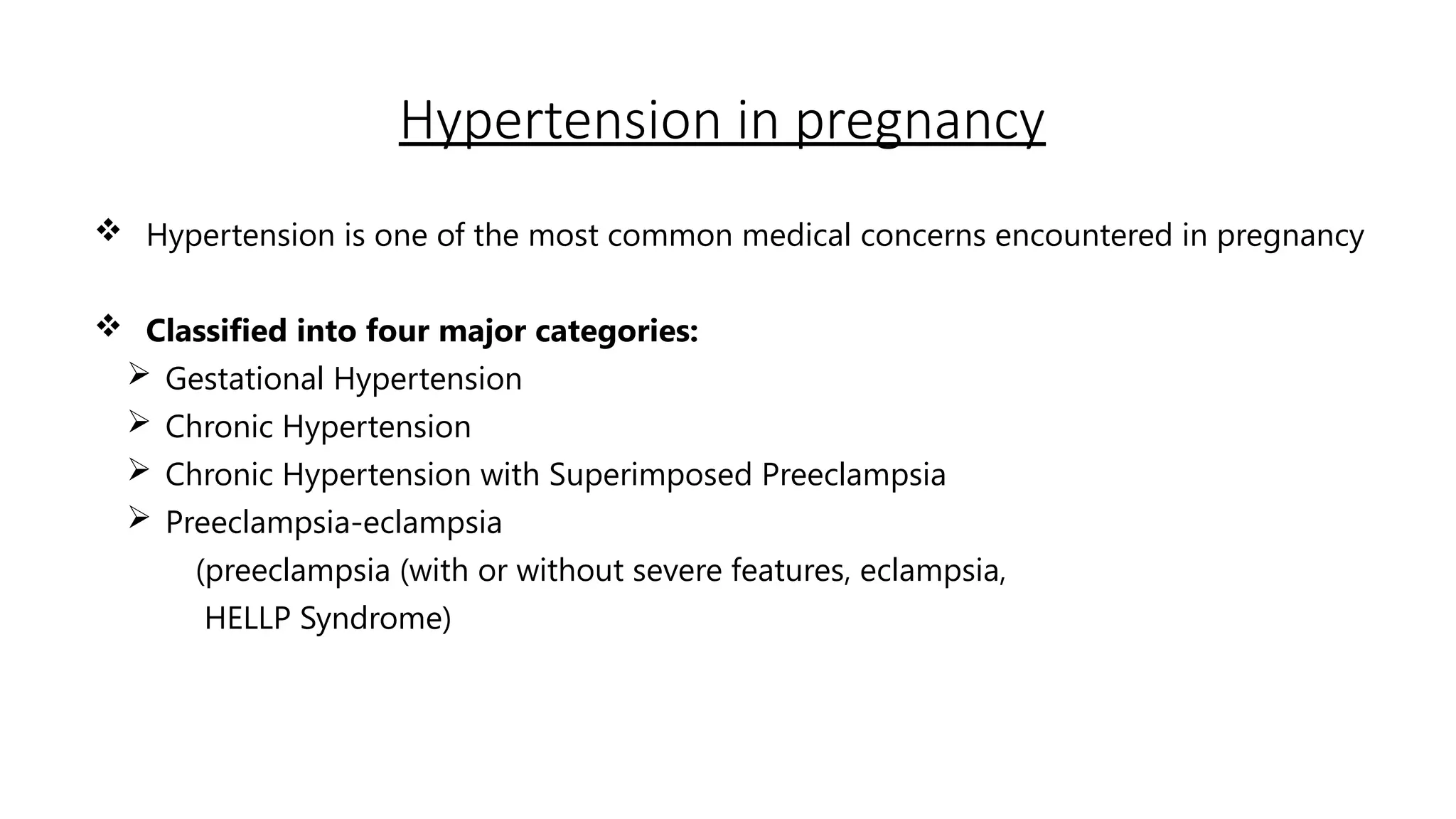
Hypertension in pregnancy
 Hypertension is one of the most common medical concerns encountered in pregnancy
 Classified into four major categories:
 Gestational Hypertension
 Chronic Hypertension
 Chronic Hypertension with Superimposed Preeclampsia
 Preeclampsia-eclampsia
(preeclampsia (with or without severe features, eclampsia,
HELLP Syndrome)
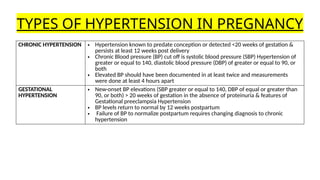
TYPES OF HYPERTENSION IN PREGNANCY
CHRONIC HYPERTENSION • Hypertension known to predate conception or detected <20 weeks of gestation &
persists at least 12 weeks post delivery
• Chronic Blood pressure (BP) cut off is systolic blood pressure (SBP) Hypertension of
greater or equal to 140, diastolic blood pressure (DBP) of greater or equal to 90, or
both
• Elevated BP should have been documented in at least twice and measurements
were done at least 4 hours apart
GESTATIONAL
HYPERTENSION
• New-onset BP elevations (SBP greater or equal to 140, DBP of equal or greater than
90, or both) > 20 weeks of gestation in the absence of proteinuria & features of
Gestational preeclampsia Hypertension
• BP levels return to normal by 12 weeks postpartum
• Failure of BP to normalize postpartum requires changing diagnosis to chronic
hypertension
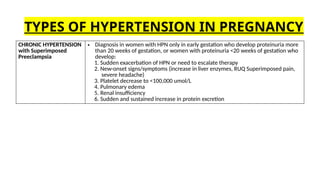
CHRONIC HYPERTENSION
with Superimposed
Preeclampsia
• Diagnosis in women with HPN only in early gestation who develop proteinuria more
than 20 weeks of gestation, or women with proteinuria <20 weeks of gestation who
develop:
1. Sudden exacerbation of HPN or need to escalate therapy
2. New-onset signs/symptoms (increase in liver enzymes, RUQ Superimposed pain,
severe headache)
3. Platelet decrease to <100,000 umol/L
4. Pulmonary edema
5. Renal insufficiency
6. Sudden and sustained increase in protein excretion
TYPES OF HYPERTENSION IN PREGNANCY
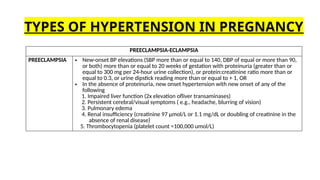
PREECLAMPSIA-ECLAMPSIA
PREECLAMPSIA • New-onset BP elevations (SBP more than or equal to 140, DBP of equal or more than 90,
or both) more than or equal to 20 weeks of gestation with proteinuria (greater than or
equal to 300 mg per 24-hour urine collection), or protein:creatinine ratio more than or
equal to 0.3, or urine dipstick reading more than or equal to + 1, OR
• In the absence of proteinuria, new onset hypertension with new onset of any of the
following
1. Impaired liver function (2x elevation ofliver transaminases)
2. Persistent cerebral/visual symptoms ( e.g., headache, blurring of vision)
3. Pulmonary edema
4. Renal insufficiency (creatinine 97 µmol/L or 1.1 mg/dL or doubling of creatinine in the
absence of renal disease)
5. Thrombocytopenia (platelet count <100,000 umol/L)
TYPES OF HYPERTENSION IN PREGNANCY
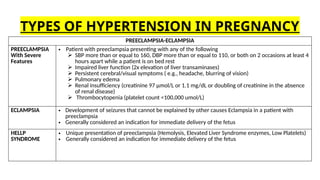
PREECLAMPSIA-ECLAMPSIA
PREECLAMPSIA
With Severe
Features
• Patient with preeclampsia presenting with any of the following
 SBP more than or equal to 160, DBP more than or equal to 110, or both on 2 occasions at least 4
hours apart while a patient is on bed rest
 Impaired liver function (2x elevation of liver transaminases)
 Persistent cerebral/visual symptoms ( e.g., headache, blurring of vision)
 Pulmonary edema
 Renal insufficiency (creatinine 97 µmol/L or 1.1 mg/dL or doubling of creatinine in the absence
of renal disease)
 Thrombocytopenia (platelet count <100,000 umol/L)
ECLAMPSIA • Development of seizures that cannot be explained by other causes Eclampsia in a patient with
preeclampsia
• Generally considered an indication for immediate delivery of the fetus
HELLP
SYNDROME
• Unique presentation of preeclampsia (Hemolysis, Elevated Liver Syndrome enzymes, Low Platelets)
• Generally considered an indication for immediate delivery of the fetus
TYPES OF HYPERTENSION IN PREGNANCY
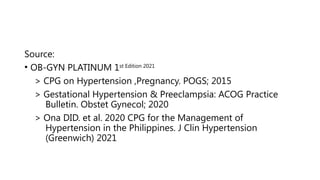
Source:
• OB-GYN PLATINUM 1st Edition 2021
> CPG on Hypertension ,Pregnancy. POGS; 2015
> Gestational Hypertension & Preeclampsia: ACOG Practice
Bulletin. Obstet Gynecol; 2020
> Ona DID. et al. 2020 CPG for the Management of
Hypertension in the Philippines. J Clin Hypertension
(Greenwich) 2021

Hypertension in pregnancy_TYPES.....pptx

  • 1.
    Hypertension in pregnancy Hypertension is one of the most common medical concerns encountered in pregnancy  Classified into four major categories:  Gestational Hypertension  Chronic Hypertension  Chronic Hypertension with Superimposed Preeclampsia  Preeclampsia-eclampsia (preeclampsia (with or without severe features, eclampsia, HELLP Syndrome)
  • 2.
    TYPES OF HYPERTENSIONIN PREGNANCY CHRONIC HYPERTENSION • Hypertension known to predate conception or detected <20 weeks of gestation & persists at least 12 weeks post delivery • Chronic Blood pressure (BP) cut off is systolic blood pressure (SBP) Hypertension of greater or equal to 140, diastolic blood pressure (DBP) of greater or equal to 90, or both • Elevated BP should have been documented in at least twice and measurements were done at least 4 hours apart GESTATIONAL HYPERTENSION • New-onset BP elevations (SBP greater or equal to 140, DBP of equal or greater than 90, or both) > 20 weeks of gestation in the absence of proteinuria & features of Gestational preeclampsia Hypertension • BP levels return to normal by 12 weeks postpartum • Failure of BP to normalize postpartum requires changing diagnosis to chronic hypertension
  • 3.
    CHRONIC HYPERTENSION with Superimposed Preeclampsia •Diagnosis in women with HPN only in early gestation who develop proteinuria more than 20 weeks of gestation, or women with proteinuria <20 weeks of gestation who develop: 1. Sudden exacerbation of HPN or need to escalate therapy 2. New-onset signs/symptoms (increase in liver enzymes, RUQ Superimposed pain, severe headache) 3. Platelet decrease to <100,000 umol/L 4. Pulmonary edema 5. Renal insufficiency 6. Sudden and sustained increase in protein excretion TYPES OF HYPERTENSION IN PREGNANCY
  • 4.
    PREECLAMPSIA-ECLAMPSIA PREECLAMPSIA • New-onsetBP elevations (SBP more than or equal to 140, DBP of equal or more than 90, or both) more than or equal to 20 weeks of gestation with proteinuria (greater than or equal to 300 mg per 24-hour urine collection), or protein:creatinine ratio more than or equal to 0.3, or urine dipstick reading more than or equal to + 1, OR • In the absence of proteinuria, new onset hypertension with new onset of any of the following 1. Impaired liver function (2x elevation ofliver transaminases) 2. Persistent cerebral/visual symptoms ( e.g., headache, blurring of vision) 3. Pulmonary edema 4. Renal insufficiency (creatinine 97 µmol/L or 1.1 mg/dL or doubling of creatinine in the absence of renal disease) 5. Thrombocytopenia (platelet count <100,000 umol/L) TYPES OF HYPERTENSION IN PREGNANCY
  • 5.
    PREECLAMPSIA-ECLAMPSIA PREECLAMPSIA With Severe Features • Patientwith preeclampsia presenting with any of the following  SBP more than or equal to 160, DBP more than or equal to 110, or both on 2 occasions at least 4 hours apart while a patient is on bed rest  Impaired liver function (2x elevation of liver transaminases)  Persistent cerebral/visual symptoms ( e.g., headache, blurring of vision)  Pulmonary edema  Renal insufficiency (creatinine 97 µmol/L or 1.1 mg/dL or doubling of creatinine in the absence of renal disease)  Thrombocytopenia (platelet count <100,000 umol/L) ECLAMPSIA • Development of seizures that cannot be explained by other causes Eclampsia in a patient with preeclampsia • Generally considered an indication for immediate delivery of the fetus HELLP SYNDROME • Unique presentation of preeclampsia (Hemolysis, Elevated Liver Syndrome enzymes, Low Platelets) • Generally considered an indication for immediate delivery of the fetus TYPES OF HYPERTENSION IN PREGNANCY
  • 6.
    Source: • OB-GYN PLATINUM1st Edition 2021 > CPG on Hypertension ,Pregnancy. POGS; 2015 > Gestational Hypertension & Preeclampsia: ACOG Practice Bulletin. Obstet Gynecol; 2020 > Ona DID. et al. 2020 CPG for the Management of Hypertension in the Philippines. J Clin Hypertension (Greenwich) 2021