Tuesday, November 1st, 2022
Reset
Bonner Network Fall Meeting
Agenda
9:00am - 9:20am (20min) Opening Networking
Exercise
9:20am - 9:40am (20min) On the Continuum
Exercise
9:40am - 10:20am (40min) Where Are We Now
10:20am - 10:30am (10min) Takeaways
Session Goals
We will:
• re
fl
ect on the ways in which our work has made a
tangible impact in the lives of different stakeholders.
• review trends from the national Bonner Network on
key Bonner Program aspects.
• reconsider how we can shift our narratives and
amplify the impacts we have made.
Opening
Networking
Exercise
On the
Continuum
Exercise
Go towards your right side of the room if
you traveled more than 10 hours to get
here.
Go towards your left side if you traveled
less than 4 hours (all told) to get here.
Travel Time to Claggett
Go towards your right side of the room if
your institution has more than 6,000
undergraduates.
Go towards your left side if your institution
has fewer than 1,000 undergraduates.
Institutional Size
Go towards your right side of the room
if enrollment grew or is up for your
institution.
Go towards your left side if enrollment
is down or declined for your institution.
Enrollment Trend
Go towards your right side of the room
if your center has
fi
ve or more staff.
Go towards your left side if your center
has one staff (or you don’t have a
center).
Center Staff Size
Go towards your right side of the room if your institution
has a VP, Dean, or Assistant Dean level position for DEI
and a link of that person with your center.
Stay in the center if you have some staff but not a clear
link.
Go towards your left side if your institution does not
have a VP, Dean, or Assistant Dean level position for DEI.
DEI Connections
Go towards your right side of the room
if your institution’s student body is
predominantly of color.
Go towards your left side if your
student body is predominantly white.
Racial/Ethnic Diversity of Study Body
Go towards your right side of the room
if your institution’s student body has
more than 50% Pell Eligible students.
Go towards your left side if your
institutions’s student body is less than
25% Pell Eligible.
Economic Diversity of Institutions
Where Are
We Now?
Identify a challenge
and successful
practice in your
program around
student leadership.
Student Leadership Analysis
•Rebuilding expectations
after pandemic
•Accountability & buy-in
•Burnout & mental health
•Staff transitions
Themes from 2021-22 Bonner Leadership Team Annual Report Letters
Challenges
Successes
•Accomplishments and
resilience amid challenges
•Return to in-person service
•Rebuilding sense of
community
•Adaptation and creativity
Student Leadership:
Examples & Best Practices
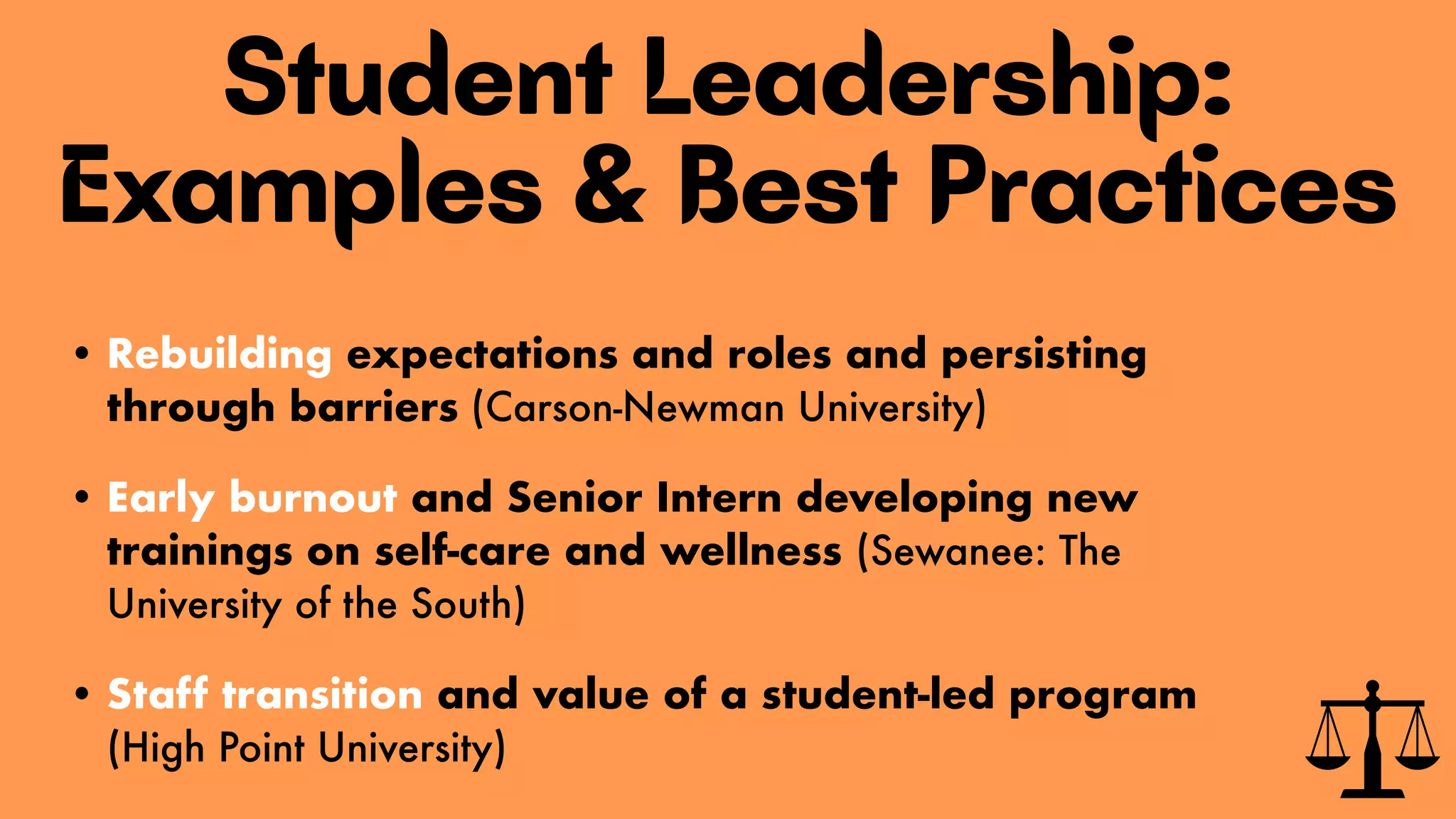
• Rebuilding expectations and roles and persisting
through barriers (Carson-Newman University)
• Early burnout and Senior Intern developing new
trainings on self-care and wellness (Sewanee: The
University of the South)
• Staff transition and value of a student-led program
(High Point University)
Student Leadership:
Examples & Best Practices
•Issues maintaining attendance led to increased focus on
communication skills and outside of of
fi
ce hours support
•Rebuilding to sense of community and belonging
through meetings and BLT led activities (Macalester
College)
•Bonner cornerstone postponement leading to new
model of “Camp Appalachia” experience tied to faculty
engagement and an academic course (Siena College)
Student Leadership Reflections
This year served as one of slight
reinvention. Coming out of the pandemic gave us the
opportunity to looks and do things differently. What works? What
doesn’t? We were able to answer those questions and take stock of
where the Bonner Leader Program had been and what we wanted it to
look like moving forward. While this new way of being was
imperfect it was a breath of fresh air that the program
needed coming out of what has been
memorable years. (CSBSJU)
Bonner Leadership Team Analysis
•Average size of a Bonner Leadership Team is 8
students (with average size of a Bonner Program at 35-40
students).
•The largest size reported is 18 students (for
programs of roughly 100 students).
•20% BLT rule of thumb
•BLT Training = average 842 minutes | 14 hours |
~ 1 hour every 2 weeks (7 schools)*
From the 2021-22 Bonner Leadership Team Annual Report Letters
Bonner Leadership Team
High Point
University
50 Bonners
(2)
Bonner Leadership Team
University of
Houston
100 Bonners (7)
• 4 Senior Interns
• 1 Member
Engagement
Coordinator
• 7 Project Leads
& Executive
Teams
Bonner Leadership Team
(5-7)
(10-12)
Sewanee: The
University of
the South
40 Bonners
Site Leaders
at every
community
partner site
What is one idea or
strategy you can take
back to strengthen student
leadership within your
program in the next year?
Identify a challenge
and successful
practice in your
program around
education and
training.
Bonner Education & Training
Themes from 2021-22 Bonner Annual Report Letters & Check-In Calls
Successes
•Return to in-person
meetings
• Strong support for FY
cohort (Orientation +
meetings)
• Prioritized community
building and wellness
•Low morale & challenges
with in-person transition
(course-load, attendance)
•Limited staff capacity
•Fewer cornerstone activities
due to the pandemic (esp. FY
trip, Sophomore Exchange)
Challenges
Bonner Meetings:
Examples & Best Practices
• Created new student leadership positions to boost
morale & help with programming (Allegheny College,
Slippery Rock University - “Bonvos")
• Increased team-building & community-building
activities (Montclair State University, Siena College)
• Set-up informal advising meetings with assigned
program manager at least 2 times a semester (Brown
University)
Bonner Meetings:
Examples & Best Practices
• Piloted Bonner Program Coordinator Fellowship to
enhance meeting structure & programming (Averett
University)
• Staff collaborated with community partners in Summer
to develop a list of potential CB/capstone projects
(Lindsey Wilson College)
• Redesigned capstone building timeline to a 2-year
Capstone process (Carson-Newman University)
T&E: Highlights
•95% schools reported holding All Bonner Meetings
regularly
•71% schools reported Seniors completing Presentations of
Learning
•71% schools reported conducting In-Person Orientation
•83% schools reported designing Capacity-Building Projects
Total # of Capacity-Building Projects = 285
•Meetings around Bonner Common Commitments
•Self-Care & Wellness
•Current Issues: War, Human Traf
fi
cking, Immigration
•Awareness - Diverse Groups / History / Heritage
Month
•Green Dot Bystander Intervention Training
•Public Policy
All Bonner Meetings:
Frequently Discussed Topics
Cohort Meetings:
Frequently Discussed Topics
•Identify Circles / Privilege
•River Stories
•Asset Mapping
•Leadership Compass
T&E: Academic Integration
•26 Schools = Courses, other Academic Pathways
The major initiative that we did
make signi
fi
cant progress on was the
fi
rst-year
of teaching in our new Community and
Nonpro
fi
t Leadership major. We designed and
taught two new regular courses, three new
fi
eld/
internship courses, and graduated our
fi
rst
student. (Mars Hill University)
What is one idea or strategy you
can implement within the next
year to improve your goals for
training and enrichment within
your Bonner Program?
Identify a challenge and
successful practice in
your program around
community partnerships
and placements.
Community Partnerships
Themes from 2021-22 Annual Report Letters & Check-In Calls
Successes
• Return to in-person service
• Establishing new or bringing back
student leadership roles focused
on community partnerships
• Fostering new partnerships &
placements
• More than 50% schools reported
doing CB projects
• Partners’ capacity to manage
Bonner students
• Diminished connections and
relationships with partners
• Limited in-person service
opportunities
• Transportation to service sites
Challenges
Community Partnerships:
Examples & Best Practices
•Transportation issues led to developing a new community
partnership (Slippery Rock University)
•Return to in-person service increased accountability and
engagement (The College of New Jersey)
•Returned focus on developing community partnerships and re-
establishment of site coordinators (Allegheny College, Christopher
Newport University)
•Challenges re-connecting with partners led to developing
Community Partner Intern (Montclair State University)
Capacity-Building Projects
Academic Year 21-22 in Bonner Network = 285 Projects*
8%
12%
15%
20%
45%
Program Development
Research
Communications
Volunteer Management
Fundraising
Example: Capacity-Building Project
Example: Erin Spence’22, Siena College
Community Partner: Albany Victory Gardens
Faculty Mentor: Beverly Thompson, Sociology
Project Description: Participatory Action Research on the motivation
of urban farmers in the West Hill neighborhood of Albany, NY. The
student used PhotoVoice (combined photography and semi-structured
interviews) to gain a deeper understanding of community experiences.
Community Partnership Example
Data from the previous year demonstrated
students' longing desire for more direct contact
with partners and the local community. All Bonner
Scholars had the opportunity to serve in person this year, with virtual
service utilized for ef
fi
ciency and safety purposes as needed. As a
result, collectively the program completed twelve
thousand hours more compared to the previous
year when we were solely virtual. (TCNJ)
Given current realities and
challenges, what is one
approach or idea to reimagine
community partnerships and
projects in the coming year?
Takeaways

2022 Bonner Fall Network Meeting Reset

  • 1.
    Tuesday, November 1st,2022 Reset Bonner Network Fall Meeting
  • 2.
    Agenda 9:00am - 9:20am(20min) Opening Networking Exercise 9:20am - 9:40am (20min) On the Continuum Exercise 9:40am - 10:20am (40min) Where Are We Now 10:20am - 10:30am (10min) Takeaways
  • 3.
    Session Goals We will: •re fl ect on the ways in which our work has made a tangible impact in the lives of different stakeholders. • review trends from the national Bonner Network on key Bonner Program aspects. • reconsider how we can shift our narratives and amplify the impacts we have made.
  • 4.
  • 5.
  • 6.
    Go towards yourright side of the room if you traveled more than 10 hours to get here. Go towards your left side if you traveled less than 4 hours (all told) to get here. Travel Time to Claggett
  • 7.
    Go towards yourright side of the room if your institution has more than 6,000 undergraduates. Go towards your left side if your institution has fewer than 1,000 undergraduates. Institutional Size
  • 8.
    Go towards yourright side of the room if enrollment grew or is up for your institution. Go towards your left side if enrollment is down or declined for your institution. Enrollment Trend
  • 9.
    Go towards yourright side of the room if your center has fi ve or more staff. Go towards your left side if your center has one staff (or you don’t have a center). Center Staff Size
  • 10.
    Go towards yourright side of the room if your institution has a VP, Dean, or Assistant Dean level position for DEI and a link of that person with your center. Stay in the center if you have some staff but not a clear link. Go towards your left side if your institution does not have a VP, Dean, or Assistant Dean level position for DEI. DEI Connections
  • 11.
    Go towards yourright side of the room if your institution’s student body is predominantly of color. Go towards your left side if your student body is predominantly white. Racial/Ethnic Diversity of Study Body
  • 12.
    Go towards yourright side of the room if your institution’s student body has more than 50% Pell Eligible students. Go towards your left side if your institutions’s student body is less than 25% Pell Eligible. Economic Diversity of Institutions
  • 13.
  • 14.
    Identify a challenge andsuccessful practice in your program around student leadership.
  • 15.
    Student Leadership Analysis •Rebuildingexpectations after pandemic •Accountability & buy-in •Burnout & mental health •Staff transitions Themes from 2021-22 Bonner Leadership Team Annual Report Letters Challenges Successes •Accomplishments and resilience amid challenges •Return to in-person service •Rebuilding sense of community •Adaptation and creativity
  • 16.
    Student Leadership: Examples &Best Practices • Rebuilding expectations and roles and persisting through barriers (Carson-Newman University) • Early burnout and Senior Intern developing new trainings on self-care and wellness (Sewanee: The University of the South) • Staff transition and value of a student-led program (High Point University)
  • 17.
    Student Leadership: Examples &Best Practices •Issues maintaining attendance led to increased focus on communication skills and outside of of fi ce hours support •Rebuilding to sense of community and belonging through meetings and BLT led activities (Macalester College) •Bonner cornerstone postponement leading to new model of “Camp Appalachia” experience tied to faculty engagement and an academic course (Siena College)
  • 18.
    Student Leadership Reflections Thisyear served as one of slight reinvention. Coming out of the pandemic gave us the opportunity to looks and do things differently. What works? What doesn’t? We were able to answer those questions and take stock of where the Bonner Leader Program had been and what we wanted it to look like moving forward. While this new way of being was imperfect it was a breath of fresh air that the program needed coming out of what has been memorable years. (CSBSJU)
  • 19.
    Bonner Leadership TeamAnalysis •Average size of a Bonner Leadership Team is 8 students (with average size of a Bonner Program at 35-40 students). •The largest size reported is 18 students (for programs of roughly 100 students). •20% BLT rule of thumb •BLT Training = average 842 minutes | 14 hours | ~ 1 hour every 2 weeks (7 schools)* From the 2021-22 Bonner Leadership Team Annual Report Letters
  • 20.
    Bonner Leadership Team HighPoint University 50 Bonners (2)
  • 21.
    Bonner Leadership Team Universityof Houston 100 Bonners (7) • 4 Senior Interns • 1 Member Engagement Coordinator • 7 Project Leads & Executive Teams
  • 22.
    Bonner Leadership Team (5-7) (10-12) Sewanee:The University of the South 40 Bonners Site Leaders at every community partner site
  • 23.
    What is oneidea or strategy you can take back to strengthen student leadership within your program in the next year?
  • 24.
    Identify a challenge andsuccessful practice in your program around education and training.
  • 25.
    Bonner Education &Training Themes from 2021-22 Bonner Annual Report Letters & Check-In Calls Successes •Return to in-person meetings • Strong support for FY cohort (Orientation + meetings) • Prioritized community building and wellness •Low morale & challenges with in-person transition (course-load, attendance) •Limited staff capacity •Fewer cornerstone activities due to the pandemic (esp. FY trip, Sophomore Exchange) Challenges
  • 26.
    Bonner Meetings: Examples &Best Practices • Created new student leadership positions to boost morale & help with programming (Allegheny College, Slippery Rock University - “Bonvos") • Increased team-building & community-building activities (Montclair State University, Siena College) • Set-up informal advising meetings with assigned program manager at least 2 times a semester (Brown University)
  • 27.
    Bonner Meetings: Examples &Best Practices • Piloted Bonner Program Coordinator Fellowship to enhance meeting structure & programming (Averett University) • Staff collaborated with community partners in Summer to develop a list of potential CB/capstone projects (Lindsey Wilson College) • Redesigned capstone building timeline to a 2-year Capstone process (Carson-Newman University)
  • 28.
    T&E: Highlights •95% schoolsreported holding All Bonner Meetings regularly •71% schools reported Seniors completing Presentations of Learning •71% schools reported conducting In-Person Orientation •83% schools reported designing Capacity-Building Projects Total # of Capacity-Building Projects = 285
  • 29.
    •Meetings around BonnerCommon Commitments •Self-Care & Wellness •Current Issues: War, Human Traf fi cking, Immigration •Awareness - Diverse Groups / History / Heritage Month •Green Dot Bystander Intervention Training •Public Policy All Bonner Meetings: Frequently Discussed Topics
  • 30.
    Cohort Meetings: Frequently DiscussedTopics •Identify Circles / Privilege •River Stories •Asset Mapping •Leadership Compass
  • 31.
    T&E: Academic Integration •26Schools = Courses, other Academic Pathways The major initiative that we did make signi fi cant progress on was the fi rst-year of teaching in our new Community and Nonpro fi t Leadership major. We designed and taught two new regular courses, three new fi eld/ internship courses, and graduated our fi rst student. (Mars Hill University)
  • 32.
    What is oneidea or strategy you can implement within the next year to improve your goals for training and enrichment within your Bonner Program?
  • 33.
    Identify a challengeand successful practice in your program around community partnerships and placements.
  • 34.
    Community Partnerships Themes from2021-22 Annual Report Letters & Check-In Calls Successes • Return to in-person service • Establishing new or bringing back student leadership roles focused on community partnerships • Fostering new partnerships & placements • More than 50% schools reported doing CB projects • Partners’ capacity to manage Bonner students • Diminished connections and relationships with partners • Limited in-person service opportunities • Transportation to service sites Challenges
  • 35.
    Community Partnerships: Examples &Best Practices •Transportation issues led to developing a new community partnership (Slippery Rock University) •Return to in-person service increased accountability and engagement (The College of New Jersey) •Returned focus on developing community partnerships and re- establishment of site coordinators (Allegheny College, Christopher Newport University) •Challenges re-connecting with partners led to developing Community Partner Intern (Montclair State University)
  • 36.
    Capacity-Building Projects Academic Year21-22 in Bonner Network = 285 Projects* 8% 12% 15% 20% 45% Program Development Research Communications Volunteer Management Fundraising
  • 37.
    Example: Capacity-Building Project Example:Erin Spence’22, Siena College Community Partner: Albany Victory Gardens Faculty Mentor: Beverly Thompson, Sociology Project Description: Participatory Action Research on the motivation of urban farmers in the West Hill neighborhood of Albany, NY. The student used PhotoVoice (combined photography and semi-structured interviews) to gain a deeper understanding of community experiences.
  • 38.
    Community Partnership Example Datafrom the previous year demonstrated students' longing desire for more direct contact with partners and the local community. All Bonner Scholars had the opportunity to serve in person this year, with virtual service utilized for ef fi ciency and safety purposes as needed. As a result, collectively the program completed twelve thousand hours more compared to the previous year when we were solely virtual. (TCNJ)
  • 39.
    Given current realitiesand challenges, what is one approach or idea to reimagine community partnerships and projects in the coming year?
  • 40.