4 Simple, Cheap Open Source Tools for African Rural Development Need to make a plow from scrap steel? Need village lighting and cell charging? Need machine tools for training, shops or industry? No problem!
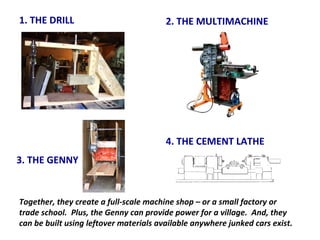
1. THE DRILL 2. THE MULTIMACHINE 3. THE GENNY 4. THE CEMENT LATHE Together, they create a full-scale machine shop – or a small factory or trade school.  Plus, the Genny can provide power for a village.  And, they can be built using leftover materials available anywhere junked cars exist.
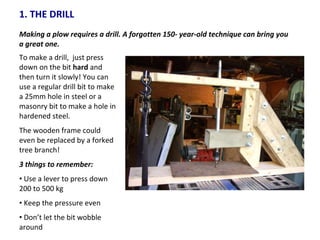
1. THE DRILL Making a plow requires a drill. A forgotten 150- year-old technique can bring you a great one.  To make a drill,  just press down on the bit  hard  and then turn it slowly! You can use a regular drill bit to make a 25mm hole in steel or a masonry bit to make a hole in hardened steel. The wooden frame could even be replaced by a forked tree branch! 3 things to remember: Use a lever to press down 200 to 500 kg Keep the pressure even Don’t let the bit wobble around
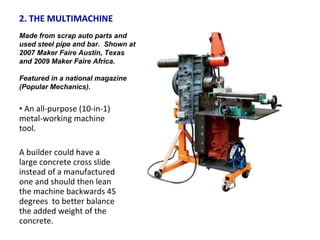
2. THE MULTIMACHINE  An all-purpose (10-in-1) metal-working machine tool.  A builder could have a large concrete cross slide instead of a manufactured one and should then lean the machine backwards 45 degrees  to better balance the added weight of the concrete. Made from scrap auto parts and used steel pipe and bar.  Shown at 2007 Maker Faire Austin, Texas and 2009 Maker Faire Africa.  Featured in a national magazine (Popular Mechanics).
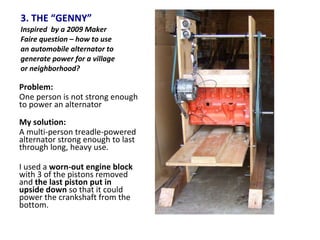
3. THE “GENNY” Inspired  by a 2009 Maker Faire question – how to use an automobile alternator to generate power for a village or neighborhood? Problem:  One person is not strong enough to power an alternator My solution: A multi-person treadle-powered alternator strong enough to last through long, heavy use. I used a  worn-out engine block  with 3 of the pistons removed and  the last piston put in upside down  so that it could power the crankshaft from the bottom.
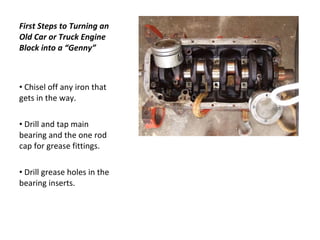
First Steps to Turning an Old Car or Truck Engine Block into a “Genny” Chisel off any iron that gets in the way. Drill and tap main bearing and the one rod cap for grease fittings. Drill grease holes in the bearing inserts.
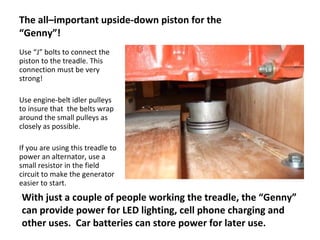
The all–important upside-down piston for the “Genny”! Use “J” bolts to connect the piston to the treadle. This connection must be very strong! Use engine-belt idler pulleys to insure that  the belts wrap around the small pulleys as closely as possible. If you are using this treadle to power an alternator, use a small resistor in the field circuit to make the generator easier to start. With just a couple of people working the treadle, the “Genny” can provide power for LED lighting, cell phone charging and other uses.  Car batteries can store power for later use.
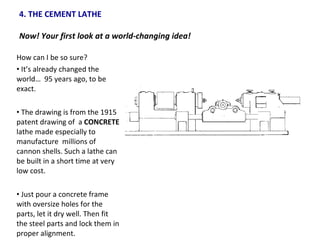
4. THE CEMENT LATHE  Now! Your first look at a world-changing idea!  How can I be so sure? It’s already changed the world…  95 years ago, to be exact. The drawing is from the 1915 patent drawing of  a  CONCRETE  lathe made especially to manufacture  millions of cannon shells. Such a lathe can be built in a short time at very low cost. Just pour a concrete frame with oversize holes for the parts, let it dry well. Then fit the steel parts and lock them in proper alignment.
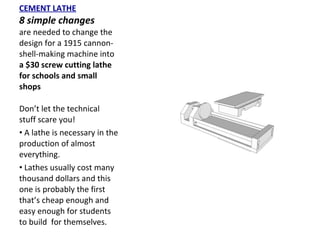
CEMENT LATHE 8 simple changes  are needed to change the design for a 1915 cannon-shell-making machine into  a $30 screw cutting lathe for schools and small shops Don’t let the technical stuff scare you!  A lathe is necessary in the production of almost everything.  Lathes usually cost many thousand dollars and this one is probably the first that’s cheap enough and easy enough for students to build  for themselves.
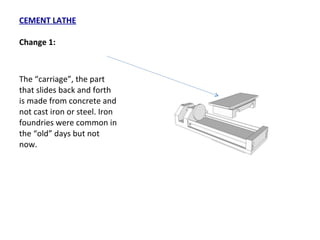
CEMENT LATHE Change 1: The “carriage”, the part that slides back and forth is made from concrete and not cast iron or steel. Iron foundries were common in the “old” days but not now.
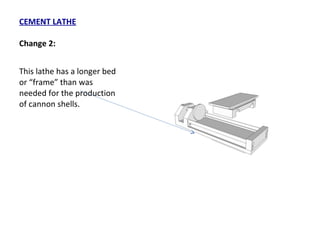
CEMENT LATHE Change 2: This lathe has a longer bed or “frame” than was needed for the production of cannon shells.
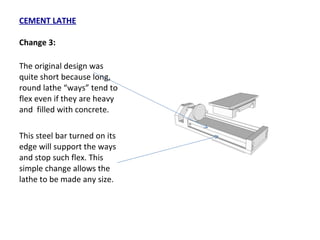
CEMENT LATHE Change 3: The original design was quite short because long, round lathe “ways” tend to flex even if they are heavy and  filled with concrete.  This steel bar turned on its edge will support the ways and stop such flex. This simple change allows the lathe to be made any size.
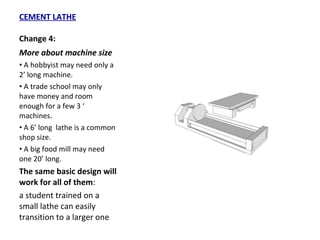
CEMENT LATHE Change 4: More about machine size A hobbyist may need only a 2’ long machine. A trade school may only have money and room enough for a few 3 ‘ machines. A 6’ long  lathe is a common  shop size. A big food mill may need one 20’ long. The same basic design will work for all of them :  a student trained on a small lathe can easily transition to a larger one
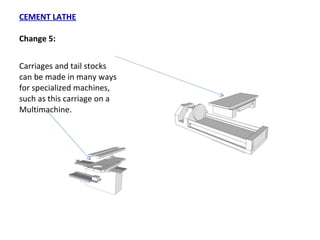
CEMENT LATHE Change 5: Carriages and tail stocks can be made in many ways for specialized machines, such as this carriage on a Multimachine.
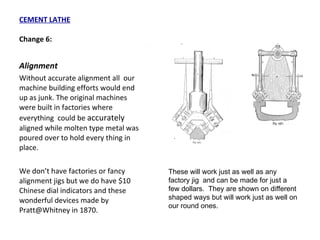
CEMENT LATHE Change 6: Alignment Without accurate alignment all  our machine building efforts would end up as junk. The original machines were built in factories where everything  could be  accurately  aligned while molten type metal was poured over to hold every thing in place. We don’t have factories or fancy alignment jigs but we do have $10  Chinese dial indicators and these wonderful devices made by Pratt@Whitney in 1870. These will work just as well as any factory jig  and can be made for just a few dollars.  They are shown on different shaped ways but will work just as well on our round ones.
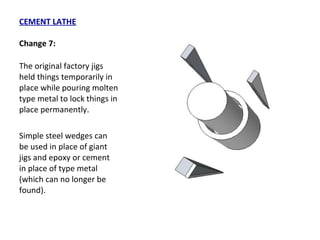
CEMENT LATHE Change 7: The original factory jigs held things temporarily in place while pouring molten type metal to lock things in place permanently.  Simple steel wedges can be used in place of giant jigs and epoxy or cement in place of type metal (which can no longer be found).
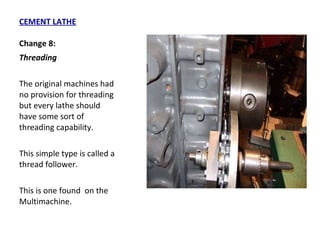
CEMENT LATHE Change 8: Threading  The original machines had no provision for threading but every lathe should have some sort of threading capability.  This simple type is called a thread follower.  This is one found  on the Multimachine.
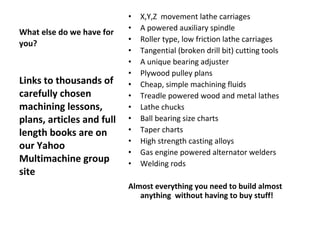
What else do we have for   you? Links to thousands of carefully chosen machining lessons, plans, articles and full length books are on our Yahoo Multimachine group site X,Y,Z  movement lathe carriages A powered auxiliary spindle Roller type, low friction lathe carriages Tangential (broken drill bit) cutting tools A unique bearing adjuster Plywood pulley plans Cheap, simple machining fluids Treadle powered wood and metal lathes Lathe chucks Ball bearing size charts Taper charts High strength casting alloys Gas engine powered alternator welders Welding rods Almost everything you need to build almost anything  without having to buy stuff!
For much more information about  building any of these machines go to http://groups.yahoo.com/group/multimachine/ For the Genny, also go to http://groups.yahoo.com/group/africapowerandlight/ For the original L.I. Yeomans concrete lathe patent, Google for patent  number 1,154,155 For personal help on any of these projects: email Pat Delany  [email_address]

4 simple, cheap tools for Africa

  • 1.
    4 Simple, CheapOpen Source Tools for African Rural Development Need to make a plow from scrap steel? Need village lighting and cell charging? Need machine tools for training, shops or industry? No problem!
  • 2.
    1. THE DRILL2. THE MULTIMACHINE 3. THE GENNY 4. THE CEMENT LATHE Together, they create a full-scale machine shop – or a small factory or trade school. Plus, the Genny can provide power for a village. And, they can be built using leftover materials available anywhere junked cars exist.
  • 3.
    1. THE DRILLMaking a plow requires a drill. A forgotten 150- year-old technique can bring you a great one. To make a drill, just press down on the bit hard and then turn it slowly! You can use a regular drill bit to make a 25mm hole in steel or a masonry bit to make a hole in hardened steel. The wooden frame could even be replaced by a forked tree branch! 3 things to remember: Use a lever to press down 200 to 500 kg Keep the pressure even Don’t let the bit wobble around
  • 4.
    2. THE MULTIMACHINE An all-purpose (10-in-1) metal-working machine tool. A builder could have a large concrete cross slide instead of a manufactured one and should then lean the machine backwards 45 degrees to better balance the added weight of the concrete. Made from scrap auto parts and used steel pipe and bar. Shown at 2007 Maker Faire Austin, Texas and 2009 Maker Faire Africa. Featured in a national magazine (Popular Mechanics).
  • 5.
    3. THE “GENNY”Inspired by a 2009 Maker Faire question – how to use an automobile alternator to generate power for a village or neighborhood? Problem: One person is not strong enough to power an alternator My solution: A multi-person treadle-powered alternator strong enough to last through long, heavy use. I used a worn-out engine block with 3 of the pistons removed and the last piston put in upside down so that it could power the crankshaft from the bottom.
  • 6.
    First Steps toTurning an Old Car or Truck Engine Block into a “Genny” Chisel off any iron that gets in the way. Drill and tap main bearing and the one rod cap for grease fittings. Drill grease holes in the bearing inserts.
  • 7.
    The all–important upside-downpiston for the “Genny”! Use “J” bolts to connect the piston to the treadle. This connection must be very strong! Use engine-belt idler pulleys to insure that the belts wrap around the small pulleys as closely as possible. If you are using this treadle to power an alternator, use a small resistor in the field circuit to make the generator easier to start. With just a couple of people working the treadle, the “Genny” can provide power for LED lighting, cell phone charging and other uses. Car batteries can store power for later use.
  • 8.
    4. THE CEMENTLATHE Now! Your first look at a world-changing idea! How can I be so sure? It’s already changed the world… 95 years ago, to be exact. The drawing is from the 1915 patent drawing of a CONCRETE lathe made especially to manufacture millions of cannon shells. Such a lathe can be built in a short time at very low cost. Just pour a concrete frame with oversize holes for the parts, let it dry well. Then fit the steel parts and lock them in proper alignment.
  • 9.
    CEMENT LATHE 8simple changes are needed to change the design for a 1915 cannon-shell-making machine into a $30 screw cutting lathe for schools and small shops Don’t let the technical stuff scare you! A lathe is necessary in the production of almost everything. Lathes usually cost many thousand dollars and this one is probably the first that’s cheap enough and easy enough for students to build for themselves.
  • 10.
    CEMENT LATHE Change1: The “carriage”, the part that slides back and forth is made from concrete and not cast iron or steel. Iron foundries were common in the “old” days but not now.
  • 11.
    CEMENT LATHE Change2: This lathe has a longer bed or “frame” than was needed for the production of cannon shells.
  • 12.
    CEMENT LATHE Change3: The original design was quite short because long, round lathe “ways” tend to flex even if they are heavy and filled with concrete. This steel bar turned on its edge will support the ways and stop such flex. This simple change allows the lathe to be made any size.
  • 13.
    CEMENT LATHE Change4: More about machine size A hobbyist may need only a 2’ long machine. A trade school may only have money and room enough for a few 3 ‘ machines. A 6’ long lathe is a common shop size. A big food mill may need one 20’ long. The same basic design will work for all of them : a student trained on a small lathe can easily transition to a larger one
  • 14.
    CEMENT LATHE Change5: Carriages and tail stocks can be made in many ways for specialized machines, such as this carriage on a Multimachine.
  • 15.
    CEMENT LATHE Change6: Alignment Without accurate alignment all our machine building efforts would end up as junk. The original machines were built in factories where everything could be accurately aligned while molten type metal was poured over to hold every thing in place. We don’t have factories or fancy alignment jigs but we do have $10 Chinese dial indicators and these wonderful devices made by Pratt@Whitney in 1870. These will work just as well as any factory jig and can be made for just a few dollars. They are shown on different shaped ways but will work just as well on our round ones.
  • 16.
    CEMENT LATHE Change7: The original factory jigs held things temporarily in place while pouring molten type metal to lock things in place permanently. Simple steel wedges can be used in place of giant jigs and epoxy or cement in place of type metal (which can no longer be found).
  • 17.
    CEMENT LATHE Change8: Threading The original machines had no provision for threading but every lathe should have some sort of threading capability. This simple type is called a thread follower. This is one found on the Multimachine.
  • 18.
    What else dowe have for you? Links to thousands of carefully chosen machining lessons, plans, articles and full length books are on our Yahoo Multimachine group site X,Y,Z movement lathe carriages A powered auxiliary spindle Roller type, low friction lathe carriages Tangential (broken drill bit) cutting tools A unique bearing adjuster Plywood pulley plans Cheap, simple machining fluids Treadle powered wood and metal lathes Lathe chucks Ball bearing size charts Taper charts High strength casting alloys Gas engine powered alternator welders Welding rods Almost everything you need to build almost anything without having to buy stuff!
  • 19.
    For much moreinformation about building any of these machines go to http://groups.yahoo.com/group/multimachine/ For the Genny, also go to http://groups.yahoo.com/group/africapowerandlight/ For the original L.I. Yeomans concrete lathe patent, Google for patent number 1,154,155 For personal help on any of these projects: email Pat Delany [email_address]