Acute gastrointestinal bleeding is a common medical emergency that frequently results in hospitalization. Rapid initial assessment of clinical parameters such as estimated volume of blood lost, appearance of expelled blood, hypotension, mental status changes, and coagulopathy should all be evaluated as part of the outcomes prediction equation. For upper gastrointestinal bleeding, early endoscopy of the upper gastrointestinal tract will also provide important information to aid in efforts to predict risk. Endoscopic evidence of ongoing rapid bleeding or the presence of a “visible vessel” or adherent clot on the ulcer base are findings that are associated with a high likelihood of continued bleeding or recurrent bleeding. Endoscopic therapy can reduce the rates of recurrent bleeding, surgery, and length of hospital stay in patient with
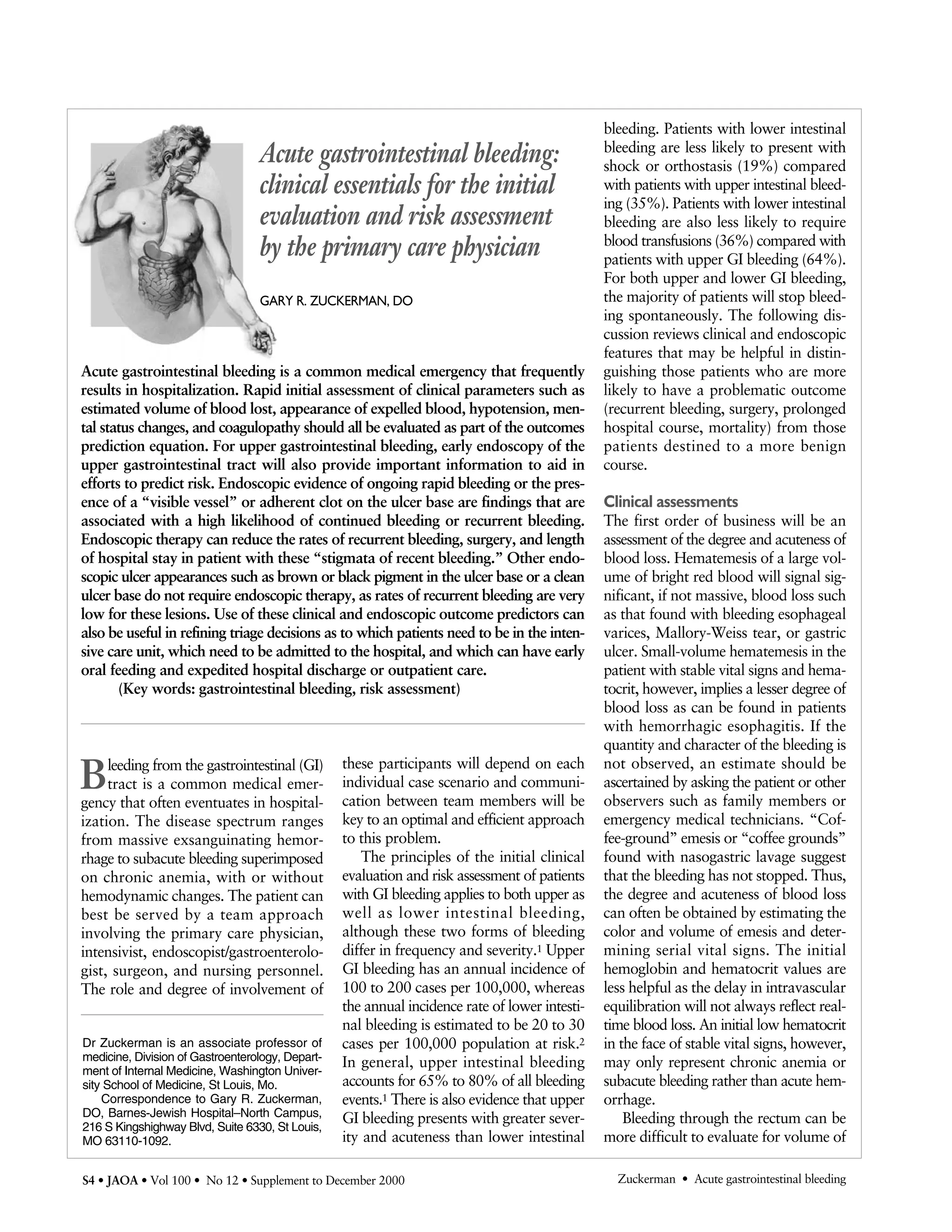
![blood loss because of its admixture with
stool. Blood acts as a laxative and con-
tinued large-volume bleeding is usually
associated with the passage of repeated
amounts of blood liquid stool or just
blood. Maroon or black, solid stool
implies that the volume of bleeding was
less and that there is no ongoing bleed-
ing.
The brightness or fresh appearance
of blood can also be helpful in estimat-
ing acuteness of the blood loss, but again,
this visual evaluation needs to be coupled
with the clinical picture. The passage of
a small volume of bright red blood by a
patient who is hemodynamically stable
will have a different connotation than
the passage of fresh blood by a patient
with tachycardia.
An objective color-confirmation test
may also be helpful in categorizing the
character of blood. Although it is a com-
mon clinical assumption that the rectal
passage of bright red stool is consistent
with lower intestinal bleeding and that
black stool per rectum implies an upper
GI source, this hypothesis has only been
tested recently and only confirmed with
objective color testing.3 It has been
shown that subjective reporting of stool
colors by physicians and patients is
inconsistent and confusing.
Medical terms such as melena and
hematochezia are not as helpful as objec-
tive color testing, and there is frequent-
ly a discrepancy between the color point-
ed to and the color verbalized by the
patient. The greatest accuracy for corre-
lating the location or level of bleeding
to blood color is found when the patient
points to a specific test color. The objec-
tive color that corresponds to maroon
blood is not helpful in locating the level
of bleeding.3
Risk factors and predictors
of outcome
Various clinical features can be helpful in
predicting outcomes for patients with
GI bleeding, in particular, nonvariceal
upper GI bleeding. End points, other
than mortality, include recurrent bleed-
ing during the same hospitalization, pro-
longed hospital stay, and surgery for
bleeding. Repeated bleeding within 72
hours of the initial bleeding episode
occurs in about 25% of patients and is
a marker for increased morbidity and
mortality. Other independent risk fac-
tors for poor outcome include age older
than 60 years, ongoing bleeding, and
hypotension (systolic blood pressure
Ͻ100 mm Hg) on presentation. Initial
hypotension can be associated with a
negative outcome, even in the face of
successful resuscitation. A number of
these risk factors have been grouped
together in order to improve predictive
ability. The criteria using the mnemon-
ic BLEED is helpful (Figure 1: ongoing
bleeding, low systolic blood pressure
[Ͻ100 mm Hg], elevated prothrombin
time, erratic mental status [change in
mental status], and any comorbid dis-
ease that would warrant admission for
intensive care event without the bleeding
event [such as acute myocardial infarc-
tion]).4 Evidence of any one of the
BLEED criteria places the patient in a
poor outcome category. This outcome
predictor applies to both lower and
upper gastrointestinal bleeding.4
Other risk or provocative factors for
gastrointestinal bleeding include antico-
agulation therapy and coagulopathy with
elevated prothrombin time or thrombo-
cytopenia. Aspirin and other nonsteroidal
anti-inflammatory drugs are associated
with GI ulceration and bleeding, and
interdiction of such medications, if pos-
sible, will be important for prevention of
recurrent bleeding.
Although the majority of patients
with GI bleeding will stop bleeding, there
still is an associated mortality, although
not always directly related to the bleed-
ing. Historically, the mortality rates have
been higher for upper than lower GI
bleeding. A recent outcomes study of
both upper and lower GI bleeding found
Zuckerman • Acute gastrointestinal bleeding JAOA • Vol 100 • No 12 • Supplement to December 2000 • S5
Figure. Mnemonic for clinical risk criteria for guarded prognosis for upper or lower
gastrointestinal bleeding. The presence of any one criterion places patient in
high-risk group for poor outcome. (Source: Kollef MH, et al. BLEED: A classi-
fication tool to predict outcomes in patients with acute upper and lower intesti-
nal hemorrhage. Crit Care Med 1997;25:1125-1132.)
Ongoing Bleeding
Erratic mental status (change in
mental status)
Elevated prothrombin time
Comorbid Disease (other than
bleeding) requiring admission to inten-
sive care unit
Low systolic blood pressure
B
L
E
E
D](https://image.slidesharecdn.com/4s-130910112252-phpapp01/85/4-s-full-2-320.jpg)


![GASTROINTESTINAL BLEED ARUP SIR [Autosaved] copy.pptx](https://cdn.slidesharecdn.com/ss_thumbnails/gastrointestinalbleed-arupsirautosavedcopy-250402060103-4e590a88-thumbnail.jpg?width=640&height=640&fit=bounds)


